The Eighty-eighth Key, Ch. 32

Featured

Part IV

Chapter 32

____________________________________

Lloyd Callahan wasn’t quite frantic, yet, but it had been five months since he’d last seen his son, and that had been just after the premiere of Imogen’s concerto.

Harry had changed. Sara’s murder had done something he’d never expected would happen to his boy: Harry appeared to have simply given up. Like a party balloon that had slowly deflated, by the time Harry and the team made it back to Israel – after the brief stop in Davos – his son looked like a different human being.

He’d stopped eating and his eyes seemed to have sunken deep within their sockets, and around his eyes Lloyd had noted splotchy dark circles. When offered food Harry pushed it away, though from time to time he drank coffee…black coffee.

Then he’d done something Lloyd never expected: Harry had gone out to his mother’s crypt. He’d been followed, of course, but even his followers had little to report. Harry had reportedly sat in some modest shade and had talked – quietly – for an hour or so…to at least two people who remained invisible. When Colonel Goodman relayed that information, Lloyd felt sick to his stomach. 

Was Harry coming undone? Would the affliction that had plagued Imogen all her life now come for their son? Would Harry fall under the dark spell of that voice?

That Goodman girl wouldn’t let him to see his son, and he’d immediately resented her for that unwarranted bit of sanctimoniousness. And though he’d sat next to his boy at the premiere, Harry had sat there quietly, almost stoically, through the entire performance, the only emotion on display coming as the final crescendo approached. Lloyd had seen his son’s hands grip the armrests, could feel the tension rise in his boy’s quivering arms and legs, but then there had come un unexpected release, like the explosion Harry had been expecting didn’t come. And at first Harry had seemed confused, then relieved when the expected calamity didn’t materialize…

But then…nothing.

Harry had returned to the compound and disappeared into his room – what had once been his mother’s and Avi’s room – and the next morning he was gone.

And now, after one round trip to Hong Kong just completed, Lloyd was home for a scheduled rest-leave and not due to captain another sailing until early December. With almost a month on his hands, he had wanted to tackle some long overdue home maintenance – but had halfway been expecting his boy to come around to lend him a hand.

He was sitting on the covered front porch sipping his favorite Good Earth tea, watching homes come alive as his neighbors got home from work. Dogs were leashed and taken for walks, backyard grills lit-off and grilling burgers filled the air with their own uniquely familiar aroma, and, yes, he could hear a loud argument over mismanaged money already underway just across the street.

Life on the street was as boringly predictable now as it had been almost forty years ago, but even so he couldn’t stop himself from thinking about Harry’s girlfriend, June. He looked to the right, looked where their old house had been before some yuppies came in and built a multi-unit condo. In another world, another life, maybe she would be sitting out here with him, both of them waiting for Harry to get in from work. Or better still, Lloyd Callahan thought, Imogen would be in the kitchen…making dinner for the four of them.

Nothing had turned out the way he’d expected, he thought. Or wanted.

And now…all this bullshit with vigilantes and Columbian drug-lords, the police department in tatters and his son’s career up in the air.

It felt like the entire world was coming undone.

The Iranians taking the embassy almost four hundred days ago, all those people still hostages, Ronald Reagan looking like he might actually run that that peanut farmer out of the White House. The commies in Cuba lending a hand in Nicaragua, exporting their revolution to Central America, while the U.S. still seemed to be lost inside some kind of narcissistic coma after the Fall of Saigon.

Yeah…what had happened?

It wasn’t all that long ago, he thought as he sipped his tea, that Kennedy had challenged the nation to land men on the moon. And these crazy Americans had pulled it off, too. They’d fought a war in Southeast Asia and done it all at the same time, hadn’t they?

Then Oswald and the Grassy Knoll became a part of the lexicon, just before John, Paul, George and Ringo came along and She Loves You Yeah Yeah Yeah was all the rage.

Was that all a happenstance, he wondered? Could we have had the Beatles without Kennedy falling by the wayside? Would they have made sense to us without all that despair? Could everything that happened after – the free-speech thing over in Berkeley, all those wild groups up at the Fillmore giving birth to the next ‘real’ counter-culture – have happened without Kennedy’s murder? And all the murders that followed?

He looked down into his tea, swirled the cup and looked at the scattering leaves, wondering what might come next…

“Hey Dad.”

He looked up, saw what looked like just another long-haired freak standing on the steps to his house, but no…there was something in the eyes…

“Harry?”

“Yeah Dad, it’s me.”

He stood, almost stumbled to the floor but his son caught him; they stood staring at one another for a moment…then Lloyd Callahan grabbed his son and pulled him close, wrapped his arms around this cool echo of himself and held on tight.

_______________________________________

They walked down to the waterfront, down to their favorite clam-shack for a basket and a schooner of beer, and Harry talked to his father about where he’d been, and a few of the things he’d done. About the girl in New Orleans and a friend of his from ‘Nam out in West Texas. About his bus ride from there up through New Mexico, where things had gotten dicey…

“Dicey? What do you mean by dicey…?”

“Oh, the bus stopped in the town out in the middle of nowhere, Farmington…something like that. Time enough to go into this little diner for a burger. Some redneck started to beat up on his girl and she was like nine months pregnant. She went down hard and, well, so I intervened…”

“Which means what? You beat the ever-lovin’ crap out of the guy?”

“Something like that, yeah.”

“And…?”

“He was the mayor’s kid.”

“Hoo-boy. Have your badge with you?”

“No. I called Didi from their little jail.”

“Jail? No shit?”

“No charges filed. Turns out the kid’s father went and beat him up even worse.”

“What did Didi do?”

“Shit, I don’t know. About a half hour later they let me out and the mayor put me up in a hotel.”

“What happened to the girl?”

“Baby boy, healthy.”

“Uh-huh. What are you not telling me?”

“She wanted out. Out of that town, out of that relationship…”

“So you made that happen too, right?”

“Yeah.”

“What? Did you buy her a house?”

“Something like that?”

Lloyd shook his head. “Harry, man, I don’t know what’s eating you, but I’m not sure buying-up other people’s troubles and making them disappear is going to make all yours go away…”

“Yeah? Maybe not, but let me tell you something, Dad. If you’ve ever looked into someone’s eyes and seen despair, and I mean real despair, and you had the capability to snap your fingers and make it all go away, are you telling me you wouldn’t? Because the look in peoples eyes when you do that is something you wouldn’t believe…”

“I don’t know, son. Is it really your place?”

“Who’s place is it, Dad? I mean, really, and I hate to get all holy-roller on you, but didn’t someone say we should strive to be our brother’s keeper? Ya know, like once upon a time? To treat others as you’d treat yourself?”

“I know, but…”

“There aren’t any buts about it, Dad. No man is an island, right? We either look after one another or we don’t. Only thing I can tell, really, is that helping people when they’re down makes a difference. It changes things. Like a domino falling, maybe. You never know what the end results might be, but that doesn’t matter. If you see someone down on their luck and simply ignore them, think of it as a missed chance, or a missed opportunity to change the flow of all our falling dominoes.”

“Okay. So that’s what you’ve been up to?”

“I wasn’t up to anything, Dad, at least not anything I can make sense of yet, but all of a sudden I felt like I was drowning in history. My history. June, An Linh, then Stacy and Sara, all of it. I kept falling – back – into that stuff and as I was listening to mother’s composition I heard something different. Like a voice within the music telling me that it was time to, well, fall…forward? Does that make any sense?”

“Fall forward? I don’t know. Not really…”

“I know. It’s hard to describe the feeling, but it was there, in the music. As clear as any voice I’ve ever heard. Stop looking to the past. Move on to the future. And moving on, to me, meant finding a way to change the course of some of those falling dominoes.”

“Son? Don’t all dominoes, sooner or later, end up falling?” 

“Maybe so, Dad. But there’s something else going on here too, something I really don’t understand. And I’ve kept thinking about it, too… Take that girl in New Orleans. What drew her to me? Why did she follow me? Why didn’t I push her away, let her domino fall. Now, suppose she actually does become a physician, and suppose she ends up saving a bunch of lives? I mean, think about it, Dad. Is it all simple coincidence, or is their something else at work here…?”

“I don’t know, Harry. You’d have to go to seminary to find answers to questions like that…”

“Seminary? Oh no, Dad…you’re not going to put all this on God, are you?”

“What else?”

“Seems unfair. Everything we don’t understand gets dumped on Him. Kind of lazy.”

“Lazy?”

“Yeah, Dad. Like we really don’t take the time to look at things like this. The things that are hard to explain. We don’t even take the time to acknowledge them, let alone the why of it all.”

Lloyd looked at his son then shook his head. “You seem…different. What are you going to do now?”

“Get back to work.”

“At the department? Really?”

“Yeah, sure…why not? Got eight more years, ya know, ‘til I can draw retirement…”

They both laughed at the absurdity of that idea.

“What about you, Dad? What are you up to?”

“I’ve got four weeks off. Gonna get new shingles on the roof and paint on the gables.”

“Want some help?”

“I don’t know. You up to it?”

“Hey, Dad. I just put up three miles of barbed-wire fence in Alpine Texas. You got no idea what that means…”

“Fence is fence, Harry. What was so…”

“Rattlesnakes. I’ve never seen so many fucking snakes in my life…”

“I hate snakes,” Lloyd whispered.

“Who doesn’t?”

“Did you kill any?”

Harry looked away, and Lloyd could feel the change that came over his son in that seismic moment. 

“Only one more snake to kill, Dad.”

Lloyd nodded even as a chill ran down his spine. “So, you’re gonna go through with it?”

“She killed my wife, Dad. She made it personal.”

“Did you ever stop to think…”

“It doesn’t matter what she thought, Dad. She did what she did. Her choice. Now I’m going to do what I’ve got to do.”

Lloyd looked at his son and could only shake his head. “You know, Stacy was a little girl too, once upon a time. Maybe she just made a mistake, Harry. Maybe there was nobody around to keep her domino from falling.”

“Yeah. Ain’t life a bitch.”

____________________________________

“I’m glad the pitch is what it is!” Harry called down to his father. “Not sure I could handle it if this was any steeper.”

“We’re makin’ good progress, son. At this rate, we may finish by sundown.”

“What do you make it? Two more squares?”

“‘Bout that. Maybe a tad more.”

“Dad?”

“Yeah?”

“Why red?”

“What?”

“Why red shingles. Don’t you think that’s carrying the whole red thing a little too far?”

“They’re not red, Harry. The color is called Redwood Breeze.”

“Looks fuckin’ red to me, Dad.”

“I just couldn’t see doing gray again. She needs something new.”

“She?”

“This old house. She’s carried us through some times, ya know?”

“Reckon so.”

“Besides, after I’m gone you can change the color to whatever you want.”

“Dad? Would you stop with the ‘after I’m gone’ bullshit? It’s creepy.”

“Creepy?”

“Yeah, creepy.”

“I haven’t heard that one since you and Junie watched those horror movies…”

“Horror movies?”

“Oh, you know, like that Beast from 20,000 Fathoms thing. Crap like that.”

“That wasn’t crap, Dad. That was Art.”

“You say so.”

“Gonna need some more nails up here soon.”

“I’ll go get some. Why don’t you knock off for a minute? Go get us a couple of Cokes?”

“Will do.” Harry put his roofing hammer down and walked over to the ladder, then made his way down to the yard. Everything about this old place still felt like home, like a pair of old shoes…comfortable old shoes. He took a deep breath and turned to face the sun, held his arms out to soak up all the sun’s warmth, then he looked away, shook his head and went inside to the kitchen. 

It was the same refrigerator that had been in the same spot from when he was a spud, the same faucet at the sink, too…everything was the same, like his dad was afraid to change anything, afraid he might lose all his associations that had formed between Imogen and the things in this space.

He pulled a couple of glasses down and filled them with ice cubes, and he heard his dad sitting on the front porch as he poured the drinks. 

“Want anything to eat?” he called out.

“No, I’m good.”

He carried the drinks out, sat down beside his father as he passed over a glass.

“Feels good to do this together again, Harry.”

Harry nodded. “Yeah. It almost feels like we’re connected to the earth through this place. When I think of home, this is it. I really used to like it when we put up the tree, had all those Christmas decorations and lights up.”

Lloyd nodded. “Took me a while to get used to all that.”

“What do you mean?”

“Well, I grew up in Scotland, son. Christmastime in the 1930s wasn’t exactly like California in the 50s. If I got a new sweater for Christmas that represented a real financial burden for my parents. Things got different after the war, after the depression ended.”

Harry shook his head. “Hard to imagine.”

“People have gotten used to this life. Not sure they could go back to the way it was.”

“Maybe we won’t have to.”

“Things change, son. And if it’s predictable, it ain’t change. Remember that, okay?”

“Dad?”

“Yeah?”

“It’s okay. We’re gonna be alright.”

Lloyd took a deep breath, held it a second then let the air slip away. “Yeah, I hear you.”

“What did you think of Mom’s concerto?”

“Over my head. A couple of parts seemed unfinished, the ending most of all.”

“Yeah, I felt that too.”

“It felt like, to me, that the last few minutes of the thing were written by somebody else.”

“Yeah. Like somebody was trying to hide something,” Harry added.

Lloyd nodded. “Yeah. I was just going to say that.”

They both sat there for a moment, then Lloyd spoke again. “You think she was trying to tell us something?”

The thought hit Harry, and he leaned forward, took a sip of Coke from his glass. “Not sure, Dad. I thought it was more like that conductor had, maybe, changed something.”

“Why would he do that?”

“Again, I’m not sure, Dad, but something felt wrong.”

“Anyway you could check?”

“Well, I’d have to compare her original composition against what’s published, but the only person who was there was that Karajan fella, so he’s the only one who truly knows what she meant to say.”

“Who has the original?”

“I’m not sure. Technically, it belongs to me.”

“Who can you call to find out?”

“Didi.”

“Does that girl know everything?”

“Pretty much, yeah.”

“She’s cute, don’t you think?”

“I don’t want to think about her like that. I can’t. She’s holding things together for me right now.”

“Well, if you can ever get your head out of your butt take a good look at her. She’s cute as hell, son.”

“Why don’t you go after her, Dad?”

“No way. That goddamn psychiatrist squeezed the bejesus out of my nuts. I’m done with all that for a while.”

“What? No more Caverject?”

“Well now, I didn’t exactly say that…”

“Man, I don’t know how you do it…”

“Do what?”

“Give yourself a shot, in the willie…”

“You think about something else. Notably, about how good it’s gonna feel to pop your nut…”

“The doc? How was she?”

“Kinky as shit.”

“No kidding?”

“Yeah. They do things differently in Switzerland.”

“Really? Not just tab A into slot B?”

“No way. She was a fuckin’ trip, son. Leather, whips, chains…”

“Whoa, Dad! Too much information!”

Both of them laughed, nervously, like fathers and sons often do.

“Anyway, I couldn’t handle her kind of medicine.”

“Jeez. I had no idea.”

“You know who’s weird? That Frank Bullitt character.”

“Frank? Really? How do you mean?”

“The whole time back at the compound, that woman never let up on him. Screaming at him all the time, and he just takes it.”

“He loves her, Dad.”

“Yeah? I’d sure like to know why, because I couldn’t live with anyone who went after me the way that woman went after him.”

“I must’ve missed something…”

“She was hitting on him, Harry, biting, you name it…”

“Maybe it’s menopause?”

“Yeah? Maybe. Anyway, I doubt those two will last much longer.”

“Too bad. I’ve always liked Cathy – kind of classy, ya know. Too bad.”

“Well, maybe they’ll get it together,” Lloyd added.

“You get those roofing nails?”

“Yeah, I put ‘em down by the ladder.”

“Oh well,” Harry moaned, “we better get back at it. We’re burnin’ daylight.”

“You gettin’ tired?”

“No. You?”

“I got a little bit left in me.”

“Well, let me buy the clams tonight, old man.”

“You ain’t exactly a spring chicken, ya know?”

Harry finished up the shingles, even running the ridge-line, then he went down and helped his dad get paintbrushes into thinner. After a quick shower, they met out front and were about to walk down to the waterfront when an old green Ford Mustang pulled up out front. Frank Bullitt jumped out of the car and ambled over.

“Lloyd,” Bullitt began, “good to see you again.”

“You too.”

“Harry? Long time no see. You get it all figured out?”

“Think so. What brings you out here?”

“Just thought I’d drop by. Y’all headed out?”

“Just down to the clam-shack. Wanna join us?”

“Sounds great. Wanna drive down?”

“Nah,” Lloyd said. “I need to work the kinks out. Legs’ll cramp up if I don’t.”

Bullitt nodded as they began the short walk down to the waterfront. “So, Harry. Where-ya been?”

“All over. New Orleans, Texas, New Mexico. Just looking around.”

“Oh? So…What are you going to do now?”

“What’s going on at the department?”

“Same ole same ole, but it doesn’t feel the same with Sam gone.”

“Nothin’ feels the same, Frank.”

“I know,” Bullitt sighed. “Anyway, Dell made lieutenant, so I just lost him.”

“When’s the next captains’ test?”

“December,” Bullitt replied, matter-of-factly.

“You going for it?”

“Yeah. Sam thinks I should.”

“I do too. It’s time. The division needs someone like you.”

“We could use you too, Harry.”

Callahan looked down, then nodded. “I kind of figured I’d put in my time, put in my twenty, anyway.”

Frank looked at Lloyd. “What are you going to do, sir?”

“I was eligible for retirement last year, Frank. I’m just not sure I’m ready to retire to my back yard yet.”

“Uh, Dad…we don’t have a back yard.”

“Goddammit, Harry, you know what I mean.”

Frank shook his head. “So, you going to keep at it a few more years?”

“Ya know, I’ve been wanting to go back to Scotland, visit relatives while I can still get around easily…”

“You’ve never mentioned that before, Dad…”

“And I’ve never told you I have hemorrhoids, either. So what?”

“I’d like to go with you, that’s all. That’s a part of me I know nothing about.”

“Are your folks still alive, Lloyd?” Frank asked.

“Goodness, no. They both passed during the war. I’ve got a sister in Glascow, though. I’d love to see her again.”

“I have an aunt? And I know nothing about her?”

“Aye, that you do, laddie,” Lloyd said…only now speaking in a thick brogue. “You’ll no doubt be awantin’ to meet her too, I reckon.”

“So, when are we goin’, Dad?”

“Well, she wants to come visit here. That may happen first.”

“Oh.”

“Anyway, I’m shipping out in a month. I’ll be gone through the new year, but we can talk about it when I get back.”

They arrived at the clam-shack and grabbed a table out on the wood deck overlooking the water; the tide was out and the briny shore was strong-smelling after a few hours in the sun. The last of the afternoon sun was slanting through houses and trees across the street, and a waitress clicked on patio heaters as the deck fell into shadow.

“Almost too cold for a beer,” Lloyd said.

“Never thought I’d hear you say that, Dad,” Harry said as their waitress walked up to the table.

“What’ll it be tonight, fellas?”

“I’m starting with an Irish coffee, Stella. The boys will be taking a pitcher of Anchor Steam, if I’m not mistaken. Then let’s have some fried clams. Any scallops tonight?”

“Yup, and fresh, too.”

“I’ll have a plate of broiled scallops then, Stella.”

“Me too,” Bullitt said.

“Better make it three,” Harry added.

“Slaw and fries?”

“Yup,” Lloyd said, just as Stella dropped her pencil. He bent to pick it up just before she did, and the sniper’s round slammed into her left shoulder before the sound hit the patio, spraying Frank and Harry with blood and bits of flying bone fragments. Everyone on the patio dove for cover…

…Everyone but Bullitt…

…who sprinted from the deck, his 45 drawn…

“You carrying, son?” Lloyd asked as he cradled Stella in his arms.

“Nope. I’ll get an ambulance headed this way…”

“You do that, boy,” Lloyd whispered, then he turned his attention to the wounded girl. “You hang on now, you hear? Help’s on the way, so you just hang on…”

He looked into her eyes, saw the stark terror lurking in her eyes, then came the fast, ragged breaths, the bloody foam from her mouth and nose…

“It’s alright now, lassie,” he whispered as he took the girl’s hands  in his own. “That warmth you’re feelin’? That’s God’s open arms cradlin’ you, cradlin’ you in his love. There’s nothin’ to be afraid of now, lassie. You’re going home now…”

She squeezed his hands once, tried to speak one more time – then she was gone.

Lloyd Callahan held her until the paramedics arrived, and when Harry found his father he was still sitting on the patio deck, his face awash in tears, his bloody hands shaking uncontrollably…

Frank had a patrolman drive them up to the house, and the two of them wrestled Lloyd into a hot shower before they got him into bed. Harry poured his old man a Scotch and made him drink a few sips, then he went out to the front porch.

Frank was waiting for him.

“Witnesses say it was a black Sedan de Ville, only plate information is the last three: 274.”

“It’s Threlkis,” Harry snarled.

“This isn’t over yet, Harry. Not by a long shot.”

“You got my paperwork ready?”

“Yeah.”

“Okay, I’ll be in first thing in the morning.”

“Could I make a suggestion?”

“Sure.”

“Get your dad outta here. Ireland might be far enough away, but I doubt it.”

Harry nodded, and after Bullitt left he went inside and called Didi…

© 2020 adrian leverkühn | abw | and as always, thanks for stopping by for a look around the memory warehouse…[and a last word or two on sources: I typically don’t post all a story’s acknowledgments until I’ve finished, if only because I’m not sure how many I’ll need until work is finalized. Yet with current circumstances (a little virus, not to mention a certain situation in Washington, D.C. springing first to mind…) so waiting to mention sources might not be the best way to proceed. To begin, the primary source material in this case – so far, at least – derives from two seminal Hollywood ‘cop’ films: Dirty Harry and Bullitt. The first Harry film was penned by Harry Julian Fink, R.M. Fink, Dean Riesner, John Milius, Terrence Malick, and Jo Heims. Bullitt came primarily from the author of the screenplay for The Thomas Crown Affair, Alan R Trustman, with help from Harry Kleiner, as well Robert L Fish, whose short story Mute Witness formed the basis of Trustman’s brilliant screenplay. Steve McQueen’s grin was never trade-marked, though perhaps it should have been. John Milius (Red Dawn) penned Magnum Force, and the ‘Briggs’/vigilante storyline derives from characters and plot elements originally found in that rich screenplay, as does the Captain McKay character. The Threlkis crime family storyline was first introduced in Sudden Impact, screenplay by Joseph Stinson. The Samantha Walker character derives from the Patricia Clarkson portrayal of the television reporter found in The Dead Pool, screenplay by Steve Sharon, story by Steve Sharon, Durk Pearson, and Sandy Shaw.  I have to credit the Jim Parish, M.D., character first seen in the Vietnam segments to John A. Parrish, M.D., author of the most fascinating account of an American physician’s tour of duty in Vietnam – and as found in his autobiographical 12, 20, and 5: A Doctor’s Year in Vietnam, a book worth noting as one of the most stirring accounts of modern warfare I’ve ever read (think Richard Hooker’s M*A*S*H, only featuring a blazing sense of irony conjoined within a searing non-fiction narrative). Denton Cooley, M.D. founded the Texas Heart Institute, as mentioned. Many of the other figures in this story derive from characters developed within the works cited above, but keep in mind that, as always, this story is in all other respects a work of fiction woven into a pre-existing historical fabric. Using the established characters referenced above, as well as a few new characters I’ve managed to come up with here and there, I hoped to create something new – perhaps a running commentary on the times we’ve shared? And the standard disclaimer also here applies: no one mentioned in this tale should be mistaken for persons living or dead. This was just a little walk down a road more or less imagined, and nothing more than that should be inferred, though I’d be remiss not to mention Clint Eastwood’s Harry Callahan, and Steve McQueen’s Frank Bullitt. Talk about the roles of a lifetime…]

The Blue Goose, Part Eight

An ending here, of sorts. Revisions likely when I consolidate all nine chapters into one post.

Music? Paul Simon: Hearts and Bones. Yes: Hearts. Buffalo Springfield: Expecting to Fly. Linda Ronstadt: You’re No Good. The Dream Academy: Twelve-Eight Angel. Double: The Captain of Her Heart. Dusty Springfield’s version of The Look of Love, from Casino Royale, the original 1966 motion picture soundtrack.

Part Eight

After backtracking around Keflavik, Hank set his course to skirt the small islands around Vestmannaeyjabær, and once they passed the village of Vic they faced a 350 nautical miles passage to the Faroe Islands. The weather forecasts they had downloaded looked decent, not great but decent, for the next two days – but after that there was a growing possibility of storms, this time from a tropical cyclone that had skirted the Bahamas before turning towards Bermuda. This new beast was predicted to blow itself out in the mid-Atlantic, but so far this storm had defied prediction and seemed to have a  mind of its own. As for right now, there wasn’t a breath of air and both boats were motoring along at five knots. At least, Hank told himself, they were charging their batteries.

Hank had long planned on stopping in Tórshavn, then spending a week or so exploring the islands, but the plain fact of the matter was that they were running out of summer. It was already mid-August, and while it wasn’t impossible to reach Hull by the end of the month, spending a week sightseeing anywhere was looking less and less possible, and that was not what he had been hoping for. What was the point of rushing if the things you wanted to explore were lost to you? Didn’t that defeat the real purpose of a trip? Any trip?

Which had left him with the germ of an idea a few nights back, an idea that was even now rattling around in his brain.

‘What if we keep the boats in Hull for the winter, then come back next summer and retrace our path, return to the Faroes on their way north to Bergen and the fjords.

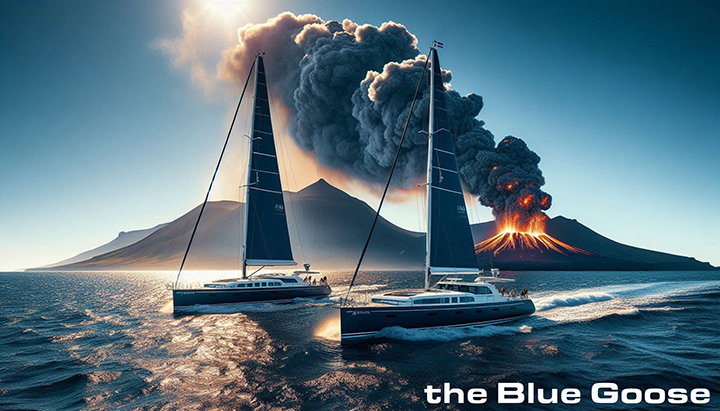
In fact, he was thinking about next summer so much that his mind wasn’t on their present situation. Grindavik was coming up on their port beam and while the shoreline was still in sight, though just barely, he saw a low, dark plume of volcanic ash streaming off the mainland straight out to sea, and the plume was maybe ten miles dead ahead. Volcanic ash, he knew, was full of all kinds of abrasive particulates, everything from silicates to larger bits of airborne pumice, but there were a gazillion different chemicals in these clouds that were toxic to breathe. The most immediate concern was damage to their eyes and lungs, and there might be carbon dioxide alerts for low lying areas, where CO2 pooled in lethal concentrations. The sea was definitely a low lying area, so would an alert apply to them?

But Judy was already two steps ahead of him when he called her on the VHF.

“I’ve just talked to one of the volcano observatories,” she began, “and they advise we head well offshore before traversing that plume.”

“How far offshore?” Hank asked, bewildered, knowing that any detour might add days to their crossing.

“Call it a hundred miles south,” she sighed. “So yes, I hear you, this is going to add at least a day to our time, but the alternative is to go around the northern coast of Iceland and that would take weeks, not days.”

Hank sighed and shook his head, but the knew she was right. He entered a new course on his chartplotter and then told Huck his plan. He hit execute on the plotter’s screen and the autopilot made the turn to starboard, then he turned on his radar and yes, sure enough, he could see the plume right there on his screen. 

He nodded – because at least he could monitor their position relative to the danger…but he was fuming now. More delays…

And then he felt a shuddering thud reverberate throughout the Goose. “What the hell?” he mumbled.

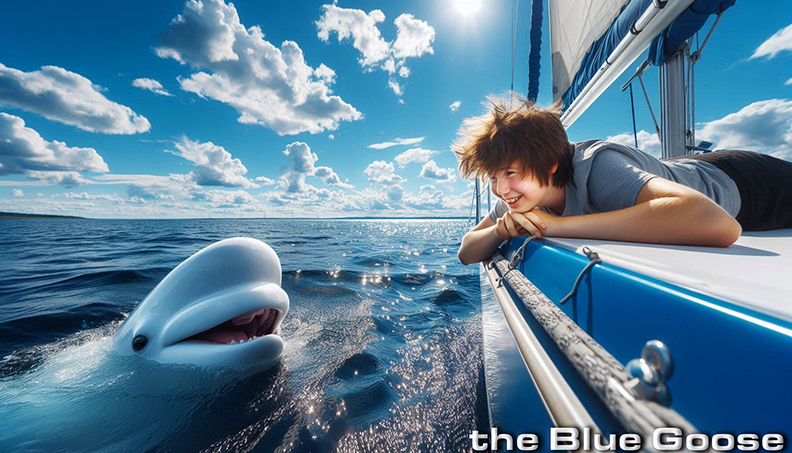
Afraid he’d run into an errant shipping container he leaned over the starboard rail and found himself face to face with the grinning white countenance of an impressively large Beluga Whale. Its face was about a foot above the mirror smooth surface, and its mouth was open a few inches. The dome of its forehead was impressively huge, and the natural curve of its mouth looked inviting. Like he, or she, was indeed smiling at him.

“Well,” Hank said as he cut power and put the transmission into neutral, “hello there. How are you today?”

And to his surprise, the whale replied, our tried to, anyway. While its enunciation wasn’t perfect, it was close, and Hank grinned at the effort.

“We’re going that way,” Hank added, pointing to the south. “Where are you going?”

But then the whale shook its head – and then it swam around The Blue Goose’s stern and literally pushed the boat to a course further west.

Thee radio hissed and came alive. “Is that a Beluga?” Judy asked.

“It is, and I told him we were heading south and that seemed to bother him. He’s pushing me to the west right now.”

“Interesting. Hank, if he swam through that plume he may have gotten a lungful of pumice, and he just might be trying to warn us off.”

Hank leaned over the port rail and the Beluga was still right there, bobbing on the waves while looking up at him again. He pointed to the west and nodded: “You want me to go that way?”

The whale responded by pushing the Goose again, and yes, it pushed the Goose to the west once again.

So Hank set a course of 220 degrees and engaged the autopilot, yet the next time he looked down into the sea the whale had vanished…just like a ghost.

“Damn,” he muttered under his breath as he scanned the sea around the Goose, “now that was just weird.”

+++++

Two hours later the plume was still visible off in the distance – but it was gaining some serious altitude now. He couldn’t tell what surface conditions were like that far away, but he hadn’t seen any airliner’s contrails overhead all morning so assumed this had been a big eruption. He turned on the single-sideband radio and tuned in the BBC, and then he learned that there had been big volcanic eruptions all around the world, and that the Pacific Coast of North America had been especially hard hit just a few hours earlier. Mt. Etna, the stratovolcano on Sicily’s east coast, had just erupted, and so had Mt Kilimanjaro in Tanzania, and that volcano had long been thought extinct. There were reports of eruptions in far east Russia, but no confirmations had been received at the time of broadcast.

Hank picked up the VHF and called Judy.

“Have you listened to the BBC today?” he asked.

“No? What’s up?”

“Just tune in and listen for a while, then tell me what you think we ought to do.”

“I got it,” Huck said. “Judy’s gone down to work on it. How’re you doing over there?”

“I was doing okay until I heard this shit. Huck, volcanos are erupting all over the world, and it’s real bad on the west coast.”

“You mean like California and shit?”

“Yup.”

“Fuck.”

“Yup.”

Judy came on the air about ten minutes later and she sounded different now. Like the usual calm she projected had been ruptured. “Hank, I have no idea what we should do, but there are volcanoes all over Iceland so I think we should get away from here.”

“Agree, but where to? Keep going to Scotland?”

“There’ll be ash clouds everywhere within a few days, so our best bet is to get somewhere…well hell, Hank, I have no idea where a safe place would be.”

“I’m texting my dad. He’ll know what to do.”

“Their flight took off an hour ago,” she said. “He should be in Boston in a few hours.”

Hank didn’t like the way that sounded. If air travel was disrupted by volcanic eruptions, it seemed like the worst place you could be was in an airliner over an ocean, but now wasn’t the time to think about that. “Okay, I’m going to set a heading of 270 degrees and get away from that plume. There’s no telling how bad it is now.”

“Okay. We’ll be right behind you.”

There was a light breeze blowing now so he set the main and the genoa, then engaged the Hydrovane self-steering vane. With so much sun shining he set the angle of the solar panels to receive maximum solar gain then checked the Victron displays to see how well they were doing. He looked down, saw the surface of the sea was still sort of calm but it looked different now. Almost gritty, like there was a thin layer of gritty film spread over the surface.

And if that was volcanic grit, he thought, what would that stuff do if it got into the engine’s raw water coolant loop? Foul up the diesel? What about the Spectra water maker? Would the grit foul up the pre-filter and clog the pump? And the sails? Would grit settle onto the Dacron fabric and tear up his sails? If so, how long would it take to destroy them?

Then the thought his him.

We could be out here unable to run the engine and even unable to sail. Then what would we do?

He turned and looked over his wake and could still see Iceland back there – and that’s all it took. He swung the wheel hard over and turn back to the northwest, then he looked at Judy, now standing in the cockpit staring at him. A minute later she pulled alongside.

“I was thinking,” he began, “what would happen if we got a bunch of that ash in our engines, and then in our sails. Or the water makers. We could get halfway to nowhere real fast, then be stuck out there with no way to get anywhere…”

“Jesus,” Huck sighed.

Judy nodded. “Good call. You want to head back to Reykjavik?”

Hank nodded. “I don’t want to be out here right now. The BBC is saying nothing like this has ever happened before, so no one really knows what’s going on. It just hit me, you know? Being out here in the middle of the ocean sounds like the last place we should be.”

His phone pinged and he realized he had put the phone in its holder on the binnacle so he leaned over to look at it. He read for a second then nodded. “Text from my grandfather. They’re still at the airport, all flights grounded. He’s asking our intentions.”

Judy nodded. “Hank, we’re following you, okay?”

Hank picked up his phone and replied: “Understood. Heading back to Reykjavik now.”

A minute passed and the reply popped up. “See you at the marina. We’ve reserved your same spots.”

“Okay. Be there tonight.” He nodded then turned back to Judy. “They’re headed to the hotel and we have the same berths in the marina. I think we should motor-sail as fast as we can.”

Huck reached down and started the diesel, then turned two follow Hank as the Goose began heading northwest, back to Reykjavik. Judy got on the radio again and called. “I’m making sandwiches, so don’t get too far ahead of us!”

“Okay, take your time.” Hank said as he cycled the chartplotter to the radar screen, then set the range to 36 miles, the maximum on this unit, and the plume was still there, only now in his mind it was a dark, malevolent thing, something that could hurt him, even kill him, and then the thought hit him. 

The world had just changed. Not a little, but a lot. Reality had shape-shifted and this was a new world…

Now even the air he breathed could no longer be taken for granted, then an even scarier thought hit. If it was bad here – what was it like along the Pacific Coast? How long would it take for all that ash to make it here? He remembered a couple of movies about that volcano under Yellowstone National Park, what the scientists called a ‘Super-volcano.’ In one movie more than half the country had been buried under ash, and the sun didn’t come out for a couple of years. 

Would that happen now? 

But why were volcanos erupting in Italy and Russia, and why were they all erupting at the same time? And then there was that extinct volcano in Africa? That just seemed beyond weird.

He turned the chartplotter back to the main chart display and noted they were coming up on the point at the southwest tip of the island, labeled Reyhkjanes on his chart, so now they had 20 miles to go to reach the lighthouse on the point, the old Garður lighthouse, where they would make the final turn into Reykjavik…

“Hank,” Judy said over the radio, “come and get it!”

“Okay, I’ll cut power, tell Huck to come alongside, make it starboard side and I’ll put the fenders out.”

“Okay, got it.”

They were only a few hundred yards off so it took just a few minutes, and she already had the cockpit table set up. She’d made Huck’s favorite, a pitcher of cherry-limeade from frozen concentrate, and then she handed up a platter of shrimp salad sandwiches and a bowl of tabouli salad. 

“Wow, what a feast!” Hank said as he sat down in the cockpit. The sandwiches were on big sub rolls, and she’d sprinkled fresh dill on them so they smelled great. The tabouli was full of lemon and parsley and fat, juicy chunks of tomato oozing with summer freshness, and it all looked so good, almost like a celebration.  And maybe it was. Because maybe this was the end of the trip. Maybe this would be the last meal they had out here for a while.

So he looked at Judy, and then at Huck, and he kind of choked up when he thought about that. To come so far, to get so close, and then…to end like this…?

“What are you thinking?” Judy asked.

And Hank snapped out of it and looked over at her, not really sure what to say. 

“I guess this is it,” Huck said, beating him to the punch. “Our last day out here.”

Hank nodded. “Yup.”

“Let’s not jump to conclusions,” Judy said, smiling. “We don’t know what’s really going on or how bad it is out west.”

“I’ve been watching the news feed on my phone,” Huck sighed, “and it looks pretty bad to me.”

“Like what did you see?” she asked, now concerned.

“Seattle is gone. San Francisco too. Los Angeles was having big earthquakes early this morning and then the news stopped coming out of there. That sounds bad. Real bad.”

Judy nodded. “It is.” She looked up at the sky and Hank thought she looked calm, maybe too calm, given the circumstances, but sometimes that’s just the way she was. Like the worse things got, the calmer she became. He had no way of knowing, but she was worried about Liz and how she might take it if she was cut off from Henry and Hank, but that was out of her hands now. Her doctors at DHMC would have to handle all that now.

Her phone pinged and she looked at it, saw a text from Emily. She sighed then opened it.

“Are you alright?”

“Yes, WE are.”

“Where are you?”

“Returning to Iceland. How are things there?”

“Strange. People real nervous. All airline flights cancelled. Grocery store in Lebanon packed, shelves at the Co-op picked clean. No deliveries from Fed-Ex or UPS today. I went by the Langston’s house. Ellen is still there, still taking care of the kids. Elizabeth is back at DHMC, something to do with a bad liver function test. I want to talk to you. When can I call?”

“Tonight.”

“Okay. I guess you can’t talk now. Bye for now.”

“Goodbye. Take care.”

She looked up and sighed, then looked at Hank. He was looking at her, and he seemed concerned.

“Emily?” he asked.

“Yes.”

“She doing alright?” 

Judy nodded. “Things are a little chaotic there. I’ll call her later.”

He nodded. “Huck, maybe you should call your mom.”

Huck nodded and went up to the bow and sat with his legs dangling over the side, and Hank looked at Judy again. 

“Okay, what are you not telling me?” he asked.

Judy shrugged. “Your mom is back in the hospital, a bad blood test. She’ll be fine.”

He grimaced, looked away.

“Your grandmother is still there, Hank. She’ll know what to do.”

He nodded. “Need some help with the dishes?” he asked.

“No, I got it. You go on back, we’ll be fine here.”

Hank stood to go but she reached out and stopped him. “Could I have a hug, please?” she asked.

He looked into her eyes, saw the pain, then something else he didn’t recognize, but she was reaching out to him and he stepped into her arms and wrapped himself around her. And he found he couldn’t move, that he didn’t want to let her go, and it felt like she didn’t want him to, either. He felt her face on the side of his chest, felt the heat of her body against his own and that same strange nervous feeling he’d felt on Pegasus, when he first went to Tarawa, returned to him. 

Minutes passed, or perhaps it was days or years, then she let him go and he stepped back, then turned and hopped over to the Blue Goose. She cast off his lines and pushed him off, and he went to the cockpit and turned on the engine. He looked at Huck and waved as he motored ahead of The Untold Want once again, and he was by himself – again. Judy had started the diesel and engaged the autopilot, and was clearing the cockpit table just now, Huck still up on the bow, still talking to his mom.

Still talking to his mom.

How long had it been since he’d talked to his mother…? Hank wondered.

He’d been so mad at her after Thanksgiving, when she’d invited Carter Ash and his family over, that he hadn’t wanted to talk to her – and so he hadn’t. Maybe he’d said a few words to her in passing, certainly nothing of consequence, but the odd thing, the really painful thing, was that he couldn’t remember the last time he’d told her he loved her. And then she’d gone from their lives.

Why? Why had that happened? What had happened that made him feel that way? Did anger prevent us from seeing love, the love that mattered most?

And it hit him then, in the stillness of that one crystalline moment.

Is that what love is? Does love transcend everything else, every other feeling?

Is love the most important thing we’ll ever feel?

“But…what if I can’t feel love?” he asked a passing gust of wind.

He turned and looked at Judy and he knew in his heart that he loved her. And he knew in his heart that he loved Huck, too. And Bud. And his father. 

But did he love his mother?

Judy waved at him and he waved back, then he watched as she went below and Huck returned to the wheel, and he sat down and looked at the chartplotter, then over his right shoulder at that spreading plume of fouled earth spreading out over the sea, over the earth, over all of them, everything he had loved or might ever love. And he felt a thump alongside the hull again. A gentle, but insistent, thump.

And when he went to the rail he found himself face to face with the same white grinning face he’d first seen just a few short hours ago, only now the Beluga was surrounded by dozens of his kind, maybe hundreds of them. Most were swimming to the northwest, swimming away from the spreading plume, but not this one. No, he was down there looking up at him, and he wasn’t smiling now.

“Are you as sad as I am?” he asked the Beluga as he cut the throttle again.

And the Beluga just looked up at him, not sad, not grinning, just looking.

Another, smaller Beluga stopped and seemed to hover by the first one’s side, and it too looked up at him, but this one seemed intent on studying him. Another stopped and stared, then another and another and soon dozens had stopped.

And he realized what he saw on their faces, and in their eyes. It was regret. And was that pity he saw?

Or was that a reflection he saw? A reflection of his regret, the pity he saw in their eyes nothing but his own self pity?

And one by one the Belugas slipped beneath the gritty surface of the sea and disappeared. All but one, the first one.

And Hank couldn’t move now, couldn’t not stare into the Beluga’s eyes, and for how long they held each other like that he could not say, then this last Beluga slipped away, a ghost melting away inside an infinite, bottomless darkness.

“Hank!”

He shook his head, tried to break loose from the spell.

“Hank!”

It was Huck, and he wasn’t on the radio, he was calling out to him.

He turned and looked and Huck was waving frantically at him. He picked up the radio and called. “Yes, what is it?”

Huck reached for the radio’s microphone. “It’s Judy! She’s gone!”

“Gone? What do you mean, gone? Is she in the head?”

“I called out and nothing. I went down to check on her and she’s not here. Not in the head, not in the v-berth. She’s gone!”

“Were you in the cockpit the entire time? Is there anyway she could have fallen overboard?”

“No way, dude! I was right here!”

He nodded. “I’m coming over.”

Hank threw the wheel over and cut the power again, then made an S-turn to pull alongside Judy’s boat, and he tossed the fenders down again and tied off after he jumped across. Huck was frantic now, his eyes darting about, lost somewhere between guilt and helplessness and not knowing where to turn.

Hank went below and walked forward to the v-berth in the forepeak and he found a logbook from the library sitting on her pillow. And as he picked it up an envelope fell out onto the bunk.

It was addressed to him.

He closed his eyes, took a deep breath then opened the envelope.

He read through her letter twice, tears filling his eyes from time to time, until he was finished reading and could take no more, until he was sure he understood what she had told him, then he climbed up on her bunk and sat there feeling numb inside.  

“Hank! What’s going on?”

He slid off her berth and went to the head then carefully opened the door, and he stood there, staring into the mirror over the sink, lost inside the infinite possibilities of her loneliness. 

CODA

“Every voyage is a journey of exploration, yet each and every voyage is an exploration of yourself, of your own mind. But Hank, only open minds learn from what they find out there.”

How many times had Bud told him that? When would his words finally sink in? When would he have the courage to face the world with an open mind?

His father and grandfather were on the dock again, at the same marina, and as Hank approached the piers jutting out into the little harbor he saw them pointing at Judy’s boat when they realized Huck was alone. It was obvious, of course, that she was gone. Not so obvious was why.

But Hank still didn’t understand why.

She should have returned seconds later, moments after she left, no matter how long she stayed. And he couldn’t understand because he had simply refused to open his eyes. He had from the beginning of this voyage. He had never opened his eyes long enough to see her. As she really was, someone lost and in love.

Even though her letter to him spelled it all out. Her love not just for Henry, but for him. “Because,” she had written, “you are one and the same.” She had admitted to herself that she could never have him, just as she had come to understand that Hank’s distant relative was indeed the template, the mold into which Hank had been poured. Yet she was a physician, a psychiatrist, and when she had recognized her love she had knowingly recoiled from it, then grudgingly accepted the reality – and the impossibility – of her love. She had distanced herself from his mother after that, and to a degree even his father, because she now felt that she had violated their trust, but when the trip emerged from the recesses of his mind she had seen this voyage as an opportunity. Not to love Hank, but to understand herself. Because love had finally opened her eyes, no matter how painful the journey.

As Hank backed into the same slip again, his father hopped onboard while Bud tied off the bow line, yet Bud couldn’t take eyes off his grandson. The pain in the boy’s eyes was impossible to ignore, and Bud was – perhaps – the only person in the universe who could understand that pain.

Huck backed in next to slip next to the Blue Goose, his father jumping onboard and helping with the lines, and then the two boys just stood there, staring into the moment. At each other, for a moment or two. When the enormity of their loss became overwhelming.

Yet Bud knew. He knew as soon as the logbook disappeared from his library. He knew what the outcome would be. And still he had let his grandson undertake this voyage. Only Bud knew what Judy’s heartbreak was capable of uncovering. Because every voyage is an exploration. Of the mind. And of the soul.

+++++

“As soon as the ash settles,” Henry said to Carter, “the rains will start. Cloud cover will envelope the planet, temperatures will fall, gradually at first – then temperatures will plummet – and after that, of course, the snow will begin. It might snow for months, or it may for years, and there’s also the possibility that so much snow could trigger a new ice age.”

The boys were in their rooms; Carter Ash and Bud were with Henry in the hotel’s rooftop bar, ostensibly to watch the latest technicolor sunset. People at nearby tables were listening to Henry, because here was someone who appeared to know what was really happening. And what would happen next. And while local news stations were still on the air, satellite coverage had dropped off hours after the eruptions as the ionosphere was overwhelmed by charged particles from the ongoing disruptions and signal degradation as the upper reaches of the atmosphere filled with refractive silicates. As sources of hard news dried-up, speculation and rumor filled the vacuum; reputable authorities were scarce, and none were willing to go on the air.

“Does that mean we’re stuck here?” a plump midwesterner from Duluth, Minnesota asked Henry.

Henry turned to the man and his wife and shrugged. “Air service might not resume, perhaps not in your lifetime, so you’ll want to think about your alternatives.”

“What do you mean, our alternatives,” a woman at another table said.

“I mean, where do you want to spend the rest of your life.”

“That’s hardly fair,” the woman’s partner said.

“Life isn’t fair,” Henry said, “and this new chapter of life on Earth is going to be a lot less so. Plan accordingly, or don’t. Life doesn’t care one way or another what you do, and frankly, Ma’am, neither do I.”

“So,” Carter said, his voice now almost a whisper, “what do we do now?”

Henry nodded. “Well, we have an advantage. We have two well-found cruising sailboats. We have food and we have water. And, most importantly, we have time. A narrow window, but it’s there right now.”

“A window? What do you mean?”

“Most of the computer models for an event life this show planetary temperatures stabilizing in two to three years, and the best place to weather the storm will be in the equatorial regions. That’s the zone between the Tropics of Cancer and Capricorn. And guess what? That includes the Caribbean, Central America, and even Cuba. Miami and the Keys are very close to that zone, too…”

“And that’s why I called my wife a few hours ago and told her to start heading to Florida,” Bud said. “On my instructions, she’s called all my employees, and they’re loading all their tools and families and heading for Miami.”

“Our objective,” Henry said, “should be to sail south to the Azores, then Bermuda and Miami.”

“Our Holding Company has land in San Juan,” Bud continued, “Puerto Rico, and last night I instructed my attorney to negotiate terms on a two hundred acre parcel in Boca Chica, and as that’s in the Dominican Republic we should have decent options going forward. Boat building is about to be a big business again.”

“You don’t mean yachts, do you?”

Bud shook his head. “Clipper ships, Carter. Much more advanced sailing vessels than we used to build but, oddly enough, for some reason I kept all the plans to all the ships our company ever built. Without such sailing ships, global commerce falls off a cliff, and if that happens…well then, civilization falls right along with it.”

“And,” Henry added, “it’s not our intention to sit back and let that happen.” 

+++++

“So that’s why she named her boat The Untold Want?” Bud sighed as he read through Judy’s letter one more time. “She couldn’t tell you how she felt, and yet she wasn’t sure she’d ever find Henry again. At least not the same Henry she met the first time she went back, but then again she had you.”

“So, she went back anyway? Why, Grandpa? I just don’t understand why she went back again?”

“Because a slim chance was better than no chance at all. But Hank, step back a moment and look at the facts, will you? Well, just one fact, really.”

“What?”

“What’s the one fact that stands out to you right now?”

“That Judy’s gone. She should have reappeared moments after she left, but she didn’t.”

Bud nodded. “Correct, but what do you think that means?”

Hank shrugged. “I don’t know…”

Bud nodded sympathetically, because obviously the boy’s eyes hadn’t been opened yet. “She chose not to come back, Hank. She lived the life she found back there, and then she died. Died back there, wherever that was.”

Hank looked down at his hands crossed in his lap and he shook his head slowly. “This is a nightmare…”

“It is, yes, if you choose to look at life that way.”

“What? What other way is there?”

“She chose the life she wanted, Hank. If she’d found herself in someplace she didn’t want to be, well, all she had to do was come back to us. But that’s not what happened, is it? No…and perhaps she chose a new journey, a new way to explore, and it’s my hope she found happiness, wherever, or whenever, she found herself, and with the people she found there.”

Hank looked up at his grandfather and nodded. “Could I go back to find her?”

Bud swallowed hard, but neither did he look away. “You could, yes, but the same risk applies to you. You might arrive in a timeline without her, and then, hopefully, you’d return to us. But worse still, Hank, imagine going tomorrow. You’d still be, what? Twelve going on thirteen? The same dilemma you presented to her now would apply then, and nothing would be different but the time.”

“What if I waited until I was the same age she was?”

Bud looked his grandson in the eyes, and one thing was becoming clear. “So, you love her too?”

Hank nodded.

“You mentioned the girl you encountered at Tarawa at that news conference in St John’s. You were certain that reporter was the same girl. Why?”

Hank closed his eyes and thought back to that moment in Newfoundland. “Something about her eyes. I saw something in her eyes…”

“She’s sitting over there, you know? Her flight was canceled, too.”

Hank whipped around and looked at the woman, then, as his face turned red he turned back to his grandfather. “I’d need to go back to Tarawa. I’d have to see her again to know for sure.”

“Yes. You would.”

“Why are you looking at me like that, Bud?”

“Think about it, Hank. If that woman is indeed the same girl, then…”

“She can do it too!” he blurted loudly.

Bud looked at Linton Tomberlin who, however unlikely it may have been, seemed not to have heard Hank. Then he looked at Hank again and smiled. “Alright. Now what?”

Hank crossed his arms over his chest and furrowed his brow. “There’s nothing I can do about it now, Grandpa. The logbooks? They’re in the library, and I can’t get to them now, can I…?”

“I see.” Bud said as he looked at Hank, but then he leaned over and pulled a logbook, and just the one in question, from his briefcase. He looked at it for a moment, turning it over in the dim light, then he handed it over to his grandson. “By any chance, would this help?”

Hank did a double take then leaned over to take the book from his grandfather.

“How did you know?” Hank asked. “I mean, how could you?”

“Yes, that’s odd, isn’t it?”

“Well? Are you going to tell me?”

Bud smiled as he watched his grandson leaf through the book’s musty old pages. “Remember, this is a journey, Hank, so don’t forget to open your eyes from time to time. Take a look around, smell the roses. You’re smart, so you’ll know what to do when the time comes.”

+++++

Two small sailboats left Reykjavik a few days later, both boats sailing south, both bound for the Azores. Two sons, two fathers and a grandfather were onboard, and the Icelandic Coast Guard followed them out, then wished them a safe crossing. Strange weather patterns were taking shape and the way ahead wasn’t clear to either the sailors or the crew on the Coast Guard ship, but there was nothing to be done about it now. 

Linton Tomberlin, the CBC reporter, watched the sailboats leave, while her cameraman recorded scenes that would never be watched by television viewers either in Canada – or anywhere else. She watched the boy sailing The Blue Goose, the boy who had once seemed so familiar to her, and she wondered if she would ever see him again.

© 2025 adrian leverkühn | abw | adrianleverkuhnwrites.com | and this is a work of fiction, plain and simple.

Dramatis personae 

The Langston Family

  Hank, aka Eldritch Henry Langston V

  • Hannah, Hank’s oldest sister, from his father’s first marriage
  • Jennifer, his next oldest sister, also from his father’s first marriage
  • Ben Langston, Hank’s younger brother, from his father’s second marriage
  • Elizabeth Langston, Henry’s current wife and mother of Hank and Ben
  • Eldritch Henry Langston IV, Hank’s father
  • Eldritch Henry Langston III, Hank’s grandfather
  • Ellen Langston, Hank’s grandmother
  • Eldritch Henry Langston, Jr., Hank’s great-grandfather, Captain of the Pegasus II
  • Eldritch Henry Langston, Sr., Hank’s great-great-grandfather, Captain of Pegasus I

At the Langston Boat Company, Melville, Rhode Island

  • Ben Rhodes, foreman

In Hanover, New Hampshire and Woodstock, Vermont

  • Carter Ash, Elizabeth’s suitor
  • Huck, or Carter Ash Jr., Carter’s son, who is not quite a year younger than Hank

In Norwich, Vermont

  • Dr Emily Stone, the Langston family’s veterinarian
  • Dr Judy Stone, psychiatrist, Emily’s wife and Elizabeth’s psychiatrist

In St. John’s, Newfoundland

– Linton Tomberlin, reporter for the Canadian Broadcast Corporation.

The Blue Goose, Part Seven

So, this is my first post of 2026 and my 21st year writing these short stories. What a kick in the ass that is! Time flies when you’re havin’ fun.

Willie has been on my mind (alas, not Georgia), and I read an interesting article about him last week in the New Yorker, titled How Willie Nelson Sees American. He’s 92 and still has a unique point of view. Once you meet the man you’ll never forget him, and after reading this article I was reminded why that will always remain true. As music always matters, why not walk down memory lane with him and see what you find in your memory warehouse. I hope you find your way to his rendition of September Song.

Part Seven

Hank looked at the apparent wind display and winced: the last gust had clocked-in at 67 knots and the had Goose shook it off – but only because the waves had blocked some of the wind. Both boats were dealing with twenty foot waves now, for the most part, but every now and then a sneaker caught them off-guard. Judy was exhausted and it was now too rough to even consider having Huck go over to lend a hand, but the good news was that the Hydrovanes were working as advertised and steering both boats without problem. Both boats were flying storm staysails and storm tri-sails on their masts, and the forecasters were still saying the wind would be tapering off ‘anytime now.’

The wind hadn’t gotten that memo yet, however, and it was still kicking the snot out of them.

He changed pages on the chartplotter and noted the seawater temp was still 37 degrees, and in 48 hours they had made good a solid 220 miles from St. John’s. Of course that meant they still had 1200 miles to make Reykjavik, but at least nothing on either boat had broken – yet. Huck slipped open the companionway and poked his head out into the space under the dodger and smiled.

“You want a sandwich or anything?” he asked.

“No point,” Hank replied. “As soon as I choke it down it comes right back up.”

Huck popped down below and came up with a Gatorade, the red kind, and handed it to Hank. “See if you can hold this down. You need a Zofran?”

Hank shook his head while he grabbed the bottle, then he slammed it down. “Thanks, Amigo.”

“Hey, no sweat. You want me to take it for a while?”

Hank had realized that Huck was stronger than an ox and was no longer bothered by seasickness. On the other hand, the wind and the waves still scared him, and when the boat heeled in a big gust he still got kind of weird, like the ‘world-is-coming-to-an-end’ kind of weird. Hysteria, Judy called it. Almost like he was losing control. So…Hank still kept an eye on Huck when he took over at the change of watch. 

“Come on up when you’re ready. I want to tighten the bolts on the Hydrovane again.”

The VHF squawked. “Hank, you on frequency?”

“Judy! How’re you doing? Did you get some sleep?”

“Yup, but my Hydrovane is making funny noises.”

“Get a 10mm socket and tighten those two bolts I showed you. It’s on the right mounting bracket on my unit. Try that one and let me know.”

“Okay, will do.”

“Damn,” Hank sighed, “one of us needs to be with her until we get out of this crap.”

“You want me to try and…”

“Hell, no. At 38 degrees you’d last thirty seconds in this water before you were fucked up.”

“I know, man. Just askin’…”

“As soon as it’s safe, Amigo.”

“Okay, Hank. Now, how ‘bout a sandwich.”

“Maybe. Just no tuna fish, okay…?”

+++++

They enjoyed three days of benign conditions, with temperatures in the low-50s and winds out of the west at 15 knots. Huck managed to hop aboard The Untold Want and get Judy below for a full night’s sleep, and when she woke the next morning he handed her a bowl of hot oatmeal, then some scrambled eggs on toast. With a chaser of blue Gatorade. Judy smiled and ate everything, then went to call Hank.

And she received no reply. 

She tried again. No reply.

She slid open the companionway and looked ahead and saw that the Blue Goose was sailing merrily along, and Hank appeared to be sound asleep, though still in the cockpit. She went back down the steps and turned to Huck. “How long have you been over here?” she asked.

“Hank dropped me off as soon as you went below. I turned off your alarm so you could get some sleep.”

“Yes…but…how long have you been here?” 

“Maybe 18 hours? Why?”

“You need to get back and relieve Hank!”

“He said he’d call when he needs me.”

“So he decided I need help.”

Huck nodded. “Yup. He was real worried about you for a while.”

She shook her head and sighed. “Yeah, I was too, so I guess I should be thankful. I really needed the sleep.”

“I know. We could hear it on the radio.”

“Really?”

Huck nodded. “So, can you take it for a few hours? I’ll do the four-to-midnight watch if that’s okay with you?”

+++++

Hank jerked up and shook himself awake, then heard the insistent beep again. He slid down the cockpit seat to the wheel and looked at the chartplotter and saw the red radar guard zone alarm flashing, and he muted the audible alarm while he shook the cobwebs out of his skull.

There! Right at the edge of the 36 mile ring on the radar. Two big returns. No…three. Make that ten…

He shook his head, changed the range to 24 miles and the targets disappeared, and when he ran the range back to 36 miles dozens of targets appeared. And that just didn’t make sense.

Then it hit him.

Icebergs. Those are icebergs. Dozens of them – and dead ahead.

He went to the radio and called Judy.

“Is your radar picking up targets about 35 miles ahead?” he asked.

“I was just about to call you. Could those be icebergs?”

Hank chuckled. “It’s either that or the Spanish Armada.”

“How close do you want to get to them?”

He thought about that for a moment then replied. “Maybe a quarter mile, enough to get some good shots of the boats around the bergs with the drone.”

“Huck says he wants to take the Zodiac over and walk on one.”

Hank shook his head. “Of course he does.”

“Okay. I’ll try to talk him out of it.”

There was a thin layer of mist hanging over the water that morning, so binoculars were pointless for anything more than a mile out, so he watched the radar then scanned ahead visually, looking for small bergs that might not show up on radar. 

Fifteen minutes later he began seeing little chunks of ice, some the size of a basketball, others the size of a small car, and none of them were showing up on radar…

So he let out the main and furled the genoa, dropped his speed down to 3 knots, then called Judy. “We’re coming up on some growlers, too small for the radar to pick up. I’ve slowed down to about 3 knots.”

“Okay, got it,” Huck replied.

“Is she asleep?”

“No. Making breakfast.”

“You had any sleep?”

“Lots. I’m good. How ‘bout you?”

“I was asleep when the radar alarm went off, so I think I got about three hours.”

“Judy’s making breakfast burritos. Want one?”

“No, I want two. Maybe three.”

“They’re pretty big, Hank.”

“Then two. That ought to do me.”

“Wow…”

“Huck, I haven’t eaten in two days!”

“Neither have we.”

“Okay, well, I’m coming over now, and putting some fenders out.” 

“It almost looks calm enough to raft up for a few minutes.”

“Almost,” Hank sighed, “but not quite.”

“Okay. I’ll hand over a plate when you come alongside.”

Judy was on deck when he came alongside, and she stepped over with two plates, then stepped down into the cockpit with Hank.

“Here you go. Breakfast in bed!”

Hank smiled as he took the plate, then he sat behind the wheel and wolfed down a whole burrito in three bites. Judy shook her head, amazed, then took a small bite. When she looked up Hank had already finished his second burrito.

“You weren’t kidding, were you?” she asked.

“I could eat three more. I’ve never been so hungry…”

“I’ll make you a big lunch. Now go down and get some sleep.”

“No way.”

“Hank, you slept out here all night. You’re pale, you need hydration, and you need deep sleep. Doctors orders, so go below and hit the sack. I’ll wake you when I think you’ve had enough.”

+++++

The way ahead was relatively clear of big icebergs, but the smaller ‘growlers’ were now everywhere. Most of the small stuff was easy to spot, but Huck was up on the Goose’s bow, pointing out when to turn port or starboard, and Judy was following just a few yards behind Hank. Whenever a larger, car-sized berg appeared, Huck shouted out the alarm and Hank cut the throttle and drifted in the direction Huck pointed. 

The latest ice report indicated this ice field was about 20 miles across, and they’d already traversed half that distance when the way ahead began to look impassable, with the growlers packed so tightly the area was turning into a solid sheet of uninterrupted white. Hank saw an opening to starboard and took it, Judy turning where he’d turned, and about a half hour later the ice began to thin again. Two hours later they were back in open water, almost all the large icebergs showing ten miles off their port beam. Hank opened the weather app on his iPad and the latest updates streamed in via StarLink, and as he looked at the forecast for the next day he groaned. Another low pressure system was coming down the Labrador Sea, following the same track as the one that had just slammed them, and instead of ten days of good weather it looked like they might get half that number.

They were now almost 250 miles due south of Nanortalik, Greenland, which put them, according to the chartplotter, 717 miles from Reykjavik. So they’d covered half the distance in eight days, one day longer than he’d expected. Because they’d slowed to deal with the ice, of course. But now they needed to put some distance between them and this new low pressure system, and that meant raising sail and pushing hard. He waved at Judy then pumped his fist, their agreed upon signal to pull alongside for a chat.

“Got time for a sandwich?” Judy asked as she pulled alongside.

Hank nodded. “We got another storm coming, same track as the last one. We need to put some miles between us, and fast, so let’s eat and then get all sail up and see if we can’t outrun that thing. I’ll take a nap, and Huck can come take over for you in four hours.”

“Okay. Can Huck take the wheel while I make sandwiches?”

Huck jumped but his timing was off, and Judy’s boat fell away as Huck’s foot bounced off the rail, and just like that he was in the water. His Mustang life vest popped and then inflated, scaring him, then shock of the icy water caused him to scream out in pain; Hank started the engine and put the wheel hard to starboard, and he dropped the main while the boat began to lumber around the turn. He rolled in the genoa and got behind the wheel and made a course correction, then got the folding boarding ladder in the port-side boarding gate deployed. He tied a bowline in the main-sheet and tossed it down to Huck as the boat drifted to a stop, then he pulled him over to the ladder.

“Can you make it?”

Huck looked up at him, now helpless and in tremendous pain, and shook his head. Hank leaned out, got the looped main-sheet under Huck’s arms then went to the electric winch and started tailing the line as Huck was hauled back onboard. Hank got him out of the rope and down the companionway and, leaving the diesel on to provide power, he turned on the Espar heating system and grabbed a handful of towels then started rubbing Huck’s arms and legs, drying him and getting his circulation moving again. He felt a bump, a hard one, and heard Judy hopping onboard then racing down the companionway. She came in and started working on Huck, checking his vitals then getting a blanket wrapped around him. She continued rubbing him down, concentrating on his extremities…

“Hank, could you get some hot cocoa going?” she said softly.

“On it,” he said, his hands now beginning to shake as the enormity of the moment finally hit home. He shook his head – hard – then got the stove going and water on to boil. He looked up, saw Judy getting Huck’s clothes off, and a minute later she was taking him into the head, sitting him down and turning on the shower, using warm water to get the boy’s core temperature up slowly. Five minutes later she walked Huck into the forward cabin and got him under the blankets, wrapping his head in a towel and just leaving enough face exposed to insure an unobstructed airway.

She came back to the main cabin a few minutes later, and she was pale, seriously shook up.

“What happened?” she asked.

“I don’t know. I think maybe he got careless, or maybe he just didn’t time his jump right…”

“Goddamn…I don’t know why but I started a timer on my watch. He was in the water over four minutes…I’m surprised he’s still breathing…damn, Hank, what did we do? Are we getting careless?”

Hank shrugged. “He didn’t have his harness hooked on, we never do when we jump across. I think I need to rig a longer line to hook onto so we’re tied to the boat when we make the jump…”

“Right. Good idea.”

“Judy? Is he going to be okay?”

She nodded. “Yeah, I think so. Hank, he’s in such good shape, his heart is as strong as anything I’ve ever seen, so yeah, he should be okay in a few hours.”

“Did the shower work okay?”

She nodded. “Yes, and the heater was a great idea. Glad we have those now.”

“I’ll get a fire going. Are you tied off okay?”

She shook her head. “Just one line. I’ll go set some fenders…”

“You stay here. I’ll do it, you stay with Huck.”

She nodded and watched as he went up the companionway, and then it hit her. Hank was so much like Henry, her Henry. Resolute, and he never panicked, not once that she had seen, and his speed and concentration saved the day. He had saved Huck’s life, pure and simple, and yet all he could think about was how to fix the problem going forward. Again, just like Henry. Don’t blame anyone, just identify the problem and fix it. No hysterics, no bravado, just steady as she goes and get back to work. She got lost in the moment, thinking about Hank and Henry and even Bud, and she realized there was a straight line running between them, connecting them through time, and she of course understood genetics but had never really seen the consequences in such a direct, a profoundly direct, way. She stepped into the galley, everything the same here as on her boat, only the way food was stowed marked the difference between the two. She found what she needed and made grilled cheese sandwiches and chicken noodle soup, and soon the cabin smelled like home, her home when she was a kid, when her own mother made the exact same thing and it hit her, she was part of another line extending back in time…or forward, into the future and into the past – because such lines are infinite…

Hank came down and ate, but she was aware he was looking at her much more than he usually did, and she looked at him in kind. “What’s on your mind, Kiddle?” she asked, gently, maternally, just like her own mother had always asked when she knew something was up.

“You, I guess.”

“Oh? How so?”

“I’m beginning to feel something different when I look at you. I can’t explain it but it’s there.”

She nodded. “I know, and I understand, Hank. When you start to rely on people in situations like this a special kind of bond grows. It’s almost like a new kind of family.”

He nodded. “When did you fall in love with Henry?”

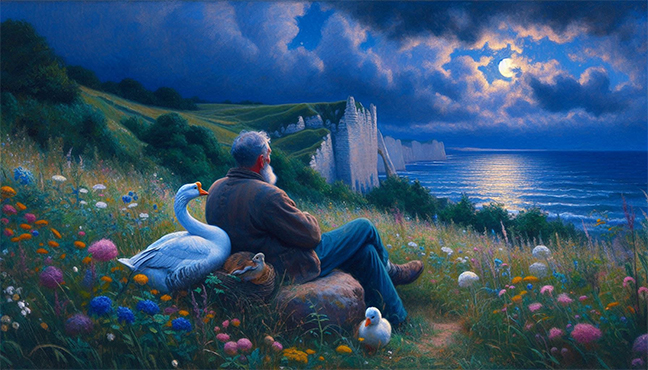
“In France. We took a long walk one evening. It was in Normandy, on a chalky white trail in an impossibly green pasture, right alongside a cliff. We came to some rocks, big rocks, and we sat and watched thunderstorms out over the sea and it was like watching life, the entire cycle of life from birth to death, taking shape and playing out, and I looked at him and knew. I just knew. I was married once before, to a really mean person, a man I met in college. He was so sweet when he wanted to be but it was all an act, a show, and after we were married he felt like he didn’t need to hide anything anymore and he became like this whole other person. He was the same on the outside, ya know? But he was hiding something monstrous on the inside.”

“Did he hurt you?”

She nodded her head, looked away. “Just once, but that was all it took. I called the police and moved back in with my parents until I finished medical school, and then one day I met Emily and suddenly I felt safe again. Or maybe I felt safe for the first time in my life…”

“Are you going to leave her after when finish this trip?”

She nodded again. “Probably. I’m not, well, I’m not into the things she is. I wanted a friend, a companion, but she wanted something else. Something I can’t give her, and that isn’t fair. To her, I guess, more than anyone else.”

“I’ve always liked her. Every time we take Daisy in for her shots I watch her, the way she relates to Daisy, the way she feels, I guess.”

“It’s not an act, Hank. She really is that way. She has a big heart, a gentle soul. I love her, and I always will, but kind of in the same way I love you and Huck.”

He nodded. “I guess I understand, but I’ve never felt what I feel now when I look at you. You’re not my mother but sometimes it almost feels that way, then it feel different than that. I can’t describe it, but I feel it.”

“Okay, thanks for telling me, Hank. And it’s okay to feel that way. Like I said, I love you guys too, I love you because you’re becoming not just friends, but best friends, and I think we always will be, too.”

“Yeah, that’s it, I guess. It just feels really strong sometimes.”

“I know, but real friendship is like that sometimes. Overpowering. When you realize there’s someone out there who really gets you. Those are great moments, Hank. Really great. Now…who gets to do the dishes…?”

+++++

They weren’t fast enough.

The storm swept over southern Greenland and turned east as steering currents from a frontal passage coming up from the Great Lakes pushed the storm east, and directly at The Blue Goose and The Untold Want. Hank felt the change almost a day before the first winds hit, before the dark gray storm clouds appeared along the western horizon, and a quick glance at the chartplotter revealed a 300 mile gap between them and Reykjavik. 300 miles was three days, give or take, so at least two days of the storm and a final approach into an unfamiliar port. 

And right now there was no place to run, nowhere to hide, no island redoubt, no harbor of refuge. Just 300 miles of open North Atlantic Ocean, and with water temperatures now down to 35 degrees. In other words, even more deadly. Huck still wasn’t a hundred percent, and his fingers were still numb 20 hours after he went overboard. He also seemed more hesitant walking around on deck, like the experience had really messed with his head.

When the first icy fingers of wind struck they did so gently, almost seductively, daring Hank to leave too much sail up, to not be prudent and start reefing the main and rolling in the genoa. He’d heard their music before and wasn’t falling for it this time.

So Hank didn’t listen, as warm and tender as their music at first appeared to be. He rolled in the main to the third, deepest reefing mark, the point where the sail’s reinforcement was strongest. He went forward and pulled in the genoa and the staysail, then hoisted the storm staysail on the Pro-furl furler. He folded the bimini and lashed it, and when Judy saw what he was up to she began to do the same.

And then Huck saw her, and he looked at Hank. “I better go and give her a hand,” he said.

Hank nodded. “Ready when you are.”

“You know, Hank, I’m not sure I’ll ever be ready again.”

“Okay, understood. You want to take the wheel. I can go over if you don’t feel up to it.”

Huck looked down and shook his head. “Man, I don’t feel right. Something’s fucking with me, Hank. I’ve never been scared like this, like I am right now.”

“I understand, Amigo. We’ll just take it one step at a time, okay?”

“I feel like I’m letting you guys down, ya know…”

“You’re not, Huck, so don’t sweat it.” He picked up the VHF and called Judy, told her he was coming over and Huck came and took the wheel as Hank disconnected the Hydrovane. Hank hooked onto the new, longer safety line then went to the boarding gate, waiting for Huck to steer them into place. He jumped over without incident and changed out Judy’s sails while she steered into the wind, and when he went aft to the cockpit she was looking at him.

“How’s Huck?” she asked.

“Still pretty freaked out.”

She nodded. “Want me to make a couple of sandwiches?”

“Sure. That’d be great. I’ll take the wheel now,” he said as he went to the wheel and checked the chartplotter. He steered until they were back on the correct heading, then set the Hydrovane to hold the same angle to the wind.

She came up with four sandwiches in a sack and took the wheel. “See if you can get him to come on over after he eats. Tell him I could use a hand.”

He looked at her and nodded. “Understood,” was all he needed to say, because they were thinking the same thing. The first thing you do when you fall off a horse is get right back on. You never walk off, you never give in to fear.  Bud had told him that a million times.

She steered over and watched as Hank handed Huck a sammie, then a second one, and she watched them talking and laughing a little, and then she felt something wrong, something big, and she turned around and looked behind them.

The dark gray wall was getting closer, and she turned and looked at Hank.

He looked at her and nodded.

There was no need for words now. He knew what she was going to say, and probably before she knew it, too. They were on the same wavelength, operating in some other zone, someplace she had never been before, and when she realized that she was suddenly unafraid. 

“How strange,” she said to the wind. 

When she looked at Hank a few minutes later he was looking at her, and then he smiled.

And when she saw Henry inside that smile she knew everything would be okay.

+++++

“Oh fuck!” Huck screamed. “Judy! Hold on to something!”

The wave had crept up on them, silently, like it had been stalking them. And now it had decided to pounce.

The waves and swell had combined now, combined into something new and fierce. Tall things, now just big. Tall, but this one reared up like a cobra getting ready to strike as it came up behind them. Huck had one chance to get this right, to steer a little to starboard and try to surf across the face of the wave before it broke and fell on them, and he turned the wheel, felt the stern lifting and the rudder biting hard, trying to overcome the wave’s boundless force. The Untold Want slid to starboard and began surfing along the side of the wave, and as he held on tight he guessed it had to be 25, maybe 30 feet tall, but right now this wave felt mean and angry. He found the slot, the way out and in an instant they were free of it. Free of this one, anyway, and he looked to his right, tried to see the Goose and he just caught sight of her red running light, up on the bow pulpit. Saw her rising to meet the same wave, then falling off and surfing down the back side and he smiled. He smiled because he knew Hank was smiling, and inside that one singular moment he felt truly connected to Hank – like maybe they had been friends before, but this storm, like all the storms they had endured before this one, was a forge. A forge that had cast them into something beyond brotherhood.

And Judy, winching in the staysail then letting it out, controlling their speed on each concussive gust, on the front of the next wave, and then again, coming off the backside and into the next windshadow, deep inside the next looming trough. 

Steer up the backside and point into the wind a little, then look behind and gauge the distance to the next face, get ready to fall off and surf the face of the next one.

Hank was struggling because he couldn’t leave the wheel so had sheeted his lines in, and the Goose went from overpowered on the crests to underpowered in the troughs, so he compensated with the various wind angles by steering, and his shoulders were beginning to burn – because they’d been at it now for 12 hours straight. And still, there was no end in sight.

Except Reykjavik. 

Their last ace in the hole…and the only hand Hank could play now…was to get them into Hafnarfjordur, into the marina on the south side of Reykjavik, or possibly the Snarfari Docks, deep inside the city, but while both offered protection from the storm, getting into either presented serious challenges. Getting into any slip in 80 knot winds was going to be a bear, and with Huck on Judy’s boat he would have to do it alone.

His phone rang.

The number popped up on his iPad, which was mounted under the dodger, beside the companionway, and he sighed. It was his grandfather, but taking the call now meant leaving the wheel, and he just couldn’t do it.

The line went dead, then a text appeared. The iPad was too far away to read, but he could pull up texts over Bluetooth on his chartplotter and the text popped up, overlaid on the current active chart.

“Have a slip for you at the Snarfari Docks, more protected entrance than Hafnarfjordur. Your fathers and I standing-by to help with lines.”

He dashed forward and replied. “Received. Huck with Judy, bad out here.”

“We’re here so take your time. We have you on AIS.”

Hank made it back to the wheel in time to counter the rising stern, and he turned, looked at the wave and groaned.

“Oh, you’re a big one, aren’t you?”

The wave was curling now and about fifty feet above him, the roaring noise of the falling crest wiping out all other sound – and in the next instant he was under water, his body being pushed forward into the companionway slides. His line held and he tried to pull himself back to the wheel – but it felt like the Goose was beginning to roll so he reached for the binnacle and held on tight…

But the Goose held on, she didn’t roll. She shrugged off the wave and stood tall, and Hank found himself face up on top if the dodger, his legs caught up in the mainsheet traveler. He pulled himself free, saw Huck and Judy fighting the next one as he fought his way back to the wheel and reoriented the Goose to the waves. Next, he started the engine – more to make sure the fuel pumps hadn’t been compromised in the near-roll, then he set up an intercept course for the approach to Snarfari.

He called Judy, told her their destination and that Bud, Henry, and Carter were already there, waiting for them.

“How far are we now?” she asked.

“Fifteen miles from the lighthouse on Gróttutangar, another three to the marina after that.”

“Okay. Are you okay? It looked like you rolled a few minutes ago…”

“Yeah, close call. Look, I think I broke some ribs…”

“Is it hard to breathe?”

“No, but there’s a sharp pain on my left side and it hurts to twist my body.”

“Then don’t! I’ll come over and check you out when we get closer.”

“Okay. Out.” He knew that wasn’t going to happen, not until they were in the marina, and right now the storm wasn’t letting up. And steering hurt. A lot.

He had to start coming to port in order to get on the new heading, and to make matters even more interesting they were now approaching a lee shore. The storm was, in short, pushing them towards the rocky coastline, and if they couldn’t get far enough to the north to enter the harbor, their trip would be over, their boats dashed against the rocks.

So now they had to ride dead downwind, with the waves coming directly from the rear. And if he surfed off the backside of these wave, he’d have to go to port, towards the north, where the waves appeared to be even larger.

But there were no other options now. He was running out of luck, and right now it was either make this happen or lose the boat. 

+++++

“This isn’t funny!” Huck snarled. “God! If you’re doing this, would you knock it off, please? Now?”

The wind speed was a constant 65 knots, gusts were now approaching 80 knots. The wind was blowing so hard that waves were now having a hard time forming. They were being blown flat, and the spray felt like a shotgun blast to the face.

And that was exactly when the snow started. Fat and wet, horizontally blown snow was suddenly streaking by at 65 knots, coating the inside of the dodger, the standing rigging, and soon, the back of his jacket. And his neck. He’d almost been able to see the lighthouse on Grotta Point, at least he was certain he’d seen the light, but not now, not with this snow. The chartplotter was standing in for his eyes, the radar too, but radar was less effective in heavy snow. The hull was bouncing around so erratically that even the readings from the depth-sounder were unreliable, leaving the only human sense that mattered, vision, shut down and irrelevant. Both boats were relying on instruments now, like pilots flying in fog…

But…

…his ears were working and they heard breaking surf. He double-checked their depth; it now showed a solid 25 feet under the keel, and according to the bottom contours on the chart, that put their boat about 300 yards from the point, and the lighthouse. Judy sheeted in the main and they picked up speed, then they saw the light on top of the lighthouse, like a dim flash inside deep blue-gray fog. Really, it was more a diffuse brightening within the fog – and snow – and wind driven spray, but it was there, really there, and right where it was supposed to be.

The Blues Goose was a hundred yards behind them when the Untold Want made the turn and fell within the windshadow of land and a sudden urban landscape, and almost instantly the wind speed fell to 20 knots, then 15. Hank pulled alongside and the three of them exchanged a quick glance, and a half hour later they pulled up to the marina.

Huck saw his father standing there and at first wanted to cry, then he realized that no, big boys don’t cry.

Judy saw that Emily hadn’t come and she sighed, but she understood. Emily’s letter had spelled it out in plain English. They had reached an end. It was time for them to move on to the next chapter.

Judy knew that was true, but even so, the sudden emptiness of the moment hurt. Hurt more than she had expected it might. And Huck sensed that. He sensed her sudden loneliness, the deflation of no one waiting on the dock – for her.

“Hey Doc,” he said to her, breaking her reveries, and when she turned to him he continued. “We did it. You and me, together. We did it.”

She smiled and nodded. “We sure did. Your father looks so happy to see you.”

“And I feel happy to be here with you, like you’re my new bestest friend ever.”

She looked at him, puzzled now and wondering where this was coming from. “You okay?” she asked.

“I’m not sure. Not really, but I’m glad you and Hank are here.”

She nodded. “Me too. Can you believe how fast that wind disappeared? What a hoot!”

“And no waves,” Huck sighed. “My shoulders are burning…”

Hank pulled ahead and swung a lazy arc in front of his family and the CBC news crew – who were on the dock recording everything, which meant they were going to record their docking, and when Huck realized that he looked at Judy and shook his head. “You want to take it? I don’t want to screw up on camera.”

“You’re doing fine, Huck.”

He nodded and watched as Hank backed into his slip, his father hopping on board and throwing dock lines to Bud and Carter. He executed the same sweeping turn, then backed into the slip next to Hank’s – and in that moment he seemed to deflate as two weeks of solid tension evaporated. It was raining here and he just didn’t care. His clothes were soaked, his skin moist and chafed in spots, but he didn’t give a damn. His took lines from Judy and he helped them tie-off, then Carter came aboard and went straight to his son and held him close.

Huck grabbed hold of his old man and didn’t let go for a very long time.

The CBC camera crew recorded it all, but the reporter kept back. She had been instructed not to intrude on the moment.

+++++

Bud had decided he wasn’t going to mention the missing logbook to anyone, not even Hank. Hank probably had every reason to know, but the decision, ultimately, was Judy’s. If she was planning on using the log to go back to France, to Henry and her daughter, there really wasn’t much he could do to stop her. He’d told her of the dangerous possibilities, and she was an adult. She could make her own decisions.

Which was why, when Judy first hopped down to the dock in Reykjavik he ignored her. Carter was with his son Huck, Henry with his son Hank, and then there was Judy Stone, all by herself. And he couldn’t do it; he couldn’t ignore her, not when she was alone like this.

“How are you holding up?” he asked as she wobbled around the dock, trying to shake off being on solid ground again.

“Is it just me, or is the ground moving?”

He grinned. “It’s you.”

“I’ve never been so happy…when I saw the three of you up here I was about to cry. And we need to get Hank to a doctor’s office. I think he’s got some broken ribs and we need an x-ray to confirm.”

Bud nodded. “To the doctor’s office, now!” he said to his son.

Henry nodded. “Got it.”

“How did you know he was hurt?” Judy asked.

“Just a precaution. We got in two days ago and spotted out all the places we thought we might need to visit. What broke on your boat?”

“Nothing, really, but Huck went overboard.”

Bud stopped walking and looked at her. “How long was he in the water?”

“Four minutes.”

“Damn it all!” Bud grumbled. “Did he forget his safety line?”

“It was too short, so yes, he unclipped before he jumped.”

He nodded then resumed walking. “We rented a van, and we’ve got a bunch of rooms at the Hilton. The hot water seems endless, and I got you a room with a jacuzzi.”

“Oh, bless you. I’ve been dreaming of boiling myself in an endless bath…!”

“There are hot springs here, assuming that volcano doesn’t eat it for breakfast tomorrow. Swimsuit optional, I hear.”

“Really…? That sounds fun. You want to go?”

He looked at her and chuckled. “We went yesterday. Nice water, very hot, but yeah, I’ll go with you – if you need a chaperone.”

“It might help Hank,” she added hastily.

“That it may. Well, here we are,” he said as he opened the sliding door for her. As soon as everyone had piled in Henry got behind the wheel and drove the few blocks to the Landspitali University Hospital. 

“The doctor in the emergency department gently palpated Hank’s chest then sent him straight to radiology. The x-ray revealed two broken ribs on his left side and one on the right, and the doctor wanted to know how this had happened.

So Hank told him, and the more he described what had happened out there during the storm the more alarmed the doctor became. “You are out there alone and you are twelve years? This is madness! Madness!”

After the doctor finished wrapping Hank’s chest with thick, heavy white tape, the entourage returned to the marina to secure the boats from the storm, which had followed them into the city, then they went to the hotel. Huck had a room with his dad, and of course Hank was staying with his dad, which left Bud and Judy – in two separate rooms. But as tired as everyone was, and even with three of them in dire need of a shower, no one wanted to do anything but talk.

About the storm. About everything that had happened, but especially when Huck went overboard. Carter listened, appalled, then proud of them all. He too could see what was happening now. His boy was turning into a man over the course of one summer, one month, really, and it was astonishing to watch the transformation. Hank talked up Judy’s burritos, Judy talked up Huck’s tuna salad, and slowly but surely Huck’s eyes grew heavy. Then Hank’s did too. Judy called time and they got the boys to their rooms and tucked in, then the adults went out to dinner.

And they talked and talked, mainly about the storm and the toll it had taken on the boats and their crews. Judy had been terrified twice, when Huck went into the water and when The Blue Goose had almost rolled when that colossal wave hit her. Which was when Hank’s ribs got busted, she reminded them. The Goose was on her beam ends, her sails in the water and it looked like the cockpit had flooded, but the boat righted and Hank was okay, or at least he had  looked alright.

But that moment, Judy said, had marked a moment in her life bigger than anything else she had ever experienced. She made another startling admission then, too. She was beginning to love the boys almost as if they were her own boys; the feeling was that intense. When they did something impressive she felt impressed, but she also felt proud, and these feelings were all very unexpected to her.

Bud sat back and tried not to interrupt this manic display, because he knew she really needed to vent, to get these feelings out in the open. Henry knew enough to let her talk, but Carter wanted to know all about his son’s trip into the icy cold North Atlantic.

“There’s not much to tell, really. He misjudged the distance and he’d taken off his tether so he could jump across. His life vest inflated as advertised, and Hank got to him faster than fast, and Hank had also gotten him up on deck by himself, and down below – by himself.

And Carter Ash was as mystified as he was grateful.

“So, what you’re saying is that Hank saved my boy’s life?”

“Oh, yes, without a doubt. I think not one of you appreciate just how calm he is, but especially when things are going wrong. Hank just keeps his cool and carries on. It’s impressive to watch, really.”

“Henry, I had no idea,” Carter sighed. “You have one helluva boy.”

Henry nodded but he just looked down into his drink, then he looked up – at Judy.

“Where were you during all this?” he asked Judy.

“I got out of his way, then after Huck was safely aboard and the waves settled a little I went over and tied off to the Goose and went below to help. Everything happened so fast, we didn’t have time to think. Everything was just pure adrenaline and instinct.”

Bud looked at Henry, then at Judy. “So, what say we load up after breakfast and head over to the hot springs again. I bet the boys could both use a long soak.”

And that was the cue to break off the interrogation for the evening, because that’s what it had turned into. Two overprotective dads trying to figure out what went wrong – when nothing unexpected had happened. Going overboard was predictable, and Hank had everything onboard to pull off the rescue. And so he had, under the most difficult conditions imaginable, but he had.

And once Judy was in her room, Bud turned and lit into his son.

“Damnit, why did you turn that into some kind of FBI interrogation? She’s done nothing wrong, Henry, nothing. And if you can’t be nice to her, then just leave her the Hell alone.”

Henry turned and looked away. “Is that what I was doing, Dad?”

Bud nodded. “Both of you were. It was a tag-team match, like watching two bullies beating up on an innocent bystander. And Henry, it wasn’t enjoyable to watch. You each owe her an apology.”

“Damn, Dad, what’s with you? You falling in love with her?”

Bud wheeled around and got in his son’s face. “Don’t you ever speak to me like that, not ever again.” And with that, Bud turned and stormed off down the hallway to his room, and he even slammed the door as he went inside.

Henry stood there for a few minutes, wondering what the hell had just happened…

…then it hit him.

‘If I’m that obtuse, that much of a bully, have I been doing the exact same thing to Liz? Have I been running all over her, pushing here around – just because I can? Do I owe her an apology too?’

And he’d left her in Norwich – again. With his mom. Because her psychiatrists had told him it was too soon. She shouldn’t travel yet, she was emotionally too unpredictable, even on her meds, and might end up arrested by Homeland Security for making a disturbance on the flight.

But she was home, without her husband and one of her boys. Alone, again, to drift within her dreams once again.

+++++

How, she wondered, could that man be such an asshole – while his son was nothing less than a saint? Was it Bud? Had Bud made all the difference in the boy’s life, had he learned from the mistakes he’d made when he was raising Henry? Or had sailing played a role, because the self confidence Hank displayed didn’t just spring up out of nowhere. Yet his father was almost arrogant. ‘No, he is arrogant!’ she said as she washed her hair for the second time. The water was not quite hot enough but it was getting the job done, and she was looking forward to going out to the hot springs in the morning. Maybe the warmth would finally penetrate the cold that seemed to have taken root in her bones, a cold she just couldn’t shake.

+++++

They came out of their changing rooms into a low ceilinged rock passage that led to some stone steps, and the steps led to a pool with another tunnel like exit that took them out into a series of pools that twisted and turned until they were in a rock lined infinity pool perched above a ledge overlooking the North Atlantic.

“Shit,” Huck sighed, “we were right out there yesterday morning.” He was pointing to the sea and he wasn’t incorrect. 

They had sailed right by this place, the Sky Lagoon, a hot springs located almost right in the city center, and the place was gorgeous. The water temperature was hovering right around 40 degrees celsius, while the wind, on the other hand, was still ripping in from the northwest. And it remained as unseasonably cold as it had been yesterday.

Judy sunk down to her neck and literally shivered, not because of the cold air but because the enveloping heat felt so good. She wanted to lay back against the rocks and just sleep…so she did. And then Hank joined her.

“You don’t look right,” he said quietly as he waded over to her. “You looked like you were upset at breakfast.”

She nodded. “Because I was.”

“Is it my dad?”

She nodded. “Yes, and Carter. I think they’re mad at me for coming on this trip.”

“Why? You’ve been so cool too be with, and you’ve been helping us every day…”

“I don’t know, Hank, I really don’t, but maybe because they think I haven’t been protecting you guys well enough.”

“Protecting…enough? Damn, no way. You saved Huck after he went in the water…”

“No, Hank, actually you did, and Huck wouldn’t have gone in the water in the first place. He was trying to jump across to me, so I could get some sleep. Remember?”

“Of course I remember, but they’re ignoring all the good things you’ve done. All the good things we’ve talked about, that we’ve learned. And I hate to say it, but you’ve been the best thing about this trip.”

“That’s such a sweet thing to tell me, Hank. It means the world to me for you to think that.”

Bud drifted over and leaned into the rocks and sighed audibly. “Damn, I just about fell asleep in this very spot yesterday, and I do believe I might again. I’ve never felt as good as I do right now, right here on this rock. I could be a turtle and just bask here for the rest of my days!”

“Your wife might not like that, Bud,” she said.

“I hear Icelandic Airlines allows women on their aircraft,” he grinned. “We could just lay here, side by side on the rocks, like a couple of beached whales.”

Hank snorted and looked away.

“You be careful there, you young whippersnapper,” Bud growled – even though he was smiling. “Don’t be disrespectin’ your elders!”

Hank smiled but a minute later he drifted off to join Huck and both their fathers, but when Hank was out of earshot Bud turned his attention to Judy.

“Have you thought about what you’re going to say to him when he tells you that he’s fallen in love with you?”

She shivered – again. “Yes,” she said, before she sighed and closed her eyes. 

So he leaned back and sighed. “Good,” he finally managed to say, just before he too closed his eyes.

+++++

Bud went into the port-side salon lockers on Judy’s boat and took off the teak covers that concealed the chainplates and he used his small Surefire flashlight to examine them, one by one. 

“This one here,” he said to Judy. “There’s a little rust on this one, too. It’s 316 stainless so it shouldn’t show signs of rust so soon. That means the new chainplates we installed are probably inferior metal.”

“Inferior?”

“The supplier we’ve been using for decades closed shop during the pandemic, and we ordered these from another shop in Massachusetts. At any rate, we should change these again once you get to England.”

“Why not now?” she asked.

“We could, if you don’t mind staying here a month. That’s how long their wait times are right now.”

“Anyone else you could try?”

“I called an outfit in Charleston last night. I can get some in three days, but they’ll be made out of titanium, and they won’t be cheap. You’ve got six chainplates and they’re asking 900 a pop. Then there’s shipping and import duties. We can put ‘em in right here.”

“So, eleven grand and change…for piece of mind.”

“If I was a betting man, which I’m not, I’d say there’s a ninety nine point nine percent chance they won’t fail.”

“And if it was your boat?”

He sighed. “I’m going to order replacements for Hank’s boat.”

“Then double the order.”

+++++

The CBC reporter moved about uncomfortably in her chair, squirming a little as Hank stared into her eyes. 

“So, tell us…what was that last storm like? Is that when you broke your ribs?”

“Yes, that’s right. And it was pretty intense.”

“Oh? How big were the waves?”

Hank shrugged. “I dunno. Huck? How big do you think they were?”

Huck was leering at the reporter’s legs again, but he looked up and grinned. “Oh, I don’t know, I think up to eight, maybe nine inches…”

The reporter turned crimson and started stammering. “Inches? Surely you mean feet, or even meters…?”

“If you say so, and who am I to argue with you?”

“Hank? Perhaps you’d like to have a go at that question?”

He nodded, though he was scowling at Huck again. “My best guess is about two-thirds of our mast height, so around 30 feet.”

Her eyes went wide. “Thirty feet?”

“Yup. The one that got me was bigger. Maybe forty feet, maybe bigger, but it had crested and was breaking over the boat so I wasn’t in a good position to see.”

“I was,” Huck said, suddenly serious, “And it was the biggest wave we’d ever seen, maybe twice the height of our masts.”

The reporter blanched at that figure. “But that would be…”

“Ninety feet,” Huck stated emphatically. “It was huge and Hank never had a chance. We saw him try to surf out from under the worst part, the part that was breaking on top of him, but it caught him. We thought he was dead, the boat destroyed, but a few seconds passed and the Goose was spit out the side of the wave and dropped into the next trough. We tried to get to him as fast as we could because we could see him splayed out on top of the boat…”

“Do you remember that part, Hank?” she asked.

He nodded. “Very much so. Water had flooded the cockpit and, well, I just fought my way back down there and started working the pumps. It hurt a lot, but the water was gone in a few minutes.”

“So, are you two ready for the next part of your trip?”

“I can’t speak for Huck, but I sure am. If you’ve seen the prices in the grocery stores around here, you’ll understand why, too.”

She smiled dutifully and then turned to Hank’s partner-in-crime. “And you, Huck? Are you ready?”

“Are you going to be in England when we get there?” Huck asked.

“Why yes, I am.”

He leered at her legs again, then looked up at her eyes and smiled. “Then I’ll be ready.”

+++++

Hank was down on his belly scrubbing out the bilges on the Goose, as two plastic squeeze bottles of honey had split open in the knock-down and drained their contents inside one locker, only then two pints of rich, delicious honey had oozed down into the lowest spot on the boat: the bilge. After untold days sloshing around down there the entire boat now smelled like rotten flowers, and everything in the bilge was sticky, including the fuel tank and the emergency bilge pumps. He had unscrewed and pulled up all the floorboards over the tanks to get to the entire area, and was only now taking a sponge and diluted bleach to the entire, effected area, while Huck was taking the sponges that Hank handed up and then squeezing them into a bucket. When one bucket was full, he went topsides and carried it up to the marina’s bathroom and dumped the nasty water in the toilets, then he trudged back to the boat for the next round. Six hours later the bilge was dry and both of the boys were exhausted.

The next day was spent at an Icelandic version of a mariners’ market and everyone gasped when they saw the prices of even basic foodstuffs. They had put off buying fresh vegetables and fruit until the last moment and even these were obscenely expensive at this store, and then Bud reminded them that literally all the food on the island was imported – aside from a few things grown in greenhouses. Milk and cheese, too, were a bargain, but most people on the island didn’t regularly eat beef, or most any other animal. “And after seeing these prices I can understand why!” Carter grumbled. Seafood was the cheapest protein available, and it wasn’t cheap, but they stocked up on cod and whitefish, and a couple of large salmon filets, then hauled everything to the boats and put the fresh fish in their refrigerators. It took another day to unpack the food lockers, then repack them with all their new stuff.

The chainplates cleared customs and Bud supervised their installation, first on the Goose then on the Want. He then went topsides and retuned the rigs on both boats and, as the sun was still out, helped them disassemble their cockpit winches, grease them and put them back together. Everyone went back to the Hilton covered in lithium grease and sawdust.

“Who doesn’t love the smell of WD-40!” Bud declared as they sat for a last supper together.

Everyone raised a hand.

“Well,” he sighed, dismayed, “that settles that.”

Ten days after their arrival Bud cast off the Goose’s bow lines and tossed them to Huck, while Hank backed out of their slip, then he went over to The Untold Want and cast off Judy’s lines.

Before she backed out of her slip he looked at her and nodded, then spoke quietly, yet carefully, so she would hear him. “Be careful out there,” he said, speaking directly to her soul.

She nodded, then slipped the transmission into reverse and backed into the fairway. She turned and waved to the men on the dock as she followed Hank out the docks area and towards the open ocean once again.

© 2025 adrian leverkühn | abw | adrianleverkuhnwrites.com | and this is a work of fiction, plain and simple. Thanks for dropping by, and we’ll see you soon for the conclusion.

The Blue Goose, Part Six

Sorry to do this, but instead of one long chapter I’m going to break it into two. Hell, maybe even three. We’ll get there, I promise, but I just may take the long way around to get there.

New Year’s Eve here. Quiet night in Wisconsin, snow and about 7 degrees F. Cold, in other words. Too cold for champagne and fireworks. Maybe a hot buttered rum? Or how bout an Irish coffee…? 20 minutes to go…

Music? I was wandering along the back corridors of the memory warehouse once again and I ran across John Nitzinger’s One Foot In History. Then I took a side trip to Buffalo Springfield, with a short stop in a song called Expecting to Fly. Then I got to thinking about Three Dog Night’s Out In The Country, but then I got hung up on Mama Told Me Not To Come. And it had been a while since I made a stop in the land of Spirit, so I had a listen to Natures Way, from their last album. Spirit always seems to lead me back to Cat Stevens, and tonight was no exception. Who can’t listen to Teaser and The Firecat and remain unmoved? The Wind, If I Laugh, and the immortal Morning Has Broken. My personal favorite has always been Bitterblue, but that’s just me being me.

Time for Tea, or maybe Tea for The Tillerman, but a short chapter awaits – so read on, dear reader, read on.

Part Six

She renamed her Langston 28 ‘The Untold Want.’ Few knew exactly what that meant, fewer still what that meant to Judy Reitman Stone, M.D.

She had always been a reader, teachers considered her an avid reader, and her interest in literature never abated, not even in medical school. As much as she had loved emergency medicine when she’d been an intern, psychiatry had called out most distinctly to her, and perhaps because literature has so often been grounded in the psychological development of the characters within poems and novels, going all the way back to Homer – and beyond. Psychology and literature were concerned with the human in human nature, whether the story concerned fear or tragedy or comedy, and while she had always known she’d study medicine, psychiatry would allow her to pursue the two great intellectual loves of her life.

The Untold Want was just one poem within Walt Whitman’s sprawling Leaves of Grass, from part of the cluster known as the Songs of Parting. All of two lines in length, The Untold Want is among the richest, most influential two lines in American literature, and they had resonated with Judy from the moment she first crossed paths with them. Perhaps more so after staying up late one night to watch the Bette Davis film Now, Voyager, which – she felt – described the circumstances of her life almost perfectly. The film derived core elements from both Whitman’s poetry and Freud’s work on dreams, and remained one of her favorite films even through her psychiatric residency.

And it seemed oddly humorous to Judy that, of all people, Bud Langston’s eyes lit up when she told him that she planned to rename her new sailboat The Untold Want, to just those three specific words. She had wanted to ask him why he reacted that way, but, then again, she now regarded Bud as something beyond ordinary classification. He was a man of infinite contradictions, a man who streaked between mature reflection one moment and a withering churlishness the next, a perplexing manner that often left her feeling unsettled, but he was also a learned man, and she respected that. Of course she had fallen in love with ‘Henry the first’ for those very same reasons, so these feelings only made sense.

The Untold Want was moved into the paint shop when the boat first arrived at the Langston Boat yards, and her hull given a fresh coat of navy blue Awlgrip. The nonskid on her decks were refreshed, the standing rigging and chainplates replaced, the fuel tanks, too. The electronics were gutted and replaced with exactly the same units Hank had now on his L-28, The Blue Goose. She decided to replace the engine and transmission, including the drivetrain, from the shaft to the propellor, because she didn’t want any failures along the way – and the engine was, after all, almost 32 years old. The refrigerator compressors were pulled and replaced, as were the bilge and sump pumps. All new cushions were made, both inside and out, and these completed the list of big items; Bud’s team finished the work in six weeks, leaving her a month to prepare for departure and to iron out all the inevitable little issues that remained to be discovered. 

And she spent that month with Hank and Huck, when their schools permitted such nonsense, anyway, and when the boys weren’t available Bud would go out with her. A local L-28 owner, an older man who was more than willing to help her learn the lines, taught her small boat seamanship and the finer points of impeller changes in a heaving seaway. After a long weekend out with the boys she decided to get new sails and to have the conventional mainsail replaced with the same Forespar LeisureFurl unit that was on Hank’s -28, and that meant an electric winch had to be placed on the coachroof. She liked that so much that she had electric winches added to handle the jib sheets, so Hank’s Goose got those too. Bud thought electric winches were overkill and just shook his head when she made the request, but he installed them on both boats with a straight face.

When The Untold Want was finally ready to go, Judy went out one morning with the boys – who remained on The Blue Goose – and they sailed like two jet fighters, side-by-side all the way across the Sound to Block Island. They anchored in the Great Salt Pond then inflated their Zodiacs and motored over to the marina and walked across to the Mexican place for lunch. An hour or so later they went back out to their boats and raised anchor, then sailed home, arriving long after sunset – which had been the point of the exercise. Sailing at night is tough on the mind and the body, and seasickness thrives on susceptible people in the dark. Bud needed Judy to truly understand just how hard and fast seasickness hits so she could come prepared both mentally, as well as medically. 

Their planned departure date was now one week off, yet the long range weather forecast wasn’t looking good. There was an early season hurricane brewing off the west coast of Africa and the models showed it starting across the Atlantic but then veering hard north for Bermuda, then the Canadian Maritimes, so right into their projected course north along the coast of Nova Scotia and on to Cape Breton Island. After traversing the Bras d’Or Lake and gaining Cape Breton’s north coast, they’d dash across to St John’s, Newfoundland, and wait there for the next weather window to open. Right now their departure hinged on the path of the current hurricane.

Bud, Henry, and Emily planned to meet up with them Newfoundland, more for moral support than anything else, but Bud wanted to go over both boats before the next leg of the journey, as well as the weather. This next leg might be the most treacherous part of their voyage, a 1400 mile slam across the North Atlantic to Reykjavik, Iceland, which also meant about a thousand miles of icebergs and almost instantaneous death to anyone who fell overboard. Once in Iceland, they planned to rest for a week or so, and Bud alone was planning on coming to check-out both boats once again.

Next stop after Iceland: the Faroe Islands and another 500 miles of open, and often treacherous, North Atlantic Ocean. The last 550 miles of their voyage, south along the east coasts of Scotland and England to Hull, would be made in the North Sea, one of the most volatile bodies of water on the planet. Rogue waves and gale force winds are the norm, and as mild conditions were a rarity in the North Sea, Bud wanted ‘his’ boats in top shape before making the attempt.

This almost 3,500 miles of open ocean can, however, only be crossed in a narrow window of time, as weather conditions make crossings from early-September through mid-June almost impossible for small boats; the remaining window, from late June through late August, is only barely possible if the weather cooperates and ideal conditions persist through the weather window. In years with hurricanes that hit the Maritimes, it is clearly not advisable to even make the attempt, and in years with excessive sea ice drifting south off the east coast of Greenland, conditions are marked by millions of small icebergs hiding inside dense fog. Equipment failures here are often lethal, not only because of the remote location but also because of the inclement weather that prevails along the route. Rescues are difficult, not least because a sailor can survive in the water for a few short minutes. Survival after a five minute exposure is complicated and usually requires a hospital’s intensive care unit to pull-off, and there just aren’t hospitals like that floating around in the middle of the ocean.

Yet while hundreds of sailors in small boats take the North Atlantic route to Europe every year, only a relatively small number perish. Equipment failures, on the other hand, are the norm, so being prepared is the key ingredient to a successful crossing.

That statistic was of no comfort to Emily Stone, or to Henry Langston. For Carter Ash, nothing about this trip seemed logical or in the least desirable, though now he considered it inevitable. They thought the trip unnecessarily risky, but Henry at least understood where Hank was coming from. Emily Stone, however, simply had no idea what was running through Judy’s mind. She felt isolated and lonely, and resented the distance Judy had placed between them. 

But what bothered Emily most about this trip had remained a constant ever since she’d first learned of Judy’s desire to make the crossing: Judy seemed lost in some kind of dream, searching for something that no longer existed. Emily was sure Judy would never concede that, or even try to understand Emily’s fears, which she found vexing. And yet even more troubling, Emily was sure Judy wanted it that way.

+++++

Two almost identical Langston 28s were tied off on either side of the pier at the bottom of the lawn under Bud and Ellen’s house, and both were laying low on their waterlines. Both boat’s tanks were full, their drawers and lockers were packed with food and supplies, their chart tables loaded with the most up-to-date charts and cruising guides available. StarLink antennas were facing the southern sky, up to the minute weather forecasts were loaded and ready to go.

Bud and Ellen were standing on the pier, looking at their grandson with something akin to wonder in their eyes. Hannah and Jennifer were jealous, but only because the attention had shifted to Hank recently and both were furious about that. Carter Ash looked wan, like he couldn’t believe what his eyes were trying to tell him. Huck’s mother had come down for the occasion, and even though Judy Stone was a coworker of hers, she cared not the slightest what happened to Judy Stone, only to her son. She had never thought this trip possible and still couldn’t believe her own eyes, but right now her baby boy was coiling lines in the cockpit of a tiny sailboat and getting ready to set out across the Atlantic Fucking Ocean – without her. Maybe it was his dream, she sighed, but right now it felt like a nightmare.

Henry was onboard the Blue Goose, down below with Hank, going over a few last minute details with him. Hank had a bright yellow duffel he kept under the quarter-berth, purposely placed right beside the life raft. This was his ‘ditch bag,’ the bag he had to grab before abandoning ship and getting into the life raft – if shit hit the fan and the Goose was sinking. 

“I’m putting this envelope inside the ditch bag, and you’re not to open it unless you wash ashore someplace without facilities and need money. It’s just cash and a few gold coins, but they’re there if you really need them. Understand?”

“Yessir. Understood.”

“Okay, son. This is it. No change of heart? No second thoughts?”

“No. Nothing like that, Dad.”

“But?”

“Why couldn’t Mom come down?”

Henry sighed. He knew this was going to come up but he still didn’t know what to say. “Your mother had to go back to Boston, Hank. She’s not doing well.”

“What happened? I thought with that new medicine she was getting better?”

“The medicine is experimental, and Judy was concerned that it was hurting your mom’s liver. Turns out the medicine was hurting her badly.”

“Dad?” he asked, his eyes filling with tears. “Are you saying she’s going to die?”

Henry shook his head. “If I thought that was a possibility I would’ve told you, and I’m not sure I’d let you leave. But Hank, her doctors think they have everything under control, and that she should be home in a few weeks. If something changes, do you want me to email you?”

Hank nodded. “If something happens…I should be there with her, don’t you think?”

“I do, yes.”

“Okay.” 

“Are you going to go up and say goodbye to your Grandmother. She’s really having a hard time with this, Hank.”

“I know she is.”

“And she needs a hug. A big one.”

“You know what, Dad? I could use one too.”

“From her?”

Hank shook his head. “No. From you.”

Henry smiled, then stood and grabbed his son and pulled him close. “You can do this, Hank. You know it and I know it, so go out there and show the rest of ’em what you’re made of.” He held onto his boy and shook his head, lost in images of Hank when he was a baby. “You know, I never saw this coming, Hank, but I’m so proud of you I could bust.”

Hank squeezed his father hard. “You know what’s weird, Dad?”

“Hm-m, what?”

“I’m taller than you are now.”

Henry chuckled. “Shit happens, kiddo, but if you find yourself in my shoes one day, well, you’ll understand what all this means to me right now.”

Hank went up to the dock and went to his grandmother and ran into her waiting arms and they hugged for a lifetime or two, then he pulled back and looked into her eyes. “The best thing that ever happened to me is you.” She held him in her eyes and couldn’t let go.

He turned and shook hands with Bud, then gave him a hug too. Words between them weren’t necessary now, but Bud felt a surge of excitement as he watched his grandson hug and shake hands with his little brother. Ben was in a walking cast now, his knee still on the mend. 

“I can’t believe you’re really going to do this, man.” Ben said to him.

“You and me,” Hank said. “Let’s do the Pacific together one day, okay?”

“You got it, bro.”

Judy walked down from the house with some last minute necessities in a small duffel, and she hugged Emily then shook hands with Henry and Bud before hopping on The Untold Want. Emily gave her a hug then stepped back onto the dock, still shaking her head. Judy started her checklist, checked her engine temp and charge state, then double checked her chartplotter to make sure all the local tides and currents were displaying properly. When the wind app came up on her iPad she turned to Hank on The Blue Goose and nodded. Daisy Jane hopped off the Goose and ran over to Ellen, leaving Gertrude alone with Hank in the cockpit.

“You ready to do this?” Henry asked his first-born son. The word were a ritual between them now, and both smiled at the import of the moment.

“As I’ll ever be,” Hank replied, in keeping with the moment.

Bud took the line from the cleat nearest him, Henry the other, and they handed the lines over to Huck. Bud gave a little push and the Blue Goose drifted away from the pier for a moment, then Hank put the transmission in forward and turned towards Newport. Huck turned and saw his parents standing arm-in-arm for the first time in years and he nodded, then waved at them. Bud whistled once and Gertrude alighted from Hank’s shoulder and flew to Bud’s shoulder, and Judy wasn’t in the least surprised by that. Not now.

Emily leaned over and handed Judy an envelope while Henry and Bud untied her mooring lines and tossed them on deck, and Bud pushed her free and watched her drift away. He swallowed hard as their eyes met, but he understood her now, and what she was setting out to do. He didn’t agree with her, but that didn’t matter. She’d left all her important papers with him – just in case.

Henry and Bud stood side by side at the end of the pier, watching Hank steering a confident course towards Newport, and Huck was coiling lines like a seasoned old pro. 

But this was Hank’s journey, even though he was carrying all their hopes and dreams on his shoulders right now, and Bud seemed to drift away on the currents of other dreams for a moment before he waved at his grandson one last time. 

And then he watched as The Untold Want followed dutifully in his grandson’s wake. Gertrude settled her neck on his and he heard her sigh, and he saw Daisy Jane was sitting quite still now, not at all sure she liked what she had seen. Bud reached out and touched Daisy’s head and she looked up at him; he saw she was crying, tears were forming in the corners of her eyes.

“He’ll be okay, girl. Don’t you worry. He’ll be okay.”

Bud felt Gertrude turn and look at Hank again, now almost a half mile away, but he knew she understood. 

Bud turned around and walked slowly up to his house…with Ellen’s arm in his, and once inside he went to his computer. Both boats were pinging on his AIS display and he smiled.

+++++

Hank’s first executive decision concerned their passage around Martha’s Vineyard and Nantucket Island. Once the two boats cleared Brenton Reef and Seal Ledge off Newport, they could turn towards Vineyard Sound and then work their way through Nantucket Sound, but if he chose that route they’d hit the Main Channel just after midnight and neither he nor Judy had traversed this minefield before. Better to head south far enough to clear the area around Nantucket Shoals before making the turn north. Once free of the minefield of rocks and ledges south of Nantucket, they’d be able to sail direct to Lunenburg, Nova Scotia, and check into Canada.

So he set the course on the chartplotter to carry them well south of Nomans Land, off Squibnocket Point on the southwest corner of Martha’s Vineyard, which they’d pass around six that evening.

They’d agreed two use their handheld VHF radios for ship-to-ship communications, and to transmit on the low-power setting while using channel 72, and he called her as the afternoon wore on.

“How’re you doing over there?” he asked Judy when she answered his call.

“I’m seasick,” came her reply, “and I’m afraid if I put a patch on I’ll fall asleep.”

“Okay, got it, we’ll pull alongside and Huck can take this watch. You put on a patch and get some sleep; you’ll need a clear head tonight.”

“Okay. Thanks, you guys.”

So Hank maneuvered close to Judy’s port-side rail and Huck literally just stepped across the small gap between the two boats. Judy went below and found her stash of Scopolamine patches and put one behind her left ear, then grabbed a blanket and lay down on the pilot berth she’d made-up in the main cabin. She was sound asleep within a minute. Huck shot Hank a ‘thumb’s up’ soon after that, and Hank increased the space between them again.

They cleared Nantucket Shoals a little before sunrise, so made their turn to the northeast into the dawn. The wind picked up to a steady 23 knots out of the west-southwest, and they broad reached across Massachusetts Bay under the most benign conditions imaginable: sunny skies, the wind almost at their backs, and the sea putting on a benevolent display for them. Hank cooked breakfast and then crashed, as he’d stayed up all night, but he woke up four hours later and sailed over to Judy’s so she could sleep for a few uninterrupted hours. She cooked them some lunch before she went down and slept for seven hours.

This first passage passed quickly and easily; their first weather window had been perfect despite the looming hurricane, and the weather forecasting tools they had onboard were making things look easy.

They had pre-cleared into Canada so only had to call and check in with the harbormaster in Lunenburg, and after they received clearance they motored up to the fuel docks, fighting for space among the fishing boats and lobstermen for their turn at the hoses. There were no marinas here, just an anchorage for transient sailboats, but they spent two days there anyway – mainly just walking around the town and eating ice cream and going – once – to the worst Mexican restaurant on the planet. They tied off at the pier behind the supermarket for an hour while they replenished their stores, then literally raced away from the town, hurrying to beat the turn of the tide.

Their next planned stop was St Peter’s on Cape Breton Island, and the canal that literally separates the Bras d’Or Lakes from the sea. This was also the first set of locks that any of them had attempted, so Hank was spending a lot of time reading up on the subject of line handling and lock protocols, and even after reading several accounts he was not feeling any more confident about the endeavor. No, not at all.

So when they approached the locks and Hank hailed the keeper on the VHF, Hank advised them of the situation. And so, of course, a half dozen people were on hand to help out when The Blue Goose pulled into the lock chamber. More were standing by when The Untold Want entered and tied-up just behind the Goose, so in the end all that worry had been for nothing.

They spent several nights at anchor on the main body of the lake, pulling into tidy little inns for lunch or a shower, and spending one luxurious night ashore, draining the hotel’s hot water heaters after the boys ate their weight in lobster. They stopped in Grace Bay to refuel and to make a grocery run, then they set out for St John’s, Newfoundland, 370 miles further north.

No one wanted to admit it, but despite the fact that it was the middle of summer they were now wearing their winter jackets – over down vests. The temperature was, in a word, cold, and the further north they went the colder it was getting. Numbers weren’t needed now, knowing just how cold it really was only seemed to make it worse. And of course it was humid so the mood onboard both boats was turning cold, too, and perhaps because the magnitude of the crossing just ahead was finally dawning on them. They were about to set off across the far North Atlantic, and the way ahead would be lined with icebergs. No one dared mention the name of the ship…that ship…that had tangled with the bergs out here – and lost. And certainly no one mentioned the fact that the Titanic’s lifeboats were a lot bigger than their sailboats. 

So Hank texted Bud.

“The temps onboard are getting too cold for comfort. Got any ideas?”

“I’ll take care of it,” came the instantaneous reply. “See you in St. John’s.”

When he told Huck and Judy about the exchange they seemed ecstatic. Judy in particular was not enjoying the colder air, but at least she’d thought to bring insulated ski gloves, which was more than either of the boys could say. Handling salt-encrusted lines in 38 degree wind just wasn’t fun.

But as they pulled into the docks in St John’s, Newfoundland, there saw an entourage on the docks waiting for them, including work crews to install Espar diesel-fired forced air heaters and Dickinson solid fuel cabin heaters – that burned either coal or wood. Burning wood in the wall-mounted Dickinson also dried out the main cabin in minutes, eliminating condensation and humidity down below, and because the flame was visible the cabins took on a cheery ambiance when the wood-fired heaters were going. The boys and their fathers went shopping for better insulated foul weather gear, and then they spent several afternoons just walking around town – while keeping an eye on a powerful storm coming from the northwest – and not a hurricane from the south. This deep arctic low pressure system was generating 25 foot waves, a few reported to be much larger, as well as gale force winds.  Attempting the crossing under these conditions was simply not possible, so now Hank had to confront a new, more pressing reality.

They’d already spent two weeks ambling up the coast, and now they only had a few days left in the month of July. If they left and pushed hard to Iceland and then cut their time in Reykjavik down to the bare minimum, maintaining a fast enough pace to the Faroe and Shetland Islands, in three weeks, might see them reach Hull in the last week or so of August. Twenty-eight foot boats with twenty four foot waterlines simply could not cross at the greater speeds larger boats can attain, and coaxing six knots out of their boats was often not simply challenging, but also uncomfortable. Throw in the near-arctic conditions of the seas, and racing across the Atlantic in a month was going to prove a herculean task – unless they departed St John’s soon. Really soon. And walking around while waiting out this storm was cutting into their safe passage making window.

And though the storm raged for another day and a half, the wind prediction apps they had on their iPads were telling them a very interesting story. High pressure was going to fill in behind the storm, temperatures were going to rise into the 60s and the wind would fill-in from the northwest at a steady 15 to 20 knots – and these forecasts said it would remain like that for almost ten days. In other words, conditions were going to be ideal for the crossing.

“The choice is yours,” Bud told Hank and Judy. “You are the captains of your vessels, and so the captains of your fate, and now you must decide. The choice is as simple as it is stark: leave tomorrow or turn around and head back to Rhode Island before autumn sets in.”

“What about me?” Huck cried. “Don’t I have a say in this?”

“Of course you do, but if Hank decides to return that choice will have been made for you. On the other hand, if Hank decides to press on, you are under no obligation to continue. You can return with us if you want.”

Huck turned to his friend, the question in his eyes clear for all to see. “Well? Are we doing this, or what?”

Hank nodded, then he turned to Judy. “You feel like going on?”

“Me? Well hell, Hank, I wouldn’t miss this for the world.” 

Emily listened to this exchange and turned away, devastated and suddenly feeling nauseated; Carter Ash seemed to fall away, as if he too knew now that someone he dearly loved would be well beyond his reach. Beyond the range of help should the worst happen.

But when Carter had first laid eyes on the boys, as The Blue Goose approached the docks in St John’s, Carter had been the first to realize that the boys had changed during the course of the first part of their trip together. Huck looked leaner and much more confident, his voice was turning and when he spoke now he almost sounded like a man, like the words he spoke no longer seemed to be coming from a little boy. Hank, already a born leader, seemed confident in his ship, and in Huck – which hadn’t been the case before they left Rhode Island. Yet after the rescue off Block Island, Hank had begun to appreciate Huck’s virtues, his strength and athleticism, and the bond between was growing stronger by the day.

And as he watched the second little ship in Hank’s flotilla, Carter began to wonder what role this psychiatrist was playing in these changes. The boys were in constant contact with her by radio, or so he assumed, yet in truth he had little idea how often Huck was hopping over to The Untold Want and lending a hand when Judy simply needed some sleep. Both fathers would have been surprised to learn that their boys were hopping over simply to talk with Judy, to listen to her and to learn from her. About all kinds of things, too, but literature and psychology for the most part. Judy had been a gifted student of life and was an avid listener, and she recognized a fellow traveler in these two. The boys could not have been in finer, or more patient hands, but the fact remained that, yes, without question, Hank also wanted to learn more about what was happening to his mother. He wanted to understand her pain, and what he could do to help, and Judy explained what she could, under the circumstances.

Bud had watched these new dynamics taking shape before the three of them left Rhode Island, yet he had seen this ‘coming together’ in all the many voyages he had made with his forebears, trips that were now lost in time, trips that had, perhaps, only happened in some other frame of reference, but he had learned most of all that voyages made shipmates of the most unusual characters. People who would not have, in any other circumstances, been friends or even acquaintances. But once you were on a ship together, any ship, what soon became most apparent was one simple aspect of life at sea: a chain is only as strong as its weakest link. Henry the First had taught him that, and Bud suspected Henry had imparted that upon Judy, too. Maybe that’s why she was proving to be so valuable to the boys right now, despite what Emily thought.

Now, as the parents and grandparents – and one wife – looked on, this unity of purpose was apparent to them all. The three of them were shipmates now, each caring for the other, pitching in and helping to carry the load when one of the others flagged, and now sharing a knowing glance or answering questions from reporters.

Yes, reporters. 

Because the CBC had learned of the boys’ trip from the harbormaster, and that two 12 year olds were crossing the North Atlantic on a 28 foot sailboat, and this was News. Then the CBC learned that the boys on the Blue Goose had rescued an incapacitated boater on Long Island Sound not two months before, and after that the boys and their story didn’t simply spread, it was soon being mythologized. Here were two boys turning their backs on modern culture and a way of life dominated by sedentary dreamers who seemed to care of nothing else but video games and their social media presence. Two boys who were not content to simply dream, but who were determined to act on their dreams. Yes, this was News!

As the storm broke and the weather began clearing a Canadian Broadcasting Company van approached the dock and soon a reporter and camera crew were setting up lights and microphones in front of the harbormaster’s office. Local fishing boat captains were being interviewed about the dangers of the sea in general, and this part of the North Atlantic in particular. One skipper mentioned that the boys would soon be sailing almost exactly over the location where the Andrea Gail, the fishing boat from Gloucester, Massachusetts featured in the movie The Perfect Storm, had been lost. Another skipper talked about rogue waves and how rapidly, and unexpectedly, they formed, and the passage between Newfoundland and Greenland was as treacherous as the so-called ‘roaring forties’ in the southern ocean. Henry and Carter were interviewed, lending the piece a parent’s perspectives, but Bud and Emily declined the invitation to appear before the camera.

The CBC had, so far, dwelled on the idea that this voyage represented nothing less than blatant parental irresponsibility, a point the harbormaster echoed when it was his turn before the camera, then a public affairs officer from the Canadian Coast Guard was interviewed, saying only that they would be monitoring the situation as far east as Greenland.

When Huck walked up and to take a seat opposite the reporter, who, unfortunately was gorgeous  – in the extreme – his eyes seemed to focus on the young lady’s legs, which were, of course, spectacular. She asked him a question, something innocuous about what had gotten him interested him in sailing.

So Huck did what Huck usually did when confronted with a gorgeous woman. He leered, he grew provocative, and he was soon almost drooling.  “You’re cute,” Huck said at last, grinning. “Wanna grab a Coke after we wrap this up?”

The reporter’s eyes twitched. “Excuse me?”

Huck turned to his father and grinned. “Dad? Would you look at the legs on this one?”

Carter Ash seemed to shrivel up and disappear in a puff of gray smoke.

“Just how old are you?” the reporter asked – as steam and sparks started fuming out of her ears.

“How old do I need to be?”

“Excuse me…what did you say?” she gasped.

“How old do I need to be…to get in your pants?”

Carter leapt forward and grabbed his son by the arm and pulled him away from the roar of laughter that greeted this response, then Hank realized it was his turn, and he also recognized that with the harbormaster’s and the Coast Guard’s attention now focused squarely on them, he needed to tread carefully and present an image of the prudent mariner.

The reporter opened a bottle of water and took a long pull, then someone put some more powder on her forehead. She took a few minutes to compose herself, then she turned to Hank, who was now sitting across from her, staring into her eyes.

“Do I know you?” the reporter asked, clearly still flustered. 

“I don’t think so,” Hank said, smiling easily.

“Strange, I could’ve sworn we’d met before.”

Hank shrugged, then held out his right hand and leaned forward. “Hank Langston,” he said formally. “Nice to meet you.”

And when she took his hand in hers the connection was instantaneous, and direct. Hank saw the girl on Pegasus, in the lagoon at Tarawa, only she wasn’t 14 now. “No,” the reporter sighed, “no, something isn’t right. I know you. I know we’ve met somewhere before today…”

Hank smiled. “Yes, I know.”

“You do? Really?”

The cameras were rolling. Both cameramen was making sure their audio levels were in the green.

Hank nodded. “Did you have a question for me now?”

“Yes, I uh, yes, I do. I wanted to know why you’re doing this.”

Hank nodded, then he shrugged. “I think maybe I’m doing this for my mother.”

“Your…mother? Really? How so…?”

Hank’s smile softened. “Yes, I’m sorry, but that’s the best thing I can come up with for you right now.”

“Why? I mean, why your mother?”

“Yes, well, my mother has been sick for a while, and I think there’ve been times when she wanted to give up, to let go, and maybe because she began to think that all her hopes and dreams had never meant anything. And I wanted to show her that that’s not true. Sometimes dreams are all we have, but our dreams are meaningless unless we act on them, and no one can make their dreams come true if they give up. So this trip is about making dreams come true, but not just mine, and probably not even Huck’s. It’s about my mom, too, and her dreams. I want her to fight, to fight and make her dreams come true.”

The reporter looked around at the people crowded around the pier, watching the boy as he spoke from the heart about his mom, and right then and there she threw away all the hard questions she’d planned to ask about responsibility and foolhardiness and risking life and limb for something so frivolous as this. “She must be a very special lady to inspire such devotion. If she was here right now, what would you tell her?”

Hank looked puzzled by the question, then he looked at his father, then his grandfather.

“Words don’t matter much, Ma’am. It’s what you do that counts.”

She nodded, then turned to the camera and spoke her prepared remarks about two young boys sailing across the Atlantic, and she simply omitted any talk of Judy and her following along. Judy wasn’t a real part of their story, just a footnote, and CBC executives in Toronto decided right then and there that they would be following the boys’ progress all the way to England. And they decided to find out all they could about the boy’s mother, too.

+++++

Their water tanks were full, their fuel tanks as well. Their new forced air heaters worked so long as they had electric power and fuel to burn – which was fine when tied up to the docks – but now the boys were loading sacks of coal and wood pellets, and even small 3 inch logs in burlap sacks, to burn in their new solid fuel fireplace – which required no electricity or diesel to operate. Their lockers were crammed tight with even more food, mainly canned goods but also plenty of fresh produce from the local supermarket. Local fishermen dropped by to wish them luck, and to give them loads of fresh salmon and shrimp. Both the Canadian Coast Guard and Navy were standing by just offshore to send them off with a fit and proper salute.

Emily knew this was it. She could feel it, her intuition was screaming as she watched the boats cast off and sail away from the docks. She watched until the pain became unbearable.

The CBC crew stood nearby recording the scene, the reporter haunted by her encounter with Hank stood there lost in a haze of doubt.

Henry and Carter watched in silence, lost in thoughts of their own childhoods.

While Bud alone among them seemed understand the enormity of the challenge awaiting the boys and the psychiatrist, but there was nothing he could do now but watch. 

Because The Blue Goose and The Untold Want would soon be beyond his help. But at least they had StarLink, and if the worst came to pass he would at least know where to look for his grandson’s body.

+++++

“Henry? Do you know where Hank is?” Liz asked as Henry followed the Interstate north out of Boston.

“He’s been down in Rhode Island a lot this summer, but he’s taking a trip right now.”

“I had a dream about Huck, about Carter’s son Huck. He was with Hank. On a boat.”

Henry nodded. “That wasn’t a dream, Liz.”

“What?”

“They left last month, from Newport.”

“What? Henry…where are they going?”

Henry sighed. “Their plan is to sail from Newport to Newfoundland, then press on.”

“Press on…press on to where, Henry?”

“Reykjavik, in Iceland, then on to Tórshavn. That’s in the…”

“I know where Tórshavn is, Henry. Why? Why did you let them do it?”

“I didn’t. This was their plan, their dream, and their decision.”

“And your father’s too, I bet.”

Henry nodded. “Probably. He gave Hank the boat for Christmas.”

“But of course he did,” she sighed as waves of sarcasm flooded her thoughts, crossing her arms protectively over her chest. “And that means he’ll go to Bergen after that, then Lübeck…”

“Probably, sooner or later.”

“I can’t believe you let him do this. Henry…he’s just 12 years old…?”

Henry looked at her and shrugged. “True, but he’s older than you think, Liz…older than his age. Besides, he has a buddy boat going along with him. Along for the ride, I guess you could say.”

“A what?”

“A buddy boat,” Henry said with a smile. “Someone who’s going to follow along, so if something happens to his boat there will at least be someone nearby to lend a hand.”

“Oh no, don’t tell me…your father is going to make that trip again?”

“Well, no…no he isn’t.”

“Well then…who is he with, Henry?” But when her husband sighed and shrugged she only grew more restive. “Dammit Henry, who’s going to be out there – out there with our son?”

And still he smiled, because he was sure he’d heard these very words a few weeks before…when Huck’s mother blew a fuse and came unglued.

“Well, Liz, he’s with your psychiatrist. It seems they’ve become good friends this year.”

She looked out the window, but the reflection she saw in the glass got in the way. The tears, however, were real enough.

+++++

“This is good weather?” Huck cried. “Hank! Look at those fuckin’ waves!”

Hank didn’t need to look. He’d been fighting them all night and all day and the smallest were 20-footers. The boats were taking them right on their port beams, their left sides, and the larger waves, the waves that crested and broke, were getting close to knocking them down. And now the sun was setting. A small storm raged 10 miles ahead.

“The Hydrovane seems to be handling the waves a little better now,” he said, “so just fix a sandwich and try to keep out of the wind. I’m going to call Doc Stone and see how she’s doing.”

“Yeah, you do that. If she’s making dinner tell her I’ll be right over.”

Hank laughed at that then held on tight as he tried to get down the companionway ladder without breaking his skull. A big wave broke and The Blue Goose lurched to the right, heeling about 50 degrees before righting again, and he used the lull to get down to the chart table and braced in the seat behind the desk before the next wave hit.

“Goose, Want, you listening?”

“Yup,” Judy said. “How’re you two doing over there?”

“Huck says he’s coming over for dinner.”

“Good. Tell him while he’s at he can clean up the barf on the galley countertops.”

“Will do. Did you manage to sleep any?”

“A little, but I’m holding my own. How about you?”

“Sleepy. Going to take a nap.”

“Might be hard if these waves keep at it.”

“The wind is supposed to drop to ten knots after the sun goes down, but I didn’t see anything about wave heights.”

“I did. Not going to let up until tomorrow afternoon, then we might go to zero wind for a few days.”

“Then tonight is going to be bad. No wind and rough seas. Might be time to heave-to and deploy the parachute-drogues.”

“Let’s see how it goes first. I want to keep moving while we still have wind,” she said.

“Okay. I’ll keep the radio on stand-by. Goose out.”

“Want, standing by on 72.”

+++++

Bud finished cleaning up after their supper, then went to the library.

He was rummaging through the logbooks around the time of Henry the First’s last voyage when he noticed something wrong. Something out of place. Then he realized one of the logbooks was missing, but he wasn’t sure which.

Then he remembered Judy, right before they left she had gone up to the house to get some things she said she’d forgotten. She’d come back with a duffel. He had thought nothing of it at the time, but now he knew what she’d gone back to the house for. Now he had to find out which logbook she had taken…and quickly…

© 2025-26 by adrian leverkühn | abw | adrianleverkuhnwrites.com | and this is a simple work of fiction, as plain and simple as it always is, which means no real people or situations were involved in the creation of this story. As always, thanks for stopping by and having a read. Be safe and have a good New Year. AL/abw

The Blue Goose, Part Five

Aye, so here we are again, easing’ into the finale, so to speak. Lots of tangled webs. Lots.

So, the music on my mind while writing? All Things Must Pass, George Harrison’s seminal album. The Who’s Tommy. Peggy Lee’s Is That All There Is. Nick Drake’s Five Leaves Left. That’s four decent albums to spend some time in, all worth a listen. Time to cue up some coffee and light a fire? If so, let’s roll on to…

Part Five

She did to know where she was, only that it was dark here. And cold…so very cold.

She tried to moved her wrists, and…she…felt nothing. Her hands moved a little, but not her wrists – and she wondered why. And her muscles ached, especially in her neck. She tried to open her eyes but nothing worked and she began two panic. Kind of a slow burning panic. An awareness that something was wrong, very wrong, more like a new reality laid on top of the old. She couldn’t remember ever feeling this way before, but she did feel a growing awareness that she had very little control over her body. She flexed her toes, then her foot, but when she tried to lift her leg she felt something holding her back. Not a force…but some…thing. A rope, perhaps?

Then a wave of unsettling warmth. Almost like a warm blanket, but not quite. Oppressive heat, then a falling away, as if sleep was coming for her.

But no, this wasn’t sleep, this wasn’t at all like sleep. Her body began feeling pinched and distorted, like the forces of the universe were stretching her body into vast, unfamiliar shapes…almost as if the atoms of her physical body were being stretched out of shape, too – then she realized that there wasn’t a thing she could so about it – so she just let go and fell away, surrendering to the darkness.

And it seemed as soon as she did she felt her eyes open and close. Light danced off her retina, and she felt crusty, particulate sand stuck along the hot margins of her eyelids. And once again she could’t do a thing about it. Someone came by with a cool washcloth and wiped away the detritus on her eyes – and the coolness so close to her eyes felt wonderful. Luxurious. Like she wanted to stop and linger in this sudden release of tension.

She opened her eyes again and looked around the room. More like a cubicle. Medical devices on the walls, beeping and flashing. The light, she suddenly realized, wasn’t bright at all. The room was dimly lit and it felt like she was wrapped-up inside a cool forest glade, shaded by lush, overhanging trees. She recognized a familiar pain in her right arm, in the crook of her elbow, and she could just lift her head enough to see an IV stuck in her arm.

She licked her lips, felt they were dry and cracked, and now she felt the inside her mouth was dry, too. Especially the roof of her mouth. It felt like her tongue was cemented there, and her mouth even tasted hot and dry.

A face leaned over. 

It was Henry.

Oh, blessed Henry! Those strong eyes, always so full of courage, and duty. Did he still feel anything for her? After her betrayal? After her many betrayals? She felt herself falling towards the abyss but something pulled her back. 

His eyes. His words.

“Liz? Can you hear me?”

She nodded. “Yes…yes…oh, Henry…it feels so good to see you…”

“Does it, babe?”

“Oh, God, you have no idea. Sometimes it’s like you are the only thing left I can hang on to.”

“I’ve come down several times. Do you remember seeing me before today?”

She nodded – but hesitantly. “Sometimes. Maybe. Everything back there feels dreamlike right now.”

“Back there?” he asked.

“Wherever it is they take me.”

The words hit like an icy blast, but all he knew right now was that he didn’t want to follow her down those rabbit holes. “But you’re free of them now, right?” he decided to ask.

And she nodded vigorously. “Oh, yes…and it feels so good to get away from them…even if it’s only for a little while.”

Judy Stone had advised that she might always incorporate elements of her hallucinatory existence in everyday conversations, and there wasn’t much the new, experimental anti-psychotic medications could do about that. After her tenth ECT session she had begun to revert once again, and it was only ‘at the last minute’ that her team gained approval too enroll Liz in the clinical trials for a new class of drug; within 36 hours of starting the new medication her hallucinations abated somewhat. After a week she was speaking coherently for the first time in months, then lucidly about that other world. This, Judy Stone knew, was a big first step. Compartmentalizing those two worlds could lead her to becoming functional again, assuming the intermix of hallucinatory experience didn’t continue to overcome reality.

A month after her last ECT session, and three weeks after starting the new medication, Elizabeth Langston was discharged from Massachusetts General and cleared to return to inpatient therapy at Dartmouth Hitchcock. After her return to New Hampshire she would remain in the care of Dr. Judy Stone – who still refused to give up…

+++++

When she appeared in the upstairs bath, the one off Hank’s bedroom in his grandfather’s house at the boatyard, Judy Stone seemed different. Changed. Perhaps radically changed in unpredicted ways. She and Hank Langston, both of them.

The two reappeared at the same time, of course. Even though the trajectories of their visits had been very different, whatever it was transporting them through time brought them back in the same instant. Hank had been gone for five months; Judy Stone had been gone almost fifteen years. Now, when she reappeared beside Hank she looked almost the same as when she had first stepped into the vortex, yet a closer look revealed subtle changes. Her hair was gently streaked with gray. Her skin was dry, dry as parchment, from living a life at sea for so many years. She had stayed with Henry Langston, Henry the First, and after they departed Hull for France she initially stayed as his guest and friend – but then, more or less, she became his wife. She loved him, and he loved her, but then again he had from the moment he’d first laid eyes on her.

She had never been interested in the sea. Never. Then again, she had never loved a sailor, yet his interests soon became her own. Within a year she had visited Ijuiden twice, and Rotterdam, in Holland. Then Cherbourg and Saint Malo, in France, but soon she fell in love with the western reaches of the Norman coast. Of all the places they had been together, this region seemed to call out to her, to draw her in – and hold her close. They’d been anchored on Pegasus off the tiny village of Port Blanc, in the lee of the Ile aux Femmes on an August afternoon, and even the breezes felt right to her. Existence in the village soon reached out to caress her soul, and nothing in her experience had prepared her for the moment. They were carrying cheeses and wines back to London on that trip, and one afternoon they’d been sitting on the deck just behind the helm, Henry slicing cheese and fresh bread while she poured wine and dreamed out loud. Henry had been so in love, she felt so enamored in the moment, then she had looked around that scattering of islands and known in her heart that she had been born here many times before, and that Henry had somehow always been the most important thing in her life. Now, when she looked at Henry she knew she had always been meant to be by his side. Here, in this moment. There was, she realized, something eternal about that afternoon. Eternal and recurring.

They had sailed together as far as Marseilles, working their way back along the coast of France, then Spain, picking up small consignments of goods to be sold in London. She wandered those ports, even at night, until the ancient airs she breathed became her own, until she felt as though she belonged to this world. They made another trip to Port Blanc and Henry purchased a small house there, just for her. It was on a small parcel of land, good, productive farm land that had been planted with artichokes and cherry trees for millennia.

And they had a baby together. A little girl, Olivia. Judy’s first and only child. She stayed there, in Port Blanc, while Henry made one trip back to Hull, and when he returned he was brimming with excitement. Pegasus had been engaged by one of the large trading houses to sail by way of the Horn to India and Hong Kong, but he would be gone years this time, not just months.

“Can we come?” she asked. “Olivia and me, the two of us? Could we make the trip with you?”

And Henry had smiled. “Truly? You would do this?”

“I would enjoy nothing more!”

And so she had. 

Pegasus had returned to Southampton and been loaded with cargo, mainly heavy armaments, and had from there sailed down the Atlantic, stopping in the Madeiras for water, then in Clarence Bay off Georgetown, on Ascension Island, to deliver mail. They made another mail stop at St Helena then sailed directly to Cape Town before sailing on to Goa. After a month making repairs to the ship they had departed for Hong Kong, and when they arrived Olivia was reading and writing and doing her numbers, something almost unheard of for a girl her age.

With her hold stuffed with tea and bolts of silk, Pegasus sprinted home, only stopping at the Atlantic Islands to pick up mail, and on their arrival in Southampton Olivia was five years old, soon to be six.

And after that voyage Henry was a wealthy man. He established his very own trading house and began carrying goods to the New World, purchasing land in Rhode Island and establishing a merchant’s bank in Boston. He carried colonists on one voyage, carrying shipwrights and designers and all the specialized tools to build ships and settling them on his holdings in Rhode Island, and for a year Judy remained with Olivia in France, at their cottage in Port Blanc. She saw Pegasus entering the shallow bay one afternoon and rushed down to meet her husband only to learn that he had passed away just a week before. 

Ian Nicholson escorted her to Henry’s cabin and she found him there, laid out on his table covered by two flags: the Union Jack and Rhode Island’s. She sat beside him in the silence, regarding her best friend with eternal warmth in her heart, and she held his cold, stiff hand for hours – then, without warning she felt the pinched distortion begin and she cried out – and inside one drawn out breath she returned to Bud’s house, standing beside 12 year old Hank once again.

She had at once resolved to go at once to Bud’s library and re-read the logs of Henry’s last voyage on Pegasus – but she stopped short, decided against reading anymore details of his life. 

‘What’s the point?’ she asked herself. “Was any of this real?”

In the days after her return to Rhode Island, Judy felt bereft and alone, without warning stripped of her only child and her husband, and, oddly enough, now trapped in a time where she felt she no longer belonged. Emily simply could not, and would not accept what had happened to her wife, and the sudden, unexplained distance that had sprung up between them. She felt the pain of this split was too great to bear – even as she struggled to acknowledge Judy’s lack of emotional commitment to their relationship.

Bud listened carefully to Judy, of course, on her return, but he was more than merely curious. She had tasted the forbidden fruit and wanted more, and he listened as any detached observer might as she described the various journeys she had taken with Henry on Pegasus. Bud had been interested, if not exactly engaged, as she described the rich emotional experiences of finding love and, finally, having a child. Of sailing halfway around the world, of working as the ship’s physician, and all the other adventures – some planned, others very much not planned – she had enjoyed. Bud nodded knowingly as he listened, because he had done as much – and more than once – when he was her age. He had never told Ellen, of course, but he had children scattered all over Europe and Japan, from Norway to Marseilles to Kyoto. And though he still visited these children regularly, he had never, not once in more than fifty years, told Ellen – his wife – about these other affairs of his misguided heart. 

Then one time, after one of his son’s trips, and after Henry had immediately grasped the possibilities of living what amounted to an infinite number of lives, when Henry stepped out of the restroom he was livid. He had seen into this hall of mirrors, seen impossible lives lived with limitless permutations exploding into view, each iterative reflection incorporating new variables every time the traveller might return to the past. And Henry had immediately grasped the implications: each new trip potentially meant new wives, and new children too, and with each encounter leading to untold suffering when he disappeared. Had his father become a serial husband who’d never developed an understanding of the emotional richness of true love? What he was doing, Henry told his father, was a moral abomination. How many women and children had he abandoned?

His father wouldn’t say. He couldn’t, not really.

After that realization, Henry had adamantly refused to return to any past, and soon he refused to even go down to the library and flip through the logbooks. Any logbook. Perhaps not unexpectedly, soon after he left for Annapolis, Henry began drifting away from his father; when he called home he talked to his mother – and he avoided talking to his old man. But once, during a visit home one year, his father had prevailed on him, asked him to come with him to Hull in the early 1800s, to meet Henry’s little brother, Ben. “Just this once,” his father said, his voice earnest. And yet Henry had heard a faint desperation in the request, almost as if his father was pleading with him to return.

And that did not add up.

And so it was that on a quiet, foggy night off High Street, not far from the banks of the River Humber in Kingston-upon-Hull, and years before the first Pegasus was built, Henry first met a goose, and a blue goose at that. He met Ben but Ben wasn’t what he’d expected. He was very different, yet Henry simply could not remember anything about him. And not long after he met Ben, it seemed as if everything about his life began to spiral out of control.

+++++

“So, show me this boat your grandfather gave you,” Judy said later on their first morning back.

“What? Now?”

“Sure. We’re not leaving until tomorrow morning…”

“Okay, sure. It’s down in the shop, inside.”

She followed him down through the boatyard to the finishing shed, where boats that were almost ready for delivery had their electronics, or other, more specialized options installed. There were four boats in the shed, and two were L-28s, their dark navy blue hulls and exterior teak gleaming.

“Ah, the Blue Goose. I wonder where that name comes from?”

“Bud named it. One of the guys carved the name board.”

“That’s a heckuva a Christmas present, ya know…?”

Hank nodded. “She’s something else. We’ll have to use a ladder to get up on deck. You okay with that?”

“Sure. Lead on.”

She helped him carry a large step-ladder over and then she followed him up, watching him carefully as he lifted the companionway boards and went below. He was moving with practiced ease now, so he had developed muscle memory during his months on Pegasus, and she found that interesting. Revealing, and interesting. Whatever else may or may not have happened to them while on Pegasus, their bodies had changed, even if ‘time’ itself hadn’t.

He went to the breaker panel and flipped a few switches, then he turned on the cabin lights, and she almost gasped when she saw the interior. The ceiling was ash, the bulkheads and cabinetry were all teak, and even the cabin sole, the floor, was teak and a lighter colored wood, and the effect was overwhelming. It felt like some kind of womb, or maybe a cocoon, all very warm and protective feeling, but the crew here at the yard also had taste. The satin varnish on the bulkheads, the oiled wood finish on the floor, lights casting pools of warm amber light all conspired to make the interior glow, and it seemed to come alive the more she looked around.

“It feels so much bigger that I expected,” she said.

He nodded. “That’ll change once I start moving stuff aboard. Clutter kills that feeling.”

“You’ve seen that already, haven’t you?”

“Oh, sure. When I help new owners get their gear onboard, everything gets laid out on the cushions and countertops, and suddenly what looked real big looks cramped.”

“And what does that tell you?”

“To keep everything stowed. It’s not only visual, though. It’s safer to move around down here that way.”

“Henry taught me that, too.”

Hank nodded, but he heard the change in her voice, too. “Do you miss him…?”

“Oh, God…I can’t even begin to describe how lonely I feel right now.”

“I’m going to go back to Tarawa. There’s a girl there…”

She watched the change come over Hank as he spoke. His first crush, so of course she had to exist a hundred and sixty years ago, and she wondered what he’d do about it. “That’s kind of a big step, don’t you think?”

He shrugged. “Maybe. I want to see her again. See if I react the same way I did the first time.” He looked around the cabin, and she thought he was imagining where he’d put stuff when he loaded his own things aboard. “What about you? Did you run into anyone like that?”

“I fell in love with Henry.”

His eyes went wide, then he grinned and shook his head. “Ya know, I kinda thought he had a thing for you, but…you had a thing for him, too?”

“Yup.”

“How long did you stay?”

“About fifteen years.”

“Holy crow! Anything else happen?”

“We had a baby, Hank. A little girl.”

He blinked rapidly, as if he was having a hard time with the idea of pregnancy and children, then the timeline hit him. “How old was she when you left?”

“Very young. She was seven, I think,” she said, her eyes tearing up.

“Why did you come back?”

“Pegasus came in to the port where I was living and I found out that Henry had died. Almost immediately I was in the bathroom…”

“You mean…you didn’t choose to come back?”

She nodded. “That’s right. It felt like something, or maybe someone, was watching me. Whatever it was, it grabbed me and yanked me back here, to the present.”

“Damn…” he sighed. “You think you could go back?”

She shook her head. “Who knows. But the thing that bothers me is, well, if there was something watching me it probably won’t let me go back.”

“Maybe my grandfather knows.”

“Maybe. So, tell me about your boat. What do you need to have installed to make her ready to go?”

“Well, I’ve got a water-maker to install, then the wind-vane. I’ll need help with that one.”

“What’s a wind-vane?”

“Kind of like an autopilot, except it doesn’t use electricity. Anyway, the wind steers the boat so you can do other things.”

“Have you thought about what you might cook?”

“Grandma is going to help me with that. Bud recommends we pre-cook a bunch of meals and seal them in vacuum bags, then freeze ‘em up at the house before we carry them down and load ‘em. There’s already one freezer onboard, but we converted a storage cubby into a second freezer so I’ll be able to carry tons of stuff like that.”

“Want me to make you a really good first aid kit?”

“Gee, could you?”

“Sure, but are you afraid of needles?”

“No, not really.”

“Well, I’d need to teach you how to use some things, just in case.”

“Okay. Are you going to go see my mom?”

“Day after tomorrow. That will be right after her last treatment.”

“Then she can come home?”

“If she’s better, yes.”

He took a deep breath and sort of held it, and she knew then that he really was still very worried about his mother. “And what if she’s not better? Then what?”

“Then we talk. You and me.”

“Okay.”

“You know what? I love this boat. It’s super cool.”

“Are you like…from the 80s or something?”

She had a good laugh at that, but something had just popped into her mind. An idea. And who knows, maybe it might even work…

+++++

“How long does its take you to build your 28 footer?” Judy asked Bud.

“Why? You want one?”

She nodded. “I might.”

His eyes narrowed. “Oh? And what are you thinking now, young lady?”

“I want a sailboat. I miss sailing already.”

“Why do you want a 28? Why not a 43?”

“I don’t have a reason, but I like the looks of Hank’s boat. The size seems perfect for me, as well.”

“It is, if you’re single-handing. It gets crowded with one dog onboard, and with two people you start feeling pretty confined. Any more than that and the crew will start bailing out, and you’ll probably go first. So, tell me. Did you do a bit of sailing recently?”

“I did.”

“And you feel comfortable at sea?”

She nodded. “I do now,” she said, grinning.

“Oh? And how long did you say you stayed back there…?”

“About fifteen years, more or less.”

“Uh-huh. And what else happened to you?”

“Well,” she began, “it’s complicated.”

“No, it isn’t. Tell me what happened, Judy. What’s behind all this?”

So, she told him. It was, after all, his family so he deserved to know. So Bud listened and did not appear to judge anything she told him, no matter the subject…until she got to her last moments in France.

“So, you were yanked out of there, just when you found out about Henry?”

“Yes. That’s what I remember.”

“And how old was your daughter?”

“That’s the thing, Bud. She’s fading. Every memory. Every remembrance. Everything I remember about her is fading.”

He sighed, but then he looked away and shook his head. “She’s probably gone, Dr. Stone. And I don’t mean gone as in dead, either. I mean she never happened.”

“That’s not possible. Please, Mr. Langston, tell me that’s not possible…”

He shrugged. “The truth is, Judy,” he said warmly, almost sympathetically, “that it is a possibility. I can’t assign a probability, but you must entertain the possibility.”

“Oh, dear God. No…”

“It’s a terrible thing you’re feeling. Terrible. And I must warn you, too. Don’t do anything stupid. Don’t try to return. There’s a possibility you’ll end up living inside a completely new timeline, and it’s even possible you could find yourself marooned there, with no way back.”

“I wanted a child of my own, you see,” she said absently, her eyes now focused on an infinity that might not have ever existed.

“Surely it’s not too late? You and Emily? Have you thought of adopting, or surrogacy?”

She shook her head, lost in her thoughts. “So, you never answered my question.”

“Which one?”

“The 28. How much would one just like Hank’s cost?”

He smiled, then shook his head. “We have one in brokerage right now. It’s ten years older than his, but it’s still in remarkably good shape.”

“When can I see it?”

“Would next weekend be soon enough?”

+++++

Carter Ash and his son Huck were behind Henry and Hank, following in Carter’s old Subaru southbound on the Interstate heading to Springfield, Massachusetts. There was no snow on the grown now, but the trees were still cloaked in the naked blacks and grays of their winter sleep. Carter was feeling as bleak, regretting the day he’d met Elizabeth Langston now more than ever, because his son was absolutely sure he wanted to go on this hair-brained idea of a trip that Hank was all fired up about. Carter wasn’t jealous, not really, but he wasn’t exactly scared, either. Huck was a strong sonuvabitch, and a real athlete. His balance and coordination were excellent, but his muscle strength was something else. Maybe he might have become interested in football or ski racing, but no, he’d run across a sailing magazine at a friends and had been daydreaming about boats ever since. Far away horizons were calling. Sailboats were calling. And to his son, sailboats made all the sense in the world. 

“They’re not just toys, Dad! People live on them, they travel on them, and not just across the country. Didn’t you want to buy a truck camper last year? You said we could go see Yellowstone?”

Carter nodded. 

“Well, it’s the same thing, but we could go anywhere in the world…”

“What’s this ‘we’ business, Huck. There’s no we in this, okay. I spent two years in the Navy and I’ve seen what the sea can do when it gets pissed off, and you’re not going to find me out there on a 28 foot anything, let alone a little sailboat like that thing Hank has…”

Huck crossed his arms over his chest and looked out the window. “Weird weather, isn’t it?” he muttered.

“Weird? What’s weird about it?”

“Snow one week. Rain the next. None of the ski slopes open in March, not even out west.”

“That’s why they call it climate change, Huck. We’re finding out that kind of change is unpredictable, too.”

“It was sixty degrees in Newport this morning.”

“I know. I checked. I wish Hank didn’t want to go out this weekend.”

“I think he wants to see how strong the new standing rigging is.”

“The standing rigging? What’s that?”

“The wires that hold up the mast.”

“Oh. Swell. So the things that hold up the mast are untested?”

“Yup, but that’s a good thing, Dad.”

“I’ll take your word for it.”

“Hank’s done a bunch of sailing, Dad. He knows what he’s doing.”

Carter nodded. “Yeah? Need I remind you that Hank is 12 years old?”

“He’s been around boats all his life, Dad.”

“Swell. What about you?”

+++++

Carter and Huck were standing in The Blue Goose’s cockpit on either side of Hank, watching as Hank zoomed in on the chart displayed on the gizmo attached to the thing that held the steering wheel up, explaining the area just off the coastline here by the boatyard.

“The island over there? That’s Dyer Island, and on the other side is the main shipping channel that goes up to Providence, so we’ll stay on this side of the island as we head south, to keep away from that traffic.”

“Then what?” Carter asked.

“We work our way down to Newport. Bud got us a slip for the night at his club.”

“Then what?”

“We leave Newport at four-thirty Saturday morning, and once we clear Brenton Point and the reef it’s about 18 miles to Block Island. We’re going to anchor in the Great Salt Pond.”

“I thought you were going to stay at that marina bay our hotel?”

Hank sighed. “I really want to test the new windlass, so we’re going to anchor. If it doesn’t work we’ll motor over to the docks.”

“You’re coming too, aren’t you, Dad?” Huck asked.

“I paid for a room, and we have reservations on the ferry, so I guess I’m going.”

“On the ferry from Newport, right?” Huck asked.

Carter nodded.

“Right,” Hank said. “Well, there aren’t any hazards between Newport and Block Island, at least until you get close to the island. The main thing is the tides, but once we get close to the channel entrance over at the island we just have to watch the buoys.”

“And Dad,” Huck cried, “there’s a good Mexican place over there! Are you stoked, or what?”

Carter squinted his disapproval, then stepped off the Goose and walked up the pier to the house.

+++++

The 30 horsepower Yanmar started instantly; the Balmar high output alternator registered the proper voltage, 12.8, and all three lithium batteries were at 100 percent of their rated capacity. Hank grabbed his checklist and started making his rounds, checking all the seacocks on the thru-hull fittings, then proper function of the two electric bilge pumps. The bilge was dry, but he decided to check the PSS shaft seal on the propellor shaft, then the packing glands on the rudder shaft. He turned on the propane solenoid, turned on a burner on the stovetop, then shut it down before turning off the solenoid. “Huck! Turn off the propane tank, just like I showed you,” he called out.

“Got it.”

Next he checked the engine exhaust; the smoke for color and correct water flow through the coolant loop discharge. He flipped on the switches for the boat’s required lighting then walked the deck checking each light for function. A few minutes later he put away his checklist and looked at Bud and his father on the dock.

“You ready, son?” his father asked.

“As I’ll ever be,” Hank replied.

Henry and Bud slipped the boat’s lines from their cleats and handed them over, and Bud reached out with his foot and gave the Blue Goose a little shove. Hank put the transmission into forward and gave her a little throttle, and the little ship motored away from the Langston Boat Company’s docks. Daisy and Gertrude watched as he sailed away, and Gertrude was still smiling.

+++++

Carter watched his son watching him with his hands in his pockets and his stomach doing barrel rolls. He was fidgeting and picking at his fingernails as the little boat disappeared into the night…

“They’ll be alright,” Bud whispered to Carter.

“Yeah? And you know that – how?”

“Two reasons. I’ve built 90 of these, the 28, and more than 30 have circumnavigated. And next, because I have friends in the Coast Guard, and they’re going to be in the vicinity – just in case.”

“No kidding?”

Bud nodded, then he took Carter by the elbow and turned him towards the house. “Now, you look like you could use some pancakes.”

+++++

“Hank, this is the coolest thing ever…!”

Hank looked at the chartplotter and hit the Home button then the AIS overlay, then the radar, and – because it was still dark out – he wanted to monitor all the vessel traffic moving in or out the ship channel. An instant later all the information he needed was right there: the vessels moving up and down the channel, their names and home ports, their destinations and their current heading and speed. The radar confirmed their positions, and when all the information was overlaid on top of the nautical chart it was a remarkable enhancement to situational awareness, because along with all that other information he could also see bottom depths and buoys, lighthouses and other prominent landmarks used for navigation. He explained it all to Huck – who was eating it up by the spoonful and who was, so far, in love with sailing. Their elapsed trip distance was now almost three miles, and they were motoring because the windspeed was currently a blazing 1.2 knots.

“Who’s that?” Huck asked, pointing at a boat a few hundred yards behind them.

Hank checked his display and there was nothing showing up, other than a strong radar return. “They don’t have their AIS on,” he replied. He looked again and couldn’t see their running lights either and he sighed. “Oh joy. It’s the Coast Guard.”

“How do you know?”

“AIS switched off, no running lights. They’re following us.”

“Which means what?”

“We’ll probably be boarded once the sun comes up, so don’t take your harness off.” The harness, or safety harness, hooked up to a hard attachment point on the boat, meaning it was a strong connection between the wearer and the boat. If for some reason the line broke and the wearer went overboard, the harness automatically deployed a water activated life vest, and there was a small PLB, or Personal Locator Beacon, that could then be activated once in the water – signaling rescue authorities either in the region or around the world of an unfolding man overboard situation.

“What do they do when they board you?”

“Check for safety items and paperwork, unless they see something obviously wrong.”

“Like what?”

“Drugs, mainly.”

“Hank, I’ve got some pot in my duffel!”

“You…what?”

“Pot! My dad sent some with me, in case I get seasick.”

“Go below – slowly – and get it. Then bring it up and dump it overboard, but act like you’re barfing when you do it.”

Five minutes later the pot was gone and the Coast Guard boat hadn’t changed position; it was still a few hundred yards behind them, in the same shallow channel headed towards Newport. “I bet Bud asked them to keep an eye on us,” he mumbled.

“Your granddad? Why would he do that?”

Hank shrugged. “Doesn’t matter. What does matter, Huck, is that you never, ever bring drugs on anyone else’s boat. If the Coast Guard finds that stuff they can confiscate the boat, even if the owner had no idea it was onboard, and that’s that, no negotiation, no second chance. And no more boat. Got it?”

“No shit?”

“No shit. So you gotta promise me. No more, okay? None.”

“You got it, Hank.”

He switched on the autopilot then got his binoculars and swept the horizon, lingering on the patrol boat for just a second, then he nodded. The men on the patrol boat saw that and hit the throttles, then powered past the Blue Goose, apparently going on to Newport. 

“Man,” Huck said, “did you see the guns on that thing?”

Hank nodded. “I think they run into a lot of bad shit out there.”

“Like what?”

Hank shrugged. “Emergencies, drug smugglers, that kind of stuff.”

“Looks like fun.”

Hank nodded. “Check ‘em out sometime. They drop by the boatyard every now and then, too. Bud always takes time to fix coffee for them.”

“Really? Why?”

“He’s in the Coast Guard Auxiliary, helps them set up training exercises, all kinds of stuff. He says without the Coast Guard his business probably wouldn’t exist.”

Huck nodded. “Yeah, I can see that.” He leaned over and looked at the display, then pointed at some numbers. “Is that how far we’ve gone, and how far it is to Newport?”

“Yup, 2.8 miles to go. You stand at the wheel, let me know if any boats come near us.”

“Gotta take a leak?”

“Systems checks, look at the bilge and the drivetrain.”

Huck nodded then stood beside the wheel, staring at the autopilot controls and the radar display. “So many things to learn,” he mumbled.

“And unlearn,” Hank said, poking his head up the companionway – before disappearing again.

Huck laughed, because he thought Hank looked like a turtle with his headed popping up and down like that. 

A half hour later the Blue Goose pulled alongside the guest docks at the Newport Yacht Club, and the boys’ fathers were waiting there to take their lines. Bud was taking pictures, of course, and Hank had no doubt that the images would show up in the company newsletter next month…

+++++

They left Newport at four-forty the next morning, and the Blue Goose cleared Goat Island before sailing through the East Passage and along Aquidneck Island before reaching Long Island Sound. Hank had already programmed the route into the autopilot and all he had to do was hit ‘Engage’ and the boat made a gentle turn to starboard, to their right, then he reached inside and powered up the winch on the coachroof and hoisted the main out of the furling boom. Huck watched the sail run up the mast in awe. Then Hank set the traveler and unfurled the staysail, then the yankee, and the Blue Goose just settled into her groove and scooted along. The wind – and it was wind, not a breeze – was coming out of the northwest at 18 knots…according to the local NOAA weather radio broadcasts, anyway, but the onboard display of apparent wind was showing a solid 22 knots – with occasional gusts to 28. 

And Bud knew that once the Goose cleared Point Judith, Hank’s little sailboat was going to get slammed by that wind.

And this would be Hank’s first real test of seamanship on a ship of his own. But seamanship, Bud knew, wasn’t just about skills and strength, it was also a measure of knowledge and judgment. He knew Hank, or at least he was pretty sure he did, but you never really could tell until someone was tested by the sea.

Because the sea never suffers fools. Gladly or otherwise.

+++++

The NOAA weather radio frequency on the VHF radio hooked to Bud’s belt hissed and popped, and he pulled the radio out of its holster and brought it up to his ear.

“The national weather service has issued a small craft warning for Long Island Sound, including the waters of Block Island Sound, Buzzards Bay, and Vineyard Sound. Small craft are advised against using these waterways until 1700 hours. Mariners should exercise caution if transiting these waters, and be alert for vessels in distress by monitoring VHF channel 16 and reporting any mishaps to the Coast Guard…”

“Well…damn,” Bud sighed.

“Shouldn’t we call Hank?” Carter asked, now clearly anxious.

“Hank knows what to do,” Bud sighed. 

“What does that mean?”

“If he’s not comfortable he’ll turn around, and if he decides to press on…well, we’ll need to be there when they reach the dock. Won’t we, Henry?”

Henry nodded, but in truth he was a little rattled. His boy was, after all, twelve years old – and this was his first real trip on the Goose, too. “Should we go ahead and get on the ferry?”

Bud nodded. “If we need to get back in a hurry I can arrange that over there.” He took out his iPhone and called his friend at the Castle Hill Coast Guard Station and spoke for a minute of two. He hung up and smiled, then turned to Carter. “They’re doing fine. The Coast Guard patrol boat has them in sight and they report the wind isn’t real bad right now…”

+++++

“Goddamnitttofuckinghell,” Huck screamed as a 12 foot wave broke over the Goose’s bow, “what’s the wind doing now?”

“Thirty one, just had a gust hit forty.”

“Fuckme!”

Hank leaned over the transom and engaged the Hydrovane self-steering gear then set the angle on the vane. When he thought it looked good he turned off the autopilot then watched the Goose round up into the wind. He furled the main a little more and then rolled-in the staysail a foot or so; the big yankee was already furled – yet the Goose still had a lot of weather helm – so he eased the traveler a little more and watched the Hydrovane settle down, and he nodded at that. The Goose started tracking like a freight train, the Hydrovane holding her course better than the autopilot had.

He turned just in time to see Huck blowing beets into the water, then he turned away and shook his head. He really hated that smell…

+++++

The skipper of the ferry from Newport to Block Island was reluctant, to say the least, about making the trip this morning, but reluctance wasn’t in his job description. Businesses on the island depended on him to bring not only tourists but everything else, from the mail to the groceries needed to restock the local market’s shelves. Canceling wasn’t something the company did often, and it wasn’t quite bad enough out there – yet – to do that. The trouble was…he knew that in an hour or so conditions out there would get so bad that the Maydays would start jamming up the VHF, and then the Coast Guard would have its hands full with rescues the rest of the day. And besides, he didn’t need fifty seasick passengers barfing all over his boat.

+++++

The Goose was in Rhode Island Sound now, about a mile off Scarborough Hills approaching Point Judith, and Hank had his eye on the lighthouse one minute and breaking waves the next. Huck was hanging on for dear life now, clearly terrified and literally almost green with seasickness. He adjusted the Hydrovane so she steered a little more to port, then he pulled up the AIS and looked at the traffic on the far side of the point. There was rapidly shoaling water all around the point but the tide was approaching slack and the wind almost calm so close to shore.

“What did you do?” Huck asked.

“About what?”

“It seems smoother now.”

Hank nodded. I cut in a little closer to shore, keep us out of the wind a little longer. Once we clear the point that’ll change, and it’s going to get real nasty.”

“You mean…worse? Again?”

“You wanna go back?”

Huck seemed to think about that for a moment, then he shook his head. “Not unless you do.”

He saw the ferry pop up on the AIS and wondered if his father and grandfather had decided against coming…

+++++

“Where’s Carter?” Bud asked as he handed his son a cup of coffee.

Henry pointed at the rail, to Carter Ash heaving his guts into the sea.

“What a waste of good pancakes,” Bud chuckled. “Whoa! Man, he looks like the great white whale!”

“Thar she blows,” Henry said with a flourish.

+++++

Hank peered through the binoculars and was pretty sure he had the Red number 2 buoy, marking the shoals off Point Judith, in sight, so he adjusted his course again, falling further off the wind. The boat’s motion eased again and Huck moaned his approval. Hank looked at his watch and noted the time, almost ten in the morning, then he looked across at the ferry. It looked like half the passengers were hurling over the rail and he grinned.

+++++

“Damn, I haven’t seen this much garp since I was a middie,” Henry snarked. 

“Gawd, I hate that smell,” a woman behind them sighed…before she too made a mad dash for the rail.

“Almost made it,” Bud said. “Well, it’ll wash out.”

+++++

Hank checked the tide for mid channel: it showed .14 kts, 76 degrees, Ebb decreasing, so the tide was almost running with the wind, but not quite. The tide was coming out of the west and the wind out of the northwest, and the confluence of forces was creating a nasty chop. The Goose had a fine entry and was cleaving the waves, but the swell was another matter. The boat was rolling now as ten foot swells came out of the west, mixing with the five foot waves coming out of the northwest, and soon even Hank was beginning to feel a little queasy.

So he concentrated on watching the horizon, then looking at the chartplotter. “Less than 7 miles now, Huck. You hanging in there?”

“Yeah. Never better.”

+++++

Carter came over and sat beside Bud. “Man, that was embarrassing,” he groaned.

“Embarrassing?” Bud said. “Hell, son, half the people on this tub are flashing hash right now. That’s nothing to be embarrassed about…”

“Oh yeah? Look at my shoes?”

Bud looked, then shook his head. “That woman standing next to you had pretty poor aim, I reckon.”

“They sell Dramamine at the snack bar,” Henry said helpfully. “They’re right next to the hot dogs.”

Carter blinked rapidly then stifled a heave – before sprinting to the rail again.

“Damn, Henry. That was just plain mean.”

“I know. Ain’t life grand?”

Someone somewhere farted and a fresh wave of stench washed over the remaining passengers; this soon caused another massive dash for the rails. 

“Damn, this is fun,” Bud said as he showed Henry the can of fart spray he’d purchased online.

“You did that?” Henry whispered.

“Hell yeah.”

“Do it again…”

+++++

The VHF hissed and popped, and Hank leaned forward to tune out the noise with the squelch knob…

“Help us, someone, please help us…”

It was a girl’s voice, a little girl’s voice. He picked up the mic and keyed the microphone. “Sailing vessel Blue Goose to vessel in distress, say again?”

“Help us…my daddy fell off the boat…”

“Blue Goose, Blue Goose, this is Coast Guard Station Point Judith, are you picking up a distress call.”

“Affirmative, Coast Guard. A little girl says her father is overboard and in the water.”

“Coast Guard, roger, she must be transmitting on low power, which means they’re probably close to you.”

“Blue Goose, got it. Will check now.”

Hank picked up his binoculars and swept methodically from due south to west, then back to due south. Then from our north to west, and back. Finally…something caught his eye.

“Coast Guard, Blue Goose, I have them, compass bearing 2-6-0 from my present location, and no more than a mile out. We’re turning that way now.”

“Goose, understood, we have you on AIS but don’t show anyone else in that area.”

“Coast Guard, Goose, looks like a 24 foot center console, one outboard. White hull, light blue canvas, and I have a solid radar return on them now. Showing 2-6-3 degrees and 1500 yards.”

“Roger, Goose. We have a helicopter refueling right now. They’ll be airborne in one zero minutes, ETA your location two five minutes.”

“Goose, understood.”

Hank turned on the Yanmar and sheeted-in the staysail, then completely furled his main.

“Huck, you with me?”

“Never left, Dude.”

“Remember this?” he said, pointing to the LifeSling on the stern pulpit. 

“Yup. I watched the YouTube video, too.”

“Okay, our first priority is to look for the man in the water, and I need your eyes for that, okay?”

“Got it.”

“When we see him we deploy the sling and get the line to the winch on the coachroof, then we’ll pull him in and help him up.”

“Just like a fish, right?”

“Yup. But Huck, look, you may need to go over to the other boat. Understand…?”

“You mean jump over?”

Hank shrugged. “Before you do anything, remember the most important rule out here?”

“Always keep one hand on the ship?”

“Right. Whatever you do, you hang on with one hand…to anything. You need an extra hand, ask me for help, but don’t let go of the ship. We don’t need two people in the water, okay?”

Huck nodded. “Got it.”

Hank looked at the boat, saw a little girl pointing to her left and he swung the binoculars in that direction…

“Coast Guard, Goose, I have a visual on one man in the water. Proceeding to his location.”

“Coast Guard received. Uh, Goose, would you activate the distress button on your VHF?”

“Affirmative. Activated.”

“Okay Goose, we have your lat-lon now, forwarding to the helo.”

“Hank, that dude is in fucking bad shape. He can’t even raise an arm.”

“Hypothermia. Water temp, Huck. It’s 52 degrees in there. Okay…hang on, big wave!”

A fifteen footer broke over the Goose’s bow and she fell off to port after the remains of the wave rolled under into her; Hank struggled to get her back on course and Huck came over to help.

“Thanks, shipmate,” he sighed as they got the boat pointed in the right direction again.

“Hey…no problemo, amigo.”

“You taking Spanish?”

“No way, Dude. Terminator 2!”

“Oh yeah. Hasta la vista, baby. Got it.” He had the man in constant sight now and adjusted his course to the left in order to circle around him. “Okay Huck, time to get ready. Pull the red tab on the flap there, then the sling will fall out into your hand. When he’s right by us throw the rope right in front of him…”

“Okay. Got it.”

“Okay, get ready.” Hank heard the velcro release and wiped some salt spray from his eyes, then focused on the man in the water. When he was right alongside, Huck tossed the line into the water and Hank swung the wheel hard to starboard to circle the man, then he cut power and slipped the transmission into neutral and began drifting down towards the man.

“Okay,” Huck cried, “he’s got the line!”

Hank leapt forward and got three wraps in the electric winch then began reeling the line in. “Huck! The boarding ladder! Drop it and let’s see if he can climb up!”

Huck hopped over to the folding ladder stowed over the starboard boarding gate and pulled the release; the gate dropped into the water with a loud splash. 

“Huck…I need to steer right now, just keep pulling him until he reaches the gate.”

“Right. Got it, but man, this dude must weigh a ton!”

“Don’t get hung up in the rope!”

“Okay…he’s at the ladder, but Hank…he can’t do it…he’s got nothing left!”

“Okay…keep the line from fouling and I’ll try the winch again…oh crap…Huck! Hang on…big wave coming…”

+++++

“Blue Goose, Blue Goose, this is the U. S. Coast Guard. Are you receiving my transmission?”

+++++

Hank lifted his head, saw Huck in the water and the man drifting out of reach. Then he heard the Coast Guard.

“No time…” he said as he ran to the wheel and slipped the transmission into forward. He turned the boat around and went for Huck first, then he pulled the sling in, coiling the rope for another throw. Once he was on top of Huck he tossed the line and Huck grabbed it; Hank pulled him right over to the ladder and then right up on deck – in one fluid motion, then he hopped back to the wheel and powered around to the man in the water – again. Huck resumed his station, readied the line by coiling it the same way Hank had, then he tossed it over to the man again.

Hank heard a helicopter and looked up, saw a news helicopter out of New Haven hovering overhead, their cameraman leaning out over the sea – recording everything…

“Oh, swell…” Huck sighed. “If my Mom sees this she’s gonna be so pissed!”

Hank almost laughed at that, but he was still coming down from the surge of adrenaline to do much of anything yet…

+++++

When the boys walked into the Mexican place on the island everyone inside stood and cheered. Hank shook his head. Huck looked around and smiled – when a girl smiled at him. The news crew had their lights set up and a reporter was waiting for them.

“Dad? Do I have to do this?”

“No, of course not. I can handle it for you if you like.”

Hank took a deep breath, then shook his head. “No, I guess I better handle it.”

“Okay.”

“Huck? You ready to do this?” he asked.

“Fuck yeah! You know it, Dude!”

Henry led the boys over to the waiting reporter and she asked all the obvious questions, then, as she was wrapping up the segment she asked one more question. “So, what were your two doing out there today. I mean, there was a small craft warning…”

And Huck spoke right up. “Mind if I answer this one, Hank?”

“No, fire away.”

“Hank’s been teaching me how to sail, because we’re going to cross the Atlantic in June.”

“Excuse me?” the reporter asked, her mind short-circuiting as internal fuses started blowing. “You two are going to cross the Atlantic Ocean? In that tiny boat?”

“Yes indeed, Ma’am,” Huck said, grinning from ear to ear. “We sure are. Wanna join us?”

Smoke started coming out the reporters ears. “Uh, what did…just how old are you, anyway?”

“He’s old enough to know better,” Carter Ash said, taking his boy by the hand and pulling him away from the snake pit.

“C’mon, Dad!” Huck cried. “Did you see the legs on her? Bodacious tatas too, huh?!”

Hank buried his face in his hands…but suddenly the room was knocked flat by the stench of an overpowering fart.

Hank looked around for Bud or his dad, then he finally saw them laughing as they walked out the restaurant’s back door.

+++++

Judy Stone spent several hours on the used 28 the very next weekend, going over the boat with the marine surveyor she’d hired to inspect the boat. Bud remained down on the dock, talking with Emily and Hank while the surveyor went over all the ship’s systems one by one, taking notes and snapping images on his phone. The surveyor wrapped up his inspection and told her he’d have a written report to her in three days, but that the boat was in perfect shape.

“I hate to say this, but all Bud’s boats are like this. People take care of them, and I guess because Bud took care of them when they were buying the boat. They’re almost always like this, too. Just about perfect.”

“So no flaws?”

“Nope. None. The seller is asking a fair price, too.”

“Okay, so I’m good to close?”

“Yes, Ma’am, that’s what my report will say.”

“Okay. Thanks, Jim.”

Once the surveyor had left the boat Bud climbed onboard, then Emily and Hank came up.

“Well,” Bud asked. “What’s the verdict.”

“Five out of five,” Judy said, beaming. “When can we close?”

Bud smiled. “Any time is fine. When do you want me to start on the work?”

“Yesterday too soon?”

“Okay. Understood. Soon as we get the paperwork we’ll get going on her.”

Hank looked at Judy and wondered what was going through her mind. Whatever it was, he knew it wasn’t good, but it probably wouldn’t turn out good for anybody.

© 2025 adrian leverkühn | abw | adrianleverkuhnwrites.com | and this is a work of fiction, plain and simple. We’ll be back soon with, I hope, the final chapter. Stay warm, and adios.

The Blue Goose, Part Four

Ah well, here we are at another Christmas…and so…what else is there to do? I will wish you a very Merry Christmas, and hope the coming year brings a fair measure happiness your way.

I have a few pieces of music in mind for you today. I have been listening to Pat Metheny’s The Lore all week, a compilation of works spanning decades and that makes for a perfect backdrop to writing a story – or getting a turkey ready to roast. I have to assume it will work for reading a story or two, as well. If so, you might linger on The First Circle, It’s For You, or even Barcarole. The Beatles Now and Then keeps popping up in my thoughts, which takes me to George Harrison’s When We Was Fab. That, for no reason that I can discern, carries me right on over to River Man, by Nick Drake, which takes me to In Places On The Run, by The Dream Academy. If you really want to go all 80s on Christmas Day, nothing will do that better than A Mannheim Steamroller Christmas. If a 60s Christmas is more your thing, throw away your Bing Crosby or Nat King Cole and put on the soundtrack to A Charlie Brown Christmas. And have a sip of Drambuie for me, would you?

And now, let’s see where Hank takes us – this time.

The Blue Goose

Part Four

Winters in the Upper Valley tend to be bleak – in the extreme. The cold comes early in autumn  and lasts well into spring, and because it is a valley the air does get very cold. Actually, really very cold. So cold that the U.S. Army Corps of Engineers located their Cold Regions Research and Engineering Laboratory there, on the highway leading north from Hanover, New Hampshire. The sky seems to turn the color of lead in November and then remains that way until summer. When the first snows arrive in late October, long after summer’s lush green veneer has given way to reds and golds, the snow drapes the landscape in chaste shades of white, and the blue hour that arrives each evening seems to welcome the coming holidays. Yet by the time Thanksgiving and Christmas have come and gone for the year, even the snow has changed. It has turned from white to dirty gray. Snow plowed from streets and highways lines the pavement in chest high piles covered in road salt and oily grime. Driving around the towns and villages of the Upper Valley becomes an exercise in emotional futility.

At least that was Judy Stone’s version of winter.

Her days were filled with an endless parade of professors and students and desperate housewives coming to talk to her about the endless fugue of life in this gray-sheathed void of a town. She wrote out scrips for anti-depressants at the end of each appointment, and it seemed like the longer winter endured the deeper her patients’ depressions became. Yet every now and then she took on a new patient that broke the cycle. Someone who was profoundly ill. And right now that someone was Elizabeth Langston.

She had just spent the entire day at Mass Gen, on the third floor of the Wang Center in their psych ward, observing Elizabeth. She had noted, as her other physicians had, the sudden, dramatic improvement in her mental state after treatment, only to look on helplessly as an immense black hole returned and swallowed her whole. Within two hours of her ninth electro-convulsive therapy session, Elizabeth slid deep inside winter’s shades of blue and gray, and she did not return. Judy stayed until five in the afternoon and all afternoon she had watched the veil return, watched the light fading from Elizabeth’s eyes.

This descent was hard to take, and all the more so as Stone had so little frame of reference.

Elizabeth wasn’t simply manifesting severe depression; no, there were elements of a psychotic break interlaced within this depression, but ECT should have knocked them both back more than it had. Her delusional architecture, this thing about her son drowning and being saved by his pet goose, almost fit the circumstances. Almost, but not quite. Hank drowning might symbolically represent her own sense of drowning, her own psyche being smothered by her father’s predations when she was Hank’s age. But the goose? What might the goose represent inside this delusion?

She walked back to her car in the physicians lot then fought her way through Boston’s rush hour congestion on Charles Street, finally making it onto Interstate 93 north towards Concord. She had a good 90 minute drive back to the Upper Valley, and she had to admit that winters up here were really getting to her. The unrelenting grayness, the cold damp grayness of this place was beginning to feel more than oppressive.

A goose? A blue goose? 

Where did this blue goose come from? Was it a mutation, or was it a natural variation that occurred with some regularity? Emily might know…but did it really matter? The goose probably meant nothing, at least it did if it was just another feature of Elizabeth’s delusion. If that was indeed the case then Hank’s drowning had to represent something about her own childhood…but if that was the case then why did Elizabeth keep retreating back into the confines of a childhood delusion? What was keeping…no, what was holding her there? Why would she keep returning to the same delusion if not because she found comfort and solace there? But…why wouldn’t taking care of her children bring her comfort?

Her thoughts bounced between these evolving permutations all the way to Concord, but once she was on Interstate 89 heading towards Hanover it started snowing. Heavy, wet snow. The road’s surface looked black, slick and fathomless, and soon enough the pavement began disappearing under a veil of fresh, white despair. 

“You need to slow down now,” a distant voice said.

She flinched as the words washed over her, just as she recoiled from their specificity. 

The radio wasn’t on. The voice the car sometimes used to sound an alert didn’t sound at all like the voice she’d just heard. And she’d heard it, too. This wasn’t some kind of dime store hallucination. This was real. Something, or someone, had just told her to slow down…

She put both hands on the wheel and slowed down to 55 miles per hour, then 50…

“You need to slow down more,” the voice said. She jerked around, looked in the rear of her Subaru and saw there was nothing there.

“More. Slow down more. There’s an accident up ahead.”

“Alright!” she shouted. “Enough! Who the hell is this? Where are you?”

“You’ll be fine now, just stay to the right as you crest this next hill. Two people are hurt, so stay out of the road when you go to help them.”

She recognized the voice now. It was unmistakable. 

It was Henry Langston. She knew that voice…

And as soon as she crested the hill she came upon several cars and a jack-knifed moving van sprawled across the highway, a steady stream of smoke and flames coming from one of the cars. As she rolled to a stop she could already see that several people had been seriously hurt, and she pulled out her phone and called 911. She made sure her jacket was zipped then grabbed her black bag and went out into the blinding snow…

+++++

By the time Judy made it to her house in Norwich, Emily was almost frantic.

“What happened to you out there?” she cried, looking at the clock on the wall behind Judy. “It’s two in the morning, for Christ’s sake!”

So Judy told her. Everything. About Elizabeth, about the accident. About the voice that had forewarned her. Henry’s voice.

“Oh, that’s just great!” Emily moaned. “Ladies and Gentlemen, meet Judy Stone, the hallucinating shrink!”

Judy smiled. “He told me to slow down, Em. And that over the next hill there was an accident, and that it was a bad one. But here’s the thing. If I hadn’t slowed down when I did I would have plowed into all that wreckage. It was a chain reaction accident, Em, and how the hell did he know that…?”

“He didn’t, Judy, because he wasn’t there. Are we clear on that? He wasn’t there, so…”

The doorbell chimed.

Judy looked at Emily, who was dressed in her bathrobe and slippers, so she shrugged. “I guess I’ll get that,” Judy sighed.

“Are you out of your cotton-picking’s mind? It’s two in the morning, and you’re going to answer the door?”

“It’s him.”

“It’s who?”

“Henry. I know it’s him.”

“Oh, well then, why not? Sure, let’s just go with it and say it is. Then what?”

Judy shook her head and walked over to the door and looked out the peep-glass and then just shook her head as she unbolted the door.

And of course in walked Henry Langston.

Emily Stone pursed her lips and took in a deep breath, then took off for her bedroom.

“Are you alright?” Henry asked Judy. 

“How did you do that?”

“I could tell you…but I feel certain you wouldn’t believe me.”

“Go ahead. Try me.”

Henry sighed. “Damn, I thought I knew what I wanted to say, but now I’m coming up empty.”

Judy took him in hand and towed him into the living room. “Sit, please. You feel like coffee?”

“Might as well. I’m sure not going to sleep any tonight.”

She went into the kitchen and put a pod in the coffeemaker and got two cups ready, then as soon as Emily reappeared – now dressed – she got a third cup ready to go. When she made it back to the living room she handed a cup to Emily and another to Henry, then she went back for her own.

But Emily wasn’t having any of it. No, not at all.

“Judy tells me you warned her about some accident on the highway tonight?”

Henry nodded. “I did. Yes.”

Emily’s eyes narrowed. “Care to tell us how you pulled that off?” she asked, as Judy came into the living room and sat.

“I need to ask Judy something first.”

Judy shrugged. “Sure. Why not?”

“What did Liz tell you today, after the procedure?”

“I don’t know, Henry. Why don’t you tell me?”

He nodded, looked down and steepled his hands. “She saw Hank. Hank and Gertrude, right?”

Judy flinched again. “How could you possibly know that?” She looked at Henry, then at Emily. 

Emily Stone was pale now, and suddenly didn’t feel good.

“Did she tell you that Gertrude was with him?” he asked again.

“Yes. Why?”

“Because we can’t find her. The goose, I mean. She was with Hank down at my father’s house, and then…”

“Down in Rhode Island, right?” Judy said, confused.

Henry nodded. “Yup. Down near Newport.”

“On the water? Is Hank sailing?”

“Yes, but he’s not there right now. He’s – elsewhere.”

Emily’s brow furrowed. “Sailing? In this weather? Henry, that’s a nor’easter blowing out there! You’re not saying your boy is out sailing in this storm…?”

“Not this one, no, but Judy, Liz said the goose was with Hank, right?”

She nodded. “She did. Now, you want to tell me how you knew that wreck was on the highway?”

Henry downed his coffee and stood. “Sorry, but I’ve got to run.”

Judy stood and blocked his way, and she was shaking her head. “No, not until you’ve answered my question.”

Henry sighed. “I’ve got to get down to Newport, now. If you want answers, you’ll need to come with me.”

Emily stood too. “If she goes, I go.”

Henry shrugged. “You better pack a suitcase. We might be gone for a while. And, while I’m thinking about it…do you have a good medical kit you could bring along…?”

“My bag. Will that do?”

“Could you get a couple of bags of saline and maybe some D5W, and bring a couple of sets to start IVs.”

“Uh…why?” Judy sighed, suddenly feeling small.

“In case we need to set fractures or something.”

Judy put her hands on her hips, her lower lip jutted in a display of incredulity. “At your father’s house? Really?”

“And maybe put on some clothes you don’t mind getting…soiled,” he added – with a sly grin.

Judy looked at Henry, now totally confused, then she looked to Emily for reassurance, and finally she just shook her head, not at all sure what to do. 

So Emily went to get all the supplies Henry had asked for, even if some of the things she brought along were meant for dogs and cats…

+++++

Judy could hardly keep her eyes open; Emily was sound asleep by her side, snoring gently. Henry was behind the wheel, the two women were in the rear seat of his Land Rover and Hank’s dog Daisy was sitting up front beside Henry. 

She looked out the window, at the unremitting grayness of the passing Connecticut landscape. There was snow on the ground here too, of course, but nowhere near as much as there was in Norwich, yet it just didn’t matter; one foot of snow, or ten, the gray was the same. Relentlessly empty, and she thought the bleak gray-black of sunrise was worst of all. ‘Why am I so depressed,’ she asked as Henry passed another snow plow grinding along over in the far right lane. ‘Ya know, I don’t think I’ve ever been so depressed. Is it Henry? Does he depress me? Or is it…Emily?’

She and Emily had started out as friends but after a few months together the relationship had changed into – something else. Their time together had at first turned soft, then over a long weekend more intimate, yet in truth it had been a gradual thing, they’re coming together. Emily had told her once that she had never thought of herself as gay or straight…that she just…was. She had never been physically attracted to anyone, and had never wanted to share her life with…anyone. She had always been quite comfortable being on her own and she told Judy that between her patients and her staff she simply had never felt alone.

That had all changed after she met Judy. It wasn’t an overwhelming attraction, Emily had implied, it was more a yearning for connection and, ultimately, the comfort of knowing someone was at home waiting for her at the end of the day. Funny, Judy thought, how things like that come about. Judy was a workaholic and sixteen hour days were the norm. She came home and had a snack then went to bed, while Emily usually caught up with her veterinarian journals, often reading past midnight. Yet the brief intimacy they shared had flared brightly but had simmered unattended in the years since.

Yet Judy now felt herself slipping into this bleak, gray landscape, her sense of self disappearing inside what was beginning to feel like a soul-sucking icy-gray landscape of barren trees and broken dreams. She knew her life looked great from someone standing on the outside, but from in here she felt like she was circling the drain. When she thought about it, every one of her colleagues in the department felt pretty much the same way…like dealing with other people’s emotional lives, and the endlessly complex dead-end emotional landscapes her patients found themselves in, was sapping her own sense of self, draining her appetite for life. And Emily wasn’t helping matters. Emily wanted physical intimacy, and Judy was beginning to realize that she wanted nothing to do with her, not in bed, not even around the house. So, had she found her very own dead end, or was she just drifting through the doldrums of middle age? Could they rekindle what they’d once had, or was the end in sight?

Or, as she had long felt, did it really matter anymore?

Some people seemed born with a happiness gene, and then, she thought, there were the rest of us. The ones who called for appointments, looking for a way out from under the oppressive bleakness of another day.

Then there were people like Henry…who just didn’t seem to give a damn about happiness, one way or another. He was all about duty. Duty, and honor. To his family. Was that the key? The secret to lasting happiness? Was keeping your nose to the grindstone and making sure your family went on into the future…was that it? Because if that was indeed true…well then, she was fucked. Family had never seemed all that important to her, and now more than ever.

The landscape outside this car bore all the hallmarks of futility, too. Of futile lives doing…

“Stop it!” she sighed, bunched up inside like she wanted to cry.

“Stop what?” Henry said.

“Oh, nothing. I was just thinking…”

“And you need to stop? What’s got you down?”

“What makes you think I’m down?”

“Well, for one thing, the frown, no, it’s more like a scowl, on your face. The same face I put on after after a really bad day in the classroom.”

“Really? Physics professors have bad days? I had no idea…”

“Oh, sure. Try teaching remedial calculus to someone who made it through high school with inflated grades and who scored a few points with the admissions committee by being a legacy ‘with a bright future’… That’s about half my students, by the way. They’ve never heard of a quadratic equation and never heard of Pythagorean geometry, and they show up in a class where three years of calculus used to be the norm and before they know it they’re failing. But Judy, that’s when the real fun begins. The calls from their father come first. If that doesn’t work, the department chair calls next, then the Dean, and before you know it the president of the college is holding on line 2. ‘You can’t flunk so-and-so’s kid, Henry! It’ll cost us millions in future endowments!’ That’s when I reach into the top drawer of your desk and pop a Maalox, then come to the conclusion that you are in real need of a career change…”

“I guess we all have our problems.”

“That’s about all you deal with, isn’t it? Other peoples problems, I mean.”

She nodded. 

“And that’s what you were thinking about, wasn’t it?”

“So, you’re a mind reader, too?”

He chuckled. “I have two daughters, so of course I read minds.”

She smiled. “I wouldn’t know.”

“Oh, so now I hear regret, too. Judy, are you doing okay?”

“Sometimes it feels that way. Regret, I mean.”

“You could adopt?”

“I suppose, but that’s not the same, is it?”

He shrugged. “I don’t know about that. Raising kids is all about the love. Everything else flows from that.”

“Is that the voice of experience talking?”

“No. That’s my parents talking.”

“That’s what they…what you took from them?”

“Yup.”

“You’re lucky, Henry. You don’t know how lucky you really are…”

“And that’s why I said what I said, Judy. Any problems you have with kids…you just have to handle the situation with love. Or maybe put it another way. Do unto others usually works out for everybody, but with your kids you have to do that with love in your heart.”

‘And you’re naive,’ she wanted to say. Life can’t be boiled down into such a simplistic outlook. That was not just unrealistic, it could lead to lasting pain and damage. Or…am I wrong…? She saw his eyes in the rearview mirror – but he wasn’t looking at her. He was looking at Emily right now. And she just knew he was reading her mind. He had to be. How else had he…spoken to her last night, on the Interstate?

She didn’t even want to admit that something as crazy as that had happened, yet it had. And she wasn’t finding any answers right now, especially not from him. So far he had evaded her every question, and adroitly, too. Just like he had done all this before, and probably more than once. Yet he was promising resolution, wasn’t he? All the answers to her questions. Down here, at his father’s house…at his family’s boatyard…by the sea…

+++++

And, of course, Henry’s father was out front, waiting. For them. But…how did he know they were coming? Henry hadn’t called, or had he?

But that blue goose was out there with the old man, too. Gertrude? Her name was Gertrude. ‘But…who names a goose Gertrude?’

Bud went right to Emily’s door to open it, and his smile was warm and welcoming – yet there was something more in his eyes. Was that a wry – if knowing twinkle…? Like someone in on the joke, perhaps?

Henry went around to get Judy’s door, and he held out his hand to help her down onto the snow covered driveway, and she saw the same knowing twinkle in his eye, too. What was going on? What were these two up to…?

“Henry? You look like you could use some sleep.” Bud shook his head as he shrugged, going around to get luggage from the year of the car. “You’re too old to pull all nighters, you know?”

“Et tu, Brutus,” Henry replied.

Bud had a good laugh at that. “Well played, Julius. Well played.” Bud turned from Henry and started for the house – but as Judy watched all this, the goose flew up and landed on the old man’s shoulder – and she stayed there as he walked across the boatyard’s parking lot and into his house.

“A tame goose?” she muttered under her breath. “Why not, ya know? Why the fuck not…”

Henry heard that and chuckled. “Sometimes nothing’s as it first appears,” he said – to both Emily and Judy.

“I thought your dad was married?” Emily asked, wondering why Bud was alone.

“He is. My mom is staying with Hannah and Jennifer while Liz is away, so don’t be shocked if the kitchen isn’t gleaming.”

But of course the kitchen in Bud’s house was gleaming, ready for a general inspection by the the ship’s commanding officer. He had pancake batter whipped up and bacon draining on paper towels and was already working the griddle, pouring cakes and warming plates.

Judy looked around the house – yet more by way of professional assessment than idle curiosity. One of the first thing that happens to people experiencing a mental health crisis, whether acute or chronic, is the ability to take care of themselves – and their surroundings – and this shows up as anything from clothes scattered one the floor to dishes piled up in the kitchen sink…

Yet this house was spotless. Much of the furniture in the house looked like it had been built on-site, and everything had a distinct nautical flair, but especially this kitchen. 

“What kind of wood is this,” Emily asked as she ran a hand over the grain of a cabinet door.

“Burmese teak. The boys and I made these cabinets back in the 70s, before all the rampant deforestation began. There’s not a more elegant wood in the world, not when it’s maintained correctly.”

“Did you varnish it?” she asked.

“Hand rubbed with teak oil, about ten coats when they were first built, and I hit ‘em with lemon oil every month or so. The trick is to oil all the surfaces, inside the cabinet and out. Teak will literally last forever if you do that. Something to do with the crystalline nature of the fibers.”

Henry chimed in now. “Do you still bring clients in here? To show them the woodwork?”

“Oh, absolutely. This is the same cabinetry we put in all our boats, and when a buyer takes one look at this work, well…they’re sold. The stuff going in new boats these days is all veneer cut on a computer controlled milling machine. Those boats have no soul, and that crap will fall apart in a year or two.”

Judy opened a cabinet door and looked at the workmanship, guessing it took someone a few hours just to assemble this one door. She was wrong. It often took three people an entire day to cut down the raw lumber, plane it to perfection, then measure and cut – before assembly even began. After that, fitting the hinges and routing the slides, then getting the first two coats of oil on. Every joint on every bit of woodwork on one of Bud’s boats was glued and screwed, and there wasn’t a nail gun anywhere to be found in his boatyard.

“How many carpenters do you have working for you?” Judy asked.

“None. Everyone here works on every part of a boat during the construction process. We don’t build twenty boats a month, we build twenty a year so there’s no way to have teams with different skillsets. Funny thing, too. Most of my guys have been working with us for around twenty years, a few a lot more than that.”

“So any one of your employees can make furniture of this quality?”

Bud nodded. “Yup. And an hour later he – or she – might be wiring a circuit breaker panel or welding stainless steel. With a low volume business like this one, there’s no way to employ hundreds of people, and when you’re focusing on build quality there’s no way you can outsource critical components, so when we take someone on here they’re essentially starting a years long training program, learning all the skills they’ll need to do the job.”

“How many people do you hire every year?”

Bud chuckled. “Oh, maybe one person every three or four years, Ms. Stone, but it’s probably less than that. In the last twenty years no one’s quit or moved on to another job. We replace people only when they decide to retire. If somebody gets dissatisfied with the conditions here I like to find out why and fix the problem.”

“So you know everyone’s name?”

Bud laughed at that one. “I know their wives names, their kids, their dogs. I know most of their birthdays, and I know their retirement goals, too. It’s a part of my job to see that my guys retire with dignity, that they can go out there and do the things they’ve wanted to do.”

“Amazing,” Emily sighed.

Bud shrugged. “I’m not going to preach, not going to say that’s the way it should be, but it is the way I was taught to run my business, and it’s the way I’m teaching Hank to treat the people here.”

Judy crossed her arms. “Speaking of Hank, Mr Langston. Where is he?”

Bud looked at his son, then at the pancakes on the griddle. He turned one then shook his head. “Damn near burned that one,” he sighed. “Oh, well, got to concentrate better…”

Henry spoke next. “I told you; he’s out sailing right now.”

“Surely not around here?” Emily said. “Not in this blizzard…”

“No, not here,” Bud sighed. “I believe he’s somewhere on the North Sea, about a hundred and forty miles east of Aberdeen.”

“You mean he sailing off the coast of Scotland? In the middle of winter?” Judy snarled.

“It’s not winter when he is,” Bud said with a grin.

“Not winter there? How is that ev…wait a…wait a minute. You said when he is, not where he is. What’s that supposed to mean?”

Bud turned to Judy and shrugged. “So, will two pancakes do ya, or are you a three pancake kinda gal…?”

+++++

There was a book on the table in the breakfast room off the kitchen, but Bud and Henry ignored it while they ate. Judy fidgeted, still not sure what these two clowns were up to but absolutely sure they were about to play a joke on them. And that crap about fractures and a medical kit…? These two were world class con-artists! 

Then Bud stood and began clearing their plates from the table, and it seemed to Judy that Henry joined him automatically, picking up their plates and taking them to the kitchen, and  then working together the two cleaned the kitchen and got the dishes in the dishwasher. Very practiced, very much a team effort. And with nothing said between them.

But when the two men came back to the table their demeanors had changed. They were no longer pleasant. Bud was no longer smiling. Henry almost looked somber – even though he had to be beyond tired. But they both sat down, then Bud picked up the book in the center of the table.

“This is a logbook from a voyage my great-great-grandfather made in 1821 on a ship called Pegasus, and he went from Hull, on Britain’s east coast, to Bergen, in Norway, then on to the Hanseatic city of Lübeck, which Henry, my relative, refers to in the log as the City of the Seven Towers, although he – infrequently – refers to it in the German, Stadt der Sieben Türme. Incidentally, Lübeck was called this because of seven large church spires in the main part of the city, not that this tidbit is of much relevance right now.

“Pegasus was carrying goods between these cities, and after leaving Lübeck, the ship returned to Bergen before sailing south for London. Not quite halfway into this last part of the voyage, the ship was overtaken by a large storm system, which Henry describes in these pages as a white squall, which is a type of line squall. These storms move across the sea like a hand pushing a wall of wind and water at high velocities, and when they first appear sailors see only this wall of white mist approaching. The storm hits with extraordinary strength, and captains who are aware of these approaching storms get all their sails down, then prepare the crew to prepare for extreme angles of heel, which often occurs as the storm hits. Large sailing ships were most effected by these types of storms because of the windage created by their large masts and yards, and of course all the rigging associated with holding up these spars. When such a wind catches a sailboat unawares the consequences are immediate, and usually lethal; when an knowledgeable skipper notes the storm’s approach and is able to adequately prepare his ship before the storm hits, it is possible to survive one of these storms.

“I’d like you to read the day’s entries in this logbook, made on the day when Pegasus encountered such a storm, then we’ll go and take a look at the real life consequences of one of these squalls.”

Bud passed the log to Judy, and the book was already open to the page that began the day’s notations.

Judy held the book open and Emily scooted her chair close to Judy’s so they could read the passage together. It took them no more than a minute to get through Henry’s stilted wording.

“What’s a topsail?” Judy asked.

“Ah. On a square rigged ship, the sails on the main spars are furled and flown from a yard, a horizontal spar attached to the spar, or mast. The topsail is flown from the highest yard on a spar.”

“And a gaff?” Emily asked.

“On the mizzen mast, the mast furthest aft, a mainsail is usually flown, as opposed to a sail unfurled from a yard. A mainsail looks like that,” Bud said, pointing to a painting on the wall of a Langston 43. “It’s the tall, triangular sail behind the mast. A gaff rigged main is trapezoidal in shape, and the gaff is a short spar that holds the mainsail aloft from above the sail, and it is adjusted vertically to change the shape of the sail to suit the current condition of the wind. By the way, the gaff is attached to it’s mast by an iron ring.”

Judy shrugged. “Okay. What’s all this have to do with Hank?”

Bud stood, then so did Henry. “Let’s get your gear,” Bud said, suddenly smiling again, “and take a little trip…”

Henry carried their duffels to, of all things…a bathroom. Bud stood by the sink with Gertrude on his shoulder again, and as the women came into the small room they looked seriously unsettled. Judy was now expecting the worst…

“Now,” Bud said, “if you wouldn’t mind, have a look in the mirror – and tell me what you see…”

+++++

For some reason, Judy looked into Gertrude’s eyes. She was still on Bud’s shoulder, but she had just caught the goose staring at her…

And so, of course, she stared in the goose’s eyes.

And so, into the blackness she saw inside those eyes…

…and then she felt her world collapsing…

…she had no idea why, but for a moment she thought she was being swept away then inside a black hole, that she had been caught in the outer reaches of the intense gravitational pull and was now swirling away into oblivion, yet dissolving inside Gertrude’s eyes…

And a moment later she felt herself adrift, adrift in endless black. Not just dark, but an infinite black. And she wanted to scream – but who would hear it if she did? This was absolute nothingness. Infinite nothingness. And she was alone, inside…nothingness. And then she realized she had been afraid of just this moment – her entire life.

She drifted there for days, or perhaps weeks. Or maybe it was just a minute.

‘Time can’t exist in nothingness. But…neither can I…’

And that thought scared her most of all.

Then…a sound.

Like a hand on a doorknob. Turning a doorknob.

A door opening. The creaking of an old, disused wooden door swinging open. A sound as lonely as nothingness, yet in a way full of lingering hope. 

But there was no light, no form in the darkness. Only nothingness…

…yet she heard footsteps. Footsteps in this darkness, in this infinite nothingness.

Then…a man. An old man. Very old. And yet he looked…familiar.

Like an old Jewish man, almost like…Albert Einstein, or the actor who played the professor in that movie…the one with Klatu and Gort…and Patricia Neal…

She remembered the movie, and the way the Patricia Neal character reacted when her boyfriend acted out of greed to betray her, to betray Klatu, and she remembered feeling that way about her own husband. All he’d been interested in was money, and all the things he’d talked about, what he wanted to do with her after they were married, had turned out to be a lie. He’d been a good liar, too, yet a liar with a black heart. As black as nothingness.

She’d been in her fourth year of med school when he died…

“And you came to his funeral,” she said to the man standing there inside her nothingness. “Didn’t you?”

“So. You remember me?”

“You were my grandfather.”

The old man smiled. “It’s nice to be remembered.”

“You can’t be real.”

“Oh? Why not?”

“Because you died. I was there. I was with you when you died.”

“I remember when you whispered in my ear. What you said to me. ‘Thanks for always being there.’ You don’t know how much those words meant to me.”

“I always loved you, you know? Even more than Dad.”

He smiled. “What are you afraid of, Judy?”

“This. Darkness. Nothingness.”

“Is that so?”

“What? What do you mean by that?”

He smiled. “Isn’t that what you call resistance? Changing the subject. Words used to conceal your real answer, the real truth. Do you remember, when you were four years old when Jamie Weiss took your tricycle away from you and hid it in his parent’s garage. Remember how much you hated him?”

“He was a bully. Everyone on our street hated him.”

“You were afraid of him, too, weren’t you?”

She nodded. “Yes. I was afraid.”

“And you’ve been afraid of bullies like Jamie ever since. Is that why you’re afraid of Henry?”

“Maybe.”

“Is he a bully?”

“I don’t know. Maybe.”

“Why? Because he’s a man? And every man you’ve ever known has been a bully?”

“Maybe?”

“Judy, isn’t that answer just another form of resistance?”

“How could you remember that? With Jamie. You weren’t even there?”

And in an instant the old man resolved into a woman, a middle aged woman in a gingham dress, wearing an apron. 

“Mom? Mom, is that you?”

“You came home with a strawberry on your knee that day, too. Do you remember? When Jamie pushed you down, after he stole your tricycle?”

Judy nodded as tears started rolling down her cheeks. “You made it all better. You always made it all better. You always made the pain go away.”

“You always felt pain,” her mother sighed. “Even other peoples’ pain.”

“I know.”

“But it wasn’t really pain, was it? It was fear. You were afraid.”

“I was. Yes, I think I’ve always been afraid of people.”

The visage of her mother wavered in the nothingness and then her grandfather reappeared.

“There, there. Was that so hard?”

“Who are you?” Judy asked.

“Who do you think I am?”

“Are you…God?”

The old man looked away, then shook his head. “Are you God?” he asked immediately?

“Me? Of course not!”

“Then how could I be God?”

“What?”

“You look inside a goose’s eye, just as you might look inside a mirror, and what do you see? Do you see God?”

“No. I see myself?”

He smiled again. “Is that something to be afraid of, Judy?”

“My own reflection? No, of course not.”

“Then don’t be afraid. Go on now, because it’s time to join your friends…”

The old man faded and another appeared. It was Bud again. Bud Langston, and he too was smiling at her…

“Are you ready now?” he asked, holding out his hand.

She reached out and took it. His flesh was warm, reassuring. Human. His grip was firm, yet friendly.

“I’m afraid,” she said.

“Sometimes life is scary, sometimes you meet mean people, but that doesn’t mean you need to be afraid.” He squeezed her hand gently as his eyes lingered in hers. “Should I take you back?”

“Back?”

“To the house. Or we can go on and join Emily and Henry.”

“Would you…would you stay with me, please?”

“Of course.”

She felt a gentle tug before the feeling of dissolution returned, before the event horizon reasserted itself, then she was inside a large sea cabin. Emily and Henry were standing there, and Em looked like she was in a state of shock. Her mouth was wide open, her body was rigid – yet her eyes were scanning her surroundings. Suspicion filled her heart, too. Judy could feel it…

And so Judy looked around too.

She saw a large desk, a few cabinets and a bookshelf. Windows, leaded glass in an arc, a gentle arc, across the back wall. She let go of Bud’s hand and walked to the windows, and then a part of her wanted to recoil from what she saw. Something like a hand, perhaps, or her grandfather’s voice. She saw the sea, which meant she was on a ship, and that the ship she was on was battling rough sees. She looked out, saw a raging wall of white mist approaching, then she heard shouting up above, like up on the deck of this boat.

Bud came to her again.

“We’ll be heeling now,” he said gently, almost warmly, “so get ready.”

Muffled cries from above, men shouting huzzahs! as someone did something heroic, and while she opened up her medical kit she realized that Henry was no longer with them…

But a minute later Hank and Henry returned, carrying a completely disheveled rodent of a man who smelled like nothing she had ever encountered before. Dirt and sweat, filth ground into the flesh, no bath in weeks, maybe months. Maybe not ever. His right ankle a mess. The flesh over his tibia had been abraded and now only bone showed. Bone, and blood.

And then her training took over. Emily’s did as well.

“Put him here, on the table,” Judy said as she went to her kit and found a bottle of sterile saline.

Emily was at Ian Nicholson’s side, examining the bone, flexing the tendons, ignoring the stench and the boy’s pain. 

Hank was holding Ian’s hand, telling him it would be alright soon, and Henry and Bud quite literally disappeared. Hank heard his great-great-great grandfather calling out and he remembered his place was up on the poop deck to help at the wheel, but before he left he looked over at the two physicians.

“There’s a big blow coming. When it hits, find something to hang onto.”

Judy looked up and nodded, then opened a bottle of Betadine and poured some on Ian’s wound. She daubed it carefully, removing all the splinters and debris she could see in the dim light, poring more saline onto the tattered bits of flesh hanging beside exposed bone.

Emily was preparing a syringe, a tetanus shot, and she took an alcohol swab and wiped Ian’s shoulder, then pinched his skin a little before she inserted the needle. She put that syringe down then hit him with a small dose of morphine and almost instantly Ian stopped crying and screaming; Judy was examining the wound, trying to see if there was enough skin left to suture – when the sound of the wind assaulting the ship suddenly changed…

‘…tie yourself to something!…’

She heard the man’s voice shouting out the alarm and she looked out the window and saw the white wall was now just a few hundred yards away…

“Let’s get him on the floor,” Judy said to Emily. They lifted Ian and she couldn’t believe the boy weighed so little…perhaps a hundred pounds but she doubted even that. Half his teeth were missing, his fingers were a series of calluses, and the boy’s hair was a greasy mess of tangled red strands.

Then the wind hit.

The moaning sound in the rigging changed to a screaming howl. The back of the ship seemed to yaw, hard, to the left, and a moment later the heeling motion grew noticeable, then frightening. All three of them began sliding down the floor, down to the wall on the left side of the ship. She was on her back as she slid and her head hit the wall first, then the boy slammed into her, knocking the wind out of her. She saw Emily tumbling, bouncing off a chair as she fell on her way to the wall, then the chair followed and crashed into her…

And yet, she wasn’t afraid.

That was the one thing that entered her mind.

‘I ought to be afraid…but I’m not. I need to take care of this boy…’

The ship seemed to lay on it’s side for minutes but soon she was righting and the resulting chaos was almost as bad as when the wind hit. Men were screaming orders, she heard bare feet running on the deck overhead as men ran to carry out orders…then the sounds of water rushing and waves crashing and winds howling merged into one layer of chaos…

The floor leveled and she grabbed the boy and carried him over to the table. She lifted him – by herself – and got him up on the table. Then she reached into her bag, pulled out a penlight and looked into the boy’s eyes. The morphine had him now, but his pupils were reactive so she moved down to his leg again. More crap to debride, more saline, then more Betadine. Pull the flaps of flesh up, hold them in place with steri-strips, then lidocaine into the margins. Probe, make sure no debris is hiding deep out of sight. More saline. Emily by her side now, holding the penlight so Judy could see better.

“I think I’ll try 3-0 ethicon,” she sighed.

Emily pulled out a small steel tray, still wrapped and sealed after going through an autoclave, and Judy gloved-up and took the hemostats Em handed her. She was surprised how easily it came back to her. She had enjoyed her stint in the ER more than anything else she had done during her internship, but she had been – afraid – of going into emergency medicine because it would keep her away from home. Psychiatry, she remembered, would interfere less so she could be home on a regular schedule…and she had been afraid, always afraid…

It took her maybe five minutes to sew up Ian’s leg, then she took a four by four and wiped it clean again, wiping away all the remaining traces of blood and fleshy debris. Emily helped her wrap the wound in gauze, then they wrapped his lower leg with an ace bandage before Judy worked a compression sleeve over her work.

“That ought to keep everything in place while he heals…” Judy said as she rummaged around in her kit. She found a syringe and a vial of broad spectrum antibiotic and Emily cleaned off a spot on the boy’s flank, then Judy gave him the shot. “He’s never had an antibiotic before,” she said as she looked up…

“It ought to work even better,” Emily added.

“You know…I’m not afraid anymore. Isn’t that strange?”

“Afraid? Of what?”

“I don’t know…maybe my life.”

“Really?”

“Yes, I know it sounds strange. It’s kind of hard to put into words, but I’m tired of being afraid…so I’m not going to be. Not right now, not ever again.”

“Is that a bad thing, Judy.”

“And I’ve never loved anyone, Em, except maybe my grandfather.”

“So, not even me?”

“I don’t know what I feel about you, Em. Maybe it’s like love but I’m not sure what it is, not really.”

Emily didn’t know how to react to this. What to say. How to feel. But one thing entered here mind: “Henry? Do you love Henry Langston?”

“Him? Gawd-no! Are you kidding me?”

Emily sighed. “If he wasn’t married I’d go after him. In a heartbeat.”

“Really?” Judy said, shocked. “He turns you on?”

Emily smiled. “Yup. Big time.”

Judy shook her head as she grinned. “He seems like a real stick in the mud to me. Bland. Like a physicist, I guess. Lost in his own universe.”

“Those guys always got to me, I guess. Cerebral. Made me weak in the knees, too.” She sighed, looked around the messed up cabin, the furniture scattered everywhere. “You were that way once, ya know?”

“Was I? Is that what attracted you?”

Emily nodded. “It’s funny, I guess – in a way. We’re here right now because of a lost, injured goose. A blue goose, at that. I wonder about things like that, sometimes.”

“That’s just life. You never know how it’s going to come at you, do you?”

“I always thought we’d be together, Judy. That we’d make it, ya know?”

Bud appeared, and he looked around once and shook his head. “Not as bad this time,” he sighed. “Well, are you girls ready?”

“Ready?” Emily asked. “For what?”

“You don’t want to stay here, do you?” he asked, pointedly looking at Judy.

“I think I do,” Judy said.

“You’re not…afraid?” he added – with a smile.

“No. No, I’m not.”

“Okay. Well, tell Henry that you’re a friend of mine and he’ll understand.”

“Henry?” Judy said.

“My great-great-grandfather. Sometimes we just call him Henry the First. It’s easier that way.”

“You come her often,” Emily said mockingly.

“Oh, yes, all the time. Whenever I…lose my way.”

“What is this place, really?” Judy asked, clearly confused.

Bud turned and looked at her, then he smiled and nodded. “What do you see when you look into a mirror?” he asked.

“Me. My reflection.”

Bud shrugged. “Well, it’s as simple as that. You’re simply looking inside yourself. And who knows, maybe you’ll like what you see.”

A split second later both Bud and Emily spun out of existence, at least existing in this space, and she was left standing beside this boy on the table. She looked at him, recognized his face. He had the same face as all the bullies she had ever known. Mischievous, devious faces, their smiles always too ready, their words too cunning for their own good. Too willing to intimidate, so unwilling to listen. To learn – how can you learn if you never listen? Really listen? Bullies are know-it-alls, and yet they never want to learn, do they?

The boy opened his eyes and lifted his head a half inch off the table.

“Who be you? The Captain’s lady, perhaps?”

She looked down at him and smiled at him easily. “Does your leg hurt?”

“No,” he sighed, raising up on his elbows and looking at the bandaged wreckage down at the other end of the table, “nothing hurts.”

“It will in an hour, so you might as well rest right now.”

“What happened to me?”

Judy shrugged. “I don’t know. I didn’t see what happened.”

“You talk funny, like. You ain’t from Hull, is ye?”

“No. No I’m not. Are you?”

The boy nodded. “Me mother works at an estate outside the city proper. I stayed with her there until I was of age, then I shipped out with the Captain.”

“Captain Langston?”

“Yeah, that’s right.” He looked at her, at her green surgical scrubs. “What’s DHMC?” he asked.

She realized the hospital’s logo and information was printed on the pocket over her left breast and smiled. “That’s the name of the hospital where I work.”

“Oh.”

“You better to get some sleep. I’ll be down to check on you in an hour.”

She turned and walked over to the door then walked down the heaving corridor, bouncing off the walls until she made it to the next door. Once she figured out how to open this door she stepped out into pure bedlam.

The boat’s rigging was a shambles and scattered all over the deck. Men were already sorting it out, some on deck but more up in the rigging that remained, and she heard someone calling her name.

Hank. Hank Langston. It had to be him.

She turned and saw a tall, thin man with searching, peregrine eyes locked onto hers, so she waved and made her way up the four steps to the poop deck, stepping over ropes and lines and pulleys while trying to keep her balance on the heaving ship. She confronted a huge gap at the railing there, as it had to be twenty feet of wide open space to reach the captain and the ship’s violent motion made walking almost impossible. Fear reached out for her and she felt herself falling away…

Then she steeled herself and walked across to him as if she was out taking just another Sunday stroll, and he smiled at her as she approached.

“Henry told me you might be stayin’ with us for a time. You’re a physician, I hear?”

“Yes.”

“And you fixed up young Nicholson?”

“He’ll be alright in a few days, but he should keep off his feet until the wound heals.”

Langston nodded. “You say so. Well, as soon as we can we’ll be headin’ to London, so I expect you’ll be needin’ a room. You might have to share a room with young Hank there, if that’s not a problem for you?”

“No sir, that will be fine.”

“Good, good, and now, if you don’t mind I have a few things to attend. Perhaps I’ll see you later?”

She smiled. “May I stay up here a while? Just to watch?”

“Of course, of course. Back there by the stern rail will be a place for you. No one will disturb you there.”

“Thank you, Captain Langston.”

“You there, Killick! Get that yard arm back up under my topgallant, and sometime today, if it pleases you?”

She walked aft and looked up, saw Hank up in the rigging with the rest of the crew. He was flying between the rope rigging and the wooden things up there, helping where he could or moving off to help someplace else if he couldn’t. For a 12 year old he seemed confident – and strong. Stronger than he had been the last time she’d seen him. How long had he been here, she wondered. And…why had he come…?

+++++

He came into the little cabin they shared long after the sun had set, long after the squall had passed, and Hank looked tired. Beyond tired. Exhausted. And he was filthy, too. Like almost everyone else onboard. There were no bathing facilities and the restrooms were ludicrous, nothing more than little benches perched out over the sea with holes cut into them so you could sit and get your business done. There was a bucket with white fleecy stuff in it next to the bench, excess cannon wadding that sailors used to wipe their bum. The sailors called it boom-wad, assumably because the stuff was used to pack down cannon balls before firing, but maybe because the stuff was used after a particularly loud bowel movement. Given the quality of food onboard, Judy thought, that was not as unlikely as she’d first thought.

And the water!

The water supply was kept in barrels and no one drank it, and with good reason. It tasted oaky, musty, and about five minutes after drinking a cup she had started cramping – then experienced one of those moments when you just know you’re going to shit your pants if you don’t get to a toilet – right now!

So she sat there on the bench shitting her guts out, accompanied by knowing glances and a few off color comments from the men sitting beside her.

Like her farts weren’t ladylike enough? Really?

There wasn’t a ship’s surgeon onboard Pegasus; most surgeons were employed by the Royal Navy and only the biggest merchantmen, the ships carrying cargo down the African coast or heading further east to India and Hong Kong had the resources to employ a physician. So Pegasus had a surgeon’s mate, a barely qualified young man with almost no schooling, but a modest willingness to learn.

So, she spent hours teaching James MacDonald the ins-and-outs of wound management, ways to prevent the spread of disease by exercising basic hygiene, then how to diagnose a few basic maladies, notably appendicitis – as a case popped up the next morning – when one of the sailors reported excruciating pain in his lower belly. He was cramping, farting up a storm, and hot to the touch; when she palpated the sailor’s lower right quadrant he screamed.

“Let’s divide the belly up into four quadrants,” she said to MacDonald as the sick sailor watched in dumbfounded agony. “Upper left, upper right, lower left and then lower right. When you’ve got extreme pain in the lower right quadrant there are two things you need to check right away. One is to palpate the abdomen…right here…and if you don’t get a reaction you move on to something called Murphy’s Rebound. We’ll talk about gall bladders later, because our patient has all the symptoms of a hot appendix.”

“What’s that?”

“A small vestigial sack on the bowel, and when it gets infected it has to come out. If it doesn’t it will rupture and the contents of the colon will spill out into the gut and a massive infection occurs. That can only be repaired by extensive surgery and a long course of…treatment.”

“So if we don’t get that thing out, you’re sayin’ ole Tom’ll die?”

It hit Judy then. The enormity of the challenge she’d just posed to herself, and the reality posed by these limited facilities. Let alone the little, and uncomfortably relevant fact that she hadn’t removed an appendix in over 15 years. And it wasn’t like she had a textbook to review.

Captain Langston soon heard about the medical emergency playing out belowdecks, and he came forward and found Judy and her patient on the forward gun deck. He listened patiently while she explained the problem and what she proposed doing, and he nodded. “What can I do to help?”

“I need a steady platform to work on. Is there any way you can make the ship sail more smoothly?”

“Aye. Dead downwind would do it, but right now that would head us to the Hollands. How long do you propose to spend on this endeavor?”

“It should take an hour, maybe less?”

“Okay, tell me when and we’ll bring her around.”

“Great. And could you get some men to help me get him to your cabin? I’ll need to use the same table I used when I fixed Nicholson’s ankle.”

“Aye, Mr. Henderson! Lay that on for the doctor, will you now?”

“Aye, Captain!”

She was waiting for this small entourage in the captain’s in-port cabin, and she already had a sheet over the table. She’d found a nail in one of the timbers overhead and hung a bottle of lactated ringers from it. She started an IV and flushed it – all while a dozen men looked over her shoulder. When she pulled out a digital thermometer and ran it over ole Tom’s forehead another dozen sailors appeared. Then Captain Langston walked in and the crowd parted.

The Captain watched as she injected morphine into the line, then watched, astonished, as she pulled out a stethoscope and listened to Tom’s breathing. She washed the old timer’s belly with saline and Betadine then put purple – purple! – gloves on, then slit open Tom’s belly and soon enough the Captain saw inside ole Tom and with that he turned and walked straight out to the deck and went to the rail and held on tight, breathing as fast as he could. 

“Here there, Mr. Kildare! I said keep it smooth! The lady wants it smooth down there, so keep a good eye on them waves and try to keep to the troughs…!”

+++++

She’d been to London several times, of course, but not the London of 1821. The dome of St Paul’s cathedral was the biggest thing on the skyline, and as Pegasus had docked in Greenwich she had a decent view of the old part of the city across the Thames. Wharves and docks, for the most part, and dozens of ships berthed along the endless waterfront. Sailing ships but no steamships, yet some of these ships were huge, especially the warships. The crew were given shore leave and so, of course, word soon spread about the lady physician and the operation she had performed at sea. 

The next day a delegation of physicians appeared at the gangplank asking to come aboard, and Captain Langston had the good sense to recognize a bunch of charlatans when he saw them so he told the lot of them to bugger off, and that he’d let no lady physician on his ship! Ever!

She took out her iPhone and opened it in airplane mode, then opened the camera and started taking panorama photos of the waterfront, then pictures of the crew at work as they loaded cargo for the last leg of their voyage back to Hull, the ship’s home port.

Two days later Pegasus was riding the outgoing tide down the Thames, then sailing out into estuary past Allhallows and Sheerness. She turned north, trying to fetch Yarmouth then made the turn northwest towards Grimsby and the Humber estuary.

Hank came up to her on their last day at sea, when Judy was standing on the aft deck lost in thought, watching the ship’s wake fade away into the sea. He came up beside her and hopped up until he was sitting on the rail, and with both hands on the rail and his legs crossed he leaned over and sighed.

“Are you going back tomorrow?” Hank asked.

“Are you?”

He nodded. “Yes. There are some things I want to do back home, then with the boat.”

“The boat?”

“Yeah. Bud gave me a 28 for Christmas. I’m going to get her ready, sail her over here this summer, as soon as school’s out.”

“By yourself?”

He nodded. “Maybe. There’s this guy who’d come if I asked him, but he’s never sailed before.”

“Sounds risky.”

“Yeah. Probably so. If it’s okay, I wanted to ask you about my mom.”

“Sure, go ahead.”

“What’s wrong with her?”

“Your mother had a difficult time when she was growing up. Her father was, well, he was kind of a monster, Hank. A predator. He tortured your mother, and he did so much and so often that your mom began to find places inside her mind where she could run and hide. Pretty soon she stayed in those hiding places all the time, at least until she graduated from high school. She was very smart so went to college to learn how to be a librarian, but she was still hiding whenever she could. She was still afraid of her father, afraid of the things he might do to her.”

“What things?”

“I can’t talk about those things, Hank. Not yet. I hate to say it, but you’re still to young.”

“Okay, I understand.”

“I know you do. You know, if I had a son I’d want him to be just like you. I bet your dad is real proud of you.”

Hank looked down, then shrugged. “Maybe, maybe not.”

“Does he ever talk to you? Alone, I mean. Just the two of you?”

“Not much. He’s busy a lot, and he goes away a couple of times every year. He’s gone a lot, really.”

“Oh, I didn’t know that. Where does he go?”

Hank sighed, then shook his head. “I’ve heard some stuff, but I’m not sure exactly, but he’s working on something that has to do with the sun.”

“The sun? You mean,” she said, pointing up to the star in the sky, “that sun?”

“Yup. I think he goes up there, too. To some kind of space station. I think it’s a secret space station where the Navy does things.”

Judy filtered these comments through her psychiatrists mindset, and she heard a boy with an active imagination building up his own father to almost mythic proportions. An astronaut, working on secret projects, and of course with no way to confirm or refute his adulatory feelings she had no way of knowing if this was the truth, or not the truth. What kind of delusion was he building, and why? Had it something to do with his mother? Was there something his father had done – to him?

“I thought he was a physicist?” she asked.

“He went to Annapolis but I think he was always interested in space.”

“I was,” Henry Langston said, coming up from behind.

“Oh, you’re back?” Judy sighed, startled and suddenly a little confused.

“I am. And Hank, you know you’re not supposed to talk about this stuff.”

“I know,” the boy said, his head hanging a little low.

“So, just what do you do when you’re away?” Judy asked, trying to take the heat off Hank.

“I’m working on a project that involves unusual sources of energy.”

“A secret project?”

He nodded.

“Do you go up there?” she asked, pointing skyward.

Henry sighed, then he smiled – slowly. “I do, yes.”

“So your son isn’t lying?”

“No. He’s not.”

“Are you lying?”

He smiled. “You are a shrink. I keep forgetting that.”

“Henry, are you lying?”

“I told you. It’s a secret.”

“That’s not fair,” she said, losing her cool. “But truthfully…just how long are you away?”

“Sometimes a few weeks, other times for months at a time.”

“Months? And you leave Liz alone to take care of the kids all the time you’re away?”

He nodded. “I know it isn’t optimal.”

“Optimal? Henry, that borders on neglect. Not just to your children, but to your wife.”

“It’s important work, Dr. Stone.”

“More important than your wife and family?”

Henry looked away; Hank looked up at his father.

“I used to think so,” Henry sighed. “Now…”

“Now…?” Judy repeated.

“Now there’s nothing more important to me than my family. There never was, not really. In my defense, after my first wife passed, well, I think I lost sight of that. I don’t know, maybe I was running away from all that.”

Judy looked up at him and nodded. “I can see that.”

“Now, may I ask you a question?” Henry said.

“Sure.”

“Is Elizabeth going to make it?”

“I’m not going to give up on her, Henry. Are you?”

“That’s not an answer.”

“No. No, it’s not, but the truth is I just don’t know, so I can’t give you a legitimate answer. Not yet, anyway.”

“But you’re not sure, are you? One way or another?”

“The only thing I’m sure of is that I’m not ready to give up.”

“Does that mean her team in Boston has given up?”

“I don’t know, Henry. They’re frustrated, but I don’t think they’re ready to call it quits, either.”

“We’re not talking about depression any longer, are we?”

“Henry, are you sure you want to talk about this around your son?”

“I don’t want to get in the habit of keeping things from him, Dr. Stone. He’s going to find out sooner or later, and sugar coating the reality of her situation with a bunch of lies isn’t going to feel real good when he finally learns the truth.”

“There are more appropriate ages for these kinds of discussions,” she admonished. 

Henry turned to his son. “Do you want to listen to this, Hank?”

Hank nodded. “I think I understand that Mom is in real trouble, but I don’t understand why.”

“Do you want to understand that, Hank?” Judy asked.

“I probably don’t want to, Dr. Stone, but I think I need to.”

She nodded, really quite amazed by his stable sense of duty, even his maturity, but she turned and looked at Henry again. “There’s one thing I don’t understand. I’ve been here days, several days. When we go back, how much time will have passed?”

“In absolute terms, it’s as close to zero as I’ve been able to measure.”

“No time…at all?”

Henry nodded. “You have to think of this experience as happening entirely within your mind. No one here will remember you, but there are weird complications, unpredictable permutations. It’s possible, for instance, that the leg you treated will remain treated. It’s also equally possible that the boy may die, or lose his leg. The strength that Hank has gained over the months he’s spent here will, more than likely, disappear, but it may not. There don’t appear to be hard and fast rules, not that I’ve discovered, anyway.”

“Are you and your family the only ones who can do this?”

Henry shrugged. “As far as any of us knows, yes.”

“Is it possible that Elizabeth can?”

The possibility, apparently, had never occurred to Henry. “I don’t see how, unless she developed the ability on her own.”

“Or maybe she watched you?”

“Oh…”

“Well, I ask because whatever it is that’s affecting her is very hard to pinpoint. There are elements that fit what you might call a very profound depression, yet there are psychotic elements, as well. Or at least I thought they were psychotic elements, until…”

“Until you came here.”

“Yes. That’s right. Somehow, she’s making some kind of connection with your son, but I have absolutely no idea what it is, or now, even what it might be. This…” she said, sweeping her hands around Pegasus, “doesn’t fit any paradigm I know of. It doesn’t even begin to fit within any framework of reality that I’m aware of.”

“I understand,” Henry sighed.

“But I remembered what happened the first time I came,” Hank said. “It has to be real, right?”

“I think it is, too, Hank,” Henry sighed.

“I do too,” Judy added. “Shared delusions are certainly possible, but…under these circumstances? I think not…”

“It couldn’t be a dream, could it?” Hank asked.

Judy shook her head. “I guess it’s possible, but we’ll know for sure when we get back. And speaking of getting back? When should I return?”

“You can go any time you want, but I’d like Hank to stay for a few more days, until after Pegasus returns to Hull.”

“Why?” Judy asked. “Is something going to happen?”

Henry smiled. “Let me just say that Hank is going to learn something important.”

“How do you know that?” she asked.

“Because it happened to me, when I came on this voyage.”

Judy’s eyes registered astonishment. “You made this voyage? The same exact trip?”

Henry nodded. “So did Bud, my dad. We both did, when we were twelve.”

Judy swooned. “I feel kinda light headed, ya know?”

“You’ve been through a lot,” Henry said, reaching out to steady her.

“That’s the understatement of the year,” Hank muttered as he turned and walked off to the foredeck.

+++++

Pegasus ghosted up the Humber on a flooding tide, with just enough speed over her rudder to maintain steerage. Her sails, many still tattered after her encounter with the white squall, hung lifelessly; Captain Langston had deployed both her longboats with ten men in each to row pull her upriver, and, hopefully, to help her make Hull before slack water. If not, he’d have to anchor out and hope Pegasus did not end up on the flats, resting in the mud on her keel. 

Judy went down into the crew’s space, a deck just under the forward gun deck and above the cargo hold, a space that had – perhaps – four feet of headroom. The crew slept in hammocks slung from the beams overhead, and the most senior men only had one man above them. The most recent hires hammocks were stacked three deep, and of course the hammocks swung in time to the ship’s motion. 

And Judy had never smelled anything so revolting in all her life. Fifty men packed like sardines in a space only a little larger than the garage where she and Emily kept their cars, men who almost never bathed, producing a stench so overpowering she gagged as she entered the dank space. Her eyes began to water as she began duck-walking behind Hank, over to the hammock where Ian Nicholson lay recuperating, and as she unwrapped the gauze around his lower leg even by the light of her small penlight she could see that the wound she had sewn up was festering. The tear along his tibia was red around the margins and the boy was now febrile; it certainly didn’t help that the bucket of water he was drawing water from smelled of raw sewage. She took his temperature and shook her head, then drew another syringe of antibiotic and jabbed the boy in the flanks. She turned to Hank and nodded, then she followed him out to the passageway that led aft to the main stairwell. Once back up the fresh air she gasped – as if she had been holding her breath the entire time she’d been below – then she walked hurriedly to the rail and sucked in the warm, salt-laden breezes.

“That wound looks nasty,” Hank said.

“We need to get him up here out of that hell-hole, and someone needs to get him cleaned up.”

“You mean…like a bath?”

“Exactly like a bath. Don’t these men ever bathe?”

“Not that I’ve seen,” Hank sighed, grinning. “I hardly notice the smell anymore.”

“I know, but take my word for it. It smells like an open latrine down there.”

“Yeah, well, they shit and piss in buckets, and if the sea is rough the buckets spill when they fill up.”

“It’s a wonder they aren’t sick all the time.”

Hank nodded. “Maybe they aren’t sick because they’ve grown up around this stuff?”

She nodded to. “You’re probably right. Anyway, the least we can do is get his legs washed down and new bandages over that wound. Will he stay onboard when Pegasus reaches Hull?”

“I think his mother works in some kind of castle or something. Maybe she’s a cook and he stays with her when he’s not out to sea.”

“Well, I doubt he’ll be going anywhere if that leg doesn’t heal, except perhaps six feet underground.”

Hank nodded. “I’ll tell the Captain,” he said, turning and walking up the steps to the poop deck.

‘Why did his father want him to spend so much time here?’ she asked herself again. Henry had as much as told her that he had once joined this crew, on this very voyage, when he was 12 years old. And that Bud had too. Why? Was it some kind of a rite of passage? And that kid? Nicholson? Had he been injured like this over and over again? Would he die? Without her intervention she was sure that he would, so what now? What would happen if he did in fact survive?

She felt more that saw Captain Langston as he walked up beside her, and she looked at him quickly, barely acknowledging his presence as he stopped and put his hands out on the rail.

“So, you think the boy will pass on?”

“Without better care, yes. No one with his injuries can survive in that amount of filth.”

“Filth?”

“Yes. Squalor. Disease spreads easily under those conditions?”

“Eh? How so?”

Judy proceeded to explain the concepts of microbes and the spread of disease in confined quarters, but then she remembered that it was unlikely the man would remember any of these things once she was gone…so…in the end what was the point? The reality of the situation was that Ian Nicholson had been injured two hundred years before, and her presence here was almost like an overlapping layer of consciousness that might, or might not, have an impact on what happened next. But what of Hank? Hank was here to learn something, but what? And yet…Bud and Henry had wanted me to come here in order to learn something…but again, what?

The only answer that came to mind was Elizabeth.

One way or another Elizabeth had to have something to do with this experience.

“So, ye think I should send young Ian home, to this mother? Or should I keep him here?”

“He needs sunlight, clean water, clean bed linens, clean bandages, and his wound needs to be cleaned several times a day, and with clean water, until no pus runs from the wound.”

“The bone is sound?”

“Yes. If the wound heals he’ll be just fine.”

“What are those things ye poke in his arse…?”

“Medicine. Medicine that will help him heal.”

“Such things…these are from your time?”

She nodded. “That’s right.”

“I am not comfortable with such things taking place. Henry didn’t tell me you would be doing this. Are you a healer, where you are from?”

“I am. Henry’s wife is ill, and I’ve been trying to help her.”

“Ah, well then, perhaps he has a reason for all this.”

“Yes, perhaps so…but I am not aware of any.”

“You’ll be goin’ home soon, I take it?”

“I think so, yes.”

“A pity. I was growing fond of your company.”

She smiled. He had invited her to eat with the officers every night and Henry had turned out to be a real gentleman. “I’ve enjoyed my time here immensely,” she said, smiling.

“So, stay.”

“What?”

“Stay with us, here. We’ll be going to France soon, and then on to Lisbon and Marseilles. Fewer storms this time of year, too,” he said with a grin.

“Is Hank staying?”

“Ah…alas, no. There’ll be no need for that now. The boy has reset his course, and he’ll be doin’ fine now.” He paused a moment and she thought he looked as if he was summoning his courage before speaking again.  “You know – if the idea be pleasin’ to ya – well then, ya might stay and take care of young Ian, if ya be alookin’ for a reason ta stay, that is.”

She looked at him and realized what he was really asking of her. What he really wanted to say; that he wanted her to stay. Or, he…wanted her. And he was as tongue-tied as any fourteen year old she’d ever encountered, too.

“You’ll be going to France?” she asked. “Really?”

“Indeed so. Well, you give it some thinkin’ and you’ll let me know. Anyway, we’d love to have ya.”

He walked off, as suddenly calling out orders and…in all likelihood just blowing off all the anxiety he must have felt before he walked over to ask her that one question. Because, obviously, it had to have been on his mind. And she’d been stunned by his question, too. As stunned as she was amused. ‘But,’ she said to herself after a few moments passed, ‘why not? Why not stay here a little longer? There’s no cost to me because whenever I decide to go home, well, what did Henry say? Exactly no time will have elapsed. So, I could stay here a lifetime, or even several lifetimes, and not age even a day! But…think of the things I could learn…?’

+++++

Pegasus got her lines ashore late that afternoon, only making it to the wharves off High Street with the help of a freshening breeze. Almost immediately Henry Langston strode down the gangplank and walked across to the counting house, then to the bankers, and when he came back to his ship he looked relieved. Judy knew right then that the financial strain on him during the voyage must have been staggering, but she was the first to admit she didn’t understand nineteenth century mercantile finances. 

Yet Henry also had made arrangements for clean well water to be delivered to the ship, then he had the crew set about scrubbing the ship, literally from stem to stern.  He planned to move Ian Nicholson to a new room he wanted built, right off a new cabin for a ship’s surgeon. Henry had listened, and paid close attention when Judy taught him about diseases and how they spread in confined spaces, and his problem-solving mindset had immediately set about looking for solutions.

After the sun set on the day, Henry asked Judy and Hank if they’d care to join him in the city for dinner, and so an hour later the three walked down the gangplank and up High Street to Henry’s favorite pub. They kept a room for him there, up in the living spaces, and he spent nights there when Pegasus was laid up in town. “The pub, by the way, belongs to me brother. Ben’s his name, in case the matter comes up…”

“Ben?” Hank asked.

“Yes, lad. Ben’s his name, and can you imagine that now…”

As they approached the pub, Hank thought the establishment looked more like a house than the others he’d seen along the street, and the building was even set back from the street a bit more than the others. There were rose bushes out front, and a carved wooden sign hanging over the door; oil lamps were already aglow inside the pub, casting amber light across the roses and out onto the cobblestone streets, and Hank could smell roasting beef and potatoes on the air.

As they walked up the bricked walkway, Hank looked up and tried to read the name of the pub carved into the sign, but he had to step aside a bit to see it…

But he could not believe what he saw.

For the name of the pub was The Blue Goose, and there was even a goose carved on the sign. A goose as blue as the sea, as blue as…Gertrude was.

They stepped inside the pub and faces turned their way, and conversations stopped.

Hank walked in and almost immediately his eyes were drawn to a man behind the counter filling steins with a deep amber brew, and without a moment’s hesitation he knew the man’s name was Ben. Because he looked just like his brother – indeed, all grown up now but just like his very own brother.

But the strangest sight of all was the deep blue goose sitting on Ben’s shoulder.

For the goose was looking right at Hank. And the goose was smiling now, too.

© 2025 adrian leverkühn | abw | adrianleverkuhnwrites.com | and this is a work of fiction, plain and simple.

So, once again, we be a wishin’ ya a Very Merry Christmas, and we’ll be pleased to find you in our home waters next time out. Adios.

The Blue Goose, Part Three

It IS that time of year again, isn’t it? Christmas trees and eggnog, chestnuts roasting on an open fire and, of course, ruptured credit cards. But perhaps it’s better to focus on these things now, rather than on political events. Moral decline seems so pointless, so endlessly, nauseatingly pointless.

SO…we have a new puppy this winter, yet another Springer to add to the pack, and she’s adorable. After we lost our precious Heidi we kind of fell back on Suzy, Heidi’s daughter, to get us over the chasm, and it worked. Suzy is literally almost identical to Heidi, and yes, in every respect (she’s a true empath). Yet Suzy is also seven going on eight, and time marches on. She was (is) still (just) young enough to birth another litter and the idea of losing the last part of Heidi when Suzy leaves us has been closing in on both of us. So, to make a long story even longer, when Suzy went into heat recently we sent one of our boys out to do the hunka-chunka one more time, and lo! Suzy was pregnant! Amazing how that works, isn’t it? At any rate, Suzy gave birth to one, yes, one pup, a tri-color girl we’ve named Bonnie. Assuming an average life expectancy of 12 years I’ll be long gone by the time Bonnie checks out, so I’ll have a part of Heidi with me ’til the very end. I don’t really know why I find that comforting, but I do. I guess because there’s hardly a day goes by that I don’t think about Heidi, or Finch, or Ode, or Scout. My life has been bookended by Springers, and what a thing that is. Heidi was such a great pup and I loved her something fierce, but in their way they all have been. We took Bonnie in for her first shots this week and it was the first time I’d been back to the vet’s office since we took Heidi in for her last visit, and all those memories came back in an unwanted rush, but that’s they way of it, sometimes.

Anyway…c’est la vie.

I stopped writing this part of the story after about 20 or so pages, so not a long chapter for you today. Still, the story just reached a natural stopping point, so there you have it. Call it time for one cup of tea? And that means att least two more parts to reach an end…?

We shall see…

Music? Well, yes, but let’s just skip the Tony Bennett Christmas music this year, okay? That doesn’t mean we’re not listening to music as we write (sorry, that’s just not possible), but that does mean – no Christmas Muzak…! That said, the Beatles Anthology 4 dropped recently, and I recommend setting aside a few hours to trip down bluejay way with the lads one more time. This release includes a lot of studio takes, complete with the boys talking about how to do this or that and it’s just a blast listening-in, because it’s a fly on the wall sort of vibe. This release is NOT your usual polished, overproduced Beatles album, not this time around. So, it’s fun and that’s what I’ve been listening to while writing. Now and Then.

And also, a brief note about the Moody Blues. I read an interesting piece in Rolling Stone last week about Justin Hayward, titled The Last of the Moodies, by Andy Greene. The piece was more an interview with Hayward than a summation of the group and/or their music, but there WERE a ton of insights into the group’s internal dynamics. As Hayward was arguably the most influential member of the group, and as he is now the last surviving member, I took the time to walk down memory lane while I read this piece, and if you were around in the late 60s to early 70s you might enjoy this bit of reporting, too. I feel certain your local librarian will help you find the article if you can’t access the piece online. It might be worth your time, Stephan.

So, t-t-t-time to r-r-r-read…! Onward then…!

The Blue Goose

Part Three

The disorientation he experienced was just as bad as it had been on his first journey, when Hank had found himself on Pegasus, then anchored inside the lagoon just off the atoll called Tarawa, but the entry in the logbook he had just been reading ended near midnight, just after the very first Pegasus had tied-off in Hull, after completing a short trip to Antwerp and back. The captain, his great-great-grandfather Eldritch Henry Langston, Sr., had made a small error in timing the incoming tide, just as Pegasus approached the Humber Estuary, and Pegasus had struggled for hours to gain the commercial wharf on the north side of the river right off High Street, but she was tied-off and most of the crew had gone off in search of a good time.

And after standing at the bathroom mirror, this was exactly where Hank was now standing.

The cobbled street was slick from the dense fog that had settled over the town, and it seemed that most everyone that lived near the waterfront had long since retired for the evening. Hank turned and looked up the street, his eyes drawn to movement in the shadows, perhaps, or was it the mayhem coming from a drinking establishment down the way, closer to Pegasus? His curiosity seemed to tell him to focus on the noise coming from inside the pub down the street, yet his instincts were telling him that he was surrounded by danger.

So he focused on the shadows, letting his eyes adjust to the darkness.

Yes! There! Two men hiding behind a barrel, crouched down low as if hiding, and they were staring at him.

The hair on the back of his neck was standing on end now, and about the same time he remembered reading in the log that it was cold here in March – and so realized that he was woefully underdressed for the moment. He was wearing a windbreaker, one of his father’s actually, a dark blue jacket that identified the owner as a Lieutenant Commander in the U.S. Navy. Hank was now almost tall enough to wear the jacket without rolling up the sleeves, but his father weighed quite a bit more so the fabric hung loosely on him. He was wearing a red t-shirt under the jacket, and the same jogging pants he’d been wearing since Friday. And, of course, a new pair of blindingly white Adidas tennis shoes. In other words, he looked just like any other kid in America – only from two hundred years in the future.

But his father’s windbreaker wouldn’t protect him from two men intent on attacking him, would it? He turned and started walking towards Pegasus, and the two men broke cover and started following him, picking up their pace when they realized their intended was now walking to the ship on the wharf.

Hank picked up his pace again, then he began jogging. The two now gave up any pretense of trying to hide and began running after the boy…but Hank was faster. Not as fast as his brother Ben, but fast enough. He was perhaps 100 yards from Pegasus when two more other men stepped out from behind a small shop just ahead, and these two were now blocking his way. Hank suddenly realized that the first two had been herding him, forcing him into the trap the four men had set for unsuspecting victims – just like himself.

He shuddered to a stop. Trapped. And the four men knew it, too.

They started taunting him as they closed in, and Hank saw that one of them had a long dagger, another had a small club dangling from a lanyard around his wrist. Hank looked towards the water, thinking he might make a jump for it and try to swim away from the trap – but the tide was obviously out and the water appeared quite shallow. And in the other direction? Nothing but shops and warehouses, packed so close together that most appeared to share common walls.

He couldn’t run and he certainly couldn’t fight four armed men, so he relaxed and decided two wait for an opening before making a break and running from them.

One of the men, the one with the dagger, was making kissing sounds with his lips, taunting Hank as he came close, saying he was going to take him in the arse – whatever that meant.

But just then a man in uniform stepped from the shadows and walked over to Hank.

The man was wearing a seafarers uniform, and apparently the man held high rank. He was tall and thin, but then Hank saw that the man also had a pistol of some kind in his right hand. He was holding the weapon in such a way that all four bully-boys would know they were approaching an armed man, and an officer at that.

The man with the dagger hesitated for a moment, recalculating his chances as this new threat emerged, but then he smiled and came on again, deciding to press home his attack.

The officer held the pistol out at arm’s length and cocked the firing mechanism, and still the attacker came on; on seeing this, however, the rest of the gang began melting into the shadows. 

As the lone attacker closed the remaining distance between them, the captain leveled his weapon, now pointing it directly at the assailant’s face. And then the bully-boy stopped, his head cocked a little to one side.

“Captain? That you, sir?”

The pistol dropped a fraction and the officer peered into the fog. “Nicholson? What the devil are you doing out here?”

“Aye, we was just havin’ some fun, skipper…”

“Indeed. I suggest you go look for your amusements elsewhere. Now.”

“Aye, sir.”

And the bully-boy walked sheepishly away down the slick cobblestones, leaving Hank and the officer standing there in the middle of High Street.

“You certainly chose an odd time to come along,” the officer, and Hank’s greet-great-great-grandfather said.

“Henry?” Hank sighed. “You’re Henry Langston?”

“Aye, that’s right, boy. Now come on, let’s get you down to Pegasus, and me out of this cold.”

Hank now felt at ease enough to take a look around; he recognized the Holy Trinity Church from Google Earth just a few hundred yards away, but nothing else looked familiar. The waterfront was a loose collection of wooden wharves and shacks on spindly piers, and many appeared quite worn down by both time and tide.

And wind!

The wind down here on the exposed waterfront was howling, and it was cold, too. And the air was damp, Hank realized, then remembered that high humidity made extremes of both heat and cold more uncomfortable.

And Pegasus!

This wasn’t the sleek schooner he’d been aboard at that atoll. Called Tarawa, he remembered. No, this ship looked more like something out of that Russell Crowe movie. Master and Commander, wasn’t it? Fat, tall, two gun decks, three tall masts, the center mast the tallest, and with a bowsprit that jutted way higher than the sleek-lined schooner’s had. This Pegasus looked twice as fat as that schooner, too, and probably had twice the complement of crew, too.

As they approached the gangplank, Hank thought the crossing looked unusually dangerous, like a couple of boards slapped across the gap between the main deck and the seawall, and it had to be twenty feet, maybe even thirty, down to the water. Hank had never been especially afraid of heights; then again, he’d never had to walk across anything like this before.

And yet Henry walked right out onto the gangplank as if he was out for a Sunday stroll; Hank got to the threshold and stopped, and it was all he could do not to look down into the abyss thirty feet below…

“Here, boy, just look at me. Don’t you be looking down, not’t all. That’s right. Look at me, then a few paces ahead. That’s it, that’s a good lad.”

Hank’s few steps on the oak planks felt okay – probably because the plank wasn’t deflecting too much while close to the seawall, but by the time he was halfway across, the plank had deflected a lot – at least a couple of feet, and Hank felt queasy when he realized he was walking on something that could break at any moment…

But nothing broke. The wood didn’t make a sound, not even the slightest creak, and Henry was regarding him with a wry, knowing smile. 

“You’re not the first to have a problem crossing, boy. Don’t you worry. You’ll get used to it in no time.” And with that, Henry turned and walked aft to a low doorway under the poop deck that led, apparently, to officer’s cabins, or rather a long corridor with tiny, cubicle-like cabins on both sides of the narrow hallway, the very low-ceilinged passage only dimly lit by two small, flickering oil lamps. Hank heard loud snoring coming from a cabin and at first he thought this must be a cattle pen, then he heard a long, low rumbling fart followed by a satiated, lip-smacking moan. Then the smell hit.

And he retched. Involuntarily. Something about the combination of body odor, rank feet and that fart got to him, and Henry shook his head as he ducked low to enter his sea cabin. It was even darker inside this cabin, even with the white-washed ceilings above the heavy oak timber beams overhead. Hank could just see a fairly large table under the arched row of windows across the stern, and two men were sitting there, apparently waiting for their captain…

But as his eyes adjusted to the dim light in the cabin he blinked several times, as if he couldn’t believe what he was seeing.

Because he saw both his grandfather – and his own father sitting there, waiting for him.

And so was Gertrude. And even she seemed to be enjoying this little surprise…

+++++

Elizabeth Langston woke in a cold sweat, yet she was sure she was still dreaming.

She had been watching her son almost from above. He was standing on an old cobblestone street, and four men were surrounding him, closing in on him, and she had tried to scream, tried to warn him…

…but then that silly blue goose had come into her dream…

…and then the goose had come right up to her and stared into her eyes. Her coal black eyes almost seemed lit from within, and suddenly she was sure the bird was trying to tell her something…

Then through swirling mists she saw the officer with the pistol and then she knew her baby boy would be alright.

+++++

He could hardly sleep here. The noises all seemed so unfamiliar, but the smells were truly awful. Like the locker room next to the gym at school, only ten times worse. And then, as soon as he’d crawled up into the tiny sea-berth, he’d felt little creepy-crawly things burrowing into his skin. First on his thighs, then on his forearms. When he was sure something was going for his nuts and asshole he jumped out of the berth and started picking at the lice crawling all over his legs, then he grabbed his father’s windbreaker and went to lay down on the floor beside the little wood burning fireplace by the chart table. And a few minutes later he felt himself falling asleep.

Maybe he had expected he would wake up back in Rhode Island, but that wasn’t to be the case.

No, Pegasus was making her way slowly from the seawall, and men were running about on deck shouting orders and climbing the rigging and someone was calling out their depth, too. He looked at his Apple Watch but realized it was gone, and when he reached for his father’s windbreaker he realized that it was now gone too, which also meant his iPhone was gone.

“That figures,” he sighed, because he was sure either his dad or Bud had taken them.

Then he realized he had been covered by a blanket some time during the night, and his head had been resting on a small cushion, too. Clothes had been laid out for him on the chart table, everything but shoes, anyway. He looked at his white Adidas tennis shoes and sighed, yet there was nothing he could do about them right now. He changed clothes then followed the noise down the long hallway to the same low door he had entered late last night, then he stepped out into the brightest sunshine he’d ever seen.

He squinted and shielded his eyes with his hand as best he could, then he heard Henry calling out to him.

“Here there! Boy! Come up on deck, now! Come on, let’s not take all day, shall we?”

Hank turned and made his way up the short set of steps that led up to the poop deck, and Henry was waiting for him by the ship’s huge wheel, complete with a large cast iron fitting on the forward facing side that was attached to a heavy chain, so attaching the chain to the wheel. The chain disappeared belowdecks, so it apparently was attached to the rudder – because when the wheel turned the chain ‘turned’ too, and then the ship turned with it.

“You there, boy, get out of the way!” Henry snarled, and he saw that, yes, Henry was snarling at him!

“What do you want me to do?” Hank asked.

“Stand over there and watch! And mind your manners now, boy-o!”

Henry was pointing to a small platform beside a nested mass of rope that almost resembled a sailboat’s standing rigging, except there were no chainplates here, or anything else he was familiar with. And these rope shrouds were as big around as his wrists, too!

He moved to the starboard rail and watched two men forward, both right beside the bowsprit; one was swinging a line with a lead plumb on the end, and the other was calling out the depth under the ship’s keel. He saw there were no markers to indicate the channel, just swirling brown water the color of coffee with a lot of milk in it, so no way to know where the hazards lurking under the water were located. No wonder everyone on the poop deck seemed tense!

He took hold of a line and hauled himself up on the rail so he could get a better view of the way ahead, but a moment later he felt Henry by his side.

“Here, boy, go on up and have yourself a look around, and have yourself a fine old time up there while you’re at it.”

Hank saw Henry was pointing up the ratlines to a small ‘crow’s nest’ where this widespread set of shrouds came to a point, but it had to be thirty or forty feet up there…

“Go on, boy! Give her a try!”

Hank knew this was a test – as he could see the challenge in Henry’s eyes. Maybe there was a little hint of a taunt in there, too, and he didn’t like that so he swung around off the rail, landing hard on his feet, then he walked aft to the stern rail. He found another shroud and hopped up on the rail and looked down at the ship’s gurgling wake, not at all liking this man. 

But soon Henry was barking orders at his helmsman, then at someone up on the bow, probably the two men sounding the muddy bottom under Pegasus, so he had all but forgotten about Hank.

What had his father told him last night? “It’s time you learned your way around a real sailing ship, so you’ll stay here until you do…” And it hadn’t been a request, either. And Bud felt the same way, too. His father had never spoken to him like that, never! Only his grandfather seemed to understand why, too. Yet Bud never had to order people around, probably because people respected him, respected the way Bud treated the people who worked for him. But then his father had started barking orders at him, telling him what to do, just like this Henry was doing…and it had upset Hank.

But hadn’t his father told him all about that once before? During his first year at Annapolis? That had been all about learning to take orders from superiors, and then learning how to carry them out – and to the letter – without complaint. Because ships couldn’t function without leaders, and leaders couldn’t exist without seamen to carry out orders. It seemed simplistic to him until he remembered that ships needed leadership or lives would be lost. What had his grandfather always said about the sea? That the sea doesn’t care who you are, only that you respect her? At first he didn’t understand that, but after a few long trips on small sailboats, when he first made it out into the Atlantic, the meaning of that respect became clear. The sea, his grandfather told him after one such trip, doesn’t suffer fools gladly. Hank understood after that. Orders save lives, even if they hurt your feelings.

Was Henry doing the same thing? 

Hank turned and studied the ratlines. How and where to put his feet, and where to put his hands. How to steady himself as he made it up to the crow’s nest, because at first glance that looked difficult, but not impossible. But then…he’d need to come down, too. He’d felt queasy on that gangplank, hadn’t he? Because he’d never climbed anything more difficult than stairs. He’d never even hiked up Mount Ascutney, or the big mountains over in New Hampshire. Never tried to climb up even a little rock face. Was he afraid of heights?

He jumped down and walked over to the ratlines and started making his way up, slowly, one rung at a time, deliberately moving a foot up, then a hand, then pulling himself up to the next bit of rope. What had Henry said last night? Don’t look down? Focus on the way ahead?

So of course he did just that. He took a step up, then another…

And after a few steps up he realized it wasn’t all that scary.

So he looked up again and started climbing. The crow’s nest seemed to waver in the sunlight, the ship rolling around, dancing a bit with each step he took, but soon enough he was almost at the platform and so pulled himself up, then stood.

Yet Henry was already there, waiting for him.

“Now, that wasn’t so bad, was it?”

“How’d you get up here?” Hank asked, dumbfounded.

“Well, you know, I’ve done this a few times before, boy-o. And it’s a practical this, a wee bit of skill you’ll need every day. You’ll come to know that you either move fast up here, or you will often times find yourself bleedin’. Sometimes people die up here too, boy-o, because they never learned how to move fast in times of trouble. Bad thing it is to see, too, but we all have to start somewhere. Yes…we all do, and now your time has come. But that’s as it should be, young Henry.”

Henry turned and scanned ahead of Pegasus and then, upon taking a fat shroud in hand, he leaned out over the deck and shouted to the man at the helm. “You there, Mr. Withers, give us ten degrees to port if you please!”

“Ten to port! Aye, Captain!”

“Now, boy-o, come over here and look forward, just to the right of the bowsprit. See that swirl, and how the water darkens under? That’s the tide moving past a rock or a stump down there, and the water turns dark because dangers lurk just under the surface.”

“Okay,” Hank said, nervously looking down at the deck before looking forward.

“And the smooth waters to the left? See it there? Aye, that’s deep water. But when we return, in a month or so, this channel may have shifted some. Do you know why?”

Hank nodded. “Yessir. The action of the tides carries mud and silt as it ebbs and floods, and that movement makes the bottom shift.”

“Oh, that’s right. You been sailin’ a wee bit, have you? Well, good ons you. Less to teach, for me anyway, but things are different here on the Humber than they are when you get out on the sea, right out there,” he said, pointing to the North Sea now just a mile ahead. “When the winds pitch a fit and the waves start talkin’ to you some, well now, that’s when the real learnin’ happens. Got that, boy-o? There’s no cryin’ out there, none a’tall. And we ain’t got time for no cryin’ when the storms come at us, never when the storms come.”

“Where are we going now?”

“Aye, yes, to Hanseatic Bergen for our first stop, then on through the Skagerrak and into the Baltic, where we be going into the Trave River on our way to Lübeck. We be carrying wheat and broadcloth to Bergen, then hides from Bergen to Lübeck, and we’ll return with barrels of beer and our hold full of timber and some iron. We’ll be keeping an eye out for a bit of copper, too. Now…look up.”

“What?” 

“Aye, are ye deaf as well as daft? I said look up, there, up to the top of the mast!”

“Okay?”

Henry wrapped his wrist and lower legs around the shroud in his hand and smiled. “Now, follow me!” 

And with that the spry old men started pulling himself up the shroud, heading for the masthead.

Hank blinked. He watched his great-great-great-grandfather sliding up the greasy old shroud like there was nothing to it, then he tried to emulate the way the old man had wrapped the line around and through his legs. He tentatively pulled on the rope once, then tried to pull himself up.

And…nothing. He couldn’t do it.

He tried again.

Nothing.

And watching all this, Henry slid down the shroud and back to Hank’s side all in one fluid motion, and once he was beside Hank he felt the boy’s upper arms and shoulders. “Here there, ye got no muscles, boy-o! Well now, it’ll be one thing at a time…so first, let’s get you down, then maybe get some food into you…”

Hank looked down, obviously feeling a little low about this assessment.

“Now, there’ll be no pouting on Pegasus, boy. None at all. Anyway, after a few months working up here you’ll be free as a bird, flying all over this rigging, but not today, and not on an empty belly!” Henry slipped down the shroud to the poop deck and walked off, shouting at the men up on the bow. “Hey there, Killigan, keep them calls a-comin’ now, will you?”

Hank looked ahead, then off to port at a little village that had a magnificent steeple jutting skyward, hovering there just above the village and he thought it must be an obvious reminder of faith to seamen coming and going. It had to be a parish church for it was too small to be a cathedral, but the structure was handsome – and it looked strong, too.

“Not like me, that’s for sure,” Hank sighed. The thought of sliding down that shroud like Henry just had filled him with foreboding, almost pure dread, and he just knew if he tried to do the same he’d fall down to that deck and break every bone in his body…

…so his hands found the ratlines and he climbed gingerly out there until he was balanced on the braces, looking down at the deck and feeling his muscles freeze and knot-up…

…but he forced himself to move…

Left hand down a rung, then the right foot. Right hand, left foot. Down another rung in white-knuckled fear, grasping his way down to another rung and another…until his feet were on that wide, comforting oak, that fat rail atop the sheltering bulwarks, and from there he hopped down to the deck, beaming at his accomplishment.

But no one was paying him the slightest bit of attention. Not even Henry.

He sighed then looked down into the swirling water, and Henry came by a few minutes later and put his hand on Hank’s shoulder. “Here now, go on, get some breakfast in my cabin, then we’ll get you a bunk with the other midshipmen.”

“I’m not really hungry yet…”

“Well, you soon will be, son. It’s blowing holy snot out there, and just as soon as we pass Spurn Head we’ll be in the thick of it. You eat now ‘cause you might not want to again for days, and it won’t do to have you dyin’ on us, now will it?”

“What?”

“There’s no goin’ back, boy-o. No lookin’ in the mirror and duckin’ back to the comforts of your grandfather’s boathouse. No, you be goin’ back in a year or two, or not at all…”

“But…”

“No buts now, boy-o. No, you go and get yourself some food – or I’ll put you right to work, and now…”

+++++

She was adrift. Adrift in time. Unmoored from the moment, drifting away from the pain.

As she always did. As she always had, drifting from the pain. The pain of this one everlasting moment in time. The pain that never went away.

She had found the door once quite be accident, and then she had opened it. Once inside, once drifting away, she had learned how to escape. Escape from her father, from the needy intrusions of his warped, grubby needs. She had learned soon enough that she could drift away anywhere she wanted, even away from him.

She felt the straps binding her wrists, and her ankles, yet these were nothing new to her. She had been tied down and beaten for as long as she could remember. Beaten for no reason. Beaten because her pain amused him. Her blood amused him. So she had drifted away, opened the door and drifted.

She saw her baby high above the sea, the raging sea, and she saw the fear in his eyes. Fear, but no pain, and she smiled. She did not want him to feel pain. He was still too young for pain.

Fear was, after all, a firm, if patient teacher – for those willing to learn.

+++++

The sea is a firm teacher, even though she is often more than a little impatient. Eldritch Henry Langston was a firm teacher, too, and he did not suffer fools – gladly or otherwise. He explained a thing once, and you either listened and learned or you suffered the slings and arrows of the sea’s impatience. Depending on what you were doing at the time, this might mean the merest embarrassment, or it might mean instant death. Your own death, and others too. To the sea, it made no difference. You ate when you had time or you did not eat, often for days. The same with sleep – take it while you may. When you were told to climb the foremast in a gale to secure lines that had come loose, you did so or the mast might come down – and all hands on board might be lost.

Hank began two understand that life on a ship was not the same as daydreaming in middle school. That he could not tune out the teacher and daydream because he wasn’t all that interested in split infinitives or what happened in 1066. He was also beginning to understand that inaction held consequences as dire as actions poorly performed, too. He watched what happened to the laziest among the crew, to the not so gentle ostracisms, then the shunning, and he vowed not to ever become that sort of person. He wanted to be thought of as someone that could be relied upon to do the job right the first time. Like Henry, just like Henry.

Maybe that’s why his father and grandfather had come back here, to Pegasus – and to Henry. Maybe they wanted to help him understand the absolute gravity of personal integrity. People are attracted to integrity, just as they are repelled by its opposite. But Hank’s life, up to this very moment, had no context. He had never experienced what the Langston family was all about. Personal integrity, certainly, but in the end all Langstons had been explorers. But Hank didn’t know the meaning of the word, not yet, because that’s not something that can be taught in school. Exploration has to be experienced before it can be understood, and yet the best explorers are neither leader nor follower. They are guides.

Ian Nicholson, the leader of the bully-boys, was a true seaman and, oddly enough, a patient teacher. Once he learned that Hank was the Skipper’s nephew, he took the boy in hand and literally showed him the ropes. From what they were called to what they were made of. He taught Hank how to splice lines. How to tie knots with lines. How to climb lines, hand over hand and with the line leading around the ankle ‘just so.’ Hank began to understand, too, that when he did the job right he gained a measure of respect. Once his mates began to understand that he could be counted on to get the job done, it was like a switch had been thrown: Soon enough he was no longer the skipper’s nephew but a shipmate, and Hank soon realized that there was no finer feeling in all the world.

And he soon loved it high up in the ship’s rigging, and with Ian’s steady hand guiding him, Hank was soon comfortable doing any task assigned up there.

And on seeing that, Henry promptly moved him to the gun deck. And then, a week later, to help the merchantmen with their counting belowdecks or on the wharf in Bergen. 

When Pegasus sailed into the Hanseatic port of Bergen, Hank was with the men unloading cargo and the reloading the ship’s hold, learning the intricacies of placement and then securing each item to prevent movement. He spent time with merchants and bankers, keeping an inventory and counting payments. On the voyage to Lübeck, he worked in the galley, then, after they arrived on the Trave, he spent two days with a team assigned to scrub the bilge. He stayed down there until the rancid space gleamed.

And one thing he knew, innately, was that complaining was not an option. If he had to shovel shit, he covered his nose and with his mates he got to it. When he left the bilges cleaner than they had been in years, his mates began to look at him differently, and not one of his shipmates thought of him as the skipper’s nephew after that.

He had been on Pegasus for three months by the time she slipped her lines and eased into the main channel of the Trave, the river that led from the docks in Lübeck back out to the Baltic, at Travemünde. He had tried beer by then, eaten the best sausages ever, and even made a few new friends in the town. He’d been too a merchant-bankers home to dine, and as he conversed with timber merchants from Prussia and Poland he felt a self assurance he had never known as he answered their endless questions about the forests in New England. And when he stood beside Henry as the men made sail, he felt better about himself than he ever had.

“You seemed quite confident last night,” Henry said as he watched the men on the bow swinging the lead-line. “I think you lit the fires of more than one man’s imagination, too. There’s great money to be made in this New World of yours, and you met many who will lead the way.”

“I wish I spoke the language,” Hank said.

“Aye. It’s no good to rely on someone else to translate. Have you not learned the French or the Dutch yet?”

“No, not yet. But I will.”

“When you get back, you mean?”

Hank nodded. “I can’t stay here forever.”

“Aye, well, you could. You can stay for years and years and when you return all will be as it was. No time will have passed there, and you will not have aged. My own son has come back more than once, you know. Your father, too.”

“Really?”

Henry nodded. “Now look, boy, don’t take this the wrong way, but I’d as soon you not go back yet. I know why you might want to – with your mother and all – but if you leave now and come back again, you’ll find no one will remember you. It will be like you were never here.”

“You mean the friends I’ve made…?”

Henry just shrugged. “No. The knowledge fades. You will remember the time you spent here, I will too, but none of the crew will, so stay until you are sure you don’t want to come back. It’s better that way, and for all concerned.”

“Have you ever come to my time?”

Henry shook his head. “No, and I’m not sure that we may. Not one of us has tried venturing into the future, and I think perhaps that the pain would be too great.”

“Oh? Why’s that?”

“Aye, think of it, son. To know one’s future? To see the mark you made? Or worse still, the mark you failed to make…?” He looked away and sighed. “So, you tell me…What good could come of that?”

“What if you could see the mistakes you made along the way? Would you still not go?”

Henry looked down, shook his head slowly. “Isn’t it bad enough that we can do what we do? And you know, boy, you’ll spend many a restless night wondering why this happened to us…because this thing is as much a curse as it is a blessing…”

Hank turned and looked forward, up past the ship’s bow. “Should we start our turn now?”

Henry seemed startled by that and looked ahead too. “Aye, and thanks, boy. Mister Bennett, start your turn now…! That’s it. Now there! Keep to the middle of the channel…”

“Is the middle ground always the safest?”

“Oh, no, not in the least, but I’ve made this passage many times before. The secret to it all, young Henry, is to put everything to pen and ink. Put your observations in both your rutters and the ship’s log, then you can read your notes before making the same passage again.” 

“Rutters? What’s that?”

“Aye, the rutters are more personal, son, just your own observations, and they are for your eyes only, too, never to be shared.”

“What do you put in yours?”

“Actual observations, for one, not so much what’s been passed on to me. I keep a record of the course we steered between ports in the logbook, but my rutters contain what worked well, and what didn’t. And more importantly, why things worked, or didn’t. Tides and currents, for instance, or hazards in a waterway. Because of my rutters, I know that around this next bend we will come upon rocks along the starboard reach, unless we keep to the left side of the channel. I know that because I wrote it all down at the time, when I made my first trip upriver. Which brings to mind one last task I have in mind for you.”

“Oh?”

“I’ll want you to stay with me at the helm, and when I make entries in the log or even additions to me rutters, I want you to take me words down, exactly as I speak ’em. You need an understanding of these things, and not just because every captain should. Everything little thing is knowledge, young Henry. Everything, even the littlest thing you might think unimportant. And out here, knowledge is the only thing of lasting value. Knowledge is the only thing keeping you alive, and make that double for a navigator.”

Hank nodded. “Are we going back to Hull after we unload our cargo in Bergen?”

Henry shook his head. “No, no, we’ll make for the Thames with more, for the docks at Greenwich. I’m sure we’ll have cargo to load there for the journey home, as sure as the sun rises.” He shouted orders to men up the foremast, then turned back to Hank. “Now, let’s think about the day we have right now. The future can wait a little longer, don’t you think?”

+++++

Judy Stone looked up from reading the latest reports re: Elizabeth Langston, from Mass Gen, and she wondered how she was going to tell Henry Langston about the latest developments in her case.

Elizabeth simply wasn’t responding to ECT therapy, at least not in any measurable way. She seemed almost lucid after she came out of anesthesia, but within an hour or two reverted to the same semi-catatonic hallucinatory state she had been in before. The only words she had uttered after her last treatment were “Why won’t you just let me die?”

And that time the neuropsychiatrist beside her had simply replied: “Because you’re 38 years old and have children who need you? And there’s nothing medically wrong with you?”

And with that, Elizabeth had simply shut down again. Just like the time before and the time before…

She still refused to eat. Or drink, so her treatment team kept her on IV support. Yet they knew it wouldn’t be long before the woman’s organs began failing, so they had two confront an uncomfortable reality. It was time her family begin looking into end of life care.

And when Judy Stone read that her heart began breaking.

She had made an inexcusable mistake, too. She had grown close to Henry and his family, maybe too close. They had done nothing wrong, nothing to deserve what they were about to go through. And Henry was in the worst shape of them all. Now if anyone asked how his wife was doing he was just as likely to burst out in tears as he was to shrug and look away, and as he had always been the absent-minded professor the change had startled his peers in the department. Now even his students were beginning to avoid him.

And now – she cared. About what happened to Henry most of all, because without his understanding and strength there would soon be four kids spiraling down the drain with him. 

So, how would he take this latest news? 

More to the point, was it really time to start thinking of hospice care?

She wasn’t sure, and that was why – as soon as she got into work that morning – she called the lead psychiatrist in Boston and asked to come down and observe Elizabeth’s next treatment. She wanted to understand exactly what was – and was not – happening, both during and after her treatments, because she wanted to understand why Elizabeth wasn’t responding. And the strangest thing about all this, she admitted to herself, was that she felt she owed this to Henry and his children. She had, after all, been behind the push to get Elizabeth to Boston – for her to undergo what Henry called ‘shock therapy.’

In fact, no one knew exactly how electro-convulsive therapy really worked, only that it did, in demonstrable fact, result in a significant reset of brain function, often eliminating the most debilitating elements of profound depression, up to an including suicidal ideation. Recent research had also been focused on employing ECT to moderate, or alleviate, the worst symptoms of schizophrenia: the visual and auditory hallucinations that effect schizophrenics. Symptoms vanished in a significant percentage of schizophrenic patients, and more often than not it worked in those patients that failed to respond to mainline pharmaceutical interventions. 

But, once again, no one quite understood why, or how. 

Massachusetts General was a teaching and also a research hospital, and cases like Elizabeth’s might provide critical missing pieces to the evolving puzzle that is neuroscience. Judy Stone was the first to admit that medicine did not yet have all the answers, but she was not the sort of physician that gave up easily. Indeed, that was why she had gone into medicine in the first place. Physicians, she knew, that were guided by a strong sense of curiosity became the best patient advocates, and usually secured the best outcomes. Unfortunately, this patient’s outcomes would, in some sense, be measured by the amount of collateral damage done to her family. Because of Elizabeth’s steady deterioration, Stone had to balance a wide array of risks and benefits when she worked on taking the next steps.

After she finished talking to Elizabeth’s psychiatrist in Boston she turned in her chair and stared at the painting on her office wall. It was a print, of course, of John Martin’s Pandemonium, painted in 1841 and that she had first seen when visiting the Louvre with her husband. Martin had painted this scene after studying Milton’s Paradise Lost, and Martin had rendered a surreal Neo-classical landscape with Satan standing on a bluff surveying his domain, and in Stone’s mind this painting represented the pure, unrelenting Madness of Hell. And Madness was her enemy, the enemy. The enemy she suited up to fight every day of her life. The enemy that was butchering Elizabeth Langston thought by tortured thought, and an enemy that was making that family’s life a living Hell, on Earth.

And Judy Stone was not about to let Elizabeth slip away. Not without a fight, a real fight.

She stood and walked over to Pandemonium and looked at Satan standing there, so proud of his debaucheries, and it had been years since she’d felt so angry.

“No, not this time, you prick – you don’t get this one. I won’t allow it, so take your God-damned hands off her!”

+++++

Henry was watching the waves coming at Pegasus, counting the time between crests on one hand, and passing swells on the other. He was guessing the waves were ten feet tall, and the swell about 15, but every now and then a sleeper came along and walloped she ship’s starboard quarter. As she was taking a brisk breeze off her starboard quarter, Pegasus was heeling a bit and when that big one hit it had pushed her stern into the wind, causing Pegasus to heel even more. Tom Whitacre was steering and even he had been overwhelmed, yet Hank had been standing nearby and dashed-in to help make the save. Tom and Hank had struggled to turn her away from the wind and just managed to succeed – this time – so Henry called out to the men waiting below.

“All hands, time to shorten sail!”

Hank looked over his right shoulder at the wall of dark blue-gray clouds stretched across the far horizon, and any idiot could tell that a big blow was coming.

But what had Henry said? That every voyage has it’s storm?

“Just like life, son. And don’t you be forgettin’ that, neither!”

Now he watched his mates as they took to the ratlines and made their way up into the rigging, making their way out the yard-arms to pull in and furl sail. Pegasus was a fully rigged ship, with a foremast, a mainmast, and a mizzen mast, and her fore- and mainmasts set, from top to bottom, a topgallant sail, a topsail, and a course sail, each flown from stout oak yards. Her mizzen was gaff-rigged, and she flew a gaff topsail in light to medium airs, as well as upper and lower spankers in the lightest breezes. She almost always flew three foresails ahead of the foremast, but once the wind and the seas started acting up it was time to shorten sail, or to reduce the amount of sail area aloft to the minimum necessary to maintain steerage as wave height built. When two men could no longer manage the helm, it was long past time to shorten sail, and Henry chastised himself for making such a stupid blunder. If you thought it was time – it was already too late…!

He’d been watching the barometer in his cabin all morning, and he knew a blow was coming. Now, as he turned to looked at the approaching line of gray clouds, he squinted some, trying to make out details in the clouds.

And what he saw now caused his heart to grow cold with dread.

“Master Henry,” he said to Hank, “perhaps your eyes are better than mine, but look at them clouds. Do you see a strand of white along them, just above the sea?”

Hank looked. “Yessir. It looks like white mist.”

“Well,” Henry hissed between closed teeth, “damnit-all to hell…we’re goin’ t’have a stinkin’ white squall, so a big mother-stinkin’ blow.” He turned to his pilot and shook his head. “Line squall’s-a-comin’, Mr. Pattison. Bring in all canvas and secure the decks and hatches.” 

Pattison ran forward and relayed the order and soon everyone up in the rigging knew a white squall was coming, and nothing filled a sailor’s heart with more dread than those two words. Even with all sail down, a line squall, or what some captains called a white squall, was capable of hitting so hard that even the biggest ship could founder under the blow. Ships the size of Pegasus could be blown over on their beam ends, with her masts parallel to the sea, and if that happened water could flood the lower decks and prevent the ship from righting. Henry had been through two such events; one ship foundered, the other had been so badly damaged it had taken three months to get the ship seaworthy again – and that had been somewhere in the islands off the Brazils, with half the crew soon taken by malaria.

They were not halfway to the Thames at the morning watch, so almost abeam Edinburgh – but loaded with timber and iron goods, and with the low-lying Frisian islands now a lee-shore, Pegasus was not in the best position to weather any squall, of any sort. A white squall? No, not at all, because she was too heavy with this load.

“Hank,” Henry said calmly, “you go and check the lashings on the boats, will you? Make ‘em good and tight, boy.”

“Yessir.” Hank felt a knot forming in his gut, a white hot boiling mass of anxiety…as he trotted aft to check on the two longboats…but then, over the moans of freshening winds in the rigging, he heard someone screaming…high overhead…

He looked up, saw someone’s foot caught in the iron ring that carried the gaff aloft…but no one was free to come to the man’s aid…

…but Hank…

…and he went to the ratlines and hauled himself up to the running backstays, then it was hand-over-hand up to the jaws of the gaff… and he found Ian Nicholson hanging by his crushed ankle, blood streaming down his leg and into his face – and Ian looked a mess. 

Hank looked down, saw Henry looking up, pointing to the gaff’s halyard and Hank nodded. He swung out, grabbed the halyard and carried it back to the mast, then he braced himself and pulled against the weight of the gaff’s spar. Then, when it hardly budged, he pulled harder and this time the gaff rose an inch or so. Nicholson’s mangled foot was keeping the throat from sliding…so Hank swung out again, this time putting all his weight on the line – and then the gaff shot up a foot or so. Nicholson fell free as his foot slipped out from under the y-shaped throat, and if Ian had not had a good wrap around his wrist he might’ve fallen down to the deck…

But with Nicholson now out of the way of the huge gaff’s spar, Hank let it fall – while controlling the speed with his weight and a wrap around the mizzen. He then helped Ian get back down to the deck, with Hank carrying all Nicholson’s weight in his hands. The surgeon’s mate took Ian when they reached the deck and then, without a word, Hank went aft to check the longboats, while also keeping an eye on the approaching squall…

Which was hardly a mile away now. Three men were working on the main topgallant and unless they got down soon they would be caught up there when the squall hit; he looked at Henry, and Henry was looking at them too, while also watching Pattison securing the last of the deck hatches. He felt gun ports slamming shut underfoot, wedges being driven home to secure them against the sea, all with men shouting, trying to be heard over the rising cacophony of wind and wave.

And then, just before the squall hit, Henry turned and began shouting: “Tie yourself to something, to anything! You there, Hank, tie yourself to the mizzen and hold on tight!”

As Henry’s words registered, icy needles of frozen mist pierced the skin on Hank’s hands and face and he reached out, grabbed one of the mizzen backstays as the full force of the squall slammed into Pegasus’s fat stern. He grabbed a line and fashioned a bowline around the mizzen mast as quickly as he could – just as the wind tore through Pegasus. He felt the ship swinging as if the weight of an invisible hand began pushing her stern, and as her quarters began falling off the wind her bow quite naturally began to swing to starboard, and deeper into the wind. As the ship began heading into the full force of the squall Pegasus began heeling to port; within seconds the squall had Pegasus on her port beam – and then, as the squall caught her and began pushing her beam, the full force of the wind reached her bilges.

And as Pegasus began her lumbering roll…men began sliding down her decks into the arms of the waiting sea…the patiently waiting sea…

+++++

By the time Judy Stone arrived on the third floor of the Wang Ambulatory Care Center at Massachusetts General, an IV had already been started in Elizabeth Langston’s left arm. Elizabeth had been mildly sedated so was still conscious, and she was also visibly angry. She also recognized Stone as she approached, and on seeing her the first words out of Elizabeth’s mouth were: “I hope you rot in Hell, you cunt!”

Yet this was the reaction Judy Stone had anticipated. The reports she’d read the day before hadn’t minced words.

Because this was also the usual reaction Elizabeth spat-out when approached by one of the physicians on her team, and she had little else to say to anyone else. The nurses on her team had also taken to calling her Linda Blair behind her back, after the actress that had portrayed Regan MacNeil in William Friedkin’s film version of The Exorcist. This was not meant as a compliment.

Stone walked beside Elizabeth to the procedure room, and once inside the team double checked her restraints, then the anesthesiologist administered a light general anesthesia. A mouthguard was inserted, then the muscle relaxant succinylcholine went into her IV. Electrodes were then placed on her skull, some to induce current, others to monitor brain activity, then an EKG and blood pressure monitors were placed on her chest and abdomen. When everything had been checked, and then double checked, electrical current was passed to Elizabeth’s brain, producing a seizure. The muscle relaxant prevented any dramatic musculoskeletal movements during the seizure state, which concluded in 52 seconds. The anesthesiologist brought her out of anesthesia and Elizabeth was moved to the recovery center; five minutes later she was conscious and oriented times two. An hour later she went back to her room, accompanied by Judy Stone.

“How are you feeling,” Stone asked when Elizabeth’s eyes met her own.

“I’ve felt better,” Liz said with a chuckle. “You’re Dr. Stone, right?”

“Yup. Do you know where you are right now?”

Elizabeth looked around then shrugged. “I’m…not sure. A hospital, maybe?”

“What city?”

Liz shook her head. “Nope. No idea.”

“You know who the president is?”

“Clinton? I remember Bill Clinton.”

Judy smiled. “How about the names of your children?”

“Hank and Ben. And Hannah. And…is there a Jennifer, too?”

Judy nodded. “Yup, sure is. You remember where you live?”

Liz shook her head, then scowled. “My father? Does he know I’m here?”

“No, he doesn’t, but we don’t need to talk about that right now.”

“Where’s my mother?”

“Probably at home, her home, but you don’t live there anymore.”

“I don’t? Where do I live?”

“With your husband and children, in Vermont.”

“I remember Daisy. And a goose…a blue goose. Her name is Gertrude, and she’s been keeping me company.”

“Gertrude has? How does she do that?”

“I don’t know, but whenever I feel like I’m disappearing she comes to me and keeps me from falling.”

“From falling?”

Liz nodded. 

“Falling…where?”

“Our basement.”

“You mean the box in the basement your father kept you in?”

She nodded again. “She comes to me and keeps me from going back there. Sometimes she takes me to Hank.”

“To Hank? And where is he?”

“Right now?”

“Yes. Where is your son Hank, right now? Do you know?”

Liz nodded. “He’s drowning. The ship he’s on is capsizing, but Gertrude is with him now. He’ll be okay.”

“Yes, but do you know where he is?”

She shrugged, her voice growing distant, almost infantile in manner. “No. He’s far away now. Very far away, but Gertrude is with him.”

“And he’ll be alright?”

“Oh yes, she’ll protect him. She’s protecting all of us now.”

“Oh, she is? Gertrude sounds like a very special goose…”

Liz smiled. “Oh, she’s not really a goose…”

“She’s not? Do you know what she is?”

Again Liz shook her head. “No, but I think it’s a secret.”

“A secret?”

Liz nodded. “I’m not supposed to talk about it, am I?”

“I don’t know. Who told you that?”

“I don’t know,” Liz said with a shrug, “but I’m sleepy now.”

Judy Stone watched as Liz appeared to fall asleep, yet it looked almost as if she had been hypnotized. “Liz? Can you hear me?” she asked.

There was no response.

She sat and watched Elizabeth’s vitals reel off on the overhead display, and after a few minutes she stood to leave – not at all sure what that last bit had been about, or even if she should mention it to Henry when she saw him tomorrow. Even so, it was an interesting delusion, and she wondered what Hank’s drowning, and even the presence of a goose inside her delusions, might represent inside Elizabeth’s tortured mind…?

© 2025 adrian leverkühn | abw | adrianleverkuhnwrites.com | and this is a work of fiction, plain and simple.

The Blue Goose, Part Two

My, what interesting times we live in. Studies concerning the nature of time and consciousness reveal surprising new concepts almost every week, and our understanding of humanity’s place in the cosmos continues to evolve. As Mr. Spock would say…fascinating! Interesting times, indeed.

Music, of course, continues to evolve – year after year, style after style. One of the best ways to teach (or to learn, for that matter) is to build upon solid foundations of understanding of what “came before.” You learn to play chopsticks before you compose your first symphony, I guess. Or…you can’t understand the present without also understanding the past, and that applies to music as much as it does anything else.

Gordon Sumner, the poet from Newcastle, is an interesting case in point. His is a life full of surprises, yet also a life that has come full circle. His latest release, The Last Ship, is a sprawling two disc set of rearranged material previously seen, and though most are predominantly acoustic in nature, with a good measure of bawdy thrown in for good measure, the music is vintage Sting. There are Newcastle laments and sea shanties and so much more, so maybe a few will like strike a chord or two with you. While not exactly Holiday music, you might start with August Winds and see where his words carry you. Island of Souls is a deep look into what was, a little moody but a perfect lament. Practical Arrangement is a mature arrangement, yet classic Sting. Have fun.

The Blue Goose continues here right where it left off, and I’m seeing a four part story taking shape (I thought three would do, but…alas…). It is cold and gray up here in the northlands, and an afternoon on a sailboat somewhere warm would sure feel good right about now. Anyway, enjoy, so put on some tea and cue up some Sting, then sit back and have a read.
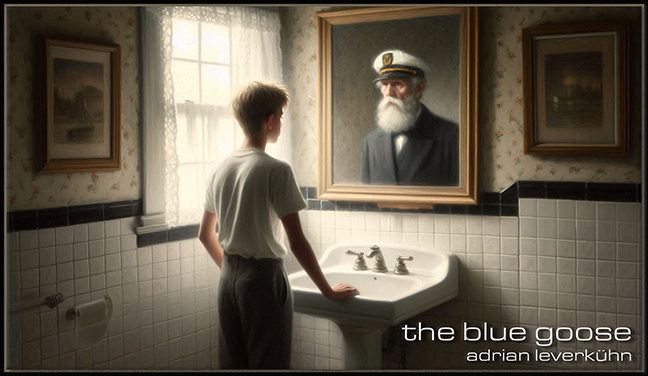
The Blue Goose

Part Two

Hank looked at the face in the mirror, at first unsure of what its was exactly he was looking at. Not his reflection, certainly, but when the visage began speaking his hands began to tremble, his knees to knock. Daisy saw the man in the mirror and the hair on the back of her neck stood on end – before she turned and scampered under the bed, farting twice before she disappeared.

But then Gertrude came over to him and she pecked gently along his lower thigh, at least until he looked down at her. She was looking up at him, and she kind of honked once, something she hadn’t done before. Then he looked at the man in the mirror again.

“Is that Gertrude?” the man in the mirror said. “Might I see her?”

Hank’s eyes were fluttering now, as he hovered along the edges of consciousness, but he bent over and picked up Gertrude and brought her up to the sink. And once there she looked up at Hank before she turned and looked at the sea captain on the far side of the glass.

“Ah, hello – my old friend,” the reflection said, and Hank was now pretty sure he was dreaming. In fact, he was certain, and said just that.

“I’ve never had a dream like this before,” he began, “but anyway…who are you?”

“Me? Well, I’m Eldritch Henry Langston, Jr., and I suppose that makes me your great-great grandfather.”

“Do you know Gertrude from somewhere?”

“Indeed I do, but now is not the time to speak of such things.”

“Are you on Pegasus?”

“I am.”

“Tarawa? Are you in the lagoon at Tarawa?”

The man nodded. “Yes, right where you left off, in my log entry.”

“How do you know that?”

“Because I saw you, boy. Hank, think of what you’re experiencing as being like echoes, or ripples spreading across a pond. Sooner of later those ripples gain the far shore and bounce back, and Hank, you must begin to see that your thoughts are like that, too. And for some reason, it seems that a few of us in the Langston clan are able to hear one another’s thoughts and experiences, even across vast gulfs of time.”

Hank nodded. “I was reading something about that at school a few weeks ago. Some researchers say they have proof that some feelings, bad feelings like dread or even like when you feel you’ve been someplace before, those are actually thoughts traveling backwards through time. So, do you still go by the name Henry?”

“I do indeed.”

“Can I come where you are?”

Henry shook his head. “Are you sure you want to? Your grandfather tried once, too, when he was your age.”

“What happened?”

“He ran into the mirror and smacked his forehead, that’s what happened. He was not at all happy about it, I seem to recall.”

“So Grandpa Bud has done this?”

Henry nodded. “There is one thing you must remember, Hank. It helps if you’ve just been reading an entry in the logs, from something one of us has written.”

“So…that’s why I can see you at Tarawa?”

“That’s correct.”

“And it’s 1861, right?”

“Indeed.”

“I wonder if the Civil War has started yet?”

“The what?”

“The Civil War. The War Between the States, between the North and South.”

“I have no knowledge of such a thing. Tell me what you know.”

So Hank told him what he’d been learning in class the past few weeks, about slavery and abolitionists and the agrarian south versus the industrialized north.

“What about the Navy? What is the Navy doing?”

“I think they were trying to blockade the south, to keep Britain and France from trading with the confederacy.”

Henry nodded. “Do we get in a war with the British again?”

“I don’t think so. Why?”

“Because presently there’s a large British ship entering the lagoon. When did this war start, Hank?”

“In April, I think. April of 1861. Is it March where you are? That’s the date of the last entry I read…”

“Yes, it is indeed. So even if this new war has begun, there’s no way this other ship could know. How long does the war last, Hank?”

“Until 1865. The month of May, I think. Are you still going to Japan?”

“Yes, indeed we are. With the successful return of Commodore Perry, the Congress has asked that we merchants send representatives to Japan with all due haste, yet I fear that’s why there’s a British frigate entering the lagoon at this very moment. I fear we may have trouble today.”

There was a commotion outside the captain’s cabin followed by the sounds of distant cannon firing, then explosions in waters near Pegasus.

Henry nodded and frowned. “I will see you soon, young Hank, but now I must take your leave…”

Swirling drizzles of condensation reappeared on the mirror and Gertrude turned to him from her perch along the edge of the pedestal sink, and again her eyes were enigmatically black and penetrating, focused on his own. Her head was barely moving; it was more swaying a motion than anything else, but as Hank stared into her eyes he felt something stirring inside, something less than a memory. Like a memory that wouldn’t take shape and form into words. A feeling like deja-vu, perhaps.

“Have we been here before?” he asked.

The goose raised it’s head until it was almost even with his, then she lowered her bill – in effect presenting her forehead – and Hank lowered his head to hers…until their foreheads were touching. Hank felt a wave of dizzying speed, a rush of kaleidoscopic light and he reached out with his hands to steady himself on the edge of the porcelain sink…

…yet then he felt his hands resting on warm wood…

He shook his head, tried to push the swirling light from his mind’s eye but it was as if he was staring through the wrong end of a telescope. As if he was looking at a distant world through a distorted fisheye lens. Everything was far away and black mists swarmed, but he saw Henry running from his cabin and up into the light, up into the fight, and he could just hear Henry telling his men to prepare to make sail, then Hank heard running on the foredeck, Henry getting other men to weigh anchor. Across the lagoon the other American ship, the Bunker Hill, returned fire with the small battery on her foredeck, and Hank could just see that she too was preparing to get underway. 

The black mist retreated and he smelled gunpowder in the air, heard seamen shouting, trying to make their voices heard over the sound of the almost continuous cannon-fire. He looked around, was suddenly aware that he was now in the captain’s cabin and that there was barely enough headroom for him to stand upright. He took a few steps and his forehead slammed into a deck beam and he grumbled, then stooped low and ran towards the stairs he had seen his great-grandfather running towards. He reached the stairway and grabbed hold of a bronze rail and took the stairs two at a time and in an instant he was on deck, standing beside Henry and one of Pegasus’s helmsman.

“Why are you here?” Henry shouted when he realized Hank was now by his side.

“I don’t know! What’s happening?”

“That British Man-o-war is firing at us…that’s what’s happening!”

“But you weren’t at war with Britain, were you?”

“No…we aren’t…” Henry sighed.

“So…what if they aren’t British? What if they’re pirates?”

Henry grabbed his “Dutch Telescope” and brought it to his eye; not one of the officers he could see on the British-flagged warship was wearing the correct uniform, but they were indeed wearing a uniform. A Spaniard’s uniform.

“Spaniards!” he shouted. “I will be poxed! Mr. Gilbert, get that anchor stowed. Mr. Talbot, get those foresails up, and prepare to tack to port as soon as we have some way on! We need sea room!”

“Aye, sir,” someone shouted.

Henry picked up a bullhorn that appeared to have been fashioned from brass or bronze, and he began shouting to Captain Anders on the Bunker Hill. “Anders! You there, Anders! Spaniards aft on the warship! Repeat, Spanish officers in command!”

Signal flags soon rose off Bunker Hill’s stern, first acknowledging the information, then more flags appeared, these stating Anders’ intentions to maneuver for a broadside, to engage the warship port side to port side.

“He doesn’t have room for that,” Henry sighed. “He’ll run aground before he makes sail!” He looked at the man-o-war, then at the water, and in an instant gauging both windspeed and direction as he ran through his options. “Mr. Gilbert, man the forward batteries and as soon as we tack prepare to fire, on my command! Mr. Cummings, you will go below and prepare the guns for a starboard engagement, and get the men to hop-to or they’ll be eating mud for their supper!”

Henry then handed the telescope to Hank. “Keep an eye on her officers,” he said, his voice steady. “Tell me when they react to our movements.”

Three large foresails dropped above Pegasus’s bowsprit almost simultaneously and began pulling. The ship began slipping through the water…

“You there, Anderson, go get the mizzen staysail organized. Mr. Lightfoot, get that mizzen up now, and keep her backed until we’re over.”

“Aye, Captain.”

“Hank, take the helm, would you?”

“Sir?” Hank replied, too stunned to think straight.

Henry’s eyes were majestic, like a falcon’s in a dive, yet his voice was still eerily calm. “Take the helm. Now, if you please.”

“Yessir.”

“And ready about, Mr. Talbot!” Henry shouted as another broadside, once again aimed at the Bunker Hill, fell short.

“Aye-aye, Captain!”

“Alright, Hank, make your helm left, about sixty degrees.”

“Left sixty,” Hank repeated. He looked at the compass card, saw their current heading was 340 degrees, so left sixty meant come to 280 degrees and so not quite due west, then he noted the four cardinal points on the compass and easily worked his new heading out. But the wheel was heavy! It took almost all his strength the turn it, and while Pegasus responded slowly his grandfather didn’t seem to think anything was amiss.

“Mr. Gilbert, ready your mounts to fire!” Henry paused, gauging the wind. “Right! Fire!”

Two cannons on Pegasus’s bow fired and while one round fell short one did not. This shot ripped through the mid-deck near the man-o-war’s main spar and a vast cloud of rigging fell away. A moment later her main mast slowly tilted and some crewmen could be seen falling into the water.

As the man-o-war began falling off the wind, Bunker Hill was unexpectedly going to be able to get off a full broadside with her port batteries, just as Pegasus started to come into range for a starboard broadside. Hank was trying to see the geometry of the engagement in his mind as he kept his eye on the compass card, and if he had it right it looked like an equilateral triangle was forming, with the man-o-war at the apex of the pyramid and the two American ships anchoring the base of the triangle – but with both their broadsides simultaneously coming to bear on the target.

“Mr. Cummings!” Henry shouted. “Prepare to fire – on my command!”

“Aye, sir!”

“Hank, another ten left please.”

“Ten left!” He kept the wheel over and he was sure he felt water moving over the rudder somewhere down there beneath the ship. 

“Mr. Cummings, fire the starboard batteries!”

Pegasus seemed to lurch sideways under the force of the cannonade, and his view off to the right disappeared in clouds of blueish-white smoke – then Bunker Hill’s broadside cut loose. She had two gun decks and even from this distance the shockwave from twenty-four cannons firing at once was staggering.  Smoke cleared and the man-o-war was ablaze, bright orange flames coming pouring out of the gun-ports on her starboard side. Men were diving overboard as the fire spread, and when Henry looked through his telescope he nodded, satisfied with the results of their combined attack. “There’s no one on her helm now,” he said, his voice almost a whisper.

“Mr. Cummings? Are we ready to come alongside and board her?”

“Almost, Captain! Ready to fire again, Captain!”

“Fire then, now!”

“Aye, sir!”

Maybe five seconds passed before Pegasus let loose her second broadside and that was the end of the man-o-war; a white flag was hoisted off the man-o-war’s stern just after Bunker Hill’s second broadside hit her bows. The ship’s once proud bow-sprit fell away, blown in half by Bunker Hill cannonade, this loss taking the foremast down in a loud series snapping stays and splashing timbers. With no one on the helm and no one sounding as the ship entered the shallow lagoon, the man-o-war slammed into a reef and shuddered to a stop – just as fire was engulfing her lower decks.

“She’s dead,” Henry sighed, “and ’tis a pity,” he sighed as he watched the enveloping chaos through his ‘scope. “Well, perhaps there will be something to be salvaged.”

Her powder ignited and the man-o-war’s main deck heaved upward and hovered there indecisively, then the ship fell in on itself, her back broken and fires beyond control. Within seconds she began to settle by the stern, yet only partially sinking down in the shallow lagoon, her spreading fires soon engulfing the remains of the ship. Hank could see a few dozen men swimming away from her, but Henry saw something more troubling still.

“Sharks,” he muttered quietly. “Mr Gilbert! Prepare to lower away the longboat! Sharks in the water! There!” he commanded –  as he pointed just aft of the smoking wreck.

And Hank smelled carnage everywhere. Black smoke hung over the water near the man-o-war, white smoke from cannons clung to Pegasus and Bunker Hill, and soon enough the screams of men fighting off sharks filled the air too, joining into a surreal, macabre cacophony of death.

But just then several people emerged from the passenger cabins just below, near Henry’s cabin in the aft section of the ship just below the deck he was standing on. Most were reasonably well dressed, indeed, one of the men looked rather prosperous. So did his wife.

And, Hank soon realized, so did the man’s daughter.

She was impossibly cute too, and though she probably was no older than he, she was so pretty it seemed as if the mere presence of the girl took his breath away. Her mother was dressed quite well in the fashion of the day, a long dress with ruffles and frills adorning her sleeves and neck, but her daughter seemed not to care for such things. She was dressed in simpler attire, a blue and white gingham skirt and a very plain white blouse…and no shoes! Indeed, her checked skirt looked recently made…

She had to be one of the survivors from the whalers lost off the Cape. As he watched her she indeed seemed a little too unsure of her surroundings.

“Mr. Gilbert,” Henry shouted, “will you get that boat underway, while there are yet men to be saved!”

Hank reluctantly turned away from the girl and walked to the starboard rail and he looked down at a well-kept skiff, perhaps twenty five or so feet long, as it pushed away from Pegasus. Four seamen started rowing and Mr. Gilbert stood to the boat’s tiller, steering for the smoldering hulk of the still burning man-o-war. The water beneath Pegasus was shockingly clear, a clear light blue he had never seen before, and certainly not ever in the Connecticut River below the house in Norwich.

And he could see the sharks now, too. Missile shaped torpedoes, silver-gray and fast, homing in on the struggling survivors thrashing about in the water, and when their dorsal fins gained the surface Hank saw that they were black-tipped reef sharks, known man-eaters and frenzy feeders typically found in shallower lagoons throughout the South Pacific…

The passengers walked to the starboard rail and looked at the unfolding carnage, but the women quickly turned away when they realized exactly what was happening out there. But not the girl, Hank noticed. No, she held onto the heavy wooden rail and leaned out just a bit – and he thought it looked as if she was studying the scene, perhaps trying to memorize the sequence of events.

But just then the girl turned and stared right at Hank. 

He was standing by the ship’s wheel and there wasn’t another soul nearby so he was certain she was looking right at him, and that time her gaze really did take his breath away.

Yet he held her eyes in his; he did not look away.

Nor did the girl, until she decided to walk up on the poop deck where he stood. 

It wasn’t far. No more than twenty feet or so, but she had to climb the modest stairs first and he watched her movements as she made her way up the broad wooden steps, as she walked right up to him.

“I haven’t seen you before,” the girl said, and it was more a statement than a question.

“I’m just visiting,” Hank replied – and he knew his words were a little evasive.

“But where have you been?”

“He’s been locked away, hard at his studies, Miss Tomberlin,” Captain Langston said as he came to Hank’s aid. “This is Henry Langston, Ma’am, and he’s my grandson. He’s aboard as a provisional midshipman, learning the basics of seamanship and navigation on this voyage.”

“Oh, I see,” the girl said, and Hank could clearly see that she believed not one word Henry had just told her. “So tell me, Master Langston, what is our current latitude and longitude?”

Hank looked at the girl and grinned, all the while trying to remember the position he had seen entered in the logbook he’d been reading in the library. “Our current position is one degree twenty-seven north latitude by one hundred seventy two degrees fifty six east longitude,” he said easily, “if I’m not mistaken.”

“Very good, Henry,” the captain beamed, then turning to the girl. “He’s been helping with my log entries,” Henry said, grinning. “As a matter of fact, young Henry, I thought you were supposed to be in your cabin doing your words?”

“I was, sir, but thought it best I come topsides during the engagement.”

“Yes, your presence did indeed prove useful. Very well, Master Henry, you’re dismissed.”

“May I stay topsides, Captain. In case the the physician needs a hand while tending to the injured?”

“Oh, yes. Carry on, then. Report to Dr. Chamberlain on the foredeck. And now Miss Tomberlin, you shall retire to your cabin before the injured have boarded. Is that clear?”

The girl noted the stern tone in the captain’s voice and she seemed confused, almost angry by that sudden turn. “Why must I do so, Captain Langston. I surely won’t be in the way?”

Henry now turned the full force of his manifest authority on the girl, accompanied by a withering stare. “Miss Tomberlin, shall I have Midshipman Langston escort you to your cabin? You are too young to view such atrocities, and I will not have that on my conscience!”

“Then I think you should have this boy escort me to the brig, Captain!” the girl huffed sarcastically, though she was smiling inwardly. The old captain had been so easy to manipulate, because now she’d be able to talk to the boy without his interference, and far from all the other prying eyes onboard.

“Midshipman! See this lady to her cabin, if you please, then report to Dr. Chamberlain.”

Hank grinned. This outcome was far better than he’d expected. “Aye, Captain!” he said, really getting into the act. “Miss Tomberlin, lead the way, if you please,” he added.

Nothing was far away on this ship, of course. Nothing was on a 170 foot schooner. Her cabin turned out to be fairly close to Henry’s, and was not much larger than the closet he and Ben shared back at the house in Vermont. And as she was indeed a shipwreck survivor, she now had few possessions with her. Indeed, what little she now possessed had been purchased for her in Valparaiso by Henry and the ship’s surgeon, Dr. Chamberlain.

“So tell me, Midshipman Langston, just what is a New England Patriot?”

“What?” he moaned, suddenly realizing he was still wearing his clothing from home…

“And what is that on your wrist?”

He reflexively moved one hand to cover the other, trying to hide the Apple Watch on his left wrist. “I’m sorry…what?”

“The device on your wrist. Show it to me,” she demanded – as she reached out and grasped his hand. Of course, as soon as she lifted it the watch activated and the display came on, and when she saw that she literally dropped his wrist and stepped away from Hank. “What manner of thing is this?” she whispered.

“It’s a device for telling time.”

Her eyes went wide and round. “You jest!”

“No, actually, it does. Here, look…” he said as he lifted his forearm up so she could see, but the time was still set to the New England time zone so the time shown was of course nonsensical, but the display was showing his heart rate and blood oxygen levels too, which were pulsing merrily away.

She looked at his wrist then at his eyes, and her gaze lingered there a while. “When did you come aboard, Midshipman?”

“Please, call me Hank, would you?”

“Hank? So, your name really is Henry Langston, like the captain’s? You are his relation?”

Hank nodded, but he wasn’t sure what he should or shouldn’t say to her, so he remained silent.

“And this shirt? Who are these Patriots?”

“A sports team in Boston, and now, if I may, I need to report to the surgeon.”

But as he began to step away the girl reached out and grabbed his hands in hers, then she leaned forward and whispered in his ear. “You can trust me,” she said to him with a gentle squeeze of the hand. “Whatever it is, you can tell me. I will never betray your secret, or your trust.”

And with that she let go of his hands. He looked at her again, then nodded.

“There’s something about you,” he said. “Something about your eyes. When I first saw you, well, I started to feel strange inside, almost like I was getting dizzy. Not like I’ve ever felt before, I guess.”

“I know. I felt that strangeness, as well.”

He nodded once, now feeling disoriented much more than before, so he then turned and left her alone in the tiny cabin, his mind a torrent of strange, inrushing emotions. He turned towards the only daylight within his grasp and made his way up on deck, now almost reeling. The next thing he felt was Henry grabbing him by the arms and carrying him into his sea-cabin, then the old captain placed him face to face with the mirror.

And it was the strangest thing, all these unfamiliar sensations.

At first he saw himself in the mirror, but then he saw his reaction from the far side, and a moment later he was standing at the sink in the bathroom of his grandfather’s house in Rhode Island.

“Hank?” he heard his grandmother asking. “Are you up yet?”

It was all he could do to hang onto the pedestal sink as he fought off wave after wave of vertiginous convulsions, and he could feel his thighs and shoulders twitching. Not gentle little twitches, but deep, jerky movements, and at one point he felt he was about to collapse right there beside the sink.

Then Bud was there, by his side.

“Looks like you picked up a bit of sun last night?” he asked – a little sarcastically.

“What?” Hank moaned.

“Don’t worry, boy, these feelings will pass soon enough, but the first time is hardest. Next time you go, you’ll be better prepared.”

“What?”

“Hank, you’re not the first of us to do this sort of thing. Even your father has been.”

“No…”

“Now hop in the shower. Your brother is loading the car right now, as we speak.”

Hank remembered now. Ben got new skis for Christmas, and he was going to get new ski boots before heading up to the Skiway tomorrow. 

But he wanted to see his mother most of all, yet he wanted to get back to Pegasus, too. Ben could ski all he wanted, but his mother had to be in bad shape to still be in the hospital after almost a month. Yet Hannah and Jennifer really didn’t seem to care at all. And Hank understood that, to a degree. His mother wasn’t their mother, and maybe it was as simple as that – but that felt wrong, too. Elizabeth had been taking care of Hannah and Jennifer like they were her own children, and their reaction to her collapse seemed to lack not just empathy, but common courtesy. So many thoughts. He felt so confused. Lost in a forest of disjointed dreams, framed by entries in a logbook. What was real, and what was a dream…?

And what was her name?

The girl on Pegasus? Tomberlin, wasn’t it? But what was her first name? And why had he felt so disoriented by her? She was the most beautiful thing he’d ever seen, but did beauty make people feel like that? It was like he couldn’t think…at all…when he looked into her eyes. Had he grown as insipid as all that?! 

But Hank – had – forgotten about his mom and dad the entire time he was on Pegasus, and he might’ve wondered why but for the lingering vision that girl’s mesmerizing eyes.

+++++

The psych ward at DHMC was located in a quiet wing on the third floor, not far from Judy Stone’s office, but even as he walked to his mother’s room Hank could tell there was something peculiar about this part of the hospital. There was something unfamiliar about mental illness in general, but now that the reality of suicide had come into their lives the dynamics of all their lives had changed. And Dr Stone was not at all sure she wanted someone as young as Hank on the ward, even if the boy was visiting his mother.

The sight of someone restrained in a bed is not a pleasant one. The sight of someone who has been refusing food for days is dramatically more unpleasant, and it is the sort of experience that gets seared into memory, especially to one so young. It is a sight that one simply cannot erase.

And try as she might, Dr Stone simply could not convince Hank that now was not the time to visit his mother. And Stone could not do so because Elizabeth Langston was getting close to death; indeed, she had been placed on a gastric feeding tube two nights before, yet somehow she continued to yank the tubes out. The night before this had very nearly caused a pulmonary emergency, when the yanking tube leaked the feeding solution into her trachea. Restraints were ordered, and Elizabeth had grown combative after her wrists and ankles were secured to the bed frame. 

But the woman was adamant. She wanted to die.

And she was willing to starve herself to death in order to do just that.

Like many teaching hospitals, Dartmouth Hitchcock had an Ethics Committee. Unlike most hospitals, this committee was made up of philosophy professors and graduate students working in the Philosophy Department of a highly regarded Ivy League school, and, as such, this committee took its work more than seriously. They had been called in to assist the treatment team trying to take care of Elizabeth Langston, and members of the committee had been observing her care for days. Yesterday, members of the committee had interviewed her, trying to determine the validity of her claim, that she wanted to die because her life had been so corrupt. Was this wish grounded in reality? What was the totality of her life circumstance? Had she been suffering chronic emotional distress for years, or was this the emotional acting out of someone who, perhaps, really had no idea what they were asking for? Did she, in the end, fully comprehend the consequences of her request? This case, the the head of the committee knew, would more than likely become a published case study, so their actions would be studied, and scrutinized – for years to come.

The patient was a librarian at the college and had long been regarded as a model of her profession – right up until the moment of her break. Her husband was a physicist at the college, her children were all regarded as well adjusted and three of them were academically gifted. On the surface, everything about her life was as unremarkable as could be. Nothing they knew explained all this…

Yet under the surface trouble had been percolating for years.

One of the first things Judy Stone learned concerned Elizabeth’s relationship with her parents, and to her father specifically. Stone was fairly certain, given her profile, that the woman had been sexually abused, and that this one feature of her upbringing had grown into the one causal item that had corrupted her ability to form close intimate relationships with others. Just a few interviews revealed that the woman’s pattern of abuse as a child had produced a uniquely crippled psyche. 

Elizabeth Langston had grown up consumed by the need to conceal her deepest wishes and fears, and so consumed was she by the need to conceal these things that she never revealed any of these things to anyone in her life. Classic repression. Easy to uncover, difficult to understand. And painful for all involved in her deceptions.

And it at first appeared that her children knew nothing about any of this, because – so far, anyway – Elizabeth had been unwilling to involve her children in her predations. Yet after a week in her care, Dr Stone was not so sure this was true anymore.

Ben was, by almost any measure, a gregarious, outgoing kid, and he had the potential to be a gifted athlete. Yet, and again by any measure, his academic performance had presented one red flag after another – and despite this his teachers had ignored each and every one of them. He was presenting with all the academic warning signs of someone being abused, from daydreaming to becoming moody when confronted, and already she’d learned enough to want to interview the boy. Yet even so, doing something so invasive over Christmas was hardly the best time to do something so unsettling, as who knew what might be uncovered…?

+++++

Bud and Hank got the heat going as soon as they arrived at the house in Norwich, yet the next thing Hank saw was evidence that someone had been in the house. Nothing was wrong, specifically, just certain things seemed out of place. But one quick trip to the garage revealed that their father’s Volvo was missing, and Bud immediately called the police. Ellen took Ben to the ski shop in Hanover, which seemed to settle the boy down a little.

But no sooner had the police arrived at their house than the Volvo turned up, and it was being driven by none other than Henry Langston. The police soon left and Henry enlisted his children to unload groceries from the back of his Volvo, and all the while Bud filled in his son on what had been going on over the past month, and Christmas, while he had been away.

“Has anyone been to see Elizabeth?” Henry asked.

“We were advised not to come until after Christmas. Ellen has talked to Elizabeth’s psychiatrist almost daily, but no one has talked to the children about any of this – yet.”

Henry nodded. “Well, I’m sorry you two were pulled into this, but thanks for being there for them. I know they had a great Christmas.”

“Hank has become very special, Henry.”

Henry turned to his father, because he knew what that meant. “Already? Where did he go?”

“To Pegasus, when she was at Tarawa the first time, with Henry on his first Pacific crossing, the trip he made in 1861 as Master.” 

Henry smiled. “So, he met Linton Tomberlin. I bet he’s in love.”

“You were too, I seem to recall.”

“I was. No doubt about it.”

“Where have you been, if you don’t mind my asking?”

Henry pointed at the sun with a nod of his head. “Things are getting busy up there.”

“Oh?”

“Come on, Dad. Let’s fire up the Egg and put on some steaks. I got stuff for salad, too.”

+++++

Daisy was walking beside Hank, Gertrude was perched on his shoulder, and the three of them were once again walking up the hillside behind the house. There was a solid foot of snow on the ground and Daisy loved the stuff; she plowed along, stopped to sniff for grouse under fallen trees and around fluffy old snow covered pines, and they walked along until they came to one of the old Quaker churches formed by planted pine trees. Planted more than a century before, these churches were now little more than wildlife sanctuaries, but few knew of their existence, let alone what they had originally been intended for.

Pines had been planted in a broad cruciform, but only in outline, so now this church had walls of towering pines swaying in the breeze, and roofs of sheltering boughs covering the grassy interior, yet anyone could see the beauty of the resulting structure. Perhaps fifty people could have been seated inside the space, if the structure had ever been used as such. But probably not, for time left the planted chapel to grow on its own. And now, this church was occupied only by deer seeking shelter from passing storms. The animals bedded down up under the transept on soft grasses, and as Daisy walked around the area she sniffed around the flattened area lost in the scent of sleeping deer, while Hank, as he always was, seemed entranced by the sense of desolate space. Deer had found shelter here, perhaps for decades, and it was obvious why. With a foot of snow cover out beyond these trees where the deer lived, their landscape was a bitter test of survival, yet inside this sanctuary there was still soft grass to be found, and shelter from the howling winds and driving snow. In a way, Hank mused, this little chapel was more attuned to God’s word than anything yet fashioned by the hands of man.

And there were dozens of these chapels scattered among the settlements that had sprung up along the Connecticut River. Had these early settlers visions of using these chapels as places of worship one day, or had they meant them for wildlife to use? No one seemed to know, as few historians even knew of these chapels, but what a nice thought it was. He sat and looked up at the sky, at white clouds scudding along up there beyond the breeze, then he looked around as Gertrude hopped down from his shoulder and walked around pecking at the grass. He could just make out the shape of the cross in the sentinel-like formation of trees, and whoever had planted them had done so following a rigid formula.

Hank had found another such chapel when he was on a Cub Scouts camping trip two years before, and this second chapel had been near Mount Ascutney. He had counted the pines as he noted their placement, the same shape of a crucifix. The ‘arms’ of the transept were each planted with seven pines, with seven paces between each pine. Seven pines above the transept, fourteen below, so each arm of the crucifix had been planted in multiples of seven – but why? And the head of each transept pointed east, due east. Why?

Daisy came over and flopped down beside him, her nose lingering over the flattened grass, her eyes searching hidden contours and fleeting shadows. Gertrude extended her wings and tested them with a few tentative flaps, but then she just flew away.

And Hank watched, helpless as his expectations gave way to her instincts. Daisy looked up at him, her eyes suddenly full of reflected sadness. Like ripples spreading across a pond…

“Well…holy crow…” he muttered. This was turning into one bad day. He couldn’t see his mother and his father seemed to be living in another world. Certainly not this one. But…now this?

‘Has the universe decided to take a crap on me today?’ he sighed.

He stood and looked around the little chapel again but now, suddenly, this forest enclave was nothing more than a curiosity, and a very lonely one at that.

“Come on, girl,” he said to Daisy as he patted his thigh, the sound mostly muffled by the thick mittens on his hands. He made his way out the hidden opening and stepped out on the game trail, then he looked down valley towards Norwich and White River Junction, watching the last of the day’s sun falling on the summit of Mount Ascutney on the southern horizon. It would be getting cold out soon, real cold, and he hoped Gertrude would find someplace warm and safe…

But he needn’t have. 

He heard fluttering wings then felt her light on his shoulder and he turned his head just enough to meet her gaze. “I sure hope you don’t do that again,” the boy said, “at least not while I’m alive.” He took off a mitten and reached up, rubbed the top of Gertrude’s head, and she bobbed along on his shoulder as they made their way down through the crunchy snow back to the house.

His father and grandfather were out back on the flagstone patio standing beside his dad’s smoker, a huge green thing shaped like a dimpled egg, and smoke was curling out of the little cast iron chimney on top of the egg. He had smelled burning charcoal and searing steaks from a quarter mile away and it hit him then, that was the smell of home, at least his home on the occasional good days the family had usually enjoyed in spring and fall.

Other than Christmas, winters in the Upper Valley had been bleak and dreary, but his dad said that was because Hank had simply grown so comfortable while being down on the water – all summer long. That was true enough, but starting in November it seemed like everyone had the Upper Valley Crud, a combination of upper respiratory and sinus infections, that didn’t leave until April or May, and that just made the dreariness all that much worse. So far he’d only had a mild case this year – yet it had cleared up as soon as he got down to the sea air in Rhode Island. He felt sure he’d start feeling crummy again soon, because he felt the sea in his bones. It was where he felt he belonged…

Hank kicked the snow off his boots as he walked up onto the patio, and as usual Gertrude fled as soon as she took a direct hit of smoke from the grill; she glided over to the patio door and tucked her head under a wing, waiting for Hank to come to his senses and get out of that nasty purple haze and let them both go inside, where they belonged.

His grandfather looked up at the commotion and smiled at Gertrude. A very special smile.

And then Hannah walked into the kitchen with Jennifer and Ben, followed a moment later by Ellen. Ben had his new ski boots in hand, carrying them by a little plastic handle looped through the upper buckles. The were the newest Head competition boots, white and very slick looking. Hank thought they even looked fast, ‘and at that price they should,’ he muttered.

Ben took off upstairs like a rocket, lost in fevered dreams of racing down Swiss mountains.

Ellen and Hannah started pulling stuff from the fridge and tossing a salad, while his dad poked the steaks on the grill, and after adjudging the bounce he turned them one last time to finish them off with a baste of lime and butter. A minute later he pulled them off the fire and put them on a preheated platter, then everyone went inside. Hank finally slipped out of his snow boots and woolen mittens, stopping to warm his hands up by the wood stove before heading into the kitchen to help set the table.

Which fell to Jenn and Hank that night. Then again, it always seemed to fall to them, but isn’t that just the way it is sometime?

“How was your walk?” Jenn asked as she handed him the napkins, her manner as easy as it ever had been, almost as if she didn’t care about a thing in the world.

“Gertie flew off while we were out. First time, too, but she came back a few minutes later.”

“I bet that was scary. You think she’s ready to go live in the wild?”

“I’m not ready for her to.”

“Okay, but what if she is?”

“Then she is. I won’t stop her. I couldn’t…”

“She was born in the wild, you know, so maybe she would rather be free…?”

“So why did I run into her, Jenn? Why did she attach herself to me?”

“Because you saved her life.”

“Exactly.”

“Do you think that means she belongs to you now?”

He shrugged. “I guess not…but maybe I belong to her.”

“Oh, you do? Well, I guess I would feel like that, too, if I was in your place.”

He looked at her and nodded. “Thanks. She means a lot to Daisy and me.”

“Thanks for what?”

“For understanding.”

“Do you remember when Ben left the back door open and Daisy ran off?”

He nodded. “Yeah, sure?”

“Well, she came back on her own, didn’t she? And she’s never done it again. I think maybe she learned her lesson.”

“And that was?”

“That it’s dangerous out there, and that you take care of her. Maybe she just needed that one little taste of freedom, you know? To understand just how good she has it with you. And maybe Gertrude needed that too.”

He nodded. “I hope that’s it.”

Ellen and Hannah carried in platters loaded with steaks and a big spinach soufflé, then Bud came in carrying the salad bowl, and soon everyone was seated around the dining room table passing plates around and talking – just like families everywhere do over dinner. But then, after a few minutes of that normalcy it dawned on Hank – that this was the first time they’d had a family dinner without their mom around, and he realized he felt all hollow and empty inside because she wasn’t with them.

“Has anyone been to see Mom yet?” he asked…and the almost carefree atmosphere around the table shattered into a thousand pieces as everyone fell to the floor.

But seeing this, Ellen replied casually, and she casually saved the evening. “Oh, I did,” she said, smiling, “and Dr. Stone is going to come by later tonight to talk with all of us. I think she wants to talk to us as a family, instead of in her office. That was nice of her, I think. Don’t you, Henry?” she added, looking her son in the eye as the question lingered in the air – apparent.

Hank’s father nodded, but he didn’t look up from his steak.

Then Bud looked at his wife. “Do we need to call her first?”

“I have her number,” Ellen said, grinning, “ and I’ll give her a call when we’re finished here.”

Bud grimaced, hating to spring this on the kids so fast – but, he thought, maybe this was the best way…? He wasn’t so worried about Hank, but Ben was another matter.

Ben had barely mentioned their mother, not since that night right after Thanksgiving. He had retreated into his daydreams since then and, Bud thought, he had been acting almost like he felt guilty about something.

But then, just moments after that singular thought crossed his mind, the hair on the back of his neck stood on end. Something wasn’t adding up right now, was it?

He sat back, and having suddenly lost his appetite, he did his best not to look at Ben.

“So, Ben,” he finally said, trying to change the flow of his thoughts, “which boots did you settle on?”

“The Head Comps, which are supposed to the best for GS.”

“That’s Giant Slalom, right?”

Ben nodded. “Right. Faster than slalom, not as fast as Super-G, or Downhill.”

“I thought you did pretty good on the Slalom course at the Skiway last year,” Henry said. “Why the change?”

“Slalom is getting too technical,” Ben said, reciting something he’d read in a magazine somewhere. “Besides, I want to go faster but I can’t join the Downhill squad until middle school. If I do good at GS, I might have a shot at making the squad.”

“How many from the program made the U.S. Ski Team last year?” Ellen asked, now regarding her husband carefully.

“Four made the Alpine team, and I think three made the Jumping squad. I don’t know how many made the Nordic team, but it was a bunch.”

“And that’s what you aim to do?” she added.

Ben nodded. “Yup, sure is.”

Henry looked up at that and smiled. “Good to have a goal like that. You put in enough hard work and who knows how far you’ll go.”

Hannah and Jenn were starting to feel a little left out and Hannah definitely wanted to take some of the spotlight now, so she cleared her throat and… “So, Dad, I got my second SAT scores in the mail. I got a combined 1550!”

Henry looked up at her and beamed. “Damn! Now there’s something to be proud of, kiddo! You get any letters yet?”

“One from NYU, one from Columbia. Do you think we could go down soon and take the tour?”

Henry thought a moment – which for him was difficult, as taking a college pre-admissions tour had nothing at all to do with quantum mechanics – but then he remembered where he was and nodded. “The week after New Years. Think you could manage that?” he said.

Hannah squealed with delight. “You betcha!” she said, suddenly ecstatic with this sudden turn of events.

Henry looked at his father then. “Dad? Think you could come with us?”

“Of course.”

Henry turned his attention to Jenn, who hadn’t spoken at all during their dinner. “And Jenn, did you get your PSATs?”

She nodded. “I did, yes, but I took the regular SAT, remember?”

“Oh, right. I knew that…! And…?” her father asked.

She looked at Hannah then shrugged. “Could we talk about it later?”

“No need to be shy around this table, young lady,” Bud said, prodding her a little.

Jenn sighed. “Sixteen hundred,” she sighed, looking down.

“But that’s a perfect score, isn’t it?” Ellen asked.

Hannah visibly deflated and now their father understood Jenn’s reticence.

“Did you get any letters?” Henry asked. 

“Three so far. Harvard, Yale, and Princeton.”

“Nothing from Dartmouth?” Henry asked.

“Yeah. Them too,” she added with a quiet scowl. “And a couple others, I guess.”

Ellen watched the old dynamic take shape, yet she also kept an eye on Ben – who seemed to get smaller and smaller as the girls’ scores took precedence over his ski racing. Only Hank seemed genuinely proud of Jenn and Hannah, even more so than the girls’ father, and that just piqued Ellen’s curiosity.

“Hank?” she asked. “Did you tell your father about your Christmas present yet?”

Bud cleared his throat and shook his head just a micron off center. His gift of The Blue Goose, the Langston 28 in the finishing shed, was still not open knowledge among the kids, at least not yet. Hank followed the exchange with his eyes and shrugged.

“I’m sending him to sailing camp down in Newport next summer, Henry,” Bud said…which was true, of course, but it also postponed the inevitable outbursts of sibling jealousy a little longer.

“Oh? Which one?”

“The racing camp at U.S. Sailing, in Newport.”

Henry nodded. “470s, right?”

Hank nodded. “Yessir. Same as you, when you went there.”

“Good. Fun little boats.”

‘Whew!’ Bud thought. ‘Crisis averted. For now, anyway.’

Jenn cleared her throat and looked first at Bud, then at Hank. “So, when are you going to tell us about The Blue Goose?”

Bud scowled and looked down at his hands. Ellen smiled triumphantly, because she detested secrets. Hank shook his head, then threw a couple of hate bombs in Jenn’s direction.

“What’s The Blue Goose?” Henry asked.

“A 28 we took on trade last summer. Ben Rhodes and some of the team cleaned her up a bit, and then your mother and I decided to give it to Hank for Christmas.”

“What?” Hannah cried. “A sailboat?”

“Dude! That’s awesome!” Ben said, smiling broadly while he fist-bumped his brother.

Jenn smiled. ‘Mission accomplished,’ she told herself, as always intent on upsetting the applecart.

But Jennifer’s grandfather studied her, too, and he wasn’t at all sure he liked what he saw in her eyes.

+++++

Dr. Judy Stone, Elizabeth’s psychiatrist, arrived after the kids had finished helping Ellen get the dishes cleared and into the dishwasher, and after greeting everyone the physician asked to talk to the adults for a moment. Ellen and Emily Stone, Daisy’s vet, took the kids upstairs and they all huddled together, all six of them, and as it was the largest, they did so in Hannah’s bedroom. Emily asked the boys how their Christmas went and so of course Jennifer had to go into one of her passive-aggressive fits of jealousy by blurting out the details surrounding Hank’s very own sailboat. Ben, of course, couldn’t talk about his new skis and boots enough, while the girls acted like spoiled brats, bemoaning the fact that all they got were new laptops. 

Ellen, on hearing this, decided she’d had enough. “Hannah? You do recall you have a graduation coming up? What do you suppose your grandfather will get you for the occasion? But oh, wait, how do you suppose he’ll think about that if he hears you talking like you are right now?”

It was flipping off a light switch, Emily Stone thought. The girls were instantly back on their best behavior, smiling pleasantly as if nothing had happened, and in a way the veterinarian admired their resiliency. Yet, in another way, she now regarded them warily. Hannah’s plastic expression was bad enough, but Jennifer was showing the obvious signs of middle-child syndrome, acting out her petty jealousies while being remarkably clever about how she masked her inner feelings. Jennifer was, she thought, maybe the most toxic element in this family. Maybe – the – toxic element. Watching these kids, and listening to them, were of course why she had come this evening.

Judy had mentioned her misgivings about Ben to Emily – so she could watch for signs of trouble, but now she wasn’t so sure that he was a problem. She watched Ben carefully but he really seemed to be a perfect example of a happy-go-lucky misfit, always living in the moment and without a care in the world – beyond next seasons lineup of skis and ski boots. And, she knew, he probably wouldn’t change until he was seventy years old. If then.

Hannah seemed a simple narcissist, self-centered in the extreme but not particularly dangerous. Despite her tendencies to see the world as a series of Pavlovian responses to immediate wants, she didn’t appear to be as malignantly manipulative as Jennifer – but that was just a simple assessment after a half hour of watching the kids talking to one another. Jennifer, on the other hand, was studying what everyone said, always looking for an momentary advantage or a weakness to exploit, and the girl was smart. Possibly a sociopath, definitely way up there on the narcissistic personality disorder spectrum, Emily soon began to feel uncomfortable around Jennifer. Worse still, she was now sure the girl’s grandmother felt that way, too.

Which left her own personal favorite, Hank.

The boy seemed like a perfect son, and like anyone who had taken a bunch of psych classes as an undergraduate, when anyone appeared perfect it was time to raise the alarm.

Yet as they talked it was obvious his only concern was for his mother, but also, of course, his parent’s deteriorating relationship before her collapse. These feelings were natural enough and quite understandable, yet she could tell he was holding something back. Something big, something very important to him. Maybe even more important than his mother.

And she wondered what that could be…then it was time for all the family to talk to Judy.

+++++

One of the most troubling aspects of Elizabeth Langston’s family background became apparent as soon as she was committed for psychiatric observation. When contacted, Elizabeth’s mother expressed no interest in coming to visit her daughter, and it turned out that Elizabeth’s father was deceased. She had two sisters, yet her mother seemed reluctant to pass along any sort of contact information. After her first two attempts failed, she enlisted the support of the police department in Boston, who were able to uncover the necessary information through other means. Judy called both of them, and two days later they both made the trip to Hanover. Henry picked them up at the airport in Lebanon and took them to the Norwich Inn, because he wanted them close to the boys…just in case.

Because after his meeting with Judy Stone two nights ago, Henry was now all too aware that his wife was skating along the razor’s edge between life and death. More troubling still, Elizabeth had chosen death and it was only through the nonstop efforts of Stone and the Ethics Committee that his wife was still alive. The committee had come to the conclusion that it was simply too soon to discontinue life saving interventions, because Elizabeth’s case still fell into the “acute” phase. If Elizabeth could maintain that the pain of her existence was simply too great to bear, and do so over an extended period of observation, the Committee’s recommendation might change. But not now, not yet.

Oddly enough, it had come as a shock to Henry that his wife had family, and now he wanted to know more about his wife’s childhood almost as much as Judy Stone did. It had always been a ‘red flag’ that she didn’t have any family, and he had blithely accepted her explanation that they had been gone for years, so she had flat-out lied when she maintained she had no other family. Looking back on that now he could clearly see the error he’d made, if only because he was now learning that his second wife was a master of disguises. Henry could see deeper patterns emerging, too. Elizabeth had grown accustomed to doing whatever was necessary to keep people from uncovering her past, from lying about her family to refusing to talk about her childhood, and now that he could see the tumblers falling into place he was dismayed about his careless approach to dating her.

But now he needed to know: what was it about her past she wanted to conceal?

With that question now out in the open, both Judy Stone and Henry decided it was time to contact Carter Ash, to see if she had talked to him about any of these things. Still, it was decided that Judy would handle all these interviews, simply because Henry was in fact emotionally compromised where Ash was concerned. Yet it turned out that Ash was as much in the dark as Henry had been; Elizabeth had in fact told Carter that she was a widow, and when he found out at Thanksgiving that this was a lie, she had evaded his further enquiries by saying he had simply misunderstood her, that she was merely separated. Carter had begun to distance himself after that, yet when he learned what had happened to her, he was concerned for her well-being, and for that of her kids.

Hanover was a small town and Judy knew that soon enough word would spread that the children’s mother had tried to kill herself. Maybe news that Elizabeth was a suicidal in-patient wouldn’t spread as quickly, so that would need to be a consideration going forward, which was why she was beginning to think that the boys might do better at their grandparent’s place in Rhode Island, at least for the remainder of this academic year. Hannah and Jennifer, on the other hand, were both too close to graduation, and pulling them out of Hanover High would create more problems than it might solve. She spoke to Henry about these possibilities and he agreed with this thinking.

But Henry asked his dad what he thought.

Perhaps many grandparents would rebel at the merest mention of taking on such a burden, but not Bud, and certainly not Ellen. In some ways this was like a dream come true to Ellen, as she missed having children to take care of on most any morning. She had always loved getting up early and making breakfast for her children, then getting them ready for school. She needed something like that, and perhaps more than either was willing to admit, but Henry was nonetheless surprised by the faint little smile he thought he saw cross his father’s face when he brought it up.

“Why don’t we ask the boys first?” Bud said.

“Because,” Henry sighed, “Hank won’t have a problem staying down there with you, but Ben will. Ben won’t want to move away from the slopes, or the ski team.”

“Then he stays,” Bud said with a shrug. “And if he stays, we shouldn’t single out Hank. He might get the wrong idea…”

“Mom? Would you mind moving up here for the rest of the school year? At least until Hannah graduates?”

Ellen looked at Bud and he could see it in her eyes.

“Of course she can,” Bud sighed, even knowing how much she would be missed in the front office. “But maybe Hank could come down on weekends to help me get caught up…?”

Henry nodded. “I can handle that. Yeah, especially with that new boat. I like it, Dad. That’ll keep him focused.”

It never occurred to either that Hank was the real empath in the family, and that all the doubts and uncertainties surrounding his mother and her illness were beginning to crush the life out of him.

+++++

Carter Ash called one afternoon and asked Henry if he could come over to the house, and he only said it had something to do with his own son. Given the circumstances, Henry reluctantly agreed. 

It was New Year’s Eve, of course, and Ben was just getting in from the Skiway when Carter and Huck arrived. Henry met them out front, mainly to ask what all the drama was about, so he was a little amused when he learned it had to do with Hank having mentioned that he would get Huck a brochure detailing the Langston 28, which seemed to possess the meaning of life to Huck…in the boy’s current state of mind, anyway.

‘Oh, my,’ Henry thought, ‘I can’t wait to see this…’

So Henry walked with them inside and asked Hank to come down, and as soon as Hank realized what this was all about he got into it, too.

“Well, my Grandfather is here this week. Would you like to meet him? And maybe he can bring one up for you one weekend, too…”

“What’s this?” Bud asked.

“Oh, Huck has a real thing for the 28,” Hank began. “I kinda promised I could get him a copy of the brochure, too.”

Bud had at first regarded this boy with cool detachment, but when he heard this news his smile said it all. “A brochure, eh? What about that 28 we have in the finishing shed? Maybe he’d like to come down and take a look at her one weekend…?”

Huck was beside himself now, for this was like a dream come true, and he wheeled around and turned to his father. “Dad? Could I?”

Carter looked at Hank, then at Henry. “Fine by me,” Carter said. “Are you sure you don’t mind?” he asked Bud.

“Love to have him. I’m going down tomorrow, so if you can get him over here by noon? We’ll bring him back in a couple of days, unless you want us to just keep him,” Bud said, adding that last bit with a ferocious grin, mainly for Huck’s benefit – but Carter grinned too.

“I think he’d love that. We’ll be here in the morning.”

“How much stuff should I bring?” Huck asked.

“Would two nights be okay?” Bud asked Carter.

So a few minutes later a very happy Carter Ash, Jr., departed, no doubt with visions of sailboats dancing in his mind, and Hank smiled as he watched them leave.

“That was merciless, Hank,” Bud said, smiling appreciatively. “You did well.”

“Think we should get him a brochure, too?”

Bud rolled his eyes as he went to help Ellen in the kitchen, repeating “Merciless,” one more time, just for good measure. “The kid has a decent sense of humor,” he told Ellen as he got to work.

“And I wonder where he picked that up?” Ellen muttered under her breath.

+++++

Henry was sitting in a conference room at the medical center, sitting with Rebecca Nichols and Mary Stuart, Elizabeth’s two sisters; they were waiting for Dr. Judy Stone to arrive, and both women were nervous. By tacit agreement, everyone had refrained from talking about Elizabeth until they were joined Elizabeth’s treatment team. Sitting there with the women, Henry was only getting more curious as the minutes passed.

And while Dr Stone appeared a few minutes early, the rest of the team dragged in more slowly. After introductions were finally made, Stone went in with guns blazing; she asked the girls point-blank what their childhoods had been like, especially regarding their father.

Rebecca looked away; Stone saw the woman was biting her lower lip and her left eyebrow was already twitching. Mary, the oldest of the three, nodded and sighed, taking the lead – as if this was the role she was used to taking when it came to these things.

“Did you ever see the movie ‘The Great Santini?’” Mary asked – to no one in particular.

“I read the book,” Stone replied.

“Well, that was our father. On a nice day. Except when he got drunk.”

“So, was your father a Marine?”

“No,” Rebecca sighed. “Our father was also The Great Pretender. I think the longest job he held was working at a Pontiac dealership in Worster, at there used car sales lot. He could schmooze your ears off, tell you anything about everything, and probably ninety percent of what he said was made up on the spot. He told all our neighbors The Great Santini was about him, that he had been some kind of hotshot pilot in the Marines.”

Judy Stone nodded, because it fit what she knew so far. Elizabeth was shaping up to be a pathological liar, so just like her father, and that meant anything she told anyone on the treatment team was suspect, and her statements would have to be verified – one miserable lie at a time – because sometimes a kernel of truth was hidden inside these lies, and that one truth often held the key to successful treatment.

Stone looked at the girls, and she hated to ask this next question but she had to – even though she was already sure she knew the answer. “Were any of you abused?”

“You mean sexually?” Mary asked, looking down at her hands.

“Sexually. Physically. Verbally. It really doesn’t matter which. I’m looking for patterns, and I need your help to see what I may have missed.”

“Does being pushed down and fucked in the ass count?” Mary asked, her voice a feral snarl.

Stone met the woman’s cold fury head-on. “Did he do this to you? Or to Elizabeth?”

“How ‘bout all three of us? Do we get extra points that way?” Mary snarled. So, she was using brutal sarcasm to mask the pain and embarrassment she’d been hiding all her life.

Stone held her gaze, nodding inwardly. But if Mary’s resistance was taking shape as angry sarcasm, helping her to keep distance from the pain she was re-experiencing under the watchful gaze of a half dozen shrinks was the least she could do. This wasn’t unexpected, yet she wasn’t fully prepared for what the women told her over the next hour and a half. Tales of being sodomized, forced into oral sex with her father and his friends, of being sexually brutalized with everything from broomsticks to beer bottles. When Mary was in her teens he’d tied her up in a box he’d built in their home’s basement, then he’d had even more friends from work come over and take turns sodomizing her. Mary found their mother down there one afternoon, bruised and bleeding after her father and his friends had done the same to her. And their father had gone on like that for years. Then there were years of silence, years spent learning how to deceive, how to cover up their feelings. Mary had somehow managed to get out of the trap after high school, and she’d fled to Northern California, ending up on a commune growing weed. She broke away from that group, which was little more than a pseudo-religious cult, and she made it to Seattle where she eventually finished college. She worked as a coder at a large software company there, and claimed she had a partner.

Rebecca experienced many of the same violations, but eventually their father began having his friends and their wives over for swinging parties in the basement, where she and Elizabeth were passed around like party favors. And it happened that their mother participated in those little get togethers, too.

Their father’s abuse took on many other forms, as well. Usually verbal abuse, but occasionally beatings when they didn’t do as he said or when they stayed out too late. Everything in their father’s house was a capital offense. Everything always felt like life or death, like there was no in-between, just his way…or else.

Stone soon regretted not interviewing the women separately, as now she was simply not sure how much of this was rehearsed and how much really happened. If Elizabeth was a pathological liar, the odds were pretty good that both of these women were too, assuming even half the things alleged were true. That, however, would be law enforcements job.

Henry had no way of knowing that the things he was hearing were actually fairly routine stuff for attending psychiatrists at any medical center in the country. These types of assaults were so common it almost felt mundane to the professionals in the room, but the more he heard the sicker Henry began to feel. His wife hadn’t been raised in a traditional, loving family; she had been kept as a pet by monsters, and it was a wonder she had been able to function at all. On any level.

And the more he thought about the things his wife had endured, the things she had compartmentalized and walled-off from him, the more he began to love her. She had pretended as long as she could, until the facade began to crumble under the weight of her dissatisfaction with life. In her world she must have felt unloveable, because no one treated anyone they loved with such careless disdain. Certainly not a parent.

“Henry?” Judy Stone asked, after she saw the expression on his face. “Are you feeling okay?”

He shook his head. “No, no I’m not. I’m sorry, but is there a restroom around here?”

One of the shrinks got up and both men left the room. Henry did not come back.

And Judy began what amounted to a painful cross-examination of the women’s stories, checking off questions and looking for inconsistencies in their retelling. But when nothing emerged after almost an hour she concluded that the women had been as truthful as possible, given the circumstances.

“Are either of you in treatment?” she asked as they wound up the session.

Both shook their head. ‘Survivors guilt,’ Stone knew was one more piece of this evolving puzzle. They blamed themselves as much as they blamed their parents, and without help they always would. She discussed treatment options, offered to help them get funding from foundations that assisted women in their position. Neither was interested. Judy gave them her card, told them to keep in touch if they remembered anything else of importance.

And that was it. Stone now knew what she needed to know.

Two members of the Ethics Committee had attended, and both were a little shell-shocked.

“They make a strong case for chronic dissociative disorder,” they said. “It will be harder to deny Elizabeth’s request to stop gastric feeding.”

Which meant after a childhood full of traumatic abuse, the system was now going to allow her father one last victory. There would be no accounting. No justice served. Just a woman alone in a hospice bed slowly starving herself to death as her demons fluttered overhead, waiting for their last moment of torment together.

But Judy Stone wasn’t prepared to stop trying. Not yet, anyway. And now she knew she had a strong ally.

+++++

Bud listened to Hank and Huck chattering away just like eleven year old boys – and from Hanover all the way to the coast; by then he was he was about to lose his mind. They were too young to talk about girls, too old to talk about playing with toy soldiers, and just about the perfect age to talk nonstop about video games. He did what he needed to do and turned on has satellite radio to channel 72, the Sinatra channel, and zoned out to the classics. His generation’s classics, anyway. The boys were in back, plugged into their PlayStations – or whatever they were called these days – and from time to time they jerked and twitched like they were having epileptic seizures as they dodged make-believe bullets or crazed demons. Every time one of them burst out in one of their convulsive outbursts Gertrude and Daisy dove under his legs, which made for interesting driving.

He took 91 down to Springfield, then hopped on the Mass Pike all the way too his exit, and as two in the afternoon came along he thought about his son sitting through that meeting with Dr Stone and Elizabeth’s sisters, and his mind drifted through all the implications of what might be uncovered – while he navigated the usual insane traffic on the turnpike.

Drivers in and around Boston weren’t called Massholes for nothing, he told himself each time a passing SUV cut him off to exit without signaling, and he couldn’t wait to get on the 146 to Providence. The closer he got to the Providence River the more at-ease he felt, and they made it to the boatyard about two hours after the sun set, just a little before six that evening. They stopped off for – what else? – pizza, before going to the boatyard, and his house. He was exhausted, but then again he was old. At least that’s what everyone told him.

Of course Hank wanted to show the kid The Blue Goose, and he couldn’t help but give in – even if it was almost nine at night by the time they had unloaded his old Blazer. He grabbed a flashlight from the drawer by the back door and they walked through fog just rolling in across the boatyard, and once he unlocked the door to the finishing shed he let Hank lead them in. He knew where the light switches were by now, and Hank flipped them on and then waited for the reaction.

Poor Huck. He had it bad. 

He walked over to the hull and ran his hands along the boot stripe, then bent low to look at the centerboard aperture before walking aft to check out the rudder, and all the while he was reeling off the 28s vital statistics, everything from the displacement to length ratio to the sail area of the main. Bud was actually impressed.

“Do you think the owner would mind if we went onboard?”

“No, I don’t mind.”

“Not you, silly. The owner? Do you think he’d mind?”

Hank shrugged, then pulled out his key and handed it to Huck. “No, I don’t mind. Go on up.”

Huck’s double-take was textbook, the jaw-drop as satisfying as Hank had hoped.

“No way,” Huck cried.

“Way,” Hank replied, grinning.

“Well…fuck me…”

Bud laughed then found a chair and watched the boys go up the ladder and start crawling all over the deck. After a good half hour they disappeared down the companionway and the lights came on down below, and just then the phone in his pocket started chirping. Bud looked at the display and remembered he’d told Henry he’d call when they got in…

“We just made it, Henry,” he said before his son said a word.

“Traffic that bad?”

“We stopped off at Rocco’s for a couple of pies. Ya know, I forgot how much pizza an eleven year old can put down in ten minutes. It’s astonishing when you think about it.”

Henry chuckled. “I bet.”

“So,” Bud said, changing tack, “how’d the meeting go?”

“I don’t know what to say, Dad. I got so upset in there, so mad I was about to lose it. I felt sick, so sick that one of the docs gave me something. I don’t know how but I calmed down, but Dad, I had no idea people can be so evil.”

Bud didn’t say anything. Not yet.

“It was just awful, Dad. Anyway, I’m glad you didn’t come with us.”

“What does Doc Stone want to do now?”

“That’s the bad part, Dad. You aren’t going to believe this, but…”

+++++

After Huck was shown to his room, Hank walked down the creaky old hall to his own bedroom and straight into the bathroom. He leaned over the sink and stared into the mirror, hoping against hope that nothing would happen, and he was not disappointed. He sighed, brushed his teeth and then got ready for bed.

A few minutes later he heard a gentle knock on his bedroom door, and his grandfather came in after he answered.

“How’d your guided tour go?” Bud asked, his voice sounding tired, worn down by time.

“Are you okay, Grandpa?”

The old man shrugged, looked away. “Mind if I sit?” Bud said as he took a seat behind the little desk in the room. He switched on the lamp on the desk and then leaned back, gathering his thoughts, not really knowing where to begin. “Hank, I just got off the phone with your dad. We talked about his meeting at the hospital today, and it’s not good.”

“What does that mean?”

Bud looked down, steepled his hands over his chest and sighed. “I’m not sure I know where to begin, son, but maybe in the beginning. Your mother’s sisters were at that meeting, and they told the doctors what they experienced during, well, what had to be a pretty scary childhood. Your mom had a real hard time growing up, Hank, and she went through things that no child ever should. These things hurt her emotionally. Do you understand what I mean by that?”

“You mean her parents beat her?”

Bud nodded. “Yes, they did that, but they did other things too, things I can’t talk about right now because I’m so upset, but my feelings aren’t important right now. What is important is what your mother is feeling, and she doesn’t feel good about her life.”

Hank’s face turned full and pale as his eyes reddened. “What do you mean, Grandpa?”

“She’s really tired right now, like she’s been on a long hike up a mountain and she’s running out of steam, and she’s not sure she can make it to the top anymore. She’s thinking about giving up, Hank.”

Tears began rolling down both their faces. Bud was still feeling ill after listening to his son’s retelling of that meeting, and while he couldn’t bear to tell Hank any of those details he couldn’t in good conscience tell the boy a pack of lies and falsehoods. His family was dealing with the consequences of such things, of a life destroyed by falsehoods, and maintaining the wall of lies would only keep them all in darkness. He had always firmly believed that truth can only flourish in the light of day, that life withers and dies in the darkness of deceit, and he wasn’t going to change now.

“But Hank, here’s the thing. Your father is going to take your mom down to Boston tomorrow, and Dr. Stone is going to go with him. They’re going to try something, something really different, and if it works it could really help your mother cope with the things that happened to her. Again, when she was little…not now. So don’t think you’ve done anything wrong. Okay?”

“Okay, but what happens if it doesn’t work?”

Bud shrugged again. “Then we have to be strong for her, Hank. We have to be strong so…” – but Bud had to stop there. He couldn’t put the onus on the family, couldn’t leave his grandson with the impression that if only he had somehow helped enough bad things wouldn’t have happened. In so many ways now, Elizabeth’s fate was in her own hands and there was almost nothing her two boys could do but hang on tight and hope for the best, yet that powerlessness left Bud feeling worse than useless. For someone used to helping people build their dreams, this was a painfully uncomfortable place for him to be – but this was family. This was personal. And somehow he had to help make it right. “Hank, all I can say with any certainty is that you’ll need to be ready for the unexpected, but remember one thing for me, okay? You won’t be alone, and when you feel down about things, you need to come to one of us, either to me or Ellen or to your dad, and try to explain how you feel. Maybe we can get through this if we lean on each other, and by doing that maybe we’ll take some of the pressure off your mom. Got it?”

“Yessir, I think so. I guess, well, I wish I could talk to her, ya know?”

Bud nodded. “I know, son. Doc Stone will make that happen when your mom is feeling better.”

Hank nodded too, and he tried to smile but something inside was telling him that his mom wasn’t going to get better. Bud leaned over and put his hand on the boy’s head, then turned and went downstairs to get a glass of buttermilk – to go with his heartburn medications.

Hank lay in bed staring up at the ceiling, and he just couldn’t wrap his head around a world without his mother in it. What had happened to her? How could something that bad happen to someone so good?

+++++

After the meeting with Elizabeth’s sisters, her team in the psychiatric department decided to send her down to Massachusetts General, in Boston. She was transferred by ambulance, leaving Henry and Dr. Stone to follow in his car, and as he sat there with his thoughts, driving down the interstate towards Concord, New Hampshire, he found he was having a hard time concentrating on the road. There had been several snow storms the last few weeks, yet even so the roadway had been expertly cleared, so unless he strayed onto the shoulder the trip presented no real problem to him.

Dr. Stone was, however, another matter entirely. The woman was an expert interrogator, and he assumed she had been trained by the CIA. Or the KGB…

“So,” she asked at one point, “how’d you two meet?”

“I was putting some papers into the reserve reading file at Baker, and she was helping out on the desk that morning. I hadn’t dated since my wife passed, and I don’t think I planned to again. I guess we just sort of happened, like two particles colliding in a maelstrom, maybe.”

“So the girls are from your first marriage?”

Henry nodded. “That’s right. Liz didn’t want to wait, wanted kids of her own. Funny, my first wife didn’t want to wait, either.”

“It’s a biological imperative. To procreate, I mean.”

“I suppose so. It’s a wonder we’ve survived as a species for as long as we have.”

“Why do you say that?”

“Oh, I don’t know. Sometimes it feels like we’ve embraced chaos. Planning is verboten. Everything is just random chaos, so we’re creating a chaotic world.”

“Sometimes I forget you’re a physicist,” she said with a chuckle.

“So, how did you and Emily meet?”

“I inherited a dog after I married my husband. He was into gun dogs, pointers and setters, but he had an Irish Setter when we met.”

“Divorce?”

She shook her head. “It was an accident, really. Hunting pheasant out in North Dakota. A rattler bit him on the inside of his thigh, and venom made it into the femoral artery. His heart stopped before they could get him to an ambulance.”

He turned and looked at her, noted the resolute stoicism, the detached honesty. Clinical. That’s how she walled off the pain. “What was the setters name?”

“J-J, for James Joyce. He taught at Harvard.”

“You met him there?”

She smiled. “Yup. We had a good run, too.”

“And then you met Emily?”

“When J-J was twelve. I found a mass. We did chemo, too. Kept him with me for another year and a half. I just couldn’t let him go, I guess.”

“Understandable.”

She nodded. “Emily got me through it and we’ve been together ever since.”

He nodded.

“Does it bother you?” she asked.

“Does what bother me?”

“Me and Emily, the lesbian thing.”

“As long as people are happy together, well, I’m not sure anything else matters. Not with all the misery in the world these days.”

“Don’t you think misery has been a constant throughout human history?”

“On a mundane, day-to-day level, perhaps so, but I think I’m alluding more to the existential crises we’re facing as a species. Given those operative conditions, what’s more important than love?”

“Nothing.”

“Nothing,” he repeated.

“So, you’re not going to bail on Elizabeth, are you?”

“I was, yes, but I’ve had time to cool down. Then this. So I guess the short answer is no, I won’t leave her. What good are oaths and vows if they become disposable?”

“If a marriage is toxic, what good comes from endless suffering?”

“Like I said, I was ready to walk away.”

“But you didn’t. Why?”

“Two reasons, I guess. My oath, and then those kids. Divorce teaches kids exactly the wrong thing, until divorce becomes the only way to end a family’s suffering. The problem, in my mind, is that marriage has become disposable.”

“Like everything else in our culture,” she sighed.

“Maybe so, but that’s a way of life we’ve embraced. Maybe we did so for all the wrong reasons, but we did, and now we’ve got to deal with the mess we’ve made.”

“Where’d you go to school?”

“Annapolis.”

“Ah.”

“Ah? So, have you slapped a label on me already?”

“You take oaths seriously. You embrace order, logical order. The Navy makes sense. All in all, Elizabeth is lucky to have found you, yet it surprises me that she gave up so easily.”

“I have to take some of the responsibility for that. My job requires that I spend a good deal of time away from home, and that created tension, and probably more than a little uncertainty.”

“So you rely on your parents too lend a hand when you’re away?”

“Not until recently. I left Liz alone for most of those trips. I think I was counting on Hannah to help carry the load. She’s a good kid. I’m taking her down to New York as soon as we get back.”

“Oh?”

“Good SAT scores, college tours, that stuff.”

“What does she want to do?”

“Medicine, like her mom.”

“Have you thought about what you might do if Liz doesn’t turn this around?”

He shook his head. “No. I’m not ready to go there yet.”

“Let me know if I can help. As a friend, not a doc. Okay?”

He turned and looked at Judy. She met his gaze. They shared a moment.

+++++

Liz looked like a zombie, like something straight out of a horror film. Her skin was grey, except where it was yellow, and her hair was a rat’s nest of greasy strands hanging over her face, and Henry could barely see her eyes hiding behind all that pain. Those eyes, he thought, the same eyes I fell in love with. Now she was in a gown on a gurney and she was so heavily sedated that restraints were superfluous.

She’d fought the nurses, though, as three of them struggled to find a vein and get an IV running. Henry then listened as a staff neuropsychiatrist and an anesthesiologist described the mechanics of ECT, or electroconvulsive therapy, and how Elizabeth would respond over the short and the long term. She would remain at Mass Gen for the time being, taking two ECT treatments a week for five weeks, and if she improved enough for psychotherapy they’d try to get that going – in Hanover, if possible.

“If it works, this is really going to be something,” Judy Stone said.

“Oh, nationwide the success rate is greater than 80 percent. We get closer to 90 percent here,” the attending said. “Everyone remembers One Flew Over The Cuckoo’s Nest and Girl, Interrupted, but the latest procedures are painless and bear no resemblance to what was shown in those films. Biggest side-effect is short term memory loss, and that usually resolves in a couple of weeks – if it even shows up at all. Now, are you Elizabeth’s guardian?”

Henry nodded. “Yes. I am.”

“And the necessity of attempting this procedure has been explained to you by Dr. Judith Stone, her attending psychiatrist at DHMC?”

“It has, yes.”

“And on behalf of your wife, are you authorizing us to go ahead with the procedure.”

He looked at Judy Stone. He’d listened to her when she described the alternative; the ethics committee would approve sending her to hospice for end-of-life management and care, and that would be the end of his wife.

“Yes, I authorize you to proceed,” Henry sighed as he took the proffered clipboard and signed where indicated, in triplicate no less. He felt the walls pressing inward as he scrawled his name on the form, felt his life caving in and dissolving as the physician took the clipboard back from him. He took Elizabeth’s hand in his own and gave it a squeeze, then he leaned close and whispered in her ear: “Don’t be afraid, Liz. I’ll be here all the way, I’ll be with you on the other side.”

And though she was sedated he felt her squeeze his hand right back.

“I love you, babe,” he added.

Another squeeze, this time with fluttering eyelids. Her lips were split, dry and cracked after the ambulance ride, and she must have been parched but he was sure she had tried to say something – just as the OR techs came into the cubicle and wheeled her away to the procedure room.

“I’m doing the right thing, aren’t I?” he said to Stone.

“I wouldn’t have recommended this if it wasn’t, but I have to tell you, Henry. In football terms, this is kind of like a Hail Mary pass, if you know what I mean. If, for whatever reason, Elizabeth decides she’s had enough after this course of treatment is over, we’ll be at the end of what we can accomplish medically.”

“What do I tell the boys, Judy?” he muttered as he he put his face down in his hands. “God-damn, what do I tell them…”

+++++

“Hank!” Bud called out, shouting up the stairwell. “You two get up, we’ve got incoming!”

Hank shot up in bed and rubbed his eyes with the backs of his knuckles, then he scurried down the hall and got Huck up. “Wake up, we’ve got a boat coming in for service and Bud needs us.”

“He needs – us?”

“Yeah, everyone’s still on their Christmas holiday – which means we’re the hired hands today.”

“Dude! No way!”

“Way! Now get dressed, but it’s warm out so don’t put on your long-johns.”

They were dressed and downstairs in less than five minutes.

“So, what’s up?” Hank said as he took his cup of coffee-milk from his grandfather.

“We got a 43 coming in. Diesel’s putting out some white smoke and Dan is starting off for Norfolk, then he’s going down the ICW to Beaufort before jumping to Bermuda, then the British Virgins.”

“Dan? You mean Dan Whittington?”

“Yup. You remember him, don’t you?”

“Sure. He has that 43 you delivered two summers ago.”

“We delivered, Hank. You were there too, remember?”

Hank nodded. “So, white smoke? Under load or at low r.p.m.?”

“I reckon you’ll have to find that out, son.”

“Yessir. He has a Yanmar, right?”

“Yup. The 4JH2 HTE, if memory serves. You remember the key diagnostic checks?”

“Yessir. First you check the exhaust. If it smells sweet, start in on the coolant system. If it smells like diesel, we track down the unburnt fuel.”

“What else?”

“Check the dipstick, see if the oil is milky or frothy.”

“Which means what?”

“That engine coolant and oil are mixing.”

“Next?”

“Clogged mixing elbow, check for water in the exhaust manifold.”

“And last, and this one is easy.”

“Check the Racors, to see if there’s too much water in the tanks.”

“And why might that be?”

“Because it’s cold as snot out and if he isn’t keeping his tanks full, condensation will form inside the fuel tanks, and because water sinks in diesel it will get drawn into the Racors. Past the filters water will foul the injectors.”

“And what tests can we not do here, without a full crew?”

Hank had to think about that one for a minute. “We might need to do a compression check or do a leak-down test to check for internal leaks…?”

Bud nodded. “Ben and Chuck will be around later this morning, but let’s see if we can take care of this ourselves.”

Hank grinned. “Yessir. When will they get here?”

“Maybe a half hour, depending on the tide.”

“Bring him into the fuel dock?” Hank confirmed.

“For now. And let’s get some extra fenders and lines ready. He’s single handing this trip and you know what that means. Now, who wants pancakes…?”

Twenty minutes later Dan Whittington called in on 16, then 72, and as he asked for a hand on the docks the three of them took off across the patio and then walked down the massive lawn to the small marina on the old stone seawall. Dan’s 43 looked spectacular coming in, too. She had a deep maroon hull and sparkling white topsides, and all her canvas was oyster white trimmed with minimal maroon accents. And her diesel was indeed spewing thick white smoke. That smelled like burnt diesel fuel.

“What can you tell so far?” Bud asked when Dan was still about 50 yards off.

“Smoke is coming out no matter the r.p.m. That might lead to fuel injector timing being off.”

“How old is his boat?”

“Two years next summer.”

“And how long is Yammer’s warranty?”

“Three years.”

“If it’s bad injectors, will that be covered under warranty?”

“Yessir.”

“You sure about that?”

“Yessir.”

Bud smiled. He’d had Hank spend a month working with Chuck Nolan, the yard’s chief diesel mechanic, two summers ago, so he wasn’t that surprised that the boy still remembered everything.

Dan pulled up to the dock and tossed over his lines; Hank secured one and Bud the other, then Hank ran spring and breast lines before doubling up the fenders on the starboard side. Dan hopped down onto the dock and Bud shook his hand then escorted him up to the house for coffee.

“Come on,” Hank said to Huck. “This probably won’t take long.”

“Dude! Where’d you learn all this stuff?”

“Here, in the yard. I’ve been working summers here since I was five.”

Huck shook his head. “Man, you mean we get to go aboard this thing?”

Hank shook his head then hopped aboard. He checked the engine control panel for diagnostic codes then went down the companionway. Once Huck was down he moved the companionway steps aside then dove hands first into the engine compartment. It took him about two minutes to diagnose water in the fuel, so he got on 72 and called Bud up at the house.

“Racors are full of water,” Hank said, “and the bottom of the main tank is full of sludge.”

“Okay. I’ll send Chuck down with the polishing cart. You run up to the shop and pick up some biocide and stabilizer.”

“Right.”

Four hours later they were watching a very happy, and now very relieved owner of a Langston 43 motoring down to Newport, his exhaust now all but invisible. And Huck was flummoxed.

“How old are you, Dude?”

“Eleven. You?”

“I can’t believe this shit and I saw it with my own eyes. How’d you learn all this stuff?”

“You said you love sailing, and sailboats, right?”

“Yeah?”

“The first thing you do when you start loving boats is learn how they work. Then you got to learn how to fix them, because they break all the time. And the labor rate up here is now about two hundred bucks an hour, so it pays to know how to do things yourself.”

“That guy was here almost five hours. You mean that cost him a thousand bucks?”

“It would except he bought the boat from my grandfather, and my grandfather takes care of the people who buy his boats.”

“This is so fucking cool, man. You think I could come down here one summer and learn?”

Hank shrugged. “That depends on my grandfather. If he likes you, if he thinks you really love working on boats, he just might. Most of the guys who work here have been here at least twenty years. Some more than thirty. They stay because they know that my grandfather will take care of them, year after year. And they know that he won’t cheat them. And that’s why this boatyard is almost two hundred years old. The guy on the boat?”

“Dan?”

Hank nodded. “That’s his third Langston, and he gave the first two to his sons.”

“That’s so cool.”

“It is, isn’t it?”

+++++

Bud knocked on Hank’s bedroom door later that night, just when Hank had decided to crawl under the blankets. His grandfather came in and sat at the desk again, and he looked even more upset than he had the night before.

“Has something happened to Mom?” he asked.

But Bud just sighed and shook his head. “No, but your dad called and he wanted me to ask you something. Because your mom isn’t going to be home for a while, he wanted to know if you’d like to stay down here this winter. Go to school for the rest of the year right here in town.”

“Do you know why he wants me to do that?”

“I guess he thinks it will be easier for you here. Less to worry about, maybe.”

“I think I should stay close to home, in case anyone needs me.”

“That’s what I told your dad you’d say.”

Hank nodded. “We know each other pretty good, don’t we? Or is it pretty well?”

Bud smiled. “Take your pick, Hank. No one’s judging our grammar tonight.”

“So you think I should stay in Norwich?”

Bud sighed, then nodded. “In case your mom needs you, yes.” A long pause, then: “Yes, I think that’s best. But I could sure use your help, too.”

Hank nodded. “I know, but I can still come down next summer, right?”

“Always. The yard wouldn’t be the same without you…”

+++++

Hannah decided on Columbia, but still had to finish out the year in Hanover so was bored beyond belief. Ben made the Giant Slalom squad and was doing reasonably well until he hooked a tip at speed and ripped the ligaments in his right knee to pieces. And it was a practice run, so there was no glory involved, just surgery. Jenn did little but read that winter, unless she was at school. Henry and his mom, Ellen, took care of the boys, at least when Henry was around. He had a busy teaching schedule that quarter, but for the first time in his long career with the Navy, when they called in February he told them he couldn’t be away from his family for the time being. Ellen was proud. Jenn was stunned.

Hank went down to Rhode Island on weekends in January and February, before his mom came back to Hanover from Mass Gen, simply because he really couldn’t stand being away from his grandfather. He made up other reasons, excuses really, but that was the truth of it. Every Friday morning Ellen picked him up at school and took him to the Amtrak station in White River Junction, and Hank rode down to Connecticut in silence, usually working on his homework assignments, and Bud was waiting for him on the platform in Hartford. They’d drive back to the yard catching each other up on what they’d missed that week. And a couple of times Huckleberry Ash came along.

Because he had caught the bug and now he couldn’t get enough time around these boats.

One weekend, and it was a weekend when Huck came along, Bud drove the boys to New London, to the submarine museum adjacent to the base, and he took them down to see the Nautilus, the first sub to reach the North Pole under the ice, and the boys crawled around that thing for hours. They talked with the docents onboard, asked good questions, and had a great time together. But Bud took Hank because he’d taken his son there when he was 12, and that one trip had sparked an ongoing interest in Annapolis, of working on submarines, and he was curious to see if Hank would have the same reaction.

Yet it was Huck who seemed most affected by the day, and Bud could only guess at the reasons why, but he had an idea. The boy lacked structure and discipline in his life, and while some kids thrive under those conditions others seem to whither away in apathy. Those kids also usually have no idea of their place in the world, no idea what they’re going to do ‘when they grow up,’ and as a result many get pulled into the first thing that affirms their need to belong, to belong to a group that does offer structure and discipline, and Bud had worked with kids in Providence and South Boston and seen them fall away into gang life for just those reasons. Kids with a weak sense of self, little or no self-esteem, and more often than not kids that came from broken homes. And the first time these kids had a chance to join a group that offered a strong sense of self, they jumped at it.

His son had been like that for a while, and Bud had often wondered why. Henry had always disliked the boatyard, and he had been so good in school his friends drifted away. Sports had offered the only way out of that trap, and Henry had been a decent football player, even if he as a little too skinny for college ball. And now Hank was falling into the very same traps. Few friends, no real interests beyond the boatyard, and now his family was under tremendous strain as their mother fell apart.

So Bud was more than happy to have Huck come along on weekends, and he encouraged Hank to bring other friends. Only there were none. In so many ways Hank was just like his father had been, brainy and aloof, but unlike his father he also had zero interest in sports. As Henry seemed clueless and therefore unable to help his son expand his field of interests, Bud decided to take this on by himself.

The night they came back from New London, Bud put on a corned beef and cabbage, then he  took the boys, as well as Daisy and Gertrude, down to the finishing shed. He had some new things he wanted Hank to find on The Blue Goose, a few things that Ben Rhodes and Chuck Nolan had installed. Electronics and such, fun stuff but in the end, useful. And some new rescue gear, too. A new EPIRB and a small Winslow life raft fitted under the helmsman’s seat.

When Hank made it down the companionway and flipped on the breaker to get power to the lights, he found most everything in plain view, aside from the life raft. He popped his head out the companionway hatch and saw Bud standing down there looking up at him expectantly, and Hank nodded once before he spoke.

“So, when can we get her in the water?”

Bud laughed a little, if only because there was a nice heavy snow falling outside, then he just shrugged. “March, if we’re lucky. See all the manuals?”

“Yessir?”

“You’ll need to start studying each one, especially for that B&G chartplotter. It has some very useful new features. The diesel and the battery management system show up on the main chartplotter menu, and you can change parameters there. Anyway, the manuals stay onboard, always. Okay? Don’t even take them to your room to study, because that’s how things get lost.”

“Yessir.”

“And the reverse cycle heat works now, so turn on the breaker for the a/c and hit heat on the control panel. You two stay up there and daydream for a while, okay? I’ll be heading to bed soon, so lock up behind you.”

“Yessir!”

Huck made it up the ladder and then ducked low to clear the dodger and bimini to get down into the cockpit, and once again he looked around at the sailboat, mesmerized by all the possibilities The Blue Goose represented.

“Hank?”

“Yes?”

“Where are you going to go first?”

“Probably out to Block Island, maybe over to Nantucket or Montauk. Why?”

“You ever want some company, you know where to find me, right?”

Hank nodded with a grin. “Yeah, I think I can manage that. Where would you go? You know, on your first trip?”

The kid just grinned and his eyes brightened. “Around the world, I guess.”

“Anything on a more practical level? You know, for a first timer?”

Huck sat back in the cockpit and Hank could see his mind working as daydreams coalesced around him. “I saw a National Geographic show on the Faroe Islands a couple of months ago. They look amazing, like something out of one of those Star Wars movies…”

“The Faroes? Those are just north of Scotland, right?”

Huck shrugged. “Shit, Hank, I don’t know that stuff. I probably couldn’t find Scotland on a map, even if it was labeled…”

Hank shook his head. “Kind of hard to know where to go if you don’t know where things are. Maybe you should pay attention when your teachers cover geography.”

Huck nodded. “I have a hard time seeing things like that, Hank. I have a hard time seeing myself in the future, sometimes it feels like I won’t be there, ya know?”

Hank didn’t know. He’d never felt anything like that before, not even once. “No. No I don’t know. What do you mean?”

Huck looked down, seemed to study his hands for a second. “I don’t know, Hank. It feels like right now is the only thing that matters. The past doesn’t matter and the future won’t matter, only right now matters. I never think about what you call the future because it’s never existed to me. Same thing with yesterday. It’s gone, so why think about it?”

Hank came up into the cockpit and sat across from Huck, and in a flash he realized that this boy, hell, his friend, was in pain. Real pain, maybe a pain just like the pain his mother had tried to hide from him. Like Huck was hiding from something. 

‘Could he be hiding from Time,’ he wondered.

“Come on, let’s go below and get the heat on, then maybe we can see if we have a chart for the Faroes…”

+++++

Bud heard the boys come in and go to the kitchen, and they found the hot cocoa and brownies he’d just pulled out of the oven, then Hank came into the living room, Daisy and Gertrude by his side, as they always were.

“Grandpa, would you like some cocoa or a brownie?”

“No thank, son. I’ve got to keep an eye on my delicate figure.”

“One eye, or two?”

It was an old play on words they often shared, and now both chuckled, as the ritual decreed.

“You going to be up a little longer?” Hank asked, turning serious for a moment.

“I can be. Need to talk?”

“A little.”

“Okay, fix me a cup then, would you? And just one brownie…?”

A few minutes later both boys were sitting by the fireplace and Bud sipped his cocoa while he looked at them talking, and it wasn’t hard to imagine what they’d been talking about down in the shed. Taking trips on The Blue Goose. What else was there right now? A few minutes later Huck yawned and made his goodnights, then he took off up the stairs – leaving Hank alone to summon his courage.

“Grandpa, last summer I read some of the first logbooks that Henry the First maintained…”

“I take it you mean your great-great-great grandfather?”

Hank nodded. “Did the family come from Hull?”

“Well now, that’s a good question, but first let’s get some geography in order. Hull is actually called Kingston upon Hull, and the family originally came from just east of there, from the village of Patrington in the Holderness region of what’s known as the East Riding of Yorkshire.”

“East Riding?”

“North, South, East and West, as in riding from the center, and I assume on horseback.”

“Oh.”

“So, our Henry the First, as you call him, came from a family of shipwrights, men who framed the wooden hulls of sailing ships. And because the river ports on the east coast of England were far from France as well as the destruction wrought by Atlantic gales, ship building flourished there, but especially in Hull and Newcastle.”

“Hadian’s Wall ends in Newcastle, right?”

“Right you are, at a village called Wallsend. Anyway, the Langston’s settled in Patrington before medieval times, and if you’d like you can read more about his life in the village. Little snippets turn up in Henry’s first four logbooks, but the seventh book recounts the family’s history in some detail.”

“Have you been back there?”

Bud tried not to look away but he found it difficult not to. “Yes, I suppose we all have, but do try to get some sleep tonight.”

Hank nodded. “It’s twenty-five hundred miles from here to the Faroe Islands, so how long would that take?”

Bud nodded, but he could already see where this conversation was going. “Do you perchance mean in a 28 foot long sailboat?”

Hank nodded. “In the Goose.”

“Well, assume a five knot average speed. How many nautical miles a day can you cover at that Vmg?”

“Velocity made good?”

“Yup.”

“120.”

“And how do you find Time when you know Speed and Distance?”

“Time is equal to Distance divided by Speed?”

“So? How much Time, expressed in days?”

Hank pulled out his phone and did the math. “20.8333…days. So, almost 21 days.”

“Alright, next you have to account for power generation, which you can break down into hours per day of engine run time. You could add solar or hydro power, but you’d still need to run the engine so you need a fuel estimate. Same with water. How much would you need to carry if you consume two gallons per day? And remember, that figure does not include showers. Then food. How much would you need to carry? And don’t forget that the food and water figures are per person estimates. So, does that answer your next question?”

“My next question?”

“Can you do it on the Goose?”

“What do you think? Is it possible?”

“Possible? Yes. I suppose it is possible, but I would say it’s inadvisable.”

“That means not a good idea, right?”

“Yes, indeed it does, because lot’s of things might be possible, but probably not a very good idea. I do seem to recall that a 14 year old boy made the crossing about 20 years ago, and I believe he was on a 28 footer, as well. But he already had a lot of experience – and I think he had a good deal more than you do right now, Hank. That’s something to think about.”

“What if Huck and I did it together?”

“Well, what problems can you see with that?”

“He has even less experience than I do.”

“What else?”

“He’s spent no time on the water.”

“Those are pretty big problems, Hank. Think about that, would you?”

“Okay.”

“Does Huck want to do this?”

Hank nodded.

“Ah. Well, maybe Huck needs to go for a sail the next time he comes down.”

“Grandpa, what do you think of him?”

“Me? I think he’s a daydreamer, just like your brother. He’s also a nice kid. I’d hate to see him get hurt, wouldn’t you?”

“I don’t know him that well, Grandpa, but he seems kind of, well, kind of strong. Not physically strong, but mentally. And he’s lost.”

“Oh? Why do you think that?”

“He’s been through a lot, I guess.”

“Like you have?”

“His parents got a divorce.”

“Oh?”

“Yeah, and his mom is a psychiatrist at the hospital.”

“At Dartmouth? Really? Now that I did not know. Interesting.”

“You mind if I stay up and read in the library for a while?”

“No, of course not, but remember…we have to drive back in the morning. We should leave before eleven.”

Hank nodded. “Okay. Well, I’ll see you in the morning.”

“Okay, Hank. Sleep tight.” He watched his grandson head off to the library a little wistfully, because he remembered the first time he’d done the very same thing. Because he had wanted to do exactly what Hank wanted to do right now. Bud had needed experience, experience of a very specific nature, and it hadn’t taken him long to figure out where he could go get it.

But experience of this sort represented a kind of Faustian bargain, in that such experience came at a price. And he wondered…would Hank, in the end, be willing to bear the cost?

As he finished his cocoa, he remembered his own time wandering down the rabbit holes of his youth – but he tried not to dwell on all the heartache that had followed in his wake.

© 2025 adrian leverkühn | abw | adrianleverkuhnwrites.com | and this is a work of fiction, plain and simple. 

We’ll see you next time. Thanks for dropping by.
The Blue Goose

So here we are again. Happy Thanksgiving, for those of you lost inside Amerika, and a Happy Thursday to you all. And remember, He Who Stuffeth, Puffeth.

And here we start a new story, and a tale (perhaps) unrelated to the TimeShadow world. This is just the first chapter/part, and I’ll see if I can’t get the next done by Christmas. Music matters, so let’s look at some options for you today. I always had a thing for ELP, or Emerson Lake & Palmer, but their keyboardist, Keith Emerson, was a composer as well as a jazz pianist. In 2003 he cut an album called Emerson Plays Emerson, an interesting hours long exploration of jazz a la ELP, and of course there was his Piano Concerto No 1, on ELP’s Works, vol. 1. If nothing else, those show you the depths of the man. If some acoustic guitar sounds right, try Ralph Castello’s album called Single. Check out the track called Better Things. Deutsche Grammophon released Ravel, The Essentials, in 2017, and you can get lost in those luscious soundscapes, so these might see you through to the end.

So, on to the story.

The Blue Goose

Part One

There aren’t many boys whose best friends are a dog and a goose, and even if there were, you probably wouldn’t run across a goose like his. His goose was blue, as blue as the bluest sky, and she always had been, since the day they’d found one another in the woods.

In a sense, they grew up together in a new house that looked quite old but really wasn’t, because his father had built it when the boy was still quite young. The house was located in Vermont, on a wooded two acre parcel just north of Norwich, out Willey Hill Road a bit. His dad taught at the college just across the river, in Hanover, and his mother worked there too, only she wasn’t a teacher. She was one of the librarians.

The boy shared a bedroom with his little brother; it was on the second floor of the house and right at the top of the stairs. There was a bunkbed in their room, too, which the boy hated – because he had the lower bunk and so couldn’t see out the window very well. Some nights, usually when he couldn’t sleep, he crawled up on the top bunk while his little brother slept and he would stare out the window at the moon or watch deer in the meadow above the house, anything to pass the night away. And some mornings his mom would find him asleep up there, curled up under a little blanket, usually with one foot dangling over the edge.

The family had a Golden Retriever, Daisy Jane, and even though she was getting kind of old, on most nights she slept with the boy, usually on his bed but down by his knees, except when it was hot out. Then she slept on the cool hardwood floor, because no one in Vermont had air conditioning. Their bedroom got pretty warm in the afternoon, and it stayed warm most of the night.

The boy had two sisters, both much older than he was. His dad had been married before so his sisters had a different mother, or something like that. His dad’s first wife had died when she was still young, but he’d gotten remarried a few years later, after he moved up to Vermont. Both his sisters were real smart, and one was going to graduate from Hanover High next spring.

Hannah was the smart one. She was his oldest sister, and everyone knew she was going to be a doctor – just like her mother. She always made the best grades in school and because she was cute she was really popular. Whenever his parents went out to eat Hannah was in charge, and because she was strict and ran a tight ship he really didn’t like her very much. Jennifer was his other sister, and she was a year younger than Hannah. While she was kind of cute, she was also smarter than Hannah, only in a different way. Their said she had “people smarts,” whatever that meant. She was doing well enough in school but she always seemed bored, yet she read all the time. She was also a jock, and played soccer and lacrosse on the varsity teams at Hanover High.

Ben was his little brother, and Ben was a first-class screw-up. He was always getting into trouble, and he was also a first-class day-dreamer. Ben wasn’t doing well in school, yet he was learning to play the piano – and the drums. He’d never been the outdoor type and rarely went outside to play after school – except in winter – but that was only because he liked to ski. He had a couple of posters taped to the ceiling over his bed in their bedroom; one of a skier jumping off a cliff in some place called Zermatt and another that had a girl with huge boobs advertising ski boots, the poster seductively proclaiming that Lange ski boots were Soft Inside. Presumably just like the girl. In fact, Ben had a thing for ski racing and for Switzerland, so when the leaves started turning in autumn Ben started talking about getting his skis ready for snow. He even went out for a run occasionally.

His mom, Elizabeth, was usually arguing with Hannah about chores not done around the house, except when she was arguing with their father. She was really pretty but always seemed to be mad. Real mad. At everyone, about anything and everything. Which made her perfect, he thought, for working in a library. The librarians in the school he was going to all seemed to be mad all the time, especially at anybody who dared utter a syllable in their library. His mom was just like that, only worse.

He didn’t understand what his dad did. It didn’t take long before he realized that almost no one understood his dad or what he did. He taught something called quantum mechanics, which was kind of like the stuff he had been reading about in science class this year, only ten times worse. Things like electricity and why things move the way they do. His dad was usually in the little study off the living room where he kept all his books and stuff, and maybe because the walls were lined with bookshelves his mom called that room a library too, even though it wasn’t really like the library where she worked.

The stuff in his science textbook was easy enough to understand, but most of the things he read about really didn’t interest him. He hated English but he really couldn’t stand history, so in the end math had turned out to be his favorite subject. He loved the certainly of numbers, and he found comfort in working out the answers to problems on the assignments his teacher sent home every night. He never missed a homework assignment, and usually made perfect scores on the tests he took in that class.

When he got home after school the first thing he did was get Daisy Jane and the two of them would head up the hill behind the house in search of grouse, but on some afternoons, usually in spring, they would go down to the river and swim. The water was usually too cold for him to stay in very long, but Daisy didn’t care. There were a couple of ponds up the hill behind the house, but the water up there didn’t look clear enough to go swimming in, though once again that didn’t seem to matter much to Daisy.

The boy’s name, as it happened, was Eldritch Henry Langston V, although everyone called him Hank. When his mother was really mad at him she would lower her voice into something like a feral growl then let slip his name in full, but other than that he was usually just plain ole Hank. Even so, that didn’t keep him from wondering why he was the fifth of anything. Like…with so many names in the world to chose from, why did people keep using the same ones over and over? Anyway, the whole name thing never made much sense to him, but especially when his mother got mad at him. 

Was using his entire name supposed to make him fearful or something?

So…his dad was the fourth Eldritch Henry Langston, his granddad the third, and so that also meant he shared the same name with his great-grandfather and, somewhere back there, a great-great-grandfather, too. Anyway, as his father’s firstborn son, he got stuck with the name and there wasn’t much he could do about it – other than go with Hank – which he had – almost by default.

If Ben was into skiing, and if his sisters were into competing on the lacrosse field over at the high school, Hank’s thing was sailing. There weren’t any sailboats at the college, not even across the river at the Ledyard Boathouse – which of course belonged to the college – so he had to wait until summertime to get his time on the water. And he cherished those three months, almost as much as he cherished Daisy, which was saying a lot.

And he had fallen in love with sailing because he spent his summers at the Langston Boat Company, down in Melville, Rhode Island.

Which was where his grandfather’s boatyard was located. Which was where his father grew up.

And Melville was where his grandfather built sailboats. Big, beautiful sailboats. And also where his great-grandfather had built sailing ships. Big, beautiful sailing ships. Some said the prettiest, most seaworthy sailing ships ever built in America. And Melville, Rhode Island was where his great-great grandfather settled when he moved his family to America, back in the early 1800s. He’d been a Captain in the British Navy, as in Nelson’s Navy, but all that was before he became interested in more profitable ventures. Before Eldritch Henry Langston (the First) passed on to the big ocean in the sky, he owned a large shipping company, became a full partner in a trading house in London, and he as well became the part owner of boatbuilding venture in the New World. In Melville, as a matter of fact. By the time Hank the First hoisted his last mainsail, he owned a second shipping company, this one based in Boston, that took goods around the Horn to California, as well as a couple of Merchant Banks, so he left an immodest fortune in his wake.

And that immodest fortune had done little but grow over the intervening 150 or so years.

Which meant not a thing to the Langstons that followed. The shipping company prospered until it was bought out by a bigger shipping company, the Merchant Bank became a regular lending institutions, then a commercial bank, before it too was absorbed by a bigger bank in New York City. But the Langston Boat Company, still down there in Melville, Rhode Island, was still building boats. In fact, the Boat Company had made everything from PT boats to mine-sweepers during World War II, and at one point even manufactured wings for gliders used during the Normandy landings.

Yet because Eldritch Henry Langston IV had studied physics when he went to Annapolis, he had absolutely no interest in any of that. Not in the merchant lines, nor the banks, and certainly not in the Langston Boat Company, which he ignored in polite conversation almost as frequently as he ignored his father – when his father called to check on his grandchildren.

Yet to say their relations were strained was to miss the point.

Because there was no animosity. There were no long-standing grievances or simmering tensions.

The plain truth of the matter was that Hank’s father was somewhat absent-minded. It wasn’t that he didn’t care…it was rather that he didn’t remember such things – unless they related to little things no one could see.

Things like…remember that he had a father, or even a mother. He even had a sister, yet he hadn’t seen or spoken to her in years. If they had been physicists he might have, but that was simply not the case.

But Hank’s grandfather still went to work at the Langston Boat Company every morning, he still woke up at five thirty sharp and walked across the boatyard to begin the new day’s work. He was still building boats, usually sailboats but recently he had been building experimental hydrofoils that were powered by experimental power plants. 

And no one called him Henry or even, heaven forbid, Eldritch. Instead, everyone called him Bud. Or, occasionally, just Sir. But usually Bud. And Bud loved three things about life, his life.

He loved his wife. He loved the boatyard. And he really, really loved his grandkids – but especially Hank. And he had five of them, too. But as much as he loved his grandkids, only one of them came down right after school let out and stayed with him the entire summer, and that was Hank.

Hank’s dad had no use for sailboats. It wasn’t that he disliked them, either. He just found them pointless, little more than toys for people with nothing better to do than waste their time on pointless toys. He had been sailing a couple of times when he was a kid, and he had to at Annapolis, yet sailing had always bored him. One time when he was a boy, the wind had piped up when his father had taken the family across Long Island Sound to Block Island, and he’d been so seasick he had vowed to never go sailing again. He had kept to that, too, whenever possible.

Hank, on the other hand, loved to go out when the weather was snotty. He loved to go out when the Sound was under a small craft advisory most of all. He found everything about bad weather exhilarating. Hank seemed, to his grandfather, anyway, to be absolutely fearless – but never reckless.

“There are two kinds of people who come to me to buy a boat,” Bud told Hank one afternoon while they were installing a thick stainless steel backing plate under a beefy Lighthouse 1501 Windlass. “The first will embrace the adventure, no matter the conditions. The second will succumb to his fears. That guy will be full of excuses, too, but his every excuse is just a way to hide that fear. Pretty soon, Hank, you realize that this second character is hiding his fears from himself. In a way, he’s a liar. The worst kind, too. There’s no one more pathetic than some simple S.O.B. who lies to himself. Please don’t forget that.”

Hank usually got up at 0530, right when Grandpa Bud got up. He had his very first cup of coffee when he was nine years old, too, when Bud fixed him a cup one morning. Turned out it was mostly cream and sugar – with a little coffee tossed-in to turn the cream kind of brown, but it was good and Hank was hooked. On Saturdays, Bud fixed pancakes and bacon, and on Sundays Grandma Ellen made waffles she served with huge bowls of fresh strawberries and thick, juicy wedges of pineapple. But not on weekdays. From Monday through Friday they got up and had their coffee, then they went to Building Number One, to the big room. Because that’s where the big boats were made.

And it was a strange room, too. Full of strange, magical things. As you stepped inside you found yourself in the small drafting room where Travers worked, but then you went through one more door and you were out onto the shop floor. Which was weird because you were walking around on a plywood floor that was at the same height as the waterline of the boats being worked on in the room. In other words, the real floor, the concrete floor, was almost ten feet beneath the plywood floor. The boats being built were propped up on that concrete floor, and the plywood floor was there so it was easier for the workmen to get around the boats.

Hank went around and helped clean up the job site before the crew arrived at 0800, and sometimes he helped Bud go over blueprints to make sure the workmen had the parts they would need that morning. In this very ordered way, Hank was learning boats from the inside out, the old fashioned way, like the sea captains and pilots of old, because such men learned how to build boats before they were allowed to sail them. 

The real fun, the real magic of sailing with his grandfather, happened after four each afternoon, after all the workmen had gone home for the day.

Because that’s when Bud went down to the slips on the water and hopped on Pegasus, his own L-42, but every now and then they would take out a brand new boat. That way Hank got to sail a brand new boat before anyone else, which was like special. And Hank was good at it, too. His grandfather had taught him everything he needed to know over their summers together, so while Hank steered and trimmed the sails, Bud went all over the boat checking to see that everything was ship-shape. When they took out a new boat, Bud had something he called a punch-list on an old wooden clipboard by his side, and he might be inside the engine compartment one minute and in the galley the next, working the stove or making sure the fridge worked. It was one thing, he said, if everything worked in the shop, but something else entirely if stuff broke down once the boat was actually out there on the water. But that never happened on a Langston.

A boat’s new owners usually came down on weekends, and Bud always took them out for a long sail on the Bay before moving on to the next step; real sea trials with a surveyor, and that was just before then the final official acceptance in his office. Hank was allowed on those sea trials only if the new owners didn’t mind, but once they realized how good a sailor he was they didn’t seem to mind at all. Not one little bit.

Because…if a ten year old could sail their new boat, the new owner knew he or she most certainly could. And that was the truth of it, too. Langston boats were considered the best because the quality was that good. No shortcuts allowed, no inferior materials used – ever. Nothing but the best. It was common knowledge in the sailboat community that there was simply nothing better than a Langston, and Bud took great pride in that.

So Hank did too, and yet that was remarkable in its way – because this kind of pride in what your hands produced seemed to have been encoded into the boy’s understanding of the world around him. And Bud knew just how rare that was.

Before a new boat was officially turned over, the buyer had spent a few days at the yard while she was being built – first going over all the onboard systems then finally spending a few days out on the water with members of the delivery crew. By the time a new owner left on his sailboat, he or she knew everything necessary to operate and maintain their purchase, and by the time he was nine years old, Hank was a part of the crew getting everything onboard just right. He helped polish the chrome and the stainless steel, or sometimes – because he was still small – they’d send him down to adjust the stuffing box in the least accessible part of the engine compartment, right where the propeller shaft exited the hull. After a year of that, after he’d demonstrated both his understanding and his proficiency, Hank was sent to check on things like the engine’s alignment or the rudder shaft seals, both physically demanding tasks. And this was with a ten year old boy, which might’ve stunned new owners had not Bud been on hand to explain the situation. “Hank knows these boats inside and out, because he’s been doing this since he could walk.” And, Bud didn’t have to say, because Hank was just like his grandfather. The boy knew everything about these boats because he loved them. And anyone could see that the boy loved his grandfather at least that much.

His grandmother Ellen ran the front office and Hank usually spent a few hours a day up there with her, usually just helping out – and learning what the girls up there did, too – because Bud said they were the real brains of the outfit. The glue that held everyone and everything together. Hank knew all the girls up there, too. By name. And by the time he was ten he knew their husbands’ names, and their kids, too. Pretty soon he began to think of the women up there as his sisters, and it wasn’t long before he realized he cared for these people, all of the people working at the yard. He had no idea how unusual that relationship was, only that his grandfather felt that way, too.

The worst part of the year came when summer days started growing short, when sunsets came earlier and earlier in the day, but as was usually the case, his grandfather had taught him all about the movement of the sun across the sky, even the concepts of latitude and longitude and the plane of the ecliptic and how you used that knowledge in navigation. It seemed there wasn’t a thing his grandfather taught Hank that somehow didn’t relate to the way the world worked, and to his life.

On his last weekend at the yard that summer, the summer of his tenth year, they went out on Pegasus, and they went way out past Block Island towards Montauk and the Atlantic. Bud introduced him to celestial navigation out there, including how to use a sextant and how to reduce the sight they took using tables and formulas. He had Hank read chapters in a book Bud simply called Bowditch, and Bud sent his grandson home that labor day with his own practice sextant and a new copy of The American Practical Navigator, by Nathanial Bowditch. It turned out that this book was nothing short of an encyclopedia containing everything anyone might need to know concerning navigation and seamanship. Soon he found himself staying up at night reading his new book, then dreaming about all the places he might go one day with his very own sextant – on his very own Langston 42, of course.

+++++

His little brother, Ben, came alive when the leaves started turning, usually in the second week of October, and as soon as school let out for the day he’d go to Main Street and over to the Co-op, to start checking out all the new skis and ski boots. And then the daydreaming really took hold. Ben would get the latest Buyer’s Guide from Skiing Magazine and soon he had everything memorized. His mother, of course, lamented that the boy had no memory when it came to reading and writing, and she was sure Ben was a moron. Literally. Yet Ben could read and write all day long if he got to read about snow, or sliding around on snow – on five hundred dollar boards. In the end, Ben was easy to understand.

Of course, Hannah and Jennifer were playing lacrosse as the leaves turned, which left Hank blissfully free to go straight home after school and grab Daisy. They’d run out the house like they were breaking out of prison, then head up the hill in search of whatever or wherever their imagination took them. He loved their runs through the woods when the leaves turned almost as much as Daisy did, all the more so because this time of year wildlife was suddenly easier to spot. There were ponds up there, too, and they too were crowded this time of year. With deer and moose, usually, but elk too. And black bears. Some of the old-timers in town, the crotchety old men who wiled away their afternoons sitting in old rocking chairs at Dan & Whit’s, said they’d seen gray wolves recently, but few people took anything these old guys said seriously. Yet Hank did. He’d seen the tracks up there, where the mud was soft around the muddy edges of the less frequented watering holes, and he knew they’d been made by wolves because he had a book that described such things. They looked like a dogs footprint, only bigger. Much bigger. Daisy might not have been big enough to ward off a pack of wolves, but she could certainly hear well enough to give them fair warning. Anyway, he usually didn’t get too far away from the house because this far north it started getting dark early in the afternoon, at least until daylight savings time ended. After that it was dark by the time he got home from school and stayed that way all winter.

His sisters usually came in from practice sporting scabby knees and grass stains in the unlikeliest places, but they were jocks and he couldn’t relate to their nonsense. His mom would usually get in about the same time his sisters did, and she always started cooking as soon as she put her purse and coat away. Always. Like clockwork. He didn’t know it yet, but Hank’s mom was the glue holding the family together, and she seemed to take the job seriously. His dad was too forgetful, she told him once, too much the absent-minded professor to tend to things as inconsequential as children or running a household. Ben, on the other hand, would come in from school with piles of brochures about the latest skis and ski boots in hand, then he’d head up to their room only to re-emerge when their mom called everyone to dinner.

His dad was, usually, home for dinner, too, unless he was at his other job.

Funny thing about that, though…

No one, not even Hank’s mom, knew what that other job was.

Hank went with them one time to the little airport in Lebanon, New Hampshire, to a little parking lot across the airport from the tiny passenger terminal building. There were a bunch of little propellor airplanes out there, but pretty soon a small jet painted just like Air Force One landed and pulled up next to the fence; after the little jet’s door opened two men in blue and white Navy uniforms came out to help his dad get his bags onboard, then the jet left. Just like that. Sometimes his dad was gone a week or two, other times he didn’t come home for months, and that time he was gone for months.

He asked his grandfather about it once, but Bud just shook his head and shrugged. “Best not talk about all that stuff, Hank.”

“But do you know what he does, GrandPa?”

“I think it goes all the way back to Annapolis, when your father was first in the Navy. I’m not sure, but he made some kind of discovery when he was a student there, and I think it has something to do with submarines and all those missiles. But you listen to me, Hank, this is all top secret stuff, so don’t you ever go around talking about any of this.”

And so, that was that. Whatever it was his father did, that was a forbidden topic. Period. 

And one afternoon just before Thanksgiving, just as he came in from school, he heard his parents in their room – and they were fighting. Again. And it had to do with another one of those top secret trips.

“How long will you be gone this time?” his mother shouted.

“I have no idea, Liz, but why are you pretending you care?”

“And just what do you mean by that?”

“Look, I know all about you and Carter. Everything. So don’t you dare try to deny it.”

Silence. And then…

Sounds of his father putting a few more things in a suitcase. Drawers opening and slamming shut. Walking to the bathroom, things being removed from the medicine cabinet. Those kinds of sounds, and none of it was pleasant.

Hank slipped past the door to his parent’s room and walked gingerly up the stairs, and he found Hannah, Jen, and Ben huddled on his bed with Daisy Jane, and they’d apparently been listening to the fight since they’d gotten home. He walked in and Daisy’s tail started thumping so he tip-toed over and sat on the floor right next to her, then he looked at Hannah. She looked at him, too, but then she shook her head. Which meant this was a bad one.

Their parents fought like this all the time, and the funny thing was they all knew it was their mother’s fault. She seemed to enjoy picking a fight with their father, too, but what was all this stuff about Carter Ash? Who was he, and what was going on?

And then…

“I’ve already contacted Tom,” his father was saying just now, his voice now noticeably more calm, “so I’d suggest you get yourself a lawyer. When I get back I’ll take a room at the Inn, but I’d think about moving on soon. I do seem to recall that your name is not on the title to this house, and I sincerely hope you do not try to contest this.”

And with that their father walked out of the house. A car was waiting for him in the driveway, a car with two men in Navy uniforms inside. When he walked out the front door the men sprang into action and grabbed his bags, and a moment later their father was gone.

Hannah waited a few minutes, she said to let the dust settle, then she walked quietly downstairs and into their parent’s bedroom. She did not come back up to them for quite some time.

+++++

It was the first time their father had been away for Thanksgiving, but to make matters even more interesting this Carter Ash was coming over. With his kids.

Turned out Carter was a science teacher at the high school in Woodstock, Vermont, and he’d been divorced for a while. He had three kids, and he got them for Thanksgiving one year, then Christmas the next, so this year was his kids’ Thanksgiving with Dad. They arrived in an old Saab hatchback and even though there was a little snow on the ground they were all, every last one of them, wearing Birkenstock sandals. With brightly colored rag-wool socks, too. And Carter’s nine year old son had the longest hair of the bunch; hair so long it hung almost to his waist. His father’s hair was not quite that long, but by that point Hank really didn’t care. He’d sized them up as they got out of that old Saab, and as he watched from the comfort of his room he didn’t like one thing he saw about them.

Except it turned out that Carter Ash was pretty cool. Laid back. He was from California, of course, and had ended up in Woodstock when he followed his girlfriend across the country to Hanover when she took a job working at the medical school. She’d soon fallen in love with another psychiatrist and that was that. Carter became the latest casualty in the gender wars, his kids just another scarred mess of collateral damage, yet nothing penetrated that cool, laid back California vibe he had going.

The boy with the long hair was called Huck, even though that wasn’t really his name. He was actually named Carter Stockton Ash, Jr., but he hadn’t taken to that name early on and now preferred Huck. As in Huckleberry, or Huck Finn, which fit him like a glove. Huck liked skiing so he was alright in Ben’s book, but when he found out that Hank was into sailing he went over and sat by him, then struck up a conversation.

“My dad says you spend summers down on the water, sailing with your grandfather.”

Hank wanted to ignore the long haired kid but there was something earnest about him, and about his question, so he chose to look Huck right in the eye and answer his questions as best he could. “Not quite. My grandfather builds boats in Rhode Island, and I go down there to help out.”

“Langston? Your grandfather owns Langston Boats?”

“That’s a fact.”

“That 28 footer…man, that’s the real unshelled nuts…the perfect boat. It’s my dream boat, I guess.”

“Really? You’re into sailing?”

“Yeah, I guess you could say that, but I haven’t been out sailing in years. Still, there’s just something about it, ya know…?”

Hank nodded. “I know. Why the 28?”

“It’s perfect, man. Not too big, not too small, nice galley, decent head, and the woodwork in the cabin is insane!”

“Insane?”

“It’s the best ever!”

Hank nodded. “I’ve been out on a few, but only on acceptance trials…”

“What’s that?”

“When a buyer comes down to check out the boat before he actually buys it. One or two of us always take them out for the day, help them learn where everything is.”

“You help with that?”

“Oh, sure. A couple of times a week, more in August.”

“And you’ve been out on a 28?”

“Tons of times. Maybe three last summer.” He could see the wanderlust in Huck’s eyes now, too. The same look all the buyers had when they first laid eyes on their new Langston. It was like an explosion of dreams, and it happened right in front of him, too. Bud showed him once and now it was obvious. Sailboats did something to people. They untamed the far horizon and let the imagination fly, made it seem like you could reach out and grab hold of a star and fly away forever. “I’ve got a brochure on the 28 up in my room. You wanna take a look?” 

Huck was on his feet and heading towards the stairs before Hank could react, but he smiled inside when he saw the happiness in Huck’s eyes. The same happiness he’d seen in the eyes of the new buyers he’d been out with. The same happiness he’d seen in his grandfather’s eyes when he saw how infectious that kind of happiness really was. Making someone’s dreams come true wasn’t just an opportunity to make a few bucks, Bud had told him more than once, it was a grand privilege. 

Hank had brochures for all the Langstons in a binder on his bookshelf, the 28, the 38, and the 42, and when Huck started flipping through the photo album behind the brochures the boy’s wanderlust kicked into overdrive.

“Did you take these pictures?” Huck asked.

Hank nodded. “Yeah, I take a couple on every sea trial. Bud takes a bunch, too.”

“Is Bud your grandfather?”

“Yup.”

“He sounds like a pretty righteous dude.”

That language took Hank by surprise, and he was suddenly annoyed enough to fall away from the moment. “He’s not a dude. Okay?”

“Sure. Yeah. I got it. Sorry.”

Hank relaxed – a little – then he looked at the kid and nodded. “We better get back downstairs. I think Mom’s carving the turkey.”

“Better her than my dad.”

Hank saw that the kid was grinning when he said that, and right then and there he decided that Huck was alright after all.

The week after Thanksgiving was always kind of a letdown, but this week seemed worse. 

On top of the usual miseries at school, the kids in the family were dealing with the absence of their father, an acute pain heightened by feelings of uncertainty that just wouldn’t go away. And on top of it all, there was their mother’s less than forthright telling of her relationship with Carter Ash. If everything about their life as a family now felt precarious, Hank realized that right now it also felt unclean, steeped in lies, and he’d never felt that way about his life before. He intuitively knew big changes were coming, yet for now he was doing his best to sweep all that under the rug.

Hannah, however, seemed to be taking this separation harder than anyone else – so far, for while she had always been regarded as ‘the mature one,’ that role had taken on new urgency when she was least prepared to take it on. She couldn’t simply be mature now, because she was too scared, but first she needed to be honest with herself. That meant telling her sister and brothers the truth, whatever that truth may be, and wherever that truth took them. She was eighteen going on eighty, and the strain was telling because she couldn’t do it on her own.

Daisy Jane seemed the least effected among them but even Hank could see that she knew something wasn’t right. Elizabeth was coming home from work and no longer setting out to fix dinner; now she was carrying in boxes of pizza from EBAs, the pizza place behind the Co-op just off Main. She came in and dropped the boxes on the kitchen table then went straight to her room, then closed the door behind her. No signs needed.

But Hannah’s retreat didn’t make sense to Hank, because her reaction was so unexpected. Really, nothing made sense right now.

If his mother had been so unhappy in her marriage that she needed to find companionship elsewhere, now that she had someone why was she still so depressed? This little undigested bit of cognitive dissonance was of course just one piece of the shattered puzzle Hank was sorting through, but that was the one piece on the floor that Hank saw and understood. Nothing about his mother had made a whole lot of sense that Thanksgiving, but Carter Ash was more than just a huge question mark. He was quite obviously a very different man than his own father, but on an even more fundamental level Carter’s distinct California vibe was seriously at odds with her own strait-laced New England upbringing. She was also used to the conveniences of wealth and privilege, of being around families with a real New England pedigree, so once again Carter Ash was the antithesis of that.

‘Is that what she’s attracted to?’ he wondered as he and Daisy Jane made their way up the hill behind their house. A man who represented a clean break with everything about her past? 

But, if so…why? What was so bad about her life?

And then there was school to deal with. The usual post-prandial gluttony of Thanksgiving had given way to the academic doldrums that arrived between Thanksgiving and Christmas, a span of three weeks between vacations that somehow felt as pointless as it did cruel. Anything taught in this span would soon be forgotten, and even his teachers looked distracted as they tried to plow aimlessly through their lesson plans. Everyone’s thoughts were quite naturally focused on Christmas this time of year, and to pretend otherwise was pointless. About the only thing on the calendar that made any sense at all was a dance for fifth and sixth graders, and Hank was pretty sure he wanted nothing to do with anything that involved being around girls.

The trail up here on the hillside was clear of undergrowth now and Daisy ran ahead every now and then, usually chasing grouse, but soon they came to one of the larger ponds up there and he was surprised to see several geese paddling around out there on the water, their heads bobbing under the surface in search of the delicate morsels they craved, usually hiding under logs in those dark, scummy waters. He stepped out into the clearing on the east side of the pond and saw Daisy on point, her head down, her right hand pulled up close to her chest, her tail ram-rod straight and parallel to the earth beneath her low-slung belly, and Hank’s eyes naturally enough followed her point.

To a small gosling on solid ground by the edge of the pond, watching his family out there on the water.

And this little goose was as blue as the waters out past Block Island, out there in the deep waters of the Atlantic, and Hank had never seen anything like this little thing. It was the color of a blue jay, kind of cobalt blue on top and gray closer to the ground, and even it’s beak was bright, shiny blue. It’s eyes were following one group of geese out there on the water and Hank could see that the little thing was anxiously attending their every move.

Yet he soon realized that the little blue gosling was being ostracized, so did that mean it had been abandoned? He watched Daisy watching the gosling, but when he watched the gosling’s family swim away the little thing extended one wing and stepped tentatively towards the water, and just then Hank could see that it’s left wing was broken. And now Daisy had lowered her body very close to the earth and she was advancing slowly towards the gosling.

She was going to stalk the little goose, and that meant she planned on attacking it.

So Hank broke cover and advanced towards them. “Daisy! Come!”

Daisy turned and looked at him, her feelings of betrayal clear in the surprised expression on her face, but the imperative in his voice was not something she ever betrayed so she stood and trotted over to his side. He watched her as she came, then knelt to greet her. “Daisy is my good girl,” he repeated softly until she was tucked close to his side. He reached inside his coat and found a treat and gave it to her, then he turned his attention to the little blue goose again.

It was staring at him. Head held high, body low to the earth, obviously aware of this new threat to its existence.

Hank looked at the other geese out there on the water and they were all now swimming away from the little blue gosling as fast as their little flippers could carry them, and now the situation was abundantly clear. The gosling wouldn’t survive the night up here by itself. If the cold didn’t kill it, then coyotes or a fox would surely do it in.

So Hank followed the language of his heart, the only language he knew.

He advanced slowly towards the gosling, with Daisy still by his side, and the poor creature slowly lowered it’s head to the grass and the leaves, trying to make itself small and inconspicuous, and Hank could only imagine what it must have felt.

Yet the gosling did not try to flee. It’s head moved only fractionally as Hank approached, it’s tiny black eyes following both the boy and his dog as they came close. Then Hank knelt down close to the gosling, and he reached out to stroke it’s head.

The gosling watched, clearly terrified.

But it did not recoil too much from his hand, nor did it try to defend itself, perhaps because nature had equipped this little creature with just enough understanding to read hope into the moment. The hope of an outstretched hand, crossing the primal barriers of instinct and survival.

Hank stroked the top of her head as he spoke the quiet, reassuring words the moment required.“It’s okay, little fella. Are you all alone?”

The gosling’s eyes followed his hand; at first it’s head flinched from the unfamiliar touch but soon it seemed to relax as Hank kept speaking soft words of reassurance.

He bent closer, saw the broken bones and bloody feathers along the leading edge of the gosling’s left wing and nodded as he sighed, before he turned and looked at Daisy Jane. “Daisy, we’re going to have to take her down to River Road,” he said, speaking the only two words that incited rebellious fright in Daisy’s heart. River Road was where the vet’s clinic was, and no good ever came from a visit to the old lady lurking about in that smelly place.

Hank stood and took off his jacket, glad he had worn a sweater today, then he knelt beside the gosling and scooped her up inside his jacket. Still it did not struggle. Was it in shock? Was it too terrified to even put up a fight?

“Come on, Daisy. We need to get a move on,” he said as he took off down the hill at a steady jog. It took almost an hour to get to the clinic and the doctor was getting ready to close down her office for the day when he came huffing and puffing up to the front door. It didn’t take more than a moment for the old lady to size up the situation, but what interested her most was the gosling’s cobalt coloration.

She was a kind-hearted person, had grown up in town and only left to go to college and veterinary school at Cornell, in New York, and yet she had returned and taken over a marginally profitable clinic as soon as she graduated. She was also not in it for the money, so had no qualms at all as she took the gosling from the boy’s coat and set about examining the creature’s injuries.

“I’ll have to keep her overnight,” she finally said, “but what are you going to do with her?”

“What do you mean?”

“Well, single geese don’t normally do very well in captivity without professional care. They need their families as much as you and I do, and that could be a problem. There aren’t many people taking care of geese these days…”

“I can learn, can’t I?”

She hesitated to answer that one. “You could,” she began, but then something stopped her. “Do your parents know about this?”

He shook his head. “We just found her, up on the hill above the Porter’s place.”

“Maybe you’d better talk to your parents about all this before committing to taking care of her. You’ll be taking on a lot of new responsibilities, and some new expenses, too.”

“How much?”

“Well, there’s specialized food and she’ll need a safe place to recuperate…to get well while her wing is on the mend. Do you have anyplace like that?”

His mind raced, but then there was the crawl-space under the dormer right beside the bunkbeds in his room, so he told her.

“That might work…if you can keep it warm in there. And you’ll need to make sure there’s a little light, too. But dim light, not bright. I tell you what…when you come to pick her up tomorrow you bring your mom and dad and we’ll talk about it.”

He looked down, then turned away.

“Hank? What’s wrong?”

So he told her about his parents, and about Carter Ash, and about all the other uncertainties swirling through their lives right now. And she listened, thinking all the while. She knew his parents and she knew Daisy, and she’d always thought this family solid and stable. But not now. Now this was a family in crisis, flying through unexpected turbulence. Yet something like this little goose could really help Hank get through this, too…

“Okay, Hank. But you’re going to have to talk to your mother tonight.” She paused, then nodded as another thought came to her. “Tellya what. I’ll drive you home right now, and maybe we can talk to your mom together. And you know what? If anyone can, I bet you and I can talk her into it…”

But when they got back to the Langston house, Elizabeth was locked away in her room and wouldn’t come out. There was nothing cooking in the kitchen, and no boxes of pizza on the table. Hannah looked confused, Jennifer distraught. Ben was up on his bunk, staring out the window.

This wasn’t a family in crisis, Dr Emily Stone told herself. This family was melting down – in real time.

“Where’s your father?” Emily asked Hannah.

“No one knows,” Hannah responded listlessly. 

“It’s some kind of top secret thing,” Hank added. “With the Navy.”

“Is there anyone we can call? Some other family member who could come and give us a hand?”

Hank nodded and went to the phone, and once he looked up the area code for Rhode Island he called his grandfather.

+++++

They both came, of course. Both Bud and Ellen. This was family, after all, and his son’s family at that. Hank had explained everything, too. From the fights to Thanksgiving with Carter Ash to the blue gosling up at the pond, which helped explain that surprisingly incongruous update from the family’s veterinarian, too. Bud had advised Ben Rhodes, his shop foreman, what was going on and where he’d be while Ellen packed their suitcases, then they’d set out across Connecticut to Hartford, and there turned north on Interstate 91, bound for the Hanover, New Hampshire exit, and they arrived a little before ten that night.

Emily Stone had by then taken the kids across to Hanover for something to eat, so she stayed with them until Bud and Ellen Langston arrived. 

But Elizabeth still refused to open the door to her bedroom.

And Bud wasn’t having any of that. 

“Do you happen to know a psychiatrist around here?” he asked Emily.

“Well, not to put too fine a point on things, but my wife is.”

Bud nodded. “Think you could give her a call?”

“I already have. She’s on her way over.”

“Thank you.”

Emily and Bud turned to Hannah. “How are you doing?” he asked.

“Oh, I’m fine.”

One look told him all he needed to know about her. She was far from fine. In fact, this evening was too much for her and she was coming undone at the seams; one sidelong glance from Ellen was all the confirmation of that assessment he needed. “Well then, why don’t you take Jennifer upstairs. I think the two of you should try and get some sleep. Tomorrow might be a busy day.”

And once the girls were gone he turned to Hank. “Think you can stay up a few more hours, son?”

“Yessir.”

“Okay. Ellen? Think you could rustle us up some coffee?”

When Dr Stone’s wife Judy arrived, and after introductions were made, they once again tried to get Elizabeth to open the door. But now there was no response at all from inside the room.

And at that point Judy Stone threw herself against the bedroom door, and after it fell away she ran in the room. Hank’s mother was in the bathtub, and her wrists had been slashed. Blood was no longer flowing into the water, and Elizabeth’s eyes was cold and still. Judy palpated Elizabeth’s neck, feeling for a pulse, then she turned to Emily. “Call 911,” she said calmly. “Mr Langston, help me get her out of the water. I want to start CPR now, so Ellen, would you take Hank away for a while?”

“I want to stay,” Hank replied.

Judy looked at the boy and nodded. 

They laid her on the cool tile floor while Emily called the paramedics, and Hank looked up, terrified, while this stranger started chest compressions and rescue breathing, then satisfied he’d seen enough he went out to sit with his grandmother. When the ambulance arrived he helped guide them to his mother’s room, then went back to the kitchen to nurse his coffee-milk by the cast iron wood-burning stove in the corner by the mudroom. 

His grandfather rode in the ambulance to Dartmouth-Hitchcock Medical Center, leaving the kids with their grandmother and Emily Stone. Hank sat by the fire, every now and then putting a fresh log in the firebox, waiting. Always waiting. 

“Hank, let’s you and me go check on your brother,” Emily said, and he led her upstairs to their room. Ben was still sitting up in bed, looking out the dormer window at the moon coming up over the river, and at the college’s bell tower, a near duplicate of Independence Hall in Philadelphia. Ben did that when he zoned out, often staring away into nothingness for hours and hours, and when Dr Stone asked how he was doing Ben just shrugged away the question.

“How should I feel?” he finally asked.

And without hesitating Dr Stone answered: “Scare, lonely, confused.”

“That’s about right,” Ben sighed, just before he turned and buried his face in his pillow. When Emily saw the boy was crying she climbed up on his bunk and laid down next to him, stroking his hair while she cooed the music of gentle reassurance in his ears.

Hank closed the door and went to check on Hannah, but she was either asleep or playing possum so he went to Jennifer’s room instead. She was sitting at her desk with Ben’s headphones on, listening to music while reading another one of those books by C.S.Lewis she seemed to be infatuated with these days.

“What are you reading now?” he asked as he came in and sat on the edge of her bed.

“‘Out of The Silent Planet. You’d love it, too. A professor is kidnapped and taken to Mars.”

“By Martians?”

“Yes, Henry.”

“Why do you call me that?”

“Because it annoys you.”

He nodded and got up to leave.

“Don’t go, Hank. Not yet, okay?”

“Okay, but could I ask you a question?”

“Sure?”

“Do you believe it’s your mission in life to tear me down when you think no one is looking?”

“No, of course not.”

“Then…would you please stop trying?”

She put her book down and looked over at him. “Is that what you think?”

He nodded. “Yeah. And you know what? Carter’s son asked me pretty much the same thing, so it isn’t just me.”

Jennifer turned away and shook her head for a moment. “I guess I never thought about it much, Hank, but I’m sorry you…no, I’m sorry if I’ve been doing that.”

“Okay. Apology accepted.”

“Okay.”

“Now, how’re you feeling?”

“Me? I’m mad, Hank. Mad and angry. Mad at Dad for not being here, mad at Mom for not taking better care of herself, and I’m even mad at that Carter Ash…”

“Why him?”

“Oh, I’ve been trying to understand that, but I think maybe he’s been taking advantage of her.”

Hank nodded. “Yeah, maybe, but what if it’s the other way around?”

“Then I’ll be really, really mad at Mom. Is she still asleep?”

And then he realized she probably had no idea what had happened. Sitting up here inside her own little cocoon, plugged into her music and the ambient comfort of another book, how could she…?

“No, she’s not here right now, Jenn.”

“What? Where is she?”

“She went to the hospital with Grandpa Bud.”

He now had her full attention. “What?”

“Jenn, she tried to kill herself.”

“What?” she cried. Tears started flowing and she turned pale as a ghost.

He nodded. “She hurt herself bad, Jenn. Real bad, with a knife.”

Jennifer nodded. “She’s trying to hurt Dad again. She’s always trying to hurt him.”

That thought had never occurred to him before, and the idea hit like an epiphany. “Why? Why do you think that?”

“Because she’s never been able to control him any other way.”

And that hit like thunder right above the house.

She saw his confusion, too. “Hank, I think she learned all that when she was a kid, and I think maybe that’s why she married Dad, too. He was always way too smart for her, too smart to control, so in a way she set herself up to fail. The only problem with that is that her failures always rub off on us.”

“Because of Dad?”

“Yup. Because I think he got tired of her games a long time ago.”

“I know she’s not your mother and all, but you really don’t like her, do you?”

“Me? Well, no, Hank, I despise her. I think she’s evil, and she probably always has been.”

“Evil?”

“I’m sorry, but yes, that’s how I feel.”

“You know, one of my first good memories is watching those Narnia movies with you. You’ve always reminded me of Lucy. The wise and courageous sister.”

Jenn stood and came to him, then she sat beside him on her bed and put her arm around him. “I’m really sorry if I’ve hurt you. I’ll try to do better, Hank. Okay?”

“Yeah, okay. I’d like that.”

She nodded. “Me too.”

+++++

His mother was checked in to the ‘mental facilities’ at DHMC, and Judy Stone became her therapist – which in the end was probably the best thing that could have happened to Elizabeth Langston, given current circumstances. And when Hank thought about it, which he often did, it all came back to that afternoon walk on the hill above Norwich, and so, in the end, to Gertrude.

Which was what he had named his little blue goose. Gertrude, after the goose in the old Journey to the Center of the Earth movie, the good one with James Mason and Arlene Dahl. Gertrude came home from Dr Stone’s clinic in dire straits; barely able to take care of herself and in a lot of pain. But that didn’t matter, not to her, and pretty soon not to any of the kids in the Langston house. Just like they needed their mom to get better, they wanted to help this little gosling. 

But the deeper problem was simple enough to understand.

There wasn’t much the kids to do to help their mother as she was still in the hospital, yet there was no end to the things they could do for Gertrude. Hank and Grandpa Bud built her a nesting box and they put it near one of the baseboard heaters. Grandma Ellen got all the food and other things that Doc Stone recommended, and together everyone simply pitched in and helped take care of Gertrude. She had a plastic graft holding her wing together as it healed, and yet within a week Gertrude was up and around, following Hank all around the house when he got in from school.

Bud commuted to and from the boatyard for those three weeks, until school let out for Christmas, when Bud came up in his old Chevy Blazer with Ben Rhodes, his foreman. Rhodes came up in a the company Suburban, and together they hauled the family down to the boatyard for the holidays. And, of course, as Gertrude was now a part of the family so she came, too. When Hank walked around the boatyard Gertrude ambled along right behind him, waddling along gracefully while trying not to hurt her damaged wing. Daisy had become her protector, too. Now they were inseparable.

Five days before Christmas Bud and Ellen put on their annual Christmas party in the main building, and as usual he personally handed out Christmas bonus checks to each employee. What was new this year was the presence of Bud’s grandkids from Vermont, and as word about their circumstances spread everyone went out of their way to make the kids feel at home. Of course, Hank was already at home – because he’d felt that way about the boatyard for years – yet in his way he was beginning to feel a sense of pride about not just the products turned out here, but about the team that made all this magic possible. None of this would have been possible without his grandfather’s dedication, too. Not simply to his boats, but to his employees, as well.

One of the things Hank loved most about the boatyard had little to do with the boats being built in all the various sheds and buildings. No, the thing he loved most was his grandparent’s house, an early 19th century red brick colonial that had been built by Eldritch Henry Langston, Sr. when he first arrived from England. The house was, even for it’s time, quite large, with a half dozen bedrooms on the second floor and a huge library off the living room that even had its own fireplace. And that library was Hank’s favorite place in the whole world. Bud’s, too.

And it was because one day Grandpa Bud had taken him to an almost hidden little alcove off the main library, where all the logbooks kept by the various Langstons over the last two hundred years were kept. Sea captains all, as ship’s masters each had not simply maintained their vessels’ logbooks, they held onto them, passed them on, for they contained priceless knowledge. And, as Hank soon discovered, once you understood the language of the sea, each entry read like the best mystery novel ever written.

Yet Bud had slowly been leading Hank to this discovery, one step at a time. Molding and shaping the boy’s outlook and expectations of his place in their world, so much so that the secret alcove in the library was nothing so much as it was the gateway to the one enduring mystery that bound all the Langstons together. That mystery was, of course, hidden within the many moods of the sea, and those many moods were detailed in all these logbooks.

Two summers before, Bud had taken Hank to the alcove in the old library for the first time, and that day he had shown his grandson the way to delve into these mysteries, if he indeed wanted to do so. “You never know what you’ll discover hidden away in here,” Bud said, his eyes twinkling with pure mischief. “Tales of your great-great grandfather sailing from Newcastle or Hull across the English Channel to France one year, but then to West Africa and on to India the next. The adventures are endless, but Hank, they’re not make believe. Everything you read in those pages really happened.” 

Bud pulled one logbook from a shelf and handed it to Hank, then left him alone after dinner one August night, left him to read about a series of impossible voyages from Boston to Polynesia and then on to the Japans. When he found his grandson still reading at five the next morning, he knew the circle had been closed. He knew the family’s sacred journey was now in good hands, and that he was but one link in a chain of events stretching back in time as far as memory dared reach. Because of Hank, that chain would continue to grow into the future, and now that he knew his time would soon be at an end, there was nothing more important than this boy – and his dreams.

+++++

One of the things that the Langston kids most enjoyed about their grandparent’s house at the boatyard was the sheer number of bedrooms on the second floor – with six there was one for each of them, with more to spare. And because there were two more bedrooms on the first floor, crowding was never an issue. And having a bathroom all his own was nothing short of bliss to Hank. Having grown up sharing one bathroom with Ben and his two sisters meant that mornings in there soon turned into chaos, with his sisters just manipulative enough to monopolize the tiny room all morning.

Which Hank circumvented by waking up an hour before the girls. Ben had proven to never be an issue because he was a sackrat who had to be dragged forcibly from bed simply to make sure he got to school on time. The downside, of course, was that being first in the shower meant he had to deal with cooler water temperatures, but that hardly mattered. Sharing that time with either of his sisters, on the other hand, meant sharing their dreadful early morning odors while he was trapped inside the steaming shower stall, which left him feeling less clean than he had before he got in the shower. So having his own bathroom was Hank’s idea of heaven.

And unlike Ben, he was fastidious, and so more like his own father – a real creature of habit. He unpacked his things and put everything away neatly in drawers, while Ben left his things crumbled up in a duffel bag stuffed under his bed. Hank brushed his teeth twice a day; Ben forget his toothbrush. Hank changed his socks and underwear daily, and he refused to talk about how infrequently his little brother changed those things. At home, he tried to keep their shared bedroom picked up and habitable, but that was often simply not possible. Ben was a slob, and like all slobs he was a procrastinator. Any homework assignment, like all Ben’s daily chores, could be put off ’til tomorrow, and no matter how many times Hank told him to get his act together his little brother just shrugged and walked away. Being a lazy slob was apparently Ben’s destiny, and Hank was fast learning that there were some things you could change, and some you couldn’t. Destiny was, apparently, one of those things you couldn’t.

But now that Gertrude was a part of his life, combatting Ben’s sloth had taken on a new sense of urgency. She couldn’t waddle over the usual piles of dirty clothes discarded on their floor, and yet because of these piles they were soon both discovering the joy of stepping in goose shit – with their bare feet – at three in the morning. But here at his grandparent’s house, Gertrude was enjoying the simple art of cleanliness, and she soon was getting in the habit of doing her business in a cat’s litter box, too. She could not yet navigate the stairs on her own and relied on Hank for that, but beyond that minor inconvenience the little blue goose followed her savior anywhere and everywhere.

Though Hank had just turned eleven years old he was sprouting up almost uncontrollably, and that Christmas he broke into the six feet tall range. He was, in fact, almost a foot taller than Ben and already four inches taller than either his father or grandfather, yet Ben weighed almost as much as he did – and Ben was far from being overweight. Hank was skinny, the awkward kind of skinny with a prominent Adam’s apple and floppy, almost gangly legs, and if his sisters and Ben were jocks, Hank was their polar opposite. He cared not at all for football or soccer or lacrosse and though he tolerated the family’s trips to the local slopes at the Dartmouth Skiway, he usually just managed to get down the hill without face-planting, whereas Ben streaked down like a heat-seeking missile.

And this year, as Ben was in the Ford Sayre junior racing program, he had decided to go out for the ski jumping team. One look at those daunting ramps was all it took to send Hank into shock, and the thought of his kid brother flying off one of those things left him feeling unsure of his footing. Ben, meanwhile, could hardly wait for on the hill training to begin.

One of Hank’s biggest concerns right now was the weird looking hair sprouting on his upper lip; this was secondary, of course, to his biggest concern, the painfully large red zits smoldering on his upper back and forehead. He had one on his back just after school started that was the size of supertanker, and when Hannah popped it he had screamed so loudly that Daisy ran from the room. And Hannah, apparently, loved to pop zits so much that he refused to take his shirt off around her.

He had snuck into his parent’s bathroom before they loaded up to come to the boatyard for Christmas, and he had taken one of those disposable razors his father used to shave in the shower. Now, in the splendid privacy of his own bathroom, he pulled the thing out and looked at his reflection in the mirror over the ancient pedestal sink as he tried to figure out how to use it. There were no instructions on the plastic packaging so all he had to go on were the glitzy ads he’d seen on TV – which were, he soon realized, next to useless. He put some soap on his face and lathered it up a little, then took the little plastic protector off – and then, for the first time, his eyes behold the blades. Two slivers of shiny steel that seemed purpose-made to slit a throat, or a mother’s wrists, and he stared at those two blades for the longest time – before he carefully put the cap back in place and rinsed the soap off his face. After a half hour of internal deliberations got him nowhere, he decided his next best course of action was clear. He needed to ask his grandfather.

And while Bud made their early morning coffee, Hank asked him about shaving and Bud came over and examined the peach fuzz on his grandson’s upper lip and nodded. “Yessir, I reckon it’s time,” he managed to say while doing his best not to smile, then he whipped up some pancakes and sausage links before they went upstairs to tackle the razor issue. With that chore out of the way, it was time for everyone to run to the Christmas tree lot and pick out the family’s tree, which Bud and Ellen usually did on Christmas Eve, and almost always late that afternoon, setting the tree up right before dinner. Of course Ellen had already been to the lot and had already picked out a tree – just in case – yet when the grandkids were there the final decision was always made by the group.

Once the tree was loaded on the white fiberglass top of Bud’s ancient Chevy Blazer, they all went back to the house and unloaded the tree, then began the hours long tradition of grooming the tree with endless strings of lights and dozens of old glass ornaments, until every branch was drooping under the tremulous weight of all those expectations. Christmas morning, of course, could not come soon enough…

Which in no way had stopped Grandma Ellen from preparing a feast to end all feasts, the gathering held before anyone dared head off to bed. Though she had in years past roasted a goose, under the circumstances she held off that year and made do with a huge slab of beef, which she roasted with Yorkshire pudding, creamed spinach and cranberry relish, as well as a dish of cheesy potatoes. This rounded out their Christmas eve, and after dinner Ben and the girls went upstairs. Bud and Hank took Daisy and Gertrude out for a long walk, the boy trying to orient himself to the night sky overhead while his grandfather pointed out the different navigation stars found in winter’s sky. “Follow the arc to Arcturus,” he admonished, followed by: “And remember? You drive the spike to Spica.”

“Yessir.”

“Are you going to the library tonight?”

“May I?”

“Of course, that’s what it’s there for, son.”

And so after Daisy and Gertrude had done their business, Hank disappeared within the secret alcove beyond that hidden corner of the library. He found the logbook he had started reading last August and noted that his place mark was still where he’d left it, then he went to the big overstuffed easy chair by the window and sat down. Instead of turning on lamp on the table beside the chair, he turned and watched the moon rising over the eastern horizon, marveling once again at the illusion of size the orb displayed as it rose through the trees, once again breaking free of the earth and dashing into the clear sky above. Once upon a time he might have kept an eye peeled for Santa and his reindeer, but not tonight. No, tonight he wanted to continue the journey had had started last summer, on his great-grandfather’s second trip across the Pacific.

But as he opened the logbook he almost immediately felt something different about the night. Not about the book, but something about the room and the lingering blue light flooding through the huge window and into library. Was it the moon – as the silent orb vaulted into the night sky? No, not really, because he felt it everywhere he looked, yet when he thought about it he had no name for what he thought it was he was feeling. In a way, it felt most like halloween, like spirits were lurking about, maybe the spirits of his ancestors…but no, he was getting carried away with himself, wasn’t he…?

He tried to shake off the feeling so decided the best way to do that was to turn on the reading lamp, and he looked around the library once again…just to make sure he really was alone…

This was Eldritch Henry Langston, Jr’s. third trip on Pegasus, but it was his first around Cape Horn as the ship’s master, and as Hank read through the entries the flow of the voyage began to take shape in his mind. Leaving Boston in April, heading east towards Bermuda but turning south well before they ran into the British warships usually on patrol around the island. They put in for water and provisions somewhere along the coast of modern day Brazil, then again as they grew near to the Cape. They passed a small flotilla of whalers once, the four ships heading back to New England without escort, and he wished them well after they passed along their own observations of rounding the Horn. They had lost two ships just a few miles off the rocks, with all hands lost. Including several women and children, Captain Langston recorded near the end of his first logbook of this voyage.

The second volume picked up where the first ended, approaching the Cape. 

The weather encountered by Pegasus over the next three weeks was, according to Henry, ferocious, and Hank could see the anxiety in his great-grandfather’s handwritten entries. There was evidence of dread in the tremulous script, and Hank recognized this anxiety as evidence of something new that Henry either had encountered, or was about to. Raging gales, mountainous seas, the constant moaning sounds the wind made as it passed through the rigging, all these things weren’t simply facts to be recorded on the page, they were the “something new” that Henry was dealing with as a new captain. Then Pegasus experienced not one incident of St Elmo’s fire, but three, and in just as Pegasus rounded the Cape. A few of the older hands onboard took this a good omen, signs that the weather would soon improve, while the usual malcontents grew wide-eyed with fright. These poor souls noted that these appearances of Witch’s fire, as they called them, foretold that they were all doomed to sickness and death, and soon.

Yet in one entry the weather cleared, the sun came out, and a lookout spotted survivors from one of the whalers adrift on slabs of wood and sailcloth. Once they had been taken onboard Henry wrote of all the various superstitions once again, but as always he was a scientist so hardly seemed able to countenance supernatural explanations.

Yet Henry took note of the effect these superstitious had on morale, and he did his best to record them in these pages. He also recorded in some detail the conditions when ‘the fire’ appeared, including the temperature and barometric readings around the time of each event, but he had little else to say about the matter beyond a few choice, oblique references to the bad omen chatter. Nearing the latitude of Valparaiso he began to worry about the ship’s water supply so put-in to load barrels of fresh water, and to once again replenish the ship’s stores before setting out towards Polynesia and the Line Islands. The survivors opted to disembark and settle in the town.

The last entry in this volume had described Pegasus’s landfall in the Gilbert Islands, on an atoll the locals called Te Rawa, and there was an American ship at anchor in the lagoon when Pegasus arrived and dropped anchor. When Henry met with Captain Phillip Anders, the captain of the Bunker Hill, he learned that Thomas Gilbert of the East India Company had named the islets around the lagoon Tarawa, and that the U.S. Exploring Expedition had officially recognized that name not quite twenty years before, back in 1841. The two captains went over the available charts they had of the region, and Henry sketched out a reasonably detailed rendering of the Tarawa atoll, as well as the enclosed lagoon. Pegasus was anchored in Charlotte Harbor, as a matter of record that Henry duly noted in his last entry…

And there Hank closed the logbook. He looked over the vast expanse of the night beyond the windows and could almost hear the wind in the rigging, and feel Henry’s anxiety when two barrels of water had turned up black. A man of the Enlightenment, he had no tolerance for the superstitious among his crew, and his intolerance of willful ignorance was often brutal, but in these pages everything was explained in muted detail, leaving Hank to read between the lines every now and then. Yet the boy felt lost as he paged through the entries, often feeling like he was lost in time. Like he was there beside his grandfather on Pegasus, pacing the deck behind the helmsman or sounding the hull with the ship’s carpenter after taking a series of brutal waves after Pegasus rounded the Horn. 

He drifted along for a few minutes then placed the book back on the shelf where it belonged. It was now four in the morning and he was exhausted. Daisy was asleep on the floor, Gertrude was sitting attentively by Daisy’s side, as usual watching every move Hank made, but when Hank stood so did Daisy, and the little blue goose seemed to sigh as she stood too, waiting for Hank to pick her up. They made their way up the stairs and soon all were fast asleep, perhaps not to dream of sugarplum fairies that night, but to linger on the sea for just a little longer, perhaps until dawn and the changing of the watch.

It wasn’t long before he heard Ben up and about, running down the stairs to check out his haul under the Christmas tree. Several woo-hoos followed, then Hannah was out her door and galloping down the stairs. Jennifer, dear jaded Jennifer, met him in the hallway outside her bedroom and shook her head when they heard Hannah’s squealing delight.

“Well,” she sighed, “we might as well get this over with…”

Ellen had been acutely aware that without either of their parents on hand, this was to be a Christmas filled with uncertainty, even fear. And, possibly, even a little acting out. Yet Ellen knew of no better way to push aside such feelings than two bury them under waves of wretched excess, and this she was well prepared to do. She had flooded the floor around the regal pine with dozens of boxes of gifts, some more consequential than others, but no one would go without this year.

With one exception.

Ben found two new pairs of skis under the tree, one for downhill racing and the second for ski jumping, both purchased on the advice of his coaches in the Ford Sayre program. Hannah and Jennifer each received new laptop computers, the latest Apple MacBooks, yet oddly enough there were no presents under the tree for Hank. Not even one.

And yet Bud saw no trace of disappointment in his grandson. He saw nothing less than the simple joy of the moment, his brother and sisters receiving their presents, each running over to Ellen or Bud and then enjoying a big Christmas hug. That was the way of a generous soul, he knew, and it was this one simple truth that had evaded his own son. Yet here it was again, a minor – if unexpected – miracle. So he sat back and watched Hank as he handed out presents to all his family, until even Hannah and Ben realized that, so far, anyway, there had not been a single present for their brother.

“What about Hank?” Ben asked.

And of course Hannah’s lower lip jutted malignantly, now that she was aware of the injustice.

Yet Jennifer? Oh, she had noticed immediately and even now the sense of anticipation was spreading across her face like a wildfire.

Yet Bud was in no hurry. 

In fact, as soon as all their presents had been passed around and admired, Hank found one last gift and gave it to Grandma Ellen. It was a picture Hank had taken of the family in happier times, last winter in fact, when his family had spent a long weekend at the von Trapp Family Lodge, over in Stowe, Vermont. And yet not one of his siblings knew Hank had taken the picture, let alone had it enlarged and framed, so of course everyone gathered around and looked. Even Jennifer.

And within that interplay of light and shadow captured on a single piece of paper, the absence of the children’s parents finally hit home, and while the children tried to reconcile their feelings within the moment, Ellen and Bud reeled under the weight of their own son’s various abdications. Duty was one thing, Ellen thought, but his children needed him – now more than ever, while Elizabeth’s dalliances with this Carter Ash were beyond the pale. Her bringing this stranger and his family into their home at Thanksgiving had been unforgivable, and Ellen was still furious about it. Yet where was their father – her son – during all this? Off on another submarine somewhere? Testing another missile, perhaps? Who knew what he was doing, but that had soon become her greatest concern. He should have been here, now, holding his family together. Instead of…going out yachting with the navy…

Hank saw the mood in the room darken and he instinctively looked to Jennifer for clarity, if not affirmation. She alone understood what was happening to them, and yet she remained aloof, detached, as if things such as emotional pain could not reach her. Yes, he saw, she understood what he had meant by the gift. He had wanted to serve up a of slice of happier times, that’s all.

But then Bud looked at him and nodded. He understood, too. Ellen squeezed his hand, then smiled her approval; after that everyone took their presents and retreated to a corner to take inventory of all the new memories just waiting to be had. Then Hank pulled a new chew toy from his coat pocket and gave it to Daisy. And still Gertrude sat, her eyes, as always, focused on Hank.

The boy was, after all, her savior.

Bud stood and walked over to Hank and quietly handed him a small manilla envelope, a little brown thing no larger than a credit card. He smiled at his grandson, an obscure, enigmatic slip of a smile, then he walked off to the kitchen to put Ellen’s homemade cinnamon rolls in the oven.

+++++

Hank took Daisy and the goose out for a walk after the family’s mid-morning breakfast, and from his study off the kitchen Bud watched the boy carefully. Still no sign of disappointment, still nothing but curiosity. Hank had helped Hannah get her MacBook up and running, and then helped Jenn get a software update downloaded and installed. He even helped Ellen with the dishes, then he had even helped get the smoker lit and burning, and the turkey on the grate. Just now Hank was throwing a stick, clapping approval as Daisy ran after it. Bud grinned as he watched them, watched as the blue goose seemed get interested in this new game, too. The gosling stood tall and extended it’s neck high above her outstretched wings before it began running around in excited circles, and for a split second Bud thought it quite possible that Gertrude might just turn into a decent retriever.

And when he decided he’d had enough, he went outside and walked over to Hank and his little brood and stood behind them until the boy realized he was there.

“Hi, Pops.”

“She looks ready to chase that thing into the water. Too bad it’s so cold out there.”

“Oh, she gets whatever I throw in the water, no problem.”

“You’re not going to hunt with her, are you?”

Hank looked down, not sure how to answer that one. “Never been hunting, and anyway, I’m sure I don’t want to kill anything…”

“Oh? Why’s that?”

“I don’t know, Pops. Killing something wild and free when they have a hard enough time just surviving in the wild? That just feels wrong to me, I guess.”

“That turkey we just put on the smoker? How do you reckon he felt?”

“I know, I know. If I could just eat veggies I probably would…”

“That’s not how we evolved, son. And whether you like it or not, hunting is a skill, and it’s a skill you should understand. That doesn’t mean you have to go out and start killing things, but think about that turkey we just put on the cook, would you? You and I didn’t look him in the eye while we killed him but he’s just as dead, and I bet you’re going to enjoy eating him this afternoon, too.”

Hank nodded. “I can’t resist anything covered with Grandma’s lemon-butter sauce.”

“Same here, only that cranberry relish gets me every year. Don’t tell her I told you, but that stuff is full of Grand Marnier…”

“What’s that?”

“Booze, son. Pure-bred French booze, and none better.”

“No kidding?”

“No kidding, and she doesn’t cook it down so it’s pretty potent. Don’t eat too much or you’ll get sleepy. And she’s cooking Brussels sprouts, too…”

“Oh, God, not again…”

Bud laughed at that. “When I was your age I hated ‘em too.”

“I’d rather eat roadkill. Bleck-k-k…”

“Did you open that little envelope?”

“Yessir. Is it the key to a padlock?”

Bud nodded. “Well, what say you and I go find out.”

Hank took the stick from Daisy and put it on the picnic table by the patio, then they fell in beside Bud as he started walking to the finishing shed, where new boats were painted and varnished. “You remember the 42 we delivered to Ralph Seaton last July?”

“Sure. The one with the navy blue hull, right?”

“That’s a fact. He bought a 28 from us about fifteen years ago. Took real good care of it, too. I think he had mixed feelings about buying a new boat, but he really couldn’t justify keeping two around. In the end, he asked if I’d take his 28 in trade, and he brought it down in October,” he said as he used his key to unlock the door to the shed. Bud stepped inside and turned on the lights, and there along the far wall was a Langston 28, her freshly buffed navy blue hull gleaming under the sparkling light, the white cove and boot stripes accenting the red bottom paint perfectly.

“Holy smokes,” Hank sighed as he looked at the glowing hull. “I don’t think I’ve ever seen anything so beautiful in my life.”

“Ben Rhodes has been working on her in his spare time, getting her ready to go.”

“I bet you didn’t have any trouble finding someone to buy her…”

“Oh, I’m not going to sell her, Hank. As a matter of fact, she’s your Christmas present.”

Hank stopped dead in his tracks, then he slowly turned to look at his grandfather. “What?”

“She’s yours, son.” Hank knelt down and grabbed hold of Daisy, and Gertrude came over and stood tall again, this time draping her neck over Daisy’s, and Bud saw the boy’s hands were shaking just a little. 

“The key opens the padlock up on the companionway sliders, if you want to go below and check her out.”

There was a step-ladder leaning against the outer wall; Bud helped him get it over to the side of the hull and steadied it as Hank climbed up the rungs, then watched from below as his grandson enjoyed the moment. He’d brought along a few treats for Daisy and the goose, and they listened as Hank made his way below and rummaged around in the darkness. He finally found the breaker panel and got the interior lights on, and Bud couldn’t help but smile.

When Hank came down maybe ten minutes later, tears were running down his cheeks.

“I don’t know what to say, Grandpa. I really don’t. Thanks hardly seems enough.”

“I understand, son. And just so we don’t get the girls too jealous, the boat is registered to the company for now.” He paused, watched his reaction. “Mainly because you’re not legally old enough to own a boat yet, but she’ll be yours from now on. When you turn eighteen you’ll own her officially. And I didn’t know what to name her, but I had a new name plank carved. Take a look.”

Hank walked around to the back of the boat and up there on the stern was a curved mahogany name board, and there carved in gold-leaf was the boat’s name: The Blue Goose.

Hank turned to his grandfather and grinned. “How’d you know?” he asked.

“Because if I was in your place, Hank, that’s what I would’ve named her.”

Hank went over and hugged his grandfather; Daisy and Gertrude watched, neither really understanding what was happening, though Daisy was pretty sure she wanted to go back up to the patio and find that stick. That grassy lawn was calling her name, and there was still lots of daylight.

+++++

Hank helped with the dishes again, then he helped Bud bring in wood for the fireplace. Once the fire was going everyone gathered around and Ellen made sure everyone had hot cocoa and a thick wedge of her pumpkin cheesecake. In the afterglow of their contented gluttony, everyone stared at the Christmas tree and just sort of zoned out for a while, drifting along down memory lane and for a few blissful moments not thinking about their mother too much. Grandpa put on his favorite Christmas movie, White Christmas, the one with Bing Crosby and Rosemary Clooney, and pretty soon everyone was singing along to ‘Snow-snow-snow…’ or taking long sips of Ellen’s cocoa. It was Christmas night, after all.

About halfway through the movie Bud got up and went to one the large windows overlooking the bay, and he just stood there, lost in thought. Hank joined him, then Daisy and Gertrude did too.

“Is that snow?” Hank asked. “It felt too warm just a while ago…”

“Look at the thermometer,” Bud said, pointing to the instrument just outside the patio door. It now read 27 degrees, almost ten degrees lower than an hour ago. “Weather service is saying we could get ten or so inches overnight, more up in Vermont.”

Ben heard that and came right over to the window. “Really? We’re gonna get a big dump tonight?”

Bud nodded, smiled at the boy’s obvious excitement. “I reckon we better get you over to the ski shop in the morning, maybe get you some new ski boots. They ought to have the roads plowed by noon, so maybe we could head up to Norwich in the afternoon, get you guys up on the mountain the day after tomorrow.”

“Oh, Gramps, that’d be awesome!” Ben said, a wide grin splitting his face in two. He had his eyes on some new Head ski boots and was already stoked about his new boards, so…

Hank turned and looked at Jennifer, and he already knew what she was thinking. It was time to go to the hospital in Hanover. It was time to go and visit their mother.

He was already afraid of what they were going to find there.

+++++

Bing and Rosemary, Danny and Vera finished crooning White Christmas one more time. Hannah was fighting back tears, Jennifer was lost in thought, and Hank was still thinking about his mother. Ben was, of course, thinking about new ski boots and bombing down the GS course at the Skiway. Daisy was asleep, her head draped over Hank’s lap, while Gertrude was perched on the back of the sofa, her head resting on her feathered back.

Bud felt a familiar stir in the air and smiled.

Hank helped gather plates and cups, then helped Grandma with the few remaining dishes while the others yawned and thanked Grandpa-Bud once again for their day, then they headed up the stairs to get ready for bed. Hank got the dishwasher loaded then hugged Grandma one more time before he went to stand with Bud by the window again.

“Already have about three inches,” Bud sighed when he saw Hank’s reflection join his own in the glass. “We’ll be lucky to get out of here tomorrow if this keeps up.”

Hank saw the temperature was already down to 20 degrees and nodded. He turned and looked at the barometer on the bookcase and saw it was strongly in the ‘rain’ part of the dial. “Where’s the wind coming from?” he asked.

“Looks like we’re in for a real nor’easter tonight, son. You might sleep with your socks on, just in case.”

“Yessir. Can I help you with anything before I head up?”

Bud shook his head. “No, we’re good.”

“Merry Christmas, Gramps. And thanks for the best Christmas ever.”

Bud nodded, then held out his arm and pulled the boy close. “And thanks for all you did today. You’re growing up fast, too fast, I know, and I understand all the things you’re going through right now are hard on you all, but I think you’re handling things as well as anyone could. We’re both so proud of you.”

Hank hugged his grandfather again then led his entourage up the stairs to his bedroom. He’d only managed a few hours sleep the night before and was already very tired, but he decided to shower before he brushed his teeth and put on his pajamas. He stood in the shower lost in thought, letting the hot spray pound down on his neck for the longest time, and when he got out of the shower the little bathroom was full of steam, the walls literally running wet with lingering moisture. He put some toothpaste on his toothbrush and began brushing his teeth, stopping once to wipe away the water running down the mirror over the little sink…

…and as he looked inside the mirror, expecting to see his own mottled reflection in the silvered glass, he saw a shape taking form somewhere within all that swirling moisture…

…and a pattern emerged…

…something like the letter ‘o’ – only tall and skinny, and pushed a little to the left so that the top off the ‘o’ was leaning to the left, and the bottom was flattened out a little…

…yet the shape was so familiar…

…but – why?

“Where have I seen this?” he whispered, his voice hollow, full of curiosity. He wiped away a rivulet streaming down the glass, then he began tracing the outline of the letter with his index finger, his hand moving around and around. 

“I saw this last night. Henry, on Pegasus, he had just copied that chart of Charlotte Harbor. That atoll…what was its name?”

“Tarawa.”

“What?” Hank barked. “Who said that?”

The water running down the glass gave way now, gave way to the image of a middle-aged man standing in a low-ceiling sea cabin. The face was lean, the eyes deep brown, and Hank saw echoes of himself in those eyes.

“Who are you?” Hank cried.

The man smiled. A knowing smile, yet kind. 

“You must be Hank,” the man said. “I’ve been wanting to meet you for some time. How was your Christmas, by the way?”

© 2025 adrian leverkühn | abw | adrianleverkuhnwrites.com | and this is a work of fiction, plain and simple. 

And just to help you keep things straight…

Dramatis personae 

The Langston Family

  Hank aka Eldritch Henry Langston V

  • Hannah, Hank’s oldest sister, from his father’s first marriage
  • Jennifer, next oldest sister, also from his father’s first marriage
  • Ben Langston, Hank’s younger brother, from their father’s second marriage
  • Elizabeth Langston, Henry’s current wife and mother of Hank and Ben
  • Eldritch Henry Langston IV, Hank’s father
  • Eldritch Henry Langston III, Hank’s grandfather
  • Ellen Langston, Hank’s grandmother
  • Eldritch Henry Langston, Jr., Hank’s great-grandfather 
  • Eldritch Henry Langston, Sr., Hank’s great-great-grandfather

At the Langston Boat Company, in Melville, Rhode Island

  • Ben Rhodes, foreman
  • Travers Stuart, draftsman

In Hanover, New Hampshire and Woodstock, Vermont

  • Carter Ash, Elizabeth’s suitor
  • Huck, or Carter Ash Jr., Carter’s son, a year younger than Hank

In Norwich, Vermont

  • Dr Emily Stone, the family veterinarian (and her wife Judy, a psychiatrist)

The Strange Turn of Alice Godfrey

Here is the Coda in its entirety.

Music matters, of course. A little Buffalo Springfield, Expecting to Fly, from 1967s Buffalo Springfield Again. Some Hendrix, as in All Along The Watchtower. What Is and What Should Never Be, from Led Zeppelin II. Nature’s Way, on Spirit’s Twelve Dreams of Dr Sardonicus. Bitches Crystal, from Emerson Lake and Palmer’s Tarkus. Sun/C79, from Cat Stevens Buddha and The Chocolate Box. The Moody Blues Watching and Waiting.

Have a good read, and once again, this is the story in its entirety, about 25k words over 57 pages, including new revisions. As always, more revisions likely before posting elsewhere.

Coda: The Seasons of Man

The Strange Turn of Alice Godfrey

Chapter 1

The invisible ones did not know what to make of this newest among them.

Like most of the new ones when they first arrived, she kept to herself. She spoke to no one unless spoken to; some noticed that she rarely spoke even to herself. This they did not understand, for most of the invisibles spoke, when they spoke at all, only to themselves.

One day she appeared among them, and like most of the others before her, most thought she seemed lost, lost and alone. She wore clothing not her own, probably from the Salvation Army store downtown. Her clothes made her invisible, invisible as only the torn and disused can, stealth in equal measures of abandonment and the reclaimed. Her hair was a quiet soliloquy of forgotten tangles, no tributes there paid to past or future. Dirt under fingernails was a given, dirt visible in the pores of her skin less so, but not remarkable, and yet she even smelled like any one of the invisibles, certainly as old and sour as most all of them did. Skin tired and unclean, beaten down by filth, she seemed as easily discarded as the past, like the clothing that had found its way to her. 

Yet this latest newcomer never walked among the invisibles, even though she chose to remain among them. At first she rarely ate, and yet she was already too thin to be healthy. When she did eat she looked away, as if her soul was in absentia. She had to be drinking something, yet no one saw her do so. 

The invisibles lived among the trees, and some among them had for many years. Maybe they had for decades, but in truth few lived so long, and there weren’t exactly historians keeping track of the people who drifted in and out of these forests. The trees certainly weren’t, so hardly anyone took notice when the girl arrived.

Like most of the newcomers the girl seemed reasonably self sufficient. She had her own tarp, her own blankets, and even a change or two of clothes. She came among them and she claimed a spot among rocks no one seemed to care about and then she strung out lines for her tarp, then collected branches to build a makeshift perimeter to help block the wind. She finished just before dark and crawled in just before it started to rain, and one of the invisibles thought he saw candlelight coming from inside the new girl’s shelter. He also heard her talking to herself, and he found that if not comforting then at least acceptable. Many people talked to themselves in this forest…

The next morning no one saw the girl until late morning, when she returned to the camp from – where? No one knew, and that first time no one really cared. She went back inside her shelter and did not come back out again until evening, when she took off again and disappeared into the forest for an hour or so. 

When she returned, several of the invisibles had gathered around a small fire and they were roasting ears of corn as well as a couple of packages of cheap hot dogs. Those not too sick to react crawled out of their shelters and made their way to the fire, as ever suspicious of anyone and everyone they saw. Yet they ate, and for some it had been the first food they’d had in days. The girl, this newcomer, was not among them, for she went directly back to her shelter.

And that was when one of the invisibles, an old man the others called Tommy, went to her shelter to check on her. He bent low and peeked inside before he spoke, hoping to see what she was up to.

“Young lady, we have some food on the fire, if you would you care for something to eat?” Her eyes, he saw, weren’t the usual haunted orbs; no, they were inquisitive, articulate, and almost nice looking. Like once upon a time she had been a caring person, before she too became invisible.

But she just shook her head. “No, but thanks,” she finally said.

He nodded and went back to the fire, and when one of the women gave him an inquisitive glance he simply shrugged. He did look at her shelter a little later, and he did see the same flickering candlelight inside again, but he knew some people took time to adjust to life up here.

Again he saw her late the next morning coming back from somewhere in the forest, and because he had always been an observant man he did notice a few things that didn’t add up. The t-shirt she had been wearing the day before was gone. Another had taken its place. Her socks were different, too. Maybe she had them with the things she had first brought along, but maybe not. He was suspicious now, and he was the sort of person who liked to get to the bottom of such things. 

Eula May Jenkins had everything she needed to make a hoecake that evening, including peppers Tommy had planted a few months back, and there were more hot dogs to cook, so a few of the invisibles got a fire going and Eula May started in on her cornmeal. And once again Tommy went over to the new girl’s shelter and asked her if she wanted something to eat that evening.

And once again she declined, and as politely as the night before.

“Miss, you have to eat. You do remember that, don’t you?”

She nodded. “I know. I just haven’t been hungry much lately.”

Tommy nodded and knelt low so he could see her better. “I know. Most of us have been where you are, but you have to remember to take care of yourself.”

The girl nodded absently. “Yeah,” she managed to get out before she looked away.

But he could see she was still to raw. Like the pain was too close to the surface. “Come on. It won’t hurt to come out and sit with us a while, and who knows, Eula May’s Johnnycakes are pretty good; they just might get to you.”

She smiled a little, then nodded. “Okay,” she sighed before crawling out of her shelter and following him over to the fire. 

Tommy, she soon realized, was pretty much in charge around here; at least everyone treated him like the Big Kahuna he was trying to be. He had a big tent not far from the fire, an old L-shaped Coleman that looked large, almost opulent, given his current circumstances, and he even had an old Igloo cooler under the tent’s large, airy vestibule. He also held court from a gray nylon camp chair that was set out by the fire like a throne, or maybe a judge’s bench. Flanked by a large log maybe ten feet long, two woman sat there watching her as she walked up to the fire, and Tommy pointed to a beefy stump, more an upturned log, where the girl could sit. She looked around at the expectant, upturned faces of the other women looking her way, because to turn Tommy down would be a most unwelcome display of defiance.

So she sat and everyone relaxed. And she took note of the faces as best she could in the flickering light.

One belonged to a slender black woman; she was tending a skillet by the fire, and the girl assumed this was Eula May. The woman on the log closest to Tommy’s chair might have been his wife – if she’d not been acting like they were on a first date together. Servile, perhaps, was the word that came to mind? Tommy introduced this woman, Abbie, as his ‘main squeeze’ – though the woman hardly looked stout enough to handle a good squeeze. Betty was sitting next to Abbie, and the girl recognized the vacant stare in both women’s eyes; it had probably been months, if not years, since they’d been on their prescribed anti-psychotic medications. A teenaged girl was sitting on the ground next to Betty, and she seemed suspicious to the point of aggressiveness, and again, despite her years she had probably been off her meds for bi-polar disorder for years. There were a handful of people sitting in the shadows but apparently these people were not in Tommy’s good graces – as they’d not been invited to join him by the fire. 

“And what’s you name?” Tommy asked the girl.

“Alice,” the girl said, as respectfully as she could, given the circumstances.

“Well, have one of Eula’s cakes. They’re not bad with a little hot dog. Better with some bacon, but we haven’t managed to scrounge up any bacon for a while.”

Alice took a piece of the fried cornbread and took a tentative bite; it was dry and bland to the point of tastelessness – until she reached a little sliver of some kind of pepper. She coughed a little when the heat hit, and Tommy chuckled at her reaction.

“That’s Carolina Reaper; we scored some seeds last summer and got ‘em in the ground just in time.” He was smiling, though he didn’t exactly appear to be enjoying her pain. “Have a bite of meat. The juices will calm things down.” His voice roamed from gruffly authoritarian to pleasantly paternalistic as he talked, and she thought he certainly enjoyed the sound of his own voice.

“God, that’s spicy,” Alice gasped.

“It is that. So, if you don’t mind my asking, what happened to you down there?”

‘Down there’ meant the city, down there among the lumpenproletariat, the permanent underclass created by the wave of automation brought on by an all-consuming AI revolution – which was bringing about the sudden collapse of mid-level jobs all around the world.

“Me?” she said with a self-deprecating shrug. “Well, you know how it is. Just one more nobody, I guess. What did you do?”

“Oh, I worked at the one of the most irrelevant jobs you could ever imagine. I was, you see, a teacher, and a history teacher at that, so there was certainly no use for the likes of me down there, not anymore. But the truth of the matter is that there hasn’t been much need for ages. No one is interested in the past, you see. There’s no social utility in understanding what brought us to the moment, to this precipice. In other words, there was no longer any need to use history to make a buck.”

She nodded. “I heard that some people up here are planting crops? Is that really happening?”

The change that came over the man was sudden, and dark; his eyes narrowed, his jaw clinched. “Don’t know much about that,” he finally said dismissively. He sat heavily, morosely, soon with his arms crossed as anger flared over his brow. “You best enjoy that Johnnycake, young lady. Maybe you ought to just move on tomorrow, too.”

She shrugged. “Me? Okay, sure.”

He fumed for a few minutes more, then turned to her once again. “You never said what it was you did down there. Why is that?”

“Because none of that matters now, does it?”

“We don’t like spies up here,” Tommy growled.

“Spies? Really? What is there to spy on?”

“Exactly. Nothing to see here, so maybe you’d better just move on. As in – right now.”

Alice put down her cornbread and walked back to her shelter, but then she just slipped inside and hung an old towel over the entrance. Tommy watched this insolence in glowering silence; he finally just growled a little before he turned to watch the glowing embers in his campfire. Soon he was talking to himself again, talking to the same ghosts of the past who usually kept him company on nights like this.

Her shelter was still there the next morning, but when Tommy walked over to check it out he saw her stuff was still inside and that made him even more angry than he already was. She had gone on another walk, just like nothing had changed, and, well, it was time to put a stop to her nonsense.  He’d watched her the day before as she walked back into the camp, so he had a pretty good idea which trail she was using. It was important, he knew, to understand what everyone around the camp was up to, otherwise he might lose control. And right now it felt like this newcomer was challenging his control over the entire hillside. He had about sixty people up here under his control, but he figured that was enough, for now.

So he took off down the hill, taking the usual trail that led down to the city. The hillside, despite years of drought, grew wet and lush this time of year, as the rains of autumn reappeared. With tall pines and even a few redwoods mixed in with stands of towering eucalyptus, this forest was still in good shape. The way ahead, at ground level, was covered with ferns and low, thorny shrubs, but the trail was old and the way ahead clear. The trails had been here forever, and Tommy kept to the trees as he skirted a small park near the outskirts of the city; once he was in the city he had no trouble blending-in because he was invisible, and he walked among the pedestrians and passersby until, finally, he saw her. Not begging, not panhandling, but coming out of a pharmacy just a few blocks from the park. With two sacks brimming with supplies.

He knew what he needed to know just then, in that crystalline moment. She wasn’t one of them, she wasn’t invisible. No, she had money. Her soul was still possessed by that great corruptor, which meant she didn’t belong in his camp, even on HIS hillside, and certainly not among his people. He would give her one last opportunity to leave – today – and if she didn’t he would kill her. If she was a spy then she was out to kill off the community, or worse still – him – and that meant she had to disappear. One way or another.

+++++

Tommy’s women, Abbie and Betty, had a fire going in the pit by his tent, and Eula May was roasting corn to go with some small game she’d killed earlier in the day; Tommy was in his tent holding his old Smith & Wesson 38 Police Special revolver. He was lost in thought as he held it in his hand; it was, he considered, an ancient weapon by today’s standards, but had remained effective nevertheless. Especially effective when killing people at close range, which he hoped to do soon. He thought of her walking into their gathering and then just walking up to her, holding the pistol up to her face and watching the fear spread across her face. Another moment of triumph, another moment of consolidating his control over the hillside, and because he had let it be known around the hillside that he had plenty of food for everyone this evening, he was sure they would all be here to witness his triumph. Everyone would soon feel his control take root and spread deeper into their lives.

Because that was the way it had always been done, since men and women gathered on other hillsides, in distant hillsides lost in time. First they would like him – for his generosity. For his kindness of spirit. They would respect him for his knowledge. For his obvious expertise. Then they would accept him as not just one of their own, but as someone worthy of leadership. That was the way of human progress, even in a society that had rejected human progress. Because they were, after all, still only human.

He heard the people gathering out by the campfire, saw their shadows drifting across the sagging fabric of his gray tent, and he smiled as his moment came.

+++++

Everyone knew, of course.

They knew the girl was walking into a trap, of sorts.

And there was an odd sense of excitement among the people gathered out there around the fire. They had gathered to watch Tommy, their leader, exercise the full measure of his authority. And though his power over them was complete, this demonstration would convince any doubters that remained. Convince them of the righteousness of their leader.

Some stood, most sat around one of the three campfires now burning brightly, and yet even these fires were a display of Tommy’s largesse. Yes, this would be a night to remember. That was what these fires meant…

Men ate corn in the firelight, women picked meat from the bodies of dead squirrels and tossed the pieces into a simmering stew chock full of carrots, onions, and potatoes grown in hidden plots on this hillside, while a handful of sullen teenagers sat near the fire, staring into flames that harbored their various hallucinations…until someone called out: “Here she comes!”

+++++

Alice Godfrey walked into the firelight, into the sea of upturned faces, but soon everyone saw that she was not alone.

No, she had come with at least ten other people, and those among the people still reasonably aware of their surroundings could feel a larger presence standing out there in the shadows among the trees.

And then Tommy came out of his tent and into the firelight and as his eyes adjusted to the light  he saw the scene was not as he had expected. He nevertheless walked up to the newcomer, slowly bringing the Smith & Wesson up to the firing position.

And that was when two men stepped out of the shadows, and in their black tactical gear he could see these men represented the authority of the people in the city. More men waited in the background, all of them heavily armed, and Tommy knew his moment had already come and gone.

One of the men stepped forward and held out his hand, and in his moment of triumph Tommy stood wordlessly defeated, and so he simply handed over the revolver as the girl came closer. She seemed to gather her wits about her for a moment, then she began to speak, addressing everyone gathered by the campfires.

“I am here to let all of you know that the federal government has passed new legislation concerning your rights and responsibilities as unhomed citizens. Effective today, you will no longer be allowed to live here. You will report to a processing facility across the street from Union Station later this evening, and once there you will be presented with several choices you will need to make regarding your future.

“Your first choice? You may voluntarily enter mental health counseling, followed by vocational training.

“Your second choice? You may enter a drug addiction treatment program, followed by vocational training. With these two options, you will be provided long term housing.

“Your third option? Voluntary euthanasia, followed by crematory services at state expense.

“When you report to the processing center you will declare your intentions, then you will be transported to the appropriate facility.

“Again, you will be transported to your processing facility tonight. Those of you who attempt to remain here on National Forest lands will be tagged with GPS ankle bracelets by these men. If you choose to flee these men will track you down and you will be sent to the euthanasia processing center in Sandpoint, Idaho, where you will be euthanized, cremated, and your remains sent to any family member you designate.

“Now, please step forward so that you may be tagged. And please, do not try to flee. You are completely surrounded, and should you try when captured you will be taken directly to the euthanasia processing center.”

Tommy, once a history teacher, knew this story only too well, he knew how it played out, and he understood how this tale came to an end. He stood, transfixed in the firelight, unable to move. Images of scarecrows being offloaded in German concentration camps filled his mind and once again he kept telling himself that this couldn’t happen here, not here, not in America.

One of the armed men stepped directly in front of him. The man’s face was almost impassive – but for the hint of elusive mirth dancing behind his eyes, and Tommy knew that look, too. The look of a bully asserting dominance over the weak. The look of the antichrist. The face of unjust authority. The mocking eyes, the casual hatred. The face of an unjust tyranny. 

But this was so unfair! Weren’t we the dispossessed? The useless and the redundant? Hadn’t we become invisible so you need not look at us any longer?

“What did we ever do to you!” he screamed. What did we do but try our best to get away from you. To become invisible, just for you! We could not live among you because there was no place for us, and now – you say you will round us up and kill us? We will not even be allowed to exist? Do we offend you so much? Offend your delicate sensibilities so much?

Tommy turned and sprinted off into the darkness.

Soon a single shot rang out like the clarion call of the righteous, and the damned.

And another line of the marginalized and the dispossessed marched off through the night, to trucks waiting to carry such people to their fates. Alice Godfrey looked down and shook her head, then using a flashlight she walked down the hillside to the park and climbed into her car. Once the motor was running she turned on the interior lights and looked at her eyes in the rearview mirror.

Haunted. Lonely. And ultimately fouled by the stench of her own rotting soul.

“Is this how Germans felt, in the 30s?” she asked the eyes in the glass. Those poor people had made a bargain with the devil and look what had happened to them when payment was suddenly due? Wasn’t that what it felt like to sell your soul? Or was that payment just the beginning?

Then one last thought bore into her soul, pressing in from every direction. “What was old is now new again…”

She had wanted nothing more than to help these people, but what was this? Most of these people were so far gone that even years of inpatient psychiatric care would yield little improvement, but was death the only option available? Or was it like that old man had screamed into the night. “What have we ever done to you?” Pushed from ‘polite society’ then shunned when they dared reappear, they had become invisible because that was the only thing left to them. But then, even that had proven to not be enough. Now they had to give their lives in order to gather one last measure of decency, presumably a small plastic urn full of sand and ash.

She followed two trucks on her way out of the park, her Volvo’s headlights casting harsh blue-white light on the people shackled inside. And as she watched their haunted eyes, as she watched the people in the back of the closest truck bouncing silently along on their way to oblivion, she wondered what had become of her world – now that her people had chosen to once again repeat a very tortured past.

CHAPTER TWO

She nodded to the physician coming on duty in the quiet emergency room when her shift ended, and again on her way out the door and into the cold fog enveloping the town. She was tired, her shoulders seemed burdened by all the cares of her world and her head was hanging low to ward off the clinging mists. She walked slowly but carefully, avoiding the usual hazards on her way home; the roots busting through old, neglected sidewalks, the weeds spilling out of yards, blocking the way ahead and forcing modest detours into the street. Most of the homes she passed were dark this time of night, most but not all, and she heard the not so unusual raised voices inside more than one. The fights over money, over spending and unpaid bills; these were the usual refrains she heard, usual but not always. The tired politics of anger and division came through too, because some wounds heal more slowly than others.

She made it to her duplex apartment and turned once to look around, to make sure she hadn’t been followed as she put the key in the lock. Then she stepped inside, turned on a light before she walked to the smaller of the two bedrooms; she quietly opened the door before she poked her head inside to check on the man sleeping there, and seeing he was awake she stepped quietly inside.

He was still pale but his fever had abated somewhat, and she checked the IV hanging on a small makeshift IV stand by his bedside. The last D5W solution was not yet empty; the small bag of antibiotics was, so she put her book bag down and pulled a fresh bag out and got it attached and running before she pulled up a chair and sat beside the bed.

“How’re you feeling? Still clammy?” the girl asked Tommy Gray. The same Tommy from the camp.

“I’m feeling better, thanks. How was it out there today?”

“They’re still looking for you, but others got away and made it deeper into the forest, so maybe you’re not the highest item on their list of priorities right now.”

He grinned. “I can’t imagine being high on anyone’s list, but thanks all the same.” He looked at Alice and still couldn’t make her out. He’d been about to kill her until he’d seen all those troops out there in the shadows, but then his thinking went into overdrive and everything had become fuzzy after that. He did remember running, or trying to, and he did remember getting shot, but after that everything was a blank, a big black hole where his memory used to live. When he woke up, after he first realized he was in the town’s hospital emergency room, he was startled by the fact that there was a real physician with him, and not one of those RMAs, one of those Robotic Medical Assistants that had taken over duties in medical facilities all over Portland, from urgent care facilities to primary care offices to hospitals. The change had happened so quickly, too, almost overnight, but apparently not in little hospitals like the one he was in. Not yet, anyway.

The physician, an older man who seemed more than skilled, had removed the single bullet from his shoulder, just above his collar bone, and he’d done so quickly, almost effortlessly. After putting in some stitches and bandaging his shoulder, he’d been moved to a room that had bars on both the windows and doors. Then he realized his ankles were shackled to the gurney and that’s when all the tumblers fell into place. He was a condemned man, about to take that one way trip Sandpoint, Idaho. What had the girl called it? A Euthanasia Processing Center? That sounded like something straight out of the movie Soylent Green, but this wasn’t a movie. 

This was a nightmare.

She smiled a little as she watched thoughts dance across his face, then she saw he hadn’t eaten today and sighed. “Why won’t you eat?”

“The doc who sewed me up? You know his name?”

She shook her head but Tommy went his own way. “I do. Why?”

“Could you thank him for me? He was nice, given the circumstances.” She nodded, but he thought she looked a little too nervous for such a simple request. “Look, I don’t know why you did what you did, but thanks for getting me out of there.”

“You shouldn’t have run, Thomas.”

“Thomas? You know my name, huh?”

She nodded. “Yup. Thomas Gray, late of Portland, professor of history, and other forbidden topics, at Oregon State. You did your undergrad at USC and grad school at the University of Chicago. You taught in Portland for ten years before getting tenure, then you were dismissed, along with all the other humanities professors, five years ago, after Project 2025 was fully implemented. As far as I can tell, you went off grid about a year ago…”

“Yup. That’s me alright. You left off the part about me being a radical subversive terrorist.”

“Oh?”

“Yeah. All us liberals, ya know?”

“The pendulum swings…”

“Not this time, Alice. The pendulum is broken. Or should I say it was burned to the ground with the rest of the government.”

She shrugged. “Things fall apart.”

“The center cannot hold. Yeah-yeah, yada-yada-yada and I’ve heard that one before.”

“Thomas, I’m not sure how safe it is here. I mean here in Astoria. There hasn’t been a big troop presence here, at least not until last week when they rounded up all the docs and told us they wanted us to go out find out all the homeless encampments…”

“And you sure did that, didn’t you…?”

“No one told us anything about enforcing these new laws, Tommy, and no one mentioned anything about euthanasia centers.”

“Funny how that works,” Thomas sighed, “isn’t it. The People are the last to know. But don’t worry, you can always fall back on the time-honored phrase… But I was only following orders…!”

“They told us we could either help or we’d be sent to one of those new dissident camps down in the Mojave. They weren’t real nice about it either, Tom.”

“So, what you’re saying is I need to get well so I can get out of your hair…?”

She shrugged. “Not quite. As soon as this bag of antibiotics is in, we’re going to take a walk. A bunch of people are holing up on tribal land on the coast just south of here, and they’ve agreed to take you in.”

“They?”

She shrugged. “Look, the less you know the better. At least right now.”

“Is it that bad around here?”

She nodded. “People are afraid to come to the ER. They’ve got troops on patrol outside the hospital, facial recognition scanners and fingerprints readers everywhere you go, all the Orwellian things. Same thing at the supermarkets and the hardware stores. They haven’t been going door to door yet, but the word is they’ve covered about a quarter of Portland, and something like twenty thousand have been shipped down to Mojave for processing.”

“What about you? What are you going to do?”

“They’re letting us work at the hospital while they install their machines, but they’ve made it pretty clear that one they’re installed we’ll be out of work.”

“Are they really that good?”

She nodded. “It’s frightening how good they are, and fast, too. They can take out an appendix in about ten minutes, or they can do a colonoscopy in five. The interesting thing is they can take tissue samples for biopsies and the machine does all the histology right there while you’re on the table. They’ve got labs built into their subassemblies so nothing has to be sent out.”

“So, you’re obsolete?”

She nodded. “We all will be, and by the end of the month.”

“I heard the robots only work on ‘Citizens.’”

She nodded. “Yup.”

“So people like you and me? What are we? We’re just supposed to get sick and die?”

“I guess that’s the way they’re looking at it. We either do that or they’ll get us in the camps. Same difference, I guess.”

“The land of the free, and the home of the brave. Man, what happened to us?”

She shrugged again. “When you burn something down, you better be sure what’s going to replace the old system before you light the match.”

“Too late to put that horse back in the barn. How much longer?” he asked as he looked at the IV dripping into his arm.

“About a half hour. I’ve got some clothes for you, too.”

“So you didn’t answer my question. Why?”

“Why? Why did I get you out of there?”

He nodded. 

“Call it the oath I took kicking in. You know, the whole ‘do no harm’ thing, but let’s just say I’m atoning for all my sins and leave it at that.”

“Works for me.” He looked at her, at her eyes. “Ya know, I saw something in your eyes up there. Lots of people I’ve run into are decent enough, but there are people like you that have something deeper going on.” He pointed to his heart as he spoke now. “Something beyond good, I guess, but I don’t know what that was…”

“You’ve been through a lot, Tom. Why don’t you lay back and rest for a few minutes, because my guess is you’re going to have a long one…”

+++++

She handed the old teacher off behind the busy salmon cannery on the waterfront off Portway Street, and as she watched the old man climb into the bed of the pickup truck she had to admit she was glad he was getting another chance. The man had grown confused and was still way too full of anger, but in a way he had every right to be. Like most of the people in the country, he’d been blindsided when the old social contract had been ripped up right in front of his face. He’d had no place to turn as his old world unraveled, and with no jobs to be had, anywhere, just like tens of thousands of his fellow disillusioned friends and neighbors, it wasn’t long before he couldn’t afford his property taxes or groceries, let alone the mortgage on his house or the exorbitant cost for health insurance, so he joined the parade of people disappearing into the forests, living off the land. Those who chose to remain in the cities ended up sleeping under freeway overpasses just to keep out of the rain, but soon enough these people found themselves either rounded up or pushed further outside urban areas, or just pushed past their breaking point. Either way, the recently unhomed were now out of sight and so definitely out of mind, which was, she knew, the point of the exercise. The recently erected private prisons were now overflowing with such people, and with more arriving every day the situation was moving from dire to catastrophic.

She needed a few things before she walked back up the hill to her apartment, so she decided to go down the shops along the Riverwalk. She nodded to a couple of rough looking fishermen, but she had sewn one of them up before and he recognized her from the ER so gave her a respectful nod as they passed, just before she reached the big refueling dock. She saw the usual commercial fishing boats tied up and taking on fuel for the trip up to Alaska, and she saw a very big, and really very opulent motor yacht tied off there too, with two lines feeding what had to be massive diesel fuel tanks. Deck crew in natty white uniforms were carrying food from the market onboard, wheeling canned goods by the case down a long metal gangplank before disappearing inside, and she wondered why so much canned food…as she walked inside the market to pick up something for dinner.

The yacht’s owners were inside at the cash register, settling a grocery bill for almost thirty-five hundred dollars…by peeling off hundred dollar bills from a wad of cash that had to be three inches thick…and she just shook her head as she walked over to the frozen food aisle.

“So, what’ll it be tonight,” she muttered under her breath. “Another Lean Cuisine, or how about a walk on the wild side and get Amy’s Pad Thai with shrimp in a lemongrass curry?”

She was reaching for the curry when someone walked up to her and stopped.

“You a nurse?” 

She stood and looked at the guy standing there. Obviously rich as shit, obviously from the yacht taking on fuel, he was decent looking in the way that only the idle rich can: expensive clothes, neat haircut, scrubbed clean and wearing nice cologne, and of course the obligatory Rolex Submariner – to go with his Ray Ban Wayfarers, of course. She sized him up in half a second and shook her head. 

“No. You need something?”

“Are you a physician?” the man asked.

She nodded. “That’s the rumor,” she said, wondering what had given her away. Was it the green scrubs or the white lab coat under her windbreaker? Or perhaps it was the stethoscope dangling from her coat pocket?

“You live here?” he asked.

Oh, she thought, this kid was a real rocket scientist. “That’s a fact,” she replied, trying to keep the sarcasm out of her voice.

He turned around and called out to the adults paying the bill up front: “Dad! Come here!”

She looked at Richie Rich then at Daddy Warbucks walking down the aisle and hoped Daddy didn’t have an ingrown toenail, because she just might reach her breaking point if he did…

“Dad? She’s a doc…how ‘bout that?”

Daddy Gotrocks walked up – and sized her up at the same time – and she sensed the man was used to getting his way as she sized him up. Mid-sixties, about five-ten and forty pounds overweight, his pulse was running 95 and his left carotid was bouncing like a bronco while his right was soft and shallow. His lower lip was slightly cyanotic, so were his nail beds, but it was the bloodshot eyes and the faint smell of Scotch whisky that put the icing on that cake. Daddy Warbucks was cruising  down the fat lane on his way to a big fucking heart attack, but he was so rich there was no way he didn’t already know that…

“Is that so?” the older man said as he stopped just short of too close to Alice. “And let me guess. Are you Family Medicine, or Internal Medicine?”

She met his iron gaze head-on and just smiled. “And you are?” she asked politely.

“Let’s see. I am on my way to Hawaii, as in right now, tonight. As soon as refueling is complete. We had nurse practitioner onboard but she bailed on us, went back home in Seattle, and we need a replacement.”

“You need a nurse? Why?”

“We’re leaving in about a half hour, if you’re interested. Be about ten, twelve days work, and the pay is a hundred grand.”

Her eyes fluttered a bit and then she nodded. “Why so much?” She wanted to ask him what his underlying conditions were, but not with Junior standing there, and she could tell he was watching her mind working the problem, probably guessing exactly what she was thinking, too.

“Yes or no, Doctor. If yes, then come on right now.”

“Without even a change of underwear? Really?”

“We’ve got everything you’ll need onboard, and you’ll have your own stateroom with its own head. We have two chefs onboard, if that matters to you.”

“I don’t have anything but my wallet. No passport…”

“Doesn’t matter,” he said as he looked down at his wristwatch. “You’re either coming right now or you’re on your own.”

“You in some kind of a hurry?”

“You could say that. Now, all I need from you is an answer. Yes or no, right now.”

The thought of going back to that shitty apartment hit her, then going into the ER in the morning only to have troops walking around, scrutinizing everyone who came into the hospital. Maybe things were as bad in Hawaii, but maybe they weren’t…and besides, there wasn’t a whole lot left holding her to Astoria, Oregon. Not with her job slated to end in two months. And no more sweeps for homeless people…which meant no more placating the troops roaming the hospital…

“Okay. I’m in.”

Maybe the old man had expected her to say yes; after all, saying no to a hundred thousand dollars was – in this economy, anyway – evidence of insanity. Still, the look in his eyes was a little unsettling. Obviously being someone who got his way all the time, her saying no would have surprised him. And not in a good way, either.

“Alright. Oh, by the way, my name is Alex, Alex Bullock, and this nitwit is Alex, Junior. He likes to pretend he’s smart, but don’t let that fool you.” And with that the old man turned on his heel and strode out the market, apparently in hot pursuit of Mrs. Gotrocks, leaving her standing with a totally emasculated young man, who could not have looked more crestfallen if he tried.

“So, do I call you Alex?” She could see his pulse hammering in his neck, but his flushed cheeks and clinched fists didn’t exactly hide his feelings.

“Notice he didn’t even have the courtesy to ask you your name?”

“Yes, I did.”

“Do you think he gives a shit?”

“No, I certainly don’t.”

That confused him, so he turned and looked at her, then nodded. “Yeah, sorry. Alex is fine. And who are you?”

“Doctor Alice Godfrey.”

“You an MD, or a DO?”

“Stanford Medical School,” she said, extending her right hand. “You?”

“Me? Hell, I flunked out of Yale about three years ago.”

And he did, she knew, because that’s where Daddy went to school, too. And Junior had been busy squandering his life by disappointing his father every chance he got, and probably had been since fifth grade. But she nodded once, then turned and followed the old man out the store and into the night. She looked over at the yacht through the fog and sighed when she saw its name: Charon.

“Oh, now that’s appropriate,” she said under her breath.

“You got that one, didya?” Alex Jr. sighed. “Well, welcome to Hell.”

+++++

If this was Hell, Alice thought, then Mephistopheles had hired a really top-notch interior decorator to finish out this beast. The yacht, she soon learned, was a 245 foot long Feadship, and at about five years old everything onboard still gleamed. Then again, there were two engineers in the engine room, two chefs, two stewardesses, a housekeeper, a captain, and a first mate – whatever the hell that was. Oh yes, there was a pilot, for the Bell LongRanger stowed on the upper deck, and now there was a ship’s physician, to go with the fully stocked mini-hospital, complete with a small surgical suite. And what a surprise…her quarters opened right up on this little clinic.

Yet her quarters were actually quite nice. The room itself was a teak cocoon with a decent sized bed, a desk with an iMac mounted on the wall above, as well as bookcases and a large flatscreen TV that retracted into a bureau. And she even had a mini-balcony, right off the little sitting room where the desk was situated. All in all, if everyone left her alone this wouldn’t be such a bad gig. Considering the alternatives.

As she looked around the room she couldn’t help but think of Tommy sitting in the back of that pickup truck fleeing through the night to an unknowable future, and here she was, doing almost exactly the same thing.

Next on her to-do list: check out the clinic spaces, mainly to learn where everything was stored, but also to see if the last practitioner had left behind any notes on the principal patients usually onboard. So, she walked through the door off her sitting room and into the “clinic” – which is exactly what it was, and for a yacht it was very well equipped, too. She had everything needed to manage fractures and lacerations, and there was a brand new Beckman Coulter DxH 3000 clinical hematology analyzer in a small lab off the main exam room, as well as a machine for running and analyzing blood cultures. And in the OR, a brand new Stanford Diagnostics Surgical Assistant, which, despite its name was more than capable of performing any sort of surgery short of neurosurgery or open heart surgery. Few hospital could afford these machines – yet – and they were the state of the art. Rumor was they cost over 25 million, for the basic model, and with an integrated CT/MRI module, this wasn’t a basic model. She roamed the OR, taking note of what was and wasn’t available, then she went to the locked pharmacy door and tried her key – which didn’t work. So, she went to the intercom and called the ship’s head stewardess, who she was supposed to call if she had any questions or concerns.

“Yes?”

“Godfrey here. My key doesn’t open the pharmacy door.”

“What do you need in there for?”

“I’m taking stock of what is and isn’t available down here, because, well, that’s kind of what I do.”

“Sorry, but nurse practitioners aren’t allowed in there without a sign off from an attending. We’ll have to do that online in the morning.”

“And I hate to be the one to break this to you, but I got my MD at Stanford.”

“Oh. Sorry. I’ll be right down.”

She hang up and went to the iMac on the clinic desk and fired it up. And of course she didn’t have the sign-in passwords…

…then the yacht pushed away from the fueling dock. Somewhere underfoot engines rumbled and thrusters whined, and she went to the rectangular window and watched the yacht pirouette in the middle of the Columbia River, then turn towards The Bar.

Which was what locals around Astoria and Chinook called the notorious stretch of water in and around the entrance to the Columbia River when coming from the Pacific Ocean. In any kind of bad weather the waves and rip currents were so bad that the Coast Guard kept a standing watch over vessels entering or exiting the channel – which was of course rimmed with all kinds of rocky ledges…some of which were almost visible, occasionally. The waters just off the entrance was a notorious graveyard for ships and boats of all sizes, and had been for hundreds of years, and these days kids with GoPros and phones went as far out the South Jetty as they could, filming small boats struggling against the waves on rough days. Though the main channel was deep, it shoaled rapidly on the south side, and five foot depths and large breakers define this area. Prudent mariners do not attempt The Bar with an ebbing tide and an onshore wind.

As soon as the stewardess, Wendy Carmichael, arrived and they tried the keys, Godfrey asked if she could go up and watch as the yacht left Astoria, and the girl smiled.

“Sure, let’s go!” 

The kid was in good shape, and Alice had trouble keeping up with her as she ran up the three flights of stairs needed to reach the main bridge. The captain, Bill Anders, was working the engines and bow thrusters to position Charon in the middle of the channel, and while he seemed completely preoccupied he did once look over and smile at Alice and Wendy. “Be with you in a minute,” he added as he answered a call on the VHF radio.

Which turned out to be from the Coast Guard.

“Uh, motor vessel Charon, be advised breaking surf in the bar, wave heights reported from one-five feet to two-five feet, wind out of the west at three-seven knots. Slack water in five hours. Recommend you delay departure until zero-three thirty hours local time.”

“Coast Guard, Charon, we’re in a bit of a rush and we’ve handled worse.”

“Roger, Charon, understood. We’ll be standing by on 16.”

“Charon, out.” Anders hung up the mic and centered the yacht mid-channel. As if thinking out loud he pointed at the depth gauge and said, “Okay, 44 feet,” then looking through his binoculars at a navigation buoy to his right and added, “Okay, 35A.” He reached for the autopilot control head and hit ‘Engage,’ and then turned to the girls standing there. “So, who’s this?” Anders said, looking approvingly at Alice.

“This is Doctor Godfrey. She’s joining us to Hawaii.”

“Oh? You a real doc, or one of those PAs.”

“MD. You one of those real captains?”

He smiled at that. “Sorry, and yes, Maine Maritime Academy, class of 2020. Did Wendy give you the tour yet?”

“No, not yet.”

“Mrs Bullock is not a happy camper tonight, Bill. Matter of fact, I better get my ass back down there or I’ll be making a swim for it. Can I leave Alice with you?”

He nodded. “Sure. You been on a boat before?”

Alice shook her head as Wendy took off down the stairs. “Nothing like this, but my mom’s brother had a small sailboat out on Lake Coeur d’Alene. We went out on it a bunch, usually once or twice a summer.”

Anders nodded, and his expression soured. “Well, this is a little different so I’ll make you a deal. You don’t touch anything up here and I won’t fuck around with the stuff down in your neck of the woods. Got it?”

She recoiled from the sudden change in demeanor and might have replied but he had turned away before she could summon the courage to hit him with a snarky comeback, so she did the next best thing. She walked over to him and pointed at his neck. “How long have you had that rash?” she asked as she pointed to the right side of his neck and face.

“What rash?”

“When you have some free time you better come down and let me take a look at it.” And with that she wheeled around and left the same way she’d come up…

…except when she got to the bottom of the first set of stairs she saw she had three choices. One said Level Two Forward, the second just said Galley, and the third said Level Three Aft and Engine Room. Another stairwell went up to the ‘Skybridge’, the lounge, and the helipad. A narrow passageway also went forward, and just then she heard some serious yelling going on up there, then Wendy came out, beating a hasty retreat from an obviously irate Mrs Bullock.

“You lost already?” Wendy said with a smile as she made her way aft.

She nodded. “Yeah, after that asshole threw me off the bridge…”

She shook her head, but she grinned, too. “Oh, don’t mind Bill. He just likes to fuck with peoples’ heads, make sure they know he’s the head honcho around these parts.”

“You from Texas?”

“Abilene? Why? Does it show?”

Alice smiled. “Well, I was hoping I’d have a good view of the passage out the channel…”

“Oh? Well, come with me…”

And once again Wendy took off like a startled gazelle, this time up the stairs to the SkyBridge, and there was a duplicate bridge up here, though not quite as fancy, but there were two swivel chairs tall enough to have a good view of the ship’s bow. Only a few of the instruments were on and the room was almost dark, so she went over to one of the high chairs and sat.

“I’ll come up and get you in a few minutes…” Wendy advised.

“Okay, but I’m in no hurry.”

Alice heard the gazelle running down the stairs again and shook her head, then turned to look out the massive bank of tinted glass windscreens. Just looking around in the dark wasn’t the best way to get oriented, but even in the dark it looked like the water was almost 40 feet below where she was sitting, and that was about the same as a four-story building…and right then it hit her. This boat had been built by real money, by someone with tremendous amounts of money, so she pulled out her iPhone and pulled up her browser and entered Alexander Bullock. He was, Wikipedia advised, the head a Bullock Broadcasting, a wholly owned subsidiary of The Eagle Network, as well as the new owner of both the Seattle Seahawks football team and the Los Angeles Dodgers baseball team. His estimated worth as of 2032 was 1.3 trillion dollars, making him the tenth richest man in the world, and the fourth richest in the United States. He was active in politics and one of the new owners of Blue-X, the new asteroid mining company formed by the merger between Space-X and Blue Origin.

She heard people locked in animated discussion coming up the stairs and turned to look, but Captain Anders and two men came up and moved aft a little, then just stood in the shadows while they talked.

“It’s going down tonight, Anders. In roughly an hour and ten minutes, and the primary fault within the Cascadia Subduction Zone will cut loose within minutes. No one is expecting any volcanic activity, but it’s a possibility. Either way, the tsunami should hit this area within a half hour, so we’ve got about an hour and forty minutes to get offshore.”

“How far from shore do I need to get?” Anders asked, and he appeared seriously shaken by what he was hearing.

“Depth is the overriding factor. 150 should do it, but remember, the apparent sea level will drop at least inverse to the height of the incoming wave, so a fifty foot tall tsunami will create a fifty foot drop in sea level just before the wave hits shoaling water.”

“That depth is about 20 miles from here,” Anders growled. “And you’re telling me I need to get this tub twenty plus miles in an hour and a half?”

“Yup, that’s about the size of it.”

Anders shook his head and took off down the stairwell, and the men followed…

…leaving Alice Godfrey alone in the dark.

She noticed her hands were shaking. Her left eyebrow was twitching. And she was struggling to remember exactly what those men had been talking about.

“It’s going down tonight,” one of them said, which meant this was a planned event. But who the hell could plan for a…

She stopped in mid thought. 

Because you simply couldn’t plan for something like that, and especially not down to the hour and the minute.

Unless you were going to cause the event.

Or you knew that somebody was going to cause the event.

But if you owned one of the largest cable broadcasting networks in the country and you knew something like this was going to happen, why wouldn’t you be screaming the news from the top of every mountain in the country?

Well, you wouldn’t if you were going to cause this event to happen. Or you wouldn’t if you belonged to an organization that was going to make this event happen. And, of course, all of this information had probably been kept so secret that only a handful of people knew the full extent of the planned operation. 

And she most definitely wasn’t supposed to know, was she?

She had her phone but who could she call? And what would they think – other than she was a prank caller? Her family was in Spokane and there was no way a tsunami could reach that far inland, and her best friends were still in Palo Alto and around the Bay Area, so who could she call that would believe her?

No one, she realized. “I’ve got no one,” she finally admitted out loud, if only to herself.

Wendy returned a few minutes after that and asked if she wanted something to eat before the ship crossed the bar – but that sounded like a set up to her. Nothing better than to get someone to load up on food before running into unsettled water, because everyone would get a good laugh out of it. “Maybe later. Mind if I stay up here?”

“No, not at all.”

“Can I go out there?” she asked, pointing to the wing-bridges on both side of this cockpit.

“Yeah, sure, but do you have a coat?”

“No. I didn’t have time to go home to get one.”

Wendy went to a nearby closet and pulled out a couple of brand new fleece lined windbreakers, red with a line drawing of the ship in black and her name in heavily embroidered white. “You about a women’s medium?”

“Good guess.”

Wendy brought one over and held it up to her. “Yup, looks about right. And just keep it. We have hundreds of ‘em stashed onboard.” 

And with that, the gazelle turned and then took off down the stairwell – at Mach three again – and Alice slipped on the jacket and went out onto the flying bridge. There were two throttle levers and a beefy joystick out there, and no place to sit, but she found a place almost out of the wind and leaned against the superstructure, lost in raging thoughts…

When Captain Anders came out on the bridge deck and looked at her. “Been out here long?”

She nodded. “Yeah. Wendy brought me up here about a half hour ago. What a view…”

“It can be nice, alright. I came up a while ago but I didn’t see you. Were you out here?”

She nodded. “When do we get to the Bar?”

“Oh, not quite a half hour. We’ll make a big right turn, then a left. The waves will be pretty big so you might get wet, even up here.”

“Seriously?”

“Yeah, seriously. If you want to come down and sit with me…?”

“Look, I don’t know you from Adam, but you sounded like you’d just as soon…”

“Yeah, I know, and I wanted to apologize. Too much going on, trying to juggle too many priorities…”

“I understand. Running a ship like this has got to be a pain.”

He smiled. “Like I said, if you want to join me on the bridge, that’d be fine.”

“Is the view as good as this?”

He shook his head. “Nothing is as good as this, but we’ll be going to full throttle soon and the apparent wind will, well, it’s gonna get real chilly up here, real fast, so if you change your mind, just come on down.”

She smiled and nodded. “Thanks.”

“You bet.”

She watched him leave and it was all she could not to run away from him in fear; instead, she shuddered inwardly, not from the cold, but from revulsion – before she turned forward again, and she resumed looking at the channel ahead. Once again she felt even more thrust from the engines, and soon it felt like the entire ship was trembling as it approached The Bar, and the Pacific beyond.

It had been hard to tell in town along the Riverwalk, but the wind coming in off the Pacific was almost cold and it was blowing at a steady clip; Alice thought it must’ve been close to near gale force, and with the ebbing tide headed back out into the Pacific the waves around The Bar would be monumental, the kind that swallowed smaller boats, and sometimes yachts this size. Legend had it that over a thousand ships had gone down trying to navigate The Bar in inclement weather, or even just during unfavorable conditions, so the area off the entrance was called The Graveyard of the Pacific with good reason.

Yet Charon didn’t seem to be just any yacht. She was a small ship, and even though she wasn’t an expert you didn’t have to be to understand that this was a machine crafted to handle anything. With a captain that had graduated from one of the most prestigious maritime training facilities in the country, and with a professional crew that seemed able to handle these conditions, she wasn’t nervous about going out. 

A Coast Guard ’44’ passed them on their left, apparently going out to The Bar to check on current conditions, and she watched it fly by doing twice Charon’s speed. Alice braced against the wind when the ship finally turned to make her final sprint over The Bar, and suddenly it felt like their speed had doubled. Maybe some of that was the wind, but she feel the engines now and they were really working hard. 

The first swells appeared, maybe eight feet tall but widely spaced, and Charon gently lifted over these first few encounters. Then…a raging wall of breaking waves appeared out of the mist, and the first ones she saw looked almost as high as Charon’s bow. Then she saw another wave building behind the closest, and that second wave looked huge. Frighteningly huge, like a rogue wave.

An intercom on the flying bridge chimed, then Captain Anders’ voice came through over a loudspeaker. “Doctor Godfrey, would you step inside, please, then take a seat and brace yourself.”

She thought it best not to ignore this order so stepped inside the upper bridge deck and slipped into one of the tall swivel chairs, and almost immediately Wendy came up carrying two tall drinks. She took the seat next to Alice’s  and handed over a tall drink with a stout measure of dark rum over ice, and someone turned on two or three powerful flood lights that lit up the maelstrom of breaking waves now just 300 yards dead ahead. Wind driven spray pelted the angled windshield and almost instantly windshield wipers turned on, clearing the glass in two swipes.

The Coast Guard patrol boat disappeared inside one of the breaking waves and a few seconds later it shot out the other side, but the Coasties trained on the entrance channel almost daily so for them it was probably no big deal, but the ’44’ and Charon were the only two boats out here, and that had to mean something.

“You been on a cruise ship before?” Wendy asked.

“No. Never really wanted to, but this is fascinating…”

“Fascinating? Now there’s a word I did not expect?”

“This is about as rough as I’ve seen The Bar,” Alice started to say, but then the intercom came alive again. 

“Y’all make sure you’re braced on something up there. The Coast Guard advises they just encountered 40 to 45 foot breaking waves over The Bar just a few moments ago.”

“This ought to be fun,” Wendy said as she turned her chair facing forward. “Turn this lever,” she added. “It locks the chair in place, and put your feet on the footrests down there to brace yourself.”

Alice rotated the lock and looked out over the sleek panel and all the modern instrumentation and wanted to laugh. All this stuff had cost hundreds of thousands of dollars, this yacht tens of millions of dollars, and while all of it was a colossal achievement, it was in the end little more than a monument to one man’s ego. Was it a waste when so many others suffered and died in poverty and want? This society apparently thought not.

But now as the wall of waves approached, all thought of ego and need disappeared.

And the first big wall that hit was stupendous. Charon seemed to shudder and loose momentum, at least until she drove ahead, then up and through the cresting wave – until the massive vessel hesitated before she took off down the backside of the wave, knifing into a deep trough. Then almost immediately Charon’s bow began digging into the next wave, and Alice saw that this one was already taller than Charon’s bridge, and rapidly building.

“Uh-oh,” Wendy whispered. “Hang onto something!”

This next wave slammed into the windshield, and while the glass held Alice could tell this wasn’t simply business as usual. Ego was running into the hard reality of nature, and while it was a contest of wills, Charon was up to the moment. Her props bit into the water and pushed her deeper into the wave and all around the bridge all Alice saw was an explosion of white spray, and the crashing noise made by the water cascading over the glass was almost terrifying. Almost, but not quite. 

One either had confidence in technology, or one didn’t, and as Alice was a child of the technological age, a product of the schools and scientific institutions of her times, she had confidence that the underlying structures of that reality would hold, that Charon would soldier on.

And then the next wave approached, and suddenly Alice wasn’t sure anything could survive this next monster. It reared up like a cobra readying to strike, yet the frothing beast seemed to hesitate, readying this final, fatal blow…

Yet while Captain Anders was an experienced, able seaman, every Titanic hits an iceberg, eventually…

Alice felt engines adjusting, compensating for a sudden roll to starboard, then a course change to port to slice through the wall head-on. She watched lights for hydraulic boost pumps come on, another as gyro-stabilizers worked, and she could feel how Anders was using asymmetric thrust to keep Charon centered to the waves; a little more left engine here, then right, and she soon saw this not as a contest of wills but more like a dance. Anders had to anticipate his partner’s next move, had to get into the rhythm of the waves, of the sea.

And he did.

Charon and this last wave met head-on in a brief, but explosive, fandango; a towering wall of water and spray came down with such force that forward momentum slowed to a crawl. The yacht fell off to the right; Anders countered by cutting power to the portside engine while increasing power to the starboard, and slowly Charon returned to the proper heading. Alice looked off to their left and saw the tiny Coast Guard patrol boat taking a beating as it reversed course and began sluicing sideways back towards Astoria, and all she saw after that was a lumpy ocean dead ahead. How dark and lonely it looked out there, she thought. So very dark…

They were just clearing of The Bar when the intercom came on again: “Ship’s doctor, please report to the main level. Repeat, ship’s physician, please report to the main level.”

Wendy stood, then helped Alice down from her perch before she spoke up. “Well, that hasn’t happened in a long time…”

“What hasn’t…”

“Must be an accident. Come on; let’s go.”  Wendy took off like a gazelle again, then realized Alice wouldn’t be able to keep up so slowed her pace a little as she led the physician down two flights of stairs, and the thing that Alice noted most down there was the utter opulence of Charon’s interior. The stairwells looked like they’d been formed of Rosewood paneling accented with gold railings. Ornately framed artwork, French Impressionist masterpieces by the looks of a few, and all the furniture was covered in ivory leather. The main salon, where Wendy led her, even smelled like new leather…

And one of the crewmen had fallen during Charon’s passage through the waves, landing on an outstretched hand and fracturing the main bones of his wrist and hand. The man was in pain, cradling his left hand next to his belly as tears ran freely down his face. Old man Bullock was standing there looking annoyed, and Captain Anders finally came down the stairs from the bridge to see what was happening.

“Julian, are you alright?” Anders asked as he came over to the boy, who looked to be in his early 20s. Alice was already down on her knees, carefully examining the boy’s hand, then his forearm.

The boy shook his head. “Sorry, Captain. I must’ve tripped on something…”

Bullock towered over the scene, both literally and figuratively, as he looked down at the boy, and he watched Alice at work for a few minutes before he finally spoke up. “Well, can you fix it?” he barked.

“I’ll need to X-ray his hand to know for sure, but it feels like a break near the ulna and lunate bones, so I’ll need to make sure the ulnar artery isn’t compromised, as well as the extensor tendons in the area…”

“Can you do it onboard, or do we need to get him to a shoreside hospital?”

“Oh, no, I can handle it with what there is onboard.”

Alex Bullock smiled when he heard that. “Well, I’ll be damned. Finally, we have a doc with balls. About time, don’t you think, Anders?”

The captain smiled and nodded, then he helped the kid up and took him forward to a cleverly concealed elevator and took him down to the clinic, while Wendy made sure that Alice found her way back downstairs via the stairwell, and both hung around and watched while Alice went to work on the crewman.

“So, your name is Julian?” she began as she pulled the x-ray unit’s scanner from the wall. She turned it on, and as it was a brand new Radmedi-X digital model, it warmed up instantly and was very easy to set up for a scan of the hand. She confirmed the break and it looked like she could set it without pins or screws, so she gave him a shot to ease his pain then went about setting the break. An hour later she sent the boy back to his stateroom with a bottle of Vicodin and told him to not use the hand until they got to Hawaii.

After her audience left she looked at the digital clock on the wall and noted it was now almost eleven at night, so she went to her cabin, only to find a few piles of clothing laid out for her – everything already monogramed with both her name and position onboard Charon, and there was even a tasteful ship’s crest embroidered over the left breast, in gold, no less.

“What is it with rich guys and gold,” she muttered under her breath as she jettisoned her scrubs from the hospital in Astoria and crawled under the freshly laundered sheets on her bunk. She was about to fall asleep when an almost impossible grinding noise filled her mind, so loud that she was sure the ship had run up on the rocks. She threw on her scrubs and took off for the stairwell, got lost once and backtracked, then ran up to the main saloon…still in her Crocs, apparently, as the Bullock clan was gathered there toasting some unknown event with Champagne.

Then she remembered the men talking about an earthquake tonight.

Were the Bullocks a part of this, too? She turned and quietly made her way back to a stairwell and, disoriented, she walked up to…the bridge.

Anders was at the helm, though this was a strictly hands off affair on Charon as some sort of autopilot seemed to be handling the steering duties.

He saw her as she walked onto his bridge, but the first thing he noticed were her shoes, her neon green Crocs, and he did not approve. “Are you lost again?”

Alice nodded. “I heard something, some kind of grinding sound and I thought we’d run up on the rocks or something…”

He smiled and shrugged. “Just got a report of some kind of earthquake activity up off Vancouver Island. USGS just posted a tsunami warning for the coast up there…”

And just then a colossal explosion tore through the air, knocking them both off their feet. She heard glass breaking on the deck below, then a woman screaming. Something heavy fell, and there was more screaming. Someone in pain. Then a fire alarm began howling. 

Captain Anders stood and shook off the shock of the moment, then he ran out onto the flying bridge. Alice ran out behind him.

The eastern horizon was flaring and Anders took out a hand bearing compass and shot a bearing then ran inside and plotted the source of the explosion.

“Looks like Mount Hood…”

And another, even larger explosion rent the air, knocking them off their feet again. They ran out onto the flying bridge again and this time the first thing they noticed was that the seas had literally been blown completely flat. And now there were two distinct heat blooms along the eastern horizon; when Anders had reduced this new bearing on his chart he sighed. “That was Mount Saint Helens,” he said, looking at Alice.

“If the Cascadia Fault let go,” Alice said, “the volcanoes along the Cascade fault might have let go too.”

“You know Geology?”

“Yeah, I took a couple of survey courses in my undergrad years. This is basic plate tectonics…”

And then another explosion rocked the ship, this time more distant and to the north.

“And that’ll be Mount Rainier,” Alice added. “Baker will let loose next, then maybe Shasta if the force spreads south.”

“Could this destabilize something like Yellowstone?” Alex Bullock asked as he trundled up the stairs.

She shrugged. “You’d better hope not. If it does, that’ll be the end of us as a species.” She thought he looked pale, and when she saw he was sweating profusely she went to check on him. “How’re you feeling?”

“Not good. Nausea, my jaw hurts, my chest too.”

“Did you fall?”

Bullock shook his head. “No. I caught myself before I could…but look, my wife is hurt, falling glass, I think. And my boy, too.”

Alice turned to Anders and nodded. “Better help me get Mr Bullock down to sick bay, then start getting the rest of the family down there.”

“There’s going to be a tsunami,” Bullock whimpered. “It will be a big one, too.”

“That shouldn’t effect us this far offshore,” Anders sighed, giving Bullock a little look, a reminder not to talk about these things around strangers.

Alice shrugged. “They say we’ve been overdue for something like this for decades. I guess our luck finally ran out tonight.”

Anders nodded. “Sure looks that way,” he said…

Alice thought the captain suddenly looked about twenty years older, too, like a man suddenly burdened with all the cares in the world…for, indeed, their world had been reduced to the size of a small ship steaming across a large ocean in the middle of a very dark night, and the earth was literally coming apart at the seams..

+++++

Bullock’s wife had required almost a hundred stitches and was now sedated in her stateroom. A large bookcase had come unmoored from it’s mounting brackets and tumbled across the main salon, fracturing Alex Junior’s left femur and right humerus. He was sedated in his cabin and would need surgery in Hawaii. Bullock Senior had had a minor infarct and Alice had him in the clinic with all kind of monitors on his chest, and an IV running to keep him sedated and hydrated without blowing his sodium levels. She needed more diagnostic equipment, but guessed he had several coronary arteries blocked and that he too would need surgery in Hawaii.

Yet as more and more news reports came in it was rapidly becoming clear that surgeries of these sorts might not be possible in the coming weeks and months. Aircraft had been grounded, globally, as volcanic ash circulating around the planet was now too dangerous for aircraft engines. All major cities on the US west coast were offline, and huge amounts of ash and pumice were falling all over the American midwest. Volcanoes in Mexico and Central America had erupted within an hour of the Cascadia Subduction Zone letting go, which had – officially – produced the largest earthquake in recorded history. At 11.5 on the Richter Scale, older high-rise structures from Anchorage to Mexico City had been flattened. The major bridges in the San Francisco Bay Area had been reported down before the area went dark. Now, no news was coming out of all major cities along the coast, and economic panic was taking hold around the world. And with all the major cities of the northern Pacific coastline, from Vancouver and Seattle to San Francisco, reportedly demolished, the sense of chaos was only growing. There were only short bursts of information coming from Los Angeles and San Diego, most seeming to confirm the worst, and the United States government went into paralysis.

Wendy came for her late that next morning and invited her up to the main salon for a late breakfast, so Alice nodded and followed her up to the main salon. 

Captain Anders was already there, picking over a salad and sipping iced tea, and Alice could tell the man had been under a lot of pressure just by looking at the expression on his face. But with Mr Bullock out of action, who exactly was exerting that pressure? Someone else onboard? Or were there more people, people not onboard the ship, behind this heinous plan? 

If so, she wanted to find out – because if nothing else, the world deserved retribution. And, as it happened, she seemed to be in the position of being able to find out. She’d just have to be very careful how she went about doing so.

+++++

“Her name is Alice Lombard Godfrey. Berkeley ’18, Stanford Med in ’22, just finished her internship and residency in Emergency Medicine at OHSU in Portland. She has a long history of supporting radical terrorist organizations like Antifa, taking part in those No Kings rallies back in the mid-20s, shit like that…”

“You mean, like, one of them Berkeley hippies? Oh, goodie. I can hardly wait. Let me see that part where she told Anders she was outside when we were talking.”

+++++

“How’s Alex?” Anders said as Alice took a seat next to his.

“Stable, for now. We need to get him to Honolulu as soon as we can.”

“That’s eight days. Will he last that long?”

She nodded. “Unless he throws another clot. If that happens it’s Humpty-Dumpty time.”

“But you have him on blood thinners, right?”

She nodded again. “Yup.”

“And the kid? He’ll be okay?” 

“Should be, as long as he doesn’t do anything stupid, like try to walk. What about that helicopter out there? What kind of range does it have?”

Anders shrugged. “Couple hundred miles, but that’s not the problem. The cabin is small, real small. No room for a gurney, or even to lay anyone down. And anyway, the old man hates helicopters.”

“Well, hopefully he won’t need it.”

“You get any sleep last night?”

“No, not really. I was about to go down when I heard that noise and came up to the bridge.”

“And last night, you were standing out on the flying wing when I came up there?”

“Yes, at least that’s what I recall.”

Two men that looked like body builders walked into the dining room and sat down, one on either side of her. One of the men, a short, mean looking man about 25 years old, held up a remote control for a TV and pushed play. 

It was, she soon realized, closed-circuit security camera footage of the upper flying bridge taken last night – at the time she was almost hiding in the shadows while Anders and the two men discussed the coming earthquake and the need to increase speed.

“So, Alice,” the mean one said, “are you a habitual liar, or were you just lying for the fun of it?”

Alice was caught and she knew it, and her mind raced ahead, thinking of the way this conversation could go. Perhaps she could leverage her skills more? But first, she had to stall for time. “What are you talking about?”

The mean one shrugged then stood; the goon on her other side stood too, then they lifted her from her chair and hauled her to the aft deck. She began kicking and screaming but in a flash she knew these guys didn’t give a damn. The next thing she knew she was flying through the air, then splashing down face first in the cold waters of the Pacific.

She kicked and thrashed her way to the surface, coughing and sputtering as she regained the surface, but all she saw was Charon’s stern heading west across the vast Pacific Ocean. 

She stared after it until the receding yacht was just a speck on the far horizon.

CHAPTER THREE

She had been treading water for hours and that had kept her body warm, but now the sun was finally settling behind a purple wall of clouds that lined the western horizon. The ocean’s surface had been an icy cold mirror all afternoon, with not a breath of wind stirring to mix solar gain into the cold water. She had been using her hands to make little fan-shaped fins, setting them in rhythmic gyres to keep her head above water, but soon her arms began cramping.

“Of course they are,” she mumbled. “My electrolytes are shot and I’m producing too much lactic acid. Anaerobic glycolysis, you idiot. Take more deep breaths…”

That’s right, she told herself after a few minutes of that, attack the problem with logic and reason. Well, what else am I going to do? Succumb to irrational fear and mysticism?

Her neck was stiff from holding her head above water, so why not attack that with reason and logic?

Ah, well, I’m wearing Crocs and they’re made of high density foam and that foam is buoyant. She reached down and pulled them free, and right then she realized her body had been heating up an envelope within the water column and her movement broke up that envelope. But she grabbed each shoe in turn and brought it up to her shoulder and shoved them inside her scrubs, one at a time, behind her shoulders. One slid free and she retrieved it, and after she replaced the shoe she tucked her top inside her drawstring waistband and tied it tight. The shoe stayed in place after that was done so she leaned back against the foam and…

Ah, bliss!

Movement caught her eye. Something on the horizon, like a wing, like an airplane. Yes, there it is, captured in that mirage-like layer above the surface of the sea, trapped within thermal currents, the rhythmic gyres of a scything fin. A shark’s dorsal fin. A big shark’s big dorsal fin.

It must have caught her scent, or radiation from own her electromagnetic field, and it had been running her down for hours. And now, here she was. Dinnertime, and guess who’s on the menu…?

It turned towards her once and swam her way, only to veer off about ten yards out, then it appeared to take roundings on her, circling her perimeter, no doubt looking for the soft underbelly in her defenses.

She moved slowly, methodically, because muscle contractions give off their own unique electromagnetic signature and sharks are remarkably well attuned to the radiative patterns of distress.

Ah, that’s right! Attack the problem with logic and reason – again! And when he sprints in to eat me, attack him with a healthy dose of that stuff and see what he thinks of it. Does logic taste good, Mr Shark? How about reason? Does reason go well with salt and pepper?

She watched the fin move closer and closer, slowly advancing along one vector, making short rapid bursts when he maneuvered in behind her, but she always managed to turn and face him head on.

Hit him on the snout. That’s what all the literature says. Hit them squarely on the snout.

It was time now. Time to get her head underwater, time to study her adversary before darkness set in. Trepidation. Reluctance. To meet one’s fate head-on. To stare death in the eye and not blink first.

So of course she saw the eye first. Big, black, and round. And empty, a black hole, an emotional void large enough to hold her every fear. That eye the perfect metaphor for death. Of a senseless, painful death. Of the death she had been afraid of for as long as she could remember.

Then there was the beast’s color. Electric blue, with a silver white underbody. Blue, sharkskin blue, a conman’s suit, but that shark wasn’t a conman, he was reality. As real as real gets.

So, because of the color and the large eye this shark had to be a Mako, and if her memory was correct – and it always was – the large eye meant it was a long fin Mako. The fastest shark in the sea, the cheetah of the open ocean, and she remembered the book telling her that Makos usually attack from beneath their prey. What else did she remember? Ah, yes, when a Mako prepares to attack it begins swimming in a figure-8 pattern, going deeper and deeper until the final charge up from depth. That perfect blue, the color of the deepest, least saline water, a blue so perfect it took her breath away, the Mako’s blue nothing less than the perfect camouflage, colors evolved over hundreds of millions of years.

And what was she compared to this embodiment of evolutionary perfection?

As the Mako swam closer she could see it’s mouth now; it was slightly open and with teeth that looked like row upon row of jumbled razor blades set haphazardly in no particular pattern. Like an explosion of teeth, yet even from fifteen feet away each one of them looked hideously sharp.

Hideously perfect.

But now it was the eye that most captured her imagination, even as the shark began it’s deep dive. Even as he began swimming in a lazy figure-8 pattern far below. 

And then…

…he disappeared.

And that made no sense. Unless…

…another predator had appeared.

She could feel that other presence. 

Growing. Beneath. Her.

The hair on the back of her neck was now standing on end. Her eyes were burning from the salt. She wheeled around, expecting to see an immense Great White bearing down on her, but instead she saw the most amazing thing she had ever seen in her life.

A shimmering blue sphere so large it defied imagination. 

The sphere was far below, but how far was impossible to say. A thousand feet? Ten thousand? Or was she looking at infinity?

And the sphere was rising.

Slowly, but it was rising, coming her way.

And suddenly she didn’t know whether to be afraid – or reassured. That shark had, after all, not wanted to tangle with it. So…what did he know that she didn’t?

It took minutes – or was it a lifetime? – for the sphere to approach, but finally it reached the surface. 

And it just floated there, inert, luminous, impassive.

And suddenly she was terrified. This thing was massive. It towered over her. Impassively.

And still the sphere just floated there.

She looked closely, saw stars reflected on its smooth surface, so she swam closer. And the closer she came to the sphere the warmer the water became. And then she realized how cold she had become, how low her body core temperature must have been, but then she did the math. She should have gone into hypothermia hours ago, yet…she hadn’t.

“Why didn’t I?” she said aloud.

She reached the surface of the sphere but so far it simply had not reacted to her in any way, so she reached out with her hand. She hesitated, suddenly gripped between curiosity and terror, then she touched the surface…

…and in the next instant she was adrift among the stars…

She felt warmth, comforting warmth, but more an emotional warmth than the physical sensation. She tried to move but there was nothing to push against and that more than anything else convinced her that whatever was happening to her, this was real. She was a fly trapped in amber.

Then she felt a presence in her mind.

A voice. A voice from nowhere, and everywhere.

“Who are you?” Alice asked. “I can feel you, but I can’t see you?”

‘Does this frighten you?’

“No. Not really.”

‘When the man asked if you had overheard them, why did you try to deceive him?’

“You know about that?”

‘Yes.’

“Because I understood I was in danger. I was playing for time. Do you understand that?”

‘Yes.’

“How do you know about that?”

‘I have been studying you for some time.’

“Studying me? Why?”

‘I cannot say.’

“Have you been keeping me warm?”

‘Yes.’

“Why?”

‘I did not anticipate this situation. I felt it best to intervene.’

“Why did you bring me here?”

‘A situation we had not anticipated is developing. We need your help.’

“My help? Really?”

‘Do you remember when you were a child you found a pamphlet about performing CPR, and you went to the classes, even though you were hardly old enough to read…?’

“Yes, I remember all that, like it happened yesterday.”

‘Why did you do that?’

“Because my father had a bad heart and if something happened to him I wanted to be able to help him.”

‘Help him? Is that all?’

“No, I wanted to save him.”

‘From death?’

“Yes.”

‘Are you still afraid of death?’

“Yes.”

‘I will be here in your mind now. If you need to talk, or if you are afraid.’

“Alright.”

‘I must go now.’

And in the next moment she was back in the sea, yet the water was still warm around her.

Then she felt another presence in the sea, something close, something alive.

The shark! It’s returned.

She wheeled around but came face to face with a gleaming wall of glistening black flesh, and a warm, almost jovial brown eye was staring into her own.

An Orca! A big beautiful killer whale!

But what was he doing here? Or had she been talking to this creature all along? Was the sphere somehow connected to the orca? She watched him watching her, did what she did best…and she studied him…

…but he was studying her, too. And not just visually, either. She felt the penetrating pulses of his echolocation system sounding her body, like little gentle hammer blows she could feel in her chest and abdomen.

“I know we’ve only just met,” she finally said, her spirit soaring, “but I think I’m madly in love with you!” And with that she leaned in and planted a big kiss on the side of the Orca’s face.

And he returned the gesture by opening his mouth a little, then squirting a nonstop stream of water squarely in her face.

“So that’s how it’s gonna be with us, huh? Tit for tat and all that?” She took a mouthful of water and then streamed it onto the side of his face, and he apparently liked that. A lot. His body came out of the water a few more inches, then he began swimming away from her – backwards – like he was performing at SeaWorld. And who knows, maybe he had once upon a time, but as he circled around and then came back to her she suddenly understood that this was more than just a casual encounter.

As he swam up to her again she looked him in the eye. “Why are you here?” she asked.

Nothing. 

“And what am I expecting? To hold a casual conversation with a whale in the middle of the ocean? Oops, you’re not a whale, are you? I mean, not technically, right?”

He regarded her sardonically, yet still pleasantly. Or, at least, that’s what she wanted to read into the situation. He seemed, in a word, amused. But by what? The way she was chattering away nonsensically? Or that a chance encounter in the middle of the ocean had led him to…her? Yet she remained sure this wasn’t a casual encounter.

“Do you have a name?” she asked.

And with that he disappeared under the mirror smooth surface and as quickly she felt bereft. Alone, in the worst possible way. Abandoned, and alone.

Then she felt him coming up from beneath, lifting her up onto his back, and then he took off. She saw Orion rising off her right side so knew he was swimming to the northeast. 

She was straddling him just ahead of his massive dorsal fin, and he was swimming along lazily, slowly, almost as if they were taking a Sunday afternoon ‘stroll through the park’ together. So she surrendered to the moment, leaned forward and rested her face against his firm flesh and just relaxed. Soon she felt herself falling asleep…

…and in the next moment she was back among the stars.

Not the random white stars of hypoxia, but massive fields of exploding star, cloud-streaked nebulae filled with billowing stellar nurseries, then she came to a massive gas giant. Ringed. Blue, swirling blue gray storms on the surface far below, great gray gouts ringed with dancing bolts of lightning. Dozens of moons arranged around the planet’s orbital plane. And then she came to one moon. Closer and closer the orca took them. And then she saw that this moon was actually Earth, or a very close twin to Earth. The same continents, the same – yet slightly different, too, like sea-floor spreading had pushed them further apart than they were now. Was this how the Earth would look in some distant future.

“What are you showing me?” she asked the orca.

But he took her closer still, down to the planet’s surface, down to another calm sea. The water here was warm and not so salty, but the color of the sky was off. A strange shade of reddish blue along the horizon and yet misty green overhead, like this atmosphere was somehow full of chlorophyl-secreting organisms.

Terraformed? 

And then she saw a settlement. High on a bluff overlooking the sea, and yes, it was a human settlement. The architecture was the giveaway. Like Mediterranean architecture, maybe from ancient Greek or early Roman times. Heavy stone walls, red tile roofs, arched walkways.

But no people.

There were no people here.

“What is this place?”

And in the next instant they were back in the Pacific, the sun was now rising and she realized she had slept through the night, and still the Orca was swimming steadily to the northeast – so she relaxed again and spread her arms wide, draping herself over the back of the beast. She lay there listening to his heartbeat, to the rhythmic opening and closing of his blowhole, the massive rush of air into his lungs. And swimming wasn’t really quite as effortless as she had once assumed, as she could feel the exertion it took to move them through the water. The sun arced high overhead and she grew hungry, then thirsty, but she knew there was nothing he could do about it. She simply had to trust him.

Was she willing to do that?

After her father died, when his heart stopped beating, after his heart finally betrayed them all, she’d found herself unable to trust people, people she’d known before, even when she knew it was wrong to do so. Boys asked her out and she always said no, friends asked her to go skiing with their families, and she always said no, until people stopped asking. After that, her life had grown into a self-reinforcing spiral down until all she had left were her studies.

She was, to a strange degree, a sort of autodidact. Her teachers bored her because usually within a few days or weeks she saw through them and their superficial ‘knowledge.’ When she tuned them out they sent her to a ‘Special Needs’ class, assuming she was a moron, or worse…another hopeless malcontent. Yet she was neither, and all it took was one gifted teacher to discover her gift.

She had always been a voracious reader. Well before the age when other children were learning their alphabets, she was reading complex works of literature, and doing so with ease. More importantly, whatever she read she remembered. One day she would understand this was called Eidetic Memory, what was popularly called photographic memory. Many with eidetic recall were called Field Dependent learners, in that they only excelled in academic areas that interested them, but not Alice. She read everything she could get her hands on, and she remembered everything she read. 

Her father had been the only person she had ever known who had taken the time to discover the hidden depths of her gift. He was the only other person she had ever felt comfortable being around, too. When he died her link to the world was shattered, until she met a Special Ed teacher who was willing to reach out to her.

His name was Ed Crittenden, and he’d been been an outcast all his life, too. He was what the books called effeminate, and he seemed to like boys more than girls, but he was also, perhaps because of his own needs, able to recognize Alice’s unique abilities. He coached her, pulled her out of her shell, reintroduced her to the teachers in the school and with Ed’s help and guidance she soon became an academic all-star. She had graduated from high school a year earlier than usual and gone off to California, yet it soon became apparent that the world was changing too fast. That people with her gifts were no longer needed. Computers were taking her place. The capabilities of machines running Artificial Intelligence programs were growing exponentially and the so-called singularity had come and gone by the time she left medical school. Soon she realized that she would only be an effective physician in places like Ethiopia or sub-Saharan Africa, and might have started off down that path had not the government stopped her. They wouldn’t issue her a passport, so in effect the government trapped her, then they forced her to go to a small town in Oregon where it would be easy to keep an eye on her.

But who, she wondered, was behind that? She might never have guessed that the scientists working to refine machine learning algorithms wanted to study her. Or, really, their machines wanted to study her. But one day Ed Crittenden dropped by the hospital and told her, then he told her he planned to disappear somewhere in the forests south of Mount Rainier…

She woke with a start, remembered where she was and reached out in the darkness to feel the orca’s skin and for a moment she almost felt as if she could feel his thoughts…

The sky turned from cobalt to shades of orange and purple as the sun came out again. The sun arced across the sky and then the Little Dipper and Polaris reappeared off her left shoulder, the misty blue ‘W’ of Cassiopeia’s chair was still dead ahead, still there amidst all the shimmering reflections of billions of galaxies. Time was becoming an illusion out here, an illusion held within the silent mirror of corporeal existence, yet still the Orca swam on.

Until the next morning, when she spied another wing suspended in the thermals.

Another fin…?

No. Too tall. Too precise.

A sail. She saw two sails, then three.

It was a sailboat under full sail, flying a colorful spinnaker in light air. It was a small sailboat, she saw. With one man at the wheel. Then the man saw them and stood, picked up binoculars and stared at them, then he was running on deck, busily lowering sails, rigging a boarding ladder, and then he was just standing there, waiting for her. 

And she remembered Lohengrin coming to Brabant, so was this man her knight in radiant armor. 

But alas, no, that was not to be. He was in fact just another useless old man, probably in his sixties, maybe older, and he even walked with a limp. His sailboat wasn’t some natty yacht, and he was certainly no yachtsman, though his boat looked clean and well-equipped.

So maybe he wasn’t a knight in shining armor, but as she came nearer Odysseus, the name on the back of his boat, she felt that he at least looked – comfortable – in a nonthreatening kind of way.

And this was another human being, and his vessel was – she assumed – dry inside, and he might even have food, too. She could not remember when she had last eaten, but she knew her body was close to the edge.

As the Orca swam alongside the man’s sailboat she simply stood and tried to step from his back onto the sailboat’s deck, but her balance was unsteady and the old man had to reach out and grab her to keep her from falling back into the sea. Once the old man had her safely onboard he handed her a towel and then a cup of hot cocoa, then he helped her down into the small cockpit of his little sailboat. He let her come to terms with the moment, refilling her mug with cocoa and going below to fix her a BLT sandwich, and when he had finished working his little miracles in the galley he came up the companionway and sat across from her.

At first the man just seemed to stare at her, like she was some kind of apparition that had sprung forth from the sea, then he noticed the embroidered scrubs she still had on, the ones from the MV Charon.

“You come from one of those big yachts that got out of Seattle?”

“Astoria. What about you?”

“Port Townsend. I was walking back to the boat after having dinner with friends when I felt that quake. By the time I got to the marina, Mount Rainier was letting go and I figured it was time to get out of Dodge. Sirens were going off, a tsunami warning, and the Coast Guard was saying there could be aftershocks so it just didn’t seem prudent to stay. Anyway, when Rainier went, then Mount Baker, everyone in the marina was trying to get fueled-up and out of there. I’ve got a shortwave and a single-sideband radio down at the chart table so I’ve been able to keep up with reports from the BBC, and I heard Mount Hood went, then Shasta down in California. The San Andreas fault ruptured that night and San Francisco had an 8.2 earthquake. From what I’ve heard, it sounds like everything north of L.A. is gone, and German Radio just reported the ash cloud is already over Europe. Temperatures are falling fast, too. We’re likely to run into big storms out here.”

“That’s what we heard, too.” She turned to look at the Orca; he was just bobbing there beside the sailboat, still looking up at her.

“What’s with you and that whale?”

“I don’t know. He found me and brought me here.”

The old fella nodded. “I think I saw him a few days ago, heading south. Guess he ran into you and remembered me. Smart.”

“The people who own the boat I was working on…I think they caused the fault to cut loose.”

“You…what?”

“I don’t think this was a natural event. Someone caused it to happen.”

“Got any proof?” the man asked, his demeanor turning serious.

“I overheard a conversation. They knew when the fault was going to let go.”

“So, nothing but hearsay? No documentation, no recordings?”

“No. Nothing. You a lawyer?”

The old fella shook his head. “No need for insults, young lady.” They both chuckled at that.

“So, where are you headed?” she asked.

“Not real sure yet. Got plenty of provisions, maybe enough for six months, but I’m not sure what I should do.”

“The boat I was on is headed to Hawaii.”

“And you fell overboard?”

“I was thrown off.”

“Excuse me? Someone threw you off the boat?”

She nodded. “The men who I overheard talking about the fault.”

“Who owns the boat?”

“Alex Bullock.”

“Oh yeah? Of the broadcasting syndicate Bullocks? And aren’t they a part of the Eagle Network?”

“Yeah.”

“I wonder if all those rumors are true? All that Nazi stuff going on down in Argentina?” He heaved a tired sigh, shook his head. “Ya know, it feels like every time there was some kind of investigation in to that group, another crisis boiled over and – poof – everyone forgot about them again. Until the next piece of the puzzle falls into place, anyway.”

She shook her head, lost in thought. “I doesn’t make sense. Why do something like this…I mean, assuming such a thing is even possible.”

The old fella chuckled when he heard that question. “You’re kidding, right?”

“No? Not really?”

“Those billionaires have been trying to burn it all down for a long time. Used to be having money was all about building things, but not now. Now the big concept is ‘creative destruction,’ burn it all down and then rebuild society from the ground up, but I assume along lines favorable to the people with money.”

She nodded. “You mean the ‘Accelerationists?’ Like Nick Land and those guys?”

“Yeah, those guys. Political hotshots like Thiel and Vance, businessmen like Musk and Bezos, and oh yeah, tech people just like Zuckerman. But that Zuckerman dude? That guy…that guy was born to play a Bond villain. All he needs is a white cat sitting on his lap, licking his chops. Anyway, I’m surprised you know about these characters.”

“Campus protests back in the day. I guess not much has changed in the last ten years.”

“Oh, sure it has. The billionaires are now trillionaires.”

She laughed with him again, and she began to relax. “I think we should try to get word to someone, don’t you?”

“About what? Bullock? No one would believe you, and anyway, no one would do anything about it. When you have that much money you’re pretty much untouchable.”

“So these clowns kill tens of millions and they just get away with it?”

He shrugged. “And who do you think would be willing to hold these people to account?”

“But what about doing the right thing, and, oh, I don’t know, what about justice?”

He snickered at that last one. “Her? Oh, it turned out she was just another two-bit whore, and  in the end she simply lifted her skirts to the highest bidder.”

She looked away. “I hate to ask, but could I have another sandwich?”

“Good bacon, huh? Costco, thick cut. Hope I bought enough…”

“You sure make a mean BLT…uh, oh, sorry, but I don’t even know your name…”

“Bill Wilder. You?”

“Alice Godfrey. And in case it comes up, I’m a doctor.”

“A Physician? And they threw you overboard?”

She nodded.

“Not the sharpest tools in the shed, I guess,” he sighed. “Then again, those clowns shut down cancer research and infectious disease labs all over the country, so I guess that kind of goes without saying…”

“Maybe. More likely they considered me a threat to the success of their plan, so it was easier to get rid of me than to try to control me.”

“I wonder where they’re headed in Hawaii…?”

“Why?”

“I’d hate to show up there if they’re still in a nearby marina. Sounds like they’d just come after you again.”

“Good point.”

“Well,” he sighed, “I guess you’ve got just as much say in this as I do right now. Where do you think we should go?”

“As far south as possible.”

“Because of the ash cloud?”

She nodded. “Yup, that’s right. I doubt many crops will make it this year, maybe not even next, but my guess is any that do will probably be grown in the Southern Hemisphere. Assuming you want to eat fresh food, Peru or Chile might be the best places to go.”

“What about New Zealand, or Tasmania?” he added.

“Yeah. Those might work, assuming half the people in the northern hemisphere aren’t already heading there right now.”

“Well, that answers that. At my age, I might adapt to life in New Zealand or Tasmania, but I don’t know how long I’d last in South America. Anyway, we’re about a month out from the Marquesas, call it another month to New Zealand, so the next question is: do you think you can handle two months on this boat? She ain’t exactly a yacht, you know…?”

She shrugged. “This is my first time on a sailboat, Bill. The question is, can you handle having someone like me along for the ride? I’m afraid I’ll be dead weight…”

“Oh, hell, I’ve been sailing this boat by myself for almost twenty years. Besides, there’s nothing magic about sailing. I can teach you just about everything I know in a few hours. The real learning curve on a cruising boat is taking care of all the things that break, because everything breaks out here. Salt water, salt in the mist, salt everywhere, so everything corrodes. Beyond that, experience is the best teacher, right?”

She nodded. “I guess, to a point, but it’s nice to have someone point out the right way to do things.”

He went down the companionway and whipped up another sandwich. “You ready for more cocoa? Or how ‘bout some water?”

“Water, please.”

He handed stuff up to her then returned to the wheel, and once there he began fiddling with the chartplotter.

“So, are you retired?” she asked as she ate, still famished.

“Kind of. If forced retirement counts.”

“Forced? How so?”

“Well, I spent almost 40 years at a large, well, let’s just call it a large manufacturing company that used to be based in Seattle. After we bought up a big competitor based in LA, we allowed their upper management to take over key parts of our own construction process. Turns out we took ‘em over because the workforce in LA was costing them too much in worker’s comp claims, most of them bogus claims, by the way, and over time their upper management grew too focused on cutting losses, not building good products. Anyway, after thirty years I became something like a senior quality control inspector, and I didn’t like some of the things I was beginning to see. I complained right up the chain of command to upper management and got shot down at every turn, then they turned on me. Discrediting my work, my attitude, and the next thing I know people I’d never worked with were saying I had anger management issues, then I started getting warnings for things that had never happened. I mean demonstrably never happened. Then the ultimatums started. If you want to work with us you’re going to need to see a shrink, then it was you’re going to need to be on this or that medication, and I’m like: “So you guys are telling me I have to take drugs that are going to mess with my basic brain chemistry or you’re going to fire me, after 38 years?” And they tell me that’s the deal, take it or leave it, and when the union didn’t do a damn thing I knew the fix was in. They offered a great severance package with health care on top of my pension so I cleaned out my locker. They made me sign a bunch of NDAs before I was shoved out the back door and I feel bad about the stuff they’re going to be getting away with, but those types of management weenies never learn.”

“Did you ever see a shrink?”

“Two. The one the company sent me to was the one that said I needed to be on meds. The one a friend referred me to said I didn’t. You do the math.”

She shook her head. “Wow, weaponized medicine.”

“Oh, hell, everything has been weaponized against the little guy. I asked a friend, a lawyer, what it would cost to file an unjust termination lawsuit and he told me a hundred grand up front, with about a one percent chance of winning against a company with almost unlimited resources. Like I said, ain’t no such thing as justice, unless you can afford it.”

“Sounds like you’ve moved on. Healthy, as long as…”

“Yeah, I know. I got over the anger part a long time ago, after all that crap in 2018. Twenty years from now no one will remember me or these problems so there’s no reason to sweat it.”

“Unless people get killed by the faulty products you were trying to correct.”

“Oh, they will. But then one group of lawyers will pay another group of lawyers to make it all go away and that will be the end of it for a while. Until it happens again. The sick thing is that product deaths are figured into all their profit and loss calculations.”

“Maybe they’re right. The trillionaires burning it all down, I mean.”

He shook his head. “Oh, I don’t know that I buy into that. The basic systems still function reasonably well. Problems begin when people with MBAs and law degrees start making decisions instead of the engineers or the people working on the factory floor. NASA didn’t learn after Challenger so the country had to go through the Columbia mess to relearn those lessons. The counter-intel guys in the FBI and CIA couldn’t get through the political hacks in the White House so we got to pretend that 911 happened with no warning. And now we’ve become used to dealing with our problems by employing magical thinking, but when you ignore objective reality pretty soon you begin to understand that magic has real shortcomings.”

“You ever read The Demon Haunted World?”

“Carl Sagan? Sure.”

“Sometimes it feels like everything he was warning us about is now coming to pass.”

“Because it has, yet none of those things had to happen. They happened because certain people wanted to burn the old system down and replace it with one of their own design. But I guess that’s what the exercise of raw political power has always been about, and that’s what happens when one side in a power struggle stops playing by the existing rules. And you know what? That might answer how the country lost its way, but not why?”

“But you think it was Accelerationists, right?”

“Possibly. The jury’s still out on that, but the greater issue is that the foundations of the country were being eroded by any number of special interests carving out exceptions to the rules, so in the end all the rules, or laws, enacted to create a more just union had so many loopholes written into them that ultimately they became unfair to everyone, and worse still, they were just plain costly and inefficient. The country legislated itself out of any meaningful existence first by trying to be all things to all people, then in the end by catering to the political donor class. Then, after the donor class saw how docile large populations become when the people have been subjected to authoritarian regimes for extended periods of time, well, once again, you do the math. Then all they needed was the erosion of truth by making the fourth estate the villain in this new story. Once the legacy news networks were out of the way truth became whatever the donor class wanted it to be.”

“You make it sound so simple.”

He sighed. “Because it was. All you need is lots of money and a few friends in high places. With those two ingredients you can create any kind of government you want. You just have to be willing to burn down the old system, and confident you can succeed with building a new one after the collapse.”

She shuddered inwardly. “It looks like they’ve finally succeeded.”

“Well, maybe. They’ve burned down the house, that much is certain, but that night was just the beginning. The final piece of the puzzle may not be so easy to put in place.”

“And what’s that?”

He looked away, then shrugged, as if he’d not yet come to a decision. “First things first, if I tell you something you’re uncomfortable hearing, you have to let me know.”

“What?”

“Just let me know if you don’t like what I’m saying, okay?”

“Okay?”

He sighed, then looked at the orca circling off the stern of his boat. “We have, well, we had a facility located about halfway between Seattle and Spokane, just east of the Cascades. It was a part of something called The Phantom Works, and we were working on some pretty far out projects up there. And I do mean far out.”

“Why are you grinning like that?”

He chuckled. “I guess because sometimes I still don’t believe it.” He looked around – as if there really could be someone out there eavesdropping on their conversation – then he just shrugged again. “So. You ever heard of something referred to as an ARV?”

“I’m not sure?”

“Stands for Alien Reproduction Vehicle.”

“You mean, as in The X-Files?”

He grinned. “Yup. Well, I worked at that facility for a few years, worked on one of those projects.”

“You saw one?”

“I saw one, I worked on one. I flew one. The greater issue, at least as far as I understand it, is that there are a bunch of them. Northrup Grumman has another. Lockheed has several. Sukhoi in Russia had one, then we stole it, and that kicked off the Three Days War in Western Europe. China has one, and we think India might, too. Now, the real kick in the pants is this. These craft did not all come from the same civilization. There are at least five different technologies in these craft, and these craft were not recovered from crashes. The hard thing to come to grips with is that they were left in plain sight, like whoever dropped the ships off wanted them to be discovered. And there was fairly conclusive evidence that at least three of these groups have been monitoring our progress as we tried to recreate the technology we found in their ships.”

“You know what, Bill? I think I’m going to get back in the water with my friend over there…”

“Okay, okay, so this isn’t in your comfort zone. And it wouldn’t be in mine, either.”

“You wouldn’t be, like, a crazy person, would you?”

“I wish I was, but let me give you one more piece of the puzzle before you tune me out completely. There was no one, not anyone, anywhere, working on the kind of technology required to trigger a fault. Not from space, not on the surface of the planet, and not from some kind of sub-sea or subterranean technology. With that as a given, what are you left with? How did someone like Bullock get a hold of that technology? Or are they working with one of those other civilizations?”

“Fuck.”

“Well said. You sure you really want to go swimming again?”

+++++

The wind was howling and the seas had been building for two days and Alice had gotten seasick. And she didn’t have any scopolamine patches, just an expired bottle of Dramamine that Bill had stashed in the head. He made her broth and gave her Gatorade but she couldn’t hold anything down; now she was getting weak and diaphoretic. She knew that without an IV she would begin to get seriously ill in a few days, and unless the weather improved she wouldn’t make it anywhere, let alone the Marquesas.

Two underlying problems were becoming crystal clear, too.

The first? Weather patterns were changing, and rapidly. But that only highlighted the second problem, namely that satellites in low Earth orbit were out of service. That included the four major GPS constellations as well as NOAA weather satellites needed for safe navigation and weather forecasting. More damaging still, the Starlink constellation was offline, so all tertiary navigation and weather forecasting resources had simply disappeared. Wilder had an old Cassens and Plath sextant onboard, but he hadn’t used it in years, if not decades, so he was busily rereading the ‘how-to’ guides he’d stashed on a bookshelf – just in case – kind of like ‘Break here in case of emergency…’ Well, that time had come.

But that was academic now as he hadn’t seen the sun, the stars, or even a planet since the second full day after the fault let go. He’d always kept a running fix of his position on paper charts so had a pretty good idea where he was when the satellites went dark, but without a celestial fix pretty soon he’d be guessing where his little ship was located, not good practice when approaching islands surrounded by low coral reefs.

Then just like it had a few years ago, his compass started to act like a lunatic, swinging all over the place for no apparent reason, and that meant the sun was acting up again. But that was the last straw, and now he had to admit that pinpoint navigation had become impossible. Then he plowed through the manual for his autopilot and discovered the rudder angle sensor was slaved to a solid state gyroscopically stabilized compass – just a little larger than a deck of cards – but that little compass could make all the difference right now. And because his autopilot had been and was still steering to the same approximate apparent wind angle, which hopefully hadn’t changed much, that solid state compass appeared to be accurate.

But the next day the sun came out, and the wind abated – somewhat. Bill got Alice up into the sunlight and got her to sit at the wheel and steer for an hour; after that her nausea settled down. He fixed her some toast and more hot cocoa, and she held those down. By afternoon she was feeling much better, though she still felt very weak. He ran the engine long enough to make fresh water, and to fire up the hot water heater, then he helped her take a shower.

And in the process he saw a naked woman for the first time in fifteen years. Pretty soon he was sure the thing between his legs was ready for pole vaulting – so he excused himself, much to her amused delight. Like anyone, she was beginning to have feelings for her caretaker, especially a stranger who had taken her in under the most trying survival conditions imaginable. She was pretty sure she wouldn’t be professing true love anytime soon, and while she was almost certain he was falling for her, she had to admit she was starting to feel something for him, too.

And the orca was still plowing along beside Bill’s boat, usually very close, too, so after she’d steered for a while she went and stared at her friend, and she wished he’d been able to talk – because there were a million things she wanted to ask him.

The navigation equipment on the boat was state of the art, and Bill had also recently installed a 360 degree Chirp sonar module that allowed him to see underwater hazards as well as fish, all kinds and sizes of fish. And whales. The orca was a constant presence on the sonar display, and other fish showed up too – but infrequently so far from land. Bill would get his fishing rod baited and in the water when something interesting appeared, and he’d managed to catch a big yellowfin tuna the day before. Alice was not, however, ready for sushi just yet, so he gave most to the orca.

One feature of the sonar was the ability to set a depth alarm, so if the boat unexpectedly entered water less than, for instance, a hundred feet deep, an alarm would sound. In fact, the alarm would sound if any large underwater obstacle appeared.

And then one afternoon the alarm did just that. In the middle of the Pacific, far from any land.

So when the alarm started beeping he ran to the chartplotter and pulled up the sonar screen and just about fainted. The orca was about twenty feet off their right, or starboard side, but there was another object about a hundred yards further out, and it was creating an immense sonar return. If the scale was correct, the object was about 400 feet long and about a hundred feet beneath the surface, so whatever it was was too big to be a ‘biologic.’

So he looked in that direction. And saw a camouflaged periscope cutting a smooth wake through the waves.

So he waved at it, then shot them a ‘thumb’s up.’

The water beneath the periscope began frothing as the submarine’s ballast tanks blew, and as he watched he went to the companionway and called out to Alice. “You better get up here. Now. You don’t want to miss this…”

She heard it in his voice. Not quite alarm, but close to it, so she dashed up the steps and arrived in the cockpit just in time to see a US Navy Virginia class submarine surface, then radar masts raised from the sail, and finally the Stars and Stripes were hoisted on another mast that telescoped out of the sail. Men and women in khakis appeared – and waved – from the sail, then his VHF radio crackled and came to life.

“Iowa to Odysseus on 16.”

“Odysseus, go ahead.”

“You doing okay over there?”

“We are, but I have some intel you need to hear firsthand.”

“Roger, understood. You got a dink handy?”

“Yessir. I’ll be right over.”

Bill slowed to steerage speed, then inflated and launched his Zodiac off the bow, then puttered aft to mount his Yamaha outboard before he motored across the rough chop between the two vessels. Two men jumped onboard his Zodiac then Bill motored back to his boat. Alice helped them up onto deck, and once Bill was in the cockpit and introductions were made, he asked Alice to retell the story of her experiences onboard the MV Charon.

Captain Skip Huntington listened quietly, amused at first but then with growing anger. Bad enough to toss a woman overboard, but if she was telling the truth then these people were responsible for the greatest calamity in human history. 

Bill, on the other hand, said nothing about his experiences with ARVs. Then both listened to Huntington as he relayed what he knew so far. 

“Is that the same orca that rescued you?” Huntington asked at one point.

“It is,” Alice said. “He hasn’t left us once.”

The submariner looked at the orca and shook his head. “Man, you think you’ve heard everything, then something like this comes along and knocks the stuffing right out of your turkey. Damn…”

Bill nodded. “Anything you can tell us about things back home?” he finally asked.

Huntington nodded. “You didn’t hear this from me, but a satellite was launched from somewhere in French Polynesia, and a large satellite of unknown origin entered orbit the day before the fault slipped. Space Force monitored strange emissions coming from the satellite until all USAF and USSF facilities went down – suspiciously enough about an hour before the event. What you’re providing is an important piece of an evolving puzzle, and I wish I could tell you more – but we’re not there yet.”

“I understand,” Alice said.

“Do you need anything before we leave?” the Captain of the USS Iowa asked.

“Well, I’m a physician but I don’t have any supplies. None at all. And I’ve been seasick. I mean really seasick.”

“You need an IV?”

“Not now, but it would be nice to have a few, just in case.”

Huntington got on his handset and called his XO, had him get their doc to put together a decent medical kit, as well as a few surplus goodies from their larder, then Bill ferried the two officers back to their ship. Three large boxes of supplies were loaded on the Zodiac, and a few minutes later the Iowa submerged and disappeared as quickly as it had appeared.

It took Alice the rest of the day to unpack all the medical supplies Iowa had sent over, and she now had enough seasickness medicine to last a few decades.

Bill pulled a large Polish ham out the smallest box, several blocks of Wisconsin cheddar cheese, and about 200 eggs. Under a foam divider he found some oranges, limes, and freeze dried banana chips, as well as two loaves of fresh baked bread.

“I hope you’re in the mood for a ham and cheese omelet tonight,” he sighed as he examined the ham. “God, I love the Navy!”

Their new routine was simple enough. 

Sail according to the dictates of the wind; navigate as best they could using the gyrocompass. One day the clouds broke for a while, and Bill managed to shoot a noon sight with his sextant. He broke out the sight reduction tables and dusted off his old HP calculator, and after much head scratching he managed to reduce the observation. He announced this to one and all, and was very happy to declare that Odysseus was now about 200 miles south of Duluth, Minnesota, somewhere on the Mississippi River. 

In reality, he had been trying to sail due south along the 130 degree line of West longitude so after ten days that put their position just about due west of San Diego. Not in Minnesota…

Fifteen days after their encounter with the Iowa the weather changed again.

The air temperature dropped from highs in the 70s F to the 40s, and that night it began snowing. Odysseus was now officially in the tropics; Cabo San Lucas was about a thousand miles due east and the Marquesas still about two thousand miles ahead, still just west of due south, and his best guesstimate was that Puget Sound was now 1700 miles in his wake. It should not have been snowing here, at any time of the year, but now they were sailing in a blizzard.

He was a tall, almost lanky man, and at six foot four inches he towered over Alice. Unfortunately that meant the clothes he had onboard were not a good fit; fortunately he had a small sewing machine stowed to make sail repairs and they were able to cut down some of his stuff to fit her, but the only thing she had for shoes were the neon green Crocs she’d been wearing when she was thrown overboard, and while they’d made pitiful deck shoes they were of no use at all on the icy deck they now had to work on.

Twenty days after leaving the Iowa, as Odysseus approached 8 degrees north latitude, the sun came out again and the temperature rose back into the 50s, then the 60s, so life aboard grew less strained. Bill spent the morning changing out the headsail sheets so he could check them for ice damage, while Alice put her skills as a physician to the ultimate test – by baking bread for the first time in her life.

Then the guard alarm on the sonar started beeping again. 

Bill ran to the chartplotter and pulled up the sonar display and saw something huge was approaching from the northwest…

“Could it be…?” he asked.

“Be who?”

And just then the water around Odysseus turned white with frothing bubbles and then the USS Iowa was beside them once again. This time Captain Huntington had his crew break out the submarine’s Zodiac, then he and a handful of men came over bearing gifts…

“We went to Hawaii, replenished our stores and were then ordered to the Panama Canal Zone to stand patrol. We picked up your signature last night and thought we’d drop by and see how you two are doing.” 

Alice was beyond ecstatic, she was teary-eyed when she saw the sub surface, like this monstrous creation was more than just a potent reminder of home, or of what home had once been. The sub also represented a world that might never be again. And certainly a home she would never see again. That Huntington had cared to stop and drop off supplies reminded her that she now belonged to an endangered species. She was, after all, an American, and after weeks of shortwave broadcasts it seemed that not much of her old homeland remained.

“Oh, it’s not as bad as all that,” Huntington said after he listened to her concerns. “Most of the country east of the Mississippi is just fine, and the southeast is positively verdant right now. Rebuilding will take a few years but we’ll get there. Anyway, how did you make out in those storms?”

“Very cold at night,” Bill reported. “We had snow and ice on deck for two days, but we’ve been making good progress.”

They made small talk for a while, but Bill notice the men with Huntington were armed, and no one had bothered to wear sidearms during their last encounter. Bill now asked about that, too.

“Yeah, well, look Bill, we didn’t just happen on you guys again. Washington asked us to track you down. Seems like they have a few things on their mind right now, and once we reported contact and they figured out who you were, well, some alarms bells started ringing.”

“Oh?” Bill said.

Alice shrank back from the sailors, reminded of that one part of America she had always distrusted. Armed men wearing uniforms.

“You were one of the team leaders at the Phantom Works facility outside of Leavenworth, right?”

Bill remained silent, though his eyes remained focused like laser beams on Huntington’s.

“Bill, we need to know what you know about Operation TimeShadow.”

And Bill said not one word.

“Alice, this may be of some interest to you,” Huntington said, changing the subject as he was handed an iPad by one of the sailors with him. “This is the Charon,” he added as the little screen showed a still image of the huge yacht she had boarded in Astoria not so long ago. The image showed Charon in the middle of the ocean somewhere, then Huntington pressed the play button and the image flickered, then changed. She was now watching a grainy video. “This video was taken by a camera inside the warhead assembly of a Tomahawk cruise missile. You’ll find it self explanatory, I think.”

The image showed the launch and climb into sky, then the first dive towards the sea. The missile leveled out just a few yards above the surface and raced along for a few minutes before it gained altitude again for a few seconds. Then it nosed over into its terminal dive and MV Charon became visible as the missile tracked-in on the yacht. The yacht grew closer and closer and then the image flickered once and went dark. The image flickered again and another video began, this time the camera mounted inside a drone tracking the Charon. It showed the Tomahawk streaking in and then the Charon disappearing inside a huge explosion. Fragments of the once mighty yacht arced out of the black fireball and the only thing Alice saw was Wendy bouncing up the stairs, trying to please everyone. The poor girl had been a complete nervous wreck, but a happy one obviously in love with her job. And now, Alice thought, because she had survived that poor girl was dead. So, was that kid just more collateral damage? Or had she been a part of the operation? Or…did it even matter anymore. The damage done by the men on that yacht could never be undone, could it? 

But was this what justice looked like?

She nodded as she rewatched the video until the screen went black again, then she held onto the dodger over the companionway and looked away.

Then Bill spoke. “And this is what happens to us if I don’t talk to you, right? Isn’t that why you’ve shown us this murder?”

“Murder? No way…I thought you’d be happy?” Huntington sighed.

“And…?” Bill added.

Huntington nodded. “It would be better for all concerned if you’d tell me everything you know about this TimeShadow thing.”

“If I were to even try, Captain, I promise you one thing. You would not like what happens next.”

“What? Bill, what are you saying? You’re out here alone in the middle of the Pacific? Who’s going to hear you?”

The orca came to the side of the sailboat and nudged the hull once; Alice went to the rail and reached out, placed her hand on the orca’s domed forehead. She saw stars, the ringed planet, and then…

A translucent blue sphere rose out of the sea, and Huntington groaned when he saw the USS Iowa completely suspended inside the sphere. Water did not drip from her hull, rather huge sheets of water seemed to coalesce and hover around the ship, and Huntington watched as his command literally began rising silently into the sky, finally disappearing behind a layer of clouds.

Another sphere rose out of the sea, this one much smaller, perhaps no larger than a small house, and it drifted right over to the side of the sailboat. 

Huntington gasped and shrank back when he saw the being inside. 

His men unholstered their sidearms and aimed them at the creature.

“I wouldn’t do that,” Bill sighed. “She’s really quite protective of me.”

Huntington spun around. “What? Of YOU? What the hell are you saying?”

“That she’s my friend, Captain, and that you really, really do not want to piss her off.”

“What…where’s my submarine, goddammit!”

“Wrong question,” Bill said, now enjoying the moment immensely.

“What…how is that wrong? Where is it?”

“Actually, it’s probably right here.”

“What…no it’s not! Any idiot can see…”

“That’s because you need to ask the correct question. ‘When is my submarine,’ is the correct question, not ‘where is my submarine.’”

Huntington shook his head. “I don’t understand.”

“Alright, let me put it to you this way. The Iowa is right where it appeared to be just moments ago, Captain, only right now, where the Iowa currently is, it is 500 years in the future. Or perhaps a thousand years by now.”

“Are you telling that creature what to do?”

“Certainly not.”

“Uh-huh. And what planet are you from, Bill?” Huntington asked.

“Me?” Bill said with a smile. “Oh, a little planet in a galaxy far, far away, for you see I’m from Planet Texas. In fact, I grew up on a farm east of Sherman, Texas, where men were men and sheep were scared. And that’s where I developed all my superhuman powers, in case anyone in Washington wants to know.”

He pointed at the creature in the sphere: “Is she what TimeShadow is all about?”

Bill sighed. “Captain, perhaps I’m not getting through to you, but don’t mention that word again. I mean it, not again. Clear?”

Huntington nodded. “Okay, I read you. Now, what about my submarine?”

“What about me? And Alice?”

“Of course you’re both free to leave…”

“Don’t tell me, Captain. Tell her,” Bill said, pointing to the pink, owllike creature within her own sphere.

Huntington turned and addressed the towering creature, told the owl that of course Bill and Alice were free to leave whenever they wanted, and then everyone turned towards a rumbling brightness coming from deep under the surface of the ocean. Then, almost predictably, the huge blue sphere slowly reappeared, coming up from deep beneath the sea in a daunting display of gravitational audacity – and then there she was, the USS Iowa in all her latent ferocity, and she appeared to be intact, too.

“Any questions?” Bill added.

“Thanks, no. Uh, I guess we’ll be going now,” Huntington sighed. “Do you need anything before we take off?”

Alice turned to the flummoxed captain and smiled beguilingly. “Shoes, perhaps? A size six, maybe?”

“We may a have few navy blue canvas topsiders. That be okay?”

“Fine.”

“Okay then, we’ll get ‘em right over to you.”

“Thank you for your assistance, Captain,” Bill added.

Huntington nodded. “You know, I didn’t want to have to do this to you, to put you through this. God knows, Alice, what a time you’ve had of it out here.”

“Thanks for understanding, Captain,” she said. “I know you’re a decent man, and I hate it that you were put in that position.”

The sub’s skipper smiled and then saluted Bill, who then politely returned the salute.

“And, oh yes, Dr Godfrey, I’ve asked our medic to include a little extra something, just for you.”

“Oh? Well, give them my thanks, please.”

“Will do.”

The big red Navy Zodiac shuttled the Iowa’s officers back to their ship, and a Navy corpsman returned with two more boxes of supplies before he too returned to the sub. Alice took the supplies down below while Bill unfurled Odysseus’ jib and staysail, then he went to the coachroof to hoist the main while the crew of the Iowa made ready to get underway again.

“I’d sure love to hear the crew of that sub tell Captain Huntington about their little adventure,” he said to Alice as she unpacked her new supplies.

“Mind of I ask who that is?” she asked, meaning the owl in the blue sphere.

“Like I said, just an old friend. Why don’t you come up and talk to her?”

“What?”

“Come up and say hello?”

He heard her walking up the companionway, then saw her head emerge – slowly. She poked her head up and looked around, then her eyes found the pink creature on the aft lazarette, standing beside Bill – and now the difference in height was startling. If Bill was 6’4” then the owl had to be over ten feet tall, but it was the incongruity of forms that Alice found so disconcerting. From the front, the creature looked almost human – or was the correct word humanoid? – and though her torso was longer, her arms too, it was the legs that stood out as abnormally long. And she appeared to be quite naked, too. Which mattered not at all as her body was covered with fine, short feathers, almost white over her belly and progressively more pink around to her backside. The killer sight, however, were her wings. Folded up against her back they added another four, maybe five feet in her overall height; the leading edges of the wings appeared to be covered in short, dark red feathers, then the feathering along the trailing edge grew stunningly gorgeous, with shades ranging from pink to maroon, with lots of bronze colored flecking scattered about the wingtips. And then, tucked under the wings were her two arms – with remarkably human hands – though her fingers were long, delicate things that looked like a pianists or, perhaps, a surgeons.

She came up into the cockpit and immediately felt a familiar presence deep within her mind.

“You seemed unsure of yourself around the warrior, almost as if you were afraid,” the presence said. “Why?”

“Because of my experiences in school, and after,” she thought, and the remarkable thing about this exchange was that it happened at such speed that there was simply no time to think of a reply – you simply thought and there it was, out there in the open. “There’s no way to deceive you, is there?” she asked as the realization hit.

“It is not impossible, but it takes a disciplined mind to thoroughly deceive when communication takes place on this level. Does this trouble you?”

“Trouble is not the correct word. It is disconcerting. Do you understand that word?”

“I do, of course. Did you know that you are with child?”

Bill turned bright red and turned away, coughed a little under his breath.

“I did not. How are you able to tell?”

“Hormonal secretions on your skin and on your breath. I sense them.”

“You must understand human physiology very well.”

“I have been studying humanity for several thousand years.”

“What other things can you detect?”

“Many things. Things that would make most humans very uncomfortable.”

“Such as?”

“Longevity. Illnesses one is likely to develop. Basic genetic information.”

“You understand these things without tissue samples?”

“I see your DNA, and I understand the sequencing.”

“You see my DNA, right now?”

“Yes. I see that causes you great concern. Why?”

“If you understand our physiology so completely, what keeps you from designing a weapon to destroy us?”

“There is no need. You will either soon destroy yourself, or you will, despite the odds, survive long enough to move out into the stars. It is this second outcome that concerns many civilizations that are monitoring your development. The greatest concern is your capacity for destruction, and there are two civilizations that are prepared to terminate all life on this planet to prevent humanity’s spread. We prefer to see how you develop in the near term.”

“Why the near term?”

“Because we have seen how humanity meets its end.”

“And do you have the capacity to prevent that from happening?”

“Yes.”

“So, you are judging us? Waiting to see if we develop…what?”

“The capacity to live up to your ideals, but with humans nothing is ever as simple as it first appears. Further reduction of motives is pointless, as the conditions for your survival are changing almost daily.”

“The conditions for our survival? What does that imply, because I feel like I’m missing something?”

“There are others who might chose to intervene, others we can not stop if they chose to do so. In fact, one such group has already acted. Our ability to interfere with this development is time dependent, and if we choose to stop this action it increases the likelihood of open conflict between many different civilizations.”

Alice looked at Bill, who was not able to participate but who could at least understand what was passing between Alice and the being, and she could see he was clearly alarmed by the strange turn of this conversation. She decided to ask one last question, though she considered a dangerous response more than likely.

“Why is Bill afraid to talk about Operation TimeShadow?” Alice asked. 

The being visibly stiffened, her features grew cloudy and hesitant, and Alice was surprised that she could both see and feel this reaction.

“You must be careful when speaking to Bill about this subject. He is not allowed to speak of what he has learned. You place your life, and his, in great peril should you choose to do so.”

“You didn’t answer my question. Are you evading my question?”

“Yes.”

“Why?”

“Because the answer reveals events that have not yet taken place.”

“And you cannot talk about such things?”

“I can do so only under a very limited number of circumstances. Those have not been met.”

“May I ask you one more question? A personal question?”

“Yes, of course.”

“Do you love Bill?”

“With all of my heart, yes, but I love many humans.”

Alice nodded. “Thank you for your honesty. I hope that I too may become as good a friend.”

The being nodded, then she turned and placed her hand on the orca’s domed forehead before she stepped inside her sphere, but she stopped and looked at Bill for a long time, and it was an awkward moment, then she turned once again to look at Alice. “I envy you the child you carry. I envy the life you will show her. And I would cherish your friendship.” 

Their eyes met and Alice nodded, and then the being smiled. Before Alice could react the sphere disappeared and she almost felt lonely – until she realized the orca was still beside the boat. She looked at him and in a blinding flash she felt a wave of pure emotion breaking over her…yet she could not identify the feeling. 

Was it love? 

Or was it pity?

She could not tell. Yet. But now she knew one vitally important thing she hadn’t known before. All their futures depended on these animals, because without their help humanity was doomed.

© 2025 adrian leverkühn | abw | adrianleverkuhnwrites.com | and here ends The Seasons of Man, the Prelude to TimeShadow. While this story is fiction, the characters lean a bit on Eric Hatch’s 1101 Park Avenue(c), a novel published in 1935 which became the basis for two motion pictures, both titled My Man Godfrey. The screenplay for the original film was penned by Hatch and Morrie Ryskind in 1936. Per Wikipedia: “In 1999, the film was selected for the Library of Congress‘s National Film Registry (NFR) of motion pictures “selected for… historical, cultural and aesthetic contributions,” saying that “Carole Lombard sparkles [at] one of her greatest roles,” in this “comedic take and sometimes caustic commentary on the Great Depression,” adding “William Powell portrays Godfrey with knife-edged delivery,” in “one of the most exemplary screwball comedies of the 1930s.” The NFR also praises Ted Tetzlaff’s black-and-white cinematography.As the author of this work, I could not fail but mention that I had Godfrey Parke in mind when I created Alice and her menagerie on the MV Charon, including the Bullock clan. 

This story will conclude in TimeShadow.

The Seasons of Man, Book 3 inclusive

Time to wrap up this part of the story and put her to bed, but this is the entire story, all three parts start to finish.

Music? Better start off with Dance On A Volcano, by Genesis. Might want to end with Al Stewart’s End of the Day. Where you go in between is always up to you.

Have fun.

The Seasons of Man 

Book Three: Mars, The Bringer of War

Part I: Flower Child

Her’s might have been an idyllic childhood but for the sudden collapse of civilization.

She grew up in Berkeley, California, deep within the womb of what had once been the epicenter of the 60s free-speech movement. Berkeley had become California’s, then America’s answer to Athens, the ancient Athens of Cleisthenes and Pericles, the Athens of demos and logic. And yet it was, ironically enough, in Berkeley where the final resurgence of modern American fascism took root, where Ronald Reagan and Edwin Meese, his Attorney General, began the systematic deconstruction of individual human liberty. All done, of course, in the name of individual human liberty.

At least that’s the version of history the little girl learned at home. Some teachers still taught that version of events in the schools she attended, but not often, as by the 2020s that version of America had been fading fast. Indeed, everything about that version of America had been fading by the beginning of the second decade of the twenty-first century. Now the tattered remnants of the United States were sleepwalking into the dark ages.

Judy Aronson grew up in a very nice two story Craftsman style house on Hillegass Avenue, right across the street from Willard Park, in the middle of Berkeley. She went to John Muir Elementary, then to the Willard Middle School before going on to graduate from Berkeley High, with honors. With her grades she might have gone onto UC Berkeley, or even to Stanford, but by the early 2030s California no longer had any need for historians and philosophers. The hills above Berkeley, famous for their groves of oaks and stands of eucalyptus, had been reduced to smoking cinders after the fires that followed the Great Cascadia Earthquake of 2032; indeed, most of the Bay Area was hardly recognizable now. What had once been the San Francisco waterfront was now a charred jumble of broken timber piers standing like sentinels, watching over all the wrecked skyscrapers; the same was true of all the bridges that had once spanned the bay, from the majestic Golden Gate to the more utilitarian San Mateo-Hayward bridge. They were all gone now, reduced to little more than hazards to navigation. And Berkeley had fared no better than the other cities on the bay, though parts of the city, those higher up the hillsides, were left relatively unscathed.

Cities around Puget Sound had disappeared under the first 120 foot tall wall of water generated when the fault slipped, before Mount Rainier cut loose. But then Mount Baker erupted just minutes after Rainier, and almost simultaneously Mount Hood cut loose, and all that energy literally flattened the remaining cities of the Pacific Northwest. All these cities disappeared literally overnight, and with them companies like Boeing and Microsoft, and almost half of the computer scientists in America. American agriculture, already reeling after a decade of tariff induced collapse, was dealt one last, fatal hammer blow by the volcanic ash circulating in the atmosphere. The American heartland, the greatest breadbasket in human history, had been covered with volcanic ash almost a foot deep. America’s vast networks of interstate highways was instantly reduced by half; her rail networks, already reduced by almost a century of corporate consolidation, could not make up the difference. At first, state governments tried to make up the difference out west, but with even basic lines of communication ruptured, city governments soon took on more importance, while the federal government, already on life support after a decade of deep cuts, simply began to disappear from American life. Only a few large military bases remained of the federal structures of government.

The Los Angeles-San Diego corridor had survived the Cascadia Event relatively intact, and aerospace manufacturing and chip making facilities were springing up as fast as labor could be found to begin new construction. A new hi-speed rail corridor was planned, hopefully linking Los Angeles to Phoenix and eventually the Dallas-Ft Worth metroplex. Atlantic Coast America first responded with rail lines linking Jacksonville, Florida to Dallas; new lines from Cleveland and Boston to the southern tier were being planned. Chicago, Minneapolis, and St Louis were considered too compromised by ash and pumice to be worth the effort to reconstruct. Acid concentrations in the Great Lakes would, hopeful scientists claimed, return to safe levels within 20 years, but the chemistry said otherwise. Dust storms were the norm throughout the mid-west these days, and rainfall was increasingly sparse. Initially, global temperatures fell as particulate ejecta circled the globe, but that trend soon reversed and high began an inexorable rise.

Oddly enough, all the so-called Smart Money that once called Seattle home had already moved by the time the physical fault lines ruptured, but the metaphorical union that had held America together for over 200 years had long since been cleaved. The first wave of the Billionaire Class went to New Zealand, while some, of course, were content to settle in Hawaii. Then a curious migration to Chile and Argentina began. Now, two years after the Event, as global temperatures began their rapid but catastrophically steady increase, suddenly all the remaining billionaires were moving to South Georgia Island and to Canada’s Hudson Bay, where land prices now exceeded those seen South Florida a decade earlier, and where the tallest skyscraper ever imagined, the 3500 foot tall Taliesin East Tower, was taking shape. A colony of extremely wealthy investors was settling near the Akimiski Island Fusion Reactor Research Facility, near the proposed site of Spaceport Canada, and soon Hudson’s Bay began to look like the last cradle of humanity. Already several large domed cities were under construction there, and migrants were flooding to the area for work.

Judy Aronson was among the last generation of Americans children that would remember things like tree-lined streets and open air farmer’s markets, of carefree autumn afternoons watching football games or a summer evening stroll, of fishing in clean streams or playing baseball on green grass at the neighborhood park.

Because things were different now.

That America was gone. That America had vanished overnight.

And anyway, Judy Aronson could hardly remember it. The present displaces the past when the pain of an empty belly replaces all your other worldly cares, or when clean water is a luxury your parents can’t afford. And two months after she graduated from middle school, over the course of one long night, that change began.

Part II: The Warrior Child

There was, of course, one way to ensure you did not go to bed on an empty stomach.

After completing high school, graduates were presented a stark choice: either you went to the CCC, the California Conservation Corps, or you “enlisted” in the California Guard. This meant either agricultural work in the fields or clearing earthquake rubble with the Corps, or protecting the Southern Border Zone with the Guard, and these were not choices, they were assignments. You could, of course, chose not to participate in either program, but this meant getting on a one way bus to the southern border, loss of citizenship and immediate expulsion. Few chose that option, not once conditions on the other side of the border became more widely known.

Like most children in America from the 1970s on, Judy’s abilities had been tracked from kindergarten through middle school, ostensibly in order to identify and accommodate ‘Special Needs’ students, and these records were permanently attached to student transcripts. After the Cascadia Event, when the decision had been made to require compulsory post-graduate public service, by the end of middle school the decision had already been made for all students. Judy was in the tenth percentile of her class, actually among the first percentile, so she was among the smartest kids in the state. Those in the top ten percent went to university – but only after first completing a two year term in the Guard; the bottom 90 percent went straight to the CCC, for a single five year term. Some who went to the Guard would decide to remain in military service; almost no one in the CCC willfully remained. The work was brutal and the pay low. The Guard, on the other hand, offered a more varied work environment: once accepted into the Guard, graduates were sent to Basic Training, after which cadets were sent to one of three main services. There was the Coast Guard, the Militia, and for the top graduates of Basic, the Air Force.  

Judy Aronson’s father was a physicist at Berkeley, her mother had been a nurse. Her own academic performance had been stellar, and after induction and Basic Training, she reported to the Guadalupe Dunes Flight Training Center, just north of Vandenberg Space Force Base on the Pacific Coast. What she would remember most about her time at The Dunes was the base’s close proximity to the last productive strawberry fields in North America, and because of that her training squadron’s unofficial anthem had been Strawberry Fields Forever. The origins of the song were not well understood, but everyone had fun at their after-graduation party, where strawberry wine seemed to be the flavor of the evening.

Judy’s class of student aviators first trained on flight simulators, then each student progressed to the MD-500 helicopter. The -500 was an old design, first produced by the Hughes Aircraft Company as the Hughes 500, in 1967. The -500 saw action in Vietnam as a scout helicopter, and pilots loved it’s strength and incredible maneuverability. So did Judy. Flying along the beach just above the breakers at 150 knots was the funnest thing she’d ever done in her life…until her instructor reefed the ship into a high speed turn that felt like a punch to the gut. Then he’d righted the ship and brought it to a stop inches above a six foot square slab of concrete, before dropping them down to the gentlest landing imaginable. He’d looked at her then and smiled, then said something like: “Okay, now you do it!” 

– And she had, perfectly. 

Her instructor nodded, made some notes and when they wrapped for the day he went to talk to the CO. Usually, before members of a training class moved on to either the Subaru-Bell 412EPX-MP or to the venerable Sikorsky Blackhawk, the instructors compared notes and identified students with special abilities, and Judy Aronson was in that elite group. 

So, Judy left her class and went to a far corner of the base to continue with the next part of her training, and this would be on the Bell UH-1Y Venom, a utility and maritime patrol variant of the original Huey that was also equipped as an heavy assault gunship. Judy had wanted to train on the Bell 412 as this was a light duty utility helicopter, and this would almost guarantee her posting to either the San Diego Maritime Sector or the Bodega Bay Maritime Patrol District. She wanted Bodega Bay as it was closer to her home in Berkeley, and that sector was involved with simple maritime search and rescue operations. San Diego meant drug interdiction.

Getting moved to the Venom was an unexpected detour, one she’d never even considered because, frankly, few even knew it was an option. The Venom, one of the last models produced from the original Huey, had little in common with it’s older production siblings: the body was longer, engine power was increased tremendously from the original, and the original twin rotor design gave way to a composite four rotor blade design that increased durability and speed, and decreased the noise made by the notoriously loud Huey. The Venom had the increased range and reduced vibration necessary to allow it to become a true combat ship, and once Judy understood what she was training for she began to feel a little more exposed. More vulnerable. Because Venoms weren’t used for maritime patrol or search and rescue, they were being used in combat operations on the southern border. The Venom was a warfighter born out of the conflict in Afghanistan, and her new instructors were now a bunch of cigar chomping, no nonsense ex-Marines.

One other change to her training regimen occurred: every morning she spend two hours at the range, at the US Marine Corps weapons training facility at the base. While her former classmates went through paramedic training and rescue operations and procedures, she started on the M4 carbine and the Sig P240, a new 10mm handgun with brutal recoil and surreal accuracy. Again, she displayed much higher aptitude for combat operations than anyone expected. They even allowed her to make her own choice about which handgun she’d carry after she left school, and no one was surprised by her choice, not once they got to know her.

Aronson finished the extended Venom school with a perfect record, and despite her lack of combat experience she was assigned to the San Diego – North Island border patrol sector. She reported to her first real squadron, MS-232, immediately upon completing a two day base orientation class put on by the U.S. Navy’s Shore Patrol safety officers.

Because MS-232, the Viper Squadron, was based at the reconstituted North Island Naval Air Station. The US Navy had never stopped West Coast operations out of San Diego, but after the Cascadia Event and as soon as the the Battle of the Taiwan Straits was officially over – and after Taiwan was “reunited” with the mainland – North Island became the navy’s only remaining fully operational facility on the West Coast, excluding Hawaii, of course. Within the past few months two reconstituted Navy P-8 ASW maritime patrol squadrons had returned to the base, while the Navy’s other remaining fixed and rotor squadrons were still up on the bluff, at Miramar NAS. Five carriers and their combined air wings now also called San Diego their home port, as did two fleet SSBN submarine squadrons. The harbor had never been busier, but never more exposed to surprise attack than it was now. 

Because there was intel that Mexico and the Chinese had formed a military alliance and were even now building bases near the border. Trouble was brewing, big trouble.

In addition to MS-232, there was an additional Guard squadron at North Island, however this squadron, known only as Raider-2, was shrouded in secrecy. This squadron was only the second anywhere in the world to operate the Sikorsky Raider-X, a stealthy airborne assault helicopter designed to operate under the hottest conditions allowable, up to 135 degrees Fahrenheit. Only “career” Guard pilots were rumored to make it into Raider-2, and only the best career pilots were even considered for the rigorous selection process. And it seemed that no one on the base knew anything about Raider-2, even what they did, but when their ships returned from overnight missions their aircraft were usually thoroughly shot up, their crew often recovered by medics.

Yet Judy was curious about Raider-2; her instructors had already noticed she gravitated towards the toughest, riskiest assignments, and that when a difficult training exercise was demonstrated she was the first in line to attempt the new maneuver. Because few people on base had even seen these new helicopters, she was advised to not ask many questions about the Raiders; as they only operated at night and apparently on combat operations deep inside Mexico. With the squadron’s members housed in an isolated compound, everything about them was a mystery.

Her squadron, Raider-2, on the other hand, handled routine border patrol operations from San Diego east to El Centro, though occasionally as far east as Calexico; Section 1 was assigned to routine maritime patrol operations, and sometimes to a patrol district in the mountains north of the border, while Section 2 was detailed to border patrol ops. When Judy arrived, she was assigned to Section 2. 

She was assigned to Huey 5, and as she was a junior pilot she was the assigned left-seater, so the second in command of her ship. Her ship operated under the callsign Raider-2-2-5, or second squadron, section 2, unit 5. Aronson was nominally a 2nd Lieutenant, though this was a probationary rank pending her mandatory six months review, and at North Island ‘second-lewies’ were considered somewhere just above pond scum on the social hierarchy.

It did not hurt, however, that Aronson was considered prime date bait, which was the current vernacular for good looking, or cute. She’d just made the height restriction for flight school, and at five-foot-eight she also managed to qualify for helicopters; five-ten was the cut-off for fixed wing operators but she hadn’t wanted that duty, anyway. The weight cut-off was one-twenty for females and one-sixty-five for males, and she’d also just made that cut-off. She’d also had to complete a physical agility course and complete a two mile run in less than fifteen minutes to make it into primary flight training, and again, she’d had no problems with either. 

She had dark greenish-blue eyes and long brown hair usually up in a bun, freckles that seemed to compliment the easy-going smile she always had at the ready. She’d loved to prank her classmates all through high school and still tried every now and then in flight school, but the mood at North was somber and she guessed that no one here wanted to deal with a prankster. She was dead right, too.

During her probationary period she was assigned to base housing, and assigned one apartment in a four unit building that, literally, was almost right on top of the Runway 29 threshold. Before 0800, ‘second-lewies’ were allowed to run on the old Sea ’N Air golf course, but at 0801 the balls started flying and ‘second-lewies’ reportedly made good moving targets.

Raider 225 was commanded by 1st Lieutenant Duncan Baldwin, callsign Donut, and Donut was weight-challenged, to put it mildly. He routinely broke 200 pounds and would have washed-out had he not been an exceptional rotorhead, or helicopter pilot, but he was barely tolerated by the Squad CO, Jim Menninger. Donut was an old school misogynist with a mild addiction to porn, and his only real demand was that all his crew be female, because Raider 225 had always been known as The Scarlett Lady. An extremely talented cartoonist had painted nose art on Raider 225 that was so lewd Menninger had it scrubbed clean away. The art had magically reappeared by early the next morning, and when the CO first heard about that he blew a gasket. The Scarlett Lady on 225’s red nose was indeed eye catching porn, and Judy thought it fun. Or funny.

All that nonsense had gone down a few months before Judy arrived, but when she reported for duty Donut was still a misogynist, still fat, and still had a very questionable relationship to authority. In fact, Donut questioned any and all kinds of authority, but appeared to question military authority most of all. No one who knew him understood why he’d gone ‘career’ and had remained in the Guard when he could’ve opted out and gone on to university, but he was popular on base, especially in the O-club, where he was also known as the Pinball Wizard. He liked to play The Who’s Baba O’Reilly over the ship’s intercom, and he usually had a dirty magazine stashed under his seat.

His long-time crew chief and radio operator, Betty Cooper, callsign Betty-Boop, despised him when they weren’t in the air together, when her hatred turned to total respect. His left door gunner, Sara Bradshaw, was a newcomer like Judy, while his right door gunner, perhaps the most important position on the ship, was a retired Marine Corps vet who’d come back for more, a old school door gunner on the UH-1 Venom. Denise Hartmann had survived not one but two shoot-downs, and had nearly been killed in a bad crash after tracking down a cartel gunship in the Sea of Cortez. She still ran a seven minute mile, and even active-duty Marine gunnery sergeants didn’t fuck with her. Menninger was said to barely tolerate her abrasive personality; Donut worshipped her.

Aronson’s primary responsibilities included flying the machine unless or until things got hot, when Donut would take the controls and steer the Huey to bring Hartmann and her 50 caliber to the party. If shit got dicey he’d swing the Huey to bring the chain gun on the port side into play, and it was Sara Bradshaw’s duty to keep the 3000 rounds per minute heavy machine gun fed and lubed. Betty-Boop was the EWO, or electronic warfare operator, but her real job was, apparently, to make sure Donut stayed awake and was otherwise left alone to flip through the stash of porn he kept hidden from Menninger. The latest rumor was that Donut and Boop were doing it, but, apparently no one took the rumor too seriously.

+++++

The radio popped once and came alive: “Raider 225,” the encrypted voice said. 

“225, Go-hed,” Boop replied, her accent a thick, southwest draw.

Aronson turned down the volume in her helmet and looked at Donut as he held up his left hand and spun his index finger, signaling it was time to start engine 1; once Judy had a good start he motioned for the ground crew to cut the ground cart and move off, then he signaled Judy to start engine 2.

“Keep an eye on your torque, especially on 1,” Donut said as he watched Judy, then he turned and looked at Bradshaw. “We good back there, rookie?”

“Yessir,” Bradshaw said. Her voice held the same mix of curiosity and fear Judy felt.

“Good start on 2,” Judy added, already tired of the butterflies dancing in her stomach.

“Raider 225, Signal 8, sector 91-bravo, code 2.”

“2-2-5, 8, 91-bravo, 2,” Boop replied.

“Raider 2-2-5, good read-back, altimeter two-niner-niner-eight, temp one-one-four, winds variable at 2-7-0, clear for ramp takeoff and a Breakers-2 departure, squawk 2442, and contact San Diego Departure 132.75 when clear of the ramp.”

Judy dialed in their departure frequency and transponder code, then looked at Donut; he just nodded and Judy twisted the throttle and watched her torque lines build, then added collective while she got on the rudder pedals to counter the torque. At a hundred AGL she pushed the stick over just a little for some nose-down, then watched her speed build before making an easy left turn – once  the ship was beyond runway 29. She scanned her instruments while heading for the beach, and if everything looked good mechanically they would follow the strand, as this long, thin stretch of beach was known, south all the way to Imperial Beach. Once there, they would turn inland towards Tecate, which was a large city just east of Tijuana, and also the first urban patrol waypoint for sector 91-Bravo.

The inexperienced and the uninformed often think the border east of San Diego is simply flat desert, but those people had never tried to walk the Otay Mountains. Perhaps these people had ever considered that the Mount Palomar Astronomical Observatory was only 40 miles north of this stretch of border – and at 5600 feet above sea level, Palomar sees snow a couple of times a year. The land along this border isn’t simply inhospitable, in places the terrain is so rough that the only reliable access is by helicopter. Or donkey. The weather is usually blisteringly hot during the day, with somewhat cooler evening temps the norm, which makes smuggling at night a much more survivable option. The lack of roads and trails also makes these mountains difficult for firefighter and rescue crews to reach.

However, that only applies to the American side of the border. Small towns and villages line the Mexican side, and have for well over a hundred years. So while the American side is almost completely devoid of people, the opposite holds true on the other side of the border. The American side has one road used to patrol the wall, while the Mexican side is criss-crossed with an impenetrable maze of unmapped game trails, donkey paths, and unpaved roadways that illegal immigrants and drug smugglers have used for centuries. 

Tecate, was a small crossing on the American side of the border, is instructive. Located just 24 miles inland from the Pacific Ocean, the village is already 1800 feet above sea level, and typically had a population of less than 200 people, most being border patrol agents. Across the border, in the Mexican city of the same name, the last reliable population figure, from 2027, was 175,000 people, while the city is notable as the home of Tecate Beer. A number of American manufacturing facilities were built in Tecate in the late 1990s, though after the collapse of amicable relations between the United States and Mexico most of the manufacturing facilities had changed ownership. All were currently under Chinese and Indian ownership, and this foreign presence had only increased in the years since the Cascadia Event. Few on the border complained about this change.

Also in the years since the economic collapse of the western United States, illegal immigration had fallen off almost completely. Yet, improbably, the border was still as active as it ever was. 

Now, in the years since the collapse, the border region was once again a hive of activity, not of manufacturing nor of immigrants lining up to enter los Estates Unidos, but of an almost nonstop flow of narcotics from China transshipped through Mexico into the southwest United States. This flow amounted to a quiet, ongoing war between China and the remnants of the United States, though China stood accused of essentially kicking the United States while it was down. Everyone understood the new government was trying to recover from the Cascadia Event, but America’s enemies were undeterred by such sentiments. 

Over the past two years, however, the border states had started to refortify their borders on their own authority, so state agencies, and not the federal government, were cracking down on this latest influx of narcotics. The effort hadn’t achieved success overnight, however. Only California had the infrastructure to put together a coherent counter force, but largely because of the resilient Navy and Marine Corps bases in the San Diego region.

One part of China’s latest strategy was to create new waves of desperate immigrants, most of them climate-refugees from as far away as Brazil, and funnel them to the larger cities along this border, cities just like Tecate – but these immigrants were not there to cross the border seeking work but to flood the region with cheap drugs, while Coyotes, or human smugglers, planned to employ all of the rugged, inhospitable goat paths that crossed into the no-mans land on the north side of the border. This was the war zone no one talked about, a war being fought not by national armies but by conscripts largely just out of high school in California, who fought ruthless drug cartels supported by China and India along this border. And it was worth noting that this war was being waged by an enemy that employed narcotics to dull the mind of the opposition, as smuggling drugs onto military bases was a large part of the plan to weaken the states. 

But this latest enemy was in it for the long haul, and even now getting ready to cut off the head of the snake that had been tormenting it for so long. All that stood between this goal and success was a rag-tag assortment of aviators, most of them teenagers like Judy Aronson, in the main fresh high school graduates from California high schools.

The region had enjoyed a rainy season in decades past, but, generally speaking, it rarely rained in the American southwest anymore. Even summer monsoons had given way to the heat, with one ‘heat dome’ after another frequently generating triple-digit temperatures. Creeks and small lakes had dried up, what forests remained undamaged by wildfires were now stunted, tinder-dry reservoirs of fuel that might last until the next dry-lightning storm rolled through. Winter days were usually hot, while summer brought daytime temperatures that scientists now called ‘incompatible with human life.’ The high dessert still came alive at night, however, and the goat paths and unpaved tracks that the smugglers traveled in the dark were quite literally crawling with venomous sidewinders and western diamondback rattlesnakes. No one walked these trails without wearing protective chaps and without carrying a sawed-off shotgun, because this new landscape was perfect for reptiles all all stripes, even the two-legged varieties.

Both Betty Boop and Sara Bradshaw had gone through intensive emergency wilderness medical training, and Raider 225 carried an extensive array of emergency medical gear, but the most important gear they carried was a small refrigerated supply of preloaded antivenin syringes. Donut also kept a small supply of tequila in this ‘fridge – in case of a real emergency, or so he was fond of saying…

After taking off from North Island, Raider 225 turned south, her skids just above the surf crashing on the beach, running dark and running fast toward the border. Abeam the old Outlying Landing Field in Imperial Beach, the Huey made an abrupt left turn to the east, following the derelict 905 freeway all the way to the mountains. The end of the freeway marked the beginning of No Mans Land, which was where the real action usually started. 

Just like it did every night.

One paved road was built, of course, when the border wall between the US and Mexico was authorized, but the nonstop manned patrols of the 2020s had stopped overnight in the immediate aftermath of the Cascadia Event. These patrols had only resumed once the true scale of the current narcotics operations was uncovered, but there simply were not enough ground personnel to patrol all of the borders many weak spots. Hence, nighttime helicopter patrols augmented daytime ground ops, with a few drones flying and scanning the border several times a day.

The dangers confronting Raider 225 were easy enough to understand. With enough technology and manpower, cartel operators from SanDiego to Texas kept a sharp eye trained on any helicopters departing bases like North Island, and when a Huey took off, especially one from the Raider squadron, a clandestine network of people and radar units began tracking the helicopter’s movements, including its altitude, speed, and heading, and would do so until the Huey briefly disappeared from screen when it entered the mountains between Tijuana and Tecate. Smuggling and other ops were then put on notice, so as soon as one of the Hueys was spotted, and it’s eastbound track confirmed, smuggling operations literally went back underground…slowing until the helicopter passed and normal operations could resume.

But Donut had thought about it and soon had come up with a plan he thought might actually catch an operation ‘in progress,’ even though the idea predated his thinking by a few thousand years. 

When a Huey arrived in sector 91, entering bravo section on the west side of Tecate, the Huey had already burned a quarter of its fuel load-out. Assuming the helicopter proceeded nonstop to the east end of the sector, in Calexico, more than a half of the Huey’s fuel would be gone. If they had to stop and loiter around an area their margin of safe operations would begin to drop lower and lower, and a nonstop return to San Diego would quickly became impossible. As a result, after running this section of the border, sector 91-Bravo, the Huey would have to divert for fuel, so at Mount Signal, just west of Calexico, the Huey would turn north and head to the Naval Air Facility at El Centro, to tank up before running 91-Bravo once again, but this time all the way back to North Island. The problem, once again, was that these Hueys would be tracked almost continuously by the cartels, all the way from North Island to Calexico and back – except for that brief period when the Huey’s passed through ‘No Mans Land.’ But there were two such areas, one on either side of the city of Tecate, where the terrain was so rough that it became impossible to obtain reliable radar returns, and while these two areas were the cartel’s weak spots, they were the Guard’s, too. 

But these weak spots were also Donut’s idea of a good time.

Donut’s ‘plan’ entailed flying the route, making sure their progress was tracked and passed along as his Huey approached and then departed Tecate, and then once again, as his Huey approached Calexico. There were currently two ‘suspected’ drug smuggling routes in these two segments of No Man’s Land, routes where, supposedly, illegal immigrants were carrying large shipments of ‘product’ through the mountains, and everyone assumed these passages were on either side of Tecate, but nobody had any reliable intel about where these routes were actually located, or when they were used. 

The first possible passage, labeled RNDZ on Donut’s Huey’s FMC, or Flight Management Computer, was located near the confluence of Tecate Creek and the headwaters of the Tijuana River, west of Tecate. The second, LKSC on their FMC, was a suspected route that used an old, abandoned shooting range in the middle of nowhere, one that militia groups had once placed right on the border. Not near it, but on it. The unfriendly supposition had always been that members of the Lakeside Shooting Club practiced on moving targets whenever the opportunity presented, but nowadays there was rarely a soul out there, and never anyone at night – unless they were involved in Cartel activities – and while it had always been a suspected hotspot, Donut now wanted a way to prove it.

The plan involved his aircraft, or ‘Huey 1,’ passing these hotspots without so much as a glance, freeing the cartel’s recon operators to give the all clear signal, while a second Huey, or Huey 2, left El Centro with a full tank of fuel and would swoop in from the north – hopefully undetected. Donut’s thinking was that once the first Huey passed Tecate the all-clear signal would open the door and product would resume flowing – just as the second Huey came in undetected from the north, with Huey 1 still in range for backup if a firefight broke out.

The squad CO, Captain Menninger, had green-lighted the plan only last week, after Donut lost both his co-pilot and left door gunner in a firefight right over Tecate. 

And when she learned that, Judy Aronson soon understood what duty in San Diego really entailed. 

She hadn’t exactly been planning on nonstop beach volleyball in San Diego, but border patrol sounded useful and relatively non-violent, even helpful. On the other hand, getting into firefights with the cartels sounded like some serious shit. Who knows, maybe the kids flying Hueys in South Vietnam back in 1968 felt exactly the same thing. Something like: “Gee, I didn’t know I was signing up for this shit…”

+++++

Porfirio Limones opened his laptop and started running through the PDFs and spreadsheets on his screen. He was a patient, methodical man, always on the lookout for real, measurable trends in product distribution; the cartel’s leaders had in the past relied on ‘educated guesses’ – whatever that meant – and for any number of reasons. Most often cited? They had been reluctant to rely on computer driven data because it was untested in the real world. Such information, these early leaders maintained, could easily be manipulated, or worse, become evidence in criminal proceedings. They were not exactly wrong, Limones knew. Rather, one had to maintain secure lines of information, and your lieutenants needed to be loyal. Very loyal.

But loyalty was, he understood, a two way street. Kindness was a more effective tool than brutality, but both had their place in the grand scheme of things.

Limones, a fit, middle aged man, was sitting in the shade, sipping Jamaican Blue Mountain coffee that Isabella, his housekeeper, had just prepared. He studied the brew, the intense blackness, the tiny, reddish-brown bubbles around the rim of his French porcelain cup, the fathomless aroma so endlessly deep, and, as always, so satisfying. He tried to push everything else from his mind, tried to focus on the moment, the endlessly satisfying moment that came from a fresh cup of coffee. Nothing else beyond the here and now, nothing more complicated than taking a breath and listening to his body as the aroma caressed his soul. He was a religious man, some considered him devout, but he took everything about coffee seriously.

A plate clinked as it came out of the dishwasher and he looked up, watched Isabella working in the kitchen just off the open courtyard where he sat. She was a miracle, he thought, even if she was Italian. She kept his house ‘just so,’ which was to say immaculate; not a speck of dust could be seen anywhere, and his laundry was always perfect, his shirts crisp to the touch. The interior tile surrounding the courtyard was spotless, the adobe pavers out here in the shaded courtyard were as clean. He had never in his life had a housekeeper like Isabella, and he gave thanks to God every time he walked through the house to his bedroom, or to his study. Wasn’t Sloth one of the Seven Deadly Sins? Did that not mean by keeping an immaculate house he was among the truly virtuous? That alone, the priests told him, would sanctify his place in heaven, and he believed that with all his soul.

He wore only white, the Sacred White of the Virgin. As he did today, a pure white, lightweight linen suit and a white shirt, all immaculately pressed. Virtuously white, Isabella told him. And he loved her for her understanding.

He’d built this house because the architect had incorporated cleanliness into the basic design; the new house was otherwise a very traditional hacienda. It consisted of a large, simple square when seen from above, yet with a large open courtyard in the center. The courtyard was defined by a large tiled fountain in one corner, and low lying palms around the perimeter. On the interior ground floor everything opened onto this courtyard, while all the much more private bedrooms were on the second floor. But everything in the house, from the furniture to the floors was also very easy to clean. Best of all, he only had a short walk to get to his stables. He loved his Arabians with a passion, and tried to ride every evening. Before his real work began.

Limones was a Capo, a captain in the Tijuana Cartel, and even by the old standards he was a wealthy man, but he was from Tecate, or a small village just south of Tecate. He had built his estancia there, on land now called Rancho Alpino. Before the Event, what superstitious locals called the Night of the Fire Gods, land developers had snatched up parcels around the old village, and had been marketing cheap one acre plots to Norteños looking to retire south of the border. Tecate was perfect, too. Close to San Diego, already a manufacturing hub for American companies seeking cheap labor, so there were Costcos and Walmarts and, most important of all, pharmacies selling cheap insulin and GLP-1 injections to fat Americanos. And, of course, many came for easy access to the drugs they craved, or the little girls that walked the streets after dark.

But The Night of the Fire Gods changed all that. The Gringos didn’t come to buy cheap land anymore. The manufacturing facilities had fallen like dominoes, one by one, then bought up by Chinese and Indian ‘investment firms.’ And maybe Walmart still existed somewhere in the world, but not in Mexico, not anymore. The old ‘superstores’ now had new names on them, Chinese names, even if they were selling the same cheap goods they always had.

Maybe that was why the Californians had shut down the border, but he did not care why, really. He only cared about moving product, and keeping losses to a bare minimum.  

When the original wall was completed in the late 2020s, official border crossings remained open and life went on. But not now. The crossings were gone, the wall closed tight. All that remained were boarded up buildings and warning signs all along the border; yet the ‘Federales’, as the Customs and ICE had been called, were now hard to find. But once the Norteños got their act together again, all the old border crossings remained closed, save for one facility serving the San Diego-Tijuana crossing, and after those closures all cross border trade ceased. Of course, that only made it easier for the Chinese to move into the vacuum created by the departure of American businesses and tourists, because a patient enemy never sleeps.

And into this vacuum, well, that was when the cartels stepped in with more and more shipments. There is opportunity in chaos, Limones liked to say, opportunities for the bold, and the wise. Because labor on both sides of the border was now cheap and plentiful, vast new networks of tunnels were planned, and his newest project – while very isolated – would be large enough to drive small trucks through. These new tunnels were located far from the old established pipelines within Tecate, even though Limones had decided to maintain Tecate as his central distribution hub. With that decided, Limones was building new roads to move product to the new tunnel complex, and for that he had needed money and equipment. For those, he had turned to Chinese bankers and heavy equipment manufacturers.

The Nogales-Tucson corridor was still the cartel’s most profitable, and that run still funneled most of its product to Phoenix and on into Texas, but the California market had been growing, gaining strength again. But shipments routed through the Tijuana-Tecate border were down more than ten percent on a year to year basis, while the street prices of products in both Los Angeles and Las Vegas were up significantly. As always, it was a question of supply vs demand, and as supply was down, that meant increasing prices. He knew he had to act fast or demand would start to shrink as users were priced out of the market and moved on to cheaper solutions. Heroin and all its derivatives were, after all, no different than gasoline.

Even now one of Limones’ construction companies was hard at work on the first of these new tunnels, the biggest tunnel yet, a veritable two lane freeway that would enter California just south of Rancho del Campo by way of an old railway tunnel. The old American network of seismometers and acoustic sensors were largely unmanned now, and boring operations were masked, when possible, by renewed operations of the old Pacific Southwest Railway, which had resumed hauling uranium ore to the old Southern Pacific spur in Ocotillo once a week. Limones’s crews were moving equipment to the new tunnel construction site at night, yet Limones was already looking forward to all the new shipments of product that could begin as soon as the new tunnel opened; indeed, he was already finalizing product delivery schedules, coordinating shipments from Southern California to Nevada and northern Arizona. Billions of Yuan were at stake.

But Porfirio had one further consideration. His financial backers. He’d never met even one of the people from this group, and not one of his associates knew how these bankers really operated, but the word on the street was that the Chinese bankers were just another mafia, with their own enforcers doing the dirty work when people defaulted, and as Chinese troops moved in, that meant these bankers had real muscle to protect their operations. He doubted the Chinese would be as easy to bribe as their Mexican counterparts had always proven to be, but he was open to trying. Human nature was just that, and heroin would never go out of style.

And with fully ninety percent of all the opiates in the world were now coming out of clandestine labs in southeast China, it wasn’t hard to understand why. Proximity to raw materials and lax government policy. It was like magic, too: hideous amounts of money were being made during a global depression – all because the enemy, the people of the United States, kept purchasing these goods. Yet the beauty of the operations was, from the Chinese perspective, that the enemy was simply cutting his own throat with every pound of product that made it across his border. Chinese heroin was pouring not just into a country; it was pouring into the veins of the stupid, the uninformed, and the desperate, with each new addict becoming one more nail in America’s coffin. It was targeted biological warfare, really, only the targets were the willfully ignorant that, Limones assumed, no one would miss. He liked to say that America had been a cash cow that had outlived it’s usefulness, but now it was time for America to just die and go away quietly.

He closed the spreadsheet program and opened up a live feed of the California Guard facility on North Island, up north, in San Diego. He watched a helicopter take off and turn out west over the beach before it turned south, and he checked the time on his laptop’s menu bar. 

“Right on schedule. Raider 225 again, no doubt.”

He’d nearly taken that helicopter down two weeks ago, but as disappointed as he was not to have killed the entire crew, he’d heard that two members were killed in that ambush. Still, he wondered if these gringos were as stupid as he’d heard, or if it was possible that they could learn from their mistakes. 

Personally, he doubted it, but it mattered no longer. He had arranged a new surprise for Raider 225, a special surprise just for them.

+++++

Raider 225 was equipped with the newest iteration of the AN/ANQ-235 electronic warfare pod, and as soon as the Huey turned inland the pod came alive – just as Donut knew it would. With Chinese help, the cartels had plastered most of the route with ground based radar sets, but to date these radars were only in urban areas. It was not thought possible to place these radars in the most rugged sections of the mountains, which would be too far from ground support, and because of the certainty the Californians would take them out as soon as they were discovered. That had prompted Limones to get in touch with his benefactors for his latest surprise.

“Hey, Boss,” Betty-Boop said, her voice coming in crystal clear through the helmet mounted intercom, “we got an airborne search radar on us.”

“What? Are you sure?”

“That’s what Iris is sayin’, Boss.”

Iris was located under the hills above Pasadena, in a hardened basement 200 feet beneath the Jet Propulsion Laboratory, and she was the latest generation of iterative AI working at JPL. Iris was linked to Raider 225 by encrypted satellite, and she saw everything Betty Boop did, only faster.

“Iris?” Donut asked. “Talk to me.”

“Good evening, Lieutenant. How are you tonight?”

“Hangin’ pretty low. You?”

“I am doing well. You appear to have been scanned by two Type 1475 AESA units. My best information is that this active electronically steered array is still used only in Block 1 and 2 Chengdu J-20 stealth fighters. It is not possible to lock-on to these aircraft, but I am inferring their location by analyzing these new beam widths and heat signatures. The lead aircraft is maneuvering to get into your six o’clock position, and appears to be in a steep dive, speed 850 knots and closing fast.”

“Let me know when he goes active, would you?”

“Of course.”

“Betty? Can you put the tactical overview on my HUD?”

“Got it.”

“Can we jam them?” Judy asked.

But Donut just shook his head. “Nope. Jamming works, mind you, but it’s too easy to pinpoint the jamming unit and home-in on it. Best thing is old fashioned flying, like deep down in the weeds.” With that he flipped his night vision goggles down and put his hands on the controls. “My aircraft,” he sighed.

“Your aircraft,” Judy replied.

And with that Raider 225 dove to the rooftops of the houses and warehouses in the foothills east of  Tijuana, and then he dropped his speed to 45 miles per hour. “The trick here is to confuse the operator up there, make us look like a truck or anything on a city street, then maybe we’ll pop up on his six and see what happens.”

“But…if there are two of them? Won’t the second aircraft just hang back and see if we try that?”

“Maybe.” He flared the Huey and bled off his remaining airspeed, landing next to an abandoned In-N-Out Burger restaurant, and a few seconds later the Chinese stealth fighter roared by overhead. 

Iris chimed in immediately. “ECM jamming from the first aircraft, the second is locking on with missiles.”

Donut pulled the collective and spun to 2-7-0 indicated and climbed to 500 AGL, and as soon as he saw the second aircraft in his camera he locked onto it with a Hellfire and fired. Instantly he dropped back down to the trees and waited for Iris to report.

“Lieutenant, it appears both aircraft have broken off the engagement. The second aircraft also appears to have sustained considerable damage, possibly fragmentation damage, and reports leaking fuel. Now the pilot is reporting hydraulic failures and states he is going to eject.”

“Where?”

“He has ejected approximately one quarter mile northwest of the Donovan Correctional Facility.”

Donut grinned. “Well fuck, ain’t that convenient. Judy, let’s go pick up that asshole and take him back to the barn. Your aircraft,” he said as he took his hands off the controls.

Judy took the stick and swung around to head to the location Iris had put up on the TAC display, and they were on the parachute almost as soon as the pilot hit the rocks. His ‘chute dragged the hapless aviator through a rocks and cacti…and Donut almost laughed at the pilot’s predicament.

“Man, that’s gotta hurt,” Donut said. “Whoa…see that?”

“Yeah, what was that?”

“That, dear Judy, is what happens when you come face to face with a ten foot rattlesnake.”

“Bastard looks like he’s trying to fly again,” Hartmann said, commiserating with the pilot.

“Yeah,” Donut sighed. “Nothing like a snake that big to put some pep in your step.”

“Whoa, shit, did you see that?” Judy shouted. “That was a big fucker!”

Donut nodded stoically. “Yup. Denise, better get the snakebite kit ready.”

+++++

Limones had listened to the Chinese pilots as they maneuvered to take out the helicopter, only to hear the shoot-down and capture of the pilot live, as it happened. And now he was angry. This American pilot, the one everyone called Donut, was becoming a real pain in his ass, but now he’d had enough of this Gringo’s interference. Perhaps, he thought, it was time to get up close and personal, and maybe take a bite out of this donut…?

+++++

After a week flying with Raider 225, Aronson was confident. She was sure she knew all the routines Donut used to outwit his opponent, and she was even getting into the vibe he kept in the cockpit. Everyone was happy, most of the time, anyway. Except when Donut pulled out an old Hustler Magazine and started moaning over the intercom.

But Donut was also doing his best to keep an eye on Judy, too, and just because of the confidence she felt.

Because, Donut knew, too much confidence too soon made her dangerous. Not dangerous to the enemy, but to the crew of -225. Nothing, he knew, was more dangerous than a rookie who thinks he, or she, knew it all. Cemeteries, he liked to say, were full of Confident Idiots.

One of Donut’s routines was to finish up a flight and go to the mission de-brief, then head to his locker and get out of his flight suit. Once he’d changed into clean shorts and a fresh t-shirt, he took off for a run, a long run, and only then went to the officer’s mess for some chow. Then it was off to his hooch, one unit in a four unit structure that also just happened to be two doors down from where Judy Aronson had taken up residence. 

And Judy was just getting out of the shower when she heard the distinct bark of a 10mm S&W so she grabbed her S&W 500 revolver and ran out to see what was going down. Donut was standing outside the front door to his unit, emptying a second clip into something down on the floor inside his unit; Judy ran down and arrived in time to see a particularly huge rattlesnake slither under the sofa in Donut’s living room, and the whole unit was buzzing with the shrill, high-frequency whine of dozens of the creatures. 

And all of them sounded like they were really pissed off, too.

Aronson saw one and aimed, then slowly squeezed the trigger. A huge fireball blossomed from the end of the barrel of her four inch Smith & Wesson 500 magnum revolver, scaring the crap out of everyone on the base as the round blew through the sofa – on its way through the concrete foundation…

“Jesus H. Fucking Christ!” Donut screamed. “What the fucking hell IS that?” he cried as he brushed singed hair from his scalp. 

“Sorry,” Aronson said, now chastened.

“God Damn! Who cleared you for that thing?”

“I qualified with it after basic?”

“You qualified on that thing? How?”

She shrugged. “I don’t know. I just did.”

“Man, you must have strong hands.”

She shrugged.

“When my ears stop ringing, how ‘bout a hand job?”

She saw another snake and lifted the gun, got the snake in her sights – and Donut managed to dive away before she squeezed the trigger again, this round blowing a three foot hole in the kitchen wall, shattering the window over the kitchen sink, and setting off the building’s fire alarms.

“Stop God damnit! Now! I ain’t gonna have no place left to sleep…”

Base SPs were arriving now and as they ran up they stopped short and were suddenly leering at Aronson. She saw Donut was smiling too, and a little too salaciously. 

So was Denise Hartmann, who walked over with a towel. “Honey, you wanna wrap this around something? And next time maybe put on some panties before you come to one of these parties, okay?”

+++++

Aronson was surprised how many reports had to be filled out after the attempt on Donut’s life, and he was still upset because his left ear had been ringing nonstop ever since. That, and it was going to take Buildings and Grounds a week to fix the damage to his unit.

The Shore Patrolmen had ended up clearing two dozen snakes from his apartment, which was a record as far as anyone on base could remember. Putting rattlers in personal cars when aircrew went off base to grab a burger wasn’t unheard of, but this was the first time the perimeter had been violated and some kind of Navy Two Star was putting together a Board of Inquiry to see what had happened, what had broken down. 

But when they next gathered for their afternoon brief, all the aircrews understood that what had happened was personal. The cartel had sent a message and everyone was pissed now, because one of their own had been targeted.

“So, why go after Donut now?” someone asked. “It couldn’t be because of the shoot down, could it?”

Donut shook his head. “No way. We gotta be getting close to something, or interfering with something they’re working on. This wasn’t personal, it was business. As in, we’re interfering in somebody’s business…”

“Or both,” Judy Aronson added.

Donut shrugged. Menninger looked at Donut, but then he nodded at Judy.

Then Donut continued. “Last time we made a complete run, we had just started the section outside of Tecate when my co-pilot spotted a faint residual heat bloom in the old railway tunnel south of Campo. We were turning to investigate when two four-wheelers, two little Honda ATVs, jumped out and took off to the south. We followed them until they literally disappeared inside a barn about two miles inland, and by the time we got back to the tunnel it was cold, nothing on IR, no residuals, no nothing. Talking with her about it earlier today, I now feel that the ATVs appeared when they did as a diversionary tactic, to draw us away from the tunnel…”

“But why use that old tunnel?” someone asked.

“I think it’s possible they may be storing heavy equipment inside, but they could be going inside and starting a new tunnel somewhere we can’t see. The other possibility is that they’re working in there, maybe building something even bigger, like tunneling a new roadway under the border.”

“A road? Seriously?”

“Why not?” Donut countered. “The Chinese have been selling heavy earth moving equipment to both the government and the cartels for a while now…”

“What we lack right now,” Captain Menninger interjected, as usual by clearing his throat before speaking, “is hard intel. We are going to stand down tonight but for one mission, and this one, Raider 223, will scrub due to a mechanical before they turn inland, then limp into the auxiliary airfield by the river. Now, as you know, and I now assume all too well, the Chinese J-20s we ran into last week will be a fact of life now, and they aren’t playing around. They’re up there right now, flying parallel to the border about twenty miles inland, but we’ve had solid indications that they have at least two J-20 ’S’ variants in the region now. 

“If you’re not familiar, the -S model is a two-seater, and the latest variant of the J-20. What none of you know is the second aircraft, the one that took a crack at Donut last week, was an -S model, and we recovered a lot of the wreckage. That aircraft was AI equipped, so the S model is NOT a fighter in the usual sense, it is not equipped for what’s called attrition warfare. It IS equipped for systems destruction, meaning it is designed to uncover and then attack our electronic subsystems, systems like Iris. The AI on the J-20 was probing the carrier bands on our encrypted radios looking for a backdoor into our AI, and it may be possible that they sacrificed this second aircraft to get a better picture of our transmission profiles when Donut engaged it with Hellfires.”

Donut nodded. “Makes sense,” he muttered under his breath, and Judy nodded too. “Too bad that pilot had such a bad night.”

“We’d love to get some drone coverage over 91-Bravo,” Captain Menninger continued, “but the S model would really love to watch these flights, too, especially our flight profiles, from take off to landing, and how our COMMs to the drones work. We better not let them do that because we really really need this sensor data. Anyway, we won’t be able to run drones very often, not with that -S model listening, so we’ll lose a lot of intel after one or two more drone runs.”

“What about ground-pounders? Why not send in some paratroopers or Seals?”

“Into that rock garden?” Donut snorted. “We’d end up hauling broken legs and snakebites all night.”

Menninger cleared his throat again. “Again, we’re going to stand down tonight, and, uh, well, we’re going to try to get some overhead imagery from an X-37B overflight. That intel does not leave this room, by the way. Once we have a better idea what the cartel is up to with that tunnel we may take in a ground force by, uh, other means. If that happens, you guys will move in to cut off any reinforcements that the cartels may have propositioned, and the Truman will be on standby offshore, and they can launch F/A-47s to play with those J-20s. And from here on out we will be operating under wartime ROE. You got that? You shoot first and ask questions later. Understood?”

Everyone did.

“One more item. Lieutenant Aronson barbecued some rattler a few days ago with a Smith 500 revolver, and the results were, well, as I’m sure most of you heard, well, they were pretty fucking impressive. I ordered a bunch of these revolvers, and they’ll be here later today; I want at least one front seater so armed on every mission going forward. Anybody checking one out, however, will need to qualify at the range, and I’m sure Lieutenant Aronson will be more than happy to help out there. Right, Aronson?”

“Yessir. Can do.”

“That’ll be all.”

+++++

Aronson checked that her holster was snapped and that two speed loaders were in the pouch on her belt, and when the rangemaster blew his whistle she drew the Smith and fired five rounds at the target, a one foot square of ballistic gelatin, but after the third round hit the target it simply disintegrated and oozed down the bench and then onto the ground. The whistle blew again, sounding the all clear, and everyone with one of the new revolvers walked down-range to look at the damage.

“Fuck me,” Donut sighed as he looked at the remnants of the cube. “What kind of velocity is this thing generating?”

“At this range, sir, over 2000 feet per second, but the mass of the bullet gives it incredible stopping power. Smith & Wesson has developed an armor piercing round, and while the recoil is ferocious I’m carrying one of those in my number one position, even in my speed loaders. It will blow through the block of an old GM V-8, no problem.”

“You got any with you?” the rangemaster asked.

“Yessir.”

“Mind firing one of those for us?”

She nodded. “Okay, but make sure your ears are fully covered, and watch the muzzle blast, ‘cause it’s kinda kewl.”

The rangemaster set a new target out, a cubic foot block of pine, and when Aronson fired the armor piercing round at the shiny block of wood everyone watched in slack-jawed wonder as the block fragmented and part of it caught fire, but Donut just shook his head after he rubbed his eyes.

“I ain’t never seen nothing like that muzzle blast,” he sighed. “Not from a handgun, anyway. What’s the muzzle velocity of this AP round?”

“Thirty-five-hundred. Anyone else pay attention to the muzzle flash?”

“I did,” someone called out. “Looked like a six foot ball of fire, maybe more.”

“That’s about right,” Judy said, “but think about that before using this round at night. You’ll give away your position in a heartbeat, and probably anyone around you, too. That’s why I’m only carrying one AP round per speedloader. Besides, the muzzle flash using the wadcutter is bad enough, so keep that halo effect in mind. Shooting this is like using a camera with a flash attached, so also consider how much this will effect your night vision, too. Everyone in the area is going to know exactly where you are, and you may not be able to see them because your own eyesight will be compromised. Assuming they survive getting hit by this thing, that is.” She grinned when she said that, then dumped her brass in a bucket and moved to help the first group go through their qualification training.

++++

A dozen Raider pilots and their co-pilots sat in the base intel facility, watching the live feed from a USSF X-37B orbital space plane as it approached San Diego from the southwest. The lights of Tijuana and Imperial Beach flared, then they saw a puff of inert gas as one of the spacecraft’s MCUs fired, fine tuning the orbit one last time before the hi-res IR cameras began rolling.

“There’s Ranch Domingo,” the operator, someone from the NSA, said. “And…here’s Tecate.” The image was in shades of green, a pure infrared scan along the border. He zoomed in again as the camera approached the railway tunnel and there they were, as expected. Tunnel boring drills, heavy earth movers, and several hundred people…and then a big surprise, two heavy transport helicopters, and they both looked like old Soviet designs. Still, no markings were visible from this angle.

“Does the Mexican Air Force still operate those Russian flutterbugs?” someone asked.

The NSA operator nodded. “Yup, the Air Force still has 14 in service, the old Mi-17. The Navy has 18 of the Mi-8MTV SAR variant. I think these are the transport variants, so probably Air Force.”

Menninger groaned. “So that means the Mexican government is supporting the cartels now.”

“The Chinese wouldn’t be up here without government support,” the NSA guy added, but that was probably unnecessary now.

“Why don’t we just take ‘em out with a Tomahawk?” someone asked.

“That’d be a huge escalation,” the NSA guy said. “We do that and the next thing we know they launch a cruise missile at North Island, and right then you’re no longer a narcotics interdiction program but the lead elements in a big fuckin’ war. In case you haven’t heard, the feds ain’t exactly in the mood for that just now.”

Menninger nodded. “So we turn the temperature up slowly, gentlemen. They escalate a little, we escalate a little, tit for tat. And we try not to do something stupid, like precipitate a ground invasion of Southern California. The Chinese would really love to do that right now, while we’re almost completely isolated out here.” He looked around the room, slowly, as if to make his point even more clear. “We don’t want that fight. Not now. Not until we’re ready.”

“Once you guys link up with Texas again,” the NSA operator added, “that’s when we’ll turn this thing around. Until then, we’re just holding the line. You guys are dealing with the Tijuana cartel here, but the Sinaloa cartel is moving as much product as they want through Arizona and New Mexico, and nothing is standing in their way. The sooner you guys clear the way here, get these guys shut down or pushed back, then we can get back in the ground game and help them. The sooner that happens, the better…”

“What’s going on in Texas?” Judy asked. She hadn’t heard anything about the rest of the former United States for months, and here was someone from the federal government who actually knew what was going on…

“Texas? Well, the Sinaloa cartel is hammering them from the west, while two new cartels, and we’re worried about the newest one in Veracruz, are moving in from the south. There’s hardly any civil government left in the Rio Grande Valley, I mean at all, and San Antonio is in real danger of falling…”

“Danger?” Donut asked. “What does that mean? What are you not telling us?”

“That the cartels are doing what they did in Mexico City and Guadalajara, they’re running out the civil government and replacing them with their own people. And here’s the kicker. These Carteleños, as they’re called, have started calling for secession in Texas and New Mexico. So, they’re starting, and supporting, secessionist movements everywhere the take over. I mean, think about it, from what we’ve been able to gather, this means the cartels, with Chinese backing, are going after the border states. I mean they want to peel them off from the United States one by one, make them a part of Mexico again. And remember, the Chinese are playing the long game. They aren’t looking for results tomorrow, they just want slow steady pressure that weakens the remaining structure of the federal government, until it reaches a breaking point. Then it’s game over.”

+++++

Judy finished her walk-around with Raider 225’s crew chief, climbing up and checking the Jesus Nut on top of the rotor assembly, then working her way down to check the transmission fluid and hydraulic pressure indicators. By the time the rest of 225’s crew walked out from the ready room, their Venom was ready to fly. Even so, Donut would do his own quick walk-around, checking little things to see if she’d done her job correctly.

She got in the left seat and powered up the primary bus, then the auxiliary battery packs before the mains, and after those were online she got the air conditioning going – because it was still 117 degrees out there on the ramp. She heard Betty-Boop waking up the radios and then the ECM pod beeping through it’s startup routine, all while Hartmann loaded a rotary drum into her chain gun. Then Donut climbed in, as usual dangling his right foot out the door until engine start. Ten minutes later they took off…then climbed out to the north, heading first to El Cajon then east to Pine valley before diving low to run out to El Centro. Once they hit 7500 AGL the air conditioning packs were turned off and the outside air vents opened, letting fresh, cold mountain air flood the cabin. Judy flew while Donut flipped through the pages of a vintage Leg Show Magazine, pausing to examine a few pictures he thought particularly nice. An hour and a half later Judy flared and set the Huey down on the southern ramp at El Centro NAF, next to two lines of seven Blackhawks and four AH-1W SuperCobras at the far end of the flight line. It looked like about a hundred US Army Air Cav troopers were waiting to board the Blackhawks, and the Cobras were maxed out with Hellfires and chain guns.

And now…they were waiting for Raider 227 to leave North Island and run sector 91-Bravo, and as 227 first approached and then passed the railway tunnel they would check-in using Iris to encrypt their transmission. By that time, the Donut Brigade, or Delta Bravo, the battle group’s official call sign, would be inbound, hoping to catch the construction crews coming out of the tunnel after they got the all-clear. If all went according to plan, the troops would take the tunnel while Raiders 225 and 227, as well as the four Cobras, provided air support. F-35s from the Truman would be flying a tight CAP, ready to come down on any J-20s that wanted to come out and play. Even more backup units were waiting in the area, on standby alert.

While 225 refueled, everyone hopped out and stretched while the tankers did their thing, then 227 reported passing Tecate, and that was the group’s go signal. Raider 225, then fourteen Blackhawks and the four SuperCobras took off, and at very low altitude the formation headed for the rail line at Campo, California. They covered the 42 miles in less than 20 minutes and arrived at the town just as Raider 227 reported passing the tunnel. Now just a few miles from possible contact, the group broke up into two flanking formations, with the Cobras leading the two columns of slicks, or transports, while Donut in Raider 225 came right down over the main axis of the attack.

And right away Iris came on line. Then Betty-Boop’s ECW panel started blinking red.

“I am picking up multiple 9K35 Strela-10 short range surface to air missile batteries,” Iris said, her voice calm, her meaning clear.

Donut immediately got on the net. “DB to all units, stand down. Ambush. Stand down.”

No one responded.

“Frequency agile jamming coming from three vectors,” Iris reported. “All radio traffic has been compromised.”

“Judy, turn on the landing lights, now,” Donut said, his voice calm and clear despite the sudden fear inside the Huey.

“Roger,” she said as she reached up and flipped the twin, center mounted lights to the ON position.

“Iris, what kind of guidance do these SAMs have?”

“Optical and infrared. Flares will help, chaff will be ineffective.”

“Judy, as soon as you see a launch cut the lights and get your targeting reticle on the launcher.”

“Got it.”

“Denny? Sara? Y’all get ready back there. It’s gonna get hot, real hot and real fast…”

“Launch!” Judy cried. She tried to reach up but Donut had slammed the Huey down hard and she had to fight the G-load to reach the overhead panel.

“Gimme some flares!” he shouted.

“Flares, roger,” Betty replied, her voice still cool as a cucumber.

Two 9M37 SAMs raced by just overhead as Donut pushed the nose even deeper into his skimming dive.

“Target!” Judy called out. “Launcher, Hellfire, Fox 1!”

Their first AGM-114L, the LongBow variant of the Hellfire anti-armor missile, leapt from the rail, and the laser guided homing scanner instantly locked onto the Strela and covered the short distance in just a few seconds. The fireball was blinding. Then: another fireball off to their left, even as another Strela launched just as they flew over the tunnel entrance. In the sudden light of the launches and fireballs, Judy saw hundreds of men down there as 225 banked hard to the left, and a lot of them looked like heavily armed troops, so of course that was when the small arms fire hit.

At first the pinging almost sounded like hail, until Judy’s side window shattered; then the sound of air rushing in and the Huey’s rotors drowned out everything else. Her left arm started to burn and instinctively she knew she’d been shot. She felt her arm and her glove came back soaked in blood.

“You hit?” Donut asked over the intercom.

She nodded. “Think so, but I can still move my arm. Target!” she screamed. “Targeting Strela-2, Hellfire, Fox 2!”

Once their second Hellfire was away, Donut reefed the Huey into another steep left 180 degree turn, then he crabbed the Huey to get Denise’s mini-gun on target. “Okay Denny…your turn…Sara, keep an eye on our six!”

Hartmann’s chain-gun belched 500 round bursts just a few seconds apart, and Judy watched as bodies began exploding wherever Denise found her aim…and then…she saw motion and…

“Target! Strela-3, coming out of the tunnel, Hellfire, Fox-3!” Their third missile leapt off the rail and into the night but then tumbled uselessly to the ground. “Misfire, selecting 4, Fox-4!”

Their last missile went straight into the missile launching platform of this last launcher, striking two SAMs in their tubes that were not quite ready to be launched. The resulting explosion collapsed the tunnel entrance, then a nearby fuel tanker cooked off, sending a massive fireball into the night sky.

The radio net was now eerily quiet as Donut flew over the battlefield. The Blackhawks had landed and all their troops were on the ground, now storming the tunnel…and then Iris came on over the intercom again.

“Four J-20 search radars now active,” she said. “F-35s on intercept. Truman is hitting the airport the J-20s took off from.”

“Oh, fuck,” Donut sighed, “this shit is gonna spin out of control…”

More small arms fire slammed into Raider 225. Someone in back screamed ‘I’m hit’ a couple of times then grew quiet. Hydraulic alarms began blinking, then alarms for a fire in engine 1 started blaring. More rounds hit, some of it heavy machine gun fire. Judy looked right and saw Donut slumped over. Torque was falling, the fire alarm in engine 2 was…

“We’re going down,” Judy called over the intercom. “Brace for impact.”

She pulled off a decent autorotation and set the Huey down – hard – on her skids, just as more small arms fire raked the right side of the helo, just as Denise grabbed Betty Boop and Sara and pushed them out the left door. Denise cried “I’m hit,” again, before she went down, just as Judy leaned across and, with her good arm, pushed open her door and fell to the ground. Of course the first thing she saw was a rattlesnake coiled and ready to strike, but she jumped back before the snake could react. She ran around the wrecked Venom and pulled Donut from the cockpit, got him over to the two girls, then she went back for Hartmann. 

Denise managed to limp over to the rocks where Betty was working on Donut; Sara was scanning their perimeter with an M4, when…

A jet roared over – and a second later Judy was knocked off her feet as some kind of bomb detonated a hundred yards away. She felt something stinging under her left eye and knew she’d taken some shrapnel just as she regained her footing. Then, movement in the rocks, off to her left. She drew the Smith & Wesson and took cover behind some nearby rocks. 

Then two…no three troopers appeared. Air Cav. Then a platoon of friendlies emerged. 

“Medic!” Betty cried.

Ten minutes after it started the party was over. Medevac choppers flew in and picked up the wounded while hundreds of ground troops arrived in both helicopters and Bradleys, and within the hour six M1 Abrams were setting up a perimeter, just in case someone decided to do something stupid.

No one did.

The tunnel was destroyed by a demolitions team. All of the construction equipment was too. Hundreds of construction workers were either killed or wounded, and while no one was allowed to talk about it, over a hundred Chinese regular army troops were captured and moved to facilities north of LA.

Donut was buried two day later, right next to Denise Hartmann.

+++++

The day after the services she was in Menninger’s office, standing at attention in front of the COs desk. Eyes dead ahead, she watched him flipping through her after action report, occasionally scribbling on a separate notepad.

“So, you got three launchers, and you say you had a dud?”

“Yessir.”

“Were you already in trouble then?”

“Yessir, I think so. We were taking small arms fire off to our right while I was lining up to fire the third missile.”

“And when Donut told you to turn on the landing lights, did you hesitate?”

“No sir.”

Menninger looked at the summary from the flight data recorder and nodded. “I’m sending you up to Pendleton. AH-64 Apache school. You’ll be up there a month or so, then we’re sending you out to Yuma. We’ve knocked the Tijuana cartel around pretty good, maybe hard enough to keep them quiet for a month or two. We need to work on Arizona right now, and I want you in an attack bird. You seem to have an eye for it, and you are officially promoted to First Lieutenant, effective this date, pending exam and review board,” he said as he signed some paperwork. He handed the papers over to her and she took them. “You are to report to Pendleton tomorrow. Any questions?”

“No sir.”

He nodded. “Good work, Judy,” Menninger said quietly, his voice now almost fatherly. “Damn good work. I’ll see you in Yuma.”

“Yessir. Thank you sir.”

+++++

She’d felt lost once, when she was little. Her mother had taken her shopping at a large department store and somehow they’d become separated. Before she understood what was happening she realized she was alone, adrift really, among huge turnstiles of clothing on spinning racks and really tall people were bumping into her, almost knocking her to the floor. Everyone was so focused, so intent of finding exactly what they wanted that they had no idea a four year old girl was wandering around down there by their knees. Eventually a saleswoman had run across her and taken her to an office, and a few minutes later her mother appeared and that was the end of that.

Except it wasn’t.

Those few moments, when the emptiness that came for her finally hit, when the depth of that  one unique fear hit, when she understood that for the first time in her life she was alone, the memory of that moment began to claw at her throat, and it would not let go. When the lights turned out at night after her dad came in and told her it was time to go to sleep, she lay there in bed, wide-eyed in the sudden loneliness, staring at shadows playing on the ceiling, wondering what all this was about. Oh, how she wanted to go up there and join them, those shadows playing on the ceiling. To play through the night instead of laying in bed, doing nothing but feeling alone. Wasting time in loneliness.

That’s what her father called it, of course. A waste of time. He was talking about sleep, because he hated it. It had been almost axiomatic among kids raised in the depression, when every penny counted and when everyone contributing the the success of the family had still meant something. Sleep was, the old, depression era saying went, the thief of time. Or, you’ll get plenty of sleep after you die. That was a good one, one of her dad’s favorite. When she went on sleepovers at Jenny Wilkins’ house, Jenny’s father said that one a lot, usually at seven on Saturday morning when he wanted help with yard work. He always wanted them raking leaves, raking leaves, raking leaves…

Her own father was much the same, except no one ever came to their house for sleepovers. The FBI wouldn’t allow it. Something to do with his job. But he never slept late. Mornings were always the same, too. Get up and stand in line to use the bathroom. Watch dad while he looked at his face in the mirror and shaved, wondering if those little cuts on his chin hurt or not. Or Penny, her oldest sister, taking forever to get out of the shower, steaming up the whole bathroom. She had a brother too, once, Ricky. And her mother, of course. But they had died in an accident, on a freeway in the car she used to drive, a silver-blue station wagon, a Volvo. Then it had just been the three of them. Penny, her dad, and herself. Then, just like her mom, Penny had gone up to Seattle, to nursing school, but after the Cascadia Event no one knew if anyone up there was still alive. Between the tsunamis and the pyroclastic flows off Mount Rainier there wasn’t much chance of that. Anyway, it didn’t matter now. No one had heard from anyone up there in three years.

After then it had been just the two of them, but her father had been like a lost soul after that night. He’d always been kind of the absent-minded professor type; her mom had kept pictures of him with a calculator in a holster on his belt, for heavens sake. Slacks too short, white socks with a dark suit. He just didn’t care so long as everything was clean. In fact, he had never cared for things like money or fast cars, until a girl came along in college and changed his world. Now that the girl was gone he had fallen back into his old ways.

And she thought of him up in that old house on Hillegass Avenue, across the street from the park where he’d pushed her on the old green metal swing-set, about his grass-stained knees from playing with her on their lawn. Mom up there on the front porch, sitting in the wicker chair she loved, and there was always a pitcher of peach lemonade waiting for them. Glasses so cold the condensation ran off them in little waterfalls, like everything was going to run down the hillside all the way to the bay. Yet that woman had held everything together. And yet Judy hadn’t been able to that after she died. And things just got worse after that Night, after Penny disappeared.

And all that loneliness came rushing in like a bad dream. Her mother dead, her father crying at the kitchen table. Penny so lost, because mother and daughter had been so much alike. And then Ricky. He never really got to do much of anything…he didn’t even experience the Event…and she almost envied him for that.

She remembered the fog in winter. Up by the school, further up the hillside, you could actually see the Golden Gate disappear when the fog started rolling in and she had always wondered what that felt like. To disappear inside fog like that. What loneliness that must be. Soon she realized she craved that loneliness.

She always wondered about her dad, because he said he never felt things like loneliness. Not even after Mom and Ricky died. Loneliness was an emotion, sure, but he said emotions were like anything else, that emotions could be defined by formulae. Emotions were equations and all equations could be balanced, reduced and factored and then sent someplace where old equations went to die. So, he said, what was the point of worrying about loneliness…?

He’d always been a mathematician, of one sort or another. Mom had liked to joke that his first birthday present had been a slide rule, but dad always shook his head. No, he said, it was a model rocket. One of those Estes model rockets with the solid rocket motors you ignited with a battery pack. It hissed and spewed a couple of hundred feet up into the sky and you could tell just by watching him that that’s where his heart and soul lived. Up there. He’d built a rocket in high school that was launched up at the Sonoma County Fair, at a science fair up there. He won, of course. The rocket went up to 150,000 feet and came down somewhere in Nevada and it wasn’t real long after that people from Cal Tech started dropping by for visits. During his junior year at Cal Tech he designed a rocket that they launched at Vandenberg Air Force Base, and that one put a solar observatory in orbit around the Sun. He’d been designing rockets ever since, when he wasn’t studying the sun…

But since the Event her father had rarely been at home. Some kind of big project. Real big.

After she went to the services for Donut and Denise, Judy walked down to Breakers Beach just past the O-club, and she sat out there all afternoon – by herself. No fog came rolling in, there was nowhere to hide. Nothing like that, nothing at all, but she felt just like she had in that department store when she was a kid, when she got separated from her mother. Lost. Surrounded by big things spinning around that really didn’t make a whole lot of sense, things that really didn’t know or care anything about her. Now she felt alone again, the same kind of bare naked loneliness that stays with a person for life.

She’d wanted to talk to him, to reach out to her dad but he was never home, and yet when he was away he was as good as invisible. But that was her life now, he was all that was left of their family but he was invisible. 

So she knew she belonged to the fog.

The idea that she had ever had a family was a laugh. Like family was there was, was all there’d ever be, like wandering around in aimless circles in a department store full of spinning clothes all by yourself. Like flying into the night, knowing that it was possible that at any moment…no, that it is almost a certainty that you would be killed. Killed dead, killed fighting drug dealers along a border that was nothing more than an imaginary line in the dirt that someone drew on a map a few hundred years ago, back when people still thought it was a good idea to divide the world up between the Haves and the Have Nots. 

But, didn’t it always come down to that?

She’d not known Donut long enough to understand what his hopes and dreams were, but she was pretty sure getting killed in a firefight over some construction equipment at a tunnel construction site wasn’t real high up on his list of things he wanted to do with his life.

“So, what did he want?” she asked the sun setting out over the Pacific.

And what had Denise Hartmann wanted?

What about the men out there in the night, those faceless innocents scattering among the rocks before a 50 caliber bullet could zero-out the sum-total of their lives. Hadn’t they all wanted something more out of life, something more than being killed in another war over drugs? Something more than an anonymous grave, a pit where 200 or so rotting bodies could be dumped before the vultures got to them?

And now they were going to teach her how to fly an even more lethal machine. One designed with nothing more in mind than the efficient killing of men in machines crossing more lines in the dirt. Is that what life had become? 

Is that what we are? Nothing more than warrior ants marching across the planet eradicating everything in our way? Our way to what? Our own oblivion? 

Watching the sun fall into the sea, she suddenly wanted to talk to her dad. She wanted to feel like someone, somewhere out there loved her. Before someone like Captain Menninger lowered her body into a hole in the ground and saluted over her hole while men fired rifles in the background and other people she would never know played somber music to mark her passing from this time and place. 

How long would she last out there? Because she was fighting in a war she cared nothing about.

And she had 14 months to go to finish her commitment, 14 months before she could go home and then pack her duffel again to go off to university. 14 more months of being alone in that department store, alone and going round and round like all the pretty dresses lost in a ghostly dance.

+++++

She stood and watched the sun fall into the Pacific and was about to turn and walk back to her hooch when she heard a screeching noise, almost like a baby crying. She turned, looked down the beach and saw something writhing on the sand.

“What is that? A shark?”

She jogged down, found a newborn dolphin stranded there, beached on a falling tide. She bent on a knee, felt it’s skin. It was dry. And dry is not good. She pulled off her sweatshirt and went down to the water and doused it, then went back to the baby and covered it. 

Then she picked it up. 

And when she looked into the baby’s eyes she felt at peace. At peace with her feelings, about feeling abandoned, about losing her mother. About feeling forgotten, by her mother in the store, then by her father. She felt…loved. For being right here, right now. For helping a fellow creature in need.

Another screech. This time out beyond the surf. 

Two dolphins. What were they? The baby’s mother and father? Could it be?

“Are those your parents?” she asked the little one.

The baby’s eyes were still clear, and they were still intently focused on Judy. On Judy’s blue eyes. On her soul, perhaps.

There was nothing to do now but carry the baby out to them, so she did. 

She waded through the gentle surf and shuffled out about fifty yards into waist deep water, and the smaller of the two dolphins came close and looked at Judy, then nudged the baby in her arms – who then slowly responded to the touch. Judy took her sweatshirt from around the baby and the mother nudged it again, then once again but more forcefully, and then the baby swam off beside her mother.

She watched them, of course. They neither one turned to look back at her, never said thank you, and as she stood there in the cradle of life she felt that loneliness again. Felt it wrap around her like a sweatshirt rich with seawater, loneliness waiting to comfort her again, to be her only companion through this life.

And that was when she felt him.

The other dolphin. The male. The father.

He had nudged her, then waited for her to turn and face him. 

She watched, spellbound, as the huge male rolled over and presented his belly to her and she instinctively rubbed the dolphin’s stomach for a moment, then he semi-submerged again and seemed to wrap around her for a moment, before reaching out to her with his pectoral.

And when she took his hand in hers the explosion of light she experienced was overwhelming. Then she was adrift. Adrift, in fields of stars. She felt infinite, and she felt real peace for the first time in her life.

And then she felt sand. On the side of her face.

She sat up, shook her head to get the sand off her face and out of her hair, then she looked out to sea.

“Are you alright?”

The voice was deep, richly sonorous, and very close.

She jumped up and spun around, only to be confronted by the most confounding sight she had ever seen.

An old man. Dressed in a loden cape. Holding out his hand as if to assist her.

“What? What did you say?”

“Do you need assistance?”

“I…no, no I don’t.”

“You seemed to be having trouble getting in from the sea, so naturally I wondered…”

“I’m…no, I’m okay. Thanks.”

“An impressive sunset, don’t you think?”

“What?”

“The clouds,” he said as he pointed to the western horizon with his cane. “The colors this evening are spectacular, don’t you think?”

She turned and looked, and yes, this sunset truly was a spectacular thing of beauty. So beautiful she wanted to cry.

“Are you crying, my dear?”

“No, I, no, of course not…”

“Ah, well, some encounters leave us empty, while other fill our souls with a sense of the infinite, and perhaps a small measure of hope. Which, I wonder, did he give you?”

She spun around again.

“He? Who are you talking about?”

“Him,” the Old Man said, pointing to the dolphin about a hundred yards out from the surf. He was pointing with his cane again, a dark rosewood cane with some sort of silver filigree down the length of the shaft, and she found it difficult not to stare at the cane even as her eyes sought out the dolphin from her encounter.

“What do you mean?” she asked.

“What did he give you?”

“Peace, I think. Yes, I think he gave me peace.”

“Then peace ye shall know.” The Old Man tapped his cane twice on the sand, then he smiled and…

…simply disappeared.

She staggered and fell back to the sand again, and as suddenly a thunderstorm appeared to come down from the north. She found her sweatshirt and took off for the junior officers compound at a run, not at all sure that anything that had happened was real, not even sure if the sand beneath her feet had any meaning at all.

+++++

Two days after the funeral services she walked to a Marine Corps shuttle and put her duffel bag in the baggage compartment, then climbed inside and took a seat. She was the only one making the trip to Pendleton that day, and maybe she wondered why.

The bus driver boarded a moment later and after he closed the door he smiled. As the driver settled in he looked in the mirror at his lone passenger, and he saw a peculiar smile on the girls face. His passengers usually did anything but smile, for this was usually the beginning of a perilous journey, so he was curious. 

He watched her for a moment, and maybe he wanted to ask her why she was smiling…but she seemed so at peace in the moment he just let her be.

Part Three: Ghost Child

Another hand shot up, and the man at the whiteboard sighed.

“Yes, Miss Washburn? You have another question?”

“Yeah, I do, ‘cause I guess I’m still not real sure what a photon is…?”

“No doubt.”

“Well, could you explain it again?”

“I’d be happy to, Miss Washburn, but first, may I ask you a question?”

“Sure. Yeah. That’s cool, Doc.”

The old astrophysicist shuddered inwardly. “Well then, I ask, you see, because I’m not sure what we can do to make this clear, assuming, that is, that you’ve read the text? I also do seem to recall that you’ve missed more than ten classes so far this term, and with that in mind I’m also wondering if your absenteeism might have something to do with your current misapprehensions about the coming mid-term examination?”

“Maybe, sure, but you know, well, I had stuff to do…”

“Stuff? Oh well then, yes, that’s quite understandable. Perhaps then, you could tell me if you managed to at least read the first chapter of your textbook?”

The girl shrugged. “I’m just not real sure about this whole photon thing, Doctor Aronson. Maybe you could just explain it for us again?”

The skin around Dietrich Aronson’s left eye started twitching, and he could feel his blood pressure creeping up. “Yes, Miss Washburn. I’d be happy to, but where shall I begin?”

“Uh, I don’t understand.”

“Well, perhaps you could tell me what you think a photon is?”

“It’s like a molecule of light, right?”

“I see. Do you understand the difference between a molecule and an atom, and, say, energy states?”

“Yeah, sure, we learned that in high school.”

Another hand shot up, and this from a girl who’d been quiet since the class began last September. He went to the seating chart on his iPad and saw her name highlighted in red, and he remembered the head of the department had flagged her as a high-potential incoming freshman. “Ah yes, Miss Tennyson, isn’t it? You have a question?”

“Is this necessary?” the girl asked.

“Is what necessary?”

“Belittling a student in front of the class? Is this really necessary?”

Aronson steepled his fingers, felt his face turning red, and he looked to the back of the lecture hall, to where his teaching assistant was standing. She shrugged, which he assumed was her way offering support. He then looked down for a moment, then looked at Jennifer Washburn once again and smiled. “Of course. Miss Washburn, I’m sorry if I’ve offended any of you. Now, a photon was once considered one of the fundamental particles in what we called the visible universe, but that definition has evolved somewhat in recent decades. A photon is now regarded as a quantum of electromagnetic radiation — and as I’m sure you’ll recall, this radiation includes visible light, radio waves, and X-rays. The way we used to think of photons was that they were massless packets of energy that travel at the speed of light, in a vacuum anyway, and as such the energy of that photon was directly proportional to its frequency distribution.

“But our understanding has evolved somewhat over time. Most researchers now feel certain that a photon isn’t simply a tiny ball of energy traveling through empty space, but is instead a localized ‘excitation’ in a universal electromagnetic field…”

“A what…?”

“Think of that field as the universe, Miss Washburn. All that black stuff you see out there at night, that infinite stuff that they call outer space in the movies. Well, as it happens it’s not really empty at all. It’s quite a dynamic place, at least on the subatomic level, and…”

Tennyson’s hand shot up again.

“Yes, Miss Tennyson?”

“The universe? Are you saying the universe is definitively infinite?”

“Our current understanding is a little vague on that. Once, there was a time when physicists said that it was. Now, however, there are a few who are suggesting that what we’re calling space may actually be curved, and of course if that is indeed the case, if space is curved, that would imply that space is, or the universe is, circular…”

“But,” Tennyson continued, “I thought the universe is infinite in every direction. If that’s the case, how could an infinite space be circular? I mean, doesn’t a circle imply a closed loop?”

“Indeed it does. I take it you will continue with your education in astrophysics? To celestial mechanics, perhaps, or quantum cosmology?”

“I’m thinking about it as a minor. I want to major in astronomy.”

He looked at his TA and touched his right earlobe. “When is your next observatory time scheduled?”

“I have the Tuesday-Thursday slot at Leuschner. Why?”

“Oh, perhaps you could drop by for office hours this afternoon. Now, Miss Washburn, where were we. Ah yes, photons! Well, we should first review the basics of Quantum Field Theory, which is a most interesting topic that will certainly be on your mid-term…”

+++++

She walked up to the oak door on the fifth floor in Campbell Hall and held up her hand to knock – but then she hesitated. She read the notice on the door, confirming that this was indeed Dr Aronson’s office, and that his hours for students in ASTRON 7a were Mondays and Wednesdays from noon to two in the afternoon. Even though her hands were shaking, she finally knocked on the door then stood back and held her breath…for surely fire-breathing dragons would come bursting forth at any moment…

“Come on in,” a woman said, and now thoroughly confused the girl walked into…

…what had to be Dr Aronson’s secretary’s office…

But this woman appeared to be yet another gatekeeper, here to prevent easy access to the esteemed professor…

“May I help you?” the old woman behind the desk stated, and the woman’s words had indeed come out as a statement, and certainly not a question. Her manner, Erin Tennyson thought, was beyond imperious. She was pugnacious to the point of arrogance.

“Yes, I’m in Dr Aronson’s Astrophysics 7A, and he asked me to drop by for office hours today.”

“And you would be Miss Tennyson?”

“Uh, yes Ma’am?”

“Have a seat, will you? There’s someone in with him right now, but he shouldn’t be more than a minute…”

Erin went to the indicated chairs, two old metal things, gray with brown vinyl seat cushions that looked older than the building, and she thought they looked uncomfortable. With no other options she slung her book bag off her shoulder and it fell away then thudded to the floor. She shook her head, then sat heavily. She wasn’t aware she heaved a sigh until the secretary smiled before she turned away.

About five minutes later Aronson came out of his office with an even older man; they shook hands before the other man departed, and then Dr Aronson turned to Erin and smiled.

“Follow me, would you? If you wish, you may leave your book bag here with Mrs Everson.”

She shrugged, then looked at the woman.

“You can put it here, behind my desk,” Tricia Everson said. “No one will bother it.”

Erin hoisted the bag and carried it over, then let it drop with another thud. Everson tried not to laugh; Aronson moved to the door, supremely amused, then he held it open for Erin.

Once in the hallway he walked down to a bank of elevators, then walked over to another set of elevator doors marked Faculty Access Only. Into this elevator, and only after Aronson inserted a key did the elevator doors close. She felt it begin climbing but it moved so slowly it was almost funny, and a minute later the door rattled as it slid open – and she followed Aronson through a rather modernistic conference room out onto a large patio. On the far corner of the patio she saw a medium sized observatory dome, and as he walked straight to it she followed at a discrete distance. She watched as he knocked on the blue-gray metal door, not knowing what to expect next.

The door opened about an inch and Aronson hopped in quickly; Erin did the same.

Her eyes were still adapted to bright afternoon sunlight, so the almost total darkness inside the dome came as a disorienting shock to the system. She reached out, felt someone there and instinctively held onto them as her eyes adjusted.

She finally saw a huge GEM, a large yellow German Equatorial Mount, and there were three telescopes mounted on an enormous tracking head. Some sort of live action camera was attached on the smaller of the three scopes, and a 35 inch monitor was displaying the feed on a desktop computer; Aronson took her by the arm and walked her over to the screen. On her way over she looked at the scopes; all had massive filters over the objectives, and the head was tracking the sun through a small opening in the dome’s shutter.

The image of the sun on the screen was spectacular.

It looked like the surface of the sun was alive, a writhing mass of granulated oranges and reds…but something was strange about the image…

“Is this coming through a Hydrogen-alpha filter?” she asked.

“Yes. What else do you notice…?”

She moved closer to the screen and looked at something, then she wiped the screen with her hand. There, far from the solar equator nearing the limb of the solar disk, she saw a spot. A round spot.

“That’s too small to be Mercury,” she sighed, “and besides, it’s not time for a transit.” She leaned closer still and watched it for a few minutes, then shook her head. “It’s moving, isn’t it?”

“You see movement?” Aronson asked.

“I do, yes.”

“What else do you see?”

“I’m not sure. Do you know what it is yet?” she asked as she turned and looked at him.

He shrugged.

“How long has it been there?”

“It arrived yesterday, and it appears to be orbiting the sun every two hours.”

Her eyes went round. “But that’s…not possible, is it?”

“The object entered the solar system four days ago. The Spaceguard Net picked it up as it passed Neptune.”

“It covered the distance between Neptune and the Sun in two days?”

Aronson nodded, but he was also studying her reaction.

“And it began orbiting the Sun?”

“Yes, after it decelerated from 80 percent of C. It’s current orbital velocity is 10 percent of C, which is why you can detect motion.”

“Did you say it decelerated?”

Aronson nodded.

“Does anyone else know?”

Aronson smiled. “Spaceguard data isn’t a national asset, so yes. Every nation still participating in the program received an alert.”

She watched as the speck disappeared into the solar corona, as whatever it was continued on its way around the Sun. Then a thought came to her. An alarming thought. “We know its velocity, right? But do we know its mass?”

Aronson’s eyes barely registered the question, but he smiled gently, knowingly. “And why might that be important, Miss Tennyson?”

“At that velocity? If it’s as big as it looks, well, how will something with this mass impact the orbits of the inner planets?”

“That is the question of the moment, isn’t it?”

“Have there been any measurable perturbations of Mercury?” she asked.

“You know, Miss Tennyson, you seem unusually well informed, especially for someone taking introductory astrophysics. Care to expound on that for a moment?”

“I spend a lot of time with books. You could say I read a lot.”

“Any books in particular?”

“My great-grandfather’s books. He was a physicist and an engineer, but he was getting into astronomy before he died.”

“And your great-grandfather was William Tennyson, was he not? The William Tennyson who taught at CalTech and worked at JPL?”

She felt his question before she had time to veil her emotions so she recoiled a little, then turned away. “Yes,” she finally said.

“And do you know why he was cultivating an interest in astronomy?”

“No, not exactly, but my grandfather talked about him a lot.”

“Your grandfather? Is he still alive? We heard he had disappeared?”

“No. He’s gone.”

“Gone? Does that mean he died?”

She shrugged. “Why are you asking me about them?”

“Well, when we were looking up information on simulating such a scenario, your great grandfather’s research kept coming up. Do you know much about what he was working on? Just before he died?”

She shrugged.

“Erin, I need you to be honest with me right now.”

She looked away, and yet for some reason she felt betrayed.

“I understand that all this must feel like an intrusion, but I have a good reason to ask. A very good reason.”

She nodded, because she knew exactly what he wanted.

Aronson walked over to a small whiteboard and scrawled out a formula. “Do you know what this is?” he asked.

She turned and walked over to the board and looked at the formula:

“It’s Newton’s law, for finding the gravitational force between two objects.”

“And what sort of equation would you need for the present situation?”

“Assuming an orbital perturbation exists, you mean?”

“Yes.”

“Second order vector based differential equations for the three bodies.”

“And this is called?”

“A three body problem.”

“And I assume you read the book,” Aronson said, smiling again.

She nodded. “Yup. And the mini-series, too.”

“So you understand the basic parameters of the problem we’re facing?”

She nodded again.

“I was going over your application with the dean. You were home schooled? On a boat?”

“Yes.” Her voice grew flat, her affect as well.

“Ever try your hand at celestial navigation?”

“My mom gave me a sextant for my birthday, my seventh birthday. It was my grandfather’s.”

“So you’ve read the Nautical Almanac?”

“You mean Bowditch?”

“I do, yes.”

“I read it.”

“Did you read it, or did you memorize it?”

She looked away, crossed her arms protectively over her chest.

“Erin? You don’t need to hide here. Not from me.”

“I can’t tell you. I’m not allowed to talk about any of this.”

“Any of this? Why not?”

Again, she simply shrugged off his question. “Because I don’t know you?”

“What about his son? Your grandfather? Did he ever talk about these things?”

“We talk about everything.”

“What did he do?”

“He was a pilot.”

“Wait…you said you talk to your grandfather about everything, present tense, not past, but you also said he was dead?”

“Oh? Did I?” She went back to the monitor displaying the solar disc and studied it a moment, then she shook her head. “Is it possible to enlarge this area right here?”

Aronson turned to his teaching assistant and nodded as he walked over to stand beside the girl; a moment later the area zoomed in. She pointed to a specific region on the disc and turned to the TA: “More, right here, please.”

More zoom, then more again. “These coronal loops are deflecting,” she said as she pointed at the display. “Watch right here, at this loop. Look at the top of it.”

Aronson bent close and watched for a moment, then he walked to a telephone hanging on the wall and picked it up. He punched in a number on the keypad, then waited a moment.

“Terrence, Dietrich here. Check the areas under the object’s orbital path. Look for deflection on nearby coronal loops. Yes, it’s very subtle but it’s also very real. And Terrence, this may be the break we’ve been looking for.”

He rang off and turned back to Erin. “Now, could you tell me where your grandfather is?”

“No,” she said, and he was a little perturbed because now she was smiling. 

But then his TA started screaming, and Aronson heard the observatory door thrown open.

“Why won’t you tell me?”

“Why don’t you ask him yourself?” she said, pointing with her head.

“What? What did you say?”

“Ask him yourself.”

Aronson turned around and two men were standing there. He recognized William Tennyson from old photographs taken after the Trinity test, and from August 6, 1945, on Tinian after the Enola Gay’s attack on Hiroshima. The man he saw standing next to Tennyson was obviously his son, yet both appeared to be about the same age, roughly 30 years old – if he’d had to guess.

“What is this?” a thoroughly indignant Aronson barked. “Who are you? How did you get up here?”

“Oh, I think you know who I am,” William Tennyson replied, as gently as Aronson had been gruff, “but as to how we got here, well, maybe I’d better let her explain.” 

The ‘resurrected’ physicist then pointed towards Erin, and Aronson half turned, expecting to see the young girl again. What he did see, a bizarre pink feathered creature almost as tall as the observatory dome, left him speechless and with fear clawing at his throat. 

Just before he passed out and fell to the cold, concrete floor. 

+++++

At first, she didn’t know what to make of the Apache. She’d trained on the MD-500, what was considered a small, fast helicopter, and she’d sat close to the ground. Her first go-round in a Huey hadn’t been all that different: a seating position close to the ground and at the front of the ship, and with two pilots still sitting side by side. The UH-1Y, the last real fighting variant of the Huey, the so-called Venom model built for the Marines, hadn’t changed that paradigm. She sat up front and she sat low to the ground, with nothing between her and the action. 

Not so with the Apache.

And especially not so with the model she was training in, the last Block II AH-64D Longbow, another Hughes Aircraft design. While technically related to the MD-500 she had originally trained on, the Apache was a tandem seat arrangement. The pilot-in-command sat up high in the rear, while the co-pilot/gunner sat up front, and so much closer to the ground. This arrangement had first been employed in the Bell AH-1 Cobra, and this required that both crew members be trained pilots. When Judy Aronson first arrived at Camp Pendleton, at the new CalGuard training facility there, she had originally been slated to undergo pilot/gunner training, but when her piloting skills proved much better than average she was bumped up to PIC training. It was also recommended that she officially sit for the First Lieutenant’s Exam. When she aced the exam she went through CalGuards review bobard and passed, once again with the committee’s highest approval rating. She was now considered a rising star among the latest class of aviators.

She had just finished the two weeks long classroom module on the EW-ECM capabilities of the helicopter, principally how with onboard systems she could jam enemy radio traffic and radar units, how she could spoof incoming enemy missiles, and how she could hunt down and take out enemy radars and SAM sites. With this last classroom module behind her, she had been assigned to CalGuard’s newest forward operating base, which was currently located in Yuma, Arizona.

She was setting up a nighttime instrument approach for Runway 21 at Pendleton North when a call came in: she was to report to the squad CO on the double, so she blew off her RNAV approach and came in VFR, putting the Apache down on the Guard’s ramp on the north side of the field. A Hummer was waiting for her; the Marine corporal drove her to the Area33 quonset and she was then escorted inside by four armed Marines. By that point she was wondering what was going on. 

They took her directly to the COs office, and so she’d naturally expected to find Captain Dale Knight waiting for her there. He was, but so was Captain Menninger and three men that looked like FBI agents that had just come straight from central casting. Black suits, radio-earpieces, big firearms bulging in shoulder holsters, spit-shined black wingtips. Not very subtle…they were MIB, or what everyone called CBI agents these days

“Take a seat, Judy,” Captain Knight said as she was escorted into a small conference room.

So, this wasn’t official Guard business. She’d have been standing at attention if it was.

And now she was getting nervous.

“Judy, something happened up at Berkeley this afternoon.”

Her heart skipped a beat. “Sir? Is this about my father?”

Menninger nodded and looked at one of the MIB. “Why don’t you tell us what we know so far.”

The agent nodded and used a remote to turn on a monitor; the first image was of the observatory on top of the Astrophysics building at UC Berkeley. “At about 1:45 this afternoon, your father and a student from his freshman Intro to Astrophysics class went from his office up to the rooftop observatory. A group is currently studying the solar corona and we assume your father took this student, her name is Erin Tennyson, by the way, up there to observe the phenomenon. Your father’s teaching assistant was there, monitoring the telescope and it’s filter array and putting the scopes output up on a screen, but suddenly two men appeared. The TA states they just appeared from ‘out of nowhere’ – and their appearance startled the TA so badly that she fled the observatory to go call campus security. When the TA and the security guards got back to the observatory your father and the two men were gone, and your father hasn’t been seen since. 

“I see.”

“Have you, by any chance, heard from your father today?” the agent asked.

She shook her head. “No. We haven’t talked in some time.”

“And how long would that be?”

She shrugged. “Just after I graduated from high school, when I reported to The Dunes for training. So call it a year?”

Everyone exchanged a knowing look. “Is that normal for you and your father?”

“Normal? I guess it is. Look, if you knew my father you’d understand that his mind has always been focused on his work. He never really had time for us.”

“Before you lost your mother and brother, you mean?”

“Before, and since. He didn’t come to my graduation, if that means anything. In fact, I had no idea where he was.”

“How would you describe your relationship to him – over the years, I mean?”

She looked away, nodded her head as a memory came back. “Yeah. Well, we never really had a relationship, if you know what I mean. Not the kind of father-daughter thing I think you mean. No Girl Scouts, no pony rides for my birthday. And he was never there for any of it after Mom died, and he’s never asked anything of me, either. It’s like I don’t exist, or maybe more like I never existed. Once I figured that out I just kind of moved on.”

“Can you think of anybody who might…anyone who might have targeted him?”

“No, no one,” she said as she shook her head, but then, in an instant it was like someone drained the blood from her face. “Unless someone is using him to get back at me.”

The agent hit a button on his remote and an overhead image of a house appeared. Set off by itself on a hillside, surrounded by lush jungle vegetation and several layers of perimeter security, including fences, guard posts and what looked like roving patrols of men with K-9 assistants. Another image, this time of the same house but a closeup of the house itself. Square with a large central courtyard, a fountain surrounded by palms, an ornate white cast iron table. An man sitting there, drinking coffee.

Another image appeared. A middled aged latin male, obviously a police mug shot. The imprinted book-in data stated the man’s name was Limones, Porfirio Jesus, and he’d been born in 1990, probably near Ensenada, Mexico. 

“This is Porfirio Limones, and as of last week, he is the new head of the Tijuana Cartel. He’s very dialed in with the foreign intel services working to destabilize the Mexican government, and also what’s left of our federal government here in the southwest. He was behind the ambush two months ago at the railroad tunnel, and the word is he’s got a bounty on your head. A pretty big one, too.”

“Me? What did I do to him?”

“Apparently you killed one of his kids, a teenaged boy. He was on one of the antiaircraft batteries, learning how to use them, from what we’ve learned so far. Anyway, Limones learned that you took out the SAM launchers at the tunnel complex and now he’s gunning for you.”

“Which is why we moved you here to Pendleton,” Captain Menninger added.

“And why you’re heading to Yuma tomorrow,” Knight said.

“Our basic supposition now,” the CBI agent resumed, “is that Limones learned who your father is and has either kidnapped or killed him. The more important problem is, if this is the case, that Limones probably has no idea who your father is, or how integral he is to certain classified projects. If he were to find out this information, well, the ransom demands could be stratospheric. Regardless, CBI leadership decided it would be best to keep you in the loop, in case anyone tries to contact you.”

“Of course. So, Yuma? Tomorrow?”

“Yes,” Captain Knight replied, “and your promotion to first lieutenant has been confirmed,” he added, handing her the amended commission and her gold bars. “You’ll be the acting executive officer of the Marauders, VCHA-177 on your arrival there.”

“The Marauders are going to bring the fight to the Sinaloa Cartel,” Captain Menninger continued, “first in the Tucson region, then El Paso. Hopefully, within the year we’ll link up with the Texas Guard, and they have a really large Army facility up and running at Fort Hood, south of Ft Worth. From there, we hope to take San Antonio back from the secessionists, then push them all the way back to the Rio Grand. If we can retake the southern border, well, then maybe the Chinese will leave us alone for a while.”

“Excuse me for asking,” Judy said, “but why don’t we go after the Chinese in Mexico. As long as their air force is up there supporting the cartels, well, it’s hard to fight that kind of air power. And once we move towards Texas we’re going to lose air cover from the Navy. What’ll we do then?”

Menninger smiled. “Your analysis is spot on, Judy, but right now it’s one step at a time. Still, let’s just say that plans along these lines are taking shape even as we speak, so, if you do good in Arizona and Texas, who knows, maybe you’ll be in on the offensive phase of the operation.”

She went to her quarters and had just started to get her stuff packed when her emotions simply gave way and she sat down, lost again. Her dad, kidnapped? But how? He usually traveled with some kind of security detail, all the members of that secretive solar engineering project did, but usually not on campus. So? Where was the security detail when this happened? The California Bureau of Investigations wasn’t exactly a bullet-proof organization, but they’d seemed competent enough. Yet…those three MIB types had seemed nervous. More than nervous. They’d had a haunted look in their eyes.

‘Maybe I just need some caffeine,’ Judy said as she looked at her watch. She walked down to the mess hall and took a tray, then walked through the line. As always, the food looked bad and smelled worse, then the servers threw a pile of hot white slop on her tray that was supposed to be something called Chicken a la King, and she grabbed little bowls of cooked carrots and green beans and a small salad, then went to find a seat at an empty table. She picked at the food, hungry but not for this crud, then she bussed her tray and walked back to her hooch. Maybe there’d be something good on the entertainment net…?

Eventually she laid down, tried to turn her brain off for a little while, but with no such luck.

She tried to purge all her emotions after Donut and Denise had died in the ambush, yet in the end everything circled back to that stranded dolphin on the beach, that evening after the funeral services. And then that old man, here one moment and gone the next. She’d pushed him out of her mind, like she had tried all her life to push her father’s absence as far from mind as possible. She’d been running from those feelings her entire life, but as she lay there thinking about all this she realized that nothing would change until she could shed the guilt she felt.

‘But what did I do? Why should I feel guilty because he won’t be a father to me?’

‘Oh, God, who could’ve kidnapped him?’

‘Why why why can’t I turn off all this noise?”

Sleep finally came for her but the next thing she knew, as she sat bolt upright in bed, was that she was rolling in sweat. Then, moment by moment echoes of the dream returned. 

Of walking on a sandy track beside some kind of wheat field, but off to the left was a forest. And deep within the forest an impossibly bright light. Shadows flying over this strange landscape, but what made these shadows? And off in the distance, on a bluff above the sea, some kind of small village. In this dream she realized she was walking along a cart-track between this field and a large body of water, but then she saw the same baby dolphin she had rescued in San Diego, and there were two larger dolphins nearby. Why were all these creatures in her dream? What did they represent? Why were they coming back to her…now?

She walked along the cart-track, and from time to time she could actually make out the shape of ruts baked into the dry sandy soil, ruts that looked like they’d been made by wooden wagon wheels. She heard a crackling noise and it sounded like it was coming from above and that was the first time she noticed the sky. Reddish along the horizons, kind of a greenish blue overhead, but it was the sight of a large planet overhead that simply made her feel small. A ringed planet, and from the looks of it the planet was a gas giant, its blue atmosphere permeated with swirling gases, probably methane. It was hard to tell, but she was sure she saw at least two other moons nearby. 

She looked off into the distance, to what looked like that small settlement in the distance. She could just make out several small adobe houses, most painted white, their roofs red, red like tiled and that made sense. If this climate was dry, tile roofs made the most sense. She started for the village but after a few minutes realized it wasn’t getting any closer; indeed, the houses now seemed further away…which because it was a dream that just seemed so typical. Everything so lucid, the colors so vivid, even the blue-gray swirls on the massive planet overhead. Too real. Everything here was too real to be real.

The three dolphins were swimming along with her, staying just a few yards off the gently breaking waves washing up along the sandy shoreline. She felt a cool breeze, heard thunder in the distance and now wondered if this was going to be one of those dreams…enduring an endless, cold soaking rain for no reason other than to…

To what? 

The path ahead rounded a sharp bend and as she walked around a huge, house-sized boulder she came upon a hut. Smoke coming out the chimney, dim lights glowing inside. So someone was there.  

She moved closer to one of the windows, taking care not to make a sound as she moved her feet slowly over tufts of dry, springy grass, looking down to avoid stepping on dry vegetation. The hut’s window was low to the ground, and she realized half the hut must have been hollowed out of the rocks and dirt…

Then she caught a scent in the smoke, and whatever was cooking inside reminded her of something. Something her mother had cooked. A boiled brisket with carrots and new potatoes…that’s exactly what she smelled…but how…and why now?

Judy went to the hut’s door and tried the primitive latch, but the door simply opened and gave way to an unexpected scene inside. Her mother was serving dinner to her father and little brother, Ricky, and as the door opened her mother turned to her and smiled.

“Ah, we were wondering when you’d make it?” her mother said, her smile as bright and inviting as Judy remembered. The tidy little hut smelled just like she remembered the house on Hillegass Avenue had, once upon a very long time ago. Her father was as distracted as ever, Ricky had a book in his little hands, while Penny tended the oven. Only her mother seemed to understand Judy’s confusion.

“Come in, Judy. You’re just in time for supper…”

So of course Judy woke up in a raging sweat, her mind filled with lingering images of what was an impossible scene, yet even the scents of pot roast on the table, just waiting for her, lingered – and that, she knew, was simply not possible. Then she felt grit on the soles of her feet and saw white sand glistening in her bedsheets, and even on the tile floor, so she reached down, ran her fingertips through the sand on the floor, then in her bed.

“What the hell,” she muttered under her breath. She shook her head in disgust, or maybe just to make sure she was awake, but she got up and went to the shower…completely unaware of the tiny blue sphere following her into the bathroom.

+++++

Captain Knight was waiting for her down on the flight line. He had a wooden clipboard in hand and was pacing around in front of the UH-1Y that had been assigned to her in operations. She had a rookie pilot assigned to fly the left side, and she was going to transport six mechanics out to Yuma this morning. She’s sighed, hoping to fly an Apache cross country, but that’s not what the Guard needed today. Neither had she expected to find the squadron CO waiting for her by the helo. 

She walked up and saluted, and Knight returned the salute, then handed the clipboard to her.

There was a memo from CBI advising Knight that Professor Aronson had been located late last night. He was with friends on a sailboat in the Berkeley Yacht Harbor and had gone out to dinner with them. He was fine, and was back in the classroom this morning. The Bureau considered the matter closed, with no further investigations needed or warranted.

“I just received this,” Knight stated, his voice actually full of compassion this morning, “and, Judy, I wanted to make sure you read this before you head out.”

“Yessir. Thank you, sir.”

He nodded, though perhaps he was a little disappointed. He’d decided to use her first name to see if he could break the ice with the girl. She was, after all, drop dead gorgeous. Still, the word was that several people had tried to get in her pants, but so far no one had ever made it to first base with her. So while he nodded he felt resigned to a self apparent truth: she was an Ice Queen, easy on the eyes but tough on the soul.

“Have a good flight,” Knight added, and after he returned her second salute he stepped back and watched her make a quick walk-around then get into the Huey’s cockpit. She moved with studied assurance, her hands didn’t hesitate, and he could see her lips move as she talked to the crew chief, then her co-pilot. ‘Yeah,’ he thought, ‘there’s something about her, something I can’t put my finger on.’ He watched her run through checklists then start the first engine, and he was at a loss to explain why but he watched her helo take off and turn to the east, and he had to admit, if only to himself, that he was going to miss her. And that, he told himself, was a first. 

‘She’s the real deal,’ he said quietly. 

After the Huey disappeared into the mountains his driver pulled up and took him to the ops shack, and he went in to speak with the controller there.

“Let me know when Aronson’s ship gets in,” he barked, and the corporal knew the tone in the COs voice. You just didn’t fuck around with Knight, not when he had that look in his eyes.

+++++

Aronson walked into the lecture hall and put his notes on the lectern, then looked up to the back of the room. No TA this morning, and he wasn’t exactly surprised, either. He was, in fact, glad, simply because he didn’t know how to explain what had happened the day before. Nothing had felt real about the experience, nothing, that is, until he wound up in the belly of a small sailboat down on the bay. At first he’d been absolutely sure that the pink, owl-like creature had transported him across the galaxy, but then William Tennyson had assured him that they were now, all of them, still on Earth.

“Still, on Earth?” he’d asked.

Because if that was in fact the case, if that was true, then the only explanation could be Earth either in the distant past, or future. Because this place didn’t look like Earth. Neither did the blue gas giant overhead look very earthly. And as Aronson had never been given to flights of fancy he’d never before considered the possibility that time travel was possible.

But, then again, neither was a ten foot tall pink feathered owl. And that ship? From his restricted perspective, locked up as they’d been in some kind of atmospheric equalization chamber, the owl’s ship appeared to be at least the size of Manhattan Island, and it was a helluva a lot prettier inside, too. And that mag-lev railway down the spine of the ship! It was a lot cleaner than anything in New York City…and about a hundred times faster, too.

But what had surprised Aronson the most was how many people were up there. People, as in humans, from Earth. They could see dozens of people shuttling about here and there. Then the blues and the greens came, and one of the pinks translated. They had been brought up to the ship for a purpose. They had been brought up there to…to go back to school. Early leaders in fusion research, like Everett Doncaster from Oxford and William Tennyson from CalTech. Solar physicists like himself and Eldritch Langston from Princeton. And Stanford’s Evan Alderson, perhaps the greatest physicist of his generation. And what the blues and greens revealed had left everyone in the chamber completely astounded. Light speed? Irrelevant. Time dilation at relativistic speeds? Meaningless. But the most thrilling revelation of them all? Humans on Earth now had literally dozens of neighbors within reach, vast mineral deposits strewn over countless planetary systems, and right now they were being given the keys to this kingdom. All humanity had to do was take the knowledge being offered and put it to peaceful use.

Of course it was Bill Tennyson who’d first seen the moral trap.

“What happens if we don’t put it to peaceful use?”

“Then your material circumstances will change,” one of the more menacing owls, a red one, said.

“I was afraid you were going to say that?” Bill sighed. “It’s the Klatu Berada Nicto solution, right?”

And the pink had actually smiled. She had actually almost laughed, too. Because she got it, she understood the cultural reference. And she knew that Bill knew what the implications of that reference were, and with that she also understood that she’d chosen him wisely. She’d chosen him to be the physicists’ moral compass.

They’d been up there on that ship for months, yet when they were returned to Earth not even an hour had passed, and that last surprise had been the most disconcerting of all. Those beings had no limits when it came to moving about through time, and now Aronson knew they could move us about as easily. Proof of that came after the pink deposited him in a hut with his wife and son, and then Judy appeared for a moment. He’d felt like he was suspended inside a rubber band, a snapping rubber band, then he was on that sailboat with Erin Tennyson, quietly amused as he tried to fit these new pieces into the pinks’ latest puzzle.

But as he watched students filing into his classroom he began to feel like a fraud. He was going to teach these students material he now knew was patently false. But…this was simply the information in their textbooks, right? Scientifically validated information. The information he’d learned up there had never been seen by other humans, let alone validated by years of scientific rigor – proving or disproving concepts that hadn’t even been imagined yet. 

That had been decided for them by scientists on other worlds. 

And just how could he say that? How could explain where he’d been?

Simply put, he couldn’t.

So…it was back to explaining photons to students who had paid almost no attention to science in either middle school or high school. How many of these kids would go on to become scholars and leaders, and how many would flutter away into lives of no consequence?

Then it hit him.

None of that mattered now. Because all their futures had just been rewritten. 

Or what did some of his colleagues call it? 

A ‘discontinuity’ had occurred.

But…why now? Humanity had been on an almost certain path, the path that would take us to our own demise. So…why the change? Why not let us follow the path we had chosen?

He’d thought of little else all night, and yet the lone conclusion he’d reached had left him feeling at once brave – and more than a little despised.

+++++

“Hatchet 66-Lead, altimeter two-niner-niner-seven, wind two-two-zero at one seven, currently one-one-niner Fahrenheit. Clear to start.”

“66-Lead,” Judy Aronson said to the other elements in the squadron over the command net, “clear to start engines.” And once again she began the process – set power to internal, then press ‘Start’ to roll the turbines. Watch internal pressures build then cut in the shaft and watch the torque build. Power to mains showing green so power up her helmet and check her data sync. Enter the barometric pressure  – 29.97 – on the main and standby altimeters. Look down on the ramp in the yellow rectangle and read off the exact latitude and longitude, then make sure those values were correctly loaded into the FMC, the flight management computer.

Captain Knight was up front this afternoon. He came up from Pendleton the day before yesterday because, he said, he wanted to take part in this Op. It was a big deal. Too big. And he wanted all his best pilots to take part. And after three months in Yuma, Judy was now considered the best of the best. 

She was now qualified on the Huey, the Venom, the Apache, and the latest notch on her list of type ratings, the Blackhawk. These in addition to the MD-500 she’d trained on. If she finished this mission, the word was she would move on to the Razor Squadron – if she committed to a career in the Guard. If not, she’d be sent north, back to Vandenberg to finish out the last of her commitment at the training academy.

But the other word going around the base was that Captain Knight had the hots for Judy Aronson. He hadn’t been out to fly a mission with his Company in almost a year, so when it was announced he was coming out to join the Devil’s Hatchet, Squadron 666, on this mission…well…everyone knew what was going down. And hell, who could blame him? Aronson was seriously easy on the eyes, and  besides, Knight had the well-earned reputation of being a major league skirt chaser.

The problem was…Aronson didn’t seem to be into men, or women, for that matter. She was cool as a cucumber when anyone even hinted at flirting with her, and shut whoever it was down before the wind-up to their pitch ever got off the mound. The usual hound dogs, the captains and majors with jack-hammers for peckers, had even consulted base security…just to see if anyone was sneaking into or out of Aronson’s quarters. But no…nothing. She came in from her hops and took a run, usually five miles, then showered and grabbed chow before hitting the sheets. She streamed movies as she fell asleep, too. Usually Hatari, the old John Wayne movie about catching wild animals for zoos. She didn’t make telephone calls and no one called her, and she had never got her driver’s license because she simply hadn’t rated one after the Event.

After Knight read the base security team’s detailed dossier on Aronson he’d just shook his head. “What a waste,” he grumbled, day-dreaming once again about planting his flag on her twin peaks. Then, after he’d flown in the day before, he called all the squad leaders into the main conference room to brief the mission himself, and while he hadn’t tried to sugar coat this one, the other squad leaders left the meeting feeling a little miffed.

“This is going to be a tough hop, people,” he began. “We’re going to be right at the end of our rope as far as range goes, as it’s about 120 miles to the objective and another 25 to the refueling depot. Also, we won’t have air support which means one helo per squad will be detailed to anti-air. We won’t have an E-3, so no radar support. No ground support, so no ground pounders to bail us out if we get in trouble. We will be on our own, surrounded by hostiles, and this will be our first operation going after the Sinaloa Cartel. The good news? I don’t think they’ll be expecting us, and so far it appears doubtful we’ll run into any J-20s out there, as the Chinese don’t have an airbase within range. They are, however, building a fairly substantial base on the north side of Puerto Peñasco. The facility is not operational but the Chinese do have troops and a couple of helicopters there. Once the call for help goes out, the Chinese are only 50 miles away, so maybe a half hour. That means we move in fast and hit ‘em hard, then scoot back across the boarder as fast as possible.”

“Captain? We won’t have enough fuel for that hop…”

Knight shook his head. “Why.”

“Excuse me? What?”

“No. Why. After we take out the objective we’ll head almost due north, follow Highway 85 to Why, Arizona.”

“Why, Arizona? There’s a place called Why?”

Knight nodded. “Yup. And after you see it, you too will wonder why anyone ever settled there.”

Someone chuckled. Knight had been hoping that one would get a bigger laugh.

“What we do have is a very large fentanyl processing facility. It’s the largest uncovered to date; a twenty thousand square foot industrial building on the outskirts of Hombres Blancos. Actually about halfway between Hombres Blancos and Obregon. For what it’s worth, that’s right across the border from the old Lukeville Border Crossing, at the terminus of Highway 85. All the GPS coordinates are in the file on the table in front of you. We also have some overheads in there too, so study the building. Note the parking lot on the west side, and the three pickup trucks under the trees on the far side of the building, because one is equipped with what looks like bed-mounted 50 caliber machine guns. That means we locate those trucks first and take ‘em out, then we hit the building with Hellfires and cannon. Assuming ten minutes loiter time, that should give us about 15 minutes of fuel to spare, assuming no one goes down or gets their fuel tanks shot up.”

“Excuse me, Captain, but did you say ‘Us’?”

“I did, because I’ll be flying guns on the lead ship, with Aronson.” There was an audible wave of murmuring when the squad leaders heard that, and Knight huffed up and scowled. “Any questions, Lieutenant Freer?”

“No, sir.”

“Anyone else?”

The room was silent now, but Judy could feel the hate-bombs hitting the back of her neck.

“One more thing. There’s an old campground on our side of the border, on the east side of the village. We got some back-up hiding there, and a couple of medics in the bushes. A few minutes before we’re due to arrive they’re going to shoot off a bunch of fireworks, and I mean a lot. When we see those go up we’re going in, and hopefully the commotion will cover the noise of our approach. If you get hit, try to make it to the campground and put down on the gravel field on the north side. Some medics will be there…just in case…”

“Anyone know what the temp is gonna be tonight?”

The squadron MET officer nodded. “Low-100s, maybe high 90s after midnight, so everyone keep your snakebite kit with you if you go down.”

Knight nodded. “Right. If you go down, remember there will be a rattler under every bush, so watch where you put your feet. Anything else?”

Everyone was looking at Judy, because right now everyone wanted to know why Knight had put her in the lead ship. She was third in line to lead, so something else was going on.

Yet she ignored all the stares when she stood to leave.

“God, I hate snakes,” someone muttered on their way out the door. Even Knight knew that comment was directed at Aronson, and he wondered how she’d hold up under the scrutiny. If she didn’t, well, too bad. If she passed this last test, she would be packing her duffel and heading to Killeen, Texas, to take over a company of Blackhawks at Fort Hood.

+++++

About sixty miles east of Why, Arizona, the Quinlan Mountains rise up from the Sonoran Desert to an elevation of almost 7,000 feet above sea level. The highest elevation in this small range is found atop Kitt Peak, and the ridges that make up Kitt Peak are home to 22 of the largest telescopes in North America. One of these is the McMath-Pierce solar telescope, one of the few telescopes on earth designed by a world famous architectural firm, a firm that had usually designed skyscrapers and massive airports. The ‘scope, a radical departure in both function and aesthetics, was dedicated by President John Kennedy in 1962, and remains one of the largest solar telescopes ever constructed. As such, McMath-Pierce is one of the most important research telescopes in North America.

When Judy Aronson was walking out of her squadron briefing in Yuma, or about 150 miles to the west, her father was sitting at a small table in the main viewing room under McMath-Pierce’s massive solar reflector. 

Dr Aronson was with Drs Langston and Alderson, all watching reruns of the curious object orbiting the sun as it emerged from behind the solar limb. After completing almost three months of measurements of both Mercury’s and Venus’s orbits no orbital perturbations had been measured, and the three solar physicists were now gathered at the observatory to make new observations of the object. The stunning conclusion they’d just reached? The object had almost zero mass, at least on a planetary scale, which all three had considered impossible. The object was simply too large, and had moved too quickly, to have zero mass.

Until the ‘object’ made another orbital correction burn, just after the three scientists had gathered to watch the object reappear through the telescope earlier that afternoon.

“Well,” Alderson sighed, “there is no doubt about the matter now. It is a ship, but who’s ship? For surely it does not belong to the Owls?”

“Are we sure it doesn’t belong to a Terran entity?”

Alderson shook his head. “Not at the velocity it entered the solar system, and certainly not from that region of deep space.”

Langston scratched his beard and shook his head as he looked at the monitor. “And neither did this ship enter our solar system through the tram-line the Owls have suggested. This alone implies that yet another civilization with faster than light technology is visiting us…”

“How many did we see on their ship?” Alderson asked.

“I counted four,” Aronson sighed, now suddenly exhausted by the possibilities presented to the group during their visit to the alien ship.

“That was my conclusion, as well,” Langston added as he looked down and rubbed the bridge of his nose. “What…I mean, who on earth should we tell about this?”

Aronson chuckled. “I assume you did not mean that literally?”

“No, of course not.” Langston grumbled under his breath. “Still, sooner or later someone else is going to talk about that ship. It always happens. Someone will leak these conclusions. Then the Church will go apeshit, and then, what of the evangelicals? They’ll start crucifying scientists…again,” he added with a smile.

Alderson looked up at the ceiling, lost in thought. “How long would it take to get one of our ships out to that orbit, to make an intercept? Four years? Five?”

Aronson shook his head. “That orbit is less than a million miles from the photosphere. Nothing we have could survive that level of heat, let alone the radiation levels, not even for a few minutes. We simply do not have the technology.”

“Someone does,” Langston sighed. “We need to see what we can come up with, based on what the blues and greens told us, and what we’re seeing here. I assume we already have spectrograph readings on this object?”

Aronson nodded. “You know, this may be kind of off the wall, but what if we’re observing some kind of energy field, and not the ship itself? Something onboard the ship that’s absorbing the sun’s energy…then converting that energy into some kind of protective field?”

Langston nodded appreciatively. “Possible. If you could store the energy, say store the energy in the field itself, so that the more energy absorbed the greater the surface area of the field would become.”

“What if one could use such a field to absorb directed energy weapons?” Aronson added. “Is that even possible? I mean mathematically?”

“Dietrich, I’ve never heard of anyone proposing such a thing. Where would we even begin?”

“Well,” Aronson said, “let’s start with what we do know. How much energy per square inch is radiated by the sun at a distance of one million miles…”

+++++

Aronson retracted her helmet’s visor, then flipped her night-vision goggles down over her eyes. She reset the brightness on her HUD, then made sure the fire-control reticle was just visible. “Okay, Captain, I’m good.”

“Alright Lieutenant, your aircraft.”

“My aircraft. Showing ten miles to the Lukeville waypoint.”

“Alright,” Knight said. “Time for some fireworks.” He made sure Comm2 was set to the correct frequency then keyed the mic. “Echo 1, fireball.”

“Fireball echo,” came the agreed upon reply.

“Okay, Lieutenant,” Knight said over the intercom, “the mission is a go, repeat go.”

Aronson turned her anti-collision lights on for three seconds, then off again. The nine Apaches split into three echelons, and she would lead the strike…

“Whoa!” Judy cried. “What the fuck was that?”

“Fireworks,” Knight said, but he didn’t sound too sure about that.

“That looked more like an explosion, Captain, and I’m not seeing any other fireworks.”

Two more large explosions followed, both dead ahead.

“Judy, send the abort code.”

“Roger.” She switched her mic from intercom to Comm1 and keyed the mic. “Firebird, echo, bar fight.” 

And almost instantly her threat receivers lit up, their comms went down, and their radar screens filled with snow. 

“Jamming on all frequencies,” Knight said. “Judy, put her down on the highway, right now.”

“Roger.” She bled off speed by pulling positive pitch and slowly easing the throttle, then she lowered the collective, watching her torque fall off. The two lane highway was empty, too. They hadn’t seen one vehicle since they’d passed Why, and nothing was showing ahead as she slowly lowered the Apache to the asphalt. 

She did, however, see a huge rattlesnake laying in the middle of the roadway, soaking up the last of the day’s warmth while it could. “See the rattler, Captain?”

“Yup. Big fucker.”

The mains settled, then the tail. She opened the left side of her canopy and hot air filled the cockpit; she also heard the other Apaches in the group landing behind her, then one by one they cut their engines off.

“We’ve been blown,” Aronson said, and while she knew it was true…the question remained…how. Someone on the inside? A Chinese AWACs with look-down radar watching their progress?

“No kidding. Man, I sure wanna find out who they got working on the inside.”

“What about an AWACs aircraft. The Chinese have a copy of the Navy’s E2 Hawkeye, don’t they?”

“We’d have picked that up.” She could hear the anger in his voice, she could see the back of his helmet jerking around as he cursed the night. “That first explosion happened as soon as we checked in on the radio, so they have our frequencies. That means they probably know…”

The howitzer shell landed about a hundred yards off to their right. Small rocks and pebbles bounced off the canopy, and the sudden light blinded her even as she powered up the engines, watching her torque build…

Another round, this one behind her. Secondary explosion this time. Then another as a second Apache went up in flames. When she hit take off power she pushed the nose down a little and started down the highway, slowly adding collective until she was airborne, then she made a gentle turn to the left. 

Five of the nine Apaches had been caught on the ground; they were on fire, their crews running off into the rocks. Movement caught her eye and she wheeled the helo around until she had a clear view of the highway coming up from Lukeville. “Trucks…check one, I got two APCs and a tank.”

“Are they ours?” Knight asked.

Arcs of tracers reached out for them and Judy pushed the nose down hard and twisted the throttle almost all the way to 100 percent and tore off through the night to the northeast. When she was behind a hillock she swung into a lazy right hand turn again. “I’m gonna try to come up from their rear,” she told Knight over the intercom.

“Sounds like a plan.”

“I’m gonna try for the tank,” she added. “Better get your safeties off.”

“Roger. Hellfire 1, ready.”

“Okay. Picking up a heat bloom in IR.”

“Okay. Into Acquire.” The tracking infrared optics jerked to life and stabilized as Knight trained his sights in the general direction of the emerging heat bloom; Judy kept her aircraft down in the weeds, dodging cacti and boulders as she made her weaving approach. Then the highway came into view and in an instant anti-tank rockets and small SAMs launched in their direction. An Apache to her right launched two Hellfires in rapid succession, then two leapt from her ships rails. She aimed the chain gun at the lead APCs and let loose several three second bursts, then she jinked skyward as some kind of small missile tracked in on her. Nose down, require a target, and Knight fired once more before machine gun fire raked the nose of her Apache. She pushed the nose down hard and dove for the dirt…

“I’m hit,” Knight moaned. “Switching weapons over to you. Signing off.”

That was all she needed to hear. She turned and raced north. 

She entered the fuel dump at Why as the next waypoint and corrected to that heading, then she called into Yuma.

“Advise command there is a large ground force northbound out of Mexico. Tanks and APCs. Looks like heavy Chinese equipment, a large force.”

“Location?”

“About ten miles north of Lukeville. We got men down and in the rocks. Need to get an extraction force ready to go.”

“Where’s the CO?”

“He’s 10-7.”

“Understood. Standby one.”

A minute later the radio crackled to life, and even over the encrypted channel she heard Captain Menninger’s voice coming through loud and clear. “Status, Hatchet 1.”

“Took machine gun fire up front. Have one Hellfire and maybe nine hundred rounds on the gun. Hatchets three and five are with me. Six birds down. Five by incoming artillery.”

“Roger. Let me know when you get to the refueling depot.”

“In sight now,” she sighed. “And Captain?”

“Go ahead.”

“Sir, it looked like an invasion force. And they knew we were coming.”

“It is. The Chinese have hit us from the south, the Russians are coming over the pole into the Midwest and New England, and we have credible reports of North Korean forces in Valdez, advancing on Anchorage. Nothing has gone nuclear, yet, but US forces just moved to Def Con 2.”

“Yessir.”

“Lieutenant?”

“Sir?”

“Our intel suggests the advance through Lukeville is a dash to take the facility atop Kitt Peak. You familiar with the facility?”

“Yessir.”

“Okay.”

“Sir?”

“Status on your gunner?”

“Unknown, Captain. He hasn’t spoken in ten minutes.”

“Understood. Once you’ve refueled, I want you to head back to Yuma, in case we need that Hellfire. We’re saving what we can, because it looks like we’ll be short on missiles for a while.”

“Sir?” That information caught her short, and she wondered why he was putting that info out on the air, even if the channel was encrypted.

“Let me know when you get back to Yuma.”

“Yessir.”

+++++

She circled the village once then turned on her anti-collision lights, then her strobes. Hatchets 3 and 5 lit up instantly, and she saw one man standing out in the open with a red wand in hand. She put her night vision goggles in place and then the fuel trucks came into view. Dozens of them. And at least two trucks loaded with Hellfires. As she hovered over the indicated landing pad, the man pointed with his wand to a makeshift fueling area and she headed that way, and almost instantly she saw Menninger coming out of a tent to watch her landing. Medics hopped out of a dark green ambulance and ran up to Knight’s cockpit as she powered down the helo; the refueling team ran up and hooked static discharge lines to the ports while Judy popped the latch on her canopy and threw off her helmet. 

She hopped down the ladder and walked over to Menninger as Hatchet 3 landed fifty yards away. Hatchet 5 circled for now, flying patrol. 

“Captain? Kind of surprised to see you out here.”

“We had to clear out of North Island. The Navy needs the room,” he said with a grin.

“What’s goin’ on out there, sir?”

“Well, it looks like the opening moves of World War Four, but that’s not why I’m here. Look, Judy, your dad is up at Kitt Peak, along with a small group of astronomers and physicists. Command wants them out of there tonight.”

“I see we have plenty of Hellfires, sir?”

“Got to feed ‘em BS when we can. Ya know, keep ‘em guessing.”

“Yessir. I reckon I’m heading to Kitt Peak then, sir?”

“As soon as you finish rearming. Here are the coordinates and callsigns we’ll be using,” he said as he handed her in the information. “We’ve got three Blackhawks and two Venoms on the way; you’ll meet up with them west of the mountain. The Air Force has an E3 up north of Phoenix, code name Red Dog. You’ll be under their control.”

“Red Dog. Yessir.”

Hatchet 5 landed and men started loading Hellfires on her rails. Another truck was pulling up beside Hatchet 3 when something that sounded like a low flying jet buzzed by overhead – then detonated. The drone exploded over the village and half of it was obliterated, but the impact had been a few hundred yards away from their helos.

“Well, they’re playing your song,” Menninger sighed. “You better get airborne and check in with the AWACS. I’ll be right behind you, in one of the Blackhawks.”

An enlisted girl ran up and handed Menninger a message. He scanned it then shook his head. “Looks like troop transports are headed to Kitt Peak. Paratroopers, more than likely. Can you handle WEPs without a gunner?”

“Can do, sir.”

He smiled, then returned her salute. A minute later she was in the air, racing across the desert towards an observatory few in the country had ever heard of, but she’d been up there dozens of times as a kid and she knew where all the fun hiding places were. And the best thing about Kitt Peak? It was so cold up there at night that the rattlesnakes denned up, so you didn’t have to worry about them – too much – until the sun came up, anyway.

+++++

She punched in the waypoint for Kitt Peak after she was in the air, then she checked in with the Air Force E3, Red Dog, who advised two heavy turboprop transports were approaching the southern border, and one large armored column was now approaching Why, while another was northbound on Highway 286, on the east side of Kitt Peak. Once both roadway approaches were closed-off, the observatory would be out of reach, and she remembered all kinds of Air Force tracking antennas were located north of the main telescope village. Losing Kitt Peak would be a disaster.

“Red Dog, Hatchet 1, any escorts with those transports?”

“Probably, but nothing on radar. Could be J-20s or even -50s.”

“You got an ETA on them?”

“Call it twenty minutes, Hatchet 1.”

Her FMC showed an ETA of 18 minutes and she shook her head. “Red Dog, can you provide vectors to intercept the transports from the rear?”

“Hatchet 1, turn right to 1-2-0 degrees. The inbound transports are at flight level 2-7-0. Now have an intermittent contact with possible escort aircraft northeast of the transports. Looks like they may be anticipating something coming up to intercept from Davis-Monthan.”

That, Judy knew, wasn’t likely. Tucson had been hit by secessionists and now had a hostile government; a few weeks after the city fell the Air Force had moved anything of value to either Texas or California. There were base security personnel, and a few light helicopters, still based there; so there would be fuel too, as long as it lasted.

“Hatchet 1, be advised second section of transport aircraft northbound, looks like this one headed to Tucson. Aircraft from Nellis en route to intercept. Come right to 1-2-7 degrees, transports now one-five miles and descending.”

“Right to 1-2-7.” She flipped on the optical tracking camera and it responded to the tracking of her eyes, then she slaved it to the E-3s radar plot. The camera panned and zoomed, then locked-on to the Chinese clone of an old Russian Antonov, which was itself a copy of the original C-130, and Iris started working up a firing solution.

“Iris? You with me?”

“I am, Lieutenant Aronson. I calculate the lead Shaanxi Y-8 will commence drop operations within five minutes. The second almost simultaneously. I’ll have a firing solution in a moment.”

“Okay. Go ahead and fire on the lead aircraft when you have the solution.”

“Fox 1,” Iris stated, her voice calm.

“Go ahead and fire when you have a solution on the second aircraft.”

The transports were reacting to her launch; both were jinking like madmen, dropping chaff and flares as both dove for cover.

“Fox 2,” Iris said. “Hatchet 3 is firing now,” she added.

Judy watched as paratroopers began jumping out the back ramp of one of the doomed transports, but they were still miles from the best jump zone and would have a long slog up the steep, rocky mountainside to reach the observatories. Then one Hellfire hit the lead Y-8, right where the left wing joined the fuselage. She squinted at the fireball as she slowed to watch the paratroopers, then she saw the aircraft break apart and fall onto the tinder-dry forest below. Immediately a large fire erupted, and it was soon obvious the ground troops would struggle to get up the mountain, because the fire would spread and cut off their approach. Then the second Y-8 took a hit; this second transport aircraft simply cartwheeled down to the forest below and exploded…

Then Iris spoke again, words Judy was dreading: “Two J-20s now approaching from the south.”

She pushed the nose over and dove for the treetops, and assumed Hatchets 3 and 5 would follow but right now it was evade, at all cost evade. 

Flying down here among the trees and boulders was hard enough in daylight, but at midnight this was seat of the pants flying on steroids. Then…one of the J-20s fire control radars locked on to her aircraft.

She pulled up on the nose, pushed down on the collective, and rolled-off on the throttle as she dumped chaff, and the Apache went into a hover just inches above the trees. An air-to-air missile flew by overhead, then Iris spoke again.

“I have an air-to-air solution on the J-20,” Iris said, and the target lit up on her HUD as it flew by overhead.

“Take the shot,” Judy said.

“Fox 3. You now have one Hellfire remaining.”

She watched the Hellfire on her tracking display, and then realized she felt detached from the absolute reality of the moment, yet it was all so simple. An explosive launch. Good missile track. Detonation. Target destroyed. Another human being, someone with hopes and dreams, their life over. Just like that. Probably one of the best aviators in China. Best in his flight school, in the best shape imaginable. Maybe he had a wife, maybe kids, too. And all of that over, now just memories would remain. But maybe, she thought, that’s all we really are. Just collections of memory…

“So why don’t I feel anything?” she asked.

“Do you feel detached from the act of killing?” Iris asked.

The question shocked Aronson, shocked her out of her floating anomie. “Iris, I need a vector to the solar telescope on Kitt Peak.”

“3-3-0 degrees, zero point nine miles, and you have an elevation difference of almost four thousand feet.”

“Status of Hatchets 3 and 5?”

“Hatchet 3 is offline. Hatchet 5 is on your six.”

She flashed her anti-collision lights then looked up the almost sheer rock face. To her right, the shattered remnants of one of the Y-8s was burning at the bottom of one of those cliffs, yet one of it’s wings was up on the cliff face, burning brightly. She flipped down her night vision goggles and looked at the crash site, and she could see dozens of injured soldiers down there among the wreckage. 

Just because they were injured didn’t mean they were not a threat, because there’s nothing more dangerous than a soldier with a radio. She looked at the scene and for a moment she drifted away, her mind embracing the reality the men down there now faced.

“This is Hell,” she sighed.

“I do not have enough data to advise you on that observation.”

“Oh, that’s okay.

Right rudder. Approach the wreckage in a slow hovering advance. Identify the targets. Switch to guns. Illuminate the reticle. There, about a dozen paratroopers, injured – but alive – so she centered the reticle on the nearest group. Thumb on the trigger. Just the gentlest pressure and the chain gun erupted in deafening spurts of 50 caliber rounds. She watched the rounds tear through the wreckage, through the men laying there, then she looked up, rolled on throttle and collective as she looked up the sheer rock face again.

And so she began the long ascent up to the mountain’s summit, and her own long ascent from Hell.

Even as she maneuvered with rudder pedals and hands on the stick, she saw those men writhing under her brutal assault, and just then the absence of feeling returned. She knew she felt nothing.

Nothing. At. All.

No remorse. No guilt.

“That’s not me?” she said, and once again Iris was there, listening. Perhaps waiting.

“What’s not you, Lieutenant?”

“I don’t feel anything, not even when I killed those men. What’s wrong with me…?”

“Referencing a lack of emotion under these circumstances, the literature states that this is a common manifestation of the warrior ethos. Rather that succumb to guilt and recrimination, the warrior shrugs off death in combat as a necessary precondition for both survival and for tactical success. Few report lingering psychiatric issues, though the accompanying literature documents a substantial rise in PTSD diagnoses in later life. The effect may respond to counseling, but a subset of the literature makes reference to the concept of damage to the soul, and the idea that some acts may be so psychically damaging that the traumatic effect is beyond the warrior’s ability to control.”

“Gee, thanks.”

“You are welcome, Lieutenant Aronson. Captain Menninger and the Blackhawk squadron are five minutes out, and they are approaching from the northwest.”

“Thanks.”

“You bet,” Iris said with a friendly chuckle.

“Could we continue this talk, maybe after I get back to my hooch?”

“Of course, Judy.”

She cleared the ridge line and rows of white observatory domes popped into view; together with Hatchet 5 the two Apaches circled the complex, patrolling for any unwanted ‘guests’ that might have slipped up the mountain. Menninger called and told her to prepare to escort the astronomers’ flight back to Yuma, and that Why was now in enemy hands.

“There are about 500 troops in the village now, and all along the border we’re getting reports of troop incursions. Our priority is to get all our combat pilots rested and their ships rearmed and ready to bring the fight to the enemy.”

“Yessir.” Judy took the news calmly, yet inwardly she felt that Menninger sounded like he was leading some kind of pep rally. Like: ‘C’mon, Coach, let me get back in the game…!’ 

Were things already that bad? And what was happening in San Diego?

The air on the mountain was quite cold now, almost at the freeze line. Smoke was rising from a few chimneys, but she remembered that making a fire was frowned upon up here, where anything that might possibly degrade seeing conditions was discouraged. But these weren’t normal conditions, and she could see confused clumps of scientists standing around outside the dormitories, most pointing at her ship as it flew by. Menninger and his squadron of Blackhawks arrived, senior level scientists and astronomers were quickly loaded, leaving about a hundred tech support crew to make it down the mountain and back to Tucson on their own. ‘Not good,’ she sighed, as she tucked in behind the Blackhawks as they took to the air again. She didn’t have a waypoint so didn’t have her flight management computer providing navigation information…but she did have Iris…
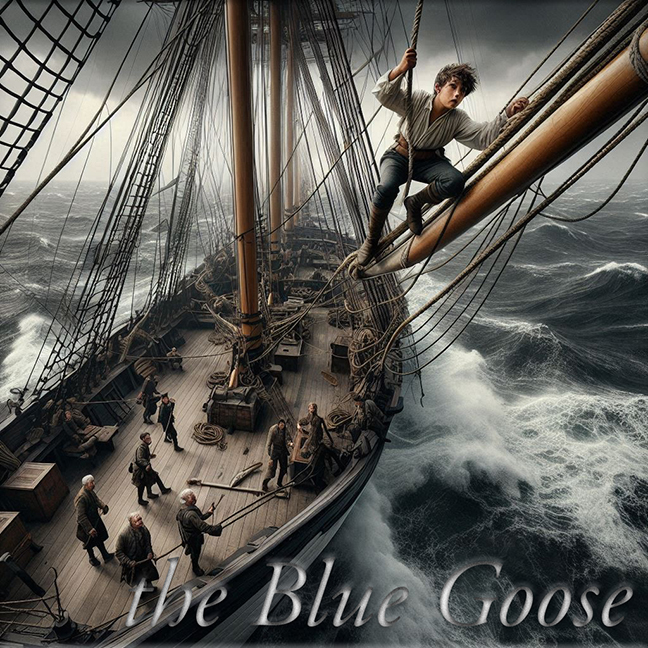
“Iris? Assuming we don’t change heading, where are we going?”

“On this course, 3-3-6 degrees magnetic, we are 79 miles from Gila Bend, Arizona. There is a General Aviation airport on the north side of the town.”

“If we maintain that heading, what’s our CPA to Why?”

“Twenty six miles.”

“Check status on the remaining Hellfire, please.”

“Status is fully operational.”

“Are there anymore J-20s out?”

“Red Dog is not tracking any hostile airborne radars at this time.”

“What about fire control radars? Any active?”

“Yes. There are several active units in Why, and two northbound on Highway 85. I mention this as there is an abandoned Army Air Corps landing field at Midway, just 20 miles south of Gila Bend.”

“Will the Blackhawks be in shoot down range?”

“Emissions from the fire control radar are consistent with that used in the S-400 design, or the Chinese equivalent. If true, then yes. The area is part of a large missile test range, so there are few terrain obstructions.”

“How many Hellfires left on Hatchet 5?”

“Two missiles are operational. The aircraft has not expended any machine gun rounds.”

“Would you get Captain Menninger on the encrypted circuit, please. And get Hatchet 5 in the loop, would you?”

“Of course.” Then, a moment later: “Shadow 1, Hatchet 1, go ahead.”

“Captain, we’re getting indications that an S-400 radar is tracking us, possible this battery is heading to an abandoned army air field located at Midway, which is…”

“I know where it is, Lieutenant. Are you saying you want to go after an S-400? Without jamming support?”

“Captain, they will be 20 miles from Gila Bend, and that is well within the solution envelope for the -400, and they’re painting our formation right now, as we speak.”

“Understood. Just a heads up, but there is a small mountain range just east of the old airfield. Maybe three to ten miles east. I wouldn’t try to get any closer than that.”

“Okay.”

“Good hunting, Lieutenant. Oh, one more thing. We have your father onboard, and he’s doing fine. He sends his love.”

She almost laughed when she heard that. Her father had never once, not even once, told her anything even remotely like that. “Tell him I’m glad he’s okay.”

“Will do. Out.”

Again, she was suffused with an odd, almost overwhelming emptiness. Kill a dozen paratroopers? No problem. Blow off my dad? Done. Go take out a couple of SAM launchers, and in the process kill another 20 or so men? Let’s do it! Go team, go…!

She signaled Hatchet 5 and both helos broke formation, turned southwest and headed for the abandoned missile test range.

+++++

Dietrich Aronson watched the two insect-like helicopters flying off the left side of the one he was in, not really paying attention to what his friends were talking about. After the captain had come back and told him his daughter was flying the helicopter closest to them, he had stopped listening and turned his attention to the Apache the captain had indicated. He strained to get a good look at her, suddenly quite proud of her…but…questions ran through his mind, and he had no answers to them.

‘My daughter is a combat pilot?’  

‘Is that what’s become of my family? My little girl is flying helicopters, killing people?’

‘I wonder what that feels like? To fly into combat…knowing you might die?’

His mind drifted back to the ship. To the owl’s ship…if you could call it that. How had something so big been constructed? How had it traveled between the stars? And how had it evaded the SkyWatch constellation searching for asteroids and comets? How could something so big be invisible?

Sitting around the table in the conference room with Langston and Alderson, they discussed the possibilities over and over, until the most obvious answer came to them.

“It’s Occam’s Razor again, Dietrich. The most obvious answer has been staring us in the face all along.”

“And that is?” Aronson replied, taking the bait.

“It’s not there.”

“I see.”

“No, you don’t. There are no such things as cloaking devices or deflector shields, no Captain Kirk or Mr Spock to come riding to the rescue. But…what if such things ARE common in a hundred years? In five hundred years?”

“Are you implying that their ship is not here now, but it is a hundred years from now?”

“I know there are countless reasons to disbelieve such a thing, but we have to look at the facts as we now know them. You and I made numerous angular measurements of that ship’s relationship to both Jupiter and Saturn. Correct?”

“Yes?”

“And we identified it was located almost exactly at aTerran LaGrange Point?”

“We did.”

“Yet it’s not there now, is it? And we, you and I, have confirmed that through telescopic and radar observations. Yet…we were there, we did not dream this, nor did we hallucinate the experience. But regardless, that structure is not there now, where it should be. And I can’t imagine the energy necessary to move a structure that massive. So, I say something else is at work, and the simplest explanation is that this structure exists in another time.”

“But that means the owls are time travelers, does it not?” Aronson sighed.

“So it would seem.”

“But why have they come here now?”

Langston looked at Alderson and nodded. “There is only one reason I can think of. They fear us. Or they fear what we will become.”

+++++

The Apache is a nimble helicopter, in the right hands.

Judy Aronson had a decent amount of experience now, almost five hundred hours of total flight time, yet only fifty in the Apache. She was still getting used to the machine’s quirks, especially compared to the Huey variants she had flown the last several months. The controls were lighter, so making sudden, jerky motions when flying the Apache produced a tendency to make equally jerky, and mildly dangerous, over corrections. That was fine at higher altitudes where solid earth was far below, but flying at high speed and at lower altitudes was the Apache’s real strength, where jerky movements were usually fatal. 

Her rotors were not absolutely silent, but they were a lot quieter than a Huey’s womp-womp-womp, and that gave her another advantage. The Apache could get closer to a target without drawing as much attention, and it could hide behind rock formations and lift it’s rotor-mounted Longbow radar into position – without revealing the helicopter’s location. Assuming, that is, the pilot was experienced, skilled, or both.

Aronson was skilled, and she had experience, but not in the Apache. She was also flying solo in an aircraft designed to be piloted by two, and with most of her offensive weapons already expended. She was flying towards a force of unknown size and armament. Between her wingman and herself they had enough missiles to engage three targets, so whatever she did, she had to pick the best targets in the least amount of time possible, engage the target then take cover, then move Hatchet 5 to another location and do it all over again. Then she had to get away from the scene without getting killed, which, all in all, was a lot to ask of a nineteen year old girl.

One of her instructors had told her class, during her first few days of training, that most of the Huey pilots in Vietnam had been fresh out of high school. They’d enlisted, gotten into the Warrant Officer’s program to become Huey drivers, and most shipped off to Southeast Asia before their nineteenth birthday. The Army’s helicopter-borne cavalry was a new idea then, too; it was, actually, a work-in-progress, a kind of experiment. At the height of the war, upwards of 70 percent of the participants in this experiment were shipped back to the states in freezer compartments, yet even with these stratospheric casualty rates the Army considered their experiment a success. 
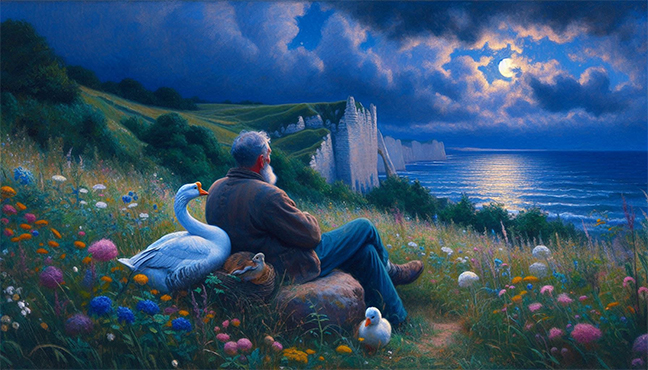
The Huey, as first conceived by Bell Helicopter, was designed to be an aerial ambulance, not a troop transport or a gunship, which was why later participants in this experiment were still flying aircraft made of ultra-thin, lightweight aluminum, that was not equipped with any armor surrounding the cockpit or waist gunner positions – because no one foresaw the type of action Hueys would ultimately encounter on the ground in Vietnam. No one could dispute, however, that the Huey changed the rules of ground warfare.

The Apache that Judy was flying bore no resemblance to those old Hueys. The UH-1 Iroquois, the original Huey, was a single engine helo with a basic IFR “steam gauge” panel; her Apache was a twin engined beast with a “glass cockpit” that provided “enhanced situational awareness,” a nice way of saying the onboard computer could handle background chores like target identification and deploying electronic countermeasures without being explicitly told to do so. And once Iris had been integrated into the ship’s systems, a whole new level of combat awareness and systems integration had been achieved.

The other advance that had changed the nature of combat was night vision, whether via helmet mounted goggles or through nose-mounted optical tracking systems. The latest night vision could be switched between modes that, depending on the outside air temperature, made it impossible for anything warm to hide, even at night, without retreating into a very deep tunnel. Some new sensor modes were so sensitive that footprints left enough residual heat to register on the gunner’s display, in effect pointing directly to escape routes or to tunnel entrances.

Even the first night vision goggles made flying manually through canyons or even crowded urban landscapes easy; with the latest augmented reality visors everything from basic flight information to evolving targeting data streamed across the pilot’s field of view, and even subtle nuances in terrain variation were easily distinguishable.

Which was why Judy Aronson was able to fly her Apache a little over twenty feet above the ground at over 150 nmph, dodging around sudden cacti and even a couple of antelope grazing in the early morning starlight. The position of the highway was clearly displayed in her HUD, as was the abandoned airfield, and as the two Apaches approached the area they flew single file down narrow slot-canyons with total confidence. With satellite imagery overlaid on her display she could see where the canyons came to an end, and where terrain would no longer provide cover for their approach. At that point, bother Apaches hovered just out of sight and carefully raised their “Longbows,” the odd donut shaped sensor atop their Apache’s main rotor. The Longbow consists of the AN/APG-78 millimeter-wave fire-control radar that feeds an automated target acquisition system, as well as a Radar Frequency Interferometer that acts as a floating ECM pod. The system can track up to 128 moving targets and engage 16 at any one time, and is also capable of ‘talking to’ systems in nearby Apaches, in effect allowing the lead Apache to control all the weapons in the squadron. The benefit of that, of course, was that only one Apache had to expose it’s Longbow; the rest could hide behind terrain until needed.

And that’s what Judy did now. Hiding behind a rocky ledge with Hatchet 5 off her left wing, she gently added collective and carefully extended the Longbow, then sensors and scanners began analyzing the valley floor below.

+++++

Porfirio Limones sat in the rear of a Chinese APC, watching the Chinese operators and Mexican unit commander working at their screens. A Chinese civilian, a translator, was telling Limones what was happening.

“Acoustic sensors have determined that two Apaches are approaching from the northwest, and now powerful millimeter band radars have activated and are searching the hills just across the valley. These new radars are capable of picking up a hummingbird in flight, so nothing escapes them…”

“Movement!” the radar operator shouted. “Longbow detected. It is in active target acquisition mode.”

“One helicopter has been spotted. It is searching for…”

“Missile launch…from 200 meters south of the primary search radar!”

“What?” the Chinese commander said. “I thought you said…”

“Second missile launch! From 200 yards north! No…Third missile incoming, from the original sensor location.”

“Shoot at something!” the commander yelled. “Now!”

“No target identified.”

“Fire chaff! Launch countermeasures!”

The optical tracking system in each of the incoming Hellfires didn’t care about countermeasures; internal computers had identified their targets and were now boring in at mach 1.3. The Chinese commander grabbed Limones and went to the rear loading ramp and opened it, then the two men sprinted away from the Command APC a few seconds before the first Hellfire hit. The Tandem-charge anti-armor fragmentation charge ripped through the APC, killing everyone inside. The Chinese commander screamed as shrapnel tore into his leg; Limones stumbled and landed on his left side, sliding to a stop and coming face to face with a very large, and very angry rattlesnake.

+++++

Judy dipped out of sight again, just as her remaining Hellfire leapt off the rail and streaked across the valley. Then she saw three small surface to surface missiles launch in rapid succession, heading north towards Gila Bend…

“Iris, notify command that they have incoming, probable target is Gila Bend.”

“On it, Judy.”

“Iris, were you able to identify the type and number of vehicles in that convoy?”

“Yes. There were 25 APCs, ten tanks, three S-300 mobile SAM launchers, two S-400 launchers and fifty troop transport trucks. My estimate is a battalion sized formation. Two APCs and one tank have been taken out of service.”

“Get that data on the net now, would you?”

“Done.”

“Thanks.”

“Judy, there are three Sukhoi light attack aircraft heading this way. ETA five minutes, coming from the south-southwest.”

“Hatchet 5, we need to get back into that deep slot canyon. Inbound aircraft.”

A tank round slammed into the rocks a few hundred yards to her right; she gently swung around and followed a reciprocal track back into the deep canyons that had covered their approach, but almost instantly her ECM pod lit up, and the inbound formation of jets showed up on her HUD…heading to their last position. 

Flying down in the weeds had camouflaged their departure, and by the time the Sukhois arrived on target both Apaches were several miles away.

“One aircraft is turning in this direction,” Iris said.

“Got it. Hatchet 5, keep heading east a mile or so, I’m going to see if I can hide under this tower, engage this guy as he passes. If I miss, you should be able to get a shot.”

“Roger that.”

She’d seen a tall butte along their inbound track, and the spiky formation had to be about 500 feet tall, and the craggy formation offered lots of places to hide. She pulled out of sight, hoping her infrared signature wouldn’t stand out too much, and she watched the readout from the passive ECM sensor pod as it tracked the incoming jet. The she activated the M230 chain gun, noted she had 900 rounds left out of the original 1200, and she tried to read the terrain below. The Sukhoi would probably follow the same arroyo she had, and if so it would be well within her 1500 meters effective range. She slaved the sight to the optical tracker in her helmet so that the gun would fire where she looked, and she had enough ammunition for about ten two second bursts.

She kept her hands on the stick and the collective but flexed her fingers a few times, took a couple of deep breaths, then that instructor telling her class about the survival rates of Huey pilots in ‘Nam came back to her – and she smiled. 

“No one’s killing me tonight,” she muttered.

“Incoming target now one kilometer and closing rapidly.”

“Thanks, Iris.”

“You bet.”

The Sukhoi came into view, and even in the partial moonlight the blue camouflage seemed eerily surreal as her eyes tried to lock onto the passing aircraft. She squeezed off one burst, then another, and she watched as flames erupted from the wings, just before the two pilots ejected.

“Judy, the other two aircraft are turning, heading this way.”

“Okay. Got that, 5?” 

“Roger.”

Aronson climbed higher up the butte and disappeared into another shadow, then turned so she could see aircraft passing on either side of the butte, and sure enough one Sukhoi flew the same track the first had, while the third flew by on the south side of the butte. She tracked and engaged this one, and watched it burst into flames just as Hatchet 5 opened fire on the second Sukhoi. She watched as four more parachutes blossomed in the moonlight, and a part of her wanted to track the pilots down and take them out, but a little voice in the back of her head told her not to do that again.

“Hatchet 5, say status.”

“Got about 600 rounds left.”

“Okay, form up on me, lets head to the barn.”

“Right.”

“Judy? May I ask you something?”

“Sure, Iris. Go ahead.”

“Why did you not kill the pilots?”

“Why waste the ammunition? Between the rocks and the rattlers, their bad night is about to get a whole lot worse.”

“Oh. Why?”

“Well, let’s see. Can you access any files on striking rattlesnakes?”

“Standby one.”

“Let me know when…”

“Oh, yes. I see now. They have their own infrared tracking system too, I see. Very efficient.”

“And Iris, they’re very mean. I hope you never have to deal with one on your own.”

“Yes. I quite understand.”

+++++

As her Apache settled on the tarmac she saw her father behind a short, chain link fence. He was watching her, and as usual with one hand in his coat pocket, the other on his old Meerschaum pipe, and she shook her head as she went through the after landing checklist. Someone ran up and chocked her tires, and a fuel truck approached from her left as she popped the canopy. She took a tentative sniff and smiled…desert air and jet fuel…which always made for an interesting mix, almost comforting in its normalcy.

“Normalcy?” she croaked.

“What was that?”

“Oh, sorry, Iris. I was talking to myself.”

“About what, if you don’t mind my asking?”

“Oh, just the way jet fuel smells out here. I don’t know how to describe it, but it’s comforting.”

“Comforting?”

“Yes.”

“Ah, might the smell remind you of the security of being back at base, with your fellow pilots nearby?”

“Yes, that’s probably it.”

“Then I think I understand.”

She stepped down from the Apache and walked over to the fence. “Hi, Dad,” she said.

“Hello, Judy. I understand you’ve had quite a night. Your Captain Menninger told me that you are now an ace. That’s quite an accomplishment, no?”

She smiled. “Is it? Oh, well, I’m just doing my thing, I guess.”

“You’re turning out to be quite the warrior, I’d say. The warrior goddess, Mars come back to life.”

She shrugged off the jab. “What were you doing up at Kitt?”

It was his turn to shrug, but she’d already known he would. “Something most unusual is going on, Judy. We need to talk.”

Now that was strange. He never wanted to talk. “Oh? What’s going on?”

“Not here. Not tonight, but take my word for it, big change is coming.”

“Dad, I think war just broke out between us and the Chinese. I think that’s about all the change we’ll be able to handle for a while…”

“Not after the world understands what’s happening.”

Now she was really confused. He never, ever talked like this. “I might have some time I can take off…”

“I’ve talked with Captain Menninger. Your group will be returning to Camp Pendleton, and I’ll come down there to visit after he calls and gives me the all clear.”

At least he was smiling, she thought. “Sounds good, Dad.”

“Look…Judy…I know things haven’t been…not since…”

“It’s okay, Dad. I understand.”

She watched him shake his head, then look down. “Look, if something happens and I can’t…if something happens…Judy, just know that I’ve always loved you. Sometimes so much it hurt. And maybe it hurts now more than it ever has, but I’ll never lose this feeling, the love I have for you right now. And I’m so proud of you.”

She started to tear up, then she leaned over the fence to hug her old man, maybe because she didn’t want him to see her cry…but he held her close and his old tweed coat smelled just like their house in Berkeley. Like patchouli and pipe tobacco, and maybe a little garam masala, too. Home. She held onto him as long as was polite under the circumstances, before he broke away abruptly. He looked her in the eye for a moment, then kissed her forehead, and it seemed neither knew what to say. He nodded again and turned to walk over to Captain Menninger, yet as he walked off, she was sure her father was crying, too.

Part IV: Star Child

After Pendleton came the Battle of San Diego.

For her part, Judy flew troops in Venoms to the front lines, which was waged as far north as Imperial Beach for a few days, and then she shipped off to Ft Worth to help the Texas Guard retake San Antonio.

She never got to have that talk with her father, though she did have one last encounter in San Diego that seemed to foretell events that awaited her in a not-so-distant future.

She came home from a mission carrying special forces types and supplies to a firebase in the mountains east of San Diego, and it had been a rough flight. She’d been assigned to take a UH-1Y Venom just after sunset, but as soon as they entered Proctor Valley they’d encountered several patrols of foreign troops, usually mixed platoons of Chinese and Mexican special forces, and they started taking heavy incoming machine gun fire. She backtracked and approached the firebase by coming up another valley and dropped off her load, then she returned to North Island. Her right waist gunner was wounded, and so was her co-pilot, and the ship was thoroughly shot up – and even her nerves were rattled. After debrief, she went back to her hooch and she stopped by Donuts old place and saw that the front door had been repaired, then she decided to walk down to the water, maybe take a walk along the beach while the sun came up.

She was still in her flight suit and probably smelled of bloodstained fear, but she found an old bench and sat, took off her boots, then her socks. She leaned back and looked up at the stars, then walked down to the water, enjoying the feel of the cool sand between her toes. The water in this part of the vast harbor was usually calm, and this dawn was no different, and there was just enough breeze to lift her hair every now and then.

She heard a slap, like a wet hand slapping the water and she jumped, but then thought it was probably only a fish jumping, or maybe a flying fish leaping for the stars, so she continued walking along. She heard it again, that slapping sound, then a little cry, though it was more like a high pitched whistle. She looked out into the inky blackness and couldn’t see a thing, but curious now she walked out into deeper water.

And just then three dolphins swam up to her. Two adults and their toddler, now all grown, and the little one swam right up to her and circled her excitedly, almost feverishly, his little tail thrashing away, splashing around and getting her thoroughly wet.

“Is that you, little fella?” She walked out into deeper water and the two adults swam up to her; the larger of the two, the male, came up to her and he turned, then drifted into her. 

And his eye was fixed on Judy’s once again.

And once again she found she couldn’t look away.

“What are you trying to tell me?” she finally asked.

And he replied by holding out his hand. And this time she knew what to do, so without hesitation she took it.

It was, she thought, like touching a live wire. Pure electricity. But then the oddest part.

The three dolphins were with her, and the four of them were adrift amongst the stars. The little one came up to her and paused, then leaned his face against hers…and wave after engulfing wave of the most unusual feelings washed over her. Something almost like peace. Then that smell returned. The house in Berkeley. Patchouli and pipe tobacco – and her mother’s curry. A lonely old man wrapped in restless tweeds called out from the stars, and as she closed her eyes the sun came to her once again, and it was as if the little dolphin would never let her go. 

© 2025 adrian leverkühn | abw | this is a work of fiction, plain and simple, and a brief coda will follow, eventually. I won’t post now as it might reveal too much. Anyway, and as I’m sure you know, The Seasons of Man, Books 1-3, are part of the greater TimeShadow sequence. As always, thanks for dropping by.