
Ah, here we go. The next chapter in Amaranth’s journey. Want some music while you put on the kettle for your tea? The latest pre-release track from Pat Metheny’s new, yet to be released album (Moon Dial) dropped today, titled We Can’t See It, But It’s There. Quite nice, but The Byrds classic Eight Miles High might be better for this part of the story. Better still, BlueJays and the always brilliant And I Dreamed Last Night.
Have a good read. The next section ought to drop in a few days.
First You Make a Stone of Your Heart, Part 5
Echoes and Shadows
5.1
Amaranth slipped away from her Navy escort off Norfolk, Virginia under cover of darkness; she then followed the main ship channel northbound up Chesapeake Bay for another 70 nautical miles the next morning, and Chief Turner was pushing the Nordhavn 120s twin 965 HP MTU diesel engines to 2100 rpm, just ten percent below their max sustained setting. Admiral Spudz MacKenzie, USN retired, shook his head in mild despair when he thought of the prodigious quantities of fuel flowing to each engine at this speed, now most grateful that the DOD was footing the bill for the duration of this operation. He grabbed his Steiner binoculars out of nervous habit and left the bridge, stepping out onto the exposed Portuguese bridge-deck to scan for red channel buoy ‘64’ – which marked the entrance to the Potomac River, near the Little Wicomico River inlet; his practiced eye quickly spotted the mid-channel marker so he looked at Turner and pointed.
Of course, the marker buoy was clearly displayed on each of the four chartplotters on Amaranth’s bridge, not to mention the two long range open array radars, but Turner nodded and shot his admiral a grinning thumb’s-up. Turner noted their depth was bouncing between 68 to 79 feet here in the main ship channel, but both the north and south sides of the channel were rimmed with extremely shallow shoals, with those just off Cornfield Harbor on the north shoreline less than three feet deep at low tide. Even in mid channel, there were areas of rapid shoaling – especially around the Point Lookout light also near the river’s entrance – but they were going to hit an ebb tide, so they would be working upriver against a .44 knot tidal flow, further increasing their fuel burn.
But at least, Turner said to himself, the orcas had disappeared.
What he’d seen before he plucked the admiral from the sea the day before had left him speechless. A half dozen or more of the beasties swimming around MacKenzie and one of those women, and then there was the smell! As he’d grabbed the admiral under the arms and pulled him aboard, the old man had smelled like the seediest Bangkok brothel he’d ever been in. Worse still, his torso had been covered with thick, slimy stuff, and it hadn’t taken a rocket scientist to figure out that MacKenzie had been covered from head to toe in whale splooge. And a lot of it, too.
Then one of those women told the old man that she was pregnant – and that he, the admiral, was the father! Hah! Turner had wanted to pick them both up and pitch them into the sea, but seeing the admiral’s reaction he had wisely chosen not to. Yet, anyway. Still, the old man had retreated to his cabin in a funk, and now Turner was walking around on tenterhooks…and more than a little mad.
And then there they’d been, northbound off Cape Hatteras later that night being followed by an aircraft carrier and its battle group, and he swore he could hear the bridge crew up on the Truman’s bridge snickering at the yacht going flat out at 14 knots, when the carrier routinely made passages at twice that speed, and could sprint to more than three times that speed when launching a strike. He’d grown thankful that another layer of dense fog had settled over Hampton Roads when the strike group turned into Norfolk, leaving Amaranth alone to puddle along slowly northward.
Sara came up from the galley with bowls of crab bisque and some kind of grilled sandwiches – panini, she called them – and he had to admit the girl could cook. She carried a bowlful out to Spudz, and Turner had wished he could have heard what passed between them out there.
Because after she left him standing out there with his lunch, MacKenzie had put the plate down and pulled an encrypted Sat-phone from his jacket and made a call. He spoke on the phone for a good half hour, and Turner was watching all the while, even as he made the turn to enter the Potomac. They were heading west now for Washington, D.C., and Turner was spooked.
And Turner did not see the lone male orca following in their wake.
+++++
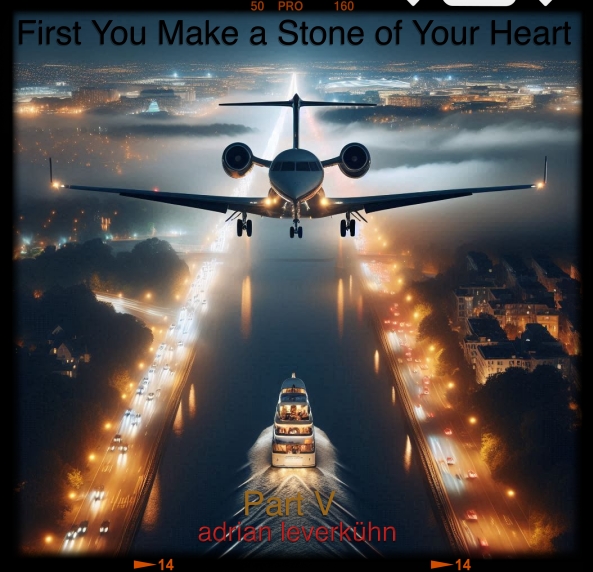
Fog clung to the Potomac as Amaranth approached the Woodrow Wilson Bridge in dense fog, and Spudz throttled back the engines as he steered for the marked channel under the 70 foot tall span. With visibility down to just a few yards he was relying primarily on radar, but Amaranth was also equipped with infrared cameras that painted a clear picture of the piers and spans now a hundred yards ahead. Sara stood beside him, watching these screens – and everything else he did, every move he made – and when she didn’t understand something she asked.
“How high are we here on the upper bridge, and what about the radomes on top?” she asked.
“With the radome tower we’re 68 feet total height, but there’s one VHF antenna up there that hits 73 feet,” Spudz sighed as he centered Amaranth on the narrow channel.
“So…?”
“It’s fiberglass and has a flexible mounting plate designed to give a little under a low speed impact like this. It should just drag along the underside of the span.” A gust of wind out of the north caught the bow and began pushing the yacht to port, so Spudz countered by cutting back the starboard engine a fraction, then he used the bow thruster to make a bigger correction, and with a little rudder added she straightened up again; once the bow was clear of the bridge he slowly added power until the ship’s speed indicated four knots. He checked their depth again, too: displays were showing 26 feet, the chart indicated 27 but shoaled quickly ahead as the main channel returned to the center of the river.
But the river got tricky up ahead, too, as the channel passing Goose Island shoaled rapidly to four feet – even less on windy days – before the real fun began. The channel narrowed considerably after passing the Alexandria Channel buoy, and water depths in several places outside the deep but narrow channel could be measured in inches.
But they were fast approaching Hains Point junction, where the Potomac and Anacostia rivers split in the heart of Washington, D.C., and here the charted depth shoaled to just 9.5 feet – mere inches deeper than Amaranth’s keel. As the yacht approached the Green 9 buoy, Spudz dropped his speed low enough to maintain “steerage way,” moving just fast enough through the water to keep the rudders effective, and then he shifted focus to the forward scanning sonar, literally “seeing” the bottom just ahead as Amaranth approached the entrance to the Washington Channel. He held his breath as Amaranth’s props kicked up tons of oozing mud, and he’d need to make sure Turner checked the water intakes and filters. The channel widened a little as soon as he passed the buoy marking the shallow entrance, and the depth dropped to 15 feet so Spudz bumped up their speed to two knots, making for the Capital Yacht Club just beyond the Gangplank marina on the right side of the channel.
Despite the early hour, four men in khakis were waiting dockside as MacKenzie brought Amaranth to the club’s transient docks, and moments later a gray fueling boat pulled alongside and began refilling her tanks. Fresh food was waiting on the dock, waiting to be loaded in the galley, and Spudz left the bridge after Turner relieved him, going to his cabin to dress for the short ride over to the main State Department building on 21st Street. When Ralph Richardson and his group were ready, Spudz walked them up the docks and through the yacht club and then out to Sutton Square, where three black Suburbans idled, waiting for them.
They drove quickly through the city, easily done as there was little traffic out at three in the morning, but guards met them at the fortified basement entrance on the east side of the main Department of State building, and after their drivers produced the necessary permits, the Suburbans were escorted to the basement entrance by heavily armed guards.
Both Eve and Devlin/Sara were fingerprinted and photographed, their previously completed passport applications completed with the assistance of lawyers, and a half hour later their passports were produced and delivered to MacKenzie. Their work done, the motorcade returned to the yacht club, dropping off everyone but Richardson, Spudz and Devlin, who were then driven through the waking city to the VIP lounge at Andrews Air Force Base. MacKenzie checked in with the control tower, received an updated arrival time for the inbound Air Force C-37B, a hardened version of the Gulfstream 550 used by the Air Force for VIP transport, then he returned to the lounge.
The on duty lounge steward produced coffee and Spudz took the offered cup and walked over to the wall of windows overlooking the VIP ramp, noting that Air Force Two was being fueled and provisioned a couple of hundred yards from the lounge. Air Police and their K-9 companions were walking the ramps, making their early morning perimeter sweeps as the sun began to make its daily appearance, and a moment later Spudz heard control tower chatter coming through a speaker in the dispatch office that told him the C-37B was turning onto final.
Sara stood beside Ralph Richardson, who was sitting in his motorized wheelchair while nursing a cup of coffee, and MacKenzie looked at the two of them – not yet really understanding the nature of the relationship between those two. Was Richardson her father, or her creator? Or, as Spudz was beginning to suspect, was Richardson merely a facilitator? Or an intermediary? But if that was true, who were the other parties involved? After spending two nights with Sara, one of those nights more intimate than the other, he had come to the conclusion that she was anything but human. Her body was anatomically correct in every respect, but she was hard in places where women were usually soft, and he’d yet to see her eat or go to the restroom. He had seen her in Richardson’s stateroom sitting in a chair with her feet resting on a stainless steel plate, and he felt certain she had been recharging power cells of some sort.
Yet in other ways she seemed almost too human. She longed for companionship and positively glowed when he complimented her, even if he simply expressed any kind of approval when she made something magical in the galley. She was almost childlike at those times, yet in an instant could turn sultrily provocative, and he’d found the juxtaposition of her contrary emotions confusing – if not even morally troubling, enough so that for now he’d decided to pull back from her a little – at least until he could arrive at some kind of emotional clarity. He’d had to admit to himself that the idea she was pregnant concerned him most of all, because what had happened in the water with all those damned orcas had been anything but consensual. And just how the hell had she known so quickly that she was with child? And then, perhaps most troubling of all, he wondered what kind of child had been conceived?
MacKenzie watched the Gulfstream touch down on Runway 0-1 Left and, after its thrust reversers roared briefly the little jet turned to the left and taxied to the VIP ramp located near the southwest corner of the airfield. An airman with red-tipped lighted wands guided the pilots to a parking place near the terminal and Spudz heard the engines shut down, then saw the passenger door open and the airstairs extend from the fuselage under the door. One of the pilots emerged, and he appeared to be carrying a small duffel, but then an old man appeared in the doorway, and MacKenzie intently studied this man as he emerged from the jet and looked around.
Tall, his back ramrod straight, and his white hair a little on the long side, Spudz grimaced as he watched the old man start down the stairs. Khaki pants, madras button down shirt under a navy blue windbreaker, and ratty old boat shoes, yet he noted the man easily came down the steep metal steps – given his injuries, but not with the usual stiff gait of your typical 93 year old white guy. The old man sat down beside the pilot in an electric golf cart and they quickly scooted over to the terminal, and the old man thanked the pilot before walking into the building.
As he walked inside, the old man reacted to Richardson first, growling something unintelligible under his breath, but when he saw Sara he stopped dead in his tracks.
And then she walked over to the old man, her right hand extended.
“Devlin?” the old man asked, clearly unnerved by her sudden reappearance.
“Hello, Harry,” Sara said to him, reaching out and taking his hand in hers.
Harry Callahan looked troubled, and he squinted as he stared into her eyes. “What happened…no, who…?” he stammered. “But this can’t…I don’t understand…I haven’t…I haven’t seen you in fifty years.”
She nodded, but she smiled reassuringly. “It’s complicated, Harry.”
“Uh-huh,” Callahan growled when he saw the bemused look in Richardson’s eyes. “You know, that just might be the understatement of the year,” he said as he turned to Richardson and scowled. “And what are you doing here, Ass-wipe?”
“Ah, Harry,” Ralph said as he rolled up, but with his right hand offered in friendship. “Nice to see you again, too. Did you enjoy your flight?”
Harry took Richardson’s hand while he looked him in the eye. “Oh, sure. I’ve always loved being dragged out of my house in the middle of the night and shoved in an airplane without knowing where I’m going. Don’t you?”
Richardson chuckled. “I think I understand.”
“What am I doing here, and why is she still twenty years old?” Harry snarled, pointing at Sara his thumb.
MacKenzie walked over to them and stood beside Richardson, the extended his right hand. “I brought you here, Mr Callahan.”
“And you are?” Harry snarled as he turned and looked at this stranger, his hands now firmly in his pockets.
“Spudz MacKenzie.”
“Oh yeah? Well, I never much cared for light beer,” Callahan snarked, “so really, just who the hell are you – and what the fuck am I doing here?” But just then the Gulfstream’s pilot walked up and produced Callahan’s luggage – two black duffels and a small camera bag – and Callahan thanked her again before he turned back to face down MacKenzie. “Well?” Callahan growled.
“We may have need for your peculiar talents, Mr. Callahan,” MacKenzie snarled in return, unwilling to put up with this old cop’s sarcastic insubordination, “and Sara convinced me to bring you here. I hope we haven’t wasted any time doing this.”
“Sara? Is that your name?” he asked her.
“Yes. Sorry for the confusion, Harry.”
He shrugged, then turned back to MacKenzie. “Here, you said? You need me…here? In Washington-fucking-D.C.?”
“Harry…please,” Sara said cautiously. “Hear him out before you…”
“What…jump to conclusions?”
“Something like that, yes,” she whispered, her words imploring him to tone it down.
Callahan looked at MacKenzie again, his eyes suddenly narrowing. “You were Secretary of Defense, weren’t you? A few years ago?”
MacKenzie nodded. “That’s correct.”
Callahan looked at the man’s hands, saw the Annapolis class ring on Mackenzie’s hand and sighed. “Sorry, sir. What do you need with me, if you don’t mind me asking?”
“We’re going to go visit the Titanic, Harry,” Richardson smiled.
“The wreck?” Callahan asked.
“No, not the wreck, Callahan,” MacKenzie said, his eyes full of searing energy. “We’re going to stop her this time. And we have need of your…for this peculiar talent of yours.”
© 2024 adrian leverkühn | abw | adrianleverkuhnwrites. com | this is fiction, plain and simple.
I predict an amusing ride in this part of the story, maybe even a few fireworks, and I hope you enjoy the twists and turns. So, with that in mind maybe you should listen to, well, just give this one a go.
Hasta later.
 Adrian Leverkühn Writes