

A short little riff tonight, hardly time for tea.
Music? Tears for Fears. Woman in Chains. You’ll understand.
5.9
20 December 2030, 1030 Hours
Marina da Glória, Rio de Janiero, Brazil
Aboard the MV Šamšīr
“The warhead need not be large, at least in this case,” the scientist advised. “A small tactical fission bomb like this will easily accomplish your objective.”
Debra Sorensen nodded. “What’s the nominal yield?” she asked.
“Approximately one tenth of a kiloton. An effective blast radius of five kilometers, fire damage out to nine, and modest radiation impacts out to 15. You said the targets will be within a few thousand yards of one another, and not hardened?”
“That’s correct. Where did you get it from?”
“I believe this one was acquired on the open market in Astana. It is of Soviet vintage, but the internal mechanisms are still considered reliable.”
“What about arming the device?”
The scientist, a retired professor of physics from the technical university in Sao Paulo, shrugged. “One would assume you will deploy this by air?”
“Yes,” Debra replied, her answers direct, her voice full of latent hostility. “We’ll deploy using the cruise missile, which has a five hundred pound payload capacity and a two hundred kilometer range.”
“Then I would suggest, given the nature of the target, that you disable the current safety system. When you are ready to deploy the device you will remove the last two safeties and arm the device with a contact detonator. Your personnel seem knowledgeable, I assume?”
“Yes, I believe they are,” Deb said.
“Then this should present no difficulties.”
“What about the radiation levels…will we be safe within the given range?”
The physicist shrugged, but she also understood the nature of the mission. “At the range from which you expect to launch the device, well, this is not without risk. You must of course begin a prophylactic dose of potassium iodide the day before, and you should be mindful of the prevailing wind. Assuming a distance of 20 miles you will be exposed to the equivalent of 15 chest x-rays. This is not a trivial amount, so of course you will want to continue to take the iodide until you are well beyond the maximum fallout range, say several hundred kilometers. But assuming you have properly trained and experienced medical technicians with you, there should be no difficulties.”
The physicist left after the warhead had been secured belowdecks, two days after technicians from the nearby Almirante Castro e Silva Submarine Base completed installation of the launch tube assembly on the upper aft deck. Once Šamšīr’s tanks were refilled, Sorensen returned to her cabin well before Captain Nuri Metin returned with the ship’s clearance papers from the Port Captain’s office. A half hour later Šamšīr was steaming through Guanabara Bay, passing the old Santos Dumont airport to starboard on her way to the main channel entrance under Sugarloaf Mountain. Three hours later the yacht was in the open Atlantic turning north, bound for the Azores – and then an unknown destination beyond. At least two DIA satellites had her under continuous surveillance, and the USS Virginia, one of the Navy’s latest fast attack submarines, followed at a discrete distance. When the Virginia’s radiation detection alarms sounded, Captain Sam Rutherford made a not completely unexpected call to Norfolk. One of the small blue spheres inside the Virginia dutifully recorded and then passed along the transmission.
Aboard the M/V Amaranth
14 April 2031 1135 hours
397 NMI SSE of St John’s, Newfoundland, North Atlantic Ocean
GPS location: 41°43′32″N 49°56′49″W
Hurricanes rarely form in the month of April – however, it is not unheard of for a hurricane’s close cousin, in western parlance called an extratropical cyclone, to spin up at lower latitudes before heading north along the Canadian Maritimes on its way to northern Europe. One such storm had been spooling up unprecedentedly low barometric pressures around a distinct eye for two days, and Amaranth had been pounded on her 90 degree heading, at least until Jim Turner decided to turn more to the northeast – in order to head directly into the rapidly intensifying nor’easter’s 55 knot winds, and the 18-24 foot seas they were taking over the bow.
Waves form when wind passes over water. Swells form when such wind-driven waves travel a greater distance. Wind and swell do not necessarily come from the same direction, they may in fact come from opposite directions. Amaranth was driving into wind driven waves coming from the northeast and a larger swell coming from the south-southwest, and the resulting seas were what Jim Turner called “confused.” As he hung onto the porcelain bowl in the small head off the bridge, Harry Callahan was calling them something else entirely, and quite loudly, too.
Which pleased Turner immensely. In fact, he felt almost giddy with childlike glee, yet Turner was a seaman only in the modern sense of the word. He was not what the same breed of sailor that, for instance, Admiral James Cook would have called a tia borau, a Polynesian Navigator, neither was he skilled in their ancient ways of reading the seas, the kapesani lemetau, of knowing the ways the ocean speaks – at least to those who know how to listen. The twenty year old male orca following in Amaranth’s wake, however, knew more about the sea than even the most gifted tia borau of all, the Persian sea captain Abharah, and perhaps that was why the Blues and the Greens studied this orca so intently now, even in this raging storm.
Valdez careened off the wall in the starboard stairwell on her way up to the bridge from the galley, ostensibly carrying a mug of homemade chicken noodle soup for Callahan – who hadn’t eaten in almost 24 hours. And when Callahan caught a whiff of her soup, this triggered another round of violent heaves.
“Jeez, Chief,” Jen Valdez smirked, speaking loudly enough for Callahan to hear, “it sure reeks up here.”
“Yeah,” Turner grinned as he fist-pumped, “ain’t it grand…”
“If he doesn’t get something down soon,” she whispered as she caught hold of a grab rail, “he’s gonna be in trouble.”
Turner looked at her and shrugged. “Take him aft, get his eyes on the horizon, maybe get him to keep his attention on something that ain’t moving much, like the carrier. Give him a few sips of soup and maybe see if he can keep it down.”
“You need anything?” she asked.
“Yeah, actually, that soup smells good. It ain’t Campbell’s, is it?”
“No, no way, it’s my Momma’s recipe.”
“Got peppers in it?”
She grinned conspiratorially. “Oh, not too many.”
Turner beamed at that. “Well, go ahead and get him out into that air. Just hold onto him, okay? With his ass being so old, his hips probably ain’t the greatest.”
“Here,” she said. “Take this one. I’ll go get him out back; it’ll get cold by the time…”
…the air shimmered and everything seemed to stretch like a rubber band as the very air inside Amaranth seemed to expand…
“What the fuck!” Valdez cried as she dropped to the floor, suddenly on her hands and knees as she tried to steady herself. Turner was on the floor curled in a tight fetal ball, his hands involuntarily contracting into convulsive fists, his legs in spasm. A moment later the temperature inside the little ship went from a comfortable 68F to a withering 20F, and the air literally condensed, began falling as a cold rain might for a few seconds; Valdez stood and immediately saw that the engines were down and only a few battery driven auxiliary systems were functioning – and these did not include the climate control system nor the ship’s primary navigation displays.
She pushed herself to her feet and ran back to the head.
“Fuck,” she moaned – when she saw that Callahan too was now gone. She ran back through the Admiral’s cabin to the aft deck, just to be sure…
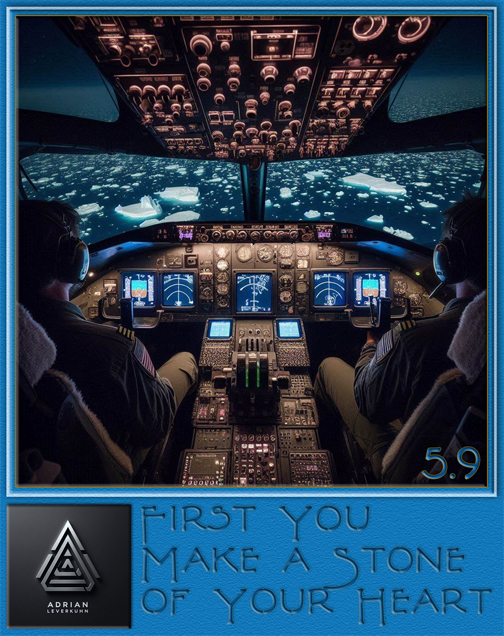
…and the sea was flat, though covered with thin ice flows for as far as the eye could see. It had been about noon just moments ago, and now it was dark…?
She fully understood just then that Amaranth was without engines to power her systems.
And that the reason they had gone on this mission was to get Sara, whatever she was, to the approximate location where the Titanic struck that iceberg in 1912.
Now she had no idea where they were, or even when it was, only that she was on a powerless ship in the middle of arctic ice flows, and that it was bitterly cold out – and rapidly getting colder.
She heard crackling static coming from the bridge. The sound stopped. Then she heard it again. A voice. A human voice.
She turned and ran through MacKenzie’s cabin at a dead sprint – until she was on the bridge again. Turner was sitting up. He’d cut his forehead when he fell and there was blood on his face and on the floor.
But the bridge was silent now.
She looked at the overhead panel, saw one of the VHF radios had power and grabbed the mic.
“Any station, any station, this is the motor vessel Amaranth on VHF 1-6. Go for Amaranth!”
Silence.
“Amaranth, this is Kestrel. Is that you? How do you read, over?”
“Kestrel, Amaranth, got you five by five…”
“Okay, Amaranth, we have you on radar. But hey, can you…? Uh, where the fuck did you come from…?”
© 2024 adrian leverkühn | abw | adrianleverkuhnwrites. com | this is fiction and nothing but, plain and simple.
One more to get you on your way. Why not try a little New Star.
 Adrian Leverkühn Writes