

There’s an old saying that goes something like this: History never treats kindly those who try and rush her. I suppose the same can be said for baking a cake, or writing a story that contains multiple diverging storylines. A story that took shape in my mind almost thirty years ago, deep in the middle of the night while standing watch on my first real sailboat. So many things roamed through my mind, and yet the startling thing about all this is that I remember the night, and that story, with absolute clarity. The process of putting this together has been like building a model sailing ship from scratch (and I’ll not mention that I tried that once, which is why I took up writing).
Music matters all the more these days, because everyone needs some Help from time to time.
5.19
“There’s no way you’ll ever get me to kill anyone,” Henry Taggart said to Frank Bullitt.
Roosevelt took his seat at the head of the conference table and looked at Taggart with a weary sigh. “Tell me something, Henry,” Roosevelt said, his almost high-pitched voice raspy from too many years of smoking unfiltered cigarettes. “From the perspective of your place in time, you understand Adolph Hitler’s actions in the second war to be monstrous. Would that be a fair assessment?”
Taggart nodded. “Yes, of course. Who wouldn’t come to that conclusion?”
“Well, obviously the members of Hitler’s inner circle didn’t seem to think so,” FDR muttered, “but that’s neither here nor there. The point I’m trying to make is elementary, Henry. If you could go back in time and, say, kill Hitler when he was a child, or even kill his mother or father, you would kill that monstrosity, that virus, before it ever had a chance to take root. You’d save tens of millions of people from the misery of genocidal warfare, a human misery grounded in one man’s tortured ego. Are you telling me that, if given the opportunity, you’d not go back in time and do just that?”
Taggart nodded. “That’s correct; I would not.”
“Why?”
“Murder is evil. You don’t stop evil with evil. You only become evil.”
FDR looked at Taggart and nodded. “And if a madman breaks into your house in the middle of the night and he’s about to kill your sleeping children with a hatchet, would you allow him to continue, or would you try to stop him, even if that meant killing him.”
“I’d kill him.”
“So you don’t really believe in a blanket prohibition against killing, do you?”
“Obviously not, but one circumstance is exigent, the other enters the realm of the hypothetical.”
“How so,” Roosevelt said.
“Your belief is that one man alone, in this case Hitler, was responsible for all the suffering in Europe in the Second World War, but isn’t that naive?”
“Naive?”
“Sure. I mean, look at it this way. You’re saying the Holocaust was the result of one man’s obsession with Jewry, yet a huge percentage of the people in Europe were anti-semitic. Hell, they still are, or were when I was last there. And no matter what, Hitler alone didn’t make the Holocaust happen…”
“But if you removed him from the equation…”
“My completely uneducated guess, Mr Roosevelt, is that it would have happened anyway. If I remember correctly, Germany was being crushed by reparations and hyperinflation, not to mention industrial policies being rammed down their throats by Britain and France. Jews had been scapegoated into taking the blame for all this, and in the Nazis retelling of this story, the Weimar Republic became a Jewish construct because a few of the leaders of the Republic happened to be Jewish, so the republic took the fall. But again, if I remember my history, the same thing had happened in France like sixty years before, which leads me to think that when bad stuff happens in Europe, the standard European reaction has been to blame it all on the Jews, so what I’m saying is if you went back and killed Hitler the odds are still real good that someone else would come along and light the exact same fuse.”
Roosevelt looked down and nodded. “Maybe so, Henry. Maybe you’re correct, but I’m still not convinced, but then again History has put me in a fairly unique position. I’ve had to learn to live with the decisions I made, which were made with the best information I had at the time, yet I’ve been holed up in that office over there reading and rereading the pertinent histories of the war and I’ve been stunned by how many mistakes historians thought I made. Some of these things I can refute, but others make for very uncomfortable reading. For instance, if we’d had better intelligence on the Wannsee Conference, might we have picked up on other signs regarding the construction of these death camps? On the other hand, there were apparently hundreds of antisemites in the War Department who were simply quashing the earliest reports…”
“You did the best with what information you had, sir.”
“Precisely my point, Henry. You view this Sorensen girl as damaged goods, a Daddy’s Girl? Is that about right?”
“Yessir.”
“And now we know that she, like Harry and Frank here, has developed the ability to jump around through time. And her father knows this and plans to use her to do something. This something we do not quite understand yet, but we first assumed it had something to do with the sinking of the Titanic. Now we have reason to believe she’s going after the battleship Bismarck, in May of 1940. The what and the why still elude us, but let’s assume for a moment that she’s successful. Everything will, in an instant, change. All history after that moment will change. Are you following me, Henry?”
“Yessir?”
“Excellent. Now, what would you make of this if you were given to understand that Adolph Hitler was once again alive, in the exact same way that I am alive in the here and now. And what if you were given to understand that Mr Hitler is once again calling the shots.”
Taggart looked at the faces around the room, looking for signs that this was some sort of Princeton debating society hypothetical, but no one was smiling. “Is this for real? I mean, are you on the level?”
“Oh yes, quite,” FDR sighed as he took a pipe out of his vest pocket.
“Well…fuck,” Taggart sighed.
“Precisely, just so. You took the words right out of my mouth, Henry. Now, what do you propose we do about it?”
+++++
“Does anyone know how she developed the ability to time travel?” Taggart asked after Roosevelt and one of his aides left the conference room.
One of the other men in the room, someone name MacKenzie, nodded and spoke first. “There’ve been experiments going on in the field for decades,” MacKenzie said. “The first, oddly enough, came together after several unexpected results were discovered in another line of enquiry, and in Canada. A professor at Laurentian University, a neuroscientist by the name of Michael Persinger, was doing temporal lobe studies, eliciting what some subjects called contact with God when his subjects used something called a Koren helmet. Subjects predisposed to religious experience sensed God, while those not so inclined still felt some kind of presence, and both types entered into a very relaxed state…”
“Is that the so-called God helmet experiment?” Taggart asked.
“Yes, exactly. Later experiments in neurotheology, using induced electromagnetic fields, yielded similar results, with some subjects reporting out of body experiences and, more to the point, out of time experiences.”
“You mean time travel, right?”
“Yes, and no. There were reports, I believe, of a generalized feeling of being in some other time reference, but nothing specific was mentioned in the literature about travel.”
“You know, it’s strange, but I think I felt something like that once.”
MacKenzie nodded. “In the ARV. I’m not surprised. That craft employs a massive electro-magnetic coil…”
Henry was sitting bolt upright in his chair now, listening intently as MacKenzie spoke. “Excuse me, but who the Hell are you, and how the fuck do you know about that?”
MacKenzie leaned back in his chair and crossed his hands over his gut. His eyes met Taggart’s and he did not look away. “Because I sent you and Rupert Collins to Kamchatka, to the Sukhoi facility, to steal that vehicle.”
Taggart’s eyes blinked rapidly as his blood pressure spiked. “So…you killed me. And General Collins. Is that what you’re telling me?”
“We didn’t know about the radiation leak, son, but yes, it was my decision. And Rupert concurred, in case you missed that.”
“Is that why he went with me?”
MacKenzie nodded. His eyes never flinched, never looked away. “You weren’t the first men I send to their deaths, Mr Taggart. When the responsibility is yours, well, you don’t know that death is a certainty, but it’s always a possibility.”
“So, it just goes with the job, huh?”
“You could say that,” MacKenzie said, his head canted quizzically. “I never got used to it, no one does, but even so, bad stuff happens. I hated that most of all, the not knowing…”
“You should try dying from multiple metastatic neoplasm disease. Now that was fun.”
MacKenzie nodded. “I understand your anger. Try putting yourself in my shoes when you get a chance.”
“No thanks, I’m trying to quit,” Taggart said with a grin, suddenly walking away from the table and out onto the hangar deck.
He looked around, saw Ellen Ripley standing by the shuttle she’d piloted from Pak’s ship, and noticed she was working with a tech on something in the shuttle’s instrument compartment so, not knowing anyone else here he walked over to her.
“Say,” he said as he stopped in front of her, “you wanna go somewhere and get laid?”
She turned to face him, the expression on her face unreadable, but he didn’t see her fist balling up behind her back. Nor did he have time to react when her haymaker came. He flew back and skidded across the studded metal floor, and though he was seeing stars he sat up and flipped her the middle finger. “I take it that means no?” he said, adding: “What? You a rug-muncher, or something?”
He saw her turn and face him again, then she was walking his way, with what looked like a ten kilo crescent wrench in her left hand.
“Yo-ho, yo-ho, a pirate’s life for me,” he sang as he stood and made for the nearest airlock.
+++++
Roosevelt and Nimitz watched all this, of course, on the Gateway’s internal surveillance net, and Roosevelt wasn’t happy about what he was watching.
“Just like his dossier, Chester. No impulse control, erratic, and he uses humor too much…”
“He’s deflecting, Mr President. Just immature, yet I see something in him. Something durable, maybe even dependable.”
“Oh?”
“The truth of the matter is, Mr President, that half the pilots we had at Midway could have been described just as you did Mr Taggart. What remains to be assessed is his ability to make good decisions under pressure, but to tell you the truth I don’t think we’ll have that luxury. Sorensen had too many irons in the fire, sir. If this doesn’t work out, he’s going to try again. And because the Grays are watching, and waiting to see the outcome, Sorensen may act instantly, and without warning.”
“What are you trying to say, Chester?”
“I think it’s time we consider taking out Bariloche. Get Hitler, Sorensen, all the bad apples in one stroke…”
But FDR shook his head. “No, Chester, someone always gets away, and you’re forgetting Peter Weyland. Some unforeseen element always gets missed, so when you show up they’re gone, or they’re ready for you. And don’t forget, in this context surprise is almost impossible.”
“In this context, sir?”
“We’re playing 4-D chess, Admiral, not checkers. Our adversary can, and will, jump around in time to evade us if he thinks we’re coming. It’s just a matter of time before they can, you know. This Sorensen girl points to that one simple truth. Besides, we have one critical advantage right now. They don’t know where we are, but more importantly they don’t know when we are. And I’m more worried about losing that advantage than anything else. What did Captain Ripley call that detection device? The one Dr. Balin is working on?”
“Hyperspectral Data Detection. It looks for E-M signatures beyond the UV and IR spectra.”
“Quantum something, I thought?”
“Yessir, it picks up radical shifts in quantum entanglement. Disruptions in time are the most likely cause of that, so the presence of a time traveler can be inferred by such a shift.”
“I’m afraid I’ll have to take your word for it, Chester. Just the thought of it makes me long for an ice cold martini. Why is there no gin on this vessel…now what’s he doing?”
Nimitz saw Roosevelt was watching Taggart on the screen again, so he looked too…
+++++
Taggart was walking aimlessly down the main A Deck corridor, but he’d just stopped at a large viewport that looked out over the port-side hangar deck. His head was down and he was leaning against the window, and he appeared to be talking to himself.
“Can we pick up the audio feed?” Roosevelt asked Nimitz.
In the next instant the image shimmered and turned to static, then a strange new General Quarters alarm started ringing throughout the Gateway complex.
“That’s the HDD alarm, Mr President. There’s a traveler onboard the ship.”
Roosevelt nodded. “There. Right there. It’s that woman, Chester!”
Nimitz studied the screen, and it only took a moment before he recognized her. It was Deborah Sorensen, and somehow she’d just discovered their whereabouts. “It’s her, Mr President. The Sorensen woman.”
They watched as Taggart jumped back in surprise, then as she ran into his arms, and a few seconds later they both winked off the screen and out of the present. And just like that, just that fast, they were gone.
Roosevelt took a deep breath and looked away, clearly angry. “Well, Chester, it looks like we’ve just lost the initiative. It’s Pearl Harbor all over again. Recommendations?”
“We get you to Hyperion, for one. Then we disperse our ships.”
“What about Pak and his people?”
“Until we’re sure they haven’t betrayed us, I suggest minimal contact.”
Another alarm started blaring.
“Now what?” FDR said as Nimitz switched screens to the command net in the Gateway’s CNC center. Radar screens were resolving new plots, sensors were busy classifying the new contacts, and mid-level officers were analyzing all this data as it streamed in. They watched Denton Ripley run into the CNC, watched him watching the situation develop before he walked over to an intercom. The intercom here in Roosevelt’s study chirped and Nimitz picked up, then switched the call to a large, wall-mounted screen.
“We’ve got about thirty ships inbound,” Admiral Ripley said as they watched another much larger wave of ships appear onscreen, then another. “Okay. Now developing tracks on one hundred twenty starships, all approaching Earth and it looks like at their current velocity the first wave should reach their orbital insertion points within three weeks.”
“Can you tell who they belong to, Captain?” Nimitz asked.
“We can infer they’re Weyland-Yutani ships, Mr President, so this is the Co-Dominium’s fleet, the new fleet we’ve been hearing about. Their fields are still up and the first, smaller group came in through the New Chicago jump point, while the larger fleet jumped from New Sparta.”
“There’s nothing of consequence left on Earth, Mr President,” Nimitz said, “so they’re here for you…”
“I disagree, Admiral Nimitz,” Ripley said. “My fleet is all that stands between the Co-Dominium and complete control of this part of the galaxy. It makes the most sense strategically that they’ve come to take it out.”
“So what are you suggesting we do, Admiral Ripley?”
“Formalize our relations with the Pak. Get out of here before the Co-Dominium arrives.”
“Abandon Earth, you mean?”
“Sir, there are only a few areas of arable land in the southern hemisphere right now. Current indications are solid that the planet is about to enter an extended period of almost complete ice cover. Parts of Australia and New Zealand, and the two capes might remain ice free, but there won’t be enough room to sustain any kind of industrial civilization for hundreds of years. Pak has identified dozens of worlds we could go to, and…”
“What about the people on Mars,” FDR sighed, “and out in the asteroid belt? Are you suggesting we leave them to the Co-Dominium?”
Ripley looked down, shook his head. “Mr President, we simply don’t have enough ships to move several hundred thousand people out of the solar system, and we never will, especially not in the time we have available.”
“Which leaves us with only one viable option,” Roosevelt muttered.
“Are you sure you want to do this, sir?” Nimitz sighed.
“No, of course I’m not sure, but it seems to me the best possible solution, given current circumstances.”
“Alright. I’m afraid I agree.”
Roosevelt turned to the screen, his voice grew cold and hard. “Admiral Ripley, gather the necessary personnel and commence Operation TimeShadow.”
“Yes, Mr President.”
“And get me a shuttle, will you? I need to go have a chat with our friend.”
+++++
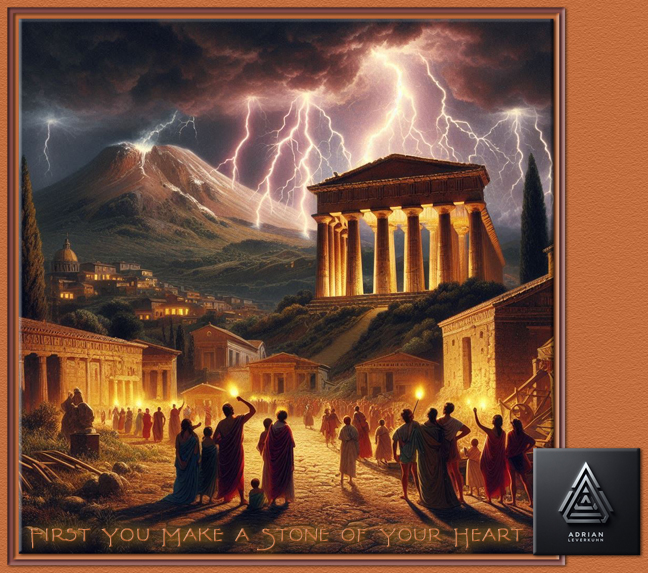
And so, here ends First You Make a Stone of Your Heart. This story © 2025 adrian leverkühn | abw | adrianleverkuhnwrites.com | and as usual this is a work of fiction, plain and simple, and nothing but. The third, and final part of the tale will conclude in TimeShadow.

If you’re still here, well, Tomorrow Never Knows just might do the trick. Adios for now.





 Adrian Leverkühn Writes