
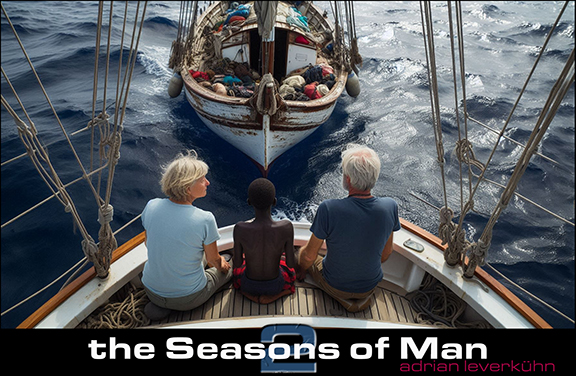
So here is the heavily edited and expanded version of the story. Sorry for all the grammatical errors. I’m going through a new round of injections in the remaining eye and some days are, well, while some days are better than others the need to write remains. There are times when I see words in pairs or even threes, or like great gobs of vaseline are floating across my field of view. Sadly, I’ve (still) yet to see Catherine Deneuve, but I will remain patiently waiting.
In the meantime…Music Matters, right?
Been back in the Genesis mode, listening to Duke. I love the second track, Duchess, the ambient flow then the build up to resurgent vocals, but this is a concept album, each song is a part of the greater story, and this project was a gamble for the group. Mining a similar vein, Peter Gabriel’s first solo album, often called Car, might go along with the zeitgeist. Moribund the Burgermeister and of course Solsbury Hill are the classics, but don’t ignore Humdrum and the last track, Here Comes the Flood.
Now…you’ve got a big read in your hands, so grab your tea and settle in.
The Seasons of Man
Book Two: The First Point of Aries
Part I: The Empath
She had always been a quiet girl, some called her reserved, while there were others who said she was withdrawn, almost antisocial, but the truth was that had never been the case. Not to those who knew her.
Most children are mildly curious about the world around them, while others are merely inquisitive. Then there are those who want to fully embrace the world around them. And not simply the physical world, but the people met along the way. This impulse is often confused with inquisitiveness, but those who spent time around Mary Ann Travers soon learned that they were in the presence of something far more unusual than that, something more than the mere inquisitiveness of a precocious child. She was not simply unusual, at least not in the ordinary sense of the word, for she at times seemed something far and away more exotic. For the few people who spent time around the girl, they soon learned that she was an empath, a true empath. More troubling to some, they would soon realize that the little girl leaned could reach in and see their deepest feelings, even their most deeply repressed feelings. Even feelings about themselves that some had spent hours and hours of their waking lives trying to hide. When such people found themselves around the little girl they soon felt remarkably exposed, and some dangerously vulnerable.
And, in time, her understanding of such people soon meant that the little girl developed an unusual working knowledge of good and evil, of what was meant by those usually oh-so-mundane and over used words, because the girl sensed goodness in the people she met. But she sensed evil, too. Especially real evil.
And she was always considered a bright girl. As in book smart; indeed, she was at times considered a bookish wonk, and she loved complex games, especially chess. From her earliest years her parents gave her books and with little effort the girl was soon reading all the time – as in at school and after school. Like when her father drove her to school, or when her mother took her shopping for clothes. Everywhere she went she carried books with her, and when confronted with a moment of free time she simply pulled out whatever book she happened to be reading and carried on. When she read something useful, or even simply interesting, she jotted her thoughts down in a small notepad she always seemed to have near at hand.
Yet when she met someone new, say a friend of her parents, perhaps, or even a new teacher at school, she rarely had a book in hand because she wanted nothing to interfere with the moment. For her eyes settled on that person, and then she watched. And listened. She reached out and inside the other person and felt the contours of their being. Oh, yes, and there were some who said she looked inside others’ souls, and who knows, perhaps there was some truth to that, if you believe in such things.
Also, it seemed that having been so examined, the people involved seemed to understand that the little girl had somehow seen inside their deepest selves. Some people were amazed, others left appalled and claimed they had felt violated by the experience. And, soon enough, many such people grew wary and suspicious when they were around the little girl.
She grew up in central London, on a quiet, tree-lined street known as Morpeth Terrace, her room looking out over the grounds of Westminster Cathedral. She first went to school right across the street, too, at the St Vincent De Paul Primary School. One might say that she was raised in the good graces of the Church, as in the Catholic Church, but that too would hardly get at the essentials of an otherwise singular truth.
Her father was in the Foreign Service, and always had been, as far as anyone could tell. For all anyone knew, he may well have been born into the service of His Majesty’s diplomatic corps, for he seemed to speak of little else, if and when he spoke at all, for the man was rarely seen anywhere other than Whitehall. The little girl’s mother seemed obsessed with keeping everything ‘just so’ – in other words, the woman’s conformity was tinged in the ochre shades of an obsessive-compulsive disorder. Though quite caring and more than intelligent, Marissa Travers spent more time than was absolutely necessary making absolutely sure that the people in her care became fit members of polite society. Her husband considered her a prig, and sometimes even worse than that, as inherently dishonest prig.
And why was that?
Two things might have come to mind if one asked Witcombe Travers that question.
Perhaps first in mind was that Marissa had concealed the true depths of her religious convictions from him. At least he like to say that was so, when out of earshot. Second, he truly cared for his daughter and by the time Mary Ann was ready for primary school he was convinced that Marissa was a malign influence on his little girl. In that regard, he had decided to intervene whenever he could.
Marissa had seemed a relatively sane and carefree soul during the time they courted, even though like most people her age she was a child of the Blitz – that brief period in time when Hitler’s legions took to the skies over southeast Britain, intent on bombing London back into the Stone Age. Despite the lingering anxiety the war imparted on her, she did well in school and attended university but soon lost interest, soon being that period in time when her romance with young Witcombe Travers blossomed into fulsome declarations of love, and his subsequent proposal of marriage.
Wit Travers was everything that his wife was not. He was a serious student of history, notably continental history through the realm of diplomacy, and yet he ignored the one simple fact of Marissa’s world that might possibly bring ruin unto his own. Marissa came from Catholic gentry, and while that may at first sound like a contradiction in terms vis-a-vis Catholics in Britain, locals recalled that her family traced an ancient lineage through the rolling hills and gentle vales of southeast Britain. Indeed, her family still possessed vast holdings throughout the region, from Hastings on the channel north to Maidstone and Canterbury, these from post-medieval times, while the family’s interests had extended north to Romford and Colchester in modern times. And her family had a somewhat different political outlook than Young Master Travers, a dyed in the wool conservative, seemed to possess.
But the short of it was simpler still: Wit Travers was willing to overlook Marissa’s rather inconvenient religious proclivities because she came from a family of immense means. Some might have said her’s was one of the most wealthy in Britain, and that might not have been too far from the truth before the First World War. To those seeking power, of course, money is an aphrodisiac all its own. With that said, their courtship was a brief but intense affair, a stately if occasionally flashy ritual that was often noted in the tabloids; marriage vows were exchanged in Westminster Cathedral, the two honeymooned on a large yacht somewhere in the Mediterranean, then young Witcombe settled into an almost hereditary fiefdom that seemed to be his station in life, deep as it was within the bowels of the Foreign Service.
Mary Ann was their firstborn; none followed. Marissa soon began a gradual retreat from her social calendar and fell deeper and deeper into the mysteries of The Church. Wit observed his wife’s apparent descent from afar, moving from tolerance to concern to outright alarm over the years of his daughter’s childhood, and so he increasingly found solace in the warm embrace of The Other Woman, or a series of them. Divorce, however, was out of the question. Members of the landed gentry just didn’t do such things, even in the middle of the 20th-century. So it might be said that Wit spent his time on more pressing matters, the affairs of state being at the top of his portfolio, but it was also remarked upon, and perhaps more times than was truly polite, that his daughter’s upbringing had been entrusted to a religious lunatic.
What impact all this had on the girl remained to be seen, but it seemed to most observers that her mother’s religious proclivities probably had something to do with Mary Ann’s peculiar sensitivities.
+++++
Her father was not so sure.
In mid-November, 1963, the family was watching highlights of a speech President Kennedy had given in Miami, Florida the day before, and Mary Ann had watched attentively when Kennedy said that “the harsh facts of poverty and social injustice will not yield easily to promises or goodwill” and that the people of this world would continue to struggle for “a system of individual liberty and social justice based on respect for the essential rights of man.” But then, near the end of his speech, Mary Ann recoiled from the television and ran crying from the room. Concerned by this reaction, her father ran after her, then stood by in shocked silence as his daughter explained that she had just seen the man on the television being shot in the head.
“You what?” her exasperated father cried, now more alarmed than ever that his little girl was a psychotic.
“The man, the President, I saw him in a car, a black car. He was shot in the head, and one of the men with him was shot too.”
When he considered the possibility that his little girl had lost touch with reality – because she had never reacted to anything like this before – he was at first lost. Now, and quite suddenly, Witcombe Travers was certain that his daughter had just experienced some kind of break related to his wife’s religious intolerance. Yet by the time Marissa Travers joined them in the kitchen, he watched his wife’s reaction and was soon certain his daughter’s break had something to do with Kennedy’s Catholicism, and therefore his wife’s. The next morning Mary Ann was describing the event in even more gruesome detail to the family’s physician, and the poor man in due course recommended she be hospitalized. Immediately.
So, in due course, she was.
And as Mary Ann’s bored psychiatrist’s watched as she described this imagined event in absolute detail, indeed, as if she had in fact witnessed the event, none of them knew what to make of this presumed break from reality because the story she told remained the same each time she retold it. All the other characteristics of a schizoid personality were absent. In test after test and interview upon interview, the architecture of her thoughts, her reasoning ability and, indeed, everything about the little girl’s emotional status simply cried normal.
And then everything the girl had described in such gruesome detail came to pass.
And just as she had described the event, too, from the motorcade through downtown Dallas to Oswald’s flight and eventual capture in a movie theatre in Oak Cliff. She had described Oswald’s perch, Jackie Kennedy’s frantic attempt to crawl away from her husband’s decimated skull, then that last desperate drive to Parkland Hospital, followed by the last rites given by a priest that had just happened by the unfolding tragedy inside the blue-green tiled inner sanctum of what was the old ER at Parkland. And as Mary Ann’s doctors watched the unfolding tragedy on the evening news they each fell into a kind of fearful respect for the girl’s prescient abilities, for now they could see and feel what she had experienced. The hospital’s psychiatrists seemed content to put the girl’s experience down to precognition, to some kind of paranormal experience, and with that label firmly affixed on her file the little girl was discharged.
But, oh, how very wrong those noble physicians were.
+++++
She was returned home posthaste two days after the assassination, but after a brief discussion it was deemed in the girl’s best interest if Marissa take her to the family’s estate just west of Paglesham, hard by Ballards Gore. Witcombe was suddenly terrified of his little girl’s abilities, but the girl’s mother now thought Mary Ann was possessed by evil forces, perhaps by Satan himself, and when he realized what was happening he decided it was time to send her away to school.
Because through all this the child remained academically brilliant and emotionally engaged with those around her, from classmates to teachers. Perhaps because she had learned the hard way that it ‘might be best’ if she kept her precognitive abilities to herself, as in ‘out of sight and so firmly out of mind.’ So it might be fair to say that after the Kennedy affair she learned to keep her abilities, and her insights, to herself. And she would, by and large, for the rest of her life.
And it was in this context that the girl lived. When she was accepted at St Paul’s Girls’ School, right off the Brook Green in Hammersmith, she blossomed. Founded by the Sisters of Charity of St Paul the Apostle, when Marry Ann arrived she did not know what to expect except, perhaps, more of the same religious instruction her mother employed. Her father certainly had no idea, but he had little say in the matter.
Yet under the care and guidance of the sisters she thrived, and performed brilliantly on her A Levels, eventually making it into Girton College, Cambridge, with ease. She drifted away from her parents emotionally, just as they pulled away from her physically.
Mary Ann remained an impressive student while also displaying remarkable abilities when playing Chess. She seemed to have an inexplicable talent for anticipating her opponent’s next move and so rarely lost, even to the best Masters around Cambridge. She studied literature and history, but soon developed an interest in journalism. On projects for her classes she developed a remarkable ability to interview people who, more often than not, were known as reluctant to talk to the press, and as a result she earned a reputation for being an extraordinarily empathetic listener, as well as a brilliant writer.
She enjoyed taking long walks along the River Cam, even crossing the more touristy Bridge of Sighs at St John’s College from time to time, which was where she happened upon a young man one evening.
He was staring down into the murky waters of the Cam, apparently just another student lost in thought, yet there was something about him that stopped her in her steps. So she reached out to him, tried to feel the contours of his pain. Then she saw the dog cradled protectively in his arms, and she could feel the boy’s pain as a searing agony of her own. She stood next to him, looked at the motionless dog in his arms, then gently touched the boy’s arm.
“Are you alright?” she asked.
“No, no I am most certainly not alright,” the boy whispered. “In fact, I am very, very not alright.”
“What happened?”
“She got old, is all,” he said with a sniffle. “Old, you know, as in she ran out of time?”
She moved closer to the boy and put her arm around him, and still he did not react to her. “May I touch her?” Mary Ann asked. And when the boy shrugged off her question she reached out and put her hand on the pup’s neck, then she closed her eyes as she gently stroked the dog’s smooth coat.
“She loved you, you know?” Mary Ann said a moment later. “Last summer, when you took her to Brighton, when you walked on the beach together…”
Malcom Doncaster turned and looked at the girl, his eyes rimmed with red-hot anger, his astonishment right out there in the open for all to see. “And you would know this how?” he asked, his voice an acid wash of curiously suppressed rage.
“Her memories, they’re still with her, they haven’t slipped away yet.”
“What do you mean…yet?”
“How long has it been since you put her down?”
“What?”
“How long?”
“We just left the vet’s office, why?”
“She’s not gone yet. She’s still listening to you, right now, she feels your heartbeat and she wants you to know how much joy that brought her.”
“Are you daft, or simply running some kind of con?”
“Neither, I’m afraid.”
“Maybe you’d best get away from me, and get your hand off my…”
“Daisy. She came when you called her Daisy. She loved the excitement in your voice, too, when you called out to her. Did you know that?”
He blinked away a tear, then shook his head and started to turn away.
“Stop, Malcolm, she wants to tell you something, while she still can.”
“Tell me…what…how do you…did you say?”
“Her ball, her favorite one, the red one, she buried it near the corner of the house, right behind a rose bush, and she wants you to have it…”
He nodded because he saw the truth of the moment.
“She’s slipping away now. Is there anything you want to tell her?”
He nodded as he turned his back to the wall, then he slid gently down the Bridge of Sighs until he was just sitting there, holding his Daisy close to his heart, tears rolling down now, then he buried his face in her neck and she could just barely hear the boy saying ‘I love you I love you…’ over and over until the girl by his side leaned close and helped him stand again.
“She’s gone now,” Mary Ann finally whispered, and she took his arm in hers and held him up while he gathered himself.
“Who are you?” the boy finally asked.
“I’m Mary Ann, and I’m at Girton,” she said with a smile. “You’ll be okay now, but get that ball. She really wants you to have it,” she said as she turned and walked off through the North Court. She didn’t want to miss the last bus out to the college, but she already knew it was running a little late.
+++++
By the time of her last year at the college she had become kind of a hot property right after a summer internship at the Telegraph, and she had soon been considered a sort of minor sensation amongst the editorial offices on Fleet Street. That her father was Lord Travers, now a leading member of the Labour Party, was supposedly of little consequence to these editors, but c’est la vie. Her professors knew she had earned the job offers she received, and when Mary Ann took a position with The Times they were most proud of her.
She began seeing Malcolm Doncaster that year, too. He was a sort of minor sensation in his own right, having been offered a teaching position in the Renaissance Literature Department at St John’s even before graduation. Gifted in languages and with an uncannily sharp mind, he was regarded as one of the best translators there was of Renaissance Latin, even within that cloistered community, and he even appeared to be an able teacher when given brief assignments in local schools. Malcolm’s students reported that he connected with them, that he engaged them and made them interested in subjects they’d rarely given any thought to, and he enjoyed leading a class along familiar lines of inquiry to new discoveries.
She usually met Malcolm at one of the pubs on Bridge Street and they would talk and talk before walking the grounds of St John’s at night, chasing ghosts and whatnot, and then one weekend they’d taken a room down by the sea in Brighton, and after that their destiny seemed to be, as they say, written in the stars. She went with him a few months later when he bought a new puppy, another Springer Spaniel, and he named her DaisyJane. “Because I like the song,” he said to those who asked. Mary Ann, however, never needed to ask such things, and she too fell in love with this new addition to their lives. DaisyJane was her first dog, too.
Soon the two exchanged vows in the St John’s College Chapel, and with Malcolm’s post-graduate studies at stake, she opted to commute to London by train most days, though she occasionally stayed in the city at her family’s home on Morpeth Terrace. Life soon settled into the warm embrace of something akin to a routine; she interviewed celebrities one day and politicians the next, and her editors loved her humorous take on the world…if only because she seemed so dialed into the quirky sides of her subjects. It was, they thought, like she could read their minds, and she possessed the ability to express what she learned in words that did not alienate their readership or, more importantly, her subjects.
Things were going along quite splendidly when another war broke out in the Middle East. In the last phases of the war the Times sent her to Tel Aviv to interview Golda Meir, then the prime minister of The State of Israel.
The results of this interview did not go over well. No, not well at all.
+++++
There remained one salient feature of Mary Ann Doncaster’s ‘gift’ that she barely understood. Perhaps because she had yet to discover the intricacies of this talent for herself.
One day, and this all happened quite by accident, she was grooming DaisyJane. She had just bathed and dried the pup, who was then not quite nine months old and so still fearful of such things, when Mary Ann held the pup close, and almost on happenstance the pup placed her forehead on Mary Ann’s. The connection was instantaneous and, for both of them, completely overwhelming.
Mary Ann at first assumed she’d been hit by stray currents of electricity, as intense, bright clouds of stars appeared in her field of view. She felt dizzy, off balance, and something like vertigo enveloped her, while at the same time strange emotions not her own flooded through her. Yet Mary Ann did not at first understand that was simply experiencing the pup’s fears as her own, but she soon understood that when she felt waves of convulsive fear running through the core of her being. And yet, as soon as she grasped what these feelings were, and where they were coming from, she recognized that something new and altogether different, and something rather remarkable was happening both of them. She was experiencing the pups emotions as her own, of that there was no doubt, but she also felt another being out there probing this connection, too.
And this being expressed wonder, and fear.
But then, a moment of emotional clarity. After Mary Ann projected her own sense of calm about what she doing, about why she was bathing the pup in the first place, DaisyJane seemed to agree with this reasoning, and then she relaxed. At first blush, Mary Ann had no context for what had happened because everything passing between them was in fact a non-verbal exchange, and she’d had no prior experience of anything like this with a pup, or with any other animal. Even so, in the aftermath she was so taken aback by the whole thing that she kept the matter to herself.
Yet another element of the exchange kept hammering away at her.
The exchange itself had not simply been between DaisyJane and herself. She’d felt another presence. Something or someone not simply watching these events, but actively monitoring them. She had not been nimble enough, nor prescient enough, to reach out and attempt contact, but this aspect of the exchange lingered, and it was bothering her.
A few weeks later, when Mary Ann bathed the pup again, DaisyJane got in the tub without any of the histrionics she’d expected, and afterward the pup seemed almost excited when Mary Ann held her up and dried her fur, but then the pup placed her forehead on Mary Ann’s again. And once again there was the same instant connection, one mind to the other. And almost immediately that third presence arrived and this time Mary Ann tried to reach out for it.
White hot clouds surrounded her, then…nothing. She had no memory of the next several hours.
Then that night, DaisyJane jumped up on the bed between Malcolm and Mary Ann and the pup nuzzled up against Malcolm’s face and waited expectantly, then seemed confused when Malcolm refused the connection. She rolled over to Mary Ann and nuzzled into her neck, then their foreheads touched and this time the connection was overwhelming…
“Mary Ann, are you alright?” Malcolm asked when he heard his wife moaning deliriously.
“Oh, oh, yes, just fine…”
“Is that beast bothering you?” he asked.
“No, no, not at all,” she said. Yet Mary Ann was feeling something akin to the radiating warmth of emotional comfort, and she knew the sensation was coming from the pup. The pup, of course, had no language skills and probably never would, but Mary Ann was sure the pup was trying to tell her something. Then she felt confusion, and a bit of loneliness, and an image of Malcolm appeared in her mind. “Mal, I think she wants you to hold her,” Mary Ann said as she made the leap.
“She does, does she? And no doubt she told you so?” he sighed, foul dripping sarcasm coming through from his deepest, most professorial voice, his usual weapon of choice.
“Don’t be an ass. Hold the dog.”
“Aye, aye, Admiral!” he snarled.
“Admiral, is it? So, I take it you’re still reading those Patrick O’Brian novels?”
“Damn right I am! And loving every minute of it, too, you scurvy-poxed wench!”
“And you, the esteemed Professor of Renaissance Literature. If your students only knew…”
“I’ve never had so much fun in my life, you daft prig, so leave me be…”
“Daft prig, am I?”
“Bloody right you are, and don’t you dare forget it.”
“Which one is that?” she asked, wanting to calm things down, if only for the pup’s sake.
“The book? Oh, the third, HMS Surprise.”
“Dare I even ask?”
“No, you dare not. I will, however, turn you loose on them once I’ve finished this one.”
“Assuming I want to read them, you mean…?”
“Oh, take my word for it…you’ll want to.”
“That good?”
“Yes, and I can’t wait for the next one.”
“You don’t mean…?”
“Yes. I do. The author contemplates a much longer series. Now, give me the damn dog.”
“Just hold her, would you, and for once pretend that you like her for just one moment.”
He sighed at her sarcasm, then put his book down as he rolled his eyes; DaisyJane snuggled into his shoulder, then the pup let slip a sigh that seemed to last a minute. “Dear Lord,” he whispered to his wife, “what’s up with her?”
“She feels that you don’t love her, oh Exhalted One. Is that so hard to understand?”
“I don’t understand this affinity you have of ascribing love to what is nothing more than an inbred instinct for utter dependence on us poor suckers…”
She smiled. “So, if I’m understanding you correctly, you ass, what you are in fact saying is that love doesn’t exist? That love has, in your mind, anyway, been reduced to a series of dependencies and obligations in some kind of contractual dominance ritual…”
“Damn right. Just so. And all of it sanctified by Mother Church, and of course duly enforced by her ever-present legions of omnipotent lawyers.”
“And what do you feel right now? With DaisyJane’s nose an inch or so away from yours? Is this all needs and obligations?”
“Oh, blast it all, woman! Yes, I feel oodles and oodles of love just pouring forth from her, from that cute little nose to those big brown, wondrously empathetic eyes…”
“And you’ve yet to acknowledge her presence, Malcolm. Would you at least look at her?”
He did. He now put his book on the bedside table and patted his chest, and the pup just kind of oozed up the bedsheets and settled onto his chest, her eyes boring into his.
“Oh my,” he sighed. “Now, just what are you trying to tell me, Munchkin?”
Mary Ann watched the unfolding interaction, curious how open her husband would really be to the pup, or if he was just placating both of them. She waited a few minutes then leaned closer. “So, what do you think she’s trying to tell you?”
“That if I continue to sit on the loo as long as I do, my hemorrhoids will soon turn into ferocious monsters that devour all of Europe.” He then leaned over and turned off his bedside light, pulled up his sheets and blanket, then turned his back to them both.
DaisyJane looked at Mary Ann and sighed, then came to her and snuggled in for the night.
+++++
She wasn’t sure why the Israelis extended the invitation to her.
Their survival at stake, the outcome of the war perilously in doubt, and even now with the Soviets rushing reinforcements to Egypt while the Americans were positioning reinforcements where they could to aid Israel, it was looking more than possible that World War III could break out at any moment. Nixon had dispatched Henry Kissinger to the area, the latter believing that the regional balance of power was at risk, and that if the Arab coalition succeeded in defeating Israel the entire region would fall into communist hands. With a looming defeat in Vietnam looking more and more likely, such an outcome was anathema to the American president, and to the liberal world order established after the Second World War.
The current tactical situation in the Sinai was looking somewhat hopeful, however, or at least it was from the Israeli standpoint. Egypt’s Third Army had been encircled east of the Suez, so this massive force of tanks and troops was now entrapped deeply within Egyptian territory, yet the Israelis seemed to hesitate before taking out this last element of resistance. The Third Army was, after all, the only thing keeping the Israeli Army from taking Cairo. Yet Kissinger was putting pressure on the Israeli prime minister, Golda Meir, to halt their advance so as to allow Anwar Sadat, the Egyptian president, to save face. In so doing, Kissinger hoped to broker a peace deal and use leverage of his success to help push the Soviets out of Egypt. This would then give the US the necessary credibility to broker a lasting peace in the region.
It was, in other words, a perilous moment in history.
The stakes could not be higher. For the modern State of Israel, they had never been more consequential, and just at that moment the Israeli ambassador to The Court of St James quietly requested that a rather junior reporter for the Times be allowed to travel to Tel Aviv to interview the prime minister.
The newspaper’s editors was astonished and Whitehall was in a tizzy. The Israelis had been tight-lipped about their progress throughout the war and hadn’t granted interview requests to any number of American or European news organizations, and just who the hell was Mary Ann Doncaster, anyway?
“Ah, Lord Travers is her father. That explains it!”
At the Foreign Office’s request, a special flight to Tel Aviv was laid on by BOAC, as all their regularly scheduled flights to the mid-east had been suspended with the outbreak of hostilities, and Mrs Doncaster, as well as a hastily assembled covey of diplomats, were rushed to an undisclosed military airfield just south of London. The little group approached the British Overseas Airways 707-420 in the dead of night then flew nonstop to Tel Aviv, arriving just before dawn. After waiting on the tarmac for several uncomfortable minutes, with heavily armed fighter jets constantly roaring off towards Egypt and Syria, an Israeli jeep appeared and Mrs Doncaster was asked to enjoin a convoy headed to yet another undisclosed location. No one else was invited. When she walked down the airstairs to the tarmac she noted the pervasive stench of jet fuel and cordite, the cologne of modern warfare and apparently an aphrodisiac to some men, and the suddenly felt vulnerable, even exposed.
Two hours later, sequestered inside an Israeli leadership bunker, the young reporter was granted access to the Prime Minister, who had apparently just finished being briefed – by a small man wearing an eye patch – in her temporary office.
And why this meeting had been arranged remained something of a mystery in the years that followed. That Sir Edward Heath, then the Prime Minister of the United Kingdom, had been a close friend of the Travers family surely had no role to play in the affair, but perhaps Heath had been reaching out to Israel after at first offending the Israelis by professing neutrality at the onset of the war. After all, in the lead-up and in the immediate aftermath of the war, Arab members of OPEC placed embargos on all petroleum products to those countries that had supported Israel, and this first oil shock of the 20th-century shook the global economy to its core. Had Heath been quietly playing both sides while steadfastly appearing to maintain neutrality, and if this was so, perhaps this interview had some role to play in the UKs redemption?
Or had Lord Travers, now completely understanding his daughter’s abilities, discussed using her in some sort of clandestine operation? At any rate, when Mary Ann Doncaster first met Golda Meir the two embraced, their cheeks met, and as a solid connection was made between the two, in an instant the reporter gained insights that not even generals in the Israeli armed forces possessed. The two exchanged pleasantries, of course, and the Prime Minister conducted an otherwise bland interview, revealing nothing, giving away nothing, and a half hour later the reporter was dismissed. Mary Ann returned to the airport and once she was aboard the airliner the same group departed for London.
As she sat down, emotionally spent and expecting to be left alone with her thoughts, she was instead surrounded by erudite men and women all dressed in somber gray and they had question upon question to visit on her memory of the event. Notes were scribbled furiously; one of the men scooted up to the cockpit with their first summary, and Mary Ann presumed the spy had gone up to check-in with their superiors by radio.
But when the article she wrote was chock full of secrets so sensitive that the editorial board of the Times submitted a copy of the article to both MI6 and the Israeli embassy, ostensibly for approval, the Israeli response was so extreme that the Times, for the first time in since the 1930s refused to print an article solely on national security grounds. Mary Ann Doncaster was then summoned to Whitehall, to be interviewed by God knows who. She revealed what she’d learned in her interview with the Prime Minister and left her reporting to speak for itself, while M, the head of MI6, Sir Maurice Oldfield, sent all of this new material, including her notes, by special courier directly to Dr. Kissinger. The Israelis denied everything in this report, notably the Israelis near use of atomic weapons in the opening hours of the war, but that cat was now ours of the bag. And running free.
After this episode Mary Ann Doncaster became a sort of minor cause célèbre in both intelligence and journalistic circles, at least in London and New York, and this lasted for a few years, too. When a dictator in Syria or Iraq wanted to grant an interview to a Western newspaper, Mrs Doncaster was summoned and hastily dispatched. When a terrorist was suspected of plotting something vile, she was sent to interview those sympathetic to the cause, and more often than not she learned where the terrorist mastermind was in hiding. She somehow always returned with the goods, yet her handlers were perplexed. Her reporting was a never ending source of intel that even the most dedicated agencies had failed to uncover, yet even after tailing her they simply could not account for her continued success.
And while not one agency knew how she pulled it off, she put it down to a very deliberate interviewing technique. And yet not one intel agency bought that explanation, but what else could they do? Yet sooner or later Occam’s Razor applies and cuts a revealing swath through the tapestries of such mysteries, so of course the truth of the matter had to be that Mrs Doncaster was simply making this stuff up and reporting her creations as fact! What else could it be?
She was fired by the Times not long after MI6 and the CIA reached that very conclusion. In the aftermath, not even the tabloids would touch her. But that did not keep the spies from knocking on her door in the deep of night.
+++++
Malcolm had been adamant that the two of them make it on their own, that they’d never resort to asking her parents for a helping hand – despite his modest stipend as a graduate student. Though he was instructing lower level classes, his wages were slightly less than that of the janitors who swept the floors of his classrooms at the end of the day, though if the truth be known, he just didn’t seem to mind living in such reduced circumstances. In point of fact he rather thrived on that sort of life. Indeed, he viewed inherited wealth as something akin to gonorrhea, surviving on such money was nothing short of a quiet embrace of the wages of sin – before the advent of penicillin. He wanted nothing to do with her family’s millions, or was it billions, and told her just that repeatedly – as he made another peanut butter sandwich.
Mary Ann took on a job writing for one of the college newspapers, juicy columns like horoscopes aimed at those who enjoyed tilting at windmills, perhaps like the budding Renaissance Lit scholars on campus, though on Malcolm’s insistence she sat down one rainy Saturday morning and started in on O’Brian’s Master and Commander as she had her morning tea. She was finishing the second, Post Captain, just before bedtime.
“How have I not heard of these before?” she asked Malcolm.
“Because we live in an age of impending literary collapse, dearest. Literary scholarship means nothing, or haven’t you heard?”
“Malcolm, I think the relevant question is why haven’t you heard?”
“I have, and I don’t give a flying fuck.”
“I see.”
“You can take your Woodward and Bernstein,” he sighed. “I’ll stick with Alighieri and Petrarch, and, well, perhaps a sprinkling of Chaucer, too.”
“And Machiavelli, no doubt?” she added.
“No doubt.” Case closed, and that door was now shut.
By the time she finished the third book she too was anxious for the next in the series.
+++++
In due course the next book in O’Brian’s series came and went, then another, and another. Malcolm was soon Dr. Doncaster, aka The Professor – or just Mr D, depending on the venue – while Mary Ann had taken a real position at The Telegraph, another conservative newspaper with a fairly large pool of foreign correspondents. With her penance finished, she resumed writing about events in the Middle East and occasionally interviewed the leaders of countries in the region, though now she toned it down, didn’t rock the boat, managing to get along with both Whitehall and Fleet Street. But the cloak and dagger sorts who had occasionally stalked her appeared in the shadows again.
Then DaisyJane passed, and of old age, and Mary Ann grieved for a day then she told Malcolm the dog had told her not to fall down that hole, and that she was to go and find another pup to take her place. Malcolm was dubious, but he understood: It was a ‘girl thing.’ Had to be, that’s all there was to it. So another Springer found a way into their hearts, a ten week old bundle of brown and white, yet Mary Ann was reluctant to connect to Sarah until she was much older this time around.
But then Malcolm asked: “Why not add a second to the mix? You know, maybe a boy?”
“Ah,” Mary Ann sighed. So that was it…did he need a boy around so they could commiserate? Too much estrogen on the sheets, was it?
So Rupert joined the Doncaster brood not long after Murdoch took over the Times. Rupert’s coat was what was called, in breeders’ circles, a ‘roan’ pattern, more of an even distribution of white and brown, neither spotted nor saddled, except his coat also had a fair amount of golden hair, so he was what, in the vernacular, was called a tricolor roan, and so he was considered fairly rare. Soon Rupert and Sarah were a team, and Malcolm loved walking along the Cam with them, even sneaking them into class every now and then.
The Travers’ holdings in Essex, south of Cambridge were, as noted, quite extensive and included several parcels along the River Crouch and the River Roach, as well as a huge, undeveloped stretch along the head of the Paglesham Pool. And it was in these soggy marshes that Malcolm well and truly fell in love with his dogs for the first time.
He went out with a trainer and was absolutely convinced that Rupert would make a fantastic gun dog, and so he’d bought himself a shotgun for the occasion and had decided to go after some of the local waterfowl, only in the company of someone who actually knew up from down.
And although Rupert would have nothing to do with this business, as hunting involved actually working and getting filthy, Sarah turned out to be a both decent flushing spaniel and an excellent retriever. Then Rupert got into it and Malcolm discovered the boy’s strength was pointing at game, so in an unexpected way Malcolm now had himself a team of real working dogs. Soon, whenever he wasn’t in the classroom he was off with the pups, in the fields and bogs working scents or practicing retrieving in the local waters. He became consumed with them, and they him. He joined a sporting clays club, and after he was cornered into an interesting conversation about breeding, he was then quite sure he wanted to do that, too. Soon the Doncaster house was overflowing with puppies, and he finally relented when Mary Ann told him that her father wanted to give them a small estate just outside Burnham-on-Crouch. This worked for him as he was now teaching just two days a week, so the commute was manageable.
He started hunting with a group of locals, barristers and doctors and the like, who came out to Burnham on the weekend to either hunt – or to take out their sailboats.
And so about the time that O’Brian’s The Nutmeg of Consolation came out, both he and Mary Ann were as devoted to the Aubrey-Maturin series as they were to each other, or so they claimed when they went to book clubs around Cambridge or Burnham. Which was odd, someone said to them, ‘as neither of you are sailors.’
“I’ve never been on a boat in my life,” Malcolm proudly exclaimed to the members of one such club.
“And why haven’t we?” Mary Ann asked her husband later that evening.
So when one of his shooting buddies invited them out for a sail a few weeks later, Malcolm accepted the offer straight away and then called Mary Ann, and he’d told her that they’d need to purchase some boat shoes.
“Whatever on earth for?”
“Yar! ‘Cause we be hoisting the main’sl and setting off for deep blue this weekend, lassie.”
“Malcolm, what have you been smoking…?”
“Ben Shepherd is taking us out on his sailboat, Saturday next. He says we’ll need appropriate shoes, jackets, and gloves. Gloves, Mary, can you imagine that? There’s such a thing as sailing gloves!”
“What will we do with the dogs?”
“Bring them, of course!”
On the anointed day the four of them appeared at the marina in Burnham and Ben and his wife Sally met them in the car park then pointed at the at the whitecaps on the river. “It may be a bit sporting out,” Ben said, trying to make his voice heard over the freshening gale. “Are you sure you’d like to go out in this?”
“Sure!” both of them said. The dogs seemed less inclined to participate as they were escorted down to the slip, but ever the brave-hearted one, Sarah hopped up on deck as if she’d done so a hundred times before. Rupert looked at Malcolm, his eyes full of pure, cold dread in his brown eyes, and eventually Malcolm had to help the reluctant beast onboard. The winds, now out of the west at about 35 knots gusting to 40, were creating waves in the river that looked better suited to surfing but, as the wind was at their backs, that very same wind made for a pleasant – if faster than hell – trip down the river and out into the mouth of the Thames Estuary.
Shepherd’s sailboat, an almost brand new 37 foot Rustler, was ideally suited for the conditions encountered that day, and he drove Achilles mercilessly into the open ocean with practiced ease, then cracked off to the north as gusts hit the low-50s. Malcolm was wide-eyed and hanging onto Rupert for dear life; Mary Ann and Sarah were ecstatic, their hair streaming out behind them, their eyes watering as the chill air bit into them, though both were soon soaked through to the bone. Shepherd turned into the wind and Achilles plowed into the building seas, the water now the color of coffee with a generous serving of milk, and crashing waves broke over the bow, sending great gouts of icy seawater all over everyone. Sally and Mary Ann was soon howling with glee, Sarah barking at the spume that pelted her, trying – more than once – to bite big globules of the stuff before they hit.
Then they turned back to the river and right into the wind.
And the waves, which were now approaching ten feet in from crest to trough, came on with terrifying strength.
Achilles slammed into each as Shepherd tacked up the river, teaching first Malcolm and then Mary Ann how to handle the winches on each tack. They soon passed Courtsend on Foulness Island, then taking the Wallasea Island seawall to port before turning back into the marina.
Now soaked and shivering, Rupert looked up at them with loathing in his eyes. ‘Like…I warned you guys, but oh no, you just had to do it, didn’t you…’
“Malcolm?” Ben asked. “You alright?”
Malcolm turned and looked at his new friend and smiled. “What kind of boat did you say this is?”
Rupert groaned, then cut a fart before he hopped down to the dock and marched off to his car, thoroughly revolted with all these crazy two legged creatures.
+++++
Ever the academic, Malcolm was now more often than not spending a considerable amount of time doing research in Italy, and then as his interest in the ancient philosophers of Greece grew, he traveled with more frequency to Athens and the Aegean, before wandering one summer in Anatolia. Mary Ann had been consumed by her work, traveling frequently to the mid-east on one assignment after another. The pups grew older, their legs soon grew wearier, much sooner than Malcolm expected.
Mary Ann was now measuring their own lives in the lifespans of the pups who soon moved through their lives. DaisyJane – 12 years. Sarah – 10. Rupert an astonishing 14. Malcolm acknowledged the part these ‘animals’ were playing in their lives, but especially so as Rupert started to grow old. Malcolm and the pup had become inseparable, and when the aging professor was on campus he was never seen without his devoted Rupert. Students doted on Rupert, and so to the faculty and tutors he ran into every time he was caught walking about the grounds. When, on a cold winter morning, after Rupert refused to get up, he called in and then took the pup to a nearby veterinarian. There was no prognosis as Rupert passed quietly on the way to the clinic, leaving Malcolm gasping by the roadside, his tears uncontrollable, his raging grief inconsolable. A patrol vehicle stopped to check on him and they soon called Mary Ann after they found the dead dog cradled in the man’s arms, and she was able to come to the scene and take charge.
It took Malcolm weeks to get over Ruperts passing, the event more viscerally devastating than anything he’d experienced before. When Malcolm passed the entry off the kitchen and saw his boots and Rupert’s collar and leash he broke down for hours, and Mary Ann simply couldn’t understand what was happening…so she did what she had long ago promised her husband she wouldn’t do ever again. She connected with him, she reached in and drifted through his feelings, and image after image of Rupert came to her; she saw him running through their fields, or splashing through marshlands with another duck in his mouth, or on Ben’s sailboat, pounding out into the channel on one of their weekend trips aboard Achilles. And then there was that time when Sarah went into season and the poor pup had wanted to conjugate a few verbs…and oh, how he’d suffered…for almost a week. Malcolm had finally taken Rupert into the guest bedroom at night and slept with him in there, well away from Sarah, and Malcolm reported that the poor guy had moaned and trembled all through the night. Not knowing what else to do, Malcolm had simply turned and held onto Rupert, rubbing his head all through the night until they both, finally, found some rest in sleep.
And as Mary Ann re-experienced these things through her connection to Malcolm, she realized her husband’s grief was as simple as it had at first seemed; she uncovered no unresolved issues from his past, no secret dalliances, just simple love – from one being to another. He and the pup had bonded so completely that they’d become not just physically inseparable, but emotionally as well. And she was suddenly more than a little jealous about that bond, too. She had never felt that level of connection from Malcolm, who after all was her husband, and yet he was capable of providing all that emotional depth – for a dog? She felt mildly displaced, yet as a result her connection to him – while already quite strong – only grew stronger. She wanted to enjoy that same bond with him.
They had tried to have children of their own, of course, but something always went wrong. Spontaneous miscarriages. Something about conflicting RNA, all very vague and useless information. In time they had stopped trying, and perhaps that had contributed to Malcolm’s emotional embrace of Rupert, and for a time she wondered if their relationship had grown as emotionally barren as their biological incompatibility had proven to be. In the end, however, their barren relationship only made it easier, and all the more inevitable, that Mary Ann would thereafter be consumed by her work.
Clinton had left office only the year before, and the new American president had, after a painfully slow recount of ballots in Florida, assumed office without what the left in America called a clear mandate. Yet despite this, one of President Bush’s first acts was to pull back from the Arab-Israeli conflict, and in the process enacting policies specifically aimed at alienating the Palestinians in Gaza and the Golan. Once again the situation in the Eastern Mediterranean began to simmer, and accurate reporting from the region grew in both relevance and importance. Soon Mary Ann was shuttling between Damascus and Baghdad one week, then Washington and Geneva the next. And once again, reluctantly, she began connecting with her most important subjects – heads of state or foreign ministers – and once again her peculiarly insightful interviews became the subject of intense speculation within the West’s principal intelligence agencies…because it was clear that the West and the Middle East were approaching one of those moments in time when unforeseeable – and often radical events take charge and alter the course of history.
With the pups now gone, Mary Ann was, in effect, free from the more routine domestic obligations of running a household dominated by two active spaniels, so she felt free to travel for more extended periods of time. Malcolm went on extended sabbaticals, spending most of his time in Florence, Italy, but occasionally in ancient Anatolia, usually in and around the town of Sinop on the Black Sea, where he had gone to research the earliest writings about the early life of Diogenes, the Cynic.
He came across one of the philosopher’s remarks, usually translated as ‘Let the whole world be bed large enough for me, let me call the universe my home,’ that seemed to resonate with his inconveniently minimalist tendencies, so much so that upon his return home he found the societal strictures and mores of England faintly ludicrous, yet really, who knows why but he soon called Ben Shepherd and asked if he was still sailing Achilles and arranged to go out with his friend the next weekend. The weather on that late summer day was glorious, perhaps the last warmth of summer in attendance, their souls caressed by gentle breezes coming right off the rich, tilled soil beyond their wake, while cotton candy clouds adrift on cerulean airs above the Channel seemed intent on beckoning them onward into some kind of dream. And he came away just as smitten as he had been the first time he’d sailed on this very boat.
“Tell me about Rustler,” he asked his friend.
“Why? You finally ready to pull the trigger?”
Malcolm shrugged. “Maybe. We’ll see.”
“Oh, well then, they’re built out in Falmouth, solid lay up, very strong…”
And the very next day he called the firm, arranged to go out to the yard – which was difficult, to say the least, as the builder was located west of Exeter and Plymouth, almost at Land’s End. With Mary Ann in Washington to interview Colin Powell, the latest American Secretary of State, he had time enough to take the train all the way out to the remote, seaside village, and he spent three days there, talking, planning, and sailing two of the boats they happened to have available for demonstrations on the water. When he got home he called Mary Ann and said he’d had an idea he wanted to talk to her about. An idea he’d had on his most recent trip to Turkey, but then he’d said he wanted to talk to her about the next phase of their life together.
She took this gracefully. More so than she felt, because his words felt oddly unsettling. Like he was ready to move on from her.
Oh, little did she know.
She was finishing up in Washington and was slated to travel to New York City for another interview later that evening, so when he called she recommended he come over and they could make a sort of impromptu vacation of it together, maybe catch a Broadway show, or finally make it out to the Cloisters. After she rang off he made reservations and took the train into London, then woke early the next morning to catch the early flight to New York.
He watched the sea far below as the BA 747 climbed out over the Irish Sea and, he supposed that like most travelers in this era he thought of the first colonists sailing to the New World over these same waters. What had taken these courageous souls months to do, he was going to do the same in just a few hours. Not an altogether original thought, he knew, yet there it was, the idea spread out just like that ocean down there, like fields for the imagination to run through, free and unfettered.
“What must it feel like to cross this ocean?” he wondered aloud.
“Oh, it’s not as bad as most people think,” the fellow sitting next to him said, casually taking up the comment and striking up a conversation.
“You’ve done it, then?” Malcolm asked.
“Actually, I just completed the trip a few days ago. Connecticut, Bermuda, the Azores and Gibraltar. I crewed with a friend and his wife. Their insurance company wanted at least four experienced people onboard so…”
“Really?”
“Yes, something to do with maintaining a proper watch, but anyway, they asked and I managed to take six weeks off from work and now here I am.”
“Did you run into any bad weather?”
“Yes, of course, but typical storms aren’t really that big a deal. Not if the boat is well equipped and the crew experienced with heavy weather, anyway. Still, we had about a half day of really crappy weather; the rest was like sitting at the beach on a sunny day.”
“Sounds idyllic.”
“It was, for the most part. I’m thinking about making the trip myself next spring.”
“Oh? You have a boat, do you?”
“Yes, a 37 footer, but I’ll probably do it singlehanded.”
“Indeed. But the insurance…?”
The man shrugged. “I’ll go uninsured on the passage, get local insurance when I arrive in the UK.”
“Have you done much sailing by yourself?”
“Most of the time, usually. I’m used to it.”
“No wife? No children?”
“Who needs the baggage?”
“Quite right.
“What about you? Done much?”
“Just a little, with a friend.”
The stranger nodded. “That’s usually how you catch it.”
“Catch it?” Malcolm sighed, intrigued.
“The bug. The sailing bug. And once you make a long passage, well, little ideas start creeping into your head. Ideas like: how far, or just where could I go? Then you realize that the world is only limited by your imagination. And that limitations exist only in the mind, not in the heart, or in the soul.”
“I see. So you’re a poet too, I take it?”
The man smiled, a becoming smile. “I teach, or at least I like to think I do.”
“Ah, then we have something else in common.”
“Really? What’s your subject?”
“Renaissance literature, St John’s, Cambridge.”
And now the man chuckled. “That figures,” he sighed. “I teach classics at NYU.”
Malcolm had a laugh at that, too. “Why do you say that ‘it figures?’”
“Oh, hell, years ago I’d given up on the idea of coincidences, until they’d begun stacking up right in front of my face for so long I couldn’t ignore them any longer.” He took a sip from a bottle of mineral water, then continued. “I read a book a few years back, James Redfield I think wrote it, title is a little off-putting but the gist of it was simple enough. There are no coincidences, but people close themselves off to them so when such events happen they can’t even see them for what they are…”
“And that would be?”
“A new door opening. The next fork in the road. An opportunity to change the path you’re on.”
“Ah. One of those New Age tomes, is it?”
“Yes, of course, but that doesn’t obscure, or shouldn’t, anyway, what may well be a basic human truth. When we meet people, these so-called chance encounters may not be what they seem. Not simply accidents, not chance. And they present new opportunities, or new solutions to old problems, but only if we’re open to the possibilities that . Or, if you will, we’re open to explore the uncharted way ahead.”
“To take the road less traveled, as Frost put it?”
“Yes, exactly. To not let the present weigh us down so completely that we can’t see an unimagined future that may wait just ahead, or to take the path Diogenes walked.”
Malcolm’s head snapped around at that. “Diogenes?”
“Yes, surely you’re familiar with…”
“I’ve just spent the summer in Sinop and Corinth, tracking down references to aphorisms attributed to him.”
“And I’ve been trying to come up with a new module to discuss the Stoics and Cynics.”
“So,” Malcolm sighed, “no coincidences, eh?”
The flight hardly lasted long enough.
+++++
“You know, there’s one thing I really do love about America?” he said to Mary Ann as he stepped into the shower.
“What’s that, Luv?”
“The bloody showers. Just look at this, would you? You could land the Hindenburg in here, and it’s all perfect bloody marble! In fact, there’s more marble in here than in all of Florence!” He got in and stood under the five shower heads, the water pressure strong enough to power-wash thick mud off his Defender back at home. “This is bloody fantastic!” he shouted after a few minutes under the spray. “Have you tried it yet?”
“Yes, last night.”
“Well, come on, then. Come and let’s play a round of golf in here.”
She came in a few minutes later and they soaped each other, then he went to the spacious seat in one corner of the vast shower and sat. She came over and stood before him, which was his cue to lean the side of his face against her tummy and let the water run between them, and she’d rub his head and shoulders while he rubbed the backs of her thighs. It was just a little ritual but that’s how their intimacy began.
And an hour or so later they were dressing for dinner and he was wondering how to broach the subject of his journey to Falmouth, which was, after all, the kernel of the idea that had been taking shape in his mind, the fork in the road he was going to propose they now take…
“Mal, just curious, but I tried to call a few days ago and, well, I thought you were back from your trip so was a little concerned when I didn’t reach you? Is there anything going on I need to know about?”
“Whatever are you going on about now?” he grumbled, standing before a mirror trying to get his bow tie just so.
She came up to him slowly, to his reflection in the mirror, and she looked him in the eye. “You’re not seeing someone, are you?”
“What?”
“Another woman, Mal. You’re not seeing another woman, are you?”
“My God In Heaven, Woman!” he thundered. “Mary Ann? What’s gotten into you?”
“Me? Me? Malcolm, what’s gotten into you?” she said, her voice breaking, her eyes welling.
‘Oh dear,’ he thought, red lights and sirens going off now in his mind, ‘so this is menopause…’
“Now Mary Ann, first of all, no, no, and another no, there’s no woman, no other woman, at least not yet…”
“What? What did you say?”
“I went out to Falmouth.”
“Falmouth? Malcolm? What on earth are you going on about?”
“Rustler Yachts are built out there,” he stated flatly, his voice now professorial, blandly matter of fact, yet his mind was racing because this was not at all how he’d planned to tackle this subject.
“Who?”
“You know? As in Achilles? Ben’s and Sally’s boat?”
“Yes? What of it?”
“Oh, Mary Ann,” he sighed, suddenly feeling both exasperated and defeated, but she knew that look, knew he wasn’t trying to evade her concerns. “Have you made our dinner reservations?” he finally asked.
“At Peter Luger? Yes, of course.”
“Well, come on then. It’ll take an hour at least to get across town, by the time we find a cabbie and make our way down to the lobby.”
It did.
When they were finally seated he smiled as he roamed the same old menu, as yet unchanged since the first time he’d visited 25 years before, and the prices were still not revealed. And it was still cash only, which caused a minor panic, but as usual Mary Ann had seen to it. Dependable as clockwork.
“What would I do without you?” he sighed as he looked at her.
“Well, you mean assuming you could find someone to tie your shoes correctly? Well then, you might get on reasonably well.”
“I’m not sure I’d like that, Mary Ann. Not sure at all.”
“Well then, let’s not do that. You do recall the whole ’til death do us part thing?”
“I doubt that death will keep us apart, Mary Ann. I just can’t see that happening.”
She smiled. “So…you were about to say something about Falmouth?”
“Yes. I visited the yard where the boats are made. Quite something, too. The craftsmanship is extraordinary, puts Rolls Royce to shame.”
“Okay. What am I missing here, Mal?”
“Well, I’ve two years off, as you know, and I was thinking that now, well, that I’d like to spend some time in Florence, well, but, you see, well, I’ve been thinking a good deal about Turkey, uh, as well, and about how nice it might be to have a place to come home to. And NOT some DREARY flat,” he said, with more than a little unnecessarily added emphasis – which generated a little smile of her own. “Then again, I was, well, a…”
So she jumped in. “What you’re saying is that a boat would be perfect.”
“Dammit! You’re reading me again, aren’t you?”
“No, not at all. It’s written all over your face, like you’ve just managed to steal a bit of Christmas pudding without getting caught…”
“And here I thought I could…”
“Not on your life,” she said, grinning, “so why don’t you stop trying.”
“Never!” he said, grinning from ear to ear. “So? What do you think?”
“What’s the next step?”
“Go out and take a look around for yourself.”
“What are you thinking? Something like Achilles?”
He shook his head. “Too small for full time life aboard. You should look at their new 42 footer.”
“As long as there’s a decent galley, Mal.” She looked around the restaurant, and though the place was a hundred years old there was something so American about it, something trying to be English, or in this case a little bit of German, yet in an instant she missed their home in Essex. “Oh, Malcolm, what has become of us? Masters of the universe for two hundred years and then this. Coming to America to enjoy the fruits of empire once again.”
“Oh, I don’t know, Mary Ann,” he rejoined, not sure where her sudden funk had come from, or where it would take them next. “But things aren’t so awful, are they?”
“No, I suppose not. But tea and scones, Malcolm, the empire will be well and truly done for when our tea and scones are gone and forgotten.”
“There’s a nice galley on the 42, Mary Ann. I think you’ll be pleased.”
Their waiter came and he ordered sliced tomatoes and onions with two slices of their colossal bacon, then steak for two with creamed spinach and onion rings.
“So, do you have a plan in mind?”
“What?” he said, startled out of his reveries.
“With this boat you’re daydreaming about?”
“Oh dear, I was lost in that menu.”
“I know.”
“Well, we ought to make our way to the Med. Ben is taking Achilles across the Channel next spring, then he’s going to go to the Med by way of Paris and Lyon on the Seine. That might be fun, don’t you think?”
“It might be, yes, but don’t you think we ought to stretch our legs a bit first, see some places we haven’t been to yet? A real challenge?”
“Such as?” he asked, intrigued.
“Well, the Caribbean, for one. And how much trouble would it be to go to New Zealand?”
His eyes bugged. “New Zealand? I have no bloody idea, but that’s halfway ‘round the world!”
“Think you could stand being locked up with me on a boat for that long?” she added.
“I think I could manage, yes, but we might consider an extra passenger.”
“Oh?”
He looked at her directly, then sighed before he went ahead. “I know how you feel about this, but I think it’s time we got another pup.”
She smiled. “Now who’s reading minds?”
“Really? You’re ready?”
“I think so,” she said, smiling at his apparent relief. “Now, when do you want to go back out to Falmouth?”
+++++
They planned on getting up early to head up to The Cloisters first thing in the morning, and as the museum opened at ten they were up at seven to shower and have some tea before setting out. The Telegraph’s travel department had, as usual, made all her hotel and air reservations, so he’d been a little disappointed to be in a Marriott on the Lower West Side, but so far their stay had been nice, and the continental breakfast just delivered seemed decent enough. Even the water was hot enough for decent tea.
“You want me to set the table on the patio?” she asked. “It’s awfully nice out…”
“Sounds lovely. Need a hand?”
“Could you get the orange juice? That pitcher is a bit heavy…it must be solid glass…”
It was a small patio, more a large balcony, but it overlooked the Hudson and the morning really was glorious. Crisp but not too cool, and hardly a cloud in the sky. He saw she’d laid out a couple of linen napkins on the glass tabletop to set their places, so he brought the pitcher with him and sat with his back to the room, both of them leaning back and taking it all in while their tea steeped.
“In a way, it’s almost as interesting a city as…”
He stopped mid-sentence.
“What the devil is that?” he grumbled.
It was a high-pitched sound. Almost like buzzing, but more mechanical.
“Is that a jet engine?” she asked, just as an airliner at incredibly low altitude raced by, and they both stared as it disappeared inside the north tower of the World Trade Center. In the next instant billowing black smoke appeared, then thousands of pounds of vaporized jet fuel ignited, and they were so close that the concussive explosion knocked them off their feet. Windows all around them were shattering, glass was raining down onto their patio…
And then came the screams…
Malcolm stood and brushed chunks of tempered glass from his head then went to the railing and looked at the towering building as great gouts of white smoke and charred metal arced into the clear blue sky, raining down on the legions of unsuspecting pedestrians below. Without knowing why he started to cry, perhaps because he’d never seen anything quite like this before, but more than anything else it was the sheer scale of the unfolding horror that clawed at his throat. He turned and found Mary Ann inside their room, already on the phone.
Of course. Her reporter’s instincts had kicked in and she was now in high gear. Note pad in one hand, she was probably talking to one of the editorial staff, telling them what she’d just witnessed, then she was jotting down instructions, writing in that peculiar shorthand of hers. She put the phone down and went to the closet, pulled out her camera bag and opened it, then went back to the phone.
“Damn it all,” she said, “I’ve only got the 85. Yes, the 1.2” More jotting, her head down in intense concentration. Then she rang off and went to the camera bag and took out the camera, a lone Canon EOS 1D with an 85f1.2 L-series lens affixed. She slipped a new memory card in and joined him on the patio. She aimed, recomposed, then fired off quick, two to three shot bursts before pausing to recompose, and he watched her, fascinated at her raw display of instinct – and talent.
She’d become completely detached from the horror they’d witnessed, slipping into full blown reporter’s mode like someone had flipped a switch inside her brain, and he was as astonished as he was disappointed. Maybe, he thought, that was how she was processing the horror they’d just witnessed…
“Do you suppose this was an accident, Malcolm?”
He turned and surveyed the scene for a moment then shook his head. “At that speed and that altitude? I can’t imagine that’s even remotely possible, not on a day such as this, and even some kind of mechanical malfunction couldn’t explain this.”
“Yes, if it had been an emergency the river was right there. So…deliberate then.”
He nodded, mesmerized by the curling black smoke arcing from the tower into the clear blue sky overhead. A helicopter was now circling overhead, adding to the chaos.
“That couldn’t be snow, could it?” she asked.
“No. It’s paper, papers from hundred of desktops, blown out through the shattered glass.”
“Oh dear God,” she whispered – as the unfolding human tragedy finally reached her – then she raised the camera to her eye and fired a long burst. “Did you see that?”
“No? What?”
“A man. Jumped.”
“What? From where?”
“From above where it hit…the fire, the flames must have…there’s that sound again,” she cried…
…and they both watched as another airliner suddenly appeared, and as suddenly disappeared again, this time inside the south tower. He looked and saw that she had been shooting the whole time, and she brought the camera down and started looking through the images she’d just taken.
“Yes, there it is…small but…oh Malcolm, what in God’s name is happening?”
He saw she was crying now, that the inhumanity of the moment had finally reached her, but now was not the time. Not with the images she’d just taken…
“Get on the phone and call in, tell them what we’ve just seen, and tell them about your images.”
She wiped her eyes and nodded, and he grabbed a napkin to clear away the snot under her nose before he helped her inside. A minute later she was on the phone again, soon taking even more notes. She looked over at him as she spoke.
“Yes, he’s a pretty good photographer, actually. Yes, alright. You say we have an account there? Alright. We’re off. I’ll check in with you in a couple hours. Right. Bye.”
“What was that all about?”
“We’re to head over to a camera store, apparently not far from here. B&H Photo. We’re to get a couple of lenses and another body, and you’re to get as close as you can and take photographs. I’m to take notes for the story.”
“What?”
“Sorry, love, but you just became a staff photographer for the Telegraph.”
“What?”
“Oh, stop standing there looking stupid. We’ve work to do…”
“What…?”
+++++
By the time they left New York City both of them felt soiled; Malcolm remarked, on their way out to Kennedy, that the experience had ruined him. He even said that those three days had stained his soil, stained everyone, everywhere, forever. Stained by evil, the most evil kind imaginable. Evil that had hidden behind a mask of resolute goodness. Evil that explained its actions in the coy language of the relativist. Evil that seeks to justify evil by becoming a darker version of itself. It was, he added, the hallmark of all religion, and mankind’s truest gift to the universe.
He’d photographed thousands of victims of this evil. He’d even photographed the face of evil itself when, before police arrived and secured the scene, he’d come upon a large clump of smoldering wreckage in the middle of what looked like a snow covered lane. A charred hulk of metal that was easily identifiable as the cockpit of the second airliner, and there in right seat were the charred remains of what had once, for a few days or weeks or hours, become evil incarnate. That charred lump had once been one of the human beings who had taken it upon himself to commit this most unspeakable act. In God’s name, of course.
Always in God’s name.
No one was yet sure what the American response was going to be, but Malcolm was sure it would be massive, and that hundreds of thousands of people, perhaps millions, would die in the aftermath.
“Evil begets evil,” he whispered as he took his seat in the British Airways 777 and looked down at the men and women loading luggage into the plane on the ramp below. Just like the people on those four airliners must have watched, before madmen came and hijacked their lives. In the name of God.
“What’s that, love?”
“I don’t think the world will ever be the same,” he said as he turned and looked into her eyes. “Something is broken inside our world, Mary Ann. Inside us. Some vital spark has gone out of us. I keep thinking about those people sitting up there in those airplanes going about their lives, not knowing yet that they had already been murdered. Then spending the last seconds of their lives in terror, wondering why their lives were at an end?”
“Because you’ve never been to Beirut, or the Golan, or Gaza. Mal, you live in the past, you chose to live in the past, but such people live in the present…”
He shook his head. “But the people who ordered this live in the past, too. They’ve dedicated their lives to preserving a very certain past, but when you get right down to it that’s exactly what I’ve done with my life, too. But Mary Ann, I don’t know any literature or history professors commandeering airliners with the express intention of committing mass murder…”
“I know it’s hard to accept, Malcolm, but this is the world we live in…”
He shook his head again. “No, I can’t accept that. No, Mary Ann, this is the world we’ve made. What was that comic strip… ‘We have met the enemy and he is us?’”
“Pogo, by Walt Kelly, came out in 1970, or maybe ’71…?”
“You are a walking encyclopedia, aren’t you?”
“You asked, Mal.”
He looked at the people down there on the ramp loading all their baggage but then he turned away, pulled the window-shade down. “He is us,” he repeated, then he closed his eyes, tried to ask once again that the images running through the windmills of his mind just leave him be for awhile. He’d had enough of all their pointed recriminations, and he had no offerings left to give save the silence he now craved.
+++++
They went into London a week after their return from New York. He had to turn in all the camera gear they’d purchased at B&H and, comically enough, someone had decided that News Corp was going to give him a cheque for services rendered, as a freelance photographer for heaven’s sake, but then he’d had to sign a few papers for the taxman but that set him right with the civilized world again. Mary Ann had typed up a sort of ‘after action’ report of their three days and was going to turn that in, as well. She’d already wired in several stories, all published on 9/11 or on the days immediately after, and her image of the second airliner just moments before impact with the south tower had been a page one item. Not dramatic enough for a Pulitzer, or so one of the editors said, but Malcolm had taken the file and had a large print made. It was grainy but in that grain he saw the truth of the moment. Lives caught in amber. Everything was smoke and mirrors save the truth of their last moments here on earth.
Hate had found them, and snuffed them out.
And with that accomplished, the circle of hate would resume.
What, he wondered, might Diogenes have thought about all this?
They took the overnight train out to Penzance that evening, then hopped the bus out to Falmouth. They walked through the Rustler Marine facility, the manager showed her the 37 and walked Mary Ann through the 42, discussed the building process, how they could be involved as much or as little as they liked, the complete sales pitch, a full-court press.
But everywhere Malcolm looked he saw that same premeditated stain on the people he watched, on everyone, everywhere. That hopeless, helpless look that never showed even the slightest traces of complicity, but that seemed to speak to a limitless anger. The evil that had been constrained by the new rationalists of the Enlightenment had finally been unleashed. Again. And while few realized what had just happened, even fewer knew what would come next.
In the eyes of the people on the train out of London and on the bus to Falmouth, in the eyes of the workers he watched it seemed everyone wanted to talk about this new evil. It was about all most people wanted to talk about, especially when some of the people they talked to on the train realized that Mary Ann had been one of the reporters sending the Telegraph’s a steady stream of information from the site.
He stood back and watched, always aloof, and listened to their questions. Questions like: What did you see? Did you really see people jumping from those buildings? What was that like? What did you feel? And then, finally, “God, I don’t know how you managed that…”
Like God had anything to do with the things men did to each other that day.
No, that was the day God gave up on the human race and walked away, in despair of his creation.
“Why do they keep doing these things…in my name?”
“Haven’t they learned anything?”
or maybe, just maybe:
“Why did I give them Free Will?”
“What do you think about this one, Malcolm?”
“About…what?”
“This colour, for the upholstery in the saloon?”
He smiled. “Do you like it more than the others?”
“I think so, yes. But what about you?”
He looked at the sample and objectively it was indeed very nice, but his mind couldn’t process color and boats and images of people jumping from imploding buildings. “Oh, I think it’s lovely, Mary Ann. You know, I’ve always been a sucker for teal.”
Their new boat, the manager said, ought to be ready to launch in March, probably early March, and then they’d need time to add all the extras. Pick colors for the canvas on the dodger and bimini, electronics at the helm and anchoring gear on the bow.
“Where will you head from here?” the manager asked.
Malcolm didn’t hear the question, or at least he acted as if he hadn’t, so Mary Ann filled in the blanks. “Not sure yet, really. Maybe the canals to the Med, or work our way down to Spain, maybe sign up for the ARC. We just haven’t decided yet, really?”
“Well, that’s the beauty of a sailboat,” the man said. “You can go wherever the wind takes you, I suppose.”
Malcolm walked over to another boat, a black-hulled 37 nearing completion, and he walked along running his hand softly against the mirror smooth hull. Then he came to the stern and looked up, lost in thought.
“Have you decided on a name yet?” the manager asked.
And Malcolm turned before Mary Ann had even processed the question, and he said just one word to the man.
“Diogenes.”Part Two: The Explorer
“Are we having fun yet?” Malcolm Doncaster screamed at his wife, trying once again – and as yet in vain – to be heard over the hideous noises made by the thundering wind as it whipped through the sailboat’s rigging. He heard a freight train coming up from behind and cringed reflexively – because he already knew what was out there in the night.
The wave broke over Diogenes, almost filling the boat’s aft cockpit and nearly washing him out to sea. Only his tethered safety harness kept him onboard – this time – but he’d come down hard on something, probably the aft pulpit, and his back was hurting now.
“You okay?” Mary Ann said as she scuttled over to him.
“Not sure,” he gasped, winded by the blow.
“You came down hard on the coaming,” she called out over the wind, “then slid into the secondary,” she added, meaning the smaller winch on the protective coaming that surrounded the cockpit.
He pulled himself back into the helmsman’s seat, checked to make sure his safety harness hadn’t been compromised, then double-checked their heading on the NorthStar GPS. Still zero-two-eight magnetic, and now they were more than halfway between the northern terminus of the Gulf of St Lawrence and the southernmost tip of Greenland, and while the weather-window had looked fair enough the situation had quickly deteriorated when a cold front came roaring out of Baffin Bay. The plan had been, that plan now being definitely in the past-tense, to skirt the remaining ice off Greenland on their way to Reykjavik, where they planned to stay a week or so. Then they’d head to the Faeroes for another stop, checking back into the UK at Stornoway before scooting through the Hebrides on their way to the Irish Sea and, finally, to Land’s End once again. This would mark their completion of the Atlantic Circle, a sequence of shorter segments taken by a few boats each year, those more often than not piloted by the more daring types. Those who circumnavigated the North Atlantic often went on to tackle the world.
Now, caught in a howling gale in the middle of one of the most inhospitable bodies of water on the planet, Malcolm Doncaster was cursing the day he’d met Ben Shepherd, the friend who’d turned them both into sailing fanatics. And it was fanaticism, he grumbled to himself for the tenth time in as many minutes. Who else would be out here doing this, and spending real money to do it? You had to be out of your mind. Absolutely bonkers!
Another freight train approached and he ducked again as he tried to angle up the face of the cresting wave, and luckily it began breaking just after Diogenes rose up and over the top. Then the terrifying descent, the boat sort of surfing down the back of the immense wave before rising to meet the next one.
Then it started to snow.
In August.
“Oh, that’s just bloody perfect,” he growled.
Mary Ann took one look at the expression of disgust on her husband’s face and scuttled down the companionway to put water on for tea. It was going to be a long night.
+++++
The doctor in Reykjavik finished wrapping Malcolm’s chest in heavy white tape and admonished him that under no circumstances was he to partake in any strenuous activity for at least a month. Maybe two.
“I suppose sailing from here to Scotland counts as strenuous activity?” Malcolm snarked.
“If you are crazy, then yes. By all means, go right ahead.”
“Oh, I’m crazy alright,” he growled on his way out the exam room door, and the physician knew better than to comment further. He knew that look, and it was not to be trifled with.
+++++
Anchored off the Carrick Roads in the Penryn River, Diogenes and crew were now just off Falmouth, taking the boat back to the manufacturer to inspect and restore the boat’s standing rigging, or, as Malcolm put it, “All those blasted wires holding up everything!” Everything, in this case, being the mast.
After the anchor was secured and the Zodiac deployed, Malcolm simply disappeared. He had been muttering something about a shower for days and by now Mary Ann was certain she didn’t want to intrude. He’d been in a foul mood for weeks, probably because it still hurt to cough, though she’d been watching him carefully for signs of burn out and hadn’t seen a thing. In fact her husband seemed most pleased that they’d completed the Circle “reasonably intact.” Now it was time to make sure that Diogenes was still in good form.
And a half hour later the Zodiac returned with Rustler’s yard manager, and the three of them moved gear and storage containers to uncover the chainplates and the ship’s bilge and by the time Malcolm took the manager back to shore everyone was convinced that their little ship was as fit as the day she’d been launched.
Malcolm seemed to puff up a little when he heard that, so proud of his little ship was he. They had her hauled out the next day and her bottom paint renewed, and all the sacrificial zincs changed, and Raytheon had released something rather new and interesting, something called an integrated chartplotter. Highly detailed charts, on memory cards, could be downloaded into the plotter, but then the real magic began…for the image usually generated on a separate radar screen could be overlaid on the chart, and this presented a whole new way of seeing where you were going, of navigating at night or in bad weather, and more importantly, of knowing who was out there with you. Installation would require a new radar set but could reasonably be accomplished in a day, so when Diogenes was hauled the electronics boffins crawled onboard and got right to it. New transducers on the bottom of the hull were slipped into place, and the installation was soon complete. As promised!
In the meantime, Malcolm had secured a palatial room at the Greenbank and walked into the shower with his clothes still on. Mary Ann simply shook her head at this latest display of his foul-tempered lethargy, but did manage to get her clothes off before joining him.
She’d had no idea he’d been so horny, of course, and afterwards they spent a long evening in the hotel’s decent dining room before falling off into the deepest sleep either had enjoyed in months. With Diogenes due to be launched the next morning they barely responded to the wake-up call from the desk until she remembered and sat bolt upright.
“Mal? Come on, get up…”
“No,” came the muted snarl from under the blankets.
“Diogenes hits the water in an hour!”
“Fuck!”
They took a mooring ball almost right off the hotel and stayed two more nights, making several trips to the nearby Sainsbury’s to replenish their lockers and Malcolm also booking a massage to see if the pain in his ribcage could be mellowed a bit. Then another massage, the very next day. And as his ribs were still hurting, off he went to the local NHS clinic for x-rays.
And when the physician told him not to do anything too strenuous for at least a month he snarled and grumbled all the way back to the boat. He fired up the new electronics and even though Christmas was still a few weeks away he sounded like a kid who’d just opened his presents. With all their provisioning out of the way, Mary Ann threw off the mooring pendant while he raised the main, and they sailed off the ball and into the Roads again, taking Flushing Beach to port and Pendennis Castle to starboard on their way to the English Channel. He pulled up the relevant chart onscreen and entered their next waypoint, the cardinal buoy marking the inlet channel to Le Havre.
“A hundred and ninety two miles!” he proclaimed. “And right here, our course to steer and an ETA, with all the channel traffic visible – right here!” he added, pointing possessively at the new display as he jumped up and down like a kid. “Mary Ann! It’s bloody magic!”
She smiled. ‘At least he hasn’t quit on me yet,’ she told herself once again, repeating her biggest fear. She’d thought he’d simply lost interest in her as he hadn’t so much as touched her in months, not since a long layover in Boston while they’d waited out a hurricane working its way up the Atlantic coastline.
But after a couple of nights in the Greenbank’s downy billows she’d come out walking bowlegged and chapped. ‘Don’t the Americans call that rode hard and put away wet?’ she asked herself.
She smiled at her own nagging insecurities, even as she squirmed in discomfort again, then she walked over to look at the chartplotter’s display. Malcolm was in love with their boat again, all over again.
Two nights later, while tied off securely deep inside the old harbor in Honfleur, he’d plowed her fields so thoroughly she could barely walk the next morning. They walked the streets of the old quarter the next day while waiting for Ben and Sally Shepherd to arrive on Achilles, and that night they had a grand reunion at a waterfront bistro.
Diogenes followed Achilles across the Seine to have their masts pulled early the next morning, and riggers and yard workers got them down and wrapped and ready for transport down to the Mediterranean. While all that was going on Malcolm had an engine tech go over the diesel under the cockpit while Mary Ann and Sally went to a bakery for fresh bread and croissants. By the time the last yard worker departed it was too late to leave so both boats remained tied up in Le Havre for the night.
Both boats cast off their lines almost at the same time, and they turned south to motor up the Seine towards Paris, and they’d timed their departure to head upriver on a slack tide. And this was a new adventure, a very different kind of adventure! Diogenes now a motorboat, plowing up the Seine just like all the other commercial barges that passed them, but instead of endless waves now it was rolling farmland and white chalk cliffs and peerless villages with endless bakeries and bistros beckoning. Maybe it was the promise of France that had gotten into Malcolm, for he was as lusty now as he’d ever been.
So much so that she’d asked him to take it easy on her last night because, she had to admit, she had suddenly found intercourse painful. And this morning she felt bloated, almost nauseous, but she put it down to the diesel fumes wafting through the cockpit on the gently following breeze. By the time they’d tied off in Rouen two night later, the pain had spread to her lower back and she mentioned it to Ben, who was, after all, a physician.
He took her down below on Achilles and did a quick exam, and ten minutes later they leapt off Achilles and onto the dock, found a taxi and drove off in search of a good clinic.
Malcolm stared in dumbfounded befuddlement as he watched them drive off, and then Sally came over to have a talk with him.
“It might be nothing,” she said, “but Ben wants to get some lab work done.”
“For what?”
“Let’s wait until they return, shall we? No reason to get bogged down in hypotheticals.”
Ben and Mary Ann returned long after sunset, and Malcolm knew something was wrong as he watched them walk out to the boats. He helped her up and into the cockpit, and he had her sweater and hot tea at the ready, while Ben left them to hash things out in private.
“Oh, Mal,” she said, crying a little while she spoke, “it looks like I’m in trouble.”
He nodded. “I know, Mary Ann. I can see it in your eyes.” He’d decided to let her tell him in her own way, because the last thing he wanted to do was have to pull it out of her.
“The doctor did a pelvic exam, then an ultrasound and some lab work. She’s pretty sure it’s ovarian cancer.”
He nodded, devastated. “Next step?” he said, putting on his bravest face.
“Ben thinks I should get it done in London; he’s already called someone he knows.”
He nodded, sighed, then looked up at the stars – because he didn’t want her to see his tears. “Okay. So tomorrow we get into Paris…”
But she was shaking her head. “He’s got us on a flight to Heathrow just after midnight.”
“Us?”
“The four of us. He’s already got a taxi waiting and he called the marina and they’ll make sure the boats are in good…”
He looked down at his watch and nodded. “Right, off we go then. I’ll throw some things in the duffel. Anything you want me to pack?”
When he climbed up the companionway with the bag a few minutes later, she was already walking up the ramp that led up to the marina office. Ben and Sally were in the carpark, and he could see a taxi was already up there, waiting for him. He left the padlock in the hasp, unlocked in case someone needed to move Diogenes, then he jogged up the ramp and dove into the taxi. Five hours later they were in central London, checking into the surgical reception at the Royal London Hospital, and Marissa Travers was already there. Her arms crossed, waiting impatiently with Bible in hand, and patently mad as hell – if the steam coming out her ears was any indication.
Oh what fun, he told himself as he held onto his wife’s hand for dear life.
+++++
Ben and Sally had put off their trip for several months to make the trip with them, and now that Mary Ann was in post-operative chemotherapy Malcolm had expected them to return to France.
But they hadn’t.
Ben went back to Rouen to secure the boats for the winter, but returned two days later. Sally went with Mary Ann to chemo on the rare days that Mal couldn’t make it, while the boys – as Mary Ann called the two men – shuttled to and from the boats all of January and into February, until Mary Ann was cut loose and cleared to resume limited activities. She’d need regular bloodwork and imaging, but the cancer had been caught early and, apparently, before any spread to adjacent tissues. The four of them returned to Rouen in March, almost two years to the day after Diogenes was first put in the water. Though both boats had been covered during their winter sojourn, both were covered in grimy black particulate matter and a fair amount of dust had made it below through their dorade vents. Mary Ann went below and started in on the teak with gallons of lemon oil while the boys put on their foulies and set about cleaning and polishing both boats’ topsides. Then back in the water and over to the fuel docks, where a service tech was standing by to run all their fuel through filtration systems to clean out any slimy gunk lurking in the bottoms of their fuel tanks.
This, Malcolm thought, was the true romanticism of cruising. Paying someone hundreds of pounds to come clean bacteria laden sludge from fuel tanks. But after a few more economic indignities they were off again, this time, hopefully, bound for Paris. And so, of course, a lovely freezing drizzle began falling, coating everything before turning the decks of their boats into ice skating rinks, while just ahead…the first locks on the Seine beckoned, which were also the first locks that any of them had ever encountered. Both Mary Ann and Sally were terrified, while ‘the boys’ were merely anxious.
“It sounds simple enough,” Malcolm said after he called on the VHF to check-in with the lock-keeper. “Wait for any down-locking boats or barges to clear the chamber and then, once we get a green light, we go on in.”
“And then what, Oh Mighty Exalted One?” Mary Ann said, now taking note of her husband’s totally unjustified confidence, and suddenly feeling pale green waves of fear rolling over her.
“It says the lock-keeper will toss us lines, one forward and one back here, then you just hold on while the chamber refills, and you take up your line as the boat rises to keep us against the wall. Simple.”
“Uh-huh, simple. You do recall, don’t you, that this boat weighs something like fifteen tons? And we’re going to ‘hang on,’ you say? While standing on a bloody sheet of ice?”
“Well, it’s that or we turn around and go back to Rouen.”
“And get covered in all that soot again? No thank you.”
“Maybe our hiking shoes would do the trick?” he asked helpfully.
She shook her head. “Do you know where our gloves are?”
“Got ‘em, right here,” he said as he pulled them out of his rain-jacket’s pocket, and he tossed hers over so of course one glove bounced off her hand and thence into the Seine. They both stood and watched as the glove quickly disappeared down-current, then they turned and stared at one another.
“We need to get back in the groove,” he said, more to himself than to anyone within earshot, but she heard him and nodded.
“We were a team there for a while, weren’t we, Mal?”
“We’ll get there again, Mary Ann. You’ll see.”
Two days later they were in Paris, at the marina by the Arsenal. Diogenes had a few new scuffs on her starboard side…and curiously enough these scuffs were the same color as a barge in the same chamber with them in the second lock. Malcolm left that encounter wide-eyed and knock-kneed.
Given the time of year most of the slips in the little marina were empty, yet Paris was still Paris, that is to say she was her incomparable self. They stayed a few weeks, until the weather began to turn a little warmer, and then both Achilles and Diogenes resumed their southbound odyssey.
Of course, the moment the boats left the city it began raining. And raining. Then more rain fell and rivers throughout France swelled. River levels in the Seine rose, currents grew more swift – and therefore unpredictable. Occasionally the sun came out for a few minutes – before beating a hasty retreat behind more storm clouds. Locks came more frequently, storm debris from all the rain ran into the river, clogging water intakes and fouling moods as engines overheated. The Seine finally merged into the Saône, and after two weeks of one lock after another and constant rainfall, they’d finally made it to Lyon, all of them drenched to the bone and utterly exhausted. Seemingly right in the middle of the city, the Saône merged with the blue-green alpine waters of the Rhone and everyone knew it was time for a break, indeed, a long rest.
The sun came out but then in a shocking change, winter turned to summer without benefit of Spring’s cooler weather, and in the span of a few days the weather turned ridiculously hot and humid. To many Frenchmen and women, however, Lyon is the true cultural heart of France, and this especially holds true where the culinary arts are concerned, so after one day in the city everyone voted on staying in the city for a few weeks. Malcolm led them on tours of the Musée Gadagne and the Musée des Beaux-Arts, then they lingered for a day in the museum of Roman Civilization before feasting on the best food in the world. And all the while the temperature continued to soar.
Ben’s sailboat, Achilles, had air conditioning; Malcolm, ever the purist, had vetoed the idea of equipping Diogenes with something so decadent. But now, after two days of these wicked temperatures he was roasting in his own juices. After two weeks the interior began to reek of sweat and condensation, and Mary Ann decided it was time to head south to the sea. By the time they made it to Avignon, Mary Ann had left Diogenes to enjoy the pristine joys of air conditioned nature and took to sleeping on Achilles, leaving Malcolm to swat flies while trying to fall asleep in the cockpit. He called the good people at Rustler, in Falmouth, and they recommended an air conditioning installer – in Port Saint Louis. In other words, relief was another week away. And it was getting hotter out with each passing day.
He called the marina in Port Saint Louis to make sure their masts had arrived and were ready to go back up, and then he called the marine services company that Rustler had recommended. Because it was still low season they could get to him straight away, and they took great pains to remind Malcolm that they were doing him a great favor by getting to him so quickly, and once all that was laid on he became more interested in moving down-river at a quicker pace. In his haste, Malcolm pushed past Arles when he’d wanted very much to stop there for a few days, but it was just too damn hot out and he was getting more than miserable now. He was starting to feel sick. A bad kind of sick. Light-headed and dizzy, palpitations and nausea. Once he felt a little pressure in his chest, pain in his jaw, so he called Ben and Mary came over and took the wheel while he went below and rested for an hour.
Once they arrived they had to find a place to dock in the overcrowded marina, then find the a/c installer, who turned out to be busy. Yet two days later the work was done and it also turned out that the new air conditioning unit could do double duty as a heater, not that it mattered right now, but it was an alternative to the noisy diesel fired hydronic system already installed. Once both masts were stepped and their standing rigging secured, Achilles led the way through the Canal Saint Louis and on to the sea. Almost as soon as they entered the Mediterranean, however, they had to prepare to enter the old port in Marseille, just a few miles to the east.
Diogenes cooled down as soon as she was hooked up to shore power in Marseille’s; with that operational Mary Ann started to sleep onboard again, so life resumed the typical diurnal cadence they’d grown used to.
But then the dream came.
For all of them.
Then the screams returned.
+++++
The old port, or Vieux-Port de Marseilles, was a revelation.
Boats from seemingly everywhere in the world were docked here. Hundreds, if not thousands of them. Fantastic restaurants were everywhere, some right across the Quai de Rive Neuve. The girls rented bicycles and pedaled around the old quarter that encircled the marina, picking up bread or fresh fruit one day and flowers the next, while the boys did what boys usually do when they own a boat. They broke out the sandpaper and the Epifanes and got to work renewing their exterior varnish. They changed the engine oil, then the Racor fuel filters had to be serviced, and the stuffing boxes repacked and tightened. The air conditioning units on both boats soon ran all the time and, because few other boats in the marina had them, theirs became the envy of the docks. They made new friends – who wanted to come below and bask in the flow, only to disappear a day or so later, never to be heard from again.
Then Malcolm found a masseuse. Ben tagged along.
And unbeknownst to each other, every night the dream returned.
And at breakfast at a local café one morning, with the four of them gathered around a small table, Malcolm casually mentioned that he’d been having a recurring dream. “You know, it’s the damndest thing, but I’ve been having the same dream every night since we arrived.”
“The same one?” Ben asked. Sally suddenly looked ill.
Malcolm nodded. “Out in the ocean somewhere, the Atlantic I suppose, and the boat is surrounded by…”
“Dolphins,” Mary Ann blurted. “And while there’s no land in sight, all of a sudden…”
“I see a huge volcano erupting off in the distance,” Ben Shepherd added quietly, “right before a tsunami appears.”
The three of them turned to look at Sally, who was looking down at her hands, trying not to join in the madness.
“So,” Malcolm sighed, “the three of us are having the same dream?”
“The four of us,” Sally Shepherd sighed. “In mine, when the big wave comes I wake up.”
“So do I,” Ben said, shaking his head in dismay, while Malcolm and Mary Ann just looked at one another and shrugged. “Sorry,” Ben continued, “but I’ve never heard of anything like this before.”
“Something is seriously not right,” Sally added, now almost in tears. “I can feel it.”
“Why do you say that?” Mary Ann said, shocked by the tone of anguish inside the moment.
Sally looked at Mary Ann, only now her eyes were red-rimmed and unfocused. “Something evil is going to happen, right here. Something monstrous, and its coming.”
“What’s going to happen, Sally?” Mary Ann asked.
“I don’t know. That wasn’t part of the dream, but we were right here.”
Mary Ann looked at Ben, who shrugged, before going on. “We were in what part of the dream, Sally?”
“I can’t see it, but it’s close. Right now. It’s getting so close.”
“I think we must sound like barking madmen,” Ben said, his eyes sweeping the room, “but to tell you the truth, I’m beginning to feel a little paranoid.”
“The dolphins,” Sally blurted, and loudly enough that other patrons in the café turned to the sound of her voice, “they’re calling out, telling us we have to leave this place…right now…”
Mary Ann stood and grabbed Sally by the hand and led her outside to the sidewalk, leaving Ben to follow and Malcolm to settle the bill, then the four of them jogged across the street and down to their boats…
…just as someone in a van started driving through pedestrians, running them over on the very same walkway they’d just been on. Sally turned to face the sounds angry voices and shocked screams, then came the gunfire, and Malcolm could see an angry Arab man inside the van leaning out the rear door while shooting anyone still standing. A nearby Gendarme saw the unfolding chaos and returned fire, and a moment later the van swerved and smashed through the tables lined up at a sidewalk café – before the van crashed through a plate-glass wall and into the café where they had just been. More gunfire as two men and a woman from inside the van sprinted out onto the sidewalk and opened fire on more dazed pedestrians. Another policeman arrived and started shooting, adding to the mayhem. Fire broke out in the café and quickly spread to the floors above, black smoke roiled up into the sky– casting a pall over the dead and the dying. Bullets ripped into a boat next to Achilles and Ben pushed Sally to the dock while Malcolm pushed Mary Ann into the water. A split second later he cried out and fell into the water, clutching his side in shock. Mary Ann knew he’d been shot and cried out in anguish as she swam over to him.
The hi-low wail of sirens filled the air, police and EMS began arriving in force, not quite drowning out all the other sounds of despair coming from the sidewalk. Crying mothers beside shattered baby carriages, the scattered moans of men and women cradling loved ones as they died, frantic eyes full of despair and questions, desperate souls taking their last breaths. Soon there was only sporadic gunfire, some high pitched and sharp, another that sounded more like a low growl, like the bark of a heavy caliber machine gun. The Ben rushed over and helped pull Malcolm up onto the dock, looking for an entry wound while he assessed his friend’s condition. Sally, now sitting up, was staring at the heavens in wonder, apparently hallucinating. Mary Ann was pulling herself out of the water and rushing to her husband’s side, then holding his hand while Ben ran to Achilles for his medical kit.
To Mary Ann it was just another nightmare, yet this one was more than real because the blood on her hands belonged to her husband. Yet while Sally had seen it all coming, she was in shock and drifting away from reality. But now, as she sat beside her husband she recognized that they were surrounded once again by the products of anger and hatred once again, and right then Mary Ann knew these dreams were coming to them for a reason.
‘Something in us has changed,’ she said to herself, even as she watched Sally drifting away from them.
The minds gathered above watching all this unfold could not have agreed more. Humanity, they now understood, was far more violent than they had once thought.
Part Three: Seeker of Minds
The Old Man walked along the Molo Umberto, his mind roaming the byways of recent experience, still unsure of the moment. Water lapped gently against the stones beneath his feet, along the old stone quay that lined this part of the harbor, and he sighed because most of the tourists were gone now. He watched as a woman in a splashy red and orange sundress composed yet another perfect moment in the viewfinder of her Nikon, pausing to keep out of the frame until the moment had passed. But…did it ever…? Could you ever really capture moments such as these?
But all things must pass, even the best things in life reach an end, and he wanted to tell the girl there is no reasoning with Time. Her life, like so many others spent rushing about in haste, trying to capture a fleeting moment of happiness, would be full of such moments, of such happiness. Yet life could also just as easily be composed of lost opportunities and memories never made, of souls rushing through the viewfinder as if Time had no meaning. But, he wanted to scream, Time is everything, especially when your Time is at an end. And what then? Will your parade of excuses make one last appearance down the byways of memory before the inevitable steals them away for good…?
The news today had been one more grim reminder of time passing out of reach. Almost forty people gunned down in Marseilles. More Palestinian extremists drowning the world with their hate. Endless circles of hate, apparently. So many people lost today, lost to the unquenchable thirst of their hatred, and he shook his head in apparent dismay. But really, nothing surprised the Old Man anymore, because nothing had changed during his long lifetime. Not even Hate had changed. Not even Love.
Still, the Pink had called out to him this afternoon. She had called and now he did as he must, for her call was, as it always had been, irresistible. She just might have been, after all, one of the Sirens.
Another yacht was slowly pulling into the little harbor, a big one this time. Rich men on full display, all so full of importance, yet not one of them was reaching out to really experience the world. No, these men were content to force the world to experience them. Yet they were blind, doomed to a peculiar silence. All of them would soon be less than a memory, would soon be forgotten, for no matter how loudly they screamed their importance the universe remained unmoved by such noise.
Clouds were building over the mountains to the east, just above Rapallo, yet even now the Pink was calling. He looked at his cane and tapped it twice, and the thunder came.
The men on the big yacht were angry now. Pointing at the storm and shouting at someone on the seawall, shaking impotent fists in the name of their God.
The Old Man smiled at the silence lurking inside their furious shadows, then turned to go. He could no longer watch such folly without feeling ill.
+++++
Malcolm opened his eyes and looked at the IV, then at the bright lights overhead. He recognized them. The clustered lights of a surgical lamp, and he realized their light was focused – on him.
But he felt nothing, not even the light. No anger, no relief, not even confusion, just the stillness of being. Here, in the moment, because that is all there is. Bright, inquisitive eyes appear overhead, and why is it, he wonders, that some eyes can smile, that some eyes can fill your soul with an impossible warmth that lingers a lifetime.
He took a deep breath and relaxed, holding onto the warmth in the man’s eyes as he slipped away.
+++++
Mary Ann had spent the morning working on Malcolm’s cabin, making sure it is spotless. Every bit of teak was scrubbed with a mild bleach solution before wiping it down with lemon oil. She had stripped his berth and washed the linens, and all his laundry had been folded and put away. Ben was helping move a little wooden stairway over to Diogenes’ starboard side so Malcolm could step aboard easily, while Sally was carrying fresh baguettes and croissant down the companionway. These were scenes from a homecoming, creating touchstones of normalcy using the echoes of lives they used to lead to recreate a sense of home.
He moved slowly as he stood from the wheelchair, pushing himself up off the armrests because his legs felt unstable. There was no hiding the drain in Malcolm’s side, though it was covered with layers of gauze, and a colostomy bag hung on a harness by his side. He looked at the two steps leading up to the deck of his sailboat then shook his head.
“I’m not sure about this, guys?” he sighed.
“I’m right here,” Ben replied, already at his friend’s side, “so use my arms to steady up.”
Mary Ann was on deck, holding out her hand – just in case – and she watched Malcolm take the first step, then the second, then the real troublemaker – the leap across the void between the steps and the deck, a hefty two foot chasm. Malcolm stepped across but came down hard, and he cried out in pain as the jolt spread through his body.
The 5.56mm NATO round had hit Malcolm in the lower groin. After it tumbled through the soft tissues of his small intestines it grazed his renal artery on the way out his back. By the time he made it to the emergency room at the Hospital Center Regional De Marseille, the city’s largest teaching hospital, he had already lost a fair amount of blood. Worse still, the sundered tissues of his colon were leaking their foul contents into his abdominal cavity, coating the peritoneum with deadly bacteria. These bacteria began attacking the peritoneal lining almost immediately, and small infections started in the gut before spreading toward the pleural cavity around his lungs. Bags of antibiotics were pumped into his veins in a desperate attempt to stop the spreading infection, even as surgeons operated a second time to repair more damage to his colon. These missed leaks had been spilling even more bacteria into his gut and the antibiotics had not been able to keep up.
The hospital had been flooded with gunshot victims that terrible day, and they treated more wounded people by gunfire in one day than they usually did in one year. Still, more than forty people will gunned down at the marina that day, while dozens more with serious gunshot wounds were triaged out to three local trauma centers, with the worst coming to the teaching hospital closest to the marina. The first surgeon in the emergency department to look at Malcolm sent him straight to surgery, then he called the best gastrointestinal surgeon he knew, and that one call made all the difference.
He had been in the hospital for five weeks by the time he first got out of the bed in his room and walked ten feet across the room. The effort had been exhausting and nurses had helped him back into bed, then called his physicians. His temperature spiked. More leaks were suspected but scans proved negative.
He felt like an empty husk, dry and brittle, especially after the morning run of vampires, the techs who came by to draw blood for testing at four in the morning, and the absolute helplessness to resist their jabs left him emotionally drained. At first he grew depressed; soon he wanted to die.
In the first few days after the attack Mary Ann felt simply felt angry. They had worked for three plus decades and now, almost as soon as the two of them had broken free of the daily grind his life had been very nearly obliterated, and his future was now a huge question mark. How many times had she defended the Palestinians when he crowed on about the hatred that seemed to run through the bloodstreams of those people, and now this?
She was interviewed by several local news outlets, and perhaps because of her background she was interviewed live on the BBC, but she found herself no longer able to defend the Arabs who perpetuated this madness, and she said so. Both the Times and the Telegraph asked her to write up her take on the event, and she tried but had great difficulty thinking clearly about the atrocity she had witnessed. In a way she just wanted to put it all behind her, but she also knew she could never let that happen.
One night while Malcolm was asleep she placed her forehead on his and she was devastated by the images that came to her through the connection. Seeing an angry looking woman running down the sidewalk with what looked like an M16 carbine in her hands, and then this crazed lunatic was spraying her venom into the backs of unarmed people fleeing the chaos she had helped create, shooting people in the back while screaming ‘God Is Great.’ Through the contours of his mind she heard him asking over and over again: ‘What kind of people do this? Who shoots at unarmed women trying to get as far away from their hate as possible? These weren’t terrorists, his consciousness screamed over and over, these were serial killers waving flags of convenience, they were Satan’s legions come to life. Their bargains with the devil struck, the remaining meaning of their lives had been reduced to body counts, to murder at all cost, even to the loss of their own humanity. And did these people not understand that their cause lost credibility with every bullet fired into every innocent mother’s back…? Did nothing matter in this world but hate?
She pulled back, broke the connection because all she saw was a circle of hate.
Then again, who lays dying in a hospital bed and has empathy for his murderer?
+++++
His was the aft cabin, a wide double berth tucked under the cockpit right off the companionway. He found sliding into the bed difficult but not impossible, yet the pain was significant and the danger of ripping stitches very real so he stayed in the saloon most of the day, usually reading but she has bought him a present, a new laptop computer called a MacBook. Soon he is writing out the notes to a book he had in mind, a book about Diogenes and his travels from Anatolia to Corinth and the people he met along the way, most of them in Athens. Malcolm almost seemed excited to be re-engaged in the academic minutiae he had once turned away from, and he realized he missed teaching, the hidden candor of the classroom, the sense of discovery as minds are opened…guided by other careful minds.
…as minds are opened…?
…guided by…
…someone just like Malcolm…?
Did he need the classroom? Did he need to look out over a sea of expectant faces, ready to listen and to learn again? How could she broach the subject without seeming to patronize him?
She brought him tea and sat across from him, watched his hands shake as he sipped from the cup.
“What is this?” he asked. “Not Earl Grey, is it?”
“No, no, something from a local shop. Sally found it and we can’t get enough of it. I thought you might like it too.”
“It’s lovely. I feel flowers turning to the sun. Really, what an extraordinary scent…”
She smiled. “How goes the writing?”
“Oh, you know. Without a good library nearby…”
“Anything I can get for you?”
“I doubt they’d have what I’m after?”
“Such as?”
“Lucian’s Lover of Lies.”
“Sounds lovely.”
He grinned. “It is a series of dialogues on the evils of superstition, but many of his aphorisms are grounded in the extant record from Athens, when Diogenes happened through on his way to Corinth.”
“God, Malcolm, you sound just like a…”
“Please, don’t say it. Really. I’m not anymore, so…”
“You do miss the life, don’t you?”
“Of course I do. That was my identity, you know?”
She sighed. “You really weren’t ready to leave, were you?”
“No, but you were, and there was no point fighting gravity, Mary Ann, was there?”
“I see. I had no idea you resented me so much.”
“I do not resent you, Mary Ann, I just did not understand what the rush was all about. Then again, you always seem to be rushing about. And breathlessly, I might add.”
“Meaning?”
“Sometimes I think you don’t look before you leap. I think we have to backtrack when that happens.”
“Do you want to return to Cambridge?”
“Heavens no. Look at us, Mary Ann. Look where we are. And everywhere we go our little home is with us. Really, who would want to give this up?”
“I take it you’ve forgotten that storm? When you busted those ribs?” she added, pointing at his right side.
He shook his head and sighed. “I’ll not be forgetting that night anytime soon. Not in this lifetime, anyway.”
“Do you think you’d be able to manage if we ran into something like that again?”
“Right now? Not on your life, but ask me in a year.” He looked at her and shook his head. “Oh, dear. We are a pair, aren’t we? You doubt my sincerity regarding this way of life, and you think I resent you for taking me from the classroom, so the question I have in mind right now, Mary Ann, is this. What are you getting out of all this?”
“I finally feel alive, Malcolm. Really alive.”
“So before…you felt dead?”
She nodded. “Maybe? Yes? Or at least I felt like I was losing my humanity, especially after, you know…”
“New York. Yes, I know.”
“I hated them, you know?” she added.
“The hijackers? Why wouldn’t you?”
“I don’t know. Perhaps a failure of the imagination. To imagine the anger and despair that drove those men to do what they did. To try and understand…”
“To understand hate? Is that what you’re asking?”
“I suppose so,” she said. “But it seems to me, well, that hate blinds us to so many things. Reporting from the Middle East for all those years, getting to know my sources in ways few could appreciate, well, when that first airliner hit the tower I knew in an instant what had happened, and who was behind it. But Malcolm, that was just the outermost layer of hate. What we experienced was just the open sore we created, and by that of course I mean the West. But now Israel has become the open sore that never heals, and now all this blood is spilling out on the rest of us.”
He shook his head and sighed again. “And where would you have had Europe’s Jews go? Where on earth could they feel safe? The world realized, finally I suppose, that these people would never be safe in Europe, so resettling their homeland was a last shot in the dark. A last, desperate gamble…”
“That’s failed.”
Again he shook his head. “I doubt there are many Israelis who would agree with that assessment, Mary Ann. And I’m not sure many in that first generation of post-war settlers ever for one moment thought it would be easy. And I think many realized they were walking into moral quicksand, but again, where else could they have gone?”
She seemed exasperated by that answer. “And that is the point of all this, Mal. No one in the region agrees, or can agree on anything – other than that one hardscrabble city is somehow their center of their civilization. But the truth is more complex, Malcolm, and yet simpler than anyone can admit. That land belongs to neither the Palestinians nor the Jews. Jerusalem belongs to the world, to all of us.”
“Well, that’s one point of view, but tell me one more thing, Mary Ann.”
“Yes, if I can…”
“Why don’t you write a book?”
She scoffed at that, then looked away. “Me?”
“Yes, you. You wrote for both the Times and then the Telegraph, and for decades. You cultivated a readership. Don’t you think that, perhaps, just maybe, that some of them might like to hear from you again?”
“Me?”
“Yes you. There’s no one else in here that I can see, so who the bloody else do you think I’m talking about?”
“Me? Write a book? Malcolm, what an extraordinary idea…!”
He looked at her and then shook his head. “Do I have to do all the thinking around here? Mary Ann? What’s come over you?”
“Extraordinary…” she whispered.
“Yes indeedy, and now that we’ve established that, how do you want to go about writing?”
“What?”
“How, Mary Ann. How do you want to write? You know, you put down one word after the one before, and soon you’ve constructed a meaningful sentence…”
“Malcolm…why don’t we write it? Together? We’ve been right there, right in the eye of the hurricane, so to speak, so who better to…”
“That might be a pretty good title, Mary Ann. In The Eye of The Hurricane. And how about, right under that, Scenes From The Edge of the Abyss…?”
“I’ll outline some ideas tonight, but Mal, it’ll be hard to write on notepads. I got so used to writing on the workstations in the office…”
“Why don’t you and the gang hop on the TGV and go up to Lyon. Get yourself a MacBook. We could knock this out in a few weeks, maybe a month, then you can carry it up to Fleet Street and shop it around.”
“Screw that. I’ll call Nathan. We’re still on proper terms.”
“Is he still on the desk?”
She nodded. “He came down while you were still out of it, took us out to dinner. He seemed very concerned.”
“I’ll be. I had no idea.”
“You were out, Mal. I mean really really out, for about a week.”
“The whole thing seems like it happened in another lifetime, Mary Ann. I think maybe I lost something vital, too. Memories, for one thing. And the past now seems very distant and…”
“Maybe writing about it will help you reclaim some of…?”
He nodded. “Maybe. Worth trying, anyhow.”
“What an extraordinary idea, Malcolm. Really. Who better than us?”
“We had a front row seat to 9/11, didn’t we? And now this?” he said.
“And it just came to you? Right now?”
He nodded, then his gaze unfocused for a moment as he stared off into space. “You know, it’s just a feeling, and I’m not really sure why it comes to me, but Mary Ann, it almost feels like some kind of invisible hand is pushing us in one direction after another, or maybe even like something is using us? Does that make any sense?”
She shrugged. “It does if that’s what you’re feeling.”
“I can’t quite put my finger on it. Very frustrating, really.”
“How’s that tea? Need some hot water?”
“No. I’m good. Why don’t you hop over to Achilles and see if Ben and Sally can go with you up to Lyon?”
+++++
Early the next morning she heard him up at the crack of dawn, struggling to make it to the head on his own and then to the galley, and she listened while he put on water and then put some bread on to toast, all this being of some interest as suddenly he was pushing himself hard enough to try things on his own. She gave him a moment then went to the head herself, before walking aft to the galley. He had several slices of thick, whole wheat bread already under the broiler, some local better and blackberry jam ready to go…and TWO cups on the counter, tea bags resting and ready for the water coming to a boil on the stove.
“If you could help me with my shoes and socks, I think I’d like to spend a few hours writing in the cockpit today. Looks like the sun will be out and I feel as white as a sheet.”
“Some sun would do us both some good,” she whispered like any good mother might.
“What time are the three of you leaving?”
“Soon, I’d say. The train leaves at seven-twenty.”
He looked at his wristwatch and nodded. “Well, give me a hand and you’d then best get yourself ready to go.”
She helped him up the companionway a half hour later; the sun was now out and the air gloriously crisp, the air still just cool enough to require a sweater, and his laptop was set up on the cockpit table. She’d laid out a blanket for his legs, “just in case,” and a thermos full of piping hot EBT, or English Breakfast Tea. Ben and Sally hopped off Achilles and enquired about him.
“You sure you don’t want one of us to stay here with you?” Ben asked politely.
Malcolm smiled while he gently shook his head no. “I’ve got to start pushing myself a little harder.”
“We won’t be back ’til 1700. Are you sure?”
He pointed to the quay and nodded. “Right you three, off you go! Don’t bother about me! Have some fun and don’t eat too many snails.”
He watched as they walked off towards the quay to find a taxi to take them over to Saint-Charles, the huge central railway station, and he took the little folded blanket and spread it over his knees before he poured a cup of tea. He opened the laptop a moment later then began thinking about New York, and that day.
They’d been in that new Marriott. Setting things out for breakfast. “We were going to the Cloisters,” he said aloud. “Then that noise. That godawful noise.” He could still hear it, the whistling howl of jet engines pushed to their limits, the whistling shriek mixed with the high-pitched growl of overheated turbines. “It was like the air was parting, trying to get away from all that evil…”
He bent to the MacBook and began writing and he looked up a few minutes later and realized he needed to pee, and badly, then he looked at his wristwatch…
“This can’t be! How bloody preposterous!” he said as he looked at his watch, because he’d been sitting in one place – but for almost five hours! “Oh hell!” he growled as the need to pee became urgent.
He pushed himself up and over to the companionway and then looked down into the boat. At that ladder. He gulped a little and took a deep breath. “Okay. We can do this,” he said, though his voice was laced with uncertainty. He took a step down, then winced as the little colostomy bag attached to his waist caught on something. He stood and turned a little, then made his way down the next step, slowly placing his feet just so. Then he was finally down and he waltzed to the head. Pull it out. Pee. Empty the bag, then replace the damn thing. To the galley. Get some saltines, and maybe one of those Moroccan tangerines Sally brought over yesterday…
Then he looked at the companionway.
“Oh dear, that might as well be Mount Everest…”
Shake it off. Shuffle over to the companionway, take it one step at a time.
First step up. “So far so good.”
‘Take another, and are you ready for the next one…? Grab hold of that winch and pull yourself up. Up onto the bridge-deck. Take a breath. Got to keep hunched over to get past the dodger, but oh, crap, that hurts…?’
By the time he took his seat he was winded and a little dizzy, suddenly seeing stars. “Damn it all, what the hell is going on with me? I’m not THAT old!”
Or am I?
He heard footsteps approaching and sat up, opened his laptop and started writing. Footsteps coming closer and a moment later an old man appeared, walking slowly, aimlessly, apparently out for a stroll and looking at boats. Striking man, older. Tall. White hair, blue eyes. Elegant. More like an Italian, or perhaps Austrian. Green loden cape. Varnished cane with some sort of silver filigree. ‘Looks like that actor…played the old assassin in Three Days of the Condor. Max Von Something-or-other.’
“Good morning,” the stranger said as he approached Diogenes, his manner offhand, almost diffident.
“And to you. Nice day for a stroll.”
“It is. Yes.” The old man paused, as if suddenly undecided how to proceed. Then he looked up and smiled: “I’m curious. Are you not the man who was injured in all that madness a few months ago?”
“I am, yes.”
“I recall seeing something about you in the papers. Are you feeling better?”
“I have good days and bad. Today is a good day, I think.”
“What a lovely boat. Have you taken her far?”
“A bit, yes. We crossed the Atlantic twice, explored the east coast of the Americas, from the Canadian maritimes to the Bahamas to the Virgins. Places like that. We had just come down through the canals when.…”
“A lovely trip, I hear. Where will you go next?”
“We may stay the winter, then go on to Turkey.”
“Have you been to the Ligurian Sea?”
“That’s around Genoa, isn’t it?”
“Indeed. We have a wonderful port in my village. Perhaps you could come?”
“I see,” Malcolm said, now a little wary. “And where would that be?”
“Ah. Yes. Portofino, just south of Genoa. If you come before summer, before the crowds arrive, it is a lovely place to rest and gather strength.”
“You’re from there, you say?”
“Yes. I have a restaurant there. Lo Stella, and it is on the waterfront. If you come you must visit us. I promise we will take great care of you.”
‘Now that was a strange thing to say,’ Malcolm thought. ‘Very strange indeed.’ He smiled and tried to think of something noncommittal to say. “I’ve heard a lot of nice things about Portofino, of course, but isn’t it expensive?”
“Oh, yes. Very. But that is in high season, but I myself own a quiet stretch along the waterfront and you would be most welcome there. Call me if you can come, and I’m quite sure we can find you a nice spot.”
He leaned over and handed Malcolm a turquoise blue business card for his restaurant, and as Malcolm took it he noticed a sharp silver glint coming from the man’s cane.
“That’s quite a cane,” he said, pointing.
The Old Man looked down and smiled. “Yes, it is. This is my Altair, and she is very special.”
“Altair? As in the star?”
“Of course, of course, but do you not know the origins of the name,” the Old Man asked.
“The eagle, isn’t it?”
“Of course, yes, that is the modern interpretation. But more directly, I think from the original Arabic it meant ‘one who flies,’ so not exactly an astronomical name.”
“One who flies? I wonder who the name applied to?”
The Old Man smiled as if he’d just been visited by a fond memory. “Altair was a horse. A very special horse. He as the purest white, so white he shone like a star,” the Old Man said wistfully, yet Malcolm heard sincerity in the man’s voice. Something beyond a recitation of facts…more like a memory.
“You knew him well, I take it?”
The question startled the Old Man, brought him back from his reveries, then he turned his eyes on Malcolm…
…and in that moment Malcolm didn’t know what to think. He saw pure, unrestrained power in the man’s eyes, in his expression, but the Old Man almost appeared inhuman for a split second, after which he seemed to calm down a bit…
“The horse lived 2,500 years ago, Dr Doncaster, or so I’ve been told, so of course I never knew him.”
Malcolm was stunned, because he’d not mentioned his name yet…and that had to mean this meeting was no accident.
And as the Old Man seemed to realize his mistake he calmed down again. “Clever,” he finally said.
“Oh?” Malcolm said, smiling a bit. “What was so clever about that?”
“I’m not sure I have the words, but I do hope that you will take me up on my offer. Portofino is a magical place, and you and your wife would do well to understand what is meant by that.”
‘So, this old fella is really laying it all out there, isn’t he?’ Malcolm said to himself. ‘He knows who I am, he knows I’m married, and he wants me to come to Portofino. But who is he, and…”
“You are lost in thought, perhaps?” the Old Man asked. “I have disturbed you. So sorry. But perhaps we’ll meet again.” And with that said the Old Man turned and walked off, but he stopped about halfway up to the street and tapped his cane twice, and Malcolm was sure he heard deep rolling thunder right after that. And then, with Malcolm still watching the old man simply disappeared. As in one moment he was walking along on the sidewalk and in the next…he was gone.
The beeping on his laptop brought him back a while later. The poor thing’s battery was almost flat and he had no way to power the charging device up here in the cockpit…but then he saw he had apparently been dozing as it was now almost five p.m.
Which meant Mary Ann and the Shepherds would be returning soon.
Which meant he had to decide what to tell her about this visit by the strange old man.
And…why Portofino? Why… Why…
He pushed himself along the seat until he was behind the wheel and he powered up the chartplotter and pulled up the harbor charts for that area of the Ligurian Sea and yes, there it was. Just 200 or so nautical miles away, so call it a day and a half by sail.
But why go there at all? What could possibly be there – besides hordes of tourists?
The thunderstorm he’d first heard in the distance was very close now, but how had it come on so quickly? He turned and looked to the northwest, out over the city and beyond the bay and yes, the storm was building as it approached, thunder and lightning filled the air as he felt the air pressure drop in his ears. Yet even as he watched he seemed to recall there’d been no mention of rain in the forecast. But there was nothing he could do now but get below, so he slipped his new laptop in it’s case and moved to the companionway.
He stopped, could see slanting veils of white-streaked rain getting close to the outer jetty, but within seconds it looked almost like a foggy white wall, which meant the storm was kicking up spray from whitecaps on the bay. He watched, startled by the storms sudden intensity, as the wall of driving rain bore down on the marina, and he noted there wasn’t the usual warning he expected, either; one minute the air was warm and still, and a split second later a blast of cold air hit, followed by the wind-driven rain. As the first wall of rain hit an even stronger gust arrived and boats throughout the marina listed as they strained at their dock lines; wind-borne rain strafed anyone that had not already taken shelter, and then a torrential downpour began – just as he saw Mary Ann emerge from a taxi on the seawall, followed by Ben and Sally. Dressed in clothes appropriate for a sunny day of traveling, the three of them sprinted down the quay to the boats, sheltering their eyes so they could see the way ahead, but with Mary Ann sheltering a fancy sage colored canvas bag under her arms. He guessed that was for the new laptop, a Bellingham Bag by the looks of it, and so he was of course instantly jealous.
Everyone had just clambered into the cockpit on Diogenes when the hail hit. Soft, pea-sized clumps of snowy ice, they played a drum solo on the canvas cockpit enclosure while Mary Ann went below to get towels. He heard her putting on water for tea then her head popped up the companionway and she passed towels all around while the hail turned to a thundering rainfall. Lightning danced over and around the marina and everyone looked around nervously – because they understood they were in a marina full of sailboats, and sailboats – with their nice tall metal masts – make fine lightning rods.
Thunder cracked seemingly right overhead, then Sally’s hair stood straight out on end – just as a flash of light registered. An impossibly loud column of blinding light slammed into a nearby motorboat, one of those tall things, and an explosion of showering sparks arced through the air, falling everywhere. There was a secondary explosion on the big motor yacht, then Ben saw fire inside the deck saloon and he sprang into action; he ran over to the yacht to see if anyone was aboard, then he looked to see if anyone from the marina office had seen the fire. Another peeling rumble of thunder rolled across the city, another shattering bolt of pure, white-hot plasma slammed into the water perhaps 50 meters from where Ben stood and that was all it took. He turned and ran back to Diogenes, and when he crawled back inside the zippered enclosure he grinned and shook his head.
What little hair there was on top of his head was standing on end, and yet another bolt slammed into something close, but this time up on the quay, and more sparks arced into the marina.
“Goddamn, this doesn’t feel right,” Ben sighed. “Mal? You ever seen anything like this?”
Malcolm shook his head, shrugged, still focused on the fire spreading inside the big motor yacht. Someone had apparently called it in, because soon everyone turned to watch fire engines approaching, then dozens of firemen running down the ramp to the finger piers, some reeling out long lines of beige hoses, others carrying bright yellow fire axes towards the smoldering yacht. A large boat from the harbor fire brigade approached from the rear and two arcs of water hit the yacht’s superstructure…
…and then it hit him…
He hadn’t seen any storms building all day. There was nothing in the forecast, he told himself again. In fact, the storm had appeared right after that Old Man tapped his cane twice, up there on the quay. Coincidence?
His mind flashed back to that flight on BA, the day before the twin towers. A sailor, and a teacher. He’d talked about coincidence, too…specifically that there are no coincidences…that the things we encounter that we mistake for coincidence are really signposts, signs marking a change in the road ahead, or to the course of your life. His eyes blinked rapidly as the memory returned; the clear sky, the sea below, shadows of clouds on the ocean’s surface. James. James Redfield. That was the name of the author he’d told him about…
“James Redfield…” he said aloud.
“What’s that?” Ben said, startled.
“Oh. Sorry. Just a thought. I was, just, I was thinking about something that happened a few years ago. Bloke I met on an airplane…”
“You said James Redfield. Was that his name?”
Malcolm shook his head. “No. We were talking about coincidence, the nature of coincidence, and he mentioned a writer, this Redfield chap. Something happened an hour or so before you returned and suddenly that name popped into my mind.”
Sally looked at him as he spoke, then nodded. “The Celestine Prophecy,” she said quietly. “I have it onboard if you’d like to have a go.”
“I heard something about that book a few years back,” Mary Ann said as she walked up the companionway carrying a tray of finger sandwiches. “Caused quite a stir with the New Age set at the Times. Seemed to upset more than a few Catholics, too.”
“Oh, well then, yes, I must read this one!” Malcolm snarked.
“Oh, Mal…you’re incorrigible!”
“And sorry, but I’m not having it, Mary Ann, not after the way your mother went after you at the hospital.”
“She was a righteous prig,” Ben sighed as he remembered Marissa Travers lighting into Mary Ann, claiming that living the life she’d chosen had angered God and he’d visited cancer on her in retribution, and right then Malcolm had taken the old woman by the elbow and escorted her from the building.
“She’s a lunatic,” Malcolm snarled, “right out of her barking mind. Sorry, Mary, but that’s the way I feel about the woman.”
“You’re preaching to the choir, you old prune,” Mary Ann replied, smiling.
“A prune, am I? And do you know what, oh darling love of mine?”
“What?”
“Your feet stink.”
Mary Ann turned bright red, but in the end everyone had a good laugh.
And a tiny blue mote no larger than a grain of sand seemed to hesitate before it drifted out from inside the enclosure, then the tiny thing vanished in the blink of an eye.
+++++
A few weeks later, with his colostomy closed and his strength returning, Malcolm began walking around the marina, slowly regaining his strength and his wind, and more importantly, his balance. He found a gym and he and Ben started weight training together, then they’d hit the stationary bicycle for a half hour before walking back to the marina. Pretty soon, their discussions centered on where to go next.
“What does Sally want to do?” Malcolm asked.
“She seems quite content to go with the flow,” Ben said, “but truthfully, Mal, I think she’s content to go anywhere you go. She’s been smitten with you for years, you know?”
“What? That’s preposterous!”
“I know that, and the trouble is she knows too. Still, she just seems to want to be around you.”
“Have you talked to her about this?”
“Good god, no. She’d deny it sure as the sun’s coming up tomorrow, so what’s the point?”
“Deny it? Ben, there’s nothing to deny. Besides, you’re the good looking bloke, not I.”
“It’s not that, Mal. It’s the whole Cambridge don thing, you know? She always wanted to go but never made the grade. Jealousy, you see? But she enjoys following along, listening to you as you carry on about this and that. You truly are a brilliant lecturer…”
“Am I lecturing you as we see the sights…?”
“My God, Malcolm, when we walked through the cathedral in Avignon even the tour guides stopped and paid attention to what you were saying! It’s a gift, a bloody gift, and believe it or not I was rather proud of you! An Englishman teaching those snooty French a thing or two… It was brilliant!”
Malcolm blushed and turned to the way ahead. “Alright, now that we’ve established I’m God’s gift to academic geeks, what about us? Where are we off to next?”
“You mentioned some place south of Naples. Some village with more intact Greek temples than anyplace in the Med?”
“Ah. Paestum. Yes, and there’s a brilliant city just south of there on the Cilentan Coast. Agropoli, with it’s 6th century Castello Angioino Aragonese on a bluff above the sea. Nice marina there, too.”
“There! See what I mean? Malcolm, you’re a bloody walking encyclopedia – so the best possible tour guide on earth, so of course she’s smitten!”
“Ben, let’s drop the matter, shall we? No good can come of this kind of nonsense.”
“Alright, Mal,” Ben said softly. “What about this Agropoli, then? Where’s it located?”
“South of Naples, Pompei and all that.”
“What, like Sorrento and Amalfi and those places?”
“Further south a bit, and the Greeks settled on that plain rather extensively. Lots to see and do.”
“How far?”
“Oh, about four or so hundred miles, but we could stop at Corsica, break up the trip before crossing the Tyrrhenian Sea.”
“And then Malta?”
“Yes, then the Ionian islands before we head to Athens.”
“God, Mal, did you ever think we’d be doing this?”
Malcolm shook his head but the wonder of it all reached him too. “What a glorious age we’ve lived through. Imagine us living a few hundreds years ago, would you? Struggling to survive, probably not living even forty years. Spending almost all your life within a few miles of where you were born…and now this? I suppose a few hundred years hence they’ll think of this as the Golden Age of Man. But, oh my, I wonder how they’ll judge us for the way we’ve botched things up?”
“I don’t suppose it matters much, Mal. Not to us, anyway…”
Malcolm nodded – yet he could have hardly disagreed more. What was more important than the world you left behind? “No, I suppose not.”
“You’re walking better. How’s the gut feel?”
Malcolm stopped and looked at Ben. “You’re a good friend, Ben. The best. The best I’ve ever had.”
Ben looked away, wiped a tear away then nodded. “You too, mate. The best.”
“Right. Well, I think I have one more appointment with the surgeon this week. I assume if he clears me we might be good to go.”
“Alright, Mal.”
“Well then, if that’s the case we might as well think about getting the boats ready for sea again.”
That night after dinner when it was just the two of them, Malcolm brought up what Ben had said about Sally as they sat in their glowing teak cocoon, two tiny Dutch oil lamps casting funny little shadows on the bulkheads and bookcases about the main saloon. “Ben said something strange this afternoon, Mary. It’s been bothering me ever since.”
“Oh?”
“Yes. He said that Sally is smitten with me, and he mentioned the whole Cambridge don thing as the reason. Anyway, I’ve been thinking that as you two spend a lot of time together perhaps you’ve picked up on something?”
“Oh, Malcolm, you are as dense as uranium, you know? That poor woman has been head over heels in love with you for years…”
“What? Have you both gone completely bonkers?”
Mary Ann chuckled under her breath. “Why are you men always the last to know? Or are you so completely shut down now?”
“What do you mean by that?”
“Oh really, don’t play stupid.”
“I am not stupid but I have absolutely no idea what on earth you’re talking about…!”
“Well, let me see if I may enlighten you, my good Herr Doktor…”
“Please don’t call me that.”
“Of course I will, and I will because I know it annoys the bloody hell out of you.”
“I see. I’m sorry I brought this up…”
“Mal, put on your big boy pants for a moment, will you? All I’m saying is that once upon a time, you know, like way back in the Jurassic when dinosaurs still roamed the earth and you were still in your teens, it’s you boys who were dripping testosterone all over the floor, and you who were leering at anything wearing a skirt while we were pretending to be either, A. not interested or, B. completely oblivious. But, my dearest moron, now that you’ve turned 60, well, oh my how the tables have turned. But with our Sally, dear Malcolm, I fear the tables have turned completely round and round.”
“Now just what on earth does that mean?”
“Well, if I were you I wouldn’t lead her on, or astray. You’d find yourself in troubled waters very quickly, and I’m not sure even I could help you then.”
“This is all preposterous, you do know that, don’t you? I mean, really…”
“You asked, oh immortal one.”
“Oh, stuff it up your nose.”
She laughed at that. “You can’t even bring yourself to say a decent four letter word, can you?”
“Don’t be vulgar, Mary. It suits you too well.”
She really laughed at that one. “Oh, Malcolm, you’re priceless, you know? I mean, you do know that, right?”
“Okay, so tell me this? Are you fucking Ben?”
“What?” she stammered, suddenly outraged.
“I think I’m off to bed now, Mary. Good night.”
She watched him struggle to get up but didn’t help just yet, didn’t want to offend his brittle pride, but she stood after he’d made it upright. She held out her arm and helped him to his berth in the aft cabin, then helped him with his shoes and socks before tending the wounds on his belly.
“This one’s no longer red,” she said officiously. “Indeed, they both look much better tonight.”
He looked away in silence, made a faint chewing sound, his feathers still ruffled.
“What else happened that day?” she asked.
“What?”
“The day we went to Lyon. The day of that big storm.”
He bunched his lips, squinted a bit as the memory returned. “Something rather strange, Mary. Something so strange I know it can’t be real.”
“What does that mean?”
“There has to be a simpler explanation.”
“So…tell me. Maybe I can help?”
“I’m not sure I have the words.”
“Oh, truly? Coming from you…”
“I know, I know…but, well, just this once I think we need to connect.”
“What?”
“You know, the Vulcan mind meld thing…?”
“Malcolm? After all these years?”
“I know, but this might be important and I don’t want to muck it up.”
“Are you sure?”
He grabbed her round the waist and gently pulled her close, until the side of his face was resting on her belly, and then she slid down to him. Then she placed her forehead on his – and waited.
And waited.
She she leaned back and resettled on his forehead – and this time an explosion of dizzying light erupted between them, knocking her to the floor and sending him down on his berth, both of them reeling as afterimages of lightning criss-crossed through their minds.
And still…nothing.
“Mary? Are you alright?”
She pushed herself upright and took a deep breath, then helped him back up to a sitting position. “That’s never happened before, Mal. Not ever.”
He nodded. He looked away, but he kept nodding his head. “I understand. He doesn’t want us going there.”
“He? Malcolm, what on earth are you going on about?”
He pulled out his wallet, handed the blue business card to her.
“What’s this?”
“An old man dropped by the boat that day. Maybe a little after noon. Striking chap, quite elegant, very Italian, if you know what I mean. But maybe more northern Italian, I think. Silver hair, and his eyes. Blue, but like looking into infinity. Dressed like he had just stepped out of Hermes.
“He started a conversation. Seemed innocent enough. Gave me his card, talked a little about Portofino, where his place is, and invited me…no…he invited us to come. He has space on the docks. But Mary, he knew our names.”
“He…what?”
“And I hadn’t told him. But he knew them, and once he addressed me by my honorific.”
“You’re kidding.”
“No, not at all, but that wasn’t the strangest part, Mary. When he left, well, he was a little miffed at me. As he walked up to the street he stopped and looked back at me, then he tapped this cane he had with him, tapped it twice on the stones and almost instantly it thundered. And yes, I mean exactly what you think, that it was like he summoned the thunder. Then, out of the blue that storm came.” He sighed, clearly distraught, and Mary just let him talk. “And what did the weather service call it? A freak storm? Some kind of localized air mass that popped up over the Maritime Alps and raced across the bay, but you’re telling me no one caught it, no one issued a warning? That…well, things like that just don’t happen these days, Mary. Something was wrong about that whole day. Something was all wrong…terribly wrong…with that Old Man.”
+++++
They sailed in tandem, Achilles and Diogenes as one in their own Homeric quest, south along the west coast of Corsica in calming breezes. After putting in at the little village of Porto, and then Liscia, they put in at Ajaccio for fuel and a serious run at the markets for fresh fruit and vegetables. They took to the byways of history once again, walking down lanes Napoleon Bonaparte had as a child, supping on Corsican bouillabaisse and warm loaves of crusty bread dipped in olive oil, but Mary Ann declared her favorite dishes were the stuffed eggplant, the Aubergines à la Bonifacienne and the local Charcuterie plates at the tiny bistros along the waterfront.
Then it was off to Bonifacio, to the protected marina on the southern tip of the island, to spend a few days walking around the clifftop citadel perched over the sea, hiking up the King of Aragon staircase carved into cliffs. Yet Malcolm was reluctant to talk much now, and he was very conscious of Sally’s clinging to his every word, as if he was delivering the Sermon on the Mount. He struggled to walk for more than a half hour, less on the steep climbs there, and his mood soured as a result.
From Corsica they sailed straight to Agropoli, skirting the western tip of Capri and right into the ancient harbor under the bluffs, and right away everyone noticed the feeling inside the little marina was different. They were in Italy now, not France, and the change was unmistakable. The air, the light, even scents lingering on the breeze, redolent with wild things like lavender and honeysuckle and sometimes even something a little more spicy, all marked the change, but it was the spice of the people most of all that proved most different. There were fewer tourists so the locals were more open, or perhaps just less reserved than the French, and of course the food came from another universe entirely.
But the weather was still somewhat cool here, at least in the marina, and Malcolm began to blossom again, to come out of his self-imposed exile, to become more and more his talkative self as his body continued to repair itself. Summer was still a few months away, so everywhere they looked they found ripening fruit and blossoming flowers in the open air markets, everything coming alive under the warmth of the Italian sun. They hopped in their Zodiacs and Malcolm steered them over to the Elephant Grotto and everyone swam in the warm water, but the tempo was much slower here, and not always in a good way.
The town was off the beaten tourist path so was not as flush with tourist dollars, pounds, and euros. Streets were just that; barren of pedestrian traffic and in poor repair, no t-shirt shops and souvenir stands hawking Chinese knock-offs. As the girls walked to the market it wasn’t unusual for someone to stop and help them carry their groceries back to the marina, something that never happened in the more touristy ports they’d visited.
But even after spending most of the winter in Marseilles, the hot sun began to feel a little oppressive after a few days. The boats grew warm by mid-morning, then downright hot by early afternoon. Hatches slammed shut, breakers were flipped and the air conditioning units on both Achilles and Diogenes sprang into action. Sally in particular seemed to plant herself in front of a vent and let the air flow through her long reddish blond hair. No one wanted to cook so Mary Ann made huge salads for everyone. Lethargy soon became the order of the day.
But Malcolm rented a car and drove them up to visit the ruins at Paestum, and Malcolm was still impressed by the site. “These temples are in such good shape,” he declared. “Nothing outside of Athens touches these; only the Acropolis is more intact.” They spent the morning walking through the ruins in a light drizzle, and Sally resumed her favorite position, walking right beside Malcolm, hanging on his every word. Ben was no longer amused.
So Malcolm returned to the site two days later, this time by himself. He’d felt rushed with the group, but now he found he really wanted a camera. A good one, too, something to take black and white photographs that he could really enlarge. He asked at the one local camera store but, the owner stated, with the coming of digital cameras interest in film had fallen flat, and not even Nikon was making a film camera anymore.
But, Malcolm explained, he really wanted to shoot film, and he wanted to take his time about it, too.
“Then you have two choices. A Hasselblad, or a Leica. The Leica is small, the Hasselblad large, but it also takes better images.”
“Where can I look at them?”
“Rome, certainly. I would not bother with Naples.”
So, with Mary Ann’s blessings he hopped on the local to Naples then the express to Rome and he took a room in a small hotel near the Pont Sant’ Angelo overlooking the Tiber and the Castel across the bridge. He spent the next day running down a Hasselblad, a 205TCC with a prism finder and power winder, and he also bought three extra film backs and several lenses, including a 110 f2.0 that soon became his favorite. He then spent two days walking around the more off the beaten path neighborhoods of Rome shooting dozens of rolls of 120 film, and even a few of his favorite touristy spots, too, before taking the return trip down the coast. He made another day trip up to Paestum to photograph the ruins, and this time Sally came with him.
Because by now both Ben and Mary Ann wanted to know if Sally’s behavior simply reflected some kind of infatuation or was something more troubling. But she acted anything but infatuated that morning. In fact, she seemed almost disinterested in him and wandered around on her own. When she walked with him she waited patiently while he set out his new tripod and slowly composed his images, and she even asked to look through the bulky viewfinder more than once, but that was as close as she got to him. Other than that? She had seemed very ladylike, the very essence of a caustically demur character out of Jane Austen all come back to life. Sally and Ben seemed terribly relieved by Malcolm’s dismissive report of Sally’s afternoon; Malcolm wondered what all the fuss was about. He yawned then went to the camera store to get his negatives developed.
With contact sheets made he took a loupe and scoured each for exposure and sharpness, then picked a dozen and took them to the same camera store. The owner looked at Malcolm’s gear approvingly, perhaps a little wistfully because he’d not earned anything but the goodwill of, perhaps, a new customer. Malcolm examined his latest contact sheets after he handed over new rolls of fill to be developed, giving the old proprietor plenty to do, and the two became friends after a few weeks.
Yet after three weeks in the marina, and with the weather getting hotter and hotter, the group discussed their options going forward. Malta, the Ionian, and then Athens remained on a possible itinerary, but proceeding along that route meant sailing into the warmest region of the Mediterranean and just as the islands began to heat up.
“What about going north?” Sally asked innocently enough. “I’ve heard really good things about Ravello and Portofino.”
So, Malcolm thought, there it is. The hidden hand. La forza del destino.
Mary Ann looked at him, apparently alarmed by how quickly his face was turning crimson.
But he simply nodded. “You know, Sally, you may be spot-on. Warm but not hot, cool air coming off the alps all summer long, so cooling thunderstorms in the afternoons.”
“And,” she continued, “we could go south next autumn, and then to Athens for Christmas, maybe…?”
Again, she was correct, her thinking clear.
“Well, Ben? Mary Ann? What do you think? Shall we try Portofino? I have a standing offer for dockage along the waterfront, so we might be in for a real treat…”
So Malcolm packed up his camera gear and walked around the village just soaking all the lazy atmosphere up, not like a sponge but like the local bread taking up olive oil. Slowly, deliberately, each bite something to be cherished. But time had one more surprise in store for him, just waiting to be discovered…
Part Four: Sojourner
Agropoli was a study in postwar contrasts, a quiet town split into distinct neighborhoods, each rising phoenix-like depending on the amount of bomb damage sustained in 1943. The old quarter around the castle, most of the buildings pre-dating medieval times, seemed intact, indeed, the ancient buildings were in many spots simply dilapidated. Just inland, the usual mix of postwar buildings prevailed: modest concrete high-rises of four to five stories packed with low-income housing; closer to the waterfront more economic stratification was apparent, the more monied residences belonging to those who tended to the yachts that came in from time to time, for without this rich infusion of cash there was little in the city of to support growth. The town was a textbook example of the postwar stagflation that plagued Italy until EU policies provided new cash infusions.
But more Americans and British of more modest means were coming these days, and more often than not they came to purchase old farmsteads just inland, on the ancient-storied slopes above the crenellated coastline. It wasn’t, anyone could plainly tell, that hard to see why. The cities along the coast had been caught in the crossfire as Allied troops advanced slowly along this front of the war, fighting both the Wehrmacht on the ground and the Luftwaffe in the air in a long and bloody series of running engagements as the German and Italian Armies retreated up the coast. Cities and towns, even smaller ones like Agropoli, saw large swaths of their history flattened during this advance, yet the small farms and vineyards above the coastline often remained unscathed. Groves of olive trees hundreds of years old, perhaps older still, often surrounded ancient stone homes twice that had dotted these hillsides for millennia, the trees marking the what had become natural boundaries between the region’s abundant vineyards, some dating back to the First Roman Republic.
One afternoon after the decision to move north had been made, as Ben and Malcolm were hauling groceries out to their boats, Malcolm saw a lone woman in the marina, sitting at an easel painting the castle on the bluff. The light was approaching the ‘magic hour,’ when the golds of slanting sunlight bathed the rocky promontory, and now in the distance a large thunderstorm approached, it’s blue belly capped by billowing white cloud-tops just now succumbing to the ambers and oranges of the early evening’s light. There were a few small fishing boats in the bottom of the scene she was painting, modern things juxtaposed with the ancient castle, the need to provide food from the sea an immortal motif. So she was blending the old and the new, yet with so much conflict hiding in plain sight, the inherent contradictions of wanting to preserve a vital past while somehow embracing an unknown future, the woman was capturing all these feelings on her canvas. Even from a modest distance the colors the woman used were striking…artistic liberties had been taken, of course, but as he watched the progression of the evening perhaps not so much as he’d first thought. The sky was turning into a shifting kaleidoscope of deepening pastels right before his eyes, and somehow the woman had captured the moment before it occurred.
He had a small rolling cart loaded with canned goods, nothing perishable to spoil, so he walked closer so he could watch her at work. Perhaps the woman was used to tourists looking over her shoulder, but for whatever reason she never looked up from her canvas except, from time to time to hold out an outstretched arm, using her upturned brush to measure the scale of the promontory and the overarching clouds beyond. His own forays into black and white photography had awakened something in him, something like an artistic impulse, so perhaps he was studying her work to get a sense of the techniques used to mold the elements of the scene into a coherent composition, so he was enthralled by her skill. Composition wasn’t always an easy thing to grasp, and he understood that from recent experience, if his own meager efforts were a good indication.
And it was just then that he saw the basket at her feet.
Three puppies, their eyes just recently opened, and by golly they were Springers and that was all he could take. He walked over and cleared his throat, then sat near her on a low stone wall beside her easel.
“Yes, may I help you?” the woman said, and Malcolm was pleased, even startled to hear the rich, clipped accent of a woman of some means, from Sweden perhaps, or maybe Denmark.
“I was admiring your work from afar,” he began, “but then I saw the pups and had to come see them.”
“Ah. So you enjoy spaniels?” she asked.
“My wife and I have had Springers in the past, for many years, really, but we sort of gave up on the idea after we decided to spend more time on our boat.”
“Are you down in the harbor?” she asked.
“Yes, right out there, at the end of the first pier.”
“The sailboat?”
“Yes. That’s us.”
“I have been breeding them, up there, at our vineyard,” she said, pointing to the foothills, “for many years now. My husband and I inherited a small place here, but I needed something more interesting to do than tending grapes all day.”
“Springers are definitely interesting,” he said, bending low to look at the puppies sleeping in the basket. “Will you be selling these?”
She turned and looked at him, this time from head to toe – as if, now that she’d lost her train of thought on the canvas, there was a sudden need to look up from her work long enough to size up this stranger. Or, perhaps, to see if he was worthy of her pups. She sighed, then her head canted to the left just a bit as if in thought. “Is your wife onboard?”
He nodded. “Should I go get her?”
“Yes. Why don’t you?”
“By the way, about this painting? Do you sell your work?”
“Sometimes. Not always.”
He nodded. “Well, I’ll go get Mary Ann,” he said as he turned to roll his cart out to Diogenes, and at one point he turned and saw that she was watching him. A few minutes later they walked back to the quay hand in hand, and he seemed almost excited now. Mary Ann still seemed quietly reluctant, as if she was still not quite ready to move on.
But that lasted less than a minute, about as long as it took for her eyes to fall on a small brown and white bundle of inquisitiveness who had just poked her head up from the basket.
“Ah,” the woman said to Mary Ann, “I see the connection already.” She leaned over and picked the pup up and handed it to Mary Ann, who was instantly smitten. Malcolm stood back, a little in awe of what he was witnessing, for the pup’s eyes were focused like lasers on Mary Ann’s, and when the woman passed the pup to Mary Ann’s waiting hands an even deeper connection blossomed. Mary Ann brought the pup up to her neck and the little thing licked an ear, then lightly chewed the round of her lobe before the licking began in earnest. “You will need to come up to the villa tomorrow,” she added. “I would like Elise to look you over.”
“Elise?” Mary Ann asked.
“Her mother,” the woman said. “She has the final say in these matters.”
Mary nodded. “I understand.”
“Here are the directions,” she said as she handed over a piece of paper. “And I insist you come for lunch. Say a little before noon?”
Both Malcolm and Mary Ann nodded, now completely entranced by the pup and, he had to admit, perhaps a little by the woman, as well. But the puppy was by no means through with Mary Ann, or, he wondered as he watched, was it now the other way around? The pups eyes were closed, their necks seemed conjoined and the utter contentment he saw on his wife’s face was beyond the price of rubies. When at last Mary Ann returned the pup it was with real pain, and, as far as Malcolm was concerned, that answered that.
So, he realized that they would henceforth continue their wanderings with a pup onboard.
So be it. But, he had to admit, he’d wanted that all along.
Yet now Mary Ann seemed almost ecstatic. A pup again! And a Springer? He could see she was so excited, and yet a part of himself asked ‘why?’…
And a curious thought crossed his mind. They’d not been able to have children, so had Springers taken on that role? Had it come to that? Or was there some other explanation?
They drove their rental up to the vineyard the next morning, turning off the paved main road onto an unpaved driveway that dropped down into a little valley. The way ahead was framed by overarching trees, and the shadows felt somehow comfortably reassuring. The driveway twisted and turned for a bit, following a creek for several hundred meters before crossing the stream over a timber bridge that rattled as they crossed, then around one more bend in the road and they were on the grounds of the residence proper. The main house was old, really old, made of stone centuries ago but he could see that the guts of the place had been cleared-out and updated, the sensitive architects very careful not to ruin the flavor of the old estate. Beyond that, he could just make out two smaller homes of the same style not far away. Ancient shade trees cast dark pools of cool relief around the expansive yard, and a few children were running around, playing in their very own World Cup football championship right there under the trees. A larger harvesting and processing building was in the distance, then smaller homes for a few of the workers who apparently lived on the grounds, and yes, he saw a half dozen or so workers walking to a trellised patio behind the big house as they parked their car.
Malcolm followed the workers to the patio, Mary Ann as well, not sure what they were walking into but as always he was cautious in the extreme, while Mary Ann seemed ready to embrace whatever or whoever she might find with open arms. Then, as they turned a corner and came to the patio proper, they found the woman they’d met last evening now setting out food on three long tables. Food for their workers, he saw, and then the woman saw them and waved.
“Hello, and find a seat!” she said, and she seemed actually happy to have fresh faces at her table. “You’re just in time for the soup.”
Malcolm found two places and pulled out a little bench and helped his wife get settled, just as the woman placed a huge bowl of bean soup on the table in front of them. Two more workers joined them, then the woman returned with a ladle, as well as a platter of freshly baked bread. There was no butter, but plenty of fresh basil swimming in pools of olive oil in bowls on the tables.
It was the start of a simple but hearty lunch, and the workers all appeared quite happy as they talked about their morning among the vines. Malcolm translated for Mary from time to time, and Mary Ann was soon quite sure she wanted the recipe for this soup.
“Oh, we just take what happens to come in from the garden that morning, then we add some spices and set it to a boil,” the woman said. “I’m glad you are enjoying it.”
Mary Ann nodded as she used the ladle to serve herself another bowl. “This bread is amazing, too.”
“The wheat comes from a neighbors fields,” the woman said as she pointed. “It is funny, but this area was ancient Rome’s breadbasket, so I think good bread is in the DNA of the grain…”
“And it always will be,” a man said as he came up from behind the woman and kissed her on the neck. “You are from the yacht?” he asked Malcolm.
“We are,” Malcolm said as he stood, extending his right hand. “Malcolm Doncaster,” he said before adding, “and this is my wife, Mary Ann.”
“We are pleased to enjoy your company, and I am Guido LeGrande. And please, you must forgive my wife’s humility, but she is an excellent cook. She makes all the sausages herself,” he said as he looked at his wife. “But Imogen, you have outdone yourself today. What spices did you use?”
“I have no idea, but I think roasted sunflower seeds and apples are the secret ingredient.”
Malcolm watched this casual interplay unfold and smiled. Aren’t all married people alike, he thought? At least given time to mature? Sometimes rough on the outside but soft on the inside, soft where the heart resides?
“Perhaps you would enjoy a walk around the vines with us this afternoon?” Guido asked, addressing Mary Ann directly but his eyes including Malcolm from time to time.
“We would love to,” Mary Ann said, her eyes twinkling from the sudden attention.
“Guido?” Imogen said. “Our guests have come to visit with Elise and her children, not to play among your grapes…”
“No reason we can’t do both, is there?” Malcolm interjected…to the other man’s immediate relief.
“No, no reason at all,” Imogen said, laughing before she turned and walked over to one of the other tables to sit with their workers. Malcolm sat and once again dipped bread into his soup, and everyone at their table resumed talking and laughing about the things that had happened out there in the fields. Then more platters arrived, these loaded with sausages and roasted field vegetables, and Mary Ann’s eyes bugged until she remembered these were workers toiling the fields and the vines, and that their appetites would surely reflect that.
They spent an hour or so walking under the sun while Guido inspected his vines, and all the while Malcolm smiled as he was breathing air redolent with history, Roman history. Now these fields produced wines that sold in restaurants and supermarkets all across Europe, some even made it to America, even in markets as far-flung as China and Singapore. They went inside dark, limestone caves and sampled a few reds, then walked up to the kennels, which weren’t kennels at all but one of the small cottages behind the main house.
And there they met Elise, the matron of the litter, and apparently of this estate, too. Imogen and a little girl were already there, showing off a little tricolor male to a couple from Verona, for Elise was a champion, both a show dog and an agility champion, and her pups were in high demand. “When Elise runs an agility course, she wins,” Imogen proudly told the couple. She’d taken ‘best in show’ honors too many times to count, and ever since there had been waiting lists for her pups. But when she stopped showing Elise a year ago the people stopped calling, and, Imogen said, she was sure that Elise had never been happier. This would be her last litter, too. Elise stayed with Imogen in the house during their mornings together, and after lunch Elise usually spent in the fields, walking by Guido’s side as he made his rounds. But not today.
No. Today Elise was here to examine the people who had come to look at her puppies, for as Imogen said she exercised first right of refusal. If Elise didn’t take to a couple, or reacted negatively to someone, the deal was off. That much was understood before negotiations ever began.
So when Elise walked up to Malcolm and sat in front of him, Malcolm looked at her then knelt to give her a good scratch behind the ears. And still the girl stared into his eyes…and for a moment he was sure she was sifting through his memories, memories of Rupert, of afternoons walking the marshes or running the fields along the river, of the absolute love they had shared, and then Elise’s tail started thumping away on the timber floor. She rolled over, presented her tummy and Malcolm lay down beside her and rubbed away until her soft moans filled the air. After a few minutes of that Elise stood, lavishly licking Malcolm’s chin before she ambled off to the couple from Verona.
“I don’t even want to know how much these puppies cost…” Mary Ann said when they were out of earshot.
“Are you ready to go through all this again?” he asked. ‘All this’ included the joy a pup could bring back into their lives, but all the heartache, too, as too soon pups grew old and the inevitable came… Putting down Rupert had been the hardest thing Malcolm had ever done, and it still hurt every time he thought of it.
“I think so, Mal. I think a pup would give our journey some kind of meaning beyond ourselves.”
He nodded. “Okay then. I brought the checkbook, so how much is too much?”
Mary Ann shrugged and walked away, as Imogen was carrying out the little pup she had bonded with the day before.
And that was that. Malcolm knew you can’t put a price on moments like this, and to do so was to demean the memories to come. They drove back to the marina with Elsie under Mary Ann’s chin, the pup’s eyes absolutely mesmerizing his wife. By the time he parked in the little lot by the marina Mary Ann was already a lost cause, her heart completely captivated.
Yet a few minutes later Imogen arrived in a haste, and she walked out to Diogenes carrying a canvas tote bag full of things to help Elsie make the transition. A blanket rich with the scents of her kennel, and her mother too, some food to help her adjust, and of course a bottle of wine, just because.
And Imogen had brought Malcolm the painting he had admired, and he was stunned by the gift. “You captured the moment perfectly,” he sighed, and the woman smiled too. “But this is too much. How can I ever thank you?”
“It has been a pleasure,” Imogen said, extending her hand. “You must come and visit us when our little girl is a older.”
“We will,” Mary Ann declared, now almost in tears. “And…thank you for a perfectly magical day! We shall never forget it…”
They watched Imogen leave, and even Elsie seemed to realize that one part of her life had just drawn to a close, but then she turned and looked at up Malcolm, up into his eyes, into the window to his soul, and maybe, just maybe she wondered where he would take her, where they would go together, but there was trust in the pup’s eyes now, and as he returned her stare he realized he didn’t ever want to betray that trust. A pup’s love and trust was, he had learned over the years, the most profound gift in all creation.
+++++
Achilles and Diogenes left Agropoli the next morning in tandem, but as soon as the boats cleared the breakwater Diogenes continued to the north, to head for the Amalfi coast, while Achilles turned south, aiming to make Malta, then Corfu, before heading to Athens and someplace warm and sunny for the winter. It was a bittersweet moment, yet one that had been inevitable from the beginning as Ben and Sally had set out to circumnavigate the world. Even so, at the last minute the girls planned to meet up again in six months, at Tourlos, on Mykonos, before sailing on to Antalya, in Turkey. Malcolm and Ben just shrugged because, after all, weren’t they just along for the ride? To steer and keep this expedition off the rocks to weather?
But the weather, of course, turned snotty within an hour of their departure, so instead of heading directly for Capri, Diogenes turned towards Salerno and her vast array of marinas. Elsie didn’t seem to mind one way or another, however, at least not once she was safely tucked inside Malcolm’s fleece lined foul weather jacket. With her little round head just poking out into the wind and rain, she sat watching while Malcolm steered for hours on end through breaking seas and squalls, and though neither ate much that day both seemed smitten.
The three of them took short, protected walks around the vast network of waterfront parks in Salerno for two days, until the weather cleared, then they resumed their trek west along the Amalfi coast. Past Ravello and her ancient lemon groves and the glorious, sun-drenched hotels ensconced within the cliffsides above Positano. then out past the rocks that had bedeviled Odysseus, the islands known locally as The Sirens but that were shown on the nautical chart as Il Gally Lungo, la Rotunda, and la Castelluccia. As the water was over a hundred feet deep almost right up to the rocks on Gallo Lungo, he took Diogenes close along the east side of the island, tempted to stop at the picturesque inlet there, beneath the lighthouse and a small castle, but he thought better of it. He didn’t feel like being betrayed by these sirens, falling to their seductive call once again.
Once past the Sirens he steered for Punta Campanella, then the Bocca Piccola, the narrow strait between Sorrento on the peninsula and the fabled Island of Capri. Soon the waters were almost as clear as those they’d sailed in the Bahamas, but while these clear waters called out to Elsie she was still far too young to start swimming. That did not stop them from sailing to the northwest corner of the island, to the Grotta Azzura, the storied Blue Grotto featured in Technicolor movies shot on the island since the 50s. So of course they stopped and then marveled…at the hordes of tourists in little rowboats waiting for the tide so they could row inside the dark caves and look down into the shockingly clear blue water lit from below in shocking shades of silver and blue.
“You want to take the Zodiac and go have a look?” he asked Mary Ann.
“Not on your life! Look at those crowds, Malcolm! There must be fifty boat queuing up!”
“Yup. Never seen anything like it,” he muttered. “Oh well, a sign of the times. Every girl wants to be Audrey Hepburn.”
“Don’t kid yourself, you old dinosaur. I bet there’s not one of them out there who even knows who she was.”
“Stop, before I kill myself,” he muttered with a smile as he clapped his palms over his ears. “I can’t imagine a world where no one remembers her…”
But now they had 300 miles to go to reach Portofino, most of the trip across open water to reach the small bean-shaped harbor hidden within trees, the entrance a truly narrow inlet lined with shallow, rocky ledges. The coastline from Rapallo to Portofina was rock-strewn and riddled with these undersea ledges, and shipwrecks had been common there through the ages. After taking two days to cross the sea, to make matters even more interesting…once again storm clouds were building to the northwest, just as they were closing on that rocky shoreline. Now it looked like the last ten miles of their journey would be made in one last thunderstorm, which meant reduced visibility. And that meant relying on radar, which Malcolm did not enjoy doing.
So Malcolm looked up from his charts, then at the approaching storm, and sighed. “Well…this is fucked, but why not?” he muttered under his breath.
“Malcolm? Did I just hear you say a four letter word? I am shocked.”
“Six letters, you daft prig. Six letters, count ‘em, six!”
She smiled as Elsie snuggled under her chin, then she went below to put on water for tea.
Malcolm looked up and watched as all sight of land faded from view – at one point the line between sea and sky seeming to hover in an indistinct blur of whitish-gray. He watched the approaching storm and wondered what Odysseus would have said.
“Man, this is fucked,” still seemed about right.
+++++
“I can’t see anything but goddamn trees!” Malcolm snarled as he looked at the chartplotter once again, then through his binoculars. His Steiner’s were now glued to his eyes as he struggled to make out the entrance buoy that marked the left side of the inlet, but it was hidden somewhere in that wall of misty foliage and the village in the distance. “It’s supposed to be flashing red, every three seconds…”
He scanned with his ‘binos’ again while Mary Ann scanned with her’s.
“Is there a green one too?” she said, almost under her breath.
“Yes, do you see it?”
“Yup, you’re heading right to it, and its about 300 yards away now.”
“Right. Look just to the left. The red beacon should be…ah, okay, I see it now…! That’s the Punta del Coppo headland. The entrance channel is just to the right…”
“Are you sure this is the right entrance?”
“I don’t know, Mary,” he snarled – as he pointed down into the inky darkness below, “why don’t you ask him?”
He asked because, for the past 24 or so hours, they’d been accompanied by a lone dolphin swimming along in their wake, just off their port quarter. And the beast was a large one, too. Much darker gray than the ones he was familiar with and this one had a shocking white underbelly, and though it was dark out now he could still hear the dolphin cruising along beside them, especially when the animal exhaled. His blowhole popped open with a deep thud as it exhaled, then air rushed noisily into its lungs. And the beast had bad breath, too. When he’d first appeared, Mary Ann had predictably been ecstatic, and had run down the companionway to fetch Elsie and her camera, but coming up a few minutes later cussing up a storm…
“She got out of her box and crapped all over the place!” his wife shouted. “Have you ever tried picking up dog shit on a pitching sailboat?” she snarled. “At night?”
“I thought I heard someone growling down there? Driving the porcelain bus again?”
“Oh, fuck you!”
He smiled triumphantly.
And all the while the dolphin was down there, taking all this in, his baleful eye almost pitiless – yet ever watchful as Mary Ann came to the rail and presented Elsie to the world.
And the dolphin reacted to the pup’s presence almost immediately.
He dove deep, then powered up into the sky, spinning on his way to apogee before succumbing to gravity and gliding down noiselessly, splashing gracefully into the sea.
But then the dolphin had reassumed his silent vigil, gliding along off Diogenes’ port side, his right eye trained on Malcolm again. At first Malcolm had been merely disinterested, yet he soon grew restless under the animal’s relentless gaze. At one point Malcolm had installed the cockpit enclosure, blocking off his view of the animal, but the air had soon grown stifling and – the dolphin hadn’t budged…
So Malcolm flipped the wheel and tacked, rapidly turning 90 degrees to port, but once again the dolphin emerged, still maintaining his position about five feet off their quarter. Only now, on this new tack, Diogenes’ port rail was down almost touching the waves, the water hissing away just a foot or so from where Malcolm sat behind the wheel – and now the dolphin was just a foot or so away from him. In other words, they were now almost eye to eye, but just then Malcolm leaned closer still and spoke to the creature.
“What do you want?” he asked.
And the dolphin moved even closer, now timing his movements to get right beside the human, his pectoral fin just touching the boat’s hull.
“He’s presenting,” Mary Ann whispered, her head popping up beside his.
“What?”
“Put your forehead on his…”
Malcolm braced himself on a stanchion and leaned out as far as he could, and the dolphin closed the gap. In the next instant Malcolm experienced something akin to weightlessness as overwhelming light flooded his sight – and then… he was in a field of drifting stars.
He woke up stretched out on the cockpit seat, Mary Ann stroking his forehead.
“Are you alright?”
“What happened?” he said, his mouth dry, his head pounding.
“I don’t know. You were leaning out to touch him and the next second you were just laying here. It was like I blinked and your body disappeared and then reappeared, and I mean in the same instant. It was weird, Mal, like nothing I’ve ever seen before.”
“Where’s the fish?”
“He’s not a fish.”
“He swims in the fucking ocean. He’s a fucking fish.”
Her eyes bugged. “Mal? Are you okay?”
He sat up and rubbed his eyes, and then he felt sand all over his face. Black sand, he saw, when he brought his hands down to look at them. “What the hell?” he muttered. “Where’d this come from?”
“Is that dirt?” she asked, equally startled.
“It feels like sand, Mary, but…it’s in my eyes too. And it’s black sand,” he mumbled as he turned and looked at the dolphin, his hands suddenly shaking, his head too, but in disbelief.
And the dolphin was still just out there, still swimming alongside, his expression unchanged.
+++++
As they approached the harbor, and it was just then a little after midnight, Diogenes had fallen into calm air, probably, he thought, as they were now in the windshadow behind the peninsula’s forested headland. And as it was still, technically anyway, winter – though just – the air was still quite cool. Elsie was tucked into her box all wrapped up in her puppy blanket while Mary Ann was standing just ahead of the binnacle, bracing her hands on the binnacle guard and a bimini rail, peering through the night at the little harbor as Malcolm motored in.
“You didn’t call that man, did you?” she asked, referring to the man he’d encountered at the marina in Marseilles.
“No, not yet. Why?”
“Because there’s a man on that seawall,” she said, pointing, “and he’s waving at us.”
He followed her finger, squinted a little then nodded. “Why am I not surprised?” he whispered, though loudly enough for Mary Ann to hear.
“Well would you look at that,” she muttered as her finger pointed out the dolphin…
And Malcolm watched as the dolphin moved ahead now, taking position as if to guide them through the congested harbor directly to the man on the seawall.
“You know…? I’m not at all sure we shouldn’t just turn around and get the bloody hell out of here right now,” he grumbled.
“Where’d that come from?” she asked.
“I have no idea, but get the main all the way in, would you? I can’t see ahead…”
She lowered the sail and he cut power to the engine, then slipped it into neutral as he followed the dolphin. When they were about twenty meters off the seawall the man called out to them.
“Dr Doncaster, I presume?” the man said, with a chuckle to top off the moment. “Can you come in for a starboard side tie?”
“Can do. Mary Ann, would you go forward with your lines, please?”
“Fenders?”
“Three, please.”
“Righty-O,” she said as she walked forward, tying off big, sausage shaped fenders along the right side of the boat before she cleated off their mooring lines. As Malcolm steered Diogenes closer to the seawall he could just make out the dolphin watching now, nodding once to the Old Man – who gently tapped his cane once.
Malcolm turned the wheel to port and put the engine into reverse for a moment, then centered the wheel and put the transmission back into neutral. Another shot of reverse, a little forward, back into neutral and a little left wheel. Right wheel, reverse, neutral…then he stepped off onto the seawall and tied his stern line to a nearby bollard before he went forward to take Mary’s lines.
“Nicely done,” the Old Man said, grinning warmly as he addressed Malcolm’s skill, then he turned to Mary Ann. “Welcome to Portofino, and to my home,” he added expansively, spreading his arms wide to embrace the village as his own.
“Thanks,” Malcolm said as genially, now extending his right hand, but then he turned to see where the dolphin was. And he as quickly spotted him, now off Diogenes’ port beam and about ten meters away, just standing out there while still looking at Malcolm. “I take it you sent him?” Malcolm asked as he turned to face the Old Man.
Which resulted in a hearty, booming laugh. “As if I could ask that of him! Dr Doncaster, are you a comedian, as well?”
“He’s been with us all day,” Mary Ann said as she stepped off Diogenes and walked over to her husband.
“And all night, too,” Malcolm added. “Very attentive fella. Not sure what planet he’s from, but nevertheless quite attentive.”
The Old Man turned and looked at them, then turned to face the dolphin and waved him away. Of course the dolphin disappeared under the inky black surface, letting Malcolm have one more very important piece of this puzzle…
“You are both cold,” the Old Man said, “but what of Elsie? Surely you won’t leave her unattended?”
Malcolm looked at Mary Ann – who for once in her life was at a loss for words – as the pup was still in her box in the forward cabin, and she’d not heard Malcolm mention they now had a dog.
“Mary, would you please go below and fetch the pup, please?” Malcolm’s voice was now tinged with respectful fear, as if they’d just confronted a lioness whilst out for a walk on Bayswater Street back home.
“Perhaps you’d like some supper?” the Old Man added jovially. “And of course something for our little Elsie, too.”
“Of course,” Malcolm said, trying to keep his habitual sarcasm at bay, “we’d love to.”
“Excellent!” the Old Man exclaimed as he tapped his cane once. “Malcolm, you are looking quite well. Much better than the last time I saw you. Yes. Quite decent, actually. Your stomach is no longer bothering you, I hope?”
“Yes, well, everything seems to have mended nicely.”
“Excellent! But…ah…there she is!” the Old Man said as Mary Ann appeared, with Elsie tucked protectively under her arm. “Look at that, would you? Is there anything in this universe more gorgeous than a puppy’s eyes? And look at the shape of that head!? Doesn’t that just pull on your heartstrings?”
“Yes, it certainly does,” Mary Ann said, trying to smile.
“Really,” the Old Man said as he bent to look at her more closely, “she has her mother’s markings. Did you notice that?”
Mary Ann was now too stunned to speak.
“Yes, it was one of the first things I noticed,” Malcolm replied. “But I had no idea you knew Guido and Imogen.”
“Ah, yes, but of course I do. I purchase a good deal from them. Not only wine, but olive oil and in the spring, soon, they will send me the best cherries in Italy. Certainly you will let us cook you something with their cherries? Some scallops, perhaps?”
Malcolm nodded. “Sounds wonderful. We’d love to join you.”
“Excellent! Now, come with me to the restaurant, please. Bernhardt has made you the most amazing supper! Lobster in a white wine reduction and, I believe, with a touch of shallots and lingonberries on his freshly made linguine. I’m sure I tasted a touch of basil with the shiitakes, too. I had a little of his sauce just a few minutes ago. Truly wonderful!”
+++++
Two weeks had passed and while Northern Italy was warming up Malcolm soon found he preferred sitting outside in the fresh air of the cockpit than in the teak cocoon below, so every morning he dragged his laptop up into the cockpit and started work on the book. Their book, actually. More and more tourists were returning to the village, too. A few came by yacht, but literal hordes came out of the endless procession of tour buses that came belching into the piazza every half hour or so, because Portofino was a very popular place for people desperate to find that one perfect place. Malcolm had, for a few days, looked up as each new tour bus arrived, each one disgorging 80 camera-toting tourists at a time, but he soon grew used to the constant swirl of people walking by right beside his home.
Some days Elsie sat with him, others the three of them sat and worked through rough drafts of chapters together – because such was the nature of their book that memories of those moments had to be sifted through slowly, carefully, and, most of all, deliberately, because they were mining their own feelings, feelings from events that had been repressed almost from the moment of their inception.
But it wasn’t uncommon for these many tourists to walk along the seawall and talk to the people they saw on the boats moored along the seawall. Or they tried to, anyway. Some sailors just ignored the tourists, others were more direct, and very inhospitable. But not Malcolm.
“Did you sail here?”
“Indeed, given that quantum teleportation is still in testing, I think that’s a safe assumption.”
“Oh, really?”
“Really.”
or
“Is that your puppy?”
“Oh, her? No, she drops be from time to time to bring me coffee.”
“Really?”
“Really.”
It was, he realized, like watching a pro tennis match. His face tracking inane comments whizzing by so quickly it made his head spin.
Then, one afternoon:
“Dr Doncaster? Is that you?”
He looked up at that one, saw a chubby girl in her early 30s standing there and his mind raced for a name to go with his memory of that face…
“Katharine? Katy? Is that you?” Talk about inane, you stupid sod.
“Dr D? I can’t believe it’s you!”
Katy Sunderland…she had been in a horrifying car crash…and she’d lost her left leg in the aftermath. She’d had to quit school to finish rehab and he’d soon lost track of her…
“Katy? How on earth are you?”
She shrugged and looked down. Never a good sign.
“Oh, just wandering around Italy. What about you?”
“Pretty much the same, but my dear, you look parched. Need something to drink?”
“If it would be okay, sure.”
“Would you like to come aboard?”
She nodded. “May I?”
She walked over to the gate in the lifelines and waited for him; he remembered her leg then came over to the gate and took both her hands in his, then as she got her good foot on the rail he pulled her up onto the deck. He guessed just then that she might’ve weighed 90 pounds sopping wet, but he doubted she weighed even that. After he helped her down into the cockpit he went to the companionway.
“Mary, we’ve company up here. Care to show your face?”
Mary Ann came up, with Elsie in one hand and the other on a railing, but she’d never met the girl before so…
“Mary Ann, this is Katy Sunderland. She was a student of mine in, oh, about ’98 or so, wasn’t it?”
Mary Ann smiled as she tended to the pleasantries but immediately saw that the girl was emaciated. “My dear, have you had anything to eat or drink today?”
The girl shook her head – and while Malcolm rightly sensed trouble ahead he knew that nothing would stop Mary from springing into action.
Because as always, Mary Ann simply did not care. Katy was a fellow human being in need and that was all she needed to know, so she went below, fired up the kettle and the oven and got to work.
“So, Katy, tell me everything.”
“I, well, I don’t know where to begin…”
“Well then, let’s start with now. What are you doing here in Italy?”
She shrugged. “I came over with friends last year. We all went to a cooking school just outside Genoa, a wonderful place on the coast, and after we finished I got a job and they went home. Then I had problems getting a work permit and so, well, I’m just seeing the sights, I guess.”
“Living where?”
Again, that shrug.
“Where are you staying, Katy?”
Another shrug.
“What about going home?”
“Dr Doncaster, it turns out that no one wants a girl with one leg, okay? Restaurants sure don’t, and my boyfriend sure didn’t, and I guess it turned out my dad didn’t either, so here I am. I don’t know why I got on the bus this morning, it was just a local stopping at every town along the coast and for some reason I got off here and, well, I walked out here because it looked pretty and here you were.”
“And here I am? Is that it?”
“Yes?”
“So, if I’ve got this straight you have no money and no home, and something, call it some act of serendipity, led you right here, right now, to this boat? Do I have that right?” ‘There are no coincidences.’ He often wondered why that little voice in the back of his head kept reminding him of just that, but now that voice was a thundering call. “Tell me what happened after the accident? I lost track, you know? But I always thought you showed real promise.”
“You did?”
“I did. I was hoping you’d come back to school, but you never…”
“I was in the hospital for the longest time, Dr D…”
“Please, please, just Malcolm. ‘Dr D’ is an unwelcome reminder of another life, a life I hardly like to revisit these days.”
Mary Ann handed up tea and sandwiches, then came up with Elsie. Then she asked: “Your pardon, Katy, but where were your parents through all this?”
“My mom…well, the short version is I never knew her. Dad remarried and I guess I never really fit in with his plans. I was his throwaway, his little mistake, or so he liked to call me.”
Malcolm turned away, Mary Ann reached out, took her hand. “So, you’ve no one?”
Katy nodded. “That’s me. Katy, the throwaway kid.”
But Malcolm saw she wasn’t crying, and that she didn’t appear bitter, either, despite her situation. So, what was the deeper issue? “Katy? Should I call your father? Have a talk with him?”
She shook her head. “I’ve tried a couple of times. He’s not going to help.”
“Here, have a sandwich,” Mary Ann said, and despite her hunger Katy ate slowly, politely, which told Mary Ann she’d been raised by a decent family…but who?
Malcolm saw the Old Man walking their way and nodded as that little voice reminded him once again that there are no coincidences, and as the Old Man came up to Diogenes he looked at Katy and smiled.
“Malcolm? You have a guest?”
“An old student of mine, she just finished at a cooking school up the coast?”
“Oh? Young lady, are you looking for work?”
Katy smiled. “I’ve overstayed my visa…”
But the Old Man shrugged off that concern, as if to state that the affairs of mere mortals were of little interest to him.
“So, tell me the ingredients in a Ligurian pesto?”
She told him.
“The correct herbs in a sauce Béarnaise?”
She told him.
“And how do you make a fresh mayonnaise?”
And she told him that, too.
“Do you want a job, or not?” the Old Man asked.
She told him that yes, she did.
“Then let’s go get you an apron. I lost an assistant three days ago and we are going crazy in the kitchen. I need help…now, so you are a Godsend!”
“Katy,” Malcolm said, “come by when you can. You can sleep here tonight or whenever you want.”
“Rubbish,” the Old Man bellowed. “I have a room on the third floor. She can stay there until she’s settled in.”
The old man seemed to know that Katy had a bad leg as he helped her down, and as he walked her back to Lo Stella, his restaurant, Malcolm looked at Mary Ann and shrugged. “That almost seemed too easy, you know?”
Mary Ann shook her head as she took a deep breath, holding on tightly to Elsie. “You’re just figuring that out, are you? That daffy old man knows what’s going to happen an hour before it happens, and then he just smiles and pretends he doesn’t know anything at all.”
“Do you want me to ask him about it?”
“No, I most certainly do not.”
“And, why not?”
“Because, oh husband of mine, oh dearest love of my life, I’m about ninety nine percent sure that the old bastard isn’t human.”
Malcolm chuckled at that. “Indeed. So, just where do you think he’s from?”
“I have no idea, but what’s more, I am absolutely certain that I do not want to know.”
“Odd. You’ve always been the inquisitive half. What’s changed?”
“He’s closed off to me, Malcolm. I can’t see him or his feelings. He’s like a black hole, just sitting out there sucking up all the energy around him…”
“You know who I think he is?”
“Yes, of course I do. Malcolm, I can read you like a book…”
“But I thought you had to…”
“Not in years; it’s like I see people’s thoughts these days, even as they have them. I have ever since the second airliner hit. It felt like a rubber band snapping into place, all the pieces of a puzzle starting to fall into place. I could see your fear that morning, but I could also see what was causing it. I can see that girl’s hunger, but I knew what she was going to say before she said a word. I not only saw it unfolding, Malcolm, I could hear her thoughts – even before she had them.”
He looked at her, not sure what to think. “So all this time…?”
“Yes, Malcolm, I’ve broken every promise I made to you about this ability.”
“Why? Mary Ann…why?”
“Because you have it too.”
He smiled. “There are times I wish I did, but Mary Ann, don’t you think I’d be the first to know if that was so?”
“You’d be the last to understand, Malcolm, because you’ve been denying these abilities all your life, ever since your father came back from the war, after he came back from America.”
“And what the bloody hell do you know about all that?”
“Oh Malcolm, must you be so very stupid?”
+++++
Malcolm’s father, as it happened, was anything but.
But, as is so often the case, the son refused to follow the father and those connections were lost.
His father went to Oxford so Malcolm went to Cambridge.
His father was a physicist so Malcolm studied literature.
His father was an atheist with a peculiar hatred of the Church, the Catholic Church in particular, so of course Malcolm had studied the Medieval Church and married a Catholic.
His mother, of course, had been all the things that his father hated, so she’d wisely learned to keep all those things to herself. She died in an automobile accident when Malcolm was still very young, but the supposition was that she had simply swerved off the road and into a river for no apparent reason, and according to his father that had been the end of that. With his wife gone, Malcolm’s father turned his son over to an older brother to raise, as his work still required endless travel.
Yet Malcolm always knew the truth. And he had grown up hating his father for pretending to not know. Because accepting the lie was the same as not caring about the truth. His mother’s death had been reduced to a lie, so her life had to be a lie too? Even in Malcolm’s limited understanding of the universe, a physicist should very well understand the difference between the truth and refusing to accept a self evident truth, should he not…?
His father had spent the war in America, but that was all anyone in the family knew. No one knew what he’d done there, or who he’d worked for, or with, or why. All his father ever said to anyone was that he couldn’t talk about it.
“Yes, dear,” his mother used to say.
And when he thought of his mother even now all he heard her saying was: ‘Yes, dear.’
Eventually his father started to drink more and more, and this began soon after his wife committed, well, when she accidentally drove off the road. And then one night, just before Malcolm headed off to Cambridge, his father had started to talk about all the things he’d done during the war. Things like working for the Manhattan Project, first in Chicago, then California, and finally in New Mexico. And he’d actually been in one of the aircraft that flew over Hiroshima that August morning in 1945. There were so many secrets eating him up from the inside and he’d never known what to do about them all, but that night he told his son.
“You must never tell anyone, son.”
“So, I must horde all your secrets? Is that what you’re telling me I must do?”
“Yes…”
So many internal contradictions, too, each so destabilizing that when they finally caught up with him his life came apart at the seams. Yet because of who he was, and what he’d done for his country, or perhaps because of all the things he still knew, the government spirited him away in the dead of night, out of sight so firmly out of mind. And that was the why and the how of it, the childhood Malcolm had tried to hide all his life…
So now Mary Ann was telling him that she knew everything there was to know about all that? That there could never been any secrets between them?
But he had been so sure all his father’s stories had been locked away, airtight, out of sight, so firmly out of mind. Even about how he’d grown up with an aunt and an uncle in Surrey, and how those two poor unsuspecting souls had never known the truth about his father mysterious comings and goings. No one did, in the end. No one but Malcolm. He remembered that last night, of course, the ambulance arriving in the dead of night, then the men in white coats taking his father away while neighbors stood and watched. He could never talk about it, someone from the Home Office told him. The things his father had told him had to remain a secret, for the good of the Crown, don’t you know? And all that tortured past had not mattered a bit to Mary Ann Travers, because she loved the man behind the façade he’d been forced to maintain.
Yet that let to the central contradiction of his own life.
He always wanted to tell Mary Ann that he loved her when she told him she loved him, but he’d struggled to because the word held little meaning to him, certainly not like it had to Shakespeare, perhaps, or even to Boccaccio. The word Mother, and to an extent Woman, in the general sense of the word, had evoked the word Suicide in the tortured corridors of his fevered, adolescent mind, so it was only natural that the word ‘love’ had become twisted into something like betrayal, or, more generally, into something more like loneliness. He’d always wanted to love Mary Ann in the same way Boccaccio had used the word, but while that funny feeling in the pit of one’s stomach was a good indicator, and one that appeared in literature from around the world, Malcolm simply had no context, no understanding of the sensation, or it’s import. Because he’d never experienced the sensation. Not even once.
So when Katy Sunderland had, apparently, appeared out of nowhere the first thing to enter his mind was ‘trouble.’ As in: she is going to cause Trouble. Or Pain. Or Betrayal. But then, of course, he felt her loneliness, too – as an echo of his own. Why, he wondered, had it never occurred to him that another’s loneliness might be a reflection of his own, that others besides himself grew up in shattered households.
While Malcolm Doncaster still had no idea of the forces gathering around him, he knew that the way he experienced the world, indeed, the universe, was rapidly changing. Yet he still had no idea that he was an expendable pawn on an unseen chessboard, and that there were unknown forces moving into place even as he watched Katy Sunderland walk away with the Old Man. Forces he would never understand, though his wife surely might, if he could only bring himself to tell her about them.
+++++
The dream startled him so badly he’d jerked up off his berth and had stood before he realized he was awake. Yet, he wondered, perhaps because he had stood so quickly that accounted for the sudden dizziness that had come over him. He reached out, braced himself against a bulkhead and took deep breaths, trying to get his bearings…but nothing felt right.
But then came echoes of the dream, and they were so awful, indeed, so terrifying that he had to sit down again.
In this dreamscape, Mary Ann was dead, the world seemed unrecognizable, and extreme violence was everywhere he turned. And he remembered a blue sphere in the dream, a really big sphere, transparent blue sphere. What had all that been about?
He got his shoes on, then a clean shirt and his wide-brimmed canvas sailing hat on, then he stepped out to the galley.
But nothing looked right.
He was on the same boat, but all the little things were subtly different. The color of the kettle on the stove. Imogen’s painting was not on the wall. And Elsie? Where was she? He saw her bowl of water, so where was she?
“Mary Ann!” he called out. “Time to get up!”
Nothing. He called out her name once again. And again, all he heard was the peculiar silence of a boat at rest. Water lapping on the hull, seagulls cawing somewhere overhead, not a trace of Mary Ann nor Elsie.
He walked forward. And found there was nothing there. No sign that anyone had lever lived in the v-berth.
Panic, indescribable panic hit home. The walls felt like they were suddenly closing in. It was getting difficult to breathe. Then came tunnel vision, and finally, total disorientation.
“What the hell is wrong with me?”
Or…
“Am I still dreaming?”
There was only one way to find out. “In the dream I was tied off…” but he couldn’t remember where now so he decided to just go topsides.
He went up the companionway steps and into the cockpit, but Diogenes wasn’t docked in where he remembered, or thought he remembered. It wasn’t England, at least not in the England he remembered. No. This was…no, the boat was still tied-off to the seawall in Portofino, but now it looked different. No tourists. No big yachts…anywhere. And yet there was no one in the piazza. No cars, no delivery trucks, no one out walking about. Just a couple of men under the awning at the Lo Stella, at one of the tables on the sidewalk out front. They were sitting in the shade of a red umbrella and appeared to be drinking coffee, and that was strange because the restaurant didn’t open until noon and their umbrellas were blue, at least he thought they once were.
Then one of the men under the awning saw him and waved.
“Guten morgen, Herr Doktor!” the man said. “How was your night?”
Malcolm sat, his eyes burned, his stomach was…he was nauseated. And bad pain now, too.
“Herr Doktor? Are you alright?”
He shook his head, sat down hard then slumped back against the coaming. Then he heard footsteps running his way.
“Herr Doktor, you are unwell?” the man asked as he climbed aboard. This man, this officer, was real, his concern was genuine.
“Something’s not right. I feel dizzy. Nausea. Nothing feels right,” Malcolm sighed.
The man raced off and a few minutes had passed when he heard a peculiar whining sound, something like a jet engine but not quite. Then an aircraft appeared. Bat-shaped, dark gray. White banner with a red cross, so an ambulance? An aerial ambulance? But…there, on the tail. The red banner, the while circle. And the black swastika.
The man, no, the men. Black uniforms, some insignia recognizable as Nazi German, as SS. The men armed, pistols in leather holsters, flaps covering the grip. Black riding boots, knee high.
And when he saw that he relaxed, because this had to be a dream. A really weird dream.
Medics arrived with a gurney. Other men lifted and set him on crisp white sheets, then the medics rolled him to the hovering ambulance, and the howling engines were not as loud as he’d expected. Then up the loading ramp in the rear, the interior all white. Bright white lights overhead, sudden awful dizziness. Medics in white, frantic movements, and one spoke in German, another Italian. He felt the burning pinch of an IV as one of the medics was inserting a line, then hanging a bag of IV solution, but he couldn’t see or read the label. Another medic bent over his face and shined a penlight into each eye while one of the others was talking on a radio. He felt the ambulance power up then lift into the morning sky, but he couldn’t see anything outside the aircraft. EKG leads were hooked up to his chest as he closed his eyes, and as the pressure in his chest built he finally realized that this was not a dream. He was dying.
Of a massive heart attack.
+++++
Cinnamon. Cinnamon and ginger. He could smell cinnamon and ginger.
So familiar.
Where do I know that from?
Where?
“Scones?” he mutters. “Mary Ann’s scones? Is it…time for breakfast already? But I just ate. In the hospital. Apple sauce. And clear broth.”
“Mal? Let’s get up. Lots to do this morning!”
That voice. That’s Mary Ann. But how? That can’t be? She died years ago. Ten years, wasn’t it?
“Mal? You up yet?”
“Coming.”
Windbreaker on. Open the door, step into the galley, and there she was. For some reason he is stunned to see her and comes up from behind and wraps his arms around her.
“Well-well-well, what’s gotten into you this morning?” she responded, as ever both playfully and hopeful.
“That dream again,” he said. “It came back. Everything was different and you were dead this time.”
“Dead? Are you sure?”
“You weren’t onboard and none of your things were in your cabin.”
“So, you didn’t actually see me get killed? What else was different?”
He shook his head and she could feel the gesture through his beard. “Mary, this one was different. I don’t think it was a dream.”
She turned around in his arms then took a deep breath. “What was different?”
“I could smell things, for one. The people were too real for it to be a dream, and, well, the flow of events was, I don’t know, maybe too logical? I was in the cockpit and then I think I was having a heart attack. Then some kind of…Mary? They were SS. I mean Nazi officers…”
“Germans?”
He nodded. “I think so. But they were deferential to me, called me doctor…then I was inside an aerial ambulance…not a helicopter but some kind of directed thrust jet, like a Harrier but much more advanced than that. And I felt like I was dying. Medics were leaning over me while they worked on me and I’m pretty sure I was dying…and it’s odd because my arm still hurts from an IV one of them gave me…”
She pushed back from him a little and then lifted his left arm and found two gauze bandages covering the skin on his inner elbow, so she peeled one back and yes, there were two fresh punctures, and they looked like the tiny wounds from an IV cannula.
She took another deep breath, then turned and looked around the little harbor, paused here and there, then her eyes settled on the Old Man as he walked out of Lo Stella and out onto the quay. He stretched his arms out wide then turned to face the sun, and she thought he looked like a solar panel recharging his batteries.
“Does everything feel normal to you right now?” she asked.
He shrugged. “What’s going on, Mary?”
“I’m not sure yet. Did you see a blue sphere?”
He nodded again. “Yes. It was huge, too. I mean bigger than this town.”
“And you’re sure they were Nazis?”
“German accent, black uniform, and I mean right down to the black riding boots and the leather holster. And that silver lightning bolt insignia on the lapel. Yeah, they were SS. I’m sure of it.”
“So Nazis in Italy and a type of jet powered ambulance that was more advanced than anything currently in use? Anything else?”
“Yeah. The village seemed almost devoid of people.”
“You think there was a war going on somewhere?”
He shrugged. “It felt like fear, Mary Ann, like an all-pervasive fear. Like the people were afraid to leave their homes, to be seen by the Gestapo.”
She grimaced, nodded her head gently – as if she already knew all this and his experience was simply confirmation of something she was already aware of. “What was wrong with you? Do you remember?”
“Chest pains. Really bad. Heavy pressure, here and here,” he said, pointing to his sternum and left pectorals.
“Okay. First things first. Lets get you to a cardiologist and see if…”
“There’s nothing wrong with my pump, Mary Ann…!”
“Well, let’s go into town, shall we?” she said dubiously.
And by that time the Old Man was standing on the seawall beside Diogenes, looking at Malcolm. “You have had a rough night, I see?”
“Oh my, have I?” Malcolm replied, not sparing the sarcasm this morning.
But the Old Man just smiled. “I see your friend is back,” he added, pointing with a nod of his head to the harbor.
Malcolm turned and looked; Mary Ann felt no need to take her eyes off the Old Man, if a man was what he indeed was.
Malcolm leaned over the rail and the dolphin came up close, then he extended his pectoral as if he wanted to hold hands, so Malcolm reached down…
…and he was once again in the aerial ambulance. He looked down, saw the IV running and some kind of monitor beeping away behind him, then he felt the aircraft banking and slowing, followed by an odd, hollow whine of engines spooling up. Then the bump of contact, the rear loading ramp hissing open, the pop of equalizing ears, then the gurney rolling down the ramp and he realized that the air was cold here. He turned his head and could see jagged, white capped peaks just a few miles away, if that. So…he was in the Dolomites, perhaps?
But everyone here was speaking German, and everyone he saw was quite concerned for his wellbeing.
Then he overheard two nurses almost whispering by the doorway…
“Is that really him?” the girl asked, wide-eyed.
And her companion nods seriously. “Yes, hopefully medical attention was summoned quickly enough…”
“To lose such a mind! What a tragedy for humanity this would be!”
‘Now I know this is a bloody nightmare,’ he muttered under his breath.
“No, Herr Doktor, no nightmare.” A man’s eyes appeared, bespectacled and clear blue, yet all else is the blue-green surgical mask of a physician talking to him. “The scan show five blockages,” the doc says with a shake of his head, “so too very much to attend to here. You will need to go back up to the station again, I’m afraid.”
“Again?”
“Yes, I understand you just returned from there not long ago, but the high oxygen content of the station’s air will assist in your recovery, and, of course, robotic surgeons will be able to perform the procedure up there, so we must now get you to the shuttle!” An oxygen mask slipped over his nose as the physician muttered something about giving him something for the pain and then he felt the warmth of an opioid flooding through his veins, this his eyes closing…
…was he back on Diogenes, leaning over the starboard rail? Was that his hand just breaking contact with the dolphin’s pectoral…?
“Malcolm? Where are you?”
“What do you mean?”
“You just vanished. I mean, you were gone.”
“For how long?”
“Just a few seconds, but do you remember anything?”
Malcolm turned around and looked at Mary Ann, but when he looked up all he saw was the Old Man – who was smiling ever so modestly – before he turned and walked off towards his restaurant.
“He knows, Mary,” Malcolm muttered under his breath, just loudly enough for her to hear, “he knows exactly what’s going on.”
And his wife nodded slowly, almost remorsefully. “I’m afraid so, but let me grab your trousers.”
He looked down, realized he was in his skivvies and shook his head. “Oh…what now…?” he growled as the chest pains returned.
Mary Ann tried not to panic, but it was hard now. He was still so much like a little boy.
He realized he was falling now and he was concerned…because he didn’t want to get blood on his fresh varnish.
+++++
The IV was on the top of his hand. That much was different, but the overhead lamps looked similar and, oddly enough, the cardiovascular surgeon’s eyes did too. Warm and friendly, exactly the eyes you’d want to look into before someone was going to cut open your chest and put you on a heart-lung machine for a few hours. Because several vessels in and around his heart were indeed clogged, and one of the cardiologists was amazed he’d not already had an event.
“Are you ready, Dr Doncaster?”
“Now there’s a question,” Malcolm said with a grin, “but I think the most appropriate question might be, under the circumstances, ‘are you ready?’”
“I am indeed. Now…you’re going to feel a little sleepy in a moment, so just relax…”
+++++
“Did you dream?” Mary Ann asked as his eyes opened.
“No. Nothing. However, I think a surgeon just said something to me.”
“Mal, that was four yesterday. You’ve been visited by Prince Morpheus.”
“Who?”
“Some kind of pain killer,” she said, pointing to his IV. “The nurse came by an hour ago and gave you a little more. You were moaning a bit…”
“Because I was dreaming of Catherine Deneuve, you prig…”
“You wish.”
“You’re right. Did Dr Morpheus tell you how it went?”
“Fine. You’ll be fit as a fiddle in a couple of weeks, and Ludvico has been by a few times.”
“Who?”
“You know…the proprietor of Lo Stella. Your friend and admirer.”
“Ludvico, eh? I thought for sure his name was Prince Vlad the Impaler?”
“Shall I check for secreted coffins of Carpathian dirt in the cellars around town?”
“Please, no laughing. It hurts like hell right here, in the middle…”
A nurse was summoned, more painkiller administered, and within a few minutes Malcolm was drifting away on warm seas again. Mary Ann remained in his room through the evening, but she went back to the boat after midnight, as soon as Ludvico arrived to pick her up. And of course he brought Elsie.
Malcolm came back to Diogenes after two weeks in the hospital, and once he made it down the steep companionway he disappeared under the blankets in his cabin, appearing only to go to the head or to sip some broth.
“Would you like to return to the house?” Mary Ann asked once, but not ever again, not after his response.
“This is my home now,” he growled. “When I’m dead and gone you can put me in the bilge and set the boat on fire.”
“I most certainly will not!” she replied in her best ‘outraged anger’ voice. “After I cremate your sorry ass I intend to flush you down the head and be done with you…!”
“Bah…you daft prig!”
“You’re a daft prig yourself, Malcolm Doncaster.”
His head slumped, his voice dropped, then he sat at the nav station and seemed to deflate. “I’ve never been so depressed, Mary. I don’t know what’s gotten into me, but I feel like death warmed over.”
“Oh, you’ve got to be kidding. You’ve just had a brush with your mortality, so of course you’re depressed. No one wants to die, Malcolm. Not even you, but I’d just like to remind you of one thing. We brought this boat into our lives because we wanted more out of our lives. We wanted to see and learn and do more, every day. Do you recall that conversation?”
He nodded his head slowly.
“So we need to get on with it. It’s either that or we go home, where I’ll soon plant you in the garden.”
“That figures.”
“Oh woe is me? Is that going to be your swan song, Dr Doncaster? Oh woe is me? Surely you jest!”
He looked up at his wife and shot her the middle finger salute.
And she shook her head as she poured him a cup of tea. “Come on. Let’s go sit in the sun for a while.”
“Sun would be good.”
“So would some tea.”
“Sunderland? Mary? What happened to the Sunderland girl?”
“She’s been sleeping in your bunk while you were away, helping take care of Elsie when she’s not been working at the restaurant. Did she just come to mind?”
“Yeah. When I went into my cabin something felt different. Maybe it was her scent?”
“Her scent? Malcolm, are you turning into a Springer?”
“If I’m lucky, yes.”
“She was only here three nights, and she helped me tidy up yesterday.”
“You like her, don’t you?” he asked.
“I do. Yes, she’s so vulnerable, but she’s also quite sweet and nice to talk with.”
“I know I’ve not been good on that account. I’m glad you’ve found someone to get along with.
“She’s back in the apartment above the restaurant. Well, really, it’s more a room with a bath, but she eats downstairs in the kitchen with the rest of the staff. Ludvico must be feeding and housing ten people, Malcolm. Amazing, really, when you think about the logistics.”
“Let alone the cost. Then again, for the price of one meal you might be able to feed a small family for a week.”
“Give me a hand with the scones, please.”
She had already set up the cockpit table and had two little blankets ready in case he caught a chill, but he managed the companionway ladder just fine and leaned back in the cockpit and let his face soak up the sunlight.
“I am become helianthus asteraceae,” he sighed. “That’s all that I am now, you know? I shall sit out here and turn my face to the sun for the rest of my days.”
“Oh, Malcolm. Do have same tea, please?”
+++++
He came topsides one morning and was met by cold air, and that did not agree with Malcolm Doncaster. No, no, no…not at all, not in the least. He wanted sunlight, he wanted warmth, and he wanted them – right now.
“Mary! Get up here, would you? It’s bloody cold out here!”
“Did you forget your sweater?”
“Fuck the sweater, it’s time to head south.”
Her head poked mole-like out the companionway and she looked around the harbor then at her husband. “Alright. Where to? Malta? We’re supposed to meet up with Ben and Sally in Greece, in case you’ve forgotten.”
“Well, no, as a matter of fact I haven’t forgotten. But I have, in fact, been going over the charts and if we’re going to make this rendezvous you two cooked up, well, we really should be getting a move on.”
She looked up at him, lowered her voice and in sweet maternal tones said: “Are you sure you’re ready for that?”
He shrugged off the question: “I suppose not, Mary Ann, but surely you don’t think that we can stay here forever.”
“Why not?”
“What?” he cried, clearly shocked by this turn of events.
“Why can’t we stay here, or in the area, anyway. Have you ever seen anyplace so beautiful as this?” she said, her arms sweeping ‘round the harbor. “We could just call this home, couldn’t we?”
“Well, sure, of course we could, but I think I must be missing something. Because planting roots along the way wasn’t exactly the point when we purchased this floating dream palace, nor when we set out on this journey – or was it, Mary Ann? Or have I missed something?”
“Malcolm…I’m just concerned for you. You were shot and very nearly killed a few months ago, and now this surgery…?”
“Alright, so what’s your point? That I’m now too fragile and so couldn’t possibly go on?”
She nodded. “Yes,” she said meekly. “I’m afraid for you, Malcolm…”
“Well then, fuck you,” he bellowed, and loudly.
And she recoiled from his words, she looked damaged, her eyes welled up and she broke eye contact.
“I mean it, Mary Ann. If that’s what you t-t-think of me, if you t-t-think I’m made of such fragile stuff, then perhaps one of us should pack our belongings and leave.”
“Malcolm, I…”
“Because here’s what this, well, this little journey has come to mean to me. It means I’m resilient, Mary Ann, and probably more than you realize. It means that I am not going to give up on life, that I’m going to keep on going until I give out completely and drop where I stand. And when that day comes there’ll be no regrets, not on my end, anyway. And I am bloody well NOT going back to Jolly Ole and putting me slippers on, sitting back in some godforsaken easy chair and sliding off into oblivion. Am I making myself clear?”
She was crying openly now, yet in her way she was proud of him, proud of the man she’d chosen, and she nodded her head almost joyously as she acknowledged his outburst. “When do we leave?” she finally asked.
“As long as you’re by my side, whenever you want.”
“Well then, let me run up to the farmer’s market. We need some things…”
“Another cucumber, perhaps,” he said salaciously, “for those cold, lonely nights?”
She fired off her own one finger salute just before she turned and gathered her shopping bags.
+++++
They had not sailed this long in over a year, since the second of their two major Atlantic crossings, and the Tyrrhenian Sea off Italy’s west coast has historically been a devilishly temperamental body of water. Calm, almost too calm, her winds can seem deceptively steady for days, but because of a confluence of katabatic energy flows these extended periods of light air can vanish in an instant. Cold fronts fall off the alps and advance from the north, colliding with hot air coming from North Africa, and when that happens the weather turns truly ugly, and catastrophic for the unprepared, or the desperate.
Malcolm laid out his initial course hugging the coastline as far south as Salivoli, but from there he chose to head deeper into the Tyrrhenian Sea on a more direct crossing to Marsala, located on the western tip of Sicily. His thinking was less than ideal in this regard, or even simply practical – because after having made the same trip a few months earlier he simply didn’t want to travel the same coastline twice – yet in so doing he was exposing Diogenes to the vagaries of a notably capricious body of water. At a minimum it would take two days to make this 300-plus mile crossing, and the weather would need to picture perfect, which for this trip meant winds out of the west-northwest at 12 to 20 knots, and with such a fair breeze at their backs they would enjoy an easy trip.
So after thanking Ludvico for his more than kind hospitality while he was ill, and for showing a particular kindness to Kate Sunderland, Diogenes prepared to leave the little harbor on a warm autumn afternoon. With her lockers full of food, her water-maker cleaned and ready to go, and with plenty of diesel fuel in her tanks, Malcolm had waited for exactly the best weather forecast before casting off his lines, but now it was a done deal. Diogenes left the Punta del Coppo light to starboard, heading for the yellow buoy that marked the boundaries of the local marine sanctuary, then headed for Monte Castello across the bay. From there, the plan was to simply follow the coastline, keeping a few miles offshore to avoid bucking the north-setting current that ran up the coast further offshore.
With one day soon in their wake, they stopped at the new marina in Pisa, on Ludvico’s advice, and then had a late supper at a restaurant he’d raved about. The next morning saw more carefree treading along the coast, this time to Salivoli and another spectacular marina. They had time for a trip to the market, then had fresh seafood in the cockpit by candlelight.
Elsie was proving to be a joy. She had learned how to use the foredeck to do her business and had turned out to be a fastidious pup, rarely making a fuss about anything. She loved long walks – anywhere. It didn’t matter if he took her to a park or a beach, or even to craggy, rock-strewn shores, she just loved to explore.
And the next day, just after they left the marina, Malcolm steered Diogenes further offshore, taking Elba to starboard before setting his course for Marsala, on the far side of the Tyrrhenian Sea. At times his emotions seemed to scatter on the winds, for these were the same waters Odysseus had crossed at least twice on his way home to Ithaca and then it hit him: it was one thing to read about these things, and quite another to feel them with every fiber of your being. At one point he pulled out an old, dog-eared copy of The Odyssey and started to read favorite passages to Elsie, and he wasn’t sure who enjoyed the experience more.
The only obstacles in their path, besides the inherent variability of the weather, were three mesoscale eddies that wandered around this part of the Tyrrhenian Sea – in great wobbly gyres. These eddies were difficult, if not impossible, to spot visually so both their location and their tidal set had to be deduced by drift calculations on a chart, important because knowing where the axis of rotation was located could add, or subtract, boat speed to or from the crossing. This, in turn, would lead to an increase or decrease in time spent at sea. As this is one of the first things aspiring captains learn when studying offshore navigation, Malcolm worked through the calculations with apparent ease.
Which was why Malcolm soon knew they were well to the west of where they ought to have been. Not yet close enough to Sardinia to worry about, but it was nevertheless something he needed to compensate for as he adjusted his course back to the east a little, towards Marsala. If he was in the top, or northern part of a gyre they could soon see a slight boost in speed, followed by the current pushing them to the east.
But it was otherwise a glorious day; the sky was bluebirds and the air cool. Just a few puffy cumulus floated by off to the east, no stratus clouds anywhere to be seen, and, as predicted, the wind out of the northwest held at a steady 17 knots. While the motion was not quite steady enough to pull out the laptop and write, it was mellow enough for Mary Ann to whip up a batch of cinnamon scones for their morning tea. The Hydrovane was handling the steering duties so all he did from time to time was adjust the main or make his rounds below, checking the bilge for water or the batteries for voltage and flow-discharge. The batteries discharged during the course of the day, of course, as power was drawn down to power refrigerators and navigation systems, the various lights or the pressurized water system, so knowing how much power was left meant understanding not just discharge rates but recharge times, and he checked these measurements every time he went below. Next he went down on his knees to see if there was water in the bilge – because the bilge pumps run on power from the batteries, and a leak could drain the batteries or, of course, sink the boat.
“You want your tea in the cockpit?” Mary Ann called from the galley.
“Sounds good. I’ll set up the table.”
She came up soon enough to hand him a plate with three steaming scones, then returned to the galley for their tea. “It’s hot, so don’t be in a hurry,” she said as she handed him a cup.
They ate in silence, Mary Ann enjoying the day, the sun finally winning out in its battle with the cold air from further north, then something caught her eye.
“Lord, it’s that dolphin again,” she sighed. “Look, there, Mal. He’s come back…”
“Oh…him…yeah, he’s been there all morning.”
“And you didn’t say anything?”
“Why? That fish seems glued to us, so we might as well get used to him.”
“Malcolm, he’s not a fish…”
“Yeah, you say so, Admiral.”
She looked at the dolphin, now about 10 meters off their port quarter, still just lazing along as if standing guard but, she thought, who knew what he was up to?
“I wonder what he’s thinking,” she said softly, still kind of stupefied by his presence.
“Next time we go to the pub I’ll get round to asking him.”
She shook her head then she turned to look at Malcolm. “Aren’t you even a little curious?”
“No, not really. Look at it this way…he showed up in our lives about the same time Ludvico did, but then you have to ask yourself why did that old man show up in Marseilles in the first place, and on the first day I’d been alone since coming back from the hospital. No. There are too many coincidences, Mary, that’s my way of looking at it. Remember, I have a medieval mindset, if you know what I mean? That’s always been my affinity; romantic mysticism unmoored from any sense of reason or, even, reality.”
“Now you’re being sarcastic…”
“I’m always being sarcastic, Mary. Haven’t you figured that out yet? Good scone, by the way.”
She smiled. “If that means thank you, then you’re welcome.”
The dolphin surfaced again, but this time just a few feet from Diogenes’ stern, hard by the aft rail again. And soon he was gliding along, one eye aimed like a laser beam at Malcolm.
“Now that’s unnerving,” Malcolm finally said, after a few minutes had passed. “I feel like he’s trying to tell me something.”
“Like what?”
“I don’t know…but something – important.”
He stood and walked forward along the windward rail up to the main shrouds and hung on, then he scanned the way ahead.
Nothing.
He kept looking, then heard the dolphin below, now swimming alongside but still keeping close to him.
“What am I looking for?” he called out to the creature.
Nothing. No response.
He stepped up to the mast and looked ahead again, and the seas were just rough enough to make spotting anything out there difficult, but right now he was sure, absolutely sure, that he was supposed to be looking for something.
“But what?” he asked the wind.
Something. A flash. Maybe just sunlight glinting off a wave, but…maybe not.
On the crest of a wave he looked in the same general direction and there it was again. A bright flash, and too bright to be a natural reflection. He turned and hopped down to the cockpit and picked up his Steiner’s and dashed back to the mast. With the binoculars up to his eyes the trick now was to hold them steady enough to see anything, while at the same time reading off the compass ‘bearing to target’ through the tiny compass window suspended in the field of view. While holding onto the boat’s mast as she plowed into wave after wave.
And it took a minute but he found something.
“Mary! Steer two-four-one magnetic!” he called out, and he felt their motion ease as Diogenes fell off the wind a little. He looked again then nodded and jumped back down to the cockpit and took the wheel.
“What is it, Mal?”
“I think its a raft of some kind, maybe a small boat, but someone is using a mirror to signal us.”
Mary Ann shook her head. “Did you see anyone?”
“There are people onboard. Why?”
“Malcolm, they’re probably refugees. Libyan, maybe, or sub-Saharan.”
“And? What am I missing here, Mary?”
“We need to call the Coast Guard.”
“Obviously, but what else are you not telling me?”
“These people have a history of being armed, Mal. I mean, they signal you to lure you in close then they either shoot you or move in fast and take your boat.”
He went back to the windward rail and looked again; Diogenes was closer now, much closer, and he could see one small head peering over the edge of a shabby wooden gunwale. He looked again. The boat appeared to be shabby, old wood with green paint, peeling green paint, with ragged red paint on the gunwale, and now the small black boy was waving at him, and the kid didn’t look like a pirate to him. Indeed, the kid looked half past dead.
“Mary, switch the VHF to hi-power and see if you can raise the Coast Guard. Give them our position and tell them we’ve got a boat out here with at least one small male alive.” He jumped down and got a couple of fenders ready, then a long line on a bow cleat – which he ran back to the cockpit.
He could hear the Italian Coast Guard coming in loud and clear over the speaker in the cockpit, and they were advising Mary Ann not to get close to the boat, but to radio the craft’s position until a helicopter could make it out to the area to look over the situation.
“A helicopter?” Malcolm asked as he regained the cockpit.
“Yes?” Mary Ann replied. “What of it?”
“Don’t the Italians and the Greeks have a habit of abandoning these people out here?” he asked.
She shrugged. “I’ve heard rumors, of course, but Mal…no one wants these people…?”
“And here I thought you were the empathetic one,” he mumbled under his breath. “Shame on me.”
“Sorry? Didn’t hear that.”
“I’m going in to have a look, I said.”
She shook her head; Malcolm turned on the diesel.
“Drop the main now, Mary. I’ll get the genny.”
The black kid was waving his hand weakly now, and his other arm was draped over the gunwale; even from fifty meters out Malcolm could see the kid was emaciated, and his skin blistered from constant exposure to the sun. As Diogenes closed the remaining distance he could nothing else moving on the boat, and it looked like the waves and swell would make tying the other boat alongside almost impossible.
The boat was about twenty feet long, maybe a little more, and as Diogenes pulled alongside he could see inside. Maybe a dozen people, probably an extended family, lay there in the bottom of the boat, their lifeless bodies half awash in seawater. The kid, a little boy maybe ten years old, could barely hold his head up but he was putting on a brave face, trying to smile, and that was all Malcolm needed to see.
He grabbed the dock line and jumped across to the boat and tied off the line, then went to the boy. He’d been using the two bodies to create some shade but that hadn’t been enough, or maybe it had. He checked several of the bodies for signs of life then went over to the kid and picked him up, and Malcolm was shocked when he realized how little the boy weighed.
He grabbed the line and pulled himself close to Diogenes, but Mary seemed afraid now, and she wouldn’t come help him, and while he didn’t really understand, he put the boy on the deck on one swell, then waited for the next to pull himself up the boarding ladder. He then picked up the boy and carried him to the shade of the cockpit and laid him out on the soft cushions there.
“Mary, get me some water, please. Cool, not too cold.”
“Should I put some sugar in it?”
He nodded, then remembered something. “Do we still have any of that electrolyte mix?”
“Yes, a powder, a mix I think, but it’s old. Gator-something. We bought some in Maine, remember?”
“Mix up a batch, would you?”
“Okay.”
He cradled the kid’s head in his lap, and Mary handed him a cool washcloth and he tried to think where the cooling effect would do the most good and settled on the top of the boy’s head, then his neck. It took a few minutes but Mary came up with a paper cup full of something that looked like radioactive waste and he held it up to the kid’s lips and got him to drink a little.
“More washcloths, Mary,” he said softly. “Keep them coming, would you?”
She nodded and ducked below again.
The kid’s eyes fluttered and opened and he tried to say something but his throat was simply too dry to form words, but Malcolm nodded and smiled before he helped the boy take another sip of the fluid. More washcloths arrived.
“Thanks, Mary. Could you get on to the Coast Guard and update them. Tell them one survivor on board, a boy, maybe ten, in bad shape. Maybe ten deceased remaining in the boat.”
“Oh, God, Malcolm…are you sure…oh, how awful…?”
He nodded. “Make the call now please, would you please?”
He turned to the boy and smiled again, then held the cup to his splintered lips. There were open sores around the boy’s nose and eyes, and his scalp was split in at least three places that he could see, and one sore on the inside of the boy’s left thigh was crawling with maggots and he closed his eyes, tried to squint the memory of that image from his mind, but too late.
“Mal? They say now five minutes out.”
“Got it.”
He heard it long before he could make it out, but the thump-thump-thump of the helicopters rotors announced it’s arrival on station and Malcolm looked up as the orange and white Agusta-Bell AB412 circled Diogenes once about a hundred yards out. Mary went up on the foredeck and waved at the pilots – who waved back – then the sliding door on the right read side of the big twin-engined Huey slid open. A man wearing olive coveralls and a visored white helmet swung out a hoist mechanism and hooked up wire mesh gurney to the sling, then the pilot maneuvered the Huey into position as the rescue diver lowered the gurney. It took a couple of tries, but Malcolm got the boy into the gurney and then watched it lift back up to the open door. The pilot waved again, and Malcolm saluted once and watched them leave, then he returned to the cockpit.
“What did they say to do about the boat. And the bodies?”
“They have a ship en route, but it won’t be here for a few hours…like maybe five or six hours.”
“Did they ask us to hang around?”
“No.”
And that meant the authorities would probably not ever respond. Just let them drift off somewhere and decompose, or maybe sharks would take care of it.
Then he saw that poor little boy’s eyes again, like they were now etched into memory. Hollow, vacant, demon haunted, and where, he wondered, was God? Had God forsaken them all, but that one little boy? What a strange way of looking at the world, he thought. Absolutely nothing and everything could be justified when you adopted that mental framework, couldn’t it? The boy lived because God wanted him to. Or all those people face down in the water over in that padded little boat were dead because that was God’s will. Really?
He stood, went to the line attached to the other boat and pulled it closer to Diogenes, then he just stood there looking at all those bodies. He took his time now and counted them…five women, three children, and nine mean, all crowded into a boat, a small fishing boat probably meant to hold two fishermen and their nets. All dead, and all God’s will? That just made no sense, none at all, so why would people even think like that? Were they so desperate to attach some grand sense of causation to everything that random acts like this were simply senseless, or meaningless. And not…God’s will?
Or more likely, maybe shuffling it all off on God’s shoulders was a neat and tidy way to avoid responsibility for all these dead people. The policies that lead to such death were growing in popularity these days, and everywhere in Europe save Germany. And how strange was that? The Germans were now Europe’s moral compass?
“Mary, tell the Coast Guard that we’ll remain on station until they arrive.”
She had been watching him, wondering what was going through his mind, but she didn’t know what to think now. “Okay, Mal,” she sighed, but really, what was the point? Maybe she’d seen too much death for this to effect her – like it was obviously hitting Malcolm – but these people were dead and gone now. She went below and called it in and she could hear the resigned boredom in the reply, because now the crew would have to come all the way out here to put a bunch of Africans in body bags, then someone, somewhere would have to try to figure out who they were and where they’d come from. In other words, this stupid British woman was accomplishing nothing, and in the process creating an enormous bureaucratic snarl that was really nothing more than a waste of time. Just let them go. Let nature take care of the remains.
Malcolm watched copper-tinged water sloshing over the bodies and it hit him then. Copper was hemoglobin, copper was blood, and it would be a mistake to let the pup up on deck right now. What if she saw a shark and decided to go on the attack. Trying to stop a Springer that had decided to make the leap would be like trying to nail Jello to a wall, it just wouldn’t work.
And yes, when he looked down into the sea he saw a shape gliding by in the darkness.
“Mary? We’ve got sharks out here, so keep the muppet down below for now, okay?”
“Okay. Shall I put on tea?”
Now there was a question. Sharks and tea. “Sure. Why not.”
“It must be God’s will,” he said with a sigh. Then he noticed something else in the water.
The dolphin.
The creature was still drifting along noiselessly, still right there beside their port quarter, and Malcolm saw the creature was still staring at him.
“Alright, you bastard,” Malcolm said as he turned to face the dolphin, “is that what you wanted me to do?”
The dolphin moved closer.
Mary Ann came topsides to see who he was talking to.
“What the devil do you want?” he shouted.
The dolphin moved closer still.
“If you think I’m going to get down there in the water with you and all those sharks, well, think again,” he added. And the dolphin was so close now that Malcolm could have reached down and touched him.
+++++
“Touch him, Mal. Lean out and see if you can touch foreheads again.”
“Are you out of your bloody mind? You do recall what happened the last time I tried that?”
A few minutes passed and still the dolphin stared at him.
Malcolm returned the stare, searching for meaning because he was sure the dolphin was trying to tell him something again…but what?
“What could he possibly want?” he said to his wife.
“I think he wants to connect with you,” Mary Ann repeated.
“But…why?”
And then that voice in the byways of his mind returned: ‘Every coincidence is just a fork in the road, the chance to strike out on a new path…’
And his mind went back to the sailor on the airplane. ‘Why didn’t I at least ask his name? Who the hell was he?’ He stared at the dolphin and saw echos of that chance encounter on the airplane bouncing in and out of consciousness. Then: ‘Or have I always been so closed off to the world? To the people I meet along the way?’
“You look angry, Malcolm.”
“Because I am. At myself. As always.”
“So…? Change the path you’re on.”
“What did you say?”
“Change it, Malcolm, change the path. If you don’t like the world you’re making for yourself, change it. Change your world.”
He turned and looked at this woman, this stranger, and for a moment he didn’t know who she was, or why she was here, then he looked down at the boat full of dead refugees before he turned once again and looked at the dolphin.
And without saying another word he dove into their wake, then swam over to the dolphin.
Mary Ann released the man-overboard-module on the stern rail, just like they’d practiced a hundred times, then she hit the MOB key on the chartplotter then in one fluid motion moved forward to drop the main and roll in both headsails. She looked around to make sure no one was near the stern then turned on the diesel and executed a tight 180 degree turn, not sure what to expect beyond seeing the two of them in the water.
But that’s exactly what she did not see.
Because they were gone. Both of them – just gone.
+++++
She reached the point on the chartplotter where he was supposed to be.
Nothing. She saw nothing but water.
She circled, then remembering something from the RYA class about setting up a search grid for a man overboard, so she set out to the north, then made 90 degree clockwise turns after 30 seconds, then a minute, then two…and still nothing.
She debated calling the Coast Guard again but then it hit her – what would she possibly tell them now…? That a dolphin had been following them around and that her husband had finally had enough and decided to jump into the sea – to ask it why? They’d lock her up and throw away the key. What a grand way to kill your husband, Mrs Doncaster. Now, how long have you been planning to kill him?
Then…a loud thump below, down inside Diogenes. Coughing and retching, then she heard Malcolm crying out for her.
She slammed the engine into neutral and cut the power before she dove down the companionway in one fluid motion, and she found him curled up in a fetal ball on the cabin sole outside the head and he was shivering – violently – and his skin was almost pure white but mottled blue around his lips and eyes. When she touched him his skin was as cold as ice, almost inhumanly cold. Then she felt a presence, something that suddenly felt indescribably evil in the air and she looked up, then fell back and away from the sullen creature that had been hovering behind her.
It’s skin was dark gray-green mottled black here and there, but there was an irregular mask of crimson skin surrounding it’s green reptilian eyes. The creature was studying her, measuring her immediate reactions to its presence, and it appeared to have something in one of its ‘hands’ – it looked vaguely like an instrument of some kind but she really had no idea what it was. The creature’s head moved slowly, deliberately, and she sensed that the creature didn’t know what to do, only that it didn’t want to hurt her.
So she did what she usually did. She reached out. She probed its thoughts. She rummaged through the creature’s memory, for she sensed the creature was female.
But as soon as the creature realized what was happening, what Mary Ann was doing, it touched something on the instrument in its hand and an instant later a translucent blue sphere appeared to surround the creature – and just as quickly, and as silently, it was gone.
She turned to Malcolm. He was literally freezing to death right there on the floor so she ducked into his cabin and yanked two blankets from his berth and threw them over his smoking wet body, then she began rubbing his extremities. His eyes were wide open, unblinking, full of astonished agony. Or was it fear? It was warm topsides but less so down here and he wasn’t warming fast enough, so what to do?
He was inert, a dead weight when she tried to pull him up into a sitting position, but his eyes fluttered.
“Malcolm?” she shouted. “Come back to me…please…come back…”
“Help…me up…got to get to the shower. Turn on the sump pump and…” He tried to stand and his voice failed, then she helped him again as best she could, and when he was up she walked beside him to the head and got him into the shower stall. Back to the mains, flip on the circuit breakers for the water pumps and the shower sump, then back to the head to get the water on. Cool at first, then slowly warmer, helping him out of his clothing until the worst of the violent shivering was at an end.
But his skin was still abnormally white, almost as white as fresh snow. She ducked back to the galley, put on the kettle and was reaching for their cups when she heard something new, something that sounded like a huge ship, maybe a tanker or freighter making a close approach.
Then it was a deep throbbing sound – more like an electrical sound, like from a huge transformer – but this tone was impossibly deep. Deep as in penetrating her body cavity, the vibrations suddenly overwhelming, almost nauseating, and closing her eyes or covering her ears made no difference…
Then the light hit. Brilliant white, almost like pure unfiltered sunlight, hot and intense and very close. Then she was floating free of the cabin sole, as was everything else inside Diogenes not in a cupboard or otherwise nailed down.
She pulled herself to the companionway and looked out, and was terrified by what she saw.
A ship. Vast, smooth, shimmering gray. Shaped like a manta but huge, impossibly large, larger than the largest tanker or freighter she’d ever seen. But right above the water aft of Diogenes something was retracting from the ship’s hull. Some kind of structure, almost like the windows of an airport control tower. But…why windows? Were they observation ports? Why? Windows were for looking out, or in…but…
Yes. She saw them now. Just like the gray creature that had just been here with her. Maybe the same one. She watched as several more came and stood there, dozens of them, staring at her as if she was a specimen under a microscope, and suddenly she felt very, very small.
Her hair was standing on end, goose bumps covered her skin and then she realized it was now icy cold outside. She looked around and recoiled from the sight of a planet below, another just above, as if Diogenes was in orbit…in an orbit caught between the two huge planets…then she was afloat again…inside one of those blue spheres…afloat on an endless sea under red skies.
All was still, and she was sure she wasn’t on Earth…until a flash and a jolt like thunder and lightning ran through her body. Then the chartplotter beeped. She turned to the chart table and watched all their instruments going through a hard restart, then the GPS ‘signal received’ light came on. All the breakers had tripped and the engine was off, so she went to the panel then dashed up to the cockpit and turned the key…and she felt a flood of relief when the engine rumbled back to life. Then she ducked down below again, made sure the water pumps for the shower were on and dashed forward. Malcolm was slumped in a corner of the shower, still sitting on the shower seat but he was now so still it almost looked as if he’d passed away. She turned the nozzle on his face and he sputtered once as his eyes flickered open, then he leaned forward, put his hands on his knees and shook his head.
“Is he still there?” Malcolm asked.
“Who?”
“That fucking fish.”
“I…I’ll go check and see.”
“No…no…don’t bother. Help get me dried off, would you?” he said as he stood, his legs wooden, still wobbly underfoot. “Where are we?”
“I’m not sure.”
He nodded. “I’m not surprised.”
She surrounded him with towels and began blotting his skin, then helped him into a fresh t-shirt and sweatpants. “I put…I have some water on. I’d better go check on it.”
He stumbled up to the cockpit a few minutes later and she had their tea set out on the cockpit table. Her eyes were fearful, yet curious as she watched him. Her hands were shaking, and he thought she looked a little like a cornered animal, small, vulnerable, and awaiting its fate at the hands of something indescribably large and awful.
“Just like a mouse, I imagine,” he sighed as he sat down beside her.
“A mouse?”
“Nothing. Just a stray thought.”
“Mal, where were you?”
He shook his head, looked away. “Those poor people,” he muttered. “Those stupid, greedy people,” he added.
“Malcolm? What on earth…”
“I’m not sure what to, what I can tell you or what to say, Mary, I’m really not. Nothing makes sense right now.”
“Well, do you at least know where you were?”
He nodded. “I do, yes. I was on the Titanic.”
“The what?” she cried. “You mean…the ocean liner?”
He nodded. “I think I got there a few minutes before impact. I was there for it all, Mary. All of it. The chaos and fear. The utter desperation in the eyes of those left to their fates. Then, in the frigid water, the feeling of abandonment, the horror of a solitary death…again, I don’t have the words, Mary, but perhaps…forsaken is best? Alone and forsaken…? In the name of money.”
“Did the dolphin take you there?”
He shrugged. “Who knows…?”
“Well, something brought you back. Something…”
“Yes? Well, what of it, then?”
She shook her head, then leaned her forehead into his and images flashed between them…
And in the next instant the same huge, manta-like craft appeared off their stern, the rogues gallery of observers there as before – but this time the observers appeared agitated.
“Are they arguing?” she asked.
“They’re deciding whether we should be allowed to live or not.”
“What?”
“They want to kill us. All of us, and I mean the human race. But a few of them don’t.”
“Malcolm…you don’t mean it…”
“Well yes, Mary, I bloody well do.”
“Did you see something? Did they tell you that?”
“No,” he said slowly, almost carefully. “But he did.”
He said this, of course, just as the dolphin surfaced behind them, right off Diogenes’ stern. They made eye contact at once, then he slid beneath the waves, confident that the man understood the meaning of the moment.
The beings in the ship hovering above Diogenes watched the exchange unfold, then they too slipped beneath the waves.
“I feel sick,” Malcolm sighed. “Sick all over.”
“You don’t look well, Malcolm. Your skin is, well, I’ve never seen skin so bleached.”
He lifted his hands and looked at them, then nodded. “How far are we from Marsala?”
She leaned over, looked at the readout on the chartplotter. “Showing 223 miles to the inlet.”
He closed his eyes, tried to visualize their position. “Can you lay a line to Ostia?”
“Okay,” she said as she maneuvered the cursor with the balky arrow keys. “Looks like 43 miles to the marina inlet.”
“Okay. Make that your next waypoint and engage the autopilot…oh dear…”
“What? What’s wrong?”
He had some hair in his hand, but a moment later, after he ran his fingers through his hair again he came up with long strands of enmeshed white hair throughout his fingers.
“Radiation poisoning, would be my guess,” he muttered as he reached out for the cockpit coaming, steadying himself as Diogenes made the hard turn to port, to the east. “Maybe we better keep the motor on, and let’s get the sails out while I can still lend a hand.”
“Malcolm…what did, what on earth did they do to you…?”
“Doesn’t matter, Mary. What matters is getting to a decent hospital as quickly as we can.”
“I wish we had one of those new phones…”
He nodded. “You might look into that tomorrow. And see if you can get word to Ben and Sally. The last time I checked in with them they were still headed to Greece.”
“Do you have the frequency written down?”
“Yes, in the logbook, look for the entry called MedNet. I’ve written all the useful frequencies down on the last page of the book, but should you try to reach them you’ll want to do so after the sun’s been down a bit. Like around midnight to 0200. You’ll find…transmission quality is…decent then…” he just managed to get those words out before he leaned over the rail and slipped into unconsciousness.
+++++
The emergency room physician listened to Mary Ann’s story, that they were crossing the Tyrrhenian Sea between Pisa and Marsala when a very large undersea object had come near. Her husband had dived to investigate and an hour later Malcolm’s hair had started falling out. They had come to Rome after they’d felt a growing sense of alarm about the object.
This patient, the doctor told his supervisor, was presenting with all the symptoms of acute radiation poisoning, and with what had to be a heavy dose, too. She didn’t have access to a dosimeter here, but the military hospital would have one. She called the emergency room at the Celio Military Hospital across town; after she explained what she was dealing with to the man on the other end of the connection, the man told her not to move the patient and to completely seal off his room. “Immediately!” he declared. “I will send a radiologic response team immediately!”
An hour later Malcolm was being transported to the military facility, while Mary Ann was escorted back to Diogenes by the Navy. Once there a UN-Atomic Energy Agency HazMat team swept the boat, eventually declaring it safe after the team sprayed some kind of pink foam on her decks. Then a group of naval officers boarded the boat and they gathered below to go over their track on the chartplotter, and to go over Mary Ann’s story once again. Soon a US Navy captain arrived, then a French submariner.
They were soon convinced that a Russian submarine had blown their containment vessel and sunk somewhere off the coast, so a Nato E-3 took off from its base in Florio while a US Navy carrier battle group diverted to the area. Soon E-8 Poseidon AEW aircraft were criss-crossing the area, dropping sonobuoys and running down spurious MAD contacts, and while no submarines were detected a massive area of radiation was noted in the area Mary Ann had indicated on her charts. That news created an even larger firestorm in Brussels and Washington…
Which all had nothing to do with the curious case of one Malcolm Doncaster. He was suffering badly now, and yet even after measuring the intensity of radiation absorbed in an ionization chamber, no one could account for the type and dose of radiation he’d been exposed to. He’d experienced massive alpha particle bombardment and that just couldn’t happen without coming into close contact with something like a ruptured containment vessel or fractured nuclear warhead. Whatever the source, cancers had been forming in his solon, stomach and lungs for hours, and now further development was being seen in his spleen and pancreas. At this rate, the man would be dead within a week, probably much sooner than that, yet one other mystery remained to be solved.
“Why isn’t the woman ill?”
“There is evidence of trace exposure only, most likely from contact with the patient.”
“So…he was exposed in the sea. That is the only explanation.”
“We’ve traced the route recorded on the vessel’s chartplotter, and it appears that any other explanation is unlikely.”
Mary Ann was allowed to visit Malcolm but she had to wear protective clothing when she was near him, and she could tell just by looking at him that he was seriously ill, and fading fast…
“Look at me,” he said with forced cheerfulness when she came in that evening, “I’m finally losing all kinds of weight.”
“You were never that fat, Malcolm.”
“Well, I damn sure ain’t now! Still, the yellow skin isn’t as becoming as I thought it might be, wouldn’t you say?”
“Oh, I don’t know, I think it’s a nice touch. It goes with your sense of humor.”
“Did those navy types bother you too much?”
“No, not at all, and they’ve run down Achilles. Ben and Sally are on their way.”
“Ah, so I’m to have the full viking send off, am I?”
“I’m afraid so.”
There was a knock on the door and a moment later the Old Man appeared, resplendent in his chartreuse-yellow radiologic gear, and as he walked into the room he seemed to not have a care in the world.
“So, here he is,” the Old Man said as he walked up to Malcolm’s bedside. “And my of my but you do indeed look like hell. What happened to you out there?”
“Who told you I was here,” Malcolm sighed, bored with such things as mundane pleasantries with this malevolent creature.
“Some navy types in ridiculous looking vehicles. They are busily checking our harbor for any signs of radiation, even as we speak.”
“I told them we had been docked in Portofino for weeks and weeks,” Mary Ann said apologetically. “I had no idea…”
“The authorities take such things seriously,” Ludvico said, still smiling. “So, Malcolm, I take it you’d rather not die?”
“What does that…how dare you!” Mary Ann barked. “Honestly Ludvico, perhaps you should leave!”
“Indeed, I probably should, yet I must present Malcolm with an opportunity, yet it also concerns you, dear lady.”
“An opportunity?” both Malcolm and Mary Ann asked, their voices in unison now.
“Ah, yes, just that. I assume you have not told these military types about our friend?”
“Our who?”
“The old gray fellow who follows you around?”
“Ludvico, what are you…”
But now the old man held up his hand, imploring them to stop. “You are not the first person this has happened to, yet even so you must understand that this was an accident. No ill will was meant.”
“Ludvico…? Make sense, will you?”
Again, the Old Man simply raised a hand. “There are those who have the means to right this wrong, but if they do so it will exact a worrisome price.”
“I see,” Malcolm sighed. “So, are you like…Mephistopheles?”
And that was good for a laugh. “No, no, not at all, but I was once in your shoes, though quite a long time ago. Now, well, let me see, how shall I explain this…?”
“How about straight to the point, and with as little BS as you can manage.”
“BS?”
“Never-mind.”
The Old Man sighed as he looked at Mary Ann, then he turned to Malcolm. “If you allow them to do this for you, Malcolm, you will no longer age like other humans. The structure of your cells will be genetically altered. You will never experience what the biologists of these times call ‘errors in replication.’ Your mind will remain sharp, your muscles strong. You will not appear to age, though time will pass.”
Malcolm’s eyes widened. “What are you saying? That’ll I’ll live a long time? Longer than most other people?”
Ludvico shrugged. “Yes, you will live a long time. Your lifespan will not be measured in decades or even in hundreds of years, but thousands, perhaps even tens of thousands of years.”
Malcolm’s eyes fluttered, disbelief crossed his brow. “And I’ll get really-really fat and dress up in a red suit on Christmas Eve, too…while Mary Ann bakes cookies and gets my sleigh ready? Come on, Ludvico! Let’s get real, okay?”
The Old Man sighed, spread his hands expansively. “You will become one of the best historians the world has ever known, Malcolm. Think of the possibilities.” He looked at Malcolm not with pity but with hopefulness.
“And Mary Ann? What would happen to her?”
And at that a shadow fell over the Old Man’s face. “I’m sorry, but no.”
“Then would you be so kind as to bugger off…”
But now this time it was Mary Ann who held up a hand, and she looked at Ludvico quietly, carefully, and her words came in a slow, measured pace: “Malcolm will get better? Is that what you’re telling me? He’ll live, and go on living?”
“Precisely.”
“But,” Malcolm said, interrupting the Old Man, “Mary Ann will live a normal lifespan, and then die? And I’ll just keep on going and going, ad infinitum?”
Ludvico nodded. “Yes. Just so.”
“Where’s the fun in that?” Malcolm added, turning away to look out the window.
“Malcolm, you’ll pass away tomorrow evening, in great pain, bleeding from every orifice, if that is what you wish.”
“That’s precisely what I wish, old boy. Now, would you please leave us…?”
Ludvico nodded and turned to leave, but Mary Ann held out her hand and grabbed the Old Man’s arm, stopping him.
“But this is not what I wish,” she sighed.
But Ludvico shrugged and pulled away. “This is your husband’s life, not yours, and his wants in this matter must take precedence.”
She turned to Malcolm and shook her head. “Now you listen, Malcolm, and do try your best not to be such an idiot right now…”
“Like the man said. My body, my life.”
“So that means after tomorrow – I’m on my own? Are you really so bloody stupid, you selfish oaf? What makes you think this is a negative, Malcolm. In any way, shape or form? So I die in twenty years, or thirty, or even two. That’s two more, or twenty more years that I’ll have with you, and then our life together will come to an end. You remain among the living, but is that really such a bad arrangement?”
“And that’s precisely my point, Mary Ann. It’s a deal. Someone is going to come calling one day, and then it’s going to be my turn to hold up my end of the bargain. Right, Ludvico?”
“No, in this you are incorrect, Malcolm. As I told you, the…people…responsible for your current condition are simply offering to right a wrong, and this is the only means they have to do so.”
“He’ll do it, Ludvico,” Mary Ann said, her voice still a measured, steely calm.
“Oh, will I?”
“Malcolm, don’t be so dim-witted. Just consider it an opportunity, the opportunity of a lifetime…
“Just so. As I once did,” the Old Man said.
“What?” Malcolm sighed, staggered under the weight of implications suddenly falling into place. “You mean…you…?”
“Yes. During what you would call the Second Peloponnesian War. Indeed, Malcolm, you and I might have been friends, for I have always loved the sea.”
“The…the Second Peloponnesian War? Did you…were you…”
“My name was then Lysander, and yes, I was in command during those final engagements against the Athenian fleet.”
“Lysander…?” Malcolm said, his brow furrowed in fragmented awe. “But…how…?”
“I was sickened by…our friends, when I was in the water. Then I was presented with the same opportunity as you just have been.”
“So, what you’re saying is I either die tomorrow or I live…a really-really long time? Is that the choice you…that your friends are giving me?”
“It is.”
Malcolm looked at Mary Ann, completely unprepared for the moment, then he simply shook his head. “I’m not prepared to live without you, you know?”
“You’ll get used to it,” she fired back.
“I won’t have to deal with your stinky feet. That’s a plus.”
“He’ll do it, Ludvico.”
“Now what?” Malcolm asked. “You snap you fingers and voila? It’s done?”
“Oh no, nothing so prosaic as that. It will take many months and a great deal of pain, but you won’t remember any of it.” The Old Man turned and pointed to one of the room’s corners, to a corner near the ceiling. “Take a look, up there in the corner. Do you see something floating around? A little blue mote, nothing more than a grain of sand?” he asked.
“No? Not really…?”
“Ah. Well then, watch closely…”
+++++
He was lost in thought, thoughts like echos of echos passing in a hall of echos, and he thought he smelled something familiar, something like a hospital room, but how could that he? It…must be just, what? A coincidence?
Then those words came to him anew. ‘Every coincidence is just another fork in the road, the chance to strike out on a new path.’
He drifted back to a warm memory, back to the sailor on the airplane…then back to that early September in 2001, and he felt a sense of wonder as they were talking at probably the exact same moment in time, that time when the 911 hijackers were discussing their final preparations…
‘Why didn’t I at least ask his name? Who the hell was he? Have I always been so closed off to the people I meet along the way?’
“You look angry, Malcolm.” Her voice startled him out of his reveries.
“I think I am. Angry at myself. And I think I always have been.”
“Oh? Why?”
“Because I seem to keep making the same mistakes over and over again…”
“So…? Change the path you’re on.”
“What?”
“Change the path, Malcolm. If you don’t like the world you’re making for yourself, change it. Change your world.”
He turned and looked at the dolphin again and the memories hit in torrential gouts. Of looming death. Radiation sickness. Of an offer, an offer he wanted to refuse. But then Mary Ann had…she had talked me out of – what? And that ship…how could anything possibly be so big…how many thousands of them were up there?
But…none of that has happened yet. I’ll never get sick, I’ll not die in that hospital.
But…how can I remember something that hasn’t happened?
“Something is different,” he sighed as he turned away from the dolphin. “Something has changed.”
“Everything has changed,” Mary Ann said softly, gently. “You don’t remember? Ludvico? In the hospital room?”
The memory hit like a punch to the gut; he was winded and a deep ache followed in his lower groin.
“Did you see…do you remember the sphere?”
Another wave washed over him. “A sphere…? Yes, blue, it was tiny – but then it expanded to fill the room…”
“Just you,” his wife said. “It was just you inside, then you disappeared.”
He shook his head, suddenly in a daze, almost in a trance. “I was on a ship, Mary Ann. Huge, I mean massive…”
“At sea?”
Again he shook his head. “No, somewhere up there,” he said, pointing to the sky. “I could see Saturn, or a planet like Saturn. It was like the ship was closer to Saturn than any other planet in our solar system, but again, their ship is huge. I mean miles long. There was a kind of tram line running down the central axis, huge gardens, even some kind of reservoir…”
“You remember all that?”
He nodded. “It’s fading fast, but yes…”
“Malcolm…you’re not going to die…I couldn’t bear the thought of losing you…not now…not ever…”
He struggled with a memory, something the Old Man, Lysander, the Spartan general…but he struggled to hold on to even that memory…
“What?” he croaked. “What are you talking about?”
“I, us, I can’t remember what I was thinking…”
+++++
Marsala was one of those cities he could have stayed in forever.
After Diogenes was secure in the marina he walked across the street to one of those 19th-century Baroque hotels that seem to flourish on the Italian coast, and after he checked in he stood in the shower for almost an hour, scrubbing his skin until it was raw. That was when he discovered the skin behind his knees was mottled with sores and he asked Mary Ann to take a look at them.
“They look like puncture wounds, Mal, but they’re bunched in hexagonal groups. There are three here, and another three here,” she said, pointing out spots behind each knee. “I don’t see anything else.”
But he soon left for the swimming pool and swam laps for an hour, until Mary Ann came and joined him. For the next three days he ate only the richest, most fattening things on the menu and yet he had no idea why. Suddenly ‘excess’ was the order of the day. He dug his Hasselblad out of the cabinet beside his berth then started wandering the city, looking for interesting things to image, and every interesting café he ran across he entered. He ate blistering quantities of food, enough for three people at a sitting, and yet he never felt full, never wasn’t ravenous, and never seemed to gain an ounce.
Mary Ann couldn’t keep up. Not with the pace he walked, nor with the sheer gross tonnage of food he was piling down. A four-course dinner at noon and two hours later he ordered something even bigger. And still he wasn’t gaining weight. The more he walked the better he felt. Swimming an hour turned to two hours, then a waiter would be ready for him with a sizzling steak and fried potatoes. In five days at the hotel he ran up thousands in food charges, and yet he never once didn’t feel like eating more.
They departed after a week in Sicily, bound for Malta. Less than 200 miles and he didn’t eat once. Nor did he sleep. Mary Ann grew more and more restless around him because, to her, it felt like he was becoming increasingly manic-depressive, with more mania than depression. He smiled constantly but hardly spoke and once she felt as if his brain had been rewired, like he had almost overnight become a teenager again.
They had several new Patrick O’Brian books in their little library that neither had gotten round to yet, and when she mentioned this he picked one up and read it, all of it, in less than an hour. That night he reread the Decameron – in Latin – in less than two hours, and he claimed he’d never gotten as much from the text as he just had.
And she believed him, too.
In Valletta he marched off and found a music store and bought an acoustic guitar…and an oboe. He bought textbooks on everything from how to read music to advanced music theory, then sat in the cockpit with the guitar for hours at a stretch, taking breaks only to do grocery shopping or work on the boat. Only now he had zero interest in eating. Or drinking – even water. She had to remind him to eat and drink one day and then she began to wonder if he was simply losing his mind…but she asked him questions and he was his usual know-it-all self, neither mean-spirited nor overly facile. He was his old self but sometimes it felt like he was on amphetamines, moving at hyper speed all the time.
Chania, Crete, was their next port, and the entire trip, almost 500 miles, he spent on the foredeck with his godforsaken oboe. The nonstop shrieking sounded like he was skinning a cat alive, but on the second day he was getting the hang of it, and on the third day he was simply accomplished. On Crete he decided he had to have a cello but Mary Ann had just one thing to say about that: “NO YOU WILL NOT! Malcolm, please! Try the viola instead,” she admonished.
So he bought one of those and started in on that, too.
They met up with Ben and Sally on Mykonos a week later and they hardly recognized their friend. Malcolm was running through life at a buzzsaw pace, cutting through anything and everything in his way. He wanted a new laptop and there wasn’t a place on the island to get the latest Apple MacBook so he hopped on a shuttle and flew to Athens. He came back the next morning and went straight into his cabin; two hours later he was playing music into a microphone, then adding tracks to a composition he was working on in a music editing program on his new Mac. A day later he’d laid down all the tracks of a concerto for guitar and oboe, and even Ben thought it was a luscious, truly captivating piece.
But with that out of the way Malcolm started in on their book about witnessing the terrorist acts in New York and Marseilles, and he tossed what he’d already written and cranked out 600 new pages in just a few hours. By then everyone noticed that Malcolm no longer had any interest in music, or even talking – to anyone. As in: not even talking to Ben or Sally. Then Ben, quite by accident, saw Malcolm very early one morning, hours before the sun came up, and he had leaned over the stern rail and was with a dolphin. As in, talking to a dolphin. That was it, he told Sally. He’d seen enough. Something was profoundly wrong with their friend and it was time to find out what it was.
Ben called and then visited with a local psychiatrist and explained the situation. The psychiatrist recommended that they have dinner at a certain restaurant that evening, and he would arrange to have table next to theirs. He would passively observe the man, then make recommendations for their next steps.
Yet Malcolm was as pleasant and as normal as another human being could be. He talked about relevant concerns. The weather. The political situation in Turkey, their next stop and where they’d planned on cruising in company for months. He ordered normally, drank water sparingly, and in every imaginable way behaved as if he knew he had been set up.
The psychiatrist called the next morning and had nothing to offer. Ben understood, so did Mary Ann and Sally. The only creature who indeed appeared to have any real understanding of the situation was Elsie…and she wasn’t exactly talkative. She was, however, enjoying the endless runs through the countryside with her human.
Yet soon Malcolm became less restless and more like his old self, and after that with each passing day he seemed less and less manic. He did spend more time with the pup but nothing out of the ordinary, and a week later the two boats took off for Chios, and they anchored off Nagos Beach and swam in the crystal clear waters for a few days, before moving on to Samos, south of Izmir, and finally to Bodrum, where they planned to get the boats hauled and painted while they enjoyed the winter in southern Turkey.
And it was perfect. Malcolm was his old self, though he did spend an hour or so on the foredeck at sunset playing the guitar, and getting very good at the instrument as time passed. Bodrum seemed to move at a different pace, too. Not quite medieval time, but close. Life was quieter here compared to London, and easier to take. Malcolm and Elsie usually took off at first light with the Hasselblad and he shot rolls and rolls of film, now also shooting the rising sun in Kodachrome 64 and then architecture with ISO 25 Tech Pan. He wore out sneakers in a couple of weeks, usually putting ten miles a day just walking around each new village or city taking photographs.
When one of the group was hungry Malcolm ate, otherwise he took photos or composed music or went for a run.
Mary Ann flew to London with the manuscript and HarperCollins signed to publish the book. It sold well in England and France and hardly at all in America, but now the two of them had a little name recognition – that she hoped might last a few months.
As winter faded and spring beckoned Malcolm talked more and more about wanting to return to Italy, to Portofino. He said he’d never been happier than when he was there and he told them he could envision them all remaining tied off in front of Lo Stella for the rest of their days.
Ben and Sally said they would join them as far as Italy but that they still planned to circumnavigate and their intention was to join the ARC in the Canary Island next November, then heading to Panama. Yet another truth was becoming clear to them: Mary Ann was fast getting old. Her hands, especially her fingers, were now badly arthritic and she found line handling problematic. She had lost her balance more than once, not often but enough to be of concern. Her ankles were swelling and she liked to rest more during the day.
While Malcolm seemed unchanged, he realized that his wife needed more time to walk, that she wanted to spend more quality time with Elsie, but she didn’t want to move off the boat. Not yet, she told him. But while Malcolm seemed more and more like his old self, instead of a morning walk together he let her sleep while he went for a run. Ben ran with him and tried to keep up on a couple of occasions, but gave up after a mile or so.
Malcolm now ate like a mouse when he ate at all, just seeds and grains and, occasionally, shrimp. Malcolm claimed he could no longer stomach the idea of eating the flesh of mammals, and he’d used that exact phrasing. “I might as well eat Elsie as eat another cow,” he added.
Ben started to lay out a course for Gibraltar and the Canary Islands, then Sally went shopping for provisions, and that was when the realization set in that another important chapter in all their lives was drawing to a close. Even so, though it seemed that their days of traveling together would soon be at an end, they decided to hopscotch through the Aegean and Ionian together – on their way to Portofino – first sailing to Alyaka and Kefalos before heading to Analipsi in the Aegean. Then, Santorini, dodging cruise ships in the caldera and tourists on the rim, walking from Fira to Imerovigli. Then Athens, for work on Achilles and, more importantly, work on Mary Ann when a worrying lab report came after a clinic visit. She decided to fly back to London and have gynecologists at the NHS do followup tests and scans, more thorough work than she’d had the past two years, but it seemed her concerns were unfounded. She returned in good health. Or so she said.
Ben recommended they go to Corfu together, but then hastily announced they’d not be able accompany Diogenes to Portofino; time was running out, he stated, and Achilles needed to head to Gibraltar in order to get some work done before joining the ARC, the Atlantic Rally to the Caribbean. After another year together the two boats finally parted ways at Marsala, once again on the tip of Sicily, and it was Sally and Mary Ann who felt their final parting most acutely. Oddly enough, Ben had begun to feel increasingly insecure around Malcolm, and while he never said anything about it to Sally, she knew. So did Mary Ann. If Malcolm suspected he never mentioned anything about it.
+++++
And the strangest part yet.
As Malcolm guided Diogenes into the tiny harbor at Portofino he professed he hardly remembered the place. He’d had to go through his logbooks and reread his notes about the inlet and where to dock, and when Mary Ann mentioned going to the Lo Stella to talk with Ludvico about mooring, he didn’t even remember the name. Everything about their earlier stay had been wiped from his mind, or so it seemed. Mary Ann had no such problem so went straight to the ristorante, only to find Ludvico waiting for her at a table on the sidewalk. By the expression on his face he seemed sympathetic as she approached.
“You seem upset? What troubles you so on this fine morning?” he said as he stood and pulled out a chair for her.
“It’s Malcolm…” she began, and she laid out his recent forgetfulness, his long walks and even longer runs and all the weird variations in his appetite…
“These will pass, dear lady. His body is adjusting to certain new realities, and it takes time.”
“New realities?” she asked.
“Ah,” he said, realizing she had no memory left of his hospitalization and near death. “I have heard that certain cases of heart attack bring about radical changes to the mind and the body…”
He did all he could to allay her concerns while at the same time concealing the true nature of what had happened to him, and who was responsible, then he told her that they were free to stay on the seawall as long as they wanted.
“I so enjoy Malcolm’s company,” he told Mary Ann, but that didn’t ring true to her.
“It’s very nice of you, but…”
“No, please stay, for you see, I have an ulterior motive. Being accomplished authors, I was hoping that you could write a book about the area. Even a cruising guide, so that we could attract more British sailors…”
“Surely you don’t need even more visitors?”
“Oh, but we do, dear lady. We need more cultured visitors, visitors who enjoy a slow lunch, perhaps, or an evening stroll. Not endless shops selling t-shirts or the same basketball shoes one might find in Bucharest. We need visitors such as yourself to help us get the word out…”
“Perhaps I could do a special for The Telegraph?”
He’d held out his hands expansively on hearing that. “You see? We understand one another!”
She’d smiled, too, because she thought she did.
+++++
Not long after their arrival, Malcolm stopped running. And a few weeks after that, the long walks came to an end. He sipped tea in the morning and rarely ate anything before midafternoon, and then he hardly ate at all. He did say once that food revolted him, which Mary Ann thought odd. He wrote sparingly about their journey across the Med, a page here and a page there, and he often seemed ambivalent about whatever it was he was currently working on. More troubling still, he went along with whatever Mary Ann wanted, whether it was shopping for a day in Genoa or taking the train to Milan for a night at the opera. Pliable was the word she was looking for, the word that best described her husband as he was now, and almost the exact opposite of what he had been recently.
He seemed to be at his best with Elsie, and of course that other friend of his…the one that hung around off Diogenes’ stern. He took the pup on walks along the rocky shore at least twice a day, usually when Mary Ann was baking in the galley. Once, the two of them even took a few days off on their own together, to go walking in the Dolomites, and for a while it seemed that Elsie was turning into his dog.
But the pup, like Mary Ann, had been growing increasingly confused by Malcolm’s many changes, for few things were as they had once seemed to her. But pups live in the moment and the little girl kept adjusting…or tried to, anyway.
When Mary Ann received an email on her new iPhone from Sally, she read it with sorrow. Malcolm’s volcanic personality had begun to frighten them, she wrote, and that it was like Malcolm was existing behind veils of secrecy, veils so impenetrable that not even he was aware of them. When Ben finally felt that Malcolm had become dangerous he’d decided it was time to leave.
Mary Ann was devastated but didn’t know how to reply, so at first she didn’t.
Which did nothing to explain Malcolm’s relationship to ‘that fish.’
Some evenings the dolphin came right up to the stern and poked it’s bottlenose snout up out of the inky black surface of the water and Malcolm would lean over and stare at the animal for a while, oblivious to the sounds of all the enthralled tourists standing about gawking at the sight. Some evenings Malcolm would reach out and touch the beast, others they’d barely acknowledge one another’s existence, yet Mary Ann was beginning to feel a powerful bond developing between the two. This union was primitive, and she felt it was almost like some kind of neurochemical exchange was happening. However improbable that may have seemed, she was sure a physical bond existed.
She joined him one evening in the cockpit just as all the village’s townspeople emerged from their homes to begin their evening stroll, this thing they called a passegiatta, the walk a passage from the cares of the day to the promise of family and friends in the evening, and she seemed enchanted by it all as the ritual unfolded around them each evening.
“Don’t you think,” she began, “that we should get out there one night and join them?” But had she asked a stranger sitting by her side, or her husband…?
“Why?” he asked.
“Well, because I thought that was the point, Malcolm. When you said you wanted to stay here, you also implied you wanted to become a part of the social fabric of the place, to really get to know the people…”
“I said that?”
“You implied that.”
“Was I drunk?”
“No, dearest, and to set the record straight, I’ve seen you – intoxicated – just once during our many years together. That was, by the way, about an hour after you said ‘I do…’”
“I do…what?”
“I do believe that was just after the two of us got married, you imbecile!”
“Was I unhappy?”
“How the devil should I know?” she growled, now sorry she’d brought it up.
“But…then…why was I drinking…and why did I get drunk, er, intoxicated.”
She’d left him then to go below, sure there was something very wrong with him. Perhaps early onset dementia? Or maybe he’d swallowed a squirrel?
But then he had poked his head down the companionway. “Would you like to join them now?” he asked.
She’d looked up, surprised, then nodded. “Sure. I’d love to. Do you think it will get cool out?”
“I’d bring a sweater, dear.”
And there it was…the reason why she loved him. He still listened to her, he cared about what she said and, after all he had been through the last two years she was lucky to have him at all. She had to remember to go easy on him, because, well, maybe Ludvico knew what he was talking about.
So when they set out that evening they were The Old British Couple living down on the seawall on their pretty sailboat and they were, really, anything but unknown. People greeted them quietly, not yet sure what to make of the couple that had heretofore been shut off from them, some going so far as to say the couple was, well, almost reclusive. But now, at long last, they were finally coming out of their shells, and the more effusive spirits in town proved to be more than accepting…they actually smiled. Malcolm was wearing shorts and a polo shirt and these regulars assumed that was simply because the poor man didn’t know any better.
So when the next evening came, Malcolm decided to bring Elsie along and she was of course game for anything that involved getting off the boat. The third evening Ludvico met them at the rail and he had a box for Malcolm; Malcolm took the box with a shrug and a smile and a reserved Thank You. When he took the box below he found a gray loden cape and a walking stick, more like a cane, really, but it was really quite ornate – with a detailed silver filigree depicting a lightning bolt running most of the way down the slender rosewood shaft. He dressed for the evening in dark slacks and was sporting his only dress shirt, but when he slipped the cape on he felt a tingle of excitement.
“Where on earth did you get that?” Mary Ann said when she saw him in his new cape.
“Ludvico came round and dropped it off.”
“He…why on earth did he do that?”
Malcolm shrugged as he helped her off the boat, then he saw Ludvico walking their way. “I’ve no idea, but here he comes so why not ask him yourself?”
“Malcolm, he has another box.”
And so he did. As he approached, Ludvico smiled and presented another box to Malcolm before he launched into his explanation of things. “You looked so dowdy, Malcolm. You must remember that the passegiatta is as bit of a pageant, someplace where one might display a cherished bit of clothing. A prized sweater, or in this case, a gift from a friend. But when I thought about it I just couldn’t see you in that cape without a hat, so here you are. Try it on, please.”
Malcolm opened the hatbox and found a gray loden Bavarian hunters hat, replete with Gamsbart Brush pinned to the heavy gray twine that encircled the head-band. “I don’t know what to say, Ludvico, but I hope thanks will do.”
“Of course, of course, but you must call me ‘Vico, my friend. Now, I have diners to attend, so if you will excuse me?”
But before Ludvico could turn away Malcolm stepped forward and extended his right hand. “Perhaps we could come by in an hour or so and dine with you this evening?”
“I shall look forward to it. And don’t forget your walking stick, Malcolm. These old stones…well, they are often hard on one’s balance. And, I dare say, you just never know when you’ll need it.”
Malcolm nodded and ducked below, and came up wearing his new things and carrying his walking stick, and he seemed to be strutting a little as he walked up to his wife.
“My, aren’t we the ham tonight?”
“Think so? I feel positively Bavarian. Schnitzel and spätzle for me, please!”
She shook her head. “You are incorrigible,” she sighed. “I mean, you do know that?”
“I take great pride in that, as you well know…” he said as he offered his arm. “Shall we…perambulate?”
“Passegiatta, you ninny. And I doubt you’ll find spätzle at his restaurant.”
“Let me take the leash,” he said, after Elsie pulled hard when she saw a black cat in a shadow, but she settled down after that. They ambled along the north side of the harbor, walking through the Piazza Martiri and out to the little coast guard facility by the small, rocky point that marked the inlet to the harbor.
“I’m quite cold, even with this sweater,” she said as the breeze coming off the water finally got to her.
“Here,” he said as he took off his cape, “give this a try.”
He draped it over her shoulders and almost immediately she shrugged it off her shoulders.
“Oh…no…that doesn’t belong to me…get it off…now…”
“What’s wrong?” he asked, startled by her reaction. “Is it the fabric?”
She shook her head violently. “No… Oh, Malcolm, that was the strangest sensation I’ve ever had in my life. It was like I was seeing the world through your eyes…”
“You…what?”
“It felt like I was seeing everything you see, okay? I saw you looking at me, and I could see down to the pavement when you looked down at me. It was…just…so wrong. All so very wrong…”
He stared at her, now more than concerned. “You do know that what you’re saying sounds absolutely nuts? I mean, we’re talking bat-shit crazy, alright?”
She shook her head. “I know, but that’s what I felt…” Then she gathered her arms around her chest and shivered.
“Okay, let’s get back on the other side of the harbor. Maybe Vico has a table for us.”
“I’m not sure I want to go there, Malcolm. Not sure at all.”
“Do we have something you’d like me to cook?”
She shook her head violently again. “I’m not hungry.”
“Well, you sure were an hour ago.” They walked along in silence for a while but as they approached Ludvico’s restaurant he was out on the sidewalk, already waiting for them. Malcolm felt her tense up, then she leaned close. “What do you want me to tell him…?”
“Let’s go on in. I’m okay now.”
He nodded but in truth he didn’t, indeed, he could not possibly understand her shifts in mood, and he’d long ago given up trying.
“How was your walk?” Ludvico asked as they drew near, before he saw Mary Ann. “But my dear, you are freezing. I have a warm little corner in the back that I feel will suit you well. Follow me, please…I have a fire going in the fireplace already…”
He seated them in what appeared to be an ancient alcove, resplendent in washed wood paneling and subtle murals on stucco walls, and the menu was spectacular, the fireplace subtly warm. Malcolm had never had octopus but on Nico’s insistence he tried it for his first course, while Mary stuck with a more tradition plate of tomatoes and mozzarella. This was followed by an endless stream of seafood, some traditional preparations though a few that were way out there, like shrimp in puffy croutons glazed with some kind of sauce that had to have been dreamt up in lingonberry heaven.
By the time Vico saw them to the door Mary Ann was in love with the place and couldn’t wait to come back. And the beauty of the evening? Little Elsie had curled up on Malcolm’s lap and slept through the meal…just like magic…
+++++
Kate Sunderland came by the early next morning and Malcolm watched her awkward gait uneasily, fearful she might take a tumble on the rough old stones, but in the end he needn’t have worried. As she came up to Diogenes he didn’t even need to ask: she wanted to talk and she was in pain. He got right up and went to the rail even before she said a word, and he held out his hands to help her up.
“My dear Kate, you look positively frightful this morning,” he said once she was in the cockpit and out of the weather. “What on earth has happened?”
“I got word that my dad has taken sick. From my step-mum. She said she wanted me to know even though he doesn’t want me to come.”
“Is he dying?”
She nodded and then the tears came. He leaned close and pulled her into his arms and just held her while the storms came, then she finally nodded and pulled away a little. “Thanks,” she said a moment later.
“What will you do?” he asked.
“I suppose I’ll just let him go. That seems to be the heart of what he wants from me…to just disappear, I mean.”
“Surely this can’t be so.”
“I know. But it is.”
“Have you your passport handy?”
“What?”
“Your passport. Is it nearby?”
“In my room. Why?”
“Well, it’s high time you went round and had a word with this bastard, and I’ll be damned if I’m going to let you do this on your own. Get some things together…because we’re off to Birmingham, Katherine.”
Of course Vico already had the car ready to go, but he had to remind Malcolm to bring along his cape and walking staff. With those in hand, Vico drove them north to Genoa.
“Vico, would you tell Mary where I’m off to, and why? If we’re not back this evening I think we should make it back on the morning flight from London.”
“Of course. Take care, Katherine. You are in good hands.”
“I know.”
“And Malcolm, do take care of your staff. You are just learning how to walk with it, so take great care.”
Malcolm nodded, yet what a strange thing to say, even so. “I’ll call when I know what flight we’re on.”
And Vico just grinned a little when he heard that. “Yes, you do that. I shall see you in the morning.”
They went into the Alitalia counter and their early flight was booked, but BA’s wasn’t, so off they went, nonstop to Birmingham, without that bothersome stopover in London.
Katy chattered endlessly on the flight, obviously nervous about seeing her father after so many years, and about seeing him in hospital. She did not know the details, only which hospital he was in. After they landed and had sorted out customs he summoned a taxi and directed the driver to carry them to Heartlands Hospital.
“That’s a big place, Mate. Know which ward?”
“No. Let me call.” So Malcolm called, found out the man was on the Oncology floor, Ward 19, and visitors were allowed, so he told the driver.
“Oy, that’s the center block, just a five minute drive. Take you right to the front door I will, sir.”
Malcolm smiled, felt a pang of nostalgia for the Midlands, for he’d grown up not far from here, after he’d moved in with his aunt and uncle. If London was the mind of Britain, the Midlands were the heart and soul…at least that’s what his uncle had always said.
Everything was green here, even in autumn, even though it was cool out, and it was a different kind of green than there was in the northwest of Italy. That part of Italy felt more like the Alps, that peculiar gray-green of Switzerland, even close to the sea, but here in the middle of Britain it felt more like Holland or Germany. A rich, wet green. After studying the world through the Hasselblad’s viewfinder he found himself looking at the characteristics of light and of color as he traveled, and it was getting to feel like he knew where a picture had been taken just by looking at the light…
But the Midlands almost felt like home, he felt the pull of home, even the need to call and ask about his own father.
But in the end he’d decided against that. He was sure he wasn’t up to that meeting just yet.
+++++
“So, how’d it go?” Mary Ann asked as Malcolm climbed aboard Diogenes and settled beside her in the cockpit.
He picked up his cup of piping hot EBT and took a small, tentative sniff of the tea, as ever his favorite thing about morning. He nodded slowly, as if still trying to come to terms with his day at the hospital. “She’s a wreck, poor thing. Her father passed about an hour after we arrived, but the only thing he said to her was ‘What are you doing here?’ Can you imagine?”
Mary Ann scowled, looked away. “Maybe you shouldn’t have taken her, Mal?”
“Oh, no, it was the thing to do, Mary. She needed the moment. Needed the closure, no more uncertainty. No more what ifs. She got to say good bye, which was the heart of the matter. She did her duty as a daughter, held his hand as the old bastard passed, and we talked about him all the way home.”
“Home? Are you referring to Portofino as home?”
“I am indeed, because it is. You know it and I do to. I can’t imagine not living right here, right on this bloody boat.”
“I’m afraid neither can I. Aren’t we a pair?”
“Match made in heaven. That’s what we are, Mary. A match made in heaven.”
“Malcolm? What’s gotten into you…?”
“A man needs to recognize a few of the basics about his life from time to time, Mary, and you are the bedrock of my life. Nothing else matters, simple as that. Seeing that cold old bastard really drove that home to me. He didn’t know the first thing about his own life. Pushed his responsibilities right out the door and out of his life, like his daughter was yesterday’s news. He wasn’t a man, he was an empty husk, and quite frankly I wanted to kill the prick.”
“Indeed. So I take it you are madly in love with Katy?”
“What did you say?” he growled, the veins in his temples turning red and distended.
“She’s becoming the daughter we never had.”
He sat back, let slip a long sigh as he nodded impassively. “I suppose there’s some truth to that, Mary, but I doubt she feels that way.”
“I wouldn’t be so sure about that, Bonehead.”
He rolled his eyes as he continued to calm down. “Bonehead? Is that what I am now?”
“Let her get settled back in for a day or so, then take her to lunch.”
“Mary Ann? What are you suggesting I do?”
“She needs a father. She always has. And aren’t you the one always going on and on about coincidence, so tell me, oh vaunted professor of mine, what coincidence brought her here, to Portofino, and to our boat? Or…to you, if I may be so blunt? Have you thought about that?”
He nodded. “Most of the day, yesterday.”
“And…?”
“And what?”
“Is she the new path you still don’t want to acknowledge?”
“Maybe. I’m still not sure.”
“Ludvico sure seems to be.”
“What?” he asked, befuddled again.
“Ludvico sure had no trouble taking her on, did he? And no problem helping out yesterday? Ever wonder why?”
He shook his head.
“Well, maybe you should. And while you’re at it, you’d better say hello to your dog before she comes completely unglued…”
He held out his hands and Elsie jumped into him, covering his face with wet tongue lashings as she tried to burrow into his soul…
“And please Malcolm, do not forget about that damn fish of yours.”
He turned and saw him out there, his dorsal fin just below the surface, eddies trailing in a stream of little blue spheres reflecting off something faraway beyond the morning sky.
© 2025 adrian leverkühn | abw | adrianleverkühnwrites.com | this is a work of fiction, plain and simple. And yes, let me not forget to ad that this is part of the TimeShadow storyline, and this element will be followed by one more, in Book Three: Mars, The Bringer of War. As always, thanks for reading along, and we’ll see you again soon.
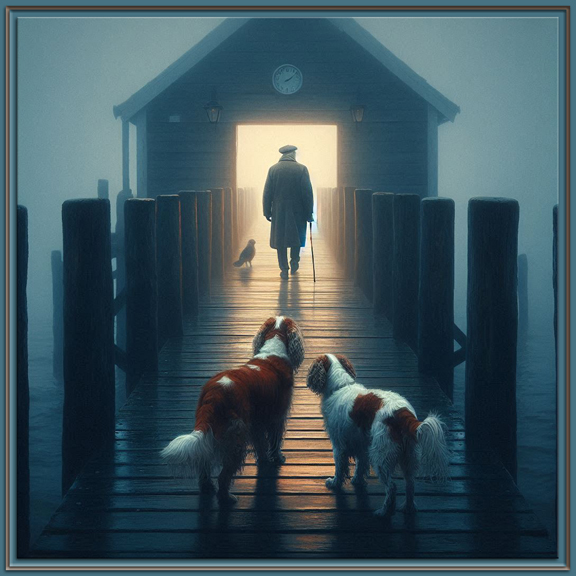
 Adrian Leverkühn Writes
An interesting update, I think. Thanks, as always!
LikeLike
Gracias, I think.
LikeLiked by 1 person
Yes. I loved it 🙂
LikeLike
A very very long life. Now there’s a thought. Keep well mate. You could do with a Ludvico in your life. Keep well mate
LikeLike