

Here is the Coda in its entirety.
Music matters, of course. A little Buffalo Springfield, Expecting to Fly, from 1967s Buffalo Springfield Again. Some Hendrix, as in All Along The Watchtower. What Is and What Should Never Be, from Led Zeppelin II. Nature’s Way, on Spirit’s Twelve Dreams of Dr Sardonicus. Bitches Crystal, from Emerson Lake and Palmer’s Tarkus. Sun/C79, from Cat Stevens Buddha and The Chocolate Box. The Moody Blues Watching and Waiting.
Have a good read, and once again, this is the story in its entirety, about 25k words over 57 pages, including new revisions. As always, more revisions likely before posting elsewhere.
Coda: The Seasons of Man
The Strange Turn of Alice Godfrey
Chapter 1
The invisible ones did not know what to make of this newest among them.
Like most of the new ones when they first arrived, she kept to herself. She spoke to no one unless spoken to; some noticed that she rarely spoke even to herself. This they did not understand, for most of the invisibles spoke, when they spoke at all, only to themselves.
One day she appeared among them, and like most of the others before her, most thought she seemed lost, lost and alone. She wore clothing not her own, probably from the Salvation Army store downtown. Her clothes made her invisible, invisible as only the torn and disused can, stealth in equal measures of abandonment and the reclaimed. Her hair was a quiet soliloquy of forgotten tangles, no tributes there paid to past or future. Dirt under fingernails was a given, dirt visible in the pores of her skin less so, but not remarkable, and yet she even smelled like any one of the invisibles, certainly as old and sour as most all of them did. Skin tired and unclean, beaten down by filth, she seemed as easily discarded as the past, like the clothing that had found its way to her.
Yet this latest newcomer never walked among the invisibles, even though she chose to remain among them. At first she rarely ate, and yet she was already too thin to be healthy. When she did eat she looked away, as if her soul was in absentia. She had to be drinking something, yet no one saw her do so.
The invisibles lived among the trees, and some among them had for many years. Maybe they had for decades, but in truth few lived so long, and there weren’t exactly historians keeping track of the people who drifted in and out of these forests. The trees certainly weren’t, so hardly anyone took notice when the girl arrived.
Like most of the newcomers the girl seemed reasonably self sufficient. She had her own tarp, her own blankets, and even a change or two of clothes. She came among them and she claimed a spot among rocks no one seemed to care about and then she strung out lines for her tarp, then collected branches to build a makeshift perimeter to help block the wind. She finished just before dark and crawled in just before it started to rain, and one of the invisibles thought he saw candlelight coming from inside the new girl’s shelter. He also heard her talking to herself, and he found that if not comforting then at least acceptable. Many people talked to themselves in this forest…
The next morning no one saw the girl until late morning, when she returned to the camp from – where? No one knew, and that first time no one really cared. She went back inside her shelter and did not come back out again until evening, when she took off again and disappeared into the forest for an hour or so.
When she returned, several of the invisibles had gathered around a small fire and they were roasting ears of corn as well as a couple of packages of cheap hot dogs. Those not too sick to react crawled out of their shelters and made their way to the fire, as ever suspicious of anyone and everyone they saw. Yet they ate, and for some it had been the first food they’d had in days. The girl, this newcomer, was not among them, for she went directly back to her shelter.
And that was when one of the invisibles, an old man the others called Tommy, went to her shelter to check on her. He bent low and peeked inside before he spoke, hoping to see what she was up to.
“Young lady, we have some food on the fire, if you would you care for something to eat?” Her eyes, he saw, weren’t the usual haunted orbs; no, they were inquisitive, articulate, and almost nice looking. Like once upon a time she had been a caring person, before she too became invisible.
But she just shook her head. “No, but thanks,” she finally said.
He nodded and went back to the fire, and when one of the women gave him an inquisitive glance he simply shrugged. He did look at her shelter a little later, and he did see the same flickering candlelight inside again, but he knew some people took time to adjust to life up here.
Again he saw her late the next morning coming back from somewhere in the forest, and because he had always been an observant man he did notice a few things that didn’t add up. The t-shirt she had been wearing the day before was gone. Another had taken its place. Her socks were different, too. Maybe she had them with the things she had first brought along, but maybe not. He was suspicious now, and he was the sort of person who liked to get to the bottom of such things.
Eula May Jenkins had everything she needed to make a hoecake that evening, including peppers Tommy had planted a few months back, and there were more hot dogs to cook, so a few of the invisibles got a fire going and Eula May started in on her cornmeal. And once again Tommy went over to the new girl’s shelter and asked her if she wanted something to eat that evening.
And once again she declined, and as politely as the night before.
“Miss, you have to eat. You do remember that, don’t you?”
She nodded. “I know. I just haven’t been hungry much lately.”
Tommy nodded and knelt low so he could see her better. “I know. Most of us have been where you are, but you have to remember to take care of yourself.”
The girl nodded absently. “Yeah,” she managed to get out before she looked away.
But he could see she was still to raw. Like the pain was too close to the surface. “Come on. It won’t hurt to come out and sit with us a while, and who knows, Eula May’s Johnnycakes are pretty good; they just might get to you.”
She smiled a little, then nodded. “Okay,” she sighed before crawling out of her shelter and following him over to the fire.
Tommy, she soon realized, was pretty much in charge around here; at least everyone treated him like the Big Kahuna he was trying to be. He had a big tent not far from the fire, an old L-shaped Coleman that looked large, almost opulent, given his current circumstances, and he even had an old Igloo cooler under the tent’s large, airy vestibule. He also held court from a gray nylon camp chair that was set out by the fire like a throne, or maybe a judge’s bench. Flanked by a large log maybe ten feet long, two woman sat there watching her as she walked up to the fire, and Tommy pointed to a beefy stump, more an upturned log, where the girl could sit. She looked around at the expectant, upturned faces of the other women looking her way, because to turn Tommy down would be a most unwelcome display of defiance.
So she sat and everyone relaxed. And she took note of the faces as best she could in the flickering light.
One belonged to a slender black woman; she was tending a skillet by the fire, and the girl assumed this was Eula May. The woman on the log closest to Tommy’s chair might have been his wife – if she’d not been acting like they were on a first date together. Servile, perhaps, was the word that came to mind? Tommy introduced this woman, Abbie, as his ‘main squeeze’ – though the woman hardly looked stout enough to handle a good squeeze. Betty was sitting next to Abbie, and the girl recognized the vacant stare in both women’s eyes; it had probably been months, if not years, since they’d been on their prescribed anti-psychotic medications. A teenaged girl was sitting on the ground next to Betty, and she seemed suspicious to the point of aggressiveness, and again, despite her years she had probably been off her meds for bi-polar disorder for years. There were a handful of people sitting in the shadows but apparently these people were not in Tommy’s good graces – as they’d not been invited to join him by the fire.
“And what’s you name?” Tommy asked the girl.
“Alice,” the girl said, as respectfully as she could, given the circumstances.
“Well, have one of Eula’s cakes. They’re not bad with a little hot dog. Better with some bacon, but we haven’t managed to scrounge up any bacon for a while.”
Alice took a piece of the fried cornbread and took a tentative bite; it was dry and bland to the point of tastelessness – until she reached a little sliver of some kind of pepper. She coughed a little when the heat hit, and Tommy chuckled at her reaction.
“That’s Carolina Reaper; we scored some seeds last summer and got ‘em in the ground just in time.” He was smiling, though he didn’t exactly appear to be enjoying her pain. “Have a bite of meat. The juices will calm things down.” His voice roamed from gruffly authoritarian to pleasantly paternalistic as he talked, and she thought he certainly enjoyed the sound of his own voice.
“God, that’s spicy,” Alice gasped.
“It is that. So, if you don’t mind my asking, what happened to you down there?”
‘Down there’ meant the city, down there among the lumpenproletariat, the permanent underclass created by the wave of automation brought on by an all-consuming AI revolution – which was bringing about the sudden collapse of mid-level jobs all around the world.
“Me?” she said with a self-deprecating shrug. “Well, you know how it is. Just one more nobody, I guess. What did you do?”
“Oh, I worked at the one of the most irrelevant jobs you could ever imagine. I was, you see, a teacher, and a history teacher at that, so there was certainly no use for the likes of me down there, not anymore. But the truth of the matter is that there hasn’t been much need for ages. No one is interested in the past, you see. There’s no social utility in understanding what brought us to the moment, to this precipice. In other words, there was no longer any need to use history to make a buck.”
She nodded. “I heard that some people up here are planting crops? Is that really happening?”
The change that came over the man was sudden, and dark; his eyes narrowed, his jaw clinched. “Don’t know much about that,” he finally said dismissively. He sat heavily, morosely, soon with his arms crossed as anger flared over his brow. “You best enjoy that Johnnycake, young lady. Maybe you ought to just move on tomorrow, too.”
She shrugged. “Me? Okay, sure.”
He fumed for a few minutes more, then turned to her once again. “You never said what it was you did down there. Why is that?”
“Because none of that matters now, does it?”
“We don’t like spies up here,” Tommy growled.
“Spies? Really? What is there to spy on?”
“Exactly. Nothing to see here, so maybe you’d better just move on. As in – right now.”
Alice put down her cornbread and walked back to her shelter, but then she just slipped inside and hung an old towel over the entrance. Tommy watched this insolence in glowering silence; he finally just growled a little before he turned to watch the glowing embers in his campfire. Soon he was talking to himself again, talking to the same ghosts of the past who usually kept him company on nights like this.
Her shelter was still there the next morning, but when Tommy walked over to check it out he saw her stuff was still inside and that made him even more angry than he already was. She had gone on another walk, just like nothing had changed, and, well, it was time to put a stop to her nonsense. He’d watched her the day before as she walked back into the camp, so he had a pretty good idea which trail she was using. It was important, he knew, to understand what everyone around the camp was up to, otherwise he might lose control. And right now it felt like this newcomer was challenging his control over the entire hillside. He had about sixty people up here under his control, but he figured that was enough, for now.
So he took off down the hill, taking the usual trail that led down to the city. The hillside, despite years of drought, grew wet and lush this time of year, as the rains of autumn reappeared. With tall pines and even a few redwoods mixed in with stands of towering eucalyptus, this forest was still in good shape. The way ahead, at ground level, was covered with ferns and low, thorny shrubs, but the trail was old and the way ahead clear. The trails had been here forever, and Tommy kept to the trees as he skirted a small park near the outskirts of the city; once he was in the city he had no trouble blending-in because he was invisible, and he walked among the pedestrians and passersby until, finally, he saw her. Not begging, not panhandling, but coming out of a pharmacy just a few blocks from the park. With two sacks brimming with supplies.
He knew what he needed to know just then, in that crystalline moment. She wasn’t one of them, she wasn’t invisible. No, she had money. Her soul was still possessed by that great corruptor, which meant she didn’t belong in his camp, even on HIS hillside, and certainly not among his people. He would give her one last opportunity to leave – today – and if she didn’t he would kill her. If she was a spy then she was out to kill off the community, or worse still – him – and that meant she had to disappear. One way or another.
+++++

Tommy’s women, Abbie and Betty, had a fire going in the pit by his tent, and Eula May was roasting corn to go with some small game she’d killed earlier in the day; Tommy was in his tent holding his old Smith & Wesson 38 Police Special revolver. He was lost in thought as he held it in his hand; it was, he considered, an ancient weapon by today’s standards, but had remained effective nevertheless. Especially effective when killing people at close range, which he hoped to do soon. He thought of her walking into their gathering and then just walking up to her, holding the pistol up to her face and watching the fear spread across her face. Another moment of triumph, another moment of consolidating his control over the hillside, and because he had let it be known around the hillside that he had plenty of food for everyone this evening, he was sure they would all be here to witness his triumph. Everyone would soon feel his control take root and spread deeper into their lives.
Because that was the way it had always been done, since men and women gathered on other hillsides, in distant hillsides lost in time. First they would like him – for his generosity. For his kindness of spirit. They would respect him for his knowledge. For his obvious expertise. Then they would accept him as not just one of their own, but as someone worthy of leadership. That was the way of human progress, even in a society that had rejected human progress. Because they were, after all, still only human.
He heard the people gathering out by the campfire, saw their shadows drifting across the sagging fabric of his gray tent, and he smiled as his moment came.
+++++
Everyone knew, of course.
They knew the girl was walking into a trap, of sorts.
And there was an odd sense of excitement among the people gathered out there around the fire. They had gathered to watch Tommy, their leader, exercise the full measure of his authority. And though his power over them was complete, this demonstration would convince any doubters that remained. Convince them of the righteousness of their leader.
Some stood, most sat around one of the three campfires now burning brightly, and yet even these fires were a display of Tommy’s largesse. Yes, this would be a night to remember. That was what these fires meant…
Men ate corn in the firelight, women picked meat from the bodies of dead squirrels and tossed the pieces into a simmering stew chock full of carrots, onions, and potatoes grown in hidden plots on this hillside, while a handful of sullen teenagers sat near the fire, staring into flames that harbored their various hallucinations…until someone called out: “Here she comes!”
+++++
Alice Godfrey walked into the firelight, into the sea of upturned faces, but soon everyone saw that she was not alone.
No, she had come with at least ten other people, and those among the people still reasonably aware of their surroundings could feel a larger presence standing out there in the shadows among the trees.
And then Tommy came out of his tent and into the firelight and as his eyes adjusted to the light he saw the scene was not as he had expected. He nevertheless walked up to the newcomer, slowly bringing the Smith & Wesson up to the firing position.
And that was when two men stepped out of the shadows, and in their black tactical gear he could see these men represented the authority of the people in the city. More men waited in the background, all of them heavily armed, and Tommy knew his moment had already come and gone.
One of the men stepped forward and held out his hand, and in his moment of triumph Tommy stood wordlessly defeated, and so he simply handed over the revolver as the girl came closer. She seemed to gather her wits about her for a moment, then she began to speak, addressing everyone gathered by the campfires.
“I am here to let all of you know that the federal government has passed new legislation concerning your rights and responsibilities as unhomed citizens. Effective today, you will no longer be allowed to live here. You will report to a processing facility across the street from Union Station later this evening, and once there you will be presented with several choices you will need to make regarding your future.
“Your first choice? You may voluntarily enter mental health counseling, followed by vocational training.
“Your second choice? You may enter a drug addiction treatment program, followed by vocational training. With these two options, you will be provided long term housing.
“Your third option? Voluntary euthanasia, followed by crematory services at state expense.
“When you report to the processing center you will declare your intentions, then you will be transported to the appropriate facility.
“Again, you will be transported to your processing facility tonight. Those of you who attempt to remain here on National Forest lands will be tagged with GPS ankle bracelets by these men. If you choose to flee these men will track you down and you will be sent to the euthanasia processing center in Sandpoint, Idaho, where you will be euthanized, cremated, and your remains sent to any family member you designate.
“Now, please step forward so that you may be tagged. And please, do not try to flee. You are completely surrounded, and should you try when captured you will be taken directly to the euthanasia processing center.”
Tommy, once a history teacher, knew this story only too well, he knew how it played out, and he understood how this tale came to an end. He stood, transfixed in the firelight, unable to move. Images of scarecrows being offloaded in German concentration camps filled his mind and once again he kept telling himself that this couldn’t happen here, not here, not in America.
One of the armed men stepped directly in front of him. The man’s face was almost impassive – but for the hint of elusive mirth dancing behind his eyes, and Tommy knew that look, too. The look of a bully asserting dominance over the weak. The look of the antichrist. The face of unjust authority. The mocking eyes, the casual hatred. The face of an unjust tyranny.
But this was so unfair! Weren’t we the dispossessed? The useless and the redundant? Hadn’t we become invisible so you need not look at us any longer?
“What did we ever do to you!” he screamed. What did we do but try our best to get away from you. To become invisible, just for you! We could not live among you because there was no place for us, and now – you say you will round us up and kill us? We will not even be allowed to exist? Do we offend you so much? Offend your delicate sensibilities so much?
Tommy turned and sprinted off into the darkness.
Soon a single shot rang out like the clarion call of the righteous, and the damned.
And another line of the marginalized and the dispossessed marched off through the night, to trucks waiting to carry such people to their fates. Alice Godfrey looked down and shook her head, then using a flashlight she walked down the hillside to the park and climbed into her car. Once the motor was running she turned on the interior lights and looked at her eyes in the rearview mirror.
Haunted. Lonely. And ultimately fouled by the stench of her own rotting soul.
“Is this how Germans felt, in the 30s?” she asked the eyes in the glass. Those poor people had made a bargain with the devil and look what had happened to them when payment was suddenly due? Wasn’t that what it felt like to sell your soul? Or was that payment just the beginning?
Then one last thought bore into her soul, pressing in from every direction. “What was old is now new again…”
She had wanted nothing more than to help these people, but what was this? Most of these people were so far gone that even years of inpatient psychiatric care would yield little improvement, but was death the only option available? Or was it like that old man had screamed into the night. “What have we ever done to you?” Pushed from ‘polite society’ then shunned when they dared reappear, they had become invisible because that was the only thing left to them. But then, even that had proven to not be enough. Now they had to give their lives in order to gather one last measure of decency, presumably a small plastic urn full of sand and ash.
She followed two trucks on her way out of the park, her Volvo’s headlights casting harsh blue-white light on the people shackled inside. And as she watched their haunted eyes, as she watched the people in the back of the closest truck bouncing silently along on their way to oblivion, she wondered what had become of her world – now that her people had chosen to once again repeat a very tortured past.
CHAPTER TWO
She nodded to the physician coming on duty in the quiet emergency room when her shift ended, and again on her way out the door and into the cold fog enveloping the town. She was tired, her shoulders seemed burdened by all the cares of her world and her head was hanging low to ward off the clinging mists. She walked slowly but carefully, avoiding the usual hazards on her way home; the roots busting through old, neglected sidewalks, the weeds spilling out of yards, blocking the way ahead and forcing modest detours into the street. Most of the homes she passed were dark this time of night, most but not all, and she heard the not so unusual raised voices inside more than one. The fights over money, over spending and unpaid bills; these were the usual refrains she heard, usual but not always. The tired politics of anger and division came through too, because some wounds heal more slowly than others.
She made it to her duplex apartment and turned once to look around, to make sure she hadn’t been followed as she put the key in the lock. Then she stepped inside, turned on a light before she walked to the smaller of the two bedrooms; she quietly opened the door before she poked her head inside to check on the man sleeping there, and seeing he was awake she stepped quietly inside.
He was still pale but his fever had abated somewhat, and she checked the IV hanging on a small makeshift IV stand by his bedside. The last D5W solution was not yet empty; the small bag of antibiotics was, so she put her book bag down and pulled a fresh bag out and got it attached and running before she pulled up a chair and sat beside the bed.
“How’re you feeling? Still clammy?” the girl asked Tommy Gray. The same Tommy from the camp.
“I’m feeling better, thanks. How was it out there today?”
“They’re still looking for you, but others got away and made it deeper into the forest, so maybe you’re not the highest item on their list of priorities right now.”
He grinned. “I can’t imagine being high on anyone’s list, but thanks all the same.” He looked at Alice and still couldn’t make her out. He’d been about to kill her until he’d seen all those troops out there in the shadows, but then his thinking went into overdrive and everything had become fuzzy after that. He did remember running, or trying to, and he did remember getting shot, but after that everything was a blank, a big black hole where his memory used to live. When he woke up, after he first realized he was in the town’s hospital emergency room, he was startled by the fact that there was a real physician with him, and not one of those RMAs, one of those Robotic Medical Assistants that had taken over duties in medical facilities all over Portland, from urgent care facilities to primary care offices to hospitals. The change had happened so quickly, too, almost overnight, but apparently not in little hospitals like the one he was in. Not yet, anyway.
The physician, an older man who seemed more than skilled, had removed the single bullet from his shoulder, just above his collar bone, and he’d done so quickly, almost effortlessly. After putting in some stitches and bandaging his shoulder, he’d been moved to a room that had bars on both the windows and doors. Then he realized his ankles were shackled to the gurney and that’s when all the tumblers fell into place. He was a condemned man, about to take that one way trip Sandpoint, Idaho. What had the girl called it? A Euthanasia Processing Center? That sounded like something straight out of the movie Soylent Green, but this wasn’t a movie.
This was a nightmare.
She smiled a little as she watched thoughts dance across his face, then she saw he hadn’t eaten today and sighed. “Why won’t you eat?”
“The doc who sewed me up? You know his name?”
She shook her head but Tommy went his own way. “I do. Why?”
“Could you thank him for me? He was nice, given the circumstances.” She nodded, but he thought she looked a little too nervous for such a simple request. “Look, I don’t know why you did what you did, but thanks for getting me out of there.”
“You shouldn’t have run, Thomas.”
“Thomas? You know my name, huh?”
She nodded. “Yup. Thomas Gray, late of Portland, professor of history, and other forbidden topics, at Oregon State. You did your undergrad at USC and grad school at the University of Chicago. You taught in Portland for ten years before getting tenure, then you were dismissed, along with all the other humanities professors, five years ago, after Project 2025 was fully implemented. As far as I can tell, you went off grid about a year ago…”
“Yup. That’s me alright. You left off the part about me being a radical subversive terrorist.”
“Oh?”
“Yeah. All us liberals, ya know?”
“The pendulum swings…”
“Not this time, Alice. The pendulum is broken. Or should I say it was burned to the ground with the rest of the government.”
She shrugged. “Things fall apart.”
“The center cannot hold. Yeah-yeah, yada-yada-yada and I’ve heard that one before.”
“Thomas, I’m not sure how safe it is here. I mean here in Astoria. There hasn’t been a big troop presence here, at least not until last week when they rounded up all the docs and told us they wanted us to go out find out all the homeless encampments…”
“And you sure did that, didn’t you…?”
“No one told us anything about enforcing these new laws, Tommy, and no one mentioned anything about euthanasia centers.”
“Funny how that works,” Thomas sighed, “isn’t it. The People are the last to know. But don’t worry, you can always fall back on the time-honored phrase… But I was only following orders…!”
“They told us we could either help or we’d be sent to one of those new dissident camps down in the Mojave. They weren’t real nice about it either, Tom.”
“So, what you’re saying is I need to get well so I can get out of your hair…?”
She shrugged. “Not quite. As soon as this bag of antibiotics is in, we’re going to take a walk. A bunch of people are holing up on tribal land on the coast just south of here, and they’ve agreed to take you in.”
“They?”
She shrugged. “Look, the less you know the better. At least right now.”
“Is it that bad around here?”
She nodded. “People are afraid to come to the ER. They’ve got troops on patrol outside the hospital, facial recognition scanners and fingerprints readers everywhere you go, all the Orwellian things. Same thing at the supermarkets and the hardware stores. They haven’t been going door to door yet, but the word is they’ve covered about a quarter of Portland, and something like twenty thousand have been shipped down to Mojave for processing.”
“What about you? What are you going to do?”
“They’re letting us work at the hospital while they install their machines, but they’ve made it pretty clear that one they’re installed we’ll be out of work.”
“Are they really that good?”
She nodded. “It’s frightening how good they are, and fast, too. They can take out an appendix in about ten minutes, or they can do a colonoscopy in five. The interesting thing is they can take tissue samples for biopsies and the machine does all the histology right there while you’re on the table. They’ve got labs built into their subassemblies so nothing has to be sent out.”
“So, you’re obsolete?”
She nodded. “We all will be, and by the end of the month.”
“I heard the robots only work on ‘Citizens.’”
She nodded. “Yup.”
“So people like you and me? What are we? We’re just supposed to get sick and die?”
“I guess that’s the way they’re looking at it. We either do that or they’ll get us in the camps. Same difference, I guess.”
“The land of the free, and the home of the brave. Man, what happened to us?”
She shrugged again. “When you burn something down, you better be sure what’s going to replace the old system before you light the match.”
“Too late to put that horse back in the barn. How much longer?” he asked as he looked at the IV dripping into his arm.
“About a half hour. I’ve got some clothes for you, too.”
“So you didn’t answer my question. Why?”
“Why? Why did I get you out of there?”
He nodded.
“Call it the oath I took kicking in. You know, the whole ‘do no harm’ thing, but let’s just say I’m atoning for all my sins and leave it at that.”
“Works for me.” He looked at her, at her eyes. “Ya know, I saw something in your eyes up there. Lots of people I’ve run into are decent enough, but there are people like you that have something deeper going on.” He pointed to his heart as he spoke now. “Something beyond good, I guess, but I don’t know what that was…”
“You’ve been through a lot, Tom. Why don’t you lay back and rest for a few minutes, because my guess is you’re going to have a long one…”
+++++
She handed the old teacher off behind the busy salmon cannery on the waterfront off Portway Street, and as she watched the old man climb into the bed of the pickup truck she had to admit she was glad he was getting another chance. The man had grown confused and was still way too full of anger, but in a way he had every right to be. Like most of the people in the country, he’d been blindsided when the old social contract had been ripped up right in front of his face. He’d had no place to turn as his old world unraveled, and with no jobs to be had, anywhere, just like tens of thousands of his fellow disillusioned friends and neighbors, it wasn’t long before he couldn’t afford his property taxes or groceries, let alone the mortgage on his house or the exorbitant cost for health insurance, so he joined the parade of people disappearing into the forests, living off the land. Those who chose to remain in the cities ended up sleeping under freeway overpasses just to keep out of the rain, but soon enough these people found themselves either rounded up or pushed further outside urban areas, or just pushed past their breaking point. Either way, the recently unhomed were now out of sight and so definitely out of mind, which was, she knew, the point of the exercise. The recently erected private prisons were now overflowing with such people, and with more arriving every day the situation was moving from dire to catastrophic.
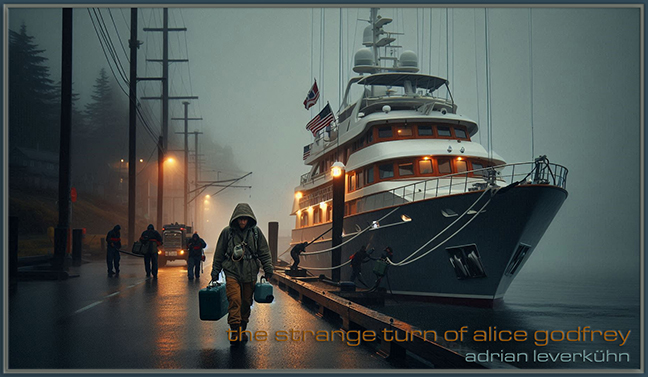
She needed a few things before she walked back up the hill to her apartment, so she decided to go down the shops along the Riverwalk. She nodded to a couple of rough looking fishermen, but she had sewn one of them up before and he recognized her from the ER so gave her a respectful nod as they passed, just before she reached the big refueling dock. She saw the usual commercial fishing boats tied up and taking on fuel for the trip up to Alaska, and she saw a very big, and really very opulent motor yacht tied off there too, with two lines feeding what had to be massive diesel fuel tanks. Deck crew in natty white uniforms were carrying food from the market onboard, wheeling canned goods by the case down a long metal gangplank before disappearing inside, and she wondered why so much canned food…as she walked inside the market to pick up something for dinner.
The yacht’s owners were inside at the cash register, settling a grocery bill for almost thirty-five hundred dollars…by peeling off hundred dollar bills from a wad of cash that had to be three inches thick…and she just shook her head as she walked over to the frozen food aisle.
“So, what’ll it be tonight,” she muttered under her breath. “Another Lean Cuisine, or how about a walk on the wild side and get Amy’s Pad Thai with shrimp in a lemongrass curry?”
She was reaching for the curry when someone walked up to her and stopped.
“You a nurse?”
She stood and looked at the guy standing there. Obviously rich as shit, obviously from the yacht taking on fuel, he was decent looking in the way that only the idle rich can: expensive clothes, neat haircut, scrubbed clean and wearing nice cologne, and of course the obligatory Rolex Submariner – to go with his Ray Ban Wayfarers, of course. She sized him up in half a second and shook her head.
“No. You need something?”
“Are you a physician?” the man asked.
She nodded. “That’s the rumor,” she said, wondering what had given her away. Was it the green scrubs or the white lab coat under her windbreaker? Or perhaps it was the stethoscope dangling from her coat pocket?
“You live here?” he asked.
Oh, she thought, this kid was a real rocket scientist. “That’s a fact,” she replied, trying to keep the sarcasm out of her voice.
He turned around and called out to the adults paying the bill up front: “Dad! Come here!”
She looked at Richie Rich then at Daddy Warbucks walking down the aisle and hoped Daddy didn’t have an ingrown toenail, because she just might reach her breaking point if he did…
“Dad? She’s a doc…how ‘bout that?”
Daddy Gotrocks walked up – and sized her up at the same time – and she sensed the man was used to getting his way as she sized him up. Mid-sixties, about five-ten and forty pounds overweight, his pulse was running 95 and his left carotid was bouncing like a bronco while his right was soft and shallow. His lower lip was slightly cyanotic, so were his nail beds, but it was the bloodshot eyes and the faint smell of Scotch whisky that put the icing on that cake. Daddy Warbucks was cruising down the fat lane on his way to a big fucking heart attack, but he was so rich there was no way he didn’t already know that…
“Is that so?” the older man said as he stopped just short of too close to Alice. “And let me guess. Are you Family Medicine, or Internal Medicine?”
She met his iron gaze head-on and just smiled. “And you are?” she asked politely.
“Let’s see. I am on my way to Hawaii, as in right now, tonight. As soon as refueling is complete. We had nurse practitioner onboard but she bailed on us, went back home in Seattle, and we need a replacement.”
“You need a nurse? Why?”
“We’re leaving in about a half hour, if you’re interested. Be about ten, twelve days work, and the pay is a hundred grand.”
Her eyes fluttered a bit and then she nodded. “Why so much?” She wanted to ask him what his underlying conditions were, but not with Junior standing there, and she could tell he was watching her mind working the problem, probably guessing exactly what she was thinking, too.
“Yes or no, Doctor. If yes, then come on right now.”
“Without even a change of underwear? Really?”
“We’ve got everything you’ll need onboard, and you’ll have your own stateroom with its own head. We have two chefs onboard, if that matters to you.”
“I don’t have anything but my wallet. No passport…”
“Doesn’t matter,” he said as he looked down at his wristwatch. “You’re either coming right now or you’re on your own.”
“You in some kind of a hurry?”
“You could say that. Now, all I need from you is an answer. Yes or no, right now.”
The thought of going back to that shitty apartment hit her, then going into the ER in the morning only to have troops walking around, scrutinizing everyone who came into the hospital. Maybe things were as bad in Hawaii, but maybe they weren’t…and besides, there wasn’t a whole lot left holding her to Astoria, Oregon. Not with her job slated to end in two months. And no more sweeps for homeless people…which meant no more placating the troops roaming the hospital…
“Okay. I’m in.”
Maybe the old man had expected her to say yes; after all, saying no to a hundred thousand dollars was – in this economy, anyway – evidence of insanity. Still, the look in his eyes was a little unsettling. Obviously being someone who got his way all the time, her saying no would have surprised him. And not in a good way, either.
“Alright. Oh, by the way, my name is Alex, Alex Bullock, and this nitwit is Alex, Junior. He likes to pretend he’s smart, but don’t let that fool you.” And with that the old man turned on his heel and strode out the market, apparently in hot pursuit of Mrs. Gotrocks, leaving her standing with a totally emasculated young man, who could not have looked more crestfallen if he tried.
“So, do I call you Alex?” She could see his pulse hammering in his neck, but his flushed cheeks and clinched fists didn’t exactly hide his feelings.
“Notice he didn’t even have the courtesy to ask you your name?”
“Yes, I did.”
“Do you think he gives a shit?”
“No, I certainly don’t.”
That confused him, so he turned and looked at her, then nodded. “Yeah, sorry. Alex is fine. And who are you?”
“Doctor Alice Godfrey.”
“You an MD, or a DO?”
“Stanford Medical School,” she said, extending her right hand. “You?”
“Me? Hell, I flunked out of Yale about three years ago.”
And he did, she knew, because that’s where Daddy went to school, too. And Junior had been busy squandering his life by disappointing his father every chance he got, and probably had been since fifth grade. But she nodded once, then turned and followed the old man out the store and into the night. She looked over at the yacht through the fog and sighed when she saw its name: Charon.
“Oh, now that’s appropriate,” she said under her breath.
“You got that one, didya?” Alex Jr. sighed. “Well, welcome to Hell.”
+++++
If this was Hell, Alice thought, then Mephistopheles had hired a really top-notch interior decorator to finish out this beast. The yacht, she soon learned, was a 245 foot long Feadship, and at about five years old everything onboard still gleamed. Then again, there were two engineers in the engine room, two chefs, two stewardesses, a housekeeper, a captain, and a first mate – whatever the hell that was. Oh yes, there was a pilot, for the Bell LongRanger stowed on the upper deck, and now there was a ship’s physician, to go with the fully stocked mini-hospital, complete with a small surgical suite. And what a surprise…her quarters opened right up on this little clinic.
Yet her quarters were actually quite nice. The room itself was a teak cocoon with a decent sized bed, a desk with an iMac mounted on the wall above, as well as bookcases and a large flatscreen TV that retracted into a bureau. And she even had a mini-balcony, right off the little sitting room where the desk was situated. All in all, if everyone left her alone this wouldn’t be such a bad gig. Considering the alternatives.
As she looked around the room she couldn’t help but think of Tommy sitting in the back of that pickup truck fleeing through the night to an unknowable future, and here she was, doing almost exactly the same thing.
Next on her to-do list: check out the clinic spaces, mainly to learn where everything was stored, but also to see if the last practitioner had left behind any notes on the principal patients usually onboard. So, she walked through the door off her sitting room and into the “clinic” – which is exactly what it was, and for a yacht it was very well equipped, too. She had everything needed to manage fractures and lacerations, and there was a brand new Beckman Coulter DxH 3000 clinical hematology analyzer in a small lab off the main exam room, as well as a machine for running and analyzing blood cultures. And in the OR, a brand new Stanford Diagnostics Surgical Assistant, which, despite its name was more than capable of performing any sort of surgery short of neurosurgery or open heart surgery. Few hospital could afford these machines – yet – and they were the state of the art. Rumor was they cost over 25 million, for the basic model, and with an integrated CT/MRI module, this wasn’t a basic model. She roamed the OR, taking note of what was and wasn’t available, then she went to the locked pharmacy door and tried her key – which didn’t work. So, she went to the intercom and called the ship’s head stewardess, who she was supposed to call if she had any questions or concerns.
“Yes?”
“Godfrey here. My key doesn’t open the pharmacy door.”
“What do you need in there for?”
“I’m taking stock of what is and isn’t available down here, because, well, that’s kind of what I do.”
“Sorry, but nurse practitioners aren’t allowed in there without a sign off from an attending. We’ll have to do that online in the morning.”
“And I hate to be the one to break this to you, but I got my MD at Stanford.”
“Oh. Sorry. I’ll be right down.”
She hang up and went to the iMac on the clinic desk and fired it up. And of course she didn’t have the sign-in passwords…
…then the yacht pushed away from the fueling dock. Somewhere underfoot engines rumbled and thrusters whined, and she went to the rectangular window and watched the yacht pirouette in the middle of the Columbia River, then turn towards The Bar.
Which was what locals around Astoria and Chinook called the notorious stretch of water in and around the entrance to the Columbia River when coming from the Pacific Ocean. In any kind of bad weather the waves and rip currents were so bad that the Coast Guard kept a standing watch over vessels entering or exiting the channel – which was of course rimmed with all kinds of rocky ledges…some of which were almost visible, occasionally. The waters just off the entrance was a notorious graveyard for ships and boats of all sizes, and had been for hundreds of years, and these days kids with GoPros and phones went as far out the South Jetty as they could, filming small boats struggling against the waves on rough days. Though the main channel was deep, it shoaled rapidly on the south side, and five foot depths and large breakers define this area. Prudent mariners do not attempt The Bar with an ebbing tide and an onshore wind.
As soon as the stewardess, Wendy Carmichael, arrived and they tried the keys, Godfrey asked if she could go up and watch as the yacht left Astoria, and the girl smiled.
“Sure, let’s go!”
The kid was in good shape, and Alice had trouble keeping up with her as she ran up the three flights of stairs needed to reach the main bridge. The captain, Bill Anders, was working the engines and bow thrusters to position Charon in the middle of the channel, and while he seemed completely preoccupied he did once look over and smile at Alice and Wendy. “Be with you in a minute,” he added as he answered a call on the VHF radio.
Which turned out to be from the Coast Guard.
“Uh, motor vessel Charon, be advised breaking surf in the bar, wave heights reported from one-five feet to two-five feet, wind out of the west at three-seven knots. Slack water in five hours. Recommend you delay departure until zero-three thirty hours local time.”
“Coast Guard, Charon, we’re in a bit of a rush and we’ve handled worse.”
“Roger, Charon, understood. We’ll be standing by on 16.”
“Charon, out.” Anders hung up the mic and centered the yacht mid-channel. As if thinking out loud he pointed at the depth gauge and said, “Okay, 44 feet,” then looking through his binoculars at a navigation buoy to his right and added, “Okay, 35A.” He reached for the autopilot control head and hit ‘Engage,’ and then turned to the girls standing there. “So, who’s this?” Anders said, looking approvingly at Alice.
“This is Doctor Godfrey. She’s joining us to Hawaii.”
“Oh? You a real doc, or one of those PAs.”
“MD. You one of those real captains?”
He smiled at that. “Sorry, and yes, Maine Maritime Academy, class of 2020. Did Wendy give you the tour yet?”
“No, not yet.”
“Mrs Bullock is not a happy camper tonight, Bill. Matter of fact, I better get my ass back down there or I’ll be making a swim for it. Can I leave Alice with you?”
He nodded. “Sure. You been on a boat before?”
Alice shook her head as Wendy took off down the stairs. “Nothing like this, but my mom’s brother had a small sailboat out on Lake Coeur d’Alene. We went out on it a bunch, usually once or twice a summer.”
Anders nodded, and his expression soured. “Well, this is a little different so I’ll make you a deal. You don’t touch anything up here and I won’t fuck around with the stuff down in your neck of the woods. Got it?”
She recoiled from the sudden change in demeanor and might have replied but he had turned away before she could summon the courage to hit him with a snarky comeback, so she did the next best thing. She walked over to him and pointed at his neck. “How long have you had that rash?” she asked as she pointed to the right side of his neck and face.
“What rash?”
“When you have some free time you better come down and let me take a look at it.” And with that she wheeled around and left the same way she’d come up…
…except when she got to the bottom of the first set of stairs she saw she had three choices. One said Level Two Forward, the second just said Galley, and the third said Level Three Aft and Engine Room. Another stairwell went up to the ‘Skybridge’, the lounge, and the helipad. A narrow passageway also went forward, and just then she heard some serious yelling going on up there, then Wendy came out, beating a hasty retreat from an obviously irate Mrs Bullock.
“You lost already?” Wendy said with a smile as she made her way aft.
She nodded. “Yeah, after that asshole threw me off the bridge…”
She shook her head, but she grinned, too. “Oh, don’t mind Bill. He just likes to fuck with peoples’ heads, make sure they know he’s the head honcho around these parts.”
“You from Texas?”
“Abilene? Why? Does it show?”
Alice smiled. “Well, I was hoping I’d have a good view of the passage out the channel…”
“Oh? Well, come with me…”
And once again Wendy took off like a startled gazelle, this time up the stairs to the SkyBridge, and there was a duplicate bridge up here, though not quite as fancy, but there were two swivel chairs tall enough to have a good view of the ship’s bow. Only a few of the instruments were on and the room was almost dark, so she went over to one of the high chairs and sat.
“I’ll come up and get you in a few minutes…” Wendy advised.
“Okay, but I’m in no hurry.”
Alice heard the gazelle running down the stairs again and shook her head, then turned to look out the massive bank of tinted glass windscreens. Just looking around in the dark wasn’t the best way to get oriented, but even in the dark it looked like the water was almost 40 feet below where she was sitting, and that was about the same as a four-story building…and right then it hit her. This boat had been built by real money, by someone with tremendous amounts of money, so she pulled out her iPhone and pulled up her browser and entered Alexander Bullock. He was, Wikipedia advised, the head a Bullock Broadcasting, a wholly owned subsidiary of The Eagle Network, as well as the new owner of both the Seattle Seahawks football team and the Los Angeles Dodgers baseball team. His estimated worth as of 2032 was 1.3 trillion dollars, making him the tenth richest man in the world, and the fourth richest in the United States. He was active in politics and one of the new owners of Blue-X, the new asteroid mining company formed by the merger between Space-X and Blue Origin.
She heard people locked in animated discussion coming up the stairs and turned to look, but Captain Anders and two men came up and moved aft a little, then just stood in the shadows while they talked.
“It’s going down tonight, Anders. In roughly an hour and ten minutes, and the primary fault within the Cascadia Subduction Zone will cut loose within minutes. No one is expecting any volcanic activity, but it’s a possibility. Either way, the tsunami should hit this area within a half hour, so we’ve got about an hour and forty minutes to get offshore.”
“How far from shore do I need to get?” Anders asked, and he appeared seriously shaken by what he was hearing.
“Depth is the overriding factor. 150 should do it, but remember, the apparent sea level will drop at least inverse to the height of the incoming wave, so a fifty foot tall tsunami will create a fifty foot drop in sea level just before the wave hits shoaling water.”
“That depth is about 20 miles from here,” Anders growled. “And you’re telling me I need to get this tub twenty plus miles in an hour and a half?”
“Yup, that’s about the size of it.”
Anders shook his head and took off down the stairwell, and the men followed…
…leaving Alice Godfrey alone in the dark.
She noticed her hands were shaking. Her left eyebrow was twitching. And she was struggling to remember exactly what those men had been talking about.
“It’s going down tonight,” one of them said, which meant this was a planned event. But who the hell could plan for a…
She stopped in mid thought.
Because you simply couldn’t plan for something like that, and especially not down to the hour and the minute.
Unless you were going to cause the event.
Or you knew that somebody was going to cause the event.
But if you owned one of the largest cable broadcasting networks in the country and you knew something like this was going to happen, why wouldn’t you be screaming the news from the top of every mountain in the country?
Well, you wouldn’t if you were going to cause this event to happen. Or you wouldn’t if you belonged to an organization that was going to make this event happen. And, of course, all of this information had probably been kept so secret that only a handful of people knew the full extent of the planned operation.
And she most definitely wasn’t supposed to know, was she?
She had her phone but who could she call? And what would they think – other than she was a prank caller? Her family was in Spokane and there was no way a tsunami could reach that far inland, and her best friends were still in Palo Alto and around the Bay Area, so who could she call that would believe her?
No one, she realized. “I’ve got no one,” she finally admitted out loud, if only to herself.
Wendy returned a few minutes after that and asked if she wanted something to eat before the ship crossed the bar – but that sounded like a set up to her. Nothing better than to get someone to load up on food before running into unsettled water, because everyone would get a good laugh out of it. “Maybe later. Mind if I stay up here?”
“No, not at all.”
“Can I go out there?” she asked, pointing to the wing-bridges on both side of this cockpit.
“Yeah, sure, but do you have a coat?”
“No. I didn’t have time to go home to get one.”
Wendy went to a nearby closet and pulled out a couple of brand new fleece lined windbreakers, red with a line drawing of the ship in black and her name in heavily embroidered white. “You about a women’s medium?”
“Good guess.”
Wendy brought one over and held it up to her. “Yup, looks about right. And just keep it. We have hundreds of ‘em stashed onboard.”
And with that, the gazelle turned and then took off down the stairwell – at Mach three again – and Alice slipped on the jacket and went out onto the flying bridge. There were two throttle levers and a beefy joystick out there, and no place to sit, but she found a place almost out of the wind and leaned against the superstructure, lost in raging thoughts…
When Captain Anders came out on the bridge deck and looked at her. “Been out here long?”
She nodded. “Yeah. Wendy brought me up here about a half hour ago. What a view…”
“It can be nice, alright. I came up a while ago but I didn’t see you. Were you out here?”
She nodded. “When do we get to the Bar?”
“Oh, not quite a half hour. We’ll make a big right turn, then a left. The waves will be pretty big so you might get wet, even up here.”
“Seriously?”
“Yeah, seriously. If you want to come down and sit with me…?”
“Look, I don’t know you from Adam, but you sounded like you’d just as soon…”
“Yeah, I know, and I wanted to apologize. Too much going on, trying to juggle too many priorities…”
“I understand. Running a ship like this has got to be a pain.”
He smiled. “Like I said, if you want to join me on the bridge, that’d be fine.”
“Is the view as good as this?”
He shook his head. “Nothing is as good as this, but we’ll be going to full throttle soon and the apparent wind will, well, it’s gonna get real chilly up here, real fast, so if you change your mind, just come on down.”
She smiled and nodded. “Thanks.”
“You bet.”
She watched him leave and it was all she could not to run away from him in fear; instead, she shuddered inwardly, not from the cold, but from revulsion – before she turned forward again, and she resumed looking at the channel ahead. Once again she felt even more thrust from the engines, and soon it felt like the entire ship was trembling as it approached The Bar, and the Pacific beyond.
It had been hard to tell in town along the Riverwalk, but the wind coming in off the Pacific was almost cold and it was blowing at a steady clip; Alice thought it must’ve been close to near gale force, and with the ebbing tide headed back out into the Pacific the waves around The Bar would be monumental, the kind that swallowed smaller boats, and sometimes yachts this size. Legend had it that over a thousand ships had gone down trying to navigate The Bar in inclement weather, or even just during unfavorable conditions, so the area off the entrance was called The Graveyard of the Pacific with good reason.
Yet Charon didn’t seem to be just any yacht. She was a small ship, and even though she wasn’t an expert you didn’t have to be to understand that this was a machine crafted to handle anything. With a captain that had graduated from one of the most prestigious maritime training facilities in the country, and with a professional crew that seemed able to handle these conditions, she wasn’t nervous about going out.
A Coast Guard ’44’ passed them on their left, apparently going out to The Bar to check on current conditions, and she watched it fly by doing twice Charon’s speed. Alice braced against the wind when the ship finally turned to make her final sprint over The Bar, and suddenly it felt like their speed had doubled. Maybe some of that was the wind, but she feel the engines now and they were really working hard.
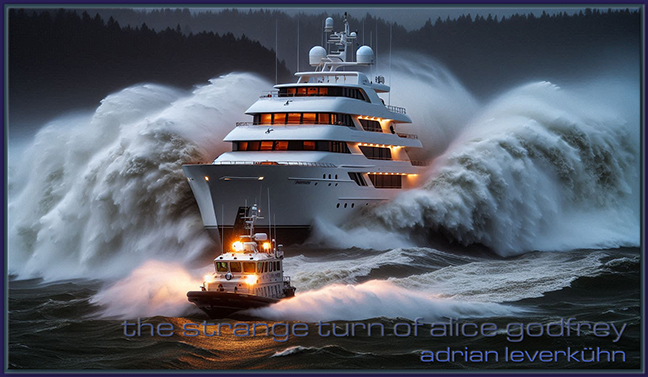
The first swells appeared, maybe eight feet tall but widely spaced, and Charon gently lifted over these first few encounters. Then…a raging wall of breaking waves appeared out of the mist, and the first ones she saw looked almost as high as Charon’s bow. Then she saw another wave building behind the closest, and that second wave looked huge. Frighteningly huge, like a rogue wave.
An intercom on the flying bridge chimed, then Captain Anders’ voice came through over a loudspeaker. “Doctor Godfrey, would you step inside, please, then take a seat and brace yourself.”
She thought it best not to ignore this order so stepped inside the upper bridge deck and slipped into one of the tall swivel chairs, and almost immediately Wendy came up carrying two tall drinks. She took the seat next to Alice’s and handed over a tall drink with a stout measure of dark rum over ice, and someone turned on two or three powerful flood lights that lit up the maelstrom of breaking waves now just 300 yards dead ahead. Wind driven spray pelted the angled windshield and almost instantly windshield wipers turned on, clearing the glass in two swipes.
The Coast Guard patrol boat disappeared inside one of the breaking waves and a few seconds later it shot out the other side, but the Coasties trained on the entrance channel almost daily so for them it was probably no big deal, but the ’44’ and Charon were the only two boats out here, and that had to mean something.
“You been on a cruise ship before?” Wendy asked.
“No. Never really wanted to, but this is fascinating…”
“Fascinating? Now there’s a word I did not expect?”
“This is about as rough as I’ve seen The Bar,” Alice started to say, but then the intercom came alive again.
“Y’all make sure you’re braced on something up there. The Coast Guard advises they just encountered 40 to 45 foot breaking waves over The Bar just a few moments ago.”
“This ought to be fun,” Wendy said as she turned her chair facing forward. “Turn this lever,” she added. “It locks the chair in place, and put your feet on the footrests down there to brace yourself.”
Alice rotated the lock and looked out over the sleek panel and all the modern instrumentation and wanted to laugh. All this stuff had cost hundreds of thousands of dollars, this yacht tens of millions of dollars, and while all of it was a colossal achievement, it was in the end little more than a monument to one man’s ego. Was it a waste when so many others suffered and died in poverty and want? This society apparently thought not.
But now as the wall of waves approached, all thought of ego and need disappeared.
And the first big wall that hit was stupendous. Charon seemed to shudder and loose momentum, at least until she drove ahead, then up and through the cresting wave – until the massive vessel hesitated before she took off down the backside of the wave, knifing into a deep trough. Then almost immediately Charon’s bow began digging into the next wave, and Alice saw that this one was already taller than Charon’s bridge, and rapidly building.
“Uh-oh,” Wendy whispered. “Hang onto something!”
This next wave slammed into the windshield, and while the glass held Alice could tell this wasn’t simply business as usual. Ego was running into the hard reality of nature, and while it was a contest of wills, Charon was up to the moment. Her props bit into the water and pushed her deeper into the wave and all around the bridge all Alice saw was an explosion of white spray, and the crashing noise made by the water cascading over the glass was almost terrifying. Almost, but not quite.
One either had confidence in technology, or one didn’t, and as Alice was a child of the technological age, a product of the schools and scientific institutions of her times, she had confidence that the underlying structures of that reality would hold, that Charon would soldier on.
And then the next wave approached, and suddenly Alice wasn’t sure anything could survive this next monster. It reared up like a cobra readying to strike, yet the frothing beast seemed to hesitate, readying this final, fatal blow…
Yet while Captain Anders was an experienced, able seaman, every Titanic hits an iceberg, eventually…
Alice felt engines adjusting, compensating for a sudden roll to starboard, then a course change to port to slice through the wall head-on. She watched lights for hydraulic boost pumps come on, another as gyro-stabilizers worked, and she could feel how Anders was using asymmetric thrust to keep Charon centered to the waves; a little more left engine here, then right, and she soon saw this not as a contest of wills but more like a dance. Anders had to anticipate his partner’s next move, had to get into the rhythm of the waves, of the sea.
And he did.
Charon and this last wave met head-on in a brief, but explosive, fandango; a towering wall of water and spray came down with such force that forward momentum slowed to a crawl. The yacht fell off to the right; Anders countered by cutting power to the portside engine while increasing power to the starboard, and slowly Charon returned to the proper heading. Alice looked off to their left and saw the tiny Coast Guard patrol boat taking a beating as it reversed course and began sluicing sideways back towards Astoria, and all she saw after that was a lumpy ocean dead ahead. How dark and lonely it looked out there, she thought. So very dark…
They were just clearing of The Bar when the intercom came on again: “Ship’s doctor, please report to the main level. Repeat, ship’s physician, please report to the main level.”
Wendy stood, then helped Alice down from her perch before she spoke up. “Well, that hasn’t happened in a long time…”
“What hasn’t…”
“Must be an accident. Come on; let’s go.” Wendy took off like a gazelle again, then realized Alice wouldn’t be able to keep up so slowed her pace a little as she led the physician down two flights of stairs, and the thing that Alice noted most down there was the utter opulence of Charon’s interior. The stairwells looked like they’d been formed of Rosewood paneling accented with gold railings. Ornately framed artwork, French Impressionist masterpieces by the looks of a few, and all the furniture was covered in ivory leather. The main salon, where Wendy led her, even smelled like new leather…
And one of the crewmen had fallen during Charon’s passage through the waves, landing on an outstretched hand and fracturing the main bones of his wrist and hand. The man was in pain, cradling his left hand next to his belly as tears ran freely down his face. Old man Bullock was standing there looking annoyed, and Captain Anders finally came down the stairs from the bridge to see what was happening.
“Julian, are you alright?” Anders asked as he came over to the boy, who looked to be in his early 20s. Alice was already down on her knees, carefully examining the boy’s hand, then his forearm.
The boy shook his head. “Sorry, Captain. I must’ve tripped on something…”
Bullock towered over the scene, both literally and figuratively, as he looked down at the boy, and he watched Alice at work for a few minutes before he finally spoke up. “Well, can you fix it?” he barked.
“I’ll need to X-ray his hand to know for sure, but it feels like a break near the ulna and lunate bones, so I’ll need to make sure the ulnar artery isn’t compromised, as well as the extensor tendons in the area…”
“Can you do it onboard, or do we need to get him to a shoreside hospital?”
“Oh, no, I can handle it with what there is onboard.”
Alex Bullock smiled when he heard that. “Well, I’ll be damned. Finally, we have a doc with balls. About time, don’t you think, Anders?”
The captain smiled and nodded, then he helped the kid up and took him forward to a cleverly concealed elevator and took him down to the clinic, while Wendy made sure that Alice found her way back downstairs via the stairwell, and both hung around and watched while Alice went to work on the crewman.
“So, your name is Julian?” she began as she pulled the x-ray unit’s scanner from the wall. She turned it on, and as it was a brand new Radmedi-X digital model, it warmed up instantly and was very easy to set up for a scan of the hand. She confirmed the break and it looked like she could set it without pins or screws, so she gave him a shot to ease his pain then went about setting the break. An hour later she sent the boy back to his stateroom with a bottle of Vicodin and told him to not use the hand until they got to Hawaii.
After her audience left she looked at the digital clock on the wall and noted it was now almost eleven at night, so she went to her cabin, only to find a few piles of clothing laid out for her – everything already monogramed with both her name and position onboard Charon, and there was even a tasteful ship’s crest embroidered over the left breast, in gold, no less.
“What is it with rich guys and gold,” she muttered under her breath as she jettisoned her scrubs from the hospital in Astoria and crawled under the freshly laundered sheets on her bunk. She was about to fall asleep when an almost impossible grinding noise filled her mind, so loud that she was sure the ship had run up on the rocks. She threw on her scrubs and took off for the stairwell, got lost once and backtracked, then ran up to the main saloon…still in her Crocs, apparently, as the Bullock clan was gathered there toasting some unknown event with Champagne.
Then she remembered the men talking about an earthquake tonight.
Were the Bullocks a part of this, too? She turned and quietly made her way back to a stairwell and, disoriented, she walked up to…the bridge.
Anders was at the helm, though this was a strictly hands off affair on Charon as some sort of autopilot seemed to be handling the steering duties.
He saw her as she walked onto his bridge, but the first thing he noticed were her shoes, her neon green Crocs, and he did not approve. “Are you lost again?”
Alice nodded. “I heard something, some kind of grinding sound and I thought we’d run up on the rocks or something…”
He smiled and shrugged. “Just got a report of some kind of earthquake activity up off Vancouver Island. USGS just posted a tsunami warning for the coast up there…”
And just then a colossal explosion tore through the air, knocking them both off their feet. She heard glass breaking on the deck below, then a woman screaming. Something heavy fell, and there was more screaming. Someone in pain. Then a fire alarm began howling.
Captain Anders stood and shook off the shock of the moment, then he ran out onto the flying bridge. Alice ran out behind him.
The eastern horizon was flaring and Anders took out a hand bearing compass and shot a bearing then ran inside and plotted the source of the explosion.
“Looks like Mount Hood…”
And another, even larger explosion rent the air, knocking them off their feet again. They ran out onto the flying bridge again and this time the first thing they noticed was that the seas had literally been blown completely flat. And now there were two distinct heat blooms along the eastern horizon; when Anders had reduced this new bearing on his chart he sighed. “That was Mount Saint Helens,” he said, looking at Alice.
“If the Cascadia Fault let go,” Alice said, “the volcanoes along the Cascade fault might have let go too.”
“You know Geology?”
“Yeah, I took a couple of survey courses in my undergrad years. This is basic plate tectonics…”
And then another explosion rocked the ship, this time more distant and to the north.
“And that’ll be Mount Rainier,” Alice added. “Baker will let loose next, then maybe Shasta if the force spreads south.”
“Could this destabilize something like Yellowstone?” Alex Bullock asked as he trundled up the stairs.
She shrugged. “You’d better hope not. If it does, that’ll be the end of us as a species.” She thought he looked pale, and when she saw he was sweating profusely she went to check on him. “How’re you feeling?”
“Not good. Nausea, my jaw hurts, my chest too.”
“Did you fall?”
Bullock shook his head. “No. I caught myself before I could…but look, my wife is hurt, falling glass, I think. And my boy, too.”
Alice turned to Anders and nodded. “Better help me get Mr Bullock down to sick bay, then start getting the rest of the family down there.”
“There’s going to be a tsunami,” Bullock whimpered. “It will be a big one, too.”
“That shouldn’t effect us this far offshore,” Anders sighed, giving Bullock a little look, a reminder not to talk about these things around strangers.
Alice shrugged. “They say we’ve been overdue for something like this for decades. I guess our luck finally ran out tonight.”
Anders nodded. “Sure looks that way,” he said…
Alice thought the captain suddenly looked about twenty years older, too, like a man suddenly burdened with all the cares in the world…for, indeed, their world had been reduced to the size of a small ship steaming across a large ocean in the middle of a very dark night, and the earth was literally coming apart at the seams..
+++++
Bullock’s wife had required almost a hundred stitches and was now sedated in her stateroom. A large bookcase had come unmoored from it’s mounting brackets and tumbled across the main salon, fracturing Alex Junior’s left femur and right humerus. He was sedated in his cabin and would need surgery in Hawaii. Bullock Senior had had a minor infarct and Alice had him in the clinic with all kind of monitors on his chest, and an IV running to keep him sedated and hydrated without blowing his sodium levels. She needed more diagnostic equipment, but guessed he had several coronary arteries blocked and that he too would need surgery in Hawaii.
Yet as more and more news reports came in it was rapidly becoming clear that surgeries of these sorts might not be possible in the coming weeks and months. Aircraft had been grounded, globally, as volcanic ash circulating around the planet was now too dangerous for aircraft engines. All major cities on the US west coast were offline, and huge amounts of ash and pumice were falling all over the American midwest. Volcanoes in Mexico and Central America had erupted within an hour of the Cascadia Subduction Zone letting go, which had – officially – produced the largest earthquake in recorded history. At 11.5 on the Richter Scale, older high-rise structures from Anchorage to Mexico City had been flattened. The major bridges in the San Francisco Bay Area had been reported down before the area went dark. Now, no news was coming out of all major cities along the coast, and economic panic was taking hold around the world. And with all the major cities of the northern Pacific coastline, from Vancouver and Seattle to San Francisco, reportedly demolished, the sense of chaos was only growing. There were only short bursts of information coming from Los Angeles and San Diego, most seeming to confirm the worst, and the United States government went into paralysis.
Wendy came for her late that next morning and invited her up to the main salon for a late breakfast, so Alice nodded and followed her up to the main salon.
Captain Anders was already there, picking over a salad and sipping iced tea, and Alice could tell the man had been under a lot of pressure just by looking at the expression on his face. But with Mr Bullock out of action, who exactly was exerting that pressure? Someone else onboard? Or were there more people, people not onboard the ship, behind this heinous plan?
If so, she wanted to find out – because if nothing else, the world deserved retribution. And, as it happened, she seemed to be in the position of being able to find out. She’d just have to be very careful how she went about doing so.
+++++
“Her name is Alice Lombard Godfrey. Berkeley ’18, Stanford Med in ’22, just finished her internship and residency in Emergency Medicine at OHSU in Portland. She has a long history of supporting radical terrorist organizations like Antifa, taking part in those No Kings rallies back in the mid-20s, shit like that…”
“You mean, like, one of them Berkeley hippies? Oh, goodie. I can hardly wait. Let me see that part where she told Anders she was outside when we were talking.”
+++++
“How’s Alex?” Anders said as Alice took a seat next to his.
“Stable, for now. We need to get him to Honolulu as soon as we can.”
“That’s eight days. Will he last that long?”
She nodded. “Unless he throws another clot. If that happens it’s Humpty-Dumpty time.”
“But you have him on blood thinners, right?”
She nodded again. “Yup.”
“And the kid? He’ll be okay?”
“Should be, as long as he doesn’t do anything stupid, like try to walk. What about that helicopter out there? What kind of range does it have?”
Anders shrugged. “Couple hundred miles, but that’s not the problem. The cabin is small, real small. No room for a gurney, or even to lay anyone down. And anyway, the old man hates helicopters.”
“Well, hopefully he won’t need it.”
“You get any sleep last night?”
“No, not really. I was about to go down when I heard that noise and came up to the bridge.”
“And last night, you were standing out on the flying wing when I came up there?”
“Yes, at least that’s what I recall.”
Two men that looked like body builders walked into the dining room and sat down, one on either side of her. One of the men, a short, mean looking man about 25 years old, held up a remote control for a TV and pushed play.
It was, she soon realized, closed-circuit security camera footage of the upper flying bridge taken last night – at the time she was almost hiding in the shadows while Anders and the two men discussed the coming earthquake and the need to increase speed.
“So, Alice,” the mean one said, “are you a habitual liar, or were you just lying for the fun of it?”
Alice was caught and she knew it, and her mind raced ahead, thinking of the way this conversation could go. Perhaps she could leverage her skills more? But first, she had to stall for time. “What are you talking about?”
The mean one shrugged then stood; the goon on her other side stood too, then they lifted her from her chair and hauled her to the aft deck. She began kicking and screaming but in a flash she knew these guys didn’t give a damn. The next thing she knew she was flying through the air, then splashing down face first in the cold waters of the Pacific.
She kicked and thrashed her way to the surface, coughing and sputtering as she regained the surface, but all she saw was Charon’s stern heading west across the vast Pacific Ocean.
She stared after it until the receding yacht was just a speck on the far horizon.

CHAPTER THREE
She had been treading water for hours and that had kept her body warm, but now the sun was finally settling behind a purple wall of clouds that lined the western horizon. The ocean’s surface had been an icy cold mirror all afternoon, with not a breath of wind stirring to mix solar gain into the cold water. She had been using her hands to make little fan-shaped fins, setting them in rhythmic gyres to keep her head above water, but soon her arms began cramping.
“Of course they are,” she mumbled. “My electrolytes are shot and I’m producing too much lactic acid. Anaerobic glycolysis, you idiot. Take more deep breaths…”
That’s right, she told herself after a few minutes of that, attack the problem with logic and reason. Well, what else am I going to do? Succumb to irrational fear and mysticism?
Her neck was stiff from holding her head above water, so why not attack that with reason and logic?
Ah, well, I’m wearing Crocs and they’re made of high density foam and that foam is buoyant. She reached down and pulled them free, and right then she realized her body had been heating up an envelope within the water column and her movement broke up that envelope. But she grabbed each shoe in turn and brought it up to her shoulder and shoved them inside her scrubs, one at a time, behind her shoulders. One slid free and she retrieved it, and after she replaced the shoe she tucked her top inside her drawstring waistband and tied it tight. The shoe stayed in place after that was done so she leaned back against the foam and…
Ah, bliss!

Movement caught her eye. Something on the horizon, like a wing, like an airplane. Yes, there it is, captured in that mirage-like layer above the surface of the sea, trapped within thermal currents, the rhythmic gyres of a scything fin. A shark’s dorsal fin. A big shark’s big dorsal fin.
It must have caught her scent, or radiation from own her electromagnetic field, and it had been running her down for hours. And now, here she was. Dinnertime, and guess who’s on the menu…?
It turned towards her once and swam her way, only to veer off about ten yards out, then it appeared to take roundings on her, circling her perimeter, no doubt looking for the soft underbelly in her defenses.
She moved slowly, methodically, because muscle contractions give off their own unique electromagnetic signature and sharks are remarkably well attuned to the radiative patterns of distress.
Ah, that’s right! Attack the problem with logic and reason – again! And when he sprints in to eat me, attack him with a healthy dose of that stuff and see what he thinks of it. Does logic taste good, Mr Shark? How about reason? Does reason go well with salt and pepper?
She watched the fin move closer and closer, slowly advancing along one vector, making short rapid bursts when he maneuvered in behind her, but she always managed to turn and face him head on.
Hit him on the snout. That’s what all the literature says. Hit them squarely on the snout.
It was time now. Time to get her head underwater, time to study her adversary before darkness set in. Trepidation. Reluctance. To meet one’s fate head-on. To stare death in the eye and not blink first.
So of course she saw the eye first. Big, black, and round. And empty, a black hole, an emotional void large enough to hold her every fear. That eye the perfect metaphor for death. Of a senseless, painful death. Of the death she had been afraid of for as long as she could remember.
Then there was the beast’s color. Electric blue, with a silver white underbody. Blue, sharkskin blue, a conman’s suit, but that shark wasn’t a conman, he was reality. As real as real gets.
So, because of the color and the large eye this shark had to be a Mako, and if her memory was correct – and it always was – the large eye meant it was a long fin Mako. The fastest shark in the sea, the cheetah of the open ocean, and she remembered the book telling her that Makos usually attack from beneath their prey. What else did she remember? Ah, yes, when a Mako prepares to attack it begins swimming in a figure-8 pattern, going deeper and deeper until the final charge up from depth. That perfect blue, the color of the deepest, least saline water, a blue so perfect it took her breath away, the Mako’s blue nothing less than the perfect camouflage, colors evolved over hundreds of millions of years.
And what was she compared to this embodiment of evolutionary perfection?
As the Mako swam closer she could see it’s mouth now; it was slightly open and with teeth that looked like row upon row of jumbled razor blades set haphazardly in no particular pattern. Like an explosion of teeth, yet even from fifteen feet away each one of them looked hideously sharp.
Hideously perfect.
But now it was the eye that most captured her imagination, even as the shark began it’s deep dive. Even as he began swimming in a lazy figure-8 pattern far below.
And then…
…he disappeared.
And that made no sense. Unless…
…another predator had appeared.
She could feel that other presence.
Growing. Beneath. Her.
The hair on the back of her neck was now standing on end. Her eyes were burning from the salt. She wheeled around, expecting to see an immense Great White bearing down on her, but instead she saw the most amazing thing she had ever seen in her life.
A shimmering blue sphere so large it defied imagination.
The sphere was far below, but how far was impossible to say. A thousand feet? Ten thousand? Or was she looking at infinity?
And the sphere was rising.
Slowly, but it was rising, coming her way.
And suddenly she didn’t know whether to be afraid – or reassured. That shark had, after all, not wanted to tangle with it. So…what did he know that she didn’t?
It took minutes – or was it a lifetime? – for the sphere to approach, but finally it reached the surface.
And it just floated there, inert, luminous, impassive.
And suddenly she was terrified. This thing was massive. It towered over her. Impassively.
And still the sphere just floated there.
She looked closely, saw stars reflected on its smooth surface, so she swam closer. And the closer she came to the sphere the warmer the water became. And then she realized how cold she had become, how low her body core temperature must have been, but then she did the math. She should have gone into hypothermia hours ago, yet…she hadn’t.
“Why didn’t I?” she said aloud.
She reached the surface of the sphere but so far it simply had not reacted to her in any way, so she reached out with her hand. She hesitated, suddenly gripped between curiosity and terror, then she touched the surface…
…and in the next instant she was adrift among the stars…
She felt warmth, comforting warmth, but more an emotional warmth than the physical sensation. She tried to move but there was nothing to push against and that more than anything else convinced her that whatever was happening to her, this was real. She was a fly trapped in amber.
Then she felt a presence in her mind.
A voice. A voice from nowhere, and everywhere.
“Who are you?” Alice asked. “I can feel you, but I can’t see you?”
‘Does this frighten you?’
“No. Not really.”
‘When the man asked if you had overheard them, why did you try to deceive him?’
“You know about that?”
‘Yes.’
“Because I understood I was in danger. I was playing for time. Do you understand that?”
‘Yes.’
“How do you know about that?”
‘I have been studying you for some time.’
“Studying me? Why?”
‘I cannot say.’
“Have you been keeping me warm?”
‘Yes.’
“Why?”
‘I did not anticipate this situation. I felt it best to intervene.’
“Why did you bring me here?”
‘A situation we had not anticipated is developing. We need your help.’
“My help? Really?”
‘Do you remember when you were a child you found a pamphlet about performing CPR, and you went to the classes, even though you were hardly old enough to read…?’
“Yes, I remember all that, like it happened yesterday.”
‘Why did you do that?’
“Because my father had a bad heart and if something happened to him I wanted to be able to help him.”
‘Help him? Is that all?’
“No, I wanted to save him.”
‘From death?’
“Yes.”
‘Are you still afraid of death?’
“Yes.”
‘I will be here in your mind now. If you need to talk, or if you are afraid.’
“Alright.”
‘I must go now.’
And in the next moment she was back in the sea, yet the water was still warm around her.
Then she felt another presence in the sea, something close, something alive.
The shark! It’s returned.
She wheeled around but came face to face with a gleaming wall of glistening black flesh, and a warm, almost jovial brown eye was staring into her own.
An Orca! A big beautiful killer whale!
But what was he doing here? Or had she been talking to this creature all along? Was the sphere somehow connected to the orca? She watched him watching her, did what she did best…and she studied him…
…but he was studying her, too. And not just visually, either. She felt the penetrating pulses of his echolocation system sounding her body, like little gentle hammer blows she could feel in her chest and abdomen.
“I know we’ve only just met,” she finally said, her spirit soaring, “but I think I’m madly in love with you!” And with that she leaned in and planted a big kiss on the side of the Orca’s face.
And he returned the gesture by opening his mouth a little, then squirting a nonstop stream of water squarely in her face.
“So that’s how it’s gonna be with us, huh? Tit for tat and all that?” She took a mouthful of water and then streamed it onto the side of his face, and he apparently liked that. A lot. His body came out of the water a few more inches, then he began swimming away from her – backwards – like he was performing at SeaWorld. And who knows, maybe he had once upon a time, but as he circled around and then came back to her she suddenly understood that this was more than just a casual encounter.
As he swam up to her again she looked him in the eye. “Why are you here?” she asked.
Nothing.
“And what am I expecting? To hold a casual conversation with a whale in the middle of the ocean? Oops, you’re not a whale, are you? I mean, not technically, right?”
He regarded her sardonically, yet still pleasantly. Or, at least, that’s what she wanted to read into the situation. He seemed, in a word, amused. But by what? The way she was chattering away nonsensically? Or that a chance encounter in the middle of the ocean had led him to…her? Yet she remained sure this wasn’t a casual encounter.
“Do you have a name?” she asked.
And with that he disappeared under the mirror smooth surface and as quickly she felt bereft. Alone, in the worst possible way. Abandoned, and alone.
Then she felt him coming up from beneath, lifting her up onto his back, and then he took off. She saw Orion rising off her right side so knew he was swimming to the northeast.
She was straddling him just ahead of his massive dorsal fin, and he was swimming along lazily, slowly, almost as if they were taking a Sunday afternoon ‘stroll through the park’ together. So she surrendered to the moment, leaned forward and rested her face against his firm flesh and just relaxed. Soon she felt herself falling asleep…
…and in the next moment she was back among the stars.
Not the random white stars of hypoxia, but massive fields of exploding star, cloud-streaked nebulae filled with billowing stellar nurseries, then she came to a massive gas giant. Ringed. Blue, swirling blue gray storms on the surface far below, great gray gouts ringed with dancing bolts of lightning. Dozens of moons arranged around the planet’s orbital plane. And then she came to one moon. Closer and closer the orca took them. And then she saw that this moon was actually Earth, or a very close twin to Earth. The same continents, the same – yet slightly different, too, like sea-floor spreading had pushed them further apart than they were now. Was this how the Earth would look in some distant future.
“What are you showing me?” she asked the orca.
But he took her closer still, down to the planet’s surface, down to another calm sea. The water here was warm and not so salty, but the color of the sky was off. A strange shade of reddish blue along the horizon and yet misty green overhead, like this atmosphere was somehow full of chlorophyl-secreting organisms.
Terraformed?
And then she saw a settlement. High on a bluff overlooking the sea, and yes, it was a human settlement. The architecture was the giveaway. Like Mediterranean architecture, maybe from ancient Greek or early Roman times. Heavy stone walls, red tile roofs, arched walkways.
But no people.
There were no people here.
“What is this place?”
And in the next instant they were back in the Pacific, the sun was now rising and she realized she had slept through the night, and still the Orca was swimming steadily to the northeast – so she relaxed again and spread her arms wide, draping herself over the back of the beast. She lay there listening to his heartbeat, to the rhythmic opening and closing of his blowhole, the massive rush of air into his lungs. And swimming wasn’t really quite as effortless as she had once assumed, as she could feel the exertion it took to move them through the water. The sun arced high overhead and she grew hungry, then thirsty, but she knew there was nothing he could do about it. She simply had to trust him.
Was she willing to do that?
After her father died, when his heart stopped beating, after his heart finally betrayed them all, she’d found herself unable to trust people, people she’d known before, even when she knew it was wrong to do so. Boys asked her out and she always said no, friends asked her to go skiing with their families, and she always said no, until people stopped asking. After that, her life had grown into a self-reinforcing spiral down until all she had left were her studies.
She was, to a strange degree, a sort of autodidact. Her teachers bored her because usually within a few days or weeks she saw through them and their superficial ‘knowledge.’ When she tuned them out they sent her to a ‘Special Needs’ class, assuming she was a moron, or worse…another hopeless malcontent. Yet she was neither, and all it took was one gifted teacher to discover her gift.
She had always been a voracious reader. Well before the age when other children were learning their alphabets, she was reading complex works of literature, and doing so with ease. More importantly, whatever she read she remembered. One day she would understand this was called Eidetic Memory, what was popularly called photographic memory. Many with eidetic recall were called Field Dependent learners, in that they only excelled in academic areas that interested them, but not Alice. She read everything she could get her hands on, and she remembered everything she read.
Her father had been the only person she had ever known who had taken the time to discover the hidden depths of her gift. He was the only other person she had ever felt comfortable being around, too. When he died her link to the world was shattered, until she met a Special Ed teacher who was willing to reach out to her.
His name was Ed Crittenden, and he’d been been an outcast all his life, too. He was what the books called effeminate, and he seemed to like boys more than girls, but he was also, perhaps because of his own needs, able to recognize Alice’s unique abilities. He coached her, pulled her out of her shell, reintroduced her to the teachers in the school and with Ed’s help and guidance she soon became an academic all-star. She had graduated from high school a year earlier than usual and gone off to California, yet it soon became apparent that the world was changing too fast. That people with her gifts were no longer needed. Computers were taking her place. The capabilities of machines running Artificial Intelligence programs were growing exponentially and the so-called singularity had come and gone by the time she left medical school. Soon she realized that she would only be an effective physician in places like Ethiopia or sub-Saharan Africa, and might have started off down that path had not the government stopped her. They wouldn’t issue her a passport, so in effect the government trapped her, then they forced her to go to a small town in Oregon where it would be easy to keep an eye on her.
But who, she wondered, was behind that? She might never have guessed that the scientists working to refine machine learning algorithms wanted to study her. Or, really, their machines wanted to study her. But one day Ed Crittenden dropped by the hospital and told her, then he told her he planned to disappear somewhere in the forests south of Mount Rainier…
She woke with a start, remembered where she was and reached out in the darkness to feel the orca’s skin and for a moment she almost felt as if she could feel his thoughts…
The sky turned from cobalt to shades of orange and purple as the sun came out again. The sun arced across the sky and then the Little Dipper and Polaris reappeared off her left shoulder, the misty blue ‘W’ of Cassiopeia’s chair was still dead ahead, still there amidst all the shimmering reflections of billions of galaxies. Time was becoming an illusion out here, an illusion held within the silent mirror of corporeal existence, yet still the Orca swam on.
Until the next morning, when she spied another wing suspended in the thermals.
Another fin…?
No. Too tall. Too precise.
A sail. She saw two sails, then three.
It was a sailboat under full sail, flying a colorful spinnaker in light air. It was a small sailboat, she saw. With one man at the wheel. Then the man saw them and stood, picked up binoculars and stared at them, then he was running on deck, busily lowering sails, rigging a boarding ladder, and then he was just standing there, waiting for her.
And she remembered Lohengrin coming to Brabant, so was this man her knight in radiant armor.
But alas, no, that was not to be. He was in fact just another useless old man, probably in his sixties, maybe older, and he even walked with a limp. His sailboat wasn’t some natty yacht, and he was certainly no yachtsman, though his boat looked clean and well-equipped.
So maybe he wasn’t a knight in shining armor, but as she came nearer Odysseus, the name on the back of his boat, she felt that he at least looked – comfortable – in a nonthreatening kind of way.
And this was another human being, and his vessel was – she assumed – dry inside, and he might even have food, too. She could not remember when she had last eaten, but she knew her body was close to the edge.
As the Orca swam alongside the man’s sailboat she simply stood and tried to step from his back onto the sailboat’s deck, but her balance was unsteady and the old man had to reach out and grab her to keep her from falling back into the sea. Once the old man had her safely onboard he handed her a towel and then a cup of hot cocoa, then he helped her down into the small cockpit of his little sailboat. He let her come to terms with the moment, refilling her mug with cocoa and going below to fix her a BLT sandwich, and when he had finished working his little miracles in the galley he came up the companionway and sat across from her.
At first the man just seemed to stare at her, like she was some kind of apparition that had sprung forth from the sea, then he noticed the embroidered scrubs she still had on, the ones from the MV Charon.
“You come from one of those big yachts that got out of Seattle?”
“Astoria. What about you?”
“Port Townsend. I was walking back to the boat after having dinner with friends when I felt that quake. By the time I got to the marina, Mount Rainier was letting go and I figured it was time to get out of Dodge. Sirens were going off, a tsunami warning, and the Coast Guard was saying there could be aftershocks so it just didn’t seem prudent to stay. Anyway, when Rainier went, then Mount Baker, everyone in the marina was trying to get fueled-up and out of there. I’ve got a shortwave and a single-sideband radio down at the chart table so I’ve been able to keep up with reports from the BBC, and I heard Mount Hood went, then Shasta down in California. The San Andreas fault ruptured that night and San Francisco had an 8.2 earthquake. From what I’ve heard, it sounds like everything north of L.A. is gone, and German Radio just reported the ash cloud is already over Europe. Temperatures are falling fast, too. We’re likely to run into big storms out here.”
“That’s what we heard, too.” She turned to look at the Orca; he was just bobbing there beside the sailboat, still looking up at her.
“What’s with you and that whale?”
“I don’t know. He found me and brought me here.”
The old fella nodded. “I think I saw him a few days ago, heading south. Guess he ran into you and remembered me. Smart.”
“The people who own the boat I was working on…I think they caused the fault to cut loose.”
“You…what?”
“I don’t think this was a natural event. Someone caused it to happen.”
“Got any proof?” the man asked, his demeanor turning serious.
“I overheard a conversation. They knew when the fault was going to let go.”
“So, nothing but hearsay? No documentation, no recordings?”
“No. Nothing. You a lawyer?”
The old fella shook his head. “No need for insults, young lady.” They both chuckled at that.
“So, where are you headed?” she asked.
“Not real sure yet. Got plenty of provisions, maybe enough for six months, but I’m not sure what I should do.”
“The boat I was on is headed to Hawaii.”
“And you fell overboard?”
“I was thrown off.”
“Excuse me? Someone threw you off the boat?”
She nodded. “The men who I overheard talking about the fault.”
“Who owns the boat?”
“Alex Bullock.”
“Oh yeah? Of the broadcasting syndicate Bullocks? And aren’t they a part of the Eagle Network?”
“Yeah.”
“I wonder if all those rumors are true? All that Nazi stuff going on down in Argentina?” He heaved a tired sigh, shook his head. “Ya know, it feels like every time there was some kind of investigation in to that group, another crisis boiled over and – poof – everyone forgot about them again. Until the next piece of the puzzle falls into place, anyway.”
She shook her head, lost in thought. “I doesn’t make sense. Why do something like this…I mean, assuming such a thing is even possible.”
The old fella chuckled when he heard that question. “You’re kidding, right?”
“No? Not really?”
“Those billionaires have been trying to burn it all down for a long time. Used to be having money was all about building things, but not now. Now the big concept is ‘creative destruction,’ burn it all down and then rebuild society from the ground up, but I assume along lines favorable to the people with money.”
She nodded. “You mean the ‘Accelerationists?’ Like Nick Land and those guys?”
“Yeah, those guys. Political hotshots like Thiel and Vance, businessmen like Musk and Bezos, and oh yeah, tech people just like Zuckerman. But that Zuckerman dude? That guy…that guy was born to play a Bond villain. All he needs is a white cat sitting on his lap, licking his chops. Anyway, I’m surprised you know about these characters.”
“Campus protests back in the day. I guess not much has changed in the last ten years.”
“Oh, sure it has. The billionaires are now trillionaires.”
She laughed with him again, and she began to relax. “I think we should try to get word to someone, don’t you?”
“About what? Bullock? No one would believe you, and anyway, no one would do anything about it. When you have that much money you’re pretty much untouchable.”
“So these clowns kill tens of millions and they just get away with it?”
He shrugged. “And who do you think would be willing to hold these people to account?”
“But what about doing the right thing, and, oh, I don’t know, what about justice?”
He snickered at that last one. “Her? Oh, it turned out she was just another two-bit whore, and in the end she simply lifted her skirts to the highest bidder.”
She looked away. “I hate to ask, but could I have another sandwich?”
“Good bacon, huh? Costco, thick cut. Hope I bought enough…”
“You sure make a mean BLT…uh, oh, sorry, but I don’t even know your name…”
“Bill Wilder. You?”
“Alice Godfrey. And in case it comes up, I’m a doctor.”
“A Physician? And they threw you overboard?”
She nodded.
“Not the sharpest tools in the shed, I guess,” he sighed. “Then again, those clowns shut down cancer research and infectious disease labs all over the country, so I guess that kind of goes without saying…”
“Maybe. More likely they considered me a threat to the success of their plan, so it was easier to get rid of me than to try to control me.”
“I wonder where they’re headed in Hawaii…?”
“Why?”
“I’d hate to show up there if they’re still in a nearby marina. Sounds like they’d just come after you again.”
“Good point.”
“Well,” he sighed, “I guess you’ve got just as much say in this as I do right now. Where do you think we should go?”
“As far south as possible.”
“Because of the ash cloud?”
She nodded. “Yup, that’s right. I doubt many crops will make it this year, maybe not even next, but my guess is any that do will probably be grown in the Southern Hemisphere. Assuming you want to eat fresh food, Peru or Chile might be the best places to go.”
“What about New Zealand, or Tasmania?” he added.
“Yeah. Those might work, assuming half the people in the northern hemisphere aren’t already heading there right now.”
“Well, that answers that. At my age, I might adapt to life in New Zealand or Tasmania, but I don’t know how long I’d last in South America. Anyway, we’re about a month out from the Marquesas, call it another month to New Zealand, so the next question is: do you think you can handle two months on this boat? She ain’t exactly a yacht, you know…?”
She shrugged. “This is my first time on a sailboat, Bill. The question is, can you handle having someone like me along for the ride? I’m afraid I’ll be dead weight…”
“Oh, hell, I’ve been sailing this boat by myself for almost twenty years. Besides, there’s nothing magic about sailing. I can teach you just about everything I know in a few hours. The real learning curve on a cruising boat is taking care of all the things that break, because everything breaks out here. Salt water, salt in the mist, salt everywhere, so everything corrodes. Beyond that, experience is the best teacher, right?”
She nodded. “I guess, to a point, but it’s nice to have someone point out the right way to do things.”
He went down the companionway and whipped up another sandwich. “You ready for more cocoa? Or how ‘bout some water?”
“Water, please.”
He handed stuff up to her then returned to the wheel, and once there he began fiddling with the chartplotter.
“So, are you retired?” she asked as she ate, still famished.
“Kind of. If forced retirement counts.”
“Forced? How so?”
“Well, I spent almost 40 years at a large, well, let’s just call it a large manufacturing company that used to be based in Seattle. After we bought up a big competitor based in LA, we allowed their upper management to take over key parts of our own construction process. Turns out we took ‘em over because the workforce in LA was costing them too much in worker’s comp claims, most of them bogus claims, by the way, and over time their upper management grew too focused on cutting losses, not building good products. Anyway, after thirty years I became something like a senior quality control inspector, and I didn’t like some of the things I was beginning to see. I complained right up the chain of command to upper management and got shot down at every turn, then they turned on me. Discrediting my work, my attitude, and the next thing I know people I’d never worked with were saying I had anger management issues, then I started getting warnings for things that had never happened. I mean demonstrably never happened. Then the ultimatums started. If you want to work with us you’re going to need to see a shrink, then it was you’re going to need to be on this or that medication, and I’m like: “So you guys are telling me I have to take drugs that are going to mess with my basic brain chemistry or you’re going to fire me, after 38 years?” And they tell me that’s the deal, take it or leave it, and when the union didn’t do a damn thing I knew the fix was in. They offered a great severance package with health care on top of my pension so I cleaned out my locker. They made me sign a bunch of NDAs before I was shoved out the back door and I feel bad about the stuff they’re going to be getting away with, but those types of management weenies never learn.”
“Did you ever see a shrink?”
“Two. The one the company sent me to was the one that said I needed to be on meds. The one a friend referred me to said I didn’t. You do the math.”
She shook her head. “Wow, weaponized medicine.”
“Oh, hell, everything has been weaponized against the little guy. I asked a friend, a lawyer, what it would cost to file an unjust termination lawsuit and he told me a hundred grand up front, with about a one percent chance of winning against a company with almost unlimited resources. Like I said, ain’t no such thing as justice, unless you can afford it.”
“Sounds like you’ve moved on. Healthy, as long as…”
“Yeah, I know. I got over the anger part a long time ago, after all that crap in 2018. Twenty years from now no one will remember me or these problems so there’s no reason to sweat it.”
“Unless people get killed by the faulty products you were trying to correct.”
“Oh, they will. But then one group of lawyers will pay another group of lawyers to make it all go away and that will be the end of it for a while. Until it happens again. The sick thing is that product deaths are figured into all their profit and loss calculations.”
“Maybe they’re right. The trillionaires burning it all down, I mean.”
He shook his head. “Oh, I don’t know that I buy into that. The basic systems still function reasonably well. Problems begin when people with MBAs and law degrees start making decisions instead of the engineers or the people working on the factory floor. NASA didn’t learn after Challenger so the country had to go through the Columbia mess to relearn those lessons. The counter-intel guys in the FBI and CIA couldn’t get through the political hacks in the White House so we got to pretend that 911 happened with no warning. And now we’ve become used to dealing with our problems by employing magical thinking, but when you ignore objective reality pretty soon you begin to understand that magic has real shortcomings.”
“You ever read The Demon Haunted World?”
“Carl Sagan? Sure.”
“Sometimes it feels like everything he was warning us about is now coming to pass.”
“Because it has, yet none of those things had to happen. They happened because certain people wanted to burn the old system down and replace it with one of their own design. But I guess that’s what the exercise of raw political power has always been about, and that’s what happens when one side in a power struggle stops playing by the existing rules. And you know what? That might answer how the country lost its way, but not why?”
“But you think it was Accelerationists, right?”
“Possibly. The jury’s still out on that, but the greater issue is that the foundations of the country were being eroded by any number of special interests carving out exceptions to the rules, so in the end all the rules, or laws, enacted to create a more just union had so many loopholes written into them that ultimately they became unfair to everyone, and worse still, they were just plain costly and inefficient. The country legislated itself out of any meaningful existence first by trying to be all things to all people, then in the end by catering to the political donor class. Then, after the donor class saw how docile large populations become when the people have been subjected to authoritarian regimes for extended periods of time, well, once again, you do the math. Then all they needed was the erosion of truth by making the fourth estate the villain in this new story. Once the legacy news networks were out of the way truth became whatever the donor class wanted it to be.”
“You make it sound so simple.”
He sighed. “Because it was. All you need is lots of money and a few friends in high places. With those two ingredients you can create any kind of government you want. You just have to be willing to burn down the old system, and confident you can succeed with building a new one after the collapse.”
She shuddered inwardly. “It looks like they’ve finally succeeded.”
“Well, maybe. They’ve burned down the house, that much is certain, but that night was just the beginning. The final piece of the puzzle may not be so easy to put in place.”
“And what’s that?”
He looked away, then shrugged, as if he’d not yet come to a decision. “First things first, if I tell you something you’re uncomfortable hearing, you have to let me know.”
“What?”
“Just let me know if you don’t like what I’m saying, okay?”
“Okay?”
He sighed, then looked at the orca circling off the stern of his boat. “We have, well, we had a facility located about halfway between Seattle and Spokane, just east of the Cascades. It was a part of something called The Phantom Works, and we were working on some pretty far out projects up there. And I do mean far out.”
“Why are you grinning like that?”
He chuckled. “I guess because sometimes I still don’t believe it.” He looked around – as if there really could be someone out there eavesdropping on their conversation – then he just shrugged again. “So. You ever heard of something referred to as an ARV?”
“I’m not sure?”
“Stands for Alien Reproduction Vehicle.”
“You mean, as in The X-Files?”
He grinned. “Yup. Well, I worked at that facility for a few years, worked on one of those projects.”
“You saw one?”
“I saw one, I worked on one. I flew one. The greater issue, at least as far as I understand it, is that there are a bunch of them. Northrup Grumman has another. Lockheed has several. Sukhoi in Russia had one, then we stole it, and that kicked off the Three Days War in Western Europe. China has one, and we think India might, too. Now, the real kick in the pants is this. These craft did not all come from the same civilization. There are at least five different technologies in these craft, and these craft were not recovered from crashes. The hard thing to come to grips with is that they were left in plain sight, like whoever dropped the ships off wanted them to be discovered. And there was fairly conclusive evidence that at least three of these groups have been monitoring our progress as we tried to recreate the technology we found in their ships.”
“You know what, Bill? I think I’m going to get back in the water with my friend over there…”
“Okay, okay, so this isn’t in your comfort zone. And it wouldn’t be in mine, either.”
“You wouldn’t be, like, a crazy person, would you?”
“I wish I was, but let me give you one more piece of the puzzle before you tune me out completely. There was no one, not anyone, anywhere, working on the kind of technology required to trigger a fault. Not from space, not on the surface of the planet, and not from some kind of sub-sea or subterranean technology. With that as a given, what are you left with? How did someone like Bullock get a hold of that technology? Or are they working with one of those other civilizations?”
“Fuck.”
“Well said. You sure you really want to go swimming again?”
+++++
The wind was howling and the seas had been building for two days and Alice had gotten seasick. And she didn’t have any scopolamine patches, just an expired bottle of Dramamine that Bill had stashed in the head. He made her broth and gave her Gatorade but she couldn’t hold anything down; now she was getting weak and diaphoretic. She knew that without an IV she would begin to get seriously ill in a few days, and unless the weather improved she wouldn’t make it anywhere, let alone the Marquesas.
Two underlying problems were becoming crystal clear, too.
The first? Weather patterns were changing, and rapidly. But that only highlighted the second problem, namely that satellites in low Earth orbit were out of service. That included the four major GPS constellations as well as NOAA weather satellites needed for safe navigation and weather forecasting. More damaging still, the Starlink constellation was offline, so all tertiary navigation and weather forecasting resources had simply disappeared. Wilder had an old Cassens and Plath sextant onboard, but he hadn’t used it in years, if not decades, so he was busily rereading the ‘how-to’ guides he’d stashed on a bookshelf – just in case – kind of like ‘Break here in case of emergency…’ Well, that time had come.
But that was academic now as he hadn’t seen the sun, the stars, or even a planet since the second full day after the fault let go. He’d always kept a running fix of his position on paper charts so had a pretty good idea where he was when the satellites went dark, but without a celestial fix pretty soon he’d be guessing where his little ship was located, not good practice when approaching islands surrounded by low coral reefs.
Then just like it had a few years ago, his compass started to act like a lunatic, swinging all over the place for no apparent reason, and that meant the sun was acting up again. But that was the last straw, and now he had to admit that pinpoint navigation had become impossible. Then he plowed through the manual for his autopilot and discovered the rudder angle sensor was slaved to a solid state gyroscopically stabilized compass – just a little larger than a deck of cards – but that little compass could make all the difference right now. And because his autopilot had been and was still steering to the same approximate apparent wind angle, which hopefully hadn’t changed much, that solid state compass appeared to be accurate.
But the next day the sun came out, and the wind abated – somewhat. Bill got Alice up into the sunlight and got her to sit at the wheel and steer for an hour; after that her nausea settled down. He fixed her some toast and more hot cocoa, and she held those down. By afternoon she was feeling much better, though she still felt very weak. He ran the engine long enough to make fresh water, and to fire up the hot water heater, then he helped her take a shower.
And in the process he saw a naked woman for the first time in fifteen years. Pretty soon he was sure the thing between his legs was ready for pole vaulting – so he excused himself, much to her amused delight. Like anyone, she was beginning to have feelings for her caretaker, especially a stranger who had taken her in under the most trying survival conditions imaginable. She was pretty sure she wouldn’t be professing true love anytime soon, and while she was almost certain he was falling for her, she had to admit she was starting to feel something for him, too.
And the orca was still plowing along beside Bill’s boat, usually very close, too, so after she’d steered for a while she went and stared at her friend, and she wished he’d been able to talk – because there were a million things she wanted to ask him.
The navigation equipment on the boat was state of the art, and Bill had also recently installed a 360 degree Chirp sonar module that allowed him to see underwater hazards as well as fish, all kinds and sizes of fish. And whales. The orca was a constant presence on the sonar display, and other fish showed up too – but infrequently so far from land. Bill would get his fishing rod baited and in the water when something interesting appeared, and he’d managed to catch a big yellowfin tuna the day before. Alice was not, however, ready for sushi just yet, so he gave most to the orca.
One feature of the sonar was the ability to set a depth alarm, so if the boat unexpectedly entered water less than, for instance, a hundred feet deep, an alarm would sound. In fact, the alarm would sound if any large underwater obstacle appeared.
And then one afternoon the alarm did just that. In the middle of the Pacific, far from any land.
So when the alarm started beeping he ran to the chartplotter and pulled up the sonar screen and just about fainted. The orca was about twenty feet off their right, or starboard side, but there was another object about a hundred yards further out, and it was creating an immense sonar return. If the scale was correct, the object was about 400 feet long and about a hundred feet beneath the surface, so whatever it was was too big to be a ‘biologic.’
So he looked in that direction. And saw a camouflaged periscope cutting a smooth wake through the waves.
So he waved at it, then shot them a ‘thumb’s up.’
The water beneath the periscope began frothing as the submarine’s ballast tanks blew, and as he watched he went to the companionway and called out to Alice. “You better get up here. Now. You don’t want to miss this…”
She heard it in his voice. Not quite alarm, but close to it, so she dashed up the steps and arrived in the cockpit just in time to see a US Navy Virginia class submarine surface, then radar masts raised from the sail, and finally the Stars and Stripes were hoisted on another mast that telescoped out of the sail. Men and women in khakis appeared – and waved – from the sail, then his VHF radio crackled and came to life.
“Iowa to Odysseus on 16.”
“Odysseus, go ahead.”
“You doing okay over there?”
“We are, but I have some intel you need to hear firsthand.”
“Roger, understood. You got a dink handy?”
“Yessir. I’ll be right over.”
Bill slowed to steerage speed, then inflated and launched his Zodiac off the bow, then puttered aft to mount his Yamaha outboard before he motored across the rough chop between the two vessels. Two men jumped onboard his Zodiac then Bill motored back to his boat. Alice helped them up onto deck, and once Bill was in the cockpit and introductions were made, he asked Alice to retell the story of her experiences onboard the MV Charon.
Captain Skip Huntington listened quietly, amused at first but then with growing anger. Bad enough to toss a woman overboard, but if she was telling the truth then these people were responsible for the greatest calamity in human history.
Bill, on the other hand, said nothing about his experiences with ARVs. Then both listened to Huntington as he relayed what he knew so far.
“Is that the same orca that rescued you?” Huntington asked at one point.
“It is,” Alice said. “He hasn’t left us once.”
The submariner looked at the orca and shook his head. “Man, you think you’ve heard everything, then something like this comes along and knocks the stuffing right out of your turkey. Damn…”
Bill nodded. “Anything you can tell us about things back home?” he finally asked.
Huntington nodded. “You didn’t hear this from me, but a satellite was launched from somewhere in French Polynesia, and a large satellite of unknown origin entered orbit the day before the fault slipped. Space Force monitored strange emissions coming from the satellite until all USAF and USSF facilities went down – suspiciously enough about an hour before the event. What you’re providing is an important piece of an evolving puzzle, and I wish I could tell you more – but we’re not there yet.”
“I understand,” Alice said.
“Do you need anything before we leave?” the Captain of the USS Iowa asked.
“Well, I’m a physician but I don’t have any supplies. None at all. And I’ve been seasick. I mean really seasick.”
“You need an IV?”
“Not now, but it would be nice to have a few, just in case.”
Huntington got on his handset and called his XO, had him get their doc to put together a decent medical kit, as well as a few surplus goodies from their larder, then Bill ferried the two officers back to their ship. Three large boxes of supplies were loaded on the Zodiac, and a few minutes later the Iowa submerged and disappeared as quickly as it had appeared.
It took Alice the rest of the day to unpack all the medical supplies Iowa had sent over, and she now had enough seasickness medicine to last a few decades.
Bill pulled a large Polish ham out the smallest box, several blocks of Wisconsin cheddar cheese, and about 200 eggs. Under a foam divider he found some oranges, limes, and freeze dried banana chips, as well as two loaves of fresh baked bread.
“I hope you’re in the mood for a ham and cheese omelet tonight,” he sighed as he examined the ham. “God, I love the Navy!”
Their new routine was simple enough.
Sail according to the dictates of the wind; navigate as best they could using the gyrocompass. One day the clouds broke for a while, and Bill managed to shoot a noon sight with his sextant. He broke out the sight reduction tables and dusted off his old HP calculator, and after much head scratching he managed to reduce the observation. He announced this to one and all, and was very happy to declare that Odysseus was now about 200 miles south of Duluth, Minnesota, somewhere on the Mississippi River.
In reality, he had been trying to sail due south along the 130 degree line of West longitude so after ten days that put their position just about due west of San Diego. Not in Minnesota…
Fifteen days after their encounter with the Iowa the weather changed again.
The air temperature dropped from highs in the 70s F to the 40s, and that night it began snowing. Odysseus was now officially in the tropics; Cabo San Lucas was about a thousand miles due east and the Marquesas still about two thousand miles ahead, still just west of due south, and his best guesstimate was that Puget Sound was now 1700 miles in his wake. It should not have been snowing here, at any time of the year, but now they were sailing in a blizzard.
He was a tall, almost lanky man, and at six foot four inches he towered over Alice. Unfortunately that meant the clothes he had onboard were not a good fit; fortunately he had a small sewing machine stowed to make sail repairs and they were able to cut down some of his stuff to fit her, but the only thing she had for shoes were the neon green Crocs she’d been wearing when she was thrown overboard, and while they’d made pitiful deck shoes they were of no use at all on the icy deck they now had to work on.
Twenty days after leaving the Iowa, as Odysseus approached 8 degrees north latitude, the sun came out again and the temperature rose back into the 50s, then the 60s, so life aboard grew less strained. Bill spent the morning changing out the headsail sheets so he could check them for ice damage, while Alice put her skills as a physician to the ultimate test – by baking bread for the first time in her life.
Then the guard alarm on the sonar started beeping again.
Bill ran to the chartplotter and pulled up the sonar display and saw something huge was approaching from the northwest…
“Could it be…?” he asked.
“Be who?”
And just then the water around Odysseus turned white with frothing bubbles and then the USS Iowa was beside them once again. This time Captain Huntington had his crew break out the submarine’s Zodiac, then he and a handful of men came over bearing gifts…
“We went to Hawaii, replenished our stores and were then ordered to the Panama Canal Zone to stand patrol. We picked up your signature last night and thought we’d drop by and see how you two are doing.”
Alice was beyond ecstatic, she was teary-eyed when she saw the sub surface, like this monstrous creation was more than just a potent reminder of home, or of what home had once been. The sub also represented a world that might never be again. And certainly a home she would never see again. That Huntington had cared to stop and drop off supplies reminded her that she now belonged to an endangered species. She was, after all, an American, and after weeks of shortwave broadcasts it seemed that not much of her old homeland remained.
“Oh, it’s not as bad as all that,” Huntington said after he listened to her concerns. “Most of the country east of the Mississippi is just fine, and the southeast is positively verdant right now. Rebuilding will take a few years but we’ll get there. Anyway, how did you make out in those storms?”
“Very cold at night,” Bill reported. “We had snow and ice on deck for two days, but we’ve been making good progress.”
They made small talk for a while, but Bill notice the men with Huntington were armed, and no one had bothered to wear sidearms during their last encounter. Bill now asked about that, too.
“Yeah, well, look Bill, we didn’t just happen on you guys again. Washington asked us to track you down. Seems like they have a few things on their mind right now, and once we reported contact and they figured out who you were, well, some alarms bells started ringing.”
“Oh?” Bill said.
Alice shrank back from the sailors, reminded of that one part of America she had always distrusted. Armed men wearing uniforms.
“You were one of the team leaders at the Phantom Works facility outside of Leavenworth, right?”
Bill remained silent, though his eyes remained focused like laser beams on Huntington’s.
“Bill, we need to know what you know about Operation TimeShadow.”
And Bill said not one word.
“Alice, this may be of some interest to you,” Huntington said, changing the subject as he was handed an iPad by one of the sailors with him. “This is the Charon,” he added as the little screen showed a still image of the huge yacht she had boarded in Astoria not so long ago. The image showed Charon in the middle of the ocean somewhere, then Huntington pressed the play button and the image flickered, then changed. She was now watching a grainy video. “This video was taken by a camera inside the warhead assembly of a Tomahawk cruise missile. You’ll find it self explanatory, I think.”
The image showed the launch and climb into sky, then the first dive towards the sea. The missile leveled out just a few yards above the surface and raced along for a few minutes before it gained altitude again for a few seconds. Then it nosed over into its terminal dive and MV Charon became visible as the missile tracked-in on the yacht. The yacht grew closer and closer and then the image flickered once and went dark. The image flickered again and another video began, this time the camera mounted inside a drone tracking the Charon. It showed the Tomahawk streaking in and then the Charon disappearing inside a huge explosion. Fragments of the once mighty yacht arced out of the black fireball and the only thing Alice saw was Wendy bouncing up the stairs, trying to please everyone. The poor girl had been a complete nervous wreck, but a happy one obviously in love with her job. And now, Alice thought, because she had survived that poor girl was dead. So, was that kid just more collateral damage? Or had she been a part of the operation? Or…did it even matter anymore. The damage done by the men on that yacht could never be undone, could it?
But was this what justice looked like?
She nodded as she rewatched the video until the screen went black again, then she held onto the dodger over the companionway and looked away.
Then Bill spoke. “And this is what happens to us if I don’t talk to you, right? Isn’t that why you’ve shown us this murder?”
“Murder? No way…I thought you’d be happy?” Huntington sighed.
“And…?” Bill added.
Huntington nodded. “It would be better for all concerned if you’d tell me everything you know about this TimeShadow thing.”
“If I were to even try, Captain, I promise you one thing. You would not like what happens next.”
“What? Bill, what are you saying? You’re out here alone in the middle of the Pacific? Who’s going to hear you?”
The orca came to the side of the sailboat and nudged the hull once; Alice went to the rail and reached out, placed her hand on the orca’s domed forehead. She saw stars, the ringed planet, and then…
A translucent blue sphere rose out of the sea, and Huntington groaned when he saw the USS Iowa completely suspended inside the sphere. Water did not drip from her hull, rather huge sheets of water seemed to coalesce and hover around the ship, and Huntington watched as his command literally began rising silently into the sky, finally disappearing behind a layer of clouds.
Another sphere rose out of the sea, this one much smaller, perhaps no larger than a small house, and it drifted right over to the side of the sailboat.
Huntington gasped and shrank back when he saw the being inside.
His men unholstered their sidearms and aimed them at the creature.
“I wouldn’t do that,” Bill sighed. “She’s really quite protective of me.”
Huntington spun around. “What? Of YOU? What the hell are you saying?”
“That she’s my friend, Captain, and that you really, really do not want to piss her off.”
“What…where’s my submarine, goddammit!”
“Wrong question,” Bill said, now enjoying the moment immensely.
“What…how is that wrong? Where is it?”
“Actually, it’s probably right here.”
“What…no it’s not! Any idiot can see…”
“That’s because you need to ask the correct question. ‘When is my submarine,’ is the correct question, not ‘where is my submarine.’”
Huntington shook his head. “I don’t understand.”
“Alright, let me put it to you this way. The Iowa is right where it appeared to be just moments ago, Captain, only right now, where the Iowa currently is, it is 500 years in the future. Or perhaps a thousand years by now.”
“Are you telling that creature what to do?”
“Certainly not.”
“Uh-huh. And what planet are you from, Bill?” Huntington asked.
“Me?” Bill said with a smile. “Oh, a little planet in a galaxy far, far away, for you see I’m from Planet Texas. In fact, I grew up on a farm east of Sherman, Texas, where men were men and sheep were scared. And that’s where I developed all my superhuman powers, in case anyone in Washington wants to know.”
He pointed at the creature in the sphere: “Is she what TimeShadow is all about?”
Bill sighed. “Captain, perhaps I’m not getting through to you, but don’t mention that word again. I mean it, not again. Clear?”
Huntington nodded. “Okay, I read you. Now, what about my submarine?”
“What about me? And Alice?”
“Of course you’re both free to leave…”
“Don’t tell me, Captain. Tell her,” Bill said, pointing to the pink, owllike creature within her own sphere.
Huntington turned and addressed the towering creature, told the owl that of course Bill and Alice were free to leave whenever they wanted, and then everyone turned towards a rumbling brightness coming from deep under the surface of the ocean. Then, almost predictably, the huge blue sphere slowly reappeared, coming up from deep beneath the sea in a daunting display of gravitational audacity – and then there she was, the USS Iowa in all her latent ferocity, and she appeared to be intact, too.
“Any questions?” Bill added.
“Thanks, no. Uh, I guess we’ll be going now,” Huntington sighed. “Do you need anything before we take off?”
Alice turned to the flummoxed captain and smiled beguilingly. “Shoes, perhaps? A size six, maybe?”
“We may a have few navy blue canvas topsiders. That be okay?”
“Fine.”
“Okay then, we’ll get ‘em right over to you.”
“Thank you for your assistance, Captain,” Bill added.
Huntington nodded. “You know, I didn’t want to have to do this to you, to put you through this. God knows, Alice, what a time you’ve had of it out here.”
“Thanks for understanding, Captain,” she said. “I know you’re a decent man, and I hate it that you were put in that position.”
The sub’s skipper smiled and then saluted Bill, who then politely returned the salute.
“And, oh yes, Dr Godfrey, I’ve asked our medic to include a little extra something, just for you.”
“Oh? Well, give them my thanks, please.”
“Will do.”
The big red Navy Zodiac shuttled the Iowa’s officers back to their ship, and a Navy corpsman returned with two more boxes of supplies before he too returned to the sub. Alice took the supplies down below while Bill unfurled Odysseus’ jib and staysail, then he went to the coachroof to hoist the main while the crew of the Iowa made ready to get underway again.
“I’d sure love to hear the crew of that sub tell Captain Huntington about their little adventure,” he said to Alice as she unpacked her new supplies.
“Mind of I ask who that is?” she asked, meaning the owl in the blue sphere.
“Like I said, just an old friend. Why don’t you come up and talk to her?”
“What?”
“Come up and say hello?”
He heard her walking up the companionway, then saw her head emerge – slowly. She poked her head up and looked around, then her eyes found the pink creature on the aft lazarette, standing beside Bill – and now the difference in height was startling. If Bill was 6’4” then the owl had to be over ten feet tall, but it was the incongruity of forms that Alice found so disconcerting. From the front, the creature looked almost human – or was the correct word humanoid? – and though her torso was longer, her arms too, it was the legs that stood out as abnormally long. And she appeared to be quite naked, too. Which mattered not at all as her body was covered with fine, short feathers, almost white over her belly and progressively more pink around to her backside. The killer sight, however, were her wings. Folded up against her back they added another four, maybe five feet in her overall height; the leading edges of the wings appeared to be covered in short, dark red feathers, then the feathering along the trailing edge grew stunningly gorgeous, with shades ranging from pink to maroon, with lots of bronze colored flecking scattered about the wingtips. And then, tucked under the wings were her two arms – with remarkably human hands – though her fingers were long, delicate things that looked like a pianists or, perhaps, a surgeons.
She came up into the cockpit and immediately felt a familiar presence deep within her mind.
“You seemed unsure of yourself around the warrior, almost as if you were afraid,” the presence said. “Why?”
“Because of my experiences in school, and after,” she thought, and the remarkable thing about this exchange was that it happened at such speed that there was simply no time to think of a reply – you simply thought and there it was, out there in the open. “There’s no way to deceive you, is there?” she asked as the realization hit.
“It is not impossible, but it takes a disciplined mind to thoroughly deceive when communication takes place on this level. Does this trouble you?”
“Trouble is not the correct word. It is disconcerting. Do you understand that word?”
“I do, of course. Did you know that you are with child?”
Bill turned bright red and turned away, coughed a little under his breath.
“I did not. How are you able to tell?”
“Hormonal secretions on your skin and on your breath. I sense them.”
“You must understand human physiology very well.”
“I have been studying humanity for several thousand years.”
“What other things can you detect?”
“Many things. Things that would make most humans very uncomfortable.”
“Such as?”
“Longevity. Illnesses one is likely to develop. Basic genetic information.”
“You understand these things without tissue samples?”
“I see your DNA, and I understand the sequencing.”
“You see my DNA, right now?”
“Yes. I see that causes you great concern. Why?”
“If you understand our physiology so completely, what keeps you from designing a weapon to destroy us?”
“There is no need. You will either soon destroy yourself, or you will, despite the odds, survive long enough to move out into the stars. It is this second outcome that concerns many civilizations that are monitoring your development. The greatest concern is your capacity for destruction, and there are two civilizations that are prepared to terminate all life on this planet to prevent humanity’s spread. We prefer to see how you develop in the near term.”
“Why the near term?”
“Because we have seen how humanity meets its end.”
“And do you have the capacity to prevent that from happening?”
“Yes.”
“So, you are judging us? Waiting to see if we develop…what?”
“The capacity to live up to your ideals, but with humans nothing is ever as simple as it first appears. Further reduction of motives is pointless, as the conditions for your survival are changing almost daily.”
“The conditions for our survival? What does that imply, because I feel like I’m missing something?”
“There are others who might chose to intervene, others we can not stop if they chose to do so. In fact, one such group has already acted. Our ability to interfere with this development is time dependent, and if we choose to stop this action it increases the likelihood of open conflict between many different civilizations.”
Alice looked at Bill, who was not able to participate but who could at least understand what was passing between Alice and the being, and she could see he was clearly alarmed by the strange turn of this conversation. She decided to ask one last question, though she considered a dangerous response more than likely.
“Why is Bill afraid to talk about Operation TimeShadow?” Alice asked.
The being visibly stiffened, her features grew cloudy and hesitant, and Alice was surprised that she could both see and feel this reaction.
“You must be careful when speaking to Bill about this subject. He is not allowed to speak of what he has learned. You place your life, and his, in great peril should you choose to do so.”
“You didn’t answer my question. Are you evading my question?”
“Yes.”
“Why?”
“Because the answer reveals events that have not yet taken place.”
“And you cannot talk about such things?”
“I can do so only under a very limited number of circumstances. Those have not been met.”
“May I ask you one more question? A personal question?”
“Yes, of course.”
“Do you love Bill?”
“With all of my heart, yes, but I love many humans.”
Alice nodded. “Thank you for your honesty. I hope that I too may become as good a friend.”
The being nodded, then she turned and placed her hand on the orca’s domed forehead before she stepped inside her sphere, but she stopped and looked at Bill for a long time, and it was an awkward moment, then she turned once again to look at Alice. “I envy you the child you carry. I envy the life you will show her. And I would cherish your friendship.”
Their eyes met and Alice nodded, and then the being smiled. Before Alice could react the sphere disappeared and she almost felt lonely – until she realized the orca was still beside the boat. She looked at him and in a blinding flash she felt a wave of pure emotion breaking over her…yet she could not identify the feeling.
Was it love?
Or was it pity?
She could not tell. Yet. But now she knew one vitally important thing she hadn’t known before. All their futures depended on these animals, because without their help humanity was doomed.
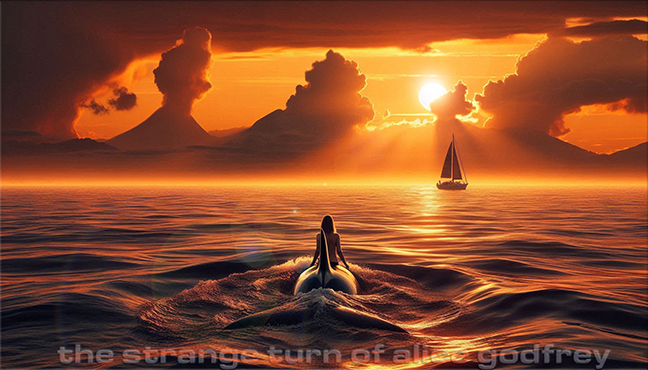
© 2025 adrian leverkühn | abw | adrianleverkuhnwrites.com | and here ends The Seasons of Man, the Prelude to TimeShadow. While this story is fiction, the characters lean a bit on Eric Hatch’s 1101 Park Avenue(c), a novel published in 1935 which became the basis for two motion pictures, both titled My Man Godfrey. The screenplay for the original film was penned by Hatch and Morrie Ryskind in 1936. Per Wikipedia: “In 1999, the film was selected for the Library of Congress‘s National Film Registry (NFR) of motion pictures “selected for… historical, cultural and aesthetic contributions,” saying that “Carole Lombard sparkles [at] one of her greatest roles,” in this “comedic take and sometimes caustic commentary on the Great Depression,” adding “William Powell portrays Godfrey with knife-edged delivery,” in “one of the most exemplary screwball comedies of the 1930s.” The NFR also praises Ted Tetzlaff’s black-and-white cinematography.” As the author of this work, I could not fail but mention that I had Godfrey Parke in mind when I created Alice and her menagerie on the MV Charon, including the Bullock clan.
This story will conclude in TimeShadow.


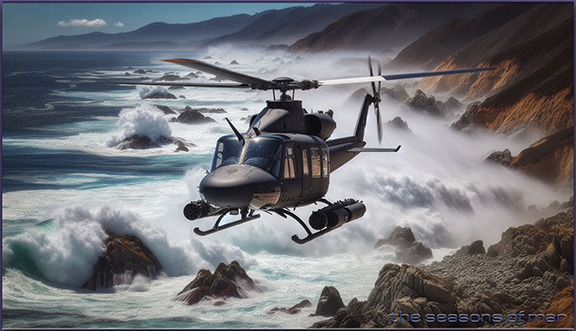
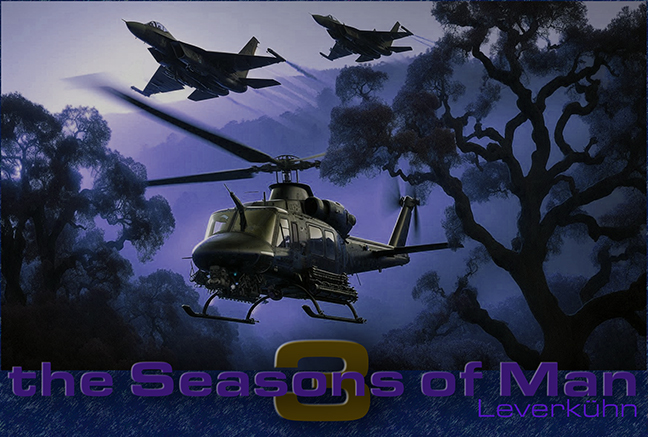




 Adrian Leverkühn Writes