

Time to wrap up this part of the story and put her to bed, but this is the entire story, all three parts start to finish.
Music? Better start off with Dance On A Volcano, by Genesis. Might want to end with Al Stewart’s End of the Day. Where you go in between is always up to you.
Have fun.

The Seasons of Man
Book Three: Mars, The Bringer of War
Part I: Flower Child
Her’s might have been an idyllic childhood but for the sudden collapse of civilization.
She grew up in Berkeley, California, deep within the womb of what had once been the epicenter of the 60s free-speech movement. Berkeley had become California’s, then America’s answer to Athens, the ancient Athens of Cleisthenes and Pericles, the Athens of demos and logic. And yet it was, ironically enough, in Berkeley where the final resurgence of modern American fascism took root, where Ronald Reagan and Edwin Meese, his Attorney General, began the systematic deconstruction of individual human liberty. All done, of course, in the name of individual human liberty.
At least that’s the version of history the little girl learned at home. Some teachers still taught that version of events in the schools she attended, but not often, as by the 2020s that version of America had been fading fast. Indeed, everything about that version of America had been fading by the beginning of the second decade of the twenty-first century. Now the tattered remnants of the United States were sleepwalking into the dark ages.
Judy Aronson grew up in a very nice two story Craftsman style house on Hillegass Avenue, right across the street from Willard Park, in the middle of Berkeley. She went to John Muir Elementary, then to the Willard Middle School before going on to graduate from Berkeley High, with honors. With her grades she might have gone onto UC Berkeley, or even to Stanford, but by the early 2030s California no longer had any need for historians and philosophers. The hills above Berkeley, famous for their groves of oaks and stands of eucalyptus, had been reduced to smoking cinders after the fires that followed the Great Cascadia Earthquake of 2032; indeed, most of the Bay Area was hardly recognizable now. What had once been the San Francisco waterfront was now a charred jumble of broken timber piers standing like sentinels, watching over all the wrecked skyscrapers; the same was true of all the bridges that had once spanned the bay, from the majestic Golden Gate to the more utilitarian San Mateo-Hayward bridge. They were all gone now, reduced to little more than hazards to navigation. And Berkeley had fared no better than the other cities on the bay, though parts of the city, those higher up the hillsides, were left relatively unscathed.
Cities around Puget Sound had disappeared under the first 120 foot tall wall of water generated when the fault slipped, before Mount Rainier cut loose. But then Mount Baker erupted just minutes after Rainier, and almost simultaneously Mount Hood cut loose, and all that energy literally flattened the remaining cities of the Pacific Northwest. All these cities disappeared literally overnight, and with them companies like Boeing and Microsoft, and almost half of the computer scientists in America. American agriculture, already reeling after a decade of tariff induced collapse, was dealt one last, fatal hammer blow by the volcanic ash circulating in the atmosphere. The American heartland, the greatest breadbasket in human history, had been covered with volcanic ash almost a foot deep. America’s vast networks of interstate highways was instantly reduced by half; her rail networks, already reduced by almost a century of corporate consolidation, could not make up the difference. At first, state governments tried to make up the difference out west, but with even basic lines of communication ruptured, city governments soon took on more importance, while the federal government, already on life support after a decade of deep cuts, simply began to disappear from American life. Only a few large military bases remained of the federal structures of government.
The Los Angeles-San Diego corridor had survived the Cascadia Event relatively intact, and aerospace manufacturing and chip making facilities were springing up as fast as labor could be found to begin new construction. A new hi-speed rail corridor was planned, hopefully linking Los Angeles to Phoenix and eventually the Dallas-Ft Worth metroplex. Atlantic Coast America first responded with rail lines linking Jacksonville, Florida to Dallas; new lines from Cleveland and Boston to the southern tier were being planned. Chicago, Minneapolis, and St Louis were considered too compromised by ash and pumice to be worth the effort to reconstruct. Acid concentrations in the Great Lakes would, hopeful scientists claimed, return to safe levels within 20 years, but the chemistry said otherwise. Dust storms were the norm throughout the mid-west these days, and rainfall was increasingly sparse. Initially, global temperatures fell as particulate ejecta circled the globe, but that trend soon reversed and high began an inexorable rise.
Oddly enough, all the so-called Smart Money that once called Seattle home had already moved by the time the physical fault lines ruptured, but the metaphorical union that had held America together for over 200 years had long since been cleaved. The first wave of the Billionaire Class went to New Zealand, while some, of course, were content to settle in Hawaii. Then a curious migration to Chile and Argentina began. Now, two years after the Event, as global temperatures began their rapid but catastrophically steady increase, suddenly all the remaining billionaires were moving to South Georgia Island and to Canada’s Hudson Bay, where land prices now exceeded those seen South Florida a decade earlier, and where the tallest skyscraper ever imagined, the 3500 foot tall Taliesin East Tower, was taking shape. A colony of extremely wealthy investors was settling near the Akimiski Island Fusion Reactor Research Facility, near the proposed site of Spaceport Canada, and soon Hudson’s Bay began to look like the last cradle of humanity. Already several large domed cities were under construction there, and migrants were flooding to the area for work.
Judy Aronson was among the last generation of Americans children that would remember things like tree-lined streets and open air farmer’s markets, of carefree autumn afternoons watching football games or a summer evening stroll, of fishing in clean streams or playing baseball on green grass at the neighborhood park.
Because things were different now.
That America was gone. That America had vanished overnight.
And anyway, Judy Aronson could hardly remember it. The present displaces the past when the pain of an empty belly replaces all your other worldly cares, or when clean water is a luxury your parents can’t afford. And two months after she graduated from middle school, over the course of one long night, that change began.
Part II: The Warrior Child
There was, of course, one way to ensure you did not go to bed on an empty stomach.
After completing high school, graduates were presented a stark choice: either you went to the CCC, the California Conservation Corps, or you “enlisted” in the California Guard. This meant either agricultural work in the fields or clearing earthquake rubble with the Corps, or protecting the Southern Border Zone with the Guard, and these were not choices, they were assignments. You could, of course, chose not to participate in either program, but this meant getting on a one way bus to the southern border, loss of citizenship and immediate expulsion. Few chose that option, not once conditions on the other side of the border became more widely known.
Like most children in America from the 1970s on, Judy’s abilities had been tracked from kindergarten through middle school, ostensibly in order to identify and accommodate ‘Special Needs’ students, and these records were permanently attached to student transcripts. After the Cascadia Event, when the decision had been made to require compulsory post-graduate public service, by the end of middle school the decision had already been made for all students. Judy was in the tenth percentile of her class, actually among the first percentile, so she was among the smartest kids in the state. Those in the top ten percent went to university – but only after first completing a two year term in the Guard; the bottom 90 percent went straight to the CCC, for a single five year term. Some who went to the Guard would decide to remain in military service; almost no one in the CCC willfully remained. The work was brutal and the pay low. The Guard, on the other hand, offered a more varied work environment: once accepted into the Guard, graduates were sent to Basic Training, after which cadets were sent to one of three main services. There was the Coast Guard, the Militia, and for the top graduates of Basic, the Air Force.
Judy Aronson’s father was a physicist at Berkeley, her mother had been a nurse. Her own academic performance had been stellar, and after induction and Basic Training, she reported to the Guadalupe Dunes Flight Training Center, just north of Vandenberg Space Force Base on the Pacific Coast. What she would remember most about her time at The Dunes was the base’s close proximity to the last productive strawberry fields in North America, and because of that her training squadron’s unofficial anthem had been Strawberry Fields Forever. The origins of the song were not well understood, but everyone had fun at their after-graduation party, where strawberry wine seemed to be the flavor of the evening.
Judy’s class of student aviators first trained on flight simulators, then each student progressed to the MD-500 helicopter. The -500 was an old design, first produced by the Hughes Aircraft Company as the Hughes 500, in 1967. The -500 saw action in Vietnam as a scout helicopter, and pilots loved it’s strength and incredible maneuverability. So did Judy. Flying along the beach just above the breakers at 150 knots was the funnest thing she’d ever done in her life…until her instructor reefed the ship into a high speed turn that felt like a punch to the gut. Then he’d righted the ship and brought it to a stop inches above a six foot square slab of concrete, before dropping them down to the gentlest landing imaginable. He’d looked at her then and smiled, then said something like: “Okay, now you do it!”
– And she had, perfectly.
Her instructor nodded, made some notes and when they wrapped for the day he went to talk to the CO. Usually, before members of a training class moved on to either the Subaru-Bell 412EPX-MP or to the venerable Sikorsky Blackhawk, the instructors compared notes and identified students with special abilities, and Judy Aronson was in that elite group.
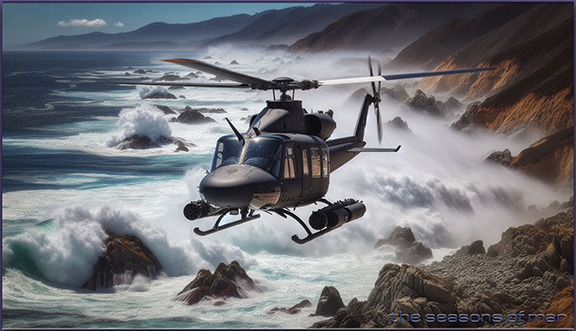
So, Judy left her class and went to a far corner of the base to continue with the next part of her training, and this would be on the Bell UH-1Y Venom, a utility and maritime patrol variant of the original Huey that was also equipped as an heavy assault gunship. Judy had wanted to train on the Bell 412 as this was a light duty utility helicopter, and this would almost guarantee her posting to either the San Diego Maritime Sector or the Bodega Bay Maritime Patrol District. She wanted Bodega Bay as it was closer to her home in Berkeley, and that sector was involved with simple maritime search and rescue operations. San Diego meant drug interdiction.
Getting moved to the Venom was an unexpected detour, one she’d never even considered because, frankly, few even knew it was an option. The Venom, one of the last models produced from the original Huey, had little in common with it’s older production siblings: the body was longer, engine power was increased tremendously from the original, and the original twin rotor design gave way to a composite four rotor blade design that increased durability and speed, and decreased the noise made by the notoriously loud Huey. The Venom had the increased range and reduced vibration necessary to allow it to become a true combat ship, and once Judy understood what she was training for she began to feel a little more exposed. More vulnerable. Because Venoms weren’t used for maritime patrol or search and rescue, they were being used in combat operations on the southern border. The Venom was a warfighter born out of the conflict in Afghanistan, and her new instructors were now a bunch of cigar chomping, no nonsense ex-Marines.
One other change to her training regimen occurred: every morning she spend two hours at the range, at the US Marine Corps weapons training facility at the base. While her former classmates went through paramedic training and rescue operations and procedures, she started on the M4 carbine and the Sig P240, a new 10mm handgun with brutal recoil and surreal accuracy. Again, she displayed much higher aptitude for combat operations than anyone expected. They even allowed her to make her own choice about which handgun she’d carry after she left school, and no one was surprised by her choice, not once they got to know her.
Aronson finished the extended Venom school with a perfect record, and despite her lack of combat experience she was assigned to the San Diego – North Island border patrol sector. She reported to her first real squadron, MS-232, immediately upon completing a two day base orientation class put on by the U.S. Navy’s Shore Patrol safety officers.
Because MS-232, the Viper Squadron, was based at the reconstituted North Island Naval Air Station. The US Navy had never stopped West Coast operations out of San Diego, but after the Cascadia Event and as soon as the the Battle of the Taiwan Straits was officially over – and after Taiwan was “reunited” with the mainland – North Island became the navy’s only remaining fully operational facility on the West Coast, excluding Hawaii, of course. Within the past few months two reconstituted Navy P-8 ASW maritime patrol squadrons had returned to the base, while the Navy’s other remaining fixed and rotor squadrons were still up on the bluff, at Miramar NAS. Five carriers and their combined air wings now also called San Diego their home port, as did two fleet SSBN submarine squadrons. The harbor had never been busier, but never more exposed to surprise attack than it was now.
Because there was intel that Mexico and the Chinese had formed a military alliance and were even now building bases near the border. Trouble was brewing, big trouble.
In addition to MS-232, there was an additional Guard squadron at North Island, however this squadron, known only as Raider-2, was shrouded in secrecy. This squadron was only the second anywhere in the world to operate the Sikorsky Raider-X, a stealthy airborne assault helicopter designed to operate under the hottest conditions allowable, up to 135 degrees Fahrenheit. Only “career” Guard pilots were rumored to make it into Raider-2, and only the best career pilots were even considered for the rigorous selection process. And it seemed that no one on the base knew anything about Raider-2, even what they did, but when their ships returned from overnight missions their aircraft were usually thoroughly shot up, their crew often recovered by medics.
Yet Judy was curious about Raider-2; her instructors had already noticed she gravitated towards the toughest, riskiest assignments, and that when a difficult training exercise was demonstrated she was the first in line to attempt the new maneuver. Because few people on base had even seen these new helicopters, she was advised to not ask many questions about the Raiders; as they only operated at night and apparently on combat operations deep inside Mexico. With the squadron’s members housed in an isolated compound, everything about them was a mystery.
Her squadron, Raider-2, on the other hand, handled routine border patrol operations from San Diego east to El Centro, though occasionally as far east as Calexico; Section 1 was assigned to routine maritime patrol operations, and sometimes to a patrol district in the mountains north of the border, while Section 2 was detailed to border patrol ops. When Judy arrived, she was assigned to Section 2.
She was assigned to Huey 5, and as she was a junior pilot she was the assigned left-seater, so the second in command of her ship. Her ship operated under the callsign Raider-2-2-5, or second squadron, section 2, unit 5. Aronson was nominally a 2nd Lieutenant, though this was a probationary rank pending her mandatory six months review, and at North Island ‘second-lewies’ were considered somewhere just above pond scum on the social hierarchy.
It did not hurt, however, that Aronson was considered prime date bait, which was the current vernacular for good looking, or cute. She’d just made the height restriction for flight school, and at five-foot-eight she also managed to qualify for helicopters; five-ten was the cut-off for fixed wing operators but she hadn’t wanted that duty, anyway. The weight cut-off was one-twenty for females and one-sixty-five for males, and she’d also just made that cut-off. She’d also had to complete a physical agility course and complete a two mile run in less than fifteen minutes to make it into primary flight training, and again, she’d had no problems with either.
She had dark greenish-blue eyes and long brown hair usually up in a bun, freckles that seemed to compliment the easy-going smile she always had at the ready. She’d loved to prank her classmates all through high school and still tried every now and then in flight school, but the mood at North was somber and she guessed that no one here wanted to deal with a prankster. She was dead right, too.
During her probationary period she was assigned to base housing, and assigned one apartment in a four unit building that, literally, was almost right on top of the Runway 29 threshold. Before 0800, ‘second-lewies’ were allowed to run on the old Sea ’N Air golf course, but at 0801 the balls started flying and ‘second-lewies’ reportedly made good moving targets.
Raider 225 was commanded by 1st Lieutenant Duncan Baldwin, callsign Donut, and Donut was weight-challenged, to put it mildly. He routinely broke 200 pounds and would have washed-out had he not been an exceptional rotorhead, or helicopter pilot, but he was barely tolerated by the Squad CO, Jim Menninger. Donut was an old school misogynist with a mild addiction to porn, and his only real demand was that all his crew be female, because Raider 225 had always been known as The Scarlett Lady. An extremely talented cartoonist had painted nose art on Raider 225 that was so lewd Menninger had it scrubbed clean away. The art had magically reappeared by early the next morning, and when the CO first heard about that he blew a gasket. The Scarlett Lady on 225’s red nose was indeed eye catching porn, and Judy thought it fun. Or funny.
All that nonsense had gone down a few months before Judy arrived, but when she reported for duty Donut was still a misogynist, still fat, and still had a very questionable relationship to authority. In fact, Donut questioned any and all kinds of authority, but appeared to question military authority most of all. No one who knew him understood why he’d gone ‘career’ and had remained in the Guard when he could’ve opted out and gone on to university, but he was popular on base, especially in the O-club, where he was also known as the Pinball Wizard. He liked to play The Who’s Baba O’Reilly over the ship’s intercom, and he usually had a dirty magazine stashed under his seat.
His long-time crew chief and radio operator, Betty Cooper, callsign Betty-Boop, despised him when they weren’t in the air together, when her hatred turned to total respect. His left door gunner, Sara Bradshaw, was a newcomer like Judy, while his right door gunner, perhaps the most important position on the ship, was a retired Marine Corps vet who’d come back for more, a old school door gunner on the UH-1 Venom. Denise Hartmann had survived not one but two shoot-downs, and had nearly been killed in a bad crash after tracking down a cartel gunship in the Sea of Cortez. She still ran a seven minute mile, and even active-duty Marine gunnery sergeants didn’t fuck with her. Menninger was said to barely tolerate her abrasive personality; Donut worshipped her.
Aronson’s primary responsibilities included flying the machine unless or until things got hot, when Donut would take the controls and steer the Huey to bring Hartmann and her 50 caliber to the party. If shit got dicey he’d swing the Huey to bring the chain gun on the port side into play, and it was Sara Bradshaw’s duty to keep the 3000 rounds per minute heavy machine gun fed and lubed. Betty-Boop was the EWO, or electronic warfare operator, but her real job was, apparently, to make sure Donut stayed awake and was otherwise left alone to flip through the stash of porn he kept hidden from Menninger. The latest rumor was that Donut and Boop were doing it, but, apparently no one took the rumor too seriously.
+++++
The radio popped once and came alive: “Raider 225,” the encrypted voice said.
“225, Go-hed,” Boop replied, her accent a thick, southwest draw.
Aronson turned down the volume in her helmet and looked at Donut as he held up his left hand and spun his index finger, signaling it was time to start engine 1; once Judy had a good start he motioned for the ground crew to cut the ground cart and move off, then he signaled Judy to start engine 2.
“Keep an eye on your torque, especially on 1,” Donut said as he watched Judy, then he turned and looked at Bradshaw. “We good back there, rookie?”
“Yessir,” Bradshaw said. Her voice held the same mix of curiosity and fear Judy felt.
“Good start on 2,” Judy added, already tired of the butterflies dancing in her stomach.
“Raider 225, Signal 8, sector 91-bravo, code 2.”
“2-2-5, 8, 91-bravo, 2,” Boop replied.
“Raider 2-2-5, good read-back, altimeter two-niner-niner-eight, temp one-one-four, winds variable at 2-7-0, clear for ramp takeoff and a Breakers-2 departure, squawk 2442, and contact San Diego Departure 132.75 when clear of the ramp.”
Judy dialed in their departure frequency and transponder code, then looked at Donut; he just nodded and Judy twisted the throttle and watched her torque lines build, then added collective while she got on the rudder pedals to counter the torque. At a hundred AGL she pushed the stick over just a little for some nose-down, then watched her speed build before making an easy left turn – once the ship was beyond runway 29. She scanned her instruments while heading for the beach, and if everything looked good mechanically they would follow the strand, as this long, thin stretch of beach was known, south all the way to Imperial Beach. Once there, they would turn inland towards Tecate, which was a large city just east of Tijuana, and also the first urban patrol waypoint for sector 91-Bravo.
The inexperienced and the uninformed often think the border east of San Diego is simply flat desert, but those people had never tried to walk the Otay Mountains. Perhaps these people had ever considered that the Mount Palomar Astronomical Observatory was only 40 miles north of this stretch of border – and at 5600 feet above sea level, Palomar sees snow a couple of times a year. The land along this border isn’t simply inhospitable, in places the terrain is so rough that the only reliable access is by helicopter. Or donkey. The weather is usually blisteringly hot during the day, with somewhat cooler evening temps the norm, which makes smuggling at night a much more survivable option. The lack of roads and trails also makes these mountains difficult for firefighter and rescue crews to reach.
However, that only applies to the American side of the border. Small towns and villages line the Mexican side, and have for well over a hundred years. So while the American side is almost completely devoid of people, the opposite holds true on the other side of the border. The American side has one road used to patrol the wall, while the Mexican side is criss-crossed with an impenetrable maze of unmapped game trails, donkey paths, and unpaved roadways that illegal immigrants and drug smugglers have used for centuries.
Tecate, was a small crossing on the American side of the border, is instructive. Located just 24 miles inland from the Pacific Ocean, the village is already 1800 feet above sea level, and typically had a population of less than 200 people, most being border patrol agents. Across the border, in the Mexican city of the same name, the last reliable population figure, from 2027, was 175,000 people, while the city is notable as the home of Tecate Beer. A number of American manufacturing facilities were built in Tecate in the late 1990s, though after the collapse of amicable relations between the United States and Mexico most of the manufacturing facilities had changed ownership. All were currently under Chinese and Indian ownership, and this foreign presence had only increased in the years since the Cascadia Event. Few on the border complained about this change.
Also in the years since the economic collapse of the western United States, illegal immigration had fallen off almost completely. Yet, improbably, the border was still as active as it ever was.
Now, in the years since the collapse, the border region was once again a hive of activity, not of manufacturing nor of immigrants lining up to enter los Estates Unidos, but of an almost nonstop flow of narcotics from China transshipped through Mexico into the southwest United States. This flow amounted to a quiet, ongoing war between China and the remnants of the United States, though China stood accused of essentially kicking the United States while it was down. Everyone understood the new government was trying to recover from the Cascadia Event, but America’s enemies were undeterred by such sentiments.
Over the past two years, however, the border states had started to refortify their borders on their own authority, so state agencies, and not the federal government, were cracking down on this latest influx of narcotics. The effort hadn’t achieved success overnight, however. Only California had the infrastructure to put together a coherent counter force, but largely because of the resilient Navy and Marine Corps bases in the San Diego region.
One part of China’s latest strategy was to create new waves of desperate immigrants, most of them climate-refugees from as far away as Brazil, and funnel them to the larger cities along this border, cities just like Tecate – but these immigrants were not there to cross the border seeking work but to flood the region with cheap drugs, while Coyotes, or human smugglers, planned to employ all of the rugged, inhospitable goat paths that crossed into the no-mans land on the north side of the border. This was the war zone no one talked about, a war being fought not by national armies but by conscripts largely just out of high school in California, who fought ruthless drug cartels supported by China and India along this border. And it was worth noting that this war was being waged by an enemy that employed narcotics to dull the mind of the opposition, as smuggling drugs onto military bases was a large part of the plan to weaken the states.
But this latest enemy was in it for the long haul, and even now getting ready to cut off the head of the snake that had been tormenting it for so long. All that stood between this goal and success was a rag-tag assortment of aviators, most of them teenagers like Judy Aronson, in the main fresh high school graduates from California high schools.
The region had enjoyed a rainy season in decades past, but, generally speaking, it rarely rained in the American southwest anymore. Even summer monsoons had given way to the heat, with one ‘heat dome’ after another frequently generating triple-digit temperatures. Creeks and small lakes had dried up, what forests remained undamaged by wildfires were now stunted, tinder-dry reservoirs of fuel that might last until the next dry-lightning storm rolled through. Winter days were usually hot, while summer brought daytime temperatures that scientists now called ‘incompatible with human life.’ The high dessert still came alive at night, however, and the goat paths and unpaved tracks that the smugglers traveled in the dark were quite literally crawling with venomous sidewinders and western diamondback rattlesnakes. No one walked these trails without wearing protective chaps and without carrying a sawed-off shotgun, because this new landscape was perfect for reptiles all all stripes, even the two-legged varieties.
Both Betty Boop and Sara Bradshaw had gone through intensive emergency wilderness medical training, and Raider 225 carried an extensive array of emergency medical gear, but the most important gear they carried was a small refrigerated supply of preloaded antivenin syringes. Donut also kept a small supply of tequila in this ‘fridge – in case of a real emergency, or so he was fond of saying…
After taking off from North Island, Raider 225 turned south, her skids just above the surf crashing on the beach, running dark and running fast toward the border. Abeam the old Outlying Landing Field in Imperial Beach, the Huey made an abrupt left turn to the east, following the derelict 905 freeway all the way to the mountains. The end of the freeway marked the beginning of No Mans Land, which was where the real action usually started.
Just like it did every night.
One paved road was built, of course, when the border wall between the US and Mexico was authorized, but the nonstop manned patrols of the 2020s had stopped overnight in the immediate aftermath of the Cascadia Event. These patrols had only resumed once the true scale of the current narcotics operations was uncovered, but there simply were not enough ground personnel to patrol all of the borders many weak spots. Hence, nighttime helicopter patrols augmented daytime ground ops, with a few drones flying and scanning the border several times a day.
The dangers confronting Raider 225 were easy enough to understand. With enough technology and manpower, cartel operators from SanDiego to Texas kept a sharp eye trained on any helicopters departing bases like North Island, and when a Huey took off, especially one from the Raider squadron, a clandestine network of people and radar units began tracking the helicopter’s movements, including its altitude, speed, and heading, and would do so until the Huey briefly disappeared from screen when it entered the mountains between Tijuana and Tecate. Smuggling and other ops were then put on notice, so as soon as one of the Hueys was spotted, and it’s eastbound track confirmed, smuggling operations literally went back underground…slowing until the helicopter passed and normal operations could resume.
But Donut had thought about it and soon had come up with a plan he thought might actually catch an operation ‘in progress,’ even though the idea predated his thinking by a few thousand years.
When a Huey arrived in sector 91, entering bravo section on the west side of Tecate, the Huey had already burned a quarter of its fuel load-out. Assuming the helicopter proceeded nonstop to the east end of the sector, in Calexico, more than a half of the Huey’s fuel would be gone. If they had to stop and loiter around an area their margin of safe operations would begin to drop lower and lower, and a nonstop return to San Diego would quickly became impossible. As a result, after running this section of the border, sector 91-Bravo, the Huey would have to divert for fuel, so at Mount Signal, just west of Calexico, the Huey would turn north and head to the Naval Air Facility at El Centro, to tank up before running 91-Bravo once again, but this time all the way back to North Island. The problem, once again, was that these Hueys would be tracked almost continuously by the cartels, all the way from North Island to Calexico and back – except for that brief period when the Huey’s passed through ‘No Mans Land.’ But there were two such areas, one on either side of the city of Tecate, where the terrain was so rough that it became impossible to obtain reliable radar returns, and while these two areas were the cartel’s weak spots, they were the Guard’s, too.
But these weak spots were also Donut’s idea of a good time.
Donut’s ‘plan’ entailed flying the route, making sure their progress was tracked and passed along as his Huey approached and then departed Tecate, and then once again, as his Huey approached Calexico. There were currently two ‘suspected’ drug smuggling routes in these two segments of No Man’s Land, routes where, supposedly, illegal immigrants were carrying large shipments of ‘product’ through the mountains, and everyone assumed these passages were on either side of Tecate, but nobody had any reliable intel about where these routes were actually located, or when they were used.
The first possible passage, labeled RNDZ on Donut’s Huey’s FMC, or Flight Management Computer, was located near the confluence of Tecate Creek and the headwaters of the Tijuana River, west of Tecate. The second, LKSC on their FMC, was a suspected route that used an old, abandoned shooting range in the middle of nowhere, one that militia groups had once placed right on the border. Not near it, but on it. The unfriendly supposition had always been that members of the Lakeside Shooting Club practiced on moving targets whenever the opportunity presented, but nowadays there was rarely a soul out there, and never anyone at night – unless they were involved in Cartel activities – and while it had always been a suspected hotspot, Donut now wanted a way to prove it.
The plan involved his aircraft, or ‘Huey 1,’ passing these hotspots without so much as a glance, freeing the cartel’s recon operators to give the all clear signal, while a second Huey, or Huey 2, left El Centro with a full tank of fuel and would swoop in from the north – hopefully undetected. Donut’s thinking was that once the first Huey passed Tecate the all-clear signal would open the door and product would resume flowing – just as the second Huey came in undetected from the north, with Huey 1 still in range for backup if a firefight broke out.
The squad CO, Captain Menninger, had green-lighted the plan only last week, after Donut lost both his co-pilot and left door gunner in a firefight right over Tecate.
And when she learned that, Judy Aronson soon understood what duty in San Diego really entailed.
She hadn’t exactly been planning on nonstop beach volleyball in San Diego, but border patrol sounded useful and relatively non-violent, even helpful. On the other hand, getting into firefights with the cartels sounded like some serious shit. Who knows, maybe the kids flying Hueys in South Vietnam back in 1968 felt exactly the same thing. Something like: “Gee, I didn’t know I was signing up for this shit…”
+++++
Porfirio Limones opened his laptop and started running through the PDFs and spreadsheets on his screen. He was a patient, methodical man, always on the lookout for real, measurable trends in product distribution; the cartel’s leaders had in the past relied on ‘educated guesses’ – whatever that meant – and for any number of reasons. Most often cited? They had been reluctant to rely on computer driven data because it was untested in the real world. Such information, these early leaders maintained, could easily be manipulated, or worse, become evidence in criminal proceedings. They were not exactly wrong, Limones knew. Rather, one had to maintain secure lines of information, and your lieutenants needed to be loyal. Very loyal.
But loyalty was, he understood, a two way street. Kindness was a more effective tool than brutality, but both had their place in the grand scheme of things.
Limones, a fit, middle aged man, was sitting in the shade, sipping Jamaican Blue Mountain coffee that Isabella, his housekeeper, had just prepared. He studied the brew, the intense blackness, the tiny, reddish-brown bubbles around the rim of his French porcelain cup, the fathomless aroma so endlessly deep, and, as always, so satisfying. He tried to push everything else from his mind, tried to focus on the moment, the endlessly satisfying moment that came from a fresh cup of coffee. Nothing else beyond the here and now, nothing more complicated than taking a breath and listening to his body as the aroma caressed his soul. He was a religious man, some considered him devout, but he took everything about coffee seriously.
A plate clinked as it came out of the dishwasher and he looked up, watched Isabella working in the kitchen just off the open courtyard where he sat. She was a miracle, he thought, even if she was Italian. She kept his house ‘just so,’ which was to say immaculate; not a speck of dust could be seen anywhere, and his laundry was always perfect, his shirts crisp to the touch. The interior tile surrounding the courtyard was spotless, the adobe pavers out here in the shaded courtyard were as clean. He had never in his life had a housekeeper like Isabella, and he gave thanks to God every time he walked through the house to his bedroom, or to his study. Wasn’t Sloth one of the Seven Deadly Sins? Did that not mean by keeping an immaculate house he was among the truly virtuous? That alone, the priests told him, would sanctify his place in heaven, and he believed that with all his soul.
He wore only white, the Sacred White of the Virgin. As he did today, a pure white, lightweight linen suit and a white shirt, all immaculately pressed. Virtuously white, Isabella told him. And he loved her for her understanding.
He’d built this house because the architect had incorporated cleanliness into the basic design; the new house was otherwise a very traditional hacienda. It consisted of a large, simple square when seen from above, yet with a large open courtyard in the center. The courtyard was defined by a large tiled fountain in one corner, and low lying palms around the perimeter. On the interior ground floor everything opened onto this courtyard, while all the much more private bedrooms were on the second floor. But everything in the house, from the furniture to the floors was also very easy to clean. Best of all, he only had a short walk to get to his stables. He loved his Arabians with a passion, and tried to ride every evening. Before his real work began.
Limones was a Capo, a captain in the Tijuana Cartel, and even by the old standards he was a wealthy man, but he was from Tecate, or a small village just south of Tecate. He had built his estancia there, on land now called Rancho Alpino. Before the Event, what superstitious locals called the Night of the Fire Gods, land developers had snatched up parcels around the old village, and had been marketing cheap one acre plots to Norteños looking to retire south of the border. Tecate was perfect, too. Close to San Diego, already a manufacturing hub for American companies seeking cheap labor, so there were Costcos and Walmarts and, most important of all, pharmacies selling cheap insulin and GLP-1 injections to fat Americanos. And, of course, many came for easy access to the drugs they craved, or the little girls that walked the streets after dark.
But The Night of the Fire Gods changed all that. The Gringos didn’t come to buy cheap land anymore. The manufacturing facilities had fallen like dominoes, one by one, then bought up by Chinese and Indian ‘investment firms.’ And maybe Walmart still existed somewhere in the world, but not in Mexico, not anymore. The old ‘superstores’ now had new names on them, Chinese names, even if they were selling the same cheap goods they always had.
Maybe that was why the Californians had shut down the border, but he did not care why, really. He only cared about moving product, and keeping losses to a bare minimum.
When the original wall was completed in the late 2020s, official border crossings remained open and life went on. But not now. The crossings were gone, the wall closed tight. All that remained were boarded up buildings and warning signs all along the border; yet the ‘Federales’, as the Customs and ICE had been called, were now hard to find. But once the Norteños got their act together again, all the old border crossings remained closed, save for one facility serving the San Diego-Tijuana crossing, and after those closures all cross border trade ceased. Of course, that only made it easier for the Chinese to move into the vacuum created by the departure of American businesses and tourists, because a patient enemy never sleeps.
And into this vacuum, well, that was when the cartels stepped in with more and more shipments. There is opportunity in chaos, Limones liked to say, opportunities for the bold, and the wise. Because labor on both sides of the border was now cheap and plentiful, vast new networks of tunnels were planned, and his newest project – while very isolated – would be large enough to drive small trucks through. These new tunnels were located far from the old established pipelines within Tecate, even though Limones had decided to maintain Tecate as his central distribution hub. With that decided, Limones was building new roads to move product to the new tunnel complex, and for that he had needed money and equipment. For those, he had turned to Chinese bankers and heavy equipment manufacturers.
The Nogales-Tucson corridor was still the cartel’s most profitable, and that run still funneled most of its product to Phoenix and on into Texas, but the California market had been growing, gaining strength again. But shipments routed through the Tijuana-Tecate border were down more than ten percent on a year to year basis, while the street prices of products in both Los Angeles and Las Vegas were up significantly. As always, it was a question of supply vs demand, and as supply was down, that meant increasing prices. He knew he had to act fast or demand would start to shrink as users were priced out of the market and moved on to cheaper solutions. Heroin and all its derivatives were, after all, no different than gasoline.
Even now one of Limones’ construction companies was hard at work on the first of these new tunnels, the biggest tunnel yet, a veritable two lane freeway that would enter California just south of Rancho del Campo by way of an old railway tunnel. The old American network of seismometers and acoustic sensors were largely unmanned now, and boring operations were masked, when possible, by renewed operations of the old Pacific Southwest Railway, which had resumed hauling uranium ore to the old Southern Pacific spur in Ocotillo once a week. Limones’s crews were moving equipment to the new tunnel construction site at night, yet Limones was already looking forward to all the new shipments of product that could begin as soon as the new tunnel opened; indeed, he was already finalizing product delivery schedules, coordinating shipments from Southern California to Nevada and northern Arizona. Billions of Yuan were at stake.
But Porfirio had one further consideration. His financial backers. He’d never met even one of the people from this group, and not one of his associates knew how these bankers really operated, but the word on the street was that the Chinese bankers were just another mafia, with their own enforcers doing the dirty work when people defaulted, and as Chinese troops moved in, that meant these bankers had real muscle to protect their operations. He doubted the Chinese would be as easy to bribe as their Mexican counterparts had always proven to be, but he was open to trying. Human nature was just that, and heroin would never go out of style.
And with fully ninety percent of all the opiates in the world were now coming out of clandestine labs in southeast China, it wasn’t hard to understand why. Proximity to raw materials and lax government policy. It was like magic, too: hideous amounts of money were being made during a global depression – all because the enemy, the people of the United States, kept purchasing these goods. Yet the beauty of the operations was, from the Chinese perspective, that the enemy was simply cutting his own throat with every pound of product that made it across his border. Chinese heroin was pouring not just into a country; it was pouring into the veins of the stupid, the uninformed, and the desperate, with each new addict becoming one more nail in America’s coffin. It was targeted biological warfare, really, only the targets were the willfully ignorant that, Limones assumed, no one would miss. He liked to say that America had been a cash cow that had outlived it’s usefulness, but now it was time for America to just die and go away quietly.
He closed the spreadsheet program and opened up a live feed of the California Guard facility on North Island, up north, in San Diego. He watched a helicopter take off and turn out west over the beach before it turned south, and he checked the time on his laptop’s menu bar.
“Right on schedule. Raider 225 again, no doubt.”
He’d nearly taken that helicopter down two weeks ago, but as disappointed as he was not to have killed the entire crew, he’d heard that two members were killed in that ambush. Still, he wondered if these gringos were as stupid as he’d heard, or if it was possible that they could learn from their mistakes.
Personally, he doubted it, but it mattered no longer. He had arranged a new surprise for Raider 225, a special surprise just for them.
+++++
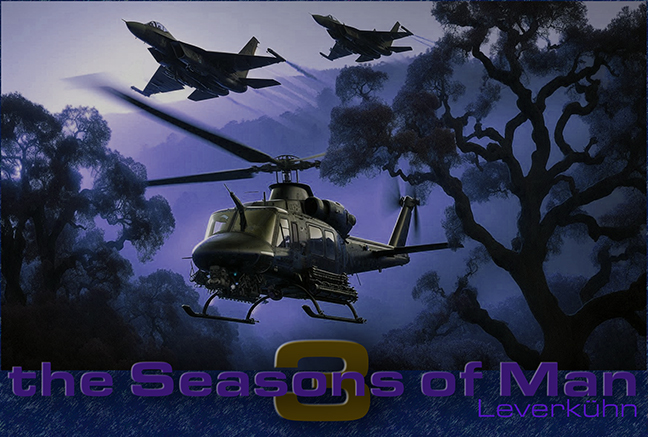
Raider 225 was equipped with the newest iteration of the AN/ANQ-235 electronic warfare pod, and as soon as the Huey turned inland the pod came alive – just as Donut knew it would. With Chinese help, the cartels had plastered most of the route with ground based radar sets, but to date these radars were only in urban areas. It was not thought possible to place these radars in the most rugged sections of the mountains, which would be too far from ground support, and because of the certainty the Californians would take them out as soon as they were discovered. That had prompted Limones to get in touch with his benefactors for his latest surprise.
“Hey, Boss,” Betty-Boop said, her voice coming in crystal clear through the helmet mounted intercom, “we got an airborne search radar on us.”
“What? Are you sure?”
“That’s what Iris is sayin’, Boss.”
Iris was located under the hills above Pasadena, in a hardened basement 200 feet beneath the Jet Propulsion Laboratory, and she was the latest generation of iterative AI working at JPL. Iris was linked to Raider 225 by encrypted satellite, and she saw everything Betty Boop did, only faster.
“Iris?” Donut asked. “Talk to me.”
“Good evening, Lieutenant. How are you tonight?”
“Hangin’ pretty low. You?”
“I am doing well. You appear to have been scanned by two Type 1475 AESA units. My best information is that this active electronically steered array is still used only in Block 1 and 2 Chengdu J-20 stealth fighters. It is not possible to lock-on to these aircraft, but I am inferring their location by analyzing these new beam widths and heat signatures. The lead aircraft is maneuvering to get into your six o’clock position, and appears to be in a steep dive, speed 850 knots and closing fast.”
“Let me know when he goes active, would you?”
“Of course.”
“Betty? Can you put the tactical overview on my HUD?”
“Got it.”
“Can we jam them?” Judy asked.
But Donut just shook his head. “Nope. Jamming works, mind you, but it’s too easy to pinpoint the jamming unit and home-in on it. Best thing is old fashioned flying, like deep down in the weeds.” With that he flipped his night vision goggles down and put his hands on the controls. “My aircraft,” he sighed.
“Your aircraft,” Judy replied.
And with that Raider 225 dove to the rooftops of the houses and warehouses in the foothills east of Tijuana, and then he dropped his speed to 45 miles per hour. “The trick here is to confuse the operator up there, make us look like a truck or anything on a city street, then maybe we’ll pop up on his six and see what happens.”
“But…if there are two of them? Won’t the second aircraft just hang back and see if we try that?”
“Maybe.” He flared the Huey and bled off his remaining airspeed, landing next to an abandoned In-N-Out Burger restaurant, and a few seconds later the Chinese stealth fighter roared by overhead.
Iris chimed in immediately. “ECM jamming from the first aircraft, the second is locking on with missiles.”
Donut pulled the collective and spun to 2-7-0 indicated and climbed to 500 AGL, and as soon as he saw the second aircraft in his camera he locked onto it with a Hellfire and fired. Instantly he dropped back down to the trees and waited for Iris to report.
“Lieutenant, it appears both aircraft have broken off the engagement. The second aircraft also appears to have sustained considerable damage, possibly fragmentation damage, and reports leaking fuel. Now the pilot is reporting hydraulic failures and states he is going to eject.”
“Where?”
“He has ejected approximately one quarter mile northwest of the Donovan Correctional Facility.”
Donut grinned. “Well fuck, ain’t that convenient. Judy, let’s go pick up that asshole and take him back to the barn. Your aircraft,” he said as he took his hands off the controls.
Judy took the stick and swung around to head to the location Iris had put up on the TAC display, and they were on the parachute almost as soon as the pilot hit the rocks. His ‘chute dragged the hapless aviator through a rocks and cacti…and Donut almost laughed at the pilot’s predicament.
“Man, that’s gotta hurt,” Donut said. “Whoa…see that?”
“Yeah, what was that?”
“That, dear Judy, is what happens when you come face to face with a ten foot rattlesnake.”
“Bastard looks like he’s trying to fly again,” Hartmann said, commiserating with the pilot.
“Yeah,” Donut sighed. “Nothing like a snake that big to put some pep in your step.”
“Whoa, shit, did you see that?” Judy shouted. “That was a big fucker!”
Donut nodded stoically. “Yup. Denise, better get the snakebite kit ready.”
+++++
Limones had listened to the Chinese pilots as they maneuvered to take out the helicopter, only to hear the shoot-down and capture of the pilot live, as it happened. And now he was angry. This American pilot, the one everyone called Donut, was becoming a real pain in his ass, but now he’d had enough of this Gringo’s interference. Perhaps, he thought, it was time to get up close and personal, and maybe take a bite out of this donut…?
+++++
After a week flying with Raider 225, Aronson was confident. She was sure she knew all the routines Donut used to outwit his opponent, and she was even getting into the vibe he kept in the cockpit. Everyone was happy, most of the time, anyway. Except when Donut pulled out an old Hustler Magazine and started moaning over the intercom.
But Donut was also doing his best to keep an eye on Judy, too, and just because of the confidence she felt.
Because, Donut knew, too much confidence too soon made her dangerous. Not dangerous to the enemy, but to the crew of -225. Nothing, he knew, was more dangerous than a rookie who thinks he, or she, knew it all. Cemeteries, he liked to say, were full of Confident Idiots.
One of Donut’s routines was to finish up a flight and go to the mission de-brief, then head to his locker and get out of his flight suit. Once he’d changed into clean shorts and a fresh t-shirt, he took off for a run, a long run, and only then went to the officer’s mess for some chow. Then it was off to his hooch, one unit in a four unit structure that also just happened to be two doors down from where Judy Aronson had taken up residence.
And Judy was just getting out of the shower when she heard the distinct bark of a 10mm S&W so she grabbed her S&W 500 revolver and ran out to see what was going down. Donut was standing outside the front door to his unit, emptying a second clip into something down on the floor inside his unit; Judy ran down and arrived in time to see a particularly huge rattlesnake slither under the sofa in Donut’s living room, and the whole unit was buzzing with the shrill, high-frequency whine of dozens of the creatures.
And all of them sounded like they were really pissed off, too.
Aronson saw one and aimed, then slowly squeezed the trigger. A huge fireball blossomed from the end of the barrel of her four inch Smith & Wesson 500 magnum revolver, scaring the crap out of everyone on the base as the round blew through the sofa – on its way through the concrete foundation…
“Jesus H. Fucking Christ!” Donut screamed. “What the fucking hell IS that?” he cried as he brushed singed hair from his scalp.
“Sorry,” Aronson said, now chastened.
“God Damn! Who cleared you for that thing?”
“I qualified with it after basic?”
“You qualified on that thing? How?”
She shrugged. “I don’t know. I just did.”
“Man, you must have strong hands.”
She shrugged.
“When my ears stop ringing, how ‘bout a hand job?”
She saw another snake and lifted the gun, got the snake in her sights – and Donut managed to dive away before she squeezed the trigger again, this round blowing a three foot hole in the kitchen wall, shattering the window over the kitchen sink, and setting off the building’s fire alarms.
“Stop God damnit! Now! I ain’t gonna have no place left to sleep…”
Base SPs were arriving now and as they ran up they stopped short and were suddenly leering at Aronson. She saw Donut was smiling too, and a little too salaciously.
So was Denise Hartmann, who walked over with a towel. “Honey, you wanna wrap this around something? And next time maybe put on some panties before you come to one of these parties, okay?”
+++++
Aronson was surprised how many reports had to be filled out after the attempt on Donut’s life, and he was still upset because his left ear had been ringing nonstop ever since. That, and it was going to take Buildings and Grounds a week to fix the damage to his unit.
The Shore Patrolmen had ended up clearing two dozen snakes from his apartment, which was a record as far as anyone on base could remember. Putting rattlers in personal cars when aircrew went off base to grab a burger wasn’t unheard of, but this was the first time the perimeter had been violated and some kind of Navy Two Star was putting together a Board of Inquiry to see what had happened, what had broken down.
But when they next gathered for their afternoon brief, all the aircrews understood that what had happened was personal. The cartel had sent a message and everyone was pissed now, because one of their own had been targeted.
“So, why go after Donut now?” someone asked. “It couldn’t be because of the shoot down, could it?”
Donut shook his head. “No way. We gotta be getting close to something, or interfering with something they’re working on. This wasn’t personal, it was business. As in, we’re interfering in somebody’s business…”
“Or both,” Judy Aronson added.
Donut shrugged. Menninger looked at Donut, but then he nodded at Judy.
Then Donut continued. “Last time we made a complete run, we had just started the section outside of Tecate when my co-pilot spotted a faint residual heat bloom in the old railway tunnel south of Campo. We were turning to investigate when two four-wheelers, two little Honda ATVs, jumped out and took off to the south. We followed them until they literally disappeared inside a barn about two miles inland, and by the time we got back to the tunnel it was cold, nothing on IR, no residuals, no nothing. Talking with her about it earlier today, I now feel that the ATVs appeared when they did as a diversionary tactic, to draw us away from the tunnel…”
“But why use that old tunnel?” someone asked.
“I think it’s possible they may be storing heavy equipment inside, but they could be going inside and starting a new tunnel somewhere we can’t see. The other possibility is that they’re working in there, maybe building something even bigger, like tunneling a new roadway under the border.”
“A road? Seriously?”
“Why not?” Donut countered. “The Chinese have been selling heavy earth moving equipment to both the government and the cartels for a while now…”
“What we lack right now,” Captain Menninger interjected, as usual by clearing his throat before speaking, “is hard intel. We are going to stand down tonight but for one mission, and this one, Raider 223, will scrub due to a mechanical before they turn inland, then limp into the auxiliary airfield by the river. Now, as you know, and I now assume all too well, the Chinese J-20s we ran into last week will be a fact of life now, and they aren’t playing around. They’re up there right now, flying parallel to the border about twenty miles inland, but we’ve had solid indications that they have at least two J-20 ’S’ variants in the region now.
“If you’re not familiar, the -S model is a two-seater, and the latest variant of the J-20. What none of you know is the second aircraft, the one that took a crack at Donut last week, was an -S model, and we recovered a lot of the wreckage. That aircraft was AI equipped, so the S model is NOT a fighter in the usual sense, it is not equipped for what’s called attrition warfare. It IS equipped for systems destruction, meaning it is designed to uncover and then attack our electronic subsystems, systems like Iris. The AI on the J-20 was probing the carrier bands on our encrypted radios looking for a backdoor into our AI, and it may be possible that they sacrificed this second aircraft to get a better picture of our transmission profiles when Donut engaged it with Hellfires.”
Donut nodded. “Makes sense,” he muttered under his breath, and Judy nodded too. “Too bad that pilot had such a bad night.”
“We’d love to get some drone coverage over 91-Bravo,” Captain Menninger continued, “but the S model would really love to watch these flights, too, especially our flight profiles, from take off to landing, and how our COMMs to the drones work. We better not let them do that because we really really need this sensor data. Anyway, we won’t be able to run drones very often, not with that -S model listening, so we’ll lose a lot of intel after one or two more drone runs.”
“What about ground-pounders? Why not send in some paratroopers or Seals?”
“Into that rock garden?” Donut snorted. “We’d end up hauling broken legs and snakebites all night.”
Menninger cleared his throat again. “Again, we’re going to stand down tonight, and, uh, well, we’re going to try to get some overhead imagery from an X-37B overflight. That intel does not leave this room, by the way. Once we have a better idea what the cartel is up to with that tunnel we may take in a ground force by, uh, other means. If that happens, you guys will move in to cut off any reinforcements that the cartels may have propositioned, and the Truman will be on standby offshore, and they can launch F/A-47s to play with those J-20s. And from here on out we will be operating under wartime ROE. You got that? You shoot first and ask questions later. Understood?”
Everyone did.
“One more item. Lieutenant Aronson barbecued some rattler a few days ago with a Smith 500 revolver, and the results were, well, as I’m sure most of you heard, well, they were pretty fucking impressive. I ordered a bunch of these revolvers, and they’ll be here later today; I want at least one front seater so armed on every mission going forward. Anybody checking one out, however, will need to qualify at the range, and I’m sure Lieutenant Aronson will be more than happy to help out there. Right, Aronson?”
“Yessir. Can do.”
“That’ll be all.”
+++++
Aronson checked that her holster was snapped and that two speed loaders were in the pouch on her belt, and when the rangemaster blew his whistle she drew the Smith and fired five rounds at the target, a one foot square of ballistic gelatin, but after the third round hit the target it simply disintegrated and oozed down the bench and then onto the ground. The whistle blew again, sounding the all clear, and everyone with one of the new revolvers walked down-range to look at the damage.
“Fuck me,” Donut sighed as he looked at the remnants of the cube. “What kind of velocity is this thing generating?”
“At this range, sir, over 2000 feet per second, but the mass of the bullet gives it incredible stopping power. Smith & Wesson has developed an armor piercing round, and while the recoil is ferocious I’m carrying one of those in my number one position, even in my speed loaders. It will blow through the block of an old GM V-8, no problem.”
“You got any with you?” the rangemaster asked.
“Yessir.”
“Mind firing one of those for us?”
She nodded. “Okay, but make sure your ears are fully covered, and watch the muzzle blast, ‘cause it’s kinda kewl.”
The rangemaster set a new target out, a cubic foot block of pine, and when Aronson fired the armor piercing round at the shiny block of wood everyone watched in slack-jawed wonder as the block fragmented and part of it caught fire, but Donut just shook his head after he rubbed his eyes.
“I ain’t never seen nothing like that muzzle blast,” he sighed. “Not from a handgun, anyway. What’s the muzzle velocity of this AP round?”
“Thirty-five-hundred. Anyone else pay attention to the muzzle flash?”
“I did,” someone called out. “Looked like a six foot ball of fire, maybe more.”
“That’s about right,” Judy said, “but think about that before using this round at night. You’ll give away your position in a heartbeat, and probably anyone around you, too. That’s why I’m only carrying one AP round per speedloader. Besides, the muzzle flash using the wadcutter is bad enough, so keep that halo effect in mind. Shooting this is like using a camera with a flash attached, so also consider how much this will effect your night vision, too. Everyone in the area is going to know exactly where you are, and you may not be able to see them because your own eyesight will be compromised. Assuming they survive getting hit by this thing, that is.” She grinned when she said that, then dumped her brass in a bucket and moved to help the first group go through their qualification training.
++++
A dozen Raider pilots and their co-pilots sat in the base intel facility, watching the live feed from a USSF X-37B orbital space plane as it approached San Diego from the southwest. The lights of Tijuana and Imperial Beach flared, then they saw a puff of inert gas as one of the spacecraft’s MCUs fired, fine tuning the orbit one last time before the hi-res IR cameras began rolling.
“There’s Ranch Domingo,” the operator, someone from the NSA, said. “And…here’s Tecate.” The image was in shades of green, a pure infrared scan along the border. He zoomed in again as the camera approached the railway tunnel and there they were, as expected. Tunnel boring drills, heavy earth movers, and several hundred people…and then a big surprise, two heavy transport helicopters, and they both looked like old Soviet designs. Still, no markings were visible from this angle.
“Does the Mexican Air Force still operate those Russian flutterbugs?” someone asked.
The NSA operator nodded. “Yup, the Air Force still has 14 in service, the old Mi-17. The Navy has 18 of the Mi-8MTV SAR variant. I think these are the transport variants, so probably Air Force.”
Menninger groaned. “So that means the Mexican government is supporting the cartels now.”
“The Chinese wouldn’t be up here without government support,” the NSA guy added, but that was probably unnecessary now.
“Why don’t we just take ‘em out with a Tomahawk?” someone asked.
“That’d be a huge escalation,” the NSA guy said. “We do that and the next thing we know they launch a cruise missile at North Island, and right then you’re no longer a narcotics interdiction program but the lead elements in a big fuckin’ war. In case you haven’t heard, the feds ain’t exactly in the mood for that just now.”
Menninger nodded. “So we turn the temperature up slowly, gentlemen. They escalate a little, we escalate a little, tit for tat. And we try not to do something stupid, like precipitate a ground invasion of Southern California. The Chinese would really love to do that right now, while we’re almost completely isolated out here.” He looked around the room, slowly, as if to make his point even more clear. “We don’t want that fight. Not now. Not until we’re ready.”
“Once you guys link up with Texas again,” the NSA operator added, “that’s when we’ll turn this thing around. Until then, we’re just holding the line. You guys are dealing with the Tijuana cartel here, but the Sinaloa cartel is moving as much product as they want through Arizona and New Mexico, and nothing is standing in their way. The sooner you guys clear the way here, get these guys shut down or pushed back, then we can get back in the ground game and help them. The sooner that happens, the better…”
“What’s going on in Texas?” Judy asked. She hadn’t heard anything about the rest of the former United States for months, and here was someone from the federal government who actually knew what was going on…
“Texas? Well, the Sinaloa cartel is hammering them from the west, while two new cartels, and we’re worried about the newest one in Veracruz, are moving in from the south. There’s hardly any civil government left in the Rio Grande Valley, I mean at all, and San Antonio is in real danger of falling…”
“Danger?” Donut asked. “What does that mean? What are you not telling us?”
“That the cartels are doing what they did in Mexico City and Guadalajara, they’re running out the civil government and replacing them with their own people. And here’s the kicker. These Carteleños, as they’re called, have started calling for secession in Texas and New Mexico. So, they’re starting, and supporting, secessionist movements everywhere the take over. I mean, think about it, from what we’ve been able to gather, this means the cartels, with Chinese backing, are going after the border states. I mean they want to peel them off from the United States one by one, make them a part of Mexico again. And remember, the Chinese are playing the long game. They aren’t looking for results tomorrow, they just want slow steady pressure that weakens the remaining structure of the federal government, until it reaches a breaking point. Then it’s game over.”
+++++

Judy finished her walk-around with Raider 225’s crew chief, climbing up and checking the Jesus Nut on top of the rotor assembly, then working her way down to check the transmission fluid and hydraulic pressure indicators. By the time the rest of 225’s crew walked out from the ready room, their Venom was ready to fly. Even so, Donut would do his own quick walk-around, checking little things to see if she’d done her job correctly.
She got in the left seat and powered up the primary bus, then the auxiliary battery packs before the mains, and after those were online she got the air conditioning going – because it was still 117 degrees out there on the ramp. She heard Betty-Boop waking up the radios and then the ECM pod beeping through it’s startup routine, all while Hartmann loaded a rotary drum into her chain gun. Then Donut climbed in, as usual dangling his right foot out the door until engine start. Ten minutes later they took off…then climbed out to the north, heading first to El Cajon then east to Pine valley before diving low to run out to El Centro. Once they hit 7500 AGL the air conditioning packs were turned off and the outside air vents opened, letting fresh, cold mountain air flood the cabin. Judy flew while Donut flipped through the pages of a vintage Leg Show Magazine, pausing to examine a few pictures he thought particularly nice. An hour and a half later Judy flared and set the Huey down on the southern ramp at El Centro NAF, next to two lines of seven Blackhawks and four AH-1W SuperCobras at the far end of the flight line. It looked like about a hundred US Army Air Cav troopers were waiting to board the Blackhawks, and the Cobras were maxed out with Hellfires and chain guns.
And now…they were waiting for Raider 227 to leave North Island and run sector 91-Bravo, and as 227 first approached and then passed the railway tunnel they would check-in using Iris to encrypt their transmission. By that time, the Donut Brigade, or Delta Bravo, the battle group’s official call sign, would be inbound, hoping to catch the construction crews coming out of the tunnel after they got the all-clear. If all went according to plan, the troops would take the tunnel while Raiders 225 and 227, as well as the four Cobras, provided air support. F-35s from the Truman would be flying a tight CAP, ready to come down on any J-20s that wanted to come out and play. Even more backup units were waiting in the area, on standby alert.
While 225 refueled, everyone hopped out and stretched while the tankers did their thing, then 227 reported passing Tecate, and that was the group’s go signal. Raider 225, then fourteen Blackhawks and the four SuperCobras took off, and at very low altitude the formation headed for the rail line at Campo, California. They covered the 42 miles in less than 20 minutes and arrived at the town just as Raider 227 reported passing the tunnel. Now just a few miles from possible contact, the group broke up into two flanking formations, with the Cobras leading the two columns of slicks, or transports, while Donut in Raider 225 came right down over the main axis of the attack.
And right away Iris came on line. Then Betty-Boop’s ECW panel started blinking red.
“I am picking up multiple 9K35 Strela-10 short range surface to air missile batteries,” Iris said, her voice calm, her meaning clear.
Donut immediately got on the net. “DB to all units, stand down. Ambush. Stand down.”
No one responded.
“Frequency agile jamming coming from three vectors,” Iris reported. “All radio traffic has been compromised.”
“Judy, turn on the landing lights, now,” Donut said, his voice calm and clear despite the sudden fear inside the Huey.
“Roger,” she said as she reached up and flipped the twin, center mounted lights to the ON position.
“Iris, what kind of guidance do these SAMs have?”
“Optical and infrared. Flares will help, chaff will be ineffective.”
“Judy, as soon as you see a launch cut the lights and get your targeting reticle on the launcher.”
“Got it.”
“Denny? Sara? Y’all get ready back there. It’s gonna get hot, real hot and real fast…”
“Launch!” Judy cried. She tried to reach up but Donut had slammed the Huey down hard and she had to fight the G-load to reach the overhead panel.
“Gimme some flares!” he shouted.
“Flares, roger,” Betty replied, her voice still cool as a cucumber.
Two 9M37 SAMs raced by just overhead as Donut pushed the nose even deeper into his skimming dive.
“Target!” Judy called out. “Launcher, Hellfire, Fox 1!”
Their first AGM-114L, the LongBow variant of the Hellfire anti-armor missile, leapt from the rail, and the laser guided homing scanner instantly locked onto the Strela and covered the short distance in just a few seconds. The fireball was blinding. Then: another fireball off to their left, even as another Strela launched just as they flew over the tunnel entrance. In the sudden light of the launches and fireballs, Judy saw hundreds of men down there as 225 banked hard to the left, and a lot of them looked like heavily armed troops, so of course that was when the small arms fire hit.
At first the pinging almost sounded like hail, until Judy’s side window shattered; then the sound of air rushing in and the Huey’s rotors drowned out everything else. Her left arm started to burn and instinctively she knew she’d been shot. She felt her arm and her glove came back soaked in blood.
“You hit?” Donut asked over the intercom.
She nodded. “Think so, but I can still move my arm. Target!” she screamed. “Targeting Strela-2, Hellfire, Fox 2!”
Once their second Hellfire was away, Donut reefed the Huey into another steep left 180 degree turn, then he crabbed the Huey to get Denise’s mini-gun on target. “Okay Denny…your turn…Sara, keep an eye on our six!”
Hartmann’s chain-gun belched 500 round bursts just a few seconds apart, and Judy watched as bodies began exploding wherever Denise found her aim…and then…she saw motion and…
“Target! Strela-3, coming out of the tunnel, Hellfire, Fox-3!” Their third missile leapt off the rail and into the night but then tumbled uselessly to the ground. “Misfire, selecting 4, Fox-4!”
Their last missile went straight into the missile launching platform of this last launcher, striking two SAMs in their tubes that were not quite ready to be launched. The resulting explosion collapsed the tunnel entrance, then a nearby fuel tanker cooked off, sending a massive fireball into the night sky.
The radio net was now eerily quiet as Donut flew over the battlefield. The Blackhawks had landed and all their troops were on the ground, now storming the tunnel…and then Iris came on over the intercom again.
“Four J-20 search radars now active,” she said. “F-35s on intercept. Truman is hitting the airport the J-20s took off from.”
“Oh, fuck,” Donut sighed, “this shit is gonna spin out of control…”
More small arms fire slammed into Raider 225. Someone in back screamed ‘I’m hit’ a couple of times then grew quiet. Hydraulic alarms began blinking, then alarms for a fire in engine 1 started blaring. More rounds hit, some of it heavy machine gun fire. Judy looked right and saw Donut slumped over. Torque was falling, the fire alarm in engine 2 was…
“We’re going down,” Judy called over the intercom. “Brace for impact.”
She pulled off a decent autorotation and set the Huey down – hard – on her skids, just as more small arms fire raked the right side of the helo, just as Denise grabbed Betty Boop and Sara and pushed them out the left door. Denise cried “I’m hit,” again, before she went down, just as Judy leaned across and, with her good arm, pushed open her door and fell to the ground. Of course the first thing she saw was a rattlesnake coiled and ready to strike, but she jumped back before the snake could react. She ran around the wrecked Venom and pulled Donut from the cockpit, got him over to the two girls, then she went back for Hartmann.
Denise managed to limp over to the rocks where Betty was working on Donut; Sara was scanning their perimeter with an M4, when…
A jet roared over – and a second later Judy was knocked off her feet as some kind of bomb detonated a hundred yards away. She felt something stinging under her left eye and knew she’d taken some shrapnel just as she regained her footing. Then, movement in the rocks, off to her left. She drew the Smith & Wesson and took cover behind some nearby rocks.
Then two…no three troopers appeared. Air Cav. Then a platoon of friendlies emerged.
“Medic!” Betty cried.
Ten minutes after it started the party was over. Medevac choppers flew in and picked up the wounded while hundreds of ground troops arrived in both helicopters and Bradleys, and within the hour six M1 Abrams were setting up a perimeter, just in case someone decided to do something stupid.
No one did.
The tunnel was destroyed by a demolitions team. All of the construction equipment was too. Hundreds of construction workers were either killed or wounded, and while no one was allowed to talk about it, over a hundred Chinese regular army troops were captured and moved to facilities north of LA.
Donut was buried two day later, right next to Denise Hartmann.
+++++
The day after the services she was in Menninger’s office, standing at attention in front of the COs desk. Eyes dead ahead, she watched him flipping through her after action report, occasionally scribbling on a separate notepad.
“So, you got three launchers, and you say you had a dud?”
“Yessir.”
“Were you already in trouble then?”
“Yessir, I think so. We were taking small arms fire off to our right while I was lining up to fire the third missile.”
“And when Donut told you to turn on the landing lights, did you hesitate?”
“No sir.”
Menninger looked at the summary from the flight data recorder and nodded. “I’m sending you up to Pendleton. AH-64 Apache school. You’ll be up there a month or so, then we’re sending you out to Yuma. We’ve knocked the Tijuana cartel around pretty good, maybe hard enough to keep them quiet for a month or two. We need to work on Arizona right now, and I want you in an attack bird. You seem to have an eye for it, and you are officially promoted to First Lieutenant, effective this date, pending exam and review board,” he said as he signed some paperwork. He handed the papers over to her and she took them. “You are to report to Pendleton tomorrow. Any questions?”
“No sir.”
He nodded. “Good work, Judy,” Menninger said quietly, his voice now almost fatherly. “Damn good work. I’ll see you in Yuma.”
“Yessir. Thank you sir.”
+++++
She’d felt lost once, when she was little. Her mother had taken her shopping at a large department store and somehow they’d become separated. Before she understood what was happening she realized she was alone, adrift really, among huge turnstiles of clothing on spinning racks and really tall people were bumping into her, almost knocking her to the floor. Everyone was so focused, so intent of finding exactly what they wanted that they had no idea a four year old girl was wandering around down there by their knees. Eventually a saleswoman had run across her and taken her to an office, and a few minutes later her mother appeared and that was the end of that.
Except it wasn’t.
Those few moments, when the emptiness that came for her finally hit, when the depth of that one unique fear hit, when she understood that for the first time in her life she was alone, the memory of that moment began to claw at her throat, and it would not let go. When the lights turned out at night after her dad came in and told her it was time to go to sleep, she lay there in bed, wide-eyed in the sudden loneliness, staring at shadows playing on the ceiling, wondering what all this was about. Oh, how she wanted to go up there and join them, those shadows playing on the ceiling. To play through the night instead of laying in bed, doing nothing but feeling alone. Wasting time in loneliness.
That’s what her father called it, of course. A waste of time. He was talking about sleep, because he hated it. It had been almost axiomatic among kids raised in the depression, when every penny counted and when everyone contributing the the success of the family had still meant something. Sleep was, the old, depression era saying went, the thief of time. Or, you’ll get plenty of sleep after you die. That was a good one, one of her dad’s favorite. When she went on sleepovers at Jenny Wilkins’ house, Jenny’s father said that one a lot, usually at seven on Saturday morning when he wanted help with yard work. He always wanted them raking leaves, raking leaves, raking leaves…
Her own father was much the same, except no one ever came to their house for sleepovers. The FBI wouldn’t allow it. Something to do with his job. But he never slept late. Mornings were always the same, too. Get up and stand in line to use the bathroom. Watch dad while he looked at his face in the mirror and shaved, wondering if those little cuts on his chin hurt or not. Or Penny, her oldest sister, taking forever to get out of the shower, steaming up the whole bathroom. She had a brother too, once, Ricky. And her mother, of course. But they had died in an accident, on a freeway in the car she used to drive, a silver-blue station wagon, a Volvo. Then it had just been the three of them. Penny, her dad, and herself. Then, just like her mom, Penny had gone up to Seattle, to nursing school, but after the Cascadia Event no one knew if anyone up there was still alive. Between the tsunamis and the pyroclastic flows off Mount Rainier there wasn’t much chance of that. Anyway, it didn’t matter now. No one had heard from anyone up there in three years.
After then it had been just the two of them, but her father had been like a lost soul after that night. He’d always been kind of the absent-minded professor type; her mom had kept pictures of him with a calculator in a holster on his belt, for heavens sake. Slacks too short, white socks with a dark suit. He just didn’t care so long as everything was clean. In fact, he had never cared for things like money or fast cars, until a girl came along in college and changed his world. Now that the girl was gone he had fallen back into his old ways.
And she thought of him up in that old house on Hillegass Avenue, across the street from the park where he’d pushed her on the old green metal swing-set, about his grass-stained knees from playing with her on their lawn. Mom up there on the front porch, sitting in the wicker chair she loved, and there was always a pitcher of peach lemonade waiting for them. Glasses so cold the condensation ran off them in little waterfalls, like everything was going to run down the hillside all the way to the bay. Yet that woman had held everything together. And yet Judy hadn’t been able to that after she died. And things just got worse after that Night, after Penny disappeared.
And all that loneliness came rushing in like a bad dream. Her mother dead, her father crying at the kitchen table. Penny so lost, because mother and daughter had been so much alike. And then Ricky. He never really got to do much of anything…he didn’t even experience the Event…and she almost envied him for that.
She remembered the fog in winter. Up by the school, further up the hillside, you could actually see the Golden Gate disappear when the fog started rolling in and she had always wondered what that felt like. To disappear inside fog like that. What loneliness that must be. Soon she realized she craved that loneliness.
She always wondered about her dad, because he said he never felt things like loneliness. Not even after Mom and Ricky died. Loneliness was an emotion, sure, but he said emotions were like anything else, that emotions could be defined by formulae. Emotions were equations and all equations could be balanced, reduced and factored and then sent someplace where old equations went to die. So, he said, what was the point of worrying about loneliness…?
He’d always been a mathematician, of one sort or another. Mom had liked to joke that his first birthday present had been a slide rule, but dad always shook his head. No, he said, it was a model rocket. One of those Estes model rockets with the solid rocket motors you ignited with a battery pack. It hissed and spewed a couple of hundred feet up into the sky and you could tell just by watching him that that’s where his heart and soul lived. Up there. He’d built a rocket in high school that was launched up at the Sonoma County Fair, at a science fair up there. He won, of course. The rocket went up to 150,000 feet and came down somewhere in Nevada and it wasn’t real long after that people from Cal Tech started dropping by for visits. During his junior year at Cal Tech he designed a rocket that they launched at Vandenberg Air Force Base, and that one put a solar observatory in orbit around the Sun. He’d been designing rockets ever since, when he wasn’t studying the sun…
But since the Event her father had rarely been at home. Some kind of big project. Real big.
After she went to the services for Donut and Denise, Judy walked down to Breakers Beach just past the O-club, and she sat out there all afternoon – by herself. No fog came rolling in, there was nowhere to hide. Nothing like that, nothing at all, but she felt just like she had in that department store when she was a kid, when she got separated from her mother. Lost. Surrounded by big things spinning around that really didn’t make a whole lot of sense, things that really didn’t know or care anything about her. Now she felt alone again, the same kind of bare naked loneliness that stays with a person for life.
She’d wanted to talk to him, to reach out to her dad but he was never home, and yet when he was away he was as good as invisible. But that was her life now, he was all that was left of their family but he was invisible.
So she knew she belonged to the fog.
The idea that she had ever had a family was a laugh. Like family was there was, was all there’d ever be, like wandering around in aimless circles in a department store full of spinning clothes all by yourself. Like flying into the night, knowing that it was possible that at any moment…no, that it is almost a certainty that you would be killed. Killed dead, killed fighting drug dealers along a border that was nothing more than an imaginary line in the dirt that someone drew on a map a few hundred years ago, back when people still thought it was a good idea to divide the world up between the Haves and the Have Nots.
But, didn’t it always come down to that?
She’d not known Donut long enough to understand what his hopes and dreams were, but she was pretty sure getting killed in a firefight over some construction equipment at a tunnel construction site wasn’t real high up on his list of things he wanted to do with his life.
“So, what did he want?” she asked the sun setting out over the Pacific.
And what had Denise Hartmann wanted?
What about the men out there in the night, those faceless innocents scattering among the rocks before a 50 caliber bullet could zero-out the sum-total of their lives. Hadn’t they all wanted something more out of life, something more than being killed in another war over drugs? Something more than an anonymous grave, a pit where 200 or so rotting bodies could be dumped before the vultures got to them?
And now they were going to teach her how to fly an even more lethal machine. One designed with nothing more in mind than the efficient killing of men in machines crossing more lines in the dirt. Is that what life had become?
Is that what we are? Nothing more than warrior ants marching across the planet eradicating everything in our way? Our way to what? Our own oblivion?
Watching the sun fall into the sea, she suddenly wanted to talk to her dad. She wanted to feel like someone, somewhere out there loved her. Before someone like Captain Menninger lowered her body into a hole in the ground and saluted over her hole while men fired rifles in the background and other people she would never know played somber music to mark her passing from this time and place.
How long would she last out there? Because she was fighting in a war she cared nothing about.
And she had 14 months to go to finish her commitment, 14 months before she could go home and then pack her duffel again to go off to university. 14 more months of being alone in that department store, alone and going round and round like all the pretty dresses lost in a ghostly dance.
+++++
She stood and watched the sun fall into the Pacific and was about to turn and walk back to her hooch when she heard a screeching noise, almost like a baby crying. She turned, looked down the beach and saw something writhing on the sand.
“What is that? A shark?”
She jogged down, found a newborn dolphin stranded there, beached on a falling tide. She bent on a knee, felt it’s skin. It was dry. And dry is not good. She pulled off her sweatshirt and went down to the water and doused it, then went back to the baby and covered it.
Then she picked it up.
And when she looked into the baby’s eyes she felt at peace. At peace with her feelings, about feeling abandoned, about losing her mother. About feeling forgotten, by her mother in the store, then by her father. She felt…loved. For being right here, right now. For helping a fellow creature in need.
Another screech. This time out beyond the surf.
Two dolphins. What were they? The baby’s mother and father? Could it be?
“Are those your parents?” she asked the little one.
The baby’s eyes were still clear, and they were still intently focused on Judy. On Judy’s blue eyes. On her soul, perhaps.
There was nothing to do now but carry the baby out to them, so she did.
She waded through the gentle surf and shuffled out about fifty yards into waist deep water, and the smaller of the two dolphins came close and looked at Judy, then nudged the baby in her arms – who then slowly responded to the touch. Judy took her sweatshirt from around the baby and the mother nudged it again, then once again but more forcefully, and then the baby swam off beside her mother.
She watched them, of course. They neither one turned to look back at her, never said thank you, and as she stood there in the cradle of life she felt that loneliness again. Felt it wrap around her like a sweatshirt rich with seawater, loneliness waiting to comfort her again, to be her only companion through this life.
And that was when she felt him.
The other dolphin. The male. The father.
He had nudged her, then waited for her to turn and face him.
She watched, spellbound, as the huge male rolled over and presented his belly to her and she instinctively rubbed the dolphin’s stomach for a moment, then he semi-submerged again and seemed to wrap around her for a moment, before reaching out to her with his pectoral.
And when she took his hand in hers the explosion of light she experienced was overwhelming. Then she was adrift. Adrift, in fields of stars. She felt infinite, and she felt real peace for the first time in her life.
And then she felt sand. On the side of her face.
She sat up, shook her head to get the sand off her face and out of her hair, then she looked out to sea.
“Are you alright?”
The voice was deep, richly sonorous, and very close.
She jumped up and spun around, only to be confronted by the most confounding sight she had ever seen.
An old man. Dressed in a loden cape. Holding out his hand as if to assist her.
“What? What did you say?”
“Do you need assistance?”
“I…no, no I don’t.”
“You seemed to be having trouble getting in from the sea, so naturally I wondered…”
“I’m…no, I’m okay. Thanks.”
“An impressive sunset, don’t you think?”
“What?”
“The clouds,” he said as he pointed to the western horizon with his cane. “The colors this evening are spectacular, don’t you think?”
She turned and looked, and yes, this sunset truly was a spectacular thing of beauty. So beautiful she wanted to cry.
“Are you crying, my dear?”
“No, I, no, of course not…”
“Ah, well, some encounters leave us empty, while other fill our souls with a sense of the infinite, and perhaps a small measure of hope. Which, I wonder, did he give you?”
She spun around again.
“He? Who are you talking about?”
“Him,” the Old Man said, pointing to the dolphin about a hundred yards out from the surf. He was pointing with his cane again, a dark rosewood cane with some sort of silver filigree down the length of the shaft, and she found it difficult not to stare at the cane even as her eyes sought out the dolphin from her encounter.
“What do you mean?” she asked.
“What did he give you?”
“Peace, I think. Yes, I think he gave me peace.”
“Then peace ye shall know.” The Old Man tapped his cane twice on the sand, then he smiled and…
…simply disappeared.
She staggered and fell back to the sand again, and as suddenly a thunderstorm appeared to come down from the north. She found her sweatshirt and took off for the junior officers compound at a run, not at all sure that anything that had happened was real, not even sure if the sand beneath her feet had any meaning at all.
+++++
Two days after the funeral services she walked to a Marine Corps shuttle and put her duffel bag in the baggage compartment, then climbed inside and took a seat. She was the only one making the trip to Pendleton that day, and maybe she wondered why.
The bus driver boarded a moment later and after he closed the door he smiled. As the driver settled in he looked in the mirror at his lone passenger, and he saw a peculiar smile on the girls face. His passengers usually did anything but smile, for this was usually the beginning of a perilous journey, so he was curious.
He watched her for a moment, and maybe he wanted to ask her why she was smiling…but she seemed so at peace in the moment he just let her be.

Part Three: Ghost Child
Another hand shot up, and the man at the whiteboard sighed.
“Yes, Miss Washburn? You have another question?”
“Yeah, I do, ‘cause I guess I’m still not real sure what a photon is…?”
“No doubt.”
“Well, could you explain it again?”
“I’d be happy to, Miss Washburn, but first, may I ask you a question?”
“Sure. Yeah. That’s cool, Doc.”
The old astrophysicist shuddered inwardly. “Well then, I ask, you see, because I’m not sure what we can do to make this clear, assuming, that is, that you’ve read the text? I also do seem to recall that you’ve missed more than ten classes so far this term, and with that in mind I’m also wondering if your absenteeism might have something to do with your current misapprehensions about the coming mid-term examination?”
“Maybe, sure, but you know, well, I had stuff to do…”
“Stuff? Oh well then, yes, that’s quite understandable. Perhaps then, you could tell me if you managed to at least read the first chapter of your textbook?”
The girl shrugged. “I’m just not real sure about this whole photon thing, Doctor Aronson. Maybe you could just explain it for us again?”
The skin around Dietrich Aronson’s left eye started twitching, and he could feel his blood pressure creeping up. “Yes, Miss Washburn. I’d be happy to, but where shall I begin?”
“Uh, I don’t understand.”
“Well, perhaps you could tell me what you think a photon is?”
“It’s like a molecule of light, right?”
“I see. Do you understand the difference between a molecule and an atom, and, say, energy states?”
“Yeah, sure, we learned that in high school.”
Another hand shot up, and this from a girl who’d been quiet since the class began last September. He went to the seating chart on his iPad and saw her name highlighted in red, and he remembered the head of the department had flagged her as a high-potential incoming freshman. “Ah yes, Miss Tennyson, isn’t it? You have a question?”
“Is this necessary?” the girl asked.
“Is what necessary?”
“Belittling a student in front of the class? Is this really necessary?”
Aronson steepled his fingers, felt his face turning red, and he looked to the back of the lecture hall, to where his teaching assistant was standing. She shrugged, which he assumed was her way offering support. He then looked down for a moment, then looked at Jennifer Washburn once again and smiled. “Of course. Miss Washburn, I’m sorry if I’ve offended any of you. Now, a photon was once considered one of the fundamental particles in what we called the visible universe, but that definition has evolved somewhat in recent decades. A photon is now regarded as a quantum of electromagnetic radiation — and as I’m sure you’ll recall, this radiation includes visible light, radio waves, and X-rays. The way we used to think of photons was that they were massless packets of energy that travel at the speed of light, in a vacuum anyway, and as such the energy of that photon was directly proportional to its frequency distribution.
“But our understanding has evolved somewhat over time. Most researchers now feel certain that a photon isn’t simply a tiny ball of energy traveling through empty space, but is instead a localized ‘excitation’ in a universal electromagnetic field…”
“A what…?”
“Think of that field as the universe, Miss Washburn. All that black stuff you see out there at night, that infinite stuff that they call outer space in the movies. Well, as it happens it’s not really empty at all. It’s quite a dynamic place, at least on the subatomic level, and…”
Tennyson’s hand shot up again.
“Yes, Miss Tennyson?”
“The universe? Are you saying the universe is definitively infinite?”
“Our current understanding is a little vague on that. Once, there was a time when physicists said that it was. Now, however, there are a few who are suggesting that what we’re calling space may actually be curved, and of course if that is indeed the case, if space is curved, that would imply that space is, or the universe is, circular…”
“But,” Tennyson continued, “I thought the universe is infinite in every direction. If that’s the case, how could an infinite space be circular? I mean, doesn’t a circle imply a closed loop?”
“Indeed it does. I take it you will continue with your education in astrophysics? To celestial mechanics, perhaps, or quantum cosmology?”
“I’m thinking about it as a minor. I want to major in astronomy.”
He looked at his TA and touched his right earlobe. “When is your next observatory time scheduled?”
“I have the Tuesday-Thursday slot at Leuschner. Why?”
“Oh, perhaps you could drop by for office hours this afternoon. Now, Miss Washburn, where were we. Ah yes, photons! Well, we should first review the basics of Quantum Field Theory, which is a most interesting topic that will certainly be on your mid-term…”
+++++
She walked up to the oak door on the fifth floor in Campbell Hall and held up her hand to knock – but then she hesitated. She read the notice on the door, confirming that this was indeed Dr Aronson’s office, and that his hours for students in ASTRON 7a were Mondays and Wednesdays from noon to two in the afternoon. Even though her hands were shaking, she finally knocked on the door then stood back and held her breath…for surely fire-breathing dragons would come bursting forth at any moment…
“Come on in,” a woman said, and now thoroughly confused the girl walked into…
…what had to be Dr Aronson’s secretary’s office…
But this woman appeared to be yet another gatekeeper, here to prevent easy access to the esteemed professor…
“May I help you?” the old woman behind the desk stated, and the woman’s words had indeed come out as a statement, and certainly not a question. Her manner, Erin Tennyson thought, was beyond imperious. She was pugnacious to the point of arrogance.
“Yes, I’m in Dr Aronson’s Astrophysics 7A, and he asked me to drop by for office hours today.”
“And you would be Miss Tennyson?”
“Uh, yes Ma’am?”
“Have a seat, will you? There’s someone in with him right now, but he shouldn’t be more than a minute…”
Erin went to the indicated chairs, two old metal things, gray with brown vinyl seat cushions that looked older than the building, and she thought they looked uncomfortable. With no other options she slung her book bag off her shoulder and it fell away then thudded to the floor. She shook her head, then sat heavily. She wasn’t aware she heaved a sigh until the secretary smiled before she turned away.
About five minutes later Aronson came out of his office with an even older man; they shook hands before the other man departed, and then Dr Aronson turned to Erin and smiled.
“Follow me, would you? If you wish, you may leave your book bag here with Mrs Everson.”
She shrugged, then looked at the woman.
“You can put it here, behind my desk,” Tricia Everson said. “No one will bother it.”
Erin hoisted the bag and carried it over, then let it drop with another thud. Everson tried not to laugh; Aronson moved to the door, supremely amused, then he held it open for Erin.
Once in the hallway he walked down to a bank of elevators, then walked over to another set of elevator doors marked Faculty Access Only. Into this elevator, and only after Aronson inserted a key did the elevator doors close. She felt it begin climbing but it moved so slowly it was almost funny, and a minute later the door rattled as it slid open – and she followed Aronson through a rather modernistic conference room out onto a large patio. On the far corner of the patio she saw a medium sized observatory dome, and as he walked straight to it she followed at a discrete distance. She watched as he knocked on the blue-gray metal door, not knowing what to expect next.
The door opened about an inch and Aronson hopped in quickly; Erin did the same.
Her eyes were still adapted to bright afternoon sunlight, so the almost total darkness inside the dome came as a disorienting shock to the system. She reached out, felt someone there and instinctively held onto them as her eyes adjusted.
She finally saw a huge GEM, a large yellow German Equatorial Mount, and there were three telescopes mounted on an enormous tracking head. Some sort of live action camera was attached on the smaller of the three scopes, and a 35 inch monitor was displaying the feed on a desktop computer; Aronson took her by the arm and walked her over to the screen. On her way over she looked at the scopes; all had massive filters over the objectives, and the head was tracking the sun through a small opening in the dome’s shutter.
The image of the sun on the screen was spectacular.
It looked like the surface of the sun was alive, a writhing mass of granulated oranges and reds…but something was strange about the image…
“Is this coming through a Hydrogen-alpha filter?” she asked.
“Yes. What else do you notice…?”
She moved closer to the screen and looked at something, then she wiped the screen with her hand. There, far from the solar equator nearing the limb of the solar disk, she saw a spot. A round spot.
“That’s too small to be Mercury,” she sighed, “and besides, it’s not time for a transit.” She leaned closer still and watched it for a few minutes, then shook her head. “It’s moving, isn’t it?”
“You see movement?” Aronson asked.
“I do, yes.”
“What else do you see?”
“I’m not sure. Do you know what it is yet?” she asked as she turned and looked at him.
He shrugged.
“How long has it been there?”
“It arrived yesterday, and it appears to be orbiting the sun every two hours.”
Her eyes went round. “But that’s…not possible, is it?”
“The object entered the solar system four days ago. The Spaceguard Net picked it up as it passed Neptune.”
“It covered the distance between Neptune and the Sun in two days?”
Aronson nodded, but he was also studying her reaction.
“And it began orbiting the Sun?”
“Yes, after it decelerated from 80 percent of C. It’s current orbital velocity is 10 percent of C, which is why you can detect motion.”
“Did you say it decelerated?”
Aronson nodded.
“Does anyone else know?”
Aronson smiled. “Spaceguard data isn’t a national asset, so yes. Every nation still participating in the program received an alert.”
She watched as the speck disappeared into the solar corona, as whatever it was continued on its way around the Sun. Then a thought came to her. An alarming thought. “We know its velocity, right? But do we know its mass?”
Aronson’s eyes barely registered the question, but he smiled gently, knowingly. “And why might that be important, Miss Tennyson?”
“At that velocity? If it’s as big as it looks, well, how will something with this mass impact the orbits of the inner planets?”
“That is the question of the moment, isn’t it?”
“Have there been any measurable perturbations of Mercury?” she asked.
“You know, Miss Tennyson, you seem unusually well informed, especially for someone taking introductory astrophysics. Care to expound on that for a moment?”
“I spend a lot of time with books. You could say I read a lot.”
“Any books in particular?”
“My great-grandfather’s books. He was a physicist and an engineer, but he was getting into astronomy before he died.”
“And your great-grandfather was William Tennyson, was he not? The William Tennyson who taught at CalTech and worked at JPL?”
She felt his question before she had time to veil her emotions so she recoiled a little, then turned away. “Yes,” she finally said.
“And do you know why he was cultivating an interest in astronomy?”
“No, not exactly, but my grandfather talked about him a lot.”
“Your grandfather? Is he still alive? We heard he had disappeared?”
“No. He’s gone.”
“Gone? Does that mean he died?”
She shrugged. “Why are you asking me about them?”
“Well, when we were looking up information on simulating such a scenario, your great grandfather’s research kept coming up. Do you know much about what he was working on? Just before he died?”
She shrugged.
“Erin, I need you to be honest with me right now.”
She looked away, and yet for some reason she felt betrayed.
“I understand that all this must feel like an intrusion, but I have a good reason to ask. A very good reason.”
She nodded, because she knew exactly what he wanted.
Aronson walked over to a small whiteboard and scrawled out a formula. “Do you know what this is?” he asked.
She turned and walked over to the board and looked at the formula:
“It’s Newton’s law, for finding the gravitational force between two objects.”
“And what sort of equation would you need for the present situation?”
“Assuming an orbital perturbation exists, you mean?”
“Yes.”
“Second order vector based differential equations for the three bodies.”
“And this is called?”
“A three body problem.”
“And I assume you read the book,” Aronson said, smiling again.
She nodded. “Yup. And the mini-series, too.”
“So you understand the basic parameters of the problem we’re facing?”
She nodded again.
“I was going over your application with the dean. You were home schooled? On a boat?”
“Yes.” Her voice grew flat, her affect as well.
“Ever try your hand at celestial navigation?”
“My mom gave me a sextant for my birthday, my seventh birthday. It was my grandfather’s.”
“So you’ve read the Nautical Almanac?”
“You mean Bowditch?”
“I do, yes.”
“I read it.”
“Did you read it, or did you memorize it?”
She looked away, crossed her arms protectively over her chest.
“Erin? You don’t need to hide here. Not from me.”
“I can’t tell you. I’m not allowed to talk about any of this.”
“Any of this? Why not?”
Again, she simply shrugged off his question. “Because I don’t know you?”
“What about his son? Your grandfather? Did he ever talk about these things?”
“We talk about everything.”
“What did he do?”
“He was a pilot.”
“Wait…you said you talk to your grandfather about everything, present tense, not past, but you also said he was dead?”
“Oh? Did I?” She went back to the monitor displaying the solar disc and studied it a moment, then she shook her head. “Is it possible to enlarge this area right here?”
Aronson turned to his teaching assistant and nodded as he walked over to stand beside the girl; a moment later the area zoomed in. She pointed to a specific region on the disc and turned to the TA: “More, right here, please.”
More zoom, then more again. “These coronal loops are deflecting,” she said as she pointed at the display. “Watch right here, at this loop. Look at the top of it.”
Aronson bent close and watched for a moment, then he walked to a telephone hanging on the wall and picked it up. He punched in a number on the keypad, then waited a moment.
“Terrence, Dietrich here. Check the areas under the object’s orbital path. Look for deflection on nearby coronal loops. Yes, it’s very subtle but it’s also very real. And Terrence, this may be the break we’ve been looking for.”
He rang off and turned back to Erin. “Now, could you tell me where your grandfather is?”
“No,” she said, and he was a little perturbed because now she was smiling.
But then his TA started screaming, and Aronson heard the observatory door thrown open.
“Why won’t you tell me?”
“Why don’t you ask him yourself?” she said, pointing with her head.
“What? What did you say?”
“Ask him yourself.”
Aronson turned around and two men were standing there. He recognized William Tennyson from old photographs taken after the Trinity test, and from August 6, 1945, on Tinian after the Enola Gay’s attack on Hiroshima. The man he saw standing next to Tennyson was obviously his son, yet both appeared to be about the same age, roughly 30 years old – if he’d had to guess.
“What is this?” a thoroughly indignant Aronson barked. “Who are you? How did you get up here?”
“Oh, I think you know who I am,” William Tennyson replied, as gently as Aronson had been gruff, “but as to how we got here, well, maybe I’d better let her explain.”
The ‘resurrected’ physicist then pointed towards Erin, and Aronson half turned, expecting to see the young girl again. What he did see, a bizarre pink feathered creature almost as tall as the observatory dome, left him speechless and with fear clawing at his throat.
Just before he passed out and fell to the cold, concrete floor.

+++++
At first, she didn’t know what to make of the Apache. She’d trained on the MD-500, what was considered a small, fast helicopter, and she’d sat close to the ground. Her first go-round in a Huey hadn’t been all that different: a seating position close to the ground and at the front of the ship, and with two pilots still sitting side by side. The UH-1Y, the last real fighting variant of the Huey, the so-called Venom model built for the Marines, hadn’t changed that paradigm. She sat up front and she sat low to the ground, with nothing between her and the action.
Not so with the Apache.
And especially not so with the model she was training in, the last Block II AH-64D Longbow, another Hughes Aircraft design. While technically related to the MD-500 she had originally trained on, the Apache was a tandem seat arrangement. The pilot-in-command sat up high in the rear, while the co-pilot/gunner sat up front, and so much closer to the ground. This arrangement had first been employed in the Bell AH-1 Cobra, and this required that both crew members be trained pilots. When Judy Aronson first arrived at Camp Pendleton, at the new CalGuard training facility there, she had originally been slated to undergo pilot/gunner training, but when her piloting skills proved much better than average she was bumped up to PIC training. It was also recommended that she officially sit for the First Lieutenant’s Exam. When she aced the exam she went through CalGuards review bobard and passed, once again with the committee’s highest approval rating. She was now considered a rising star among the latest class of aviators.
She had just finished the two weeks long classroom module on the EW-ECM capabilities of the helicopter, principally how with onboard systems she could jam enemy radio traffic and radar units, how she could spoof incoming enemy missiles, and how she could hunt down and take out enemy radars and SAM sites. With this last classroom module behind her, she had been assigned to CalGuard’s newest forward operating base, which was currently located in Yuma, Arizona.
She was setting up a nighttime instrument approach for Runway 21 at Pendleton North when a call came in: she was to report to the squad CO on the double, so she blew off her RNAV approach and came in VFR, putting the Apache down on the Guard’s ramp on the north side of the field. A Hummer was waiting for her; the Marine corporal drove her to the Area33 quonset and she was then escorted inside by four armed Marines. By that point she was wondering what was going on.
They took her directly to the COs office, and so she’d naturally expected to find Captain Dale Knight waiting for her there. He was, but so was Captain Menninger and three men that looked like FBI agents that had just come straight from central casting. Black suits, radio-earpieces, big firearms bulging in shoulder holsters, spit-shined black wingtips. Not very subtle…they were MIB, or what everyone called CBI agents these days
“Take a seat, Judy,” Captain Knight said as she was escorted into a small conference room.
So, this wasn’t official Guard business. She’d have been standing at attention if it was.
And now she was getting nervous.
“Judy, something happened up at Berkeley this afternoon.”
Her heart skipped a beat. “Sir? Is this about my father?”
Menninger nodded and looked at one of the MIB. “Why don’t you tell us what we know so far.”
The agent nodded and used a remote to turn on a monitor; the first image was of the observatory on top of the Astrophysics building at UC Berkeley. “At about 1:45 this afternoon, your father and a student from his freshman Intro to Astrophysics class went from his office up to the rooftop observatory. A group is currently studying the solar corona and we assume your father took this student, her name is Erin Tennyson, by the way, up there to observe the phenomenon. Your father’s teaching assistant was there, monitoring the telescope and it’s filter array and putting the scopes output up on a screen, but suddenly two men appeared. The TA states they just appeared from ‘out of nowhere’ – and their appearance startled the TA so badly that she fled the observatory to go call campus security. When the TA and the security guards got back to the observatory your father and the two men were gone, and your father hasn’t been seen since.
“I see.”
“Have you, by any chance, heard from your father today?” the agent asked.
She shook her head. “No. We haven’t talked in some time.”
“And how long would that be?”
She shrugged. “Just after I graduated from high school, when I reported to The Dunes for training. So call it a year?”
Everyone exchanged a knowing look. “Is that normal for you and your father?”
“Normal? I guess it is. Look, if you knew my father you’d understand that his mind has always been focused on his work. He never really had time for us.”
“Before you lost your mother and brother, you mean?”
“Before, and since. He didn’t come to my graduation, if that means anything. In fact, I had no idea where he was.”
“How would you describe your relationship to him – over the years, I mean?”
She looked away, nodded her head as a memory came back. “Yeah. Well, we never really had a relationship, if you know what I mean. Not the kind of father-daughter thing I think you mean. No Girl Scouts, no pony rides for my birthday. And he was never there for any of it after Mom died, and he’s never asked anything of me, either. It’s like I don’t exist, or maybe more like I never existed. Once I figured that out I just kind of moved on.”
“Can you think of anybody who might…anyone who might have targeted him?”
“No, no one,” she said as she shook her head, but then, in an instant it was like someone drained the blood from her face. “Unless someone is using him to get back at me.”
The agent hit a button on his remote and an overhead image of a house appeared. Set off by itself on a hillside, surrounded by lush jungle vegetation and several layers of perimeter security, including fences, guard posts and what looked like roving patrols of men with K-9 assistants. Another image, this time of the same house but a closeup of the house itself. Square with a large central courtyard, a fountain surrounded by palms, an ornate white cast iron table. An man sitting there, drinking coffee.
Another image appeared. A middled aged latin male, obviously a police mug shot. The imprinted book-in data stated the man’s name was Limones, Porfirio Jesus, and he’d been born in 1990, probably near Ensenada, Mexico.
“This is Porfirio Limones, and as of last week, he is the new head of the Tijuana Cartel. He’s very dialed in with the foreign intel services working to destabilize the Mexican government, and also what’s left of our federal government here in the southwest. He was behind the ambush two months ago at the railroad tunnel, and the word is he’s got a bounty on your head. A pretty big one, too.”
“Me? What did I do to him?”
“Apparently you killed one of his kids, a teenaged boy. He was on one of the antiaircraft batteries, learning how to use them, from what we’ve learned so far. Anyway, Limones learned that you took out the SAM launchers at the tunnel complex and now he’s gunning for you.”
“Which is why we moved you here to Pendleton,” Captain Menninger added.
“And why you’re heading to Yuma tomorrow,” Knight said.
“Our basic supposition now,” the CBI agent resumed, “is that Limones learned who your father is and has either kidnapped or killed him. The more important problem is, if this is the case, that Limones probably has no idea who your father is, or how integral he is to certain classified projects. If he were to find out this information, well, the ransom demands could be stratospheric. Regardless, CBI leadership decided it would be best to keep you in the loop, in case anyone tries to contact you.”
“Of course. So, Yuma? Tomorrow?”
“Yes,” Captain Knight replied, “and your promotion to first lieutenant has been confirmed,” he added, handing her the amended commission and her gold bars. “You’ll be the acting executive officer of the Marauders, VCHA-177 on your arrival there.”
“The Marauders are going to bring the fight to the Sinaloa Cartel,” Captain Menninger continued, “first in the Tucson region, then El Paso. Hopefully, within the year we’ll link up with the Texas Guard, and they have a really large Army facility up and running at Fort Hood, south of Ft Worth. From there, we hope to take San Antonio back from the secessionists, then push them all the way back to the Rio Grand. If we can retake the southern border, well, then maybe the Chinese will leave us alone for a while.”
“Excuse me for asking,” Judy said, “but why don’t we go after the Chinese in Mexico. As long as their air force is up there supporting the cartels, well, it’s hard to fight that kind of air power. And once we move towards Texas we’re going to lose air cover from the Navy. What’ll we do then?”
Menninger smiled. “Your analysis is spot on, Judy, but right now it’s one step at a time. Still, let’s just say that plans along these lines are taking shape even as we speak, so, if you do good in Arizona and Texas, who knows, maybe you’ll be in on the offensive phase of the operation.”
She went to her quarters and had just started to get her stuff packed when her emotions simply gave way and she sat down, lost again. Her dad, kidnapped? But how? He usually traveled with some kind of security detail, all the members of that secretive solar engineering project did, but usually not on campus. So? Where was the security detail when this happened? The California Bureau of Investigations wasn’t exactly a bullet-proof organization, but they’d seemed competent enough. Yet…those three MIB types had seemed nervous. More than nervous. They’d had a haunted look in their eyes.
‘Maybe I just need some caffeine,’ Judy said as she looked at her watch. She walked down to the mess hall and took a tray, then walked through the line. As always, the food looked bad and smelled worse, then the servers threw a pile of hot white slop on her tray that was supposed to be something called Chicken a la King, and she grabbed little bowls of cooked carrots and green beans and a small salad, then went to find a seat at an empty table. She picked at the food, hungry but not for this crud, then she bussed her tray and walked back to her hooch. Maybe there’d be something good on the entertainment net…?
Eventually she laid down, tried to turn her brain off for a little while, but with no such luck.
She tried to purge all her emotions after Donut and Denise had died in the ambush, yet in the end everything circled back to that stranded dolphin on the beach, that evening after the funeral services. And then that old man, here one moment and gone the next. She’d pushed him out of her mind, like she had tried all her life to push her father’s absence as far from mind as possible. She’d been running from those feelings her entire life, but as she lay there thinking about all this she realized that nothing would change until she could shed the guilt she felt.
‘But what did I do? Why should I feel guilty because he won’t be a father to me?’
‘Oh, God, who could’ve kidnapped him?’
‘Why why why can’t I turn off all this noise?”
Sleep finally came for her but the next thing she knew, as she sat bolt upright in bed, was that she was rolling in sweat. Then, moment by moment echoes of the dream returned.
Of walking on a sandy track beside some kind of wheat field, but off to the left was a forest. And deep within the forest an impossibly bright light. Shadows flying over this strange landscape, but what made these shadows? And off in the distance, on a bluff above the sea, some kind of small village. In this dream she realized she was walking along a cart-track between this field and a large body of water, but then she saw the same baby dolphin she had rescued in San Diego, and there were two larger dolphins nearby. Why were all these creatures in her dream? What did they represent? Why were they coming back to her…now?
She walked along the cart-track, and from time to time she could actually make out the shape of ruts baked into the dry sandy soil, ruts that looked like they’d been made by wooden wagon wheels. She heard a crackling noise and it sounded like it was coming from above and that was the first time she noticed the sky. Reddish along the horizons, kind of a greenish blue overhead, but it was the sight of a large planet overhead that simply made her feel small. A ringed planet, and from the looks of it the planet was a gas giant, its blue atmosphere permeated with swirling gases, probably methane. It was hard to tell, but she was sure she saw at least two other moons nearby.
She looked off into the distance, to what looked like that small settlement in the distance. She could just make out several small adobe houses, most painted white, their roofs red, red like tiled and that made sense. If this climate was dry, tile roofs made the most sense. She started for the village but after a few minutes realized it wasn’t getting any closer; indeed, the houses now seemed further away…which because it was a dream that just seemed so typical. Everything so lucid, the colors so vivid, even the blue-gray swirls on the massive planet overhead. Too real. Everything here was too real to be real.
The three dolphins were swimming along with her, staying just a few yards off the gently breaking waves washing up along the sandy shoreline. She felt a cool breeze, heard thunder in the distance and now wondered if this was going to be one of those dreams…enduring an endless, cold soaking rain for no reason other than to…
To what?
The path ahead rounded a sharp bend and as she walked around a huge, house-sized boulder she came upon a hut. Smoke coming out the chimney, dim lights glowing inside. So someone was there.
She moved closer to one of the windows, taking care not to make a sound as she moved her feet slowly over tufts of dry, springy grass, looking down to avoid stepping on dry vegetation. The hut’s window was low to the ground, and she realized half the hut must have been hollowed out of the rocks and dirt…
Then she caught a scent in the smoke, and whatever was cooking inside reminded her of something. Something her mother had cooked. A boiled brisket with carrots and new potatoes…that’s exactly what she smelled…but how…and why now?
Judy went to the hut’s door and tried the primitive latch, but the door simply opened and gave way to an unexpected scene inside. Her mother was serving dinner to her father and little brother, Ricky, and as the door opened her mother turned to her and smiled.
“Ah, we were wondering when you’d make it?” her mother said, her smile as bright and inviting as Judy remembered. The tidy little hut smelled just like she remembered the house on Hillegass Avenue had, once upon a very long time ago. Her father was as distracted as ever, Ricky had a book in his little hands, while Penny tended the oven. Only her mother seemed to understand Judy’s confusion.
“Come in, Judy. You’re just in time for supper…”
So of course Judy woke up in a raging sweat, her mind filled with lingering images of what was an impossible scene, yet even the scents of pot roast on the table, just waiting for her, lingered – and that, she knew, was simply not possible. Then she felt grit on the soles of her feet and saw white sand glistening in her bedsheets, and even on the tile floor, so she reached down, ran her fingertips through the sand on the floor, then in her bed.
“What the hell,” she muttered under her breath. She shook her head in disgust, or maybe just to make sure she was awake, but she got up and went to the shower…completely unaware of the tiny blue sphere following her into the bathroom.
+++++
Captain Knight was waiting for her down on the flight line. He had a wooden clipboard in hand and was pacing around in front of the UH-1Y that had been assigned to her in operations. She had a rookie pilot assigned to fly the left side, and she was going to transport six mechanics out to Yuma this morning. She’s sighed, hoping to fly an Apache cross country, but that’s not what the Guard needed today. Neither had she expected to find the squadron CO waiting for her by the helo.
She walked up and saluted, and Knight returned the salute, then handed the clipboard to her.
There was a memo from CBI advising Knight that Professor Aronson had been located late last night. He was with friends on a sailboat in the Berkeley Yacht Harbor and had gone out to dinner with them. He was fine, and was back in the classroom this morning. The Bureau considered the matter closed, with no further investigations needed or warranted.
“I just received this,” Knight stated, his voice actually full of compassion this morning, “and, Judy, I wanted to make sure you read this before you head out.”
“Yessir. Thank you, sir.”
He nodded, though perhaps he was a little disappointed. He’d decided to use her first name to see if he could break the ice with the girl. She was, after all, drop dead gorgeous. Still, the word was that several people had tried to get in her pants, but so far no one had ever made it to first base with her. So while he nodded he felt resigned to a self apparent truth: she was an Ice Queen, easy on the eyes but tough on the soul.
“Have a good flight,” Knight added, and after he returned her second salute he stepped back and watched her make a quick walk-around then get into the Huey’s cockpit. She moved with studied assurance, her hands didn’t hesitate, and he could see her lips move as she talked to the crew chief, then her co-pilot. ‘Yeah,’ he thought, ‘there’s something about her, something I can’t put my finger on.’ He watched her run through checklists then start the first engine, and he was at a loss to explain why but he watched her helo take off and turn to the east, and he had to admit, if only to himself, that he was going to miss her. And that, he told himself, was a first.
‘She’s the real deal,’ he said quietly.
After the Huey disappeared into the mountains his driver pulled up and took him to the ops shack, and he went in to speak with the controller there.
“Let me know when Aronson’s ship gets in,” he barked, and the corporal knew the tone in the COs voice. You just didn’t fuck around with Knight, not when he had that look in his eyes.
+++++
Aronson walked into the lecture hall and put his notes on the lectern, then looked up to the back of the room. No TA this morning, and he wasn’t exactly surprised, either. He was, in fact, glad, simply because he didn’t know how to explain what had happened the day before. Nothing had felt real about the experience, nothing, that is, until he wound up in the belly of a small sailboat down on the bay. At first he’d been absolutely sure that the pink, owl-like creature had transported him across the galaxy, but then William Tennyson had assured him that they were now, all of them, still on Earth.
“Still, on Earth?” he’d asked.
Because if that was in fact the case, if that was true, then the only explanation could be Earth either in the distant past, or future. Because this place didn’t look like Earth. Neither did the blue gas giant overhead look very earthly. And as Aronson had never been given to flights of fancy he’d never before considered the possibility that time travel was possible.
But, then again, neither was a ten foot tall pink feathered owl. And that ship? From his restricted perspective, locked up as they’d been in some kind of atmospheric equalization chamber, the owl’s ship appeared to be at least the size of Manhattan Island, and it was a helluva a lot prettier inside, too. And that mag-lev railway down the spine of the ship! It was a lot cleaner than anything in New York City…and about a hundred times faster, too.
But what had surprised Aronson the most was how many people were up there. People, as in humans, from Earth. They could see dozens of people shuttling about here and there. Then the blues and the greens came, and one of the pinks translated. They had been brought up to the ship for a purpose. They had been brought up there to…to go back to school. Early leaders in fusion research, like Everett Doncaster from Oxford and William Tennyson from CalTech. Solar physicists like himself and Eldritch Langston from Princeton. And Stanford’s Evan Alderson, perhaps the greatest physicist of his generation. And what the blues and greens revealed had left everyone in the chamber completely astounded. Light speed? Irrelevant. Time dilation at relativistic speeds? Meaningless. But the most thrilling revelation of them all? Humans on Earth now had literally dozens of neighbors within reach, vast mineral deposits strewn over countless planetary systems, and right now they were being given the keys to this kingdom. All humanity had to do was take the knowledge being offered and put it to peaceful use.
Of course it was Bill Tennyson who’d first seen the moral trap.
“What happens if we don’t put it to peaceful use?”
“Then your material circumstances will change,” one of the more menacing owls, a red one, said.
“I was afraid you were going to say that?” Bill sighed. “It’s the Klatu Berada Nicto solution, right?”
And the pink had actually smiled. She had actually almost laughed, too. Because she got it, she understood the cultural reference. And she knew that Bill knew what the implications of that reference were, and with that she also understood that she’d chosen him wisely. She’d chosen him to be the physicists’ moral compass.
They’d been up there on that ship for months, yet when they were returned to Earth not even an hour had passed, and that last surprise had been the most disconcerting of all. Those beings had no limits when it came to moving about through time, and now Aronson knew they could move us about as easily. Proof of that came after the pink deposited him in a hut with his wife and son, and then Judy appeared for a moment. He’d felt like he was suspended inside a rubber band, a snapping rubber band, then he was on that sailboat with Erin Tennyson, quietly amused as he tried to fit these new pieces into the pinks’ latest puzzle.
But as he watched students filing into his classroom he began to feel like a fraud. He was going to teach these students material he now knew was patently false. But…this was simply the information in their textbooks, right? Scientifically validated information. The information he’d learned up there had never been seen by other humans, let alone validated by years of scientific rigor – proving or disproving concepts that hadn’t even been imagined yet.
That had been decided for them by scientists on other worlds.
And just how could he say that? How could explain where he’d been?
Simply put, he couldn’t.
So…it was back to explaining photons to students who had paid almost no attention to science in either middle school or high school. How many of these kids would go on to become scholars and leaders, and how many would flutter away into lives of no consequence?
Then it hit him.
None of that mattered now. Because all their futures had just been rewritten.
Or what did some of his colleagues call it?
A ‘discontinuity’ had occurred.
But…why now? Humanity had been on an almost certain path, the path that would take us to our own demise. So…why the change? Why not let us follow the path we had chosen?
He’d thought of little else all night, and yet the lone conclusion he’d reached had left him feeling at once brave – and more than a little despised.
+++++

“Hatchet 66-Lead, altimeter two-niner-niner-seven, wind two-two-zero at one seven, currently one-one-niner Fahrenheit. Clear to start.”
“66-Lead,” Judy Aronson said to the other elements in the squadron over the command net, “clear to start engines.” And once again she began the process – set power to internal, then press ‘Start’ to roll the turbines. Watch internal pressures build then cut in the shaft and watch the torque build. Power to mains showing green so power up her helmet and check her data sync. Enter the barometric pressure – 29.97 – on the main and standby altimeters. Look down on the ramp in the yellow rectangle and read off the exact latitude and longitude, then make sure those values were correctly loaded into the FMC, the flight management computer.
Captain Knight was up front this afternoon. He came up from Pendleton the day before yesterday because, he said, he wanted to take part in this Op. It was a big deal. Too big. And he wanted all his best pilots to take part. And after three months in Yuma, Judy was now considered the best of the best.
She was now qualified on the Huey, the Venom, the Apache, and the latest notch on her list of type ratings, the Blackhawk. These in addition to the MD-500 she’d trained on. If she finished this mission, the word was she would move on to the Razor Squadron – if she committed to a career in the Guard. If not, she’d be sent north, back to Vandenberg to finish out the last of her commitment at the training academy.
But the other word going around the base was that Captain Knight had the hots for Judy Aronson. He hadn’t been out to fly a mission with his Company in almost a year, so when it was announced he was coming out to join the Devil’s Hatchet, Squadron 666, on this mission…well…everyone knew what was going down. And hell, who could blame him? Aronson was seriously easy on the eyes, and besides, Knight had the well-earned reputation of being a major league skirt chaser.
The problem was…Aronson didn’t seem to be into men, or women, for that matter. She was cool as a cucumber when anyone even hinted at flirting with her, and shut whoever it was down before the wind-up to their pitch ever got off the mound. The usual hound dogs, the captains and majors with jack-hammers for peckers, had even consulted base security…just to see if anyone was sneaking into or out of Aronson’s quarters. But no…nothing. She came in from her hops and took a run, usually five miles, then showered and grabbed chow before hitting the sheets. She streamed movies as she fell asleep, too. Usually Hatari, the old John Wayne movie about catching wild animals for zoos. She didn’t make telephone calls and no one called her, and she had never got her driver’s license because she simply hadn’t rated one after the Event.
After Knight read the base security team’s detailed dossier on Aronson he’d just shook his head. “What a waste,” he grumbled, day-dreaming once again about planting his flag on her twin peaks. Then, after he’d flown in the day before, he called all the squad leaders into the main conference room to brief the mission himself, and while he hadn’t tried to sugar coat this one, the other squad leaders left the meeting feeling a little miffed.
“This is going to be a tough hop, people,” he began. “We’re going to be right at the end of our rope as far as range goes, as it’s about 120 miles to the objective and another 25 to the refueling depot. Also, we won’t have air support which means one helo per squad will be detailed to anti-air. We won’t have an E-3, so no radar support. No ground support, so no ground pounders to bail us out if we get in trouble. We will be on our own, surrounded by hostiles, and this will be our first operation going after the Sinaloa Cartel. The good news? I don’t think they’ll be expecting us, and so far it appears doubtful we’ll run into any J-20s out there, as the Chinese don’t have an airbase within range. They are, however, building a fairly substantial base on the north side of Puerto Peñasco. The facility is not operational but the Chinese do have troops and a couple of helicopters there. Once the call for help goes out, the Chinese are only 50 miles away, so maybe a half hour. That means we move in fast and hit ‘em hard, then scoot back across the boarder as fast as possible.”
“Captain? We won’t have enough fuel for that hop…”
Knight shook his head. “Why.”
“Excuse me? What?”
“No. Why. After we take out the objective we’ll head almost due north, follow Highway 85 to Why, Arizona.”
“Why, Arizona? There’s a place called Why?”
Knight nodded. “Yup. And after you see it, you too will wonder why anyone ever settled there.”
Someone chuckled. Knight had been hoping that one would get a bigger laugh.
“What we do have is a very large fentanyl processing facility. It’s the largest uncovered to date; a twenty thousand square foot industrial building on the outskirts of Hombres Blancos. Actually about halfway between Hombres Blancos and Obregon. For what it’s worth, that’s right across the border from the old Lukeville Border Crossing, at the terminus of Highway 85. All the GPS coordinates are in the file on the table in front of you. We also have some overheads in there too, so study the building. Note the parking lot on the west side, and the three pickup trucks under the trees on the far side of the building, because one is equipped with what looks like bed-mounted 50 caliber machine guns. That means we locate those trucks first and take ‘em out, then we hit the building with Hellfires and cannon. Assuming ten minutes loiter time, that should give us about 15 minutes of fuel to spare, assuming no one goes down or gets their fuel tanks shot up.”
“Excuse me, Captain, but did you say ‘Us’?”
“I did, because I’ll be flying guns on the lead ship, with Aronson.” There was an audible wave of murmuring when the squad leaders heard that, and Knight huffed up and scowled. “Any questions, Lieutenant Freer?”
“No, sir.”
“Anyone else?”
The room was silent now, but Judy could feel the hate-bombs hitting the back of her neck.
“One more thing. There’s an old campground on our side of the border, on the east side of the village. We got some back-up hiding there, and a couple of medics in the bushes. A few minutes before we’re due to arrive they’re going to shoot off a bunch of fireworks, and I mean a lot. When we see those go up we’re going in, and hopefully the commotion will cover the noise of our approach. If you get hit, try to make it to the campground and put down on the gravel field on the north side. Some medics will be there…just in case…”
“Anyone know what the temp is gonna be tonight?”
The squadron MET officer nodded. “Low-100s, maybe high 90s after midnight, so everyone keep your snakebite kit with you if you go down.”
Knight nodded. “Right. If you go down, remember there will be a rattler under every bush, so watch where you put your feet. Anything else?”
Everyone was looking at Judy, because right now everyone wanted to know why Knight had put her in the lead ship. She was third in line to lead, so something else was going on.
Yet she ignored all the stares when she stood to leave.
“God, I hate snakes,” someone muttered on their way out the door. Even Knight knew that comment was directed at Aronson, and he wondered how she’d hold up under the scrutiny. If she didn’t, well, too bad. If she passed this last test, she would be packing her duffel and heading to Killeen, Texas, to take over a company of Blackhawks at Fort Hood.
+++++
About sixty miles east of Why, Arizona, the Quinlan Mountains rise up from the Sonoran Desert to an elevation of almost 7,000 feet above sea level. The highest elevation in this small range is found atop Kitt Peak, and the ridges that make up Kitt Peak are home to 22 of the largest telescopes in North America. One of these is the McMath-Pierce solar telescope, one of the few telescopes on earth designed by a world famous architectural firm, a firm that had usually designed skyscrapers and massive airports. The ‘scope, a radical departure in both function and aesthetics, was dedicated by President John Kennedy in 1962, and remains one of the largest solar telescopes ever constructed. As such, McMath-Pierce is one of the most important research telescopes in North America.
When Judy Aronson was walking out of her squadron briefing in Yuma, or about 150 miles to the west, her father was sitting at a small table in the main viewing room under McMath-Pierce’s massive solar reflector.
Dr Aronson was with Drs Langston and Alderson, all watching reruns of the curious object orbiting the sun as it emerged from behind the solar limb. After completing almost three months of measurements of both Mercury’s and Venus’s orbits no orbital perturbations had been measured, and the three solar physicists were now gathered at the observatory to make new observations of the object. The stunning conclusion they’d just reached? The object had almost zero mass, at least on a planetary scale, which all three had considered impossible. The object was simply too large, and had moved too quickly, to have zero mass.
Until the ‘object’ made another orbital correction burn, just after the three scientists had gathered to watch the object reappear through the telescope earlier that afternoon.
“Well,” Alderson sighed, “there is no doubt about the matter now. It is a ship, but who’s ship? For surely it does not belong to the Owls?”
“Are we sure it doesn’t belong to a Terran entity?”
Alderson shook his head. “Not at the velocity it entered the solar system, and certainly not from that region of deep space.”
Langston scratched his beard and shook his head as he looked at the monitor. “And neither did this ship enter our solar system through the tram-line the Owls have suggested. This alone implies that yet another civilization with faster than light technology is visiting us…”
“How many did we see on their ship?” Alderson asked.
“I counted four,” Aronson sighed, now suddenly exhausted by the possibilities presented to the group during their visit to the alien ship.
“That was my conclusion, as well,” Langston added as he looked down and rubbed the bridge of his nose. “What…I mean, who on earth should we tell about this?”
Aronson chuckled. “I assume you did not mean that literally?”
“No, of course not.” Langston grumbled under his breath. “Still, sooner or later someone else is going to talk about that ship. It always happens. Someone will leak these conclusions. Then the Church will go apeshit, and then, what of the evangelicals? They’ll start crucifying scientists…again,” he added with a smile.
Alderson looked up at the ceiling, lost in thought. “How long would it take to get one of our ships out to that orbit, to make an intercept? Four years? Five?”
Aronson shook his head. “That orbit is less than a million miles from the photosphere. Nothing we have could survive that level of heat, let alone the radiation levels, not even for a few minutes. We simply do not have the technology.”
“Someone does,” Langston sighed. “We need to see what we can come up with, based on what the blues and greens told us, and what we’re seeing here. I assume we already have spectrograph readings on this object?”
Aronson nodded. “You know, this may be kind of off the wall, but what if we’re observing some kind of energy field, and not the ship itself? Something onboard the ship that’s absorbing the sun’s energy…then converting that energy into some kind of protective field?”
Langston nodded appreciatively. “Possible. If you could store the energy, say store the energy in the field itself, so that the more energy absorbed the greater the surface area of the field would become.”
“What if one could use such a field to absorb directed energy weapons?” Aronson added. “Is that even possible? I mean mathematically?”
“Dietrich, I’ve never heard of anyone proposing such a thing. Where would we even begin?”
“Well,” Aronson said, “let’s start with what we do know. How much energy per square inch is radiated by the sun at a distance of one million miles…”
+++++
Aronson retracted her helmet’s visor, then flipped her night-vision goggles down over her eyes. She reset the brightness on her HUD, then made sure the fire-control reticle was just visible. “Okay, Captain, I’m good.”
“Alright Lieutenant, your aircraft.”
“My aircraft. Showing ten miles to the Lukeville waypoint.”
“Alright,” Knight said. “Time for some fireworks.” He made sure Comm2 was set to the correct frequency then keyed the mic. “Echo 1, fireball.”
“Fireball echo,” came the agreed upon reply.
“Okay, Lieutenant,” Knight said over the intercom, “the mission is a go, repeat go.”
Aronson turned her anti-collision lights on for three seconds, then off again. The nine Apaches split into three echelons, and she would lead the strike…
“Whoa!” Judy cried. “What the fuck was that?”
“Fireworks,” Knight said, but he didn’t sound too sure about that.
“That looked more like an explosion, Captain, and I’m not seeing any other fireworks.”
Two more large explosions followed, both dead ahead.
“Judy, send the abort code.”
“Roger.” She switched her mic from intercom to Comm1 and keyed the mic. “Firebird, echo, bar fight.”
And almost instantly her threat receivers lit up, their comms went down, and their radar screens filled with snow.
“Jamming on all frequencies,” Knight said. “Judy, put her down on the highway, right now.”
“Roger.” She bled off speed by pulling positive pitch and slowly easing the throttle, then she lowered the collective, watching her torque fall off. The two lane highway was empty, too. They hadn’t seen one vehicle since they’d passed Why, and nothing was showing ahead as she slowly lowered the Apache to the asphalt.
She did, however, see a huge rattlesnake laying in the middle of the roadway, soaking up the last of the day’s warmth while it could. “See the rattler, Captain?”
“Yup. Big fucker.”
The mains settled, then the tail. She opened the left side of her canopy and hot air filled the cockpit; she also heard the other Apaches in the group landing behind her, then one by one they cut their engines off.
“We’ve been blown,” Aronson said, and while she knew it was true…the question remained…how. Someone on the inside? A Chinese AWACs with look-down radar watching their progress?
“No kidding. Man, I sure wanna find out who they got working on the inside.”
“What about an AWACs aircraft. The Chinese have a copy of the Navy’s E2 Hawkeye, don’t they?”
“We’d have picked that up.” She could hear the anger in his voice, she could see the back of his helmet jerking around as he cursed the night. “That first explosion happened as soon as we checked in on the radio, so they have our frequencies. That means they probably know…”
The howitzer shell landed about a hundred yards off to their right. Small rocks and pebbles bounced off the canopy, and the sudden light blinded her even as she powered up the engines, watching her torque build…
Another round, this one behind her. Secondary explosion this time. Then another as a second Apache went up in flames. When she hit take off power she pushed the nose down a little and started down the highway, slowly adding collective until she was airborne, then she made a gentle turn to the left.
Five of the nine Apaches had been caught on the ground; they were on fire, their crews running off into the rocks. Movement caught her eye and she wheeled the helo around until she had a clear view of the highway coming up from Lukeville. “Trucks…check one, I got two APCs and a tank.”
“Are they ours?” Knight asked.
Arcs of tracers reached out for them and Judy pushed the nose down hard and twisted the throttle almost all the way to 100 percent and tore off through the night to the northeast. When she was behind a hillock she swung into a lazy right hand turn again. “I’m gonna try to come up from their rear,” she told Knight over the intercom.
“Sounds like a plan.”
“I’m gonna try for the tank,” she added. “Better get your safeties off.”
“Roger. Hellfire 1, ready.”
“Okay. Picking up a heat bloom in IR.”
“Okay. Into Acquire.” The tracking infrared optics jerked to life and stabilized as Knight trained his sights in the general direction of the emerging heat bloom; Judy kept her aircraft down in the weeds, dodging cacti and boulders as she made her weaving approach. Then the highway came into view and in an instant anti-tank rockets and small SAMs launched in their direction. An Apache to her right launched two Hellfires in rapid succession, then two leapt from her ships rails. She aimed the chain gun at the lead APCs and let loose several three second bursts, then she jinked skyward as some kind of small missile tracked in on her. Nose down, require a target, and Knight fired once more before machine gun fire raked the nose of her Apache. She pushed the nose down hard and dove for the dirt…
“I’m hit,” Knight moaned. “Switching weapons over to you. Signing off.”
That was all she needed to hear. She turned and raced north.
She entered the fuel dump at Why as the next waypoint and corrected to that heading, then she called into Yuma.
“Advise command there is a large ground force northbound out of Mexico. Tanks and APCs. Looks like heavy Chinese equipment, a large force.”
“Location?”
“About ten miles north of Lukeville. We got men down and in the rocks. Need to get an extraction force ready to go.”
“Where’s the CO?”
“He’s 10-7.”
“Understood. Standby one.”
A minute later the radio crackled to life, and even over the encrypted channel she heard Captain Menninger’s voice coming through loud and clear. “Status, Hatchet 1.”
“Took machine gun fire up front. Have one Hellfire and maybe nine hundred rounds on the gun. Hatchets three and five are with me. Six birds down. Five by incoming artillery.”
“Roger. Let me know when you get to the refueling depot.”
“In sight now,” she sighed. “And Captain?”
“Go ahead.”
“Sir, it looked like an invasion force. And they knew we were coming.”
“It is. The Chinese have hit us from the south, the Russians are coming over the pole into the Midwest and New England, and we have credible reports of North Korean forces in Valdez, advancing on Anchorage. Nothing has gone nuclear, yet, but US forces just moved to Def Con 2.”
“Yessir.”
“Lieutenant?”
“Sir?”
“Our intel suggests the advance through Lukeville is a dash to take the facility atop Kitt Peak. You familiar with the facility?”
“Yessir.”
“Okay.”
“Sir?”
“Status on your gunner?”
“Unknown, Captain. He hasn’t spoken in ten minutes.”
“Understood. Once you’ve refueled, I want you to head back to Yuma, in case we need that Hellfire. We’re saving what we can, because it looks like we’ll be short on missiles for a while.”
“Sir?” That information caught her short, and she wondered why he was putting that info out on the air, even if the channel was encrypted.
“Let me know when you get back to Yuma.”
“Yessir.”
+++++
She circled the village once then turned on her anti-collision lights, then her strobes. Hatchets 3 and 5 lit up instantly, and she saw one man standing out in the open with a red wand in hand. She put her night vision goggles in place and then the fuel trucks came into view. Dozens of them. And at least two trucks loaded with Hellfires. As she hovered over the indicated landing pad, the man pointed with his wand to a makeshift fueling area and she headed that way, and almost instantly she saw Menninger coming out of a tent to watch her landing. Medics hopped out of a dark green ambulance and ran up to Knight’s cockpit as she powered down the helo; the refueling team ran up and hooked static discharge lines to the ports while Judy popped the latch on her canopy and threw off her helmet.
She hopped down the ladder and walked over to Menninger as Hatchet 3 landed fifty yards away. Hatchet 5 circled for now, flying patrol.
“Captain? Kind of surprised to see you out here.”
“We had to clear out of North Island. The Navy needs the room,” he said with a grin.
“What’s goin’ on out there, sir?”
“Well, it looks like the opening moves of World War Four, but that’s not why I’m here. Look, Judy, your dad is up at Kitt Peak, along with a small group of astronomers and physicists. Command wants them out of there tonight.”
“I see we have plenty of Hellfires, sir?”
“Got to feed ‘em BS when we can. Ya know, keep ‘em guessing.”
“Yessir. I reckon I’m heading to Kitt Peak then, sir?”
“As soon as you finish rearming. Here are the coordinates and callsigns we’ll be using,” he said as he handed her in the information. “We’ve got three Blackhawks and two Venoms on the way; you’ll meet up with them west of the mountain. The Air Force has an E3 up north of Phoenix, code name Red Dog. You’ll be under their control.”
“Red Dog. Yessir.”
Hatchet 5 landed and men started loading Hellfires on her rails. Another truck was pulling up beside Hatchet 3 when something that sounded like a low flying jet buzzed by overhead – then detonated. The drone exploded over the village and half of it was obliterated, but the impact had been a few hundred yards away from their helos.
“Well, they’re playing your song,” Menninger sighed. “You better get airborne and check in with the AWACS. I’ll be right behind you, in one of the Blackhawks.”
An enlisted girl ran up and handed Menninger a message. He scanned it then shook his head. “Looks like troop transports are headed to Kitt Peak. Paratroopers, more than likely. Can you handle WEPs without a gunner?”
“Can do, sir.”
He smiled, then returned her salute. A minute later she was in the air, racing across the desert towards an observatory few in the country had ever heard of, but she’d been up there dozens of times as a kid and she knew where all the fun hiding places were. And the best thing about Kitt Peak? It was so cold up there at night that the rattlesnakes denned up, so you didn’t have to worry about them – too much – until the sun came up, anyway.
+++++

She punched in the waypoint for Kitt Peak after she was in the air, then she checked in with the Air Force E3, Red Dog, who advised two heavy turboprop transports were approaching the southern border, and one large armored column was now approaching Why, while another was northbound on Highway 286, on the east side of Kitt Peak. Once both roadway approaches were closed-off, the observatory would be out of reach, and she remembered all kinds of Air Force tracking antennas were located north of the main telescope village. Losing Kitt Peak would be a disaster.
“Red Dog, Hatchet 1, any escorts with those transports?”
“Probably, but nothing on radar. Could be J-20s or even -50s.”
“You got an ETA on them?”
“Call it twenty minutes, Hatchet 1.”
Her FMC showed an ETA of 18 minutes and she shook her head. “Red Dog, can you provide vectors to intercept the transports from the rear?”
“Hatchet 1, turn right to 1-2-0 degrees. The inbound transports are at flight level 2-7-0. Now have an intermittent contact with possible escort aircraft northeast of the transports. Looks like they may be anticipating something coming up to intercept from Davis-Monthan.”
That, Judy knew, wasn’t likely. Tucson had been hit by secessionists and now had a hostile government; a few weeks after the city fell the Air Force had moved anything of value to either Texas or California. There were base security personnel, and a few light helicopters, still based there; so there would be fuel too, as long as it lasted.
“Hatchet 1, be advised second section of transport aircraft northbound, looks like this one headed to Tucson. Aircraft from Nellis en route to intercept. Come right to 1-2-7 degrees, transports now one-five miles and descending.”
“Right to 1-2-7.” She flipped on the optical tracking camera and it responded to the tracking of her eyes, then she slaved it to the E-3s radar plot. The camera panned and zoomed, then locked-on to the Chinese clone of an old Russian Antonov, which was itself a copy of the original C-130, and Iris started working up a firing solution.
“Iris? You with me?”
“I am, Lieutenant Aronson. I calculate the lead Shaanxi Y-8 will commence drop operations within five minutes. The second almost simultaneously. I’ll have a firing solution in a moment.”
“Okay. Go ahead and fire on the lead aircraft when you have the solution.”
“Fox 1,” Iris stated, her voice calm.
“Go ahead and fire when you have a solution on the second aircraft.”
The transports were reacting to her launch; both were jinking like madmen, dropping chaff and flares as both dove for cover.
“Fox 2,” Iris said. “Hatchet 3 is firing now,” she added.
Judy watched as paratroopers began jumping out the back ramp of one of the doomed transports, but they were still miles from the best jump zone and would have a long slog up the steep, rocky mountainside to reach the observatories. Then one Hellfire hit the lead Y-8, right where the left wing joined the fuselage. She squinted at the fireball as she slowed to watch the paratroopers, then she saw the aircraft break apart and fall onto the tinder-dry forest below. Immediately a large fire erupted, and it was soon obvious the ground troops would struggle to get up the mountain, because the fire would spread and cut off their approach. Then the second Y-8 took a hit; this second transport aircraft simply cartwheeled down to the forest below and exploded…
Then Iris spoke again, words Judy was dreading: “Two J-20s now approaching from the south.”
She pushed the nose over and dove for the treetops, and assumed Hatchets 3 and 5 would follow but right now it was evade, at all cost evade.
Flying down here among the trees and boulders was hard enough in daylight, but at midnight this was seat of the pants flying on steroids. Then…one of the J-20s fire control radars locked on to her aircraft.
She pulled up on the nose, pushed down on the collective, and rolled-off on the throttle as she dumped chaff, and the Apache went into a hover just inches above the trees. An air-to-air missile flew by overhead, then Iris spoke again.
“I have an air-to-air solution on the J-20,” Iris said, and the target lit up on her HUD as it flew by overhead.
“Take the shot,” Judy said.
“Fox 3. You now have one Hellfire remaining.”
She watched the Hellfire on her tracking display, and then realized she felt detached from the absolute reality of the moment, yet it was all so simple. An explosive launch. Good missile track. Detonation. Target destroyed. Another human being, someone with hopes and dreams, their life over. Just like that. Probably one of the best aviators in China. Best in his flight school, in the best shape imaginable. Maybe he had a wife, maybe kids, too. And all of that over, now just memories would remain. But maybe, she thought, that’s all we really are. Just collections of memory…
“So why don’t I feel anything?” she asked.
“Do you feel detached from the act of killing?” Iris asked.
The question shocked Aronson, shocked her out of her floating anomie. “Iris, I need a vector to the solar telescope on Kitt Peak.”
“3-3-0 degrees, zero point nine miles, and you have an elevation difference of almost four thousand feet.”
“Status of Hatchets 3 and 5?”
“Hatchet 3 is offline. Hatchet 5 is on your six.”
She flashed her anti-collision lights then looked up the almost sheer rock face. To her right, the shattered remnants of one of the Y-8s was burning at the bottom of one of those cliffs, yet one of it’s wings was up on the cliff face, burning brightly. She flipped down her night vision goggles and looked at the crash site, and she could see dozens of injured soldiers down there among the wreckage.
Just because they were injured didn’t mean they were not a threat, because there’s nothing more dangerous than a soldier with a radio. She looked at the scene and for a moment she drifted away, her mind embracing the reality the men down there now faced.
“This is Hell,” she sighed.
“I do not have enough data to advise you on that observation.”
“Oh, that’s okay.
Right rudder. Approach the wreckage in a slow hovering advance. Identify the targets. Switch to guns. Illuminate the reticle. There, about a dozen paratroopers, injured – but alive – so she centered the reticle on the nearest group. Thumb on the trigger. Just the gentlest pressure and the chain gun erupted in deafening spurts of 50 caliber rounds. She watched the rounds tear through the wreckage, through the men laying there, then she looked up, rolled on throttle and collective as she looked up the sheer rock face again.
And so she began the long ascent up to the mountain’s summit, and her own long ascent from Hell.
Even as she maneuvered with rudder pedals and hands on the stick, she saw those men writhing under her brutal assault, and just then the absence of feeling returned. She knew she felt nothing.
Nothing. At. All.
No remorse. No guilt.
“That’s not me?” she said, and once again Iris was there, listening. Perhaps waiting.
“What’s not you, Lieutenant?”
“I don’t feel anything, not even when I killed those men. What’s wrong with me…?”
“Referencing a lack of emotion under these circumstances, the literature states that this is a common manifestation of the warrior ethos. Rather that succumb to guilt and recrimination, the warrior shrugs off death in combat as a necessary precondition for both survival and for tactical success. Few report lingering psychiatric issues, though the accompanying literature documents a substantial rise in PTSD diagnoses in later life. The effect may respond to counseling, but a subset of the literature makes reference to the concept of damage to the soul, and the idea that some acts may be so psychically damaging that the traumatic effect is beyond the warrior’s ability to control.”
“Gee, thanks.”
“You are welcome, Lieutenant Aronson. Captain Menninger and the Blackhawk squadron are five minutes out, and they are approaching from the northwest.”
“Thanks.”
“You bet,” Iris said with a friendly chuckle.
“Could we continue this talk, maybe after I get back to my hooch?”
“Of course, Judy.”
She cleared the ridge line and rows of white observatory domes popped into view; together with Hatchet 5 the two Apaches circled the complex, patrolling for any unwanted ‘guests’ that might have slipped up the mountain. Menninger called and told her to prepare to escort the astronomers’ flight back to Yuma, and that Why was now in enemy hands.
“There are about 500 troops in the village now, and all along the border we’re getting reports of troop incursions. Our priority is to get all our combat pilots rested and their ships rearmed and ready to bring the fight to the enemy.”
“Yessir.” Judy took the news calmly, yet inwardly she felt that Menninger sounded like he was leading some kind of pep rally. Like: ‘C’mon, Coach, let me get back in the game…!’
Were things already that bad? And what was happening in San Diego?
The air on the mountain was quite cold now, almost at the freeze line. Smoke was rising from a few chimneys, but she remembered that making a fire was frowned upon up here, where anything that might possibly degrade seeing conditions was discouraged. But these weren’t normal conditions, and she could see confused clumps of scientists standing around outside the dormitories, most pointing at her ship as it flew by. Menninger and his squadron of Blackhawks arrived, senior level scientists and astronomers were quickly loaded, leaving about a hundred tech support crew to make it down the mountain and back to Tucson on their own. ‘Not good,’ she sighed, as she tucked in behind the Blackhawks as they took to the air again. She didn’t have a waypoint so didn’t have her flight management computer providing navigation information…but she did have Iris…
“Iris? Assuming we don’t change heading, where are we going?”
“On this course, 3-3-6 degrees magnetic, we are 79 miles from Gila Bend, Arizona. There is a General Aviation airport on the north side of the town.”
“If we maintain that heading, what’s our CPA to Why?”
“Twenty six miles.”
“Check status on the remaining Hellfire, please.”
“Status is fully operational.”
“Are there anymore J-20s out?”
“Red Dog is not tracking any hostile airborne radars at this time.”
“What about fire control radars? Any active?”
“Yes. There are several active units in Why, and two northbound on Highway 85. I mention this as there is an abandoned Army Air Corps landing field at Midway, just 20 miles south of Gila Bend.”
“Will the Blackhawks be in shoot down range?”
“Emissions from the fire control radar are consistent with that used in the S-400 design, or the Chinese equivalent. If true, then yes. The area is part of a large missile test range, so there are few terrain obstructions.”
“How many Hellfires left on Hatchet 5?”
“Two missiles are operational. The aircraft has not expended any machine gun rounds.”
“Would you get Captain Menninger on the encrypted circuit, please. And get Hatchet 5 in the loop, would you?”
“Of course.” Then, a moment later: “Shadow 1, Hatchet 1, go ahead.”
“Captain, we’re getting indications that an S-400 radar is tracking us, possible this battery is heading to an abandoned army air field located at Midway, which is…”
“I know where it is, Lieutenant. Are you saying you want to go after an S-400? Without jamming support?”
“Captain, they will be 20 miles from Gila Bend, and that is well within the solution envelope for the -400, and they’re painting our formation right now, as we speak.”
“Understood. Just a heads up, but there is a small mountain range just east of the old airfield. Maybe three to ten miles east. I wouldn’t try to get any closer than that.”
“Okay.”
“Good hunting, Lieutenant. Oh, one more thing. We have your father onboard, and he’s doing fine. He sends his love.”
She almost laughed when she heard that. Her father had never once, not even once, told her anything even remotely like that. “Tell him I’m glad he’s okay.”
“Will do. Out.”
Again, she was suffused with an odd, almost overwhelming emptiness. Kill a dozen paratroopers? No problem. Blow off my dad? Done. Go take out a couple of SAM launchers, and in the process kill another 20 or so men? Let’s do it! Go team, go…!
She signaled Hatchet 5 and both helos broke formation, turned southwest and headed for the abandoned missile test range.
+++++
Dietrich Aronson watched the two insect-like helicopters flying off the left side of the one he was in, not really paying attention to what his friends were talking about. After the captain had come back and told him his daughter was flying the helicopter closest to them, he had stopped listening and turned his attention to the Apache the captain had indicated. He strained to get a good look at her, suddenly quite proud of her…but…questions ran through his mind, and he had no answers to them.
‘My daughter is a combat pilot?’
‘Is that what’s become of my family? My little girl is flying helicopters, killing people?’
‘I wonder what that feels like? To fly into combat…knowing you might die?’
His mind drifted back to the ship. To the owl’s ship…if you could call it that. How had something so big been constructed? How had it traveled between the stars? And how had it evaded the SkyWatch constellation searching for asteroids and comets? How could something so big be invisible?
Sitting around the table in the conference room with Langston and Alderson, they discussed the possibilities over and over, until the most obvious answer came to them.
“It’s Occam’s Razor again, Dietrich. The most obvious answer has been staring us in the face all along.”
“And that is?” Aronson replied, taking the bait.
“It’s not there.”
“I see.”
“No, you don’t. There are no such things as cloaking devices or deflector shields, no Captain Kirk or Mr Spock to come riding to the rescue. But…what if such things ARE common in a hundred years? In five hundred years?”
“Are you implying that their ship is not here now, but it is a hundred years from now?”
“I know there are countless reasons to disbelieve such a thing, but we have to look at the facts as we now know them. You and I made numerous angular measurements of that ship’s relationship to both Jupiter and Saturn. Correct?”
“Yes?”
“And we identified it was located almost exactly at aTerran LaGrange Point?”
“We did.”
“Yet it’s not there now, is it? And we, you and I, have confirmed that through telescopic and radar observations. Yet…we were there, we did not dream this, nor did we hallucinate the experience. But regardless, that structure is not there now, where it should be. And I can’t imagine the energy necessary to move a structure that massive. So, I say something else is at work, and the simplest explanation is that this structure exists in another time.”
“But that means the owls are time travelers, does it not?” Aronson sighed.
“So it would seem.”
“But why have they come here now?”
Langston looked at Alderson and nodded. “There is only one reason I can think of. They fear us. Or they fear what we will become.”
+++++
The Apache is a nimble helicopter, in the right hands.
Judy Aronson had a decent amount of experience now, almost five hundred hours of total flight time, yet only fifty in the Apache. She was still getting used to the machine’s quirks, especially compared to the Huey variants she had flown the last several months. The controls were lighter, so making sudden, jerky motions when flying the Apache produced a tendency to make equally jerky, and mildly dangerous, over corrections. That was fine at higher altitudes where solid earth was far below, but flying at high speed and at lower altitudes was the Apache’s real strength, where jerky movements were usually fatal.
Her rotors were not absolutely silent, but they were a lot quieter than a Huey’s womp-womp-womp, and that gave her another advantage. The Apache could get closer to a target without drawing as much attention, and it could hide behind rock formations and lift it’s rotor-mounted Longbow radar into position – without revealing the helicopter’s location. Assuming, that is, the pilot was experienced, skilled, or both.
Aronson was skilled, and she had experience, but not in the Apache. She was also flying solo in an aircraft designed to be piloted by two, and with most of her offensive weapons already expended. She was flying towards a force of unknown size and armament. Between her wingman and herself they had enough missiles to engage three targets, so whatever she did, she had to pick the best targets in the least amount of time possible, engage the target then take cover, then move Hatchet 5 to another location and do it all over again. Then she had to get away from the scene without getting killed, which, all in all, was a lot to ask of a nineteen year old girl.
One of her instructors had told her class, during her first few days of training, that most of the Huey pilots in Vietnam had been fresh out of high school. They’d enlisted, gotten into the Warrant Officer’s program to become Huey drivers, and most shipped off to Southeast Asia before their nineteenth birthday. The Army’s helicopter-borne cavalry was a new idea then, too; it was, actually, a work-in-progress, a kind of experiment. At the height of the war, upwards of 70 percent of the participants in this experiment were shipped back to the states in freezer compartments, yet even with these stratospheric casualty rates the Army considered their experiment a success.
The Huey, as first conceived by Bell Helicopter, was designed to be an aerial ambulance, not a troop transport or a gunship, which was why later participants in this experiment were still flying aircraft made of ultra-thin, lightweight aluminum, that was not equipped with any armor surrounding the cockpit or waist gunner positions – because no one foresaw the type of action Hueys would ultimately encounter on the ground in Vietnam. No one could dispute, however, that the Huey changed the rules of ground warfare.
The Apache that Judy was flying bore no resemblance to those old Hueys. The UH-1 Iroquois, the original Huey, was a single engine helo with a basic IFR “steam gauge” panel; her Apache was a twin engined beast with a “glass cockpit” that provided “enhanced situational awareness,” a nice way of saying the onboard computer could handle background chores like target identification and deploying electronic countermeasures without being explicitly told to do so. And once Iris had been integrated into the ship’s systems, a whole new level of combat awareness and systems integration had been achieved.
The other advance that had changed the nature of combat was night vision, whether via helmet mounted goggles or through nose-mounted optical tracking systems. The latest night vision could be switched between modes that, depending on the outside air temperature, made it impossible for anything warm to hide, even at night, without retreating into a very deep tunnel. Some new sensor modes were so sensitive that footprints left enough residual heat to register on the gunner’s display, in effect pointing directly to escape routes or to tunnel entrances.
Even the first night vision goggles made flying manually through canyons or even crowded urban landscapes easy; with the latest augmented reality visors everything from basic flight information to evolving targeting data streamed across the pilot’s field of view, and even subtle nuances in terrain variation were easily distinguishable.
Which was why Judy Aronson was able to fly her Apache a little over twenty feet above the ground at over 150 nmph, dodging around sudden cacti and even a couple of antelope grazing in the early morning starlight. The position of the highway was clearly displayed in her HUD, as was the abandoned airfield, and as the two Apaches approached the area they flew single file down narrow slot-canyons with total confidence. With satellite imagery overlaid on her display she could see where the canyons came to an end, and where terrain would no longer provide cover for their approach. At that point, bother Apaches hovered just out of sight and carefully raised their “Longbows,” the odd donut shaped sensor atop their Apache’s main rotor. The Longbow consists of the AN/APG-78 millimeter-wave fire-control radar that feeds an automated target acquisition system, as well as a Radar Frequency Interferometer that acts as a floating ECM pod. The system can track up to 128 moving targets and engage 16 at any one time, and is also capable of ‘talking to’ systems in nearby Apaches, in effect allowing the lead Apache to control all the weapons in the squadron. The benefit of that, of course, was that only one Apache had to expose it’s Longbow; the rest could hide behind terrain until needed.
And that’s what Judy did now. Hiding behind a rocky ledge with Hatchet 5 off her left wing, she gently added collective and carefully extended the Longbow, then sensors and scanners began analyzing the valley floor below.
+++++
Porfirio Limones sat in the rear of a Chinese APC, watching the Chinese operators and Mexican unit commander working at their screens. A Chinese civilian, a translator, was telling Limones what was happening.
“Acoustic sensors have determined that two Apaches are approaching from the northwest, and now powerful millimeter band radars have activated and are searching the hills just across the valley. These new radars are capable of picking up a hummingbird in flight, so nothing escapes them…”
“Movement!” the radar operator shouted. “Longbow detected. It is in active target acquisition mode.”
“One helicopter has been spotted. It is searching for…”
“Missile launch…from 200 meters south of the primary search radar!”
“What?” the Chinese commander said. “I thought you said…”
“Second missile launch! From 200 yards north! No…Third missile incoming, from the original sensor location.”
“Shoot at something!” the commander yelled. “Now!”
“No target identified.”
“Fire chaff! Launch countermeasures!”
The optical tracking system in each of the incoming Hellfires didn’t care about countermeasures; internal computers had identified their targets and were now boring in at mach 1.3. The Chinese commander grabbed Limones and went to the rear loading ramp and opened it, then the two men sprinted away from the Command APC a few seconds before the first Hellfire hit. The Tandem-charge anti-armor fragmentation charge ripped through the APC, killing everyone inside. The Chinese commander screamed as shrapnel tore into his leg; Limones stumbled and landed on his left side, sliding to a stop and coming face to face with a very large, and very angry rattlesnake.
+++++
Judy dipped out of sight again, just as her remaining Hellfire leapt off the rail and streaked across the valley. Then she saw three small surface to surface missiles launch in rapid succession, heading north towards Gila Bend…
“Iris, notify command that they have incoming, probable target is Gila Bend.”
“On it, Judy.”
“Iris, were you able to identify the type and number of vehicles in that convoy?”
“Yes. There were 25 APCs, ten tanks, three S-300 mobile SAM launchers, two S-400 launchers and fifty troop transport trucks. My estimate is a battalion sized formation. Two APCs and one tank have been taken out of service.”
“Get that data on the net now, would you?”
“Done.”
“Thanks.”
“Judy, there are three Sukhoi light attack aircraft heading this way. ETA five minutes, coming from the south-southwest.”
“Hatchet 5, we need to get back into that deep slot canyon. Inbound aircraft.”
A tank round slammed into the rocks a few hundred yards to her right; she gently swung around and followed a reciprocal track back into the deep canyons that had covered their approach, but almost instantly her ECM pod lit up, and the inbound formation of jets showed up on her HUD…heading to their last position.
Flying down in the weeds had camouflaged their departure, and by the time the Sukhois arrived on target both Apaches were several miles away.
“One aircraft is turning in this direction,” Iris said.
“Got it. Hatchet 5, keep heading east a mile or so, I’m going to see if I can hide under this tower, engage this guy as he passes. If I miss, you should be able to get a shot.”
“Roger that.”
She’d seen a tall butte along their inbound track, and the spiky formation had to be about 500 feet tall, and the craggy formation offered lots of places to hide. She pulled out of sight, hoping her infrared signature wouldn’t stand out too much, and she watched the readout from the passive ECM sensor pod as it tracked the incoming jet. The she activated the M230 chain gun, noted she had 900 rounds left out of the original 1200, and she tried to read the terrain below. The Sukhoi would probably follow the same arroyo she had, and if so it would be well within her 1500 meters effective range. She slaved the sight to the optical tracker in her helmet so that the gun would fire where she looked, and she had enough ammunition for about ten two second bursts.
She kept her hands on the stick and the collective but flexed her fingers a few times, took a couple of deep breaths, then that instructor telling her class about the survival rates of Huey pilots in ‘Nam came back to her – and she smiled.
“No one’s killing me tonight,” she muttered.
“Incoming target now one kilometer and closing rapidly.”
“Thanks, Iris.”
“You bet.”
The Sukhoi came into view, and even in the partial moonlight the blue camouflage seemed eerily surreal as her eyes tried to lock onto the passing aircraft. She squeezed off one burst, then another, and she watched as flames erupted from the wings, just before the two pilots ejected.
“Judy, the other two aircraft are turning, heading this way.”
“Okay. Got that, 5?”
“Roger.”
Aronson climbed higher up the butte and disappeared into another shadow, then turned so she could see aircraft passing on either side of the butte, and sure enough one Sukhoi flew the same track the first had, while the third flew by on the south side of the butte. She tracked and engaged this one, and watched it burst into flames just as Hatchet 5 opened fire on the second Sukhoi. She watched as four more parachutes blossomed in the moonlight, and a part of her wanted to track the pilots down and take them out, but a little voice in the back of her head told her not to do that again.
“Hatchet 5, say status.”
“Got about 600 rounds left.”
“Okay, form up on me, lets head to the barn.”
“Right.”
“Judy? May I ask you something?”
“Sure, Iris. Go ahead.”
“Why did you not kill the pilots?”
“Why waste the ammunition? Between the rocks and the rattlers, their bad night is about to get a whole lot worse.”
“Oh. Why?”
“Well, let’s see. Can you access any files on striking rattlesnakes?”
“Standby one.”
“Let me know when…”
“Oh, yes. I see now. They have their own infrared tracking system too, I see. Very efficient.”
“And Iris, they’re very mean. I hope you never have to deal with one on your own.”
“Yes. I quite understand.”
+++++
As her Apache settled on the tarmac she saw her father behind a short, chain link fence. He was watching her, and as usual with one hand in his coat pocket, the other on his old Meerschaum pipe, and she shook her head as she went through the after landing checklist. Someone ran up and chocked her tires, and a fuel truck approached from her left as she popped the canopy. She took a tentative sniff and smiled…desert air and jet fuel…which always made for an interesting mix, almost comforting in its normalcy.
“Normalcy?” she croaked.
“What was that?”
“Oh, sorry, Iris. I was talking to myself.”
“About what, if you don’t mind my asking?”
“Oh, just the way jet fuel smells out here. I don’t know how to describe it, but it’s comforting.”
“Comforting?”
“Yes.”
“Ah, might the smell remind you of the security of being back at base, with your fellow pilots nearby?”
“Yes, that’s probably it.”
“Then I think I understand.”
She stepped down from the Apache and walked over to the fence. “Hi, Dad,” she said.
“Hello, Judy. I understand you’ve had quite a night. Your Captain Menninger told me that you are now an ace. That’s quite an accomplishment, no?”
She smiled. “Is it? Oh, well, I’m just doing my thing, I guess.”
“You’re turning out to be quite the warrior, I’d say. The warrior goddess, Mars come back to life.”
She shrugged off the jab. “What were you doing up at Kitt?”
It was his turn to shrug, but she’d already known he would. “Something most unusual is going on, Judy. We need to talk.”
Now that was strange. He never wanted to talk. “Oh? What’s going on?”
“Not here. Not tonight, but take my word for it, big change is coming.”
“Dad, I think war just broke out between us and the Chinese. I think that’s about all the change we’ll be able to handle for a while…”
“Not after the world understands what’s happening.”
Now she was really confused. He never, ever talked like this. “I might have some time I can take off…”
“I’ve talked with Captain Menninger. Your group will be returning to Camp Pendleton, and I’ll come down there to visit after he calls and gives me the all clear.”
At least he was smiling, she thought. “Sounds good, Dad.”
“Look…Judy…I know things haven’t been…not since…”
“It’s okay, Dad. I understand.”
She watched him shake his head, then look down. “Look, if something happens and I can’t…if something happens…Judy, just know that I’ve always loved you. Sometimes so much it hurt. And maybe it hurts now more than it ever has, but I’ll never lose this feeling, the love I have for you right now. And I’m so proud of you.”
She started to tear up, then she leaned over the fence to hug her old man, maybe because she didn’t want him to see her cry…but he held her close and his old tweed coat smelled just like their house in Berkeley. Like patchouli and pipe tobacco, and maybe a little garam masala, too. Home. She held onto him as long as was polite under the circumstances, before he broke away abruptly. He looked her in the eye for a moment, then kissed her forehead, and it seemed neither knew what to say. He nodded again and turned to walk over to Captain Menninger, yet as he walked off, she was sure her father was crying, too.
Part IV: Star Child
After Pendleton came the Battle of San Diego.
For her part, Judy flew troops in Venoms to the front lines, which was waged as far north as Imperial Beach for a few days, and then she shipped off to Ft Worth to help the Texas Guard retake San Antonio.
She never got to have that talk with her father, though she did have one last encounter in San Diego that seemed to foretell events that awaited her in a not-so-distant future.
She came home from a mission carrying special forces types and supplies to a firebase in the mountains east of San Diego, and it had been a rough flight. She’d been assigned to take a UH-1Y Venom just after sunset, but as soon as they entered Proctor Valley they’d encountered several patrols of foreign troops, usually mixed platoons of Chinese and Mexican special forces, and they started taking heavy incoming machine gun fire. She backtracked and approached the firebase by coming up another valley and dropped off her load, then she returned to North Island. Her right waist gunner was wounded, and so was her co-pilot, and the ship was thoroughly shot up – and even her nerves were rattled. After debrief, she went back to her hooch and she stopped by Donuts old place and saw that the front door had been repaired, then she decided to walk down to the water, maybe take a walk along the beach while the sun came up.
She was still in her flight suit and probably smelled of bloodstained fear, but she found an old bench and sat, took off her boots, then her socks. She leaned back and looked up at the stars, then walked down to the water, enjoying the feel of the cool sand between her toes. The water in this part of the vast harbor was usually calm, and this dawn was no different, and there was just enough breeze to lift her hair every now and then.
She heard a slap, like a wet hand slapping the water and she jumped, but then thought it was probably only a fish jumping, or maybe a flying fish leaping for the stars, so she continued walking along. She heard it again, that slapping sound, then a little cry, though it was more like a high pitched whistle. She looked out into the inky blackness and couldn’t see a thing, but curious now she walked out into deeper water.
And just then three dolphins swam up to her. Two adults and their toddler, now all grown, and the little one swam right up to her and circled her excitedly, almost feverishly, his little tail thrashing away, splashing around and getting her thoroughly wet.
“Is that you, little fella?” She walked out into deeper water and the two adults swam up to her; the larger of the two, the male, came up to her and he turned, then drifted into her.
And his eye was fixed on Judy’s once again.
And once again she found she couldn’t look away.
“What are you trying to tell me?” she finally asked.
And he replied by holding out his hand. And this time she knew what to do, so without hesitation she took it.
It was, she thought, like touching a live wire. Pure electricity. But then the oddest part.
The three dolphins were with her, and the four of them were adrift amongst the stars. The little one came up to her and paused, then leaned his face against hers…and wave after engulfing wave of the most unusual feelings washed over her. Something almost like peace. Then that smell returned. The house in Berkeley. Patchouli and pipe tobacco – and her mother’s curry. A lonely old man wrapped in restless tweeds called out from the stars, and as she closed her eyes the sun came to her once again, and it was as if the little dolphin would never let her go.

© 2025 adrian leverkühn | abw | this is a work of fiction, plain and simple, and a brief coda will follow, eventually. I won’t post now as it might reveal too much. Anyway, and as I’m sure you know, The Seasons of Man, Books 1-3, are part of the greater TimeShadow sequence. As always, thanks for dropping by.
 Adrian Leverkühn Writes
I really enjoy the ET links in your tales. And I AM truly intrigued by your dolphin links.
LikeLike