
So here we are again. Happy Thanksgiving, for those of you lost inside Amerika, and a Happy Thursday to you all. And remember, He Who Stuffeth, Puffeth.
And here we start a new story, and a tale (perhaps) unrelated to the TimeShadow world. This is just the first chapter/part, and I’ll see if I can’t get the next done by Christmas. Music matters, so let’s look at some options for you today. I always had a thing for ELP, or Emerson Lake & Palmer, but their keyboardist, Keith Emerson, was a composer as well as a jazz pianist. In 2003 he cut an album called Emerson Plays Emerson, an interesting hours long exploration of jazz a la ELP, and of course there was his Piano Concerto No 1, on ELP’s Works, vol. 1. If nothing else, those show you the depths of the man. If some acoustic guitar sounds right, try Ralph Castello’s album called Single. Check out the track called Better Things. Deutsche Grammophon released Ravel, The Essentials, in 2017, and you can get lost in those luscious soundscapes, so these might see you through to the end.
So, on to the story.
The Blue Goose
Part One
There aren’t many boys whose best friends are a dog and a goose, and even if there were, you probably wouldn’t run across a goose like his. His goose was blue, as blue as the bluest sky, and she always had been, since the day they’d found one another in the woods.
In a sense, they grew up together in a new house that looked quite old but really wasn’t, because his father had built it when the boy was still quite young. The house was located in Vermont, on a wooded two acre parcel just north of Norwich, out Willey Hill Road a bit. His dad taught at the college just across the river, in Hanover, and his mother worked there too, only she wasn’t a teacher. She was one of the librarians.
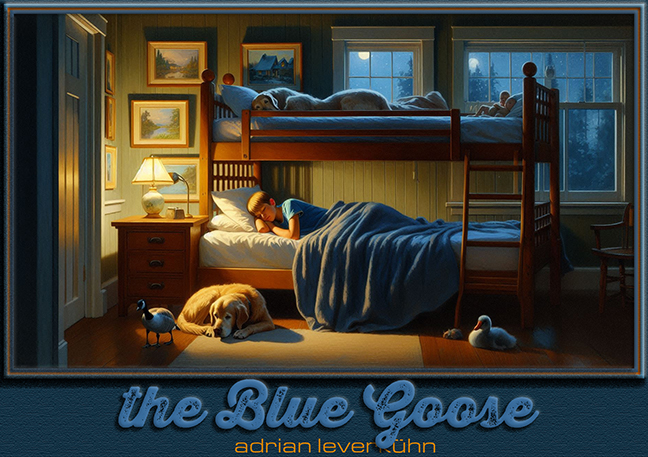
The boy shared a bedroom with his little brother; it was on the second floor of the house and right at the top of the stairs. There was a bunkbed in their room, too, which the boy hated – because he had the lower bunk and so couldn’t see out the window very well. Some nights, usually when he couldn’t sleep, he crawled up on the top bunk while his little brother slept and he would stare out the window at the moon or watch deer in the meadow above the house, anything to pass the night away. And some mornings his mom would find him asleep up there, curled up under a little blanket, usually with one foot dangling over the edge.
The family had a Golden Retriever, Daisy Jane, and even though she was getting kind of old, on most nights she slept with the boy, usually on his bed but down by his knees, except when it was hot out. Then she slept on the cool hardwood floor, because no one in Vermont had air conditioning. Their bedroom got pretty warm in the afternoon, and it stayed warm most of the night.
The boy had two sisters, both much older than he was. His dad had been married before so his sisters had a different mother, or something like that. His dad’s first wife had died when she was still young, but he’d gotten remarried a few years later, after he moved up to Vermont. Both his sisters were real smart, and one was going to graduate from Hanover High next spring.
Hannah was the smart one. She was his oldest sister, and everyone knew she was going to be a doctor – just like her mother. She always made the best grades in school and because she was cute she was really popular. Whenever his parents went out to eat Hannah was in charge, and because she was strict and ran a tight ship he really didn’t like her very much. Jennifer was his other sister, and she was a year younger than Hannah. While she was kind of cute, she was also smarter than Hannah, only in a different way. Their said she had “people smarts,” whatever that meant. She was doing well enough in school but she always seemed bored, yet she read all the time. She was also a jock, and played soccer and lacrosse on the varsity teams at Hanover High.
Ben was his little brother, and Ben was a first-class screw-up. He was always getting into trouble, and he was also a first-class day-dreamer. Ben wasn’t doing well in school, yet he was learning to play the piano – and the drums. He’d never been the outdoor type and rarely went outside to play after school – except in winter – but that was only because he liked to ski. He had a couple of posters taped to the ceiling over his bed in their bedroom; one of a skier jumping off a cliff in some place called Zermatt and another that had a girl with huge boobs advertising ski boots, the poster seductively proclaiming that Lange ski boots were Soft Inside. Presumably just like the girl. In fact, Ben had a thing for ski racing and for Switzerland, so when the leaves started turning in autumn Ben started talking about getting his skis ready for snow. He even went out for a run occasionally.
His mom, Elizabeth, was usually arguing with Hannah about chores not done around the house, except when she was arguing with their father. She was really pretty but always seemed to be mad. Real mad. At everyone, about anything and everything. Which made her perfect, he thought, for working in a library. The librarians in the school he was going to all seemed to be mad all the time, especially at anybody who dared utter a syllable in their library. His mom was just like that, only worse.
He didn’t understand what his dad did. It didn’t take long before he realized that almost no one understood his dad or what he did. He taught something called quantum mechanics, which was kind of like the stuff he had been reading about in science class this year, only ten times worse. Things like electricity and why things move the way they do. His dad was usually in the little study off the living room where he kept all his books and stuff, and maybe because the walls were lined with bookshelves his mom called that room a library too, even though it wasn’t really like the library where she worked.
The stuff in his science textbook was easy enough to understand, but most of the things he read about really didn’t interest him. He hated English but he really couldn’t stand history, so in the end math had turned out to be his favorite subject. He loved the certainly of numbers, and he found comfort in working out the answers to problems on the assignments his teacher sent home every night. He never missed a homework assignment, and usually made perfect scores on the tests he took in that class.
When he got home after school the first thing he did was get Daisy Jane and the two of them would head up the hill behind the house in search of grouse, but on some afternoons, usually in spring, they would go down to the river and swim. The water was usually too cold for him to stay in very long, but Daisy didn’t care. There were a couple of ponds up the hill behind the house, but the water up there didn’t look clear enough to go swimming in, though once again that didn’t seem to matter much to Daisy.
The boy’s name, as it happened, was Eldritch Henry Langston V, although everyone called him Hank. When his mother was really mad at him she would lower her voice into something like a feral growl then let slip his name in full, but other than that he was usually just plain ole Hank. Even so, that didn’t keep him from wondering why he was the fifth of anything. Like…with so many names in the world to chose from, why did people keep using the same ones over and over? Anyway, the whole name thing never made much sense to him, but especially when his mother got mad at him.
Was using his entire name supposed to make him fearful or something?
So…his dad was the fourth Eldritch Henry Langston, his granddad the third, and so that also meant he shared the same name with his great-grandfather and, somewhere back there, a great-great-grandfather, too. Anyway, as his father’s firstborn son, he got stuck with the name and there wasn’t much he could do about it – other than go with Hank – which he had – almost by default.
If Ben was into skiing, and if his sisters were into competing on the lacrosse field over at the high school, Hank’s thing was sailing. There weren’t any sailboats at the college, not even across the river at the Ledyard Boathouse – which of course belonged to the college – so he had to wait until summertime to get his time on the water. And he cherished those three months, almost as much as he cherished Daisy, which was saying a lot.
And he had fallen in love with sailing because he spent his summers at the Langston Boat Company, down in Melville, Rhode Island.
Which was where his grandfather’s boatyard was located. Which was where his father grew up.
And Melville was where his grandfather built sailboats. Big, beautiful sailboats. And also where his great-grandfather had built sailing ships. Big, beautiful sailing ships. Some said the prettiest, most seaworthy sailing ships ever built in America. And Melville, Rhode Island was where his great-great grandfather settled when he moved his family to America, back in the early 1800s. He’d been a Captain in the British Navy, as in Nelson’s Navy, but all that was before he became interested in more profitable ventures. Before Eldritch Henry Langston (the First) passed on to the big ocean in the sky, he owned a large shipping company, became a full partner in a trading house in London, and he as well became the part owner of boatbuilding venture in the New World. In Melville, as a matter of fact. By the time Hank the First hoisted his last mainsail, he owned a second shipping company, this one based in Boston, that took goods around the Horn to California, as well as a couple of Merchant Banks, so he left an immodest fortune in his wake.
And that immodest fortune had done little but grow over the intervening 150 or so years.
Which meant not a thing to the Langstons that followed. The shipping company prospered until it was bought out by a bigger shipping company, the Merchant Bank became a regular lending institutions, then a commercial bank, before it too was absorbed by a bigger bank in New York City. But the Langston Boat Company, still down there in Melville, Rhode Island, was still building boats. In fact, the Boat Company had made everything from PT boats to mine-sweepers during World War II, and at one point even manufactured wings for gliders used during the Normandy landings.
Yet because Eldritch Henry Langston IV had studied physics when he went to Annapolis, he had absolutely no interest in any of that. Not in the merchant lines, nor the banks, and certainly not in the Langston Boat Company, which he ignored in polite conversation almost as frequently as he ignored his father – when his father called to check on his grandchildren.
Yet to say their relations were strained was to miss the point.
Because there was no animosity. There were no long-standing grievances or simmering tensions.
The plain truth of the matter was that Hank’s father was somewhat absent-minded. It wasn’t that he didn’t care…it was rather that he didn’t remember such things – unless they related to little things no one could see.
Things like…remember that he had a father, or even a mother. He even had a sister, yet he hadn’t seen or spoken to her in years. If they had been physicists he might have, but that was simply not the case.
But Hank’s grandfather still went to work at the Langston Boat Company every morning, he still woke up at five thirty sharp and walked across the boatyard to begin the new day’s work. He was still building boats, usually sailboats but recently he had been building experimental hydrofoils that were powered by experimental power plants.
And no one called him Henry or even, heaven forbid, Eldritch. Instead, everyone called him Bud. Or, occasionally, just Sir. But usually Bud. And Bud loved three things about life, his life.
He loved his wife. He loved the boatyard. And he really, really loved his grandkids – but especially Hank. And he had five of them, too. But as much as he loved his grandkids, only one of them came down right after school let out and stayed with him the entire summer, and that was Hank.
Hank’s dad had no use for sailboats. It wasn’t that he disliked them, either. He just found them pointless, little more than toys for people with nothing better to do than waste their time on pointless toys. He had been sailing a couple of times when he was a kid, and he had to at Annapolis, yet sailing had always bored him. One time when he was a boy, the wind had piped up when his father had taken the family across Long Island Sound to Block Island, and he’d been so seasick he had vowed to never go sailing again. He had kept to that, too, whenever possible.
Hank, on the other hand, loved to go out when the weather was snotty. He loved to go out when the Sound was under a small craft advisory most of all. He found everything about bad weather exhilarating. Hank seemed, to his grandfather, anyway, to be absolutely fearless – but never reckless.
“There are two kinds of people who come to me to buy a boat,” Bud told Hank one afternoon while they were installing a thick stainless steel backing plate under a beefy Lighthouse 1501 Windlass. “The first will embrace the adventure, no matter the conditions. The second will succumb to his fears. That guy will be full of excuses, too, but his every excuse is just a way to hide that fear. Pretty soon, Hank, you realize that this second character is hiding his fears from himself. In a way, he’s a liar. The worst kind, too. There’s no one more pathetic than some simple S.O.B. who lies to himself. Please don’t forget that.”

Hank usually got up at 0530, right when Grandpa Bud got up. He had his very first cup of coffee when he was nine years old, too, when Bud fixed him a cup one morning. Turned out it was mostly cream and sugar – with a little coffee tossed-in to turn the cream kind of brown, but it was good and Hank was hooked. On Saturdays, Bud fixed pancakes and bacon, and on Sundays Grandma Ellen made waffles she served with huge bowls of fresh strawberries and thick, juicy wedges of pineapple. But not on weekdays. From Monday through Friday they got up and had their coffee, then they went to Building Number One, to the big room. Because that’s where the big boats were made.
And it was a strange room, too. Full of strange, magical things. As you stepped inside you found yourself in the small drafting room where Travers worked, but then you went through one more door and you were out onto the shop floor. Which was weird because you were walking around on a plywood floor that was at the same height as the waterline of the boats being worked on in the room. In other words, the real floor, the concrete floor, was almost ten feet beneath the plywood floor. The boats being built were propped up on that concrete floor, and the plywood floor was there so it was easier for the workmen to get around the boats.
Hank went around and helped clean up the job site before the crew arrived at 0800, and sometimes he helped Bud go over blueprints to make sure the workmen had the parts they would need that morning. In this very ordered way, Hank was learning boats from the inside out, the old fashioned way, like the sea captains and pilots of old, because such men learned how to build boats before they were allowed to sail them.
The real fun, the real magic of sailing with his grandfather, happened after four each afternoon, after all the workmen had gone home for the day.
Because that’s when Bud went down to the slips on the water and hopped on Pegasus, his own L-42, but every now and then they would take out a brand new boat. That way Hank got to sail a brand new boat before anyone else, which was like special. And Hank was good at it, too. His grandfather had taught him everything he needed to know over their summers together, so while Hank steered and trimmed the sails, Bud went all over the boat checking to see that everything was ship-shape. When they took out a new boat, Bud had something he called a punch-list on an old wooden clipboard by his side, and he might be inside the engine compartment one minute and in the galley the next, working the stove or making sure the fridge worked. It was one thing, he said, if everything worked in the shop, but something else entirely if stuff broke down once the boat was actually out there on the water. But that never happened on a Langston.
A boat’s new owners usually came down on weekends, and Bud always took them out for a long sail on the Bay before moving on to the next step; real sea trials with a surveyor, and that was just before then the final official acceptance in his office. Hank was allowed on those sea trials only if the new owners didn’t mind, but once they realized how good a sailor he was they didn’t seem to mind at all. Not one little bit.
Because…if a ten year old could sail their new boat, the new owner knew he or she most certainly could. And that was the truth of it, too. Langston boats were considered the best because the quality was that good. No shortcuts allowed, no inferior materials used – ever. Nothing but the best. It was common knowledge in the sailboat community that there was simply nothing better than a Langston, and Bud took great pride in that.
So Hank did too, and yet that was remarkable in its way – because this kind of pride in what your hands produced seemed to have been encoded into the boy’s understanding of the world around him. And Bud knew just how rare that was.
Before a new boat was officially turned over, the buyer had spent a few days at the yard while she was being built – first going over all the onboard systems then finally spending a few days out on the water with members of the delivery crew. By the time a new owner left on his sailboat, he or she knew everything necessary to operate and maintain their purchase, and by the time he was nine years old, Hank was a part of the crew getting everything onboard just right. He helped polish the chrome and the stainless steel, or sometimes – because he was still small – they’d send him down to adjust the stuffing box in the least accessible part of the engine compartment, right where the propeller shaft exited the hull. After a year of that, after he’d demonstrated both his understanding and his proficiency, Hank was sent to check on things like the engine’s alignment or the rudder shaft seals, both physically demanding tasks. And this was with a ten year old boy, which might’ve stunned new owners had not Bud been on hand to explain the situation. “Hank knows these boats inside and out, because he’s been doing this since he could walk.” And, Bud didn’t have to say, because Hank was just like his grandfather. The boy knew everything about these boats because he loved them. And anyone could see that the boy loved his grandfather at least that much.
His grandmother Ellen ran the front office and Hank usually spent a few hours a day up there with her, usually just helping out – and learning what the girls up there did, too – because Bud said they were the real brains of the outfit. The glue that held everyone and everything together. Hank knew all the girls up there, too. By name. And by the time he was ten he knew their husbands’ names, and their kids, too. Pretty soon he began to think of the women up there as his sisters, and it wasn’t long before he realized he cared for these people, all of the people working at the yard. He had no idea how unusual that relationship was, only that his grandfather felt that way, too.
The worst part of the year came when summer days started growing short, when sunsets came earlier and earlier in the day, but as was usually the case, his grandfather had taught him all about the movement of the sun across the sky, even the concepts of latitude and longitude and the plane of the ecliptic and how you used that knowledge in navigation. It seemed there wasn’t a thing his grandfather taught Hank that somehow didn’t relate to the way the world worked, and to his life.
On his last weekend at the yard that summer, the summer of his tenth year, they went out on Pegasus, and they went way out past Block Island towards Montauk and the Atlantic. Bud introduced him to celestial navigation out there, including how to use a sextant and how to reduce the sight they took using tables and formulas. He had Hank read chapters in a book Bud simply called Bowditch, and Bud sent his grandson home that labor day with his own practice sextant and a new copy of The American Practical Navigator, by Nathanial Bowditch. It turned out that this book was nothing short of an encyclopedia containing everything anyone might need to know concerning navigation and seamanship. Soon he found himself staying up at night reading his new book, then dreaming about all the places he might go one day with his very own sextant – on his very own Langston 42, of course.
+++++
His little brother, Ben, came alive when the leaves started turning, usually in the second week of October, and as soon as school let out for the day he’d go to Main Street and over to the Co-op, to start checking out all the new skis and ski boots. And then the daydreaming really took hold. Ben would get the latest Buyer’s Guide from Skiing Magazine and soon he had everything memorized. His mother, of course, lamented that the boy had no memory when it came to reading and writing, and she was sure Ben was a moron. Literally. Yet Ben could read and write all day long if he got to read about snow, or sliding around on snow – on five hundred dollar boards. In the end, Ben was easy to understand.
Of course, Hannah and Jennifer were playing lacrosse as the leaves turned, which left Hank blissfully free to go straight home after school and grab Daisy. They’d run out the house like they were breaking out of prison, then head up the hill in search of whatever or wherever their imagination took them. He loved their runs through the woods when the leaves turned almost as much as Daisy did, all the more so because this time of year wildlife was suddenly easier to spot. There were ponds up there, too, and they too were crowded this time of year. With deer and moose, usually, but elk too. And black bears. Some of the old-timers in town, the crotchety old men who wiled away their afternoons sitting in old rocking chairs at Dan & Whit’s, said they’d seen gray wolves recently, but few people took anything these old guys said seriously. Yet Hank did. He’d seen the tracks up there, where the mud was soft around the muddy edges of the less frequented watering holes, and he knew they’d been made by wolves because he had a book that described such things. They looked like a dogs footprint, only bigger. Much bigger. Daisy might not have been big enough to ward off a pack of wolves, but she could certainly hear well enough to give them fair warning. Anyway, he usually didn’t get too far away from the house because this far north it started getting dark early in the afternoon, at least until daylight savings time ended. After that it was dark by the time he got home from school and stayed that way all winter.
His sisters usually came in from practice sporting scabby knees and grass stains in the unlikeliest places, but they were jocks and he couldn’t relate to their nonsense. His mom would usually get in about the same time his sisters did, and she always started cooking as soon as she put her purse and coat away. Always. Like clockwork. He didn’t know it yet, but Hank’s mom was the glue holding the family together, and she seemed to take the job seriously. His dad was too forgetful, she told him once, too much the absent-minded professor to tend to things as inconsequential as children or running a household. Ben, on the other hand, would come in from school with piles of brochures about the latest skis and ski boots in hand, then he’d head up to their room only to re-emerge when their mom called everyone to dinner.
His dad was, usually, home for dinner, too, unless he was at his other job.
Funny thing about that, though…
No one, not even Hank’s mom, knew what that other job was.
Hank went with them one time to the little airport in Lebanon, New Hampshire, to a little parking lot across the airport from the tiny passenger terminal building. There were a bunch of little propellor airplanes out there, but pretty soon a small jet painted just like Air Force One landed and pulled up next to the fence; after the little jet’s door opened two men in blue and white Navy uniforms came out to help his dad get his bags onboard, then the jet left. Just like that. Sometimes his dad was gone a week or two, other times he didn’t come home for months, and that time he was gone for months.
He asked his grandfather about it once, but Bud just shook his head and shrugged. “Best not talk about all that stuff, Hank.”
“But do you know what he does, GrandPa?”
“I think it goes all the way back to Annapolis, when your father was first in the Navy. I’m not sure, but he made some kind of discovery when he was a student there, and I think it has something to do with submarines and all those missiles. But you listen to me, Hank, this is all top secret stuff, so don’t you ever go around talking about any of this.”
And so, that was that. Whatever it was his father did, that was a forbidden topic. Period.
And one afternoon just before Thanksgiving, just as he came in from school, he heard his parents in their room – and they were fighting. Again. And it had to do with another one of those top secret trips.
“How long will you be gone this time?” his mother shouted.
“I have no idea, Liz, but why are you pretending you care?”
“And just what do you mean by that?”
“Look, I know all about you and Carter. Everything. So don’t you dare try to deny it.”
Silence. And then…
Sounds of his father putting a few more things in a suitcase. Drawers opening and slamming shut. Walking to the bathroom, things being removed from the medicine cabinet. Those kinds of sounds, and none of it was pleasant.
Hank slipped past the door to his parent’s room and walked gingerly up the stairs, and he found Hannah, Jen, and Ben huddled on his bed with Daisy Jane, and they’d apparently been listening to the fight since they’d gotten home. He walked in and Daisy’s tail started thumping so he tip-toed over and sat on the floor right next to her, then he looked at Hannah. She looked at him, too, but then she shook her head. Which meant this was a bad one.
Their parents fought like this all the time, and the funny thing was they all knew it was their mother’s fault. She seemed to enjoy picking a fight with their father, too, but what was all this stuff about Carter Ash? Who was he, and what was going on?
And then…
“I’ve already contacted Tom,” his father was saying just now, his voice now noticeably more calm, “so I’d suggest you get yourself a lawyer. When I get back I’ll take a room at the Inn, but I’d think about moving on soon. I do seem to recall that your name is not on the title to this house, and I sincerely hope you do not try to contest this.”
And with that their father walked out of the house. A car was waiting for him in the driveway, a car with two men in Navy uniforms inside. When he walked out the front door the men sprang into action and grabbed his bags, and a moment later their father was gone.
Hannah waited a few minutes, she said to let the dust settle, then she walked quietly downstairs and into their parent’s bedroom. She did not come back up to them for quite some time.
+++++
It was the first time their father had been away for Thanksgiving, but to make matters even more interesting this Carter Ash was coming over. With his kids.
Turned out Carter was a science teacher at the high school in Woodstock, Vermont, and he’d been divorced for a while. He had three kids, and he got them for Thanksgiving one year, then Christmas the next, so this year was his kids’ Thanksgiving with Dad. They arrived in an old Saab hatchback and even though there was a little snow on the ground they were all, every last one of them, wearing Birkenstock sandals. With brightly colored rag-wool socks, too. And Carter’s nine year old son had the longest hair of the bunch; hair so long it hung almost to his waist. His father’s hair was not quite that long, but by that point Hank really didn’t care. He’d sized them up as they got out of that old Saab, and as he watched from the comfort of his room he didn’t like one thing he saw about them.
Except it turned out that Carter Ash was pretty cool. Laid back. He was from California, of course, and had ended up in Woodstock when he followed his girlfriend across the country to Hanover when she took a job working at the medical school. She’d soon fallen in love with another psychiatrist and that was that. Carter became the latest casualty in the gender wars, his kids just another scarred mess of collateral damage, yet nothing penetrated that cool, laid back California vibe he had going.
The boy with the long hair was called Huck, even though that wasn’t really his name. He was actually named Carter Stockton Ash, Jr., but he hadn’t taken to that name early on and now preferred Huck. As in Huckleberry, or Huck Finn, which fit him like a glove. Huck liked skiing so he was alright in Ben’s book, but when he found out that Hank was into sailing he went over and sat by him, then struck up a conversation.
“My dad says you spend summers down on the water, sailing with your grandfather.”
Hank wanted to ignore the long haired kid but there was something earnest about him, and about his question, so he chose to look Huck right in the eye and answer his questions as best he could. “Not quite. My grandfather builds boats in Rhode Island, and I go down there to help out.”
“Langston? Your grandfather owns Langston Boats?”
“That’s a fact.”
“That 28 footer…man, that’s the real unshelled nuts…the perfect boat. It’s my dream boat, I guess.”
“Really? You’re into sailing?”
“Yeah, I guess you could say that, but I haven’t been out sailing in years. Still, there’s just something about it, ya know…?”
Hank nodded. “I know. Why the 28?”
“It’s perfect, man. Not too big, not too small, nice galley, decent head, and the woodwork in the cabin is insane!”
“Insane?”
“It’s the best ever!”
Hank nodded. “I’ve been out on a few, but only on acceptance trials…”
“What’s that?”
“When a buyer comes down to check out the boat before he actually buys it. One or two of us always take them out for the day, help them learn where everything is.”
“You help with that?”
“Oh, sure. A couple of times a week, more in August.”
“And you’ve been out on a 28?”
“Tons of times. Maybe three last summer.” He could see the wanderlust in Huck’s eyes now, too. The same look all the buyers had when they first laid eyes on their new Langston. It was like an explosion of dreams, and it happened right in front of him, too. Bud showed him once and now it was obvious. Sailboats did something to people. They untamed the far horizon and let the imagination fly, made it seem like you could reach out and grab hold of a star and fly away forever. “I’ve got a brochure on the 28 up in my room. You wanna take a look?”
Huck was on his feet and heading towards the stairs before Hank could react, but he smiled inside when he saw the happiness in Huck’s eyes. The same happiness he’d seen in the eyes of the new buyers he’d been out with. The same happiness he’d seen in his grandfather’s eyes when he saw how infectious that kind of happiness really was. Making someone’s dreams come true wasn’t just an opportunity to make a few bucks, Bud had told him more than once, it was a grand privilege.
Hank had brochures for all the Langstons in a binder on his bookshelf, the 28, the 38, and the 42, and when Huck started flipping through the photo album behind the brochures the boy’s wanderlust kicked into overdrive.
“Did you take these pictures?” Huck asked.
Hank nodded. “Yeah, I take a couple on every sea trial. Bud takes a bunch, too.”
“Is Bud your grandfather?”
“Yup.”
“He sounds like a pretty righteous dude.”
That language took Hank by surprise, and he was suddenly annoyed enough to fall away from the moment. “He’s not a dude. Okay?”
“Sure. Yeah. I got it. Sorry.”
Hank relaxed – a little – then he looked at the kid and nodded. “We better get back downstairs. I think Mom’s carving the turkey.”
“Better her than my dad.”
Hank saw that the kid was grinning when he said that, and right then and there he decided that Huck was alright after all.

The week after Thanksgiving was always kind of a letdown, but this week seemed worse.
On top of the usual miseries at school, the kids in the family were dealing with the absence of their father, an acute pain heightened by feelings of uncertainty that just wouldn’t go away. And on top of it all, there was their mother’s less than forthright telling of her relationship with Carter Ash. If everything about their life as a family now felt precarious, Hank realized that right now it also felt unclean, steeped in lies, and he’d never felt that way about his life before. He intuitively knew big changes were coming, yet for now he was doing his best to sweep all that under the rug.
Hannah, however, seemed to be taking this separation harder than anyone else – so far, for while she had always been regarded as ‘the mature one,’ that role had taken on new urgency when she was least prepared to take it on. She couldn’t simply be mature now, because she was too scared, but first she needed to be honest with herself. That meant telling her sister and brothers the truth, whatever that truth may be, and wherever that truth took them. She was eighteen going on eighty, and the strain was telling because she couldn’t do it on her own.
Daisy Jane seemed the least effected among them but even Hank could see that she knew something wasn’t right. Elizabeth was coming home from work and no longer setting out to fix dinner; now she was carrying in boxes of pizza from EBAs, the pizza place behind the Co-op just off Main. She came in and dropped the boxes on the kitchen table then went straight to her room, then closed the door behind her. No signs needed.
But Hannah’s retreat didn’t make sense to Hank, because her reaction was so unexpected. Really, nothing made sense right now.
If his mother had been so unhappy in her marriage that she needed to find companionship elsewhere, now that she had someone why was she still so depressed? This little undigested bit of cognitive dissonance was of course just one piece of the shattered puzzle Hank was sorting through, but that was the one piece on the floor that Hank saw and understood. Nothing about his mother had made a whole lot of sense that Thanksgiving, but Carter Ash was more than just a huge question mark. He was quite obviously a very different man than his own father, but on an even more fundamental level Carter’s distinct California vibe was seriously at odds with her own strait-laced New England upbringing. She was also used to the conveniences of wealth and privilege, of being around families with a real New England pedigree, so once again Carter Ash was the antithesis of that.
‘Is that what she’s attracted to?’ he wondered as he and Daisy Jane made their way up the hill behind their house. A man who represented a clean break with everything about her past?
But, if so…why? What was so bad about her life?
And then there was school to deal with. The usual post-prandial gluttony of Thanksgiving had given way to the academic doldrums that arrived between Thanksgiving and Christmas, a span of three weeks between vacations that somehow felt as pointless as it did cruel. Anything taught in this span would soon be forgotten, and even his teachers looked distracted as they tried to plow aimlessly through their lesson plans. Everyone’s thoughts were quite naturally focused on Christmas this time of year, and to pretend otherwise was pointless. About the only thing on the calendar that made any sense at all was a dance for fifth and sixth graders, and Hank was pretty sure he wanted nothing to do with anything that involved being around girls.
The trail up here on the hillside was clear of undergrowth now and Daisy ran ahead every now and then, usually chasing grouse, but soon they came to one of the larger ponds up there and he was surprised to see several geese paddling around out there on the water, their heads bobbing under the surface in search of the delicate morsels they craved, usually hiding under logs in those dark, scummy waters. He stepped out into the clearing on the east side of the pond and saw Daisy on point, her head down, her right hand pulled up close to her chest, her tail ram-rod straight and parallel to the earth beneath her low-slung belly, and Hank’s eyes naturally enough followed her point.
To a small gosling on solid ground by the edge of the pond, watching his family out there on the water.
And this little goose was as blue as the waters out past Block Island, out there in the deep waters of the Atlantic, and Hank had never seen anything like this little thing. It was the color of a blue jay, kind of cobalt blue on top and gray closer to the ground, and even it’s beak was bright, shiny blue. It’s eyes were following one group of geese out there on the water and Hank could see that the little thing was anxiously attending their every move.
Yet he soon realized that the little blue gosling was being ostracized, so did that mean it had been abandoned? He watched Daisy watching the gosling, but when he watched the gosling’s family swim away the little thing extended one wing and stepped tentatively towards the water, and just then Hank could see that it’s left wing was broken. And now Daisy had lowered her body very close to the earth and she was advancing slowly towards the gosling.
She was going to stalk the little goose, and that meant she planned on attacking it.
So Hank broke cover and advanced towards them. “Daisy! Come!”
Daisy turned and looked at him, her feelings of betrayal clear in the surprised expression on her face, but the imperative in his voice was not something she ever betrayed so she stood and trotted over to his side. He watched her as she came, then knelt to greet her. “Daisy is my good girl,” he repeated softly until she was tucked close to his side. He reached inside his coat and found a treat and gave it to her, then he turned his attention to the little blue goose again.
It was staring at him. Head held high, body low to the earth, obviously aware of this new threat to its existence.
Hank looked at the other geese out there on the water and they were all now swimming away from the little blue gosling as fast as their little flippers could carry them, and now the situation was abundantly clear. The gosling wouldn’t survive the night up here by itself. If the cold didn’t kill it, then coyotes or a fox would surely do it in.
So Hank followed the language of his heart, the only language he knew.
He advanced slowly towards the gosling, with Daisy still by his side, and the poor creature slowly lowered it’s head to the grass and the leaves, trying to make itself small and inconspicuous, and Hank could only imagine what it must have felt.
Yet the gosling did not try to flee. It’s head moved only fractionally as Hank approached, it’s tiny black eyes following both the boy and his dog as they came close. Then Hank knelt down close to the gosling, and he reached out to stroke it’s head.
The gosling watched, clearly terrified.
But it did not recoil too much from his hand, nor did it try to defend itself, perhaps because nature had equipped this little creature with just enough understanding to read hope into the moment. The hope of an outstretched hand, crossing the primal barriers of instinct and survival.
Hank stroked the top of her head as he spoke the quiet, reassuring words the moment required.“It’s okay, little fella. Are you all alone?”
The gosling’s eyes followed his hand; at first it’s head flinched from the unfamiliar touch but soon it seemed to relax as Hank kept speaking soft words of reassurance.
He bent closer, saw the broken bones and bloody feathers along the leading edge of the gosling’s left wing and nodded as he sighed, before he turned and looked at Daisy Jane. “Daisy, we’re going to have to take her down to River Road,” he said, speaking the only two words that incited rebellious fright in Daisy’s heart. River Road was where the vet’s clinic was, and no good ever came from a visit to the old lady lurking about in that smelly place.
Hank stood and took off his jacket, glad he had worn a sweater today, then he knelt beside the gosling and scooped her up inside his jacket. Still it did not struggle. Was it in shock? Was it too terrified to even put up a fight?
“Come on, Daisy. We need to get a move on,” he said as he took off down the hill at a steady jog. It took almost an hour to get to the clinic and the doctor was getting ready to close down her office for the day when he came huffing and puffing up to the front door. It didn’t take more than a moment for the old lady to size up the situation, but what interested her most was the gosling’s cobalt coloration.
She was a kind-hearted person, had grown up in town and only left to go to college and veterinary school at Cornell, in New York, and yet she had returned and taken over a marginally profitable clinic as soon as she graduated. She was also not in it for the money, so had no qualms at all as she took the gosling from the boy’s coat and set about examining the creature’s injuries.
“I’ll have to keep her overnight,” she finally said, “but what are you going to do with her?”
“What do you mean?”
“Well, single geese don’t normally do very well in captivity without professional care. They need their families as much as you and I do, and that could be a problem. There aren’t many people taking care of geese these days…”
“I can learn, can’t I?”
She hesitated to answer that one. “You could,” she began, but then something stopped her. “Do your parents know about this?”
He shook his head. “We just found her, up on the hill above the Porter’s place.”
“Maybe you’d better talk to your parents about all this before committing to taking care of her. You’ll be taking on a lot of new responsibilities, and some new expenses, too.”
“How much?”
“Well, there’s specialized food and she’ll need a safe place to recuperate…to get well while her wing is on the mend. Do you have anyplace like that?”
His mind raced, but then there was the crawl-space under the dormer right beside the bunkbeds in his room, so he told her.
“That might work…if you can keep it warm in there. And you’ll need to make sure there’s a little light, too. But dim light, not bright. I tell you what…when you come to pick her up tomorrow you bring your mom and dad and we’ll talk about it.”
He looked down, then turned away.
“Hank? What’s wrong?”
So he told her about his parents, and about Carter Ash, and about all the other uncertainties swirling through their lives right now. And she listened, thinking all the while. She knew his parents and she knew Daisy, and she’d always thought this family solid and stable. But not now. Now this was a family in crisis, flying through unexpected turbulence. Yet something like this little goose could really help Hank get through this, too…
“Okay, Hank. But you’re going to have to talk to your mother tonight.” She paused, then nodded as another thought came to her. “Tellya what. I’ll drive you home right now, and maybe we can talk to your mom together. And you know what? If anyone can, I bet you and I can talk her into it…”
But when they got back to the Langston house, Elizabeth was locked away in her room and wouldn’t come out. There was nothing cooking in the kitchen, and no boxes of pizza on the table. Hannah looked confused, Jennifer distraught. Ben was up on his bunk, staring out the window.
This wasn’t a family in crisis, Dr Emily Stone told herself. This family was melting down – in real time.
“Where’s your father?” Emily asked Hannah.
“No one knows,” Hannah responded listlessly.
“It’s some kind of top secret thing,” Hank added. “With the Navy.”
“Is there anyone we can call? Some other family member who could come and give us a hand?”
Hank nodded and went to the phone, and once he looked up the area code for Rhode Island he called his grandfather.
+++++
They both came, of course. Both Bud and Ellen. This was family, after all, and his son’s family at that. Hank had explained everything, too. From the fights to Thanksgiving with Carter Ash to the blue gosling up at the pond, which helped explain that surprisingly incongruous update from the family’s veterinarian, too. Bud had advised Ben Rhodes, his shop foreman, what was going on and where he’d be while Ellen packed their suitcases, then they’d set out across Connecticut to Hartford, and there turned north on Interstate 91, bound for the Hanover, New Hampshire exit, and they arrived a little before ten that night.
Emily Stone had by then taken the kids across to Hanover for something to eat, so she stayed with them until Bud and Ellen Langston arrived.
But Elizabeth still refused to open the door to her bedroom.
And Bud wasn’t having any of that.
“Do you happen to know a psychiatrist around here?” he asked Emily.
“Well, not to put too fine a point on things, but my wife is.”
Bud nodded. “Think you could give her a call?”
“I already have. She’s on her way over.”
“Thank you.”
Emily and Bud turned to Hannah. “How are you doing?” he asked.
“Oh, I’m fine.”
One look told him all he needed to know about her. She was far from fine. In fact, this evening was too much for her and she was coming undone at the seams; one sidelong glance from Ellen was all the confirmation of that assessment he needed. “Well then, why don’t you take Jennifer upstairs. I think the two of you should try and get some sleep. Tomorrow might be a busy day.”
And once the girls were gone he turned to Hank. “Think you can stay up a few more hours, son?”
“Yessir.”
“Okay. Ellen? Think you could rustle us up some coffee?”
When Dr Stone’s wife Judy arrived, and after introductions were made, they once again tried to get Elizabeth to open the door. But now there was no response at all from inside the room.
And at that point Judy Stone threw herself against the bedroom door, and after it fell away she ran in the room. Hank’s mother was in the bathtub, and her wrists had been slashed. Blood was no longer flowing into the water, and Elizabeth’s eyes was cold and still. Judy palpated Elizabeth’s neck, feeling for a pulse, then she turned to Emily. “Call 911,” she said calmly. “Mr Langston, help me get her out of the water. I want to start CPR now, so Ellen, would you take Hank away for a while?”
“I want to stay,” Hank replied.
Judy looked at the boy and nodded.
They laid her on the cool tile floor while Emily called the paramedics, and Hank looked up, terrified, while this stranger started chest compressions and rescue breathing, then satisfied he’d seen enough he went out to sit with his grandmother. When the ambulance arrived he helped guide them to his mother’s room, then went back to the kitchen to nurse his coffee-milk by the cast iron wood-burning stove in the corner by the mudroom.
His grandfather rode in the ambulance to Dartmouth-Hitchcock Medical Center, leaving the kids with their grandmother and Emily Stone. Hank sat by the fire, every now and then putting a fresh log in the firebox, waiting. Always waiting.
“Hank, let’s you and me go check on your brother,” Emily said, and he led her upstairs to their room. Ben was still sitting up in bed, looking out the dormer window at the moon coming up over the river, and at the college’s bell tower, a near duplicate of Independence Hall in Philadelphia. Ben did that when he zoned out, often staring away into nothingness for hours and hours, and when Dr Stone asked how he was doing Ben just shrugged away the question.
“How should I feel?” he finally asked.
And without hesitating Dr Stone answered: “Scare, lonely, confused.”
“That’s about right,” Ben sighed, just before he turned and buried his face in his pillow. When Emily saw the boy was crying she climbed up on his bunk and laid down next to him, stroking his hair while she cooed the music of gentle reassurance in his ears.
Hank closed the door and went to check on Hannah, but she was either asleep or playing possum so he went to Jennifer’s room instead. She was sitting at her desk with Ben’s headphones on, listening to music while reading another one of those books by C.S.Lewis she seemed to be infatuated with these days.
“What are you reading now?” he asked as he came in and sat on the edge of her bed.
“‘Out of The Silent Planet. You’d love it, too. A professor is kidnapped and taken to Mars.”
“By Martians?”
“Yes, Henry.”
“Why do you call me that?”
“Because it annoys you.”
He nodded and got up to leave.
“Don’t go, Hank. Not yet, okay?”
“Okay, but could I ask you a question?”
“Sure?”
“Do you believe it’s your mission in life to tear me down when you think no one is looking?”
“No, of course not.”
“Then…would you please stop trying?”
She put her book down and looked over at him. “Is that what you think?”
He nodded. “Yeah. And you know what? Carter’s son asked me pretty much the same thing, so it isn’t just me.”
Jennifer turned away and shook her head for a moment. “I guess I never thought about it much, Hank, but I’m sorry you…no, I’m sorry if I’ve been doing that.”
“Okay. Apology accepted.”
“Okay.”
“Now, how’re you feeling?”
“Me? I’m mad, Hank. Mad and angry. Mad at Dad for not being here, mad at Mom for not taking better care of herself, and I’m even mad at that Carter Ash…”
“Why him?”
“Oh, I’ve been trying to understand that, but I think maybe he’s been taking advantage of her.”
Hank nodded. “Yeah, maybe, but what if it’s the other way around?”
“Then I’ll be really, really mad at Mom. Is she still asleep?”
And then he realized she probably had no idea what had happened. Sitting up here inside her own little cocoon, plugged into her music and the ambient comfort of another book, how could she…?
“No, she’s not here right now, Jenn.”
“What? Where is she?”
“She went to the hospital with Grandpa Bud.”
He now had her full attention. “What?”
“Jenn, she tried to kill herself.”
“What?” she cried. Tears started flowing and she turned pale as a ghost.
He nodded. “She hurt herself bad, Jenn. Real bad, with a knife.”
Jennifer nodded. “She’s trying to hurt Dad again. She’s always trying to hurt him.”
That thought had never occurred to him before, and the idea hit like an epiphany. “Why? Why do you think that?”
“Because she’s never been able to control him any other way.”
And that hit like thunder right above the house.
She saw his confusion, too. “Hank, I think she learned all that when she was a kid, and I think maybe that’s why she married Dad, too. He was always way too smart for her, too smart to control, so in a way she set herself up to fail. The only problem with that is that her failures always rub off on us.”
“Because of Dad?”
“Yup. Because I think he got tired of her games a long time ago.”
“I know she’s not your mother and all, but you really don’t like her, do you?”
“Me? Well, no, Hank, I despise her. I think she’s evil, and she probably always has been.”
“Evil?”
“I’m sorry, but yes, that’s how I feel.”
“You know, one of my first good memories is watching those Narnia movies with you. You’ve always reminded me of Lucy. The wise and courageous sister.”
Jenn stood and came to him, then she sat beside him on her bed and put her arm around him. “I’m really sorry if I’ve hurt you. I’ll try to do better, Hank. Okay?”
“Yeah, okay. I’d like that.”
She nodded. “Me too.”
+++++
His mother was checked in to the ‘mental facilities’ at DHMC, and Judy Stone became her therapist – which in the end was probably the best thing that could have happened to Elizabeth Langston, given current circumstances. And when Hank thought about it, which he often did, it all came back to that afternoon walk on the hill above Norwich, and so, in the end, to Gertrude.
Which was what he had named his little blue goose. Gertrude, after the goose in the old Journey to the Center of the Earth movie, the good one with James Mason and Arlene Dahl. Gertrude came home from Dr Stone’s clinic in dire straits; barely able to take care of herself and in a lot of pain. But that didn’t matter, not to her, and pretty soon not to any of the kids in the Langston house. Just like they needed their mom to get better, they wanted to help this little gosling.
But the deeper problem was simple enough to understand.
There wasn’t much the kids to do to help their mother as she was still in the hospital, yet there was no end to the things they could do for Gertrude. Hank and Grandpa Bud built her a nesting box and they put it near one of the baseboard heaters. Grandma Ellen got all the food and other things that Doc Stone recommended, and together everyone simply pitched in and helped take care of Gertrude. She had a plastic graft holding her wing together as it healed, and yet within a week Gertrude was up and around, following Hank all around the house when he got in from school.
Bud commuted to and from the boatyard for those three weeks, until school let out for Christmas, when Bud came up in his old Chevy Blazer with Ben Rhodes, his foreman. Rhodes came up in a the company Suburban, and together they hauled the family down to the boatyard for the holidays. And, of course, as Gertrude was now a part of the family so she came, too. When Hank walked around the boatyard Gertrude ambled along right behind him, waddling along gracefully while trying not to hurt her damaged wing. Daisy had become her protector, too. Now they were inseparable.
Five days before Christmas Bud and Ellen put on their annual Christmas party in the main building, and as usual he personally handed out Christmas bonus checks to each employee. What was new this year was the presence of Bud’s grandkids from Vermont, and as word about their circumstances spread everyone went out of their way to make the kids feel at home. Of course, Hank was already at home – because he’d felt that way about the boatyard for years – yet in his way he was beginning to feel a sense of pride about not just the products turned out here, but about the team that made all this magic possible. None of this would have been possible without his grandfather’s dedication, too. Not simply to his boats, but to his employees, as well.
One of the things Hank loved most about the boatyard had little to do with the boats being built in all the various sheds and buildings. No, the thing he loved most was his grandparent’s house, an early 19th century red brick colonial that had been built by Eldritch Henry Langston, Sr. when he first arrived from England. The house was, even for it’s time, quite large, with a half dozen bedrooms on the second floor and a huge library off the living room that even had its own fireplace. And that library was Hank’s favorite place in the whole world. Bud’s, too.

And it was because one day Grandpa Bud had taken him to an almost hidden little alcove off the main library, where all the logbooks kept by the various Langstons over the last two hundred years were kept. Sea captains all, as ship’s masters each had not simply maintained their vessels’ logbooks, they held onto them, passed them on, for they contained priceless knowledge. And, as Hank soon discovered, once you understood the language of the sea, each entry read like the best mystery novel ever written.
Yet Bud had slowly been leading Hank to this discovery, one step at a time. Molding and shaping the boy’s outlook and expectations of his place in their world, so much so that the secret alcove in the library was nothing so much as it was the gateway to the one enduring mystery that bound all the Langstons together. That mystery was, of course, hidden within the many moods of the sea, and those many moods were detailed in all these logbooks.
Two summers before, Bud had taken Hank to the alcove in the old library for the first time, and that day he had shown his grandson the way to delve into these mysteries, if he indeed wanted to do so. “You never know what you’ll discover hidden away in here,” Bud said, his eyes twinkling with pure mischief. “Tales of your great-great grandfather sailing from Newcastle or Hull across the English Channel to France one year, but then to West Africa and on to India the next. The adventures are endless, but Hank, they’re not make believe. Everything you read in those pages really happened.”
Bud pulled one logbook from a shelf and handed it to Hank, then left him alone after dinner one August night, left him to read about a series of impossible voyages from Boston to Polynesia and then on to the Japans. When he found his grandson still reading at five the next morning, he knew the circle had been closed. He knew the family’s sacred journey was now in good hands, and that he was but one link in a chain of events stretching back in time as far as memory dared reach. Because of Hank, that chain would continue to grow into the future, and now that he knew his time would soon be at an end, there was nothing more important than this boy – and his dreams.
+++++
One of the things that the Langston kids most enjoyed about their grandparent’s house at the boatyard was the sheer number of bedrooms on the second floor – with six there was one for each of them, with more to spare. And because there were two more bedrooms on the first floor, crowding was never an issue. And having a bathroom all his own was nothing short of bliss to Hank. Having grown up sharing one bathroom with Ben and his two sisters meant that mornings in there soon turned into chaos, with his sisters just manipulative enough to monopolize the tiny room all morning.
Which Hank circumvented by waking up an hour before the girls. Ben had proven to never be an issue because he was a sackrat who had to be dragged forcibly from bed simply to make sure he got to school on time. The downside, of course, was that being first in the shower meant he had to deal with cooler water temperatures, but that hardly mattered. Sharing that time with either of his sisters, on the other hand, meant sharing their dreadful early morning odors while he was trapped inside the steaming shower stall, which left him feeling less clean than he had before he got in the shower. So having his own bathroom was Hank’s idea of heaven.
And unlike Ben, he was fastidious, and so more like his own father – a real creature of habit. He unpacked his things and put everything away neatly in drawers, while Ben left his things crumbled up in a duffel bag stuffed under his bed. Hank brushed his teeth twice a day; Ben forget his toothbrush. Hank changed his socks and underwear daily, and he refused to talk about how infrequently his little brother changed those things. At home, he tried to keep their shared bedroom picked up and habitable, but that was often simply not possible. Ben was a slob, and like all slobs he was a procrastinator. Any homework assignment, like all Ben’s daily chores, could be put off ’til tomorrow, and no matter how many times Hank told him to get his act together his little brother just shrugged and walked away. Being a lazy slob was apparently Ben’s destiny, and Hank was fast learning that there were some things you could change, and some you couldn’t. Destiny was, apparently, one of those things you couldn’t.
But now that Gertrude was a part of his life, combatting Ben’s sloth had taken on a new sense of urgency. She couldn’t waddle over the usual piles of dirty clothes discarded on their floor, and yet because of these piles they were soon both discovering the joy of stepping in goose shit – with their bare feet – at three in the morning. But here at his grandparent’s house, Gertrude was enjoying the simple art of cleanliness, and she soon was getting in the habit of doing her business in a cat’s litter box, too. She could not yet navigate the stairs on her own and relied on Hank for that, but beyond that minor inconvenience the little blue goose followed her savior anywhere and everywhere.
Though Hank had just turned eleven years old he was sprouting up almost uncontrollably, and that Christmas he broke into the six feet tall range. He was, in fact, almost a foot taller than Ben and already four inches taller than either his father or grandfather, yet Ben weighed almost as much as he did – and Ben was far from being overweight. Hank was skinny, the awkward kind of skinny with a prominent Adam’s apple and floppy, almost gangly legs, and if his sisters and Ben were jocks, Hank was their polar opposite. He cared not at all for football or soccer or lacrosse and though he tolerated the family’s trips to the local slopes at the Dartmouth Skiway, he usually just managed to get down the hill without face-planting, whereas Ben streaked down like a heat-seeking missile.
And this year, as Ben was in the Ford Sayre junior racing program, he had decided to go out for the ski jumping team. One look at those daunting ramps was all it took to send Hank into shock, and the thought of his kid brother flying off one of those things left him feeling unsure of his footing. Ben, meanwhile, could hardly wait for on the hill training to begin.
One of Hank’s biggest concerns right now was the weird looking hair sprouting on his upper lip; this was secondary, of course, to his biggest concern, the painfully large red zits smoldering on his upper back and forehead. He had one on his back just after school started that was the size of supertanker, and when Hannah popped it he had screamed so loudly that Daisy ran from the room. And Hannah, apparently, loved to pop zits so much that he refused to take his shirt off around her.
He had snuck into his parent’s bathroom before they loaded up to come to the boatyard for Christmas, and he had taken one of those disposable razors his father used to shave in the shower. Now, in the splendid privacy of his own bathroom, he pulled the thing out and looked at his reflection in the mirror over the ancient pedestal sink as he tried to figure out how to use it. There were no instructions on the plastic packaging so all he had to go on were the glitzy ads he’d seen on TV – which were, he soon realized, next to useless. He put some soap on his face and lathered it up a little, then took the little plastic protector off – and then, for the first time, his eyes behold the blades. Two slivers of shiny steel that seemed purpose-made to slit a throat, or a mother’s wrists, and he stared at those two blades for the longest time – before he carefully put the cap back in place and rinsed the soap off his face. After a half hour of internal deliberations got him nowhere, he decided his next best course of action was clear. He needed to ask his grandfather.
And while Bud made their early morning coffee, Hank asked him about shaving and Bud came over and examined the peach fuzz on his grandson’s upper lip and nodded. “Yessir, I reckon it’s time,” he managed to say while doing his best not to smile, then he whipped up some pancakes and sausage links before they went upstairs to tackle the razor issue. With that chore out of the way, it was time for everyone to run to the Christmas tree lot and pick out the family’s tree, which Bud and Ellen usually did on Christmas Eve, and almost always late that afternoon, setting the tree up right before dinner. Of course Ellen had already been to the lot and had already picked out a tree – just in case – yet when the grandkids were there the final decision was always made by the group.
Once the tree was loaded on the white fiberglass top of Bud’s ancient Chevy Blazer, they all went back to the house and unloaded the tree, then began the hours long tradition of grooming the tree with endless strings of lights and dozens of old glass ornaments, until every branch was drooping under the tremulous weight of all those expectations. Christmas morning, of course, could not come soon enough…
Which in no way had stopped Grandma Ellen from preparing a feast to end all feasts, the gathering held before anyone dared head off to bed. Though she had in years past roasted a goose, under the circumstances she held off that year and made do with a huge slab of beef, which she roasted with Yorkshire pudding, creamed spinach and cranberry relish, as well as a dish of cheesy potatoes. This rounded out their Christmas eve, and after dinner Ben and the girls went upstairs. Bud and Hank took Daisy and Gertrude out for a long walk, the boy trying to orient himself to the night sky overhead while his grandfather pointed out the different navigation stars found in winter’s sky. “Follow the arc to Arcturus,” he admonished, followed by: “And remember? You drive the spike to Spica.”
“Yessir.”
“Are you going to the library tonight?”
“May I?”
“Of course, that’s what it’s there for, son.”
And so after Daisy and Gertrude had done their business, Hank disappeared within the secret alcove beyond that hidden corner of the library. He found the logbook he had started reading last August and noted that his place mark was still where he’d left it, then he went to the big overstuffed easy chair by the window and sat down. Instead of turning on lamp on the table beside the chair, he turned and watched the moon rising over the eastern horizon, marveling once again at the illusion of size the orb displayed as it rose through the trees, once again breaking free of the earth and dashing into the clear sky above. Once upon a time he might have kept an eye peeled for Santa and his reindeer, but not tonight. No, tonight he wanted to continue the journey had had started last summer, on his great-grandfather’s second trip across the Pacific.
But as he opened the logbook he almost immediately felt something different about the night. Not about the book, but something about the room and the lingering blue light flooding through the huge window and into library. Was it the moon – as the silent orb vaulted into the night sky? No, not really, because he felt it everywhere he looked, yet when he thought about it he had no name for what he thought it was he was feeling. In a way, it felt most like halloween, like spirits were lurking about, maybe the spirits of his ancestors…but no, he was getting carried away with himself, wasn’t he…?
He tried to shake off the feeling so decided the best way to do that was to turn on the reading lamp, and he looked around the library once again…just to make sure he really was alone…
This was Eldritch Henry Langston, Jr’s. third trip on Pegasus, but it was his first around Cape Horn as the ship’s master, and as Hank read through the entries the flow of the voyage began to take shape in his mind. Leaving Boston in April, heading east towards Bermuda but turning south well before they ran into the British warships usually on patrol around the island. They put in for water and provisions somewhere along the coast of modern day Brazil, then again as they grew near to the Cape. They passed a small flotilla of whalers once, the four ships heading back to New England without escort, and he wished them well after they passed along their own observations of rounding the Horn. They had lost two ships just a few miles off the rocks, with all hands lost. Including several women and children, Captain Langston recorded near the end of his first logbook of this voyage.
The second volume picked up where the first ended, approaching the Cape.
The weather encountered by Pegasus over the next three weeks was, according to Henry, ferocious, and Hank could see the anxiety in his great-grandfather’s handwritten entries. There was evidence of dread in the tremulous script, and Hank recognized this anxiety as evidence of something new that Henry either had encountered, or was about to. Raging gales, mountainous seas, the constant moaning sounds the wind made as it passed through the rigging, all these things weren’t simply facts to be recorded on the page, they were the “something new” that Henry was dealing with as a new captain. Then Pegasus experienced not one incident of St Elmo’s fire, but three, and in just as Pegasus rounded the Cape. A few of the older hands onboard took this a good omen, signs that the weather would soon improve, while the usual malcontents grew wide-eyed with fright. These poor souls noted that these appearances of Witch’s fire, as they called them, foretold that they were all doomed to sickness and death, and soon.
Yet in one entry the weather cleared, the sun came out, and a lookout spotted survivors from one of the whalers adrift on slabs of wood and sailcloth. Once they had been taken onboard Henry wrote of all the various superstitions once again, but as always he was a scientist so hardly seemed able to countenance supernatural explanations.
Yet Henry took note of the effect these superstitious had on morale, and he did his best to record them in these pages. He also recorded in some detail the conditions when ‘the fire’ appeared, including the temperature and barometric readings around the time of each event, but he had little else to say about the matter beyond a few choice, oblique references to the bad omen chatter. Nearing the latitude of Valparaiso he began to worry about the ship’s water supply so put-in to load barrels of fresh water, and to once again replenish the ship’s stores before setting out towards Polynesia and the Line Islands. The survivors opted to disembark and settle in the town.
The last entry in this volume had described Pegasus’s landfall in the Gilbert Islands, on an atoll the locals called Te Rawa, and there was an American ship at anchor in the lagoon when Pegasus arrived and dropped anchor. When Henry met with Captain Phillip Anders, the captain of the Bunker Hill, he learned that Thomas Gilbert of the East India Company had named the islets around the lagoon Tarawa, and that the U.S. Exploring Expedition had officially recognized that name not quite twenty years before, back in 1841. The two captains went over the available charts they had of the region, and Henry sketched out a reasonably detailed rendering of the Tarawa atoll, as well as the enclosed lagoon. Pegasus was anchored in Charlotte Harbor, as a matter of record that Henry duly noted in his last entry…
And there Hank closed the logbook. He looked over the vast expanse of the night beyond the windows and could almost hear the wind in the rigging, and feel Henry’s anxiety when two barrels of water had turned up black. A man of the Enlightenment, he had no tolerance for the superstitious among his crew, and his intolerance of willful ignorance was often brutal, but in these pages everything was explained in muted detail, leaving Hank to read between the lines every now and then. Yet the boy felt lost as he paged through the entries, often feeling like he was lost in time. Like he was there beside his grandfather on Pegasus, pacing the deck behind the helmsman or sounding the hull with the ship’s carpenter after taking a series of brutal waves after Pegasus rounded the Horn.
He drifted along for a few minutes then placed the book back on the shelf where it belonged. It was now four in the morning and he was exhausted. Daisy was asleep on the floor, Gertrude was sitting attentively by Daisy’s side, as usual watching every move Hank made, but when Hank stood so did Daisy, and the little blue goose seemed to sigh as she stood too, waiting for Hank to pick her up. They made their way up the stairs and soon all were fast asleep, perhaps not to dream of sugarplum fairies that night, but to linger on the sea for just a little longer, perhaps until dawn and the changing of the watch.
It wasn’t long before he heard Ben up and about, running down the stairs to check out his haul under the Christmas tree. Several woo-hoos followed, then Hannah was out her door and galloping down the stairs. Jennifer, dear jaded Jennifer, met him in the hallway outside her bedroom and shook her head when they heard Hannah’s squealing delight.
“Well,” she sighed, “we might as well get this over with…”
Ellen had been acutely aware that without either of their parents on hand, this was to be a Christmas filled with uncertainty, even fear. And, possibly, even a little acting out. Yet Ellen knew of no better way to push aside such feelings than two bury them under waves of wretched excess, and this she was well prepared to do. She had flooded the floor around the regal pine with dozens of boxes of gifts, some more consequential than others, but no one would go without this year.
With one exception.
Ben found two new pairs of skis under the tree, one for downhill racing and the second for ski jumping, both purchased on the advice of his coaches in the Ford Sayre program. Hannah and Jennifer each received new laptop computers, the latest Apple MacBooks, yet oddly enough there were no presents under the tree for Hank. Not even one.
And yet Bud saw no trace of disappointment in his grandson. He saw nothing less than the simple joy of the moment, his brother and sisters receiving their presents, each running over to Ellen or Bud and then enjoying a big Christmas hug. That was the way of a generous soul, he knew, and it was this one simple truth that had evaded his own son. Yet here it was again, a minor – if unexpected – miracle. So he sat back and watched Hank as he handed out presents to all his family, until even Hannah and Ben realized that, so far, anyway, there had not been a single present for their brother.
“What about Hank?” Ben asked.
And of course Hannah’s lower lip jutted malignantly, now that she was aware of the injustice.
Yet Jennifer? Oh, she had noticed immediately and even now the sense of anticipation was spreading across her face like a wildfire.
Yet Bud was in no hurry.
In fact, as soon as all their presents had been passed around and admired, Hank found one last gift and gave it to Grandma Ellen. It was a picture Hank had taken of the family in happier times, last winter in fact, when his family had spent a long weekend at the von Trapp Family Lodge, over in Stowe, Vermont. And yet not one of his siblings knew Hank had taken the picture, let alone had it enlarged and framed, so of course everyone gathered around and looked. Even Jennifer.
And within that interplay of light and shadow captured on a single piece of paper, the absence of the children’s parents finally hit home, and while the children tried to reconcile their feelings within the moment, Ellen and Bud reeled under the weight of their own son’s various abdications. Duty was one thing, Ellen thought, but his children needed him – now more than ever, while Elizabeth’s dalliances with this Carter Ash were beyond the pale. Her bringing this stranger and his family into their home at Thanksgiving had been unforgivable, and Ellen was still furious about it. Yet where was their father – her son – during all this? Off on another submarine somewhere? Testing another missile, perhaps? Who knew what he was doing, but that had soon become her greatest concern. He should have been here, now, holding his family together. Instead of…going out yachting with the navy…
Hank saw the mood in the room darken and he instinctively looked to Jennifer for clarity, if not affirmation. She alone understood what was happening to them, and yet she remained aloof, detached, as if things such as emotional pain could not reach her. Yes, he saw, she understood what he had meant by the gift. He had wanted to serve up a of slice of happier times, that’s all.
But then Bud looked at him and nodded. He understood, too. Ellen squeezed his hand, then smiled her approval; after that everyone took their presents and retreated to a corner to take inventory of all the new memories just waiting to be had. Then Hank pulled a new chew toy from his coat pocket and gave it to Daisy. And still Gertrude sat, her eyes, as always, focused on Hank.
The boy was, after all, her savior.
Bud stood and walked over to Hank and quietly handed him a small manilla envelope, a little brown thing no larger than a credit card. He smiled at his grandson, an obscure, enigmatic slip of a smile, then he walked off to the kitchen to put Ellen’s homemade cinnamon rolls in the oven.
+++++
Hank took Daisy and the goose out for a walk after the family’s mid-morning breakfast, and from his study off the kitchen Bud watched the boy carefully. Still no sign of disappointment, still nothing but curiosity. Hank had helped Hannah get her MacBook up and running, and then helped Jenn get a software update downloaded and installed. He even helped Ellen with the dishes, then he had even helped get the smoker lit and burning, and the turkey on the grate. Just now Hank was throwing a stick, clapping approval as Daisy ran after it. Bud grinned as he watched them, watched as the blue goose seemed get interested in this new game, too. The gosling stood tall and extended it’s neck high above her outstretched wings before it began running around in excited circles, and for a split second Bud thought it quite possible that Gertrude might just turn into a decent retriever.
And when he decided he’d had enough, he went outside and walked over to Hank and his little brood and stood behind them until the boy realized he was there.
“Hi, Pops.”
“She looks ready to chase that thing into the water. Too bad it’s so cold out there.”
“Oh, she gets whatever I throw in the water, no problem.”
“You’re not going to hunt with her, are you?”
Hank looked down, not sure how to answer that one. “Never been hunting, and anyway, I’m sure I don’t want to kill anything…”
“Oh? Why’s that?”
“I don’t know, Pops. Killing something wild and free when they have a hard enough time just surviving in the wild? That just feels wrong to me, I guess.”
“That turkey we just put on the smoker? How do you reckon he felt?”
“I know, I know. If I could just eat veggies I probably would…”
“That’s not how we evolved, son. And whether you like it or not, hunting is a skill, and it’s a skill you should understand. That doesn’t mean you have to go out and start killing things, but think about that turkey we just put on the cook, would you? You and I didn’t look him in the eye while we killed him but he’s just as dead, and I bet you’re going to enjoy eating him this afternoon, too.”
Hank nodded. “I can’t resist anything covered with Grandma’s lemon-butter sauce.”
“Same here, only that cranberry relish gets me every year. Don’t tell her I told you, but that stuff is full of Grand Marnier…”
“What’s that?”
“Booze, son. Pure-bred French booze, and none better.”
“No kidding?”
“No kidding, and she doesn’t cook it down so it’s pretty potent. Don’t eat too much or you’ll get sleepy. And she’s cooking Brussels sprouts, too…”
“Oh, God, not again…”
Bud laughed at that. “When I was your age I hated ‘em too.”
“I’d rather eat roadkill. Bleck-k-k…”
“Did you open that little envelope?”
“Yessir. Is it the key to a padlock?”
Bud nodded. “Well, what say you and I go find out.”
Hank took the stick from Daisy and put it on the picnic table by the patio, then they fell in beside Bud as he started walking to the finishing shed, where new boats were painted and varnished. “You remember the 42 we delivered to Ralph Seaton last July?”
“Sure. The one with the navy blue hull, right?”
“That’s a fact. He bought a 28 from us about fifteen years ago. Took real good care of it, too. I think he had mixed feelings about buying a new boat, but he really couldn’t justify keeping two around. In the end, he asked if I’d take his 28 in trade, and he brought it down in October,” he said as he used his key to unlock the door to the shed. Bud stepped inside and turned on the lights, and there along the far wall was a Langston 28, her freshly buffed navy blue hull gleaming under the sparkling light, the white cove and boot stripes accenting the red bottom paint perfectly.
“Holy smokes,” Hank sighed as he looked at the glowing hull. “I don’t think I’ve ever seen anything so beautiful in my life.”
“Ben Rhodes has been working on her in his spare time, getting her ready to go.”
“I bet you didn’t have any trouble finding someone to buy her…”
“Oh, I’m not going to sell her, Hank. As a matter of fact, she’s your Christmas present.”
Hank stopped dead in his tracks, then he slowly turned to look at his grandfather. “What?”
“She’s yours, son.” Hank knelt down and grabbed hold of Daisy, and Gertrude came over and stood tall again, this time draping her neck over Daisy’s, and Bud saw the boy’s hands were shaking just a little.
“The key opens the padlock up on the companionway sliders, if you want to go below and check her out.”
There was a step-ladder leaning against the outer wall; Bud helped him get it over to the side of the hull and steadied it as Hank climbed up the rungs, then watched from below as his grandson enjoyed the moment. He’d brought along a few treats for Daisy and the goose, and they listened as Hank made his way below and rummaged around in the darkness. He finally found the breaker panel and got the interior lights on, and Bud couldn’t help but smile.
When Hank came down maybe ten minutes later, tears were running down his cheeks.
“I don’t know what to say, Grandpa. I really don’t. Thanks hardly seems enough.”
“I understand, son. And just so we don’t get the girls too jealous, the boat is registered to the company for now.” He paused, watched his reaction. “Mainly because you’re not legally old enough to own a boat yet, but she’ll be yours from now on. When you turn eighteen you’ll own her officially. And I didn’t know what to name her, but I had a new name plank carved. Take a look.”
Hank walked around to the back of the boat and up there on the stern was a curved mahogany name board, and there carved in gold-leaf was the boat’s name: The Blue Goose.
Hank turned to his grandfather and grinned. “How’d you know?” he asked.
“Because if I was in your place, Hank, that’s what I would’ve named her.”
Hank went over and hugged his grandfather; Daisy and Gertrude watched, neither really understanding what was happening, though Daisy was pretty sure she wanted to go back up to the patio and find that stick. That grassy lawn was calling her name, and there was still lots of daylight.
+++++
Hank helped with the dishes again, then he helped Bud bring in wood for the fireplace. Once the fire was going everyone gathered around and Ellen made sure everyone had hot cocoa and a thick wedge of her pumpkin cheesecake. In the afterglow of their contented gluttony, everyone stared at the Christmas tree and just sort of zoned out for a while, drifting along down memory lane and for a few blissful moments not thinking about their mother too much. Grandpa put on his favorite Christmas movie, White Christmas, the one with Bing Crosby and Rosemary Clooney, and pretty soon everyone was singing along to ‘Snow-snow-snow…’ or taking long sips of Ellen’s cocoa. It was Christmas night, after all.
About halfway through the movie Bud got up and went to one the large windows overlooking the bay, and he just stood there, lost in thought. Hank joined him, then Daisy and Gertrude did too.
“Is that snow?” Hank asked. “It felt too warm just a while ago…”
“Look at the thermometer,” Bud said, pointing to the instrument just outside the patio door. It now read 27 degrees, almost ten degrees lower than an hour ago. “Weather service is saying we could get ten or so inches overnight, more up in Vermont.”
Ben heard that and came right over to the window. “Really? We’re gonna get a big dump tonight?”
Bud nodded, smiled at the boy’s obvious excitement. “I reckon we better get you over to the ski shop in the morning, maybe get you some new ski boots. They ought to have the roads plowed by noon, so maybe we could head up to Norwich in the afternoon, get you guys up on the mountain the day after tomorrow.”
“Oh, Gramps, that’d be awesome!” Ben said, a wide grin splitting his face in two. He had his eyes on some new Head ski boots and was already stoked about his new boards, so…
Hank turned and looked at Jennifer, and he already knew what she was thinking. It was time to go to the hospital in Hanover. It was time to go and visit their mother.
He was already afraid of what they were going to find there.
+++++
Bing and Rosemary, Danny and Vera finished crooning White Christmas one more time. Hannah was fighting back tears, Jennifer was lost in thought, and Hank was still thinking about his mother. Ben was, of course, thinking about new ski boots and bombing down the GS course at the Skiway. Daisy was asleep, her head draped over Hank’s lap, while Gertrude was perched on the back of the sofa, her head resting on her feathered back.
Bud felt a familiar stir in the air and smiled.
Hank helped gather plates and cups, then helped Grandma with the few remaining dishes while the others yawned and thanked Grandpa-Bud once again for their day, then they headed up the stairs to get ready for bed. Hank got the dishwasher loaded then hugged Grandma one more time before he went to stand with Bud by the window again.
“Already have about three inches,” Bud sighed when he saw Hank’s reflection join his own in the glass. “We’ll be lucky to get out of here tomorrow if this keeps up.”
Hank saw the temperature was already down to 20 degrees and nodded. He turned and looked at the barometer on the bookcase and saw it was strongly in the ‘rain’ part of the dial. “Where’s the wind coming from?” he asked.
“Looks like we’re in for a real nor’easter tonight, son. You might sleep with your socks on, just in case.”
“Yessir. Can I help you with anything before I head up?”
Bud shook his head. “No, we’re good.”
“Merry Christmas, Gramps. And thanks for the best Christmas ever.”
Bud nodded, then held out his arm and pulled the boy close. “And thanks for all you did today. You’re growing up fast, too fast, I know, and I understand all the things you’re going through right now are hard on you all, but I think you’re handling things as well as anyone could. We’re both so proud of you.”
Hank hugged his grandfather again then led his entourage up the stairs to his bedroom. He’d only managed a few hours sleep the night before and was already very tired, but he decided to shower before he brushed his teeth and put on his pajamas. He stood in the shower lost in thought, letting the hot spray pound down on his neck for the longest time, and when he got out of the shower the little bathroom was full of steam, the walls literally running wet with lingering moisture. He put some toothpaste on his toothbrush and began brushing his teeth, stopping once to wipe away the water running down the mirror over the little sink…
…and as he looked inside the mirror, expecting to see his own mottled reflection in the silvered glass, he saw a shape taking form somewhere within all that swirling moisture…
…and a pattern emerged…
…something like the letter ‘o’ – only tall and skinny, and pushed a little to the left so that the top off the ‘o’ was leaning to the left, and the bottom was flattened out a little…
…yet the shape was so familiar…
…but – why?
“Where have I seen this?” he whispered, his voice hollow, full of curiosity. He wiped away a rivulet streaming down the glass, then he began tracing the outline of the letter with his index finger, his hand moving around and around.
“I saw this last night. Henry, on Pegasus, he had just copied that chart of Charlotte Harbor. That atoll…what was its name?”
“Tarawa.”
“What?” Hank barked. “Who said that?”
The water running down the glass gave way now, gave way to the image of a middle-aged man standing in a low-ceiling sea cabin. The face was lean, the eyes deep brown, and Hank saw echoes of himself in those eyes.
“Who are you?” Hank cried.
The man smiled. A knowing smile, yet kind.
“You must be Hank,” the man said. “I’ve been wanting to meet you for some time. How was your Christmas, by the way?”
© 2025 adrian leverkühn | abw | adrianleverkuhnwrites.com | and this is a work of fiction, plain and simple.
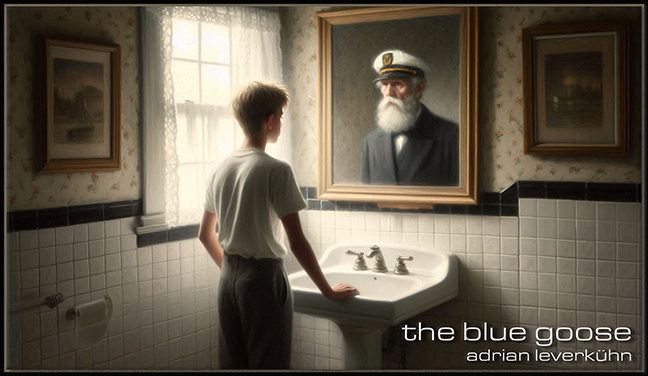
And just to help you keep things straight…
Dramatis personae
The Langston Family
– Hank aka Eldritch Henry Langston V
- Hannah, Hank’s oldest sister, from his father’s first marriage
- Jennifer, next oldest sister, also from his father’s first marriage
- Ben Langston, Hank’s younger brother, from their father’s second marriage
- Elizabeth Langston, Henry’s current wife and mother of Hank and Ben
- Eldritch Henry Langston IV, Hank’s father
- Eldritch Henry Langston III, Hank’s grandfather
- Ellen Langston, Hank’s grandmother
- Eldritch Henry Langston, Jr., Hank’s great-grandfather
- Eldritch Henry Langston, Sr., Hank’s great-great-grandfather
At the Langston Boat Company, in Melville, Rhode Island
- Ben Rhodes, foreman
- Travers Stuart, draftsman
In Hanover, New Hampshire and Woodstock, Vermont
- Carter Ash, Elizabeth’s suitor
- Huck, or Carter Ash Jr., Carter’s son, a year younger than Hank
In Norwich, Vermont
- Dr Emily Stone, the family veterinarian (and her wife Judy, a psychiatrist)
 Adrian Leverkühn Writes