The Infinity Song,  Part I, Chapter Two

Apologies up front, but I sort of rushed through this chapter so hope it isn’t too rough. Another procedure on the good eye tomorrow and I always get spooked before these little needles in the eyeball days. I guess it comes down to red lines in the sand, because finishing out my life while both blind and deaf was never in my game plan, and blindness is an ever present risk with this procedure. I tend to write on days like these almost as if they are the last thing I’ll ever write, so there’s a quick snapshot of my state of mind.

Music. Ah, where to begin, because this is an odd tale too. After a botched search warrant turned into a firefight inside a little house one night, I came out deaf in the left ear and my hearing in that ear never came back. What’s odd is that now I’m slowly losing hearing on the right side too, so slowly going deaf, and that makes music a challenge. Why, you ask? Because I can’t hear the very high or low pitches in the right ear’s track, and in stereo headphones I can’t hear the left channel at all, which means guitars and or strings, as well as bass lines or bass drums are simply absent. Yet…if I play music I’m familiar with I hear it all, every note…because the brain has committed those notes to memory and somehow, as my brain processes the incoming signal it just fills in the blanks. Fascinating, as Mr. Spock would say. That often means, however, that I stay stuck inside a musical rut. My brain struggles to fill in the gaps when I listen to new music, though it tries. But old familiar music is like a warm blanket on a cold night, isn’t it?

So, what’s on my musical radar tonight? Randy Newman, naturally enough. Falling in Love is a classic, while I Will Go Sailing No More is a bit more whimsical and, indeed, almost philosophical. Something Special lives up to its name. Baltimore is a fun piano ballad. If into Robert Redford’s The Natural, Newman scored the soundtrack and I always get lost in that one. For a change, visit Neil Young again. Old Man is meditative, while the searing pain in The Needle and The Damage Done never fails to leave you wondering – was that just a song? Young might lead you back to Crosby Stills and Nash, to an album titled Replay, kind of a “best of” compilation that will put you in the zone and keep you there.

Anyway, thanks for listening to an old man bitch about being an old man. Now, grab some tea and have a read, ’cause you ain’t gettin’ any younger, you know…?
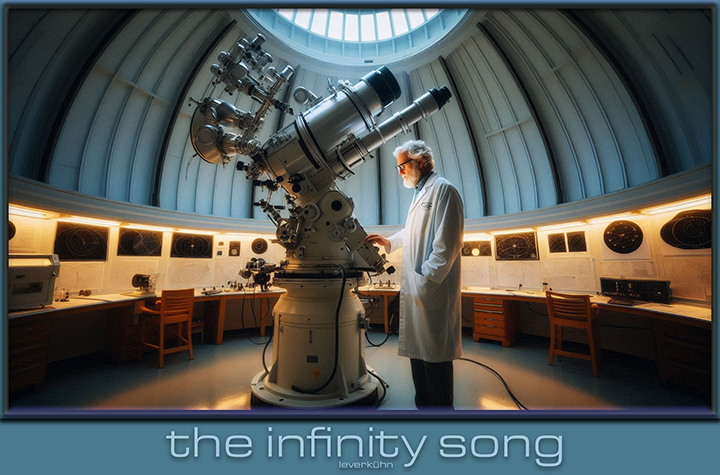
The Infinity Song  

Part I, Chapter Two

Rand Alderson belonged to the human race. He was a Homo Sapiens, he walked upright, had horizontally opposed thumbs and all the other hallmarks of the species. And yet, Rand Alderson hated himself, and all humanity, for these things.

Because he could not stand the human race, nor could he tolerate the company of his fellow man, at least not for very long. Which, curiously, had made education an odd career choice for a garden variety misanthrope like Alderson. Perhaps he had always hated his fellow man, or perhaps dealing with children in a college setting had soured him on the species. The truth of the matter was he just didn’t care. Girl, boy, young or old, Rand was an equal opportunity hater, and no one escaped his ire. His teaching assistants knew not approach him for anything early in the morning, and any requests were best made in writing. After two weeks in his classroom his students either feared or detested him. Often both. Yet he was the most gifted physicist of his generation, and peers regarded him as an Einstein caliber theorist.

And woe be unto the freshman drone entering his quantum cosmology class unprepared academically, for Alderson simply encouraged the student to drop the class. If that approach failed, he was not at all reluctant to drop a failing grade on any student no performing to standard, no matter the parents wealth and standing, and no matter the desperate entreaties from Princeton’s administration. As a result, word spread around campus: Don’t fuck with Alderson. It won’t do any good.

When students entered his office they were greeted with every edifice of naval rank imaginable.Two 6 foot long models of nuclear submarines adorned the wall behind his desk; the larger of the two was a scale model of SSN-23, the U.S.S. Jimmy Carter, the third and final Sea Wolf Class fast attack submarine, on which he first served as a reactor control officer, before taking over as the ship’s XO, or executive officer. The second model was of SSN-776, the U.S.S. Hawaii, on which he served as the ship’s XO, before ‘retiring’ from  fleet duties.

Among Alderson’s many other, and ridiculously varied accomplishments, examples of which adorned all his walls and bookcases, were the wings of a Naval Aviator, completion of the Test Pilot School at Patuxent River NAS, and featured prominently on one wall, his completion of Astronaut Training Class 229c, with highest honors. Alderson had crammed all this into one seventeen year long career in the Navy, retiring just before launching as a payload specialist on three of the last five shuttle missions. When the shuttle program was unceremoniously canceled, Rand left NASA and went to Princeton, and there he started teaching, and there his hatred of all things human began in earnest.

In appearance most of his students thought he looked just like Superman, the one from the 1970s, so of course his first year courses were overflowing with of all kinds of aspiring female physicists. Until these girls read through the course requirements and mathematical skills required to navigate the class’s coursework. Then, by the second or third meeting of these classes, there remained perhaps ten students, maybe an even dozen. By the end of the first month that number had usually dwindled to five or six. Few of these remaining students ever earned anything less than top marks, because, frankly, the only students remaining were usually genius level savants, people who tended to be just like Alderson – and just as socially maladjusted. In a word, Alderson presided over a classroom full of misanthropic – all assholes in the extreme.

Which is not to say that Alderson did not have friends. 

Of course he did. 

Henry Langston was certainly one friend, and perhaps there were a few at NASA, but he’d had no wives, or ex-wives, and no girlfriends – or even boyfriends. Anyone forced to spend much time around him soon understood why. He had dark, piercing eyes, peregrine eyes, and unless pressed he said nothing. When forced to attend faculty parties or department get-togethers, he stood ramrod straight with a fixed smile glued firmly to his chiseled face, his steely gaze daring anyone to approach and engage in idle chit-chat. New faculty members, women for the most part, always had a try at him, all soon retreating from his company, a few visibly shaken by the experience.

Yet his students, the ones who managed to survive the first month or so in his intro classes, all adored him. He was the best teacher ever. Without peer. And no one at the university understood why.

Here was a misanthrope, the very essence social malfeasance, yet surrounded by doting students. In the choice words of the esteemed, august president of the university: “What the fuck is up with that…?”

It was simple, really. As simple as it was incomprehensible.

When class was at an end and the lesson for the day yet barely understood, Rand Alderson loved to tell ‘war stories’ to his classes. Stories of his exploits in submarines and experimental aircraft, and in space shuttles. Yet every story had a point, the sharp tip of a spear aimed at a very complex subject, and by way of his stories he made his point. The most complex lessons, so byzantine that they had stood as riddles for hundreds of years, were reduced to a few well chosen anecdotes and the solution was soon plain to see. The problem was, of course, time. Or the lack thereof.

For the 0800 intro class, when the clock reached 9:15 their period was nominally over. Students were already waiting outside the door, waiting for Alderson’s students to vacate the classroom, so on Mondays, Wednesdays and Fridays his class adjourned to a nearby diner for coffee and an omelet, while on Tuesday and Thursday afternoons he and his students trooped over to The Dinky Bar & Kitchen for spicy tuna rolls and chicken katsu salad. When the discussions got deep enough, he and his students walked to his house and took up the discussion in his living room, and some of these Socratic dialogues lasted hours, a few even lasted days. One or two had been going on for years.

His living room, of course, had a blackboard.

Favored students would often find an invitation to take up residence in one of the many vacant bedrooms in the old victorian mansion that Alderson called home. Though it belonged to the university, there were no restrictions on who could reside there, and the Alderson house usually had seven or so students living within the warren of unused rooms on the second and third floors. Discussions on all things cosmological were ongoing. Major innovations in physics and cosmology were routinely made in the Alderson kitchen, usually over bagels and lox and fresh squeezed orange juice.

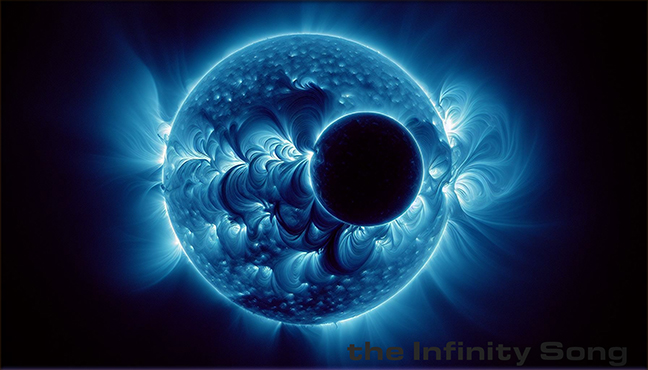
And one Tuesday afternoon, while his entourage of students was watching the live feed from a solar telescope in eastern China, his friend Henry Langston called, while they were in the middle of an animated discussion about the nature and possible origins of the black sphere emerging from the solar disc. 

A second incoming alert chimed. Dietrich Aronson was also calling from UC Berkeley, and he now wanted to FaceTime.

And soon Aronson, Langston, and Alderson were engaged in a lively discussion – with a living room full of interested students looking on and taking part. They all watched replays of the black sphere ballooning in size, then a drive of some sort flaring. Spectrum analyses were needed, the students declared, electromagnetic and gravimetric field analyses as well. One group of students settled on determining the objects departure vector, another group began working on an analysis of the drives chemical makeup. Benji Ozawa was invited to join the discussion from Hawaii, then astrophysicists from the UK, Japan, and Germany were brought onboard.

And by midnight everyone was sure of two things.

Whatever it was, it wasn’t a naturally occurring phenomenon.

And the latest object’s departure vector revealed that the object was heading somewhere between the Earth and the Moon.

And it was decided that the next task was to track the object while it was in transit so that additional studies could be made.

And one last decision was made. A working group was established and would convene in Berkeley in August, and interested students were encouraged to attend.

+++++

Henry Langston was the first to arrive, and he had asked just one student to come along: a chubby, unprepossessing girl from Pasadena and a freshman at Dartmouth. Olivia Brown was her name, and Langston allowed how he’d recently had the girl take multiple intelligence tests; her scores were so far off the distribution curves on both tests that she had entered uncharted territory. He told Dietrich Aronson that he had brought her along as a kind of recording device; she remembered everything she read, or heard. As. In. Everything. Her math skills were off the charts, and Henry considered her abilities next level. So, almost as good as his.

Rand Alderson came by himself, odd given his usual coterie of students – past and present. He told Aronson that the stakes were too high this time to allow students to meddle, and he objected to Olivia’s presence. Dietrich Aronson, on the other hand, had asked his latest superstar graduate student to attend, because he too thought her skills were next level.

And her name was Jenna. Jenna Goodman.

+++++

And Jenna Goodman was the opposite of chubby and unprepossessing. She had red hair and blue eyes, she had to be over six feet tall and most of that height seemed to be in her legs which, once seen, you could never forget. Even Rand Alderson. When he first saw Goodman he did a double take, then his eyes trained on her red high heels. “Physicists don’t wear shoes like that,” he whispered to Henry Langston, “do they?”

“I feel certain that yes, that’s been the case up to now.”

“Fuck me,” Alderson whispered. “I’d like some of that. For an after dinner drink, I think.”

“Be careful what you wish for,” Henry replied, rolling his eyes as Dietrich walked with her as they came over for introductions. Which did not go as expected.

“Henry? Rand? I’d like you to meet Jenna Goodman.”

Langston reached out with his right hand and she took it with a demure smile, and Henry thought the woman looked somewhat like a red-headed Marilyn Monroe, only with much larger breasts. She was wearing a maroon leather jacket – apparently with nothing underneath – and the jacket seemed about two sizes too small…with the net result being that the woman’s cleavage reminded him of the Grand Canyon.

Alderson hesitated before taking her hand, and Goodman seized the opportunity to strike first.

“I’ve heard, Dr. Alderson, that the color of a woman’s lingerie ofter refers to her own unique sexual proclivities. I wonder, which color do you prefer…?”

Rand seemed to reel backwards under the weight of this unplanned assault, but he regrouped quickly. “I really don’t give a rat’s ass,” he said, his demeanor now cross, and starkly so, like he had been offended by her words.

But she looked down a little, then she lowered her voice a little, too. “Oh, but of course you do,” she sighed, and Henry thought the words sounded almost sarcastic and patronizing, yet in their way, extremely seductive.

Rand looked at Dietrich and scowled; Dietrich looked at Rand and smiled. Rand was angry. Dietrich looked just like he was in on the joke, like he and Jenna had done this just to fluster Alderson. And they had. Deliberately. And it had worked, because everyone knew that Alderson was a prude with absolutely no sense of humor. 

Of course, almost everyone was wrong. Henry knew Rand better than anyone and had never thought of him as prudish, but in that moment his attention had been directed at the redhead.

“So, Dietrich,” Henry said, “tell us about your associate.”

“Oh, Henry, our Jenna is something of a polymath. She has an M.D. as well as a Ph.D., and only recently became interested in astrophysics.”

Henry looked at the girl and nodded. “I see. And what is your doctorate in, if I might ask?”

“Artificial Intelligence,” Jenna replied – without the slightest trace of irony.

“Ah, well then, we may have use of your expertise.”

“I’m counting on it,” she said, smiling brightly – even as she walked over to Alderson and kissed him on the cheek.

Alderson blushed but did not turn away from her. “What was that for?” he asked.

“For being such a good sport. Dietrich and some of the other astronomers have been cooking this up for weeks.”

“Why? To see what kind of reaction you might get out of me?” Rand said, casting an evil eye at Dietrich.

“Yes indeed, you old stick in the mud,” Aronson said. “We just wanted to see if you actually still had a pulse.”

Alderson growled as he stomped off; Jenna watched and grinned knowingly, just before she took off after him. Almost like she’d…planned it that way…

+++++

“Where are they now?” Alderson asked, looking at the plot of magnetic disturbances as the five objects advanced across the inner solar system. 

“Well, one thing seems clear,” Jenna said, “they’re not coming here. One appears to be heading directly to the L3 Lagrange Point, the other four appear to be heading towards Saturn. We need to refine the plot, but at least one model shows this second group heading towards Titan.”

“Titan?” Langston scoffed. “Now that makes no sense at all, unless they need methane.”

“Need?” Aronson asked.

“Why not?” Olivia Brown said. “It breaks down readily into carbon dioxide and water, and from there you can release pure oxygen. Look at the spectral analyses of their drives. A pure hydrogen line, so they’re burning hydrogen. And if they’re air-breathers and need oxygen, well, they get that too, and Titan offers that in almost unlimited quantities.”

“Has anyone bothered to get a scope on L3?” Langston asked.

No one had. 

Langston shook his head. “Doesn’t Benji know a bunch of people over at the Subaru scope? An optical-infrared observation might be useful.”

“What about an EM scan?” Olivia asked. “We can do that right now, from here.”

Aronson turned to his desktop computer and looked at the sky-map. “We could task either the MRO or Swarm right not. If we wait five hours we could get Hubble-2 to image and scan the area.”

“Why not get all three? To both image and scan around L3?” Alderson asked.

“All three it is,” Aronson sighed as he typed the requests. And as he was finishing up the new Hubble tasking, he finally hit the enter button…

…and the power grid failed.

From San Diego to Seattle, and as far east as Denver, Colorado.

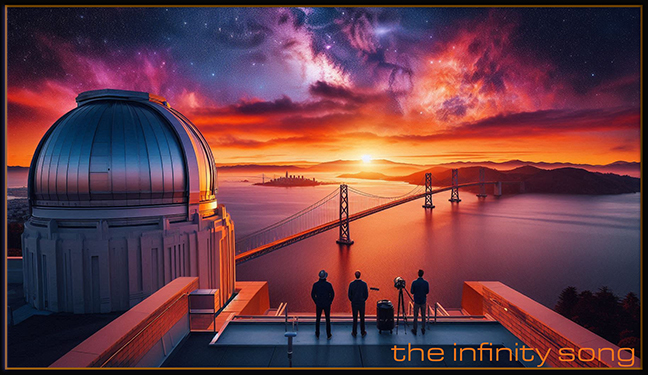
A red emergency light popped on inside the observatory dome and Aronson walked over to open the door, and when he stepped out on the rooftop he gasped. He looked up and saw stars overhead, and that rarely happened in the Bay Area. Everyone filed out one by one and everyone’s eyes immediately went to the heavens. 

“Damn! Look at that!” Henry said as he pointed south, towards San Francisco International Airport. A massive four engined airliner was gliding silently towards the bay, its engines out, gliding silently towards a water landing in the bay. But then the lights came back on. Around the city, then they saw several airliners coming back online. Thee huge airliner managed to get its engines running again and climbed away from the water.

“Well, fuck-a-doodle-do,” Aronson sighed. “Someone sure didn’t like that request.”

Olivia Brown shivered once and shook her head. “And that means…they’re watching us?”

“So it would seem,” Rand said, still looking up at the sky.

+++++

Initial measurements of the objects’ velocities put them firmly in the sub-light speed realm; these observations were further refined as they sped past Mercury. They were hardly moving any faster than an Artemis lunar mission so the group of four would take years to reach Titan. The lone object heading to the L3 Lagrange Point seemed to be moving along even more sedately, and might make it to the region in four years…and Rand Alderson thought that suspicious as hell.

“Why so slow? Why…when they are obviously capable of much greater velocities?”

“Move along, folks. Nothing to see here,” Henry quipped. “We might ignore it that way.”

“That’s possible. Just bore us to death…”

“Or maybe they’re in no hurry,” Olivia Brown added.

Rand turned to her. “Okay, but what are some reasons why they’d do that. Why would a faster than light-speed capable civilization deliberately go so slow?”

“Because they can’t,” Langston mused aloud. “I mean, think about it. These ships literally pop out of the sun – out of the sun, dammit – then just putter along slowly across the inner solar system. And when they popped out of the sun they were inside some kind of field. And for arguments sake, let’s say the field protects them from temperatures inside the photosphere…”

Rand nodded. “Meaning they’re using stars to move between solar systems. Elegant, even if it is quite improbable.”

“Is something like that even possible?” Jenna Goodman asked.

“It is if there are connections between stars, or even pairs of stars. If, for example, some sort of connection between stars remained after their birth. As our bodies are crisscrossed by all the various networks needed to sustain our lives. To pick just one example, our neural networks, and what if interstellar space is crisscrossed by an analogous network. Neural impulses move at quite an astonishing speed, you know, while all our other fluids move along quite a bit more slowly, but what if interstellar objects could obtain what we would consider impossible speeds by traveling along such a network?”

“Why wouldn’t we have discovered something like that by now?”Dietrich asked.

“Perhaps because no one’s ever had any reason to look,” Henry sighed.

+++++

Henry Langston was off in Newfoundland with his son when a new object appeared – and at the same location on the solar limb as the previously observed appearances, but this time the Berkeley Working Group, as the group was now called, was ready for it.

It had been Henry’s idea that solar quakes might precede an unexpected appearance, and as there were already dozens of satellites monitoring the sun for everything from quakes to sunspot formation to coronal mass ejections, getting notification hadn’t been the problem. What was the greatest issue was the sheer number of quakes.

So they had all the relevant satellites monitor just the one region of the southwest limb, all sensors focused where the earlier objects had emerged. There were spurious quakes in this region too, but every time the alarm sounded someone from the group began watching. More importantly, the on-duty astronomer would start monitoring all the other electro-magnetic bands, searching for any new clues that might emerge with the next object.

And a day after Henry departed for St. John’s the alarm sounded while Olivia Brown was monitoring. An object appeared and a cursory analysis revealed that a huge flare of gamma radiation, then a brief flare of x-rays, preceded the object’s sudden appearance on the sun’s surface. More important still, several high definition cameras were now focused on the object.

And what they recorded was stunning.

The object emerged from the sun at blistering velocity, enveloped within the same black cocoon seen before. The longer the object remained near the surface, the larger the balloon became, and the color of the balloon changed, too. When its emerged, the lozenge-shaped balloon was pure black, obsidian black, but as it grew in size a fringe of color appeared, and the colors changed too, shifting right up the usual spectrum of red-orange-yellow-green and on to blue. As each color appeared Olivia asked why not indigo and violet?

The answer, she surmised, lay in the nature of the balloon, or field. As the field absorbed heat it increased in size, with more surface area able to absorb more heat. But as the field absorbed more energy, as it heated internally, that heat began to register as a color shift with, she presumed, indigo and violet indicating the limits of the field’s ability to absorb more energy. 

This hypothesis seemed to be confirmed as the object moved away from the Sun over the next several hours, as the colored fringe slowly reverted to red, or to a cooler state, the further the object traveled from the photosphere. By the next morning the object was back to obsidian again, only this object was heading to Earth, and at fantastic velocities.

“When will it arrive?” Rand asked.

“Assuming constant acceleration to the midpoint,” Olivia stated, “and then constant deceleration until arriving at one of two possible orbital insertion points, it should arrive by the end of the month.”

Rand looked at Dietrich. “It’s time to call your Space Force contacts,” he sighed, “and I’ll call Henry. What time is it in Newfoundland, by the way?”

+++++

Jenna Goodman was sitting across from Rand, studying his many facial expressions in the candlelight. She appeared to enjoy this; at least Rand thought she did. He knew for a fact that he enjoyed watching her. Everything about her, as a matter of fact.

If he had ever had an image in his mind of the perfect female, she was it. Her blazing red hair, the cobalt blue eyes, the impossibly long legs and the voluptuous breasts all screamed out to him: ‘She’s the one! She’s it! Don’t let this one get away!’ The fact that she was so academically accomplished, and at such a young age, only made her that much more attractive to him. Indeed, she seemed to be so academically gifted that all the other men who had approached her over the summer soon beat a hasty retreat. Her intellect was indeed that imposing. 

‘Almost,’ he thought, ‘as imposing as her breasts.’

“A penny for your thoughts?” she purred.

He looked her in the eye and smiled. “I was thinking how beautiful you are right now. Your eyes, in the candlelight, seem almost plum colored.”

“I take it you like plums?”

He nodded. “The juicier the better.”

Her smile brightened. “Sometimes you surprise me.”

“Oh? Now why does that surprise me?”

“I never know what to expect with you, Rand. One minute you’re the essence of puritanism, and yet the next…”

“Puritanism? Really?”

She nodded. “Yes. Sorry. But sometimes, yes. But then you become almost like a teenager.”

“You have something against teenagers?”

“No, not at all.”

“So I asked you once before, but have you been married?”

She shook her head. “No. You?”

“No. I came close once. In some respects you remind me of her.”

“Oh? When was this?”

“I think I was in middle school. Probably 12 years old, maybe 13. I was sure she was the one, too.”

“What happened?”

“We didn’t find out why until the end of the year, but she stopped coming to class sometime that winter. Turned out she had a brain tumor, but I didn’t know what that was. My grandmother died of lung cancer about that time, so that was the first time I’d heard about cancer. Anyway, I think I grew afraid of relationships after that.”

“Of someone dying?”

He nodded. “Yes. Which is ironic, I think, because I have no interest in dying, or in death.”

“So, you plan on living forever?” she asked, smiling.

“I do. Yes. When my time comes I intend to download my brain into a vast computer and then rule the world, or, failing that, at least a very large brothel.”

She smiled again.

“God, there’s something about you. Your smile, the way your eyes light up when you smile. I hate to resort to clichés, but I could fall into your eyes and get lost in there.”

“Nothing wrong with a cliché if it’s what you feel.”

He nodded. “I think, what I’m trying to say…is that I’d really like to spend some time with you. Get to know you better.”

She nodded. “I’d like that too.”

“You know, I hate to ask, but do you live around here?”

“No. Across the bay, in Palo Alto.”

“Ah. Stanford?”

“Yes. That’s right.”

“That’s quite a drive to make every night, isn’t it?”

She nodded. 

“Maybe you could stay with me?”

“Maybe,” she sighed, looking away.

“I’m so sorry. I’ve overstepped my bounds and I do apologize…”

“No, no, Rand, it’s not that. It’s just that I just feel so run down after a full day up here with Dietrich and the rest of these people. Like I just need to go home and, well, maybe recharge my batteries, if you know what I mean.”

He nodded. “Yes, I sure do.”

They picked at their food for a few minutes, then she put her fork down and looked at Rand. “What do you think these objects are?”

He shrugged. “It’s not so much the what they are, but who they are that concerns me. Who knows how long they’ve been coming to our solar system, let alone why they’ve chosen not to make contact, but I don’t like the answers that keep popping up in my mind.”

“Do you believe they’re hostile?”

“Again, I have, we have, no way of knowing that, do we? Yet that alone speaks volumes. Either they’ve chosen to ignore us or they’re reluctant to make contact, and if that’s the case I’d sure like to know why?”

“What if you could ask them that question and you didn’t like their answer. Then what?”

“Then our job, or even my job, is to help us achieve technological parity with them as quickly as possible.”

She nodded. “Do you really think something like that is possible?”

“Why not. We get our hands on the technology and then get to work. By that I mean reverse engineer their technology.”

“Have you heard about projects doing just that? I mean people like Boeing and Lockheed…?”

“Only rumors. Or, really, rumors of rumors. Hearsay, in other words. So no, I don’t put much credence in that nonsense. Besides, I’m not really an engineer.”

“I’ve read your resumé, Rand. And your dissertation. Self-modesty isn’t becoming in discussions like this.”

“Oh? Are we having a discussion? I kind of thought this was, oh, I don’t know, like a date?”

“It is, Rand. I just need to know how I can best support you if the matter comes up.”

“Ah. Well, there you have it. So, not a date. Again, I’m sorry; it seems that I’ve misconstrued the situation. It won’t happen again.”

He summoned their waiter and paid the bill, then made his excuses.

And all the while Jenna simply looked at him, measuring his vital signs, analyzing his reasoning, examining his sense of morality. She watched him get up and leave, noted how hurt he seemed to be, then how angry he became as his ego took over.

He was, she decided, interesting and worth further study, if only because his ability to reason seemed to weaken when other emotions interfered with his thought processes. She transmitted her observations and impressions to the tiny blue sphere hovering near the ceiling, then stood to leave.
+++++

“Henry? What are we really doing here? I mean, what are we accomplishing?”

Henry was jet-lagged. He’d just flown from Newfoundland to Boston, spent two days with his kids and his mother, then jetted to San Francisco – only to find Rand grouchy and Dietrich leery. The mood had changed while he was in Canada, and he’d learned that Olivia Brown had soured on the mood and flown down to Pasadena to spend time with her mother. Because, according to Dietrich, everything had gone downhill after Rand and Jenna went out on a date. And that just didn’t make sense. Rand didn’t go out on dates.

At least he never had.

But Rand was also reaching “a certain age.” What was once called “middle-aged-crazy.” If things kept deteriorating at this pace, pretty soon Rand would show up wearing Ray-Bans and driving a yellow Porsche 911, and anyone wearing a skirt would be in mortal danger. 

At least that’s what Dietrich told him just after he got back on campus in Berkeley.

And now this? Rand wondering what he was accomplishing here? That just didn’t fit with the Rand he knew. That Rand was a scientist, but more than that, he was an explorer. He was driven by an insatiable curiosity, or at least he had been. So…was Olivia right? Had he finally, at long last, fallen into the clutches of testosterone driven need?

“I don’t know, Rand. What do you think we’ve accomplished?”

“Not a damn thing. Not a goddamned thing.”

“Well then, maybe you should go home. Let things settle down. Maybe you’ll see things differently.”

“Or maybe I won’t.”

“Yeah. I suppose that’s equally possible.”

“So, are you going to Iceland next week?”

Henry nodded. “Yup. You ever been to Reykjavik?”

“Once, yeah. Coming back from Faslane on a C-9. We had a mechanical and put in at Keflavik, stayed there a couple of days. Pretty girls.”

“Yeah. I’ve heard that.” And that confirmed it, Henry told himself. The Rand he knew wouldn’t have mentioned the girls anywhere, let alone when transiting to or from a deployment. So…Olivia was, as usual, right. But…when had she been wrong? “You seeing anyone back in New Jersey?” he asked.

“No, nothing serious. Just a couple of one night stands last semester.”

“Do I even want to know?”

“You? Strait-laced Langston? I doubt it.”

“You banging stuff on campus?”

“Sure. Why the fuck not, Henry? It’s a target rich environment, ya know?”

“Yeah, I guess.”

“You flying to Logan? Changing planes there?”

“Yup.”

“What’s your flight number. I’ll see if I can book something on the same flight. Give us some time to get catch up on old times.”

“Sure. Yeah. Sounds good.”

And just then both their phones pinged as an incoming text arrived. Both fished phones out of coat pockets and both looked at the exact same message – from Dietrich.

“Images from Lagrange Point coming in now.”

Henry looked over at the Astronomy Building and nodded. “You still interested?”

“No, not really, but what the hell. Let’s go.”

+++++

Henry noticed that Rand stood on one side of the observatory image processing lab, and Jenna Goodman the other, which handily confirmed Olivia’s second observation about Rand. ‘Oh well,’ he thought, ‘c’est la vie.’ He’d never thought of Rand falling into this kind of mental trap, but all the proof necessary was in this hasty pudding.

Dietrich turned to the Group and addressed them as the AI in the campus computer processed and stacked the images. Final processing would probably take an hour, but a rough image would be ready soon. “These images are coming straight from Hubble, so they’re unfiltered and, hopefully, uncensored,” he added. Henry looked at Rand through the darkness, and sure enough Rand was casting little sidelong glances at Jenna – and he groaned inwardly as this new truth kept hammering their old relationship. The idea of Rand seducing students was bad enough, but letting a woman interfere with something as consequential as this mission…? He still couldn’t believe it. Maybe he didn’t want to believe it. 

The computer pinged and an image appeared.

And as a group everyone in the room gasped and jumped back. All, that is, but Jenna Goodman.

Because there on the screen was – something – huge. Beyond huge. It wasn’t a ship, either. It was simply too big. Dietrich asked the AI to try and assign a scale so the group would know what they were looking at.

And the computer thought a moment, and then replied: “Best initial estimate: length 500 miles, breadth, 300 miles, depth, 50 miles.” Albedo, or how much sunlight was being reflected off an average of the visible surfaces, was 73 percent, or extremely bright. And bright white, too. With one highly reflective surface aspect looking almost like glass. 

“Those aren’t solar panels, are they?” Rand asked.

And the AI thought about that for a moment, then replied. “No. The black area is translucent. Spectrum indicates a high density of silicates. Only isolated areas of electro-magnetic radiation visible.”

“So…are we looking at windows?” Henry sighed.

Jenna spoke next. “Windows, but more like a ceiling. A ceiling, or a roof made of a glass-like material. And note the curve here,” she said standing next to the 72 inch monitor. “We need a chord and ord to work out this radius, because I think this looks like a space station that’s currently under construction.”

Everyone leaned forward and studied the object…

…and then the power failed again.

And once again the computer crashed. And by the time backups kicked in the image was lost. Every effort to retrieve it failed. When Dietrich queried SSTI he learned that Hubble had no record of having imaged that region of the sky, none whatsoever.

“Somebody sure didn’t want us to see that facility,” Henry sighed.

“That’s the second time, too,” Rand said. “Dietrich? Poke your head outside and see if it’s the whole city again.”

It was. And once again the entire west coast and inland as far as Denver.

“You know what? That damn thing might be big enough, and bright enough, to see in our refractor.”

The AI responded. “No, Dr. Dietrich, it is below the current seeing threshold given current atmospheric conditions.”

“Well, we saw it. We all did,” Rand said. “Now the question is what do we do with that knowledge?”

“We wait and see what the objects heading that way do,” Dietrich advised.

“And what about the object headed this way?” Rand added. “When does it arrive?”

The AI responded. “The object will enter a circumpolar orbit at 23:14 hours pacific daylight time on Saturday, 25 August, 2035.”

“Has SpaceGuard or the Space Force picked up the object yet?”

The AI thought for a full minute that time. “There are no indications either organization has changed alert status or monitoring schedules, so that appears unlikely.”

“Will the object overfly any strategic installations?” Rand asked next.

“On it’s first orbit, the object will be over the US Navy’s nuclear submarine base in Puget Sound, Washington, Vandenberg Air Force Base on the central California Coast, and the US Navy’s extensive facilities in San Diego, California. Facilities of the Chilean Navy will also be overflown. The object will then cross Antarctica and depart the landmass near Davis Station before overflights of Indian Air Force bases at Bhuj and Bathinda. Multiple military airfields in Afghanistan, Kyrgyzstan, and the Ural Mountains over Russia are next, then multiple Russian naval facilities in the Kara Sea region. The last facility overflown on the object’s first orbit is the Russian Air Force Base at Nagurskoye, and although there are currently no air assets detailed to this facility, there are multiple ground based surveillance radars in operation here, all capable of monitoring the object as it transits the polar region.”

“What’s the latest projected arrival date for the other objects reaching L3?”

“25 May, 2037, at 00: 33 hours Pacific Daylight Time.”

“Have you finished your preliminary determination the space station’s radius?”

“Yes, my initial radius estimate is in the range of 17,500 miles.”

“So, a diameter of 35,000 miles?”

“Yes, and there is a very high probability that construction materials for this project are being mined and processed on Saturn’s moon Titan.”

“That fits with what we know so far,” Dietrich said.

“I don’t like this,” Rand sighed. “The targets that will be overflown, and the size of that station. That’s just preposterous. And why build something out there at all…?”

“Because all gravitational influences are null at the Lagrange Points,” the AI replied.

“But why?” Henry asked.

“Given the limited dataset available, only conjecture is possible,” the AI continued. “I would, therefore, guess that these beings are constructing a solar shade to block solar radiation from superheating the planet once greenhouse gases precipitate one hundred percent cloud cover.”

“Best estimates for when that might happen?”

“Two hundred and thirty years, plus or minus ten years.”

“And given current estimates, how long will humans be able to live on the planet’s surface?”

“The figures vary with latitude, but equatorial regions should grow uninhabitable by the year 2110; between 60 degrees North Latitude and 60 degrees South Latitude by the year 2125, and by 2133 human life will no longer be supported on the planet’s surface.”

“So a possible solar shield would come online a hundred years after we’re extinct.”

Jenna cleared her throat. “Unless something happens to cool the planet, yes. Extinction is already inevitable, but their timing is curious. Perhaps they intend to terraform the planet, make it habitable again.”

“That might make sense,” Rand nodded. “That way we kill ourselves off, and so there’s no expenditure of military assets on their part. Clever.”

“Or they simply didn’t get the project underway in time to prevent our extinction,” she countered. 

Henry looked at Jenna, then turned to the AI console. “What would happen if we helped them?” he asked.

The AI hesitated: “You do not currently have the technological capabilities to assist in a project of this magnitude.”

“I disagree. We have the most amazing technological advantage in the universe.”

“And what is that?” the AI asked. 

“Us. Humans. You get us scared enough, or pissed off enough, and we can accomplish anything.”

“Has anyone on Earth tried to contact the objects?” Dietrich asked.

“I have no record of that,” the AI replied.

“Any evidence that the objects are communicating with each other, or with the station?”

“I have no record of that,” the AI repeated.

“Can you monitor the objects and the station for radio emissions going forward?”

“Enabled. I am detecting encrypted PCM transmissions, and this transmission is coming from approximately 41 degrees south latitude and 71 degrees west longitude. I am unable to decrypt this transmission. My central processor is now under sustained attack.”

“What city is near those coordinates?”

The AI did not respond.

“Can you hear me?” Dietrich again asked the AI.

Still no response.

“Well, someone – or something – doesn’t want us listening too their communications, do they?” Henry said, clearly now very concerned.

“I’m not aware of anyone with the capabilities to break into a fire-walled system that fast,” Dietrich replied, and he seemed stunned by this latest development.

“Someone have a phone with Google Earth on it?” Rand snarled. “We need to pinpoint those coordinates.”

“No need,” Jenna Goodman said. “They’re in Argentina, just west of Bariloche.”

Rand turned and looked at Jenna, though he was clearly perturbed now, and visibly angry. “You mean the Adler Gruppe, right? Is that who you think is behind all this?”

“Who?” Dietrich said, flummoxed.

“The Eagle Group,” Jenna said. “You know, the Eagle Network, Ted Sorensen, those people.”

“You mean those…Nazis? So,” Aronson sighed, “an encrypted message would mean that someone in Argentina is in contact…with one of those objects. You can’t be serious…?”

Jenna nodded. “And I hate to dwell on the obvious, but it seems they also have the capability to take down a heavily firewalled AI system. And, well, if they’ve been watching us, and have taken down the grid when we get too close to something, then this is a deep penetration.”

“No. This is a goddamn nightmare,” Aronson sighed. He wasn’t a practicing Jew but he was Jewish, and the idea of a hyper-masculinized sect of neo-Nazis being in touch with a vastly superior alien species was almost too much for him to take.

Rand looked at Henry, and both nodded. “You know what, Dietrich, we hate to be party-poopers, but it’s time for us to leave now.”

“What? Why?”

“This isn’t a simple solar anomaly anymore, is it? This is a matter of national security, and we need to get to Washington, to the JCS, and report what we’ve just learned.”

“You can’t do that, Henry! All our work, everything we’ve done here, all of it will be appropriated, militarized. Why? Why would you do that to us? To me and to this institution?”

“Because we’re Navy, Dietrich,” Rand sighed. “And just in case we weren’t clear with you once upon a time, our allegiance is Navy first, academia second.”

“But we’ve always been a civilian operation! They’ll take away our research, all our data.”

“That’s not the issue, Dietrich.”

“Oh, really? Well then, please remind me?”

And as much as he hated to, Henry leaned into that one: “Because you were supposed to be operating under strict electronic security protocols here, but the truth of the matter is – for whatever reason – your facility has been penetrated, and by people who do not have the best interests of our country in mind. And Dietrich, I think both you and I know they don’t give a damn about humanity, either. So the hard truth now is we know they’ve been watching and listening to everything we’ve been doing here, and knowing what we know right now, let me ask you to think real hard about what that means before you start in with the whole righteous indignation routine, okay?”

And with that Henry and Rand turned and left the rooftop observatory. They drove directly to Joint Base Travis, where they caught a transport already deadheading to Joint Base Andrews. On arrival they were just a few miles from both the Pentagon and Reagan National Airport, and Rand decided to go straight to the Pentagon, while Henry said his goodbyes and flew to Boston. He met his father early the next morning at Logan, in Terminal E in one of the first class lounges used by Icelandair, and they waited for Carter Ash to get in from Vermont before getting on their flight to Reykjavik. 

“What have you been up to?” Bud asked his son.

“Oh, you know…the usual.”

And a blue sphere the size of a grain of sand never left him, even as Henry flew to Iceland.

+++++

Dietrich had been waiting anxiously for three days, yet no one, from any agency, had come looking for the remaining members of the working group, and no one had tried to access their files. Exactly 24 hours after the university’s AI went down, the server miraculously powered up and their access to the AI link returned, only now everyone knew everything they were working on was utterly compromised, so Dietrich turned to commercial AI products to keep an eye on the four objects plodding across the inner solar system. The group’s primary interest remained focused on the one object still streaking towards Earth, and the AI they were using was interpreting the raw telemetry; as evening approached the voice advised the object had already entered into a braking orbit, and that the object was currently in an extended figure-eight approach that would take the object out beyond the Moon before slowing enough to attempt an orbital insertion maneuver. Assuming nothing prevented the object from achieving orbit, it would be over the Bay Area late tomorrow evening, and Dietrich soon had telescopes from Vancouver Island to Southern California lined up and ready to image the object as it passed by overhead. 

Yet Dietrich was concerned now, and warily curious. Why hadn’t the military, or NASA, approached the group? Why was there nothing on any of the mainstream media’s evening news broadcasts – not even on the Eagle Network’s many hundreds of stations around the world.

Dietrich found this silence unnerving, even ominous. And all the remaining members of the Group felt an unexpected anxiety, even Jenna Goodman.

Even Jenna Goodman. 

Even if she already knew exactly what was happening.
© 2025 adrian leverkühn | abw | this is a work of fiction, plain and simple, and the next part will drop in a week or so. Thanks for dropping by. See you next time?
The Infinity Song, Part I, Chapter 1

We arrive at a junction with this part of the tale, a middle ground between here and there. Characters both familiar and new will appear, and the same applies to storylines. Hope you enjoy the coming events both within and beyond.

Music? Of course. Let’s start with The Who. Eminence Front, from It’s Hard. Then Crosby, Stills and Nash. Helplessly Hoping and then Suite: Judy Blue Eyes. Then try Fair Game or Dark Star, from CSN. Stephen Stills, Love The One You’re With, or try Sit Yourself Down. Next up: Spirit: I Got a Line On You. Or, how ’bout some Three Dog Night. Out In The Country. Mama Told Me (Not to Come). One. Or even Shambala.

So many songs, so little time. Have fun.

Next, grab a cup of tea and sit yourself down. Time to read.

Time Shadow

The Infinity Song

Part I: The Gravity Well

Dietrich Aronson moved from the telescope’s eyepiece to the laptop computer on the rolling tool cart next to the scope’s pier, and he selected the calcium channel filter on the filter wheel, removing the hydrogen-alpha filter from view. After adjusting the new filter’s brightness and contrast on his computer’s screen, he started recording still images of the sun, the computer sequencing over one hundred five second exposures into a single image, automatically aligning and stacking each new image into the emerging whole. As the image ‘developed’ before his eyes he zoomed in one a region on the sun’s limb that was just rotating into view. 

One of his graduate students had called him two hours earlier, breathlessly describing the unexplained transit of – something – across the solar disc, and it was, the student claimed, weird. The object was, the student reported, just barely large enough to show up on long exposure images but not visible with the telescope he was using, so Aronson copied the alleged object’s coordinates on the solar disc and then went to work. He went to the SOHO website, the Solar and Heliospheric Observatory, that maintained the 40 year old satellite, imaging the sun through a variety of cameras and filtration methods. He pulled up the latest SDO/HMI magnetogram and looked for unusual distortions in the sun’s magnetosphere – but nothing obvious turned up.

The student’s coordinates put the object on the southwest rim, with movement just detected and her measurements not yet complete.

He punched the intercom and asked his secretary to book some observatory time at Leuschner that afternoon, after his Cosmology 501 seminar concluded, then he went over his lecture notes and emails before heading to the seminar room.

Just after one in the afternoon he set up his laptop beside the solar telescope in the rooftop observatory atop Campbell Hall at U.C. Berkeley, and slewed the scope to the solar disc. He slipped a 5mm Panoptic eyepiece into the diagonal and watched the area for several minutes, and nothing obvious emerged…which wasn’t at all surprising. In this region of the sun, the surface was rotating at close to 490,000 miles per hour and yet features on the surface appeared almost stationary, and even when Mercury transited the sun this planet looked impossibly small. For anything, anything at all to be visible through this telescope the object would need to be massive…truly massive.

So? What might it be? A passing low velocity comet captured by the sun, now, in effect, a new moon orbiting the disc? If so, how long would the object last? When would the object be pulled down into the Sun’s gravity well? 

Aronson had always been fascinated by these captures, and not simply because each presented new opportunities to observe and record an object’s demise. With each new demise, more was revealed about how objects interacted with the sun’s gravity well – and that was Aronson’s real passion. 

And most people thought that passion very odd indeed.

But everything in the solar system, he told his first year students, interacted with the sun. The solar wind. Solar storms. Sunspots. These were just the most obvious features that most people knew about, but the dynamics of solar interactions was a hot topic at NASA and the ESA these days, because the first interplanetary voyages were just now moving from planning stages to final construction, with the first two Mars mission now less than two years from their planned launch dates. How such spacecraft would be affected by the Sun remained an important area of research.

He changed filters again and started a new imaging run, this time with fifty hydrogen-alpha images, and he still couldn’t see much of anything. Well, not exactly nothing. Something was there, but it was too small to make out. He hooked up a video camera to record through a higher magnification eyepiece and started a new run of one hundred images, still in hydrogen-alpha.

“Yes, there it is.” He saw it now.

He switched to the calcium channel filter again and ran another sequence of 100 images.

And yes, there was most definitely something in this stacked image.

He switched to a 2.5mm eyepiece and tried to center the object in the field of view, but with this much magnification even the slightest movement of the building ruined his images, and he was forced to remember how much things like wind gusts moved buildings not originally designed for serious astronomy. He eventually centered the imaging reticle using a 4mm eyepiece and fired off one hundred new images, then did another sequence of 200, just because that atmosphere was cooperating and he still had a decent image of the sun.

He watched as the first run of 100 images took shape on his screen, then he zoomed in on the object.

“Hello there, little buddy…” he sighed. “Where are you going?”

The second run, the 200 image stack beeped, indicting it was ready. He opened the file and zoomed in on the object.

And in this image the object was perfectly resolved, if still quite small. Hey set the computer loose, telling his AI assistant to try and calculate the size of the object.

And a quick run through the computer revealed that the object was a perfect sphere with a diameter of 250 miles. The object was absorbing the sun’s radiative energy, as well as the sun’s visible light. He began a measurement of the object’s magnetic properties, then sat back – aghast at the results.

“This can’t be…” Aronson sighed as he looked over the sequence of graphs. In the first place, this object was too large to be anything but a minor planet, and so it was certainly too large to be the remnants of a comet. A stray planetoid, perhaps? Wandering through the cosmos over eons of time, and only recently captured by the sun’s intense gravitational pull…? This was a possibility, but something in the back of his mind was screaming right now. Planetoids are dead bodies, nothing but rock and, of most relevance, they have no revolving core so little in the way of magnetic fields. 

But this thing was generating an intense magnetic field. Larger than Mercury’s – if these figures were to be believed. And its gravity well was impossibly strong.

‘And this is a perfect sphere,’ he said to himself as he examined one of the onscreen images, ‘and such perfection rarely exists in objects that develop in unstable orbits. Even the Earth isn’t a perfect sphere…so what the hell was this?’

The sun was getting close to the Golden Gate now, about to set for the day, so he called a friend currently working at the Inouye Solar Telescope, at Haleakala Observatory Complex on the island of Maui. After he related what he knew, he was soon watching the live feed from their scope, and then conveniently, Dr. Benji Ozawa appeared in a split screen. 

And he too looked perplexed.

“Am I missing something,” Ozawa said, “or does this sphere look too big for the orbit it’s currently in?”

Aronson nodded. “Yes, it certainly looks that way – it’s too close to the photosphere. I have a grad student at Kitt Peak trying to confirm its size, but actually, two other things stand out to me.”

“And those are?”

“Well, the objects speed, for one, but have you ever seen a more perfect sphere?”

“Dietrich, I don’t know what to say – but no. Nothing like this should turn up in a naturally occurring object, and certainly not so close to the photosphere – nothing could withstand that heat, or withstand the gravity well. This is completely without precedent.”

And there they were. The words Aronson had been afraid to say out loud, even if only to himself. “Alright. That was my conclusion as well. We should make sure that we have coverage when the object rotates out of your view.”

The screen flared as intense brightness overwhelmed the optical sensors recording the object.

“What the hell was that?” Ozawa cried.

Aronson turned back to his monitor and saw the sphere inflating like a black balloon, and then a bright flaring light appeared behind the object. And as the light flared the object began accelerating out of its orbit. 

+++++

Henry Langston was exhausted.

Between running to Boston three times a week to check on his wife and taking care of his children, itself a full time job that his mother could now barely keep up with, he was running on fumes. And then he had his other children to contend with, too: his students at the college. But, of course, that did not include Hank. Hank and his Atlantic crossing was crushing him. 

So at this particular moment he was fuming at his father for having given Hank that stupid boat in the first place. Giving a twelve year old a sailboat, and then encouraging the boy to tackle an Atlantic crossing! Talk about fanning the flames of a child’s imagination…with a goddamn sailboat! He had barely been on speaking terms with his father for years, and now this…

He was in his office, in the Fairchild Physical Sciences Center at Dartmouth College, and he had just finished walking off a plate of pancakes at Lou’s Diner. Served with a side of bacon, of course. Because…why the hell not? Bacon and pancakes were made for each other, and nobody made pancakes like Lou’s. Nobody. Legions of Dartmouth students had gained millions of pounds eating pancakes at Lou’s, because the evil bastards used their own maple syrup, and their butter was locally made, too. Some professors new to the college gained 50 pounds at Lou’s – before they knew what hit them. These days Henry limited himself to one visit a month, and even that was getting hard to walk off.

Right now he was figuring out how to fly to St John’s, Newfoundland, in August, during peak tourist season, and he now knew that meant hopping a little turboprop shuttle down to Boston-Logan, then catching a flight to Toronto, and – with a little luck – catching the last flight of the day out to St John’s. Or, spending the night and taking an early flight the next morning. Then Hank planned to stop in Iceland sometime in August, and he’d need to go there, too. And it looked like his father was going, along with Carter Ash and Emily Stone. Logistically, all these flights were proving to be a nightmare, not to mention the cost involved.

He had Office Hours this afternoon, and he dreaded these snippets of wasted time. Half the students enrolled in his intro to quantum mechanics course didn’t have the math skills to complete even basic problems, so now he and his grad student teaching assistants were teaching remedial calculus during scheduled Lab periods, taking up valuable teaching time with skills that should have been covered in high school. But the real problem students were legacies, their parents either alumnus or wealthy donors, but these days usually both. If the parent in question was a very wealthy donor…well…he had to find a way to get them through the class or face the music. He had come to accept as fact that ‘grade inflation’ had made high school transcripts less than completely useless, but that realization had not made the problem go away. Frustration among faculty was endemic, and it seemed like admissions could do nothing about the problem. Kids everywhere were stupid, and the situation was only getting worse with all the political unrest.

His secretary buzzed; his first student was here and waiting.

“Send him in.”

The student shuffled in and Langston groaned inwardly. ‘Another drone,’ he thought as he took inventory of the typical attire. Armani shirt, pressed slacks and gray suede Cole-Haan loafers, and of course the obligatory Rolex, so this kid’s outfit had cost dear old dad at least a couple grand, and how many more clothes just like these were tossed on the floor in his dorm room…?

And of course the first words out of the boy’s mouth were as predictable as the sunrise: 

“Hey, Doc, look…like I wasn’t expecting so much math in this class.”

“I see. What were you expecting?”

“More stuff about space.”

“Space?”

“You know, like Star Wars type stuff.”

“How much calculus did you have in high school?”

“What’s calculus?”

Langston sent the boy packing. Well, he was referred to the remedial math lab his grad students were running this semester, but that boy represented a particularly galling case. His father had given 150 million for a new annex at the Tuck School, Dartmouth’s business school, and so he would pass, with honors, no matter his level of academic underachievement. That was the New World Order speaking, of course. If you had money you succeeded. And if you didn’t? Well then, move along. There’s nothing for you here. 

The next student arrived. A girl, and wonder-of-wonders…she looked to be absolutely poor. And Black, which made her a double rarity at this Ivy League college, but when he saw the expression in her roaming eyes he had to smile. She actually seemed impressed to be in a professor’s office…

“Doctor Langston?” she asked timidly.

His smile widened. “Indeed I am. And you are?”

“Olivia Brown? I’m in your 8 a.m. quantum mechanic class?”

“Yes, Miss Brown? What might I help you with this afternoon?”

“Our last quiz? I didn’t show my work on the last two problems so you marked them wrong.”

Technically his TAs graded quizzes, but the girl seemed genuinely hurt, and given the circumstances he wanted to understand why. He turned to his laptop and pulled her file and started to read through.

Graduated high school in Pasadena, California, 4.0 GPA, perfect scores on her SATs and ACTs. Top score on her AP Calculus exam. He looked up and nodded. “Have you ever taken a Wechsler Test, Miss Brown?”

She shook her head. “No, sir. I sure haven’t.”

“How about Stanford-Binet? Does that ring a bell?”

“No, sir?”

He stood and went to the white board and wrote out an equation, a fairly simple ‘solve for X’ problem that almost always tripped up pretenders. “Could you solve for X, please?” he asked.

“2.3,” she replied within a nanosecond.

So he wrote out a much more complex problem, a problem from classical celestial mechanics.

And she fired off the answer. It had not taken her two seconds – and she nailed it.

He returned to his desk and sat heavily, then looked at the journals on his desktop and picked one at random. He opened the journal to an entry related to celestial mechanics, to an article about using stellar drift to calculate radial velocities, and handed it over to her. “Please start reading this. Now, if you please.”

He sat and watched as she started reading, taking perhaps ten seconds per page, turning the pages so rapidly it was almost surreal to watch. Within two minutes she had finished a dense article full of new material she could not have learned before she came into his office, and now he asked her what the article was about.

And she told him. In detail. Exquisite detail, as a matter of fact.

It had taken him almost two hours to read the same article, and he’d had to reread portions to make sure he understood key points, but not Olivia Brown.

“I’m curious, Miss Brown. What do you want to do when you finish school?”

“I want to be an astronaut.”

“I see. Why?”

“I want to travel to a new world, so I…”

The telephone on Langston’s desk rang, an event so out of the ordinary during office hours he literally jumped, but he held up his hand and said “Excuse me,” even as he reached for the phone. Then: “Langston here.”

“Henry? It’s Dietrich, at Berkeley?”

“Aronson? Damn, it’s been a while. What gives?”

“I’m sending you a link at the usual edu email account. Please open it immediately.”

“What’s up?”

“Just open it. Watch it and let me know what you think.”

“Okay, here it is,” Henry said as he opened his laptop and hit the link; the link opened the video viewer and he leaned close to have a look. “What is this? Looks like Mercury transiting the limb…”

“Keep watching.”

The black blob over the sun was moving, and it looked like a perfect sphere. Too perfect. 

Then the sphere flared a little. 

And then it expanded. Like a balloon inflating. 

And then a drive flared and the spaceship began accelerating away from the sun.

“Holy fuck!” Langston cried, jumping back from the screen.

“Ah. So, I take it you understand the dimensions of the problem…?”

“What is that? Or did some kids in the film school over there whip this up for you? An April fools day prank, perhaps?”

“One of my grad students discovered it earlier today. Both Benji Ozawa and I were watching and recording when this happened.”

“How big did it get before the drive activated?”

“Linear expansion. Diameter from Two-hundred and fifty miles to twenty-five hundred miles, in less than two seconds. Really strange EM spectrum shift just before the drive flared.”

“Who else knows?”

“My grad student, Benji and myself.”

“You’d better call Rand, then archive the file in a secure facility. I mean erase it from your computer. No further mention until we can meet and discuss how to proceed.”

“Henry? When can we meet? I mean, we can’t sit on this for long.”

“I know. Call your student and contain things on your end. I’ll call you later tonight.”

Langston hung up the phone, then realized that Olivia Brown was still sitting there, just across the desk from him. 

“I hate to ask, but did you hear any of that?” he asked.

She nodded. “Sorry, but I could see everything from here.”

“What do you think you were looking at?”

“A ship. Some kind of ship.”

“Could you tell where its was?”

“The sun.”

“And does that make sense to you?”

“Nothing that close to the photosphere should be able to survive the heat or the gravity, so no, it doesn’t make any sense at all…unless it has something to do with the way it suddenly grew larger?”

“How so?”

“What if it’s some kind of energy field?”

Henry nodded, intrigued. “Maybe.”

“Dr. Langston? Maybe someone you know can track it?”

Normally he’d contact the MPC, the Minor Planet Center, or the CNEOS office at JPL, but doing so would only spread the word, and while Spaceguard telescope centers coordinated through the Spaceguard Foundation, the Foundation cooperated directly with the U.S. Space Force. No one offered a secure means of tracking an object like this – except the Space Force. And Langston was Navy, Navy through and through. And that meant he had a duty to report this to the Space Force. But not yet, not when he wasn’t sure what this was.

“I’m not sure,” he lied. “We lack coordinates, we lack velocity and mass measurements.”

“But you have a velocity vector, Dr. Langston. And those other parameters can be deduced from that.”

He looked at her and sighed. “I know,” he said as he grinned.

“Ah, so it’s the unintended consequences? Is that holding you back…?”

He nodded. “Always. Especially in this political environment.”

“I understand.”

“Do you?”

“I think so,” she added politely.

He looked at her again. Singularly unattractive, chubby and with acne scars on her cheeks, and her eyes were peculiar, too, almost too small, yet she was as nice a student as he had met in years. “Well, I’ll take care of that grade on your quiz. And now, if you’ll excuse me?”

“Okay, and thank you, sir. And don’t worry…I won’t tell anyone.”

He waited for her to leave before calling his closest friend, Rand Alderson. He was teaching at Princeton now, after putting in ten years as a reactor control officer in Virginia class submarines. Alderson had been his student, then a friend, and as both had graduated from Annapolis they both maintained strong ties with Navy physicists.

After Rand opened the file Henry waited for the moment. The moment when the object ballooned in size, then briefly flared before accelerating out of the frame.

“Well?” Henry said.

“Yeah, I just watched it, maybe ten minutes ago.”

“What?” Henry said, both shocked and dismayed.

“Yeah, a Chinese observatory recorded it an hour ago. It’s all over the internet.”

“What?”

“Henry? You getting deaf?”

“What?”

+++++

But no one saw the mysterious object again. Some odd bits and pieces emerged, like news reports of something similar that had popped into view back in the late 1990s. Astronomers had jokingly called it The Death Star, until some kind of energy beam appeared between the object and the sun. Speculation grew rampant after that, but the object didn’t reappear and the matter simply faded from polite conversation within a few weeks.

Yet when Langston looked into it, the same object had reappeared in 2007 and again in 2016, and always in the same location. Like it had literally just popped out of the sun, hung around for a few minutes and then disappeared – jetting off somewhere into the solar system. At the Center for Near-Earth Object Studies office at JPL, they even maintained a Death Star file, where all known material on the phenomenon was kept. And most physicists at CNEOS did indeed think it was a physical phenomenon, probably some kind of globule of solar matter that was spit out by an unknown process deep within the photosphere. 

And that was that. No need for secrecy. No unintended consequences to worry about.

So now all Henry Langston had to think about was his twelve year old son intent on sailing a 28 foot boat across the North Atlantic, and his wife, who would probably sleep through the whole thing.

+++++

Dietrich Aronson walked in the side door to his house on Hillegass Avenue, and out of habit he took a tentative sniff of the air. It was Wednesday and that meant a tri-tip roast with spinach souffé and a salad – because the house had smelled like that every Wednesday. For years and years. Like clockwork.

But not now, not tonight. Not after his wife and son had been caught in one of the more explosive riots that had rocked Berkeley and Oakland last autumn. Collateral damage, the Department of Homeland Security called their death. She had called him and left a message, too. She’d taken Aaron, their son, to the pediatrician, to have her check on a persistent eye infection after the first course of antibiotics had proved ineffective. Driving home from the appointment she’d stopped off at the pharmacy, then started to take her usual route home. 

Only there’d been another anti-government protest planned at Bushrod Park that afternoon, and she’d not heard about it. The demonstration had predictably turned violent when government troops arrived and issued ultimatums. When bottles and rocks were thrown at the protesters, these troops fired into the crowd; protesters, many of them military veterans, were waiting on nearby rooftops with weapons of their own, waiting for this very thing to happen. As more shots rang out and as troops fell in this unexpected counterattack, on-scene commanders called for helicopter support – even as three armored columns moved into the area, cutting off any escape routes protesters might have taken. Traffic snarled. Drivers heard gunshots, then helicopters approaching the scene, and orderly chaos degenerated into carnage. Pedestrians caught in the crossfire lent a hellish fury to the chaos, with armed protesters hiding amongst the unarmed protesters and troops firing indiscriminately into the windmilling crowds. 

Dana Aronson, a registered nurse, had been tempted to stop and render aid, until machine-gun fire ripped through her Volvo’s roof, grievously injuring her son. She tried to drive through the melee, was trying to get to the nearest hospital when an APC, an Armored Personnel Carrier, simply ran over the top of her Volvo, instantly killing both of them.

Collateral Damage? That was the official finding?

Many in Dietrich Aronson’s family, all originally from Germany, had fled their homes in 1934, after Hitler consolidated power and anti-semitism went from slogan to government policy. Those of their family who remained, those who had claimed that it would all blow over soon and that everything would be okay in just a few months, were never heard from again. A few died in Buchenwald, more in Auschwitz.

And yet, Dietrich Aronson’s family would never have been admitted to the country but for one man’s efforts. Albert Einstein sponsored Dietrich’s grandfather, brought him to Princeton, where he soon found work as a professor, and then as a staff physicist working in Los Alamos on the Manhattan Project. Dietrich’s father was born in New Mexico, as was Dietrich, but he moved to Berkeley after he finished his graduate studies at MIT, while his father remained at Los Alamos. He still loved the area around Los Alamos, and had looked forward to visiting his parents there. Dinners at The Pink Adobe in Santa Fe, walking around the square, buying pottery or copper jewelry from Navajo artisans who set out their wares on blankets in the shade. Santa Fe was an impossibly cultured town, and he’d even learned to ski there.

America had been predictable in those dreamlike postwar years – but America, and Americans, were no longer innocents. Now the country was falling apart, riven by partisan divisions manufactured by politicians and news organizations for decades. Swastikas appeared on synagogues with frightening regularity; endemic gun violence turned hospital emergency rooms into battlefield trauma centers. America, Aronson knew, was like a wounded animal thrashing out, now reaching out and killing everything within reach. Good and evil were minor inconveniences, as bullets knew no difference between the two, as bullets don’t discriminate. The new president had suspended the Second Amendment but by then it was too late, the genie had been out of her bottle too long. There were almost a billion guns in private ownership, and the carnage had been as predictable as it was inevitable.

Universities became places of refuge, neutral ground where neither protesters nor the military were allowed to roam. Faculty and students kept away from ‘areas of active conflict’ like they were areas under quarantine, like areas full of a deadly contagious disease. Police patrolled university perimeters on the ground and in the air, yet it wasn’t long before the background sounds of endemic violence became commonplace, and that violent death became just another feature of urban life, so regularly reported on the evening news that few took note anymore.

When his grandparents had found themselves living within such a calamitous landscape they had packed their suitcases and fled to New Jersey. Now, when Dietrich Aronson looked around and wondered where he might flee to, he saw Israel waiting with open arms. And Israel saw Aronson, too. They wanted him. They were, in fact, actively recruiting him. His family would be welcome there, in the Jewish homeland. They would be safe again, safe from the enduring scourge of antisemitism.

Ignoring, of course, the Palestinian issue.

So when Dietrich Aronson’s wife and son were listed as Collateral Damage and as his world fell apart, it came as no surprise to those who knew him best that his time in America was coming to an end. Such violence, such hatred was, after all, nothing more or less than an echo. Jack-booted, goose-stepping thugs were simply another universal constant. 

As any historian would tell you.

+++++

He walked inside and found his daughter, Judy, sitting in the living room, her book bag on the floor beside her chair. She was staring out the window at the park across the street, perhaps lost in memories of happier times.

Judy had told him at breakfast that she would start their dinner when she got in from school, but he had known what he’d find when he came in. His daughter was simmering away in a stew of her own creation, not at all sure when or where her last meal would be served. Helicopters overhead, distant gunfire an everyday occurrence, she was losing sleep and at times could barely concentrate. A friend of his, a psychologist at the university, said she had all the classic symptoms of PTSD, but Dietrich had just scowled when he heard that simplistic diagnosis. That psychologist’s criteria now applied to just about everyone in Berkeley, perhaps everyone living in urban America. Which meant that almost everyone in the country was brittle and battle scarred. Yet what his scientist’s mind told him was simpler to come to terms with: if everyone had PTSD then PTSD was the new norm, which meant it was no longer a disorder but a feature of American life. But the same, he knew, could be said of people living almost anywhere on the planet. State-induced violence was the new norm; peace of mind was just the latest casualty in this latest frontal assault on the mind. Living in fear made people docile and compliant, and fear was easy to manufacture.

He walked into the living room, saw she was reading a book, Herman Wouk’s The Winds of War, and she was crying. He sighed, then walked over and sat next to her.

“Where are you?” he asked.

“What?”

“In the book. Where are you?”

“Oh. Byron has just moved into Aaron Jastrow’s villa, to be near Natalie.”

“Ah.”

“Ah? What’s that mean, Dad?”

“You’ve yet to reach the more relevant parts of the tale. When did you decide to read this one?”

“Mr. Jelenik assigned it.”

“He’s your AP History teacher this year, right?”

She nodded. 

“And you’re covering the Holocaust, I take it?”

“No, not really. Our class is focused on U.S. History, and we’ve been looking at populism and isolationism in the 1930s, and how Roosevelt and the Democrats tried to counter the Republicans with legislative workarounds to enact the New Deal. You know, it’s hard to look at all that stuff and not see parallels to today. Everyone talks about how Weimar collapsed and that led to Hitler, yet that whole Make America Great Again thing started here in the thirties, as a response to the Great Depression. Mr. Jelenik thinks it never really went away, that the Republican Party has been working nonstop ever since to undo everything Roosevelt accomplished. Like the South in the Civil War, I guess. They never really admitted defeat because they were never able to see that their cause wasn’t just, and that’s why Blacks are being rounded up now. He thinks all the Blacks and Mexicans will be put in work camps and eventually be sold off as slaves.”

“I’m not sure I’d pay much attention to any historian who’s that sure of the future, Judy. There might be parallels, but nothing predicts the future. There are simply too many variables.”

“But it’s a possibility, right?”

He smiled. “Our universe is filled with endless possibilities, Judy, so yes, what he’s saying is a possibility. Yet I can’t think of a valid way to assign a probability to such an outcome.”

She picked up the book and looked at the cover, a wall of gray storm clouds. “You’ve read this, right?”

“Yes. Several times, actually. It’s an amazing series of love stories set within the collapse of several civilizations, but to me it will always be about Aaron Jastrow’s denialism. And the cost of his ignorance.”

“Ignorance? He seems the very opposite of ignorant, Dad. He’s a professor, like you.”

He chuckled at that. “A learned man, yes, but he also refused to believe what was so obviously unfolding around him. He could admit he was trapped, but he refused to act on that knowledge, which makes him profoundly ignorant in my book. Or simply stupid.”

“Could I ask you a question? I mean, a personal question?”

“Of course?”

“Are you going to move to Israel?”

He leaned back in his overstuffed chair and looked up at the ceiling, then he just shrugged. “I’m not sure, Judy. I’m really not.”

“Then how are you different than Aaron Jastrow?”

The question hit hard and left him breathless, if only because he’d never thought to ask himself that very thing. “I don’t know that I am all that different, but I suppose it’s just very hard to let go of all that we have here. This country took us in, her people sheltered us, nurtured us, and they did not shun us. I have a hard time admitting that this period is over, that America is becoming just like Germany in the 1930s, because the betrayal would be so great.”

“Betrayal?”

“Yes indeed. There is nothing worse than when a people betray their foundational ideas. When people embrace expedience over patience and understanding.”

“Should I finish the book?”

He nodded. “I think so, but you should be prepared to have some cherished assumptions challenged.”

“Is that a bad thing, Dad?”

He shrugged. “No, Judy, that’s a fine thing, as long as you can accept the consequences, because sometimes we have to admit we were wrong about things we felt were very important to us.”

“You sound…I don’t know…skeptical?”

He nodded. “It’s been my experience that most people don’t react that way when exposed to a paradigm shift. Some people are so set in their ways that no amount of information or introspection can alter their perception of the world.”

“Like Aaron Jastrow? In the book?”

“All of the characters confront challenges to their own worldviews. That’s what makes the book so fascinating. Aaron Jastrow will only admit he’s been wrong as he is herded into a gas chamber, but the same goes for Pug and Rhoda. And Leslie Slote, the know-it-all diplomat. His epiphany is the most fascinating. To me, anyway.”

“What about Natalie? Does she change, too? She seems like a 1930s version of a liberated woman, making her own choices, living it up in Paris, dating a diplomat…”

“Oh, she’s the vessel into which the story is poured, no doubt about that, but she changes too. I’d rather not give away too much, but I think she’s changed most of all when she decides to stay with Aaron. It’s best to think of all these characters as leaves blown around as a storm approaches, but remember that leaves by their very nature are hapless, they are doomed to respond, they can never act on their own. I often think that Mr. Wouk is telling us that this is true of most people.”

“Most people? Dad, you don’t mean that, do you?”

“What I think is of no importance, Judy. What you take from him is all that matters. But now, we have something much more important to consider.”

“Oh?”

“Yes, would you care to help me make our supper?”

+++++

“Do you know…I remember the first night you spent in this room, after your mother and I came home from the hospital with you. Your crib was over there,” he said, pointing two a spot near the window, “so the afternoon sunlight could fall on you. But look at you now. Here you are, graduating high school, and with honors. What a day this is.”

Judy slipped into her gown, then tried on the tasseled mortarboard. “Do I look like a scholar?” she asked, dipping in a little mock curtsy, then blowing the tassel off her face.

“A scholar? Hm-m. Now there’s a thought…”

“Dad? You seem preoccupied today. Is something going on at work?”

Aronson smiled. “Judy, there is always something going on in my little world, but today is your day, not mine.”

“So? What’s going on? You looked upset at breakfast.”

He winced, looked away, but then looked at her and shrugged with a carefree smile. “That world is of no importance today, my Judy Blue Eyes. Now, when do we need to be at the stadium?”

“Doesn’t it bother you that my eyes are kind of brownish-green?”

“It was your mother’s favorite song.”

“So, was she disappointed?”

“In you? No, never. She was so proud of you, in fact, and so in love with you both…”

With a name like Aronson, she would have been among the first to walk across the stage and accept her diploma, but such was not the case that evening. She was the class valedictorian and as such was expected to give a speech, a speech that was typically all about how the members of her class would now go forth and confront an uncertain future, and that they alone would make all the difference. The world would be a better place because of their efforts, or so the usual speech went. So, she wasn’t to give a speech, not really; her job was to lead one last pep rally. One last cheer before the big game, the game of life. But when she was selected as valedictorian she had immediately turned away from giving such a speech. It was pablum, such words hollow and meaningless in the face of things now.

So she had revisited The Winds of War in her speech, the things she had learned about ignoring reality even as it closes in on you, then thrown in some words of anarchic wisdom penned by Jerry Rubin and Tom Hayden, leftist political activists from the sixties who had helped put Berkeley on the map, words that were not met with enthusiasm by her school’s principal or the district’s superintendent. But the crowd loved it, her father, too, but he had always been something of a closet radical. But a flame-throwing, radical-hippie astrophysicist, however, he was not.

She had always wanted to go skiing in Europe, and her graduation present was just such a trip. Aronson decided they would go to Switzerland together over Christmas; if the weather was too warm they would just grab trains and visit museums when and where they could, but they had been skiing together since she’d learned to walk. And when he told Judy about the trip she went ballistic with effervescent happiness, and so he was happy about the trip, too. In the meantime she would start her usual summer job over the weekend, still working as a lifeguard at the King Pool, over on Hopkins Street. This would be her third summer doing the same job, and she still enjoyed working there. 

But Dietrich Aronson had another set of airline tickets. From Zurich to Tel Aviv. For two people. So her observations of him on the day of her graduation had proven spot on. There had indeed been something going on. 

Yet five days ago the object had reappeared, and right where the last one first appeared. And the little groups of astronomers and physicists working on these latest observations were only now coming to grips with the implications of their most recent observations. Teams from Harvard, Cal Tech, Berkeley, and Lyon had each observed five objects emerge from the same spot on the surface of the sun, and all five were now enroute to Earth.

© 2025 adrian leverkühn | abw | this is a work of fiction, plain and simple, and the next part will drop in a week or so. Thanks for dropping by. See you next time.

The Blue Goose, Part Eight

An ending here, of sorts. Revisions likely when I consolidate all nine chapters into one post.

Music? Paul Simon: Hearts and Bones. Yes: Hearts. Buffalo Springfield: Expecting to Fly. Linda Ronstadt: You’re No Good. The Dream Academy: Twelve-Eight Angel. Double: The Captain of Her Heart. Dusty Springfield’s version of The Look of Love, from Casino Royale, the original 1966 motion picture soundtrack.

Part Eight

After backtracking around Keflavik, Hank set his course to skirt the small islands around Vestmannaeyjabær, and once they passed the village of Vic they faced a 350 nautical miles passage to the Faroe Islands. The weather forecasts they had downloaded looked decent, not great but decent, for the next two days – but after that there was a growing possibility of storms, this time from a tropical cyclone that had skirted the Bahamas before turning towards Bermuda. This new beast was predicted to blow itself out in the mid-Atlantic, but so far this storm had defied prediction and seemed to have a  mind of its own. As for right now, there wasn’t a breath of air and both boats were motoring along at five knots. At least, Hank told himself, they were charging their batteries.

Hank had long planned on stopping in Tórshavn, then spending a week or so exploring the islands, but the plain fact of the matter was that they were running out of summer. It was already mid-August, and while it wasn’t impossible to reach Hull by the end of the month, spending a week sightseeing anywhere was looking less and less possible, and that was not what he had been hoping for. What was the point of rushing if the things you wanted to explore were lost to you? Didn’t that defeat the real purpose of a trip? Any trip?

Which had left him with the germ of an idea a few nights back, an idea that was even now rattling around in his brain.

‘What if we keep the boats in Hull for the winter, then come back next summer and retrace our path, return to the Faroes on their way north to Bergen and the fjords.

In fact, he was thinking about next summer so much that his mind wasn’t on their present situation. Grindavik was coming up on their port beam and while the shoreline was still in sight, though just barely, he saw a low, dark plume of volcanic ash streaming off the mainland straight out to sea, and the plume was maybe ten miles dead ahead. Volcanic ash, he knew, was full of all kinds of abrasive particulates, everything from silicates to larger bits of airborne pumice, but there were a gazillion different chemicals in these clouds that were toxic to breathe. The most immediate concern was damage to their eyes and lungs, and there might be carbon dioxide alerts for low lying areas, where CO2 pooled in lethal concentrations. The sea was definitely a low lying area, so would an alert apply to them?

But Judy was already two steps ahead of him when he called her on the VHF.

“I’ve just talked to one of the volcano observatories,” she began, “and they advise we head well offshore before traversing that plume.”

“How far offshore?” Hank asked, bewildered, knowing that any detour might add days to their crossing.

“Call it a hundred miles south,” she sighed. “So yes, I hear you, this is going to add at least a day to our time, but the alternative is to go around the northern coast of Iceland and that would take weeks, not days.”

Hank sighed and shook his head, but the knew she was right. He entered a new course on his chartplotter and then told Huck his plan. He hit execute on the plotter’s screen and the autopilot made the turn to starboard, then he turned on his radar and yes, sure enough, he could see the plume right there on his screen. 

He nodded – because at least he could monitor their position relative to the danger…but he was fuming now. More delays…

And then he felt a shuddering thud reverberate throughout the Goose. “What the hell?” he mumbled.

Afraid he’d run into an errant shipping container he leaned over the starboard rail and found himself face to face with the grinning white countenance of an impressively large Beluga Whale. Its face was about a foot above the mirror smooth surface, and its mouth was open a few inches. The dome of its forehead was impressively huge, and the natural curve of its mouth looked inviting. Like he, or she, was indeed smiling at him.

“Well,” Hank said as he cut power and put the transmission into neutral, “hello there. How are you today?”

And to his surprise, the whale replied, our tried to, anyway. While its enunciation wasn’t perfect, it was close, and Hank grinned at the effort.

“We’re going that way,” Hank added, pointing to the south. “Where are you going?”

But then the whale shook its head – and then it swam around The Blue Goose’s stern and literally pushed the boat to a course further west.

Thee radio hissed and came alive. “Is that a Beluga?” Judy asked.

“It is, and I told him we were heading south and that seemed to bother him. He’s pushing me to the west right now.”

“Interesting. Hank, if he swam through that plume he may have gotten a lungful of pumice, and he just might be trying to warn us off.”

Hank leaned over the port rail and the Beluga was still right there, bobbing on the waves while looking up at him again. He pointed to the west and nodded: “You want me to go that way?”

The whale responded by pushing the Goose again, and yes, it pushed the Goose to the west once again.

So Hank set a course of 220 degrees and engaged the autopilot, yet the next time he looked down into the sea the whale had vanished…just like a ghost.

“Damn,” he muttered under his breath as he scanned the sea around the Goose, “now that was just weird.”

+++++

Two hours later the plume was still visible off in the distance – but it was gaining some serious altitude now. He couldn’t tell what surface conditions were like that far away, but he hadn’t seen any airliner’s contrails overhead all morning so assumed this had been a big eruption. He turned on the single-sideband radio and tuned in the BBC, and then he learned that there had been big volcanic eruptions all around the world, and that the Pacific Coast of North America had been especially hard hit just a few hours earlier. Mt. Etna, the stratovolcano on Sicily’s east coast, had just erupted, and so had Mt Kilimanjaro in Tanzania, and that volcano had long been thought extinct. There were reports of eruptions in far east Russia, but no confirmations had been received at the time of broadcast.

Hank picked up the VHF and called Judy.

“Have you listened to the BBC today?” he asked.

“No? What’s up?”

“Just tune in and listen for a while, then tell me what you think we ought to do.”

“I got it,” Huck said. “Judy’s gone down to work on it. How’re you doing over there?”

“I was doing okay until I heard this shit. Huck, volcanos are erupting all over the world, and it’s real bad on the west coast.”

“You mean like California and shit?”

“Yup.”

“Fuck.”

“Yup.”

Judy came on the air about ten minutes later and she sounded different now. Like the usual calm she projected had been ruptured. “Hank, I have no idea what we should do, but there are volcanoes all over Iceland so I think we should get away from here.”

“Agree, but where to? Keep going to Scotland?”

“There’ll be ash clouds everywhere within a few days, so our best bet is to get somewhere…well hell, Hank, I have no idea where a safe place would be.”

“I’m texting my dad. He’ll know what to do.”

“Their flight took off an hour ago,” she said. “He should be in Boston in a few hours.”

Hank didn’t like the way that sounded. If air travel was disrupted by volcanic eruptions, it seemed like the worst place you could be was in an airliner over an ocean, but now wasn’t the time to think about that. “Okay, I’m going to set a heading of 270 degrees and get away from that plume. There’s no telling how bad it is now.”

“Okay. We’ll be right behind you.”

There was a light breeze blowing now so he set the main and the genoa, then engaged the Hydrovane self-steering vane. With so much sun shining he set the angle of the solar panels to receive maximum solar gain then checked the Victron displays to see how well they were doing. He looked down, saw the surface of the sea was still sort of calm but it looked different now. Almost gritty, like there was a thin layer of gritty film spread over the surface.

And if that was volcanic grit, he thought, what would that stuff do if it got into the engine’s raw water coolant loop? Foul up the diesel? What about the Spectra water maker? Would the grit foul up the pre-filter and clog the pump? And the sails? Would grit settle onto the Dacron fabric and tear up his sails? If so, how long would it take to destroy them?

Then the thought his him.

We could be out here unable to run the engine and even unable to sail. Then what would we do?

He turned and looked over his wake and could still see Iceland back there – and that’s all it took. He swung the wheel hard over and turn back to the northwest, then he looked at Judy, now standing in the cockpit staring at him. A minute later she pulled alongside.

“I was thinking,” he began, “what would happen if we got a bunch of that ash in our engines, and then in our sails. Or the water makers. We could get halfway to nowhere real fast, then be stuck out there with no way to get anywhere…”

“Jesus,” Huck sighed.

Judy nodded. “Good call. You want to head back to Reykjavik?”

Hank nodded. “I don’t want to be out here right now. The BBC is saying nothing like this has ever happened before, so no one really knows what’s going on. It just hit me, you know? Being out here in the middle of the ocean sounds like the last place we should be.”

His phone pinged and he realized he had put the phone in its holder on the binnacle so he leaned over to look at it. He read for a second then nodded. “Text from my grandfather. They’re still at the airport, all flights grounded. He’s asking our intentions.”

Judy nodded. “Hank, we’re following you, okay?”

Hank picked up his phone and replied: “Understood. Heading back to Reykjavik now.”

A minute passed and the reply popped up. “See you at the marina. We’ve reserved your same spots.”

“Okay. Be there tonight.” He nodded then turned back to Judy. “They’re headed to the hotel and we have the same berths in the marina. I think we should motor-sail as fast as we can.”

Huck reached down and started the diesel, then turned two follow Hank as the Goose began heading northwest, back to Reykjavik. Judy got on the radio again and called. “I’m making sandwiches, so don’t get too far ahead of us!”

“Okay, take your time.” Hank said as he cycled the chartplotter to the radar screen, then set the range to 36 miles, the maximum on this unit, and the plume was still there, only now in his mind it was a dark, malevolent thing, something that could hurt him, even kill him, and then the thought hit him. 

The world had just changed. Not a little, but a lot. Reality had shape-shifted and this was a new world…

Now even the air he breathed could no longer be taken for granted, then an even scarier thought hit. If it was bad here – what was it like along the Pacific Coast? How long would it take for all that ash to make it here? He remembered a couple of movies about that volcano under Yellowstone National Park, what the scientists called a ‘Super-volcano.’ In one movie more than half the country had been buried under ash, and the sun didn’t come out for a couple of years. 

Would that happen now? 

But why were volcanos erupting in Italy and Russia, and why were they all erupting at the same time? And then there was that extinct volcano in Africa? That just seemed beyond weird.

He turned the chartplotter back to the main chart display and noted they were coming up on the point at the southwest tip of the island, labeled Reyhkjanes on his chart, so now they had 20 miles to go to reach the lighthouse on the point, the old Garður lighthouse, where they would make the final turn into Reykjavik…

“Hank,” Judy said over the radio, “come and get it!”

“Okay, I’ll cut power, tell Huck to come alongside, make it starboard side and I’ll put the fenders out.”

“Okay, got it.”

They were only a few hundred yards off so it took just a few minutes, and she already had the cockpit table set up. She’d made Huck’s favorite, a pitcher of cherry-limeade from frozen concentrate, and then she handed up a platter of shrimp salad sandwiches and a bowl of tabouli salad. 

“Wow, what a feast!” Hank said as he sat down in the cockpit. The sandwiches were on big sub rolls, and she’d sprinkled fresh dill on them so they smelled great. The tabouli was full of lemon and parsley and fat, juicy chunks of tomato oozing with summer freshness, and it all looked so good, almost like a celebration.  And maybe it was. Because maybe this was the end of the trip. Maybe this would be the last meal they had out here for a while.

So he looked at Judy, and then at Huck, and he kind of choked up when he thought about that. To come so far, to get so close, and then…to end like this…?

“What are you thinking?” Judy asked.

And Hank snapped out of it and looked over at her, not really sure what to say. 

“I guess this is it,” Huck said, beating him to the punch. “Our last day out here.”

Hank nodded. “Yup.”

“Let’s not jump to conclusions,” Judy said, smiling. “We don’t know what’s really going on or how bad it is out west.”

“I’ve been watching the news feed on my phone,” Huck sighed, “and it looks pretty bad to me.”

“Like what did you see?” she asked, now concerned.

“Seattle is gone. San Francisco too. Los Angeles was having big earthquakes early this morning and then the news stopped coming out of there. That sounds bad. Real bad.”

Judy nodded. “It is.” She looked up at the sky and Hank thought she looked calm, maybe too calm, given the circumstances, but sometimes that’s just the way she was. Like the worse things got, the calmer she became. He had no way of knowing, but she was worried about Liz and how she might take it if she was cut off from Henry and Hank, but that was out of her hands now. Her doctors at DHMC would have to handle all that now.

Her phone pinged and she looked at it, saw a text from Emily. She sighed then opened it.

“Are you alright?”

“Yes, WE are.”

“Where are you?”

“Returning to Iceland. How are things there?”

“Strange. People real nervous. All airline flights cancelled. Grocery store in Lebanon packed, shelves at the Co-op picked clean. No deliveries from Fed-Ex or UPS today. I went by the Langston’s house. Ellen is still there, still taking care of the kids. Elizabeth is back at DHMC, something to do with a bad liver function test. I want to talk to you. When can I call?”

“Tonight.”

“Okay. I guess you can’t talk now. Bye for now.”

“Goodbye. Take care.”

She looked up and sighed, then looked at Hank. He was looking at her, and he seemed concerned.

“Emily?” he asked.

“Yes.”

“She doing alright?” 

Judy nodded. “Things are a little chaotic there. I’ll call her later.”

He nodded. “Huck, maybe you should call your mom.”

Huck nodded and went up to the bow and sat with his legs dangling over the side, and Hank looked at Judy again. 

“Okay, what are you not telling me?” he asked.

Judy shrugged. “Your mom is back in the hospital, a bad blood test. She’ll be fine.”

He grimaced, looked away.

“Your grandmother is still there, Hank. She’ll know what to do.”

He nodded. “Need some help with the dishes?” he asked.

“No, I got it. You go on back, we’ll be fine here.”

Hank stood to go but she reached out and stopped him. “Could I have a hug, please?” she asked.

He looked into her eyes, saw the pain, then something else he didn’t recognize, but she was reaching out to him and he stepped into her arms and wrapped himself around her. And he found he couldn’t move, that he didn’t want to let her go, and it felt like she didn’t want him to, either. He felt her face on the side of his chest, felt the heat of her body against his own and that same strange nervous feeling he’d felt on Pegasus, when he first went to Tarawa, returned to him. 

Minutes passed, or perhaps it was days or years, then she let him go and he stepped back, then turned and hopped over to the Blue Goose. She cast off his lines and pushed him off, and he went to the cockpit and turned on the engine. He looked at Huck and waved as he motored ahead of The Untold Want once again, and he was by himself – again. Judy had started the diesel and engaged the autopilot, and was clearing the cockpit table just now, Huck still up on the bow, still talking to his mom.

Still talking to his mom.

How long had it been since he’d talked to his mother…? Hank wondered.

He’d been so mad at her after Thanksgiving, when she’d invited Carter Ash and his family over, that he hadn’t wanted to talk to her – and so he hadn’t. Maybe he’d said a few words to her in passing, certainly nothing of consequence, but the odd thing, the really painful thing, was that he couldn’t remember the last time he’d told her he loved her. And then she’d gone from their lives.

Why? Why had that happened? What had happened that made him feel that way? Did anger prevent us from seeing love, the love that mattered most?

And it hit him then, in the stillness of that one crystalline moment.

Is that what love is? Does love transcend everything else, every other feeling?

Is love the most important thing we’ll ever feel?

“But…what if I can’t feel love?” he asked a passing gust of wind.

He turned and looked at Judy and he knew in his heart that he loved her. And he knew in his heart that he loved Huck, too. And Bud. And his father. 

But did he love his mother?

Judy waved at him and he waved back, then he watched as she went below and Huck returned to the wheel, and he sat down and looked at the chartplotter, then over his right shoulder at that spreading plume of fouled earth spreading out over the sea, over the earth, over all of them, everything he had loved or might ever love. And he felt a thump alongside the hull again. A gentle, but insistent, thump.

And when he went to the rail he found himself face to face with the same white grinning face he’d first seen just a few short hours ago, only now the Beluga was surrounded by dozens of his kind, maybe hundreds of them. Most were swimming to the northwest, swimming away from the spreading plume, but not this one. No, he was down there looking up at him, and he wasn’t smiling now.

“Are you as sad as I am?” he asked the Beluga as he cut the throttle again.

And the Beluga just looked up at him, not sad, not grinning, just looking.

Another, smaller Beluga stopped and seemed to hover by the first one’s side, and it too looked up at him, but this one seemed intent on studying him. Another stopped and stared, then another and another and soon dozens had stopped.

And he realized what he saw on their faces, and in their eyes. It was regret. And was that pity he saw?

Or was that a reflection he saw? A reflection of his regret, the pity he saw in their eyes nothing but his own self pity?

And one by one the Belugas slipped beneath the gritty surface of the sea and disappeared. All but one, the first one.

And Hank couldn’t move now, couldn’t not stare into the Beluga’s eyes, and for how long they held each other like that he could not say, then this last Beluga slipped away, a ghost melting away inside an infinite, bottomless darkness.

“Hank!”

He shook his head, tried to break loose from the spell.

“Hank!”

It was Huck, and he wasn’t on the radio, he was calling out to him.

He turned and looked and Huck was waving frantically at him. He picked up the radio and called. “Yes, what is it?”

Huck reached for the radio’s microphone. “It’s Judy! She’s gone!”

“Gone? What do you mean, gone? Is she in the head?”

“I called out and nothing. I went down to check on her and she’s not here. Not in the head, not in the v-berth. She’s gone!”

“Were you in the cockpit the entire time? Is there anyway she could have fallen overboard?”

“No way, dude! I was right here!”

He nodded. “I’m coming over.”

Hank threw the wheel over and cut the power again, then made an S-turn to pull alongside Judy’s boat, and he tossed the fenders down again and tied off after he jumped across. Huck was frantic now, his eyes darting about, lost somewhere between guilt and helplessness and not knowing where to turn.

Hank went below and walked forward to the v-berth in the forepeak and he found a logbook from the library sitting on her pillow. And as he picked it up an envelope fell out onto the bunk.

It was addressed to him.

He closed his eyes, took a deep breath then opened the envelope.

He read through her letter twice, tears filling his eyes from time to time, until he was finished reading and could take no more, until he was sure he understood what she had told him, then he climbed up on her bunk and sat there feeling numb inside.  

“Hank! What’s going on?”

He slid off her berth and went to the head then carefully opened the door, and he stood there, staring into the mirror over the sink, lost inside the infinite possibilities of her loneliness. 

CODA

“Every voyage is a journey of exploration, yet each and every voyage is an exploration of yourself, of your own mind. But Hank, only open minds learn from what they find out there.”

How many times had Bud told him that? When would his words finally sink in? When would he have the courage to face the world with an open mind?

His father and grandfather were on the dock again, at the same marina, and as Hank approached the piers jutting out into the little harbor he saw them pointing at Judy’s boat when they realized Huck was alone. It was obvious, of course, that she was gone. Not so obvious was why.

But Hank still didn’t understand why.

She should have returned seconds later, moments after she left, no matter how long she stayed. And he couldn’t understand because he had simply refused to open his eyes. He had from the beginning of this voyage. He had never opened his eyes long enough to see her. As she really was, someone lost and in love.

Even though her letter to him spelled it all out. Her love not just for Henry, but for him. “Because,” she had written, “you are one and the same.” She had admitted to herself that she could never have him, just as she had come to understand that Hank’s distant relative was indeed the template, the mold into which Hank had been poured. Yet she was a physician, a psychiatrist, and when she had recognized her love she had knowingly recoiled from it, then grudgingly accepted the reality – and the impossibility – of her love. She had distanced herself from his mother after that, and to a degree even his father, because she now felt that she had violated their trust, but when the trip emerged from the recesses of his mind she had seen this voyage as an opportunity. Not to love Hank, but to understand herself. Because love had finally opened her eyes, no matter how painful the journey.

As Hank backed into the same slip again, his father hopped onboard while Bud tied off the bow line, yet Bud couldn’t take eyes off his grandson. The pain in the boy’s eyes was impossible to ignore, and Bud was – perhaps – the only person in the universe who could understand that pain.

Huck backed in next to slip next to the Blue Goose, his father jumping onboard and helping with the lines, and then the two boys just stood there, staring into the moment. At each other, for a moment or two. When the enormity of their loss became overwhelming.

Yet Bud knew. He knew as soon as the logbook disappeared from his library. He knew what the outcome would be. And still he had let his grandson undertake this voyage. Only Bud knew what Judy’s heartbreak was capable of uncovering. Because every voyage is an exploration. Of the mind. And of the soul.

+++++

“As soon as the ash settles,” Henry said to Carter, “the rains will start. Cloud cover will envelope the planet, temperatures will fall, gradually at first – then temperatures will plummet – and after that, of course, the snow will begin. It might snow for months, or it may for years, and there’s also the possibility that so much snow could trigger a new ice age.”

The boys were in their rooms; Carter Ash and Bud were with Henry in the hotel’s rooftop bar, ostensibly to watch the latest technicolor sunset. People at nearby tables were listening to Henry, because here was someone who appeared to know what was really happening. And what would happen next. And while local news stations were still on the air, satellite coverage had dropped off hours after the eruptions as the ionosphere was overwhelmed by charged particles from the ongoing disruptions and signal degradation as the upper reaches of the atmosphere filled with refractive silicates. As sources of hard news dried-up, speculation and rumor filled the vacuum; reputable authorities were scarce, and none were willing to go on the air.

“Does that mean we’re stuck here?” a plump midwesterner from Duluth, Minnesota asked Henry.

Henry turned to the man and his wife and shrugged. “Air service might not resume, perhaps not in your lifetime, so you’ll want to think about your alternatives.”

“What do you mean, our alternatives,” a woman at another table said.

“I mean, where do you want to spend the rest of your life.”

“That’s hardly fair,” the woman’s partner said.

“Life isn’t fair,” Henry said, “and this new chapter of life on Earth is going to be a lot less so. Plan accordingly, or don’t. Life doesn’t care one way or another what you do, and frankly, Ma’am, neither do I.”

“So,” Carter said, his voice now almost a whisper, “what do we do now?”

Henry nodded. “Well, we have an advantage. We have two well-found cruising sailboats. We have food and we have water. And, most importantly, we have time. A narrow window, but it’s there right now.”

“A window? What do you mean?”

“Most of the computer models for an event life this show planetary temperatures stabilizing in two to three years, and the best place to weather the storm will be in the equatorial regions. That’s the zone between the Tropics of Cancer and Capricorn. And guess what? That includes the Caribbean, Central America, and even Cuba. Miami and the Keys are very close to that zone, too…”

“And that’s why I called my wife a few hours ago and told her to start heading to Florida,” Bud said. “On my instructions, she’s called all my employees, and they’re loading all their tools and families and heading for Miami.”

“Our objective,” Henry said, “should be to sail south to the Azores, then Bermuda and Miami.”

“Our Holding Company has land in San Juan,” Bud continued, “Puerto Rico, and last night I instructed my attorney to negotiate terms on a two hundred acre parcel in Boca Chica, and as that’s in the Dominican Republic we should have decent options going forward. Boat building is about to be a big business again.”

“You don’t mean yachts, do you?”

Bud shook his head. “Clipper ships, Carter. Much more advanced sailing vessels than we used to build but, oddly enough, for some reason I kept all the plans to all the ships our company ever built. Without such sailing ships, global commerce falls off a cliff, and if that happens…well then, civilization falls right along with it.”

“And,” Henry added, “it’s not our intention to sit back and let that happen.” 

+++++

“So that’s why she named her boat The Untold Want?” Bud sighed as he read through Judy’s letter one more time. “She couldn’t tell you how she felt, and yet she wasn’t sure she’d ever find Henry again. At least not the same Henry she met the first time she went back, but then again she had you.”

“So, she went back anyway? Why, Grandpa? I just don’t understand why she went back again?”

“Because a slim chance was better than no chance at all. But Hank, step back a moment and look at the facts, will you? Well, just one fact, really.”

“What?”

“What’s the one fact that stands out to you right now?”

“That Judy’s gone. She should have reappeared moments after she left, but she didn’t.”

Bud nodded. “Correct, but what do you think that means?”

Hank shrugged. “I don’t know…”

Bud nodded sympathetically, because obviously the boy’s eyes hadn’t been opened yet. “She chose not to come back, Hank. She lived the life she found back there, and then she died. Died back there, wherever that was.”

Hank looked down at his hands crossed in his lap and he shook his head slowly. “This is a nightmare…”

“It is, yes, if you choose to look at life that way.”

“What? What other way is there?”

“She chose the life she wanted, Hank. If she’d found herself in someplace she didn’t want to be, well, all she had to do was come back to us. But that’s not what happened, is it? No…and perhaps she chose a new journey, a new way to explore, and it’s my hope she found happiness, wherever, or whenever, she found herself, and with the people she found there.”

Hank looked up at his grandfather and nodded. “Could I go back to find her?”

Bud swallowed hard, but neither did he look away. “You could, yes, but the same risk applies to you. You might arrive in a timeline without her, and then, hopefully, you’d return to us. But worse still, Hank, imagine going tomorrow. You’d still be, what? Twelve going on thirteen? The same dilemma you presented to her now would apply then, and nothing would be different but the time.”

“What if I waited until I was the same age she was?”

Bud looked his grandson in the eyes, and one thing was becoming clear. “So, you love her too?”

Hank nodded.

“You mentioned the girl you encountered at Tarawa at that news conference in St John’s. You were certain that reporter was the same girl. Why?”

Hank closed his eyes and thought back to that moment in Newfoundland. “Something about her eyes. I saw something in her eyes…”

“She’s sitting over there, you know? Her flight was canceled, too.”

Hank whipped around and looked at the woman, then, as his face turned red he turned back to his grandfather. “I’d need to go back to Tarawa. I’d have to see her again to know for sure.”

“Yes. You would.”

“Why are you looking at me like that, Bud?”

“Think about it, Hank. If that woman is indeed the same girl, then…”

“She can do it too!” he blurted loudly.

Bud looked at Linton Tomberlin who, however unlikely it may have been, seemed not to have heard Hank. Then he looked at Hank again and smiled. “Alright. Now what?”

Hank crossed his arms over his chest and furrowed his brow. “There’s nothing I can do about it now, Grandpa. The logbooks? They’re in the library, and I can’t get to them now, can I…?”

“I see.” Bud said as he looked at Hank, but then he leaned over and pulled a logbook, and just the one in question, from his briefcase. He looked at it for a moment, turning it over in the dim light, then he handed it over to his grandson. “By any chance, would this help?”

Hank did a double take then leaned over to take the book from his grandfather.

“How did you know?” Hank asked. “I mean, how could you?”

“Yes, that’s odd, isn’t it?”

“Well? Are you going to tell me?”

Bud smiled as he watched his grandson leaf through the book’s musty old pages. “Remember, this is a journey, Hank, so don’t forget to open your eyes from time to time. Take a look around, smell the roses. You’re smart, so you’ll know what to do when the time comes.”

+++++

Two small sailboats left Reykjavik a few days later, both boats sailing south, both bound for the Azores. Two sons, two fathers and a grandfather were onboard, and the Icelandic Coast Guard followed them out, then wished them a safe crossing. Strange weather patterns were taking shape and the way ahead wasn’t clear to either the sailors or the crew on the Coast Guard ship, but there was nothing to be done about it now. 

Linton Tomberlin, the CBC reporter, watched the sailboats leave, while her cameraman recorded scenes that would never be watched by television viewers either in Canada – or anywhere else. She watched the boy sailing The Blue Goose, the boy who had once seemed so familiar to her, and she wondered if she would ever see him again.

© 2025 adrian leverkühn | abw | adrianleverkuhnwrites.com | and this is a work of fiction, plain and simple.

Dramatis personae 

The Langston Family

  Hank, aka Eldritch Henry Langston V

  • Hannah, Hank’s oldest sister, from his father’s first marriage
  • Jennifer, his next oldest sister, also from his father’s first marriage
  • Ben Langston, Hank’s younger brother, from his father’s second marriage
  • Elizabeth Langston, Henry’s current wife and mother of Hank and Ben
  • Eldritch Henry Langston IV, Hank’s father
  • Eldritch Henry Langston III, Hank’s grandfather
  • Ellen Langston, Hank’s grandmother
  • Eldritch Henry Langston, Jr., Hank’s great-grandfather, Captain of the Pegasus II
  • Eldritch Henry Langston, Sr., Hank’s great-great-grandfather, Captain of Pegasus I

At the Langston Boat Company, Melville, Rhode Island

  • Ben Rhodes, foreman

In Hanover, New Hampshire and Woodstock, Vermont

  • Carter Ash, Elizabeth’s suitor
  • Huck, or Carter Ash Jr., Carter’s son, who is not quite a year younger than Hank

In Norwich, Vermont

  • Dr Emily Stone, the Langston family’s veterinarian
  • Dr Judy Stone, psychiatrist, Emily’s wife and Elizabeth’s psychiatrist

In St. John’s, Newfoundland

– Linton Tomberlin, reporter for the Canadian Broadcast Corporation.

The Blue Goose, Part Seven

So, this is my first post of 2026 and my 21st year writing these short stories. What a kick in the ass that is! Time flies when you’re havin’ fun.

Willie has been on my mind (alas, not Georgia), and I read an interesting article about him last week in the New Yorker, titled How Willie Nelson Sees American. He’s 92 and still has a unique point of view. Once you meet the man you’ll never forget him, and after reading this article I was reminded why that will always remain true. As music always matters, why not walk down memory lane with him and see what you find in your memory warehouse. I hope you find your way to his rendition of September Song.

Part Seven

Hank looked at the apparent wind display and winced: the last gust had clocked-in at 67 knots and the had Goose shook it off – but only because the waves had blocked some of the wind. Both boats were dealing with twenty foot waves now, for the most part, but every now and then a sneaker caught them off-guard. Judy was exhausted and it was now too rough to even consider having Huck go over to lend a hand, but the good news was that the Hydrovanes were working as advertised and steering both boats without problem. Both boats were flying storm staysails and storm tri-sails on their masts, and the forecasters were still saying the wind would be tapering off ‘anytime now.’

The wind hadn’t gotten that memo yet, however, and it was still kicking the snot out of them.

He changed pages on the chartplotter and noted the seawater temp was still 37 degrees, and in 48 hours they had made good a solid 220 miles from St. John’s. Of course that meant they still had 1200 miles to make Reykjavik, but at least nothing on either boat had broken – yet. Huck slipped open the companionway and poked his head out into the space under the dodger and smiled.

“You want a sandwich or anything?” he asked.

“No point,” Hank replied. “As soon as I choke it down it comes right back up.”

Huck popped down below and came up with a Gatorade, the red kind, and handed it to Hank. “See if you can hold this down. You need a Zofran?”

Hank shook his head while he grabbed the bottle, then he slammed it down. “Thanks, Amigo.”

“Hey, no sweat. You want me to take it for a while?”

Hank had realized that Huck was stronger than an ox and was no longer bothered by seasickness. On the other hand, the wind and the waves still scared him, and when the boat heeled in a big gust he still got kind of weird, like the ‘world-is-coming-to-an-end’ kind of weird. Hysteria, Judy called it. Almost like he was losing control. So…Hank still kept an eye on Huck when he took over at the change of watch. 

“Come on up when you’re ready. I want to tighten the bolts on the Hydrovane again.”

The VHF squawked. “Hank, you on frequency?”

“Judy! How’re you doing? Did you get some sleep?”

“Yup, but my Hydrovane is making funny noises.”

“Get a 10mm socket and tighten those two bolts I showed you. It’s on the right mounting bracket on my unit. Try that one and let me know.”

“Okay, will do.”

“Damn,” Hank sighed, “one of us needs to be with her until we get out of this crap.”

“You want me to try and…”

“Hell, no. At 38 degrees you’d last thirty seconds in this water before you were fucked up.”

“I know, man. Just askin’…”

“As soon as it’s safe, Amigo.”

“Okay, Hank. Now, how ‘bout a sandwich.”

“Maybe. Just no tuna fish, okay…?”

+++++

They enjoyed three days of benign conditions, with temperatures in the low-50s and winds out of the west at 15 knots. Huck managed to hop aboard The Untold Want and get Judy below for a full night’s sleep, and when she woke the next morning he handed her a bowl of hot oatmeal, then some scrambled eggs on toast. With a chaser of blue Gatorade. Judy smiled and ate everything, then went to call Hank.

And she received no reply. 

She tried again. No reply.

She slid open the companionway and looked ahead and saw that the Blue Goose was sailing merrily along, and Hank appeared to be sound asleep, though still in the cockpit. She went back down the steps and turned to Huck. “How long have you been over here?” she asked.

“Hank dropped me off as soon as you went below. I turned off your alarm so you could get some sleep.”

“Yes…but…how long have you been here?” 

“Maybe 18 hours? Why?”

“You need to get back and relieve Hank!”

“He said he’d call when he needs me.”

“So he decided I need help.”

Huck nodded. “Yup. He was real worried about you for a while.”

She shook her head and sighed. “Yeah, I was too, so I guess I should be thankful. I really needed the sleep.”

“I know. We could hear it on the radio.”

“Really?”

Huck nodded. “So, can you take it for a few hours? I’ll do the four-to-midnight watch if that’s okay with you?”

+++++

Hank jerked up and shook himself awake, then heard the insistent beep again. He slid down the cockpit seat to the wheel and looked at the chartplotter and saw the red radar guard zone alarm flashing, and he muted the audible alarm while he shook the cobwebs out of his skull.

There! Right at the edge of the 36 mile ring on the radar. Two big returns. No…three. Make that ten…

He shook his head, changed the range to 24 miles and the targets disappeared, and when he ran the range back to 36 miles dozens of targets appeared. And that just didn’t make sense.

Then it hit him.

Icebergs. Those are icebergs. Dozens of them – and dead ahead.

He went to the radio and called Judy.

“Is your radar picking up targets about 35 miles ahead?” he asked.

“I was just about to call you. Could those be icebergs?”

Hank chuckled. “It’s either that or the Spanish Armada.”

“How close do you want to get to them?”

He thought about that for a moment then replied. “Maybe a quarter mile, enough to get some good shots of the boats around the bergs with the drone.”

“Huck says he wants to take the Zodiac over and walk on one.”

Hank shook his head. “Of course he does.”

“Okay. I’ll try to talk him out of it.”

There was a thin layer of mist hanging over the water that morning, so binoculars were pointless for anything more than a mile out, so he watched the radar then scanned ahead visually, looking for small bergs that might not show up on radar. 

Fifteen minutes later he began seeing little chunks of ice, some the size of a basketball, others the size of a small car, and none of them were showing up on radar…

So he let out the main and furled the genoa, dropped his speed down to 3 knots, then called Judy. “We’re coming up on some growlers, too small for the radar to pick up. I’ve slowed down to about 3 knots.”

“Okay, got it,” Huck replied.

“Is she asleep?”

“No. Making breakfast.”

“You had any sleep?”

“Lots. I’m good. How ‘bout you?”

“I was asleep when the radar alarm went off, so I think I got about three hours.”

“Judy’s making breakfast burritos. Want one?”

“No, I want two. Maybe three.”

“They’re pretty big, Hank.”

“Then two. That ought to do me.”

“Wow…”

“Huck, I haven’t eaten in two days!”

“Neither have we.”

“Okay, well, I’m coming over now, and putting some fenders out.” 

“It almost looks calm enough to raft up for a few minutes.”

“Almost,” Hank sighed, “but not quite.”

“Okay. I’ll hand over a plate when you come alongside.”

Judy was on deck when he came alongside, and she stepped over with two plates, then stepped down into the cockpit with Hank.

“Here you go. Breakfast in bed!”

Hank smiled as he took the plate, then he sat behind the wheel and wolfed down a whole burrito in three bites. Judy shook her head, amazed, then took a small bite. When she looked up Hank had already finished his second burrito.

“You weren’t kidding, were you?” she asked.

“I could eat three more. I’ve never been so hungry…”

“I’ll make you a big lunch. Now go down and get some sleep.”

“No way.”

“Hank, you slept out here all night. You’re pale, you need hydration, and you need deep sleep. Doctors orders, so go below and hit the sack. I’ll wake you when I think you’ve had enough.”

+++++

The way ahead was relatively clear of big icebergs, but the smaller ‘growlers’ were now everywhere. Most of the small stuff was easy to spot, but Huck was up on the Goose’s bow, pointing out when to turn port or starboard, and Judy was following just a few yards behind Hank. Whenever a larger, car-sized berg appeared, Huck shouted out the alarm and Hank cut the throttle and drifted in the direction Huck pointed. 

The latest ice report indicated this ice field was about 20 miles across, and they’d already traversed half that distance when the way ahead began to look impassable, with the growlers packed so tightly the area was turning into a solid sheet of uninterrupted white. Hank saw an opening to starboard and took it, Judy turning where he’d turned, and about a half hour later the ice began to thin again. Two hours later they were back in open water, almost all the large icebergs showing ten miles off their port beam. Hank opened the weather app on his iPad and the latest updates streamed in via StarLink, and as he looked at the forecast for the next day he groaned. Another low pressure system was coming down the Labrador Sea, following the same track as the one that had just slammed them, and instead of ten days of good weather it looked like they might get half that number.

They were now almost 250 miles due south of Nanortalik, Greenland, which put them, according to the chartplotter, 717 miles from Reykjavik. So they’d covered half the distance in eight days, one day longer than he’d expected. Because they’d slowed to deal with the ice, of course. But now they needed to put some distance between them and this new low pressure system, and that meant raising sail and pushing hard. He waved at Judy then pumped his fist, their agreed upon signal to pull alongside for a chat.

“Got time for a sandwich?” Judy asked as she pulled alongside.

Hank nodded. “We got another storm coming, same track as the last one. We need to put some miles between us, and fast, so let’s eat and then get all sail up and see if we can’t outrun that thing. I’ll take a nap, and Huck can come take over for you in four hours.”

“Okay. Can Huck take the wheel while I make sandwiches?”

Huck jumped but his timing was off, and Judy’s boat fell away as Huck’s foot bounced off the rail, and just like that he was in the water. His Mustang life vest popped and then inflated, scaring him, then shock of the icy water caused him to scream out in pain; Hank started the engine and put the wheel hard to starboard, and he dropped the main while the boat began to lumber around the turn. He rolled in the genoa and got behind the wheel and made a course correction, then got the folding boarding ladder in the port-side boarding gate deployed. He tied a bowline in the main-sheet and tossed it down to Huck as the boat drifted to a stop, then he pulled him over to the ladder.

“Can you make it?”

Huck looked up at him, now helpless and in tremendous pain, and shook his head. Hank leaned out, got the looped main-sheet under Huck’s arms then went to the electric winch and started tailing the line as Huck was hauled back onboard. Hank got him out of the rope and down the companionway and, leaving the diesel on to provide power, he turned on the Espar heating system and grabbed a handful of towels then started rubbing Huck’s arms and legs, drying him and getting his circulation moving again. He felt a bump, a hard one, and heard Judy hopping onboard then racing down the companionway. She came in and started working on Huck, checking his vitals then getting a blanket wrapped around him. She continued rubbing him down, concentrating on his extremities…

“Hank, could you get some hot cocoa going?” she said softly.

“On it,” he said, his hands now beginning to shake as the enormity of the moment finally hit home. He shook his head – hard – then got the stove going and water on to boil. He looked up, saw Judy getting Huck’s clothes off, and a minute later she was taking him into the head, sitting him down and turning on the shower, using warm water to get the boy’s core temperature up slowly. Five minutes later she walked Huck into the forward cabin and got him under the blankets, wrapping his head in a towel and just leaving enough face exposed to insure an unobstructed airway.

She came back to the main cabin a few minutes later, and she was pale, seriously shook up.

“What happened?” she asked.

“I don’t know. I think maybe he got careless, or maybe he just didn’t time his jump right…”

“Goddamn…I don’t know why but I started a timer on my watch. He was in the water over four minutes…I’m surprised he’s still breathing…damn, Hank, what did we do? Are we getting careless?”

Hank shrugged. “He didn’t have his harness hooked on, we never do when we jump across. I think I need to rig a longer line to hook onto so we’re tied to the boat when we make the jump…”

“Right. Good idea.”

“Judy? Is he going to be okay?”

She nodded. “Yeah, I think so. Hank, he’s in such good shape, his heart is as strong as anything I’ve ever seen, so yeah, he should be okay in a few hours.”

“Did the shower work okay?”

She nodded. “Yes, and the heater was a great idea. Glad we have those now.”

“I’ll get a fire going. Are you tied off okay?”

She shook her head. “Just one line. I’ll go set some fenders…”

“You stay here. I’ll do it, you stay with Huck.”

She nodded and watched as he went up the companionway, and then it hit her. Hank was so much like Henry, her Henry. Resolute, and he never panicked, not once that she had seen, and his speed and concentration saved the day. He had saved Huck’s life, pure and simple, and yet all he could think about was how to fix the problem going forward. Again, just like Henry. Don’t blame anyone, just identify the problem and fix it. No hysterics, no bravado, just steady as she goes and get back to work. She got lost in the moment, thinking about Hank and Henry and even Bud, and she realized there was a straight line running between them, connecting them through time, and she of course understood genetics but had never really seen the consequences in such a direct, a profoundly direct, way. She stepped into the galley, everything the same here as on her boat, only the way food was stowed marked the difference between the two. She found what she needed and made grilled cheese sandwiches and chicken noodle soup, and soon the cabin smelled like home, her home when she was a kid, when her own mother made the exact same thing and it hit her, she was part of another line extending back in time…or forward, into the future and into the past – because such lines are infinite…

Hank came down and ate, but she was aware he was looking at her much more than he usually did, and she looked at him in kind. “What’s on your mind, Kiddle?” she asked, gently, maternally, just like her own mother had always asked when she knew something was up.

“You, I guess.”

“Oh? How so?”

“I’m beginning to feel something different when I look at you. I can’t explain it but it’s there.”

She nodded. “I know, and I understand, Hank. When you start to rely on people in situations like this a special kind of bond grows. It’s almost like a new kind of family.”

He nodded. “When did you fall in love with Henry?”

“In France. We took a long walk one evening. It was in Normandy, on a chalky white trail in an impossibly green pasture, right alongside a cliff. We came to some rocks, big rocks, and we sat and watched thunderstorms out over the sea and it was like watching life, the entire cycle of life from birth to death, taking shape and playing out, and I looked at him and knew. I just knew. I was married once before, to a really mean person, a man I met in college. He was so sweet when he wanted to be but it was all an act, a show, and after we were married he felt like he didn’t need to hide anything anymore and he became like this whole other person. He was the same on the outside, ya know? But he was hiding something monstrous on the inside.”

“Did he hurt you?”

She nodded her head, looked away. “Just once, but that was all it took. I called the police and moved back in with my parents until I finished medical school, and then one day I met Emily and suddenly I felt safe again. Or maybe I felt safe for the first time in my life…”

“Are you going to leave her after when finish this trip?”

She nodded again. “Probably. I’m not, well, I’m not into the things she is. I wanted a friend, a companion, but she wanted something else. Something I can’t give her, and that isn’t fair. To her, I guess, more than anyone else.”

“I’ve always liked her. Every time we take Daisy in for her shots I watch her, the way she relates to Daisy, the way she feels, I guess.”

“It’s not an act, Hank. She really is that way. She has a big heart, a gentle soul. I love her, and I always will, but kind of in the same way I love you and Huck.”

He nodded. “I guess I understand, but I’ve never felt what I feel now when I look at you. You’re not my mother but sometimes it almost feels that way, then it feel different than that. I can’t describe it, but I feel it.”

“Okay, thanks for telling me, Hank. And it’s okay to feel that way. Like I said, I love you guys too, I love you because you’re becoming not just friends, but best friends, and I think we always will be, too.”

“Yeah, that’s it, I guess. It just feels really strong sometimes.”

“I know, but real friendship is like that sometimes. Overpowering. When you realize there’s someone out there who really gets you. Those are great moments, Hank. Really great. Now…who gets to do the dishes…?”

+++++

They weren’t fast enough.

The storm swept over southern Greenland and turned east as steering currents from a frontal passage coming up from the Great Lakes pushed the storm east, and directly at The Blue Goose and The Untold Want. Hank felt the change almost a day before the first winds hit, before the dark gray storm clouds appeared along the western horizon, and a quick glance at the chartplotter revealed a 300 mile gap between them and Reykjavik. 300 miles was three days, give or take, so at least two days of the storm and a final approach into an unfamiliar port. 

And right now there was no place to run, nowhere to hide, no island redoubt, no harbor of refuge. Just 300 miles of open North Atlantic Ocean, and with water temperatures now down to 35 degrees. In other words, even more deadly. Huck still wasn’t a hundred percent, and his fingers were still numb 20 hours after he went overboard. He also seemed more hesitant walking around on deck, like the experience had really messed with his head.

When the first icy fingers of wind struck they did so gently, almost seductively, daring Hank to leave too much sail up, to not be prudent and start reefing the main and rolling in the genoa. He’d heard their music before and wasn’t falling for it this time.

So Hank didn’t listen, as warm and tender as their music at first appeared to be. He rolled in the main to the third, deepest reefing mark, the point where the sail’s reinforcement was strongest. He went forward and pulled in the genoa and the staysail, then hoisted the storm staysail on the Pro-furl furler. He folded the bimini and lashed it, and when Judy saw what he was up to she began to do the same.

And then Huck saw her, and he looked at Hank. “I better go and give her a hand,” he said.

Hank nodded. “Ready when you are.”

“You know, Hank, I’m not sure I’ll ever be ready again.”

“Okay, understood. You want to take the wheel. I can go over if you don’t feel up to it.”

Huck looked down and shook his head. “Man, I don’t feel right. Something’s fucking with me, Hank. I’ve never been scared like this, like I am right now.”

“I understand, Amigo. We’ll just take it one step at a time, okay?”

“I feel like I’m letting you guys down, ya know…”

“You’re not, Huck, so don’t sweat it.” He picked up the VHF and called Judy, told her he was coming over and Huck came and took the wheel as Hank disconnected the Hydrovane. Hank hooked onto the new, longer safety line then went to the boarding gate, waiting for Huck to steer them into place. He jumped over without incident and changed out Judy’s sails while she steered into the wind, and when he went aft to the cockpit she was looking at him.

“How’s Huck?” she asked.

“Still pretty freaked out.”

She nodded. “Want me to make a couple of sandwiches?”

“Sure. That’d be great. I’ll take the wheel now,” he said as he went to the wheel and checked the chartplotter. He steered until they were back on the correct heading, then set the Hydrovane to hold the same angle to the wind.

She came up with four sandwiches in a sack and took the wheel. “See if you can get him to come on over after he eats. Tell him I could use a hand.”

He looked at her and nodded. “Understood,” was all he needed to say, because they were thinking the same thing. The first thing you do when you fall off a horse is get right back on. You never walk off, you never give in to fear.  Bud had told him that a million times.

She steered over and watched as Hank handed Huck a sammie, then a second one, and she watched them talking and laughing a little, and then she felt something wrong, something big, and she turned around and looked behind them.

The dark gray wall was getting closer, and she turned and looked at Hank.

He looked at her and nodded.

There was no need for words now. He knew what she was going to say, and probably before she knew it, too. They were on the same wavelength, operating in some other zone, someplace she had never been before, and when she realized that she was suddenly unafraid. 

“How strange,” she said to the wind. 

When she looked at Hank a few minutes later he was looking at her, and then he smiled.

And when she saw Henry inside that smile she knew everything would be okay.

+++++

“Oh fuck!” Huck screamed. “Judy! Hold on to something!”

The wave had crept up on them, silently, like it had been stalking them. And now it had decided to pounce.

The waves and swell had combined now, combined into something new and fierce. Tall things, now just big. Tall, but this one reared up like a cobra getting ready to strike as it came up behind them. Huck had one chance to get this right, to steer a little to starboard and try to surf across the face of the wave before it broke and fell on them, and he turned the wheel, felt the stern lifting and the rudder biting hard, trying to overcome the wave’s boundless force. The Untold Want slid to starboard and began surfing along the side of the wave, and as he held on tight he guessed it had to be 25, maybe 30 feet tall, but right now this wave felt mean and angry. He found the slot, the way out and in an instant they were free of it. Free of this one, anyway, and he looked to his right, tried to see the Goose and he just caught sight of her red running light, up on the bow pulpit. Saw her rising to meet the same wave, then falling off and surfing down the back side and he smiled. He smiled because he knew Hank was smiling, and inside that one singular moment he felt truly connected to Hank – like maybe they had been friends before, but this storm, like all the storms they had endured before this one, was a forge. A forge that had cast them into something beyond brotherhood.

And Judy, winching in the staysail then letting it out, controlling their speed on each concussive gust, on the front of the next wave, and then again, coming off the backside and into the next windshadow, deep inside the next looming trough. 

Steer up the backside and point into the wind a little, then look behind and gauge the distance to the next face, get ready to fall off and surf the face of the next one.

Hank was struggling because he couldn’t leave the wheel so had sheeted his lines in, and the Goose went from overpowered on the crests to underpowered in the troughs, so he compensated with the various wind angles by steering, and his shoulders were beginning to burn – because they’d been at it now for 12 hours straight. And still, there was no end in sight.

Except Reykjavik. 

Their last ace in the hole…and the only hand Hank could play now…was to get them into Hafnarfjordur, into the marina on the south side of Reykjavik, or possibly the Snarfari Docks, deep inside the city, but while both offered protection from the storm, getting into either presented serious challenges. Getting into any slip in 80 knot winds was going to be a bear, and with Huck on Judy’s boat he would have to do it alone.

His phone rang.

The number popped up on his iPad, which was mounted under the dodger, beside the companionway, and he sighed. It was his grandfather, but taking the call now meant leaving the wheel, and he just couldn’t do it.

The line went dead, then a text appeared. The iPad was too far away to read, but he could pull up texts over Bluetooth on his chartplotter and the text popped up, overlaid on the current active chart.

“Have a slip for you at the Snarfari Docks, more protected entrance than Hafnarfjordur. Your fathers and I standing-by to help with lines.”

He dashed forward and replied. “Received. Huck with Judy, bad out here.”

“We’re here so take your time. We have you on AIS.”

Hank made it back to the wheel in time to counter the rising stern, and he turned, looked at the wave and groaned.

“Oh, you’re a big one, aren’t you?”

The wave was curling now and about fifty feet above him, the roaring noise of the falling crest wiping out all other sound – and in the next instant he was under water, his body being pushed forward into the companionway slides. His line held and he tried to pull himself back to the wheel – but it felt like the Goose was beginning to roll so he reached for the binnacle and held on tight…

But the Goose held on, she didn’t roll. She shrugged off the wave and stood tall, and Hank found himself face up on top if the dodger, his legs caught up in the mainsheet traveler. He pulled himself free, saw Huck and Judy fighting the next one as he fought his way back to the wheel and reoriented the Goose to the waves. Next, he started the engine – more to make sure the fuel pumps hadn’t been compromised in the near-roll, then he set up an intercept course for the approach to Snarfari.

He called Judy, told her their destination and that Bud, Henry, and Carter were already there, waiting for them.

“How far are we now?” she asked.

“Fifteen miles from the lighthouse on Gróttutangar, another three to the marina after that.”

“Okay. Are you okay? It looked like you rolled a few minutes ago…”

“Yeah, close call. Look, I think I broke some ribs…”

“Is it hard to breathe?”

“No, but there’s a sharp pain on my left side and it hurts to twist my body.”

“Then don’t! I’ll come over and check you out when we get closer.”

“Okay. Out.” He knew that wasn’t going to happen, not until they were in the marina, and right now the storm wasn’t letting up. And steering hurt. A lot.

He had to start coming to port in order to get on the new heading, and to make matters even more interesting they were now approaching a lee shore. The storm was, in short, pushing them towards the rocky coastline, and if they couldn’t get far enough to the north to enter the harbor, their trip would be over, their boats dashed against the rocks.

So now they had to ride dead downwind, with the waves coming directly from the rear. And if he surfed off the backside of these wave, he’d have to go to port, towards the north, where the waves appeared to be even larger.

But there were no other options now. He was running out of luck, and right now it was either make this happen or lose the boat. 

+++++

“This isn’t funny!” Huck snarled. “God! If you’re doing this, would you knock it off, please? Now?”

The wind speed was a constant 65 knots, gusts were now approaching 80 knots. The wind was blowing so hard that waves were now having a hard time forming. They were being blown flat, and the spray felt like a shotgun blast to the face.

And that was exactly when the snow started. Fat and wet, horizontally blown snow was suddenly streaking by at 65 knots, coating the inside of the dodger, the standing rigging, and soon, the back of his jacket. And his neck. He’d almost been able to see the lighthouse on Grotta Point, at least he was certain he’d seen the light, but not now, not with this snow. The chartplotter was standing in for his eyes, the radar too, but radar was less effective in heavy snow. The hull was bouncing around so erratically that even the readings from the depth-sounder were unreliable, leaving the only human sense that mattered, vision, shut down and irrelevant. Both boats were relying on instruments now, like pilots flying in fog…

But…

…his ears were working and they heard breaking surf. He double-checked their depth; it now showed a solid 25 feet under the keel, and according to the bottom contours on the chart, that put their boat about 300 yards from the point, and the lighthouse. Judy sheeted in the main and they picked up speed, then they saw the light on top of the lighthouse, like a dim flash inside deep blue-gray fog. Really, it was more a diffuse brightening within the fog – and snow – and wind driven spray, but it was there, really there, and right where it was supposed to be.

The Blues Goose was a hundred yards behind them when the Untold Want made the turn and fell within the windshadow of land and a sudden urban landscape, and almost instantly the wind speed fell to 20 knots, then 15. Hank pulled alongside and the three of them exchanged a quick glance, and a half hour later they pulled up to the marina.

Huck saw his father standing there and at first wanted to cry, then he realized that no, big boys don’t cry.

Judy saw that Emily hadn’t come and she sighed, but she understood. Emily’s letter had spelled it out in plain English. They had reached an end. It was time for them to move on to the next chapter.

Judy knew that was true, but even so, the sudden emptiness of the moment hurt. Hurt more than she had expected it might. And Huck sensed that. He sensed her sudden loneliness, the deflation of no one waiting on the dock – for her.

“Hey Doc,” he said to her, breaking her reveries, and when she turned to him he continued. “We did it. You and me, together. We did it.”

She smiled and nodded. “We sure did. Your father looks so happy to see you.”

“And I feel happy to be here with you, like you’re my new bestest friend ever.”

She looked at him, puzzled now and wondering where this was coming from. “You okay?” she asked.

“I’m not sure. Not really, but I’m glad you and Hank are here.”

She nodded. “Me too. Can you believe how fast that wind disappeared? What a hoot!”

“And no waves,” Huck sighed. “My shoulders are burning…”

Hank pulled ahead and swung a lazy arc in front of his family and the CBC news crew – who were on the dock recording everything, which meant they were going to record their docking, and when Huck realized that he looked at Judy and shook his head. “You want to take it? I don’t want to screw up on camera.”

“You’re doing fine, Huck.”

He nodded and watched as Hank backed into his slip, his father hopping on board and throwing dock lines to Bud and Carter. He executed the same sweeping turn, then backed into the slip next to Hank’s – and in that moment he seemed to deflate as two weeks of solid tension evaporated. It was raining here and he just didn’t care. His clothes were soaked, his skin moist and chafed in spots, but he didn’t give a damn. His took lines from Judy and he helped them tie-off, then Carter came aboard and went straight to his son and held him close.

Huck grabbed hold of his old man and didn’t let go for a very long time.

The CBC camera crew recorded it all, but the reporter kept back. She had been instructed not to intrude on the moment.

+++++

Bud had decided he wasn’t going to mention the missing logbook to anyone, not even Hank. Hank probably had every reason to know, but the decision, ultimately, was Judy’s. If she was planning on using the log to go back to France, to Henry and her daughter, there really wasn’t much he could do to stop her. He’d told her of the dangerous possibilities, and she was an adult. She could make her own decisions.

Which was why, when Judy first hopped down to the dock in Reykjavik he ignored her. Carter was with his son Huck, Henry with his son Hank, and then there was Judy Stone, all by herself. And he couldn’t do it; he couldn’t ignore her, not when she was alone like this.

“How are you holding up?” he asked as she wobbled around the dock, trying to shake off being on solid ground again.

“Is it just me, or is the ground moving?”

He grinned. “It’s you.”

“I’ve never been so happy…when I saw the three of you up here I was about to cry. And we need to get Hank to a doctor’s office. I think he’s got some broken ribs and we need an x-ray to confirm.”

Bud nodded. “To the doctor’s office, now!” he said to his son.

Henry nodded. “Got it.”

“How did you know he was hurt?” Judy asked.

“Just a precaution. We got in two days ago and spotted out all the places we thought we might need to visit. What broke on your boat?”

“Nothing, really, but Huck went overboard.”

Bud stopped walking and looked at her. “How long was he in the water?”

“Four minutes.”

“Damn it all!” Bud grumbled. “Did he forget his safety line?”

“It was too short, so yes, he unclipped before he jumped.”

He nodded then resumed walking. “We rented a van, and we’ve got a bunch of rooms at the Hilton. The hot water seems endless, and I got you a room with a jacuzzi.”

“Oh, bless you. I’ve been dreaming of boiling myself in an endless bath…!”

“There are hot springs here, assuming that volcano doesn’t eat it for breakfast tomorrow. Swimsuit optional, I hear.”

“Really…? That sounds fun. You want to go?”

He looked at her and chuckled. “We went yesterday. Nice water, very hot, but yeah, I’ll go with you – if you need a chaperone.”

“It might help Hank,” she added hastily.

“That it may. Well, here we are,” he said as he opened the sliding door for her. As soon as everyone had piled in Henry got behind the wheel and drove the few blocks to the Landspitali University Hospital. 

“The doctor in the emergency department gently palpated Hank’s chest then sent him straight to radiology. The x-ray revealed two broken ribs on his left side and one on the right, and the doctor wanted to know how this had happened.

So Hank told him, and the more he described what had happened out there during the storm the more alarmed the doctor became. “You are out there alone and you are twelve years? This is madness! Madness!”

After the doctor finished wrapping Hank’s chest with thick, heavy white tape, the entourage returned to the marina to secure the boats from the storm, which had followed them into the city, then they went to the hotel. Huck had a room with his dad, and of course Hank was staying with his dad, which left Bud and Judy – in two separate rooms. But as tired as everyone was, and even with three of them in dire need of a shower, no one wanted to do anything but talk.

About the storm. About everything that had happened, but especially when Huck went overboard. Carter listened, appalled, then proud of them all. He too could see what was happening now. His boy was turning into a man over the course of one summer, one month, really, and it was astonishing to watch the transformation. Hank talked up Judy’s burritos, Judy talked up Huck’s tuna salad, and slowly but surely Huck’s eyes grew heavy. Then Hank’s did too. Judy called time and they got the boys to their rooms and tucked in, then the adults went out to dinner.

And they talked and talked, mainly about the storm and the toll it had taken on the boats and their crews. Judy had been terrified twice, when Huck went into the water and when The Blue Goose had almost rolled when that colossal wave hit her. Which was when Hank’s ribs got busted, she reminded them. The Goose was on her beam ends, her sails in the water and it looked like the cockpit had flooded, but the boat righted and Hank was okay, or at least he had  looked alright.

But that moment, Judy said, had marked a moment in her life bigger than anything else she had ever experienced. She made another startling admission then, too. She was beginning to love the boys almost as if they were her own boys; the feeling was that intense. When they did something impressive she felt impressed, but she also felt proud, and these feelings were all very unexpected to her.

Bud sat back and tried not to interrupt this manic display, because he knew she really needed to vent, to get these feelings out in the open. Henry knew enough to let her talk, but Carter wanted to know all about his son’s trip into the icy cold North Atlantic.

“There’s not much to tell, really. He misjudged the distance and he’d taken off his tether so he could jump across. His life vest inflated as advertised, and Hank got to him faster than fast, and Hank had also gotten him up on deck by himself, and down below – by himself.

And Carter Ash was as mystified as he was grateful.

“So, what you’re saying is that Hank saved my boy’s life?”

“Oh, yes, without a doubt. I think not one of you appreciate just how calm he is, but especially when things are going wrong. Hank just keeps his cool and carries on. It’s impressive to watch, really.”

“Henry, I had no idea,” Carter sighed. “You have one helluva boy.”

Henry nodded but he just looked down into his drink, then he looked up – at Judy.

“Where were you during all this?” he asked Judy.

“I got out of his way, then after Huck was safely aboard and the waves settled a little I went over and tied off to the Goose and went below to help. Everything happened so fast, we didn’t have time to think. Everything was just pure adrenaline and instinct.”

Bud looked at Henry, then at Judy. “So, what say we load up after breakfast and head over to the hot springs again. I bet the boys could both use a long soak.”

And that was the cue to break off the interrogation for the evening, because that’s what it had turned into. Two overprotective dads trying to figure out what went wrong – when nothing unexpected had happened. Going overboard was predictable, and Hank had everything onboard to pull off the rescue. And so he had, under the most difficult conditions imaginable, but he had.

And once Judy was in her room, Bud turned and lit into his son.

“Damnit, why did you turn that into some kind of FBI interrogation? She’s done nothing wrong, Henry, nothing. And if you can’t be nice to her, then just leave her the Hell alone.”

Henry turned and looked away. “Is that what I was doing, Dad?”

Bud nodded. “Both of you were. It was a tag-team match, like watching two bullies beating up on an innocent bystander. And Henry, it wasn’t enjoyable to watch. You each owe her an apology.”

“Damn, Dad, what’s with you? You falling in love with her?”

Bud wheeled around and got in his son’s face. “Don’t you ever speak to me like that, not ever again.” And with that, Bud turned and stormed off down the hallway to his room, and he even slammed the door as he went inside.

Henry stood there for a few minutes, wondering what the hell had just happened…

…then it hit him.

‘If I’m that obtuse, that much of a bully, have I been doing the exact same thing to Liz? Have I been running all over her, pushing here around – just because I can? Do I owe her an apology too?’

And he’d left her in Norwich – again. With his mom. Because her psychiatrists had told him it was too soon. She shouldn’t travel yet, she was emotionally too unpredictable, even on her meds, and might end up arrested by Homeland Security for making a disturbance on the flight.

But she was home, without her husband and one of her boys. Alone, again, to drift within her dreams once again.

+++++

How, she wondered, could that man be such an asshole – while his son was nothing less than a saint? Was it Bud? Had Bud made all the difference in the boy’s life, had he learned from the mistakes he’d made when he was raising Henry? Or had sailing played a role, because the self confidence Hank displayed didn’t just spring up out of nowhere. Yet his father was almost arrogant. ‘No, he is arrogant!’ she said as she washed her hair for the second time. The water was not quite hot enough but it was getting the job done, and she was looking forward to going out to the hot springs in the morning. Maybe the warmth would finally penetrate the cold that seemed to have taken root in her bones, a cold she just couldn’t shake.

+++++

They came out of their changing rooms into a low ceilinged rock passage that led to some stone steps, and the steps led to a pool with another tunnel like exit that took them out into a series of pools that twisted and turned until they were in a rock lined infinity pool perched above a ledge overlooking the North Atlantic.

“Shit,” Huck sighed, “we were right out there yesterday morning.” He was pointing to the sea and he wasn’t incorrect. 

They had sailed right by this place, the Sky Lagoon, a hot springs located almost right in the city center, and the place was gorgeous. The water temperature was hovering right around 40 degrees celsius, while the wind, on the other hand, was still ripping in from the northwest. And it remained as unseasonably cold as it had been yesterday.

Judy sunk down to her neck and literally shivered, not because of the cold air but because the enveloping heat felt so good. She wanted to lay back against the rocks and just sleep…so she did. And then Hank joined her.

“You don’t look right,” he said quietly as he waded over to her. “You looked like you were upset at breakfast.”

She nodded. “Because I was.”

“Is it my dad?”

She nodded. “Yes, and Carter. I think they’re mad at me for coming on this trip.”

“Why? You’ve been so cool too be with, and you’ve been helping us every day…”

“I don’t know, Hank, I really don’t, but maybe because they think I haven’t been protecting you guys well enough.”

“Protecting…enough? Damn, no way. You saved Huck after he went in the water…”

“No, Hank, actually you did, and Huck wouldn’t have gone in the water in the first place. He was trying to jump across to me, so I could get some sleep. Remember?”

“Of course I remember, but they’re ignoring all the good things you’ve done. All the good things we’ve talked about, that we’ve learned. And I hate to say it, but you’ve been the best thing about this trip.”

“That’s such a sweet thing to tell me, Hank. It means the world to me for you to think that.”

Bud drifted over and leaned into the rocks and sighed audibly. “Damn, I just about fell asleep in this very spot yesterday, and I do believe I might again. I’ve never felt as good as I do right now, right here on this rock. I could be a turtle and just bask here for the rest of my days!”

“Your wife might not like that, Bud,” she said.

“I hear Icelandic Airlines allows women on their aircraft,” he grinned. “We could just lay here, side by side on the rocks, like a couple of beached whales.”

Hank snorted and looked away.

“You be careful there, you young whippersnapper,” Bud growled – even though he was smiling. “Don’t be disrespectin’ your elders!”

Hank smiled but a minute later he drifted off to join Huck and both their fathers, but when Hank was out of earshot Bud turned his attention to Judy.

“Have you thought about what you’re going to say to him when he tells you that he’s fallen in love with you?”

She shivered – again. “Yes,” she said, before she sighed and closed her eyes. 

So he leaned back and sighed. “Good,” he finally managed to say, just before he too closed his eyes.

+++++

Bud went into the port-side salon lockers on Judy’s boat and took off the teak covers that concealed the chainplates and he used his small Surefire flashlight to examine them, one by one. 

“This one here,” he said to Judy. “There’s a little rust on this one, too. It’s 316 stainless so it shouldn’t show signs of rust so soon. That means the new chainplates we installed are probably inferior metal.”

“Inferior?”

“The supplier we’ve been using for decades closed shop during the pandemic, and we ordered these from another shop in Massachusetts. At any rate, we should change these again once you get to England.”

“Why not now?” she asked.

“We could, if you don’t mind staying here a month. That’s how long their wait times are right now.”

“Anyone else you could try?”

“I called an outfit in Charleston last night. I can get some in three days, but they’ll be made out of titanium, and they won’t be cheap. You’ve got six chainplates and they’re asking 900 a pop. Then there’s shipping and import duties. We can put ‘em in right here.”

“So, eleven grand and change…for piece of mind.”

“If I was a betting man, which I’m not, I’d say there’s a ninety nine point nine percent chance they won’t fail.”

“And if it was your boat?”

He sighed. “I’m going to order replacements for Hank’s boat.”

“Then double the order.”

+++++

The CBC reporter moved about uncomfortably in her chair, squirming a little as Hank stared into her eyes. 

“So, tell us…what was that last storm like? Is that when you broke your ribs?”

“Yes, that’s right. And it was pretty intense.”

“Oh? How big were the waves?”

Hank shrugged. “I dunno. Huck? How big do you think they were?”

Huck was leering at the reporter’s legs again, but he looked up and grinned. “Oh, I don’t know, I think up to eight, maybe nine inches…”

The reporter turned crimson and started stammering. “Inches? Surely you mean feet, or even meters…?”

“If you say so, and who am I to argue with you?”

“Hank? Perhaps you’d like to have a go at that question?”

He nodded, though he was scowling at Huck again. “My best guess is about two-thirds of our mast height, so around 30 feet.”

Her eyes went wide. “Thirty feet?”

“Yup. The one that got me was bigger. Maybe forty feet, maybe bigger, but it had crested and was breaking over the boat so I wasn’t in a good position to see.”

“I was,” Huck said, suddenly serious, “And it was the biggest wave we’d ever seen, maybe twice the height of our masts.”

The reporter blanched at that figure. “But that would be…”

“Ninety feet,” Huck stated emphatically. “It was huge and Hank never had a chance. We saw him try to surf out from under the worst part, the part that was breaking on top of him, but it caught him. We thought he was dead, the boat destroyed, but a few seconds passed and the Goose was spit out the side of the wave and dropped into the next trough. We tried to get to him as fast as we could because we could see him splayed out on top of the boat…”

“Do you remember that part, Hank?” she asked.

He nodded. “Very much so. Water had flooded the cockpit and, well, I just fought my way back down there and started working the pumps. It hurt a lot, but the water was gone in a few minutes.”

“So, are you two ready for the next part of your trip?”

“I can’t speak for Huck, but I sure am. If you’ve seen the prices in the grocery stores around here, you’ll understand why, too.”

She smiled dutifully and then turned to Hank’s partner-in-crime. “And you, Huck? Are you ready?”

“Are you going to be in England when we get there?” Huck asked.

“Why yes, I am.”

He leered at her legs again, then looked up at her eyes and smiled. “Then I’ll be ready.”

+++++

Hank was down on his belly scrubbing out the bilges on the Goose, as two plastic squeeze bottles of honey had split open in the knock-down and drained their contents inside one locker, only then two pints of rich, delicious honey had oozed down into the lowest spot on the boat: the bilge. After untold days sloshing around down there the entire boat now smelled like rotten flowers, and everything in the bilge was sticky, including the fuel tank and the emergency bilge pumps. He had unscrewed and pulled up all the floorboards over the tanks to get to the entire area, and was only now taking a sponge and diluted bleach to the entire, effected area, while Huck was taking the sponges that Hank handed up and then squeezing them into a bucket. When one bucket was full, he went topsides and carried it up to the marina’s bathroom and dumped the nasty water in the toilets, then he trudged back to the boat for the next round. Six hours later the bilge was dry and both of the boys were exhausted.

The next day was spent at an Icelandic version of a mariners’ market and everyone gasped when they saw the prices of even basic foodstuffs. They had put off buying fresh vegetables and fruit until the last moment and even these were obscenely expensive at this store, and then Bud reminded them that literally all the food on the island was imported – aside from a few things grown in greenhouses. Milk and cheese, too, were a bargain, but most people on the island didn’t regularly eat beef, or most any other animal. “And after seeing these prices I can understand why!” Carter grumbled. Seafood was the cheapest protein available, and it wasn’t cheap, but they stocked up on cod and whitefish, and a couple of large salmon filets, then hauled everything to the boats and put the fresh fish in their refrigerators. It took another day to unpack the food lockers, then repack them with all their new stuff.

The chainplates cleared customs and Bud supervised their installation, first on the Goose then on the Want. He then went topsides and retuned the rigs on both boats and, as the sun was still out, helped them disassemble their cockpit winches, grease them and put them back together. Everyone went back to the Hilton covered in lithium grease and sawdust.

“Who doesn’t love the smell of WD-40!” Bud declared as they sat for a last supper together.

Everyone raised a hand.

“Well,” he sighed, dismayed, “that settles that.”

Ten days after their arrival Bud cast off the Goose’s bow lines and tossed them to Huck, while Hank backed out of their slip, then he went over to The Untold Want and cast off Judy’s lines.

Before she backed out of her slip he looked at her and nodded, then spoke quietly, yet carefully, so she would hear him. “Be careful out there,” he said, speaking directly to her soul.

She nodded, then slipped the transmission into reverse and backed into the fairway. She turned and waved to the men on the dock as she followed Hank out the docks area and towards the open ocean once again.

© 2025 adrian leverkühn | abw | adrianleverkuhnwrites.com | and this is a work of fiction, plain and simple. Thanks for dropping by, and we’ll see you soon for the conclusion.