
We arrive at a junction with this part of the tale, a middle ground between here and there. Characters both familiar and new will appear, and the same applies to storylines. Hope you enjoy the coming events both within and beyond.
Music? Of course. Let’s start with The Who. Eminence Front, from It’s Hard. Then Crosby, Stills and Nash. Helplessly Hoping and then Suite: Judy Blue Eyes. Then try Fair Game or Dark Star, from CSN. Stephen Stills, Love The One You’re With, or try Sit Yourself Down. Next up: Spirit: I Got a Line On You. Or, how ’bout some Three Dog Night. Out In The Country. Mama Told Me (Not to Come). One. Or even Shambala.
So many songs, so little time. Have fun.
Next, grab a cup of tea and sit yourself down. Time to read.
Time Shadow
The Infinity Song
Part I: The Gravity Well
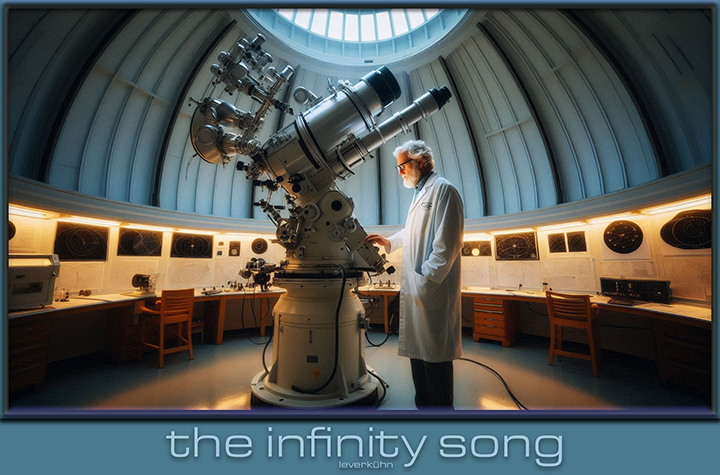
Dietrich Aronson moved from the telescope’s eyepiece to the laptop computer on the rolling tool cart next to the scope’s pier, and he selected the calcium channel filter on the filter wheel, removing the hydrogen-alpha filter from view. After adjusting the new filter’s brightness and contrast on his computer’s screen, he started recording still images of the sun, the computer sequencing over one hundred five second exposures into a single image, automatically aligning and stacking each new image into the emerging whole. As the image ‘developed’ before his eyes he zoomed in one a region on the sun’s limb that was just rotating into view.
One of his graduate students had called him two hours earlier, breathlessly describing the unexplained transit of – something – across the solar disc, and it was, the student claimed, weird. The object was, the student reported, just barely large enough to show up on long exposure images but not visible with the telescope he was using, so Aronson copied the alleged object’s coordinates on the solar disc and then went to work. He went to the SOHO website, the Solar and Heliospheric Observatory, that maintained the 40 year old satellite, imaging the sun through a variety of cameras and filtration methods. He pulled up the latest SDO/HMI magnetogram and looked for unusual distortions in the sun’s magnetosphere – but nothing obvious turned up.
The student’s coordinates put the object on the southwest rim, with movement just detected and her measurements not yet complete.
He punched the intercom and asked his secretary to book some observatory time at Leuschner that afternoon, after his Cosmology 501 seminar concluded, then he went over his lecture notes and emails before heading to the seminar room.
Just after one in the afternoon he set up his laptop beside the solar telescope in the rooftop observatory atop Campbell Hall at U.C. Berkeley, and slewed the scope to the solar disc. He slipped a 5mm Panoptic eyepiece into the diagonal and watched the area for several minutes, and nothing obvious emerged…which wasn’t at all surprising. In this region of the sun, the surface was rotating at close to 490,000 miles per hour and yet features on the surface appeared almost stationary, and even when Mercury transited the sun this planet looked impossibly small. For anything, anything at all to be visible through this telescope the object would need to be massive…truly massive.
So? What might it be? A passing low velocity comet captured by the sun, now, in effect, a new moon orbiting the disc? If so, how long would the object last? When would the object be pulled down into the Sun’s gravity well?
Aronson had always been fascinated by these captures, and not simply because each presented new opportunities to observe and record an object’s demise. With each new demise, more was revealed about how objects interacted with the sun’s gravity well – and that was Aronson’s real passion.
And most people thought that passion very odd indeed.
But everything in the solar system, he told his first year students, interacted with the sun. The solar wind. Solar storms. Sunspots. These were just the most obvious features that most people knew about, but the dynamics of solar interactions was a hot topic at NASA and the ESA these days, because the first interplanetary voyages were just now moving from planning stages to final construction, with the first two Mars mission now less than two years from their planned launch dates. How such spacecraft would be affected by the Sun remained an important area of research.
He changed filters again and started a new imaging run, this time with fifty hydrogen-alpha images, and he still couldn’t see much of anything. Well, not exactly nothing. Something was there, but it was too small to make out. He hooked up a video camera to record through a higher magnification eyepiece and started a new run of one hundred images, still in hydrogen-alpha.
“Yes, there it is.” He saw it now.
He switched to the calcium channel filter again and ran another sequence of 100 images.
And yes, there was most definitely something in this stacked image.
He switched to a 2.5mm eyepiece and tried to center the object in the field of view, but with this much magnification even the slightest movement of the building ruined his images, and he was forced to remember how much things like wind gusts moved buildings not originally designed for serious astronomy. He eventually centered the imaging reticle using a 4mm eyepiece and fired off one hundred new images, then did another sequence of 200, just because that atmosphere was cooperating and he still had a decent image of the sun.
He watched as the first run of 100 images took shape on his screen, then he zoomed in on the object.
“Hello there, little buddy…” he sighed. “Where are you going?”
The second run, the 200 image stack beeped, indicting it was ready. He opened the file and zoomed in on the object.
And in this image the object was perfectly resolved, if still quite small. Hey set the computer loose, telling his AI assistant to try and calculate the size of the object.
And a quick run through the computer revealed that the object was a perfect sphere with a diameter of 250 miles. The object was absorbing the sun’s radiative energy, as well as the sun’s visible light. He began a measurement of the object’s magnetic properties, then sat back – aghast at the results.
“This can’t be…” Aronson sighed as he looked over the sequence of graphs. In the first place, this object was too large to be anything but a minor planet, and so it was certainly too large to be the remnants of a comet. A stray planetoid, perhaps? Wandering through the cosmos over eons of time, and only recently captured by the sun’s intense gravitational pull…? This was a possibility, but something in the back of his mind was screaming right now. Planetoids are dead bodies, nothing but rock and, of most relevance, they have no revolving core so little in the way of magnetic fields.
But this thing was generating an intense magnetic field. Larger than Mercury’s – if these figures were to be believed. And its gravity well was impossibly strong.
‘And this is a perfect sphere,’ he said to himself as he examined one of the onscreen images, ‘and such perfection rarely exists in objects that develop in unstable orbits. Even the Earth isn’t a perfect sphere…so what the hell was this?’
The sun was getting close to the Golden Gate now, about to set for the day, so he called a friend currently working at the Inouye Solar Telescope, at Haleakala Observatory Complex on the island of Maui. After he related what he knew, he was soon watching the live feed from their scope, and then conveniently, Dr. Benji Ozawa appeared in a split screen.
And he too looked perplexed.
“Am I missing something,” Ozawa said, “or does this sphere look too big for the orbit it’s currently in?”
Aronson nodded. “Yes, it certainly looks that way – it’s too close to the photosphere. I have a grad student at Kitt Peak trying to confirm its size, but actually, two other things stand out to me.”
“And those are?”
“Well, the objects speed, for one, but have you ever seen a more perfect sphere?”
“Dietrich, I don’t know what to say – but no. Nothing like this should turn up in a naturally occurring object, and certainly not so close to the photosphere – nothing could withstand that heat, or withstand the gravity well. This is completely without precedent.”
And there they were. The words Aronson had been afraid to say out loud, even if only to himself. “Alright. That was my conclusion as well. We should make sure that we have coverage when the object rotates out of your view.”
The screen flared as intense brightness overwhelmed the optical sensors recording the object.
“What the hell was that?” Ozawa cried.
Aronson turned back to his monitor and saw the sphere inflating like a black balloon, and then a bright flaring light appeared behind the object. And as the light flared the object began accelerating out of its orbit.
+++++
Henry Langston was exhausted.
Between running to Boston three times a week to check on his wife and taking care of his children, itself a full time job that his mother could now barely keep up with, he was running on fumes. And then he had his other children to contend with, too: his students at the college. But, of course, that did not include Hank. Hank and his Atlantic crossing was crushing him.
So at this particular moment he was fuming at his father for having given Hank that stupid boat in the first place. Giving a twelve year old a sailboat, and then encouraging the boy to tackle an Atlantic crossing! Talk about fanning the flames of a child’s imagination…with a goddamn sailboat! He had barely been on speaking terms with his father for years, and now this…
He was in his office, in the Fairchild Physical Sciences Center at Dartmouth College, and he had just finished walking off a plate of pancakes at Lou’s Diner. Served with a side of bacon, of course. Because…why the hell not? Bacon and pancakes were made for each other, and nobody made pancakes like Lou’s. Nobody. Legions of Dartmouth students had gained millions of pounds eating pancakes at Lou’s, because the evil bastards used their own maple syrup, and their butter was locally made, too. Some professors new to the college gained 50 pounds at Lou’s – before they knew what hit them. These days Henry limited himself to one visit a month, and even that was getting hard to walk off.
Right now he was figuring out how to fly to St John’s, Newfoundland, in August, during peak tourist season, and he now knew that meant hopping a little turboprop shuttle down to Boston-Logan, then catching a flight to Toronto, and – with a little luck – catching the last flight of the day out to St John’s. Or, spending the night and taking an early flight the next morning. Then Hank planned to stop in Iceland sometime in August, and he’d need to go there, too. And it looked like his father was going, along with Carter Ash and Emily Stone. Logistically, all these flights were proving to be a nightmare, not to mention the cost involved.
He had Office Hours this afternoon, and he dreaded these snippets of wasted time. Half the students enrolled in his intro to quantum mechanics course didn’t have the math skills to complete even basic problems, so now he and his grad student teaching assistants were teaching remedial calculus during scheduled Lab periods, taking up valuable teaching time with skills that should have been covered in high school. But the real problem students were legacies, their parents either alumnus or wealthy donors, but these days usually both. If the parent in question was a very wealthy donor…well…he had to find a way to get them through the class or face the music. He had come to accept as fact that ‘grade inflation’ had made high school transcripts less than completely useless, but that realization had not made the problem go away. Frustration among faculty was endemic, and it seemed like admissions could do nothing about the problem. Kids everywhere were stupid, and the situation was only getting worse with all the political unrest.
His secretary buzzed; his first student was here and waiting.
“Send him in.”
The student shuffled in and Langston groaned inwardly. ‘Another drone,’ he thought as he took inventory of the typical attire. Armani shirt, pressed slacks and gray suede Cole-Haan loafers, and of course the obligatory Rolex, so this kid’s outfit had cost dear old dad at least a couple grand, and how many more clothes just like these were tossed on the floor in his dorm room…?
And of course the first words out of the boy’s mouth were as predictable as the sunrise:
“Hey, Doc, look…like I wasn’t expecting so much math in this class.”
“I see. What were you expecting?”
“More stuff about space.”
“Space?”
“You know, like Star Wars type stuff.”
“How much calculus did you have in high school?”
“What’s calculus?”
Langston sent the boy packing. Well, he was referred to the remedial math lab his grad students were running this semester, but that boy represented a particularly galling case. His father had given 150 million for a new annex at the Tuck School, Dartmouth’s business school, and so he would pass, with honors, no matter his level of academic underachievement. That was the New World Order speaking, of course. If you had money you succeeded. And if you didn’t? Well then, move along. There’s nothing for you here.
The next student arrived. A girl, and wonder-of-wonders…she looked to be absolutely poor. And Black, which made her a double rarity at this Ivy League college, but when he saw the expression in her roaming eyes he had to smile. She actually seemed impressed to be in a professor’s office…
“Doctor Langston?” she asked timidly.
His smile widened. “Indeed I am. And you are?”
“Olivia Brown? I’m in your 8 a.m. quantum mechanic class?”
“Yes, Miss Brown? What might I help you with this afternoon?”
“Our last quiz? I didn’t show my work on the last two problems so you marked them wrong.”
Technically his TAs graded quizzes, but the girl seemed genuinely hurt, and given the circumstances he wanted to understand why. He turned to his laptop and pulled her file and started to read through.
Graduated high school in Pasadena, California, 4.0 GPA, perfect scores on her SATs and ACTs. Top score on her AP Calculus exam. He looked up and nodded. “Have you ever taken a Wechsler Test, Miss Brown?”
She shook her head. “No, sir. I sure haven’t.”
“How about Stanford-Binet? Does that ring a bell?”
“No, sir?”
He stood and went to the white board and wrote out an equation, a fairly simple ‘solve for X’ problem that almost always tripped up pretenders. “Could you solve for X, please?” he asked.
“2.3,” she replied within a nanosecond.
So he wrote out a much more complex problem, a problem from classical celestial mechanics.
And she fired off the answer. It had not taken her two seconds – and she nailed it.
He returned to his desk and sat heavily, then looked at the journals on his desktop and picked one at random. He opened the journal to an entry related to celestial mechanics, to an article about using stellar drift to calculate radial velocities, and handed it over to her. “Please start reading this. Now, if you please.”
He sat and watched as she started reading, taking perhaps ten seconds per page, turning the pages so rapidly it was almost surreal to watch. Within two minutes she had finished a dense article full of new material she could not have learned before she came into his office, and now he asked her what the article was about.
And she told him. In detail. Exquisite detail, as a matter of fact.
It had taken him almost two hours to read the same article, and he’d had to reread portions to make sure he understood key points, but not Olivia Brown.
“I’m curious, Miss Brown. What do you want to do when you finish school?”
“I want to be an astronaut.”
“I see. Why?”
“I want to travel to a new world, so I…”
The telephone on Langston’s desk rang, an event so out of the ordinary during office hours he literally jumped, but he held up his hand and said “Excuse me,” even as he reached for the phone. Then: “Langston here.”
“Henry? It’s Dietrich, at Berkeley?”
“Aronson? Damn, it’s been a while. What gives?”
“I’m sending you a link at the usual edu email account. Please open it immediately.”
“What’s up?”
“Just open it. Watch it and let me know what you think.”
“Okay, here it is,” Henry said as he opened his laptop and hit the link; the link opened the video viewer and he leaned close to have a look. “What is this? Looks like Mercury transiting the limb…”
“Keep watching.”
The black blob over the sun was moving, and it looked like a perfect sphere. Too perfect.
Then the sphere flared a little.
And then it expanded. Like a balloon inflating.
And then a drive flared and the spaceship began accelerating away from the sun.
“Holy fuck!” Langston cried, jumping back from the screen.
“Ah. So, I take it you understand the dimensions of the problem…?”
“What is that? Or did some kids in the film school over there whip this up for you? An April fools day prank, perhaps?”
“One of my grad students discovered it earlier today. Both Benji Ozawa and I were watching and recording when this happened.”
“How big did it get before the drive activated?”
“Linear expansion. Diameter from Two-hundred and fifty miles to twenty-five hundred miles, in less than two seconds. Really strange EM spectrum shift just before the drive flared.”
“Who else knows?”
“My grad student, Benji and myself.”
“You’d better call Rand, then archive the file in a secure facility. I mean erase it from your computer. No further mention until we can meet and discuss how to proceed.”
“Henry? When can we meet? I mean, we can’t sit on this for long.”
“I know. Call your student and contain things on your end. I’ll call you later tonight.”
Langston hung up the phone, then realized that Olivia Brown was still sitting there, just across the desk from him.
“I hate to ask, but did you hear any of that?” he asked.
She nodded. “Sorry, but I could see everything from here.”
“What do you think you were looking at?”
“A ship. Some kind of ship.”
“Could you tell where its was?”
“The sun.”
“And does that make sense to you?”
“Nothing that close to the photosphere should be able to survive the heat or the gravity, so no, it doesn’t make any sense at all…unless it has something to do with the way it suddenly grew larger?”
“How so?”
“What if it’s some kind of energy field?”
Henry nodded, intrigued. “Maybe.”
“Dr. Langston? Maybe someone you know can track it?”
Normally he’d contact the MPC, the Minor Planet Center, or the CNEOS office at JPL, but doing so would only spread the word, and while Spaceguard telescope centers coordinated through the Spaceguard Foundation, the Foundation cooperated directly with the U.S. Space Force. No one offered a secure means of tracking an object like this – except the Space Force. And Langston was Navy, Navy through and through. And that meant he had a duty to report this to the Space Force. But not yet, not when he wasn’t sure what this was.
“I’m not sure,” he lied. “We lack coordinates, we lack velocity and mass measurements.”
“But you have a velocity vector, Dr. Langston. And those other parameters can be deduced from that.”
He looked at her and sighed. “I know,” he said as he grinned.
“Ah, so it’s the unintended consequences? Is that holding you back…?”
He nodded. “Always. Especially in this political environment.”
“I understand.”
“Do you?”
“I think so,” she added politely.
He looked at her again. Singularly unattractive, chubby and with acne scars on her cheeks, and her eyes were peculiar, too, almost too small, yet she was as nice a student as he had met in years. “Well, I’ll take care of that grade on your quiz. And now, if you’ll excuse me?”
“Okay, and thank you, sir. And don’t worry…I won’t tell anyone.”
He waited for her to leave before calling his closest friend, Rand Alderson. He was teaching at Princeton now, after putting in ten years as a reactor control officer in Virginia class submarines. Alderson had been his student, then a friend, and as both had graduated from Annapolis they both maintained strong ties with Navy physicists.
After Rand opened the file Henry waited for the moment. The moment when the object ballooned in size, then briefly flared before accelerating out of the frame.
“Well?” Henry said.
“Yeah, I just watched it, maybe ten minutes ago.”
“What?” Henry said, both shocked and dismayed.
“Yeah, a Chinese observatory recorded it an hour ago. It’s all over the internet.”
“What?”
“Henry? You getting deaf?”
“What?”
+++++
But no one saw the mysterious object again. Some odd bits and pieces emerged, like news reports of something similar that had popped into view back in the late 1990s. Astronomers had jokingly called it The Death Star, until some kind of energy beam appeared between the object and the sun. Speculation grew rampant after that, but the object didn’t reappear and the matter simply faded from polite conversation within a few weeks.
Yet when Langston looked into it, the same object had reappeared in 2007 and again in 2016, and always in the same location. Like it had literally just popped out of the sun, hung around for a few minutes and then disappeared – jetting off somewhere into the solar system. At the Center for Near-Earth Object Studies office at JPL, they even maintained a Death Star file, where all known material on the phenomenon was kept. And most physicists at CNEOS did indeed think it was a physical phenomenon, probably some kind of globule of solar matter that was spit out by an unknown process deep within the photosphere.
And that was that. No need for secrecy. No unintended consequences to worry about.
So now all Henry Langston had to think about was his twelve year old son intent on sailing a 28 foot boat across the North Atlantic, and his wife, who would probably sleep through the whole thing.
+++++
Dietrich Aronson walked in the side door to his house on Hillegass Avenue, and out of habit he took a tentative sniff of the air. It was Wednesday and that meant a tri-tip roast with spinach souffé and a salad – because the house had smelled like that every Wednesday. For years and years. Like clockwork.
But not now, not tonight. Not after his wife and son had been caught in one of the more explosive riots that had rocked Berkeley and Oakland last autumn. Collateral damage, the Department of Homeland Security called their death. She had called him and left a message, too. She’d taken Aaron, their son, to the pediatrician, to have her check on a persistent eye infection after the first course of antibiotics had proved ineffective. Driving home from the appointment she’d stopped off at the pharmacy, then started to take her usual route home.
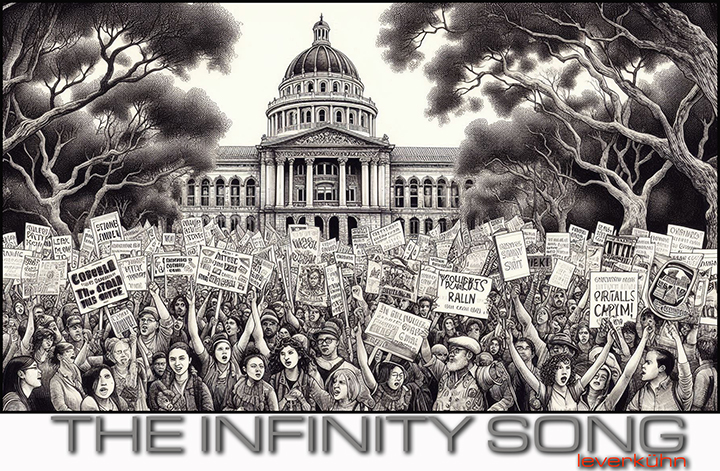
Only there’d been another anti-government protest planned at Bushrod Park that afternoon, and she’d not heard about it. The demonstration had predictably turned violent when government troops arrived and issued ultimatums. When bottles and rocks were thrown at the protesters, these troops fired into the crowd; protesters, many of them military veterans, were waiting on nearby rooftops with weapons of their own, waiting for this very thing to happen. As more shots rang out and as troops fell in this unexpected counterattack, on-scene commanders called for helicopter support – even as three armored columns moved into the area, cutting off any escape routes protesters might have taken. Traffic snarled. Drivers heard gunshots, then helicopters approaching the scene, and orderly chaos degenerated into carnage. Pedestrians caught in the crossfire lent a hellish fury to the chaos, with armed protesters hiding amongst the unarmed protesters and troops firing indiscriminately into the windmilling crowds.
Dana Aronson, a registered nurse, had been tempted to stop and render aid, until machine-gun fire ripped through her Volvo’s roof, grievously injuring her son. She tried to drive through the melee, was trying to get to the nearest hospital when an APC, an Armored Personnel Carrier, simply ran over the top of her Volvo, instantly killing both of them.
Collateral Damage? That was the official finding?
Many in Dietrich Aronson’s family, all originally from Germany, had fled their homes in 1934, after Hitler consolidated power and anti-semitism went from slogan to government policy. Those of their family who remained, those who had claimed that it would all blow over soon and that everything would be okay in just a few months, were never heard from again. A few died in Buchenwald, more in Auschwitz.
And yet, Dietrich Aronson’s family would never have been admitted to the country but for one man’s efforts. Albert Einstein sponsored Dietrich’s grandfather, brought him to Princeton, where he soon found work as a professor, and then as a staff physicist working in Los Alamos on the Manhattan Project. Dietrich’s father was born in New Mexico, as was Dietrich, but he moved to Berkeley after he finished his graduate studies at MIT, while his father remained at Los Alamos. He still loved the area around Los Alamos, and had looked forward to visiting his parents there. Dinners at The Pink Adobe in Santa Fe, walking around the square, buying pottery or copper jewelry from Navajo artisans who set out their wares on blankets in the shade. Santa Fe was an impossibly cultured town, and he’d even learned to ski there.
America had been predictable in those dreamlike postwar years – but America, and Americans, were no longer innocents. Now the country was falling apart, riven by partisan divisions manufactured by politicians and news organizations for decades. Swastikas appeared on synagogues with frightening regularity; endemic gun violence turned hospital emergency rooms into battlefield trauma centers. America, Aronson knew, was like a wounded animal thrashing out, now reaching out and killing everything within reach. Good and evil were minor inconveniences, as bullets knew no difference between the two, as bullets don’t discriminate. The new president had suspended the Second Amendment but by then it was too late, the genie had been out of her bottle too long. There were almost a billion guns in private ownership, and the carnage had been as predictable as it was inevitable.
Universities became places of refuge, neutral ground where neither protesters nor the military were allowed to roam. Faculty and students kept away from ‘areas of active conflict’ like they were areas under quarantine, like areas full of a deadly contagious disease. Police patrolled university perimeters on the ground and in the air, yet it wasn’t long before the background sounds of endemic violence became commonplace, and that violent death became just another feature of urban life, so regularly reported on the evening news that few took note anymore.
When his grandparents had found themselves living within such a calamitous landscape they had packed their suitcases and fled to New Jersey. Now, when Dietrich Aronson looked around and wondered where he might flee to, he saw Israel waiting with open arms. And Israel saw Aronson, too. They wanted him. They were, in fact, actively recruiting him. His family would be welcome there, in the Jewish homeland. They would be safe again, safe from the enduring scourge of antisemitism.
Ignoring, of course, the Palestinian issue.
So when Dietrich Aronson’s wife and son were listed as Collateral Damage and as his world fell apart, it came as no surprise to those who knew him best that his time in America was coming to an end. Such violence, such hatred was, after all, nothing more or less than an echo. Jack-booted, goose-stepping thugs were simply another universal constant.
As any historian would tell you.
+++++
He walked inside and found his daughter, Judy, sitting in the living room, her book bag on the floor beside her chair. She was staring out the window at the park across the street, perhaps lost in memories of happier times.
Judy had told him at breakfast that she would start their dinner when she got in from school, but he had known what he’d find when he came in. His daughter was simmering away in a stew of her own creation, not at all sure when or where her last meal would be served. Helicopters overhead, distant gunfire an everyday occurrence, she was losing sleep and at times could barely concentrate. A friend of his, a psychologist at the university, said she had all the classic symptoms of PTSD, but Dietrich had just scowled when he heard that simplistic diagnosis. That psychologist’s criteria now applied to just about everyone in Berkeley, perhaps everyone living in urban America. Which meant that almost everyone in the country was brittle and battle scarred. Yet what his scientist’s mind told him was simpler to come to terms with: if everyone had PTSD then PTSD was the new norm, which meant it was no longer a disorder but a feature of American life. But the same, he knew, could be said of people living almost anywhere on the planet. State-induced violence was the new norm; peace of mind was just the latest casualty in this latest frontal assault on the mind. Living in fear made people docile and compliant, and fear was easy to manufacture.
He walked into the living room, saw she was reading a book, Herman Wouk’s The Winds of War, and she was crying. He sighed, then walked over and sat next to her.
“Where are you?” he asked.
“What?”
“In the book. Where are you?”
“Oh. Byron has just moved into Aaron Jastrow’s villa, to be near Natalie.”
“Ah.”
“Ah? What’s that mean, Dad?”
“You’ve yet to reach the more relevant parts of the tale. When did you decide to read this one?”
“Mr. Jelenik assigned it.”
“He’s your AP History teacher this year, right?”
She nodded.
“And you’re covering the Holocaust, I take it?”
“No, not really. Our class is focused on U.S. History, and we’ve been looking at populism and isolationism in the 1930s, and how Roosevelt and the Democrats tried to counter the Republicans with legislative workarounds to enact the New Deal. You know, it’s hard to look at all that stuff and not see parallels to today. Everyone talks about how Weimar collapsed and that led to Hitler, yet that whole Make America Great Again thing started here in the thirties, as a response to the Great Depression. Mr. Jelenik thinks it never really went away, that the Republican Party has been working nonstop ever since to undo everything Roosevelt accomplished. Like the South in the Civil War, I guess. They never really admitted defeat because they were never able to see that their cause wasn’t just, and that’s why Blacks are being rounded up now. He thinks all the Blacks and Mexicans will be put in work camps and eventually be sold off as slaves.”
“I’m not sure I’d pay much attention to any historian who’s that sure of the future, Judy. There might be parallels, but nothing predicts the future. There are simply too many variables.”
“But it’s a possibility, right?”
He smiled. “Our universe is filled with endless possibilities, Judy, so yes, what he’s saying is a possibility. Yet I can’t think of a valid way to assign a probability to such an outcome.”
She picked up the book and looked at the cover, a wall of gray storm clouds. “You’ve read this, right?”
“Yes. Several times, actually. It’s an amazing series of love stories set within the collapse of several civilizations, but to me it will always be about Aaron Jastrow’s denialism. And the cost of his ignorance.”
“Ignorance? He seems the very opposite of ignorant, Dad. He’s a professor, like you.”
He chuckled at that. “A learned man, yes, but he also refused to believe what was so obviously unfolding around him. He could admit he was trapped, but he refused to act on that knowledge, which makes him profoundly ignorant in my book. Or simply stupid.”
“Could I ask you a question? I mean, a personal question?”
“Of course?”
“Are you going to move to Israel?”
He leaned back in his overstuffed chair and looked up at the ceiling, then he just shrugged. “I’m not sure, Judy. I’m really not.”
“Then how are you different than Aaron Jastrow?”
The question hit hard and left him breathless, if only because he’d never thought to ask himself that very thing. “I don’t know that I am all that different, but I suppose it’s just very hard to let go of all that we have here. This country took us in, her people sheltered us, nurtured us, and they did not shun us. I have a hard time admitting that this period is over, that America is becoming just like Germany in the 1930s, because the betrayal would be so great.”
“Betrayal?”
“Yes indeed. There is nothing worse than when a people betray their foundational ideas. When people embrace expedience over patience and understanding.”
“Should I finish the book?”
He nodded. “I think so, but you should be prepared to have some cherished assumptions challenged.”
“Is that a bad thing, Dad?”
He shrugged. “No, Judy, that’s a fine thing, as long as you can accept the consequences, because sometimes we have to admit we were wrong about things we felt were very important to us.”
“You sound…I don’t know…skeptical?”
He nodded. “It’s been my experience that most people don’t react that way when exposed to a paradigm shift. Some people are so set in their ways that no amount of information or introspection can alter their perception of the world.”
“Like Aaron Jastrow? In the book?”
“All of the characters confront challenges to their own worldviews. That’s what makes the book so fascinating. Aaron Jastrow will only admit he’s been wrong as he is herded into a gas chamber, but the same goes for Pug and Rhoda. And Leslie Slote, the know-it-all diplomat. His epiphany is the most fascinating. To me, anyway.”
“What about Natalie? Does she change, too? She seems like a 1930s version of a liberated woman, making her own choices, living it up in Paris, dating a diplomat…”
“Oh, she’s the vessel into which the story is poured, no doubt about that, but she changes too. I’d rather not give away too much, but I think she’s changed most of all when she decides to stay with Aaron. It’s best to think of all these characters as leaves blown around as a storm approaches, but remember that leaves by their very nature are hapless, they are doomed to respond, they can never act on their own. I often think that Mr. Wouk is telling us that this is true of most people.”
“Most people? Dad, you don’t mean that, do you?”
“What I think is of no importance, Judy. What you take from him is all that matters. But now, we have something much more important to consider.”
“Oh?”
“Yes, would you care to help me make our supper?”
+++++
“Do you know…I remember the first night you spent in this room, after your mother and I came home from the hospital with you. Your crib was over there,” he said, pointing two a spot near the window, “so the afternoon sunlight could fall on you. But look at you now. Here you are, graduating high school, and with honors. What a day this is.”
Judy slipped into her gown, then tried on the tasseled mortarboard. “Do I look like a scholar?” she asked, dipping in a little mock curtsy, then blowing the tassel off her face.
“A scholar? Hm-m. Now there’s a thought…”
“Dad? You seem preoccupied today. Is something going on at work?”
Aronson smiled. “Judy, there is always something going on in my little world, but today is your day, not mine.”
“So? What’s going on? You looked upset at breakfast.”
He winced, looked away, but then looked at her and shrugged with a carefree smile. “That world is of no importance today, my Judy Blue Eyes. Now, when do we need to be at the stadium?”
“Doesn’t it bother you that my eyes are kind of brownish-green?”
“It was your mother’s favorite song.”
“So, was she disappointed?”
“In you? No, never. She was so proud of you, in fact, and so in love with you both…”
With a name like Aronson, she would have been among the first to walk across the stage and accept her diploma, but such was not the case that evening. She was the class valedictorian and as such was expected to give a speech, a speech that was typically all about how the members of her class would now go forth and confront an uncertain future, and that they alone would make all the difference. The world would be a better place because of their efforts, or so the usual speech went. So, she wasn’t to give a speech, not really; her job was to lead one last pep rally. One last cheer before the big game, the game of life. But when she was selected as valedictorian she had immediately turned away from giving such a speech. It was pablum, such words hollow and meaningless in the face of things now.
So she had revisited The Winds of War in her speech, the things she had learned about ignoring reality even as it closes in on you, then thrown in some words of anarchic wisdom penned by Jerry Rubin and Tom Hayden, leftist political activists from the sixties who had helped put Berkeley on the map, words that were not met with enthusiasm by her school’s principal or the district’s superintendent. But the crowd loved it, her father, too, but he had always been something of a closet radical. But a flame-throwing, radical-hippie astrophysicist, however, he was not.
She had always wanted to go skiing in Europe, and her graduation present was just such a trip. Aronson decided they would go to Switzerland together over Christmas; if the weather was too warm they would just grab trains and visit museums when and where they could, but they had been skiing together since she’d learned to walk. And when he told Judy about the trip she went ballistic with effervescent happiness, and so he was happy about the trip, too. In the meantime she would start her usual summer job over the weekend, still working as a lifeguard at the King Pool, over on Hopkins Street. This would be her third summer doing the same job, and she still enjoyed working there.
But Dietrich Aronson had another set of airline tickets. From Zurich to Tel Aviv. For two people. So her observations of him on the day of her graduation had proven spot on. There had indeed been something going on.
Yet five days ago the object had reappeared, and right where the last one first appeared. And the little groups of astronomers and physicists working on these latest observations were only now coming to grips with the implications of their most recent observations. Teams from Harvard, Cal Tech, Berkeley, and Lyon had each observed five objects emerge from the same spot on the surface of the sun, and all five were now enroute to Earth.
© 2025 adrian leverkühn | abw | this is a work of fiction, plain and simple, and the next part will drop in a week or so. Thanks for dropping by. See you next time.
 Adrian Leverkühn Writes