
Apologies up front, but I sort of rushed through this chapter so hope it isn’t too rough. Another procedure on the good eye tomorrow and I always get spooked before these little needles in the eyeball days. I guess it comes down to red lines in the sand, because finishing out my life while both blind and deaf was never in my game plan, and blindness is an ever present risk with this procedure. I tend to write on days like these almost as if they are the last thing I’ll ever write, so there’s a quick snapshot of my state of mind.
Music. Ah, where to begin, because this is an odd tale too. After a botched search warrant turned into a firefight inside a little house one night, I came out deaf in the left ear and my hearing in that ear never came back. What’s odd is that now I’m slowly losing hearing on the right side too, so slowly going deaf, and that makes music a challenge. Why, you ask? Because I can’t hear the very high or low pitches in the right ear’s track, and in stereo headphones I can’t hear the left channel at all, which means guitars and or strings, as well as bass lines or bass drums are simply absent. Yet…if I play music I’m familiar with I hear it all, every note…because the brain has committed those notes to memory and somehow, as my brain processes the incoming signal it just fills in the blanks. Fascinating, as Mr. Spock would say. That often means, however, that I stay stuck inside a musical rut. My brain struggles to fill in the gaps when I listen to new music, though it tries. But old familiar music is like a warm blanket on a cold night, isn’t it?
So, what’s on my musical radar tonight? Randy Newman, naturally enough. Falling in Love is a classic, while I Will Go Sailing No More is a bit more whimsical and, indeed, almost philosophical. Something Special lives up to its name. Baltimore is a fun piano ballad. If into Robert Redford’s The Natural, Newman scored the soundtrack and I always get lost in that one. For a change, visit Neil Young again. Old Man is meditative, while the searing pain in The Needle and The Damage Done never fails to leave you wondering – was that just a song? Young might lead you back to Crosby Stills and Nash, to an album titled Replay, kind of a “best of” compilation that will put you in the zone and keep you there.
Anyway, thanks for listening to an old man bitch about being an old man. Now, grab some tea and have a read, ’cause you ain’t gettin’ any younger, you know…?
The Infinity Song
Part I, Chapter Two
Rand Alderson belonged to the human race. He was a Homo Sapiens, he walked upright, had horizontally opposed thumbs and all the other hallmarks of the species. And yet, Rand Alderson hated himself, and all humanity, for these things.
Because he could not stand the human race, nor could he tolerate the company of his fellow man, at least not for very long. Which, curiously, had made education an odd career choice for a garden variety misanthrope like Alderson. Perhaps he had always hated his fellow man, or perhaps dealing with children in a college setting had soured him on the species. The truth of the matter was he just didn’t care. Girl, boy, young or old, Rand was an equal opportunity hater, and no one escaped his ire. His teaching assistants knew not approach him for anything early in the morning, and any requests were best made in writing. After two weeks in his classroom his students either feared or detested him. Often both. Yet he was the most gifted physicist of his generation, and peers regarded him as an Einstein caliber theorist.
And woe be unto the freshman drone entering his quantum cosmology class unprepared academically, for Alderson simply encouraged the student to drop the class. If that approach failed, he was not at all reluctant to drop a failing grade on any student no performing to standard, no matter the parents wealth and standing, and no matter the desperate entreaties from Princeton’s administration. As a result, word spread around campus: Don’t fuck with Alderson. It won’t do any good.
When students entered his office they were greeted with every edifice of naval rank imaginable.Two 6 foot long models of nuclear submarines adorned the wall behind his desk; the larger of the two was a scale model of SSN-23, the U.S.S. Jimmy Carter, the third and final Sea Wolf Class fast attack submarine, on which he first served as a reactor control officer, before taking over as the ship’s XO, or executive officer. The second model was of SSN-776, the U.S.S. Hawaii, on which he served as the ship’s XO, before ‘retiring’ from fleet duties.
Among Alderson’s many other, and ridiculously varied accomplishments, examples of which adorned all his walls and bookcases, were the wings of a Naval Aviator, completion of the Test Pilot School at Patuxent River NAS, and featured prominently on one wall, his completion of Astronaut Training Class 229c, with highest honors. Alderson had crammed all this into one seventeen year long career in the Navy, retiring just before launching as a payload specialist on three of the last five shuttle missions. When the shuttle program was unceremoniously canceled, Rand left NASA and went to Princeton, and there he started teaching, and there his hatred of all things human began in earnest.
In appearance most of his students thought he looked just like Superman, the one from the 1970s, so of course his first year courses were overflowing with of all kinds of aspiring female physicists. Until these girls read through the course requirements and mathematical skills required to navigate the class’s coursework. Then, by the second or third meeting of these classes, there remained perhaps ten students, maybe an even dozen. By the end of the first month that number had usually dwindled to five or six. Few of these remaining students ever earned anything less than top marks, because, frankly, the only students remaining were usually genius level savants, people who tended to be just like Alderson – and just as socially maladjusted. In a word, Alderson presided over a classroom full of misanthropic – all assholes in the extreme.
Which is not to say that Alderson did not have friends.
Of course he did.
Henry Langston was certainly one friend, and perhaps there were a few at NASA, but he’d had no wives, or ex-wives, and no girlfriends – or even boyfriends. Anyone forced to spend much time around him soon understood why. He had dark, piercing eyes, peregrine eyes, and unless pressed he said nothing. When forced to attend faculty parties or department get-togethers, he stood ramrod straight with a fixed smile glued firmly to his chiseled face, his steely gaze daring anyone to approach and engage in idle chit-chat. New faculty members, women for the most part, always had a try at him, all soon retreating from his company, a few visibly shaken by the experience.
Yet his students, the ones who managed to survive the first month or so in his intro classes, all adored him. He was the best teacher ever. Without peer. And no one at the university understood why.
Here was a misanthrope, the very essence social malfeasance, yet surrounded by doting students. In the choice words of the esteemed, august president of the university: “What the fuck is up with that…?”
It was simple, really. As simple as it was incomprehensible.
When class was at an end and the lesson for the day yet barely understood, Rand Alderson loved to tell ‘war stories’ to his classes. Stories of his exploits in submarines and experimental aircraft, and in space shuttles. Yet every story had a point, the sharp tip of a spear aimed at a very complex subject, and by way of his stories he made his point. The most complex lessons, so byzantine that they had stood as riddles for hundreds of years, were reduced to a few well chosen anecdotes and the solution was soon plain to see. The problem was, of course, time. Or the lack thereof.
For the 0800 intro class, when the clock reached 9:15 their period was nominally over. Students were already waiting outside the door, waiting for Alderson’s students to vacate the classroom, so on Mondays, Wednesdays and Fridays his class adjourned to a nearby diner for coffee and an omelet, while on Tuesday and Thursday afternoons he and his students trooped over to The Dinky Bar & Kitchen for spicy tuna rolls and chicken katsu salad. When the discussions got deep enough, he and his students walked to his house and took up the discussion in his living room, and some of these Socratic dialogues lasted hours, a few even lasted days. One or two had been going on for years.
His living room, of course, had a blackboard.
Favored students would often find an invitation to take up residence in one of the many vacant bedrooms in the old victorian mansion that Alderson called home. Though it belonged to the university, there were no restrictions on who could reside there, and the Alderson house usually had seven or so students living within the warren of unused rooms on the second and third floors. Discussions on all things cosmological were ongoing. Major innovations in physics and cosmology were routinely made in the Alderson kitchen, usually over bagels and lox and fresh squeezed orange juice.
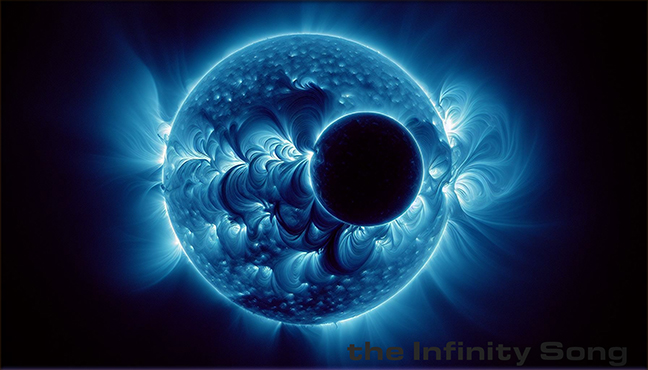
And one Tuesday afternoon, while his entourage of students was watching the live feed from a solar telescope in eastern China, his friend Henry Langston called, while they were in the middle of an animated discussion about the nature and possible origins of the black sphere emerging from the solar disc.
A second incoming alert chimed. Dietrich Aronson was also calling from UC Berkeley, and he now wanted to FaceTime.
And soon Aronson, Langston, and Alderson were engaged in a lively discussion – with a living room full of interested students looking on and taking part. They all watched replays of the black sphere ballooning in size, then a drive of some sort flaring. Spectrum analyses were needed, the students declared, electromagnetic and gravimetric field analyses as well. One group of students settled on determining the objects departure vector, another group began working on an analysis of the drives chemical makeup. Benji Ozawa was invited to join the discussion from Hawaii, then astrophysicists from the UK, Japan, and Germany were brought onboard.
And by midnight everyone was sure of two things.
Whatever it was, it wasn’t a naturally occurring phenomenon.
And the latest object’s departure vector revealed that the object was heading somewhere between the Earth and the Moon.
And it was decided that the next task was to track the object while it was in transit so that additional studies could be made.
And one last decision was made. A working group was established and would convene in Berkeley in August, and interested students were encouraged to attend.
+++++
Henry Langston was the first to arrive, and he had asked just one student to come along: a chubby, unprepossessing girl from Pasadena and a freshman at Dartmouth. Olivia Brown was her name, and Langston allowed how he’d recently had the girl take multiple intelligence tests; her scores were so far off the distribution curves on both tests that she had entered uncharted territory. He told Dietrich Aronson that he had brought her along as a kind of recording device; she remembered everything she read, or heard. As. In. Everything. Her math skills were off the charts, and Henry considered her abilities next level. So, almost as good as his.
Rand Alderson came by himself, odd given his usual coterie of students – past and present. He told Aronson that the stakes were too high this time to allow students to meddle, and he objected to Olivia’s presence. Dietrich Aronson, on the other hand, had asked his latest superstar graduate student to attend, because he too thought her skills were next level.
And her name was Jenna. Jenna Goodman.
+++++
And Jenna Goodman was the opposite of chubby and unprepossessing. She had red hair and blue eyes, she had to be over six feet tall and most of that height seemed to be in her legs which, once seen, you could never forget. Even Rand Alderson. When he first saw Goodman he did a double take, then his eyes trained on her red high heels. “Physicists don’t wear shoes like that,” he whispered to Henry Langston, “do they?”
“I feel certain that yes, that’s been the case up to now.”
“Fuck me,” Alderson whispered. “I’d like some of that. For an after dinner drink, I think.”
“Be careful what you wish for,” Henry replied, rolling his eyes as Dietrich walked with her as they came over for introductions. Which did not go as expected.
“Henry? Rand? I’d like you to meet Jenna Goodman.”
Langston reached out with his right hand and she took it with a demure smile, and Henry thought the woman looked somewhat like a red-headed Marilyn Monroe, only with much larger breasts. She was wearing a maroon leather jacket – apparently with nothing underneath – and the jacket seemed about two sizes too small…with the net result being that the woman’s cleavage reminded him of the Grand Canyon.
Alderson hesitated before taking her hand, and Goodman seized the opportunity to strike first.
“I’ve heard, Dr. Alderson, that the color of a woman’s lingerie ofter refers to her own unique sexual proclivities. I wonder, which color do you prefer…?”
Rand seemed to reel backwards under the weight of this unplanned assault, but he regrouped quickly. “I really don’t give a rat’s ass,” he said, his demeanor now cross, and starkly so, like he had been offended by her words.
But she looked down a little, then she lowered her voice a little, too. “Oh, but of course you do,” she sighed, and Henry thought the words sounded almost sarcastic and patronizing, yet in their way, extremely seductive.
Rand looked at Dietrich and scowled; Dietrich looked at Rand and smiled. Rand was angry. Dietrich looked just like he was in on the joke, like he and Jenna had done this just to fluster Alderson. And they had. Deliberately. And it had worked, because everyone knew that Alderson was a prude with absolutely no sense of humor.
Of course, almost everyone was wrong. Henry knew Rand better than anyone and had never thought of him as prudish, but in that moment his attention had been directed at the redhead.
“So, Dietrich,” Henry said, “tell us about your associate.”
“Oh, Henry, our Jenna is something of a polymath. She has an M.D. as well as a Ph.D., and only recently became interested in astrophysics.”
Henry looked at the girl and nodded. “I see. And what is your doctorate in, if I might ask?”
“Artificial Intelligence,” Jenna replied – without the slightest trace of irony.
“Ah, well then, we may have use of your expertise.”
“I’m counting on it,” she said, smiling brightly – even as she walked over to Alderson and kissed him on the cheek.
Alderson blushed but did not turn away from her. “What was that for?” he asked.
“For being such a good sport. Dietrich and some of the other astronomers have been cooking this up for weeks.”
“Why? To see what kind of reaction you might get out of me?” Rand said, casting an evil eye at Dietrich.
“Yes indeed, you old stick in the mud,” Aronson said. “We just wanted to see if you actually still had a pulse.”
Alderson growled as he stomped off; Jenna watched and grinned knowingly, just before she took off after him. Almost like she’d…planned it that way…
+++++
“Where are they now?” Alderson asked, looking at the plot of magnetic disturbances as the five objects advanced across the inner solar system.
“Well, one thing seems clear,” Jenna said, “they’re not coming here. One appears to be heading directly to the L3 Lagrange Point, the other four appear to be heading towards Saturn. We need to refine the plot, but at least one model shows this second group heading towards Titan.”
“Titan?” Langston scoffed. “Now that makes no sense at all, unless they need methane.”
“Need?” Aronson asked.
“Why not?” Olivia Brown said. “It breaks down readily into carbon dioxide and water, and from there you can release pure oxygen. Look at the spectral analyses of their drives. A pure hydrogen line, so they’re burning hydrogen. And if they’re air-breathers and need oxygen, well, they get that too, and Titan offers that in almost unlimited quantities.”
“Has anyone bothered to get a scope on L3?” Langston asked.
No one had.
Langston shook his head. “Doesn’t Benji know a bunch of people over at the Subaru scope? An optical-infrared observation might be useful.”
“What about an EM scan?” Olivia asked. “We can do that right now, from here.”
Aronson turned to his desktop computer and looked at the sky-map. “We could task either the MRO or Swarm right not. If we wait five hours we could get Hubble-2 to image and scan the area.”
“Why not get all three? To both image and scan around L3?” Alderson asked.
“All three it is,” Aronson sighed as he typed the requests. And as he was finishing up the new Hubble tasking, he finally hit the enter button…
…and the power grid failed.
From San Diego to Seattle, and as far east as Denver, Colorado.
A red emergency light popped on inside the observatory dome and Aronson walked over to open the door, and when he stepped out on the rooftop he gasped. He looked up and saw stars overhead, and that rarely happened in the Bay Area. Everyone filed out one by one and everyone’s eyes immediately went to the heavens.
“Damn! Look at that!” Henry said as he pointed south, towards San Francisco International Airport. A massive four engined airliner was gliding silently towards the bay, its engines out, gliding silently towards a water landing in the bay. But then the lights came back on. Around the city, then they saw several airliners coming back online. Thee huge airliner managed to get its engines running again and climbed away from the water.
“Well, fuck-a-doodle-do,” Aronson sighed. “Someone sure didn’t like that request.”
Olivia Brown shivered once and shook her head. “And that means…they’re watching us?”
“So it would seem,” Rand said, still looking up at the sky.
+++++
Initial measurements of the objects’ velocities put them firmly in the sub-light speed realm; these observations were further refined as they sped past Mercury. They were hardly moving any faster than an Artemis lunar mission so the group of four would take years to reach Titan. The lone object heading to the L3 Lagrange Point seemed to be moving along even more sedately, and might make it to the region in four years…and Rand Alderson thought that suspicious as hell.
“Why so slow? Why…when they are obviously capable of much greater velocities?”
“Move along, folks. Nothing to see here,” Henry quipped. “We might ignore it that way.”
“That’s possible. Just bore us to death…”
“Or maybe they’re in no hurry,” Olivia Brown added.
Rand turned to her. “Okay, but what are some reasons why they’d do that. Why would a faster than light-speed capable civilization deliberately go so slow?”
“Because they can’t,” Langston mused aloud. “I mean, think about it. These ships literally pop out of the sun – out of the sun, dammit – then just putter along slowly across the inner solar system. And when they popped out of the sun they were inside some kind of field. And for arguments sake, let’s say the field protects them from temperatures inside the photosphere…”
Rand nodded. “Meaning they’re using stars to move between solar systems. Elegant, even if it is quite improbable.”
“Is something like that even possible?” Jenna Goodman asked.
“It is if there are connections between stars, or even pairs of stars. If, for example, some sort of connection between stars remained after their birth. As our bodies are crisscrossed by all the various networks needed to sustain our lives. To pick just one example, our neural networks, and what if interstellar space is crisscrossed by an analogous network. Neural impulses move at quite an astonishing speed, you know, while all our other fluids move along quite a bit more slowly, but what if interstellar objects could obtain what we would consider impossible speeds by traveling along such a network?”
“Why wouldn’t we have discovered something like that by now?”Dietrich asked.
“Perhaps because no one’s ever had any reason to look,” Henry sighed.
+++++
Henry Langston was off in Newfoundland with his son when a new object appeared – and at the same location on the solar limb as the previously observed appearances, but this time the Berkeley Working Group, as the group was now called, was ready for it.
It had been Henry’s idea that solar quakes might precede an unexpected appearance, and as there were already dozens of satellites monitoring the sun for everything from quakes to sunspot formation to coronal mass ejections, getting notification hadn’t been the problem. What was the greatest issue was the sheer number of quakes.
So they had all the relevant satellites monitor just the one region of the southwest limb, all sensors focused where the earlier objects had emerged. There were spurious quakes in this region too, but every time the alarm sounded someone from the group began watching. More importantly, the on-duty astronomer would start monitoring all the other electro-magnetic bands, searching for any new clues that might emerge with the next object.
And a day after Henry departed for St. John’s the alarm sounded while Olivia Brown was monitoring. An object appeared and a cursory analysis revealed that a huge flare of gamma radiation, then a brief flare of x-rays, preceded the object’s sudden appearance on the sun’s surface. More important still, several high definition cameras were now focused on the object.
And what they recorded was stunning.
The object emerged from the sun at blistering velocity, enveloped within the same black cocoon seen before. The longer the object remained near the surface, the larger the balloon became, and the color of the balloon changed, too. When its emerged, the lozenge-shaped balloon was pure black, obsidian black, but as it grew in size a fringe of color appeared, and the colors changed too, shifting right up the usual spectrum of red-orange-yellow-green and on to blue. As each color appeared Olivia asked why not indigo and violet?
The answer, she surmised, lay in the nature of the balloon, or field. As the field absorbed heat it increased in size, with more surface area able to absorb more heat. But as the field absorbed more energy, as it heated internally, that heat began to register as a color shift with, she presumed, indigo and violet indicating the limits of the field’s ability to absorb more energy.
This hypothesis seemed to be confirmed as the object moved away from the Sun over the next several hours, as the colored fringe slowly reverted to red, or to a cooler state, the further the object traveled from the photosphere. By the next morning the object was back to obsidian again, only this object was heading to Earth, and at fantastic velocities.
“When will it arrive?” Rand asked.
“Assuming constant acceleration to the midpoint,” Olivia stated, “and then constant deceleration until arriving at one of two possible orbital insertion points, it should arrive by the end of the month.”
Rand looked at Dietrich. “It’s time to call your Space Force contacts,” he sighed, “and I’ll call Henry. What time is it in Newfoundland, by the way?”
+++++
Jenna Goodman was sitting across from Rand, studying his many facial expressions in the candlelight. She appeared to enjoy this; at least Rand thought she did. He knew for a fact that he enjoyed watching her. Everything about her, as a matter of fact.
If he had ever had an image in his mind of the perfect female, she was it. Her blazing red hair, the cobalt blue eyes, the impossibly long legs and the voluptuous breasts all screamed out to him: ‘She’s the one! She’s it! Don’t let this one get away!’ The fact that she was so academically accomplished, and at such a young age, only made her that much more attractive to him. Indeed, she seemed to be so academically gifted that all the other men who had approached her over the summer soon beat a hasty retreat. Her intellect was indeed that imposing.
‘Almost,’ he thought, ‘as imposing as her breasts.’
“A penny for your thoughts?” she purred.
He looked her in the eye and smiled. “I was thinking how beautiful you are right now. Your eyes, in the candlelight, seem almost plum colored.”
“I take it you like plums?”
He nodded. “The juicier the better.”
Her smile brightened. “Sometimes you surprise me.”
“Oh? Now why does that surprise me?”
“I never know what to expect with you, Rand. One minute you’re the essence of puritanism, and yet the next…”
“Puritanism? Really?”
She nodded. “Yes. Sorry. But sometimes, yes. But then you become almost like a teenager.”
“You have something against teenagers?”
“No, not at all.”
“So I asked you once before, but have you been married?”
She shook her head. “No. You?”
“No. I came close once. In some respects you remind me of her.”
“Oh? When was this?”
“I think I was in middle school. Probably 12 years old, maybe 13. I was sure she was the one, too.”
“What happened?”
“We didn’t find out why until the end of the year, but she stopped coming to class sometime that winter. Turned out she had a brain tumor, but I didn’t know what that was. My grandmother died of lung cancer about that time, so that was the first time I’d heard about cancer. Anyway, I think I grew afraid of relationships after that.”
“Of someone dying?”
He nodded. “Yes. Which is ironic, I think, because I have no interest in dying, or in death.”
“So, you plan on living forever?” she asked, smiling.
“I do. Yes. When my time comes I intend to download my brain into a vast computer and then rule the world, or, failing that, at least a very large brothel.”
She smiled again.
“God, there’s something about you. Your smile, the way your eyes light up when you smile. I hate to resort to clichés, but I could fall into your eyes and get lost in there.”
“Nothing wrong with a cliché if it’s what you feel.”
He nodded. “I think, what I’m trying to say…is that I’d really like to spend some time with you. Get to know you better.”
She nodded. “I’d like that too.”
“You know, I hate to ask, but do you live around here?”
“No. Across the bay, in Palo Alto.”
“Ah. Stanford?”
“Yes. That’s right.”
“That’s quite a drive to make every night, isn’t it?”
She nodded.
“Maybe you could stay with me?”
“Maybe,” she sighed, looking away.
“I’m so sorry. I’ve overstepped my bounds and I do apologize…”
“No, no, Rand, it’s not that. It’s just that I just feel so run down after a full day up here with Dietrich and the rest of these people. Like I just need to go home and, well, maybe recharge my batteries, if you know what I mean.”
He nodded. “Yes, I sure do.”
They picked at their food for a few minutes, then she put her fork down and looked at Rand. “What do you think these objects are?”
He shrugged. “It’s not so much the what they are, but who they are that concerns me. Who knows how long they’ve been coming to our solar system, let alone why they’ve chosen not to make contact, but I don’t like the answers that keep popping up in my mind.”
“Do you believe they’re hostile?”
“Again, I have, we have, no way of knowing that, do we? Yet that alone speaks volumes. Either they’ve chosen to ignore us or they’re reluctant to make contact, and if that’s the case I’d sure like to know why?”
“What if you could ask them that question and you didn’t like their answer. Then what?”
“Then our job, or even my job, is to help us achieve technological parity with them as quickly as possible.”
She nodded. “Do you really think something like that is possible?”
“Why not. We get our hands on the technology and then get to work. By that I mean reverse engineer their technology.”
“Have you heard about projects doing just that? I mean people like Boeing and Lockheed…?”
“Only rumors. Or, really, rumors of rumors. Hearsay, in other words. So no, I don’t put much credence in that nonsense. Besides, I’m not really an engineer.”
“I’ve read your resumé, Rand. And your dissertation. Self-modesty isn’t becoming in discussions like this.”
“Oh? Are we having a discussion? I kind of thought this was, oh, I don’t know, like a date?”
“It is, Rand. I just need to know how I can best support you if the matter comes up.”
“Ah. Well, there you have it. So, not a date. Again, I’m sorry; it seems that I’ve misconstrued the situation. It won’t happen again.”
He summoned their waiter and paid the bill, then made his excuses.
And all the while Jenna simply looked at him, measuring his vital signs, analyzing his reasoning, examining his sense of morality. She watched him get up and leave, noted how hurt he seemed to be, then how angry he became as his ego took over.
He was, she decided, interesting and worth further study, if only because his ability to reason seemed to weaken when other emotions interfered with his thought processes. She transmitted her observations and impressions to the tiny blue sphere hovering near the ceiling, then stood to leave.
+++++
“Henry? What are we really doing here? I mean, what are we accomplishing?”
Henry was jet-lagged. He’d just flown from Newfoundland to Boston, spent two days with his kids and his mother, then jetted to San Francisco – only to find Rand grouchy and Dietrich leery. The mood had changed while he was in Canada, and he’d learned that Olivia Brown had soured on the mood and flown down to Pasadena to spend time with her mother. Because, according to Dietrich, everything had gone downhill after Rand and Jenna went out on a date. And that just didn’t make sense. Rand didn’t go out on dates.
At least he never had.
But Rand was also reaching “a certain age.” What was once called “middle-aged-crazy.” If things kept deteriorating at this pace, pretty soon Rand would show up wearing Ray-Bans and driving a yellow Porsche 911, and anyone wearing a skirt would be in mortal danger.
At least that’s what Dietrich told him just after he got back on campus in Berkeley.
And now this? Rand wondering what he was accomplishing here? That just didn’t fit with the Rand he knew. That Rand was a scientist, but more than that, he was an explorer. He was driven by an insatiable curiosity, or at least he had been. So…was Olivia right? Had he finally, at long last, fallen into the clutches of testosterone driven need?
“I don’t know, Rand. What do you think we’ve accomplished?”
“Not a damn thing. Not a goddamned thing.”
“Well then, maybe you should go home. Let things settle down. Maybe you’ll see things differently.”
“Or maybe I won’t.”
“Yeah. I suppose that’s equally possible.”
“So, are you going to Iceland next week?”
Henry nodded. “Yup. You ever been to Reykjavik?”
“Once, yeah. Coming back from Faslane on a C-9. We had a mechanical and put in at Keflavik, stayed there a couple of days. Pretty girls.”
“Yeah. I’ve heard that.” And that confirmed it, Henry told himself. The Rand he knew wouldn’t have mentioned the girls anywhere, let alone when transiting to or from a deployment. So…Olivia was, as usual, right. But…when had she been wrong? “You seeing anyone back in New Jersey?” he asked.
“No, nothing serious. Just a couple of one night stands last semester.”
“Do I even want to know?”
“You? Strait-laced Langston? I doubt it.”
“You banging stuff on campus?”
“Sure. Why the fuck not, Henry? It’s a target rich environment, ya know?”
“Yeah, I guess.”
“You flying to Logan? Changing planes there?”
“Yup.”
“What’s your flight number. I’ll see if I can book something on the same flight. Give us some time to get catch up on old times.”
“Sure. Yeah. Sounds good.”
And just then both their phones pinged as an incoming text arrived. Both fished phones out of coat pockets and both looked at the exact same message – from Dietrich.
“Images from Lagrange Point coming in now.”
Henry looked over at the Astronomy Building and nodded. “You still interested?”
“No, not really, but what the hell. Let’s go.”
+++++
Henry noticed that Rand stood on one side of the observatory image processing lab, and Jenna Goodman the other, which handily confirmed Olivia’s second observation about Rand. ‘Oh well,’ he thought, ‘c’est la vie.’ He’d never thought of Rand falling into this kind of mental trap, but all the proof necessary was in this hasty pudding.
Dietrich turned to the Group and addressed them as the AI in the campus computer processed and stacked the images. Final processing would probably take an hour, but a rough image would be ready soon. “These images are coming straight from Hubble, so they’re unfiltered and, hopefully, uncensored,” he added. Henry looked at Rand through the darkness, and sure enough Rand was casting little sidelong glances at Jenna – and he groaned inwardly as this new truth kept hammering their old relationship. The idea of Rand seducing students was bad enough, but letting a woman interfere with something as consequential as this mission…? He still couldn’t believe it. Maybe he didn’t want to believe it.
The computer pinged and an image appeared.
And as a group everyone in the room gasped and jumped back. All, that is, but Jenna Goodman.
Because there on the screen was – something – huge. Beyond huge. It wasn’t a ship, either. It was simply too big. Dietrich asked the AI to try and assign a scale so the group would know what they were looking at.
And the computer thought a moment, and then replied: “Best initial estimate: length 500 miles, breadth, 300 miles, depth, 50 miles.” Albedo, or how much sunlight was being reflected off an average of the visible surfaces, was 73 percent, or extremely bright. And bright white, too. With one highly reflective surface aspect looking almost like glass.
“Those aren’t solar panels, are they?” Rand asked.
And the AI thought about that for a moment, then replied. “No. The black area is translucent. Spectrum indicates a high density of silicates. Only isolated areas of electro-magnetic radiation visible.”
“So…are we looking at windows?” Henry sighed.
Jenna spoke next. “Windows, but more like a ceiling. A ceiling, or a roof made of a glass-like material. And note the curve here,” she said standing next to the 72 inch monitor. “We need a chord and ord to work out this radius, because I think this looks like a space station that’s currently under construction.”
Everyone leaned forward and studied the object…
…and then the power failed again.
And once again the computer crashed. And by the time backups kicked in the image was lost. Every effort to retrieve it failed. When Dietrich queried SSTI he learned that Hubble had no record of having imaged that region of the sky, none whatsoever.
“Somebody sure didn’t want us to see that facility,” Henry sighed.
“That’s the second time, too,” Rand said. “Dietrich? Poke your head outside and see if it’s the whole city again.”
It was. And once again the entire west coast and inland as far as Denver.
“You know what? That damn thing might be big enough, and bright enough, to see in our refractor.”
The AI responded. “No, Dr. Dietrich, it is below the current seeing threshold given current atmospheric conditions.”
“Well, we saw it. We all did,” Rand said. “Now the question is what do we do with that knowledge?”
“We wait and see what the objects heading that way do,” Dietrich advised.
“And what about the object headed this way?” Rand added. “When does it arrive?”
The AI responded. “The object will enter a circumpolar orbit at 23:14 hours pacific daylight time on Saturday, 25 August, 2035.”
“Has SpaceGuard or the Space Force picked up the object yet?”
The AI thought for a full minute that time. “There are no indications either organization has changed alert status or monitoring schedules, so that appears unlikely.”
“Will the object overfly any strategic installations?” Rand asked next.
“On it’s first orbit, the object will be over the US Navy’s nuclear submarine base in Puget Sound, Washington, Vandenberg Air Force Base on the central California Coast, and the US Navy’s extensive facilities in San Diego, California. Facilities of the Chilean Navy will also be overflown. The object will then cross Antarctica and depart the landmass near Davis Station before overflights of Indian Air Force bases at Bhuj and Bathinda. Multiple military airfields in Afghanistan, Kyrgyzstan, and the Ural Mountains over Russia are next, then multiple Russian naval facilities in the Kara Sea region. The last facility overflown on the object’s first orbit is the Russian Air Force Base at Nagurskoye, and although there are currently no air assets detailed to this facility, there are multiple ground based surveillance radars in operation here, all capable of monitoring the object as it transits the polar region.”
“What’s the latest projected arrival date for the other objects reaching L3?”
“25 May, 2037, at 00: 33 hours Pacific Daylight Time.”
“Have you finished your preliminary determination the space station’s radius?”
“Yes, my initial radius estimate is in the range of 17,500 miles.”
“So, a diameter of 35,000 miles?”
“Yes, and there is a very high probability that construction materials for this project are being mined and processed on Saturn’s moon Titan.”
“That fits with what we know so far,” Dietrich said.
“I don’t like this,” Rand sighed. “The targets that will be overflown, and the size of that station. That’s just preposterous. And why build something out there at all…?”
“Because all gravitational influences are null at the Lagrange Points,” the AI replied.
“But why?” Henry asked.
“Given the limited dataset available, only conjecture is possible,” the AI continued. “I would, therefore, guess that these beings are constructing a solar shade to block solar radiation from superheating the planet once greenhouse gases precipitate one hundred percent cloud cover.”
“Best estimates for when that might happen?”
“Two hundred and thirty years, plus or minus ten years.”
“And given current estimates, how long will humans be able to live on the planet’s surface?”
“The figures vary with latitude, but equatorial regions should grow uninhabitable by the year 2110; between 60 degrees North Latitude and 60 degrees South Latitude by the year 2125, and by 2133 human life will no longer be supported on the planet’s surface.”
“So a possible solar shield would come online a hundred years after we’re extinct.”
Jenna cleared her throat. “Unless something happens to cool the planet, yes. Extinction is already inevitable, but their timing is curious. Perhaps they intend to terraform the planet, make it habitable again.”
“That might make sense,” Rand nodded. “That way we kill ourselves off, and so there’s no expenditure of military assets on their part. Clever.”
“Or they simply didn’t get the project underway in time to prevent our extinction,” she countered.
Henry looked at Jenna, then turned to the AI console. “What would happen if we helped them?” he asked.
The AI hesitated: “You do not currently have the technological capabilities to assist in a project of this magnitude.”
“I disagree. We have the most amazing technological advantage in the universe.”
“And what is that?” the AI asked.
“Us. Humans. You get us scared enough, or pissed off enough, and we can accomplish anything.”
“Has anyone on Earth tried to contact the objects?” Dietrich asked.
“I have no record of that,” the AI replied.
“Any evidence that the objects are communicating with each other, or with the station?”
“I have no record of that,” the AI repeated.
“Can you monitor the objects and the station for radio emissions going forward?”
“Enabled. I am detecting encrypted PCM transmissions, and this transmission is coming from approximately 41 degrees south latitude and 71 degrees west longitude. I am unable to decrypt this transmission. My central processor is now under sustained attack.”
“What city is near those coordinates?”
The AI did not respond.
“Can you hear me?” Dietrich again asked the AI.
Still no response.
“Well, someone – or something – doesn’t want us listening too their communications, do they?” Henry said, clearly now very concerned.
“I’m not aware of anyone with the capabilities to break into a fire-walled system that fast,” Dietrich replied, and he seemed stunned by this latest development.
“Someone have a phone with Google Earth on it?” Rand snarled. “We need to pinpoint those coordinates.”
“No need,” Jenna Goodman said. “They’re in Argentina, just west of Bariloche.”
Rand turned and looked at Jenna, though he was clearly perturbed now, and visibly angry. “You mean the Adler Gruppe, right? Is that who you think is behind all this?”
“Who?” Dietrich said, flummoxed.
“The Eagle Group,” Jenna said. “You know, the Eagle Network, Ted Sorensen, those people.”
“You mean those…Nazis? So,” Aronson sighed, “an encrypted message would mean that someone in Argentina is in contact…with one of those objects. You can’t be serious…?”
Jenna nodded. “And I hate to dwell on the obvious, but it seems they also have the capability to take down a heavily firewalled AI system. And, well, if they’ve been watching us, and have taken down the grid when we get too close to something, then this is a deep penetration.”
“No. This is a goddamn nightmare,” Aronson sighed. He wasn’t a practicing Jew but he was Jewish, and the idea of a hyper-masculinized sect of neo-Nazis being in touch with a vastly superior alien species was almost too much for him to take.
Rand looked at Henry, and both nodded. “You know what, Dietrich, we hate to be party-poopers, but it’s time for us to leave now.”
“What? Why?”
“This isn’t a simple solar anomaly anymore, is it? This is a matter of national security, and we need to get to Washington, to the JCS, and report what we’ve just learned.”
“You can’t do that, Henry! All our work, everything we’ve done here, all of it will be appropriated, militarized. Why? Why would you do that to us? To me and to this institution?”
“Because we’re Navy, Dietrich,” Rand sighed. “And just in case we weren’t clear with you once upon a time, our allegiance is Navy first, academia second.”
“But we’ve always been a civilian operation! They’ll take away our research, all our data.”
“That’s not the issue, Dietrich.”
“Oh, really? Well then, please remind me?”
And as much as he hated to, Henry leaned into that one: “Because you were supposed to be operating under strict electronic security protocols here, but the truth of the matter is – for whatever reason – your facility has been penetrated, and by people who do not have the best interests of our country in mind. And Dietrich, I think both you and I know they don’t give a damn about humanity, either. So the hard truth now is we know they’ve been watching and listening to everything we’ve been doing here, and knowing what we know right now, let me ask you to think real hard about what that means before you start in with the whole righteous indignation routine, okay?”
And with that Henry and Rand turned and left the rooftop observatory. They drove directly to Joint Base Travis, where they caught a transport already deadheading to Joint Base Andrews. On arrival they were just a few miles from both the Pentagon and Reagan National Airport, and Rand decided to go straight to the Pentagon, while Henry said his goodbyes and flew to Boston. He met his father early the next morning at Logan, in Terminal E in one of the first class lounges used by Icelandair, and they waited for Carter Ash to get in from Vermont before getting on their flight to Reykjavik.
“What have you been up to?” Bud asked his son.
“Oh, you know…the usual.”
And a blue sphere the size of a grain of sand never left him, even as Henry flew to Iceland.
+++++
Dietrich had been waiting anxiously for three days, yet no one, from any agency, had come looking for the remaining members of the working group, and no one had tried to access their files. Exactly 24 hours after the university’s AI went down, the server miraculously powered up and their access to the AI link returned, only now everyone knew everything they were working on was utterly compromised, so Dietrich turned to commercial AI products to keep an eye on the four objects plodding across the inner solar system. The group’s primary interest remained focused on the one object still streaking towards Earth, and the AI they were using was interpreting the raw telemetry; as evening approached the voice advised the object had already entered into a braking orbit, and that the object was currently in an extended figure-eight approach that would take the object out beyond the Moon before slowing enough to attempt an orbital insertion maneuver. Assuming nothing prevented the object from achieving orbit, it would be over the Bay Area late tomorrow evening, and Dietrich soon had telescopes from Vancouver Island to Southern California lined up and ready to image the object as it passed by overhead.
Yet Dietrich was concerned now, and warily curious. Why hadn’t the military, or NASA, approached the group? Why was there nothing on any of the mainstream media’s evening news broadcasts – not even on the Eagle Network’s many hundreds of stations around the world.
Dietrich found this silence unnerving, even ominous. And all the remaining members of the Group felt an unexpected anxiety, even Jenna Goodman.
Even Jenna Goodman.
Even if she already knew exactly what was happening.
© 2025 adrian leverkühn | abw | this is a work of fiction, plain and simple, and the next part will drop in a week or so. Thanks for dropping by. See you next time?
 Adrian Leverkühn Writes