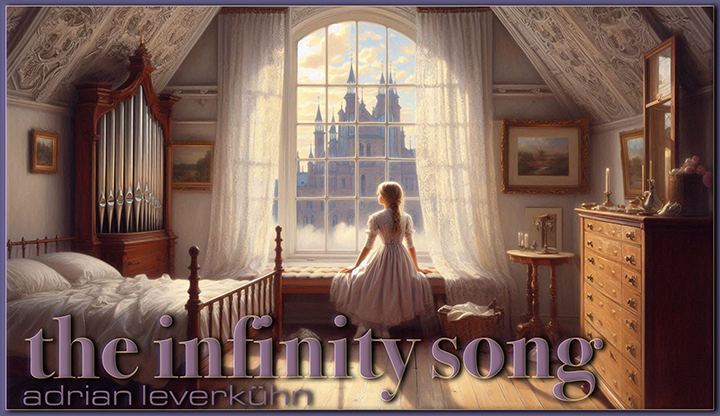
Writing this has been a challenge. The mind is willing but the eyes are problematic. I’ve tried dictating text but my mind doesn’t visualize the storyline at all when I try to do that. I’m sure you’ll find scads of errors and I apologize in advance. Things should improve as time goes by.
Gee, I remember a song with those words so it must be time to go over the music I listened to while writing this. First and foremost was Franz Schubert’s Doppelgänger, the Franz Liszt piano transcription as recorded by Dora Deliyska in 2012. You’ll find your own way to the eighty-eighth key in that one. Moving on to the pop music spectrum, let’s go back to 1975, to Eric Carmen’s eponymous album, and let’s look at two songs in particular. The first is a chart-topping ballad titled All By Myself, the second is Never Gonna Fall In Love Again. Give them a listen and then go and find a recording on Deutsche Grammophon of Sergei Rachmaninoff’s Piano Concerto No.2 in C Minor, (2023), in particular the second movement – the Adagio sostenuto. Just sit back and have a listen and let me know what you think. Music is so fun! Let’s keep in the lower registers for a while longer, so hop on over to Black Sabbath’s debut (eponymous) album, and go to the first track, also titled Black Sabbath, and you’ll find Prokofiev lurking in those shadows. And speaking of Prokofiev, head over to Emerson Lake and Powell’s only work, to their (eponymous) album and to the track titled Touch and Go. The opening synthesizer riff of this famous rock anthem is a play on themes within Prokofiev’s Lieutenant Kijé Suite, op. 60.4, the Troika sequence. Also on the lone ELPowell album is their version of Mars, The Bringer of War, from Holst’s The Planets. And I couldn’t not remind you to go back to The Doors The Alabama Song, to their version of Kurt Weill’s Alabama-Song, from the operetta The Rise and Fall of the City of Mahagonny. Look for Lotte Lenya’s version in English if you can’t handle German. And let’s ignore the classics for our last two, The Who’s Who Are You, (1978), and lastly let’s revisit Stephen Still’s Love The One You’re With. Ah, didn’t that feel good?
With all that out of the way it’s time for tea and an orange–walnut scone fresh out of the oven, then get comfy and have yourself a read. You’ve met Anna before, briefly, and I won’t spoil the surprise, but Freja looms large in TimeShadow so pay attention. And I do hope you know who Neils is…?
The Infinity Song
Part II
Harmonic Entanglements
Chapter 3

Anna Regina Kant usually walked to work, to her position as a piano teacher in a girl’s school located near a tidy neighborhood in central Copenhagen, but the snow was too much even for her this morning. Drifts had blown up from the cobbled streets and covered the sidewalks, and so far only a few horse-drawn streetcars were operating. She managed to get onboard one and rode in silence out to the school where she taught, at the Døtreskolen af 1791, then she walked the remaining distance to the school’s main building. Despite the bad weather, she had arrived early enough to attend morning assembly, then she walked to her ‘classroom,’ as usual surrounded by doting students.
Anna was popular among most all the girls in the school, but of more importance, she was popular with the parents of her students. This had led to her being engaged as a piano teacher, working most afternoons and evenings in many of the more prosperous households near the university. She soon gained a following, and word of her skill spread quickly.
Anna was popular because she was not a scold, and she never berated even her slowest students. Rather, she tendered praise when praise was due, yet offered endless reserves of encouragement to those a little more tone deaf than was usually tolerated by the more established teachers in Copenhagen. Where she really excelled, however, was in her handling of those truly gifted students who came her way.
Freja Bohr was one such student.
Her father was a professor of physiology at the University of Copenhagen; her maternal grandfather was one of Denmark’s most prominent bankers. She had an older sister and a younger brother, but of utmost importance, she had an identical twin brother, Neils. Her sister would become a teacher, while her brothers grew deeply entranced by the world of numbers.
The family resided in Copenhagen’s East Quarter, in the university district at Bredgade 62, in a large residence assigned to the medical school’s faculty. Because of their proximity to laboratories and academic facilities, the children grew up and nurtured within vast realms of scientific exploration. Theirs was a wonderful childhood, years of intellectual curiosity inside a household where science and logic were ways of life.
Yet, and perhaps this was a deliberate choice, Freja remained relatively untouched by that world.
Again, perhaps.
Her brothers’ dormers overlooked Copenhagen’s inner harbor, with the tall masts of merchant ships beckoning just a few blocks away. Freja’s window, on the north side of the residence, looked out on Sankt Ansgars Kirke, Saint Ansgar’s Church, which was home to the last vestiges of Catholicism inside deeply Protestant Denmark. More to the point, her window was in close proximity to a large cluster of pipes that belonged to the church’s rather impressive organ, and on Sunday mornings she was treated to the most elaborate recitals imaginable – complete with the voices of hundreds of parishioners. So – perhaps – her world was redefined by these unseen pastiches of Bach and Mozart that played out just beyond her reach every Sunday morning.
And while it might be hard to imagine, this calliope of music and the mind opened a door, a passage to another world. A world defined by the mathematics her mind craved, yet a world suffused in the dim underworld of the most thunderous music in the world. She could feel power in the music within those stone walls, a latent call to arms under the banner of things she knew nothing about, and so as an innocent she fell under the spell of music.
The Bohr family was, of course, Jewish, and that one of their own would fall under such a spell was disconcerting in the extreme to Freja’s parents. Yet her brother Neils understood, perhaps because his room was next to hers. He too felt the power of this music, and at times he was sure he could feel something deeper within certain passages, too. When the organist found the deeper registers, the pillars of the earth seemed to shake and rumble in the most delicious way, and inside those tremorous moments both children seemed to hover along the edge of a vast precipice, drifting through time and space…at least until the music stopped. And while Neils examined these moments with a budding scientist’s inquisitiveness, Freja drifted aimlessly within these aural kaleidoscopes, often lingering there long after the music stopped. Soon enough, she approached her mother about taking organ lessons.
Which led to her taking piano lessons at the school and then, when she showed promise, to more rigorous lessons at home. Her mother listened to these sessions, disappointed in the quality of sound produced by the ancient piano in the residence hall, and so purchased her family a new Bösendorfer grand, a magnificent creation – and an instrument that even the esteemed Anna Regina Kant seemed to admire.
+++++
It was an event, the delivery of this new piano. A thing of beauty, friends and neighbors came to see, and to hear, Freja playing this magnificent creation. The piano was placed in the parlor, a warm, wood-paneled room that looked out over the city’s high court building across the street. The parlor was also right off the family’s library, and the walls of books mellowed the sound somewhat. On warm afternoons in late spring, Freja played with the windows open, the room’s light filled curtains billowing from time to time on a passing breeze, and yes, there were times when even the curtains seemed to soar on musical airs – as Anna and Freja explored this new world together…
…and then one afternoon, with Miss Kant by her side, they came to a new piece of music.
“This is the Liszt transcription of Schubert’s Der Doppelgänger, and you must be careful here, Freja, for you may find many daunting passages within?”
“Daunting, Miss Anna? How do you mean?”
Kant opened the score and placed it on the music stand, then she moved around the piano to open the lid, carefully placing the prop just-so before moving to stand behind Freja.
And when she did so, she placed her hand on Freja’s shoulder. And this was something she had never done before.
Freja studied the opening bars for a moment, then inched down the bench a bit to the left, to better address the keyboard.
And then she began playing, slowly, carefully, and as Anna intended, Freja soon found her way to the eighty-eighth key.
+++++
It was as a hammer blow, this sudden change that came upon her.
One moment she had been playing and that same feeling returned. The same feeling she had first experienced when the organist in the cathedral next door visited the lower registers, when the entire residence seemed to tremor and come alive with wild magic…
…and now, here she was, standing in a field full of wildflowers on a gorgeous sunny afternoon, standing on a high bluff overlooking the sea…
And she jumped back in horror when she realized this wasn’t another one of her daydreams. She jumped back when she saw she was standing on the edge of a vast precipice. Indeed, the toes of her shoes seemed to be over the edge of this cliff, but then she felt Anna still behind her, her teacher’s hand still firmly on her shoulder.
“This place was very important to me when I was your age,” Anna said, lifting her head to face the breeze coming to her off the sea, closing her eyes as the sun bathed her soul with the infinite music of pure memory. “I came here on days much like this one. I came here to hide from my life.”
“From your life, Miss Anna? But why? Why would you do such a thing?”
Anna sighed as an unwanted memory came to her, and she closed her eyes, turned away from the feeling as sudden darkness fell over the land. The seas below grew tempestuous, storm clouds gathered along the far horizon and lightning flickered in seething clouds.
And as Anna lifted her hand from Freja’s shoulder they were at once back in the parlor, the sun-filled breeze still lifting the curtains.
And as Freja lifted her hands from the keyboard she turned to face her teacher. “What has happened to us?” she whispered. “Were we not just standing in a field of flowers, standing beside the sea?”
“Yes. We were near my father’s home in Königsberg, where I lived as a child.”
“And how did we get there?”
“I don’t know the how of these things, but is that so important? We did, you and I. That is the truth of it and so all that is important.”
“The music. That low progression? Was that it? Was that what happened?”
“I believe so, yes, but the first time I felt this surge I was much younger than you are now.”
“I have felt it too. From the cathedral, when then organist practices. The pipes are close to my window. Even my brother has felt this thing.”
“Not many can, but you must remember something. And this is very important, so listen to me when I tell you that you must never tell anyone about this. If you do, only tell someone you would trust with your life.”
“But Miss Anna, does that mean you place so much trust in me?”
“Yes, but there is another reason. I have seen a man, an old man. He has been following me, and I am not sure but I seem to remember him from home, from Königsberg.”
“But Miss Anna…you have been here now how many years? Fifteen, did you not once tell us?”
“Ah, yes, fifteen, but it was years ago when I told you this. I have lived here almost twenty-five years…and isn’t that strange? I don’t think the old man has aged. In all that time, he hasn’t aged even a little? Don’t you think that strange?”
“Are you afraid of him?” Freja asked nervously.
“I don’t know? He has never approached me, never has he said even one word to me, but he is there, following me…”
“Have you talked to the constable?”
“The old man disappears, Freja. I mean…he literally disappears.”
“How is that possible?”
“I do not know, yet minutes ago we were standing in a field near my home – almost forty years ago – so please tell me, how is that possible?”
“I am fairly certain it has something to entangled particles,” Neils said, sitting in a wingback chair with his back to them.
Freja and Anna wheeled around, their eyes wide, their shocked expressions clear for him to see.
“How long have you been sitting there?” Freja asked.
“Long enough,” her brother replied. “I often come quietly, just to listen as you play. I find great peace in this room.”
“What did you mean?” Anna asked, still startled, now a little annoyed. “What does this entangled mean?”
“I mean that some particles are bound together inextricably through time, and they cannot be undone. But what if a particle, or a pair of particles, can be induced to rejoin themselves in an earlier state? Freja and I have felt this on Sunday mornings, and also when the organist practices. I felt myself adrift in time one time, but it was some time in the future, I mean eons ahead. At first I thought this must be a dream…”
“But you do not feel this now?” Anna asked.
“No, I do not, and yet you just provided me the key to understand why. Because I too have seen the old man. He wears a loden cape, does he not? And he walks with a wooden staff?”
Anna nodded, dismayed. “Have you, by chance, seen him summon storms?” Anna asked, clearly now fearful beyond reason.
“No? I take it you have?”
Anna nodded. “Oh, yes. I have on several occasions. He pounds his staff on the earth and clouds appear in the distance, but thunder and lightning soon follow. I saw him do this when I was a child, in Königsberg, and once again, on the night after I arrived here, in Copenhagen. It was not an accident of circumstance, either. I feel certain he summoned these storms.”
“And you say he disappears?” Neils asked.
“Yes, I have seen this many times. Once I felt certain he did so when I turned and looked at him, yet on another occasion he came close, closer than he ever had before, and he stared at me until I finally turned and looked at him. He smiled at me for a moment, then doffed his hat and, again…he simply disappeared.”
Neils furrowed his brow at that. “And you say you have literally seen him disappear? That he didn’t just slip out of view?”
“Oh, no. He quite literally disappears.”
“Then I must follow him,” Neils Bohr said. “I must observe this. Note the circumstances. If he is what I suspect he is, then his presence destroys everything we know about Time.”
Anna seemed interested now. “And what do you think he is?”
“He is either a time traveller, or he is not of this Earth. If either is the case, I suspect he has come to observe how you are bending the laws of time.”
“So you think he may simply be curious?” Freja asked.
“Or might he have evil intentions?” Anna added, suddenly appearing quite anxious.
But Neils had no ready answer for them. “We have no way of knowing, do we? That is why we must observe the fellow, and then, perhaps, we may be able to approach him, and even speak to him.”
“Do you think that wise?” Anna sighed.
“Wise?” Neils said. “No, not at all. I do feel that all this is inevitable, that we are now on a course established by others, so we are pawns on a board we know nothing about.” He stopped and thought a moment, then shook his head slowly as he smiled inwardly. “But do you know… there are times when even a pawn might trap a king?”
+++++
She lived near the railway station in the Osterport, so usually walked along the Groningen past the old fortress, the Kastellet, on her way to the Bohr residence.
But not this afternoon.
On Friday afternoons the Bohr children usually walked home from the family’s synagogue, located on Ole Suhrs Gade, by walking along the Sølvgade towards the harbor. The previous two Fridays the old man had appeared and had followed them home, and it was Anna’s intent to trap him as he walked past the Marmorkircken. Neils would walk along the massive building’s south side, then past the colonnaded steps on the east side. When the old man walked past this colonnade, Anna would jump out and confront him, holding him if necessary until Neils could join her in restraining the old man.
She arrived earlier than she had planned so stepped inside the huge domed Lutheran church. In plan, the church was little more than a cylinder topped by a massive dome, and with little more than curved walls under the dome, the interior looked truncated. Yet she suspected the architect’s vision was that all eyes would go to the soaring dome, to the twelve Biblical stories painted there, so she could see the point. The light pouring in through the central lantern high above did indeed seem heavenly, yet once again she felt little more than annoyed at the crass attempt to manipulate. And in the end, the space seemed cold and uninviting to her, so she retreated outside to the steps to wait for Neils and Freja.
She had not considered that their other siblings would be walking with them, and when Freja passed Anna also saw her sister Jenny, and as Niels walked by she immediately saw his precocious little brother Harald. She kept out of sight as they walked by, then, as they turned onto the Frederiksgade, the old man walked past and she sprung down the steps, reaching him in just a few long strides.
He turned to face her before she had closed the distance between them, and the Old Man held out his walking cane, placing it between them as she reached out for him.
Instinctively she reached out for the staff and grabbed hold.
And in that instant Time stopped.
She saw herself surrounded by shimmering blue as her field of view imploded into brightest sunshine. In the next instant she recognized the field full of wildflowers outside of Königsberg that she had visited as a child, but no gentle breezes caressed her skin. This was not real, she told herself as the tried to turn and look at the sea…
And panic set-in when she realized Time itself had stopped.
Then she felt a presence, something unlike anything she had ever felt before.
The Old Man walked into her field of view, but he was not alone.
Soon she was surrounded by several creatures, and they were talking, or at least she thought they were talking. Then it felt like they were arguing – about her!
Two of the creatures were tall feathered things, half human and half owl, and one was pink, the other blue. There was a short, squat gray blob that had tentacled hands and reminded her of cow manure lying flat in a field, and this creature was gesticulating at her, its voice a menacing collection of clicks and growls that almost sounded like rocks tumbling down a hillside.
And then there was the white man – who was not a man. He was too tall to be human, his skin pure white, so too white to be human, yet in almost every other regard he looked human. He looked like a statue, like something Michelangelo had formed out of the purest white marble, yet she saw not one hair on this creature’s body – but the strangest thing was his eyes, which were black. As impenetrably black as the darkest night. And this creature was standing well away from the other two types – as if watching, and judging, their behavior.
So she decided to watch this one.
Then she felt a presence in her mind. Indistinct, certainly, but definitely there.
‘You cannot hear their thoughts?’ the presence asked – just as the white creature turned and looked at her.
“No,” she said.
And on hearing that the other three stopping jabbering and turned and looked at her too.
And a cacophonous barrage of questions and accusations hit her – simultaneously.
– ‘Can you hear me?’
– ‘She’s listening to us!’
– ‘Of course she is! Wouldn’t you?’
But she soon felt overwhelmed by these streams of thought cascading through her mind – but then the first voice returned, now more clearly defined than the others. ‘You may filter these other voices out; focus on one. Mine, if you like.’
‘Who are you?’
‘My name is Pak.’
‘Who are the others?’
‘They are deciding your fate.’
‘My fate? What have I done to them?’
‘I am sorry. I was incorrect in my choice of words. They are deciding humanity’s fate.’
‘Why are they examining me like this?’
‘Because you were one of the first. The first to manipulate time.’
‘And this is a problem?’
‘Not so much now as only a few have the ability, but in a hundred of your years, in your future even more will have the ability, and then trouble will begin.’
‘Trouble? What does that mean?’
‘Your descendants may alter the fabric of reality. The universe will be reordered. Established continuities will be destroyed, so several civilizations have gathered to observe, and to decide.’
‘Can you detect when I move through time?’
‘Oh, yes. Quickly. We observe in order to mitigate damage.’
‘The Old Man? Does he follow me for that reason?’
“What old man? I am unfamiliar.’
The others had stopped talking as soon as she had mentioned the Old Man, and now it appeared that they were flummoxed.
‘Who is this old man?’ the pink owl creature said to Pak. ‘Have you seen him?’
‘Do not involve us in your disputes,” Pak said clearly, and she heard real menace in this thought. ‘We have always been impartial concerning this race,’ he added with a sneer of contempt.
‘You are impartial when it suits you,’ the manure creature snarled. ‘Your thoughts betray your motives, and we have taken note of your hollow neutrality more than once. You will deceive us no more.’
And with that declaration the squat brown creature disappeared.
The blue owl departed almost as quickly.
Yet the pink owl remained, and now it walked over to Anna.
‘This old man,’ the pink owl said to her – and when she came through now she was very clearly female – ‘may not be trusted. His motives are personal.’
‘You know him?’ Anna asked.
‘I do.’
‘So, you lied to the others?’
‘We need time. Many forces are converging. Some are hostile to your survival.’
‘But you are not?’ Anna asked, now even more concerned.
‘We are not,’ she added, ‘but in your future, two internal factions will struggle for supremacy. One faction is quite dangerous, while one may yet prove beneficial to the future. Because of the evolving implications we have uncovered, this struggle between factions has come to the attention of many nearby civilizations. There is one very dangerous civilization, and they are far away. But I must tell you that in my time they are approaching your planet. The browns, the low creature you just observed, are trying to impress this group by exterminating all life on your planet before they arrive. We are trying to stop, hopefully without resorting to open warfare, yet we alone cannot fight these combined groups. We have neither the strength of arms nor the numbers needed to insure a positive outcome.’
‘Why did you bring me here?’
‘We identified you as one of the first humans able to travel using harmonic entanglement, and we have found that people with such abilities are often drawn to one another. By following you, I have two assume the old man is locating people with the same abilities, but we do not know who he is or who he is working for. We have left him alone for now, and prefer to monitor his activities rather than confront him. This may change soon.’
‘Why are you telling me this now?’ she asked, aware he was still avoiding her question.
‘It might be better for the children you teach if you were to stop seeing them. You are drawing attention to them, and that might compromise their safety.’
‘From that brown creature? From his people?’
‘Yes.’
‘Are there others who might pose a risk to them?’
‘Yes. There is one other race monitoring your activities. You must not anger them,’ the owl sighed gravely.
“How might I do that?”
“They dwell in the sea, and their interests lie with other creatures found in the sea, but even so, you must never interfere with them.”
“Why would I do that?”
“You must take great care if a sea creature approaches you.”
“You are confusing me. Why would a sea creature approach me?”
“There are some who might try to teach you.”
“Teach me? Teach me what?”
“You will know.”
Anna sighed, exasperated. “But you just told me not to interact with sea creatures? Why would I even…?”
“Once again, you should take great care if you chose interaction.”
“I’m still do not understand what you are trying to tell me.”
“Should an interaction take place, do not attempt a temporal shift, even if the creature asks you to. And should you give in to the creatures pleas, take care if an unknown creature approaches, something which to you will appear quite dangerous, almost evil, for if such a creature appears, you, or those around you, will not have long to live.”
In the next instant Anna was on the steps of the Marmorkircken, reaching out for the Old Man’s staff – but he was nowhere to be found.
Yet Neils and Freja arrived at exactly the same moment, and they recoiled in horror when they realized the Old Man had simply disappeared just as they were reaching out to take hold of his cape. Neils shuddered to a stop and his head snapped around, trying to catch sight of a man fleeing through the crowds on the sidewalk, but he gave up and turned his full attention to Anna.
“You had him!” Neils growled. “I saw it with my eyes! You had his cane in hand…”
“But just then…that was when he struck the pavement with his cane,” Freja added. “He disappeared in that moment, just when the staff hit the stone.”
“We must leave this place,” Anna whispered, interrupting them. “Now! Something has happened, and we must go somewhere private so we may talk.”
+++++
“What do you mean you were gone for a long time?” Neils asked, disbelieving what Anna had related of her recent experience – so far.
“I returned to Königsberg, to the fields where I played as a child, and I don’t know how long I was gone but long enough to listen to three creatures arguing about the annihilation of all we know.”
“Creatures? What creatures?” Neils scoffed.
“I spoke with an owl, a pink owl. Very tall…why are you looking at me like that…?”
“You should listen to yourself, Miss Kant. In a field, talking to a giant pink owl about the end of the world. And there were other creatures there with you? Who were these creatures? Where did they come from? Do you know?”
Anna shook her head. “No, of course not, but I saw them. It is either that, or I entered into some kind of a dream.”
“But you were never gone from us? How could you have been gone for so long?”
“The owl mentioned harmonic entanglement. Does that mean anything to you?”
“Entanglement?” Neils Bohr asked reflexively. “Harmonic entanglement? Did the creature use these exact words?”
“Yes. Exactly.”
Neils sat and looked out the window, through the stained-glass windows across the way, and at the pipes of the massive organ within the cathedral next door. ‘So,’ he thought, ‘these are the words that describe the phenomenon. But…how does it work? And what does entanglement have to do with time travel?’
“Neils?” Freja sighed. “I know that look. What are you thinking?”
“Anna, what was that piece of music you played? With the passage of deep lows?”
“The Schubert piece? Ah, it is Der Doppelgänger, from the Schwanengesang.”
“What is it about? The music, I mean?”
“It opens in three-part AA’B form…”
“No, no! What is the story the music is trying to tell us?”
“Ah, yes…the Schwanengesang is a collection of 14 songs, the music written by Franz Schubert, but he found his way in the written word. You of course know what a Doppelgänger is, do you not?”
“Isn’t it a double of a living person, usually a supernatural being who haunts the doubled person?”
“Close enough, yes. Well, Schubert was a composer of the Romantic era, and such compositions rejected classical structures. Generally, the Romantics, whether in Music, Painting, or in Literature, tried to develop intense personal expression, the most intense emotions, and the expression of individualism and imagination over the collectivism found in earlier classical works. Think Beethoven and his soaring Ode to Joy, because this work is a rousing expression of the collective Will, whereas Schubert offers us the recollections of a lonely man in the middle of a dark night. The music opens slowly, in the lowest register, the motif – the stark B minor sequence you are referring to – is intensely emotional, if lonely, and it describes a man almost haunted by grief. This man is walking down a street well known to him, as he is walking towards the house where his true love once lived. In the original story, by Heinrich Heine, we learn that she has left the city and that the man is in overwhelming emotional distress, but as he comes to the house he is shocked to see another man standing in front of her house. He watches the other man for some time and recognizes the other man’s pain, the wringing hands, the downturned head. But then, in a rush of sudden awareness he realizes that the man is in fact himself. He is seeing his double, his doppelgänger, and Heine wrote: “You were so caught up in your own volition That you never noticed your world turning into a gray and twisted version of its former self.” In German literature, the doppelgänger is often employed as an omen of death, or a reflection of imminent mental collapse, but in Heine’s poem the man is confronting the demon-haunted dark half of his inner self, what the reader might understand as the half that drove this woman away, so the story has becomes a Liebesleid, a story of grieving for a love lost. Butt then, the sudden appearance of the doppelgänger blurs the lines between life and death. Heine wrote: “I shudder when I see his face – the moon shows me my own form.” Do you understand the context now? The moon, the man’s skin glowing in the moonlight? Moonlight, pale and cold, deathly?”
“Yes,” Neils said, nodding, “I think I understand. Would you be so kind as to play it for me?”
“Freja? Do you recall the piece?”
“I will need the music, but yes, I think I can play it.”
“Good,” Anna said, standing. “Well then, shall we go to the piano?”
+++++
And moments after Freja began playing the piece, with Anna and her brother placing their hands on her shoulder, they were back in Königsberg watching Anna watch the gathering of creatures – yet they remained unseen by the others. And it was obvious that Anna was having her own ‘doppelgänger’ moment – standing there once again, watching herself while she was watching the creatures in stunned silence. Neils thought it was like looking down a hall of mirrors.
But soon enough Neils was focused on the aliens, if that was indeed what they really were, and what they seemed to be saying. He was listening – but, no! He didn’t hear anything, at least not a single spoken word, yet he was indeed hearing their conversation. Whatever it was these creatures thought came through to him directly – yet he heard their voices as doppelgängers of his own, as if his own mind was speaking all their words.
‘That means words represent ideas and these ideas are being translated internally, so that means their thoughts are transmitted telepathically.’
And that alone was disconcerting enough, yet the subject matter under discussion was sobering, and devastatingly so. If their words were to be believed, humanity was being judged by not one of these creatures, but all three. And more civilizations, some not currently here, were doing the same thing.
‘But why? Why judge us? Have we done something wrong?’
But then the tall white creature reacted to his question and turned towards Neils, but it was obvious the creature couldn’t see anything amiss. Then he turned to the others and spoke.
“We are being observed,” the creature said.
The pink owl whipped around and stared directly at Neils, then advanced towards him.
A split second later they were at the piano, and all three were quite shaken up.
“What happened? Who were those animals?” Freja cried, clearly petrified by the experience.
“I asked myself a question,” Neils sighed. “And I didn’t take into account that the creatures were communicating telepathically. So, quite obviously, they could hear my thoughts, too…”
And a split second later a translucent blue sphere no larger than a child’s ball appeared above the piano, yet the enormously tall pink creature from the field stood within, still staring at Neils. The sphere hovered there for perhaps half a minute then it winked out and was gone.
‘Was the creature within the sphere real, or a sort of simulacrum of the other?’ Neils wondered. Whatever it was, it now knew exactly where he and his sister lived, in both time and space.
Which meant this creature could find them, could come and go at will…
‘So? What does it want? Why did it come?’
But then Neils looked at his sister, for she had grown still. Her skin was purest white, and she was no longer breathing.
© 2025 adrian leverkühn | abw | this is a work of fiction, plain and simple. Thanks for dropping by. See you next time.


 Adrian Leverkühn Writes