
A short chapter today, hardly time for tea. Kind of a transition waiting to happen.
Music matters… So, do you M83? If not, you might give them a try. Check out Midnight City and Where The Boats Go, as well as the title track from their 2011 album Hurry Up, We’re Dreaming. Everyone knows In The Court of Crimson King, from King Crimson’s 1969 album, but have you heard the version on Steve Hackett’s The Tokyo Tapes? If you have the time, run on over to Spock’s Beard’s album Noise Floor (2018) and check out So This Is Life. Then one last piece today, from Steven Wilson’s Insurgentes (2009): the track called Salvaging. And take what you will from it, but you may get lost inside this one.
Okay, on to the story.
Chapter 4: Temporal Alignment
She had always wanted to live in Paris. The lights, the gaiety, the salons – but above all else, the music. When she had first left Königsberg she had taken an oath never to return to East Prussia, so when life in Copenhagen took a turn for the worse it was only natural that she move to France. Despite her upbringing, Paris had always seemed home.
Almost immediately, Anna Regina Kant discovered that the City of Lights was quite literally awash with pianists, of every sort. With the end of the First World War it seemed that every writer, painter, and musician had decided that life was only worth living if done so here, and Anna soon found herself taking a position, and teaching, in Honfleur, a small coastal town located just across the Seine from the port of Le Havre.
She had earned a decent amount of money in Copenhagen and by living quite frugally had managed to save almost everything she had ever earned, so she was able to travel some – from time to time, so she considered it important to find a suitable position in a location not too far from Paris. She was invited to a school in Le Havre, but was then summoned to another school across the Seine, and her interview had gone well.
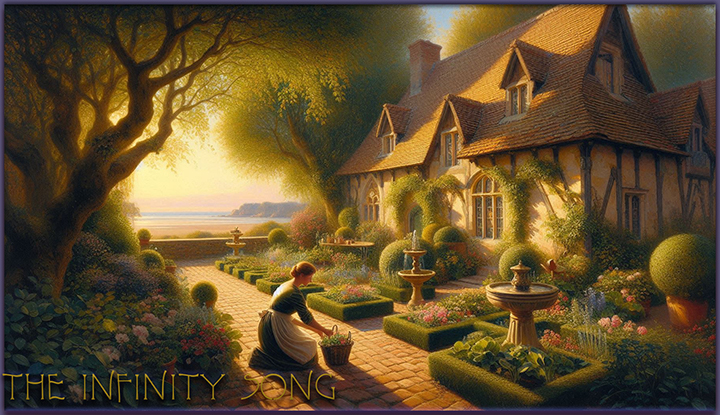
When she first arrived in Honfleur she immediately fell in love with the old medieval village, and while the school there was small the pay wasn’t much worse than in LeHavre, so she took the position there. Before school started, she found a stone cottage on a bluff overlooking the Plagne du Butin, and the previous family living there had managed to create a wondrous garden that surrounded the main dwelling. The cottage faced both the river and the English Channel, in an estuary called the Crique de Rouen. The first thing she felt was the golden sunlight of that late August afternoon, and that wondrous glow washed over the walls of her new kitchen with the same amber-hued warmth of her childhood home in East Prussia.
Because cottages were much less expensive this far from Paris, Anna was able to buy her first piano, an older Bösendorfer the headmistress of her new school knew was available. The rolling fogs of autumn would wreak havoc on the sound board, but if she diligently kept the cottage warm through the colder months she might just be able to keep the new piano in tune.
As she had in Copenhagen, Anna soon found herself engaged to teach younger students after school, and she still kept to her frugal ways and saved all her money. When Spring came she tended her garden on sun-drenched airs, working to create a world within a world, someplace far away from all the noise of the outside world. She spent her summers traveling, often to Paris but as far away as Rome and Florence. She was now in Madrid, walking through the vast collection in the Museo del Prado when she first noticed the Old Man.
He kept his distance, but there was no doubt he was following her.
And she wondered why.
She had not once tempted the fates, not once played Schubert’s Doppelgänger or any piece even remotely like it. She had understood the owl’s warning, and taken it to heart.
But unexpected change was sweeping aside the fragile peace of Versailles, and the new German Republic was first to fall away. The few surviving monarchies in Europe were nervous as they watched populist extremists undermine expectations across the continent, and some of the changes, she could see, were leading humanity deeper into uncharted extremes. First there was Mussolini, then Hitler, and then, while she was win Spain, civil war broke out – a civil war coordinated by Europe’s other fascist states and Spain’s internal extremists. As open conflict broke out she managed a hasty retreat to France, yet as she arrived in Paris she saw new, visible signs of mobilization almost everywhere she looked.
And still the Old Man followed her.
Riding across France in the train, she had decided to spend more time in Paris before returning to Honfleur, but after feeling the mood of the people there she decided to go home. She took the express to Le Havre, then the ferry across the Seine to the Old Port, and a complete stranger with an automobile carried her the last mile out to the ancient cottage she now called home, and this kind soul even helped with her luggage before smiling and bidding her a fine afternoon. She watched him depart in clouds of dust, leaving her standing beside the stone wall that lined the old road that rambled past her home. She opened the gate that entered that other world, the world of greens and pinks and honeybees she had nurtured for so many years of her life, then she walked slowly along the garden path that took her to the front door of her cottage. She loved this walkway, too. Old gray cobbles set in sand with a little mortar, she had crafted this walkway just the way her father had taught her. Sight lines were important, but a sense of mystery even more so. She had to push long dangling vines of green ivy out of the way, tendrils grown wild over her summer away from home, all this life awakening in the moist night air and just now blooming. So yes, as she completed the last few steps of her journey she seemed to slip into this other world, the world she had created to get away from – that other world.
But then reality intruded, for there at her front door stood Neils Bohr, and though she had not seen him in more than two decades it was not so difficult to see, and to feel, the pain in his eyes.
She had tried to forget about them, those two. Neils and Freja, identical twins, identical worlds. To forgot about that world, their world, and all the gathering implications the owl had implied, because there were monsters out there in the night. Real monsters. So they had sworn off taking further explorations, and the three of them each seemed to go on their separate ways.
But now she could see that Time had not been so kind to Neils after all. Something had happened. Something awful.
+++++
“A neighbor told me you were away,” Neils said as he reached for the cup of tea she offered, looking around the small, one room cottage, at the way Anna had used the limited space to create little nooks dedicated to each part of her day. Her kitchen was one such space, and while it was small everything within was so well organized it almost defied imagination. Her bed, hidden behind layers of Japanese screens, hinted at another. Her sitting room, where he sat now, was comfortable and focused on the most important thing in her life: her Bösendorfer grand piano.
And the view of the two large windows?
Incredible.
First of all was her magical garden. Than the sea beyond. The ochre bluffs beyond LeHavre, striated by one broad buff colored band of ancient limestone, surf crashing on the rocks below. Everything was small inside her cottage, small but perfect. Nothing wasted, nothing to remind one of the world beyond her walls.
So nothing was wasted her. Nothing, that is, but a life in hiding.
“Why have you come here?” she asked as she sat across from him. “And why do you wear such pain?”
Neils took a sip of tea; the temperature was perfect, the blend unrecognizable – but scented like a garden. Her china was the finest England could offer, a jumble of vines and flowers frozen in time around a delicate porcelain rim. Indeed, everything around him, from the upholstery on her chairs to her draperies and bedding seemed to reflect a sublime desire to reside within her garden. To return to the soil, to the Earth, to bring the outside in…
“You left us so suddenly,” Neils sighed. “What made you leave without at least saying goodbye?”
“I felt it safer, for us all,” Anna replied. “Considering. I’ve heard interesting things about you, of course. You and this Mister Einstein. And what of Mister Hitler? What are your plans? You plan to leave soon, I trust?”
Neils Bohr shrugged. “Those things seem inevitable now, don’t they? Cast in stone, mad men set in motion.”
She sighed. “Yes. Hate seems to boil up out of us every so often. From the soft underbelly of our ignorance, I think. So tell me. Where is Freja? How is she?”
Neils looked away, gathering his thoughts. “She’s gone,” he finally said.
“Gone?”
“Murdered, or so they tell me.”
“Oh, Neils, I am so sorry. I know how incredibly close you were.”
“She went down to the sea, you understand. She had a friend there. A whale, one of those orcas, one of the big black and white beasts. She took her daughter there often, to the shore, and they would walk for hours and hours, but one day this whale came to them.”
“Oh, God no. Tell me she didn’t…”
“Apparently many people saw the creature the owl warned us of. Shiny and black, black like oil. It came out of the water for her – and then our Freja just disappeared. Gone, in an instant, inside a blinding flash. Then the creature slipped back under the sea.”
“You said she has a daughter?”
“Ah, yes, Imogen. Imogen Schwarzwald. Our Freja married a physician, so of course he is just like our father. A kind man, and he has doted on his little girl since Freja left us…”
“Did Freja teach her daughter to play?”
“Yes, of course, but while Imogen is quite gifted she is pulled between her music and a profound love of mathematics.”
“Schwarzwald, did you say? Imogen Schwarzwald? Was she the child who wrote those piano concertos?”
“Yes. Two so far, when she was quite young. And now she is studying physics at the university. She will attain her doctorate soon.”
“Your brother? What was his name?”
“Harald. He is studying mathematics. And Jenny, our older sister, is teaching now.”
“And your parents?”
Neils shook his head; nothing more needed to be said.
“So, you came all this way to tell me about Freja?”
“In part, yes, but I wanted to know if you have encountered these whales?”
“After what the owl told us? Seriously? I am so afraid of such a thing that I rarely go to the shore.”
Neils nodded. “Then yes, I have another motive.”
She smiled. “Of course you do.”
“Imogen has a suitor. I suspect he knows about this ability we share, and I think he has talked about it. He is a physicist, but he has many friends in this new Reich.”
“You don’t think he’d tell anyone, do you?”
Neils sighed and splayed his hands wide. “I do not know this boy well enough to answer such a question, but can you imagine the outcome if such capabilities were to fall into the wrong hands?”
She turned and looked out the window, at her most cherished possession on Earth – her garden. And in an instant she knew it was time. That she would soon lose all this, because that other world had just come calling.
“Where will you go?” Anna asked. “America?”
He nodded. “I think so, yes. If Europe falls to Hitler, America may well remain free – for a while, anyway. But we need time. Time enough to finish a project.”
“So you think I should go to America, too?”
He nodded. “Yes, and before you lose the opportunity. It is getting more difficult by the day for Jews to enter the country, unless…”
“Unless you have something of real value to contribute? And I am but a piano teacher? Isn’t that what you’re trying to say, Neils?”
He nodded. “Not exactly. I can see, however, that you have created the perfect space to escape from our world.” He turned and looked out the window, and suddenly he could see into the years ahead. The sacrifices that would have to be made. Pain as yet unimagined to be endured. And cruelty, all the endless, unspeakable cruelty. That beast always lurked in the shadows, didn’t it?
“It’s not so difficult to see what it is about us they fear,” she whispered. “Is it?”
“No. It isn’t.”
“So, I suppose you have friends in America that can sponsor an old Jew like me?”
He turned back to her and smiled. “Of course. Why else would I have risked exposing you?”
“I see. And when am I supposed to leave?”
“Today. Right now. Or tomorrow morning, at the latest. You should pack only what you need, and no more.”
“I see. Is there so much need to rush?”
Neils shrugged. “When people realize what is happening it will already be too late. For us? For you and I? I hope it isn’t already.”
“Well, I’ve not had time to unpack yet, so I suppose I’m ready to leave – right now.”
“Do you have your papers, and documents that prove your ownership of the house?”
“Yes, of course. Should I bring those?”
“I would,” he said, though he said so more cheerfully than he really felt. “Who knows, you may be able to return someday.”
“I need to check the water, make sure that the pump is turned off,” she sighed.
“Where is your well?”
“In back. A small stone building, by the last hedgerow.”
“I’ll go. You might start with your luggage back out to the lane.”
He went out the cottage’s back door and found the pump-house, and after he located the breaker he closed the circuit before he stepped back out into the garden. And he felt the wonder of it all, that she really had created a perfect world out here.
Every little thing, every plant, every fountain and bird bath, every tree and even the garden pathway, seemed to coexist with nature, suffused in their immediate surroundings. A side path led to a bench and he walked over, anticipating the surprise – and yes, she had created something even more perfect. A tiny sliver of light between the cottage and the row of shrubs on the far side of the property, where just the perfect view of the sea breaking against the rocks on the far side of the estuary remained in hiding, just waiting to be discovered.
He shook his head, surprised by her deft understanding of such things, then he went inside and locked the back door before making his way through the house and out the path that led to the road. He pushed all the dangling vines out of the way – again – then closed the gate behind him as he walked through the last length of overarching trellis, only then reaching daylight just at the road’s edge. Because this lonely road seemed to mark the boundary between two worlds…
But as he looked around he saw that she was gone.
Her luggage remained by the wayside, but Anna was nowhere to be seen.
Then…
Something caught his eye and he saw dust lingering above the narrow lane, and a small Citroen speeding back into Honfleur.
And he could just see two men restraining Anna in the back seat, and he knew then that they had failed.
And then the Old Man appeared.
“I shouldn’t have left her alone,” Neils sighed. “Not even for a moment.”
“Perhaps.”
Then the Old Man tapped his staff on the pavement and thunder crossed the channel, and a moment later both men disappeared – leaving only dust to mingle with the remnants of Anna’s fear.
© 2025 adrian leverkühn | abw | this is a work of fiction, plain and simple. Thanks for dropping by. See you next time.
 Adrian Leverkühn Writes