
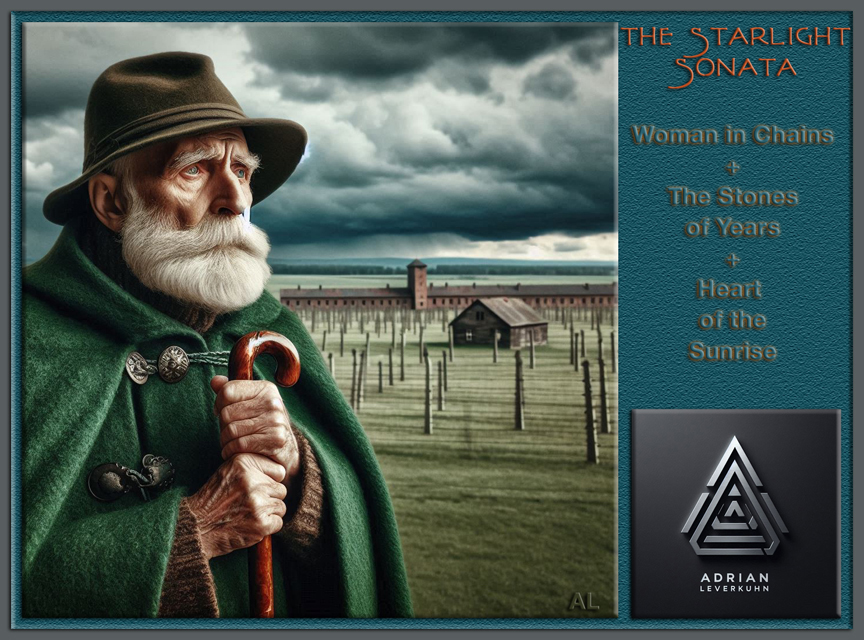
Pardon my absence from the online world, but I have been writing, almost to the exclusion of everything else, but enough of that. I first worked on this story in 2007, posted the three parts over a couple of years yet never really completed the third part. I started there this time and reworked the last part first, then rewrote the first two sections, then the coda. This little story is about 300 pages (over 100k words) and takes a few hours to get through, so you’ll either want to take it slow and brew a bunch of strong coffee.
Music? Why don’t you start with The Rain Song, by Led Zeppelin, then dig out an old Moody Blues tune called What Are We Doing Here.
THE STARLIGHT SONATA
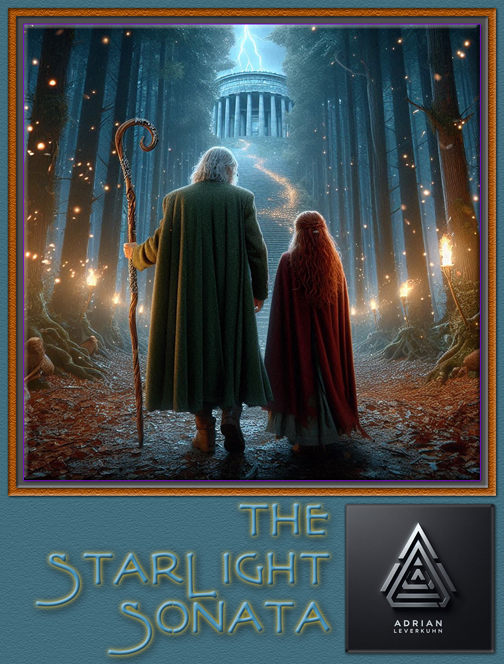
Part I: Woman in Chains
Tracy Tomlinson walked down the stairs as quietly as she could. She slipped into the kitchen like a shadow and put on coffee, then walked outside and down the driveway; she groped around in the dark for the newspaper, nearly tripped over a football when she bent over to pick it. It was still too dark out to see the headlines, but she hardly cared about them anymore. Mark kept up with all that stuff. The world would get along just fine without her knowing who had been fighting in what war over this or that reason last night, and she knew she’d greet tomorrow’s wars with about as much interest.
Yet she could remember a time when she’d cared about the world – and she knew she had. Like she had once cared about how she looked, about what she ate, or even what Mark thought of the way she looked. There’d been times when she worried what her friends thought of her, even what her children thought of her – but not any more. She had grown tired – tired of life, tired of living, tired of eating and tired of even breathing. Fucking Mark, she remembered bitterly, had been the last to go. She’d always loved a good rough fuck, but Mark had lost interest after she put on a hundred pounds, so now not even that simple pleasure remained. She was numb now, and it was like all those things resided somewhere in the back stacks, lost somewhere on a forgotten list with all her other useless memories.
She climbed the steps back into the kitchen and pulled down two little packets of flavored oatmeal and put water in the microwave to boil, then walked upstairs to her boy’s room. Brian was on his back, his morgen-bone rising under the sheet from the center of his bed; the first time she’d seen that she had almost laughed – because the spectacle looked like the troops were raising the flag on Iwo Jima once again. She shook her head at the memory and turned on his light, called out his name, then walked down to Stacy’s room – but heard the shower going in the hall bathroom and knew her daughter was already up. When she poked her head in their bedroom she heard Mark in their bathroom, his electric razor grinding away through day old stubble. Already the room smelled like his Old Spice deodorant and the scent brought back another bundle of useless, if unwelcome, memories – like the last time she’d touched herself down there and everything had felt cold and dead – or was lifeless the correct word, she wondered.
‘Like this waste of time I call my life,’ she told herself as she returned to the kitchen.
Once there she pulled out the big skillet and put it on the range, took eggs from the refrigerator and sausage patties from the freezer and set out everything she needed to cook her family’s breakfast, and then she poured coffee for Mark and Stacy. Brian was still, she thought with the last vestiges of a smile, a little too young for caffeine. Too young to do much this early in the morning besides hump his pillow or brag about how well he was doing at football practice.
She scrambled two eggs for Stacy and three over-medium for Mark, poured water over Brian’s instant oatmeal, then set out a platter of sausage patties on the table and poured orange juice for the three of them. As they flooded into the kitchen she walked by them silently and walked back up the stairs to her bedroom. She locked the door and sat down on the edge of her bed; she felt like crying for a few minutes, then walked into the bathroom. She looked at the bottles of Prozac and Xanax in the medicine cabinet and wondered if these were all she had to look forward to now, like would there ever be anything more than chemically induced oblivion to look forward to? Pills and a nap, again and again, then wake up and start it all over again, wearing a beaten path in the house’s old brown carpet on her way to an early grave.
She took her prescribed dose and lay down on the bed, listened as the kids got into the car with Mark and headed off to school. She hoped sleep would come soon for her, and take her far, far away.
+++++
She knew she was far, far away because the ringing in her ears was so out of place.
Nothing here seemed right.
She was on a beach, she was sitting on a sandy beach; she knew she was sitting because she could feel wet sand under her legs and feet. The sun was hot; a soft breeze was blowing, lifting her hair and filling the air with smells of a salt-laden sea. Mark was standing beside her, his back turned toward her, and he was holding a huge mass of heavy chain. She looked down and saw twisted and rusted links wrapped tightly around her thighs, forcing them tightly together.
Why… Mark, why? Why have you done this to me?
The ringing was insistent now and she turned, looked over her shoulder at rows of palm trees swaying in the wind. She wanted to walk into the trees, look for the ringing lost in the darkness because the sound seemed to be coming from inside the forest. Suddenly she turned back to the sea, remembered something. A sailboat sat offshore a few hundred yards away. A man was on deck, looking at her from time to time, and she saw a gray dorsal fin circling the boat. She could see the man quite clearly, yet his face was invisible, like he was not quite a part of this dream. The man was playing a grand piano on the boat’s foredeck, and she looked harder at him now – because something was wrong with the dream today. She could just see strings attached to his arms and hands; some strings were stretched tautly, others dangled loosely, and all vanished in low, gray clouds that had just swept just overhead. She could see that the man’s movements were being controlled by these strings, and she gasped when she saw the man’s helplessness.
The ringing grew louder still. Then she heard someone knocking at the door.
The door? On a beach?
She opened her eyes; she saw her bathroom door was open and felt herself adrift in the hazy, shaded ambivalence of her meds. She looked at the old clock on the table by her side just as the knocking started again. It was nine thirty. Daylight, she saw. She swung her feet to the brown carpet and stood uncertainly, fell back to the bed with practiced ease and let her head spin slowly, let the pressure in her chest subside, then she stood once again and walked down the stairs.
She could see two police officers on the front porch; one was looking in the window by the door and he saw her, stood back and waited. She reached for the door, still not sure if she was awake yet, or if this was a new, very different part of her dream.
She opened the door, then squinted into the harsh light of day.
“Mrs Tomlinson?” One of the officers said.
“Yes. Is something wrong?”
“Ma’am, could we come inside,” the other officer said.
She was waking up now; she could feel something dark circling overhead. Something wrong. She could feel it all around her now. Something was terribly wrong with this place.
She opened the door and let the men in and closed it behind them. She had the impression neighbors were standing across the street looking at her, and for some reason this scared her. She led the officers into the living room, asked if they wanted coffee and what this was all about.
“Ma’am, there’s been an accident. Is there someone we could call to be here with you?”
“An accident?” Tracy Tomlinson said, her eyes going wide as the pressure in her chest returned, and she was now fully awake. “What? Who?”
“Perhaps you’d like to sit down, Ma’am…”
“No, I want to know what’s wrong,” Her voice bit into the rising tide of fear welling up deep inside, while hysteria rippled through the air around the empty house. “Why are you here?” she asked the closest officer. “Why? Tell me why?”
“Ma’am, does your husband drive a white 2023 Volvo SUV?”
“Yes! What? What…are you saying?”
“Ma’am, that car was struck by a train this morning at the grade crossing on Paterson Parkway. There were three bodies in the car, but, well, there was a fire, and I hate to inform you that…”
“What? Where are my children?”
“Ma’am, we’ve identified the bodies in the Volvo, and, uh, I’m afraid they’re, uh, well, they are your children, well, they’re gone, Ma’am…”
She was aware of time slowing, of the room spinning, then growing dark, darker, darker with each slowing heartbeat – the pressure in her chest suddenly crushing the life out of her, then just as suddenly everything grew quiet, and the purest white she had ever known filled her sight. She was surrounded by clouds speeding by and suddenly felt like she was flying, flying into this light, and yet everything was cold in this new dream, and suddenly everything was so very quiet.
Then she felt like she was flying at great speed – but straight down. The sensation of speed was vertiginous, the nausea overwhelming, and then pain the pressure in her chest returned.
‘Why does my chest hurt so much?’ she said to herself. ‘What a strange dream this is.’
+++++
She opened her eyes, and still all she saw was fog.
But there were people in the fog now, and they were all around her, their eyes full of concern. There was a bright light overhead, a sharp pain in her left arm, disjointed faces in funny paper hats with masks over their mouthes and noses. A bald man with kind eyes behind small round glasses was leaning close, looking into her eyes – and she wanted to fall inside his kindness.
“It’s alright Tracy. You’re going to feel a little sleepy now. Don’t fight it, okay? You’ll feel better when you wake up.”
Falling again, further this time. Darker now, darker than before, but she felt warmth all around her, the welcoming warmth flooding through her like a wave.
‘How much longer is this going to last?’ she said to the reflection of herself down below. As she fell, lost inside all these sudden unfamiliar motions, she became aware of a sound very much like the clatter of heavy chains being hauled across the floor of her dream…then she saw the man on the sailboat, and the brown eye of a whale staring at her. Why did she feel like the whale understood what was happening to her?
+++++
She knew she’d been asleep for a long time, yet she knew she was still in her dream. Mark was here beside her. She felt him, and him alone for a while, and she knew he was near because she heard the chains that had shackled her to him for so long. The chains made a horrible music, a forlorn note much like a single oboe – and the monotonous music pierced the fog around her; the melody was painful, discordant, and she longed to find the oboist and correct him. She’d never held an oboe before, let alone played one, but an oboe was hovering in the air before her eyes and suddenly she realized she knew how to play it. She saw chains materializing in the air all around her, hundreds of them, and each one was carried by Mark. Only there were hundreds of Marks now, all looking at her with pale, lifeless eyes, all holding their chains up for her to see, before pitilessly walking away from her.
The chains seemed to rattle but she heard their music, too. Music everywhere, all around her, yet it was the music of her chains. She looked at a link in one of the chains and saw that it was a horn of some sort. She didn’t even know the name of the instrument, yet when she looked at another link and another and another – one by one all the links within all these chains turned into a vast ocean of musical instruments. They advanced on her and held her firmly in the dream just as surely as Mark’s chains had. She was suffocating again, trying to pull free but her hands were weighted down by chains that writhed about like coiling snakes, then as suddenly changed before her eyes into clarinets and piccolos and violins. And yet in this dream she blinked and tried to turn away, but everywhere she turned it was always the same. Chains rose, coiled in the air, readied to strike at her and as suddenly shimmered and mutated before her eyes. Before long she was surrounded by hundreds of instruments, each one being played by reflections of herself, and as suddenly the sky filled with stars. millions and millions of hot, white stars.
+++++
Todd Wakeman flipped through the chart and looked over the patient’s entries for the last 24 hours. Nothing made sense. Chemistries were all in range, surgery to repair the small clot in the base of the woman’s brain had gone off without a hitch, yet for some reason the woman had never regained consciousness. She had been in a coma for two months now, yet on more than one occasion nurses had heard the woman singing. Well, not exactly singing, at least not at first. The first nurse to observe this phenomenon had, in the middle of the night, heard what she thought was a co-worker’s innocuous humming, and this she did not report. Later that morning an orderly heard what sounded like simple singing, as in notes from a classical piece; when the woman in the coma launched off into an impromptu solo session, the orderly screamed and staff neurologists were duly summoned. One of the physicians, a classically trained pianist, noted that the woman’s vocalizations were totally original compositions and that they resembled something akin to Gregorian chant; nurses began to hear a pattern in these episodic outbursts and noted the time and duration of each. These outbursts happened almost every morning around eight, and lasted anywhere from a few minutes to a half hour.
Todd Wakeman was in the fourth year of his neurology residency, and he’d neither seen nor heard of anything like this happening before. The patient was presenting ‘Something New,’ and usually when anything in the ‘Something New’ category happened, it tended to be a ‘Very Big Deal.’ So the attending professors had looked her case over, ordered more tests and scans, but when nothing new showed up in their tests they soon lost interest in her case – again. Though Wakeman had no idea what was going on, his way of looking at medicine was grounded in curiosity; he soon noted that these singing episodes seemed to presage an electrical swarm, in as much as her EEG recordings went from almost brain-dead to near total brainstorm in the seconds just before her vocalizations began, and they as quickly subsided when she grew still again.
Wakeman had a new group of medical students that had recently begun their clinical neurology rotation and he was going to present her case that morning, perhaps to see if he could get some original ideas out of them – because it couldn’t hurt. He looked at his watch: 7:30. They would be here soon, and if the timing of the woman’s recent swarms was a solid indicator, the group would be in for quite a shock.
He closed her chart and walked out to the nurse’s station, a peculiarly impish little twinkle taking flight across his empath’s face.
+++++
“Next patient is a Mrs Tomlinson. Tracy, I think. Forty nine year old female suffered a moderate CVA after being told her husband and children were killed in an MVA. Surgery to correct two months ago was non-eventful, but she has never regained consciousness. Mother and a sister visit about once a week now, but no response from the patient. Vitals are good…”
Wakeman rattled off the recorded stats and other recent observations…all but the noted episodes of musical activity. And as luck would have it, he was just about to go over how to assess a comatose patient’s neurological status when the swarm began on her EEG. And as the med students looked on, the singing began.
Gently at first, but insistently, she began to sing the prominent parts of a piece of music that seemed hauntingly familiar to Wakeman; it was just the second time he’d been around at the onset of one of these episodes, and he still found it shocking, literally quite unnerving. Now he turned to look at his students, then the woman.
Her eyes remained closed, her body motionless, but her mouth moved precisely, methodically, while the notes that came from inside her mind were as precise, and as methodical; they were, in fact, tonally pure and structurally correct. Wakeman looked at the shocked expressions on his students’ faces and grinned, if only because he understood completely what they were feeling.
One of the third years, a girl named Judith Somerfield, stepped forward with a penlight and opened an eyelid, waved the light in front of one pupil, then the other.
“Equal and non-reactive,” she said. “But, isn’t that impossible?”
The girl took a ball point pen and went the end of the bed; she pulled up the sheet and ran the cap of the pen up the bottom of Tomlinson’s foot.
There was no reaction. None at all.
“I don’t get it,” Judy said. “Is this a gag, maybe like some kind of a twisted joke?”
One of the other students, a teenaged boy with “MacIntyre” embroidered on his pristine lab coat, leaned forward, lifted the sheet covering her arms.
“The fingers,” Ben MacIntyre said quietly. “They’re moving. See! She’s playing notes.”
“What IS that song?” one of the other students asked.
Judy Somerfield looked annoyed, because any dolt really should’ve known this music. “Romeo and Juliet. Prokofiev. The Death of Juliet! Geesh!”
Wakeman smiled; like always, this latest batch of med students was still ultra-competitive, they were always standing by with a ready put-down, looking for one way to get ahead. At least some things never changed.
“Has anyone done EEGs when this happens?” Somerfield asked.
“Oh, yes, we managed to figure that one out for ourselves,” Todd quipped. “Nominal coma until a sudden swarm, then total overwhelming cascades.”
“Interictal discharges?”
“No.”
“Transmissible spongiform encephalopathy!” MacIntyre chimed in.
“MRI and PT are both clear. No spongy tissue observed,” Wakeman said, and the boy looked crestfallen.
“Hypoxic ischemic encephalopathy?” Somerfield asked hesitantly.
“Good guess, but nothing in the surgical record supports that, and neither the paramedics or the cops reported doing CPR, because no breathing anomalies were noted.”
“Cardiac enzymes?” Judy asked.
Wakeman was brought up short by that one.
“Where are you going with this?” he asked. “An undiagnosed cardiac episode?”
“Possible, isn’t it? If everyone was focused on the CVA, maybe they overlooked an infarct. A small, transient…”
Wakeman rubbed his chin. “Possible. Where would you look?”
“Are the ER records up here?”
“No.”
“First I’d get those, see if anyone did gases and enzymes, see if anyone suspected cardiac involvement and ruled it out.”
“Okay, y’all stay put. I’ll go send for them.”
‘Could it be so simple?’ Wakeman said to himself. ‘These kids were just coming off a rotation in Cardiology, so of course that’s where their heads were at, but…could it really be so simple?’
It wasn’t.
+++++
MacIntyre and Somerfield stood outside Wakeman’s office two days later; they hesitated, second-guessed themselves, wondered aloud for the hundredth if they really should tell the head resident about the idea they’d had. Judy had been the first to figure out the key element, and she had talked to Ben MacIntyre after rounds the next morning.
“Didn’t you notice? She gets about half way through the piece then stops, retraces her steps and tries again. She gets to that same chord sequence and tries a few times to work through it, then falls back into unresponsive coma.”
“It’s a difficult passage,” Ben said knowingly.
“You know it?”
“Of course! What kind of moron do you think I am?!”
“A young moron, Bennie. I still can’t get used to an fifteen-year-old third year medical student…”
“Screw you,” MacIntyre said defensively.
“Look, I…”
The door opened; Wakeman stood there sleepily, rubbing his eyes. “You two gonna duke it out, or what?” he growled.
Somerfield and MacIntyre jumped back, startled.
“Well?”
Judy tried to look more assertive than she felt and just threw her idea out there. “It’s about Tomlinson; we’ve been thinking…”
“Now there’s a startling concept,” Wakeman deadpanned. MacIntyre frowned.
“… thinking that, well, she gets through the piece, the Prokofiev, but she gets stuck about a quarter of the way through. Like an old vinyl record. Stuck in a groove, almost. She keeps bouncing back to the beginning, starting over and getting to the same point. She did it three times this morning, then fell back into coma…”
“It’s the same music? The same…”
“Yes. Prokofiev. The Death of Juliet. From the ballet. That ending is regarded as one of the most evocative, emotionally pure pieces in the classical repertoire. And I can’t help but wonder why? Why that piece, and why is she getting stuck there?”
“So, we were…thinking, what if we kind of jump started her – when she reached that part of the phrase?” MacIntyre interrupted. “Judy and I were thinking – what if we played along with her? You know, from the beginning. And then, when she gets to that part…”
“What? You talking a CD, or what?” Wakeman asked incredulously; he could see where this was going and was startled by the ease and clarity of their proposed intervention.
“No sir,” Somerfield resumed. “I’ll play the cello or viola; Ben the violin. We’d be set up, ready to go in the early morning, waiting…”
Wakeman was startled by the possibility. If they could get Tomlinson past this stumbling point, what would happen? He riffed through the possibilities, wanted to ask a couple of the department heads, see about getting a video camera set up, maybe call her family to come in. These were fascinating possibilities, he said to himself, even if uncertainty reigned supreme.
+++++
The dream began again and she withdrew from it, wanted to run from it, wanted to get back to her other music. She resented the interruption, resented anything that took her from her music now. She worked constantly; instruments she had never known had become her dearest friends, and she composed new pieces all the time in her other dreams. But this one piece kept coming back to her, and always it was the same. She always lost her way when…
…when she arrived at the beach, the water and sand against her legs and feet, the still unknowable cadence of Mark’s chains…all the elements of the dream were the same. Then it came to her as on an errant breeze: she was chained to this music just as surely as she had been chained to Mark. The wind, the trees swaying, the man on the huge sailboat playing the piano…the man…the man… the man in the stars…millions of stars, everywhere…
Why did he always get stuck at the same place in the music? Or was it the puppeteer? Did the puppeteer not know the music? But why? Why would the puppeteer not know, why would he lead us here, only to then lose his way?
But something was different about the dream today. Something about the sound was different. The piano was…no…what was that? New instruments? The puppet-man turned and looked at her; his smile was changing, and she could see he was wearing some kind of ragged prison uniform. There was something different about the instruments this time, too. Was it their time signature? But…why?
She could see the puppet’s face now! His eyes were clear and full of empathy, his smile full of gentle mirth, yet she could see that he was proud, too. She gasped as the puppet-man nodded his head, turned away, turned back to the piano, and his hands danced over the keyboard smoothly now in an uninterrupted run.
Tracy Tomlinson opened her eyes and looked skyward; she cried out – and was blinded by the light of six million suns…
+++++
Wakeman looked at her EEG readings as Somerfield and MacIntyre played through the music on their bowed instruments; he couldn’t help being swept away by the simple rendition of this music, even by the noble majesty of the moment. He looked at Tomlinson’s mother and twin sister as they stood beside the hospital bed, their whole being radiating both the hope and the despair they had felt since the accident.
He checked the leads feeding the EEG, watched Tomlinson’s brain waves trace wild lines across the screen. He picked up the stream of graph paper that slipped out the side of the machine, looked at the gathering swarm of neurological activity. Whatever it was, whatever was happening, he saw it was huge, overwhelmingly so. Indeed, he had never seen anything like this before, not in any patients or research subjects.
And he could tell the decisive moment was fast approaching without even looking at Tomlinson.
“She’s in REM sleep now.” He said quietly as he looked up from the tracings. “Look at her eyes!”
Tomlinson’s eyes were still closed but they were moving around rapidly under the eyelids. This had not happened before and Wakeman’s sense of expectation grew even more.
Her hands began to move now; slowly at first, but more rapidly as the decisive moment approached.
Somerfield concentrated on the music, yet she was torn between two contradictory impulses. She wanted to watch Tomlinson, watch her reaction to the music, but she wanted to be as technically perfect as she had once been. Yet with just the two of them playing, she knew this would never do this music justice.
MacIntyre felt the tension in the room increasing with each note he played, the anticipation building ever higher as the music neared the anticipated breakdown, the inflection point of Juliet’s death. Would the patient, could she make the transition? He held his old violin tightly with his chin; the bow in his right hand danced across the strings as if possessed, leaving little puffs of rosin on the down-strokes. Of course, he was beginning to sweat…
Tomlinson’s voice was crystal clear now, and keeping perfect time to the music – but as the moment approached it wavered, then broke, and Wakeman hovered on the edge of howling frustration, felt like screaming as helplessness tore through him.
And then the moment was upon them.
Somerfield and MacIntyre played steadily through the passage.
Tomlinson’s voice held, broke again – and then held.
Wakeman looked at the EEG; all activity was off the scales, like the woman was in total sensory processing disorder. It was impossible that anyone could remain focused on anything, he thought, let alone sing or carry a tune. He turned away from the machine, looked down at her…
“Her eyes!” he said in an excited whisper. “They’re opening!”
Somerfield hesitated, looked away from the music.
“No, no! Keep playing!” MacIntyre pleaded, and Somerfield returned to the music without missing a note.
“Nurse, put some saline on a four by four, wipe her eyes please,” Wakeman said, and one of the duty nurses bent gently to the task, carefully wiped Tomlinson’s eyes.
The final, powerful descending notes – the long sigh of death, and then the lingering transubstantiation – crossing time and space on Juliet’s way to the infinite – the room was full of strings and one human voice united in the common language of song, and remained so until the final notes were played.
Wakeman looked at Tomlinson. Her eyes opened a bit more, the EEG was meaningless now – all readings nonsensical – and Wakeman was aware everyone in the room was willing her on. The people and the music had united as one…
They all rose as if on a wave and as suddenly broke and fell. Tomlinson’s lids just barely parted in that moment, and Wakeman gasped at the almost immeasurable power he saw in the woman’s eyes; then as suddenly Tomlinson’s eyelids closed and the EEG fell back into an almost total flatline.
“Well Goddamn it all to Hell!” he howled in his best West Texas draw – before he stomped out of the room in rabid frustration.
“She opened her eyes!” Agnes, Tracy’s mother cried. “Did you see that, Becky? My baby! My baby girl opened her eyes!”
Becky and Tracy had always been closer than close; too close, some said with a knowing smirk. There was, it had been commented upon more than once, an unnatural connection between the two of them. But now, as Becky looked into her sister’s eyes she felt a boundless, raging terror boiling inside her sister that left her feeling desolate and alone… and empathically terrified. As Tracy fell back into the impossible visions of warped stars that filled her mind, Becky’s body suddenly felt possessed by music – illimitable, endless music that gripped her heart in cold fury. But where the devil had it come from…?
+++++
Todd Wakeman was on the telephone in his office, his fingers drumming away loudly on the cheap formica desk; both Somerfield and MacIntyre could see he was agitated so they were quiet now. Todd was trying to talk with someone, anyone, at the Julliard School after listening to one of the clinical art therapists from the Neuro ward. This therapist had heard the music and watched from the corridor, and she too had been completely confused by what she’d seen, but had presented Wakeman with the kernel of an interesting idea.
He was finally connected to someone, a woman named Ina Balin, apparently with the school’s community relations department, and Wakeman got right to it; he laid out the basic outlines of the Tomlinson case, then what Somerfield and MacIntyre had done that morning, and Balin seemed impressed by the story, if not exactly interested.
Then Wakeman told Balin what the clinical art therapist had told him, and what she had in mind – and Balin had a good laugh at that.
“I’ve heard a lot of off the wall stuff before, Dr Wakeman, but I think this tops the list. When did you want to do this? Assuming we can pull it off, I mean.”
“As soon as we can, really. It feels like we had some kind of breakthrough this morning, and I don’t want to let that slip away.”
“Okay, I think I understand. Say, do you think the family would mind if a TV crew came along?”
“There could be some privacy concerns, you know, like HIPA stuff, but I’ll ask. Even so, I don’t see a big problem if it’s not for broadcast television and not in the hospital. We had a video camera in the room this morning, but that’s a long way from a news crew.”
“Okay, well let me get back to you. Oh, before I forget, where were you thinking you’d like to do this?”
Wakeman told her and she laughed again, then said she’d get back to him in an hour or so.
“Well,” Judy Somerfield asked as she leaned forward, “what did she think?”
“Nothing definite,” Todd sighed, “so I guess that means definitely maybe.”
“Cool,” Ben MacIntyre added. “Maybe is always better than ‘Hell no’ any day of the week…”
“Got that right,” Somerfield said.
“Any day of the week,” Wakeman mumbled. “Any day of the week.” He leaned back as ideas ran through his mind, weird, playful ideas…but then he asked himself the most obvious question. ‘Now, why does any day of the week suddenly seem so important?’
+++++
She drifted amongst fields of pulsating stars, and still they sang to her.
Notes as pure as a sigh, as discordant as death; the stars knew no end to the range of their music. She listened, and she learned, and still the music came to her on never ending streams of relentless starlight. In time she grew exhausted, yet still the music came.
It occurred to her more than once that she was in the presence of a vast, inscrutable teacher. At times she could feel an odd presence all around her, an infinite, vast presence in the darkness, waiting for her, and always watching her. She made mistakes and felt palpable fury building among the stars, and then she would find a new chord and the presence settled as a child might when her mother was putting her to sleep. But the steady music of these stars never let up; this teaching, this watching and measuring – the music came relentlessly and never stopped coming.
She could no longer remember a time when she hadn’t been blinded by this starlight, blinded by overwhelming bursts of music within the light, and at other times she had felt herself streaming through fields of stars at impossible speeds. At these times she had felt something new and different within the light itself, something or someone so familiar the sudden remembrance of brought great pain. Memory pushed inward, tried to push away the music; then she was aware that this ‘something’ had been a part of what she once had been. As this dawning realization flooded into consciousness, the speeding light tore at everything important to her, rendered her memory useless. Sudden pain reached inside the womb of light – the pain reached in for her, pulled at her, twisted her into impossible new shapes, and yet, in a heartbeat the music stopped – and the stars as suddenly grew silent – just as a vast, infinite darkness settled all around her.
For the first time she could remember in this new life she felt the terror of aloneness. She fell into this well of darkness and tumbled mercilessly for what seemed an eternity, but at last a single star appeared. And this single star shone in the darkness, the star’s single note piercing the infinite loneliness that had surrounded her. She focused on the star, focused on the purity of the note and responded with one of her own; soon another star appeared, and another, and then she was composing again, dancing through joyous fields of stars, running free among fields of stars as a child might when running through fields of bright summer flowers.
And yet she knew the time was coming again. The puppet’s odd music was coming again, and the stopping would return, and she knew there was nothing she could about all that now.
She always felt it first as a remembrance, yet too as an unexpected pain, then an unbroken stream of notes among the blazing light as new stars joined the stream, but eventually remembrance returned as a single, forlorn note falling away into darkness. But not now – right now – when the remembering came to her again, she knew this beginning and she felt sad, because she knew the puppet-man would fail again. She would float incorporeally among the stars, at home in the music she created with them, then there would be…his different light…just before his end came again.
Then…as before she felt surf and warm wind, sand on her thighs, her body wrapped in chain again, and as he always did, the distant faceless man stood playing the same penetrating music that led only back into night…and to the return of the one star.
+++++
Cindy Newbury looked into the camera, blinked her eyes to clear her contacts, then adjusted the ear bud.
“Sound check,” she heard in the bud wrapped behind her right ear.
“This is Cindy Newbury, ABC News, one-two-three–four.”
“Alright, good levels,” she heard while she turned again to look out at this fantastic scene. A gymnasium, what amounted to ninety percent of the New York Philharmonic and a handful of violinists from Julliard – but also a couple of med students too, one with a violin, the other with a cello. Everyone arrayed around a single hospital bed standing on the middle of a brilliantly polished maple basketball court. A cluster of doctors and technicians stood behind complicated looking banks of medical instruments; occasionally they looked down at the comatose woman on the bed and one of the physicians adjusted leads and wires on her head.
“It looks like a Shuttle launch down there!” she said into her microphone.
“Cindy?” she heard the producer in her ear-bud say, “go ahead and move on down now. Let’s see if we can get a shot of you near her face when the music starts.”
“Right, Stu.” She looked at her cameraman. “Come on, Paco, let’s get to it.”
“Stop calling me Paco!” Gordon Murphy shot back.
“I will when you stop calling me Dingbat!”
“Fair enough, Dingbat.”
They made their way from the stands down onto the polished floor. Cindy saw Tomlinson’s mother, Agnes Parker, and nodded at her as they made their way closer to the bed, then she looked at her watch again, feeling nervous as she did – because everything about this whole setup seemed…momentous – yet also quite absurd.
“Okay,” the producer said, “going live in twenty seconds.”
Newbury settled into place with Tomlinson’s face just in frame over her shoulder.
“Live in five-four-three-two-and go!”
“Yes, Good Morning, Steve, Marcy. We’re here this morning at Columbia University, at the College of Physicians and Surgeons, reporting on what appears to be a very unusual experiment that’s being tried for the first time…
Newbury talked for a half minute; she offered the at-home audience a succinct rundown of the Tomlinson woman’s tragic story, and its immediate neurological aftermath. The television image cut to scenes of the Tomlinson home, the mangled Volvo, a grandmother’s tears, then fresh flowers on three new graves…
“Research here over the past few days has revealed that these neurologic episodes begin at precisely the time her family’s car was struck, now almost nine weeks ago. It was also recently discovered that the woman has been heard singing notes from Sergei Prokofiev’s ballet Romeo and Juliet at precisely that time, but for some reason she stops at exactly one point in the music, and at the same point each time, by the way, before she falls back into the coma. A few days ago, students from the medical school accompanied her on the violin and cello and there was an unusual response; she made it past her usual stopping point but when the music came to an end the woman dropped back into a complete coma. The thinking now is that the intense stimulation of a larger ensemble might evoke a more significant response…perhaps bringing the woman out of the coma.”
(The camera zoomed out, revealing the Philharmonic arrayed around Tomlinson’s bed. The audience heard the morning anchors in their studio muttering about the size of the orchestra and asking for details about how it had been so rapidly assembled…)
“Yes, Jody, that is the New York Philharmonic, a student conductor from The Julliard School is readying them as I speak. She should be…”
+++++
The stars were growing silent now, one by one they shimmered faintly and then went out, and she felt herself adrift, adrift and bereft. Yet she felt different now, as well; she felt altered – her mind felt ordered and full, devoid of all emotion as she studied the stars all around her.
They had been her teachers once. And then they had been friends. And yes, she knew now that they had been watching her, measuring her, and she understood why. Time was now as time had always been; as time had once measured them so had they measured her.
She felt the warmth of the sun on her arms now, the cool sea surge against her feet, yet the chains seemed as tightly bound to her as they ever had. She felt sadness grip her chest again and when she looked back to the stars she felt them receding. They had turned from her, they were indifferent again, their curiosity at an end. They were, she knew, now quite finished with her.
She saw the man on the boat, the piano, her feet sinking into the cool sand, and nothing was out of place…yet she felt something was different this time. The strings? The puppet’s strings! They were gone! He began to play and she settled in to listen, and to sing once again the vast, indifferent music of his spheres.
+++++
“Steve! Marcy! Yes, something’s happening now! As you can see, Tracy Tomlinson has started to sing, and, well, as I’m sure you can hear now – the entire Philharmonic is playing with her, too. And what majestic music this is!”
+++++
Wakeman had been watching rows of EEGs and EKGs and so was not too startled when the music began; he had been watching Tomlinson’s incipient swarm, seen the build-up of energy and so knew what was coming – yet Wakeman, like Somerfield and MacIntyre and all the others that were used to seeing her in a tiny hospital room, was unprepared for the awesome scale of the music that now filled the gymnasium. Compared to what had been produced in her room, the orchestral response went beyond overwhelming; the plaintive lament of the strings was crushing in its willful intensity – the music that filled the gymnasium now did so with an almost palpably unbearable emotional intensity.
And those who could watched as Tomlinson sang as before, willfully, soulfully, and with a purity that stunned even the onlookers from Julliard.
Gordon Murphy, the cameraman, walked carefully around Tomlinson’s bed, recording the disparate elements of the scene: Tomlinson’s mother and twin sister – their features trapped somewhere between pain and hope; the two medical students – Somerfield and MacIntyre – doing their best to play with some of the finest musicians in the world; Wakeman – lost in the glow of dancing dendritic impulses and the ever-evolving music inside this poor woman’s wounded brain…
Somerfield felt the music building – not in intensity, because this piece was as far from bombastic intensity as music could be – but building to that penultimate moment, to that gap in time that is to be bridged only once.
“Jody, as you can see now, Tracy Tomlinson is singing, yet her eyes are still closed, but as you can see she is singing with the orchestra, and they are fast approaching that point where her neurologists say the breakthrough occurred! Gordon, can you move in now, get a close-up of her face?”
“I’ll try…”
+++++
The music was the same again. She knew every note of it by heart, yet she remembered how last time the music had been different, how the man on the boat had finally turned to her, and she had truly seen his face for the first time.
But now his music was shatteringly different. His music was full of power, full of celestial resonance, and the notes were beckoning and compelling her to move out into the water toward his boat. She tried to stand, felt the full weight of the chains that bound her even now – but now she struggled to break free of them. She rolled and twisted, fought them off with her hands and feet, and as the rusty links bit into her arms and legs she began to cry, to wail as her frustration painfully began dominate her thoughts, to push aside his music.
Then the music faded, but the man on the boat turned again and looked at her. His smile was as it once had been: warm, welcoming, knowing. Now, the puppet-master’s strings were gone and the man stood; he walked to the edge of the boat and beckoned her with his smile to come to him…
A link shuddered and cracked, and one strand of chain fell away, then another and another. Soon she could stand, but the music was fading now, then it was gone, gone back to the darkness…
She turned to the sky again, and everything disappeared in pure light.
+++++
Judith Somerfield saw it first, just as the music drifted past the dividing line. “Dr Wakeman!” she yelled. “Come here!”
“What – now?”
“Wakeman, get over here!” MacIntyre yelled as he looked at Tomlinson. “She’s crying!”
“What the fuck!” Wakeman was apparently completely unaware of the ABC cameraman by his side.
“You got that right, doc,” the cameraman muttered.
“You getting this, Murphy?” the producer asked Gordon over the headset.
“Yeah – got it. Dingbat, can you get in the shot?”
“Right behind you, Paco.”
Wakeman was looking at Tomlinson; he saw her body shimmer and turn translucent and golden hued, her form surrounded as if by mist one moment then clear and pure within the span of a single heartbeat, and in this cascade of moments her form turned solid and as human as everyone else in the room. Wakeman had the impression, for a moment, that her body in the bed glowed like pure white gold, like light was being born inside her body and reaching out into the world of man for the first time. Then the light became fiercely brilliant, flooding the entire gymnasium with searing white light.
Tomlinson sat up in the bed and one by one members of the orchestra fell silent; some stood and looked at the figure in the bed, others turned away from the light and covered their eyes.
The light pulsed even more brightly for a moment – and then went out; all that remained now was Tracy Tomlinson. Wide-eyed, scared, confused, and totally alone, she turned her head and looked around the room. The people around her in the room were totally silent, the air filled with an immeasurable dread, and as suddenly she recoiled from hundreds of staring, disbelieving eyes.
“You’ll pardon me for not standing,” Tomlinson finally said, “but I can’t seem to get these chains off my legs.”
Somerfield and MacIntyre high-fived; Wakeman joined them and soon a huge gaggle of squawking physicians gathered around Tomlinson; there were a few hugs, yet all the physicians were looking at the woman in the bed as if something more than unexpected had happened.
Because it had.
Soon everyone noticed that Tracy and her sister were looking at one another, that a sort of contest of wills had developed and was building in intensity right before all their eyes. Wakeman felt what happened next – as a sudden surge of power coursed between the sisters. ‘This is like lightning,’ he thought, as the surge passed from the two sisters and then poured through the building. Medical monitors flickered in the overload, then winked out in a single cascade; Murphy’s video-camera flickered and went out, and in the next instant light-bulbs in their ceiling fixtures exploded, sending showers of sparks down on stunned musicians and all the other perplexed onlookers.
As the room fell into darkness, Tomlinson’s mother turned and caught her other daughter as she fainted and fell to the floor. And then she felt Becky’s body; it was icy cold so she cried out for help. When she felt patches of ice forming on her daughter’s arms and forehead, she screamed.
+++++
One week after her awakening, Tracy Tomlinson was discharged from the hospital. Todd Wakeman and the two medical students visited with Tracy that morning, rode down with her in the elevator and walked with her to her mother’s car. It might have been an emotional parting but for one simple fact: Tracy Tomlinson now appeared devoid of any and all emotion.
For the past week the physicians attending her, as well as the medical students on rotation through neurology, had struggled to explain the intricate workings of the brain to Tracy’s mother and twin sister, but in truth they were as much in the dark as anyone. They simply couldn’t explain the profound absence of emotion with any degree of certainty. In all other respects Tracy was neurologically intact: her motor skills were unimpaired, her reasoning ability seemed, if anything, to have improved. She was, for all intents and purposes, unchanged – but for two things.
The first, the barren emotional landscape Tracy now inhabited, had become apparent when she didn’t react to the news of her family’s death. Her response was limited to a few rapid blinks of her eyes. Wakeman was watching and he thought it was almost as though she was preoccupied with something else as the news washed over her; indeed, Wakeman felt her reaction was like a computer busily churning through an advanced computation and was suddenly interrupted and called upon to process something entirely new. The computer ignored the request and returned to processing whatever it was that had preoccupied it before, so while Tracy was functionally intact – she could talk, she could relate and react to those around her – all her interest and conversation was focused now on something unexpected, and startlingly new.
For Tracy Tomlinson was now completely consumed with music.
Yet she had never played an instrument before in her life, had never evinced any interest in music whatsoever beyond listening to The Captain and Tennille or the BeeGees, and that had been decades ago. Music had never been, according to her mother and sister, a part of her life in any way. Not ever.
Yet now she was completely obsessed with music.
On the day after her awakening – early in the morning, in fact – she had demanded to be taken to a piano. Wakeman and Judy Somerfield had been alone with Tracy in her room and had looked at her when she spoke because, as Wakeman would later recall, there was something odd and – he felt – almost desperate in her demand. There was something inside her mind that wanted to come out, needed be given a voice, a means of expression, and Wakeman had called Terry Skinner, the clinical art therapist, to ask for advice; Skinner had come to the room, listened to Tracy, and acted.
They got a wheelchair and wheeled her to the art therapy room; there was a little upright piano against the back wall and Tracy brightened when she saw it. Wakeman wheeled her to the instrument that morning, thinking she must have been a pianist at one time, but when she approached the instrument it was immediately apparent she had never played before.
But Judy Somerfield had, and it turned out she was a naturally gifted teacher.
Tracy hit a few keys, asked what notes they were, and Somerfield sat beside her on the bench and played simple scales for her, showed her how to move her fingers from note to note, chord to chord. After a few minutes Wakeman left Somerfield and Skinner and called for someone with a video camera to come to the room. He called Tracy’s mother at home, told her what was happening, went back to the therapy room and pulled up a chair and watched. He’d heard of some instances of musicophilia occurring after prefrontal trauma; generally these cases occurred after electrical events like a nearby lightning strike – though very little personality distortion was typically observed in these cases, beyond obvious lapses in memory of the precipitating event.
But this was different. He moved closer to the piano and watched. Tracy asked questions; logical, focused questions, not the questions of a damaged brain. Within a half hour she was playing simple ditties, nothing complex, but she was playing them precisely and without any errors. Then:
“How do you write down these notes?” she asked Somerfield.
Judith began by verbally sketching out the structure of musical notation, then illustrated the concepts on paper.
“You were just playing ‘Twinkle, twinkle, little star’; this is how you write it out in notes…” Somerfield placed the notes on the paper, then played them one finger at a time while she pointed at the notes on the paper. “See? Easy!”
“What about chords?”
“You really want to get into this?”
“Yes.”
Somerfield turned to Wakeman; he nodded his encouragement and Judith took the paper and wrote out a couple of chords and showed how individual notes were grouped structurally to form various chords. “Here, I’ll play a chord and you try to write it out for me.”
She played a basic C major and Tracy wrote it out accurately and Somerfield looked up at Wakeman, her eyes wide, unbelieving.
“That’s good, Tracy,” Somerfield said. “Why don’t you play some on your own for a while? Try to write down the chord. I’ll be right back.” She nodded at Wakeman, indicated he should meet her outside in the corridor.
“What is it?” he said when they were out of the room.
“You’re kidding, right?”
“No? What are y…”
“Dr Wakeman, she’s like done four or five weeks worth of steady piano lessons in less than a half hour, but that’s only the half of it. She understands music implicitly. I think this is…I don’t know…I think she’s a savant of some sort. Now. But why now? We need to get a real instructor in here. Have an instructor evaluate her. We need to understand these changes before we can figure out what caused them, right?”
Wakeman thought about what Somerfield was saying. Some instances of a priori music skills had been talked about in research derived from hallucinogenic studies, but researchers generally felt the idea was little more than some sort of bogus New Age hooey. If in fact Tomlinson had not had any musical training – of any sort – this might represent some kind of . . . what? Metaphysical event? Or spiritual? If so, what kind of reawakening was this? And where had Tomlinson “been” while she was “out” – because being in a coma meant that was impossible? So, where had she learned all this?
“I’m going to call Julliard. Balin. And I want you to stay with Tomlinson; as soon as she gets tired let’s get an encephalogram. I’ll put it in the chart; you just be ready to move.”
“Right. But…”
“But what?”
“What if she doesn’t get tired?”
+++++
Wakeman hadn’t thought it possible, but Tracy had been playing the piano almost non-stop for a week when he walked her down to the car. She’d exhausted three instructors from Julliard over three days; each concluded before they left that they had never seen anything like this. Ever. The last one, a temperamental man with a reputation for brilliance had been overwhelmed:
“At this rate, inside a month,” Dr. Podgolski said, “she will be the best pianist in the world – within a month. This is impossible, I know, but this will be, even so.” The babbling, flustered man had retreated from the ward and vowed never to return.
Yet now Tracy was going home. Balin had arranged for students and instructors from Julliard to be with her as often as possible, and these students – who all seemed incredibly interested in her progress – wanted to spend as much time with her as possible. They had heard the stories Podgolski told and they all wanted to be a part of this – this awakening.
And through it all, through all the week’s lessons, through all the week’s revelations, Tracy had remained as emotionally isolated as a human being could be. It was, Wakeman once said to himself, as if she had grown a heart of ice.
Now he helped her into her sister’s car, reached across and buckled her seat belt. He brushed against her, almost jumped back when he touched her skin.
Because her skin was icy cold. So cold it almost hurt to touch.
He swallowed hard, blinked, and wondered just who or what Tomlinson was, or, indeed, what she was becoming.
“Good bye, Tracy. And good luck.”
She turned toward him, or to his voice, and he shivered when he saw her eyes. They too were as cold – and as foreign – and he hardly recognized them as human. Her eyes were, he felt, focused on something beyond the infinite.
And she seemed very comfortable out there.
+++++
By her third week at home, Tomlinson’s playing was barely human, her skills no longer explicable. Her mastery of the keyboard was complete, her dexterity was now total; students and instructors left her house each evening with looks of bewildered awe etched on their faces. They told their classmates each day of some new milestone or accomplishment reached, and Dr. Podgolski nodded knowingly at each new recounting.
He was frightened of her.
When he could stand it no more, he called Wakeman. He had an idea. Podgolski went to see Tomlinson that night; he brought Rachmaninoff’s Piano Concerto No. 3 with him; Wakeman and Somerfield had arrived a few moments before the teacher, and Tracy watched as her mother retreated to make coffee before she turned to the strangers in her house.
The old professor talked with her for a while about the nature of music, about the depth of human understanding conveyed inside the very structure of notes and chords, and Tomlinson arched an eyebrow, as if she wondered what he meant.
“Music is about love, about love of life, Tracy. The joy and the sorrow of living as we must, as we are constrained to, within this fragile window between our birth and death. Music alone can convey these ideas to any human being regardless of where they come from, regardless of what language they speak. Music is the truest universal language. Emotion is the very soul of music, as emotion is at the very core of what it means to be a human being.”
When she did not react to this, he gave her the score.
She read through the notes, looked at one passage for a while, then looked up at the teacher.
“This passage? What does this passage mean?”
He had been watching her, he had seen her eyes follow the music to this one crucial point. “It is the apotheosis of heaven, Tracy. It is the soul’s ascension. Do you understand?”
“Yes.”
“Would you like me to turn the pages for you? Would you like to try to play it now?”
“I do not need the music.”
She turned and attacked the piano; music of such unbelievable power and majesty poured forth from the keyboard that it rendered Podgolski speechless. He had seen the best in New York and London and he had known even then he had been in the presence of immortal genius; but now even those performances seemed hollow and impure compared to what he was hearing. He was for a time caught up in the rapturous beauty of the music until he looked at the poor woman; when he saw the truth of Tomlinson’s genius in that moment – when he saw her as she really was – his awe in an instant turned to sorrow. She was as cold and as empty as space itself. Such technical mastery, such apparent understanding, but in the end her display was simply an illusion. There was no joy in her understanding of the emotive structure of music, and no human emotion connected to her mastery.
She was an enigma, certainly, but in the end, a hollow, vapid enigma.
When she finished she turned to Podgolski and looked at him, or at least his way, and he felt the coldness of pure vacuum in her gaze.
“You played well, Tracy,” the old professor said.
“Did I?”
“What does the music say to you, Tracy?” ha asked. “What does it mean?”
“Mean?”
“Yes, Tracy. How do you feel when you play?”
“What was I supposed to feel?”
“It is, perhaps, different for every pianist, Tracy, but when you give yourself over to the music, when you become as one with the notes on the page, many artists feel themselves in the midst of a grand metamorphosis. They feel changed by the experience. Do you feel the same now? The same as you did before you played the piece?”
“Yes.” Her voice was flat, a vast monotonous plain devoid of what Podgolski now wanted to call the human, or the humanity in music. Now he felt alone, isolated and bereft as he sat next to her.
Wakeman leaned forward now: “If you could think of just one word to describe what you felt when you played the music, Tracy, what do you think that word would be?”
“Empty…emptiness.”
“Do you remember any other feelings, Tracy? Since you came back to us?” he asked.
“I feel cold.”
‘And so do I,’ the old man wanted very much to say, but he held back.
“Cold?” Somerfield asked. “How so? Like the temperature?”
“Yes.”
“Have you felt happy since you came home?” Judy asked. “Or sadness?”
“What?”
“Have you felt happiness since you came back? Or sadness?”
“I don’t know.” Tracy’s voice intoned the characteristically flat affect of a psychoses.
The old teacher shook inside at the human tragedy behind those words. He was at a loss. His worldview could not comprehend such genius arising from the void she described, and the sorrow he felt left him shaking and feeble-minded, inadequate to the need before him. He wondered what the physicians felt: Would they feel as lost as he did?
“Can you tell me what you feel, Tracy?” Wakeman asked. “Physically? Not while playing the music, but right now?”
“I feel chains around my legs. I can’t get them off.”
“Chains?” Somerfield asked.
“Yes.”
“Where did these chains come from?”
“I don’t know.”
“Did someone put them on you?”
“I don’t know.”
“Tracy? Does anyone know?”
She seemed to hover over vast plains of indecision when she heard that question. She looked down at the keyboard and played a simple note, then a chord.
“Tracy? Who knows?”
“i do not know his name.”
“This someone, this man, you don’t know him?”
“No.”
“Can he take them off? Tracy? Can this man help you?”
“No. But he will try.”
“He’ll try? What do you mean?”
“He will try to take them off.”
“And? What will happen if he does, Tracy?”
“He will die.”
Wakeman felt a sudden deep chill in the room; he looked at Podgolski and Somerfield. They were wide-eyed, staring at Tracy, lost in the meaning behind her words.
“Why, Tracy? Why will he die?”
Again she looked away, looked inside that place she held close inside.
“Tracy? Where are you?”
Silence.
“Tracy?”
She turned, looked at Wakeman, then Somerfield.
“He must not try. He will not be allowed.”
“Allowed? Tracy? By whom?”
“He must not. He must not try.”
“Tracy… you’re not making sense to me? Who will not allow this?”
“Only the others can take them off.”
“The others…? Who is that, Tracy?”
“The man on the boat will die. The puppet will die.”
“Wait, what? Who put the chains on you? Tracy? Who?”
“I don’t know.”
“What has the man told you?”
“He does not speak. He is a puppet.”
“A puppet?”
“Yes.”
“Is someone watching him too?”
“Yes.”
“Is someone controlling the puppet now, Tracy?”
“I don’t know.”
“Did this other person put the chains on you, Tracy?”
“I don’t know.”
“Can you feel the chains right now, Tracy?”
“Yes. I can hear them.”
“What do they sound like, Tracy? The chains; what do they sound like?”
She bent to the piano and began playing. Simple notes, but a pure melancholy filled the room, and with each new note a picture of human misery emerged.
“This…this music?” the old professor said. “These are your chains?”
“Yes.”
“Oh my God…” Podgolski said.
“No. Not God.”
“Tracy? What?”
She looked away then, looked away as if listening to something, or someone far away.
“Tracy?” Wakeman said.
“Tracy,” Somerfield said now, “what about the man on the boat? What does he do?”
“He was playing the piano, but he stopped.”
“He stopped?”
“Yes.”
“Why?”
“Because it is time. We must write now.”
“Write what, Tracy? Music?”
“Yes. A sonata.”
“A sonata?” Podgolski seemed stunned.
“Yes.”
Podgolski looked at her again and recognized something in her features. He already knew the answer to this question, but he had to ask.
“The name of the sonata, Tracy? What is it to be called?”
“Starlight. The Starlight Sonata.”
The old man suddenly felt very tired, and very, very old.
“Yes,” he said softly. “It must be.”
Everyone turned and looked at the old man.
He was shaking now, and very pale, as if suddenly the room had grown very cold.
He had, in fact, never felt so cold…not in all his life, not even in the camps.
“It had to be,” he said slowly, softly. “But why now? Why you?”
“Because the others are waiting,” Tracy said, before she stood and walked out of the room.
+++++
“She sounds psychotic to me,” Judith Somerfield said as they stepped out onto the front porch. She said so because she didn’t know what else to think…
Todd Wakeman was shook up, confused, and while he couldn’t quite put a finger on what had just happened – he wasn’t ready to jump on the psychiatric bandwagon just yet. “I don’t know about that. She seems somewhat focused and generally intact, at least when the conversation centers on music. But emotionally? I’m stumped there. I keeping thinking her behavior is more like a lesion, or maybe even a minor CVA, but there’s nothing showing up anywhere.” He crossed his arms reflexively and looked away. “Then again, there’s nothing about this case making a helluva lot of sense right now.” He helped Podgolski down the steps, then the two of them began walking down the walk to the old man’s car. “What do you think of this stuff with the music, sir? What did she call it? The Starlight Sonata?”
To Wakeman the old musician seemed troubled and distant; he felt that Podgolski was still sharply focused on what Tomlinson had said at the piano, yet very little of what was said in there had made any sense to him, but then he had seen that sudden change come over Podgolski. What she said had shook up the old man, had apparently made all too much sense to him, and now he couldn’t shake the feeling that Podgolski had seen something upsetting in there. Though the old man still seemed preoccupied, there was more to it than that. He had been startled, knocked off balance, and perhaps that was why Podgolski seemed reluctant to talk now. Even the way he walked suddenly seemed stilted and unsteady…
The old man stopped; he turned and looked up at the sky, at the stars, and a tired smile creased his face. He seemed to give voice to a silent prayer, then he turned to the physician.
“I think perhaps we should have some tea; then we can talk for a while,” he said as the little group gathered around him. “First, you see, there is a story I must tell you. We need talk no further about these matters until we do.”
“Well, God knows I love a mystery,” Somerfield said.
“Good,” Podgolski said with a wry smile, “then perhaps one of you would be so kind as to help me find my car.”
+++++
It took a while to drive back into the city and find a parking space, but eventually the medics and the old musician made it to a bar in the Village. The entry was off an alley, down a half flight of disreputable looking stairs; the lounge was dark and smoky, a jazz quartet played quietly in a far corner. Conversation was muted, and most of the people seated were nursing a coffee or cognac. The air was blue with cigar smoke.
“Wow!” Somerfield said as she sat in an old booth. “This is like the fifties. Too cool.”
“Oh, I don’t know. I understand by 1950 this place had already seen its fair share of the spotlight,” Podgolski said with a smile as he shrugged. “But things thing’s fall apart, I suppose.” He shook his head, tried to ward off the melancholy that had dogged him for hours. “Anyway, I have been coming here for years, and there is usually an interesting crowd this time of night.”
“I bet,” Wakeman said. “I’ve been in the city for ten years and love jazz, but I’ve never heard of this place.”
The old man smiled knowingly. This hole-in-the-wall was off-map, and deliberately so; it had been since prohibition. It was a hideaway, a forgotten corner for musicians to gather and relax, to give voice to their secrets, or perhaps just to get lost in errant thoughts – if only for an evening.
“It’s a special place,” he said, “and if you act like physicians I may get in trouble for bringing you here.” He looked at them with a full measure of seriousness, and when he saw that they believed him he smiled, laughed at their easygoing innocence. Irony, he knew, was so often lost on youth. They ordered drinks, Irish coffees, anyway, and sat quietly while each gathered thoughts like sweaters on a cold night. Everything the scientists had seen and heard in Tomlinson’s house now seemed hard to digest, as if it suddenly made no sense. But now each seemed to want to know why music was so central to this mystery?
“So,” Wakeman said when he could stand it no longer. “The Starlight Sonata. What is it?”
“Unfinished.”
“What?” Somerfield said. “You mean it exists!”
“Oh yes, very much so. At least in part.”
“You’ve been working on a piece of music called The Starlight Sonata? Does she… is there anyway Tracy could have known that?”
“It hardly seems possible. The piece hasn’t been worked on in years.”
“How long…wait. Uh, what do you mean – are you not the composer?”
“No. My brother is.”
“And gee,” Wakeman moaned, “I guess, well, I suppose this brother, well, he just happens to be your twin?”
“Of course.”
Wakeman stared at the old man for a moment, then he turned and looked away; Todd was dimly aware that his left eye was twitching and he rubbed it. “Is he alive?”
“Oh, yes. At least I think he is.”
“You think he is? Where is he? I mean, where does he live?”
“On his boat, I think, at least he was the last time I heard.”
“Well, crapola,” Somerfield deadpanned, “this just gets better and better.”
“You think so?” Podgolski said, his voice full of bitter remorse. “Then you need to listen now, and carefully. Listen while I tell you a story. Then you tell me if things are indeed better. I will be interested to know what you think. Yes…very interested. Because I have to tell you, I think I am now growing a little afraid.”
+++++
As Tracy Tomlinson retreated further and further from her feelings, as she in effect grew further removed from the calamities of her recent past, another disturbing yet equally curious metamorphosis was occurring not so far away. With each passing day, Becky Parker, Tracy’s twin sister, was seeming to accrue emotions that were genuinely not her own. She was, in fact, now drowning in a huge reservoir of despair that had flooded uncontrollably into her life after Tracy’s awakening. She had no idea why these emotions had found her, but she immediately knew where they had come from, and that sudden realization had left her feeling weak and very vulnerable.
Yet those who had known the girls when they were children would not have been so surprised. The link between the two girls had always been strong, but over the past few days, after Tracy’s awakening, the torrent of newfound emotion had simply overwhelmed Becky, in effect leaving her unrecognizable to those who loved her. In the girls’ sudden, awkward communion, when Tracy’s and Becky’s eyes joined in the gymnasium, some kind of unknown, perhaps unknowable transference had begun – and had been intensifying ever since.
Something happened in those first moments – when the sisters first saw one another – something powerful and unsettling and emotionally wrenching for both of the girls. As Tracy withdrew from her emotions in those first startled moments, as she withdrew from the power of the vision that had sustained her for two months, Becky had been unwittingly forced into the vortex of her sister’s emotional experience, into the very center of Tracy’s confusion. She found herself surrounded by her sister’s emotions – yet, they weren’t really her sister’s emotions at all.
And she had remained inside this nonsensical vortex ever since.
All the pain Tracy might have felt about the loss of her husband was absorbed by her sister.
All a mother’s sorrow over the loss of her grandchildren rained on Becky.
All the confusion that one might feel upon waking from an extended sleep came to Becky as if the void was now a waking dream, and as she wandered through this bewildering landscape each day the power of the dream swept aside all other thoughts and carried her along on the currents of her sister’s recent experience. She grew a little quieter each day, a little more passive – at least outwardly – as the force of her sister’s passage overwhelmed her sense of herself.
In the first hours of this metamorphosis, Becky was riven by the inexplicable undertow of emotion that came to her, yet with each passing day she slipped deeper and deeper into the star-scapes of her sister’s ongoing dream. And yet she remained curiously apart from that other world in one crucial way: she remained consciously aware of her “true” physical surroundings. Now, each day she struggled to keep the two apart – she was slowly losing this struggle. She tried to function normally, to eat and bathe and care for herself, but with each passing hour she found even these simple tasks harder and harder to perform.
Earlier that evening, when Podgolski and Wakeman and Somerfield came to her sister’s house, while Tracy and Podgolski sat at the piano and played the Rachmaninoff Concerto, far away, on the far side of the city, Becky walked into her apartment’s bathroom and looked into the mirror.
And what she saw left her breathless with unimagined fear.
She had reached out then, and she had placed her hand on the mirror…then screamed as she was pulled into the spinning light…
+++++
“I first had the dream,” Podgolski began, “when I was seven. We lived in the Soviet Union, as it was known then, on a small collective plot in what is now Lithuania. A farm, yes – but my family, we were not farmers. We, my parents, my brother and myself, once lived in St Petersburg for a few months, before we moved to a place the Russians called Star City. We grew up, my brothers and I, in a two room farmhouse, and I remember my father telling us we were lucky, even prosperous, to live as we lived. We were Jews, you see. Neither the Germans nor the Russians treated us Jews with great care, as you know, yet my parents survived, as we have always survived. Traditions sustain us, you see. Ah, but we were born a few years after the war, a few days after Israel was reborn, and I mention this only in passing because it was my mother’s greatest hope that as we grew up we be allowed to immigrate to Israel. This did not come to pass.
“I remember most standing by my mother’s side in the afternoon when we cleaned potatoes for our supper; while she worked she told us about Israel, about how good it would be once we lived there. I can still see her, you know, cleaning the skins with a brush, rinsing the potatoes, the numbers tattooed on the inside of her arm. I never knew what those numbers meant, not for many more years, anyway.”
The old man sipped from his mug, his eyes as clear as the memories that now held Wakeman and Somerfield so completely. The room seemed very still; to Wakeman it felt like distant spirits had come to join in this telling of an old man’s tale. Already he was struck by the disconcerting idea that Podgolski had been summoned to tell this tale and that somehow Tracy and her story of puppets and chains was bound up in this account as well. Wakeman looked at Podgolski, at the skin on the man’s hands, wondered just what misery those hands had known.
Podgolski looked down at his hands. “My parent’s desire to leave Russia…well, the political powers, yes? They were less than helpful as it turned out. We were transported to Siberia; my father grew more passive as that my mother continued agitating, demanding of the authorities that we all be allowed to immigrate.” His voice faltered, withered for a moment, then he summoned his courage and continued. “Well, the state had other ideas. But put all that aside for a moment; there is one thing about all this I think important, and that you must know, before I continue.
“When we were very small our father would take us out into the fields at night and show us the stars. He had been an engineer in Germany, their rocket program, but his views on the matter were incompatible with theirs. Anyway, after the war he became a farmer, yet he always loved the stars. He would take all of us out on clear nights and show us the constellations, but always on our birthday he would take just my brother and I out. He would find two stars in the sky, and like they were old friends he would point them out to us. ‘Those are Arcturus and Spica,’ he would tell us, and he told us we could always look up to them on our birthday and they would point the way to Israel. ‘Never forget that,’ he told us. And I don’t think we ever did. At least, not at first, not until Israel became impossible.
“Our Guardians of the State discovered hidden talents in both my brother and myself. We had learned to play the piano, my brother and I, how to write music and how to perform – and we were like puppets on a string, he and I. But it was a very short string. Perhaps ‘leash’ would be a better word.
“He was the better musician, always. His mastery was complete years before I became a merely accomplished musician. In time he would become famous, world famous…”
“Really?” Somerfield interrupted. “I don’t recall a Podgolski…”
“Ah. Perhaps you know him by another name. The name he took after he fled the Soviet Union. Perhaps you’ve heard of Leonard Berensen?”
Wakeman and Somerfield blinked; she was stunned, completely dumbfounded.
“He’s your brother!?”
“Oh yes. If not for him I would have never come to New York, or to Julliard. I came, of course, after the fall of the Soviet Union, long after the film scores and the musicals, after the first three symphonies – and after he became such a wealthy celebrity. He did what he could for me, for a time.” Podgolski sighed as memory taunted him, then he ever so softly added: “Before he ran away from us.”
Wakeman was wide-eyed, incredulous. “I’m sorry – but what about the dream? Where does that fit into all of this?”
“I think perhaps I’ll have a whiskey,” Podgolski sighed. “Would either of you care to join me?”
They both did, as it happened.
+++++
Tracy Tomlinson sat behind the piano again; she was silent now, alone with the music that held her attention so firmly. She leaned over the keyboard, pencil in hand, furiously put notes and chords to paper, paused from time to time to play an unfamiliar chord or work through a difficult passage. She could hardly remember Podgolski now, or the conversation she’d had with him earlier that evening. Her mind was filled with music and light, her every waking moment dedicated to listening to the music of the chains she heard so clearly – and to transferring the sounds she heard into notes on this paper.
She rarely stopped to eat or drink, and she did so only when her mother came into the room and insisted. This body seemed immaterial to her – it was a transient thing, little more than a medium of expression, and she resented the demands this thing placed on her time.
Which was why she stood impatiently now and stretched, then walked to the bathroom. When she finished she stood and started back to the piano – but she hesitated, stopped short when an impulse passed through her like an electric charge; but the impulse left as suddenly and she felt disjointed, out of phase. She blinked, confused now, but she looked into the photograph by her side, saw her body as it once had been a very long time ago, years before this body came to be. She was resting on the sand – and was she smiling? – and suddenly she remembered what it was like to smile.
She turned to this most distant reflection of herself and raised her hand to the image – it was almost an act of selfless remembrance; she felt her own skin like an echo on the surface of the glass, felt the joy of Mark’s hands all around her once again, and in that moment he was with her again, and happiness washed over her like a sunrise. She began to forget the stars and the ice and the chains…
His smile, the warmth of his hands on her face, his lips seeking hers – she remembered all of it as she fought off the calling darkness once again. She longed to hold onto herself as he once had, to linger within this echo of happiness, but above all she longed to look into his eyes one more time.
She felt her body turning but she was no longer aware of where she was. She could not tell if she was in the bathroom of a house on Long Island or on a beach that belonged to this other dream, or if her tortured body was being dragged across an icy lake. Nothing made sense, but nothing had in the time that had passed since their parting, but she could smell him now, that smell of sun-warmed skin and salt-kissed air, and she knew that somehow he would be beside her again.
She turned to him even now and realized she hadn’t been thinking of Mark, yet now she turned to this new face and the unfathomable beauty of his eyes. Her own eyes filled with wonder when she saw them, for the stranger’s eyes danced in starlight.
+++++
Wakeman swirled the whiskey around in the bottom of his glass; he watched as ice mixed with amber and new patterns formed in the chaos. He was unsure whether he felt more like the ice or the whisky – or has life become chaos? – but never had so many of his life’s basic assumptions been so directly challenged. What was the word? Anomie? Was that what he felt now? Or was the immediate choice really between light and dark – as if there to be no middle ground in the old man’s tale?
The three of them had spoken of other things for a while, as if by mutual consent they would take a break from the night’s unfinished business for a few more minutes. And while Wakeman could feel questions hovering expectantly over Podgolski, he wasn’t sure now that the answers would be painless. Perhaps, he felt, such answers are poised as the blade of a guillotine over the condemned.
Somerfield turned to Wakeman from Podgolski and back again; she shrugged, looked lost, like her answers waited elsewhere.
Wakeman looked at Judy, at her impatience, then he turned to the old man:
“So, Berensen is your brother? When did he come over to the West?”
“Funny, but I’m not sure. My best guess would be the late-70s, I believe. Your Mr Carter was still president then. You were how old then, Dr Wakeman?”
“I wasn’t.”
“Ah.”
“You’ve seen a lot of change in your life, haven’t you?” Judy Somerfield asked.
“A bit, but less than you might imagine. Music tends to obscure a great deal when it becomes the focus of your life. Other things – beyond music – become, oh, perhaps less relevant.”
“Medicine can be like that too, I think,” Somerfield sighed. “Consuming, I mean.”
Podgolski smiled at the unexpected irony. “Perhaps so. I used to see such clarity in music. Now I find only questions, and yet the answers no longer seem as important to me as they once did. Isn’t that – silly? Truthfully now, is medicine really like that?”
“I don’t think so,” she said earnestly. “No, not at all. That’s what science is all about; questions lead to a conclusion, but the conclusion all too often leads to more questions. The answer that seemed so important is just a point along the curve; what seemed so important soon fades as new concepts replace the old.”
Podgolski nodded but did not look up from his drink while Somerfield spoke. He tilted his glass, looked down into the amber like he was looking at the very meaning of life – and was not at all happy with what he’d found. He looked at the age spots on his hand, his yellowed, ridged fingernails, and objectively he knew they were his, but still, they looked so foreign now, so – alien, and out of place.
“The worst thing about growing old,” he said after a pause, “is that it’s in color.”
“What?” Wakeman said, startled.
“Oh, when I was little, back on the farm – in Lithuania, the only photographs I knew were of old relatives I would never know, and these images were always in black and white. I used to think that in the olden days life must have been so; that everything and everyone in the time before I was born was rendered in blacks and whites and shades of gray. And then in time I began to think that only older people were rendered as such, in black and white, and that only the young could be – colorful. In those old photographs people looked so natural in black and white, so pure. Color has done nothing but make such things as ‘the real’ feel like an imitation of life.” Podgolski looked up from his glass, looked at Wakeman, then smiled.
“Is that so bad?” Wakeman asked.
Podgolski shrugged. “As long as one does not confuse what appears real for the truth. Truth is not so easy to find; it often hides behind reality, behind even a world of blacks and whites.” The old man took a deep breath, rubbed his eyes. He had decided to talk now: “The dream came to us in deepest winter…”
“Us?” Wakeman interrupted.
“Yes, to Lev and myself. On the same night.”
“Lev?”
“Leonard, Lev, do you see now what I mean by reality and truth?”
Wakeman smiled.
Podgolski continued. “So yes, the dream. A woman on a beach. And the chains; the woman was wrapped in chain, her legs bleeding from them, as a matter of fact. The dream, or dreams, we shared seemed to have everything in common, but after Lev and I discovered what had happened, when we compared notes, so to speak, one key difference emerged. The woman in my dream was an older woman; the woman in Lev’s dream was very young. No older than we were then.”
“What did the two of you make of that?” Somerfield asked.
Podgolski looked at the girl. “The truth has not been so easy to grasp, young lady. Reality gets in the way. At least, our truth was not so easy to grasp, perhaps until tonight.” He wondered how far he could go, how much of this retelling they would believe. He decided to tell them as much as he could.
“One fact emerged that night: both women said much the same to us in our versions of the dream. Not exactly the same thing, but close enough. Or so we thought. The young girl in Lev’s dream said that she had come to help him begin something – some piece of music. The old woman in my dream told me she had come to help us finish what we had begun. ‘Because it is time,’ she said.”
“Isn’t that what Tomlinson said?” Somerfield asked, suddenly alert.
“Yes. Just exactly,” Wakeman said. “We must write now, because it is time.”
“And ‘he is waiting for you’; didn’t she say that too?”
“Yes, yes, she did…” Podgolski said as he looked at the two scientists. He even smiled.
“Did either of these – apparitions – mention this sonata?” Wakeman asked.
“The Starlight Sonata?” Somerfield seemed almost mesmerized at the thought.
“Yes, yes,” Podgolski said, now both irritated and amused. “But that is not so important. Now we must jump ahead a few years. To Siberia. To the school, to a music school inside a gulag. As I said, Lev was always the more talented of us, but I think only he knew that in the beginning. Everything was always so clear to him, music came so easily to him. Our teachers adored him; soon all the musicians felt a special bond with him. There were many musicians in Siberia, but I don’t suppose they teach that in school these days. Not any more. Artists tend to be somewhat radical in their worldview, and brilliant musicians by the score found themselves playing for the most unusual orchestras in the world. Prison orchestras, by and large, but very good ones; as good as any in the world, as a matter of fact.
“One day two new students ‘joined’ our school, and I hope you will appreciate the full irony of the word I use here. ‘Joined’ is hardly a term I would choose, but nothing else seems to fit. Two girls. Sisters. Twin sisters. Their parents were very radical, great troublemakers for the regime, but very famous. It was about the time of the troubles in Cuba, with the missiles and Kennedy.
‘The girls were identical twins, not like Lev and myself. They were almost impossible to tell apart. They kept to themselves at first, but like everyone else both soon fell in love with my brother. It was Tina, Valentina Lenova, who first mentioned to him that he would one day write a great symphony. And here I trust you will bear with me a while longer, for she told him that she had dreamed long ago of meeting him, of working with him on this music…
“What music?” Lev asked her.
“Tina called it The Starlight Sonata.” Podgolski said. “It will be your masterpiece, she told him.”
“Wait a minute, wait a minute!” Wakeman said, clearly exasperated. “Are you saying that this girl, this young girl, was the girl from Leonard – uh – Lev’s dream?”
“Oh, yes. That should be obvious by now.”
“Then how does Tomlinson fit into all this?” Somerfield asked, clearly shaken. “Is she old enough to be one of the girls?”
“Oh no, nothing of the sort,” the old man said. His eyes were really bothering him now, and he seemed very tired to Wakeman. “It is not possible that it is her, but…” Podgolski’s voice trailed off.
“But what?” Wakeman said. “You acted like you recognized something in Tracy tonight. So, did you? And if so, just what did you see?”
“It was her eyes, you see,” Podgolski said. “Something in her eyes. I have seen it before. I recognized it…”
“Who, what? Valentina?”
“No, no. Not Tina.”
“Then who?”
“Well, you see, that is the trouble. We knew the girls for a few years, and in time Lev and Tina became very close. Sara, her sister, well, in time she and I became close. But…I do not know what the truth here is. I can only tell you what I saw tonight. I saw in Mrs Tomlinson something I never expected to see again. I saw my Sara’s eyes, and yet in her eyes I also saw Tina’s. Like a hall of mirrors – reaching back into infinity. It was like her eyes were reaching out Sara, or to Tina, like all these eyes were trying to touch one another. And I saw this inside Mrs Tomlinson’s eyes.”
“You said there was no way that Tracy could be either one of these girls you knew,” Wakeman said. “But isn’t it possible that they immigrated? Maybe they came to America, maybe you didn’t know…”
“No, Dr Wakeman, it is not possible.”
“But how can you be so sure?”
“Perhaps because the authorities loved my brother so – we escaped the same fate. I do not know. But the girls’ parents did not grow quiet; they were anarchists, as I said. Soon they became quite violent. To teach all the musicians a lesson one day they took the girls, and their mother and father, out onto the ice and they shot their parents in the head, before us all. The authorities had punched a large hole in the ice, the ice that covered the lake by the school. They took them, the girls and their parents, out onto the ice and dumped their parents in.”
“Oh my God,” Somerfield said, now feeling quite ill.
“Perhaps God was there that day, Miss Somerfield, but I doubt it. You see, whoever was there that day had a vile sense of humor, or perhaps irony. Because then their bodies were wrapped in chain, then the chain was sent into the like.”
Wakeman felt the icy grip of fear around his heart; he shivered, turned away from the images in his mind.
Judy Somerfield began to cry.
“So there you have it,” Podgolski said. “Once upon a time we, my brother and I, we loved, and that love was taken away from us, ripped from our arms, and all we could do was watch as that love disappeared beneath the water.”
“But tonight? What…”
“Tonight, Dr Wakeman? Tonight? Why, isn’t it obvious? Remember what I said about what is real, and what is the truth? Tonight they came back, Dr Wakeman. Tina and Sara have returned, in these sisters. Now you tell me what is real, and what is the truth, and then we will go and have a nice laugh together.”
The Starlight Sonata
Part II The Stones of Years
The air was so cold that the snow underfoot crunched like shards of broken glass on cold, dry stone; each breath the boy drew-in burned so sharply it made his clear blue eyes water. The cold seared his eyes, tears formed and started down his cheeks, yet they froze instantly and he peeled them off like brittle old scabs. Every now and then as he walked, and despite the bitter cold, he looked up into the vastness of the night sky to the stars that always stood ready to guide him safely home.
He would never forget those summer nights with his father; they were always with him. The memory would often leave him as quickly as it had come, but he smiled tonight as it lingered with warm arms all around him…
Home…the right stars always pointed the way home…
He was tired tonight, very tired, his fingers where cramping and sore, but just as Professor Soloff was his friend and mentor, the stars above were his friends as well, his companions, and like Professor Soloff they always reassured him, comforted him when unwanted memories became too real, the grief too sharp. Though grief bound him to a very useable past – just as the frigid air that burned in his lungs bound him to this life, he also knew that he could never turn away from the naked truth of his grief, and as such this inability constrained his idea of what was possible. Yet above all else he felt he would never turn from Madam Soloff, because she was his friend as well as his teacher.
After practicing all afternoon, he looked forward to coming back out to the stars despite the bitter cold, and he listened with wonder to the songs they sang in the darkness.
The stars, it seemed to him, sang the song of his father. An eternal song, without end.
And Madam Soloff had helped him hold on to the memory of his father through the darkness of this place. It was through music, the emotive language of music, that he found his way home.
The lake he walked on had been frozen now for three months; the endless Siberian winter – like the endless Siberian night – held him in its icy grip just as surely as it held the ice he walked on. The way ahead was endless and emotionally impenetrable, and sometimes he felt the ice was a stark imitation of his life on this earth. Lost in a thought, he stumbled on a pressure ridge, fell to his knees and winced at the sharp pain that spread up his legs and arms; he cursed, pushed himself up with his arms and checked to make sure the bundle was still safely under his coat, even as he caught his breath. There was no moon out tonight and the sky was limitlessly black, and he reminded himself that the shadows cast by the stars were hardly enough to see the way ahead. He pushed himself all the way up and brushed up his pants off, picked up his rucksack and checked the bundle under his arm, then moved to walk again – but it was in that crystalline moment he first heard the sound. And he had never heard anything like this music before…
Because a faint humming had suddenly filled the night. The sound was almost like the electric generators working across the lake in the pump-house, yet he could just make out a faint crackling pulse inside the hum, and suddenly it felt as if the noise was all around him. He felt power in the air, a sharp crack like distant thunder split the night, and the hair on the back of his neck stood on end. He shivered violently, and he felt as if a current had suddenly and without warning passed through his body. He stood still under the vast dome of the night sky and, for a moment, wondered if this was what it meant to be afraid of the unknown.
“Are you afraid?” a voice said. A voice not his own, yet as clear as could be.
‘The voice is behind me,’ he said to himself, now unsure if the voice was human. He halfway expected to turn around and see one of those funny lights in the night sky that the guards talked about, perhaps one of those spaceships from another world that they talked about when they were roaring-drunk, yet he knew these were the delusions of tired, incurious minds. The hair on his neck had been attracted by airborne electro-magnetic currents, not fear. His father had taught him enough to understand that much about the world.
Then he turned and looked up into the night sky – and gasped at what he saw.
He had never seen them come so close before! And the colors!
Great kaleidoscopic arcs of green mist pulsed overhead, dancing arcs shimmered and hummed and shifted toward violet and pink and back to green again, and Lev Podgolski cried tears of pure joy. He had never heard such music in his life, and his heart filled with immeasurable, limitless wonder. His back to the camp, all thought of the bitter cold forgotten, he held out his hands as if he had been summoned to conduct a great orchestra. He closed his eyes and listened to the music of the spheres, his head cocked gently to one side as their music came to him, then his body began to sway gently, his hands to move as if in communion with the pulsing rhythms that filled the sky. From time to time, his eyes barely open, he looked up at Arcturus and smiled, then he closed his eyes again and returned to the warmth of the dream.
“Thank you, Papa,” the boy said once the aurora subsided. He thought of the arrangement of chords he had just learned and committed them to memory, then turned and ran toward the prison compound he now called home.
+++++
A street of sorts ran between the rows of splintered log cabins, each identical in the misery they housed, each small hut containing two, but more typically three families. Snow more than a meter deep covered the frozen ground, vast crystalline drifts were piled up under small windows and forming chutes that led to icy doorways. He walked down paths shoveled carelessly, indeed recklessly; he made his way by dim golden oil-fired light that barely seeped through tattered burlap curtains. The pale light cast contorted purple shadows between the cabins, and he picked his way carefully between each building because it was late, and guards might be about.
The boy walked along chiseled canyons of snow and ice to a hut near the center of this community, this prison; he walked up to a flimsy door and gently kicked snow and ice from his boots; he turned the half frozen knob and quickly stepped inside, his face set in stone now, as if he had a secret to keep. He might have been disappointed to find the air inside almost as cold as that outside, but this was his fourth winter in Siberia – and he knew better than that now. You learned, you adapted, or you perished. One of the first things his family had learned was that there were no bars on these windows, or even fences surrounding the compound – for there was no need. There was one road that led away from the camp, and the next settlement was almost a hundred kilometers distant. There was nothing between the camp and the settlement but forests, and the guards had no trouble finding escapees within a few hours. Once captured, these people were eviscerated and left for the wolves.
He took a moment to make sure all the snow was gone from his boots, but even so he left his coat on. He walked down the narrow, dimly lit hallway to the room he shared with his brother; though it wasn’t late he was certain Misha would be asleep, and was little surprised when he opened the door and found him still awake. Misha was sitting in the corner of his bed, blankets bundled around his shivering body. The room was as icy cold tonight as it was most every night, perhaps with the clear sky tonight even more so, and of course there was no heat – just the single oil lamp on the stump that served as a table by their narrow bed. The peaty-wet Siberian mud that served as their floor had frozen solid long ago. The boys found that marginally better than the sticky muck of their summer floor.
“Well, did you get any food?” Misha asked, knowing that the famous teachers across the lake usually brought gifts of food back for their favored students, and Misha was hoping against hope that Lev had been able to bring some home tonight.
Lev made a glum face and shrugged, but when he saw his brothers crushed expression he relented and opened his coat enough to remove the burlap bundle from under his coat. His brother’s eyes changed in an instant, his whole being seemed to lighten for a moment, and he looked expectantly – if a little guiltily – at the sack.
“Professor Soloff just returned from Prague, and you would not believe the things she saw…”
“I don’t give a damn what she saw,” Misha said quietly, almost desperately. “What did she give us – uh, you?”
Lev opened the sack and poured the contents onto their bed.
“Are those smoked oysters?” Misha grinned as he held up the little oblong tin in the dim light. “And sardines, too? My God!”
“I don’t know – I can’t read the label, I think it’s Japanese; but Misha… look at this!” Lev held up a brown paper rectangle little larger than a deck of cards and he waved it in front of his brother’s face.
“Is it… could it…” Misha began, but his eyes filled with tears.
“Yes. From Switzerland. Milk chocolate, with raisins. Can you believe it? From Zurich.”
“We must save it!” Misha said, his voice full of firm conviction – even as he appeared to waver as he looked at the gold foil wrapper. He could feel himself moving off into the dream, the dream he sometimes had of his mother and of her chocolate pastries coming out of the oven, yet already his eyes were scanning the other goodies in the pile. There were two tins of green olives and a small tin of peanuts, and even a small wedge of pale yellow cheese and some bread, and…was that a handful of fresh cherries? These last Misha had not seen since he was very young, and he picked one up now and stared wonderingly at it.
“These are cherries, Lev.”
“I think so, yes, but whatever they are – they taste very good. But be careful, they have a seed inside.”
Misha looked at all the food laid out on the bed and it was all he could do not to cry; Lev pulled apart the stale bread and mashed bits of cheese into it and handed half to his brother. They ate hungrily, picked crumbs from their clothes and the blanket and slipped them wordlessly into their mouths, each eyeing the small bar of chocolate from time to time, each lost inside that infinite landscape between caution and desire.
They ate the cherries one by one; Lev put the pits into a small box filled with loose dirt and sprinkled melted snow on them, then he slipped the box back onto the shelf over his bed. Then he looked at Misha, and the chocolate.
“Well?” Lev asked his brother.
“Let’s save it. I’m almost full now, and who knows how long it will be before we see so much food again.”
“You’re right,” Lev said as he took the chocolate and the oysters and put them inside his old leather suitcase under the bed. He buckled the straps and slid it back under the bed, looked at the flame in the oil lamp and the steady beat of its light as he leaned back against the ice-cold timbers.
What a strange night it had been. Misha wrote music for a while, then looked over at his brother. Lev had fallen asleep as soon as he leaned back, but almost as quickly he was fighting his way through the tortured landscapes of his dreams, twitching and moaning.
‘Won’t his dreams ever end?’ Misha asked as he looked at this little mirror of himself lying there beside him. ‘God, let him know peace, just once in this life.’
+++++
Professor Soloff – though people close to her had called her Mariana once upon a time – returned to the compound the day before from a concert tour of Old Europe; she had spent the morning telling her best students of the weird and wonderful cities the prison orchestra had visited, and the impossible luxuries available there, but also of being watched every moment of every day by men and women whose sole job it was to keep musicians like her from disappearing into the many labyrinthine corridors of escape. There was no escape, she told her students, while their handlers looked on, and the punishment for making an attempt was too horrible to talk about.
But why escape, her students asked facetiously, into the seductive fantasies of the decadent West?
Why, indeed.
Yet when, in the middle of the night, the state’s True Believers abandoned their listening posts for a few hours, these musicians and teachers spoke in hushed tones of the vast conspiracies used to keep their “counter-revolutionary tendencies” bottled-up. Of why they were kept inside this soul-numbing arctic deep-freeze of a prison. So it was inevitable that in time all their sidelong whispers spread out among their students like ripples across a still pond. Flames of resentment – perhaps too long damped by the long Siberian night of their lives – resentment kindled and stoked, kept alive and waiting. Dichotic conversations formed within the notes of the music they shared with their students, and this new music spread across all their souls like a Siberian sunrise. Soloff lived, like all of them, inside this dichromic dream – a dream of bitter cold days and even colder nights. The warmth found in these dreams was the only warmth Mariana Soloff knew anymore. And now she longed for release…for escape. She longed to live again as a free human being, even for one minute.
Mariana often returned with treats for her most favored students, but these days she held none in higher regard than Lev Podgolski, and consequently she lavished upon this most favored pupil almost everything her handlers had allowed her to keep.
Now her best student sat side by side with her in the classroom; she watched his hands caress the keys of the old piano, and she felt connected to the future through this boy. She saw in Lev’s blue eyes, and within the brilliant white skin of his fingers some vague semblance of the future and that, she knew, was the real flame she kindled. She knew she was too old, her time in this world too short, to return to the land from whence her dreams came. No, her hopes would come to life again through this young boy’s eyes. His fingers, and that glorious mind of his, would give birth to her dreams one day, and through these dreams the voice of the silenced would finally be heard, and their story would at long last be told – as only he would be able to.
She listened to him now, watched him play, chided him gently when he misread a veiled emotion or drifted into discordant timing, but she watched his fingers as they danced over the keys. The music was, as it always had when the boy played, touching her soul, carrying her along gently over distant Silesian streams – back to a mist-laden farm draped in the careless shadows of weeping willows and apple blossoms floating lazily by on warm breezes.
‘Oh, the music you’ll make,’ she told herself. ‘How the world will cry.’
“Are you alright, Professor?” she heard him say, and she came back to the frigid reality of the barren yellow room.
“Lev, oh my? What did you say?” She turned, saw him looking at the scars on her hands.
“You were crying, Professor.”
“Was I? Oh, how silly of me. Perhaps it was the music?”
“I did not think it so sad. Do you?”
“Debussy is complicated, Lev. You must remember, the Suite Bergamasque comes from the poetry of Verlaine. ‘Your soul is like a landscape fantasy, Where masks and bergamasks, in charming wise, Strum lutes and dance, just a bit sad to be Hidden beneath their fanciful disguise…’ But even this is complicated by so many contradictions of form, a reflection of that region in Italy, so I suppose your response depends on your point of view, yet more importantly, how the artist chooses to interpret the music.”
“But the prelude is so… playful! And the Passepied…”
“But the heart of the work is the third section. Moonlight, yes? And how is it played?”
“Pianissimo.”
“Yes. Softly, gently. Not playful, Lev. Never playfully. The essence of moonlight is to become the gateway to a dream.”
“But…”
“It is a Bergamasque, Lev. Do you remember what I told you about the meaning of the form?”
“Yes, a medieval dance, from Bergamo, in northern Italy.”
“And? Why is this of any importance to the musician?”
“It is the form of the dance in A Midsummer Night’s Dream, again, taken from the forms of the ritualized dance in the medieval city of Bergamo.”
She smiled. “And so, why is that significant?”
“Because the dance occurs in the forest land of the fairies, under the light of the full moon. It is in that moment that spells are cast…”
“Ah, so Debussey makes reference to a rustic medieval dance employed by Shakespeare in a comedy, yes? All in a suite that draws reference to a poem by Verlaine. So then, why do you suppose he chose to end with a Passepied?”
“In homage to the Baroque, to the purity of Handel. The Passepied, the passing feet, is a reference to the fleeting nature of time, time as a part of the very fabric of existence.”
“Alright, Lev, so why is the Clair de Lune pianissimo? If, as you say, Debussey’s intent was to explore the playfulness of time itself?”
The boy looked at her, crestfallen and suddenly lost, and when she saw the weight of all her expectations it broke her heart. He was so very young, too young to be here, really. Yet even so, to understand the immense emotions contained within such vast works, and when he played she could feel his implicit understanding of the music within the music. But then…he looked at her again and she could see his mind was even now thinking about her question…
“Because,” he finally said, “all that has befallen the lovers up until their interlude in the forest has been a comedy of errors, but when Puck is at work, when spells are cast – under the moonlight – the nature of truth is revealed, love is revealed as the greatest of human truths, and yet only then does the tragedy within this truth become clear. The passepied develops as their re-emergence into the stream of time, it is the moment of their rebirth. The perfection of the baroque form affirms the perfect truth of human existence.”
Mariana blinked rapidly while Lev spoke. ‘My God,’ she said to herself. ‘My God, and he’s only a child!’ He was looking at her – not expectantly, not looking to her for approval – but trying to understand what was in her heart. She wanted to cry, to hold him, to give to him all that had been taken from him – all his innocence, stolen – but she knew these impulses were not simply problematic, that they would only hurt him in the end, confuse him even more.
Instead she pulled back, looked at him cooly. “That’s a very workable summary, Lev. Yes, very insightful. So, what is the focal point of the Suite – in it’s entirety…”
They continued to talk a while longer; she had him play key passages again, play them as written, play them in different styles, until she knew he was sure what the music meant in his own heart, to his very soul.
As afternoon turned the score to evening she grew tired, gave him the treats she had brought back from Prague and Bratislava, told him to hide them carefully, and then reluctantly she had sent him on his way.
Despite the cold she stood outside the classroom building and watched him cross the lake; he had seemed so happy, so excited that these treats would help his brother. He always seemed so connected to both the happiness and the sorrow of the people he loved, and was so oblivious to his own needs, and so she worried about him, about his soul, and how he would survive this horrible place. With his knowledge and insight he seemed so very strong, yet she could feel the fragility residing within his core. It was as if his soul had grown porous and brittle too soon, unnaturally tired and – old, with each winter he endured here.
As he ran across the lake she heard the sky come alive and stepped out onto the ice and snow under the stars; she turned to look at the spreading aurora and smiled as the majesty of the moment washed through her. She turned, looked at Lev standing in the middle of the lake, his arms raised, his eyes apparently closed, swaying to a music unseen and as yet unheard, and she gasped when she understood what his movements meant. She began to cry, slowly, gently, but her grief pushed aside restraint and she broke down completely as she watched the boy.
“Oh, my God! No! Not again!” she gasped between sobs. “Not again, God! Not again! It is too soon!”
“Are you afraid?” the voice said to her once again.
“I am,” she sighed. “I am afraid for what awaits him.”
+++++
Vasily Kushnirenko stood by the window in his darkened office; he looked at the vast frozen lake and the clear black sky, and beyond – into the infinite darkness that had always terrified him. He picked at his fingers, chewed a tag of skin off his thumb and spit it out, then rolled another cigarette and compulsively lit it. He drew the smoke in deeply and coughed, then coughed again, and when he felt little bits of spittle hit his hand he wiped them on his trousers.
Though he was from Leningrad, the labor and re-education camp at Surgut was under his nominal charge. He considered himself very sympathetic to musicians, and even though the very best ones in the camp were Jews he tried to not let that distasteful fact color his judgement of the men and women he presided over. But even after years of rehabilitation, after years of being provided for by the State, he detested the ones who continued to make trouble.
And the very best of them caused him nothing but the most extreme trouble.
Now, word had come down from on high that the Soloff bitch had been contacted in Prague by people long suspected of helping smuggle citizens to the West. His superiors were livid once again; he had assured them before this last trip that she had been rehabilitated, that it was safe to showcase her talents once again. Now they were demanding she be made an example of; the others needed to be reminded of the dangers they all faced by spreading their relentless discontent about so carelessly. It was a contagion that could – and would – consume them all.
“So be it,” Kushnirenko said into the darkness. Between drags on his cigarette he closed his eyes, imagined what he might do to her. She was old, perhaps too old to fuck, but some of the older guards might enjoy taking her; perhaps he would make the other women watch as she was raped again and again. Or her students? Might that not silence those impressionable young minds once and for all?
A flicker of light caught his eye and he saw Soloff step out onto the low covered porch of the musician’s classroom building. And what was this; a young student? Ah, yes. He recognized Lev Podgolski and immediately remembered the boy’s father, the way the man had looked contemptuously at him before he had shot him in the face. Kushnirenko smiled at the memory, smiled when visions of raping the boys’ mother played through his mind. Both of the boys had been forced to watch that first time, and the other boy – what was his name? – had been forced to watch many more times. Hadn’t that one been sodomized, too?
He couldn’t remember anymore, but anyway, what did it matter?
He watched the boy walk away from the classroom building, stepped back from the window just a bit and watched the Soloff bitch watching the boy.
The sky flared, great sweeping arcs of luminescence filled the air and he gasped; in all his years out on this frozen hell he had never seen such a bright display of the aurora. He came back to the window, his breath frosted the icy glass as he looked up into the night and he wondered what caused such things to happen. Was it, as his father had once told him, a sign that great change was about to come – or was it, as the scientists said, mere radiation?
No. It was, he knew, an omen of things to come.
He greedily wondered what that change might look like. And would it be coming his way soon? Yet then he felt a creeping darkness fall over his soul and he shivered in sudden loneliness, looked back at Soloff and at the boy in the middle of the lake, and then he laughed out loud.
“What a fucking moron!” he said as he watched the boy swaying like a dead branch in a wind; yet as he watched he felt it was as if the boy was conducting a vast, unseen orchestra, and for a moment the feeling of darkness that had just swept over him left. Kushnirenko looked on with darkness filling his heart and took another deep drag from the cigarette and coughed again, but this time even more violently. He held his hand to his mouth, felt the moisture spray his hand again, and he turned on the lamp by his desk. He looked at his hand, at the little red droplets of blood and wet flakes of pink tissue on his skin and on the cuffs of his clean, white shirt, and his lips curled in a feral snarl.
“Now what the fuck,” he said grumpily – but then the darkness reached out for him. He reached for a handkerchief in his back pocket as fear crawled up his spine, but then he started to laugh as if he was without a care in the world – until another fit of coughing came for him out of the all consuming darkness.
+++++
Misha and Lev walked across the lake the next morning toward the school house just outside the administrative compound; the early morning sky was cobalt-blue, crystal-clear, and bitterly cold. Venus was still brightly visible just over the trees that lined the eastern horizon.
“Look at that star,” Misha said as they walked along. “How come that one stays so bright after all the others have gone? Is it closer to us?”
Lev looked up from the ice ahead; without thinking he told his brother that the ‘star’ was in fact the planet Venus, that it was between the Earth and the Sun, and that the Soviets were building probes to land on it. Lev did not see the look of hatred on his brother’s face as he spoke, nor would he have understood if he had.
Misha knew his brother was more intelligent – gifted, he had heard their teachers say – and that one simple fact more than any other drove him to wild despair. Yet he loved his brother more than anything in the world; Lev was, in fact, the only thing that grounded him to life. He could not imagine life here in this camp without him – yet the simple fact the deck had been so unfairly stacked against him made him feel dirty, unclean, and he struggled to understand his feelings about not just his brother, but about himself. He could never admit to feelings of simple jealousy…no, it was more complicated than that…it had to be…had to be – but was it something else?
Sometimes his feelings were all so complicated. Nothing made sense when he was so confused.
They made it to the classroom building and went their separate ways; he to a basic mathematics class, Lev to a class in something called calculus. It was always thus, he knew, and it always would be; they were brothers, yet they were so much more. They were twin brothers. Though they hardly looked alike, though intellectually they were as different as night and day, the incontrovertible fact was that the had shared the same moment of creation, they had formed together in the warm seas of their mother’s womb, and they had come into this world just moments apart. They were, he remembered his father saying more than once, cut from the same cloth.
The same cloth.
Same cloth?
“Cloth?” Misha said aloud as he walked down the close wooden corridor to his classroom.
“What was that, boy? You there!” he heard a voice say, but he ignored it, walked on by lost in his own little world. A moment later he felt a hand on his shoulder, felt himself being spun viciously around, and when he had collected himself he saw Mr Kushnirenko looking down at him, his mottled face angry and red.
“Sir!” he quailed, his voice a trembling shambles.
“You know you are not to speak in the hallway!” the fat old man sputtered. “To whom were you talking?”
“Talking?” Misha didn’t know what Kushnirenko was saying.
“Yes, you daft turd! Talking! You know? Open your mouth…and sounds come out? Talking?”
“Sir…I…I don’t know…” but Misha saw the old man was staring at his shirt.
“What is that on your shirt?”
“What?”
The blow to his face was instantaneous and stinging, and his eyes welled up with hot tears.
“This shit all over your shirt, you imbecile! Are you deaf as well as stupid?”
Misha looked down, saw the red stains, remembered last night…
“Cherries, sir.”
“Cherries?! Where did you…who gave you…”
Now Misha understood the danger he had put his brother in. “I found them, sir. On my way home from school – just last night.”
The next blow knocked him off his feet. He came down in a ball, crying, and he looked up in time to see Kushnirenko balling up his fist and kneeling, coming his way.
“Does that make you feel better, Comrade Kushnirenko?” he heard another voice saying. “To beat up little children? Do you feel like a man now?”
Misha turned toward the voice, saw Professor Soloff standing between him and Kushnirenko.
“You would do well not to talk to me like that, Madam,” the old man said quietly, yet Misha could feel the brooding malevolence in his voice.
“Oh, really? I think I do rather well, Comrade Kushnirenko.” She knelt beside Misha, dabbed his lip with a tissue, and he saw his own blood when she pulled it away from his face.
“So, did you enjoy Prague?” the old man said as he came for her. “Did everything meet with your satisfaction?”
“Yes, thank you, it was lovely. I can’t wait to return in the Spring.”
“Spring? No one’s said anything about you…”
“I want to see the flowers bloom, you see…”
“Flowers? What are babbling on about, woman?”
“Yes, I long to see white lilies. Vast clouds of white lilies.”
“Ah. Well, perhaps that can be arranged. Perhaps even sooner than Spring.”
Soloff looked at Kushnirenko with knowing eyes and she smiled at the implied viciousness of his threat. “I would welcome it, Comrade Kushnirenko.”
“Really?” he said, his voice suddenly dripping with uncertain sarcasm, but she was helping the boy up now, then pushing him down the hall toward his classroom.
Misha ran unsteadily into the classroom and took his seat. Mrs Tritov looked at him unsteadily as he took out his paper and a pencil, then she looked at the door – nervously, he thought. She remained, as everyone else in the room remained, quiet, filled with a tremulous sort of dread that hovered like dead clouds somewhere over the great plains of hopelessness and fear.
Nothing. Suddenly all was quiet. Misha fell into the dreams that always came this time of day.
Later that morning, in literature class, the teacher was discussing the poetry of an Irishman named Yeats while Misha daydreamed, and he drifted off suddenly into limitless vistas of white lilies on fields of black cloth. He saw Madam Soloff kneeling by his side, Kushnirenko’s red face sputtering limitless venom, and as these dreams came to him he could just make out the words of his teacher talking about a poem.
“Aedh wishes for the Cloths of Heaven,” Misha heard the teacher saying as he drifted away from her voice once again.
He saw his mother, her broken body shuddering over her husband’s lifeless form…
“The blue and the dim and the dark cloths…”
Her blue dress tattered and torn, the deep reddish-brown blood that ran from the gunshot wound in his father’s face…
“I have spread my dreams under your feet…”
Kushnirenko standing over his father, that pistol in his hand, blue-gray tendrils of acrid smoke arcing away lazily from the end of the barrel…
“Tread softly because you tread on my dreams…”
Suddenly there was a commotion outside on the snow-covered lawn and everyone rushed to the windows. Kushnirenko had Madam Soloff by the hair and he was whirling her body around, dragging her across the snow, shouting at her, taunting her. He let go of her and her body tumbled across the snow, and he walked over to her. He kicked her once in the head; her body shot over backwards and came to rest on the snow. She was lifting her head, trying to stand…
The world grew blue and dim and dark – and everything grew very still and slow – as Kushnirenko walked over to Madam Soloff, but now he had that same pistol in his left hand and he raised it and fired once, twice, into her head. She fell back silently onto the snow, and Misha saw the crimson well of her life emptying onto the unendurably limitless white fields of the dead. He wanted to cry – yet he could not.
He watched as Kushnirenko – laughing at first, only to double over coughing – finally slipped the pistol into his coat pocket…
And still he could not cry.
He stared at Madam Soloff as Kushnirenko walked away from the schoolhouse, laughing as he went. The old man was enjoying the power of his performance, knowing that he had his cowed audience in the palm of his hand – and still Misha could not cry.
He saw his brother run from the schoolhouse to Madam Soloff’s side, saw his twin brother kneeling beside the dying woman, saw him take her hand in his, lean over her body and listen as she spoke her last words.
And yet as time stopped, Misha was now aware that, strangely, he felt nothing at all.
He saw Lev rocking over the woman’s body, saw his brother lost in prayer, and then, as teachers came slowly out of the building, only then did Misha Podgolski turn away from the mute horror of the scene.
Yet still he did not cry.
Indeed, no, he did not because he could not. He looked at the writing on the slate-board, at the lines of a poem:
“Tread softly here because you tread on my dreams…”
He looked at the line from the poem his teacher had been reciting, and a long time passed before he noticed that no one remained in the little classroom – and then he looked down at his hands to see if there was any blood on them.
When he saw that there was none he smiled, then he too stood and walked silently from the room.
+++++
“Most prisons are built of concrete and steel, you see,” Misha Podgolski said to Todd Wakeman, “but what of that prison we toil over all our lives, that prison of the mind we build within ourselves year after year, that prison which serves only to tear apart our dearest dreams. You know,” he said, looking at these two physicians, these lost souls, “our walls invariably come down at the least opportune moment – destroying that which we love most. And everything lies buried under the stones of years, concealed by the treachery and deceit we hide away in our souls. And do you know, doctor, what amazes me most? It is the dedication we apply to constructing our own little prisons. We build them, you know, stone after goddamn stone, relentlessly, pathetically, as if we are compelled to construct our little castles out of sight, but never out of mind. It is as if we think no one will see our ill labors, and the smallness that has consumed our dreams as we craft our own annihilation.”
Todd Wakeman looked at Podgolski and shuddered. “Why do you think you smiled?” he asked after the old man finished telling them of the Soloff woman’s murder. “I mean, you knew she had been murdered, did you not? Why would there have been blood on your hands?”
“Of course I knew. Dead, yes, quite dead; there was no mistaking what had happened. Just like my father was – dead. Murdered. The symmetry of place was perfect too, you know. I’ll never know if that was what the old monster intended, but, oh, I wouldn’t have put it past the old bastard.”
“You mean he killed your father in the schoolyard, too?” Judy Somerfield asked.
Podgolski nodded. He was looking down at his hands; they were crossed on the table in front of him, candlelight danced in his eyeglasses and his pale skin looked leathery, almost like a new parchment.
“I thought the Gulags had been shut down by the sixties,” Somerfield said, almost accusingly.
The old man looked up at her, pain and anger in his eyes, then he simply shook his head. “The work-camps, you mean? From Stalin’s time? There were hundreds of them, you know. Not the dozen or so that the Germans built – oh no. I don’t know how many people were killed in Stalin’s camps; maybe four, five times as many as Hitler killed. Odd, but history has been relatively kind to the old wolf. But no, Ms Somerfield, they were not closed down by the sixties. Far from it. Some remained open for business right up until the day Gorbachev was chased from the Kremlin, but, well, they were no longer called Gulags. Resettlement camps, I think, is a name I heard once. No longer work camps. Shit, work camps! Concentration camps, forced labour, people worked to death, starved to death, all in the name of some godforsaken State. God forbid you criticized the State, or spoke your mind about the State, or criticized the glorious leaders of the State…
“But you must remember, my dear, that my parent’s were brought to this camp in 1954 and, well, from the beginning ours was a very “special” camp. Ours was the first, how should I say this, “composed” of musicians and their families. Sorry, but I could not resist…”
“So you’re saying,” Somerfield said, interrupting the old professor, “your parents went from a German concentration camp to a Russian camp?”
“Aside from a brief interlude after the war, yes; as I mentioned, we were born and living on a small farm in Lithuania then, but they were free. Free? Imagine how they felt? That was before the Russians found my father, well, the Germans working for the Russians. But my mother, yes; she had been in that German camp near Weimar, I recall. Not so my father, at least not at first. He was more useful to the Reich, so he fared better – for a time. He was an engineer of sorts, you see. He dreamed of building rockets, and he wanted humanity to go to the stars. Apparently he was very good at what he did. He was a Berliner, studied in Germany and France before the war and – well, he was working for them when German tanks rolled into Poland, in 1939. He spent much of the war on the Baltic, near Peenemunde, until the rockets he designed were used to kill. Then he simply stopped.”
“He stopped?” Wakeman said.
“Yes. Just so. He refused to cooperate any longer, demanded he be sent home.”
“He what?”
“Well, you see, he was a scientist, so in a way I doubt he knew there was a war going on until that happened. I know how absurd that must sound, but he was, well, he was just that way… so focused, so absent-minded it was almost comical. Yet I understand the authorities were unamused, so instead they sent him to the very same camp, the one north of Weimar, and there he met my mother…”
“Wait… so, wait, your mother was the musician?”
“Just so. Truly gifted, a prodigy. Violin. Some charming fellow in the Gestapo had her picked up, in Paris I think, about the time Hitler turned on Russia. She spent the war performing in a string quartet in the camp, entertaining officers and the like, I suppose. She never talked about her experiences there, you see, not even to father. I can only imagine what they made her do…”
“Do you remember the name of the camp, where they met?”
The old man thought for a moment, then looked away. “Buchenwald, I think. ‘Jedem das Seine’, or words to that effect.”
“What?”
“Ah. ‘To each his own’, or, in the instant case, ‘you reap what you sow’. That was the camp’s enticement to work, or else,” Misha Podgolski added with a dismissive flourish.
“Was your mother from Lithuania?” Somerfield asked.
“No, oddly enough, she was from that island off France, Corsica – but I do not know much about her side of the family. Still, she was a teenager when the Germans took Paris, but she was, however, already something of a sensation. The Germans were not philistines – well, I have been led to believe that some of them were not – and she continued to perform, mainly in Paris, but sometimes in Germany too, at least until someone figured out that mother was a Jewess. So, Jedem das Seine’.”
“I don’t get it,” Wakeman said. “What did she do to deserve…?”
“Ah, perhaps I misstated my translation. ‘One gets what one deserves’ might be more accurate – idiomatically. Like ‘work sets you free’ over another such entrance, in Auschwitz. You must admit, Dr Wakeman, that these Nazis had a rather unique sense of humor.”
“Misha, how about another drink?”
“Perhaps a mineral water. But here, let me get this round…” the old man said as he stood and walked off to the bar.
“Holy Mother of God,” Somerfield said breathlessly. “I felt like I was going to lose it there for a minute.”
“What do you make of him? Think he’s on the up and up?”
“What do you mean? You think he’s making this shit up?”
Wakeman turned and looked at the old man standing at the bar. “No, I suppose not, but PTSD does some pretty weird things to perception and memory. I’m not so sure I’m ready to buy into the idea that he saw two girls from a concentration camp floating around in Tomlinson’s eyes. I mean, come on!”
“What about the chains?”
“Sounds pretty far-fetched to me. Coincidence maybe.”
“Coincidence? Are you serious?”
“Hell yes… oops, here he comes.”
Podgolski sat down, poured his water into a chilled glass, then squeezed a wedge of lime into the glass and watched as images formed in the water. As the lime settled to the bottom of his glass he thought of chains and ice and falling, always falling into the darkness beneath the ice. He watched, his mind thousands of miles and decades away from New York City, but the pain was with him always, and yet he smiled at the pain like it was an old friend, for what else could he do…?
“Prisons are like that,” he said softly as images resolved before his eyes.
Wakeman looked at Somerfield and gently shook his head, but the old man saw their doubt take form in the air and he turned his smile to them.
“Shall I continue?” he asked …
+++++
Lev Podgolski walked along the razor’s edge of the lake, from time to time his boots sinking into the sandy mud at the limit of the water’s reach, his eyes focused on the slippery trail just ahead. The sun, high overhead and fiercely hot, beat down on his naked back, beat down on the huge stone he carried awkwardly in his bleeding hands, beat down on his ability to keep his grit-filled eyes on the shimmering mud just ahead.
Lev was in a line of boys hauling stones around the lake for the masons to use in the construction of Mr Kushnirenko’s new dacha; they had been hauling stones for weeks now. He pushed through the pain in his legs and arms, pushed through the hatred that filled his every waking moment, tried not to worry about Misha and what they might be doing to him today. There was a new rumor that people from the Army were testing new vaccines for diphtheria and typhus on “volunteers”, but no one really knew what they were doing in the clinic – anymore than anyone knew why they were hauling rocks around the lake when the ones on this side of the lake were no different from those they hauled. This was an insane world – and Lev had learned long ago that all questions of the insane were better left unasked…far better to leave them hanging in the roiled air than to tempt an answer. Madmen are, after all, mad men.
He heard trucks in the woods across the lake, and trucks inevitably meant one of two things: supplies would soon need to be offloaded or new “settlers” would need to be shown to their “quarters”. Of course, Kushnirenko might show up and need to provide one or two of the unruly ones with a little demonstration of his authority, or he might take an interest in a particularly charming young lady and express a rather pressing need to show her around his quarters.
Lev felt grit settling on his teeth and he rolled his tongue around the inside of his dry mouth and spit out what he could; he looked at monstrously huge black flies swarming around the boy just ahead and wondered why none swarmed around his head, but he was grateful whatever the reason. He heard the line of trucks grinding up the last long grade before reaching the plateau the camp had been built upon, then the first one crawled into view on the far side of the lake and bounced along the rutted dirt track, but for a time the sound of boys groaning under their loads almost drowned out the distant rumble. Lev listened but remained focused on the muscles in his shoulders and gut, how hot and hard they felt, almost like steel cables pulled tight under his skin, yet as much as they hurt he had to admit they burned in a good way.
Kushnirenko’s new dacha came into view and the group staggered up a short, steep rise and placed the stones on the ordered piles the camp’s masons had shown them how to make, then the work crew foreman shouted at them, herded them back down to the village for soup and a short break. They trundled down the hill and sat on the stumps of recently felled trees, wolfed down watered soup and grainy black bread, and as focused as they were on their food they hardly looked up when the trucks finally rolled to a stop by the administration building.
Kushnirenko was, however, waiting for them. He had his riding crop out, was beating his right hand regularly like a metronome. The camp goons were gathering around now too, a half dozen armed goons waiting beside each truck.
Lev groaned inwardly. No one dared say a word when the goons were so near.
Tailgates were thrown open, canvas pulled back, guards barked orders at bleary-eyed men and women who slid to the ground and looked around at their new home. Some turned and helped children down to the ground, and more than one body was passed down, as well. The living were pushed into a line, their backs to Lev and the other boys, but he could just hear Kushnirenko growling and snarling at them. The monster was laying out the ground rules, explaining consequences for infractions, and then one of the new prisoners sneezed. Kushnirenko hurried to the man and hammered the man’s face with the butt of his riding crop, then kicked him in the gut after he fell to the ground.
It was in that tortured moment that Lev first saw the two girls.
They were quite tall and very thin, almost willowy, their brown hair in braids, their rail thin legs showing under knee-length skirts.
‘Twins!’ he said to himself. ‘Identical twins!’
The girls and – apparently, their mother – knelt beside the stricken man and helped him stand while Kushnirenko looked on contemptuously, almost mockingly daring them to speak.
“Don’t think I don’t know who the fuck you are!” Lev heard Kushnirenko yell at the stricken man. “And don’t think I don’t know what kind of scum you are! That’s over now, do you hear! Now! Over!” He raised the crop in his hand as if to strike another blow, but the man did not flinch or draw away. “Do you hear me!” Kushnirenko thundered. “You belong to me now!” He turned to face all of the assembled prisoners. “You all belong to me now. Whether you live or die today or tomorrow, whether you eat today or starve to death chained to a tree in the forest – understand this. I choose! I choose whether you live or die! Work hard, obey my rules, cause me no trouble – and you will find your life here tolerable enough. You will have the opportunity to play your goddamned music, to learn and teach music as befits your talent, but your destiny is in my hands. Do not forget this!”
Kushnirenko turned and walked away, but then someone in the group muttered “Fuck off.”
Kushnirenko turned and looked at a guard, who pointed at a prosperous looking man in the middle of the group. He walked up to the man and put his pistol to the man’s face. People flinched in that moment, some stepped back moaning; a woman fell before Kushnirenko’s knees and began begging him to spare her husband.
“Do not do this, please!” the woman wailed, and Kushnirenko regarded her dispassionately for a moment, then shrugged and put his pistol away.
“Does anyone else have another pithy comment they would like to share with me?”
He looked around.
“No?”
He stood back and looked slowly down the line.
The woman on the ground moaned now, reached up to her husband – but he seemed to step back from her – and yet he remained absolutely quiet. Kushnirenko walked up and down the line again, looking each “settler” in the eye, then he turned and walked back to his office. The guards cursed the new inmates and barked orders at them, began herding them off towards a half dozen new cabins at the far end of the compound. They walked by Lev and the other boys in the work crew while they finished their soup, their eyes cast to the ground as if embarrassed by what had just happened. Even the boys eating their soup looked away.
All except Lev Podgolski.
He looked at Kushnirenko’s retreating form, at the ruddy skin and thin hair of the monster, and there was pure hate in his eyes.
At least that’s what one of the girls remembered, one of the twins, whilst they settled into their new home. She told her sister about the boy she had seen earlier that afternoon, about how he alone had looked at them, and at the commandant; she told her sister that she did not quite know why, but she felt one of them would fall in love with this boy.
“Why would you think that, and why do you always dwell on such foolishness?”
“I don’t know, Sara,” laughed the first girl, “but for some reason I feel as if I have seen him before. When I saw him it felt as though I had, I don’t know, been with him – maybe in a dream. I can’t explain it, but when I saw him everything inside me turned upside down.”
“Do you know what I think?” Sara Lenova said.
“No, tell me,” her sister Valentina said.
“I think the heat went to your head.”
They wanted to laugh but each looked around their room again.
“But this is no dream, Sara.”
“No, no it’s not. This is a nightmare.”
+++++
Lev and the rest of the boys bathed in the lake; the icy water nearly always took his breath away, but today, after the blistering heat the prickly ice-cold water actually felt very good. He dove under the water and swam along just above the rocks on the bottom of the lake, wondered what it must feel like to be a fish, then turned over and looked up through the clear water toward the sun still high overhead. He continued to swim, holding his breath until his chest felt hollow and full of fire, and when he could stand it no longer he rushed for the surface and burst back into the air.
“Are you afraid?” the voice thundered.
Lev spun around, sure that someone was right behind him.
“You! Podgolski! What are you up to!”
He spun around again, disoriented, then looked back towards the shore, now almost fifty meters away. One of the guards was looking at him menacingly, the rifle in his hands at the ready. Lev swam back to the shore, dove under the water a couple of times as he did, and he skimmed over the rocks again, marveled at how it would feel to glide through water all the time, and how warm the water grew the closer he got to the rocky beach. He so desperately wanted to be a fish for just one day…
“Are you afraid?” This time the he’d heard the voice underwater! How was that possible?
He walked out of the lake and threw his briefs on, then the boys gathered their clothes and, still half-naked, ran back to the compound and into their cabins; Lev cleaned mud from between his toes before he dressed, then made his way through the cabins to the clinic. He brushed his hair with his fingers and walked inside.
“May I see my brother today?” he asked the nurse who finally came out to the reception desk. The woman regarded him silently while she filed papers away in a cabinet; Lev felt she was ignoring him on purpose, like she was trying to provoke him or anger him. Perhaps he would have been surprised to know what she was really thinking as she watched him.
“No, not today, and probably not tomorrow either. He still has a high fever, and he may yet be contagious.”
“What is wrong with him?” Lev asked, unable to hold back the growing alarm he’d felt the past few days. “He was fine when you people brought him here! What’s happened? How did he get sick?”
“How old are you?” she asked.
“What?”
“Are you deaf? How old are you?”
“What have you done to my brother!”
“I will not ask you again,” the nurse said. There was a new tone in the woman’s voice, a very unpleasant menace in her eyes, for technically the woman was also a guard. Lev recognized the implicit threat instantly and immediately complied.
“Twelve, Comrade Nurse!” he lied.
“But your brother is thirteen! How…but aren’t you twins?”
“Yes…but, I forget…” – yet before he could finish his sentence the nurse had scuttled back onto the ward, looking back at him anxiously as she left. Now Lev looked around the room as he realized he was now in a very dangerous place; he backed out the door and ran into the bowels of the camp. He was suddenly very afraid, thought it best not to return to his own cabin for the time being and wandered carefully toward the library, hoping to look as inconspicuous as possible. He went into the little building and looked around – it was empty – so he drifted in, disappeared into a dark corner and sat on the floor; he reached out and took a book from the closest shelf and looked at the title:
Paul Verlaine
Poèmes saturniens.
The name sounded familiar…but why? Where had he heard that name before?
He opened the book, looked at the type on the pages – the text was in French, which was not a problem as his mother had taught him to read and write in her native tongue – but still the feeling of familiarity persisted. As he flipped through the pages the Clair de lune crept into his thoughts and he looked up for a moment, closed his eyes and played through the music in his mind. He saw the notes hovering there, just out of reach – and he was there again – the warm light, a familiar room, Professor Soloff’s soothing voice leading him to new understanding…
He had not played that music in years – he would not, could not even imagine those notes without thinking of Madam Soloff dying in his arms – but now, here they were, images of the dead and the dying forcing their way back into his consciousness. He wandered through the pages but stopped when one called out to him:
Melancholia — VI. Mon Rêve Familier
Of course!
Verlaine – Debussy – Madam Soloff! They had been talking about Debussy and Verlaine the day before she was murdered! The Clair de lune!
Verlaine!
Of course!
He fought back the tears that called out through the music, closed his eyes as the memory of her being burned back into the light of consciousness. He struggled to open his eyes, to look at the words on the page, yet they drifted on wounded airs through limpid waves of pain that gripped his eyes and squeezed, and suddenly he was swimming in the lake, gliding just over cold, green rocks, swimming endlessly against vast oceanic currents of tortured humanity – and that’s when the voice had come to him.
He reached up into the light of day, wiped his eyes, fought to focus on the words before his eyes. They came to him now as he read, as if they were a prayer:
Oft do I dream this strange and penetrating dream:
An unknown woman, whom I love, who loves me well,
Who does not every time quite change, nor yet quite dwell
The same, — and loves me well, and knows me as I am.
For she knows me! My heart, clear as a crystal beam
To her alone, ceases to be inscrutable
To her alone, and she alone knows to dispel
My grief, cooling my brow with her tears’ gentle stream.
Is she of favor dark or fair? — I do not know.
Her name? All I remember is that it doth flow
Softly, as do the names of those we loved and lost.
Her eyes are like the statues’, — mild and grave and wide;
And for her voice she has as if it were the ghost
Of other voices, — well-loved voices that have died.
The words clawed at his eyes, tore at his soul, and then he was leaning over Madam Soloff, holding her on the snow-covered ground as her blood returned to the earth. Rocking gently back and forth, trying to comfort her – to keep the spreading red darkness from consuming them all, he saw her grow still, eyes lost in the light, saw her lips move, heard the whisper of her final thoughts and he leaned close to take them into his heart.
“When the moment comes, my love, you must be without fear,” he held onto her voice, still struggling to be heard through the roaring light. “She is here with us now, waiting.”
“Madam, what? Who? Who is there?”
“Chains, Lev. The woman in chains. She is… you must listen for her…she will lead you to the moment…”
And then all had grown still, as if even the stars had finally gone quiet.
He closed his eyes again and the tears came. He brought his knees to his face and put his arms around his legs as he cried, then he began to rock slowly back and forth. He could still see her, see her coppery life spilling out over his hands and down through the white snow, gliding down to the rocks below where she might glide free once again, free of all her earthly hopes and fears.
“Oh, God!” he cried. “Why her? Why?”
“I wonder why people always blame God,” he heard her voice say, and he pulled his hands away from his face.
But now she was standing there.
The girl. The girl from the trucks he’d watched earlier, while he’d finished his soup.
He wiped his eyes and slammed the book shut in one fluid movement, slipped the book onto the shelf and stood up. He turned away and wiped his eyes, then turned and looked at the girl.
“What did you say?” he just managed to say – before his voice cracked.
“I’m sure it was unimportant. Are you alright?”
Lev started to move away but she blocked his way, held him captive in his dark corner; he thought of pushing his way past but something in her eyes held him. He took a deep breath and looked at her anew.
She was younger than he was, or perhaps not – he could not tell. Her eyes were gray-green and speckled with coppery flecks, her hair deep brown – with just a hint of auburn, but it was her pale skin that caught him and held him in that moment. Brilliant white, yet soft, but her flush cheeks stood out like fresh wounds on snow and he turned away as echoes of distant pain ebbed through the space between them.
“I saw you this morning, when we got here,” she said. “You didn’t turn away.”
And all of a sudden he was aware she was speaking French.
“Excuse me?” he replied in kind.
“The commandant. You didn’t turn away from him, or look down. Why not?”
“As you said, I’m sure it was not important. Why are you speaking French?”
“The book. Verlaine.” She was looking deeply into his eyes now. “Have me met before?”
“What?”
“Have we… but no, of course we haven’t. Yet you seem so familiar.”
“I’ve lived here most of my life, since I was six.”
“My God! No…”
“Don’t tell me you’re going to blame God now…” he said almost playfully.
And she laughed. The sound thrilled him, yet it haunted him, too, wrapped him in a luminous tapestry of dread that seemed to deny the existence of time – or even God.
“No. It’s just that, well, the people I’ve seen so far look as though they’ve lived here for decades.”
“Yes.”
“Yes? What do you mean?”
“There are. People who’ve lived her since, well, since before the war.”
She swallowed hard, looked down through her hands into the depths of a horrible unknown.
“Why are you here?” she asked.
“My parents,” he said, and she nodded.
“Ah.”
So many tortured expectations dwelled in that lone syllable.
“And they are still here, I take it?”
“No,” he said quickly, then he looked away. “The man you met this morning, Comrade Kushnirenko, shot my father. We had lived here about a year, I think, when that happened.”
“I’m sorry. I did not mean…”
“Don’t be. I would recommend that you learn to stop feeling as soon as you can. If you fail to do so you will find that life here soon becomes unbearable.”
“But that’s absurd. How can one simply stop feeling? It’s not as though feelings are like a tap, that you can turn them off as easily as one turns off the water.”
“Nevertheless. You would do well to try. This is your home now.”
“But why? Surely people are released?”
“Are they? I haven’t heard that one before. That’s funny.”
She seemed confused, decided to look for another way out of this maze.
“So, your mother is still here?”
“No.”
“Oh, so she was released?”
“No. Kushnirenko beat her, raped her, and beat her some more. What was left of her, I do not know. They took her body into the woods. We never saw her again.”
She swallowed hard again and looked away; saw brief contours of the life that lay ahead as she stumbled through the unfamiliar terrain of his words. But then she caught the inflection in his voice and looked at him anew. “We?” she said.
“My brother and I.”
“And he is…”
“Yes, he is alive, but he is in the clinic. He is sick, I think.”
“You think?”
“He was fine when they took him there. Now they say he’s sick.”
“But you think they are lying?”
“Yes, of course. Something isn’t right, I complained, and now I’m afraid they’re looking for me. I was just there, you see. When the nurse found out my brother and I are twins she left to tell someone.”
“Do you think…”
“Yes. I’ve heard they do experiments on people in there; at least they have in the past. I told you: in time you learn to stop hoping. You always expect the worst that can happen, the worst your brothers and sisters of the state can do to you. If you can accept that reality, you’ll never be disappointed here, you’ll never underestimate the capacity for savagery and hatred of the people who claim to control you.”
She shuddered again, looked at him silently for a moment, then looked away. “Did you mean to say your mother is dead?”
“I assume she is. Perhaps in another life I would presume to hope she is alive. As it is, I would hope that she died rather than live with what they did to her.”
“Dear God…”
“You see. You just can’t leave Him out of it, can you?” He smiled benignly, spoke in a gentle tone; he understood the despair she felt, even felt sorry for her, but knew the best way to adjust to life here was to confront the unreality of this existence head-on.
“I don’t see how you can be so… I don’t know… so cavalier about all this…”
“It’s simple, really, although I know nothing feels simple right now. But in the end you either choose to live or you give up. You do what you need to do to live, or you don’t. You choose to accept the life you have been given, or you give in to the darkness.”
“And you call that a simple choice?”
“Yes. Simple. You will see it as such, and soon.”
“You seem so certain of yourself…”
“Of myself?” he said through a tired smile. “No, not quite. But of Kushnirenko, well, that is another matter entirely. I have an absolute faith in the inhumanity of monsters.”
“You say that as if it is a good thing.”
“Good or bad – this is irrelevant. His lack of humanity is a…a certain thing, a thing you can count on, like the sun rising in the morning. When you have a degree of certainty in your life you can adjust, you can cope. The mongoose can adjust to the cobra – the cobra can cope with the mongoose.”
“But… but, you were crying just now…”
He looked down at the floor for a moment, then back into her eyes: “Misha, my brother, he cannot understand this world. What he cannot understand, he fears. What he fears? Well, he has never had much self-control; his fears take hold and run away with his soul. Sometimes he does stupid things. Other times? Well, I’m not so sure. Sometimes he does things to hurt himself, and he is careless of what the consequences are for others.”
“What do you think has happened to him?”
“Many of the weaker students were taken to the clinic last week. They were taken a few days after some scientists flew in.”
“There is an airport here?”
“An airport? No, but one of those stubby Antonovs can land in the field behind the school. Anyway, they came with boxes full of ice. I know because I helped unload them. Other boxes were full of medical supplies, and some of the people were from the Army.”
“The Army? What has that got to do… Oh, I see. Experiments, you mean experiments. Like the Germans did to their Jews.”
“Like the Germans. Yes. So, what are ….” He cocked his head to one side as if listening, and his eyes grew cautious. “Sh-h-h-h,” and Lev motioned her down while he whispered. They knelt by the books and waited for a moment, then: “Someone is coming. Go sit in the room, pretend you think no one else is here. Here, take a book…” he said as he handed her a different edition of Verlaine. She stood and walked away, had just taken a seat when the front door burst open.
Two guards thudded in, their heavy, mud-caked boots dumping loose clumps of long grass and thick, clingy mud on the floor as they came. They looked around, saw the girl and walked her way.
“You there! Who else is in here?”
“I… I don’t know,” she quailed, “I just got here… I have seen nobody…”
“Go see,” the smaller of the two said. “You just arrived today, right?”
“Yes, this morning.”
The other guard walked toward the shelves, quickly found Lev. “Here he is,” the guard whispered. “He’s curled up, asleep!”
“Pick him up! Let’s go!” the smaller guard said while he looked at the girl. “So? You did not know he was here?”
“I – uh – no sir!”
“Where did you get that book from?”
“This? It was here on the table when I came in.”
His eyes narrowed as he considered her, and what he might do to her. “Perhaps this is so, and perhaps not, but let me tell you again so that you understand clearly, do not fuck with me or you will regret it!” He looked at the other guard and shouted: “Well, are you coming?”
The guard picked up Lev, then threw him across the room; the big guard then walked over and kicked the boy viciously. “Stand up, damn you, or I will put you to sleep for good!”
Lev stood as best he could, holding his side, gasping for breath, then the guard grabbed him by the hair on the back of his head and pushed him through the library toward the door.
The smaller guard remained for a moment, looked the girl over as if he was deciding on what to have for his next meal, then leaned close: “Don’t fuck with me again, you little bitch.”
“Yes, sir, but…”
“Shut up!” he yelled as he backhanded her. She flew from the chair and lay sprawled on the old wooden floor. She lay still, not knowing what to do, afraid of what she knew was about to come, but she heard the man’s footsteps receding out the front door and sat up, caught her breath and wiped mud and tears from her stinging cheek.
She waited a few minutes then walked back to the crude hut she now called home. She ran into her mother’s arms and cried for a long time.
“What has happened? Tina? What is it?” The woman held on as gales swept through her daughter, just as the afternoon sun grew pale and dim.
“I don’t even know his name,” she finally whispered through her tears.
“What? Who?”
“Mama, I think it’s him. The one from the dream.” She felt her mother’s body stiffen, then tremble as evening filled the room.
“Are you sure?” she heard her mother ask. She could feel the pain all around her daughter now.
“Yes, Mama.”
“Then we must be careful. Do not mention this to your father.”
“But, Mama. Why…”
“No! He must not know of this! He will not understand…”
“But why?”
“Where is your sister?”
“I do not know.”
“We must be careful, Tina. We must be very careful.”
“I know, Mama, I know.”
“Now, there are carrots and beets. Help me wash them…”
“Yes, Mama.”
“I hope you are wrong, child.”
“But we knew it would happen. Someday.”
“Yes.” She looked at the rough logs and shivered again. “It gets so cold here, and so quickly, doesn’t it?”
“Yes, Mama, it does.”
“I hope tomorrow you can find him.”
“No Mama. We mustn’t hope.”
“What? Why do…”
“Because he told me so, Mama. He told me there was no hope in this new world – in this place we have come to. And I believe him, Mama, I do. I have seen the truth of his words.”
The two women, joined as they were by blood and time, looked at one another as if each was looking at the other in a mirror. Everything felt otherworldly and just slightly discordant, as if the dream they had each known as children was nothing more than a reflection, or perhaps an echo, and each hoped that the story they had seen unfold within their dream was not the only path that lay ahead.
+++++
She was walking across the compound almost two months later when she saw him again. He was sitting on a gnarled log lying alongside the trail that led to the lake, and at first she didn’t recognize him. She saw a gaunt, pale figure of indeterminate age, dark circles under his eyes, staring at the lake – and it took her a moment to recognize who he was. She walked towards him in plain view of everyone in the camp, yet he never gave any sign that he saw her approach. She stood in front of him, looked at his unseeing eyes and knew the rumors spreading through the compound were true.
“Are you alright?” she asked.
He blinked, winced as if her words had physically hurt, and she noticed that most of his hair had fallen out. There were huge black bruises inside both his elbows, and the top of his hand was a mess of warped skin, his lips were dry and split badly in two places – and she thought his lips looked as if they were healing from a massive outbreak sores.
“Are you alright?” she asked again.
He nodded, opened his mouth and cleared his throat. He tried to speak but apparently couldn’t and deflated before her eyes, his defeat now obvious, and complete.
“May I sit with you?”
He nodded again and she sat next to him.
The afternoon had been warm but now, as the sun raced for the western horizon, the faint coolness of a September’s breeze slipped the through grass around them as it darted across the meadow. Little groups of ripples formed and danced across the still lake. She looked at the distant stand of pine forests across the lake and shuddered as she watched the hillside turn from gray-green to black. The odd, white-skinned birch stood out in stark contrast against this transfiguration, and she looked at a pair of solitary trees that stood in isolation much closer to the lake. Their gold leaves were barely moving in the evening’s gentle wind, much as her hair now barely moved.
She felt him shudder and looked at him; he was growing visibly colder and beginning to shiver.
“We need to go in now,” she said, beginning to stand.
“No,” he barely managed to say, “not yet,” and she sat down again, then, following an impulse as manifestly strong and unknowable as instinct, put her arms around the boy and rubbed her arms up and down, trying to warm him. And so, she was not prepared for the feelings that swept over the boy: he slowly lowered his head to her shoulder and began to cry.
She held him tightly now, held his head next to her own and after a while she began to rock him gently, run her fingers through his hair. She was lost within her own feelings now, lost in that place far beyond the reach of mere empathy, for unlike most of the inmates in the camp, she had not yet abandoned hope.
The sun disappeared behind the forest, the clear blue sky turned violet, then black, and still she held on to the boy. He was quiet now, his body still but for the easy rhythm of contented breathing, but she was content, too – and she could have remained this way forever – yet she knew on one level that they had to get back to the camp soon or face dreadful consequences. As awareness of the hour came to her she stood, helped the boy to his feet and put his arm over her shoulder and they walked to her own cabin; as they staggered in her parents helped the boy take a seat.
“Who is this?” her father asked.
“He is one of the boys…the boys they have had in the clinic.”
Without saying a word the man knelt beside the boy and took his wrist in hand and felt for a pulse, then he forced the boy’s mouth open and looked at the sores still there.
“Shit!” he said. “The fucking bastards!”
“Papa! What is it? What have they done to him?”
“Hmm? Oh, nothing; get your mother, would you? She is next door.”
Valentina Lenova left the room, though she passed her sister on the way out.
“Sara? Would you get some water, please?” their father said.
The other girl came and dipped the ladle in a vase on the table and poured a cup full and handed it to her father.
“Try to drink some, boy,” he said. “If you can hold this down we’ll try to get some soup in you…”
Valentina and her mother returned a few minutes later; he asked her to warm some soup while he talked to her.
“Are you sure?” he asked her again. “Sure he was in the clinic.”
“I was there when they took him. Yes Papa, I’m sure. What have they done to him?”
“I would say anthrax and botulism, by the looks of it. They have found a way to combine the two. You say his twin brother is, or was in there too?”
“I heard him say that, yes.”
“I wonder if his brother is still alive. That would explain much.”
“Why?”
“We’ve seen the bodies leave, some in the cemetery, some even flown out. So they are testing a new weapon, but here is a boy with immunity. Why? They have been testing to understand. See? Look at the bruising on his hands and arms…from too many venous punctures. Either that, or they are using them, trying to develop an antitoxin.” He turned to his wife. “We must contact Sasha. We have to get word of this out while we still can.”
A few minutes later his wife put a cup of soup down in front of the boy, but he jerked awake in startled fear and tried to stand.
“Easy, easy boy…you are safe here.”
“Madam? Madam Soloff? Is that you?” the boy said while staring at the woman.
“No, boy. My name is Sophie…”
“Madam…Soloff?”
“Does he have a fever?” Mrs Lenova asked her husband.
He shook his head. I don’t think so, but that’s the point, Sophie. They were trying to kill him with their new weapon, but they couldn’t.”
“I wonder if they gave up, or if he escaped?” she said.
“Gave up, I should think, or they are done with him. He’s wearing his own clothes, not a gown, you see.”
“They will be looking for him soon,” she stated. “What will we do?”
“If they come we will tell them he just stumbled in, that we were feeding him, and just getting ready to send someone to his cabin.”
“Alright. Girls? Did you hear that?”
Both nodded their understanding.
“Does anyone know which cabin is his?” he asked.
“No, Papa,” both said at once.
“Alright, Sophie, see what you can learn. And see about Sasha.”
She nodded and left the cabin again, then he turned to his girls. “You two. Make yourself useful and feed the boy.”
Both scrambled and knelt at the boy’s feet.
+++++
“Are you a doctor?” Lev asked the man later that night.
“Yes. Well, I was; but that was some time ago.”
“Why are you here? At this camp, I mean.”
“Sophie – my wife – she is a cellist. Well, I suppose that’s not the only reason why, but…”
“I play the piano.”
“I see. About your brother; is he alright?”
“He was this morning, though he has lost more weight than I have. But he can eat now.”
“You’re both very lucky, you know, but I think you’ll be fine in a few weeks. At least you will if we can get you to eat!”
“I’m sorry, but I haven’t been able to keep anything down for a while – several days anyway.”
“The soup will help, and there are some herbs we can use to calm your stomach. We’ll find some tomorrow. I have seen these in the meadow.”
“Well, thank you, doctor.”
“I’ve done nothing, Lev. And call me Grigory.”
“Alright.”
“Now try to get some sleep. We’ll get you to your room tomorrow morning.”
The doctor wanted to ask more questions but the boy fell asleep again – he had been in and out all evening – so now he pulled the blanket up and covered the boy before he walked back to the tiny kitchen.
“He’ll be fine,” he said to his daughters, and they both visibly relaxed. He smiled, laughed inwardly, walked over to his wife and hugged her. “Did you find out anything?”
“There will be a group of woodcutters going out later this week. You should get a message ready for Sasha by then.”
“Sure, fine,” he said.
“The boy – his name is Podgolski. What kind of name is that?”
“Lithuanian, Polish maybe, but he is circumsized.”
“Ah, so a Jew. Well, we have someone sleeping in his bed tonight, so that’s covered. And we will get him to his cabin in the morning, well, if you think he’ll be ready.”
“Is there anyone to take care of him there?” the physician asked.
“No, but I was thinking of sending one of the girls…”
“Tina.”
“What?”
“Send Tina, she’s in…”
“I know, I know,” she said. “But it won’t be long until Sara is too, you know. Then there will be jealousies.”
He shrugged. “That can’t be helped.”
“Such a pragmatist!”
“We must get them out of here, to the West somehow. At least one of the boys, anyway.”
“Can we do such a thing?” she asked.
“I don’t know. Sasha will have to get word to Moscow. Maybe the Americans – or the British – will take an interest.”
“But…”
He crossed his arms in thought. “And before the weather gets cold. Or they will have to wait until next year.”
“A year,” she said. “That sounds like forever.”
“What about you? When do you find out?”
“I did, tonight. I will teach cello for now, and the symphony will hold auditions in a month.”
“Auditions?”
“Yes, auditions! There are over seven hundred musicians here! Five thousand people in just this camp.”
“God-in-heaven! So many? I thought the facility looked large, but I had no idea…”
“Yes, this is a human catastrophe,” she sighed. “We were told the orchestra will play at Army bases, and I am given to understand that there are tours to Europe, as well.”
“Now, isn’t that just like Ivan? What a sense of humor!”
“I also hear that Comrade Kushnirenko is ill,” she said.
“Oh?”
“Someone heard it has to do with his lungs.”
“Oh, wonderful!”
“Yes. There is a rumor they are going to make you work at the clinic.”
“But they told you I would never be allowed to practice medicine again!”
“I suspect once Kushnirenko found out your history he has convinced others to have a change of heart. Someone has, anyway. And just what of your Hippocratic oath, physician?”
“If it is within my power to cure him, I will do so. You know that.”
“I know, Grigory. I know. That is one of the things I love most about you.”
“Do not mock me, woman!” he said with a smile.
She smiled back at their old, inside joke. “Alright, if you insist.”
“Are the girls asleep?”
“Yes, I think so. Why?”
He looked at her and smiled. “Perhaps if you’d come to bed I’ll show you.”
“But, I haven’t eaten, and I’m starved…”
“Curiously enough, woman, it just so happens that I have just the thing for you. Enough for a second helping, I’m sure.”
“I don’t see how you can think about sex at a time like this!”
“Because I’m not dead, and I refuse to surrender all that I am to these grotesque little monsters.”
She regarded him for a moment, then held out her hand. “Come on then, you beast. I hope I won’t be the only one eating tonight!”
+++++
Lev woke up in the middle of the night.
‘Something’s not right,’ he said to himself. The air, he felt, was full of electric intensity…a vast current was loose in this room…
There was a full moon out and bit of silvered light streamed in through the window above his bed; he could just make out Misha’s withered form under the blanket and he reached over and put the back of his hand on his brother’s forehead, just like Dr Lenova had shown him to do, and he relaxed when he felt it.
Lev had been released from the clinic almost a month earlier, Misha just two weeks ago, and his brother was still – in Dr Lenova’s words – a total wreck. His ribs were so prominent, his belly so shrunken, it looked as though one of the bones might poke through his flesh at any moment.
Lev looked at his brother while he slept, feelings of sorrow cascaded over his eyes – washed away all objective thought of the things that had happened to them these last four months. He had never felt as alone as he had while laid up in the clinic; it seemed as if Misha would die at any moment and these last ties to his mother and father would be irretrievably cut. It wasn’t so much that he loved his brother – they had, after all, had their share of tussles and scrapes – but now it was this tenuous connection to the only past he knew that he mourned.
He resolved, if they were fortunate enough to leave the clinic with some good measure of their health, that he would try to take care of his brother better than he had in the past. He understood more than ever before the responsibility his parent’s death had thrust upon them both, that it was the nature of families to take care of one another. As long as they were locked away in this hell, Lev vowed, he’d do his best to keep Misha away from Kushnirenko and his roaming bands of thugs.
He heard squishy footsteps on the mud floor outside their door and lay down, pretended to sleep, then he held his breath when the knob turned. The door creaked open a bit, and he saw her hair in the moonlight…
“Lev?” he heard Valentina’s whisper and relaxed. He slipped out from under the blanket and went to the door.
“What are you doing here? It’s too…it’s so cold out!” Suddenly the cold hit him; after months of summer’s warmth this first bitterly cold night hit him in the chest with another hammer blow.
“Father wants to talk to you,” she said breathlessly, “and you must come quickly.”
“What? Now?”
She pulled him through the door, pushed him down the mud hallway to the back door, spoke to him in hushed, urgent tones:
“I will stay here with Misha. You go, and you must be careful. I heard Yakov with his dogs earlier, walking by the lake.”
“Great…”
“Go now! Hurry!”
He kept to the shadows, ducked silently around corners, fell to the ground and rolled under a bush when he heard a dog’s bark not far away. He saw two guards walking from Kushnirenko’s dacha, listened to their drunken banter and cruel laughter until they disappeared from view, then he stood and ran the last few yards to the Lenova’s hut. It was dark inside and he wondered for a moment if he’d picked the wrong door, then he heard another door open and saw the doctor’s dark form slipping across the little room.
“Come,” the doctor whispered, and Lev followed the doctor to a bedroom.
The tiny room was lit by a single candle, yet even so the light seemed impossibly bright; Lev squinted and saw there were two men in the room already. Doctor Lenova motioned him to the bed. “Sit down, quickly, and take off your sweater.”
“What?” Lev said, his voice full of suspicion.
“I am going to draw some blood from your arm, Lev, and these men are going to take it to be studied.”
Lev looked at the men, then at the physician, now at a loss. One of the others looked like an old woodsman, his pockmarked face was dirty and wrinkled by long years working outside in Siberia’s brutal cold. The other was something else entirely. He was dressed in black, and his face was covered with black shoe polish; he spoke a language Lev had never heard before and the only word he recognized was ‘submarine’.
“What is this?” the boy said, now clearly alarmed.
“These people are here to help us, Lev. They need some of your blood – to study. Now sit down.”
“Is he an American?” Lev asked, his eyes wide open now.
“Sit down, Lev.”
He sat, studied the foreigners face intently while the doctor tied off his arm with rubber tubing. The foreigner studied him quietly too, looked him in the eye while Lenova swabbed his arm with alcohol, even while the needle slipped into a vein inside his left elbow.
The foreigner put the vials into a black metal case and nodded to Lev with a grin, then the foreigner and the old woodsman disappeared out the back of the cabin.
“How do you feel?” the doctor asked.
“Okay. Fine. Was that an American?”
“Lev, it’s better that you do not know these things. In fact, it is better to forget any of this ever happened, alright?”
“Yes, sir. I understand.”
“Can you make it back? Do you need to rest first?”
“No, I will be fine, but Valentina said Yakov was out walking with his dogs…”
Her father seemed to consider that for a moment. “If you see him, hell, if anything seems funny, you just stay with her until morning. Understand?”
“Yes, of course.”
“Alright, off with you! And keep to the shadows!”
Mrs Lenova came in as Lev reached for the door and she looked at him, touched his cheek with her hand. “Bless you, Lev,” she said.
“Be careful,” the doctor said to his back, just before the boy slipped out into the night.
He made it back quickly, darted into his room and found Misha still asleep and Valentina sitting on the floor at the end of the bed. She jumped, had apparently been dozing, and seemed surprised Lev was back so soon.
He helped her stand and tried to see her face in the intense darkness. Instead he felt her body draw close to his, felt her warm breath on his lips, then her lips on his. Her mouth lingered on his a long time, and the sensation shocked him – he instantly felt weak in the knees and more than a little breathless. Then without warning she stood back from him and slipped out the door.
The room was suddenly spinning violently and he sat down, put a hand out to steady himself.
“I thought I saw someone… a girl,” he heard Misha saying. “I’m sure of it…”
“How are you feeling, Misha?”
“But, there was a girl… Lev! You’re freezing! Have you been outside?”
“Yes, I had to take a crap.”
“Oh.”
“Can I get you anything?”
“No, no, I’m fine. Did you see the girl in here?”
“No, no girls, Misha, but let’s try to get some sleep. I have an audition tomorrow, remember?”
“Oh, right! Mr Big Shot musician!” Misha said groggily, though still angrily. “The prodigy! I keep forgetting!”
Lev crawled under the blanket, regretted saying anything to stir up Misha’s insecurities. “I hear Mr Stelnikov may ask you to audition for the ensemble? Is that true?”
“I heard that too, but I am not yet strong enough.”
“We will walk again tomorrow. We will get you strong again, Misha. You’ll see. You’ll feel good again, before you know it.”
“I’ve never been as good as you, Lev, and you know that.”
“Nonsense! Now, let me get some sleep, and may I have some more blanket, you bed-hog!” Misha laughed and Lev might have felt better covering his misstep but for the lingering waves of lust and confusion that moved from his mouth to his stomach.
He lived within those moments for the rest of the night, felt her breath, her lips, her tongue – each new sensation playing out over and over again until his eyes burned with exhaustion. He watched as the eastern horizon lightened, the fire in his stomach burning out of control, and he simply could not get Valentina Lenova out of his mind.
+++++
She was everywhere – and nowhere.
Everywhere he turned – at auditions and rehearsals, at lessons and work details – she was everywhere – and nowhere, as in always beyond his reach.
He could not get her out of his mind, her lips most of all, especially the way her lips had found his. Oh God, those lips! The way they parted. And let me in. The memory of the feeling drove him mad! Even the thought of her lips – and his stomach was on fire again, his eyes clouded by visions of her moving into his arms again and again. He had never felt anything like this sensation before, not ever. In all his life he’d never heard anyone talk about feelings such as these, and he had always taken it for granted that in this place there was hardly room for such a wondrous thing. But then words from another afternoon crossed his brow…
‘No hope.’ Isn’t that what I told her, down by the lake soon after she arrived? ‘There is no hope here?’
Hope was, he now knew, everywhere – and nowhere. Hope was of the mind, and yet he had held hope in his arms. How could that be?
He had been gliding through lessons earlier that afternoon – a piece by a composer he’d never heard before, an American named Gershwin – and for just a moment he had become lost in the music – but soon Tina was there again, in the air all around him, as if her memory had come again on silken clouds. She was taunting him, leading him on to the Promised Land, taking him right to the ledges of his extremes, and no matter how hard he tried that afternoon, the music hardly made any sense to him. This sensation of being cut-off from his senses left him feeling unsure of himself; it was as if his ability to breathe had been compromised by her hidden presence throughout the room – and in his blind panic all ability to interpret meaning within the notes on the page had somehow slipped from his grasp.
He felt naked and alone, unsure of the power within his hands as he played, unsure of all that he had taken for granted – before she came to him.
‘But what of Misha? How must he feel now?’ he asked himself.
Lev had done well at his audition; it had been decided he would perform with the symphony when they toured military facilities this winter, and while he was excited at the possibility of seeing life beyond the camp, he realized that in his rush he had forgotten about his brother. That could not be, but then he thought of Tina and the mad flurry of hot impulses began again.
“Where are you today, Lev?”
He was suddenly aware that he had stopped playing, that he was staring into the clouds of her hopes and dreams. That was when he heard Mr. Collins speak.
“What?” he heard himself say – but it was like hearing a voice in another room
“You are somewhere else today, Lev. Is there a problem? Would you, excuse me, but is there something you need to tell me?”
Collins was, Lev thought generally, a decent enough teacher even if he was a little too attentive. He was young, maybe thirty and a Canadian. Rumor had it he had moved to the Soviet Union to study music and decided to stay when he met someone and fell in love. Unfortunately, that someone had been, the authorities discovered, a man as well; both had been sent to camps years ago; not to the same camp, obviously, and now Collins was, as a result, deeply depressed and morose all the time – but the poor man was a very capable teacher nevertheless. He had introduced Gershwin to the staid musical community within the camp and had become something of a sensation as a result. Collins might have performed with the touring musicians himself but for a crippling case of stage fright.
“No, Pete, Comrade Collins. I am alright. I just didn’t sleep last night, that’s all.”
“Pete is fine, Lev. So, is it Tina?”
Lev turned bright red, so red it felt like his face was on fire! “No!” he barked defensively.
“Uh-huh.”
Lev looked over and saw the knowing look on Collins’ face and his flesh burned even more fiercely.
“So, what does this music remind you of?” the teacher asked, changing the subject.
“I don’t know,” Lev said. “I’ve never heard anything like it before.”
“Yeah? Well, wait until you hear it with the orchestra! It really comes alive then.”
“So, just what is this music all about?”
“I don’t know if there’s an easy way to sum it all up, Lev, particularly since you don’t know much about America…”
“Much? Come on, Pete! I don’t know a thing about this place, this America. I’m not even sure I know where it is on a map!”
“Yeah? Well, what have you heard?”
“You mean beyond the capitalist-imperialist stuff? I don’t know. Maybe something about slaves, and a civil war.”
“Well, yeah, that’s one place to start. There were slaves in America, and they fought a war to abolish slavery, to free their slaves. That’s true. But when all those slaves were released a lot of their music and folklore was released into the mainstream of American culture, especially from their religious music, which are called ‘spirituals.’ Do you know where these slaves came from?”
“No.”
“Africa, for the most part. They were Negroes. Have you heard that word before?”
“Is it from the Latin, for black?”
“Yes, very good. These people, from Africa, they have black skin…”
“What?!” Lev burst out laughing. “You must be joking!”
“Have you never seen…?” but Collins stopped in the middle of his thought. Of course this kid hadn’t seen an African; he’d grown up in a Soviet concentration camp! He’d never seen an American, either. This kid’s life had been defined by snow and ice, by hauling rocks around gravel pits to amuse sadistic men like Kushnirenko.
“Lev, it’s not important. What is important is that America is this impossible land where people from all over the world go; including many who escape from camps just like this one. To live on their own, make their own way and their own money, and people have, Lev, people have gone there in huge numbers. People from all over the world have gone there, and America has turned into this crazy make-believe place where people go to make their dreams come true.”
“But Pete, don’t people only dream in their sleep?”
Collins laughed inwardly, yet at the same time he wanted to cry. Had everything been taken from this boy, by these parasites? Did these monsters steal even the dreams of children? “I don’t know Lev, maybe they do. But maybe, just maybe, there’s another kind of dream.”
“What have these things to do with this ‘Rhapsody in Blue’?”
“Absolutely nothing, Lev. And everything. Tell me… have you ever heard of New York City?”
“No. Well, maybe…”
“Ah. Well Lev, once upon a time…”
+++++
“And Misha, there are buildings in New York City made of shiny steel that reach up into the clouds, and everybody has an automobile and lives in one of these shiny towers; they go…they go to the theatre every night and to museums and out to watch movies…”
“Movies? What is…what are you talking about, Lev?”
“I don’t know for sure, but Pete said it was like they had a special camera that takes pictures of people as they move, and you can hear the words as they speak, and there is even music…”
Misha burst out laughing, and Lev looked hurt.
“It’s true, Misha. Pete told me about these movies, and all about one of them. It is called ‘The Wizard of Oz’, and it is about a lost girl and witches and a talking lion and even a man made of tin…”
…but Misha laughed even harder now, and Lev picked up his bread and stomped out the front door and ran off toward the lake…
Valentina Lenova watched Lev running toward the lake; she knew where he was going.
“Mama, I’m going for a walk,” she said into the gathering darkness as she picked up a sweater.
“You are crazy, Tina! It’s freezing outside!”
“No it’s not, Mama!” but she was already out the door, gathering her old green sweater around her arms and walking quickly toward the lake. The sun was still above the trees, if just barely. She knew it would be dark in half an hour, and that it would get very cold indeed after that.
She walked as quickly as she could, but she didn’t want to draw any attention to herself…
He was sitting on the log, that same log where she knew he would be; she came to him quietly and sat beside him.
He didn’t say a word; in fact, he seemed almost angry.
“What is it, Lev? Is there something wrong?”
He looked off to the west, beyond the far horizon, beyond even the sun.
“Lev?”
“I think everything here is – all wrong,” he said, finally. “I don’t think life is supposed to be like this.”
“Like what, Lev?” She watched as he looked around the gently sloping meadow and the lake, but there was something faraway in his eyes – faraway and calling out to him. It was like he was looking for something, or for somebody far, far away. Suddenly her mind was filled with images of stars…vast fields of stars…and they were singing to her…calling out to her…and for a moment she felt like she was seeing his thoughts…
“Lev? Where are you now?”
His eyes remained fixed, fixed beyond the stars, and yet she smiled. She put her hand on his leg, and waited…
His eyes fluttered, she felt the muscles in his leg stiffen.
“Lev? Come back to me, please…”
He turned to her now, turned to her words and looked into her eyes.
She reached for him, reached for his face, first with her hand – then with her mouth.
All was instinct now; all wuthering need come unbound as the sun fell from the sky.
She felt the warmth of his breath again, his breath on her lips, and she smiled as his stars sang out to her.
+++++
His restless dreams came as one endless torment all through the night. He felt her by his side, felt her slender fingers drawing formless shapes on his thigh, and always, always he felt her lips on his. He turned to her again and again; saw the glistening tip of her pink tongue moving between her just oh-so-barely parted lips, her smooth pink lips, and she fell into his arms again and again – like in a dream that wasn’t really a dream anymore. He could smell her hair, feel it brush against his face as soft evening breezes lifted them both into a world of never-ending tomorrows. Her hands were always on his face, holding him as he had longed to be held for so long – oh! the unbelievable intensity of that warmth – the endless galvanic convergence of skin on skin.
Oh! Would that it never end!
Yes, she was everywhere…
…and nowhere…
+++++
“So you’re saying that America was a – what did you call it – a ‘melting pot’? That people from all over the world go there – come there – to escape injustice, and that as a…that one result is that America is full of almost every kind of music there is?”
“Yes, Lev, and nowhere does this all come together with more force than in New York City. It’s one of the largest cities in the world now, but no other city in the world is as diverse. Gershwin, George and his brother Ira…”
“Were they Jews?” Lev asked.
“Yes, yes they were, are. Ira is still alive, I think.”
Lev nodded. “Did Ira write music, too?”
“He mainly wrote lyrics, the words to songs George scored.”
“So, what has this got to do with a melting pot? I still don’t get it…”
“Well, let’s take a look at another Gershwin tune before we tackle the ‘Rhapsody’ again. In the 1930s George wrote an opera called Porgy and Bess…”
“Porgy?”
“Yes Lev, Porgy. Porgy and Bess are, well, they’re poor people, poor black people, who in the opera are from South Carolina, from a town called Charleston. Porgy is a disabled beggar and Bess is a prostitute…”
“What’s that?”
“A prostitute? Someone who sells sex for money, Lev.”
The boys eyes were wide, uncomprehending, shocked. “Sex?” he said.
“Oh, never mind.”
“But what is it… this sex for money? Is it what boys and girls do together?”
“Right – uh, well, sometimes. Now Lev, well, but, but, that’s not the point. The opera opens with a song called “Summertime.” It’s one of Gershwin’s most famous songs, and it illustrates the point I’m trying to make perfectly. The opera opens with a bunch of negroes standing around…”
“Negroes? You mean…”
“Black people, Lev. Africans. Now listen to the melody…”
Collins began playing the notes.
“What do you hear?”
Lev listened, his eyes closed while Collins played. His head turned slightly at one passage…
“It is in structure like a lullaby,” he said.
“Exactly! Gershwin found the basic idea for the melody in a Ukrainian lullaby called ‘A Dream Passes by the Windows’. Now, listen to the melody with the lyrics. Collins began singing as he played:
‘Summertime,
And the livin’ is easy
Catfish jumpin’
And the cotton is high’
He stopped playing. “Now what’s going on in this passage?”
“I don’t know this thing… a catfish? What is this?”
“Well, a catfish is a fish, Lev, a fish with the face of a cat…oh, Lev!”
But the boy was laughing hysterically now, slapping his knees. “Oh, I get it! A cat-fish! It’s an allegorical beast!”
“No, no, Lev, it’s a real fish…”
“What?” said Lev as he stopped laughing, now wide-eyed and unbelieving. “Real, did you say?”
“Yes, but listen, Lev, what’s happening here, in general terms, in this passage?”
“I don’t know.” The boy was scowling now, lost in a thought… “A fish, with the face of a cat?”
“Well, yeah, Lev. A catfish. But the music, Lev, it’s a Ukrainian lullaby, right? The form. You understand?”
“Yes, of course.”
“So what’s happening in the story?”
Lev shrugged. “Things are good.”
“Yes! It’s summertime, fish are jumping in the river, crops are growing, so things are good for these people. Now listen…” He began to play again:
‘Your daddy’s rich
And your mamma’s good lookin’
So hush little baby
Don’t you cry’
“So this too is a lullaby,” Lev noted.
“Right! The opera opens with a mother singing to her baby, but it’s a song of hope, Lev, yet it is sung almost as a prayer. Remember what we talked about before, the negro spirituals? Your daddy’s rich, your mother’s good looking; the mother is singing about all the things her family is not, indeed, can never be, because they aren’t white. Now the important part:”
‘One of these mornings
You’re going to rise up singing
Then you’ll spread your wings
And you’ll take to the sky’
“I see it now,” Lev said. “Yes, this is a prayer!”
“Right! The Gershwin’s fused a negro-slave spiritual, a hymn sung in the fields while these slaves worked the crops, and right on top of a Ukrainian lullaby! There is no end to the pain of this life, the mother tells her baby, until he rises to the sky, to heaven. Then it finishes like this:”
‘But till that morning
There’s a’nothing can harm you
With daddy and mamma standing by’
“Can you play it through,” Lev asked, “from the beginning?”
“Sure…”
When Collins finished he looked at Lev and was surprised to find the boy openly weeping.
“Lev, are you alright?”
The boy stood and walked across the cold, barren room to the window. He pressed his face to the glass and looked at the forest and the meadow, both now wearing their first mantle of winter snow, and finally, his eyes went to the lake. The rippled surface of the lake lay beyond his reach now, though still dappled by silvered breezes, and suddenly the thought of living through another winter in this place was more than he could stand.
“Why, God? What did I do?” he asked the frosted reflection he saw in the glass.
“What? Lev? What did you say?”
The boy grew silent, but after a moment he returned to the bench and sat down beside his teacher again.
“Okay, so I have to learn this song too?” Lev asked.
“No, no, just the Rhapsody.”
“And I want to learn to speak this American. Will you teach me?”
+++++
The old man leaned over his drink, lost in the rhythms of other days and other dreams while he remembered, or tried to remember, all that he had worked so hard to forget. His eyes were tired now, tired of all he had seen in this life, tired of the smoky, dimly lit world he had stolen from his brother.
‘But there was no other world for me…’ he said to himself.
“So your brother learned to speak…”
“Yes, Dr Wakeman; Pete provided the epiphany, then he provided, if you will, the keys to the kingdom. Without his timely input none of us would be sitting here right now.” The old man chuckled at the thought… “On such a strange, tortured creature does our fate hang even now. Odd, isn’t it.”
“Odd?” Judith Somerfield scoffed. “How so?”
Misha Podgolski laughed gently now, but the smile that creased his face was tired – too tired. Everything about him felt too old and too tired – all used up, he said to himself in his pity, but this only made his smile cut more deeply into his creased face, made the open wounds of memory more raw.
“Odd?” he said as he looked at the young girl. “Don’t you find it odd that a Canadian misfit, running from his rich father no less and suddenly finding himself in a Soviet Gulag, would soon be extolling the virtues of America – America, for goodness sakes! – to an imprisoned prodigy – and a Jew, lest we not forget – who at that very moment in time was falling in love with a girl he had first seen in his dreams when he was hardly old enough to walk? Odd, you say? That this young prodigy would get it in his head that America was where his destiny waited? That his every waking moment would soon become consumed with the idea of getting to America? Even this young woman, this girl, really – whom my brother loved without measure…she fell almost completely by the wayside as dreams of New York came for him!”
“Really? But, why? You say they fell in love?”
“Oh yes, they did, that much I know.”
“And what of the other girl? What was her name?” Somerfield asked. “Sara, didn’t you say?”
Podgolski looked away for a moment and Somerfield thought she heard the old man sigh. Soon he cleared his throat and looked at her again, his eyes misty and withdrawn.
“I thought, you see, she loved me. But no, that wasn’t the case. No, not at all.”
“She? Sara, you mean?”
Misha nodded…
+++++
They were sitting on the log in the meadow above the lake, just the four of them, enthralled by a billowy spring afternoon coming fully alive on the awakening land. Yellow and violet wildflowers swayed in breezy blooms; bees drifted from one ripe blossom to the next while the hot sun high overhead beat down on pale winter skin that all too soon turned their shoulders a painful crimsoned pink. Two boys talked and two girls laughed, they each ate bread and butter sandwiches and drank tea made of dried herbs. Carefree clouds as white as new cotton rose in the heat and climbed majestically to kiss the edge of the sky; distant clouds gray and pregnant with rain danced along far horizons to the south, and their conversations were as light and airy.
“So what was the city like at night,” Tina Lenova asked Lev, who had just returned from his first tour. “I can’t begin to imagine what Warsaw is like these days.”
“It was amazing, the crowds – and, well – the electricity, the lights, the life on the streets was just amazing,” he replied as he looked off dreamily towards the west. “I have never had such food in all my life, and I heard the most amazing music in the world. Four boys from England who call themselves Beatles. I heard a song on an American station called Norwegian Wood. It was so beautiful it made me weep…”
“An American radio station, in Poland?” Sara Lenova laughed as she spoke, her voice dripping with scorn.
“Yes, yes. It is called Radio Free Europe. The people in Poland listen all the time to music and news from America, and I mean all the time. It is amazing. And these Beatles…”
“So, all of this stuff is real?” Misha asked while Sara shook her head. “All that Professor Collins has told us about America?”
“Don’t be ridiculous!” Sara said. “All that nonsense about…”
“Sara!” Tina interrupted. “When you have been to Warsaw again you can tell us what you have seen, but for now would you let someone else finish?” Tina looked at Lev again, saw the hard look in his eyes as he looked at Sara, but after a moment he turned back to Misha.
“I think much of what Pete told us must be true, but I can tell you one other thing with certainty. The further one gets from Moscow, the happier people become, and to hear people in Poland talk about Russians and the Soviet State is to hear people talking about pure evil. They are afraid. I had to” – but just then Lev stopped talking; it was as if he’d remembered something important, some promise made, perhaps, or a vital understanding recalled, so he pulled back, looked down at the ground.
“Yes?” Tina said, confused now and prompting him to go on.
“It is not important,” Lev said seriously, then he brightened and stood up. “I wonder if it is still too cold for us to go for a swim?” he said even as he began pulling off his shirt.
“Lev! Are you crazy!” Misha shouted gleefully. “There was ice on the water just last week! Of course it is too cold!”
“Come on, sissy!” Lev taunted as he pulled off his boots, and Misha stood and started to take off his shirt.
“You’re not!” Sara groaned as she looked away.
“You bet I am!” Misha said. “I smell like a goat! Perhaps because I haven’t had a bath in months!”
“You do smell like a goat, brother!” Lev said as he started jogging down to the water.
“I’m going too,” Tina said as she stood, looking at Sara she continued: “You’d do well to bathe now, you know.”
“You are all crazy!” Sara said as she crossed her arms over her chest.
“What? And you are not?” Misha said with mock-grumpiness, hopping on one foot as he pulled a tattered sock off.
Before long they were all tip-toeing into the icy water, dressed only in their underwear. Lev walked cautiously out into waist deep water but he hopped backwards as the water hit his groin…
“My God in heaven but that’s cold! Yikes!” He stood in the sun a moment longer then gathered his courage and dove headlong into the black water. He came up a moment later and splashed hurriedly back to shallow water – coughing and sputtering as he came. “Well, come on!” he shouted. “Am I to be the only one today with any balls?”
Misha walked out until his groin went under, then he howled and stepped back:
“Shit! Shit! Shit! My balls! Where did my balls go?”
“What?!” Sara shrieked. “What do you mean?”
Everyone laughed until Sara realized what he was talking about, then she turned red and reached down, splashed water at Misha with her hands.
“I wish I had some soap!” Lev called out…
“Perhaps you should bring some back from your next trip, Comrade Podgolski!”
Everyone turned toward that voice, and sudden fear rose out of the depths.
It was Kushnirenko!
The commandant was standing on the rocky beach, looking at the girls.
He was thin now, almost gaunt, the skin on his neck and face sagging and yellow in places, as if it had been molded from chicken fat, yet Lev could still see the dark malevolence smoldering inside the man’s eyes.
“Greetings, Comrade Kushnirenko!” Lev called out cheerfully, and the old man recoiled slowly, suspiciously.
“And greetings to you. Did you enjoy Moscow?”
“It is a grand city, Comrade, just as you said it would be. And I brought you something. Will you be in your office later?”
Kushnirenko squinted, unsure of this new angle and what it might portend.
“Of course, Comrade. You are most welcome to drop by anytime!” The old man’s voice was thick with sarcasm, but Lev continued, undeterred.
“Did you hear I was with Ludmila Gromyko? She accompanied me to Warsaw!”
“Hah!” the old man bellowed. “The foreign minister’s wife? You?”
“Yes! But I did not meet her husband. Next time, she promised.”
Kushnirenko stepped back a little more, unsure of his next move. He had planned to abuse young Podgolski and his brother before these two whores, but now he was having second thoughts. If the lad indeed had such a powerful patron he would do well to cultivate a better relationship with the boy; the consequences could prove worthwhile!
“So! How is the water, Comrades?” he called out.
“Very cold, Comrade Kushnirenko,” Tina Lenova replied. “Will you join us?”
The old man laughed at her brazenness, narrowed his gaze on her. “Perhaps another time. Give my regards to your father!” He turned and walked up the trail back to the camp.
“God damn!” Misha groaned, then turned to look at Lev. “Well, I see that you have not lost your balls!” But he saw the latent fury in his brother’s eyes as towering hatred oozed as puss might from an open wound. Then his brother turned and looked at him, quizzically at first, but soon a devious smile crossed his face.
“He is a simple man,” Lev said finally. “I will miss him.”
“What!” Sara Lenova said. “What do you mean by that?”
“Hmm? Oh nothing, Comrade Lenova,” Lev said formally. “Just that I have heard Comrade Kushnirenko is very ill. So ill, in fact, that he may soon leave us.”
“Where did you hear that?” she said while Misha moved to her side.
“Oh, someone on the trip mentioned it. I forget who.” He looked at Sara, then at Misha, and he was filled with hatred for the duplicity he saw in her eyes. How else would Kushnirenko have known to come here so soon? “Anyway, the water is not so cold now, is it, Brother?” He rumbled through the water and tackled Misha and drove him backward until they fell over backwards into the water.
They played thus for quite some time.
+++++
“Lev had become, you see, famous throughout the central region for his performance of the Rhapsody in Blue; first at military facilities throughout Siberia and then, as word of his skill spread beyond the Urals, to Moscow, and then beyond.” The old man sipped his water, slipped a piece of ice into his mouth and chewed it for a moment. “Anyway. With each performance he began giving talks about the Gershwin’s everywhere he went. He even gave “Porgy and Bess” a rather amusing socialist makeover to warm-up political officers and members of the Politburo…”
“No shit!” Wakeman said. “That must have been a sight!”
“Well, yes, I suppose ignorance is bliss – in any language.”
“When did all of this happen?” Somerfield asked. “The concert tours and stuff?”
“Stuff? Ah, well…let me see…” Podgolski scrunched up his face as memories came back unbidden. “Hmmm… The Lenovas came in the summer of ‘62, right before the Cuba thing; that means Collins began teaching Lev in ‘64, so he gave his first performance of the Rhapsody in 1965. You see, no one out there in Siberia had heard Gershwin before; it was new and grand and took everyone by surprise – but it wasn’t just the music. No – Lev had a real passion for the piece, and it showed in each performance. Yet something magic happened that winter…some very wild magic, indeed…”
Somerfield looked at the old man: “Do you still remember the way he played?”
“Oh my, yes. There was just one recording made during all that time; very inferior, but even so you can feel the exuberance of the boy within. Something very odd, yes, very odd and otherworldly came alive in those moments.” He seemed to drift on the currents of displaced memory for a moment – as if he had just come upon the first snow of autumn – but slowly he drifted back to the day. “That next summer, yes, he was invited to a competition, in Moscow – which he won, by the way – and the next winter all his performances were “sold out” – everywhere. The State sent him to exhibitions all over the Soviet Union after that, then with famous orchestras all over Eastern Europe, even to Paris once, but even so, even with all of this sudden fame he came back to the camp time and time again.”
“That doesn’t seem right,” Judith said. “Why? I mean if he was becoming famous? That seems self-defeating…from a propagandist’s point of view…”
“Self-defeating? But of course it is self-defeating. All evil is self-defeating. All totalitarian systems are built upon a rock-solid foundation of self-loathing and decay. You have not read Buddenbrooks, I take it?”
“I’m curious,” Wakeman interrupted, “but what illness did that commandant, that Kushnirenko fellow have?”
“Emphysema, I was given to believe. He was, I think, a heavy smoker.”
“So he never was tried, or arrested, for the things he did?”
“Good heavens no, but his case illustrates the point I try to make, no?” Podgolski said, his voice thick with pedantic sadness. “Kushnirenko was all self-loathing and decay, the very essence of dis-ease. And, well, the world remains full of Kushnirenkos even now, does it not? The world still remains a dangerous place for Jews too, if I am not mistaken? But let us be clear, this holds true for any minority perceived as weak and vulnerable. There are probably not, or never will be, you understand, enough prisons to hold-in all the hatreds that consume the dis-eased. Not in all the world.”
“You continue to avoid mention of Sara,” Somerfield said as she looked at Podgolski again, this time over the rims of her glasses, “and your relationship with her? Do you know what happened to her?”
“Ah. So this is to be an interrogation, is it? Well, I should warn you, Miss Somerfield; I have been interrogated by some of the very best – but you’ll pardon me. Perhaps I should say the very worst interrogators the world has ever known, so please, spare me your little condescensions, will you?”
Somerfield looked away for a moment, unsure of her ground, and Podgolski smiled at this little triumph…because he knew it would be among his last.
+++++
He held her in his arms, felt her shaking as another wave of tears shook her.
“It can not be true,” he whispered in her ear. “Surely you are mistaken.”
“I don’t think so, Lev. I saw her; saw her listening at father’s door. Sasha was with father. Sasha and one of the others…”
“The others? You mean…”
“One of those military people, with the painted face. She listened, and then she went and wrote down what was said…in our bedroom…”
“But why?” cried Lev. “Why would she do this?”
Tina cried into his shoulder and tried to run away from her fears, but it seemed all so obvious now. Why couldn’t he have seen such a simple truth? Sara had loved him too; she had since that first night when they took care of him, but she had in time lost that war. Sara had taken up with Misha to taunt Lev, to make him jealous, never realizing he could simply care less what she did…and so in time her love had turned to something else…
“We must tell your father!” he said. “Quickly! We must go now…” He had taken her by the hand and led her across the compound to the clinic. Dr Lenova had been busy – was in fact talking with Comrade Kushnirenko even as they waited outside his office for him – and soon the old commandant had come out of the examination room, even then coughing and wheezing, and thanking the doctor, shaking his hand before he left the building. Lev and Tina scurried into his office and she without any preamble told him what she had seen the night before, and what she suspected.
“Did you see the notebook?” he asked quietly when she had finished.
“Yes, Papa. It is the one she carries in her apron, the one she carries now all the time.”
The doctor went to his chair and sat heavily, his head fell into tired hands and Lev could hear him talking quietly to himself. Presently he sat up, looked at them both standing there, waiting for him to say something – anything – but he seemed to Lev quite at peace with himself, resolved to the injustices of this life, the unfairness of the fate that was his, and what surely waited for him with the next midnight knock on the door.
But still, Lev saw, the doctor struggled with so intimate a betrayal, struggled to find the right words to express his grief for this one great failure.
“Why, Tina? Why do you think she has done this?”
Valentina Lenova looked at her father, then at Lev, all implication clear…
“So, you think she has done this – because of him?” he said in a whisper as he looked at Lev. “I cannot believe she could be so…petty, so small. You two are of the same cloth, are you not?”
Tina looked away, for the implications of his words shattered her…
“That may be, doctor,” Lev interrupted when he saw the effect his words had on her, “yet it may also be that there are two sides to this particular coin…or two faces – like Janus – one looking ahead, to the future, the other always consumed by the past.”
The doctor looked at Lev and nodded. “Janus was the God of beginnings, and of endings, was he not?” he said as he looked again at Tina. “Yet I think it is of endings now that we speak…”
“Papa!” Valentina said quietly, urgently, “I don’t know what to do…”
The doctor stood and went to the window; he looked out on falling leaves and another leaden sky.
“Winter is coming,” he said quietly, as his life closed in around them. “I feel snow in the air.”
Tina came to his side and slipped under his arm; he held her close to his side and she felt the chill that took him in that moment. She felt Lev beside her and looked at him, then heard her father say…
“Oh my God!”
…and the three of them looked as one across the compound…
Sara was talking to Misha, showing him the notebook.
They talked rapidly, or so it seemed; Misha made wild gestures with one hand and pointed at the clinic with the other, then he nodded his head and took her by the hand.
And then they began walking toward Kushnirenko’s office…
…and Lev could see the smile on his brother’s face…
Lev looked at his brother as they walked across the compound, looked at the body so different from his own, at the tortured soul so helpless to deny its own destiny, yet even so all he felt was love.
Love was all around him now – everywhere…and nowhere…
Just as Tina was everywhere – and nowhere…
Yet he found he could hardly look at his brother that night. Misha’s eyes were piggish, evasive, and he talked in endless circles of deceit – yet he seemed at peace. If what Lev suspected was true, then his brother had become one of them. Weak, corrupt, tolerant of injustice – a monster.
+++++
She came for him that night – as she never had before – in his sleep.
She was clinging to ice, beseeching him, begging him to listen…to listen to the stars…
Chains around her waist, her neck, her hands and feet, the cold blackness under the ice waiting for her. Misha ran after her, dove beneath the ice, reached across the infinite gulf of space and time to feel her skin on his – but there was nothing, as there had always been nothing.
He swam up to the shattered edge between ice and darkness and looked down into the smoky blackness – he saw her ghostly glowing face down there, her frantic, searching, pleading eyes – and now he watched helplessly as she sank further and further from view…
He held onto to the edge and tried to swim after her but something – no, someone – had hold of his legs and he could not move. He watched helplessly as she slipped away into deeper water, the last trail of bubbles leaving her nose as she struggled against the chains of her fate, and he willed her to hold her breath against the coming of darkness…
But then she was gone.
Gone, just gone. Now only nothingness remained.
He sat up quickly, could feel his dead mother stirring next to him in his little bed and he shot out of the room, bolted outside to escape the crushing weight that had suddenly gripped his chest. Sweat ran down his forehead and froze to his brow; he gulped down air as he leaned against the hut, his head spinning with images of the her falling – and now he knew she was the woman in chains – and that she had slipped from his grasp and fallen away. He fought his every impulse to deny what he had seen – because he alone knew the truth.
“It isn’t real!” he groaned as he bent over, his hands on his knees now. He began to feel nauseous, like he was about to vomit, and he fell painfully to his knees. He felt light-headed as pin-pricks rose on his scalp. Fear raced down his spine, yet even with his eyes closed he saw her…there was no escaping her image now…or the fate she had bestowed.
And then she was beside him, beside him in the cold moonlight.
“Misha?” he heard his mother say.
He looked at his mother, but no, it was Tina standing in the moonlight! And yet she was luminous, transparent, and he wanted to cry and run from her… but all he could do was cringe and wait for the inevitable truth to be revealed…
“Misha?” she said – whoever she was. And wasn’t that his mother’s voice?
He felt hands on his shoulders, shaking him…
“Misha – wake up!”
What?
“Misha, you’re dreaming – wake up!”
He rolled on his side and pushed himself from bed, acrid bile rising in his throat as he stood.
“What is it, Misha?” he heard his brother ask. “Are you alright?”
“Yes, but no. I was having a bad dream.” Is it really him… or is this still the dream?
“No kidding,” his brother said quietly. “What was it about?”
“I don’t know, Lev. I think it was about her…”
“Shit. You mean…her?” But there was something in Misha’s voice…something untrue…
“Yeah. I feel sick, Lev. Real sick. My head hurts…like I’m going blind…”
“You want me to get Doctor Lenova?”
“No, no…well, maybe help me walk over there.”
Misha stepped uncertainly then leaned against his brother as they made their way outside and across the compound to the Lenova cabin; the moon was full and there was a fresh blanket of snow covering the icy ground. Suddenly everywhere Misha looked he saw glittering diamonds – literally billions of them – like six million suns blazing away, spread across the infinite sea of snow. Everywhere he looked millions of suns glared at him, blinded him with all their otherworldly fury…yet it felt like they were all calling out to him now…
“What the…hell is this?” Misha groaned as he shielded his eyes.
Lev looked down silently, concentrated on his footing as he led them through the field of moon-snow, yet he knew what was happening. The doctor had told him that lingering reactions to the experiments might cause things like this…
They came to the cabin and Lev worked the handle, pushed snow away from the entry with his boot then opened the door.
The doctor was sitting on a little wooden chair, reading by the light of a single candle; he hardly glanced up as the boys stumbled into the room; indeed, he seemed intent on finishing what he was reading.
When at last the doctor looked up, it was Lev who spoke first: “Doctor, Misha is not feeling well.”
The doctor looked at Lev, then slowly at Misha: “Of that I have no doubt,” he said almost to himself.
“What?” Misha thought he heard himself saying. “What did you say?” The room was spinning now, and the colors were all wrong…
“What seems to be the problem, boy?”
Misha looked at the doctor, then at Lev. “I had a dream – a nightmare – and when I awoke I felt – strange. My head hurts, behind my eyes; it is as if I can’t see correctly. Everything is too – bright!”
“Ah.”
“What are you reading, doctor?” Lev asked.
“John Donne, ‘Forbidding Mourning’. Are you familiar with it?”
Lev smiled; Misha looked down at his hands. “Is that blood on my hands?” he asked himself wordlessly.
“This is the key passage, Misha; tell me, please, what you think of it:
“As virtuous men pass mildly away,
And whisper to their souls to go,
Whilst some of their sad friends do say,
“Now his breath goes,” and some say, “No.”
“Tell me, Misha, what do you think this means? Given the current situation?”
“The current situation?” Misha said while he looked at the blood on his hands. “What do you mean? Why am I bleeding?”
“Your conversation today. With Sara and Comrade Kushnirenko. What do you think this passage means – in light of your betrayal?”
Misha struggled to break free yet Lev let go immediately and stepped away; Misha fell to the floor heavily, all control of his legs gone now. His mouth felt dry and full; he felt like his head was stuffed with cold cotton. Soon everything in the room receded into foggy recesses all their own, even the voices he heard sounded now as if they’d come from miles away, perhaps from a mist-laden forest.
‘Everything is running from me, from the blood,’ he said, almost out loud. ‘It is as if they want nothing to do with me anymore…’
“Will he be alright?” he heard Lev say, and he wondered what they were talking about.
“Oh, yes. By morning, perhaps noon; but by the afternoon, yes, almost certainly.”
“And Sara?”
“The same. We should leave her with your brother. Are you packed, ready? We will have a long walk through this snow. Perhaps twenty miles, maybe more.”
“Is Sasha here yet?”
“No…” and even Misha could hear the worry in the doctor’s voice. He tried to open his mouth, to say something…but nothing worked now…the blood had covered everything…even his eyes…
“Is Sara…” Misha tried to say, but now even his thoughts betrayed him; he slid into darkness, yet words remained just within his reach.
“The same, I suspect. Sophie is with her.”
Misha was dimly aware of these words as he slipped further into the darkness, and soon the darkness was everywhere…and nowhere was all around him now…waiting for him to speak…waiting to take the measure of his words…
…then came the music…
…he heard it first, then felt it in his soul…
…the music was growing louder, coming closer…
…and the music was, he knew, coming for him.
+++++
“I loved my Sara, you see,” Misha Podgolski stated – but Todd Wakeman looked away. “I thought if I helped her, well, she would choose me over Lev. I had no idea…” he stumbled while he looked about helplessly for the words he so desperately needed to find, to hold onto, but even words had chosen to run from him now.
Somerfield looked away, squinted to check the flow of tears she knew was coming, then she stood and walked off into the smoky gloom.
The old man turned and watched her leave through gales of blue smoke.
“They always leave…” he said quietly as she disappeared.
“And…do you wonder why?” Wakeman asked.
Misha looked at Judy for a moment, then he turned back to the young man: “No, doctor, I do not. I know who I am. And I know what I’ve done.”
Wakeman looked at Misha for a long time – they held each others’ eye and each refused to turn away, but in due course Judith returned and came between them. Her hands and face were wet; she held a paper towel in both her hands, held it close to her body with talismanic rigidity.
“So. Did Sasha make it?” she finally asked.
Misha looked away again; he looked at the voices that chased him as if they were drawing near again. He bunched his lips and furrowed his brow, his shoulders tensed as if he expected her blow at any minute…
“Yes,” he said flatly. “He made it. Sara had written everything down; when Sasha was coming, and with whom – even where. Kushnirenko’s men were waiting for them, but Sasha was clever. Kushnirenko waited until they were clear of the camp, then he closed the vice. There was a spy, maybe American or British – I don’t know – but he got away with Sasha and his team. They killed a bunch of Kushnirenko’s men, some Army men too…”
“Was Lev with them?”
“Oh yes.”
“What did they do…”
“Do you really want to know the details, Ms Somerfield?”
She looked away, steeled herself against this monster and his denials, then looked at Wakeman. He seemed ashen, unsure of himself; she wasn’t sure why but she was filled with the impression that Wakeman had withdrawn into a landscape of burned trees.
She turned back to the old man. “Can you tell me what happened to your brother, Misha?”
He pursed his lips again; his blue-veined lower lip protruded a bit as he shut his eyes.
“Very well,” he said at length. “Some of what I tell you I witnessed; some things I learned later…”
“Later? From Lev?”
“No, not Lev.” Podgolski opened his eyes and examined his fingernails closely for a moment, picked at something he saw there then scratched his lip. Finally, he took a deep breath…
+++++
Misha and Sara stood by the lake, lost in the crowd of people who had been summoned the next day. A work detail was clearing a hole in the ice; several of Kushnirenko’s thugs were milling about, watching the laborers and the restless crowd like vultures from overhead, their black Kalashnikovs circling lazily around the crowd like ill-tempered sharks.
Misha had been ill at-ease all morning; the drugs Dr. Lenova had given him had left him nauseous and with a blinding headache, and Sara just wasn’t doing well at all. She had carried-on hysterically for over an hour – when she heard her parents had been captured and were even now somewhere in the camp – being tortured. She’d grown pale and quiet after that, yet for all that Misha hadn’t been able to tell if she was happy or sad. That realization had sickened him further.
There was movement behind the administration building and everyone turned as one to see guards hauling men and women across the slushy compound toward the lake. Misha turned and immediately saw Lev and his heart grew heavy with ice-borne fear: only Lev’s pants remained on his broken, bleeding body. He had been whipped and loose bits of flesh hung from his back, exposing the bones of his left shoulder; a guard had Lev by the hair and was pushing him along with the barrel of his rifle jammed-in at the base of Lev’s skull.
Sophie Lenova was bleeding from a wound on her exposed breasts; a small stream of blood was running down the insides of her naked thighs, yet she seemed unafraid, almost proud. The doctor was untouched, pristine, and while Misha couldn’t see Valentina he knew she was there. The mass of guards in their blanket-like great-coats hid the rest from view, but Misha saw others in the assembled gathering – on the far side of Kushnirenko’s men – point and gasp and turn away in fear.
He wanted to turn away as well and run and run, but he couldn’t, not now. He felt as if his legs were paralyzed, lost to a spreading numbness inside the deepest reaches of his soul…
And yet, something or someone was calling out to him…
He turned his head to face the sound, and his eyes found Sara – and only now was her face roiled with doubt, the unyielding, newfound doubt of the betrayer.
He saw her lips move, saw her say ‘Papa’ once – then again – but no sound came from her broken soul. He looked through the sides of her eyes, through the crescent arc of the lens, and the shattering clarity he saw was overpowering, yet he wondered why everything had grown so muddied and riddled.
Was it her?
‘Oh, no, Misha. Take a good hard look in the mirror.’
Kushnirenko walked along behind the escapees, his thin, yellow skin glowing with self-satisfied hatred. Every few feet he stifled a cough, yet even Misha recoiled when he saw the man’s eyes. They seemed almost totally red now, red but with silver gray centers. Those eyes looked inhuman, otherworldly, and Misha stood transfixed, lost in the obscene power of the man’s inverted humanity.
And still he heard the voice…calling from a great distance…
‘Is that you, Mother?’
Someone inside the mass of people shouted and there was violent movement – and a scuffle broke out; a man Misha had never seen pushed his way clear and ran toward the lake. Guards turned to Kushnirenko; he regarded the fleeing man for a moment then raised his hand and waved it dismissively. Guards turned and gunned the man down and the assembled crowd moaned and stepped back as the fear that defined their daily existence revisited them; Kushnirenko merely coughed once and resumed walking toward the ice.
Misha looked at the broken heap of death a hundred meters out, near the hole in the ice – and the man was no longer visibly human – he was just another small gray lump on the infinite white plane of the lake.
But Sara looked at the twisted lump, then back at her father.
The guards were lining-up the prisoners now; they lined them facing the crowd. There were ten left now, Misha counted. Lev and the doctor were closest to him, then Sophie and Valentina and six others Misha had never seen before. Kushnirenko walked down the line, his pistol drawn, and he shot the first one in the face, one of the new prisoners, and the boy’s body crumpled and fell to the ground.
Kushnirenko moved to the next person and fired again.
The closer Kushnirenko came to her mother, the wilder Sara became; she trembled and finally screamed, pulled free of Misha and ran toward the members of her family – and Lev – but pulled up short and fell to ice in front of Kushnirenko’s freshly shined boots.
“Oh please-please-please,” Misha heard her cries from where he stood – still rigid and mute – and he watched her for a moment, then looked at Kushnirenko – but if the man was moved he didn’t show it. Misha then looked at Lev and the doctor; his brother was looking up at the clouds, almost smiling, but the doctor was looking at his daughter like she was something diseased and beyond his ability to treat. Mrs. Lenova’s face seemed filled with detached sympathy, and Misha wondered if this is what the Christ had looked like as his Roman guards approached.
Betrayed by his own people, condemned for his humanity, soon to die at the hands of one more wretched monster, the newest usurper to the throne of evil.
‘And what does that make me?’ Misha thought. ‘A pawn, really. Nothing more and nothing less than another useful idiot.’
“As I have always been,” Misha Podgolski said aloud as…
…Kushnirenko kicked her in the head. She fell away, scattered across the ice; the old monster stood over her in his triumph, looking at her father all the while. He shouted orders at guards who jumped swiftly at his words; muffled, disembodied voices turned and barked orders at stooped figures who turned and began hauling the dead out to the hole in the ice. And Misha watched as the dead were dumped into the lake. The living returned to the line of those not yet dead and waited; new orders snarled into the graying air, and gray shadows converged on Sara and Valentina and carried them to the water’s edge. They were chained together while Lev and the doctor and his wife were pushed out onto the ice at gunpoint – to watch. Kushnirenko strode out behind them, kicked clumps of bloody slush out of his way as he walked.
Kushnirenko coughed again and walked up to his doctor.
Grabbing the doctor by his shirt, Kushnirenko turned and walked up to Sophie Lenova and pushed her into the water; while she struggled he shot her in the face. The doctor looked at Kushnirenko, then spit in his face and jumped in after his wife…
…and then he disappeared under the ice…
Valentina looked at Lev and he held her eyes in his.
“I love you,” Valentina Lenova said, and then: “You must listen.”
“I will always love you,” he replied, then he resumed looking up into the clouds.
Kushnirenko next shot Sara in the face, after her body fell into the hole in the ice he kicked the mass of rusted chain into the water; Tina struggled behind the chains and she grabbed desperately at the ice. Her fingers dug in but the weight of the chains, and her sister, was simply too much for her…
“Well boy!” Tina heard Kushnirenko say. “Do you think you can save her? Go ahead! Try!”
Lev dove across the ice, slid toward the hole and reached for a hand; his fingers slid into hers and knocked them free of the ice as she slid beneath the water. Lev crawled for the edge, his eyes found hers in the darkness…
She was not so far below…he could see the rocks…the rocks he’d glided over on a warm summer day not so long ago…with the sun on his shoulders…and in her eyes…the wind drifting through her hair…her hair wafting as cold water might…no, as it was now.
She was reaching out for him now, her eyes wide with regret and he crawled toward the edge…reaching now…reaching down…and ready to follow her in death.
Hard firm hands had his ankles and pulled him back roughly across the ice and flipped him over on his back…now he was looking up at Kushnirenko, at the very beast Himself.
“You just couldn’t do it, could you, Jew?”
Lev looked up at all of the twisted rage on the man’s face, and…what did he see? Was that snot? Snot hanging off the monster’s ear? Doctor Lenova’s parting gift? A wad of green snot?
Whatever Kushnirenko had expected to see or hear from the boy, it was not the sneering laughter that ripped through his soul in that moment.
Kushnirenko fell to his knees, the pistol in his hand gripped so tightly his hands shook; he put the barrel up against Lev’s temple and pulled the trigger…
‘click’
He racked another round into the chamber and pulled the trigger again…
‘click’
Kushnirenko fell back snarling, red faced, then he lurched forward, yelling, then clutched his chest. He staggered drunkenly to Lev once again and raised the gun again and fired; this time the gun discharged and Kushnirenko fired again and again. Misha saw explosions rise from the snow and ice and with each impact he felt his life melting away, dissolving…as if all there was left of his soul was cold water falling on a hot stove…
Kushnirenko kept missing and grew enraged and, now sputtering and clutching his chest tightly, he coughed while he barked incoherently at everyone around him. There was no order or sense to these ravings, just a monster in its senseless rage craving fear, creating disorder and chaos.
But then the pistol dropped from his hand and bounced, spent, into the water. His rage gone now, the old monster turned and walked back to his office, leaving Lev alone on the ice.
The storm was over, Misha said to himself…all over and done.
But still the voice called out to him…his mother, perhaps, calling from the earth. Tentatively he walked out onto the ice. He took one step and stopped, looked at his motionless brother and took another step out.
With each step his chest hurt more; soon his chest grew tight and he felt short of breath – but he continued walking, slowly, toward his brother’s soaring anger.
Yet the voice called insistently now…yet he could not understand the words.
Lev moved to the water’s edge again, and Misha ran to him but stopped short.
The voice? Was the voice meant for me? Are we so tightly joined, Lev and I?
He could hear his brother’s anger through the moaning Siberian wind and he looked closely and saw Lev’s hand resting smoothly on the very top of the smooth water. Little ripples – as if from Lev’s beating heart – spread out across the little hole. Misha remained motionless until the sky turned to darkness once again.
He was conscious of the cold air now, and the coming of night.
“Lev?” he said.
Silence.
“Lev? We must go.”
Silence.
He took a step nearer…
“Don’t come near me,” he heard Lev’s voice say, though oh-so-softly through the wind, then he saw his brother stand and walk away from him, away from everything.
“Lev!” he shouted, but his brother walked onward – and out into the darkness.
Misha Podgolski walked to the water’s edge and looked down into the crowded darkness. He couldn’t understand what he saw at first…
…the drifting shapes made no sense…
…bodies soared on unseen currents…
…resolved into…
“What?!” he yelled.
He fell to his knees and began to cry…
+++++
“When I stood the moon had risen. It was so cold…so cold and windy, and still I could not move.”
Still Wakeman remained detached from the words he heard; it was all he could do now to remain at the same table with this broken soul. He felt he knew enough to genuinely detest his brand of evil, but there remained a dread fascination attached to these simple words – and he found he could not turn away from the man and his story – not just yet.
‘What had happened out there?’ he wondered. ‘What did he see down there?’
“But… why did you cry?” he heard Judy Somerfield ask, and only then did he look at the old man again, his heart now full of dread and loathing. “And, you said he’d been shot. I don’t understand…”
“No, I said I saw explosions – in the snow and ice, Miss Somerfield. I do not know what happened or the even the why of what happened; I can only relay what I saw, what I understood in the moment, as even now I do not understand what happened. I suspect the old monster was so enraged he couldn’t shoot straight, or perhaps he merely wanted to scare my brother. Take your pick – whatever comes to mind. I’m sure your imagination will suffice.” These last words were laced with cyanotic sarcasm.
“But, what was in the water? What did you see?” Wakeman asked.
The old man looked into the smoky gloom of the present room – and beyond, into the smoky depths of that distant lake. His voice trembled as if the forces he had seen drifting in the darkness yet walked his haunted land, for given events of the last few days – well, perhaps they did.
Yes, perhaps they always would.
“I saw them…” he began, but his voice broke and he cleared his throat. “The doctor…the doctor and Valentina…the water was only – at best – ten, twelve feet deep…so you see, they were there and Valentina was wrapped in her chains. I saw all of them…all of them twisting on drifting on currents so obscene…so…there are no words, Ms Somerfield, for what I saw. Perhaps the word ‘Hell’ would suffice, but does it really matter? I suspect not. Time had no meaning under that water, doctor – none at all for them, yet something was happening down there in those depths.”
“What? What are you saying?” Somerfield said.
“Well, you see, Valentina was shackled to Sara, true enough, but her face was locked in her grim struggle and yet her eyes looked skyward, while her arms moved in the current as if…” But the old man stopped there after his voice trailed off again…
“As if…” Somerfield sighed, imploring him to continue…
“Her arms seemed to move as if by some terrible volition all their own…as if she was alive down there, conducting a vast orchestra…”
“What! You don’t mean…”
“But that is not all, Ms Somerfield. I suppose I must have been…been having a hallucination of some sort…because as I looked at them…at my Sara and her parents…the water around their chained bodies was filled with…well, it looked like the water around them was swarming with stars, Miss Somerfield. Like the remnants of millions of dying stars had come to them, and now the dying stars were dancing all around their bodies…”
“What the fuck are you saying!?” Wakeman shouted, and people in the bar turned to look at the sudden commotion. “You’re full of shit, you know that? Certifiably full of bullshit!”
Wakeman threw back his chair and stomped out of the bar and into the night. Somerfield watched him leave, shook her head at Wakeman’s immaturity, then turned back to Podgolski. The old man’s head was hanging down now, his forehead almost resting on the table, and she could see he was gently crying.
She reached across the gulf of space and time and rubbed the old man’s shoulder, ran her fingers through his hair for a moment while he settled down. If even half of what the man said was even remotely true…
“What about Lev?” Judith asked as softly as she could, then she felt him ease somewhat.
“What about him?” Misha said through tears that had shielded him from the inevitable for so long.
“You said he walked away…off…into the night…”
“Yes.”
“And? Did he say anything else to you before he left?”
“He moved to another cabin that night. We did not speak again, but I seem to recall he did mention the Sonata, and the dream, before I saw him last.”
“What do you mean, ‘seem to recall’?”
“Just that. Is it not clear to you? We have not spoken since that day. Not to one another, but it was clear to me – that he had seen exactly what I had seen.”
“Are you serious?” Somerfield sighed.
“Yes. That much is clear to me, Ms Somerfield. I have had the dream myself since that night…if that is what you would call this vision of ours…”
“You said Leonard… Lev, brought you here to New York?”
“Yes. He brought me here. It was, I suspect, arranged by one of his patrons. I never knew the details. When I arrived, well, by then he had gone…”
“But what…? What happened in the camp – before he escaped? If he didn’t leave the camp, well, did he quit his music?”
“Oh Lord, no. He retreated into the depths of his music, but I heard he grew distant – like he vanished inside a shell. A protective shell. I mean that quite literally – something hard. He grew lean and taut, all muscle, and his music took on fierce characteristics as his body changed. The very opposite of me, as I’m sure you can tell. I concluded, if you will, my descent into mediocrity after I came here. A small price to pay for such treachery, don’t you think?”
Podgolski looked at his hands again and shook his head; when he continued all he could think of was the blood that had covered his hands – then, as now.
He drifted on those current – now, as then…
“He attacked the piano – except on those rare occasions he found his way back to the feminine side Madam Soloff had cultivated in him. I once heard him play the Clair de Lune, while he was still in the camp, it…her phrasing, had left him by then, so that when he confronted the truth within those earlier phrases he simply pushed them aside; I would say that time had dissolved into meaninglessness for him. When he returned to Debussy, the last time I heard a recording of his, he drifts within currents of icy ambivalence. Such brilliance he had was gone. I have never once heard the piece so completely laid open as he played in the camp, a soul so completely examined, as when I heard him play that night.”
He paused, looked into his empty glass and shrugged.
“How did he get to America?” Judith asked after a moment.
“It was a few years later, I think, and he was allowed to go to East Berlin. To a music festival. Foolishly, the authorities let him go, though I understand he was under very heavy guard at the time. Anyway, I don’t know the details. We’ve never talked about it, you see.”
She could only imagine how lonely Misha must have been. “So you remained behind?”
“That’s a remarkable way of putting it, Ms Somerfield. But yes, why not; indeed, I chose to remain in the camp.”
“I’m sorry… I didn’t mean to…”
“No, of course you didn’t.”
“So, well, after the fall of the Soviet Union he arranged to have you brought to New York?”
“So it would seem.”
“You said another thing, something I’ve been wondering about. Something about how we all build our own prisons…”
“Ah, yes.”
“What did you mean by that?”
Misha looked away again, then down at his hands. “So much blood,” he said inwardly. “But, I chose, you will recall, to turn away from my brother…when I embraced the jealous Sara. I turned from my own blood, to the embrace of short-sighted lust, and I have paid the price ever since. Without that love, without my brother and my mother and father, I had my prison all to myself – just as, I’m sure you can see, I must have wanted it. My treachery provided the stones with which to build the walls of my prison, and time provided all the punishment a man might ever need, or deserve.”
“Deserve?”
“Atonement, Ms Somerfield. The price we pay. For building our little prisons. For turning away from the life we could have chosen…”
“So, where do we go from here, Mr Podgolski? What about Mrs Tomlinson?”
The old man looked through her, to Todd Wakeman. He was coming back to the table, and he was carrying three glasses. He sat heavily, pushed snifters of cognac to Judith and Misha.
“Sorry,” Wakeman said, and Podgolski shrugged, picked up his glass and sniffed.
Somerfield ignored the glass in front of her. “Misha? What should we do about Tracy?”
“Ina Balin,” the old said finally, softly.
“Who?” Somerfield said.
“The woman from Julliard,” Wakeman said, then he turned to Misha. “What about her, Mr… Misha. What…”
“She knows, well, if anyone knows, she will know how to find him. How to get in touch with him.”
“So what?” Wakeman said. “I mean, why would you want to pull your brother into all this? Don’t you think that maybe he’s had enough?”
Podgolski focused on the darkness around him for a moment, then turned his attention back to Wakeman: “Don’t you see, Doctor? Whatever happened then has come to pass to again…it is part of our journey…and his journey, too. These events were meant to close a circuit. Tomlinson and Lev need to…they need to be brought together…to finish the Sonata…to close this circuit.”
Somerfield seemed perplexed: “Why this music, Misha? Why is it so important?”
Podgolski turned away again, held his hands up speculatively to the smoky blue room and examined them through the cobalt currents swirling about.
Wakeman and Somerfield looked at him for a moment, then at one another. Wakeman shrugged, clearly trying to classify the form of the old man’s delusion…
“Misha?” Judith said. “Misha? Come back to us, please…please…”
Podgolski held his hands higher, toward the stars that filled the room even now.
“It is part of a promise,” he said finally, quietly.
“The promise? Misha? Who…”
“The promise Lev made to my mother. Before they killed her.”
Wakeman and Somerfield looked at one another again; after a long pause Todd tried again:
“Mr Po… Misha? Where are you right now? What do you see?”
“The sun, Dr Wakeman. The rising sun. Can’t you feel it? Their sun is finally coming out of the lake, waiting for his birth.”
The Starlight Sonata
Part III Heart of the Sunrise
Once upon a time Tracy had not cared about the world she lived in – in those long ago, faraway days before the accident took even her depression away. Today she felt nothing. She rarely experienced anything beyond what the music allowed her to see, to hear, or to touch. All the life that she’d taken for granted, her entire life, really, had been swept away in that one shattered, heart-stopping instant. And yet, the desperation she’d felt before the accident had been replaced by something far worse – the utter desolation of pure, conscious nothingness. All that remained of her husband and children was a pale echo, feelings almost like an old mirror that had fallen on cold, dusty stone. She could look down onto the scattered fragments of her life and almost make out disjointed pieces of what had been.
Yet, something about her life had changed. She knew the remnants of that earlier life were somehow still alive – because she had recently felt echoes of that other life, her old life, in a new dream that was now consuming her nights. This dream came to her as a vast oceanic uncertainty, a shadow in the darkness that hazily resembled some other life, yet a life that meant nothing to her. The man and the boat were taking on form and substance, but there was something else. Something new.
While the chains still bound her, she was no longer on a beach. She still felt sand underfoot, but when she looked around she saw nothing but the shimmering blue-green nothingness of water. When panic set-in, when the feeling of suffocation finally overwhelmed every other sensation, she felt a shadow pass by overhead and looked up to find the man on the boat was reaching down for her. He was trying to pull her free of the chains, pull her back to a life among the living
And yet…still the stars called. Lest she forget.
‘…It’s not as if I ever really tried to forget…’ she said back to them.
But now when she spoke to the stars, the stars had decided that they would no longer remain silent: “But we are gone – forever gone,” the stars would say to her. “And now that world, that life, has grown silent within you.”
And there was a part of her that had accepted this silence as one might accept the gift of peace from a stranger.
And yet…still the stars called out to her. Lest she forget them.
Remnants of the life that had been were all around her – scattered everywhere, all meaning lost in hollow ubiquity. Everywhere the fragments remained – like scars one can no longer feel. The stars told her should could see the truth of that other existence when she looked: in angry voices; in black, unseeing eyes; in the casual hatred carelessly flung about like wet clay off a potter’s wheel. Menacing hands crafting empty vessels. So many empty vessels calling out, demanding life from her.
And yet…still the stars called out to her. Lest she forget.
There was beauty in that other life – just as there is beauty in truth. And, once upon a time, words like truth and beauty defined that other life.
And yet…still the stars called out to her. Lest she forget.
We are the stars, and we will never stop telling our stories of truth and beauty.
Yet Tracy Tomlinson had been surprised to learn that she had no choice but to listen to the stories the stars told her…for there was so much that had been forgotten, and so little time left to get ready.
+++++
The scars of war were everywhere. Huge open scabs dotted the blackened landscape, virulent sores where Russian bombs had fallen on retreating Germans, whole sides of buildings crumbled and slumped against burned-out ruins – like old drunks dropped dead beside broken dreams after one hard life too many. Trees scorched and splintered, leaves of forests reluctant to bud, copper colored grass beneath bare limbs nourished by human blood, all withered and dying – waiting for rains that might never come.
Waiting for peace. For rains to wash away the hate.
German had fought a running retreat across this ground, through these trees; line engagements of a bygone era had given way to aerial bombardments and swiftly evolving battles between heavily armored columns of tanks – but it was the land itself that had ultimately lost this war. Lithuania in the summer of 1945 was a land destroyed by marching armies that had bruised her and burned her and bled her dry.
The dried bones of young men once free to roam and dream now littered fields like toy soldiers causally tossed aside by spoiled children. Farms that had produced the lifeblood of generations lay fallow and deserted, centuries-old markets and town-squares had fallen in a battered series of petulant cries. Roads – even if they were little more than cart-paths – disappeared under crimson washes of blood-soaked mud; bridges meant to hold perhaps an ox and a cart loaded with produce lay broken under the weight of vast iron machines – and now all of man’s ill-purposed machinery, their rusted hulks still oozing the life-blood of hate from their ruptured guts, lay waiting under a careless sun for time to reclaim their waste.
So many had fallen on these grassy plains. And so many were buried in these forests.
And yet…still the stars called out. Lest we forget.
Evil had been given free rein here among the trees, but now not even that memory was safe here. Something was astir in these woods, and the stars shone down at night on this painful awakening. Waiting for life – always waiting, faint tendrils drifted among these shattered forests, singing a song of themselves. Singing to any who had the heart to stop and listen.
It was this way in many parts of the world after the war, but in Lithuania, under the hot summer sun of 1945, it felt as if the continued silence of the stars had become unbearable.
+++++
On a low bluff overlooking the Nemunas River southwest of Alytus, nestled deep within the wooded ridges of southern Lithuania, was a small farm located on the edge of a large forest that had been known for hundreds of years as the Vidzgiris. In the summer of 1945, dazed Jews released from camps wandered through these woods – until Russians in green uniforms picked them up and sent them east to refugee camps.
Many of the Russians who rounded up these walking scarecrows had no way of knowing that these wandering Jews had just been released from other camps over the last few weeks and months; most – perhaps – could not have known what these drifting ghosts had experienced at the hands of other men, soldiers in gray uniforms, not green, let alone why they had disappeared into these dark forests with nothing but their lives. These wandering Jews now feared anyone in uniform, and the Russian boys who tried to help were – perhaps – confused by this fear – for these young conscripts had yet to learn the one simple truth of scarecrows:
Hate does not concern itself with borders or nationalities – nor does Hate dwell on the color of the wool on a man’s back, or the color of his skin – just as Evil is not limited by those who deny its existence.
Indeed, for many of the Jews wandering the Vidzgiris, those first tentative days of summer came to them as an awakening, perhaps even as something like the dawn of a new era. And this awakening came to the scarecrows in the form of a prayer, of the mourner’s prayer:
May the One who brings peace to the universe bring peace to us and to all the people Israel. And let us say: Amen
And to all the people Israel.
Yet for the scarecrow, there could be no Israel without an understanding of what had happened in this forest.
This was a moment in time when, for some, simply eating and breathing and falling to sleep without fear came only with great difficulty. When a quick, nervous glance at numbers tattooed on inner forearms brought back the utter monstrosity of the evil they had endured. When even now, that same Hatred was alive and still stalking the unwary, even if that evil kept to the shadows. When the scarecrow made it to a village market, the scarecrow took note of the averted eyes and the quick, sidelong malevolence.
And yet…though the stars called out in vain, they could not, would not let others forget.
Thomas Podgolski found as he wandered through the Vidzgiris that he had become something of an agnostic. He no longer wanted to worship on the altar of gyroscopically-controlled electro-mechanically-actuated steering vanes; he no longer wanted to watch his creations streak upward to the heavens – knowing as he now did that his work was not bound for the stars. It had been thrilling at first, this watching fire streaking skyward, until he saw explosive warheads fitted to these rockets. Then such thrill had turned to ambivalence, then to horror.
Podgolski had never known that his release from servitude was itself something of a minor miracle, or that the Germans having allowed him to live would soon become something of a mixed blessing. While he had quickly come to an understanding of this intoxicating new reality, this knowledge had been attended by a stark realization: life was even more fragile than he had ever imagined. His journey through the Vidzgiris with Anna, his wife, was all the proof that theorem needed.
But now he was determined to make up for lost time, to make the most of what was left of this life. He and Anna would start a family. He would plunge his hands into the earth and raise food to feed hungry mouths, and this vocation came to him as might a calling. A calling to atone.
And yet…the stars still called.
Yet he listened to the call, for he understood the voices of these stars, and these stars were patient with their pupil. That the scientist had turned to the soil was to come to terms with the terrible cost of Hate, but that lesson had not been his first. No, the stars had much to pass on.
+++++
Thomas arrived in Weimar one June morning in 1944, standing in a railway car originally designed to haul pigs to slaughter. He had never seen the town but he was an educated man and understood what Weimar meant to mankind – yet the long train did not stop at the old station on Schopenhauerstraße; instead the train was switched onto a siding where it waited for hours. There was no room to sit in this car, not even for the dead. The temperature inside the car was sweltering, and there had been no food or water given to the scarecrows for a day and a half. Eventually the train left the main station and switched to a short line that lead northwest of the town. This last part of the journey was only a few kilometers, yet for some reason it took hours, and by that point in time he had wished his journey to be at an end. Had Thomas known the reason why – that other trains at their final destination had not yet been unloaded – he might have wished otherwise. As it was, the scarecrows in his hog-car were escorted down wet, orderly streets toward a processing center that, ultimately, lead his fellow scarecrows through the gates of Hell. He saw signs indicating they were in a settlement he had never heard of before – a place called Buchenwald. And for such an inauspicious day, it had ended in the most hideous way possible.
He remembered a black sedan parked in the shade of an orderly row of Linden trees, and a group of men standing watch over this latest procession of scarecrows. Guards in gray drove the butts of their rifles into the backs of stragglers, even as a light rain began falling, and Thomas felt an unwelcome chill visit the formation. Then just as suddenly it seemed to him that a portal between two dimensions had opened out of nothingness, and he felt the ground around the scarecrows shake violently.
“But, what is this?” he stammered – just as the road ahead filled with stars.
He had, if only in that brief moment, stumbled upon a vast mystery while walking those cold, cobbled streets, before a guard hammered him in the back, forcing him down and onward into a great yawning darkness that stretched ahead into the infinite. But even as he fell hundreds of stars appeared in the air all around him, as if in the brief and the dim light of self-awareness something had pushed aside his mortal self – as if to make room for something else.
And yet…the stars and their song were not through with him.
When Podgolski regained his feet he smiled as he walked, smiled – for what he had seen in the cold, wet air put his mind at ease. Now he felt true light waiting beyond darkness.
And still the stars sang to him.
+++++
August, 1945. The Lithuanian sun falls hard on this ravaged land, yet the air is still, heavy with the promise of a good harvest. A solitary field full of shooting beets and potatoes, green and tan and rich, the yielding crops well fed on the blood of hundreds of men and women and children that had fallen on their flight over this ground. A man and a woman are on their knees, picking weeds that have grown between rows of crops, killing pests that cling to once-verdant leaves with fingers mud-caked and blistered.
Sweat rolls down the man’s face, clings to the end of his nose, falls to the ground only to dissolve quickly under the remorseless sun. The man sits back on his knees and pulls the front of his shirt up to wipe sweat from his face; he shrugs when he finds the cloth already too wet and wipes the sweat away with his hand and flings the salty drops away.
“My God. I have never felt such heat in my life,” the man says as he leans back into his work.
The woman by his side does not pause, she does not look up. Her long, delicate fingers do not belong in the earth, yet she works quietly and without complaint, even as her alabaster skin wilts under the brutal afternoon sun. She does not sweat – her body has not yet forgotten the long winter of her recent life; yet she can not complain – her mind has grown immune to pain after living in the darkest depths of Hell for almost four years. Even now she equates free speech with sudden death, and she still carefully tends the quiet that sustained her.
And yet…the stars still sing a song of love to her.
Though the man and the woman have only known love of a different sort. They have learned what it means to live in the moment, and what it means to live within a world filled with unreasoning hate. That they found each other at all wasn’t the only miracle of their song.
“We must finish this section today, before the rains,” the woman replies, her head bent to the unfinished task.
They move slowly down the row, and as the sun settles on the far horizon they take a ladle of cool water from a wooden pail hanging in the shade of a young tree. They might dream of better days, but to what purpose? Better days are for dreamers, yet they have learned that dreams are for those who enjoy sleep, and that dreams are a luxury they cannot yet afford.
The woman holds her hand to shield her eyes from the low angle of the sun; she no longer stops to consider the graceful arc of her fingers, and even the intricate delicacy of the music she has produced with these fingers is now just a memory.
And yet…the stars remember her song, too.
+++++
Tracy Tomlinson holds her hand up to the fading sun and regards her fingers with a mixture of wonder and contempt. They seem to respond to the call of something beyond her comprehension. She, like the rest of her body, follows – like any other puppet on a string.
“Won’t you leave me alone?” she says into the evening’s gathering darkness, shielding her eyes from the setting sun.
+++++
It is the 13th of March, 1942, a Friday, the second Friday the 13th of the year, after February’s. Josef Barkus can see his breath in the brutally cold morning air as he leads a detachment of Russian POWs to a railway siding on the south side of Alytus, just another small town near Lithuania’s southern border with German occupied Poland. Hundreds of Jews are waiting in livestock cars, waiting to be unloaded. The dead in the cars will be handed down to the conscripts, to be loaded onto ox-drawn carts.
Barkus has repeatedly proven his reliability to the operational commander of Einsatzkommando 3a, even though he is Lithuanian by birth. Never a particularly good student, his family had durable connections with the bishop of the local diocese, so despite his lack of academic achievement, Josef had after graduation been sent to seminary. Not surprisingly he soon dropped out – rather than face expulsion – when his examiners uncovered unusual behaviors inconsistent with that vocation. He drifted from job to job for several years after that, until war came to Alytus.
Josef Barkus was a sadist; he enjoyed hurting others, even animals, but he especially loved abusing children, whom he particularly relished torturing mentally. He had been disciplined in the middle forms for being an unprincipled bully, and this tendency had contributed to his dismissal from seminary. His councilors noted that young Josef did these things in order to establish a sense of control and order in his life, but other priests weren’t so sure. Barkus controlled his peers by causing the other seminarians to fear him, and he typically achieved this through physical intimidation, and he only did worse to the children in their parish church.
After reviewing files of potential collaborators, the commander of Einsatzkommando 3a quickly ran across Barkus’s dossier, most notably his time spent working in the local constabulary as a jailor. Barkus had been disciplined on multiple occasions for beating prisoners for no apparent reason, and was eventually dismissed after a prisoner was found dismembered in his cell.
On this Friday the 13th Barkus arrived at the railway siding after breakfast, and he saw the usual huddled mass of whimpering Jews through the icy tendrils of his breath. There were seven cars in this manifest, so approximately eleven hundred Jews to be dealt with this morning. Dozens of frozen bodies were passed down to other prisoners, and these men were commanded to carry the dead to a waiting cart. Some objected to this; Barkus usually walked up to these scarecrows and shot them in the face, and today was no exception.
Once all the dead were loaded, Barkus ordered the Russian prisoners under his charge to form up the survivors; this loose formation began the walk south through the outskirts of the town into the dark womb of the Vidzgiris. The afternoon before, these same Russian prisoners dug deep trenches in the frozen earth, and now, as another formation of scarecrows approached these trenches, the Jews saw a half dozen uniformed locals and a handful of Germans in black uniforms waiting for them in the shadows.
The scarecrows walked into a small clearing. A low fog clings to the earth, and it is silent in here, though a shaft of sunlight dances through the trees overhead. The air is cold and still, like death.
Barkus leads the Jews to a spot above the trenches and tells the scarecrows to stand with their backs to this unholy place, and then the locals, armed with heavy machine guns, face the huddled mass of Jews. The commander of Einsatzkommando 3a gives the order to open fire and one body after another falls into the waiting embrace of the earth.
A terrified little girl clings to the hem of her dead mother’s dress, and though she does not understand what is happening, or why, she is so very afraid. In fact, she is too afraid to cry. As a sinister, looming shadow takes form in the darkness above her, she watches as one of the men walks among the fallen, raising his pistol and firing single shots here and there.
She is aware now, aware that the man’s purpose is to kill, and in a sudden rush of awareness she understands that she too is about to fall to the man’s pistol. That she too is about to die.
Then there is a commotion, something like gunfire from deeper inside the nearby forest – but not from these men. The little girl is about to raise her head and look when she feels the iron grip of a strong man pulling her free of the dead, and the dying, and then she realizes that this man has her now, and that now he is slipping away from the trenches through the impenetrable forest. He moves deliberately yet quickly, as though he is trying not to make a sound, and the little girl instinctively understands that she too must remain quiet.
The man carries her for what might have been hours, and yet the man never stops running. She hovers in this sundered moment aware of the man’s warmth and she clings to his neck. She is now caught inside this impossible landscape, lost somewhere between hope and fear, and yet already she knows that her other life is over. Things will never be as they were.
“Are you afraid?” a voice asks, and she does not understand, because the man did not speak.
The sun arcs across the sky and always the man moves swiftly through the forest. He pauses once, gives her some water to drink, and even a piece of chocolate; this is her first food or water in almost three days. He takes some water for himself and resumes his march through the trees, and still he carries the child. At one point she sees a river through the trees, and she can also see that the man is keeping to the trees while he follows the course of the river.
They stop as the sun gets low in the sky, and he finally puts the child down. As the man rolls his shoulders to ease his cramping muscles, the little girls sees the man for the first time. He is short and thin yet he reminds her of a tree. He is strong, like a tree. He can bend like a tree, without breaking.
He takes a knee before her, then takes her hand as he studies the little girls eyes.
“What is your name, little one?” he asks.
His voice is kind and patient, like her piano teacher back home, in Paris. And while no one has spoken a language she understands, this man does.
“Ina,” the little girl says, gently squeezing the man’s hand. “My name is Ina Balin.”
“I am pleased to meet you, Ina. My name is Sasha, Sasha Berensen, and we are going home now.”
“You are taking me to Paris?”
The man shakes his head, though he smiles gently now. “No, we are going home, to Israel.”
He picks her up again and they head south along the river; when they come to a clearing it is now dark out, and the sky is very clear.
“It is very cold here,” she whispers as he stops and puts her down again.
“We will be warm soon enough.”
She hears a twig snap in the forest behind them, then she sees three men with rifles and she is suddenly afraid again – but then Sasha speaks quietly to the men. When she sees that he knows them she begins to relax, and after a moment Sasha once again picks her up – but this time they follow the new men deeper into the forest. Now it is very cold out, so cold that it hurts, but as she looks over Sasha’s shoulder she smiles – as her soul is warmed from within by the light of six million suns.
+++++
At times the stars felt like a fever. Hot and close, like death stalking in a dream. And then the music would come, coming out of the light and into her hands. She could not stop the stars, she could not control them; when the heat and the light came, when the music possessed her completely, if no piano was near she started scoring. When she was in her house by the new piano the music came, notes and chords flowed through her, some days for so long the tips of her fingers bled. She had no say in the music just as her mind held no sway with the stars, yet occasionally they must have taken pity on her and let her be – to rest for a while. Then she would drift as if on the wings of fallen angels, always unsure.
Then the music would come back for her and shake her soul, wring all that it could from her clumsy fingers – testing her, pushing her. Dark, chaotic chords full of wild magic would take her mind and in the flood fill her mind with a language she had never known, then on the ebb she would drift along the shores of distant recall, almost as if the life she had known once was still within grasp. Wondering always – why? Why had this happened? What have I done?
Hot, like by a virus possessed. Strange languages, frantic searching, taking flight through dark forests. Lakes, cold and hard, like ice. Holes in ice, rusted chains. The man on the sailboat. The man on the sailboat playing a piano. Hot, sharp pain, as the chains chafe, as her ankles bleed. She tries to gain the sea, her bleeding legs yearn for cooling water, but they hold fast and she falls to her knees.
And still the music comes. Cold and hard, like stones scattered on a beach, yet she can see patterns in the stones. Patterns always mean something. Patterns mean notes and notes mean chords and chords are life to her now, her only means of expression. She looks at the stones, reads the patterns, then wakes from her fevered dreaming and starts adding to the score. When she loses her way all she needs is to close her mind to the outside world and the stones come back to her.
Questions penetrate chaos, leave her shaken and scared. Her past is a question so she runs from it now. It is as though the virus that has infected her does not want her to go back. In the periodic deliriums of her fevered madness, great noises consume her; she tries to make sense of the things she hears but nothing ever does. Nothing. Nothingness? Why does this word haunt her?
Why am I afraid?
She sees fragments of a life she has never known, a life that waits in stillness. The still waters of a lake. The bottom of a lake, a lake covered in ice, ice like a shattered mirror on cold stone. Within these brief, shimmering moments she finds fear and betrayal, yet she soon understands that she is feeling the icy fragments of another life, a life superimposed over her own. As if two bodies occupy the same space and time together. And yet…
They do. The stars have made it so. Then the stars push their way into this space and time, music comes for her again – and the music takes her to this other time – and she can see the truth. The stars sing this new music and she understands. Understands this new music, the music of Hate. The sounds are discordant like the monsters that roam free here, they leave her feeling uneasy and unsure of all life. Like nothing can be taken for granted. Like Hate can take everything, take even the most beautiful thing in the world and turn it into the dim and the gray.
It is all very odd, this thing called Hate. Very odd indeed. She wonders what music without Hate would sound like, but then the stars grow silent.
They are angry now.
+++++
A woman stares at a small sailboat that has just anchored in the shadows, sheltered deep within the sheer limestone cliffs of the Calanque d’En-vau. The inlet is a world unto itself and she comes here often – so often she considers it her own special place; though located just a few miles southeast of Marseilles, the tiny beach at the head of the inlet is accessible only by trail – or from the sea – by sailboats like this one. Locals know the place well, and though many tried to keep their little hideaway a secret, in time word of this particular calanques almost surreal beauty slipped out into the world of tourists and all the other assorted thrill seekers. Now, on summer days when the weather cooperates, the little beach absorbs hundreds of people – laid out like sardines in a tin. Most are tourists, though most are from Paris or Lyon. Few Americans even know of this place, a fact that the woman cherishes.
The woman is one of a handful of sun worshippers basking on the white sands of the tiny beach this afternoon, though every now and then she goes down to the water to cool off, or perhaps to swim along cliffs that line the inlet. The water out there is crystal clear, the temperature in summer is delicious, and the white sandy bottom is scarcely fifteen feet deep – so it is perfect to explore with a mask and snorkel. At the moment, as she stares at the sailboat, it swings around on a puff and now she can see the stars and stripes fluttering off the yacht’s stern.
‘Oh mon Dieu, non, pas un autre Américain!’ she swears under her breath, watching the lone man aboard as he goes about the deck tidying up lines and tending to other equipment on the yacht’s rear. He ducks below and a moment later she hears music, a breezy piece – obviously some kind of jazz, of which she has no interest at all – but at least it isn’t rap. Bad enough that she can hear his music, and how typically boorish of an American to do so. She grows angry, angry enough to swim out and to tell the man to turn down his accursed music, so she walks into the water, then swims along the cliff until she is close to the sailboat, yet now, from her new vantage point, she can see that this is no little boat. It is, she thinks, chunky. Fat, like an American. Yet strong, too – just like an American. She has already made up her mind about the owner; he will be a big, fat, rich boor of a man, a true philistine and ugly beyond belief.
So she is a little surprised when the man reappears in the middle of the yacht, for that is where the wheel and all the things needed to control the sails are located. And…he has a mandolin in hand; after he sits he begins playing along with the music she has heard playing onboard.
Fascinating.
She swims out to the side of the boat and listens. He is good, she hears, and she finds herself drawn into the music, not simply listening, then she realizes that she is treading water, using her hands almost like little propellers to help her hover beside the boat. And now, before she realizes what is happening her upper arms begin to burn, then to cramp.
“Oh non, non, ce n’est pas possible?”
The music stops, the man is soon looking down at her – and she also realizes she is swimming right alongside the hull and so at the very least is intruding on his privacy. “Are you alright,” the man asks, his French perfect, the accent more Parisian so quite noticeably different than that spoken by the locals around Marseille and Cassis.
“My arms are cramping,” she says, and even she can hear the panic in her words – but the change that comes over the man is immediate – and resolute.
The man hops out of the cockpit and darts aft to the swim platform, a sturdy area built-in to the yacht’s stern, and with a kick he deploys a swim ladder; she hears a splash, then another, and now he is behind her – and with one arm he holds on tightly as he pulls her over to the ladder.
“Can you pull yourself up the ladder?”
“I…I don’t think so.” Her teeth are chattering now, and the feeling of panic is growing.
And with that said, the man uses one hand to climbs up the ladder, never letting go of her, then he turns and, using both hands, literally pulls her up and out of the water and onto the swim platform. He sees her shivering, pulls out a shower head on a long hose and turns the water on, then adjusts the temperature; when it is just right he turns the spray on her head, then a moment later he lifts her arms and aims the spray all around her torso. Her skin is almost pure white, and he thinks she is close to falling into a state of shock.
“Are you feeling dizzy, or perhaps a little light-headed?”
“A little, yes.”
He bends down, pulls her dangling feet onboard and then sprays her legs with the warm water, then he works his way back up to her neck, and soon she begins to visibly relax. Color returns to her face as the trembling stops, but with the sun now fast going down the air is getting cool and he does not want to risk letting her get cold again.
“Let me know when you think you can stand.”
“Alright, I think I can now.”
With his hands under her arms he lifts her up, then leads her up into the cockpit. He opens a compartment inside the table there and pulls out a thick, fluffy towel and wraps it around her shoulders, then takes her hand and leads her down the companionway, then forward past an office – with a desk and a small Yamaha piano keyboard, she sees – and then into a bathroom that has a large sit-down shower.
“More towels in here,” he tells her, “in this cabinet. There are sweatpants and t-shirts over in that…”
“Socks? Do you have socks? My feet are like ice…”
“Of course. Top drawer, over there,” he says. “Would you like coffee, or tea?”
“Tea? Earl Grey?” she asks.
“Lemon and sugar?”
She nods, then smiles at him. “Thank you,” she sighs.
“Of course. Put your wet things in the sink. I’ll run them through the dryer.”
“You have a machine…”
“Yes, of course, this is my home. Now, please, under the water and get warm.” He closed the door and walked aft, fired up the generator then the hydronic heating system, and for good measure he started the water-maker – in case she forgot she was on a boat and not on land. Once the kettle was on he prepared two cups, then decided to warm up a couple of scones he’d picked up at an English bakery in Cassis the day before. Then topsides to get his mandolin out of the night air and to pull up the swim ladder. Back to the main panel, power up the anchor light and to make sure the StarLink was locked on to a satellite. Kettle whistling, pour the water, one wedge of lemon and two cubes of raw sugar, set up the table in the saloon then fire up the toaster – ‘and make sure not to burn these, dumbass…’
She dries off after a ten minute shower, uses the hair dryer and a brand new brush on her short reddish hair, and she finds he has closed all the doors so she has complete privacy in the forward cabin. There is a large double bed there but everything in the cabin looks brand new; the sheets and pillowcases, all of the clothing in the closet, the hairbrush, and even an assortment of toothbrushes and toothpaste, all new, most still in their plastic wrappers. Everything, that is, but a little Navajo throw rug on the floor, which looks ancient, though in good repair. She decides that all this is very odd, even for an American.
But he does speak passably well. For an American, anyway.
She finds drawers full of brand new clothing, too. Everything loose fitting, everything designed for comfort – with no pretenses to the passing fads of the moment – she finds her size in one drawer and quickly dresses, taking real delight in the fluffy wool socks in the top drawer. Now, for some reason, she wishes she at least had some lipstick…
So, she stepped out of the forward cabin and the next thing she did was stop and stick her head into his little office – and right there she suddenly felt herself come undone.
There was an L-shaped desk in there, the piano keyboard on the surface next to the hull and a blue iMac on the other – yet it was the bookcases on this wall that got her attention. She recognized the two Academy Award statuettes, the so-called Oscars, as well as several small Grammy statuettes. On the opposite wall were framed record albums – two in gold, one in platinum, as well as the album covers – and then she saw his name under a photograph: Leonard Berensen.
“Oh, merde,” she sighed. “Oh mon Dieu, putain de merde…” She closed her eyes and slowly shook her head and suddenly wished she’d had the good sense to stay on the beach, but now it was time to go and face the music.
He is pouring tea and then cursing as he pulls two well cooked scones from a toaster-oven, and she smiles as he at least appears to be all too human and not this god that everyone raves about. He has to be at least 70 years old but looks – maybe – 50, and he was certainly strong enough to pull her effortlessly from the sea, wasn’t he?
“Excuse me,” she says as she steps up into the main living room, “but can I help with anything?”
“Tea’s on the table there,” he snarled – and now he was speaking English, too – “and I burned the goddamn scones. Again. Sorry.”
She replied in English as well. “I do the same. Almost every time.”
“Goddamn English. So hard to get them warm all the way through without burning the shit out of them.” He looked up, did a double take and looked at her: “Oh, Hell, excuse my language, would you? Please?”
“It’s quite alright. My father is Irish, so I understand completely.”
“Well, that explains the hair. Your mother from around here?”
She nodded. “Marseilles, or near enough.” She sat down in one of the dark gray leather swivel chairs and picked up her tea and just held the hot cup in her hands. “Oh, that feels so good.”
“The water temp is 65…uh, that’s in Fahrenheit, of course, so no wonder you feel so cold.” He looked around and she had the fleeting impression he was almost shy, certainly a little nervous about these circumstances. “What were you doing out here, anyway?”
“I was swimming and I heard music, so I came to investigate.”
He saw her darting evasion, her eyes looking down and to the left and right, but he just smiled and nodded understanding, put it away for future reference. He had long ago given up on the idea of coincidences, so now he only had to pay attention – because he was sure this meeting held some sort of significance; as always, he just needed to be open to the possibilities as they presented.
“So, too loud?”
“Excuse me?”
“My music? Was it too loud?”
“No, not at all. I heard the mandolin and I…”
“I knew it was too loud,” he sighed as he squeezed lemon in his tea. “Two cubes enough for you?”
“Yes. Fine, thanks. So, are you a mind reader, as well?”
“Hm-m, what?”
She smiled and shrugged. “No matter. What are you doing here? With your…did you say your home?”
“Yes. I’m just wandering, taking some time to smell the roses.”
“Ah. Time.”
“Yes indeed,” he replied.
“You have no house now?”
“I have no house. But I’m still looking,” he said with a child’s easygoing, almost impish smile.
“Oh? Where?”
“I’ll know when I find it.”
“I see. Where have you been, with your traveling home?”
He shrugged. “Any way the wind blows, really.”
“You must excuse me, but I saw inside your office. You are Mr. Berensen?”
He looked away for a moment, suddenly on-guard. “Yes, I suppose I am.”
“You do not sound so sure of yourself. May I ask, are you running from something?”
“Yes, just so. All my life, really.”
“What are you running from? Or, should I say, who are you running from?”
“I have no idea, but I’ll let you know as soon as I find out. Now, is someone waiting for you? Up there on the beach?”
“No, not really, though I will need to call my daughter soon.”
“Ah.”
“She is in Svalbard, with her father for the summer.”
“Oh? How old is she?”
“She will be nine in October.”
He seemed startled by the number but shrugged it off. “Why Svalbard? Seems a little harsh for a girl that age.”
“Her father teaches archeoastronomy, in Paris these days, so he takes her wherever his summer travels take him. For several years now he has taken her there.”
“I see. And what do you teach?”
“Did I mention that I teach?”
“No, but you have the look. Studious, serious, and with a wild contempt for American tourists who play their music too loudly.”
“I look studious to you?”
“Well, two out of three ain’t bad,” he said in English.
It took her a moment but she finally understood his wordplay. “I teach, yes. Cosmology and astronomy, here in Marseilles.”
“So you did poorly in math as a child. I see.”
She smiled, and he smiled with her. “How old are you, if I may ask?” she asked.
“Old enough to be your grandfather.”
“My grandfather is 72.”
“Hell, I’m old enough to be his grandfather.”
“So, that makes you…how many years?”
“More than 72, and I’m being nice.”
“And you are alone out here? On this boat, alone, all the time?”
“Guilty on all counts, your honor.”
“Why?”
“Why not?”
“Because it is dangerous.”
“So is taking a bath.”
“What?”
“You know what? This is a conversation I’d rather not have. Could we, perhaps, talk about something else, perhaps the stars?”
“I saw the name of your boat back there. Why Sonata?”
“Do you know much about music?”
She shook her head.
He smiled as he took a deep breath. “A sonata is a composition in three parts, the so-called exposition of the main ideas, the development of these ideas through music, and finally a recapitulation of these themes, but a long time ago I came to understand that our lives are a little like a sonata. We are born to satisfy a reason, our lives are spent trying to understand those reasons, and in the end we are left to come to terms with the value of our endeavors…our reasons for being here.”
“So this boat of yours, this is a coming to terms, with your life? It is a – what did you call it – a recapitulation?”
“Just so, yes. I think that, perhaps, I came to an understanding, when I was much younger, that I was born to wander this earth, to recreate what I experienced, or what I learned, through music. I wanted to share what I could, how I could.”
“That almost sounds like a noble quest. It seems very medieval, I think.”
“In a good way, I hope? I could never stand to think of the medieval as a dark age.”
“Oh? Why not?”
“Time isn’t blocked out into discrete periods, is it? No, it is a continuum. From barbarism to rationalism to mysticism to romantic idealism, and do you know what else?”
“No, what?”
“I don’t know your name.”
She laughed a little. “I’m so sorry, but yes, we have not been properly introduced, have we? Claire. Ny name is Claire Rousseau.”
“Of course,” he said. “You are the light of reason, then?”
“Something like that, yes.”
“Your father is a philosopher?”
“My mother.”
“Your father?”
“He is a poet. They teach at the Sorbonne.”
“So, Paris is home?”
“It was, once.”
“Your husband?”
“My former husband.”
“Ah. I’m sorry.”
She shrugged. “He developed other interests. We parted on friendly terms, at least.”
“Good for your daughter.”
“Yes, but you are very good at changing the subject.”
“I’m the least interesting person I know,” he said with a shrug. “I suppose that is why I keep to myself. Does that answer your question?”
“Hardly. That sounds more like a well practiced evasion.” The ship’s clock rang off the time and she looked up, alarmed. “My God, is that the time?”
“2200 hours? Yes…”
“My things, my phone…they are on the beach…”
“Then we should get you back to terra firma, don’t you think?”
“Yes, yes please. I…I forgot…Emily was going to call…”
He stood and went aft, got her swimsuit out of the dryer and folded them neatly, then went back to the companionway. “These are yours, I believe,” he said as he handed over her things. “Now, let’s get you to the beach.”
“I should put these back on, no?”
“No, just keep those…”
“I mean, to swim back to the shore.”
He shook his head, exasperated, then walked up the steps into the cockpit where he flipped on bright lights that were positioned about halfway up the mast. There was a Zodiac tied off on the left side of the boat, and little steps to climb down to the boat, and he went down first then helped her get seated. He put a lanyard on the outboard motor and then he untied a couple of lines. Once he’d pushed them clear they motored to the beach and she hopped out and ran up to where her belongings had been – and found that everything was now gone. He phone, her beach bag with her wallet…everything…and she began to panic again, then to hyperventilate…
“What’s wrong?” he asked as he came up to her.
“My things, they have all disappeared.”
“Your phone?”
“Yes, and my wallet, my car keys, everything.”
He took one look at her, saw her mental state and took her hand. “Let’s go,” he said.
“Where?”
“Home.”
“What?”
He pointed to Sonata. “We can call from there?”
“But there is no reception. Phones are useless here.”
He smiled. “Wanna bet?”
An hour later he’d helped her file a police report, cancel her credit cards – and even call her daughter, and while she was on the Inmarsat link he made a fresh Caesar salad, then he also sautéed some fresh shrimp to toss on top just for good measure. As she wrapped up the call to Svalbard he set the table and laid out their supper.
“This is amazing,” she said after she took a bite. “I’ve never had a salad this good.”
“It’s Cardini’s recipe. He invented it, you know. The secret is the anchovies. They have to be mashed thoroughly in lemon juice and Dijon.”
She shook her head. “You will make someone a good wife,” she said, smiling.
“You live and learn. That seems to be a part of the bargain,” came his steady reply.
“I hate to say it, but I have no place to sleep.”
He pointed to the cabin up forward. “Feel free,” he said. “The sheets are clean.”
“They look new. Everything up there looks new.”
“I like to take care of things. They last longer.”
“Yourself included?”
He smiled. “That too is a part of the bargain.”
“Bargain? With whom? Mephistopheles?”
“Hardly. With myself. Life is a gift. You owe the ones who sacrificed to get you here at least that much.”
“Sacrificed? Your parents? They sacrificed what…for you?”
“Their lives.”
“Oh?”
“A soviet gulag. We spent our last years together there…” he started to say, but he stopped short and looked away. “But this is also not a conversation I wish to have.”
“Conversations are like little streams, don’t you think? They go where they like, as they like.”
“And yet we shape the course of streams everyday.”
“True. Where do you sleep?”
He pointed aft, beyond the galley. “Back there, at the back of the boat. There’s not a lock on your door, but you should be safe, even so.”
“Do you desire safety?”
“At a certain point in life safety becomes an end in itself, not simply a means to an end.”
“Yours may well be an old soul, but I think not everything about you is so old.”
“You should ask my knees about that. Especially when storms approach. How is your little girl.”
“Miserable. She wants to come home already.”
“Oh?”
“Her new mother, oh, what do you say? This step-mother? She is a very disagreeable person.”
“And her father?”
“He is disagreeable as well, but that is my opinion. I think he does not want her there, but summers are his time with her so he feels, oh, I don’t know, an obligation, I think.”
“Did you speak with him tonight?”
“Yes. He is very frustrated with Emily. He wants her to return.”
“You have six weeks off, do you not? Why don’t you spend the summer with her?”
“She would be bored. I stay at home and write, do research…”
“So, could you not take a vacation, from your life? The two of you, go somewhere together, get to know one another in a different context.”
“She is the adventurous one, not I.”
“Svalbard is not adventurous? Why is she not happy?”
“This is her third summer there. She has exhausted the possibilities of so small a place, I think.”
“I’m sure you’ll think of something. Now, I cooked but I could use some help with the dishes.”
The two working together knocked them out in a few minutes, then he walked topsides and checked the set of his anchor, and that his anchor light was visible. He noted there were now several boats anchored in the inlet, but the wind was calm and the forecast benign, so he went below, found Claire standing in the doorway to his office, staring at the memorabilia on the walls of his little hideout.
“You have had an extraordinary life, you know?”
“I’d like to thinks its not quite over, not yet, anyway.”
“What will you go next?”
“Corsica. Porto, then Porto Vecchio, then on to Italy.”
“It sounds…I don’t know…idyllic. Almost like a dream.”
“It can be.”
“Ah yes. Storms.”
“Life is full of many such things,” he sighed. “Oh, by the way…there are things in the head…the bathroom, to get ready for bed. Now, it is past my bedtime so, if you don’t mind?”
“Oh, yes. So sorry. Is it really midnight?”
“Yes. My knees are telling me just that, and in no uncertain terms.”
She smiled and turned to face him…but he was already heading aft and so she sighed. She brushed her teeth with one of his new toothbrushes, then tried to sleep on his like new sheets but soon gave up trying. She sat up in the near total darkness and stepped out of her cabin and walked through the boat until she came to his cabin, and she hesitated there but finally opened the door and went inside. She slipped under the sheets and slid close to him – until she felt his arm drape over her waist.
And she had no trouble at all falling asleep after that.
+++++
The modern sailor’s armamentarium includes things unimaginable to counterparts of even their most recent past. With GPS and radar, they know exactly where they are at all times, and what ships pose an immediate risk of collision. With AIS, they even know the names of these ships, the course and speed of each, and even their destinations. With Inmarsat, a sailor in the middle of the Pacific can call another sailboat in the mid-Atlantic and exchange sports scores or share recipes. On Sonata, Berensen could use all these things, and he could map the seafloor and share the data with anyone who might follow in his path. He could make popcorn in a microwave and turn seawater into fresh drinking water, and he always had a good supply of Ben & Jerry’s ice cream in one of the three freezers in the galley. He was hardly “roughing it”…but his little home was also expensive. Even so, he considered his home necessary, for he had grown weary of his fellow man long ago and preferred to keep his own company more and more these days.
Now he was tied off in Marseilles and Claire had set out for the airport to pick up her daughter – who was indeed returning from the arctic more than a month ahead of schedule. And what of Claire?
She had proven to be patient and doting. She loved to cook, to clean, to take care of him. She loved to curl up next to him and sleep under his arm, yet she made no real demands. She craved their gentle intimacies, his quiet signs of appreciation, and she positively swooned when he played the piano for her. Within a few days she held onto him protectively as they walked through the market stalls in Cassis and as this was France there’d been no disapproving glances. Every now and then a fan recognized him and asked for an autograph but he otherwise slipped along under the radar, drawing no attention to himself. She asked how he felt about Emily joining them and he’d simply shrugged.
“Do you think she’ll enjoy this level of solitude?”
“I don’t know. Perhaps.”
“Ask her. Don’t force the issue.”
“Alright.”
It was going to be a hot summer, very hot, and also quite humid. Almost 100 degrees Fahrenheit in central Marseilles, the high-90s at midday in the marina, so he had plugged into shore power and was running the air conditioner – something he disliked doing. Yet everywhere he went, once indoors air conditioners were blasting away and still most people were simply not prepared for this level of heat. They sat near fans, drinking iced drinks – in France! – where a generation before everyone sneered at iced drinks as an American abomination.
He was stocking up on engine parts, “spares – just in case” items if the diesel needed quick repairs far from a service facility – but after an hour he dropped into an Ethiopian restaurant simply to get out of the blistering heat radiating from the ancient cobbled pavement. He enjoyed a quick snack-sized portion of tibs and azifa, as well as a tall glass of blissfully iced coffee before heading back to the boat, and he was putting the new parts in a cubby near the engine compartment when he felt Claire and Emily boarding amidships.
The little girl was instantly suspicious when she saw Berensen; just as her mother had said, her new friend was indeed older than her grandparents. On the other hand, his boat was cool, and she let him know it, too.
“Do you really sail this by yourself?” little Emily asked, now wide-eyed as he showed her around the cockpit.
“I do, yes, but there are lots of things that help me do the hard parts.”
“But why do you go by yourself?”
Children, he knew, had a knack for getting to the heart of the matter, and Emily was no different. “Well, I didn’t know anyone stupid enough to want to come with me.” En-garde! Thrust and parry!
“That’s an excuse, not a reason…” she countered, going for the quick kill.
‘Oh my,’ he thought, ‘she does indeed come from a long line of philosophers…’ “You are quite right,” he said. “The truth is more complicated, but as I’ve gotten older I’ve found it difficult to be around people…”
“All people, or just some?”
“I’m not sure.”
“Are you what is called a misanthrope?”
“No, no, not at all. I said difficult, not impossible, nor did I say I do not enjoy people…”
“So, why is it difficult?”
“I find it more difficult to concentrate, especially when I’m working on projects.”
“Projects? Like what?”
“I write music.”
“On a boat?”
“Absolutely.”
“Show me.”
“If that means we can get out of this heat, then gladly…”
“It was freezing when I left Papa, my father, and very cold in Bergen, too.”
“Really? Maybe we should head that way…”
+++++
“Is that an Oscar?” she asked.
“I’m not sure. Why don’t you ask him.”
“Don’t be so silly. It’s immature.”
“Is it, indeed. And here I thought I was just going for a little self-deprecating humor.”
“You shouldn’t. It doesn’t suit you.”
“I think you’re absolutely right, but how old did you say you were? And yes, that is an Oscar. And those other statuettes are called Grammy awards…”
“I know. What was the Oscar for?”
He told her.
“That was the one about the two doctors in Africa, right? In Ethiopia?”
“Have you seen it?”
“Yes, and I loved the music, too. When she dies, that music made me cry. Mother did too.”
“That is the language of music.”
“The language? How so?”
“Well, think about it, Emily. I wrote that music in California for a movie made in Hollywood, though most of it was filmed in Ethiopia and Somalia, but you watched the movie here in France. That music makes everyone, everywhere, feel sorrow and loss, yet with no words spoken. Music is a language all its own, and everyone, everywhere, understands that language.”
“I’ve never thought about music like that, but you think this is true?”
“I do. I have seen the same reactions all over the world. In Japan and China. Australia and Peru. Everywhere it is the same.”
“Mother says that mathematics is the universal language.”
“Yes, I think that’s true.”
“But you said…”
“No, I didn’t say music is a universal language, but I will say that most human beings understand and react to music in much the same way as they react to words that they understand, and that makes music very different from all our various spoken languages. When I was very young I had a teacher, a very special teacher, who taught me about that…” He looked at the girl closely now, so he could tell if she was indeed interested and wanted him to continue. “Do you know the story of Romeo and Juliet?”
“Shakespeare? Yes, of course…” she huffed, though doing her best not to appear too petulant.
“Here, close your eyes now and let me play a little snippet from a ballet that’s been set to the story…” He cued-up the Berlin Philharmonic’s 1997 performance of Prokofiev’s Romeo & Juliet, Opus 64:52, or Juliet’s Death, playing the last four minutes of the work for her, watching her reactions to key passages on Juliet’s journey into death. Inquisitive at first, then relaxing as the story unfolds in the mind’s eye, then sadness when the meaning of the final passage hits home.
“It is like a long sigh, that last part,” Emily said as she opened her eyes. “This has to be about death. Is it Juliet’s?”
“What makes you think it’s hers, and not Romeo’s?”
“The…well, the music sounds more feminine, and not about a boy, or even a man.”
“Okay, but you know the story well enough to read a lot into your interpretation, so,” he said as he moved to another playlist, “let’s try another piece…”
“From another story?”
“No, not really a written story, however after the composition was completed several poets were inspired to write accompaniments, or even homages. Now, put on these headphones, and I’ll let you fiddle with the volume. But I’ll warn you, the largo, or the beginning, is very soft, yet the music will soon become very loud, almost chaotic. Ready?”
She nodded as she slipped the headphones on over her ears, then he cued up Richard Strauss’s Tod und Verklärung, or Death and Transfiguration, and spent the next twenty minutes watching her reactions, again, as the arc proceeds from an artist on his deathbed reliving his fondest memories as death approaches, then onto the final subsidence of the heart, then through the explosive chaos of impending death and the futility of repeated denials – to, finally – death. But death is not the end, not in this composer’s world, for death is followed by one of the most uplifting pieces in the classical canon, the Transfiguration – where temporal man reaches the eternal.
Emily was falling under the music’s spell even as she was trying to grasp the nature of the story, the unseen emotions conveyed by the music, trying to put this strange language into words she both recognized and knew. She drifted in the artists gentle recollections, her eyes shifted when she felt the transition from recollection to fear, and then denial. She jumped when denial reached chaos and she looked at him like she, on one level, understood what was happening but, on another level refused to accept this new understanding. Emily was nearing the limit of her ability to accept what she heard, was about ready to give up on the story – when the Transfiguration sequence began, and then she fell into the soft embrace of this new tonal understanding, this gift from the artist.
When the piece was at an end she removed the headphones and leaned back, now quiet, and subdued.
“And what did you hear, Emily?”
“At first I thought it was about a river, maybe running through a meadow…”
“Not bad. The river, of course, is usually a metaphor about the course of life.”
She nodded. “Yup, that first part was about that kind of journey, then everything falls apart…”
“As it must…”
“What? What do you mean by that?”
“All life falls apart, Emily, eventually.”
“You mean physically, right?”
He nodded.
“Okay, yeah, so then I heard that heart beating, normal then all over the place, and then that really loud part…”
“And the loud part means what?”
“A fight, some kind of fight.”
“Good. And then, what happens next?”
“Then it’s like pure peace, this really amazing feeling of peace.”
“Okay,” he sighed, “what happens when you put all those parts together, starting with the river?”
They talked about what life meant after that, but Berensen kept away from matters of death, guiding her instead through a discussion about ‘the hereafter’ and what the literal definition of transfiguration was all about, where it came from, and even how that differed from Christian transubstantiation, yet he soon figured out that, predictably, she had literally no understanding of matters either philosophic or religious. Beyond, that is, the understanding and common sense of someone who read voraciously and was being raised by parents with a decent moral compass.
But he had, just as he’d hoped, awakened her curiosity.
He turned then and saw Claire standing beside the open doorway, and she was wearing a benign little of curiosity, perhaps like this afternoon was unfolding just as she’d hoped it might.
+++++
Mid-morning. The air still cool, just a little. Berensen in the cockpit with his MacBook open on the little teak table that folds-up from the binnacle, reading his email. Emily sitting next to him, working through math problems on an iPad, because Claire does not think that summer vacation should mean that time is wasted. This is a time to get ahead, to be ready to go as soon as school begins.
He opens an email from Ina in New York. Something obscure about recent developments. ‘Where will you be next week?’ she wants to know, and this is unusual. Ina never asks this unless the matter is of the utmost importance, and now his curiosity is piqued, even if he is a little annoyed.
“What’s wrong?” Emily asks.
“Oh, just someone in New York…interfering with my idleness.”
She giggled at that. “I’ve been wondering?”
He waited for the inevitable but saw she was waiting for his permission. “Wondering about what?”
“Why the boat?”
“What?”
“Why are you all alone here?”
He leaned back, then closed his eyes and asked himself the exact same question, as he usually did early in the morning. “I think I grew tired of the expectations, Emily.”
“Like fans? Those kinds of expectations?”
“No, not quite,” he said with a sigh. “More like I had expectations of others, frustrated expectations.”
“Frustrated?”
“When I was your age, Emily, I lived in a prison camp, in Russia. Well, it was called the Soviet Union then…”
“A prison? What did you do wrong?”
He smiled a little, and nodded. “I was born, I think. My parents were considered ‘dangerous counterrevolutionaries,’ which meant my father refused to work for them so the state decided to punish all of us…”
“That doesn’t sound fair,” she said, looking a little angry.
“Ah, well, if you expect life to always be fair, then you may find that life does not always live up to your – expectations.”
“Oh yes. I see. How long were you there?”
“Many years. We had a school there, as many of the prisoners were teachers. Teachers and artists, and musicians, of course.”
“How many people were in the prison?”
“Oh, thousands. I heard six thousand once, but this one prison was divided into sections, one for political prisoners, another for criminals, another for people who were, well, just different.”
“Different?”
“You are familiar with this LGLBQT movement?”
She giggled at his mistake but nodded her head.
“Well, there was a separate camp for those people, too. Anyone who refused to submit to the state, or who annoyed the state’s leaders, went to these camps…”
“And there were 6,000 people there?”
“In this camp, yes, but there were many more camps like ours. I have heard that as many as twenty million Russians died in such camps.”
Her eyes went wide. “That’s more than the Jews in the Holocaust!”
He nodded as he sighed. “Yes, just so, but Emily, that too is one of those expectations I talk of, one of those things I wanted to get away from when I moved here.”
“But how long ago did all that happen?”
He sighed. “Yes, I understand what you are saying, yet even so there are things that happened that still define almost everything I do.”
“Yes, but Uncle Lenny, how long ago?”
“It is now sixty years since, no, even more than that…”
“I think I understand,” she said as she leaned against him. “Some things never stop hurting, do they?”
“That is very true, especially of the big things. Things like betrayal. Betrayal and hypocrisy.”
“Who did this to you?”
He turned and looked at the little girl, this little human wise beyond her years, and he flinched inside as the pain came back, and as Ina’s email circled in the distance. “My brother, Emily. My brother betrayed me, many of us, and so, many people were murdered as a result of this.”
“Your brother? Really?”
Lev nodded – but as he looked at Emily he saw echos of Valentina, another human wise beyond her years, then he looked at his iPhone, at Ina’s warning – for that was indeed what these words meant. Something was lurking out there, waiting for him, and he couldn’t help feeling that he needed to protect this little girl – and her mother. “My brother pretends to be many things, Emily. Perhaps all things to all people,” he sighed. “But when he is around, terrible things happen – to the innocent. Like all things evil, he preys upon the innocent among us.”
“But, he’s still your brother, is he not?”
“Oh, yes. Always and forever. That is the tragedy of twins.”
“He is…your twin?”
“Yes, he is. He is indeed, though we look nothing alike. In fact, I think you could say we are as different as night and day.”
“And he is the dark one? He is night?”
Lev smiled as an incongruous thought crossed his path. “You know, I am not so sure. He was always afraid of the night, of the dark, so no. He likes to stay in the light, so it is more like he prefers to hide in plain view. His victims never see him coming.”
“Until it is too late?”
Leonard Berensen nodded. “Yes, exactly. When it is too late – even to hide.”
+++++
They left Marseilles the next morning, and Berensen had left Ina’s email unanswered. Negotiating the heavy traffic into and out of the Port de la Pointe Rouge was the most difficult part of their morning, but the hot wind remained out of the west so Sonata sailed downwind along the coast. He’d purchased a portable dive compressor that floated on a bright yellow inner-tube, and that had three forty foot long regulator-hose assemblies, and he wanted to try out the rig at the Calanque d’En-Vau. After anchoring near the beach again he set up the gas grill and cooked shrimp and bacon and vegetables on skewers while Claire and Emily made salads, then they turned in early.
He had the so-called hooka-rig set up and in the water while the sun was still low on the eastern horizon, so when the inlet was in full sunlight they all hopped into the water and put on their masks and fins, then their buoyancy vests. He’d gone over the safety protocols with people at the dive shop and once everyone was ready to go and felt comfortable with their weight belts, he showed them how to descend while they hung onto the anchor rode. With the marginal tide out they had about 15 feet of workable depth and they swam along side-by-side, looking at fish and even a few smallish lobsters, for more than an hour. They quit only because their mouths were getting dry from the compressed air.
Then Emily spent the rest of the day retracing their adventure with images she’d taken with a little red Olympus underwater camera, so she was, by the time evening rolled around, primed and ready for DVDs of Jacques Cousteau’s adventures on Calypso. Early the next morning they motored over to the next inlet to their east, to the Calanque de Port Pin, and they dove on two small wrecked boats in less than 25 feet of water, then had a picnic dinner on the beach before sunset. Dozens of sun-worshippers dropped by to look at Emily’s stunning photographs, then someone built a bonfire in the big concrete fire-pit; a boy produced a guitar and started playing local folk music – and Lev was entranced with these new forms. He remembered later how he’d looked at Claire and Emily and how much they’d looked like kelp swaying on unseen currents of music, and then he realized he’d never need a photograph to remember these precious moments.
The next morning – another short motor to the Port de Cassis, this time to a marina berth underneath the yacht club. And where he found several new emails from Ina.
‘Why aren’t you answering?’ ‘Where are you?’ ‘Please reply. Most Urgent!!!’
He replied. “At sea, heading to Corsica, first to Porto, then to Porto Vecchio. Be there in a week to ten days. After that I have no plans.” He made sure of his StarLink signal then sent the email; though it was early in New York the reply was almost instantaneous. And not from Ina.
‘Lev, the woman in chains, she has come back to us. Many startling developments, need to bring you up to date. Misha’
He replied: “Ina, call me.”
Of course, only she had his Inmarsat details, and she would never betray him by violating that confidence, so when his phone chirped a few minutes later he checked the caller ID information before completing the handshake sequence. He answered, then saw Claire coming up the companionway with two bottles of mineral water. When she was settled in the shade he closed his eyes, then said “Hello?”
“Are you alone?” Ina asked.
“Of course.”
“Something startling has happened. We need to see you. When can we do so?”
“If Misha is coming, then never.”
“Lev, he’s a part of this, whether you like that or not. He needs to be there.”
“He mentioned the Woman in Chains. What is this about?”
Ina told him of Tracy Tomlinson’s recent experiences, her coma and then her very public awakening, then of her piano playing and writing without training of any kind, and that Misha was convinced there had to have been some kind of metaphysical event that had brought Tomlinson into contact with Valentina. She had seen Tina’s death in the lake while in a coma, and she’d been having dreams about a man on a sailboat, a man that played the piano…
“This sounds utterly preposterous,” he said.
“I couldn’t agree more, but nevertheless I too have seen these things. Lev, they are true. You must believe me.”
Claire was looking at him. The story in her eyes held nothing but questions.
“I suppose he’s still broke?”
“Yes, isn’t he always? But Lev, I think it best that we all come.”
“All? How many people are involved in this, Ina?”
“The woman and her twin sister…”
“Twin, did you say?”
“Yes, Lev, but that is not even close to how weird this gets.”
“How many people?”
“Misha and myself, the sisters and their mother, as well as a psychiatrist and two medical students. We are all involved in this, Lev. We need to see it through, together.”
“So, there are eight of you? And am I to pay for all these people?”
“Yes, I’m sorry, but…”
“Say no more. Misha would like a vacation from New York. Are we sure I need to be around?”
“You are the only person who can do this, Lev. I wouldn’t ask this of you if I didn’t believe these things to be exactly as I say, but now the woman has stopped eating. I this goes on much longer, well, her doctors fear she may not live.”
He sighed, looked at Emily as she too came up the companionway. “What else does Misha want,” Lev said heavily, as if the weight of the world had settled on his shoulders.
“A symphony orchestra, Lev. We will need a full orchestra.”
“Of course you will,” he muttered. “Any ideas?”
“I may be able to get something in Sorrento, perhaps Capri.”
“Not Corsica?”
“I’ll see who might be available, but Leonard, you must consider the desirability of keeping this matter quiet, at least until we understand what is happening.”
“But did you not say that this so-called awakening was televised in New York? Surely many people already know that something odd has happened, or is happening…”
“Lev, I would advise caution.”
“Oh my dear friend, Misha is involved, so I will indeed be very cautious indeed.”
“How can I get in touch with you, should things change…?”
“Oh, by all means, just send an email. If I am in range I should be able to respond quickly.”
She paused. “I know nothing of Porto Vecchio. Is this a large place?”
“No, not at all, however, there is a decent hotel, Le Belvédère.”
“Are you near land now?”
He paused, thought that over a moment. “What’s on your mind, Ina?”
“I am afraid of what this means, of what is to come.”
“Why…?”
“It is just a feeling, Lev. Even so, I am afraid. This woman is, well, I think she is dangerous?”
“Dangerous?”
“To you, Lev. I am afraid she is a danger to you.”
“And I am an old man, Ina.”
“I think that is a part of the danger.”
He sighed, now felt very put out. “Email if something happens,” he said, and then he abruptly cut short the call and looked at Claire, then her daughter. “I think it is time we go into town. Emily, I think you saw a new place to get ice cream last night, did you not?”
+++++
Sonata left Cassis before sunrise the next morning, bound for the tiny village of Porto on Corsica’s west coast. The crossing is extraordinarily weather dependent, with a dry sirocco blowing from the south or southeast making the journey almost impossible, and the absence of a sirocco, more than anything else, dictated Berensen’s decision to leave the safety of the coast behind.
The crossing is only about 170 nautical miles, and traces the approximate boundary between the Mediterranean and Ligurian seas, with Genoa to the north and North Africa southward. To the north, beyond Genoa, are the Alps – and when low pressure systems develop over North Africa, the Gregale wind blows through this part of the Mediterranean from the Alps towards the center of the low – typically across the Gulf of Genoa and the Ligurian Sea towards Malta – and Berensen was counting on a mild Gregale to help Sonata on her way.
Sonata was a blue-hulled Island Packet 485, a forty thousand pound behemoth designed for comfort on long passages, yet at nearly fifty feet in overall length she would have been too much to handle for a solo sailor of Berensen’s age – had she not been designed and built with short-handed sailing in mind. Her three sails could be deployed electrically and as easily retracted, the same with her two huge anchors, as either or both could be hydraulically deployed. The autopilot was overbuilt, and vital ship’s systems were duplicated where possible and, in a few instances, triplicated, so a systems failures simply meant powering up the redundant back-up unit. There was food enough to last several months, including the necessary stores to make bread and to grow sprouts, and with the engine or generator running, the water desalinator could refill her massive water tanks in just a few hours. The only real limitation she faced was the fuel needed to feed her diesel engine and generator, but the electrical system was backstopped with several large solar panels and a wind generator, so even with zero fuel Sonata could sail and power her basic systems almost indefinitely.
Once clear of their berth in the inner harbor as Sonata left Cassis, Berensen set the autopilot to maintain a heading of 160 degrees magnetic for ten miles while he steered through the parked yachts, then he entered the settings to make the turn east for Porto, using a new heading of 107 degrees for the 163 mile leg. The wind was out of the northeast at 12 knots, the sea state so gentle it was hardly worth noting in the log; ship traffic was light at this early hour but he had both the radar and AIS active, just in case.
Emily had, apparently, decided she didn’t want to sleep through their departure, and as Berensen kept an eye out for traffic she came up into the cockpit and sat next to him. The sun was not yet up, though the eastern horizon was turning orange, and she watched as the motored through the inner fairway, as passages between boats in berths are called, and she pointed out a police boat coming out of its slip, heading their way. One of the officers onboard waved as they passed, then they sped out of the harbor on their way to answer a call.
“Do you want some coffee?” Emily asked as she yawned.
“No, but I think you do…”
She smiled. “I’ll wait until you do.” She looked at the chartplotter, saw their position on the chart and read the information readout below. “Does that mean we are 170 miles from where we’re going?” she asked, pointing at the screen.
“It does.”
“Why two screens?”
“One is for the chart, the other, right now, is for the radar. See? Here is the little police boat, moving away from us.” He reached up, turned on the forward scanning sonar as they approached the narrow entrance channel. “And this shows the bottom just ahead of the boat. See how narrow it gets?”
“What is this number, this 3.2?”
“That is the depth, in feet, and right over there, just outside the channel.”
“How much is…it shows 3.2 feet?”
“About a meter.”
Her eyes went round. “Ooh-la-la…how deep are we in the boat?”
“About five and a half feet, so call it a meter and a half.”
“So…we can’t go over there, can we?”
“No, there are many shallow rocks, so we have to follow this channel,” he said, pointing at the dotted lines on the chart that indicated the depth contours. “The depth here in the middle of the channel is about 16 feet.”
“So, we have to turn left up here? To follow the channel?”
“Yes, but then we can turn on the autopilot and go fix breakfast. Is your mother still asleep?” he asked.
“Yes, she tossed and turned all night,” Emily said. “I think it was a nightmare. I think maybe she should stay with you, in your room.”
He shrugged, because he didn’t want to get involved in some kind of family drama if Claire’s ‘ex’ wanted to cause a stink. “I will probably be up all through the night…”
“It is warm enough to sleep out here. Could I bring a blanket and pillow out here tonight and stay with you?”
“Sure, but let’s see what the weather looks like first, okay? If there is a storm I would rather you stay below.”
“Why?”
“Lightning, more than any other reason. Remember, when you are on the ocean in a storm, the mast is the tallest thing around and sometimes lightning is attracted to it.”
“But you said last night there were no storm in the forecast?”
“Weather is unpredictable, Emily.”
“Just like people,” she added. “Isn’t that what you told me?”
He smiled. “Almost, but not quite. Some people are very predictable, even too predictable, while with others you never really know what they are going to do. Both can be very dangerous.”
“But friends can be predictable too, can’t they?”
He nodded. “Yes, indeed so. And I think that maybe the best friends are the most predictable, because you can count of them.”
“You should turn now,” she said.
“Thank you, but why don’t you do it?”
“Show me.”
He smiled at her self-assuredness, then patted the space next to wear he stood. “Come stand here, behind the wheel. Now, take the wheel in both hands, at ten and two o’clock – and right about now just turn the wheel to the left. There you go. Okay, see the compass? You want to line up right behind it, and you want to line up the course you want to steer with that little blue line. That’s called the ‘lubber line…’
“A lubber line? What’s that mean?”
“People new to sailing have to be taught how to steer, and these people are called ‘landlubbers’ by people who have been sailing a long time, so this is the line you teach a new sailor to steer to.”
She giggled. “So, I’m a lubber?”
“You were, but not any more. Okay, keep it lined up to 160 now, and when the boat rolls under you, you roll with your hips and knees to keep steady. Now, there’s a nice wave, see how when we go over it the boat rolls to the left when we go up? Now, it will roll to the right when we go down, but look what it does to your course…”
“It’s moving away…what do I do…”
“Okay, we’re moving away from our course to the right, or to the south right now, so we need to turn back to the left a little…”
“Okay, I see it.”
And she did. The waves weren’t big by any means, but they were big enough to cause sudden course deviations. “Okay, now we can look around, first with our eyes then with the radar, so see if we are safe on this course…”
“Is that the police boat, there?” she asked, pointing at the blip on the chartplotter’s main display.
He turned and looked, then nodded his head. “We can put the A.I.S. information on the radar display – like this – and we can see the boat’s name, speed, and the direction they’re heading right there on the radar. So, there’s the police boat, which you can see belongs to the Cassis Port Authority Police, and they are going 15 knots while their heading is…”
“243 degrees?”
“That’s right. And right now, because they are heading away from us, the radar shows that target with a green icon, but if they change course and head our way the icon will switch to red, and that means the target has turned and now there’s a danger of collision. When a dangerous target comes close we can ask the AIS unit to sound an alarm for us, in case we aren’t paying attention as well as we should.”
“How far away can the radar see?”
“Well, we can change that with this setting, here. We can set it to scan just a few hundred meters, like if we were in a harbor surrounded by fog, or we can run it out to 36 miles, or about 50 kilometers…like this…”
“Wow, what’s that one?” she asked.
He looked perplexed – as there was no indication at all on the AIS, but there was a huge target out there moving at about 30 knots – and then his radar screen filled with squiggly black lines that jumped all over the screen. “Ah,” he said, then he reached up and shut down the radar unit. “That, Emily, is someone who doesn’t want to broadcast his position information.”
“Like who?”
“Well, he’s moving away from the coastline, and from the area near Toulon. Do you know what’s located there?”
“No?”
“The biggest naval base in France, where they keep their biggest ships and submarines.”
“So, do we know how far away it is?”
“It looked like about 25 miles before they started jamming our radar. I experienced the same thing when I left America, off the coast of Virginia. When that happened, a few minutes later jet aircraft flew overhead to check me out.”
“I see lights in that direction.”
He pulled out his binoculars and scanned the area, then nodded. “Here, squeeze here so the eyepieces fit your eyes, then take a look…”
“It’s too fuzzy?”
“Ah. Here, turn this until the view is nice and clear.”
“Oh, my…there are several boats, and two really big ones.”
“Oh? Let me take a peek?” He took the binoculars again and looked over the small fleet, then handed them back to Emily. “The lighter colored ship out front is the Charles de Gaulle, the bigger one behind it is an American aircraft carrier. It looks like they are heading south, so probably back to Lebanon or Syria.”
“How do you…”
An immense roar filled their world, then again, and again, as three fighter jets flew by not a hundred feet above the water, and maybe a few hundred feet off their right side – and Emily shrieked in that curious mixture of terror and glee that accompanies such benign displays of raw power. And of course within seconds Claire came running up the companionway, now white as a ghost.
“What on earth was that?” she screamed as she ran to her daughter.
And Berensen pointed at the three jets as they banked hard over and began their second fly-by. “Cover your ears…” he just managed to say before the deafening roar hit again, in three successive pressure waves of sound. The jets were so close this time that the smell of unburned jet fuel drifting down on Sonata was overpowering. “You know, I think they are trying to tell us something…” he added. He cut power and made a hard turn towards the coastline – and away from the formation, and with that the jets disappeared into the early morning haze.
“What was that all about?” Claire cried, still disoriented after coming out of a deep sleep and into the utter chaos in the jets’ deafening noise.
“It appears the French Navy is coming out to play, and with their American playmates,” he sighed, pointing at the small flotilla to their east. “Now, who’s cooking breakfast this morning?”
+++++
They anchored off the Rivière de Porto thirty hours later, and though the girls were impressed with the tall mountains that rose up out of the sea, the sun still was mercilessly hot, the temperature still pegged in the 90sF. The only respite was to be found in the sea but the bottom fell away rapidly here and there wasn’t much to see beyond a sandy bottom and fish hiding from the sun in Sonata’s shadow. After they got the Zodiac inflated and the little Yamaha outboard mounted, they motored into the village and after lunch did some shopping for seafood and fresh lemons, but Sonata was broiling under the sun now so Berensen did the unthinkable and fired up the generator, then turned on the air conditioning system.
“This heat is unbelievable,” Claire sighed as everyone pitched-in chopping veggies for their salad, so they waited until the sun had almost completely set before rolling down the mosquito netting that formed a cockpit enclosure, and then setting up the table there to watch the last of the sunset. And still the temperature was stifling hot below, so he ran the a/c all night just to preserve their sanity.
The first thing next morning he checked the weather and saw more of the same for at least the next week, but then a strong low was due to fill-in over the Sahara – which meant a strong Gregale from the north – so if they were going to take Sonata to Porto Vecchio they would want to get there before the winds kicked up.
And for that, he needed to know what Ina and Misha were up to. When he checked his email he found a new one from Ina and opened it. “I don’t suppose you can come to New York?” she wrote, and he replied with a curt “No.” Almost instantly her return popped on-screen: “Paris?” “No.” “Can I call?” “Go ahead.”
“The best option near Corsica is Cannes, and it is after the festival so no crowds,” she said over the crystal clear satellite connection.
“Which is?”
“The relevant parts will be over in two weeks. The London Symphony Orchestra would be willing to give some time to the project. If I act fast, I can get you a month in a slip at the Old Port, right on the Esplanade. But you have to take the slip for the whole month of July, and the cost is outrageous.”
“Of course it is,” he sighed a little too sardonically. “No doubt Misha will be pleased. Can you find something cheap for him? You know, something pleasant…like a student hostel, or a brothel?”
“What about the others?”
“There are three physician types, and then the three women?”
“Yes.”
“Put them in the Carlton, if you can find rooms.”
“A three bedroom suite on the top floor is available?”
“Do I even want to know the price?”
“I doubt it.”
“Maybe you can stick Misha in a dumpster behind a McDonald’s? That will make up for some of the added cost.”
“I found a modest room at the Cristal, just up the hill.”
“Is it a nice, steep hill?”
“Lev, you are getting terrible in your dotage.”
“Of that I have no doubt.”
“I think I’ve found a way to recoup some losses. Assuming the Tomlinson woman does in fact come up with something interesting, the LSO will split a nice percentage if you conduct the finished score, more if they’d be allowed exclusive video rights. And they will underwrite the entire affair if you will conduct highlights of your movie scores for a new album.”
“I see. And there residuals and percentages?”
“They’re healthy figures, Leonard.”
“Okay, get the lawyers involved, have papers ready to sign. What about you? You still plan on coming, correct?”
She chuckled. “I just booked a room at the Carlton, while we were talking. And now your lawyers are in the loop.”
“Ah, the wonders of the internet. And I do hate being so predictable,” he sighed.
“You are not predictable, Lev. You are decisive – and smart.”
“So, I need to be in Cannes two weeks from today, and I need to plan on staying there for a month?”
“Correct.”
“Okay, send the slip confirmation and berthing assignment as soon as you have them. Now, I am going diving.”
“What for?”
“Lobster, if the water is cool enough.”
“And if the water is too warm?”
“Then I shall rent a car and find a restaurant that has lobster. Now, I must say goodbye, before you spend all my money.” He put the Inmarsat phone down next to his laptop – and saw Claire standing in the companionway, staring at him.
“I’m curious, Leonard, why you make plans but never mention us.”
“If there is a need to tell Ina about you, I will tell her.”
“I know this may not be the best time to mention such things, but do you ever wonder about my feelings for you?”
He looked at her carefully now. She appeared a little hurt, and that troubled him a little, because he knew where this would lead. “I assumed we cleared that matter up when you pressed me on my age. I think the relevant number put me ahead of your own grandfather, if I recall correctly…”
She looked away, her shoulders sagged a little under the weight of his reply. “And so tell me, Leonard, do you have any idea what Emily feels – for you?”
“I have seen the way she stares at the spots on my hands,” he said, “but no, I never had children of my own so consider myself woefully unprepared to understand them, especially little girls. What do you think she feels?”
“She has told me that she loves you. And she thinks that you are, oh, what is the word? Cool?”
“I see. Have you considered that she might be starved for attention?”
“No, I haven’t, because she isn’t.”
“Okay,” Lev said with a deep sigh, “where are you going with this, Claire?”
“I think we want to be part of your life.”
“And I am indeed flattered, but Claire, you are still young, young enough to remarry. To even have more children. And I can give you what, exactly? Material comfort, and perhaps companionship – for a few years? I’m sorry, but you are selling yourself short, you have a tremendous life ahead of you and I could only get in your way.”
“And where will you be in a few years time? Still able to sail this boat? Still able to shop and take care of the chores onboard. Alone, all by yourself?”
“And you, Claire? You would walk away from an academic career to take care of an old man?”
“If I loved him, I would.”
Their eyes met and she held him fast, there, in her eyes. “Oh, my,” he said at last. “This I did not foresee.”
“Nor did I, but I can assure you that Emily is as lost right now, as she does not understand all these new feelings. Leonard, she needs you to listen, to help her understand why she is having such feelings. It is either that or we go to the airport today and return home, before this becomes too confusing for us all.”
He looked away, looked at a faraway mountain and he could see himself up there by himself, alone and vulnerable. “I think I understand, Claire.”
“I would not choose to leave, but I knew this within a few minutes of meeting you.” Her eyes were direct, penetrating. An astronomer’s eyes, used to looking for minute differences among barely distinguishable objects. Yet she had a mother’s eyes, too, attuned to the needs, and wants, of her child. “And this has troubled me, Leonard, because I have never had this reaction before. And I say reaction deliberately, because this has been, to me, something like a chemical reaction, like covalent bonds, a stable balance of forces has been forming.”
He nodded. “Yes, Perhaps I have felt this once before. Before I met you.”
“You have?”
“Yes. Almost…no, exactly when I reached out to you, when you were still in the water. When our skin first touched, I felt this thing again. Like the completion of a circuit, yet even so, at first I did not understand this is what had happened. The sensation is strange, is it not? Every time I touch you I feel echoes of this faraway moment, yet I feel you as well; it is like time has been arranged in layers – and now those layers are touching.”
“This other person? You made love to her?”
“No. We were of a time and a place where such things were not possible.”
“I only heard a little about the time you spent in Russia from Emily. Is that where you knew this person?”
He nodded. “Her name was Valentina. Valentina Lenova. I met her when I was, when we were nine…”
“As Emily is nine,” Claire said with a shiver.
“Yes, this did not escape me.”
“What happened to her?” she whispered, because for some reason she was afraid of the answer.
“She was murdered, just as everyone I have ever loved was murdered, right before my eyes.”
Claire looked away, because now she understood her fears were well grounded. “What happened, Leonard?” she asked when it became apparent he was not going to continue.
He shrugged. “Such circumstances are meaningless to talk about, Claire. Our existence was monstrous; it was thought up by monsters, carried out by even more monsters – yet who can understand the actions of monsters? Perhaps only other monsters? Ours was an insane existence, just that and nothing more, and yet in the end Tina and her family were murdered to teach the rest of us one more lesson in this monstrous thing called humanity. And yes, I am convinced that what I experienced was the innate monstrosity of humanity.”
“What? Is that what you think?”
“When you strip away the veneer of civilization, yes. We kill when we feel like we need to, even if less difficult options exist. We may do so “to protect what is rightfully ours” – yet not even once considering that we live on one planet and that, ultimately, we in fact share what we think we own – because that is how we evolved. To survive now, to compete and survive, we need to share. And yet to survive, we have internalized that we must also kill, indeed, we must kill or be killed. We are trapped between two competing instincts.”
“Is that all that your life has taught you?”
He shrugged. “Every moment of my childhood was defined by monsters, Claire. I never knew goodness existed until good people helped me. They carried my broken body to Israel, and there more good people helped put me back together again, piece by broken piece. I had tried to slip away and been caught, you see, and the monsters decided to break as many bones as they could. They kicked the teeth out of my face. They cut off my testicles and I started to bleed to death in a subway tunnel, and I think they were going to leave me there to die, but the good people were waiting. They carried me to a hospital in West Berlin, then the good people got me onto an airplane going to Frankfurt, then to Tel Aviv. I could no longer speak, you know – because my larynx had been kicked with such force, when the monsters kicked my mouth.”
His eyes were wide open, his voice curiously flat, and Claire felt ashamed for having asked him to revisit his nightmares – but as she looked at him she saw he was now someplace else. Someplace far away.
“They dragged Tina across the ice. There was this gaping wound in the ice, monsters used picks to make a ragged hole, no, it was more like a tunnel to the underworld, and so we knew what they were going to do to Tina and her family even before they dragged us out there. I remember Vasily, Vasily Kushnirenko, directing his men to shackle old rusted chains to Tina’s legs, then Kushnirenko kicked the chains into the water. He held a gun to my head as the weight of the chains pulled Tina towards the opening. How she struggled to stop the slide; I can still see her fingertips frantically grasping in my dreams, trails of blood on white ice, but most of all I remember her eyes. Pleading eyes, so full of terror. And yet, what I remember most of all was Kushnirenko laughing as he looked at me, waiting to break my spirit completely, because that was his entire purpose in life. To break the human spirit. Tell me, Claire, what kind of people allow this to be done in their name? Tell me, please, because I really need to know. I need to know if my understanding of humanity is somehow incorrect.”
She didn’t know how to respond.
“The interesting thing, Claire? The most interesting part of this particular murder? Tina’s father was a physician and he had been caring for Kushnirenko, and I mean for at least a year, maybe two, yet the monster displayed no regret when he killed Dr. Lenova. In fact, I think that murder empowered him, despite the fact that he became progressively more ill after that. So you see, there wasn’t even self-interest in this murder. It was self-defeating, like all murders are self-defeating, yet monsters cannot see or understand such simple things,” Leonard sighed as he reached an end.
“I think that’s true,” Claire said, her mind reeling.
“True? Yes, true. As if there really was such a thing as truth. In the camp there was no such thing. Two plus two equals five, you know? If you disagreed you got shot in the head, or three guards took you into the woods and fucked you in the ass until you were bleeding so bad you had to crawl back to camp. That,” he cried, “is truth!”
“I’m sorry, Leonard.”
“Sorry? Yes, I understand. And now you can pack away your feelings about wanting to take care of an old man in his dotage. And you can help your daughter turn a blind eye to my misgivings because you will excuse me, but I doubt very much that I have much to pass along of any real use.”
“That’s not…true, Leonard, and you know it isn’t. You are a good teacher because you have a good heart, and that’s what I love about you. And I believe you have a lot to share and pass on.”
“I’ve passed along what I felt I safely could through my music…”
“But your music allows you to maintain a safe distance from others, Leonard. I’m sorry, but that’s not the same thing.”
“Amen to that. I like safe, Claire, and that’s why I like being alone. I have nothing to prove now – to anyone. I will never be a father or a husband and I have it on good authority that I’m not really a particularly good friend. I will never be someone’s lover…”
“But that doesn’t mean you can’t love someone else!”
“Really? But here we are at the most basic element. In order to love, one needs to be able to trust – and that, Claire, is something I will never be able to do. I have seen the monster, and he is us. And by that, Claire, I am given to understand that this monster is in us all.”
She looked around…at him, at the village and the red rock spires beyond. “Why did you come here, Leonard? Here, to this village?”
He leaned over and pointed towards the hills above the breaking surf. “Just there, about three miles inland, is the village where my mother lived, before her family moved to Paris. I had always wanted to find this place, to see where she lived as a child, and now I am here. I will see now, with my own eyes.”
“You’ve never been before?”
“No. The people here were good to her family, despite the minor inconvenience of their religion, and my mother asked that I not forget that these were good people. Actually, I believe I may still have family here.”
“What? Really?”
“Yes. Imagine that. The wandering Jew has a family.”
“You said you went to Israel, after you were left for dead?”
“Yes, I did, didn’t I?”
“You never became a citizen?”
“No. I always wanted to be a New Yorker. Isn’t that silly?”
“But isn’t there a decent Jewish community there?”
“Perhaps, perhaps no. You first have to believe in God to want to worship Him.”
“You don’t?”
“I have no interest in such things, and even if there was a God he does not seem the type of creature worthy of respect, let alone worship.”
“I know the list. Endless wars between the people who claim to believe in Him, and…” she sighed.
“But let us not forget about such trivial matters as his benign absence when six million of his chosen were gassed and cremated in Nazi ovens. It takes a special kind of deity to turn a blind eye to that, but I know, I know, he gave us free will. But let us also not forget that if we were created in his image, why then are we such monsters?”
“Perhaps you’ve forgotten, but I am an astronomer.”
“And I noticed a little crucifix hanging from Emily’s neck.”
“Her father gave her that, because he…”
“Because he knew it would cause grief. Like I said, monsters are everywhere, but especially in the shadows.”
“He’s a prick, Leonard.”
“So was Kushnirenko. And I suspect he was not the worst of them.”
She nodded. “Russians do have a knack.”
“For murder? Yes, I’d say I have to agree with that. Paranoia and ignorance are a difficult combination to beat.”
“This village? Where your mother’s family is from? Is it close enough to walk?”
“If perhaps you were a goat accustomed to this heat, then maybe, but it is quite a climb…”
“When were you going to try and go?”
“Soon.”
“Do you want company?”
“I think this visit might be complicated enough as is, but right now I am waiting for a call. From New York, if you will permit me the irony.”
Claire looked away suddenly, looked down the companionway, and Lev followed her eyes – until he saw little Emily in the shadows belowdecks. And when he could see the tears coursing down her cheeks he closed his eyes and took a deep breath, instantly regretting the caustic stream of sarcasm he’d let slip during this conversation. ‘This isn’t like me,’ he said inwardly. ‘Something about this day does not feel right.’ He peeled off his t-shirt and went aft then dove deep into the crystal clear water…
…and as suddenly he was swimming along the bottom of the frigid lake beside the camp, and there was a rusted pile of chain ahead…
“Are you afraid?”
‘Will you never leave me?’ he thought. ‘Why can’t you leave me be?’
He closed his eyes and tried to shake away the image of her but even so he saw Tina’s hair floating on unseen currents, saw her fingertips surrounded by copper colored traceries of fleeting life, then of course her terror-stricken eyes. Then there came the stars, always the stars, her ever-present stars. He bowed his head – almost as if in prayer – as they came to him…
…then he heard a splash overhead, then felt little fingers grasping his wrists and he looked up, saw Emily pulling him to the surface. They popped-up off Sonata’s stern and she grabbed hold of a line her mother had tossed out, then she swam into his arms, staring him in the eye…
“What were you thinking?” she whimpered. “You can’t do this to me, do this to people who love you…”
He took hold of the rope and nodded. “I was very warm, Emily. And very tired.”
He heard another splash, looked over to see Claire swimming their way. “Are you alright?” she asked when she had gained them.
“Yes, quite. And I am rather thankful that these aren’t shark infested waters, too.”
“Why did you do this?” Claire asked.
“It was getting too warm for my comfort,” he said, perhaps a little too mischievously.
“No doubt. Your phone started ringing, I answered and told some woman you would call back in a moment.”
He groaned, shook his head. Now he’d have more questions to answer.
“This woman,” Claire said bitterly, “is your wife, perhaps?”
He looked at her and sighed. “Hardly. She is one of those friends I mentioned, from Berlin. She also handles my affairs in the States.”
“I told her you would call in a few minutes. Was this not correct?”
It wasn’t, not really, but he was hardly in a position to get into an argument with her out here, so he simply nodded in acquiescence, then turned away. “The water feels nice,” he sighed as he leaned back, until he was floating with his face skyward, the water lapping against his eardrums, the infinite clicking of seaborne life filling his mind with unknown conversations.
He heard a squeal, very close. He raised his head, looked around. Emily was pointing, her mother pulling her towards Sonata. He turned, saw the curved dorsal fin scything through the water perhaps twenty feet away – and then the fin turned towards him. But then the dolphin’s smiling face broke the water…
“Be still,” he said quietly, just as the dolphin swam up beside him.
The creature paused and seemed to look him over, but then it swam over to Emily – and rolled over on its side as it passed. Not quite knowing what to do, both Emily and Claire ran their hands over the dolphin’s belly before it slipped under Sonata, disappearing for a moment. Emily turned and looked at Leonard, smiling as this chance encounter unfolded, and a moment later the dolphin returned, this time stopping beside Berensen.
The dolphin was vertical now, its face completely exposed, and it seemed to stare at Berensen.
“Well hello there,” he said to the creature. “What are you looking for?”
There were several boats anchored nearby and now it seemed everyone was gathered in the cockpits of their boats pointing at the old man and the dolphin…and then the cellphones came out…
“Not feeling very talkative today?” Berensen continued. “Well, neither am I. What do you propose we do about that? Do you by any chance play chess?”
“Are you afraid?” came the reply – deep within his mind.
The dolphin’s head tilted quizzically and paused there for a moment, then the creature slipped under the surface and disappeared again.
“Now what was that all about?” he muttered as he started swimming back to the ladder hanging off Sonata’s swim platform.
“What did she say to you?” asked a now very excited Emily.
“How do you know it was a girl?”
Emily looked at him like he was the classroom dunce: “Boy dolphins have two slits back by the tail, while girls have three.”
“Sorry, I missed that class.”
“Well, what did she say to you?”
“She didn’t say anything.”
“They don’t use words, silly. They speak in pictures…didn’t you know that?”
“Gee, no. Mom? Did you know that?”
Claire shook her head.
“What pictures did you see,” Berensen asked.
“I’m not sure. Rusty chains, I think. Maybe at the bottom of a pool, or a lake.”
Lev stopped swimming and stared at the girl. “What else?”
“Red stuff, floating in the water.”
They’d been swimming and diving all around Sonata the day before, and there weren’t any abandoned chains down on the seafloor. Was this, he wondered, just another coincidence? Or was this nine year old girl a part of the unfolding story? With what Misha had told him, however briefly a few days ago, Lev wasn’t so sure that what was happening could be ascribed to mere coincidence. If that was true, if this woman awakened from a coma was to be believed, and if this woman did indeed have some sort of tenuous connection to events on that frozen lake…? But now, why was Emily involved? How had she become a part of this tapestry?
He swam to the ladder and helped Claire up, then he looked up at her. “Would you toss me my goggles, please? I want to take a look around down there.”
Claire saw the expression on his face, the concern in his eyes, so she helped Emily up the ladder then went to fetch his diving gear. She carried it down to the swim platform a moment later, then knelt there by the water while he got the dive compressor running. “You looked worried, Leonard. Is everything alright?”
He shook his head. “There’s something strange about this day. I’ve felt it since I got up.” He quickly rinsed the mask and cinched it tight, put the regulator in his mouth then slipped under the water again…
…and the dolphin was down there, waiting for him…
He moved forward to the anchor line then pulled himself down to the sandy bottom – and there he waited. The dolphin was circling almost out of visible range, and a few minutes passed before she reappeared, now with other members of her pod.
‘What in God’s name is this…?’ he said to himself as his breathing deepened.
A large male approached this time, and Lev was astonished by how much larger this creature was – compared to the lone female who’d first approached. This one came by and presented its belly to him, so Lev rubbed its belly as it passed by slowly – and the creature seemed to appreciate the gesture, turning around in its own length and passing by again.
His family, at least Lev assumed as much, circled nearby, watching carefully as the pod’s patriarch sized-up this strange looking creature…
He came up to the contraption on its face and looked everything over, not really understanding purpose but seeing results. The creature was breathing through the long thing attached to its face, and it seemed to want to communicate so he stopped and looked into the creature’s mind. Water, he saw water, and blood. Then stars, another creature like this one but in the stars. He looked at the patterns formed by the stars, saw through the distortions of time to memory and place, then saw into the creature’s essential sadness. So alone. Too alone. He could not stand to feel so much pain in another, so he filled the creature’s mind with images of joy, of playing with his children, of swimming as fast as he could then bursting forth into the sky, of swimming beside his mate, feeling her hot blood against the cold sea, then he saw the creature’s eyes suddenly full of wonder and this made him happy.
Splashes overhead. The small creature returning, this time different. The same thing on her face, coming down now, her eyes full of knowing, of the wonder that sustains. He calls to his family. Come. Join. Feed joy where there is none.
Claire had no idea what to do now. Emily had seen the dolphins return and she’d run to get her mask and fins and was in the water before she realized what was happening. She shook her head, looked down into the turquoise opera playing out down there. Down there without her.
“Well, fuck it!” she said as she too went for her gear. She slipped in gently off the swim platform then went to the hookah rig and found the third regulator and slipped it into her mouth. Shaking her head she swam up to the anchor chain then began pulling her way down to the conclave below.
She saw a huge male with the dome of its forehead pressed against Leonard’s, and then a positively tiny dolphin not even half Emily’s size with its forehead pressed against the side of her daughter’s face – and then the female, the first one to appear – swam up beside her…
Yearning. Confusion. Loneliness. The drive to mate, the drive to preserve her pod, to protect, to nurture, to teach. She swam up to the creature and felt her mind, then she found the other creature’s mind and let this one see the truth inside. So much pain. So much…but, wait. What is this?
She felt stars coming from the other creature, saw the pattern and knew this was long ago and far away. She passed the images on. Another creature on frozen water. Pulled under. Despair. Death. Fury and loneliness. The creature’s feelings came to her like thunderclaps, painful discontinuities. And she passed these feelings on whole, unadulterated, real.
And just then Claire saw the camp, saw this man Kushnirenko that Leonard had talked about. She saw his ruddy face, the missing teeth, the cold, dark emptiness in his eyes – a burnt husk of walking death, the man’s essential evil. She saw two girls, girls not much older than Emily was now, then their parents. Shot – yet only wounded – then chain tied to their feet before being pushed into the water. The boy with the pistol held to the side of his head, this Kushnirenko pushing the barrel into the boy’s skull so hard it is leaving a mark, then a trickle of blood appears and runs down the side of the boy’s face as the last girl’s ankle shackles are lashed to a huge pile of rusted metal. Links of chain, brittle and sharp, dig into her ankles. Fear. Despair. To die a lonely death, unloved. No pod to grieve for her. The monster beside the boy, this Kushnirenko-monster, is black inside, the soul of a burned cinder floating on the surface of a black sea. It has never known joy. It never will. It cannot. Joy is closed off to him. Claire is hardly aware of her own self now as experiences fill her mind. Strange experiences. More death. A burning car. A woman much like herself, overwhelming pain, crushing pain, then oblivion. Adrift in fields of stars. Singing stars. Overwhelming stars. Music everywhere. Star-music. So intense, so close – this need to understand so close. Close, but not touching. Firm, but yielding. Seeking, but never giving way. Music everywhere, never at an end. Compelling compulsion, endless. Kushnirenko. Kushnirenko is everywhere and nowhere. The monster is shadow, hiding, never hidden, it is endless – and hungry. It feeds on shadows, devours all light. Twisted images fill her mind. Sharp distance dulls the pain, but only just. She feels the boy, the lost boy, lost in his mother’s arms, fields of autumn gold, calming voices, fireflies in forests, scarecrows lined up above pits, earth yearning for the blood of martyrs, for the tears of scarecrows left to nourish the wastelands. Lost. Lost to the music.
Claire feels the creature pull away – as if these images were too much for her, as if the pain was too much. She turns and looks at Leonard, and Emily, and all the dolphins are gone now. Gone, and she is sure they will never return. They have seen into the essence of us, the monsters lurking inside, and now they are afraid of us.
As they should be.
Emily looks stricken. Like her mind has been raped, all innocence devoured. Yet she sees that her daughter’s eyes are full now. Resolve? Is that what she sees?
Emily looks at the old man by her side, seeing him as he is, as if for the first time, and she is sure now. Sure of her love – for him. Something eternal, beyond understanding. His soul was stolen, raped and desecrated. Desecrated, and left for dead. Cold and moldy, hollowed out and adrift. Things taken, never returned. And the worst of it all, endless betrayals.
Claire grabs her daughter by the arm and pulls Emily free of the trance; she points to the surface and Emily nods but then turns to the old man. She can see his eyes behind the glass, behind the tears, behind the pain, and she grabs him, shakes him free, points to the surface.
The three ascend slowly with one hand above, eyes circling, looking for danger, trailing their bubbles. Break free. Look around. Swim to the aft ladder, climb aboard. Towels warmed in sun, warmth so good against the skin.
Emily sees that Leonard is still crying, still bereft. Still in mourning, grieving for the life that never was, a simple life that monsters had denied him, and so many others like him. Yet he is here, now. He must not feel alone, alone in this world, in this life.
And soon the three are standing side-by-side, together, arms intertwined, feelings laced tightly, seamlessly, together. As one.
“What is happening to me?” the man-child sighed. “What was that?”
Claire told him what she had experienced, what she had seen and what she now felt, and then Emily did as well, explaining the echoes she’d experienced.
“That’s everything,” he cried, “everything I wanted to keep to myself!”
“Who is this woman?” Claire asked. “The woman, and the stars?”
“I don’t know yet. The call I missed, it concerns this person…”
Emily came to him and put her arms around him; she held on tight and refused to let go. “Why are we here?” she finally asked.
“I really do not know, little friend, but something or someone has brought us together.”
“I had a dream last night. A strange woman was in my dream, and the girl from the frozen lake – she was in it too.”
Claire shook her head in despair, now beyond confused. “I have as well. What I remember most was a girl trapped under the ice, and yet she was singing to the stars. Singing the most lovely melody I have ever heard.”
Berensen heard something, a splash perhaps, and so he turned to the sea once again.
And a different male was out there now, and just a few feet away; the creature’s soulful eye was fixed on his own, and suddenly Lev felt differently than before. It felt like this one was probing him, like the creature was probing his mind, rummaging at will through fields of memory. Then he noticed a small scar over the creature’s eye, a whitish, crescent shaped scar – perhaps earned in battle? A dominance ritual, a fight, or warding off a larger predator?
This new male swam close to Sonata’s port side, and rolling a little he was able to keep his eye on Lev – and once again he felt like he was being examined, like a butterfly under a lepidopterist’s magnifying glass.
“But am I not doing the same to him?” he mumbled.
Emily was beside him now, and she had taken his hand in hers – but to do what? Keep him from jumping into the sea again? Or to let him know he wasn’t alone now…?
The dolphin disappeared under the surface and was as suddenly gone, and he turned to Claire, who was now merrily snapping away with a Nikon.
“Did you get him?” he asked hopefully – as she chimped her way through the images on the camera’s display.
She looked up at him and shook her head, puzzled. “Here,” she said as she walked over to him, “take a look.”
In the center of the frame was an area of bright fog, but no details were visible. “Are all of them like this?”
She nodded. “All of them, yes.”
“Something wrong with the camera?”
She brought the camera to her eye and took his picture, then passed the camera to him.
Perfectly normal. No ghostly smudge.
“What could cause this?”
She shrugged. “Sensors like this are designed to pick up certain wavelengths of light, and they have filters to reject other bands, like infrared.”
“So, what does that mean?”
“It means that this dolphin was either emitting energy on wavelengths this camera cannot detect, or less likely, it was absorbing light in the visible spectrum. Neither possibility is likely, however compelling the evidence.”
“Did you see the scar over its eye?”
“Of course.”
“Strange place for an injury like that.”
She shrugged. “I would imagine life out there is difficult, but that’s not what bothers me. Why would an otherwise normal looking mammal emit or absorb light in the visible spectrum?”
“You do know you are asking the wrong person, don’t you?”
She smiled, shook her head casually. “Sorry. I tend to notice little things like that,” she said, and not a little sarcastically.
“Okay, so…any ideas?”
“None,” she said.
Emily looked at Lev, and she appeared a little shook up by this latest encounter. “Did he reach out to you?” she asked him.
He nodded. “Yes. And powerfully, I thought. What about you?”
She shook her head. “No, but I could tell he was more interested in you.”
Claire turned to her daughter, exasperated. “How do you know this?”
“I could feel it, Mamam. Couldn’t you?”
“No. Nothing. I felt nothing at all this time.”
Lev shook his head. “I guess the question now is – does his presence mean something?”
“Like what?” Claire asked.
“This one ignored you and Emily. Why?”
His phone chirped and he rushed to the cockpit table and picked it up, looked at the Caller ID display and answered the call as he walked over to his laptop. “Ina?”
“We are confirmed for Cannes, and your marina berthing confirmation is coming to your LB2 email.”
“And Misha? Where did you put him?”
“In the Carlton, with the others.”
He nodded. “You were reading my mind again.”
“I know you, Lev. There isn’t a mean bone in your body, not even where your brother is concerned. Besides, I put them all in a three bedroom suite, and there are seven of them. It will be interesting to see who gets the sofa in the living room.”
“I have heard that he snores like a water buffalo.”
“True.”
“Ina, dear God. They will kill him. Does he still drink?”
“Like a fish. Mainly whisky, but brandy too. Of course, it usually depends on who’s picking up the bill.”
“Once an asshole…”
“Always an asshole,” she replied, and they both laughed
“I’m curious. Is he still too fat to fit in a coach class seat.”
“I put them all in business class.”
“What airline?”
“Air France, of course. Nonstop to Cannes from JFK.”
“Dear God, I don’t want to know what this is costing me…”
“Nothing at all, Leonard. Between the LSO and the networks I worked out a very advantageous deal for you. If all goes as expected, you’ll add a nice cushion to your nest egg.”
“You are too much, my friend.”
“Too much and never enough.”
He felt the pain in her reply, knew she’d always wanted something more from him, but she’d understood him – from the first time they met. She had, after all, walked through the forest behind the farmhouse where he and Misha had been born. And she knew the forest’s secrets. Every one of them.
+++++
The village of Ota, not even three miles inland from Porto, is notable for an elevation gain of 4,300 feet, and that short distance is traveled along a narrow lane that twists and turns its way up the side of a mountain often in dense shade. There are sharp switchbacks, sheer drop-offs, and the occasional mountain goat along this route, and then, almost without warning you are there.
He looked out the little Renault’s window as the car climbed away from the sea, its little motor working furiously to get him up the mountain, but too soon the driver finally slowed as they entered the village. After a few hundred yards he saw the tall pink stucco bell tower, and just past that the Renault turned right down a steep drive, and after finding one parking spot open the driver pulled in and stopped.
“Down that walkway,” the old man said in halting English. “Second house on left, blue door.”
“Thank you.”
“I wait for you?”
“Please.”
Lev climbed out of the tiny car and made his way to the house and found that the door was open just a crack; even so, he knocked gently and two woman came to the door.
And Lev’s mind reeled. The older of the two, a woman easily in her 80s, looked eerily like his mother – at least what he thought his mother had looked like. It was, more than anything else, the woman’s eyes, but he could see that same look in the younger woman’s eyes, too.
“You are Lev?” the older woman asked, her smile easy and genuine.
He nodded. “I am, yes.”
“I am Sophie, your mother’s niece, and this is my daughter Anna.”
“I’m sorry, but I don’t know what to say,” Lev sighed. “I thought, you see, I thought I was alone, that there was no one left.”
The old woman came to him and put her arms around the wounded man-child, and he almost instantly broke down. He grasped the woman, held her close – and simply cried, until even the younger woman came to him and held on.
And time passed. Anna had prepared snacks and there was some wine, but he could soon see that these two women were actually not well off, that they were indeed quite poor. They were family, they shared what they had to share, so made him feel welcome. Made him feel at home.
“You have your mother’s eyes,” Sophie told him at one point. “You have a brother, too?”
“I do. He’s coming to France in a few weeks. Perhaps you can meet him as well.”
The woman scowled a little. “His name is Misha, is it not?”
“Yes.”
“Your mother always tried to love him, but she was certain that there was something wrong with him. I only received a few letters from her, just after the war, and then I lost her again. Never heard from her again. Could you tell me about her life, and what happened to her after they left for Paris?”
“I know a little of the story, but only the bits she was willing to tell us.”
“I must know…did the Germans get her?”
He nodded and could immediately see a change come over the old woman. “The camps?”
“Buchenwald. She met my father there. He was an engineer. Rockets, I think. The Russians got to him before the British, but somehow they escaped – for a while. But they found him, I think it was about ten years later. He refused to work for them so they took us all to a camp in Siberia. They were killed there, Mother and Father. She taught us music when we were young. We lived on a farm, and I’m pretty sure the farm was in Lithuania, but that was a part of the Soviet Union then. They were trying to hide from the State. Always trying to hide.”
“They were betrayed?”
“Yes, you could call it that.”
“Your brother?”
Lev nodded. “We were in school. He was bragging that Father had designed rockets and that he still studied the stars, and a teacher reported that information to the authorities. We were in Russia a week later.”
“Your brother? Is he stupid, or evil?”
Lev shrugged. “I think sometimes a little of both.”
“Then I do not want to meet him. You have honest eyes, so I must ask one more question, and I must have an honest answer.”
“If I know the answer to your question, certainly I will not deceive you.”
Sophie stood and walked out onto the terrace that spanned the width of her house, and she looked up at the jagged spires across the valley, waiting for him to join her.
“We warned your grandparents not to leave the island,” she said when he came out to her. They were safe her. We were welcome here, and we have always been grateful to the people here. They are truly God’s people, his children. Even when the Germans came looking they held our secret.”
“Is that why you remained?”
She nodded. “Yes. My father was a physician; he was your mother’s brother, a few years older than she. His clinic was just next door, and he never left, not even after the war was over.”
“Do you think it was simply because of my mother’s talent, with music, that they moved to Paris?”
“Yes, but all that happened long before Hitler invaded France.”
“Where were we from? I mean, before our family came to Corsica?”
“Italy. Santa Margherita Ligure, south of Genoa.”
“That’s near Portofino, isn’t it?”
She nodded. “That’s correct. Your grandmother was a pianist, a very good one. Your grandfather was an architect. He had been trained in Rome and after Mussolini they came for him. They said they wanted him to design buildings for the new Empire. Once when he was allowed to return to his home the entire family escaped to Corsica. He assumed a new identity here, but even so everyone told him not to go to Paris. The danger was too great.”
“So, I’m half Italian?”
She smiled, and now there was a twinkle in her eye. “Your musical half is. I would say the good half as well, but I never knew your father.”
“I see,” Lev said, lost in thought. “My father was from Königsberg, or near the city, anyway.”
“So, he was a Prussian, and an engineer? How temperamentally at odds with your mother that sounds…?”
“As I said, he and my mother met in Buchenwald. I think because once he learned what his designs were for he refused to cooperate any further.”
“He was not a Jew, I take it?”
“He was a scientist.”
“Of course.”
“You had a question you wanted to ask?” Lev said, changing the subject.
She looked at him again, carefully and slowly, especially his eyes, then she simply shrugged away her last concerns. “I wonder if your mother ever mentioned a dream? A dream about a woman, a woman in chains…?”
+++++
He had waited until both Claire and Emily had gone to their cabins for the night before returning to the chart table to check the electric panel. The generator was running and the air conditioner was humming away so there was little risk of waking anyone, but although he knew sleep would elude him that night, he checked his watch for the time. He put on a kettle for tea and powered up the Inmarsat and waited for the green ‘connected’ light to illuminate, then poured a cup of water and put his teabag in to steep, then went up the companionway to the cockpit and settled in. He powered up the plotter when he saw lightning off to the north, then he powered up the satellite weather receiver and looked at the storm on the display, noting it would be here in about two hours.
He looked at his watch again and double-checked the time in New York City, then found Misha’s number and hit connect. And as simple as that he was finally reaching out to his brother – after how many decades? After how many sleepless nights, and dreams?
Two rings, then his brother picked up the phone on his end.
“Misha?”
“Lev?”
“Tell me about this woman.”
“Her name is Tracy. Tracy Tomlinson. And Lev, she has a twin sister…”
“So I have been told. Ina has been in touch, I assume?”
“Yes, and thank you for letting me join…”
“Misha, you would seem to be a part of this, so I need to tell you about what I learned earlier today. I am in Corsica. Does that mean anything to you?”
“Mother grew up there, did she not?”
“Yes, and Ina located relatives there. I spoke with them this afternoon.”
“Truly? We have a family?”
“Interestingly enough, yes. They are good people, but Misha, our mother told of the dream when she was very young. In fact, I think the dream goes back generations?”
“What? Before mother?”
“So it seems. And today there was a new dimension added. I was swimming in the sea and was approached by a dolphin…”
“You…what?”
“A dolphin, Misha. This sea creature knew of the woman, and the stars.”
“Lev, this is not possible. This must be a mistake…”
“Alright, but even so I had this experience.”
“Then…then this dream, these dreams, they are not simply about us, about Mother and Tina and Sara…?”
“And no longer simply about you and I.”
“Then what, Lev? What could the dream mean?”
“I used to think it had to do with the Sho’ah, but Misha…”
“Yes, but if what you are saying is true, this dream goes back in time much…”
“Yes, precisely,” Lev sighed. “Deep is the well of the past…if I remember correctly.”
“What? Are you still reading that Germanic nonsense?”
“Yes. I have been rereading Joseph. I still seek comfort in Mann’s words.”
“You were able to, even in the camp. I envied that.”
Lev sighed, exasperated yet enjoying the sound of his brother’s voice even so. “There was a poet in 11th-century Iberia, Samuel ibn Naghrela, who wrote:
“Angered by difficulty
And angered by want of sin
And there is sho’ah hidden in good
And good hidden in sho’ah.”
“A thousand years ago? But Lev, this means the woman is…”
“Yes, Misha. The woman is eternal. Our mother was eternal, just as my Tina was eternal, and just as this Miss Tomlinson is eternal. They are eternal recurrence, Misha, brought to life in flesh and blood. We cannot escape this fate, we are instead condemned to fulfill it.”
“I’m not sure I understand, Lev.”
“Do you not remember reading Nietzsche? His Zarathustra, or Ecce Homo?”
“I could not make sense of those books, Lev. I never could.”
“Why do you say that, Misha?”
“Because I always trusted you to understand these things for me. I knew you would, just as I knew you would take care of me, with your knowledge.”
“Then I have betrayed you.”
“No, Lev! The opposite is true! You got me out of Russia, you got me to New York, to Juilliard. You gave me life where there had been only death, just as I always knew you would.”
“Misha, after the lake, I never…”
“You never forgave me? Yes, I understand, I understood this at the time, just as I understand that even now the bitter taste remains, but Lev, Sara was convinced she was saving us all. She wasn’t evil, she was…”
“Not wise.”
“She could not see the world as it is, Lev. She saw another world, a world of make believe, a world…”
“Without monsters.”
“Precisely,” Misha said. “And as I now understand, a world without monsters simply does not exist.”
“Such a world cannot exist, Misha. Such is this thing we call our humanity. We cannot outrun this thing, Misha, because it does not pursue.”
“I recall you telling me about something Nietzsche said about the abyss…”
“Yes, I remember. ‘Beware that, when fighting monsters, you yourself do not become a monster…for when you gaze long into the abyss, the abyss also gazes into you.’”
“So, what are the chains, Lev?”
“The monster, dear Brother. And we are doomed to be that monster. Always.”
“And we cannot escape this fate? Is that what you are saying?”
Lev watched the stars of the Milky Way reappear from behind the mountains to the south and he smiled as he remembered his father in fallow fields behind their house, pointing out the great star clusters hidden in those clouds of fiery hydrogen. “Do you remember the Lagoon Nebula, Misha?”
“Of course. And father, teaching us the Summer Triangle.”
“I am watching the Lagoon rise just now, and I can feel him here with me.”
“Wait,” Misha said, and Lev could hear his brother scooting through his apartment then opening a door and walking outside. “Yes, there it is. I can see the last of it here, Lev.”
“Reach out, Misha. Reach out and try to feel our father, and do it every chance you get.”
“Lev?”
“Yes, Misha, I love you too.”
“Thank you for my life, Brother.”
“I will see you soon, Misha. We have much work left to do before we can rest.”
“I know. I have seen this.”
Lev broke the connection, then called Ina. He needed one more room in Cannes, for Sophie and Anna. Then this circle would be complete. Then he could move on.
And as lightning flickered along the northern horizon he wondered what would happen when that singular moment returned. As it had to. As it must.
He looked at the weather display and ran out a lubber line to the leading edge of the storm, saw the rate of advance was much faster than expected and thought now would be a good time to check Sonata’s anchor line for chafe and a good set, so he grabbed his flashlight and started out of the cockpit…
…and then he heard a sound like the rustling of leaves…
But no, that made no sense. He made his way forward and then looked down into the water, and the old dolphin was waiting for him, down there in the water, suspended in time as his time came around and around again.
“So, it is you again,” Lev said to the creature waiting for him.
The creature looked up at him, and then all was inrushing images…images of his life unfolding in kaleidoscopic flashes of blue lightning…until he at last was standing in the fields behind the farmhouse with his father and brother, looking up at the stars…until the lightning came to them…again…
Then their song came again, just as it had once before, as fireflies, at least that’s what the boy had thought they were. Luminous points of light came out of the forest behind the house, just like fireflies might, then the points of light surrounded the three skywatchers and the boy thought he was adrift in a sea of stars, maybe floating within a vast lagoon of stars. But when the stars began to sing the boy listened. He listened until he understood.
“Are you still afraid?” the voice asked, as lightning filled the sky.
+++++
He made it below just as the first wave of the storm hit. Sonata strained at her anchor but held, though she rolled hard over in the staggering immensity of the line squall’s first impact. He heard shrieks forward as Sonata swung around, until her bow was now pointing north, into the wind, then he heard cries of terrified alarm out there in the wind. Though she was still heeled over about five degrees, Sonata was still holding firm – at least according to his anchor alarm she was – but someone out there was in trouble.
He went back up the companionway into the confines of the just enclosed cockpit, but he could now neither see nor hear through the howling wind and rain. His view out the Strataglass enclosure had been reduced to a smeared, rain-streaked mess, but he could still hear human cries in the darkness, even above the raging wind, so he unzipped one of the segments and poked his head out and looked in the general direction of the anchorage.
Yes, one boat, a small cabin cruiser, was dragging anchor, and dragging down towards Sonata. The motorboat looked like one of the many charter boats that anchored here, and no doubt those inexperienced mariners onboard had no idea what to do now. He grabbed the lanyard for the Zodiac’s outboard, then grabbed the stern anchor and nylon rode and got into his inflatable. The outboard sputtered to life and he cast off and motored out to the small motorboat, beating into the waves all the way there.
They saw him. And when he gained their stern he handed the bitter end of his rode off to them, then pointed to their bow. Once the terrified skipper had the new line cleated down, Lev motored out about a hundred feet and threw his small stern anchor, a 15kg Rocna, out into the water. He could see the location of their dragging anchor and immediately saw they’d not set enough scope, but his spare stern anchor had plenty. And he knew within moments that the anchor had set.
He motored back to the little cruiser’s stern and told them the set looked good and they thanked him, so Lev motored back to Sonata – only to find both Claire and Emily wide awake and in the cockpit, staring at him. As he approached Sonata’s stern, Claire hopped down to help him tie-off the tender, and to help him get back aboard, but he could see her vivid displeasure.
“What were you thinking!” she shrieked as he climbed up to the aft deck. “You could have been killed out there!”
He stared at her and simply shook his head then walked to the cockpit and then straight to his cabin. He stripped out of his wet clothes and turned on the shower; he stood under the hot spray until he began to warm up again, lost in thought. ‘Why,’ he wondered, ‘do women have to shriek so? Why not wait to ask, or, better yet, figure it out for themselves?’ He stepped out and dried off, put on sweats and thick wooly socks then returned to the chart table – where he found his tea refreshed and hot as a pistol. ‘So many contradictions,’ he sighed as his eyes found the two of them, sitting – obstinately – in the salon, staring at him.
“The little boat’s anchor was dragging,” he said calmly, “and if their line had crossed ours it may well have fouled our anchor and caused Sonata to head for the rocks. Understand? There was no time to wait. No time for analysis. No time to run and rouse you from your sleep. I had to act. To save both you and my little home.”
“Oh.” Claire looked a little crestfallen. Emily understood now, too.
“And if I may be so blunt, it is such actions which most often compel me to continue on my own merry way, to maintain my solitude, but then again I cannot tell you how much I appreciate your warming my tea. I hope that does not sound too virulently misanthropic, or misogynist, or whatever the current nom de guerre happens to be these days, but I do so wish you would allow me to convey to you one more time that I am quite capable of taking care of me and my home, and even you. I know what I am about.”
Claire nodded, but she was angry now – and even Emily knew it. He certainly knew this was so, and he wasn’t so sure he hadn’t spoken so directly simply to piss her off, but she didn’t get up and storm out of the cabin, either. Instead, all she said was “You’re welcome. I knew you would be cold.”
And so then he felt a little ashamed of his outburst.
“Did you see the dolphins?” Emily asked.
“I saw one of them a few hours ago. Why?”
“They were out there, swimming alongside the Zodiac,” Claire sighed. “A lot of them.”
“They were protecting you,” Emily added.
“Oh? Well, no, I saw only the one – when I checked on the anchor, well before the storm came.” He looked at his watch, shook his head when he saw the hour. “This is going to be a short night, isn’t it?”
“Leonard? Do you want us to leave?”
He looked at Claire and shook his head. “No, I should think not. You are both a part of what’s unfolding right now, though I simply have no idea what that part may be. And after tonight, I am not at all sure about these other creatures…these dolphins.”
“So we are going to Cannes with you?” Claire added.
“If that’s alright with you, yes.”
She nodded. “I would like to ask that my parents come. Is this alright?”
“A poet and a philosopher? That sounds just right. Where are they now?”
“In the mountains. They have a place in Saint-Gervais-les-Bains they visit every summer, when the heat in Paris is too much.”
“They will be welcome, but it promises to be an event. There will be more than a few people there.”
“I will be there too?” Emily asked.
“Of course,” he said with a smile. “Where we go one, we go all…right?”
“What is that from?” the little girl asked.
“The Three Musketeers?” he replied.
She shook her head. “I haven’t heard of them.”
“You might be a little young for that one.”
Claire gently shook her head. “Do you recall tales of matadors and their red capes?” she admonished him.
“Ah. Sorry.”
“What?” Emily asked, not quite missing the mixed signals but confused nevertheless.
“So tell me,” he charged ahead, “what you think these dolphins are doing here?”
“They seem to know a lot,” Emily said, “so maybe we need to ask them.”
“That’s not a bad idea,” he said as he nodded in agreement. “Maybe by morning the storm will be gone and we can go ask them?” Claire stifled a yawn and he took that as his cue. “I think, in the meantime, that we should try to get a few hours sleep?”
+++++
He woke with a start, to the clarifying wafts of bacon frying in the galley, to the voices of mother and daughter having fun together, and suddenly he felt very good indeed, almost light-hearted. He dressed and made his way forward – only to find no one in the galley, and nothing cooking on the stove. He looked around, began his morning routine: a quick check of the bilge, then the electric panel for current state of charge. He shut off the a/c and then the generator before he checked the engine oil. After he checked the generator’s oil he restarted it and turned on the air conditioning again, then looked over all the belts and hoses in the little engine room. Back to the chart table. Plotter on, position confirmed, weather noted and then everything jotted down in the ship’s log before heading topsides for a look around. Anchor set, snubber in place. Standing rigging? A few tugs here and there and everything felt as it should. The Zodiac still tied off the stern, the inflatable floor still a little water-logged. Hop down and pump it out, then check the fuel level for the outboard. Lanyard clipped to the engine, start on the first pull, cast off the line and motor over to the little cruiser he’d helped last night. A woman in the cockpit, brushing her hair, the man on the foredeck, tending a spaghetti pile of tangled lines.
He pulled alongside the foredeck and the man looked up as the woman walked forward to join her man.
“Ah, there he is!” the man exclaimed. “Our hero!”
Lev smiled but inwardly he recoiled. The man was a monster. He could see it in his eyes and in the way he moved, and in the way he ignored the woman now by his side. “How did your ship do in the storm?” Lev asked. “Any water in the bilge?”
The man shrugged. “I rented this piece of shit in Calvi, supposedly to go to Ajaccio, but nothing works. The stove won’t light and now the engine won’t start…” The woman looked exasperated, and not just a little afraid.
“Oh? Mind if I take a look?”
“No, please. Feel free.”
Lev tied off the cruiser’s stern and hopped aboard, then went to the steering station. When the man came up he asked: “Show me what you did to start the engine, would you?”
The man inserted his key and flipped the ignition switch, and this was followed by a high-pitched alarm. “See? Nothing happens!”
“I see.” Lev turned the switch off then hit the switch to turn on the engine compartments blower, then after a half minute he turned on the ignition switch and the engine roared to life. “Where’s your stove?”
The woman led him to the galley.
“How did you try and light the burner?”
She turned a burner to the start position and punched the red ignitor button and, predictably, nothing happened.
“See this switch, here? This is a safety switch, and it turns the gas off and on. Use it before and after you use the stove.” He flipped the switch and then turned on the burner and lit it, then he shut it down and turned off the solenoid. “Now, you try it.”
She did. And she seemed embarrassed, too.
“Did they give you a manual to consult?”
The man grunted. “Yes, of course.”
The stranger’s spoken English was decent enough, yet Lev knew his accent was Russian, and then in a flash every instinct he had was screaming ‘Get off this boat!’ – and as quickly as possible.
“You look familiar, like you are famous person? Like maybe I know you?” the man added, and his syntax confirmed it. This guy was Russian, and his paranoia screamed loudly now.
“No, I’m certainly not famous,” Lev muttered as he made a hasty scan of the boat’s interior.
“My name is Katrina,” the woman said while holding out her right hand. At first Lev thought she was trying to cover for her husband’s lack of manners, but there was something not quite right about the way she was looking at him, and the way she was boxing him in the galley. There was something sinister about her actions too; they were faint but, Lev thought, real enough to take seriously.
“I’m Leonard,” Lev said, reluctantly taking her hand in his.
“And this is my husband, Vasily. Vasily Kushnirenko.”
Kushnirenko held out his hand and Lev absently took it, then turned to the woman. “You should be okay now. If not just give a shout.” Then he gently pushed his way out of the galley and made for the Zodiac tied-off behind the cruiser, but now this Kushnirenko was following him, fumbling around in his pocket for something as he did. Lev hopped into his Zodiac – the hair on the back of his neck standing on end – and he got the motor started just as Kushnirenko leaned out to him, trying to hand him a wad of sweaty cash.
“Here, you take. For the help, no?”
Lev shook his head as he cast off his line. “Thanks, but that’s not necessary. I do need to get my anchor.”
“Yes. Go ahead.”
Lev nodded and scooted to the cruiser’s bow; he removed the line from the small Samson post there, then he turned and motored away from Kushnirenko’s boat as fast as he could. He felt sick, suddenly quite physically ill as adrenaline flushed through his system, yet the further away from the man’s boat he got the better he felt…
‘Had the fat bastard somehow been married all that time? Did he have children? Had he raped a woman – only to keep this devil-spawned creature as his own. Or was this just an innocent happenstance? But what if this prick was actually related? Then what?’
These thoughts and a million more raced through his mind – until he realized he had no idea where he was, or even where he was going. He saw the island receding behind his left shoulder and realized he must’ve been lost inside his own storm for quite some time, as now he was about a mile from the island, while his own recurring Sonata was fading swiftly from sight…
+++++
Berensen stood at Sonata’s helm, dreaming in the heaven-scented breeze coming off the Cap d’Antibes, between Cannes and Nice, in the heart of the Côte d’Azur. Sonata had departed Porto, Corsica the morning before, and Berensen had planned on a leisurely sail across to the mainland. Even so, the weather so far had been magical…a warm, 15 knot breeze from the northeast and hardly any waves to speak of, Sonata had been on an easy beam reach, galloping along with an easy motion while she made a solid eight knots through the water.
He had surrendered his cabin to Sophie and Anna, his family from the village above Porto – because as he had said they were now a part of this thing. He’d slept in the cockpit the night before, with a single pillow and under an old wool blanket and, he’d had to admit, it had been the best sleep of his life. He’d set proximity alarms on the radar and AIS, but nothing had gone off all night. He woke to surreal scents coming from the galley – salmon soufflé and asparagus Hollandaise, Corsican coffee and lingonberry scones, all served with a side of the most gorgeous coastline imaginable. The closest he’d previously been to such beauty had been a week he’d spent in Santa Barbara, just north of Los Angeles, but he had to admit that this coastline was without peer, California reduced to a dusty imitation of the original.
They were now about seven miles out, approaching les Îles de Lérins, the Lérins Islands, and the bell tower of the Cistercian monastery on the Île Saint-Honorat was now plainly visible, standing guard over the little islands chalky southern promontory. He planned to skirt the rocky shoals off this island before turning to make his final approach into the Cannes, and then into the Vieux-Port de Cannes.
And yet he simply could not take his eyes off the Cistercian monastery as he steered past the island, and Sophie watched him as if she could tell what was roaming through his mind.
“The monastery has been there since 410, you know? Not as it is now, of course, yet it seems there has always been a monastery on the island.”
“I wonder what it’s like?” he sighed. “To live your life like that?”
“Quiet. Contemplative. Not all that different from that which you have chosen, Lev.”
He looked at her and nodded. She was priceless, he thought. A kind soul steeped in a life of hardship and despair, she had always overcome life’s difficulties before soldiering on to the next chapter of her life. And now here she was, teaching Emily how to cook then reading stories together on the aft deck under the warming sun, even if she was on her way to the next battle.
Berensen looked at the plotter’s display, watched the shifting bottom contours 700 feet beneath Sonata’s keel, then he smiled when he saw the seafloor rise sharply to 120 feet then less than 50 in just a few hundred feet and he wondered what the diving would be like down there along that wall. There were several small sailboats lying at anchor just off the Pointe du Barbier then as suddenly the bottom dropped to 500 feet, then 1200 feet again as Sonata sailed past the Pointe du Dragon on the Île Sainte-Marguerite. He closed his eyes and took in the sounds, Emily reading aloud, Sonata’s gurgling wake, white canvas lifting them on flower-scented breezes, carrying them all to sidewalk cafés and patisseries and cappuccinos at midnight. To life. Life, Leonard Berensen felt most certain, as it should be lived – and not as it once had been when monsters had defined his life.
“You appear lost in thought?” Claire said as she came up the companionway, then sitting next to him.
He shook his head a little but did not open his eyes. “Sit there quietly and just listen, try to take it all in…because this is a perfect moment…”
He heard her breathing, soft and carefree, then heard the subtle release that came to her, expressed in a single “Oh, yes, I see…” When she opened her eyes she saw that there were a few tears streaming down his cheeks, but his face was upturned now and to her in that moment he looked absolutely regal, the composer in his element, dreaming his next symphony in real time…
Then he shook himself free, opened his eyes and smiled. “I want to walk on clouds, to sip coffee scented life and eat a sorbet of smiles,” he said, taking another deep breath.
“And I wonder, Leonard, could you find your way to love…me? Even just a little?”
“And what makes you think that I don’t?”
She turned away and looked ahead. “So, this is Cannes, from the sea.”
“Have you been here before?”
She nodded. “Yes, with my parents. My house now is not far from here.”
“I feel bad, you know? With their having to cut short their time in the alps, to do this. I hope they don’t mind.”
“Not to worry, Leonard. My mother is a fan. She is already, how do they call it these days? Gobsmacked?”
He shook his head and grimaced. “Gawd, I do hate that word. Meaningless gobbledygook.” He paused, then shook his head again. “But then again, I don’t suppose gobbledygook is any different.”
“You will love her, Leonard. She is serious when she tries to be fun, and funny when she tries to be serious. She is so smart it is not even funny, yet she seems to have no common sense, and she searches for meaning in absolutely everything.”
“And that sounds like someone I’d love? Whoa…so, tell me about your father?”
My Papa is a free spirit, Leonard. He is like, oh…what you once called a ‘beat poet,’ at least such poets were, back in the sixties. Like Ferlinghetti and his Coney Island of the Mind, he is crazy – but in a good way. He uses words the way you use a baton, you know, to conduct your symphonies – because nothing he says makes the slightest sense unless you really know what he’s actually doing, where he’s going. Oh, and he rarely speaks. He is more the observer.”
“I’ve never asked, but your surname Rousseau? Are you related?”
She nodded. “To Jean-Jacques? Oh, yes, very much so.”
“Well, isn’t that fascinating. And so the poet creates an astronomer, and your mother becomes the philosopher. How the circles turn and turn, turn and reform their way to infinity. Yes, fascinating.”
“You are feeling very, I don’t know, poetic this morning. Did you have a good dream?”
“What if life is a dream, Claire? What if I am just a dream within your dream?”
“Ah. Well, let me show you a cluster of nebulas in the southern sky, near the center of the galaxy, then you tell me if this is all a dream…”
“You mean the Lagoon and the Trifid?”
She seemed surprised. “You know of these?”
“Yes, my father taught us the summer sky. We tried and tried to see the Toucan, the big cluster, but we never did.”
Claire smiled as a plan formed in her mind. “Well, I think I can show you where to look, once we get to Cannes and have a dark sky.”
“A dark sky? In the city?”
“No moon. The light from the moon washes out the night sky in a small telescope, or worse, with binoculars. But even so, this time of summer we will find it, and easily.”
Lev took a deep breath and he thought of his father, and Misha, out in the fields on such nights. “We would go out into the fields and he would show us the constellations, tell us there names and even where these names came from. He knew the stars, I mean really knew them, Claire. I think all he really wanted to do was spend nights with a big telescope staring at the things he loved up there.”
“I can relate,” she said with an easy grin. “Do you think he would’ve liked me?”
Lev looked at Claire and nodded. “I think he would have loved you, loved to talk with you.” He shook his head and smiled as another memory came to him. “My mother? She had no interest in such things. No interest in anything but music. And her potatoes. Teaching us, Misha and myself, on this horrible old piano.”
“Horrible?”
He nodded. “It was falling apart – but the soundboard was still intact, still solid, so if you could keep the thing in tune it really made a nice sound. There were, however, several bullet holes that my father patched, but he could fix anything, you know. Cars, trucks, ox-carts…you name it, he could fix it. He knew machines, knew materials, what worked together, what didn’t.”
“What was it about potatoes she liked?”
“Ah, it wasn’t that she liked them so much as she took care of them. Yes, took care of them. She would say the old cliché, you know, I take care of them so they can take care of us?”
“Oh yes, I understand.”
“You grew up in cities, no? Marseilles and Paris? You never worked on a farm?”
She shook her head. “No, never.”
“I think everyone should, you know, like some countries have mandatory military service after school? Everyone should spend a season planting and harvesting food, to feel it in their bones, where food comes from, how difficult the work is.”
“It’s funny, but to me it seems that some people are born to be farmers. Our house in Marseilles, well, outside of the city, east, near the university, there are many small farms nearby.”
“I haven’t been on a farm since those days. I would, I think, like to find the exact place, maybe stand in those fields at night. On a night in summer, and look up at those same stars. They are constant, but you know that, like companions you can always count on to be there.”
“You are a romantic, Leonard. Like Chopin and…”
“Please, please don’t say Wagner. If you do I will end myself, right now, right here!”
She laughed at that. “I was going to say Berlioz, but come to think of it…”
“Have you called your parents yet?” he said quickly, changing the subject.
“I sent an email this morning. They sleep in on Saturdays.”
“Sensible people.”
“You never sleep in, do you?” she asked.
“No, no, I don’t. Sleep is the thief of time.”
“I wish I could sleep more, but there’s always so much to do.”
“Perhaps you just need to organize your time? Sometimes even little changes…”
“Stop, please, you sound just like Emily’s father…”
“He doesn’t have a name? Why do you never…”
“Because saying his name makes him real again, makes his betrayals real again. I am trying to forget everything about him. Everything!”
“Do you think Emily notices that?”
“Yes, of course, but I have talked to her about all this. She understands.”
“Understands?”
“Yes, Leonard, I know, I know, she needs her father, she can never just forget him. Not like I can just forget him.”
He nodded, put his binoculars to his face then shook his head. “I need a new pair of binoculars. These lenses are all scratched up…” He fiddled with the focus and put them away in apparent disgust, then turned to the chartplotter, adjusted Sonata’s course a little to port on the autopilot. “Well, anyway, I am looking forward to meeting your parents, your father especially…”
“Oh? Why my father?”
“I don’t think I’ve ever spent time with a poet – I mean a real, published poet. I downloaded one of his early volumes…”
“Oh? Which?”
“‘My Talks with a Yellow Umbrella.’ Fascinating, and I laughed at several. Poodles in Parks really got to me.”
“You know, he wrote that in New York. He spent a year teaching at NYU, most of those come from New York.”
“No wonder I love them.”
“Why did you leave?”
“New York…or the States?”
She shrugged. “Aren’t they the same thing?”
“Oh, no, not at all. America, and Americans, are regional products. Southerners, Yankees, Down Easters, and of course, Californians. They are each as different as you can imagine, and once they were united by their ideas, but no more. No, they are fractured, drifting apart. Very sad to watch, as an outsider. Now they are all mad at one another…”
“Is that why you left?”
“Me? No, not really. I spent many years there, in New York City, and life was good to me there. I like to think I gave something back to her. She took me in, sheltered me when I needed her.”
“Not Israel?”
“Of course Israel, but I could never tell the difference between Israel and America, not then. Israel seemed to me a little like California, the sea on one side, surrounded by hostile neighbors who’d love to kill you on the other.”
“I had no idea.”
He nodded as he turned on the radar and checked it against the displayed chart. “Why would you? After all, you don’t believe in monsters?”
“I never said that, Leonard. I just believe that people are, well, basically good. That goodness is real, that in their hearts, people are good.”
“I know.”
“And, you will never agree?”
“I will never agree.” He shrugged, but he seemed happy with his outlook, too.
“I don’t know, Leonard, but I think this is a very sad thing.”
“Maybe one day I’ll grow up.”
“Oh, no. Not you, Leonard. Yours is an old soul. Yours has traveled too many times, and too far off the usual path…”
“An old soul, huh. I like that. I feel like an old soul.”
“Now you’re making fun of me!”
“I am making fun of you. Your smile is always honest when I make fun of, of you. You let your guard down, but you know what? Most people…their guard goes up when you play with them. They retreat inward, grow hostile. Soon they become like monsters.”
“So? Don’t make fun of people? Seems simple enough to me!”
Sonata was well beyond the abbey now but Lev was staring at it again, as they sailed along. “It must be nice, you know? To wake up, pray to this thing you believe in with all your heart, toil in fields beside your spiritual brothers, then pray and go to sleep. To live, walled off from the monsters. Even getting the monsters to pay for this sojourn, to pay for this thing they call a life.”
Emily came up the companionway, carrying a plate of fresh-baked cookies. “I made these,” she beamed, her eyes on Leonard Berensen, “just for you!”
“Oatmeal raison! My favorite! How did you know?”
Claire giggled. “Because there are ten boxes of oatmeal raison cookie mix in your cupboard, that’s how!”
“Ah. Well, my dearest friend,” he said, taking a cookie from Emily, “thank you so much. I have been craving one of these, you know, and for weeks and weeks!”
“I know. Everyone needs cookies.”
“How right you are!”
“What is that?” Emily said, pointing at the abbey still hovering above the water.
“Mom? Why don’t you give her the rundown. I’m going to be too busy eating cookies…!” He ate one while he entered waypoints on the chartplotter, taking care to skirt the rocky shoals on the right side of the entrance channel, near the inner breakwater – while also noting the active seaplane landing zones on the chart.
They had arrived, of course, at the beginning of High Season; the Film Festival had just ended and the vaunted Le festival d’art pyrotechnique de Cannes, an extravagant fireworks display over the bay, was a only week away, so crowds were at their seasonal peak. And those crowds extended to the entrance to the Old Port, too, the Vieux-Port de Cannes. Boats – or yachts, as was more appropriate – were pouring in and out of the harbor entrance, and Berensen had never seen such traffic on the water before. And suddenly it was impossible to take it all in – the Romanesque bell tower of the Église Notre-Dame d’Espérance, the stone watchtower and imposing fortifications of the old castle, the Château de la Castre – all perched high above the yacht harbor. The view of it all from the water was time-bending, as well; he was looking at essentially the same waterfront that had greeted returning merchantmen and fishermen for hundreds, if not thousands of years, and the feeling was almost unsettling.
He checked in with harbormaster on the VHF-12 and his berthing assignment was confirmed.
“Is your vessel equipped with a passerelle?”
“Sorry, but no.”
“Very well, prepare to dock with your starboard side to the seawall.”
“Understood.”
“What does this mean?” Claire asked.
“Our assigned berth is in the far northwest corner of the marina, hard up against the seawall. We’ll need to get through this crowd and somehow turn around and back down into the space…so… this could be interesting.”
“Interesting? Will you need help?”
“Oh, all moral support is cheerfully accepted.”
“Okay,” she said, suddenly all business, “tell me what to do if you need help?”
“Here, take the wheel,” he said as he rolled in both the main and the staysail; he then pulled his fenders and docklines out of the port lazarette. Sizing up the situation, he walked up Sonata’s right side, cleating-off docklines and placing big, inflated fenders along their starboard, or right side. He looked these placements over, then retraced his steps, carefully placing his docklines at even intervals, and in very neat coils, then he walked back to the cockpit. With one push of a button the huge genoa rolled up on the headstay, and with another push of a button he started the diesel engine and let it warm up. Then he checked that the bow-thruster was awake and doing its thing, too.
A ferry was backing out of its slip to port so he checked his rear then cut to the right before returning to the center of the channel; garish men in orange speedos and gold chains roared by behind the wheels of their speedboats and he did his best to hold his temper in check – there was, after all, a 5 knot speed limit in the inner harbor, which these bronzed Adonises seemed to gleefully ignore – seemingly just to piss off all the skippers trying to obey the rules…
“Okay,” he said to himself as he surveyed the approach, “depth good, wind less than five. We can do this…” He found the west marina fairway and made his down the narrow channel and finally, near the end, saw a dock-hand waving at him. “So, the dinghy dock is right behind us and I’ve got to squeeze this tub in between that dock and…that schooner. Yup, this will be interesting…”
Claire watched him as his eyes darted about constantly, checking traffic, looking at the water’s surface for telltale signs of a crosswind or some kind of hazard…like those kayakers determined to cut in front of him…and all he did was cut back on the throttle a little more, maybe turn a little to the left or right…constantly sizing up the situation…
Then he hit the bow thruster and it made a hideous high-pitched whine as it pushed Sonata’s bow quickly to the left. When he’d execute a neat 180 degree turn he turned around and backed down towards the waiting dockhand, using the wheel and engine to control Sonata’s stern, and the bow-thruster judiciously for minor course corrections.
Dozens of people had gathered along the quay and were now watching Sonata, some with their phones out, this crew of spectators hoping to catch another fat bastard wrecking his toy in a horrendous crash while garnering a zillion views on Youtube or Instagram…but she saw Leonard was now too focused to care who was where.
But he spoiled the YouTubers day and slipped into the allotted space with not even a hiccup, and to make matters worse, he hopped down and slowly tied off Sonata’s lines to iron rings set into the seawall – with no assistance at all from the perplexed dockhand.
“Nicely done, sir,” the boy said. “I’ll meet you aft for your power lines.”
Claire seemed astonished. How could someone his age to this? She shrugged as he came up and killed the engine, then he went down the companionway and she could hear breakers flipping at the chart table. A moment later he bounded up the steps and went aft again, pulling out a monstrous power cable, which he handed to the dockhand. Berenson waited for the boy to plug it in…
“Okay, Captain. Good connection, green light so no faults.”
Berensen nodded, then returned to the chart table; sound of breakers flipping again, then the air conditioner roaring to life. “Claire, could you go below and close all the hatches and portlights? I’ve got to go to the port captains office to do some paperwork.”
“Alright. What about the companionway?”
“Yeah. Shut her up tight, it’s hot out and she’ll cool down faster.” He patted his aft pocket to make sure he had his wallet, then hopped off and joined the boy – who guided him through the maze to the office.
“He sure knows what he’s doing,” she said to Emily.
And her daughter sat there in the shade, a smug, knowing look on her face. “Of course he does, Mama.”
“You do love him, don’t you?”
“Yes, of course,” Emily said. “I have all my life…maybe even longer than that…”
“Emily, what do you mean?”
“I’m not really sure…only that’s the way I feel now.”
“Do you want to go home now, back to Marseilles?”
Emily shook her head. “No, I don’t think so, but something real bad is going to happen here. Lots of good things, then something very bad.”
“How do you know this?”
“I see it.”
“You…see it?”
“Yes,” she said, pointing to the water, “he showed me.”
Claire looked, but she already knew what she’d see. That’s why the YouTubers were still holding their phones up, taking videos of the big male dolphin beside Sonata. The one with the funny scar over his eye. He was standing there, his face a foot or so out of the water, staring at Emily – who walked to the rail and leaned over, as if to speak to him…
“Alright,” she whispered, “I heard you. What do I need to do now?”
+++++
Sonata was laying to hard up against the Quai Saint-Pierre, one of the busier tourist strolls along the waterfront and, as it happened, right across from the L’Assiette Provençale, Claire’s favorite restaurant in the city. “You won’t like it,” she advised. “It’s one of those places where the food is portioned for rabbits and costs a hundred euros…”
“You are so right. We’re on the coast. I want seafood, preferably lots of it, and everything drenched in lemon and butter.”
“Are you sure you weren’t born in France?”
“I think it’s a genetic thing,” he sighed.
“No doubt,” she said. He had showered and shaved and thrown on clean clothes, even discarding his disreputable boat shoes for their first evening on the town. “I think I know just the place.”
“What…Burger King?”
She laughed. “Emily would love that. Oh, do you have any aloe? She has too much sun on her shoulders…”
He nodded, ducked aft to the galley and pulled a tube out of the icebox. “Here you are. Just put it back in when you’re through.”
She disappeared forward – just as his Inmarsat chirped. “Hello? Ina?” he said, switching to English.
“Yes. Did you make it in okay?”
“Yes, no problems, and everything is perfect. Thank you again!”
“Great. Well, we’re leaving Monday evening so we’ll be there Tuesday, early morning I believe.”
“Do I need to come get you?”
“No, no, I’ve arranged for cars to bring us into the city. I’ll call your iPhone after we’ve settled-in, but I suspect we’ll be too jet-lagged to be much good to anyone.”
He nodded absent-mindedly just as Claire came through the salon on her way to the galley, and he heard the icebox lid open and close. “Well, I can’t wait to see this woman and hear her story, in her own words, I guess. Safe travels, and take care.”
“You too, Lev.”
He broke the connection, turned to look at Claire – who looked bewildered, her skin ashen. “Is everything alright up there?”
“I’m not sure, Leonard. Emily is acting, well, quite strange.”
“Strange?”
“I think that fish is talking to her again.”
“Claire, it’s a mammal, not a fish…”
“It swims in the sea, so it is a goddamned fish!”
The change that had come over her was startling in its intensity. “Okay,” he sighed. “Can you tell what’s happening?”
“No, I can’t. She seems different. Unsettled. Very unlike her usual self.”
“So, what you’re telling me is she needs pizza and ice cream, right?”
“Leonard, you spent too much time in New York. You have become one of them…”
“Don’t knock it ’til you’ve tried it, Sweetheart.”
“Leonard?”
“Yes, dear?”
“No more Humphrey Bogart imitations? Okay?”
“Alright, Sweetheart.”
“I am going to scream!” she laughed. “I am trapped – with two children on this boat!”
“You say so, doll.”
She shook her head – just as Emily came into the salon – and with her arrival the Bogart stuff came to an end, for now, and Claire led them up to the quay. She looked around, got her bearings and set off up a sidewalk away from the water.
“I thought we were going there?” Berensen said, pointing at the place across the street, L’Assiette Provençale.
“No, that one is too chi-chi,” she said. “I must take you to another street that you must see for yourself.”
It took a few minutes, but she led them to the Rue Saint-Antoine, a narrow, cobbled lane that seemed lifted right out of medieval France and plopped down intact, in the 21st century. The walk now took them up a gently inclined, winding tapestry of ancient restaurants and tiny shops, and the competing scents emanating from all these eateries in close proximity was almost overwhelming, moving from garlic here to tarragon there, perhaps a waft of chervil here and there, all wrapped in simmering onions and broiling fish. It was, Lev thought, a riot of the senses, the anarchy of pure sybaritic gastronomy run amok.
She led them to a quaint place, Da Bouttau Auberge Provencale, and she eschewed the sidewalk café out front and advanced inward, into the darkest interior Lev had ever seen. Low oaken beams, walls stained almost black from centuries of varnish and beeswax, a maitre’d with the requisite cool, sophisticated distance, and a menu that simply defined classical French cooking.
“Oh my, this is quite the place,” he said as the maitre’d led them to a quiet corner. “Emily, no hotdogs tonight, okay?”
She smiled. “Okay. Why don’t you order for me?”
Lev looked at Claire, who simply smiled a little to mask her ambivalent gallic shrug, so that settled that. “I’d be happy to. Let’s see…where do you think I’ll find peanut butter and jelly sandwiches?”
The girls laughed.
“Well, I know what I’m having. Escargot and duck. Does that seem to boorish, Claire?”
“It is very traditional. I would recommend the bisque. It is very good here.”
He nodded. “Sounds about perfect. Emily? Care to have what I’m having?”
“Yes. Though a salad sounds good, too.”
“The Salad Niçoise?”
“Yes, please.”
They ordered, but because Leonard never drank alcohol Claire omitted wine, though she succumbed to the intense need for a Campari and soda – with a thin wedge of lime, no less.
“So tell me, Emily,” Leonard said, “did our friend talk with you all the way across from Corsica?”
“No, not really, although they were out there the entire time. He is worried about you, thinks something is going to happen to us, but to you in particular.”
“Did he tell you what?”
“He was not sure.”
He nodded, though Claire seemed skeptical. “You know,” he continued, “twice on my way across the Atlantic I was visited by dolphins, and both times they seemed agitated, and I felt they were trying to tell me something, or to warn me about something, and both times, not a few hours later, Sonata and I were hit by really violent line squalls…”
“That was him,” Emily said.
“Oh, he told you that?”
“Just now, yes.”
“He’s in contact with you now?”
“Oh, yes.”
“Why doesn’t he just talk to me?”
“He’s been trying, but you have to try harder. He says you don’t know how to listen yet.”
Claire looked away. Their soup came and she ate in silence, watching her daughter carefully – because all this fish stuff was really beginning to bother her. ‘Could she be schizophrenic? Is she really hearing voices? Are there other hallucinations, too? If so, what do I tell her father? What do I do…?’
His snails came and while Emily didn’t seem squeamish about them, she politely declined his offer to share. He dipped his baguette in the garlic butter, enjoyed the cherries on his duck and Emily remained focused on Leonard all through their meal. She said not a thing more about the dolphin, and neither did Claire, even as they started walking back through the old quarter to the marina, and to Sonata.
And yet at one point Lev felt like they were being followed, and the closer they got to the quay the stronger the feeling became…
“…Do you feel it now?” Emily whispered.
He nodded. “Is that him?”
“Yes. He says someone is behind us, someone you know.”
Leonard wheeled around and one man off in the distance stopped then ducked hastily into a souvenir shop – and Leonard sighed as he recognized the man. It was Kushnirenko, from the little cruiser. So yes, their meeting off Porto had not been an accident, and now he knew they were all truly in danger. Not just Emily and Claire…but everyone; Misha, Ina…all of them.
But…why? Why, after all these years?
It must have to do with the woman, he thought. This woman and her confounded dream…
+++++
Anna Podgolski was bent over a washtub, scrubbing dirt from potatoes she had carried in from the fields not a half hour before. She was hot, still sweating from the afternoon’s lingering heat, so the cool water on her hands felt good, almost soothing. She used a soft washcloth to remove stubborn dirt, but she usually thought of Paris and of playing in the Opera at times such as this. It was a trick of the mind she had forced upon herself while in Buchenwald, and she always did everything she could to not think about her years locked away in that hideous place. She was thinking about an old Stradivarius she had played once in Paris when she first heard the sound. This new sound.
This sound was not quite a rustling of dry autumn leaves, nor was it the gentle whisper of a fresh summer breeze through the pines behind their cottage – no, this sound felt more like a sigh. An insistent sigh. No, she thought as she listened, it is as if the earth itself has sighed. She dropped the potato she had been washing and walked to the open door off the kitchen.
Thomas was gathering wood for their fire, yet whatever she’d heard – the experience had been hers alone. Her husband swung his axe with great care, split wood into fragments that would provide heat for their stove – yet it seemed that was all that had happened. Thomas had not heard – the sigh – or whatever it was she thought she’d heard.
She had turned back to face her sack of potatoes when she heard the same rustling sigh again, and this time she stopped what she doing and ran out into the yard. The sun was fading from the far horizon, the last bands of purple and amber were receding across the western sky as she peered off into the deepening woods – and into the infinite darkness of the rumors that swirled around this place – and without understanding why she closed her eyes and reached out with her hands.
And as suddenly she was back in Paris, and the plaintive chords of ancient music swarmed around her like a crisp, heady perfume. Without thinking she walked from the house, and past an unknowing Thomas, past the few apple trees that were just now bearing fruit, and from there into the woods – this Vidzgiris, the forest around which so many dark rumors fell – her mind still alive with echos of the sights and sounds of Paris under another layer of time.
She walked a few minutes lost in her reveries – and just long enough to lose her way, and soon, in the growing darkness she grew ever-so-slowly aware that she ought to at least feel afraid – yet she felt nothing of the kind. Indeed, she was experiencing something that felt rather like forlorn hope, or perhaps it was faith – that she was where she was supposed to be.
She heard the sigh again, the same now, yet different. But, yes – there was also something different about the sound now – something almost melodic…indeed, almost hypnotic.
She heard a man’s voice…singing…or was this more like a chant? Like, perhaps, a Gregorian chant?
She moved toward the voice, careful not to make any untoward noise. Then, impossibly, the way ahead was lined with both overarching trees – and gas-lamps! – as both stood superimposed over one another, as if each was occupying the same space – yet at different times! But…how could this be?
And what was that? Not simply a voice? As this creature spoke the words seemed to transcend space and time, and she almost felt like looking away, like she was violating some unknown law of the universe. Was it something in the way the light around the forest suddenly pulsed, like some kind of mercurial fluid was adrift here? Or was there something about this voice, or the words she heard, that was simply, and innately, powerful?
The she saw the source of the chant. A man, old and gray, kneeling beside a shallow depression in the forest floor…and as she stared she suddenly felt he was giving flight to the dead through to his incantations, and yet…she recognized a few of the words, too.
‘ose shalom bimromav
She heard him sing…and now his voice was full of infinite sorrow…
hu yaase shalom alenu
His body was shaking with grief, the grief of ages born too long…
v’al kol yisra’el, v’imru, amen
… and then she recognized his words. He spoke the Kaddish, the mourner’s prayer, the prayer for the dead, and now she was more than afraid.
She stood transfixed in the glowing silver light, unable to speak, or to even move. There was so much light, blinding light, that it was almost impossible to see anything – yet the old man was plainly visible. He knelt by the depression in the earth for a long time, then he stood, and then he lifted his hands to the sky and for a moment she thought the old man was freeing a caged bird…
When she saw what had taken wing she gasped as fear gripped her heart, but just then the old man turned towards the sound and when his eyes fell on Anna she felt a terrible fury building in his eyes…
…Anna Podgolski recoiled in horror when she felt this; she felt pure anguish tearing through her soul. She stumbled backwards, tripped on a fallen limb and lost her balance, began falling with her hands out to soften the fall. As she hit the verdant forest floor she saw the lights of a concert hall in Paris flicker and dim, and she remembered those moments before the curtain was about to rise on some vast, grand performance – then she felt, if only for a moment, that she was phasing between these two worlds – and in that moment the forest came alive with the flickering light of tiny stars.
These stars were white-hot, their light purest silver, and soon they were adrift among the trees, tentatively at first, some almost shy, but after a moment she could see patterns in their chaos. They had at first drifted aimlessly but as the fury in the old man’s eyes built they began moving in a tornadic circle – and now they were moving around the old man. Slowly at first, slowly yet deliberately, and as suddenly Anna felt like everything happening was taking flight inside a dream.
And though the old man still looked at her she saw he was now staring at her hands, even as his hands remained high above his head, his hands gathering starlight grown full of silent anticipation. Yet the stars still spiraled higher and higher above the old man, as if he alone inhabited the center of their vortex, and slowly, as some came closer to the man’s outstretched hands each star in turn began to glow brighter and brighter.
Anna held her hands up to her face to shield her eyes, but then she saw blood on her hands, and that she had injured herself when she fell. She felt her blood calling to the old man, calling out the lament of the blood of the innocent, but these calls were lost inside the growing light, and then, at the very last instant of awareness she felt a concussive explosion all around her.
And she felt every atom that made up her body being ripped apart by the furious light of six million suns, and yet for the first time in her life she felt a great peace settle over her soul.
+++++
The Air France 777 had seemed to circle endlessly inside dark, angry clouds, lurching upwards in violent turbulence as lightning flashed inside the womb of this dark dawn. Cannes and Nice lay down there in apparent stillness, people mostly asleep, no doubt, but every now and then brief glimmers of a city slipped into view – but were as suddenly gone in the slipstreaming clouds.
Todd Wakeman, his face pressed to the scratched plastic oval beside his window seat, looked at grey wings flexing wildly in the fading night, strobes pulsing through the clouds while shards of lightning pulsed through openings in the cloudscape, yet all this commotion screamed silently on the other side of the thin aluminum membrane that barely separated his body from the howling maelstrom just inches from the skin of his face. It wasn’t exactly funny, but as he watched this performance he was full of wonder at the very absurdity of human existence. Hearts and bones hurtling through the night over an ocean to a distant continent, so now we were time travelers – of a sort. What had once been an unthinkable accomplishment in less than months had just now been accomplished in seven hours and a few minutes, yet wasn’t all this just a sort of twisted veneer? As civilization itself was just a veneer, and a very thin veneer at that, he thought as something glimpsed below resembling the coliseum flashed through his mind’s eye. Rome had never really fallen, he’d read somewhere, it had simply been subsumed from within; the bureaucracy of empire had simply transformed itself as the new Christian empire swept away the ruins of the old – and in that way Rome had indeed become eternal – and even though the idea was faintly troubling, Wakeman smiled at the thought. There was order in empire, a mild, grim comfort to be had from the stability of some kind of order guiding our destiny…
But wasn’t that the very essence of medicine…and of the modern Weltanschauung ?
Sitting ahead the wing he looked back, watched as a bewildering variety of surfaces sprouted and shaped the air outside his window, slowed the huge Boeing as it settled towards a rubber-streaked runway somewhere down there in the fog. He turned and looked at Tracy Tomlinson beside him, and at Judith Somerfield across the aisle from her, and he thought again of the dream he’d been having recently, dreams about a young girl wrapped in chains, falling into the infinite darkness of a Siberian lake. ‘We’ve all been linked by this – somehow,’ he said to himself once again as the impossibility of recent events hovered above the fulcrum of their lives. ‘But by what? Or by whom?’ he kept asking the passing clouds. His was a rationalist’s mind, and he had a scientist’s way of discarding data outside the accepted range of anticipated outcomes.
No, this was a metaphysical journey of the first order, which meant – if nothing else – that this small group of unrelated people was, and not by accident, about to embark on a journey deep into something beyond the unknown. They were heading into the unknowable, and his rationalists mind rejected the idea as comically absurd.
But he wasn’t laughing now. He was afraid.
Because there was something peculiar about the unknown, something he had learned when he’d studied the philosophy of science as an undergrad: The Unknown was exactly that. The Unknown was often not recognized because the mind, the human mind as much as any other, simply had no frame of reference when it confronted the unknown, or was confronted by the unknown. You had to decide, to believe or to reject belief, without any supporting facts. He didn’t believe in something like luck because he couldn’t measure it, yet generals in charge of large armies had often picked subordinates because they were lucky. And if this was true, if luck was real, then how many other things were there? Things so far outside the realm of human experience and understanding as to be invisible. Worse still, what if such things could in fact be experienced by the group, yet be so psychically traumatizing that denial was the only logical response. What then?
He’d looked at Tracy as she slept her way across the Atlantic, still oblivious to her surroundings. Just as she’d been almost completely oblivious to the altered reality of her existence since she’d emerged from her coma. She had not once cried over the loss of her family; not her husband, and not her children. She’d not once responded to food other than to eat what she needed for bare sustenance. Being driven to appointments or to meet people she’d known for ages, she evinced no excitement – indeed, she often didn’t remember these people. Todd might have been tempted to classify her case as some kind of rapid onset dementia, or even Alzheimer’s – had it not been for her newfound musical abilities. That one element was the key, the key to understanding just what the hell had happened to this poor woman.
But what would happen if the answer proved more daunting than the question? What would happen if, he wondered, the answer ripped our understanding of reality to shreds.
+++++
The light was fading, her eyes clearing, and she was suddenly aware of a presence by her side. She moved her hands, if slowly, from her face, then looked up into ancient eyes, almost blue like the sea, or like a fall day before a first hesitant snow. Clear, yet not. Clouds, but not yet.
The fury contained inside the old man’s eyes was gone now, all power latent, though manifest; pyroclastic eyebrows arched across an old face lined with sedimentary strata – fragmented by eons of time, by time unimaginable. Wild hair, storm-streaked and long; long – as in hanging like tendrils of smoke above grasslands. A coarse cloak or tunic, the fabric like burlap but woven from…what? When Anna looked into the fabric she saw living things inside each strand. How could this be? Then a thought came to her, a thought she felt most sure was not her own: This is the fabric of Time. Each strand is woven from Time itself.
Anna Podgolski was beyond frightened now. Was she facing limitless power, or was this illimitable evil. Sorrow without beginning, and without end, filled her heart – yet she knew not why. She turned her head, looked for some way out of this place, but the forest was now full of stars, radiant, steady, unmoving as if fixed in place by the power radiating from within this old man’s eyes.
‘Fireflies?’ she thought. They looked like fireflies…only they weren’t. Their light was steady, unyielding, and blinding. And they filled her with fear.
Why are you here?
The words came from the old man, the sounds were rounded and full as if his mouth was full of stones, yet his mouth had never moved. She’d wanted to laugh when she heard this voice – until she realized she was listening to the stones of years rolling like thunder through the forest. Then, as realization replaced rationalization, his words held her like fireflies frozen in amber. Or like the stars, fusing in time.
“I heard a…a sound,” she finally said
“A sound.” Not a question…rather, a statement of fact.
“A strange sound, like the rustling of leaves, only made of metal.”
“Chains,” the old man said, and as he spoke now she saw his lips moving. “You have heard chains.”
“Chains! Yes, that’s it, just exactly. Chains. Did you hear them, too?”
Clouds passed over his eyes, but still his eyes held her.
“You must leave this place,” he said after a moment lost to this stream of time. “Now. And you must never return, no matter what you hear from those who know of this place.”
He bent to help her stand and she felt his dry, hot skin on her arm.
“You have hurt yourself,” he said when she was standing beside him. She watched as he held her arm in his hand, watched as his eyes regarded the blood on her hands. He pulled a clean rag from his tunic and wiped her hand clean, yet a fierce heat remained where he had touched her skin.
“Who are you?”
She was hardly aware she had spoken these words, yet the old man seemed to recoil from them, the stars that peopled the forest seemed to flicker and dim – like some vast performance was coming to an end – but he turned to her and smiled.
“I am Times. Go now, please. Go while you may, while they still let you.”
She turned to leave and walked a few tentative steps away from the old man, then she turned and looked at him again.
But he was kneeling on the ground, the rag soaked with her blood in hand, lost in what sounded like prayer. He was oblivious to everything, to the stars, to the forest, and to her – but then he turned and looked at her again.
She stood, transfixed, as the old man slowly stood – only now the stars resumed their dizzying gyre. They coalesced at his bare feet until the earth glowed like blue magma, and the faster they spun the brighter their vortex became…
And then one star broke off from the whole and drifted towards Anna, then another and another, and soon the entire spire had migrated to her and she was locked inside, terrified, as suddenly all she could see was light so bright it hurt.
And then she felt them come to her. Within seconds the spinning gyre lighted on her womb, and then the music began, the music of the spheres, and she felt herself falling through time, lost and falling.
She woke up some time later and walked quietly back to their house, she cooked dinner, not knowing what to think or say about what had happened.
And when she asked, Thomas said he had not heard a sound all afternoon.
+++++
Todd Wakeman walked up to the brand new Toyota Land Cruisers in the rental lot and shook his head when he opened the door to the first one. Maroon leather bolsters on the seats but with bizarre neon striped fabric elsewhere, and the dash looked like every other car coming off the lines anywhere in the world these days. A series of boxy gloss digital displays with hardly any control knobs, and a sunroof big enough to handle the launch of a cruise missile. The second Land Cruiser was dark gray with a reddish interior, and he took that one, leaving Judy Somerfield to drive the neon-striped Euro version.
He and Ben MacIntyre loaded the group’s luggage into the capacious rear cargo decks, then he tried to program the Toyota’s balky NAV system to get them from the airport in Nice to the Carlton, in the heart of Cannes. The NAV display asked if he wanted a quicker route with tolls or the longer toll free route; Wakeman was a resident so perpetually dead broke and out of habit he chose the toll free option – which also benefitted from taking them through potentially congested beach traffic – had it not been so obscenely early on a weekday morning, and had it not been raining cats and dogs.
Ina Balin came and sat up front with him, leaving Ben MacIntyre to twiddle his thumbs in the back seat beside Tracy Tomlinson – who was still staring ahead blindly, her expression a psychiatrist’s blank slate, just like any other garden variety schizophrenic zonked out on Thorazine or Geodon. Wakeman adjusted the center rearview mirror so he wouldn’t have to look at her – because every time he did his mind rebelled, and his thoughts raced away on irretrievably sudden tangents that always led nowhere.
Instead, Todd aimed the mirror to show a bit of Ben’s teenaged face – because if nothing else Ben could be counted on to chatter away nonstop about anything at all to do with music, especially playing his prized viola. Strange, for a medical student, anyway.
And Todd was more than happy to let Judy drive into Cannes, for two reasons. The first? She was the best driver in the bunch, and he included himself in that ranking. Second? He was so in lust with her it was driving them both nuts. He hadn’t done anything about his feelings – not yet, anyway – but the simple fact was that as he was a head resident, and that he had graded her performance during her clinical rotation through neurology, any appearance of impropriety was worse than strictly verboten. Once she was out of med school and he held no sway over her future…well, then, some kind of relationship might be feasible at that time, assuming she opted for a specialty other than neurology. Maybe.
That said, as it was now July and temperatures were soaring, Judy had worn short shorts on the flight and it was as if she knew she was driving him mad, so she had decided she was going to have as much fun as possible with him. And it had worked, too. She was pouring pheromones into the cabin’s recycled air and he’d been right in her line of fire and was now as worked up as he’d ever been in his life. She could’ve been a plumber or a wrestler because he flat out did not care about anything else in the universe right now. He was a human animal primed to procreate – and so was she – yet she was flooding the kill zone with every kind of signal imaginable.
He was, he knew, doomed. And she knew it, too.
Ina Balin had ignored these children as best she could, because she was fighting through turbulent currents of her own. This entire incident, from Tomlinson’s perplexing awakening to Misha Podgolski’s equally perturbing revelations about the ‘woman in chains’ had been profoundly unsettling to her, and to the project. That she had been Leonard Berensen’s confidante and personal assistant for so many years, and yet this was the first time she’d heard the whole story about Valentina Lenova and how she and her family had been murdered. After knowing Lev as long as she had, she was hurt that he’d never once talked with her about this part of his life. Yet now, his unknown role in this evolving drama had only served to confuse her more. Perhaps Ludvico would know.
Who was this Tomlinson woman and what did she want – or was she really just completely out of touch? More importantly, what the hell was she? What had happened to her? The physicians at Columbia had assured her that Tomlinson was indeed quite human, yet even now Balin had a problem with that assessment. Tracy was no longer acting anything at all like a normal, healthy human being. She was either engaged in some kind of underground musical endeavor or she simply shut down. Balin liked to say she’d been surprised there wasn’t some kind of USB port on the back of Tomlinson’s head – for recharging.
Ben MacIntyre, on the other hand, was by far the most empathic member of the group and so quite naturally the most impacted by Tomlinson’s journey thus far. Playing Gershwin at NYU, watching Tracy ‘come out of it’ had been one of the most gratifying moments of his life, and he had quietly resolved to hereafter focus his studies with the goal of going into neuropsychiatry, and somehow getting music theory into the equation, too. He already had several lines of thought in mind, and of all the people in the group he alone felt privileged to be here. He was brilliant, too; a classic nerd when he started college at NYU – when he was thirteen – he’d had a difficult time in the dormitories, first in The Fairholm, then in 600 West, and so had psychologically drifted towards other outcasts during his first semester…until he realized this would take him down the path to academic self-annihilation. After that epiphany he decided to combat ostracism with utter ambivalence – with a little ironic humor sprinkled on top. His humor usually took on the forms and characteristics of information warfare, easy for ‘BennyMac’ because he was a major league hacker, so when someone put him down he went into the trenches and dug up enough dirt to shut the bully down, then dropped hints that he had more dirt if needed.
Not exactly physician material, but BennyMac knew how to cover his tracks. Near the end of his second year of med school he started doing stuff on weekends, stuff that turned out to be the real epiphany. On the advice of one of his professors, he began spending weekends volunteering at a local free clinic, and because his professor worked there already, members of the staff taught him how to pump stomachs and take histories. Soon, every time an OD rolled in he was there, waiting. Ready and waiting. But then something else happened to him. He started talking to these patients, and after a while he started listening. Really listening. For a rich kid from Down East, Maine, the stories he encountered were real eye openers, but more importantly, he started to see these people not as lost causes, but as problems to be solved, by him. Pretty soon he figured out that by simply getting down on their level and talking to these people, he got way better results than by walking in wearing a white lab coat and talking down at them.
And then he started his clinical rotations, and that’s when he fell into the whole Tomlinson thing. He at first got into Prokofiev to impress Judy, until he figured out she had her sights set on Todd, but after Tomlinson ‘woke up’ and began learning music at this weird, hyper-accelerated pace, BennyMac started getting into the whole medicine thing again. Big time. This was a mystery, and he loved mysteries.
Ina turned around and looked at Tracy, still wide awake, still off in the zone, probably composing music as she sat there, then she turned her eyes a bit more and looked at the kid, MacIntyre. He was weird. Still in puberty, wildly in love with Judith but trying to keep his feelings under wraps, he had little chance of becoming a decent human being simply because he was so self-centered. Tracy was “interesting”; Tracy did not need help getting her old life back, and the kid couldn’t see the difference. But he was smart, at least he was when he got his face out of his phone long enough to see the world as it really was. And there he was, face down, thumbs tapping away on the screen, lost inside that other reality.
She looked out through the heavy rain and saw a road sign, an exit for the marina at Port Vauban Antibes, so she knew they were about halfway to Cannes. The marina off to their left looked huge and there were yachts just visible that looked like small cruise ships. Big money. With the film festival now over, the big yachts, the really big ones, were headed back to Croatia or the Balearics for the rest of the summer. By late October they would start showing up in Gibraltar to bunker up and stock up on food before heading to the Caribbean for Christmas, but some would transit the canal and head for French Polynesia. As she looked at these boats, these rows upon rows of super yachts, it was hard to imagine so many people had so much money they could live like this. Then again, Leonard was living like this, even if his ‘yacht’ hardly qualified as much more than a sailboat, and not a big one, at that.
Yet nothing made sense now, least of all Leonard’s role in all this. She’d watched Misha at JFK yesterday, doing his best to play the role of the sleek European industrialist and she’d stifled another laugh; the fat oaf had succeeded only at looking like a minor pretender –which, she had garnered from long experience, was in word and deed all he had ever been, and perhaps ever would be. She’d worked long and hard to protect Leonard’s anonymity, and to isolate him from his brother’s corrosive smallness, but she wasn’t sure how she could help Leonard now.
Oddly enough, Ina Balin had never known the true depths of Misha’s betrayal in the camp, and probably never would. Had she understood the full nature of the peculiar history gathering around Leonard and this strange woman, it was unlikely she would have facilitated this reunion. But she didn’t understand; indeed, she hadn’t been there so never would. As things stood now her role in this drama might have been complete if not for her overwhelming love for Berensen, her desire to be with him when this project came to an end. That he seemed oblivious to her only heightened her love. Her limited understanding of Lev Podgolski had helped construct the Promethean edifice she’d called Leonard Berensen, and she had shared her towering creation, her image of this protean musician, with the world. It was true that Berensen’s reputation rested on the truth and power in his music, but reputations are all too often manufactured and embellished to suit commercial needs, and his reputation had been in her capable hands ever since his surprise emergence from the Soviet Union almost forty years ago. She had shaped and molded his public persona as surely as any great sculptor might have; yet for Ina Balin the dividing line between truth and edifice had long been blurred by the fires of her own peculiar desire.
She felt eyes boring into her, actually felt her flesh burning under the flashing intensity of Tracy Tomlinson’s eyes, and she turned to look at the young woman again.
Only the blank stare was gone now, the woman’s ghostly pallor had given way to verdant, almost virulent femininity, and the power now manifest in the woman’s eyes was as frankly breathtaking – as it was sobering.
“What are you?” Ina Balin said, though she was unaware she had actually spoken aloud.
“I am times.” Tomlinson’s face remained fixed on hers for a moment longer, then the flat mien returned – and all was as before.
“Times?” Balin managed to say. “Times?”
Suddenly all she heard was the roar of engines and rain pounding on the Toyota’s roof as they rushed along, the present rushing past on its way to memory, but now she closed her eyes and gasped as a huge star formed in the blackness. Winged fingers of fire seemed to reach into her, and for a split second she was aware of wanting to run. To run away and hide, as when Sasha first pulled her from the pits of Hell. Then she felt these burning fingers reach into the very core of her being, and instinctively she knew her life was at an end.
“Are you still afraid?” his voice said.
“Why? Why now?” she wondered, then she heard a young girl’s voice speaking, and she was faintly surprised to realize that it was her own, the voice of her childhood, her younger self drifting through time to the present. She watched from above as worlds of blue water and white cloud receded and gave way to infinite blackness, yet she smiled as her eyes filled with the light of six million suns.
+++++
The twins came nine months later, deep in the night of the seventh day of the seventh month. The midwife spoke softly of how gently the first had come, and how harshly the second; all Anna Podgolski could think about was her husband, and what had taken him from this moment. What was life that it could be so easily sundered?
Weeks ago a bureaucrat from the city, a man named Lavroz – she was told by a friendly neighbor – had been asking questions about Thomas – where had he come from? what had he done during the war? things like that – and the next day three men in a tired old black ZIS sedan came by and just like that Thomas had left with them. No words of explanation, no threats or packed bags, just here one minute and gone the next.
Anna’s first impulse had been to withdraw inside herself – just as she had when she found herself alone in Buchenwald – but supposedly there hadn’t been anything sinister about these men. Neighbors reported that they had in fact seemed outwardly friendly towards Thomas, and, indeed, that they had been most protective of him. The helpful neighbor returned a few days later and told Anna that Thomas was now at a university, and that he was safe.
Safe?
Safe from what? And why did this friendly neighbor suddenly know so much about them?
She received a letter from Thomas in late June, from where she did not know, and he apparently could not say, and while he said only that he was working, his words were hollow, almost meaningless except in their capacity to confuse. Neighbors, meanwhile, helped with the harvest, helped prepare for the coming birth, and after the boys came, with the help of her neighbors Anna began to reorder her life, now around these two little boys, as a single parent…
Then one day in October she received a letter from Thomas telling her people would be coming for her, and that these people would bring her and the boys north to a new home.
The next day she met Sasha Levine for the first time, and the decision she made doomed them all.
+++++
Leonard Berensen woke early, put on tea and scones then quickly checked his laptop for emails and texts up in the cockpit. “Nothing that can’t wait,” he mumbled before ducking down to the galley to look for a jar of clotted cream to put on his scones.
“You’re up early,” Claire said as she came out of the forward cabin. “Have you showered?”
He nodded. “About an hour ago. Tea?”
“No, I think this is going to be a coffee morning.”
“Oh?” he asked. “Bad vibes?”
“I don’t know. I think so, but I’m not sure.”
“I hate that feeling. Like sitting on razor blades. Are we out of the Devonshire cream? I thought I picked up enough…?”
She stepped into the galley and went to one of the cupboards and pulled out the small jar. “You bought six, and they’re in there, right where you put them.”
He shook his head. “Figures. Well, I’m setup in the cockpit,” he said as he took his tea and scones up into the dim, early morning light. He had one of those airline radar tracking sites up and was watching the progress of the Air France flight from New York; it would pass overhead in a few minutes, though it was so cloudy out he doubted there’d be a good opportunity to catch a glimpse…but why not try? He took a sip of tea and leaned back, watched seagulls just waking up and coming down to the harbor…
…Then he caught a wave of inrushing stars, gauzy-bright and swirling through his mind’s eye and for a moment he thought he was floating in deep space until his mind snapped back to the present…
He shook his head, tried to clear his mind as he looked at his laptop and then yes, the Air France 777 was almost overhead so he stepped out onto the aft deck and looked up. He heard it up there, then yes, there it was – darting between clouds, strobes on its wingtips flashing away before disappearing inside another wall of blue-white cloud.
“Was that them?” Claire asked as she laid a plate of fresh fruit out on the cockpit table.
“Yes. Yes indeed, and how strange. I haven’t see my brother in, oh, so many years now, and yet there he is, or was, up there in the sky inside a white metal tube streaking between continents. And then there’s this herd of strangers with him…” And Ina, he didn’t say, who he hadn’t seen in almost two years.
“What time do you think we need to get to the hotel?”
“Somewhere between nine and ten, I’m guessing. You still have time to shower.”
“And I still don’t think that Emily or I should go. Not today, not to this first meeting.”
“What has that to do with taking a shower?”
“What?” she smirked. “Are you saying I stink?”
“Like cheese.” His smile was tremendous, face-splitting, and mildly condescending.
“Ooh…and I suppose you think you smell of lilacs and roses?”
He sat down again and slathered clotted cream on his strawberry scone, then just held his creation there under his nose, lost in waves of sybaritic uncertainty. “I love the way this smells,” he sighed, his eyes closed now. “It’s perfect, you know? The cream, the strawberries, the perfect sweet scent of the dough – cooked to perfection. But to eat it is to make perfection vanish…”
“You are too much, Leonard.”
“Oh? Am I? Well then, tell me, is there anything on our little earth more perfect than a bakery beside a harbor full of yachts? And a harbor like this, in France? Really? Could anything be more perfect?”
“You speak of that bakery as if it is the Sistine Chapel, or maybe the Moulin Rouge, but Leonard…I hate to be the one to tell you, but it’s just a bakery.”
“Just a bakery,” he scoffed. “And I suppose the Mona Lisa is just a painting.”
“Well, are you going to eat the damn thing or just sit there and smell it?”
“That’s the conundrum,” he muttered. “Do I eat it? But if I do, then this utterly perfect creation will simply disappear, never to exist again, while I could, in theory, just sit here and smell this thing forever and ever…”
“Leonard…you are a lost cause.”
“You know, I think perhaps I am.”
She watched a frown settle in over his face and she regretted being so harsh, even if in jest, but his moods had been swinging fast the closer they came to Cannes, and she had been thinking last night that this whole thing was shaping up as a reckoning, of sorts. Perhaps between two brothers, or between these brothers and their fate.
“Leonard?”
“Hm-m?”
“When did all this begin?”
He tried to shake off the clouds rolling through his mind, tried to fight off going there again, but time was never so friendly to him. “Oh, if it is beginnings you seek, I am not sure there is one – not really.”
“What? What do you mean?”
He shrugged. “Sometimes, all this feels like a problem of creation. Misha and I were pulled into this maelstrom, just as my parents were, as too were Valentina and Sara. Perhaps this is something that can never be resolved, a dilemma with no resolution, like good and evil…”
“Good and evil?”
He sighed. “I have always been given to understand that you can’t have one without the other. If, perhaps, one could vanquish all evil…well then, wouldn’t goodness be extinguished as well?”
“Okay, but when did this start…for you?”
He remembered Madam Soloff returning from her tour, the chocolate and the cherries and running from her classroom to share her treats with Misha – then stopping on the ice covered lake when the score of an impossible symphony began taking shape in his mind. At first he had heard this music but suddenly it had struck him like a bolt out of the blue, this music, this energy, never stopped. And then he’d turned to the northern sky, turned to pulsing curtains of lights dancing through the treetops, reaching to the heavens. He had turned to his father’s old friends, to Betelgeuse and Bellatrix in the shoulder of Orion – and he’d been stunned to see Mars and Jupiter just above Orion’s head. Like his own crown of thorns.
His own crown of thorns?
And just then the music of that night poured into him once again…
“Leonard? Where are you? Now? Where are you right now?”
“Swimming. Swimming through a field of stars, above a frozen lake.”
She had no idea what he was talking about, only that it appeared his entire psyche had been completely absorbed by wherever he was, or by whatever was happening to him there. “What are you feeling?”
“Music. My mother’s music, her despair, I think. And her hope.”
“Your mother? What is she doing?”
“She is in a forest, and there is an old man…”
“Tell me, what else do you see…”
“A woman, I think it is my mother, and I think she is very frightened. She is surrounded by light. By lights. Small pinpricks of light and they circle her with…haste. Something is very wrong here, in this forest. Something beyond evil. And there is this old man…”
“The old man? Leonard? Is the old man evil?”
He shook his head. “No, I don’t feel that. I feel sorrow, a great sorrow. Infinite sorrow, without end, and he is here for the light.”
“Here? For the light?”
“The old man has come for the light.”
“What else is happening?”
“The woman, the woman who was my mother, is being consumed by light.”
“Consumed?”
“The old man. He controls…no, that isn’t correct. He has something in his hands. A rag, a blood-soaked rag. My mother’s hands. Are they bleeding? Bleeding…is this her blood…?”
She saw his breaths growing shallow and quick, and then a great panic was settling on his brow.
“…on the cloth…what…where? Where does the blue light, is that the dim light of heaven on his hands…Oh no, my God, no!” he screamed – inconsolably. “Ina, no! You can’t leave this place! Not yet, not now!”
And as suddenly he was crying, but then he was grasping at his chest in wide-eyed panic, just before he began falling.
“Times,” he whispered as he fell. “I am Times…”
+++++
“He is in Russia, near Moscow. The name of the village is Shchyolkovo, but you must believe me when I tell you he will not be there for long.”
“I don’t understand,” Anna Podgolski said. “Do you know why?”
“We tried to get him out of the, well, the trap that had been set for him, but the best we could do was follow him. Apparently when the Red Army took Peenemunde they took custody of many scientists and engineers. Most have been moved to this place, they are calling it Star City, and the military is building a community near there, a community of people involved with rockets. Thomas is one of the most gifted designers there is, the metallurgy and geometry of nozzles, or so I’ve heard, and we think his name must have come up within these people from Peenemunde, when they were interviewed… Security officials had been called in to search for these engineers, and your husband’s name was on their list.”
“You keep saying ‘we’? Who is this ‘we’ you are so fond of reminding me of?”
“We,” Sasha Berensen said while he looked at Anna with his piercing grey eyes, “are a group trying to locate Jews and get them to Palestine. While we still can.”
“What do you mean, ‘while you still can’?”
“Surely you must understand that this war is not over. The lines have been redrawn, certainly, but the hatred that has defined our lives for two thousand years has not disappeared. Only now is the depth of the tragedy becoming known, like what you witnessed in Buchenwald, but even now people deny what has happened to us. And great things are happening in Palestine, in the United Nations. We may be able to go home, at long last, and soon, now that the British are no longer a factor in the region.”
She looked at him, at the complexities within his offer. Who was he? Why did he care?
“Thomas wants me to come to Leningrad,” she said petulantly. “It was in his last letter.”
“He’s not in Leningrad, Anna. He never was.”
“But, why? Why have they taken him so far away?”
He shrugged. “This Star City is almost like a prison, Anna. Residents may not come and go as they please. This place will be like an island, self sufficient. I think it is mistake for you to go there. If you do go I think it unlikely you or your children will ever leave Russia. That would be a tragedy for us all, Anna. A great tragedy.”
The words hit her like a slap across the face.
“What? What do you mean by that?”
The man looked around, unsure of himself, sure of what he wanted to say, unsure of how to say it. “I saw you play in Paris, more than once,” he finally said and Anna quickly looked away, her eyes now distant, almost vacant.
Neither knew what to say as dissonance drifted in the air between them, and time seemed to slow, then stop. Sasha longed to hear her play again, Anna longed for the silence of the home she had made on this farm.
“That was a long time ago,” she said at last. “In another life.”
“I understand,” Sasha said. “I think you would find our new homeland very welcoming, Anna. And I promise to keep working to get Thomas out.”
“Do you think he is – what are you saying – trapped in this village? A prisoner?”
The man shrugged his shoulders, looked away. He could not bring himself to tell her he had been searching for her for years, and how desperate he was to get her to Palestine. She would question his motives, perhaps rightfully so, and he was afraid of this particular truth, what it might cause in the minutes just ahead. If her husband was indeed trapped it was likely she would decide to join him, despite her children.
“Answer me!” Anna Podgolski exploded.
He turned back to her, took her eyes in his: “No,” he lied. He felt grim finality in his deceit.
“Then he went of his own accord, to this Star City? Is that what you’re telling me?” She looked down at the floor; the boys grew restless in their crib.
“Yes, and no. We have not talked to him, Anna, but we have talked to others and we have seen the choice they make. It will be put to him like this: Come with us of your own free will and we will take care of you. Turn us down and you will die in Siberia.”
She turned away, covered her eyes. Sasha saw one of the boys looking at him and he turned to meet the child’s gaze.
“Why?” he heard Anna ask as this new reality hit her.
‘Because he was a stupid, a simplistic, idealistic fool,’ he wanted to say. ‘Because in the end he loved his silly rockets more than anyone, or anything, else. Even you. Nothing more than that, really. Just a simple fool. And he will destroy you all.’
But instead he remained quiet, silently watched thief-like grief steal into the room and take her away from him, from the promise of her homeland.
At length she turned back to him and immediately he saw the truth of her resolve, the power of Thomas’s hold over her. “It will be a long journey, Anna,” he said with finality, admitting his own defeat. “Two days to Leningrad with the railroads as they are.” He looked at her longingly, protectively. “From there? I cannot say. But you should be prepared to travel for a week more, perhaps longer.”
She nodded, tried to smile. “Is it as cold as I’ve heard?”
“Colder.”
She sighed, tried to laugh but found only the infinite white drifts of despair without end calling her name. She walked to the window and looked out into the forest behind the farmhouse, saw a firefly drifting among the trees…
“There was an old man in the woods,” she heard herself say. “He was, I think, saying prayers. When I saw him he was kneeling in a shallow depression; it felt as if the earth had swallowed up something when I found that place. Do you know anything about him?”
He looked at the innocence of an age betrayed on her face, then at the stark numbers tattooed on the inside of her arm, and he heard the question within her question. Would she ever really be able to hear such truth? Could he tell her about Ina and their escape from this forest, of finding their way to the Danube, and then floating downriver to the Black Sea and on to Turkey? But no. What was the point?
“No. No I don’t,” he said, lying to her once again. He looked into her eyes, at the understanding in her soul, and he knew he had underestimated her Will to love.
“I love him, you see. Have you ever loved someone, Sasha?”
“No. No, I haven’t.”
The boys stirred in their crib, and he thought of his own boys as they looked at him that last time. He rubbed the numbers on the inside of his arm, conscious that his own burning grief would never go away. He – like so many others – had lost so much to the crematories of Auschwitz, so many lives, so much love that could never be replaced.
That could never be replaced.
She moved dismissively to her children.
“Will you need my help?” he asked, already knowing what her answer would be.
“No. Thomas has made all the arrangements.”
He nodded, looked at her again, then walked out into the gloom of night.
He heard her boys crying as he walked out to the battered old car; he might have fought to push back tears of his own – had he not lost the ability to cry when the metal doors had closed on his own children.
+++++
The people from Leningrad were due to come for them in the morning, but their bags were already packed. The boys were on their backs now, in their crib, sated breast milk full on their lips, but Anna felt cool and restless even so, resigned to a fate of her own choosing but her heart full of regret that seemed to have taken her right to the edge of a vast, beckoning cliff. Her future was, she knew, in the abyss that lay before them all; her past was an unusable wreckage of skeletons shuffling by on their way to ovens that consumed devotion and vomited evil like a darkened stain on the earth. There had been nowhere to hide, really, nowhere to run, so she had turned inward to cling to the only real thing in her life – her love for Thomas.
What was Israel to her, anyway? An idea? Another godforsaken idea to be erased from another hastily redrawn map?
How many more ideas would there be to keep humans from the ultimate truth of their existence – that love was the only destiny worth living for? All the proof she needed of that truth lay beside her and she looked at her boys with wonder in her eyes. What future could she make for them if she denied the very truth of such an existence now, at the beginning of their lives?
She smiled at them, listened to their contented coos – her heart so full of love she thought it might burst – when she heard the sound again, the sound of chains in the forest. She did not know what to do – she felt at once both calm and afraid – but for Anna Podgolski, memory had not been an honest forge.
So she stood and walked to the window, the window where she had stood so many times over the past two years looking at Thomas chopping wood behind the house, or coming in from working the fields, her soul full of wonder at the life that was alive and growing in her belly…at the window where life and love had come back for her…yet she gasped when she looked out over the ragged grass of her life into the woods beyond.
The forest was alive with fireflies…millions of them! And now they all seemed to be drifting toward their house, floating on amber mists that seemed to be drawn to this place. Anna stepped back from the speckled glass and looked at the boys again, her racing heart now, full of unreasoning fear. She stepped back, back closer to the crib, but even from here she could see the writhing mist pulsing closer to the house; she reached down and picked up both of the boys and held them close to her breast.
Light came and shone in the windows, a vast, unnatural light, blue-white and fierce, and soon even the boys seemed aware something out of the ordinary was gathering around them.
Lev seemed most attentive, focused, and the most interested, while Misha grew increasingly uneasy and fussy. Lev clung to his mother’s dress while Misha tried to push himself from her grasp – but Anna clung to them ever more desperately, the fierceness of her grasp rising with each pulsing of the light. When she could stand it no more and panic was setting in she bolted for the door and ran from the house.
It was hard to see him at first, the old man from the forest, but she could just make him out standing there in the woods, walking towards the clearing behind the house. The woods were alive with fireflies, an infinite sea of glowing orbs ebbing from the shelter of the forest and pooling around and on the house itself. It was an impossible sight, more impossible still as the old man seemed to be covered entirely in chain… heavy, rusted links of chain covered with glistening blood, blood dripping with malevolence and falling not to the ground, but up into the night sky.
His head was down, his pace steady, and as he grew near she could just make out parts of his face, then only the faintest sliver of the old man’s eyes. There was no mistaking his direction, either: he was walking right to her – no deviation, and with no hesitation.
Fireflies settled on her now, and on the boys, only now she could see that they weren’t flies. They were – pure light. Only light. She looked down at Lev and saw a cluster of orbs floating in front of his eyes, saw the reflected light of millions of orbs dancing on the glassy surface of his eyes, but then she saw the smile on his face and in his soul, so she relaxed.
The sound the chains made grew subdued, like they were the sounds from a dream far away in time, and Anna Podgolski looked up, looked up into the old man’s eyes, now only inches from her own, but she saw he wasn’t looking at her.
He was looking first into Lev’s eyes, then Misha’s, looking as if there was a decision to be made, a decision that could no longer be denied, yet she saw weariness in the old man’s eyes and knew the decision had already been made. Perhaps it had been made eons ago.
At length he put a hand on Lev’s head, the other on her arm, and it was as if a circuit had been completed; as something irresistible flowed through her veins once again into Lev she sensed the completion of one journey and the beginning of the next.
The old man regarded her for a moment then turned away, resumed walking but now toward the fallow fields beyond their house. After a few steps he seemed to hesitate, then he stopped and turned, and finally he spoke to her. She saw infinite sadness in his eyes, and that sadness fell on her with quiet fury – like a question that has no answer.
“He will not forget you.”
Then the old man smiled at her, a gentle, knowing smile, and then he was gone.
The sun was down now, the forest a black wall between yesterday and tomorrow, and she noticed her world was now completely dark – even the firefly orbs had vanished as quickly as the old man had – all, that it, but one.
This single orb hovered before her, before the boys, and slowly resolved in the air before them all. The form of a woman, translucent, milky white and shimmering, grew before them. Anna had never seen her before, and the woman seemed at once young and ancient. She stepped forward, and then Anna saw that rusted chain was draped over the woman’s hands, and now she held it between them – as if to hand the chain to her.
But then Lev responded.
He reached for the impossibly heavy chain and held it in his tiny hands, regarded it with curious detachment for a moment and Anna watched as he turned a link over in his hands.
The night grew hushed, and suddenly very small.
Anna looked up and saw that the woman was gone, indeed, there was only the simple darkness of night around them now, and even the black wall of the forest seemed to have disappeared as well. Anna could feel the ground underneath her feet but suddenly she felt disoriented, as if she was floating in the sea – but suddenly the stars overhead grew impossibly bright and close and she knew without thinking what lay ahead.
Light flared everywhere and without thinking she covered Misha’s eyes; impossible music filled the sky and Lev reached out, trying to touch the shimmering veil of aurora that had just settled over the little farmhouse, the home that stood guard over a forest full of menacing secrets.
Two eyes over Orion’s shoulders stared at the boy, perhaps balefully and a little defiantly, but Lev smiled as they sang to him.
+++++
“Misha! Here!” Lev Podgolski called out, and the small entourage following his brother turned toward the sound of his voice. Misha looked distraught, too, as out of sorts as Lev felt. The entourage turned and walked his way, and Lev could see the sadness in his brother’s eyes was real.
‘So, the news is not good,’ Lev told himself – but his eyes were immediately drawn to the two middle-aged women by his brother’s side. ‘The eyes,’ he said inwardly, ‘there’s something in their eyes; like the hunter and the hunted?’ He watched as they came closer, then a shadow passed through his soul as a cloud might when passing in front of the sun.
“This just cannot be,” Lev Podgolski said as he looked in Tracy’s eyes.
“But it is,” Misha said. “Unmistakable, isn’t it?”
And indeed it was.
Then Lev looked into both women’s eyes, from one to the other and back again.
Yes. The similarities were unmistakable.
He had at first thought he was looking into the eyes of Valentina and Sara Lenova, then the earth sighed and he found he was looking into his mother’s eyes as he recognized similar features to her adoring eyes. He turned and looked Misha, his astonishment no doubt there for all to see – which was when Lev looked at the three physicians trailing along. Two very young, and one that looked like he was just out of diapers. And the other woman? The twins’ mother?
“What happened to Ina?” Lev asked.
One of the physicians stepped forward, the impossibly young one. “She was sitting in front of me; at first I thought it was a heart attack but her pulse was strong and regular, so my guess is she had a CVA, a stroke.”
Leonard Berensen looked at this kid with one eyebrow arched quizzically and his lips bunched up – like he was regarding an artichoke, perhaps, or an avocado. “And let me guess,” he sighed, “you got out of kindergarten last year? So you know this how?”
Wakeman stepped forward. “Uh, sorry sir, I’m Todd Wakeman, the senior resident in Neurology at Columbia Presbyterian, and this is Ben MacIntyre, a third year in the medical school, and this is Judy Somerfield, also a third year. I was driving, Ben was assessing Ms Balin even as I was pulling out of traffic, and paramedics were on scene in less than ten minutes. We administered tPA, that’s the thrombolytic agent that dissolves the blood clots that cause strokes, in time, and she’s in MRI now so we should know pretty soon exactly what’s going on.”
“Oh, no. Not a stroke.” He turned to Misha, at a loss for words.
“Lev, we must, we have to talk.”
Cannes Hospital was the largest, best equipped hospital in the city, yet by American standards it was tiny. There were no ‘food courts’ here and the ‘ER’ was, again, by American standards, quite small. The physicians were, however, as well-trained as any in America, and while the facilities gleamed there weren’t many spots for a group this large to sit and talk in privacy.
Lev nodded. “Let’s get you to the hotel and checked in. Does anyone have Ina’s little notebook?”
“I do,” Ben said. “It was in her hands; once I saw what was in it I decided to keep it close.”
Lev sighed. “Quick thinking.”
“Gee, and I learned that last year, right before I started elementary school.”
“Knock it off, MacIntyre,” Todd Wakeman growled. And as usual, Judy Somerfield hovered just out of striking distance, and, as always, she was watching – closely – for all the vital signs people usually ignored. She glanced at Ben and only slightly shook her head before she resumed scanning Berensen’s face and eyes, because what she’d seen so far was scaring the hell out of her.
“I hate to say it,” Misha interjected, “but my sugar’s low. I’m afraid I’m going to need something to eat soon.”
“How low is low,” Wakeman asked.
“110, but it’s dropping fast now.”
“How far is the hotel?” Todd asked.
Berensen shrugged. “Nothing is really far away, but the city is dense, quite congested. I came by Taxi. I propose that you get to your cars, then follow me…”
Todd interrupted. “There are good NAV systems in these rentals; we didn’t have any trouble getting her.”
“Fair enough,” Berensen said. “I’ll go with you. Misha, I have to assume there’s decent food at the Carlton.”
“I have about a half hour before I start getting nervous.”
Lev looked at his brother. “What do I not know here?”
Todd spoke up. “He’s on insulin. I take it you didn’t know?”
Lev shook his head, then walked over to a nurses station. A few minutes later he came back with an orange juice. “Give this a try,” he said as he fell in between Wakeman and MacIntyre. “And you are Dr. Somerfield?” he said as he looked at Judy.
“Not until I graduate,” Judy advised. “I’m just good old Judy for now.”
“You seem nervous,” Lev stated. “Are you feeling unwell?”
“Jet-lagged,” she said, feigning a yawn.
“Ah.” He looked at Agnes Parker, the twins’ mother. “And you are Tracy’s mother?”
“And Becky is here, too!” Tracy’s twin pouted. “In case anyone’s interested…”
Agnes looked at Berensen and smiled. “I hate to ask, but before we leave could I get your autograph?” Becky rolled her eyes; Tracy stared dead ahead, adrift somewhere in the stars.
“Of course. And Becky, pleased to meet you, and the chip on your shoulder, too.”
“She’s sorry,” Agnes scolded, “aren’t you, Becky?”
Lev ignored their bickering dysfunction, followed Wakeman to the basement level parking garage. Once he realized that Becky and Agnes were in the other car he breathed a sigh of relief, but then he caught a warning glance from Wakeman and remembered Tracy was still terra incognita, and sitting right behind him. So was the infantile med student.
He glanced to the backseat and found Tracy staring at him, but he thought she looked a little sad, or maybe a little terrified.
Of him?
+++++
The suite was stupendous, the view spectacular. Three bedrooms, each more opulent than the one before, a living room fit for a king, or a movie mogul, and the whole thing set-off by a huge patio on a terrace that overlooked the beach, and the Mediterranean, that was almost within throwing distance.
The terrace was obviously a feature designed to accommodate the needs of movie royalty during the film festival, but mere mortals obviously loved such things as much as any studio head, and Berensen stood at the high balustrade, his elbows resting on the terra cotta capstone as he looked at impossible crowds roasting on the beach. The very same beach that Cary Grant and Grace Kelly had flirted there way across when filming Hitchcock’s To Catch a Thief. And come to think of it, he thought, this was the same hotel, and possibly the same room used for many of those iconic scenes.
Room service arrived with carts loaded with a kinds of sugary treats, and all the makings for an incredible lunch, too. The weather was perfect; clear blue skies with a sprinkling of puffy white cumulus casting cerulean shadows on the turquoise sea, a handful of sailboats scudding along the horizon. He caught a scent of saffron, saw bowls of some sort of seafood bisque and walked over to investigate. The butler assigned to their suite advised it was a lobster bisque, the briny crustaceans just in from Maine and at the peak of their flavor.
“Better fix me a bowl, please.”
“Of course, sir. Something to drink, as well?”
“Perrier, I think. And maybe that scone?”
“Very good, sir. I have clotted cream, fresh from Devonshire, and some fresh strawberries, just in from California.”
“That sounds perfect.” Lev, or Leonard, or whoever the hell he was supposed to be that day, sat at the patio table and leaned back in the overstuffed wicker chair. He looked up into the infinite blue sky overhead, then looked at this butler – a kid from Provence, no doubt, in his butler’s uniform playing the part of someone well-versed on the properties of dairy herds in southwest Britain and the warm daytime and crisp night temperatures in Santa Rosa and the other villages strung out along the coastal valleys of central California. The kid was playing a prescribed role, a role designed to help wealthy people feel at ease, and even happy about, paying a few hundred dollars for a pound of lobster. And he’d been as content to fall back and play the part of the rich sybarite all too happy to be catered to by this kid.
‘How fucking odd,’ Lev thought while making all the appropriate gustatory noises to the kid. ‘It’s like I’m living inside a constantly evolving con game, and everyone is simply sleepwalking through lives predicated on playing a prescribed role…’
Wakeman and Somerfield came out after a quick change of clothes, then MacIntyre, the infant-physician, came out, and Lev watched as each approached the butler and easily slipped into their new roles. Bowls of bisque appeared, a constant stream of strawberries and clotted cream ran to the patio table as Lev waited for his brother to make his appearance, and Lev pictured all this as a kind of meter ticking away in a taxicab. Five bisques, five plates of strawberries, three gravlox and one bottle of champagne corked. Let’s call it an even grand for a half-hour’s play acting.
And finally Misha came out – in loose fitting pants that almost looked like silk – and some kind of Tommy Bahama shirt that somehow looked kind of like an old school Hawaiian print that had imbibed in a little too much mescaline before breakfast. Lev looked at his brother and wondered what his latest con was, because Misha was always working people, always playing the angles, taking roundings, sizing up.
“Todd,” Lev began, “could you call the hospital and get a condition update, please.”
“Yessir. On it.”
“Misha,” he continued, “you look like a pimp from Las Vegas. Do I need to take you shopping?”
Misha looked crestfallen, but hopeful at the prospect of an updated wardrobe. “I never had your eye for such things,” his brother said, deciding to play the ‘Oh woe is me’ card his first time at bat. “I’d be grateful.”
“Of course. Mr MacIntyre, I’m so sorry if I offended you earlier. Please understand that at my age anyone under fifty looks young, while anyone under twenty looks like they should be in diapers.”
“That’s alright sir. I understand.”
Leonard Berensen looked around, satisfied that these august surroundings had suitably impressed these children, and obviously if Leonard Berensen could afford these digs then he truly was a man worthy of the utmost respect, someone to be reckoned with. “Miss Somerfield? How about you, how are you feeling?” The girl smiled, and a beguiling smile it was, too. She was short, maybe five foot four, wearing old school cream colored cotton tennis shorts and a white polo shirt. “Ready for some tennis?”
“Do you play?” she replied a little caustically.
“I do, actually. When my knees permit me the pleasure, anyway. Maybe we’ll find time for a match?”
Her smile morphed from beguiling to beguiled. “I’d like that. Misha told us you live on a sailboat?”
“I do. It’s moored in the Old Port, just down the Promenade,” he replied, pointing. “Are you a sailor?”
She nodded, smiling. “For as long as I can remember, we spent summers on my dad’s boat in Maine.”
“And once you’re through with school? Where will you practice? By the sea?”
She nodded. “I keep thinking about going home. That’s Portland, Maine, and I love it there.”
“Perhaps you’d like to go out while you’re here? Broaden your perspectives a little?”
“I’d like that,” she said, having just decided that Berensen reminded her of her grandfather. He looked like an old male lion – keeping a steady watch over his pride. A steady but firm watch, she decided. And so she decided she could trust this old lion…
And yes, he saw she was at ease now, that the sharp slant of her sword had let up somewhat. “Misha, what happened to Ina?”
His brother shrugged. “Sorry, but I was in the other car.”
Leonard looked around patiently. “Anyone here speak to her? See something I need to know about?”
MacIntyre cleared his throat.
“Yes, Ben?”
“She, Miss Balin, sir, had just turned around and was looking at Tracy, at Ms Tomlinson, and she asked Tracy – and this was weird, sir, but she asked Tracy something like ‘Who are you?’ or ‘What are you?’ – something like that, but then Tracy leaned forward a little and she was smiling a little and then she said ‘I am Times.’”
“‘Times?’” Leonard asked, a little shocked. “She said Times, not time?”
“Yessir. Times. I heard it clearly.”
“Well, damn,” Lev said as he searched for the time he’d heard that. Once, a long time ago. Just an impression, really. Of an old man, a very old man, and pinprick orbs on a colorless sky. And his mother had been there.
Todd Wakeman came back to the patio and took a seat, and when Leonard looked at him expectantly he spoke up. “She’s fine, no evidence of a clot, anywhere. They want to keep her overnight to monitor the effects of the tPA, but she should be okay to come here tomorrow.”
Lev leaned back and sighed, a weight was lifted from his heart. “Excellent. Todd, we were talking about this episode in the car, when Ina collapsed…”
“Yessir. Very strange. Tracy said something about Times, not time, and then it was like someone flipped a switch and Ina, Miss Balin, went out like a light.”
“Jet lag?” Leonard asked. “Or maybe dehydration?”
“If there’s no clot, then yessir. That’ll probably be the diagnosis.”
“What about that word, Times?” Ben asked. “Even you seemed to react when you heard that. Do you know what it means?”
“Not exactly,” Lev said, a faraway look in his eyes. “I remember hearing it, that word, once before. Probably when I was very little, like maybe one of my earliest memories, but the word I seem to recall would not have been spoken in English.”
Misha leaned forward. “Funny you’ve never mentioned this before.”
“I’ve never had the occasion to remember it before, but…I do remember hearing this word…and an old man, a very old man said this. Stars, there were stars everywhere around me, and my mother, and I think that was the first time I ever saw the rusty chains, too…”
Todd leaned forward too. “This old man? Was he in a dream, or do you think he was real?”
“Whatever he was, he was not part of a dream,” Lev said, his voice firm, sure of the circumstances surrounding his sudden conviction. “My mother asked his name. He said something like I am Times, and then he handed me rusty links of chain.”
“Well, pardon the fuck out of me,” Ben MacIntyre sighed, “but this shit just keeps getting weirder and weirder.”
“Well said, Ben,” Leonard sighed, “but we’re missing something. Something important.”
Todd looked up, nodded. “Is there a pattern to these experiences? To this old man?”
“A pattern?” Leonard asked. “Such as?”
“History, ya know? History repeats itself, or at least some people think it does…”
Judy chimed in. “Everyone is repeating Mark Twain these days. ‘History may not repeat itself exactly, but it sure rhymes,’ or something like that.”
Leonard leaned forward too. “Patterns? Patterns in history? You mean like that Fourth Wave stuff? So, if this old man appears and reappears, you’re saying we need to look for a pattern behind his appearances – as a function of cycles in time? I am Times? Is that what you’re asking, Todd?”
Wakeman nodded. “Basic epidemiology, sir. If you suspect an outbreak of disease, say like during the early days of Covid, you start looking for patterns in the chaos. Patterns are markers, they lead to waypoints along a vector, and these early markers usually lead researchers to the causal event. Then you can begin to treat along the vectors.”
“Sir,” Judy continued, “where were you when this happened? When you saw this old man?”
“Before we moved to Star City,” Lev muttered, his voice almost inaudible.
“At the farm?” Misha asked.
“I think so, yes.”
“How could this be? We were so young, not even a year old…?”
“I don’t know how, Misha, only that this is a memory.”
“This farm?” Judy continued. “Where was it?”
“Lithuania, wasn’t it, Lev?” Misha sighed, his voice full of uncertainty.
Leonard nodded. “Yes, close to a village by the Vidzgiris, just beside that forest.”
“How do you spell it?” Judy asked, whipping out her phone. As Leonard recited the letters she entered the name then started reading; she soon began nodding as events became clear to her. “There’s a Holocaust memorial in the forest. Germans and local collaborators were rounding up Jews coming in on railway cars, then herding them into the forest. Estimates are they killed more than ten thousand in one action alone, and there’s like a mass grave in the forest where the memorial is…”
“Sir, what did this old man do? With the chains, I mean?” Ben asked.
“I remember holding it when he held it out; it was a big iron link, but that’s about all I do remember.”
Judy leaned forward, put her phone down and shook her head. “Maybe I’m wrong, but something seems pretty obvious to me,” she whispered.
“What does?” Misha barked.
But Judy looked away, still unsure of her footing in this strange new group.
Until Leonard leaned over and put his hand on hers. “It’s okay. Tell us.”
She sighed, looked at Leonard, then at Misha. “Your mother has to be the key,” Judy said, looking between the two, “so I have to ask. Was she involved somehow in the Holocaust?”
Leonard squeezed her hand, then actually picked up her hand and looked at it, closely. “Buchenwald,” he sighed, “she was taken from Paris to Buchenwald.”
“How do you know this?” Misha asked as his face blanched.
“Sasha, dear brother. He told me everything he knew, and Ina has since filled in a few of the remaining blanks from the research she did for me. What was left I recently uncovered when I talked with our mother’s remaining family on Corsica…”
“How did you find these people?” Misha asked.
“Ina did most of the research, mainly in Genoa, which is where mother’s side of the family came from.”
“Are you saying…that we’re Italian?”
“Misha, what does that matter? We are human beings. We are Jews. Our mother came from Italy, our father from Germany. The established order in those countries collapsed and in the end our parents were murdered, just as has happened in France – a hundred years ago, then in Spain and Portugal, four hundred years ago – and, oh yes, as is happening once again, as we speak, in America. It is a virus, this collapse of sanity, and millions more must die from this dis-ease of the mind before the blood-lust is sated once again. I don’t know, maybe this is a part of all the Fourth Wave nonsense, but I doubt it.”
Misha looked away, crestfallen and defeated by his brother once again.
But Lev continued. “Our mother’s family fled Mussolini in the twenties, then, when her talents were discovered they left for Paris. In 1942 they were shoved into cattle cars and taken to a camp north of Weimar, which was Buchenwald; our mother was attractive so she escaped the showers and the crematories, only to become the plaything of another kind of evil. Sasha came to the camp regulary, disguised as a technician of some sort, and when he recognized people, people like our mother, he tried to get them out. He did the same when the Soviets started to imprison Jews. He might have succeeded, too, had she not met father.”
“Wait,” Judy said, “your father was in Buchenwald, too?”
Lev nodded. “He was an engineer, and he was German,” his voice quiet now, “yet he dreamed of going to the stars. After school he was assigned to the HVP, the Heeresversuchsanstalt Peenemünde, the German Army’s missile program. At first he worked on the V-2 program, but soon worked under a Major-General Dr. Walter Robert Dornberger, developing the very first sea-launch ballistic missile system. Once he understood what Dornberger was trying to do, to fit smaller versions of their V-2 rockets onto U-boats, father simply quit. When threats did not move him he was taken to Buchenwald, where many of the Reich’s political prisoners found themselves. He was detailed to pick up the bodies of the murdered and load them onto carts. That was all he did, day in and day out, for not quite two years, yet somehow he met our mother inside that maelstrom and here we are, the two of us with our friends here enjoying smoked salmon and strawberries with our champagne as we enjoy the sun. Odd, isn’t it? And right now the very same virus, dormant now for almost eighty years, is screaming to be released again.”
“I’m sorry to ask you this, sir…” Judy began.
But Leonard stopped her. “Call me Lev, call me Leonard, but please, no more of this sir business, okay?”
She nodded. “Did your mother mention the chains, an appearance of the chains in her dreams, anything like that?”
“Never directly,” Lev said. “After we moved to Star City, the Russian Army’s missile research center, I understand my father was working for many of the same people he had been working with in Peenemünde. These Germans had been promised that they would be working on a manned space program, that the program had been established to explore in the planets of the inner solar system. It was not to be a weapons program. Yes soon enough my father was working on a program that could only be offensive in nature, so he quit again. This time we were taken to Siberia, to one of the hundreds of gulags there, and only our mother’s immense talents saved us from going to a labor camp.”
“She didn’t survive?” Judy asked, patiently trying to draw him out of his shell.
“Do you remember, Misha? Do you remember that morning?”
Misha looked away, tears streaming down his face.
“The camp commandant, an odious creature, Vasily Kushnirenko was his name, put a small pistol to my father’s forehead, then my mother’s. He would pull the trigger and nothing would happen. He had orders, you see. He had to break my father’s Will, convince him to return to Star City, but after years of trying the order came down. Kill him. So he did, then they took our mother to the forest, and I think Kushnirenko and his men did these things to people because they enjoyed watching the terror that filled the eyes of everyone in the camp. And of course, our tears. How strange it seems to me even now that there are so many people who enjoy such things. Watching children cry. As their mothers and fathers are killed before their eyes.”
“You think this man enjoyed doing that?” Todd Wakeman sighed.
“Oh yes,” Misha cried, “as God is my witness that bastard Kushnirenko enjoyed every tear. The sight of children hiding behind their mother’s skirts filled him with glee…”
Leonard shrugged. “Who knows what warps mens souls so, Dr Wakeman. Something visited upon them when they were young, perhaps? All I can tell you is that the usual constraints that keep men from doing this are removed once people begin to throw others into cages. Common decency, perhaps things as essential as empathy, they are gone, a slate wiped clean. What is left is a monster, and the soul is forever destroyed. You cannot get down on your knees and pray away the stain on your soul, for you are beyond God after you have willfully done these things. And for me, I see the monster now everywhere I go. He is lurking in the shadows with his dagger. He is standing on the street corner, wearing some kind of badge. He is in the classroom and in the confessional, just waiting to be reborn. And he will be reborn – because that is our humanity.”
“You can’t believe that?” Judy sighed.
“It makes no difference what I believe, or what you believe. This is not a matter of belief. This is the reality of the human condition, and neither you nor I can escape that reality. You can cloak yourself in belief all you want, but the monster will pay you no heed. He will, however, rip children from their mother’s breast – and enjoy every minute of it. He will tell you to worship at the altar of his religion, and if you refuse he will kill you, yet he will kill you in the name of God’s love.”
“Is that why you left New York?” Misha asked his brother.
And Lev simply shrugged. “It would be easy to say that, but there would be no truth in the answer, but only because you have not heard me, Misha. The monster is everywhere. You cannot run from him, you cannot hide. You can sell your soul to him, which he will gladly take from you, and he may grant you some small measure of peace for a time, but without a soul what are you? In case you don’t see the answer already I will tell you. You, me, we have all became the monster, through our complicity, through our weakened humanity. We have become that which destroys everything, so yes, now we destroy ourself, and before we know what has happened to us we wake up from our slumbers only to find that we are truly beyond redemption.”
“So,” Ben MacIntyre said, “you’re a nihilist.”
“And no, child, I am not a nihilist. A nihilist, if you recall, believes that there is no meaning, and I am telling you quite the opposite. There is indeed truth and beauty and goodness but there is this – thing – within us all, this monster, that when aroused from its slumber seeks to destroy all that. This monster is precisely why we can’t learn from our mistakes, and why we can’t even see our mistakes when we visit them on others. Our monster is innate, and as Yeats said, the monster is waiting to be reborn. He is, if you will, waiting to consume us all – one soul at a time.”
“So that explains what happened to Tracy?” Todd asked. “That this monster, this thing within us, is represented by these chains…?”
“Chains?” Judy whispered. “Why chains?”
“Chains restrain something,” Ben added. “In this case, they are restraining a woman, Tracy…”
“But, the dream?” Judy continued. “In the dream the woman is trying to get to the man on the boat, the man on the strings…”
“What’s this?” Lev said, startled.
“Sara saw the man,” Misha said. “And she said her mother had been having the dream, for years.”
“Tina never told me that,” Lev sighed, feeling lost as he searched his memory of her. “Who is this man? Who is he supposed to be?”
“He is you.”
Startled, everyone turned to find Tracy Tomlinson standing in the open door that led into the living room, and now she was naked, absolutely naked.
Judy got up and walked over to her, tried to walk her back inside, but Tracy was inert, immoveable. “I can’t move her,” she said through gritted teeth, suddenly sounding anxious. Wakeman moved to help, but he too found that the woman was fixed in place, her body completely rigid, and now her skin was as cold as ice again.
And yet the woman’s eyes were fixed on Leonard’s, like an assassin’s rifle.
Lev stood and walked to the woman, never taking his eyes off hers. “And where are your chains?” he asked when he was directly in front of her.
“Where they always are.”
“And where is that?”
“Where you left them.”
“Answer my question, damnit!” Lev snarled.
“My chains are in your music.”
“My music?”
“Yes.”
Lev looked at her, at her skin now turning pale blue. At vapor seeping from her mouth. “Where are you?” he asked.
She looked around, confused. “I am on the lake. On the ice. With you.”
“And…what are you?”
“I am…Times.”
“No, you are not.”
“I am not.” Tracy looked around the patio, color returning to her face, then realization came, too. “Why am I here?”
“Come with me,” Judy said, starting to help Tracy back to her room. “Todd, could you give me a hand?”
Lev went back to the table and sat heavily, exasperated.
“If she isn’t Times, just what is she?” Ben asked.
“The woman in chains,” Misha sighed. “Whoever, or whatever this figment of our imagination is…”
“I would not dismiss this thing so lightly, Brother. Not until we know more.”
“Maybe she’s this monster you’re talking about,” MacIntyre said mockingly.
Leonard shook his head, looked at the boy. “Would you like some money for ice cream?” he muttered as he got up and went to the balustrade again. He looked west towards the old port and decided it was time to head back to Sonata – though he was mildly surprised to admit, if only to himself, that he missed Claire – and with that he walked out of the suite and down to the lobby. Five minutes later he was back onboard, only to find that Claire and Emily were gone. Their bags, their belongings, all gone.
And suddenly he felt lonely, lonelier than he had in years. He walked around down below, pacing like a caged beast while he looked for a note, an explanation, anything to explain her decision – but none came until he found a mirror. He stared at the reflection of the creature trapped in there and he couldn’t even feel pity for it, let alone the contempt he felt.
+++++
Judy Somerfield came down to Sonata that afternoon. She called Berensen after Tomlinson was sedated, listened to him, found his despair concerning and asked to come by for a visit. He gave her directions then went up the companionway to the cockpit, and he waited for her there in the shade, stewing in sudden ambivalence.
She popped out of some kind of sedan – perhaps it was an über, whatever the hell that was? – and he watched her walk across the old stone quay up to the starboard boarding gate. She was a good looking girl, he thought, but didn’t he do that because he’d been programmed to do that all his life? Did he really, on some kind of objective level, believe that she was good looking because maybe the shape of a muscle bundle in her thighs or calves made her somehow more beautiful than another girl? Or woman? Her hair was pretty, but what made hair ugly, objectively ugly? He watched her climb aboard and smiled when she smiled, but otherwise he just looked at her as she settled-in under the shade of the cockpit cover.
“I hope you’ll excuse me for calling,” she began, “but we shouldn’t have left you with Ben. He’s an asshole, and an insecure one.”
Leonard shrugged. “How was Miss…Tracy?”
“No one’s really sure what’s going on with her, sir…Leonard. You saw her. Skin ice cold to the touch, turning blue from frostbite, the vapor from her mouth, and it was eighty degrees out there. And not much cooler in her room. There’s no explanation that makes sense, short of the quasi-religious stuff you see in all those exorcism movies, and that doesn’t really seem to apply here, you know?”
“I hope you’re not looking to me for an explanation?”
“I don’t think anyone here is looking for an explanation. I’m not even sure an explanation exists, or could possibly exist.”
“Then…why are you here?”
“You mean right now?”
He shrugged.
“I heard something in your voice when I called. Something like despair, or maybe loneliness, but you weren’t that way earlier and I grew concerned.”
“I had a friend aboard, and her daughter, and when I returned they were gone.”
“Did she leave a note? Any explanation?”
He shook his head.
“Is it possible something happened to her?”
He sat up, and suddenly the image of the Second Coming of Vasily Kushnirenko sprang to mind, of how he was sure he’d seen him two nights ago. “I’m…not sure.”
“Sir?”
He told her of his encounter with the Kushnirenko doppelgänger off Porto, and of seeing him again two nights ago, not a hundred yards from where they now sat.
“Have you called her?”
“Heavens no. I didn’t want to intrude.”
“May I suggest you do. Now?”
He found his phone, dialed her number, and she picked up on the first ring. “Where are you?” he cried.
“Almost home. In Marseilles, picking up a few things at the market.”
“Why did you leave?”
“Leonard, you don’t need us there, complicating your life…”
“The hell I don’t!”
“Leonard? What are you saying?”
“That you weren’t complicating my life,” he said softly, quietly.
“What happened?” she asked.
“Look, things are getting very complicated here. Very.”
“In just one morning? My, my…”
“How is Emily?”
“Upset. Confused. Angry. In that order.”
“Can you return? Or must you stay?”
“For now, we will stay here, see if we can learn to live together again.”
“I see. Well, I was concerned.”
“Is that all?”
“Well, I was upset, and maybe a little confused, and very angry…”
She laughed. “Call me tomorrow, let me know how things are going.”
And then she was gone.
“So, she’s alright, I take it?”
“So it would seem, yes,” he sighed, defeated.
She’d been watching him as he spoke, and he’d gone from angry to despair in the blink of an eye, but if he loved this woman that never came through. Not in word, not in tone. It was more like he’d been expecting her to read his mind, to cater to his needs, so of course the woman had left. Couldn’t he see that? “Could you show me around?” she asked.
“Hm-m, what?”
“Sonata? Could I get the nickel tour?”
“I don’t know. Do you have five cents?”
She laughed and he seemed more at-ease. “My dad had one, an Island Packet, I mean. Not as big as this but it’s funny how familiar this feels. They way the lines are laid out, the rope clutches, the winches, it feels…”
“Familiar?”
She smiled again. “Even the color of the nonskid, the hatches, everything. Where are you going after this?”
I think back to Corsica, then to Genoa. I suspect I’ll work my way down the coast after that, maybe the Adriatic, then Greece, Turkey. Who knows, really?”
“Anyway the wind blows?”
“Oh, no, nothing quite so prosaic. It’s more like I’m following my lineage, walking in the path of my ancestors, or – sailing that path, perhaps.”
“Do you know where they came from, before Genoa?”
“No, not really, but the Genoese operated a crucial hub of the maritime trade for almost a thousand years, and Jewish merchants often came to Europe through the city. Assuming I can find the records, perhaps I’ll know which way to go from there.”
“You’ll go alone?”
He nodded. “That has always been my plan, at least until recently.”
“What does she do?”
“An astronomer, oddly enough. I only met her a few weeks ago.”
“Oh, so this was an old relationship?” she said, smiling.
“I think I like you, Judy Somerfield. Strange, as I was fairly certain you hated me earlier this morning.”
She smiled again. “And I’m pretty sure I’ve never hated anyone, Leonard.”
“Have you ever loved anyone?”
She shook her head. “I was always into studying, mostly science, especially biology and physics. And when I was a kid I was never a part of the ‘in crowd’ – if you know what I mean.”
“Not from personal experience, but I watched a few Elvis movies one weekend.”
“My mom made me watch the movies she watched in high school. The Breakfast Club, Sixteen Candles. Those John Hughes coming of age films from the 80s.”
“Odd. I’ve never thought about it before, but I don’t think I ever went through anything like that. Not in the camp, anyway. I’d never seen a movie until I went to Berlin, and I must have been almost by then.”
She shook her head. “All that’s hard to believe. That stuff like that really happened.”
“Hard to believe? Why do you say that?”
“We were protected from all that in America, I guess.”
“They didn’t cover the Holocaust in your high school, or in college…?”
“Like I said, I studied science.”
“I see. Well, that’s understandable, I suppose.”
“No, it’s not, but it was a reflection of the values in our community.”
“Whose values? Your teachers?”
“No, more likely our parents. My guess is they wanted to protect us from all that.”
“But then, doesn’t it become almost like it never really happened?”
“Maybe so.”
“And if it’s almost as if it never really happened, what do you think that means?”
“Pretty soon it never happened.”
“Ah,” he sighed. “And then what?”
“It happens again.”
“Strange, isn’t it? Exactly what you didn’t want to happen, you insure that it will happen again.”
“It’s not strange. It’s sad.”
“And before you know it you miss an astronomer you never really knew.”
“What?” she said, confused.
“What you just said? Exactly what you didn’t want to happen, you insure that it happens again.”
“Oh yes, I see what you’re saying.”
“I wish I had, but in truth I’ve had almost no experience with women.”
“You know, Leonard, when you were talking to this woman just a minute ago, I couldn’t tell she meant anything to you at all.”
“What do you mean?”
“I picked up on some self-deprecating humor, a little irony, but nothing like love or caring for her.”
“I don’t love her, Judy. I thought I had made that clear.”
“Oh? Then why does it hurt right now.”
“Does it appear to you that I…?”
“Oh, come on, Leonard. Lighten up on yourself, okay?”
“What? Is that what you think?”
She smiled again, though warning bells were going off now. “There’s a place over there,” she said, pointing across the quay, “that looks like it has ice cream. Buy me a scoop?”
His eyes were hard now, and razor sharp, but he sighed and visibly forced himself to relax. “You…want ice cream?”
“Maybe. What I really want is for you to show me around your boat.”
“Ah yes, I forgot. You said your father has an Island Packet?”
“Yes, a 320. He keeps it in Rockland, and it goes into the water every May first, come hell or high water. When I was a kid we spent every Memorial Day up in Acadia National Park, in Northeast Harbor. Then we’d go to Beale’s, in Southwest Harbor…”
“Beales?”
She struggled to go on now, as if she’d just run across a painful memory. “It’s a lobster pound. They unload lobsters right there on their own dock, and the steam them fresh to order, along with corn on the cob and steamed butter. My kid brother always got the biggest one they had, I mean like a three or four pounders, even bigger sometimes, and by the time he finished he was covered in butter and…”
“Why are you crying?”
She turned away, looked down. “He got sick, leukemia. He went down fast.”
“I’m sorry. Well, let’s head below.” He followed her down the companionway and she stopped and marveled at the space.
“Now that’s a chart table,” she sighed as she looked at the NAV station. “We always used ChartKits on a maneuvering board, up in the cockpit. Lots of fog up there, all summer long.”
“I never went up there.”
“Really? Why not?”
“I bought Sonata in Florida and took her across from there. Bermuda, the Azores, Gibraltar, and I’ve been working my way east along the coast ever since.”
“Oh. Too bad. Maine is something else, but I guess there are cool places everywhere you go. Your cabin forward?”
“No, aft,” he said, pointing to the passage through the galley.
“Mind if I take a look?”
“No, though forgive me if I wonder why the interest.”
“I’m still trying to get a handle on you, Leonard.”
“A handle?”
“Whether you’re a pretender or the real deal.”
He held up his hand, indicating the way. “After you,” he said, smiling.
The aft cabin was large, almost too large to be safe in a rough seaway, but everything was ordered and neatly stowed. There was a book by his bedside and she walked over to take a look: “Der Zauberberg,” she said aloud, “by Thomas Mann. What’s this about?”
“The Magic Mountain? I take it you’ve not read it?”
She shrugged, and he saw her ambivalence…
So he nodded and smiled, doing his best to hide his disgust with modern education. “I suppose it is best thought of as a series of dialogues that take place in a tuberculosis sanitarium high in the Swiss Alps, just before the outbreak of the First World War. There are seven principal characters, most are patients in this place, and on first reading the conversations that result appear to be a discourse on the nature of all the various political realities on the eve of war. Humanism versus liberalism versus democracy, authoritarianism and so on. Another layer is added when these patients become representatives of all these countries decaying cultures. I reread the book every few years.”
“Do you think I should read it?”
He looked at her and sighed. “Probably not.”
“Oh? Why do you say that?”
“If, as you say you are a scientist, then there are concepts you might not be aware of.”
“Or that might make an American like me feel uncomfortable?”
And now it was his turn to shrug away his ambivalence.
“Such as,” she continued, “in the final contest of Wills between Settembrini and Naphta, when they are in essence competing for Hans Castorp’s intellectual soul? Wasn’t Mann also warning the world about Hitler, ten years before he rose to power? Even as he was telling us that the authoritarian impulse lies dormant within, what did he call it, culture?”
Lev turned slowly and looked at this girl, sizing her up again. “So, you are not at all what you pretend to be. Pulling out elements of the psyche, no doubt?”
“I told you I was trying to get a handle on you.”
“Very clever.”
“You’re not angry, are you?”
“No. Disappointed, perhaps, but not angry.”
“Why disappointed?”
“I prefer honesty over subterfuge.”
“And when you hide behind layers of shifting identities? What are people to do?”
“Did you come here to assist with Miss Tomlinson, or to psychoanalyze me?”
“Leonard, there’s no way we’ll ever understand what’s happening to Tracy unless we can come to an understanding of you, even a basic understanding.”
“Why do you say that?”
She shook her head as she grinned. “This whole story boils down to music, Leonard. Just as happened on that Magic Mountain. Remember? Time has no meaning in the snow?”
“Time? We were talking about time this morning, weren’t we?”
“Yes,” she smiled. “Cycles of time, cycles of authoritarianism, of antisemitism, and how…”
“Of course. The chains. These chains are our cycles, their reemergence…they return…when?”
“Go back to first principles, Leonard. If we’re looking for something that triggers a new cycle…?”
“Music?” Lev sighed. “Could it be so simple?”
“Mann thought that artists were culturally suspect, didn’t he? Even musicians?”
“Especially musicians,” Lev said, lost in thought. “He had almost worshipped Wagner as a young man, until he realized what his music unleashed. I think the Beatles did much the same thing; they opened a door that should have remained closed.”
“Why closed?”
“Because once the new force is released, once the new momentum is established, the opposing force reawakens, and now we know what that force is. Jesus was such a new force, and he reawakened the dormant volcano of Empire; it is a cycle, this creative impulse. And now, over the past few hundred years, as music has become more and more the locus of change, authoritarians try to kill off change by subverting these agents of change.”
She looked concerned. “But isn’t that exactly what we’ve come here to do?”
Lev nodded. “This Tomlinson woman. Of course, she must possess the key, but who, or what, is manipulating her. Her reactions are not natural, so this new music in her head, something wants it unleashed.”
“And if this is so, do we let this happen?” she asked.
“What makes you think we might be allowed to prevent this from happening?”
She looked confused now. “We’ll be playing with dynamite, Leonard. And that stuff can blow up in your face. If what you say is even possible…”
“Yes, but perhaps that is exactly what’s supposed to happen here. So. Ready for some ice cream?”
+++++
Perhaps three miles west of the old port, where Sonata still remained tied to land, lies Cannes Mandelieu Airport, a small non-commercial airport nevertheless capable of handling smaller business jets and turboprops. Of note here, almost directly under the final approach to runway 22 is a rather modest, some would say a nondescript building that houses the rehearsal hall, the Salle Des Arlucs, used by the Orchestre national de Cannes. This remote facility is not a true performance hall and was never intended to be, though what was taking on form and substance within this building had all the characteristics of a performance of significant importance. For more than two weeks now, Leonard Berensen and Tracy Tomlinson had been bent over a large Steinway concert grand, furiously scribbling notes and notations as handfuls of curious stakeholders wandered by from time to time. Managers from London, recording engineers from Paris and Frankfurt, film crews from the West End and Santa Monica – and musicians from everywhere – came in and watched with a sense of awe – and foreboding. Some looked at this process as a joke – a woman with no real training, writing a symphony? “C’est absurde, une perte de temps totale!” was heard more often than not, though the usual Teutonic complaints were voiced, as well:
Eigentlich sollte ich diese Woche den Eiger besteigen!
Ach, die Nordwand?
Aber klar!
Londoners fretted over money and the difficulty of finding decent gin at the local clubs, while a few Floridians with low foreheads skanked about looking for underage girls. C’est la vie, comme si tu ne savais pas…
Ina Balin, now in a wheelchair, watched Tracy from a safe distance, while Misha Podgolski clung to Sophie, his mother’s niece, and Anna, her daughter, his newfound Corsican relations. Todd Wakeman and Ben MacIntyre commiserated in a lonely huddle, as it now seemed that Judy Somerfield was madly in love with the old lion, Leonard Berensen, and she had not left his side in almost two weeks. Agnes and Becky Parker, Tracy Tomlinson’s remaining family, never came around the facility; they both professed to detest classical music and preferred to retrace Grace Kelly’s steps in and around Cannes and Monte Carlo.
But today was supposed to be a big day. The first and second movements of the new piano concerto were complete, and Leonard was going to conduct the London Symphony Orchestra for their first run-through. Tempers were frayed, too, as all the big money backers were assembled near the stage in their red seats, while musicians nervously skimmed through key passages within the first movement, most all too aware that camera crews were roaming about, cataloguing the emotions of everyone in the hall. A news crew from ABC in New York City, the first to document Tracy Tomlinson’s ‘awakening’, was already setup beside the stage, their camera focusing on Tomlinson, the satellite feed to their studio in Manhattan already up and secure.
“Hey, Dingbat, gimme a levels count, wouldya?” Gordon Murphy snarked.
“Fuck-off, Paco,” the network’s on air reporter, Cindy Newbury, replied.
“Okay, levels look good.”
Newbury checked her hair, then her lipstick before she faced the camera. “Right you are, Marcy. This has indeed been quite a journey for the housewife from Long Island. The word is she’s been here in Cannes for several weeks, working with the brilliant classical composer, who I might add also scored the soundtrack to my favorite movie, Leonard Berensen. Today this duo is going to begin rehearsals for their new piano concerto.”
“Does this piece have a title yet?” the talking head back in New York asked.
“Nothing formal, Marcy, but I’ve seen the title on the sheet music in front of the violin section. It’s called The StarLight Sonata. I’ve also heard one of the cellists say that the piece is technically difficult, in much the same way that the works of Philip Glass can be difficult. Another cellist said the new work reminded her of Glass’s Fifth Symphony. And wait a minute, yes Marcy, it now looks like members of a chorus are coming into the building, so this is shaping up to be quite a production. Paco, are you getting this?”
“No sweat, Dingbat.”
+++++
He hadn’t felt this tired in years. Ten hours in the rehearsal hall with Tomlinson, then another five or six going over notes, making changes here and there, layering time signatures, changing others completely, shifting octaves up here, down when the chorus came in. The process was endless – because as soon as he laid his head on the pillow new ideas would come to mind and he’d sit up and write out the new idea, but then this inexorably led to a new change here, forcing another change two bars on. And he simply wasn’t used to doing this level of work on the boat. The little stateroom that was his office simply wasn’t big enough to lay out scores, so he’d turned to putting everything into LogicPro because he could hear changes on the fly.
The best thing to happen, as far as he Leonard was concerned, was Judy.
She was fascinated by the process. Fascinated watching him as he fought through the process. And she was supportive. Emotionally supportive, even physically supportive. She’d taken the forward cabin and make their breakfast early in the morning, then made sure they both went for a brisk walk. She helped him keep up with his medications. She drove him to the Carleton, or to the rehearsal hall, and while he worked with Tracy she watched his back, kept reporters’ ambushes to a bare minimum. When she learned the extent of his injuries from his escape in West Berlin she devised a new HRT medication regimen to help keep his strength up, then she kept an eye on his chemistries as his body adjusted. It was, he decided, like having his own on-call physician, who also was turning into a good friend.
She could see the emotional toll the project was having on him. Constantly making him go back and relive events in the camp. Relive Valentina’s murder, his brother’s subterfuge and ultimate betrayal. Then having to face his brother every day; at lunch in the hotel, a press conference in the concert hall. The astronomer from Marseilles, calling to check up on him, her daughter wanting to talk to him. And he had only so much he could give at his age before he started to literally get sick. She’d stop him, check his vitals, force water, curtail sodium intake, take him out for a fifteen minute walk, give him a pep talk. Anything, everything to keep him going without letting all the others tear him apart.
Now he was facing the orchestra, one of the greatest in the world. His pure white lion’s mane brushed back, his eyes clear, his mind too. The first notes, almost a whisper. No more than a faintly rustling breeze, autumn leaves scattering on ice, wind in the trees. A rhythm, almost subterranean: chains. Chains on ice, timpani, pipe organ, tinkling, tentative.
Judy is sitting beside Tracy a few feet from Leonard, watching. She feels the hair on the back of her neck in the breeze, she closes her eyes, waiting. For the change. She knows is coming.
Cymbals, so lightly. A gentle line of surf. Warm sand, sparkling sea. Beating heart, Sun overhead, palms leaning into evening trade winds. Distant murmur, cellos, faint, fading, fading, gone. Timpani. Rustling, a puppet dancing on strings. Water lapping on the side of the hull. To the one. To the heartbeat.
Piano, starlight, no chance dancing here. Deliberate, fandango, rhythms of desire only the heart knows. The heart knows. All.
Judy is sure of it now.
But wait, the lights are dimming. They aren’t supposed to do that, are they?
+++++
“I just lost power,” Gordon Murphy, the ABC videographer states. “Switching to battery.”
Cindy Newbury looks at Murphy, then at Berensen on his podium and she gasps. “Marcy, are you getting this? Marcy? New York? Are you – is anyone there?”
She has no words for what she sees, or what happens next.
+++++
He is music, adrift. As kelp, standing to the Sun. Fish swim by in dappled light, time pauses in the uncertain moment. Arms out, baton falling to the adagio, now strings control the puppet. He feels the world growing dark, like he is in shadow and he opens his eyes.
“Who turned out the lights?” someone asks.
“I can’t see anything,” another disjointed voice declaims.
“No one can, Dingbat,” yet another says. “My batteries aren’t working.”
Leonard is holding onto the podium, trying to maintain his balance inside this sudden, preternatural darkness, but it is so dark. So impossibly dark, darker than the darkest night. He looks to his left: nothing. To his right: nothingness. He puts a hand in front of his face and sees absolutely nothing. “Everyone, please,” Leonard Berensen says, trying to establish order where suddenly there is none, “let’s remain seated until someone gets the lights working.”
“I’m afraid,” a woman says. “This doesn’t feel right.”
And now the room is growing cold, a cold so bitter that Lev feels the skin on his face growing hard, that the vapor from his breath is freezing in his mustache and beard, and soon he is shivering. Gently at first, but soon he is shaking. Shaking violently.
“I remember this,” he sighs as his mind goes back to the camp, to Valentina and Sara. To Misha. To the frantic, pleading voices of the martyrs, to the sneering derisions of the damned.
And then, a light.
A single point of light, intensely brilliant bursting forth, emerging from the center of Tracy Tomlinson’s being. The light comes to him, circles him, then begins to circle the room.
“What the fuck is that?” Ben MacIntyre says. Ever the skeptic, he cannot admit that what his eyes see truly exists. “No way!” he declares as another point of light emerges from Tracy.
Then another, and another.
Todd Wakeman moves toward Tracy, to see these lights more closely, but something pushes him back, something he can neither see nor feel, and suddenly he too is afraid.
The child that was once Lev Podgolski reaches up, his hand now high into the light, and the boy hears a woman shriek, chairs grinding back then turning over, footsteps running from the light. He looks up, his eyes clear, yet he feels no fear as a great wind, a vortex takes shape around him, a vortex of light, spinning light and he feels Valentina down there on the ice, her frantic hands clutching and grasping at the puppet’s strings.
He cannot look at her, he must not, a tiny voice inside says.
“But I must.”
“You must not.”
Judy is horrified. The light has become blinding, yet she can see Leonard as he was, as a twelve year old boy, and he is standing in the middle of a frozen lake, standing on ragged ice, a girl is at his feet with her legs wrapped in chain, rusted links cut into her skin and she is pleading with the boy as wolves come out of the forests that surrounds the lake. The wolves walk slowly towards the boy and the girl on the ice, and soon they are circling the boy and the girl as icy blasts of frozen air tear at their white fur. The wolves stared at the boy, they measured his resolve as they circled and circled the two children.
A leering monster approaches, its mouth dripping hot malice on the ice, its eyes brimming with cold fear. The monster walks up to Valentina and looks at her chains with contempt, then he kicks at them once and the links begin to fall into the gaping hole, one by one into the green water below.
And one of the wolves watches the chains, watches their inevitable fall, then he turns and walks over to the boy.
“Where was your faith?” the wolf seemed to ask the boy.
“My faith?” the boy says, incredulously. “Why had you no faith in me?”
“Because of your faith in Monsters, because you never had faith in Love,” the wolf replied.
“I had faith in Truth,” the boy sighed, defeated.
The wolf stepped closer and before all their eyes everyone watched as the wolf turned into an old man, and now he regarded the boy carefully. “Did you ever consider that Love and Truth are the same?”
The boy looked away, then he looked at Tina grasping at the ice, her fingers bleeding as she slid inexorably into the grasp of her looming fate. He reached out to her, but the old man stopped him.
“Why did you do that?” the boy yelled. “Why are you allowing her to die?”
“Because of your faith in Fear.”
“My…what? My faith, in fear?”
The old man raised his staff and light returned to the recital hall. Judy rushed to Leonard’s side and held onto him as he staggered about, lost and confused.
“Did you see that?” Lev asked. “Did you?”
“See what?” Judy replied. “The lights went out for a minute.”
“The old man? Did you see the old man? Or the wolves?”
Judy looked at Todd Wakeman and shook her head. “Leonard, I was afraid this would happen. You’ve been pushing yourself too hard. You need a rest…”
“No I don’t!” Lev cried. “I’m fine! Now, did you see Tina, there on the ice?”
Todd was now by his side, and together they led Berensen to an overstuffed chair. Judy sent someone to fetch water, and she stood protectively over her old lion while Todd took a blood pressure reading, then he slipped a pulse oximeter on one of Berensen’s fingers and waited for the result.
“Why don’t we get him down to Sonata,” Ina Balin said from her wheelchair. “He needs to take a couple of days off, get some real rest.”
Judy nodded. Members of the orchestra began putting away their instruments, and Lev looked around suspiciously, careful now because nothing was as it had been.
And nothing was as it was supposed to be.
Someone put a glass of water in his hands and he tentatively took a sip then looked around the room. And Tracy Tomlinson was gone. She was nowhere to be seen.
“Where’s Ms Tomlinson?” he asked.
And Judy looked around, then she turned to him and shrugged. “She probably went to the bathroom.”
“Alone?” Lev asked.
Judy nodded and walked off to check, but Lev already knew she was gone. No one would ever see the woman again. He knew that now…because of his faith in fear…
But Judy came back a few minutes later with Tracy in tow, as Tracy had indeed just walked off in search of a bathroom, and now everything was alright, Leonard. We’ll load you in a car and take you to your yacht, and we’ll let you rest for a few days before we resume rehearsals.
He looked down at his hands, saw melting ice on his fingertips and smiled.
+++++
He saw Ina being loaded in her van, watched his little entourage getting into their Land Cruisers, then Judy led him to the back seat of his Range Rover and helped him in. She reached across and buckled his seat belt, then walked around and got in her seat.
“Get some air moving back here, Henri,” she told their driver.
He leaned back, closed his eyes. It would, he knew, take a half hour to drive the three miles to the marina, so he just let go and drifted.
“Are you feeling better now?” Judy asked, clearly worried.
He smiled. “Yes, I’m fine now. Don’t worry about me.”
“But I do, Leonard. You know I do.”
He turned and looked at her. Such a lovely girl, so smart, so accomplished, everything my Tina might have been. Had I not been so afraid. “Judy, you were such a lovely friend. I can’t begin to tell you how much you meant to me.”
She looked at him, aghast. “Leonard, I’m not going anywhere. Just sit back and relax, we’ll be home soon.”
He turned and looked at the city as it drifted by and he looked at his hands, and the skin he barely recognized, at the things he had done with them, created with them. A jet took off from the airport and he watched it climb into the late afternoon sky then turn away and disappear.
“Are you afraid?” the voice said.
He closed his eyes and listened as the question came again, and he knew it was that dolphin. He knew because he had been coming to the boat in the very early morning when he went up with his coffee. He had been waiting for him. Asking him, every day, are you afraid?
“What does it matter if I am?” he said.
“What did you say, Leonard?” Judy asked.
“I’m a little cool now,” he replied. “Would you roll my window down a little? I need some air.”
“Henri, please?” she replied, and instantly his window slid down an inch. She put the pulse oximeter on a finger, then fingered his wrist in search of a pulse. “Henri, could you arrange for an oxygen bottle to be delivered to Sonata?”
“Oui, Madam.”
What an odd life this was. Half my life in a camp, absolutely nothing within my grasp, and now this. Now I don’t even need to ask, and yet all I did in both places was make music. Why? What was the point? What was the point of such needless suffering, of enduring so much hate. And what of all this? Is this love? This thing called friendship, is this really love? Could this be love?
Could love be the absence of fear? Or its negation?
“Are you afraid?” the voice asked again.
“I don’t know. Maybe I am, but really, what does it matter now?”
“Leonard? Do we need to take you to the hospital?”
“No, no, I’m fine. Just babbling to myself.”
“What are you thinking about?”
“You, Judy. How important you’ve become to me these past few weeks. It’s meant the world to me, in case you didn’t know.” He felt her take his hand in hers, so he gave it a little squeeze.
The Range Rover negotiated a sharp corner and he saw Ina’s van falling in behind them and he couldn’t help but smile. She’d been taking care of him for so long he couldn’t imagine life without her. Sasha and her, until the old spy passed away. His mind flashed back to Berlin, of Ina and Sasha helping him up the rear airstairs into the TWA 727, of breathing a sigh of relief when they landed in Frankfurt. Somehow they made it to the flight to Rome just in time. Then they’d spent a night at the embassy before one last hurried flight to an air base outside of Tel Aviv, his escape followed by weeks in one hospital after another. Learning to walk again, to play the piano again, and in all that time Ina had never left him.
Maybe that was love?
What about Madam Soloff? Thinking to bring me food from her tours? How she sheltered me from Kushnirenko, even when it placed her in so much peril. Was that love? And Claire? Had she loved me? Loved me enough to stay?
Or did I fail to love them?
“Were you afraid?” the old dolphin asked. “Are you now?”
I suppose I was.
The Rover stopped on the quay beside Sonata; the sun was still up but lights were coming on everywhere he looked, and everything he saw looked almost magical. Restaurants and sidewalk cafés were filling with people, loud music was playing on a nearby yacht and all kinds of beautiful people were coming down to the marina. His limousine caused no untoward second-glancing because limos were coming and going from the marina all the time; Leonard smiled because he was, after all, just one more small fish in this aquarium.
Henri stopped the Rover then hopped out to get Judy’s door, and as quickly the driver was coming around to get his door, too. Leonard was sliding around, then stepping down from the Rover, looking at the black van pulling up behind them, when he first heard the sounds.
Screams. People screaming. An engine roaring, metal crashing into metal. Ahead, down the quay, he watched as something, a body, flew up into the air. More screams, men yelling. A truck, or was it a van, is careening through the evening crowd, the driver in the van doing his best to run over as many people as he can. Henri is on his cellphone calling the police and he can see the side door to Ina’s van is beginning to slide open.
Lev turns and stares at the van and suddenly he remembers ‘this has happened before, not far from here’ as the terrorist drives over and crushes a young family before crashing into a heavy concrete bollard and the van swings in an arc it’s rear wheels a foot or so above the pavement and as the van slides to a ragged stop the doors open and men pour out onto the sidewalk and he sees that one of the men has a machete and this man is hacking away at a young man while another emerges from the van with a knife and starts attacking the people nearest him and another jumps out with a small machine gun and he can see the end of the barrel fire coming out of the end of the barrel and glass is exploding right next to his face and he’s turning and sees Kushnirenko getting out of Ina’s van and he’s drawing a pistol from a shoulder holster…
“Get down!” this Kushnirenko yells as he takes aim…
…and then Ina is scrambling out of the van pistol in hand and she is shooting beside Kushnirenko and he sees Judy trapped coming around the front of the Rover and she is looking at him and he thinks she looks like Tina her fingers on the ice and the man with the gun is shooting at the Rover now and glass is flying everywhere and Judy is screaming then crying and he crouches low and moves her way and as clears the front of the Rover he grabs her arm and pulls her close then turns his back to the man with the machine gun and he can feel pinpricks of cold fire slamming into his back once twice three times and another in his leg and he knows he is falling but he also knows he has to keep his body between Judy and the man with the machine gun and he’s falling falling and he lands on top of her as another icy pinprick explodes in his shoulder but this isn’t so bad…
“Are you afraid,” the dolphin asks.
“No, no I’m not.”
“Then let go of her.”
Ina pulls him over and he looks up at her, at his oldest friend, and she kneels next to him.
“How’s Judy?” Lev Podgolski asks.
Ina has him now, she is squeezing his hand hard, trying not to panic. “She’s good, she’s alright, Lev.”
There are sirens everywhere now and Kushnirenko is standing above him, speaking into a radio. Speaking Hebrew, not Russian.
“Who is he?” Lev asks.
“That’s Sasha’s boy, Lev. You remember him? He was just a boy when you knew him.”
“Why? Him?”
“We’ve had him following you for quite a while.”
“We? You still Mossad?”
“Yes, Lev. Always.”
“Figures, he said, shaking his head at her continuing subterfuge.” He heard a commotion then saw Judy kneeling beside him, then the paramedics were by his side. Another pinprick, this one in the arm, and then someone, another kindergartner by the looks of her, was shining a light in his eyes just as the doors slammed shut. By the time the ambulance was roaring away from the carnage he was already far, far away, in a dark sky surrounded by six million suns.
Coda: The StarLight Sonata
Judy Somerfield was exhausted. Utterly. But this was the home stretch, the last week of a six year grind that had left her both physically and emotionally spent.
After graduating medical school she had gone straight into her internship at Mass General, in Boston, and despite all her training she’d never imagined anything about medicine being so physically demanding. Weekends in the ER were the worst; the nonstop parade of gunshot wounds, the MVAs at three in the morning with the usual parade of drunk driver and half-dead kids coming through the doors in one long nonstop mass casualty event.
And there’d been no respite. No way to cope, no way to make sense of her memories.
She’d tried to unwind one summer up in Maine but as soon as her father took her down to the boat she’d lost it. The boat, she cried, reminded her too much of him. Her father had been worried about her before that day, but after that he had called a friend, a psychiatrist, and asked for advice. It had been, after all, almost three years since the tragedy in Cannes. But she’d gone back to Boston after that, and not left since.
She was riding the T out to Cambridge on the Red Line, doing her hardest to ignore the Bangers at the rear end of the car, but what was the point? The gangs were just the latest expression of laissez-faire capitalism, American style; they had a product to sell, there was a limited supply and almost unlimited demand; beyond that it was all just a matter of simple arithmetic. They worked the malls and the schools with equal opportunity impunity, just like the Irish mobs had a hundred years ago, and just like the Italian mobs had fifty years ago. And it was always the end of the world, too, until it wasn’t. Then everybody got back to making money and having babies and paying taxes and voting for the least corrupt liar on the ballot every other year, and that was life in America. Doctors were just there to pick up the pieces when things went wrong, when those free markets didn’t behave exactly as social scientists predicted.
She got off at Harvard Yard then hopped on the bus up Mass Avenue, got off at Exeter Park and walked down to her house. Well, to her apartment in an old house, a house that had probably seen better days when Franklin Roosevelt was in office. She picked up her mail then walked into the kitchen, looked around for something to eat but already knew the answer to that one. She hit the speed-dial for Changsho, ordered hot & sour soup and crispy shrimp, gave her credit card info and went to the living room to look through her mail. She slipped off her clogs, put her feet up, then leaned back…
She woke to knocking on the door, remembered where she was and sprang up, ran to the front door.
“Bad day?” Hoshi asked. Hoshi usually delivered her dinner, at least he tried to.
She nodded. “How you doing, Hoshi?” She’d already treated his herpes twice this year because he still couldn’t afford insurance.
“Oh, you know. Same ole same ole.” He handed over her dinner and said goodbye, and she retreated to the warmth of cool soup and shrimp that had probably been cooked hours ago.
But no, it was good tonight and she ate slowly, then picked up the little stack of mail on her table. Bills, bills, student loan payment late notice, more bills. Nothing out of the ordinary…
“What’s this?”
It was a letter from Julliard, in New York, so she opened it and read through the letter once, then went back and reread it:
Dear Judy, Ina and I were hoping you might be able to join us for a week or so in October, near Genoa of all places. We’ve reserved some rooms in Portofino as it’s just a short ride to the concert hall from there, but the LSO is finally going to premiere Leonard’s Sonata and we know he would have wanted you to be there. Anyway, the organizers will cover expenses, so if this sounds like something you’d like to do, please give Ina a call for more details. Love, Misha.
“Well, goddamn!” she sighed. “If that don’t beat all.”
Her phone rang; she picked it up, saw Todd Wakeman’s Caller ID and hit the green button. “Todd? That You?”
“The one and only. Howya doin’, Betty-Boop.”
“I’m nominal. How’s it hangin’ down there?”
“Down to my knees.”
“In your dreams.”
“Got that right. Say, you get something in the mail from Misha?”
“Yup, just read it. I am like gobsmacked, ya know?”
“Me too, man. Was this like out of the blue, or what?”
Judy nodded, just like Todd was still right there, still holding her hand when Ina told them that Leonard was gone. “I haven’t had time to process it, ya know? I don’t know what to think.”
“Hell, I know what I think, Judy. Two weeks in Portofino, Italy. A world premiere. The London Symphony. And did I mention two weeks in Italy? So hell yeah, man, I know exactly what I think.”
“So,” she said, “you’re not going, right?”
“Yeah, right.”
“You call Ina yet?”
“No, just got in. Only thing in the mailbox, too. Man, I’m jazzed. This sounds like a blast, ya know?”
She sighed. “I don’t know, Todd. Sounds like a lot of old feelings are gonna get dredged up, you know? You sure you wanna go through all that again?”
“Judy, those feelings haven’t gone away once, not once, since I got back to New York. Maybe this will help put them to bed, I guess. At any rate, for two weeks in Italy I think I can put up with some dank vibes. But, Judy…?”
“Yeah, Todd?”
“I am not going if you’re not.”
“Man, that’s a little passive-aggressive, Dude. You sure you wanna go that low?”
“I mean it, Judy. We should do this.”
“You mean I should do this, don’t you, Todd?”
“It can’t hurt, Kiddo. Come on. Let’s do it. You hold onto me, and I’ll hold onto you.”
She felt herself nodding but still, she felt conflicted. “How ‘bout I call you tomorrow, let you know then.”
“Judy? This is a good thing. For you. Don’t blow it off, okay?”
“Okay. I’ll call you tomorrow night,” she said as she rang off. And almost instantly her phone rang again, this time it was Ben MacIntyre, out in Palo Alto. “Yo, BennyMac, how’s it hangin’?”
“Damn, Judy, you been talking to Wakeman again?”
“Just got off the phone. Wassup?”
“I take you both got that letter from Misha?”
“That’s a fact.” She could here him thinking things over, even from three thousand miles away. “What are you thinking?”
“Man, I don’t know. Portofino sounds kind of out there, you know? Lifestyles of the Rich and Famous out there, ya know?”
“I know.”
“You thinking of going?”
She shook her head. “Not really.”
“Man, I’m just not sure. I mean, I liked the dude and all, but man, he led some kind of life, ya know.”
“A lot of bad things happened to him, Ben. The world was seriously fucked up back then.”
“It hasn’t exactly gotten a lot better, Judy. I mean, if recent history is any indicator at all…”
“I know, I know. One thing in the letter got to me, Ben. The whole ‘Leonard would’ve loved it if you could come’ thing. That strike you as manipulative?”
“No,” Ben sighed, “not really. Matter of fact, I think he’d be upset if you didn’t.”
“Really?”
“Yeah, really. Look, Judy, I didn’t know what was going on between the two of you, but any fool could see he loved you. And even I could tell that you loved him. And more than just a little, ya know?”
“I know,” she said, though she had already started crying again.
“Oh, no man. I didn’t mean…I…Judy? Please? No crying, please. I can’t handle that, alright?”
“Benny, did this whole thing fuck you up as much as it did me?”
Silence.
“Yeah. Maybe. There was something larger than life about the guy, Judy, something I could never put my finger on, not exactly, but yeah, when they told us he was gone it felt like the floor had dropped out, ya know? I just couldn’t handle it. For a few months. Hell, I don’t know – maybe I still can’t.”
“So? You’re going?”
“Damn right I’m going. You?”
Judy looked around her room, at the half-eaten paper plate of Chinese take out on the table, and at the stack of unopened bills. “Damn right I am. Where we go one…”
“We go all!” they said together.
And so, after she rang off from her call with BennyMac, she thought a minute and then called Todd back, if only to share the news. It seemed they both had a good cry, like they might finally be able to leave all this behind.
+++++
She looked at her documents on the way to airport, in the limousine that Ina had sent to collect her. The evening flight on SAS to Copenhagen, then a change of planes for the hop to Genoa. She had been given explicit directions from there: adjacent to the baggage claim she would find a limo service that would carry her on to Portofino. The driver would carry her to the Hotel Splendido Mare, on the Via Rome in the old village, and everyone would meet for dinner on the Piazza, at a little place called Ristorante Lo Stella. Beyond that the day was hers, and beyond that she didn’t know quite what to expect.
She hadn’t flown since that time in Cannes, but once again here she was in First Class, wearing her scrubs and clogs – because she’d had to pull a last minute double shift in the ER. She’d had to call Ina to have the limo pick her up at the ER entrance, and hadn’t had time to change before the limo arrived. The flight attendant looked at her and grinned before she took her to seat 4A.
“Did you just get off work?” the FA asked, looking down at her blood-spattered lab coat.
“Yes, just. I have a change in my carry on. Do I have time to change now?”
“Yes, let’s get you cleaned up. We have a few minutes to spare…”
When she came back out into the cabin there was a glass of champagne waiting for her, along with two warm towelettes, and as soon as she’d wiped her hands and face she leaned back and closed her eyes. She woke up seven hours later as the huge Airbus taxied up to the gate in Copenhagen, and now she was hungry.
“No one had the heart to wake you, Dr Somerfield,” the flight attendant said as Judy walked up the galley, “but the first class lounge is right across from this gate, and they serve breakfast. I called and told them to expect you…”
“Thanks. Sorry, but I didn’t catch your name.”
“Heidi. Perhaps I’ll see you there?”
Judy smiled and made her way up the jetway and crossed over to the lounge; the attendant behind the counter checked her in for the next leg of her journey, and with that out of the way Judy marched straight to the huge breakfast buffet. She had no trouble finding a seat this time of day and a waiter took her order for coffee – “extra strong,” she sighed – before she attacked a heaping plate of poached eggs and smoked salmon. A few minutes passed and Heidi, the flight attendant came by.
“Oh, good, you found your way!”
“Oh, yes thanks. Are you off, or could you join me for coffee? You must be exhausted…”
“Not tonight. The aircraft was empty so we just sat and played cards with one of the passengers. What did you do yesterday to make you so tired?”
“Oh, the usual. A drive-by from South Bay about noon…”
“A drive-by? What is this?”
“The gangs, uh, turf wars, wars for territory to sell their drugs, they drive by a gang members house and shoot it up, and usually a bunch of innocent bystanders get caught in the crossfire.”
Heidi’s nodded. “We hear of this on the news now all the time, everywhere in Europe. Gangs from Vietnam, from China, from El Salvador and Haiti, they are everywhere.”
“They’re selling a product that people want.”
“You agree with this?”
“No, but I’m in the reality business. I deal with the results of political fantasies.”
Heidi nodded. “Nothing works anymore, we see this now everywhere. Everything is breaking down, nobody wants to work and somehow we keep going.”
“Or maybe somewhere along the way people lost touch with reality. A big enough jolt will come along and wake them up.”
“It has happened before, I suppose,” Heidi said. “It could happen again.”
“Or,” Judy sighed, “maybe we’re all just monsters.”
Heidi seemed startled by that. “Monsters? How do you mean?”
Judy shrugged. “It was just a thought.”
“I see. So, where are you going from here?”
“Genoa, then Portofino.”
“A vacation?”
“Kind of, but not really. A friend of mine was a composer, and there is going to be a premiere of the last piece he completed next Saturday, in Rapallo.”
“Oh? Who?”
“Leonard Berensen?”
She recognized the name, and perhaps something in Judy’s voice, as well. “The thing in Cannes a few years ago. Were you there?”
Judy nodded.
“You were close?”
“We were.”
“Ooh, I am so sorry.”
Judy smiled, because she had learned a long time ago that most people can’t see pain through a smile.
“Are you alone?” Heidi then asked, and innocently enough. “If you are and want some company, perhaps I could come?”
“No, but thank you. I believe there will be many of us there, many of his old friends. Like a reunion, I think.”
Heidi nodded, then stood and held out her hand with a smile. “Well, I wish you the best. Have a pleasant rest of your journey.
Judy took her hand and held it a moment, and she looked at the girl wonderingly. “Yes. You too,” she said as she let go. She watched the girl walk off, stunned. She’d never been picked up by a woman before, and she found it unsettling – yet almost amusing, too. One minute Heidi had been complaining about cultural breakdown, and then – hadn’t she then been engaging in a little cultural breakdown of her own? And yet somehow the encounter, beyond the mere irony of the moment, took on a weight and substance of its own. ‘Am I giving off those kinds of signals?’ she wondered. ‘Or did losing Leonard fuck me up so much that I’ve lost interest?”
+++++
She tipped the bellman and went to her suitcase, got out some nicer clothes and went straight to the shower. On the flight into Genoa she had looked at her watch and seen splattered blood on the watch face and after that she’d thought of little else besides scrubbing her skin clean. As she stood in the shower with the steaming hot water beating on her neck she’d wondered if it might be possible to scrub being a physician from her life – until it hit her…
“But that’s what I am now. For better or worse, richer or poorer, that’s who I am.”
The water felt so good. So purifying. And if she was doing what she was supposed to be doing, why then did she suddenly feel so soiled? So…dirty?
She stepped out of the shower, put on a robe that completely redefined plush, then dried her short hair and walked out onto the terrace off the bedroom. Someone down on the street whistled and she looked down at men on the street and saw several staring at her – and then she remembered: this is Italy. She blew them a kiss and waved before she went back into the bedroom, and she heard one of the men down below comparing her to Meg Ryan, which she thought was rich. She unpacked her bag, put on jeans and a polo shirt, socks and some Merrill hiking shoes, as well as the pale blue Island Packet baseball cap her father had given her a few years ago, then she set out to go for a walk.
And of course the first thing that hit was the aroma of frying garlic and some kind of seafood in a heavenly sauce so she listened to her stomach and followed her nose. The closest she’d ever come to real Italian cooking was at the Macaroni Grill by the mall in Portland, Maine, but after reading the menu out front of this place she knew she wasn’t exactly in Kansas anymore. Two hours later she walked out of the ristorante madly in love with the idea of Italy and sure she wanted to move here. Tomorrow, maybe.
She stepped out onto the piazza and literally had to stop and let her mind catch up to her senses.
A tiny harbor. A smattering of sailboats. An ancient stone quay, lined with shops and restaurants. Above it all, tall pines waving in the breeze, parapeted castles, slate roofs, stone walls.
Timeless. This place was timeless. Cannes had overwhelmed her with ostentatious wealth; Portofino came at her with understated elegance nestled into the most magical setting imaginable. She was smitten.
It was a little cooler out than expected and she hadn’t brought a sweater so she stopped in a shop when she saw something too cute to pass up, then she looked at the sailboats in the tiny harbor – because she was her father’s daughter, and when all was said and done she loved sailing. There were a couple of nice boats on the far side of the harbor, near some trees that arced out over the water, and if there was a painting of the scene she wanted it.
Which of course she found a few minutes later, in another window. A painting of just what she had seen, an impressionist’s daydream of a summer evening, and with two small dolphins talking to someone at the aft rail of their sailboat. She looked at the painting for a minute then walked in the shop. She looked at others but kept coming back to the one with the dolphins, maybe because they reminded her of Leonard and those dolphins he’d found off Corsica.
The proprietress came and Judy asked the price, and she blanched when the woman told her.
“Sorry, but that’s a little too much for me.”
“Well, perhaps you will find something else that captures your imagination?”
“Perhaps. Thank you.” She went outside, looked at the painting again, then looked for the artist’s name. “Trudi Blixen,” she sighed, opening her phone and jotting the name down, snapping a quick image just so she’d remember it, then she walked off towards the line of sailboats moored stern-to the quay under the trees.
The stone surface underfoot was worn and uneven, little blue and black stones set in mortar perhaps hundreds of years ago, or perhaps yesterday – there was no way to know. She saw a dog on the first boat, a brown and white spaniel, and the pup was snoozing contentedly in the afternoon sun. An old man was in the cockpit banging away on an ancient typewriter, and it was a scene that reminded her of Hemingway, or even F Scott Fitzgerald. The old man had definitely found the best spot in the world to write…
An older woman came up the companionway and handed the man a teapot, then a plate full of scones, and Judy could just imagine what their galley smelled like just now. Warm and sweet, like coming home from school in late September, just before the trees turned.
She came to the man’s boat, saw it’s name was Diogenes and she didn’t know that one so she pulled up her phone and Googled it, then read the entry as she walked.
“Do try not to fall into the harbor,” the old man admonished as she came to the edge of the quay. “You see, I’d feel obliged to jump in after you, and I’d really rather not if it’s all the same to you?”
“Oh, yes, I see. Thanks.”
“Oh, dear, another Yank,” the old man sighed. “I thought all of you went home in August, at the first sign of cool weather.”
“Not all of us, apparently. Is that a Springer?”
“That mop up there? Why, do you want one?”
She laughed. “No, we always had Springers around when I was little.”
“Mary Ann! I’ve found you another Springer fanatic! You can come out and play now!”
“Is she young and cute?” came a screeching replay from the galley.
“Yes, on both counts!”
“Then why don’t you go out and play, you horse’s arse!”
The old man shook his head. “The Admiral’s been in a stinking foul mood all day. One of those hormone things, I expect.”
“Maybe she should see a doctor,” Judy said playfully, like they were sharing a secret.
“Got one of them next door. ‘Course he’s always up in Genoa cutting people up for a living, but I hear he’s a good one. A Yank, too, matter of fact.”
“Oh? Is he a surgeon?”
“Yes, indeed he is. A heart surgeon, from one of those fancy eastern hospitals.”
“Oh? Know which one?”
“Me, no. I’ve forgotten already, but then again I have a time of it remembering her name,” he said, using his hitchhiker’s thumb to indicate the woman down below. “So, don’t tell me. You’re a doctor too, and from a fancy eastern hospital, right?”
Judy shrugged.
“I knew it! As soon as I saw you, I knew it…”
“I’d imagine a lot of doctors come here,” she said, looking past the doctor’s boat to the last one moored here along the quay, and as soon as she saw it her blood ran cold. It was an Island Packet just like Leonard’s, and without saying a word she walked down and looked at the name on the yacht’s stern.
“Sonata,” she whispered. “What the…?”
She walked back to the talkative old man and noticed he was watching her closely, like he was looking to see what her reaction was, but he just watched and said not one word.
“Whose boat is that,” she asked. “The one named Sonata?”
“No idea, really. It showed up here last week. It must have arrived in the night, and we haven’t seen anyone onboard since. Kind of strange, I think. Mary Ann calls it our ghost ship. Do you know anything about it?”
“No, not really, however it used to belong to a friend of mine. Same name and everything.”
“Well, look at the leaves on deck, would you? Falling from these trees night and day, and when we’ve come up first thing in the morning the decks have been washed and polished. And do note that the power cord is plugged into the shore power receptacle. If you look closely along the port side waterline you’ll see the air conditioning discharge is working, yet there’s no one onboard.”
“Well, I bet the answer is innocent enough.”
“Oh, no doubt, no doubt. These things usually are.”
“I wonder if you could answer a question, about a painting I just saw in a shop over there.”
“If I can, certainly?”
“It’s a painting of the harbor and I could swear your boat and Springer are in it, and a man with a dolphin, too.”
“Ah. Yes.”
“Do you know anything about it, or the artist?”
“You saw one of Trudi’s, I take it?”
“Yes, Trudi Blixen.”
“You’d best talk to Tom about her. They were quite close.”
“Tom?”
The old man pointed at the boat next to his. “Your surgeon. She left a few canvases at that shop, the owner was an old friend. I didn’t know there were any left.”
“What do you know about her?”
“Trudi? Oh, my, where does one begin? Danish royalty, I take it. She wintered over at that little inn,” he said, pointing to an old three story ochre colored inn on the far side of the harbor, “and I think she had been doing so for, oh, quite literally for decades. She painted the boats, I think, because she loved them, as she loved the sea.” He paused, lost in reflection for a moment. “Still, I think more than anything else she loved this little village, and the timelessness she found here.”
“Timelessness?” Judy asked.
But the old man just shrugged away her question.
“And the dolphins? Why are there dolphins in the painting?”
“I suppose you should talk to Tom about all that, too.”
“The answer man?”
The old man smiled now. “Yes, that’s Tom. He holds the answers you seek, young lady.”
“Judy,” she said with a smile. “My name is Judy Somerfield.”
“Malcolm Doncaster,” he said with a brief salute. “And that’s the Admiral down there. Mary Ann, I seem to recall, is her name.”
The woman came up the companionway and smiled at Judy. “Don’t mind him,” the woman sighed, “he has the manners of an old bull.”
“And they’re a damn sight better than yours, woman!”
Judy smiled at their performance, if only because it was obvious they doted on one another.
“If you’re about tomorrow, do drop by for tea,” Malcolm said brightly.
“I’d like that,” Judy replied. “Any time better than another?”
The spaniel had come down to the cockpit and was now settling on Mary Ann’s lap, and the pup was looking at Judy, sizing her up. “Why not mid-afternoon?” Mary Ann said. “I’m going to make lemon scones, a new recipe, so you can be my taste tester!”
Judy smiled. “Great. I’m looking forward to it already. Uh, Malcolm, what happened to the painter, Trudi?”
The old man glanced at Mary Ann, then looked at Judy. “Oh, she just disappeared one afternoon, got on a boat and left us.”
“I see,” Judy said, but in truth she didn’t, though she could also see that the Mr and Mrs Doncaster were more than a little reluctant to talk about the matter. “Well, tomorrow afternoon, then?”
“Adios,” Malcolm said, affecting an innocent little grin before Judy turned and walked back to the shop that had the painting in the window. The painting was expensive, true enough, but after hearing this much of the story she wanted it, and badly. She told herself she wasn’t working her ass off six days a week to walk away from things like this, from things both little and big – that might truly mean something to her in thirty or forty years. ‘So by God,’ she muttered as she walked into the shop, ‘I am going to have it…!’
+++++
The Ristorante Lo Stella, located just a few meters from the quay, was, apparently, one of those places that took food seriously. Judy was early, more than hour early, but she stood outside of the entrance under a vast green awning looking over the menu. Given their location she’d expected seafood would be featured, and she wasn’t disappointed. There was a page of starters, then a first course – followed by a soup – and then the main course. Assuming she wasn’t in a food coma by then, another page of desserts beckoned. The wine list was in a book thicker than her second year biochemistry text, and looking around at the guests sitting outside on the ‘sidewalk café’ section, she saw multiple bottles at each table, so this little ‘get together’ was going to cost someone about five hundred dollars per person. Did Ina Balin command such resources? She was reputed to be the executor of Leonard’s estate so…maybe? The fact of the matter was she really had no idea who was behind this reunion, let alone who was paying for it, or why. Perhaps the people putting up the money to host the premiere of Berensen’s Starlight Sonata?
“Hey, kiddo,” she heard from behind, “how ya doin’?”
She wheeled around, saw Todd and BennyMac standing there like a couple of nerds – which of course they were – but Tracy Tomlinson was with them, and she looked radiant, more like a movie star than a frumpy widow from Long Island.
Judy jumped into Todd’s arms and gave him a good squeeze, then took Ben’s hand and pulled him into her grasp. Judy finally turned to Tracy and just stared at her.
“Wow,” she finally said, “now that’s a dress! Tracy, how are you doing?”
“Fine, fine, and how are you?”
Judy shook her head as she looked at Tracy because she was simply gorgeous, and whoever had been in charge of her makeover had spent some serious money. Judy picked out a little work under her chin, and even some sculpting on her nose. Her gown looked like it had cost thousands, and the diamond necklace she had on looked serious, like six figures serious. “I’m sorry we haven’t kept up,” Judy said, “but things were moving so fast…”
“I know,” Tracy sighed, the bracelets on her wrists twinkling away. “So much to process, so many changes, and I still don’t know what to make of all this?”
“Are you looking forward to the premiere?” Judy asked, studying her intently now.
“I am, but you know, I’m a little afraid, too.”
“Afraid? Goodness me, why would you be afraid?”
“I’m playing the piano, but Judy, I’ve never played before so many people!”
“You’re playing at the premiere?”
“Yeah, how ‘bout that?” Todd said, trying to horn his way back into the conversation. “Our Tracy has made it to the bigs, the major leagues, and this is her big debut!”
Judy looked at him and sighed. He was still obtuse, still clueless, and still a nerd. But he was a nice nerd, even so. Not like Ben, standing there with his arms crossed and a smoldering glower on his baby face. But he wasn’t a baby anymore; he just looked skinny and angry, like he’d been picked on for so long that he’d grown comfortably introverted. Or maybe uncomfortably. She smiled at him and quickly turned to see Ina Balin and Misha Podgolski walking across the Piazza, and the fat old man was walking with a heavy wooden cane now, though still wearing the same kind of pretentious heavy wool cape he always had. This one, she saw, was black as night, with ornate silver clasps and a deep red lining. She closed her eyes to his continuing attempts to look like some kind of aristocrat, recalling that Leonard had thought his brother was little more than a buffoon. How right he was.
There was another woman with Ina, and this woman had a daughter. Was this the astronomer Leonard had mentioned, that he’d spend a few weeks with on Sonata? She was dressed rather plainly like herself, dressed as an academic might, one unused to long weeks in Portofino. They both looked unsure of themselves, like they felt conspicuously out of place.
‘As I do,’ Judy sighed – as Ina came up to her.
“I trust you had a good journey?” Ina said as she extended her hand.
Judy smiled as she took Balin’s hand. “I did, thanks, but I ran across something today I was hoping you could help me understand?”
“If I can, certainly.”
Judy pointed towards the harbor, though she never took her eyes off Balin’s: “Sonata is moored down there. Do you know why?”
Balin smiled vacuously. “Yes, of course I do,” she said, before she walked off to speak with the Maitre’d.
Judy stood there, her eyes fixed dead ahead, dumbfounded – and then Ben MacIntyre walked up and stood close. “Are things rotten in the state of Denmark, or what?” he whispered – before he too walked off.
‘What the hell is going on here?’ she asked herself. Tracy decked out like a platinum bombshell straight out of the sixties, Ina pulling some kind of James Bond bullshit, and her most likely ally was – BennyMac?
This promised to be an interesting evening, and not just because there was octopus on the menu.
+++++
The proprietor of the ristorante was holding court tonight, going from table to table as new diners came in, advising them on what was fresh from the boats, and what wines might go best with whatever was of interest, but so far the old man had almost assiduously ignored their group, and Judy wondered why.
She had also wondered why there were placeholders at each seat, as someone had decided rigid assigned seating was mandatory tonight – and that, Judy thought, had to be Ina’s handiwork yet again. The old woman was controlling everything with a velvet fist so far, and Judy felt like their little group was an orchestra – with Ina their conductor. But why? For the premiere of a new work of classical music from a deceased composer? No, nothing was adding up, and that bothered Judy.
And it was bothering Ben MacIntyre, too. His eyes were scanning everything from Tracy’s Bulgari necklace to the new Rolex on Todd’s wrist, because Todd was in a fellowship now and still not earning the kind of money necessary to pick up a new chronometer – that cost forty grand. And Tracy? What was she doing with a necklace like that? And Misha? He looked like someone right out of Don Giovanni, which was, perhaps, only fitting. Judy still looked untouched by money, big money, and maybe that astronomer and her daughter, but why them? And he’d been bothered ever since his tickets on Air France arrived, in Premiere Class, no less. He’d called a travel agent and found out his airfare alone had cost almost twenty grand, then he’d learned his hotel room went for almost a grand – a night! So, two weeks here was costing someone some serious money – and just for him, let alone all the others in their little group. So that meant someone was willing to drop nearly a half million on this little get together, and that didn’t make sense…it just didn’t add up. And when four bottles of Dom Pérignon appeared by their table, nicely chilling on ice, MacIntyre was suddenly almost apoplectic.
Then the old man, the owner of this establishment, came to their table – and Judy was immediately intrigued by this old character. He looked positively ancient, yet his eyes were clear, his hands steady, and his voice sonorous, indeed, he oozed confidence with his place in the world as he surveyed their table. “We have a special treat in store for you tonight,” he beamed to Ina. “Octopus such as we haven’t seen in years! And Tiger Prawns! The biggest I have ever seen!”
“Thank you, Ludvico,” Ina Balin cooed. “We are all so grateful…”
She was paying attention to Ina when the voice hit, as clear as a bell and so deep it rattled her soul:
“Are you afraid?”
Judy wheeled around, half expected to find Ben speaking in her ear but no, he was leaning back, looking at the old man. She looked at everyone around the table and no one else had apparently heard anything out of the ordinary.
“Are you afraid?”
This time the voice seemed to come from inside her skull, deep and unmistakably close.
But this Ludvico was talking now, or rather he was holding court. “Yes, your country faces a dilemma,” the old man said to Todd Wakeman. “I am reminded of an old tale, a tale from the east. ‘The forest was shrinking but the trees kept voting for the axe,’” Ludvico said to everyone’s rapt attention, “‘for the axe was clever and convinced the trees that because his handle was made of wood, he was one of them.’” The old man looked around the table as if to make sure everyone understood the metaphor before he continued. “Of course, we have flirted with such forces before, but it always ends the same. Always. Perhaps your people will come to their senses, or perhaps not. I suspect one way or another life will go on.”
“But not as before,” Todd said to this Ludvico.
“No, not as before, but those who face the future with fear in their hearts never endure. You greet each day with the smile of gratitude; that is the secret to the good life.”
“How old are you?” Judy blurted out.
“And how old are you, young lady?” the old man replied.
“I am twenty seven. You?”
“Oh, let me see. At last count, I believe I was almost three thousand years old, give or take a few years.” His smile was beguiling, his eyes twinkling, but Judy knew he was speaking the truth – even as everyone around their table began laughing. But Judy wasn’t laughing. And the old man was staring right into her soul, daring her to speak again about his age.
“So,” she continued, “the secret to your rather advanced age is the beneficence of your smile?”
“Oh yes, dear lady. Just so. But with a smile like your own, what have you to fear?” His eyes were like diamonds now, infinite refractions of brilliant carbon – on the tip of a lance.
‘What have I to fear?’ she repeated to herself. So, is it his voice I hear?
Ludvico came to her chair and leaned over. “Perhaps you are in need of a breath of fresh air?” he asked as he pulled her chair out a little.
“Yes, perhaps so. Would you walk out with me?”
“I would be delighted,” Ludvico said smoothly, almost seductively.
“Are you afraid?” the voice boomed now, crashing around inside her skull like cannon fire.
She held onto the edge of the table as she steadied herself, and Ludvico put a hand under her arm and helped her stand, then he walked her from the table.
Ben MacIntyre stared at the old man as he helped Judy, mute with banked rage, then he turned to look at Ina Balin – and the old woman was staring…directly at him. Her smile was inscrutable, her eyes shone like diamonds in firelight.
Ludvico helped Judy out onto the piazza, then he leaned back and looked up at the night sky. “Infinity is indeed something to behold, is it not? There it is, right in front of our faces, staring at us, and yet we ignore her. Just as we ignore time, until it is too late.”
“What are you not telling me, Ludvico?” she asked.
“I understand you purchased a painting this afternoon. Might I enquire why?”
“Because it spoke to me?”
“The painting spoke to you? Are you sure?”
“Am I sure of what?”
“You speak of clarity – where there is none. Did the painting speak to you, or was it something the artist said?”
“The artist? Trudi Blixen, you mean? But, isn’t she, hasn’t she passed on?”
The old man shrugged. “Do you, perchance, know Tom Goodwin?”
“Goodwin? Isn’t he the owner of that boat,” she said, pointing at Springer, the boat moored next to the Doncaster’s boat.
“He is, yes.”
“No, I don’t know him, but I was talking to Malcolm Doncaster this afternoon. He mentioned Goodwin, and told me a little about Miss Blixen. Do you know who’s on the other boat, the boat named Sonata?”
“You mean…him?”
“What?” Judy looked down to where the three boats were moored and she saw that the lights were now on inside Sonata, and a man was walking around on her foredeck. Her heart began racing, hyperacuity defined her vision – yet she was now in a panic and she didn’t understand why.
“Excuse me,” she finally said as she pulled away from the old man and took off across the piazza. She walked at first, but then began to run.
Ludvico watched her go, just as Ina Balin walked up and stopped beside him. Ina took his arm and sighed, then gave him a little pull. “Come on, no sense you catching a chill out here,” she said warmly.
“I envy her, you know. I always have.”
“I know. Come now, let’s go back inside.”
“I want to watch.”
“Why? You already know what’s going to happen…”
“I know, but even so, even after all this time, everything about it still amazes me.”
“Because you are a silly romantic at heart, and you know it.”
“True, true. But…why is she stopping?”
+++++
The man was standing on Sonata’s foredeck, right up in the bow pulpit, and he was looking up, up into the night sky.
Judy was on the quay, under the overhanging trees…
“Are you afraid?” the voice boomed, and now she had to admit that she was. In fact, she was terrified.
The man up there was too young to be Leonard, yet something told her that’s exactly who it was…but how was that possible? And why? Why would this have happened? She’d been with him when he passed.
“Or was I?” she asked the night.
Ina had simply told the group at the hospital that Leonard was gone. Gone, not dead. Was this all part of some bizarre plot to make Leonard disappear? To protect him? But – from what? The terrorist attack hadn’t been directed at him. Unless it was.
She saw a commotion in the water just beneath the man, and so she leaned over to get a better look. She saw a dolphin down there in the inky darkness, and the creature seemed to be looking up at the man.
Then the dolphin moved and was now looking right at her.
Another dolphin appeared, then another, and another, and soon she saw several out there beyond Sonata; some were swimming in aimless circles, several were motionless, their heads now out of the water and all of them were looking at her.
Yet the man was taking his shirt off, then his slacks and underwear fell into a small pile at his feet, and a moment later the man dove into the water. She watched as the man grabbed hold of a dorsal fin and swam off down the inlet channel, presumably off to the sea.
“What are you afraid of?”
Judy turned towards Springer, Tom Goodwin’s yacht, startled by this new voice. A young girl’s voice.
The little girl – she couldn’t have been more than nine or ten – was looking at her, but now Judy could see she was standing next to a man. Her father, perhaps? He had his hands on the girl’s shoulders, and he too was looking at Judy.
Judy hopped across to Sonata’s swim platform and climbed up to the aft deck, then she make her way quickly to the bow – and when she looked down into the water she saw that a lone dolphin was there. She heard footsteps and turned to see the little girl and her father had walked up to the bow of their boat, and both were still simply looking at her. Perhaps, she thought, they were waiting for her.
“What do I do?” Judy asked the girl.
“Are you afraid?” she replied.
“Yes. Yes, I think I am.”
“Then you will never find your way.”
Judy turned and looked at the dolphin, and the creature was simply looking up at her, motionless.
She started in on her shirt, then cast off her slacks and her undies, leaving everything in a little pile by the man’s discarded clothes, and then Judy went to the bow and dove in.
+++++
“You know,” Ina Balin said, “I was beginning to doubt the outcome.”
“Because you never understood them. They surround themselves with suspicions and hate, yet they always reach out for love, even when they are afraid. Even when they are most afraid.”
“You think you know them, don’t you?”
“Oh, I don’t know that I’d go that far, but I’ve always had a feeling about him, even when he was just a boy.”
“The forest?”
The old man nodded. “Yes, I think so. I heard his song even when he was inside, still locked inside the womb of the night. His music was so pure even the stars sang, his purpose seemed so clear to us all.”
“What about the girl? Is she the one?”
The old man turned and looked at the woman by his side, then shook his head and looked away. “You always seem to think I understand these women, yet how many times have I told you that such a thing is beyond me?”
She made an unrecognizable sound, then looked up at the stars. “I long to go home.”
“I know, I know, but these things take time.”
“To know if they will survive or not?”
“It is by no means certain, even now. When I think what that boy has lived through, I still feel ill. In the end, we have to trust their judgement.”
“Those fish?”
“For the thousandth time, they are not fish, and yes, we must trust them. Now more than ever.”
They watched the human female holding onto the dolphin’s back, and the old man thought he could still see Lev Podgolski before the boy disappeared around the little rocky point at the mouth of the inlet. It would be, he knew, another long night. Then again, the old man said to himself, he hadn’t built Rome in a day.
(c) 2008-2024 adrian leverkühn | abw | adrianleverkuhnwrites.com | this was fiction, plain and simple, and I hope you enjoyed the telling.
 Adrian Leverkühn Writes
What an amazing effort. Most enjoyable. Hope you and yours are well and have an enjoyable Xmas and a refreshing new year
kindest regards
Stephan
LikeLike
Thanks so much. And yes, Happy Christmas and a Merry New Year to you as well!
LikeLike