

New Year, new story. Inevitable, I reckon. And I am going to do my level best to keep my mouth shut about current events. All that seems a pointless expenditure of precious oxygen. That said, perhaps a little Yes music today? The More We Live, Let Go?
About 12 pages here. Perhaps time for tea.
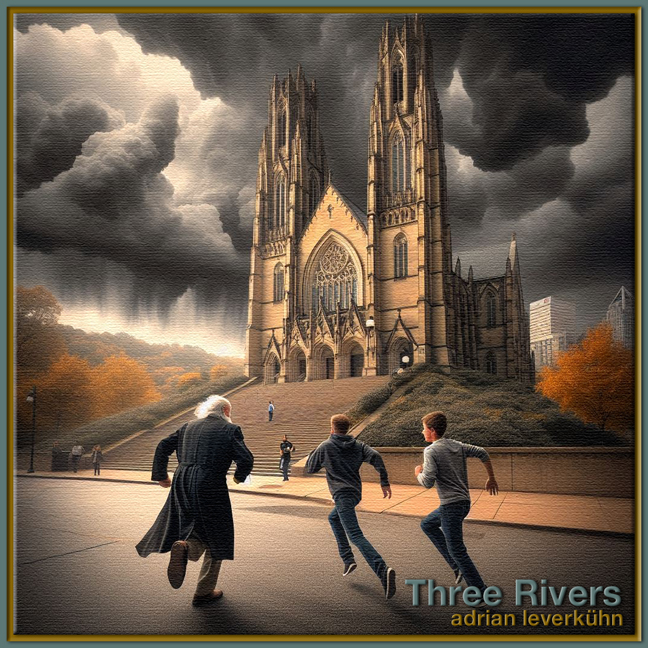
Three Rivers
Part I: Tolerance
Peter Wells was a morning person. He routinely got up an hour before sunrise just so he could shower and dress in time to watch the darkness of night give way to the budding light of a new day. He particularly enjoyed those partly cloudy mornings when the rising sun created sunbursts of radiant light vaulting toward heaven, and he often wondered if that light did indeed reach God.
Yet he understood that was a meaningless question.
For Peter Wells was a complicated man. He was an educated man. And Peter Wells was a lonely man. By choice, and circumstance.
Born and raised in Pittsburgh, Pennsylvania just after the Second World War, Peter Wells had never known a moment of physical discomfort in his life. He had never been sick, never been a patient in a hospital so took pride in the simple fact that he had all his original pieces and parts. Even his wisdom teeth. He had never known hunger, had never been abandoned by a parent or a friend, and had never been without the means to provide for himself. He had, in fact, been what most of those who knew him thought him to be: simply a wealthy man. Wealthy in the extreme.
Oh, but never idle.
He had never, to his knowledge, wasted one moment of his time. Indeed, he simply could not abide those who wasted time – his time or even their own.
Peter Wells was also a rather fastidious man. He bought his suits and shirts and shoes at the same shops his father had. And, presumably, these shops had served his grandfather as well, for these businesses had been in the neighborhood at least that long. The same went for all his possessions, really. He saw no need to strike out on his own, to make some kind of statement, or to parade around like a peacock. His one concession to that rule, however, was his automobile, a Mercedes 500SLC his father had given him when he completed his undergraduate studies. Though the Mercedes was now 42 years old he still drove it from time to time, when he chose to drive at all. Which was infrequently.
He belonged to all the right clubs, Longue Vue and Rolling Rock chief among them, and he kept a chestnut at an equestrian center near Rolling Rock for their fall outings
Oddly enough, he had lived in the same place for almost that long, in a two-floor condominium on Dithridge Street, in the North Oakland neighborhood of Pittsburgh. Sandwiched between the Allegheny and Monongahela rivers, each about a mile or so distant, the Hampton Hall condominium building was an older property with quaint Tudor styling and a convenient location for those who worked at either Pitt or Carnegie-Mellon.
Of more importance, his two-story penthouse possessed a spectacular view of both the Heinz Memorial Chapel and St Paul Cathedral, two of the most impressive neo-Gothic structures in the Americas. And both were within walking distance of not just his home, but his office, as well.
Peter Wells loved to walk. He despised most automobiles, most of all those which imbued passing fads and fancies. He appreciated understated elegance, and he appreciated people who appreciated understated elegance almost as much as he despised the aimless, flashy boorishness of youth.
Peter Wells stood beside the window in his dining room, entranced with this morning’s light. Amber-hued tendrils bathed St Paul’s twin spires, while slate gray thunderstorms building to the south lent an apocalyptic air to the blue morning light. He felt a shiver run down his neck and then the goosebumps came – and as he usually did, he wondered why. He felt something lurking in the shadows, something predatory and feral, yet something completely unknown, and so, perhaps, unexpected. As he watched, lightning flickered within the passing cloudscapes and time seemed to stop, and again, he wondered why.
Peter Wells was the product of another time, yet a time not yet forgotten. A time of privilege and of a chivalrous, if misbegotten, misogyny, as well as a time of lingering, malevolent racism. But it was also a time of great wealth and privilege, and yes, a time of savage, widespread poverty. His maternal grandfather had been into railroads and banks; he had in fact owned several of each; his father had returned from the Second World War as something of a hero. A pilot before the outbreak of war, Preston Wells had flown B-17s during two tours. Stationed in Britain, he had participated in 50 missions over France and Germany from 1943 through the end of hostilities. When Colonel Wells came home from Britain he married his high school sweetheart and declared his true intentions; he wanted to fly for a living – yet this was something his new father-in-law would neither understand nor allow. Instead, Preston Wells received an airline as a wedding gift, to go along with his managerial position downtown working for the Pennsylvania Railroad. But of course, within a year he was working out at the airport, coming home after midnight with grease under his fingernails. Soon he was flying DC-4s from the frozen north to sunny Florida, and by the time he retired the Pennsylvania Railroad was dead and gone, while his airline was flying 747s to Europe and the Orient, in addition to the sprawling domestic route network he had pioneered.
Peter Wells knew nothing about the Pennsylvania Railroad – other than his grandfather had made a bunch of money from his interests in it over the years, somehow, before he passed. He’d taken trips on the Pennsy, of course, to New York and Chicago – before Amtrak took over. After Amtrak took control of the bastardized Penn-Central’s passenger operations, his mother’s side of the family refused to get on the ‘new’ Broadway Limited…their refusals grounded in a mortal loathing of anything that smacked of socialism.
Peter Wells attended The University of Pittsburgh and studied international relations, concentrating on Russian studies. After graduating – at the top of his class – he went to Boston, to Tuft’s Fletcher School of Law and Diplomacy before moving on to the Department of State. After additional training, he was posted to Moscow, in 1978, just before all the excitement in Iran and Afghanistan. He remained in Russia through 1996, returning to Washington to take a position in the White House during Clinton’s second term, and after Bush won in 2000 he returned home, and to his beloved view of the Heinz Chapel. He took a teaching position at Pitt, as well as the house Russia specialist at the RAND Corporation’s Pittsburgh office, conveniently located a five-minute walk from his front door.
He played golf regularly and always walked the course, whether at Longue Vue or Rolling Rock, and on Saturday he always, come rain or shine or snow, took his chestnut out for a ride. He walked to his classes at Pitt, and to his office at RAND. He walked to his beloved Heinz Chapel at least once a week, and he preferred to walk to restaurants whenever feasible. His Mercedes did not yet have twenty thousand miles on the odometer, a fact he was most proud of.
Peter Wells was soon fully engaged in the ongoing efforts to revitalize Pittsburgh after the long decline and sudden collapse of the steel industry in the city. He was invited to serve on the boards of directors of several local charities and businesses, and he was admired throughout the upper tiers of Pittsburgh society as a fully engaged member of the dynasties that had guided the City for well over a hundred years.
The neighborhood around his home wasn’t particularly wealthy; it was, rather, a typical urban area that catered to two large, highly regarded universities; in some respects, the Oakland neighborhood was not unlike the Cambridge area around Harvard and MIT in Boston. Less desirable neighborhoods, however, bordered the Oakland area, particularly just north of his residence, as formerly middle-class areas fell into disrepair. Two of these neighborhoods were increasingly being overrun by gangs selling narcotics, and fully radicalized Islamic militants were not unheard of in these blighted neighborhoods.
Peter Wells was no longer a young man, neither was he middle-aged. At 75 years old, he was considered elderly, yet it was not in his constitution to bow to age. He was teaching two courses this semester, one on the history of Russian literature and the other, in the graduate school, concerned Russian foreign policy objectives in the Putin era. He led two teams at RAND, both concerned with American foreign policy objectives in both Russia and the Baltic.
And Peter Wells was a bachelor. He had never married, nor had he been involved personally with anyone, at least not that anyone could recall, so the Wells line would end with him. Oddly enough, he thought this was as it should be, for despite current trends he held a dim view of Gilded Age politics, whether in the 1880s or the 2020s. He was a Democrat and he believed in democracy, and not unlike many with similar views, as the election of 2024 approached he despaired for the future of his country.
+++++
Dressed as he always was, in a pressed black suit with a white button-down oxford cloth shirt adorned with black wingtips and a pale yellow tie, Peter Wells put on his camel hair overcoat and, after consulting the Post-Gazette’s forecast, decided against an umbrella – though he knew this was risky. Rain, and potentially heavy thunderstorms, were in the offing later in the afternoon, but his foreign policy class concluded at noon, his office hour at one-thirty, so that ought not present a problem.
It was but a short walk to his classroom, located in the University’s Cathedral of Learning, in room 153, the Russian ‘Nationality Room’. His walk took him past Heinz Chapel and as always he stopped for a moment to admire the building’s gorgeous symmetry – and its sublime theological messaging. The chapel was the equal to any in European Christendom, and that such a thing had sprouted above the Allegheny River was a testament to the vision of the city’s benevolent founders, his own family chief among them. When he thought of such things, which happened more frequently these days, he was filled with a peculiar mixture of pride and humility – and, perhaps, not unrealistically so. His grandfather had brought the Pennsylvania Railroad to the city, and had helped in the creation of this university and the medical center. Peter Wells had good reason to be proud, and as a crisp autumn breeze buffeted the quad beside the chapel he gathered his overcoat tightly around his neck and set off across fields of slumbering grass to his classroom.
+++++
As he always had, Wells had assigned Thomas Mann’s Buddenbrooks to the students in his graduate seminar. The novel concerns the decline of a merchant banking family in nineteenth-century Lübeck, one of the original Hanseatic city-states of the medieval European world. The decline of the family over four generations, with each successive generation falling deeper into moral and physical dis-ease, had been crafted not only to depict one family’s descent but to allegorically present the predictable decline of autocratic regimes, with each succeeding generation of leaders falling deeper and deeper into their own dis-ease. Using this allegory as his guide, the American diplomat George Kennan had, in one of those key inflection points in History, used the model presented in Buddenbrooks to chart the decline of the Soviet Union. He did so in 1947, in the so-called X Article, published in the July issue of Foreign Policy magazine. In The Sources of Soviet Conduct, Kennan presented the policy of strategic containment, advising his readers that by using the patient application of judicious amounts of limited military power to contain Soviet expansion, the West could frustrate the Kremlin’s plans to export communist ideology around the world. Kennan postulated that the life of the Soviet Union could be measured in the passage of four generations, and he predicted the Soviet system would collapse in the 1980s, perhaps as late as the early 90s; writing from his vantage point in 1947, Kennan’s work was beyond prescient. It was, Wells thought, inspired.
And now a new generation of diplomats was needed to combat Putin and the new generation of autocrats taking root around the world, and Peter Wells now thought that it was his mission in life to do just that.
+++++
After class, Professor Wells sat for office hours, which usually meant getting caught up on waiting correspondence, but today he actually had a student waiting for him when he arrived. Her last name was Caldwell. That much he remembered. And she stood when he came into his ante-room and asked if she could talk to him. He smiled, barely, then unlocked his office door and held it open for her.
“Do come in, Miss Caldwell.”
Impressed that he had actually remembered her name, she nodded and walked into this storied inner sanctum. It was, she soon saw, as amazing as she had heard. The room was solid oak, everywhere. Deep, pictured-framed paneling, three vast walls of shelves lined with books. A palatial desk of dark oak, and it too was massive. Even the room’s entire ceiling was made of oak, the space criss-crossed with deep beams. The room was overwhelming, just like the man. She’d been afraid of him before the seminar had even begun; his reputation was that of a fierce taskmaster who brooked no fools in his classroom. She knew he was ancient yet she thought him elegant, too; tall, thin, and yet muscular, with longish hair now white as snow, and always dressed like someone caught out of time, totally from another era. He was, in other words, the exact opposite of her father and both her grandfathers.
She stood as he made his way around the massive desk to his chair, a dark green leather thing that also looked like something from another period, until he indicated a chair. “Please, make yourself comfortable.”
“Thank you for seeing me, Professor Wells.”
He shrugged. “That’s what office hours are for, Miss Caldwell. Now, what might you need to talk about?”
“I know it’s early in the term, but I was thinking of applying to the Fletcher School next year and I wondered if I could talk to you about it?”
“It?” Wells growled, turning red in the face. “What on earth does ‘it’ mean?”
“Uh, the school. You know, what it’s like, what it takes to succeed there.”
“You must love indefinite pronouns, Miss Caldwell. Are you interested in diplomacy, perchance?”
“Yes, I think so…”
“I see. Well, there is no place in diplomacy for indefinite anything. You must strive for absolute clarity in everything undertaken, and everything said. Everything. Whether in writing or spoken. Is that clear?”
“Yes, Professor Wells.”
“Now, would you care to rephrase your request?”
By the time she left his office Sarah Caldwell had almost been reduced to tears, yet Wells had spent a good half hour building her back up, reforming her confidence in herself, and she left feeling very much better about deciding to meet with the old lion. She was still terrified of him, but she had seen something unexpected in him too, something like an easily accessible wisdom. And she wanted to understand where that came from, and how she too could develop her own wisdom.
+++++
Just before his office hours ended, the department secretary advised that the Dean had asked if Dr. Wells could come up to his office, so Peter Wells put away the classroom notes he had been working on and closed up his office. He took the elevator upstairs to the humanities office and stopped to admire the view of the city spread out before him, here atop this glorious Cathedral of Learning. How profound were the aspirations of his forefathers that they would have the audacity to even conceive of such a thing, but then they had gone ahead and done it. There was nothing else like this building in America, perhaps even the world, but then again the people who built this city never stopped with the impossible. The impossible was merely that which they had not yet tried.
And those rivers! The Allegheny and the Monongahela joining in the city center to form the mighty Ohio. How perfect for the ends these titans had hoped to achieve, fleshing out this New World, taking veins of ore and their furnaces pouring rails that shot out like arteries across a naked continent. He hated to admit it, even to himself, but these furnaces of Manifest Destiny had built the world that all the Sarah Caldwells out there now took so casually for granted.
+++++
His team at RAND awaited him on the third floor. Acolytes and disciples of pure data analysis, they were scheduled to go over the latest output figures from a cluster of arms factories east of Moscow, in the foothills of the Urals. Some figures were estimates, others came from ‘friends’ that Wells had made over the years. Friends that were concerned about the trajectory of recent events. His teams’ work would go straight to the NSC, and, if warranted, to the White House. All his analysts had been students of his at Pitt, but only the best and the brightest were asked to apply here. All but one had been on the team for fifteen years.
And that worried Peter Wells.
He had experienced firsthand how many incoming freshmen could barely string enough words together to form a coherent sentence. Few had ever read even one complete book; they had instead been provided with anthologies of prominent works that contained ‘highlights,’ so instead of reading books by F Scott Fitzgerald or Mark Twain they had often read no more than two or three pages from one of the assigned authors works. Raised on video games and their walls adorned with participation trophies, these new students had not the slightest ability to concentrate on anything that wasn’t flashing and beeping in their hands. More troubling still, they knew almost nothing of the world around them, aside from the location of the nearest sushi bar or, perhaps, where the nearest phone store was located.
So when he was confronted with a graduate student like Sarah Caldwell…? Well, he sat up and took note. He would cultivate her, bring her along on visits to RAND, pique her curiosity a bit, and see where things went from there. If she indeed had the intellectual grit he would indeed write the inevitable letters of recommendation she would need to get into the Fletcher School, or Georgetown, or, heaven forbid, the Kennedy School.
But, he had to admit, time was running out. He figured he might be able to teach for five more years, assuming his health held. And RAND? He was already down to just two afternoons a week, the bare minimum needed to produce meaningful intel, but for how much longer could he do so? Could he, in all fairness, try to mentor a girl like Sarah Caldwell when he might not last the time needed to see her assume productive duties at State or the NSC? Or here at RAND?
He looked out the window across the street to St Paul Cathedral, its twin spires deliberate copies of those that formed the magnificent cathedral in Köln, Germany. There was something about them, and every time he looked at these spires he was overcome by the same feeling. He had spent a brief period working at the embassy in Bad Godesberg, just south of Bonn on the banks of the Rhein, and on his days off he walked the region. One spring day he was walking near the small village of Oberpleis, just east of Bonn, while keeping an eye on two thunderstorms. He was walking through parts of what was then called West Germany, and he remembered that Napoleon had marched across the same plateau almost two hundred years before, and he was looking down a broad Rhine valley at Cologne, or Köln, at the cathedral there. He had to have been fifteen, maybe twenty miles away from the cathedral, but even from that distance, those twin spires had captivated his imagination. Had Napoleon looked down on the city from this vantage point? Had he seen much the same thing? Those twin spires? If so, what had he felt? What had run through his mind? And what of Beethoven? He had been born in Bonn, and had walked those very same hills and vales, and not long before Napoleon. Had he gazed in wonder at those two spires? To, perhaps, escape the abuses of his alcoholic father?
But when Peter Wells stood out there on that grassy plain as thunderstorms danced near and far, he felt caught up in the flow of time, in the ebb and flood of history, if only for a moment. He had never shared those moments with anyone because, in a way, those feelings had frightened him. There had been a hallucinatory element to that moment, a split second when he had felt himself actually standing out there in the early nineteenth century, and the feeling of disorientation had felt like a rip running through the fabric of his conscious awareness of time and place. He’d felt lost, lost in time, if only inside those few, fleeting moments – yet those moments were most precious to him. Perhaps as important as any he’d had.
+++++
He left his offices promptly at six, but hesitated when he stepped out onto Fifth Avenue. He hadn’t had much of anything for breakfast and no lunch at all, so now he was hungry and he didn’t feel like cooking. He turned around and looked down Craig to the little crêperie there and smiled. A spinach crêpe sounded nice, with a glass of something quiet, a riesling, perhaps, or a Piesporter if they had one. And a salad. He walked down and sat at his favorite table and looked at the specials chalked on the board, then tried not to appear too surprised when Sarah Caldwell approached his table, with pen and paper in hand. ‘Working here as a waitress?’ he thought as she walked up and smiled.
“Well, well, so we meet again,” Peter Wells said. “I take it you work here when not attending to your studies?”
“You got it, Professor Wells.”
He grimaced. “Just Peter, if you please, when off campus. You’ll blow my cover,” he added with a disarming smile of his own.
“Sure thing, Pete. Watcha havin’?”
He laughed at that. “Touché!” he said at her thrust.
“So, Peter, let me guess. You’re a German beer and ham and cheese guy, right?”
But he shook his head. “Hardly. A glass of riesling, a small Greek salad and two spinach crêpes.”
“Extra kalamatas on the salad?”
“Am I so transparent?”
“I can read you like a book, Doc.”
“I see. Well then, I suppose I’ll need to remember that.”
He smiled and she smiled right back at him, then she turned and thudded off to the kitchen. Perhaps it was those heavy, black Doc Martens shoes she wore? She brought his wine and salad, then his crêpes, and then she left him to eat in silence. When he had finished and after she’d cleared his table she came over and sat across from him. “So, crêpes au Gran Marnier for dessert?”
“Are you insane?” he cried. “After that meal!”
“Doc, you ate enough for a bird. A small bird. And anyway, when’s the last time you indulged?”
He sucked in a deep breath and looked away, lost in thought. “You know, the last dessert crêpe I had was from a little street vendor near the Sorbonne.”
“And how long ago was that?”
“Ah, well, probably sometime back in the early Pleistocene, but don’t quote me on that.”
“So…?”
“Alright. One crêpe, and just one, if you please.”
“Cappuccino?”
“Oh, why the Hell not?”
And this became their routine. He came to the crêperie twice a week and she took his order twice a week. Academics never intruded on their time, but he watched her. Watched her when she dealt with strangers and with the crêperie’s owners. She was good with people, easygoing and friendly when friendliness was called for, yet calm and collected when things got busy. When he came in later than usual she wondered where he’d been but had the good sense not to ask, and he appreciated that, too. One evening, one of the late arrivals, she stopped by after she’d cleared his table and sat heavily, and he could see that something was wearing on her.
“What is it, Sarah? What’s happened?”
“Does it show?” she replied.
And he smiled then: “I can read you like a book, kid.”
Which brought a smile to her face. “You remember that, huh?”
“I remember everything,” he’d said, and he’d meant it, too, because it was the truth.
“Everything, huh?”
And he’d nodded. “Everything.”
“Okay, wise guy. What was I wearing in class last Tuesday?”
“Jeans, Levis I think. A yellow Pitt sweatshirt and pink Converse hi-tops. Little socks, pink, with cats on them.”
“Jesus Christ,” she mumbled.
“I never met the man, but I understand he was quite bright.”
“Why do you stop and stare at the chapel?” she asked quietly. And seriously.
“You’ve noticed, have you?”
“I notice everything, Doc. Every little thing.” His eyes smiled at that, and she enjoyed the way his eyes sparkled when he smiled at her.
“I think it’s the sense of accomplishment more than anything else. That we can create such enduring beauty when we set out to, which leads me back to my original question. Something’s bothering you, and I’d like to know what that is.”
“The chapel led you back to that, huh?”
“Oh, yes, very much so. Anytime anyone tries to evade a question by changing the subject, well, that always gets my complete attention.”
“I’m losing the roof over my head, Doc. I’ve been sharing a place, splitting the rent with a friend but she’s getting married and that’s that. I’ve got to find a place by the end of the month, but so far nothing affordable is popping up.”
“The University’s housing office can’t help?”
“Not much, at least not in the middle of the term.”
“I used to let out the rooms on the second floor of my place, had them listed with the housing office for years. Stopped doing so a few years ago.”
“Yeah? Affordable?”
“Oh, quite. You see, I traded room and board in exchange for housekeeping services. In other words, I kept the kitchen well stocked and expected a spotless house and two meals a day, five days a week. Interested?”
“Are you kidding?”
“No, not in the least. The only thing is that I’d need to re-list with student housing. That affords both of us some protection, in case one of us turns out to be an axe murderer or something.”
“You don’t look the part, Doc.”
“Nor do you, Sarah.”
“That means I could quit waiting tables…”
“I rescind the offer!”
“Well ain’t that something…”
“What?”
“You like me, don’t you? I mean, just a little?”
“I do. Yes, Sarah, I do. You are without a doubt the best waitress this place has ever had!”
+++++
So Peter Wells listed his three vacant rooms with graduate student housing, and under the same conditions he always had. Even before the Thanksgiving break his rooms were taken again, with Sarah Caldwell taking the largest. Though Wells was himself a fastidious housekeeper he appreciated the new help, especially in the kitchen. His new ‘tenants’ in the other two rooms were both second-years in the medical school, and one of these, a sweet girl from Louisiana named MaryAnn Albright, was an excellent chef, though with a strong Cajun background, her meals had a kick he wasn’t used to.
And so without any real planning on his part, Peter Wells had a kind of new family around; while many considered Wells a closet misanthrope nothing could have been further from the truth. He enjoyed having people, especially bright young people in the house again, and he enjoyed getting to know their routines and idiosyncrasies.
The girls wanted to put up a tree for Christmas and he went out with them, helped them pick out a tree and get it set up in the living room on his floor and, as it seemed none would be going home for the holiday this year, he went out and bought presents to put under the tree. When he overheard Sarah talking to MaryAnn and Aaron, the third inmate in this new asylum, about wanting a puppy but being afraid to ask, Peter broached the subject the next morning.
“You know what we need around here?” he said at breakfast that Saturday morning. “We need a big, fat puppy. How would you all feel about that?”
To Sarah Caldwell, this all seemed to be too good to be true. She’d had a tough upbringing; divorce, her mother’s alcohol problem, her father’s absence from her life, and suddenly Peter Wells was becoming the family she’d never had. Now her life had, she admitted to her roommates more than once, never been better.
The week before Christmas they hopped in Peter’s ancient Mercedes and drove out to a breeder and when one particular Bernese Mountain Dog puppy covered Sarah with sloppy kisses Peter Wells smiled almost like a father, or, perhaps, maybe more like a grandfather. Sarah held the pup in her hands all the way back into the city, and watching her, Peter realized he had never known such happiness.
The realization left him breathless, and full of a gentle regret.
Christmas Eve was priceless. MaryAnn cooked, Aaron hauled split logs up to the fireplace, and Sarah tidied up the big living room on the main floor, stopping every now and then to wipe-up puppy-piddle from the hardwood floors. The little group ate in the formal dining room then sat in front of the television and watched A Charlie Brown Christmas before settling in to watch White Christmas by the fireplace.
At midnight, Peter poured four flutes of a rare Champagne and they toasted the occasion before heading up to bed, and everyone gathered around the Christmas tree early the next morning for presents. The girls gave Peter scarves and neckties and he laughed at their audacious choices – one necktie featuring the lyrics of the Beatles Back in the USSR in gold splashed on a crimson silk background. Peter had wrapped presents for them, little things he’d overheard like headphones and iPads, but he also handed a small box to Aaron.
“You open this, Aaron, but this gift is for the three of you.”
It was a key fob for a Subaru.
“I’ll keep the car in my name and pay the insurance, but it’s for the three of you…to run errands or to go to movies.” They went down to the lot beside the building and he showed them around their new car, and he watched like any proud parent might as they made appreciative noises and tinkered with the settings.
All in all, it was a good day, and Peter Wells felt most pleased.
+++++
One morning early in the following spring, Peter Wells stood by the window watching thunderstorms building in the distance and he smiled. Storms brought water and water was life. Water brought green grass and blooming flowers and nourished budding trees, and yes, all those were wonderful things, but what he loved most about storms like these was their drama. The building clouds, lightning jumping about, the potential danger that often accompanied such storms, especially this time of year. He recalled the great stories his parents had read to him when he was just learning to read, about the mythologies surrounding the gods who lurked about in such storms. He looked at these freshening storms and could feel his mother by his side, hear her voice as she read to him, feel the mystery once again. How easy it had been to believe those stories, how difficult they were to unlearn, even now. How easy it was to believe in things we could not see.
MaryAnn was cooking, Sarah and Aaron setting the table. It was Eggs Sardou this morning, a beautiful creole breakfast of poached eggs, artichoke bottoms, creamed spinach and Hollandaise sauce, served with a strong chicory blend from New Orleans. He pulled himself away from the storms and drifted to the table, as ever in awe of MaryAnn’s skill in the kitchen. “If you keep this up I’m going to explode,” he sighed as he looked over the table. “Even so, I will pass with a smile.”
He looked at his little family just then, if that’s what it really was, with a sense of detached awe. Did these kids just seem to want to take care of him, or was there something deeper going on? MaryAnn had been an enigma, for a few weeks, anyway. She was plump, not fat, but time and a few babies would see her blossom into a large woman, yet she professed to want a career in internal medicine and had pointedly mentioned she never wanted to marry. So yes, she was a contradiction, one not unlike many of the undergrads he taught, and he always seemed to find less-than-happy childhoods behind many of these choices. Strange, too, because his childhood had been more than happy and yet he’d made the same sorts of decisions, and as a historian, he wondered what academics a hundred years hence would make of the early 21st century. This was, after all, the era of grievance-filled politics, or supposedly so, anyway, yet he couldn’t recall any era that wasn’t filled to overflowing with similar grievances. Was it the volume of information these kids had to deal with, or the cognitive dissonance that resulted from so many competing narratives?
Aaron had already turned into Wally, Beaver Cleaver’s older know-it-all brother who always seemed to lend a steady hand until Ward, their father, showed up to provide fatherly wisdom and a handy resolution to the problem at hand. The odd part about it? MaryAnn doted on Aaron. She acted just like a heat-seeking missile around the boy. Was it genetic programming kicking-in, as perhaps some kind of maternal drive seeking fulfillment? But recently he’d been picking up similar vibes from Sarah, too. Like maybe she had a thing for Aaron, too. Was there trouble brewing?
He had already dressed for the day and planned to walk to the chapel for morning services. He’d never been particularly religious but had gone, when the impulse hit, simply to participate in the communal rituals that had, for centuries, bound people together. And yet, lately, he’d been doing so with increasing regularity. ‘Isn’t this an elective affinity?’ he wondered. ‘But if so, why now? Is it the kids? Am I responding to some need in them, or is it just because I’m getting old?’
MaryAnn planned to take the Subaru out to Costco to do some shopping, and Aaron wanted to tag along; Sarah needed to go to the library to plow through items on a reserve reading list. After their plates were cleared and the dishwasher loaded, they all headed to the elevator and down to their appointed rounds.
Peter Wells stopped to check his mailbox while MaryAnn and Aaron walked off to the Subaru, while Sarah took off out the front door, heading to the library. Peter followed her out a moment later, his practiced eye suddenly drawn to the building thunderstorms now towering over the city, probably just now reaching the three rivers. He saw Sarah up ahead, already crossing Fifth Avenue at the light, but turning now to walk towards the chapel and the shortcut across the quad to Hillman Library.
He saw them in the next instant. Two boys, young, probably teenagers, but something about them looked off because it seemed like they had very deliberately fallen in behind Sarah after she passed the shadows they’d been lurking in.
She crossed Bellefield and made a left along the sidewalk beside the hedgerow and he quickened his pace to catch up, but the light caught him and he watched, now helpless, as the two boys jumped her from behind and pulled her behind the hedge.
Maybe it was adrenaline. Maybe it was testosterone.
Maybe it was pure rage that mindless hooligans would defile both a gracious young woman and the University, and not far from his beloved chapel.
He darted through traffic as he ran after them, and arrived just in time to push one of the boys off Sarah. Then the other boy, dark, swarthy, and with malevolent pale silver eyes, pulled out a pistol…
…just as the earth shook under the hammer blow of an immense crack of thunder. The kid flinched and pulled the trigger just as a shattering crack of lightning struck the chapel’s steeple; bits of molten metal arced through the morning sky as cascades of sparkling embers settled over the quad…
…Peter Wells was aware of falling. Then the pain registered. Pressure, hot boiling pressure. Radiating down his left arm and up his neck, settling behind his eyes. He was aware of hitting the grass, of his flaccid head bouncing off the turf, but now he could see his beloved chapel in the distance, yet something looked wrong. The air was on fire. Sarah was on her knees, crawling towards him and one of the boys was staring from Sarah to him to the other kid, the kid with the pistol in his hand…
…and that’s when the sphere appeared. Out of the trees. The shimmering orb fell to the ground but stopped short and hovered there, then it advanced on the boy with the pistol. Peter Wells couldn’t believe his eyes.
“That’s ball lightning,” he whispered as recognition penetrated the last remnants of consciousness. The lightning drifted across the grassy quad like it was drawn to the boy, or was it to the pistol in his hand? He wanted to shout out a warning but couldn’t. Drop the pistol and break the ground circuit! You’ll be safe then!
But the boy froze and then started shooting at the hot sphere.
And the sphere simply ran into and then through the boy, whose body simply exploded. Only his hands and feet remained, and Sarah Caldwell started to scream and cry.
But Peter Wells was up there in the clouds now, looking down on the world his father and grandfather had helped build. He watched as a white car pulled up on the curb, and he recognized MaryAnn and Aaron running to the stricken man on the grass, but his mind was on the three rivers now, and where they might take him.
© 2024 adrian leverkühn | abw | adrianleverkuhnwrites.com | this is fiction plain and simple, and nothing but. And here ends part one, of three.
Perhaps more Yes is in order here. Close to the Edge might do the trick.


Strewth! Where do these tales come from? Nice one again mate!
LikeLike